Episode 89: Money talks

In these early months of Dark Shadows, we hear that all the money made in the town of Collinsport finds its way to the old dark house on the top of the hill, where it does nobody any good.

The house itself is full of examples of wealth going to waste. Each of the last few episodes have involved long treks through abandoned corridors and visits to forgotten rooms. Everywhere you turn in these dank spaces, years of accumulated dust bury vases, paintings, antique furniture, oriental rugs, and other apparently valuable objects.

The Collins family is headed by a woman who hasn’t left the house in eighteen years. Reclusive matriarch Liz shares her home with her brother Roger, a spectacularly irresponsible man who squandered his entire inheritance and now holds a position in the family business which seems to involve little or no work. It is difficult to imagine that they run a dynamic enterprise that is taking advantage of the economic boom of the 1960s.

At the same time, Liz seems to have a vigilant concern for the security of her employees. Her only household servant, gruff caretaker Matthew, often brings up the fact that she gave him a cottage on the grounds of the great estate and assured him he would have it for the rest of his life. When plant manager Bill Malloy comes to the house to ask Liz to approve the acquisition of some new machinery for the cannery, her first question is how many men will lose their jobs as a result of it. Only when he assures her that the answer is zero does she agree to the purchase. So we might imagine that the attitude of local wage-earners towards the Collinses will be two-fold- on the one hand, gratitude that they go out of their way to ensure that the people working for them keep what they have, but on the other frustration with their failure to create opportunities for them to move ahead at a time when working people everywhere else in the USA were experiencing the fastest rise in real incomes in the nation’s history.

The relationship between hardworking young fisherman Joe and flighty heiress Carolyn occasionally seems like it will dramatize this situation. Joe is a local boy, and like everyone else in town, he works for the Collinses. Liz has taken a liking to him, and wants him to marry her daughter and have a career as an executive with the firm. He would be glad to marry Carolyn, but is not interested in that career- he wants to buy his own fishing boat and build his own business around it. Liz keeps trying to pull him deeper into her family’s firm, but he keeps insisting on his plan to go his own way. Joe mentions a friend with whom he wants to go into partnership. We never see this friend or anyone else who is working with Joe, and Carolyn doesn’t show the slightest interest in Joe’s plans. Since he doesn’t have anyone to talk to about his ideas, beyond a couple of scenes when he shakes his head at Liz and says “I’m sorry, Mrs Stoddard, but my mind’s made up,” the story of his attempt to diversify Collinsport’s economy doesn’t go anywhere. Earlier this week, the Joe/ Carolyn relationship met its long-awaited demise.

Joe has moved on to a relationship with Maggie Evans, The Nicest Girl in Town. The daughter of drunken artist Sam Evans, Maggie runs the restaurant in the Collinsport Inn. She and Joe are representatives of Collinsport’s working class. During their first date, Maggie demonstrated an encyclopedic knowledge of sail-rigging, which may not be the most useful thing for a commercial fisherman in the age of diesel, but her interest in the sea raises our hopes that she might be a partner to Joe in his ambitions. Together, they might show us what it has meant for the town that the Collinses control so much wealth and do so little with it.

In a comment on Danny Horn’s blog Dark Shadows Every Day, I mentioned another way the show could have done more with this theme. I imagined that they might have expanded the part played by the only African American actor to deliver lines on Dark Shadows, Beverly Hope Atkinson.

The opportunities they missed came into view in episode 563, when Beverly Hope Atkinson appears as the unnamed nurse who keeps Nicholas Blair out of Joe’s hospital room but lets Maggie in. Unnamed Nurse lights up when she sees Maggie and greets her by name; they seem to be old friends.

In the first 42 weeks of the show, when the supernatural was in the background and the stories were slow, it would have been easy to have a couple of tea party scenes at the Evans cottage where Maggie and her lifelong friend, Unnamed Nurse, recap whatever is going on. Those scenes could have led to a whole exploration of the tension between the working-class people in the village and the jerks in the big house on the hill. That in turn could have led to the introduction of Unnamed Nurse’s family, headed by Unnamed’s parents, Mr and Mrs Nurse, including her brothers, Young Mr Nurse and Master Nurse, and her sister, Miss Nurse. We could then have seen the ancestors of the Nurse family in each of the flashback segments and analogues of them in Parallel Time.

I try to keep my contributions to Dark Shadows fanfic modest, so I didn’t try to think up a new name for Unnamed Nurse. My point is that the makers of the show did not need any more sets or many more characters to create a much more spacious world in the imaginations of the audience. The Evans cottage by itself, as an instance of a working-class home in Collinsport, is almost enough to make us think of a whole town of people teeming with ambitions, resentments, plans, and frustrations. Just a few small scenes there shedding light on some underused themes could have got us the rest of the way.

Another character who brings the Collinses’ deficiencies as commercial leaders of Collinsport into view is dashing action hero Burke Devlin. Himself born into Collinsport’s poorest class, Burke has gone away and somehow made himself very rich. The whole time he was in Collinsport he was penniless. He left town when he was sent to prison. Only five years after his release from prison, he is a millionaire many times over, in a position to buy up the Collinses’ debts and claim all of their assets. The show has dwelt on this timeline often enough that they have started making awkward attempts to explain how he got so rich so quickly. But it seems that we are supposed to feel that it was simply getting clear of Collinsport that opened the doors to wealth for him. He went to South America, he went to New York, he went to an oil field, he went someplace, but all that really matters is that he went far from the stifling influence of the Collinses and their gloomy house.

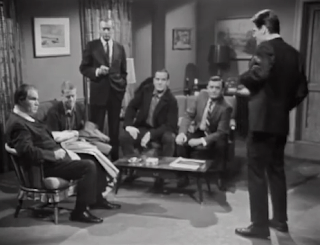
Now, Burke is moving to destroy the Collinses and supplant them at the head of local industry. Today, he and his lawyer meet with some of the key men from the Collins cannery and fishing fleet. He wants to recruit them to work for a competing firm he is buying. When the lawyer tells him the men may be too loyal to Liz to take his offer, Burke recites a list of the tired cliches that wealthy villains spout when boasting to their henchmen of the power their money gives them: “Money talks. Money buys loyalty. Everyone has their price. Name it and you can buy them. Some just come a little higher than others, that’s all, but everyone is for sale.” Too bad Cabaret didn’t get to Broadway until three weeks after this episode was broadcast, or he might have closed with a few bars of “Money Makes the World Go Around.”

The men are offended when Burke says he wants them to leave the Collinses and come to work for him. They pride themselves on their loyalty to the Collinses. If they feel that way, it’s a mystery why they agreed to come to a meeting with Burke in the first place- everyone in town knows about his vendetta against the Collinses. They start to leave, but stay long enough to hear Burke offer them higher wages than the Collinses can pay, and a profit-sharing plan.
Screenshot by Dark Shadows Before I Die

The most senior of the men present, Amos Fitch, stops by the house to tell Liz and Roger about the meeting. Apparently the other men are more rational economic actors than Amos, and they are considering Burke’s offer.

After the meeting has broken up, Burke spends a few more minutes expounding to his lawyer on his theme that anyone will do anything if you dangle enough money in front of them. He interrupts himself before he can literally say that all people are whores and gives the lawyer a check, telling him that it’s always good to have some extra loyalty around. Apparently he decided that leaving a two-dollar bill on the night-stand might be too subtle. The lawyer reacts with distaste to Burke’s crassness, but takes the check.

Burke’s first attempt to buy someone’s loyalty took place all the way back in episode 3. He met Joe in the local tavern and offered him enough money to buy a fishing boat in return for information on the Collinses. When Joe refused, Burke told him that he himself got his start when a strange man approached him in a sleazy bar and offered him a lot of money to do something he wasn’t very specific about. He accepted, and that led him directly to great riches. That’s wonderful career advice, “A guy in a bar flashes some dough, you don’t ask no questions, honey, just leave with him.” Sounds like a guaranteed path to success. Anyway, it’s obvious in that one that Burke is trying to lure Joe into something dishonorable. We already care about Joe, so if he were to be tempted we would be in suspense until he proved his uprightness.

Contrast Burke’s attempt to buy Joe’s services back then with today’s attempt to hire this group. We’ve never seen or even heard of any of the men whom Burke is trying to lure. So if the conflict over control of the sardine-packing business is a test of their moral rectitude, it’s none of our concern. On the other hand, if it were a choice between a prosperous future for the town that does not include the Collins family or a stagnant future that does, there might be real suspense.

The Collinses are our point of view characters and the story cannot continue if they are thoroughly defeated, so if we enjoy watching the show we will root for them no matter how strong a case their antagonist may make for his position. On the other hand, we do care about Maggie and Joe, and are ready to care about characters who are friends of theirs. Therefore, if we see that a plan will be good for the working people in town, it won’t be easy for us to hope Liz and Roger will foil it. If the show can put us in that situation, we will feel suspense as we watch the events of the story and look for a way to resolve the tension that our mixed feelings have created. That’s how every thriller works- we may want the good guy to beat the bad guy eventually, but not until we’re done enjoying the contest between them.

Think again about Burke’s temptation of Joe in episode 3. Joe earns a few points with the audience by rejecting Burke’s offer out of hand. If he’d considered it, we would have paid attention to him until he made his decision, but only to him- a temptation story works only if the person or people being tempted find themselves isolated from everyone else. If he ultimately rejected the offer, the story ends and leads nowhere. If he’d accepted it, we would be disappointed in him and lose interest in his subsequent doings. He wouldn’t become interesting again until he either went through a redemption story, which would again tend to isolate him from the rest of the cast, or became a villain, which isn’t what they want the character for right now. But if, instead of a moral test, he had been presented with a plausible business decision, we could have had a story that would have given us a virtual tour of Collinsport and given us a feeling that we know the place, even if we didn’t actually see any new sets.

So that’s why I wish Dark Shadows had done more with the relationship between the Collinses and the rest of Collinsport. Not that I suppose the writers had deep political and sociological insights that I long to have heard, but that putting your characters in a bigger world allows you to tell bigger stories.

Episode 83: I resign from the idiots union

In the great house of Collinwood, well-meaning governess Vicki makes unsuccessful attempts to reason with strange, troubled boy David and with David’s father, high-born ne’er-do-well Roger. At the restaurant in the Collinsport Inn, it dawns on hardworking young fisherman Joe that Maggie, The Nicest Girl in Town, would like to date him.

A fancy fountain pen Vicki found on the beach has gone missing from David’s room. After the two of them have spent a few relaxed moments looking for it, David declares it isn’t in the room. He suggests a ghost might have taken it. Rejecting this possibility out of hand and seeing no other explanation, Vicki concludes that David must be hiding the pen from her. She calmly asks him to return it; he indignantly denies having taken it. Exasperated with him, she raises her voice.

We cut to an outdoor setting, where we see Roger burying the pen. The audience saw him steal the pen at the end of yesterday’s episode. Roger is afraid the pen will be a piece of physical evidence implicating him in a homicide, so he is desperate to get everyone to forget that it exists. Why he doesn’t throw it in the ocean, or in a trash can, is never explained.

Roger returns to the house and hears Vicki and David yelling at each other about the pen. He goes upstairs to make inquiries. He takes David’s side, leaving both David and Vicki staring at him in astonishment. Roger then talks privately to Vicki, and urges her to forget about the whole thing. She reluctantly agrees never to speak of the pen again, to anyone. Roger visits David in his room, extracting the same promise from him. David tells Roger that he will get even with Vicki for her false accusation against him. Roger, eager as ever to get Vicki out of the house, has no objection to that idea. David glares out the window, looking directly into the camera and muttering to the audience that he will settle his score with Vicki.

David tells the audience of his plans. Screenshot by Dark Shadows Before I Die

The B-plot is much friendlier. Joe and Maggie are nice, attractive young people who have known each other for a long time, have fun together, and share many interests. Maggie is single, and Joe is at the end of a dull and mismatched relationship with flighty heiress Carolyn. There is no reason why they shouldn’t become a couple.

In fact, that is their biggest problem. As soap opera characters, they can have a romance if and only if there is some obstacle between them they will have to overcome in a dramatic fashion. Maggie and Joe are so obviously well-matched that generating such an obstacle will require the writing staff either to dig deep into the characters’ psychology and to expound that psychology in a superlatively well-crafted plot, or, if that is beyond them, to do something dumb like have them get bitten by vampires.

Joe stops by Collinwood to see if he can talk to Carolyn. Vicki tells him that Carolyn isn’t around, but asks him to stay for a while anyway. Vicki is nervous. She explains that “You don’t know what it’s like to be alone in this house with David.” Joe asks Vicki if she thinks he is an idiot for trying to resuscitate his relationship with Carolyn. When she can’t say he isn’t, he announces that he’s resigning from the idiot’s union and leaving for a dinner date. We know that he’s going to Maggie’s house, but he doesn’t tell Vicki that.

Joe may be resigning from the idiot’s union, but it looks like Vicki is ready to fill his place. David looks at her with undisguised hostility and tells her that he has indeed hidden her pen. When she asks where it is, he points to the closed-off part of the house. Vicki tells him no one can get in there; he shows her a key, and says that no one but he can. She is clearly on edge throughout the whole scene. After some protest, she follows this person she has just said she fears into a locked area to which he has said only he has the key. All that’s missing is a gigantic sign made of electric lights spelling out the words THIS IS A TRAP.

Future writing teams will gradually transform Vicki from the intelligent, appealing young woman we have come to know into a fool who will get them from one story point to another by doing or saying something stupid. We’ve seen Dumb Vicki in one or two fleeting moments already, but those moments haven’t really damaged the character yet. She is just on screen so much of the time, and is so consistently the innocent party in whatever conflict is going on, that when the writers paint themselves into a corner she is the only person available to take some insufficiently motivated action that will solve their problems for them.

This time, though, the episode is credited to not to any of those future writing teams, but to Vicki’s creator, Art Wallace. And her inexplicable action is going to stick us with her in a frustrating situation for days to come. As Vicki, Alexandra Moltke Isles follows David into the place of confinement with slow steps and her neck bent, as if she has resigned herself to being sacrificed. That’s an intriguing acting choice, but there is nothing at all in the writing to suggest that her spirit has been broken in that way. My theory is that Wallace, who will be leaving the show in a few days, is losing interest in the work, and Mrs Isles is trying to salvage what she can from a weak script.

Vicki to the slaughter

Monday’s episode was so washed-out I thought it was a kinescope, and I said in my post that it was the first one of the series. Apparently it wasn’t- that episode is taken from a surviving videotape, just one that is in bad shape. This one really is the first episode to come down to us on kinescope. It really doesn’t look any worse than do prints like Monday’s.

PS- This is the only episode from the first 42 weeks that Danny Horn discussed on his tremendous blog Dark Shadows Every Day. He includes an analysis of it in the middle of a long riff about #1219, the “missing episode.” His remarks are hostile, unfair, misleading, and absolutely brilliant. I recommend it to everyone.

Episode 82: Gift from the sea

Last week’s episodes established that high-born ne’er-do-well Roger Collins and dashing action hero Burke Devlin are both unpredictable men capable of real cruelty, and that our point of view character, well-meaning governess Vicki Winters, is about to find herself in the middle of a conflict between them. Today, we see that Roger and Burke’s conflict will take the form of a lot of prattling about a fountain pen.

As we open, Vicki is starting a math lesson with her charge, “strange and troubled boy” David Collins. David, son of Roger, has been studying his crystal ball, hoping to find evidence implicating his hated father in murder. Unknown to either of them, Vicki may have stumbled upon just such evidence. While taking a walk on the beach at Lookout Point, she found a fountain pen that Roger may have left there during a homicide. All Vicki knows is that the pen looks nice. She is in a happy mood, and teases David with jokes about the pen. As usual, David refuses to laugh or to cheer up in any way, but he is impressed that the pen looks to be very pricey.

Vicki reclaiming the pen from David

In the restaurant at the Collinsport Inn, Burke invites himself to sit at the sheriff’s table. Perhaps Burke has a crystal ball of his own- he has somehow developed a theory that Roger left the pen on the beach at Lookout Point while killing beloved local man Bill Malloy. The sheriff is unimpressed with Burke’s theory and bored with the whole topic of the pen. In this, he is the voice of the audience. On his blog Dark Shadows Every Day, Danny Horn lists 21 episodes that are largely or entirely dedicated to talking about the pen. I believe it is uncontroversial among Dark Shadows fans to say that 21 episodes was too many for this theme.

Knowing that Vicki has the pen, Roger is close to panic. He succeeds in his second attempt to steal it from David’s room. Between the two attempts, he has offered Vicki thousands of dollars in cash if she will go away and take a job with friends of his in Florida. He has also complied with Burke’s telephoned demand that he go to town and participate in a confrontation about the pen. During this confrontation, the sheriff happens by and earns a cheer from all of us by telling Burke to find another topic.

As the Saga of the Pen begins, the idea that Roger will be exposed as a murderer generates a measure of excitement. Our desire to see justice triumph is in conflict with the fact that Roger is so much fun to watch that we don’t want him to face any consequences that will remove him from the core cast. That is the sort of conflict an audience experiences as suspense.

Today, though, the suspense is blunted. The coroner has ruled Bill Malloy’s death an accident, so the sheriff doesn’t have a case to investigate. Even if there were still a homicide case pending, there is no way of proving that the pen was left on the beach that night. Bill died many days before Vicki found the pen. In that interval, a person, an animal, or the tides could have moved the pen a great distance.

Roger’s conflict with Burke is similarly unconvincing. Burke has searched Lookout Point and knows the pen isn’t there now, and he has no reason to think that it ever was there. He had no reason to summon Roger to town, nor did Roger have any reason to come.

At times, the writing seems to be deliberately tedious. Both the word “pen” and images of the pen are repeated countless times. The sheriff’s exasperation with the topic gets a great deal of screen time, and Roger’s labeling of it as an “endless conversation” is the only memorable phrase in his whole scene with Burke.

The pen was first introduced in episode #42, the second episode written by Francis Swann. Episodes 1-40 were all credited to Art Wallace, who also wrote the original series bible, Shadows on the Wall. Neither the death of Bill Malloy nor the pen is in Shadows on the Wall; those may have been among Swann’s contributions. This is Wallace’s last week on the show. Swann will stick around for another month, leaving after episode #113. I wonder if the tedious parts of today’s script are Wallace’s refusal to try to make Swann’s inspiration interesting, or if they are a positive warning to Swann and the writers who are about to come on board that the Saga of the Pen is going to bore the audience silly unless they rethink it radically.

Episode 39: Questions don’t mean a thing

Yesterday’s episode was a relaunch of the series, with a new actor (a new kind of actor, in fact) as Matthew Morgan, an exposition of the Revenge of Burke Devlin story so straightforward as to include a bibliography of its origins, an emphatic closing of the Who Failed to Kill Roger? story, and a checklist of the other narrative threads in progress. The relaunch continues today, with an established character re-introduced as a potential action hero.

That character is Bill Malloy (Frank Schofield.) Bill is first seen with Liz in her sanctum, the drawing room at Collinwood. She is approving his plan to dramatically improve the capital plant of the cannery without laying off any employees. He tells her about Burke’s investigations of the family’s debts. Regular viewers know that this investigation was a deep secret, and that only a capable businessman could have learned what Bill knows about it. The scene itself makes it clear that it is difficult to get Liz to face facts about the threat Burke poses, and that Bill is equal to that challenge.

Roger is at the Evans cottage, demanding Sam back out of painting Burke’s portrait, hiding in the bathroom and listening at the door when Burke comes and poses, emerging to threaten him after Burke leaves. Sam is helpless to get rid of Roger, Roger is helpless to control Burke, Burke is helpless to get Sam to start talking. Burke leaves the cottage to meet Bill at the restaurant.

The restaurant is in the Collinsport Inn, Burke’s home base. So far Burke has maintained the upper hand in most encounters there. Even when Matthew came to the restaurant yesterday and informed Burke that he might kill him, Burke kept his wits about him. But when Bill and Burke sit down together, Bill drives the conversation from beginning to end. Bill asks Burke to leave town, and declares his opposition to whatever plan he may have to harm Liz, Carolyn, or David. In return for Burke’s backing off, Bill offers to help him clear his name, presumably at Roger’s expense. Thus Bill breathes new life into the Revenge of Burke Devlin story- no longer is it a static confrontation between dashing but stymied Burke and charismatic but despicable Roger. Now the action is coming from a third, independent, corner.

Back in the Evans cottage, Sam and Roger are reprising their mutual helplessness, when Bill walks through the open door. Roger has just been yammering on at length about the information he doesn’t want Sam to give Burke. As the credits start to roll, we are wondering how long Bill was standing there and whether he has already learned everything Burke has spent all this time trying to uncover and Roger to hide.

Image captured by Marc Masse

Episode 38: The Count in his castle

Vicki first met Matthew in the basement of Collinwood, back in episode 6. So the basement is Matthew’s territory. Not even the cottage where he lives is more so. Before we ever saw it, we heard him go on about how it was a gift from Liz. When we do see him there he’s having an uncharacteristic moment, baking muffins. The basement is the dusty, forbidding workspace is where we expect to find a dusty, forbidding workman like Matthew.

In his remarks on episode 37, Patrick McCray complained about “writing shortcuts that occasionally make Victoria look like a moron.” I didn’t quote him in my post on that episode, because I don’t agree with his assessment of the scene- he thinks Vicki is falling for Roger’s obvious lies, I think she is disregarding them because she knows she has him where he wants him and is about to squeeze some information out of him. But this opening scene is definitely a case of Idiot Plot. Vicki chased David into the basement in episode 6, only to be menaced by Matthew and scolded by Elizabeth; she followed the sound of the sobbing woman there in 37, to be yelled at by Roger. Those were moments of hot pursuit, when she could claim that in the heat of the moment she forgot Elizabeth’s prohibition on going to the basement. But now, she’s just looking for some books. There’s no reason she couldn’t have asked Liz about the books before going to the basement. What’s more, she’s going after those books only because David, last seen telling her he’d make her wish she had never come to the house, suggested she go after them. I realize she’s had a stressful few days, but unless she’s had a massive head injury off-camera, going to the basement at David’s suggestion is inexplicable.

Of course, the out-of-universe explanation is obvious- a new actor is taking over the role of Matthew, and they want to introduce him on this set. On the one hand, the scene is a reprise of the first introduction of Matthew, thereby making it clear that this is a new start for the character. On the other hand, because it is his territory, and our point of view character is trespassing there, he is all the more menacing to us than he would be if we met him in someone else’s space.

I think Danny Horn described Thayer David’s acting style well when he said that “He’s loud, and disruptive, and he plays to the balcony. Not this balcony, naturally; I mean the balcony in the theater next door.” He’s relatively subdued in his first outing as Matthew, but the appliances the makeup shop constructed on his face prepare us for the titanic approach he’ll be taking in the weeks ahead.

Matthew goes upstairs. In the foyer, a more or less neutral space among the residents of the estate, Liz gives him a shopping list to take into town. She then asks him into the drawing room, her home base. There, she asks him to do something horrible- take the blame for Roger’s car crash. He is shocked at the request, and asks for an explanation. She doesn’t give him one, but he agrees anyway. Thayer David’s anguished face shows the terrible price Matthew is paying for Liz’ insistence on covering up what really happened between David and Roger.

This encounter closes the story of Roger’s crash. Along with the Mystery of the Locked Room, Vicki’s search for something David might like, and the talk about ghosts, it ties Thayer David’s Matthew in to four of the stories we’ve been following.

We next see him in town, ordering coffee at the restaurant in the Collinsport Inn. There he’s tied in to a fifth story, The Revenge of Burke Devlin. The Inn is Devlin’s territory, and Matthew encounters him there. Still unhappy because of Liz’s shocking request, Matthew is in no mood to be diplomatic with the known enemy of the family he is sworn to serve. He tells Devlin that if he makes trouble for Liz, “I’ll kill you.” Devlin tries to reason with him, asking if it makes a difference whether the family deserves trouble, to which Matthew does not respond kindly.

Even before Matthew came to town, Devlin had met another Collinwood resident at the restaurant. Carolyn sits at his table and notices he is reading The Count of Monte Cristo. She summarizes the plot, and realizes that it is one of the sources of The Revenge of Burke Devlin story-line. She’s so self-aware it wouldn’t be surprising if she and Burke started gossiping about what the new writers coming on board next week have in mind for their characters. She drops the subject, and immediately starts wheedling him for a date. When he begs off, she deliberately leaves a ring behind.

Back at Collinwood, Carolyn and Vicki talk on the landing overlooking the foyer. This is the first conversation we’ve seen in that space. A couple of times, we’ve seen David Collins standing up there by himself, looking menacing, or as menacing as a not-very-tall nine year old boy could. In the years to come, a succession of villains will take turns declaring themselves to be Master of Collinwood by standing on this spot and looking at the camera. The last of these will be the ghost of Gerard, played by an adult actor about the same height as the nine year old David.

This time, the space is not being used to suggest menace, even though the camera is shooting up at the same drastic angle. Instead, it is a relatively intimate place, separated from the public-facing foyer by the stairs and leading to the bedrooms. Carolyn and Vicki are there because they are at home. Carolyn confides in Vicki about her plan to leave the ring where Burke would find it, obligating him to call her and return it. Vicki confides in Carolyn about the sobbing woman, and Carolyn admits to having heard her many times, and to having lied when Vicki asked her about the sounds her first morning in Collinwood. The friendship between Carolyn and Vicki is settling in as a wide-open information exchange, a regular channel not only to keep the audience up to date on what’s happened in previous episodes, but to make it possible for characters to learn enough about what’s going on to make plans and take action.

Back down in the foyer, Liz talks to Vicki about the basement. Vicki tells her that she can’t believe in ghosts; Liz assures her there’s no one being held in the locked room. Liz offers Vicki the key to the room and invites her to let herself into it and search it. Vicki declines the offer. Liz repeats it, doing everything she can to show that she has nothing to hide. Vicki declines again, and turns away. As soon as Vicki can’t see her, Liz’ face resolves into an expression of immense relief.

Over the closing credits, ABC staff announcer delivers the usual blurb for “Where the Action Is.” He trips over the title. It sounds like he’s stifling a laugh or is distracted or something. Unusual to hear him commit a blooper!

Episode 33: The one with Harvey Keitel

At Collinwood, Liz tells Carolyn that David won’t be going away just because he tried to murder his father. “Things will go on just as before.” On the other hand, Carolyn should marry Joe and leave the house, because “You’re the only one of us who can have a sane, happy life.” I suppose we’ve all seen that in real life, someone swinging wildly between deep denial and exaggerated despair. Two forms of learned helplessness, I guess.

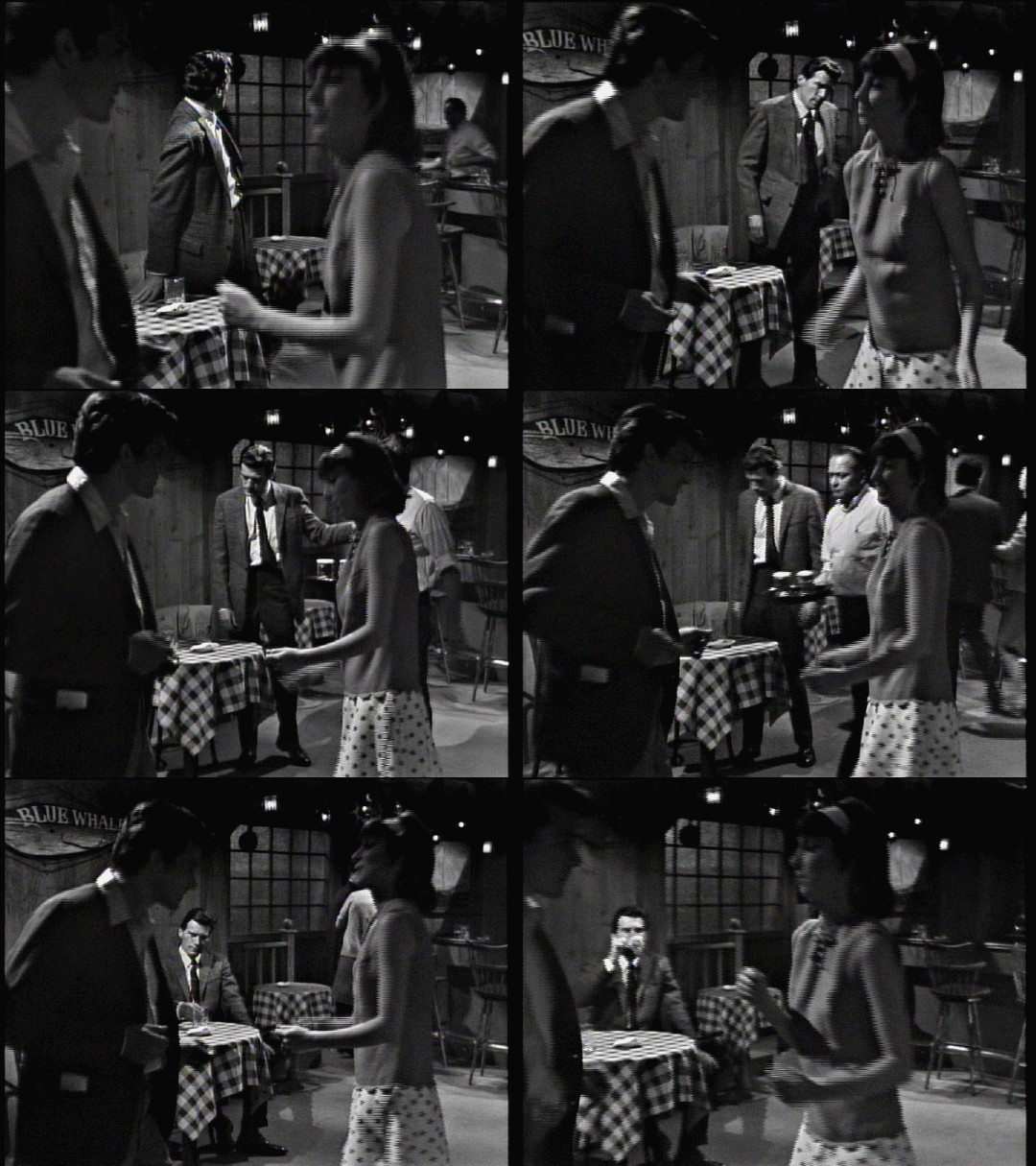
At the Blue Whale, Joe is getting well and truly sloshed. Burke joins him at his table, interrupting a conversation between Joe and his whiskey glass. Joe tells Burke that he doesn’t like him, expresses his frustration with Carolyn’s refusal to get married, then goes to Collinwood, roaring drunk, and tells Carolyn, Liz, and Vicki what he thinks of them.

One thing Joe thinks is that Carolyn is doomed to be a spinster. Considering that she’s supposed to be about seventeen, that does call to mind Barnabas’ line to Carolyn in the 2012 Dark Shadows movie, “Fifteen? And no husband?

Marc Masse brings this point out well on his Dark Shadows from the Beginning, and argues that the depiction of Carolyn may be one of the things that sunk the show with young viewers between the end of the first month and the introduction of the vampire:

You have to wonder what kind of impression the character of Carolyn Stoddard would have made to young viewers in 1966. Here she is having grown up in a mansion with forty rooms and her only option in life is to be married off before her eighteenth birthday to a local fisherman, or else face a life of lonely spinsterhood. In that respect, Dark Shadows seems to belong to the sensibilities of previous decades.

This paragraph is part of an in-depth discussion of Dark Shadows’ place on ABC’s schedule, its ratings, the show that preceded it in its time-slot, and Art Wallace’s rather antiquated view of the world. It’s all very informative, highly recommended.

When Joe passes out on the couch, Vicki goes to town. She goes to the Blue Whale, where Burke asks if she’s looking for someone. “I just found him,” she replies. Obviously, she’s talking about Harvey Keitel, who is dancing a few feet away from her.

That Harvey Keitel was once an extra on Dark Shadows is pretty interesting. If he took that job, clearly he would have taken a speaking part. I gave some thought to parts I wish he had taken in comments on Danny Horn’s Dark Shadows Every Day four times: here (on episode 470,) here (on episode 769,) here (on episode 1057,) and here (on episode 1137.)

Episode 27: In your room

Vicki tells Carolyn that David was the one who sabotaged Roger’s car, which Carolyn accepts as fact almost immediately. The story does build a foundation for Carolyn’s reaction- she repeatedly calls David a monster, and has been guilt-stricken at the thought that she let Burke into the house to commit the crime. But it is also the first example of what will become the hallmark of all of Nancy Barrett’s performances on the show. Her characters are the first to throw themselves into whatever is going on. She comes to serve as a one-woman chorus backing whoever happens to be the protagonist at the moment.

Liz still refuses to face the facts about David. When Vicki finds David’s Mechano magazine in her underwear drawer with the page about hydraulic braking systems marked, she and Carolyn see it as evidence that David had access both to the drawer and to the technical information he needed to commit the crime. Liz sees it differently, saying in a distant, ghostly voice “It was in your room, Miss Winters.”

Liz’ ghostliness is highlighted strikingly earlier in the episode. In the upstairs hallway, Carolyn is chattering away about ghosts, both the metaphorical ghosts of current problems resulting from past conflicts and the literal ghosts that, she would have you know, most definitely exist. Vicki looks at the door to the rest of the house which inexplicably opened and closed itself a few episodes back, and gasps as it opens again. This time it’s Liz coming out, having looked for David in the closed-off wing. Liz is impatient with the girls’ talk of ghosts, but her manner and appearance as she enters through that door are spectral.

The other setting in today’s diptych is a hotel room in Bangor.* Burke is meeting a private investigator there. He’s giving him a tough assignment. He wants more information about the Collinses in less time than the investigator had originally expected. He also wants the job done in absolute secrecy, and if the Collinses catch wind of the project the investigator will suffer dire consequences. The investigator is played by Barnard Hughes, a highly accomplished actor, and his skills are needed. Burke is being harsh and unreasonable, and the investigator is being deferential. Hughes is able to give his character enough texture that he seems to be keeping his dignity. Without that, Burke would have come off as a bully. The audience has to like Burke, so Hughes makes an important contribution to the show in this, his only appearance.

There’s an irony to Burke’s hard-driving intensity. He’s looking for information to hurt the Collinses, while the women at Collinwood have information far more damaging to the family than anything he’s sending his man to look for. So we’re in suspense as to what he’ll do when he catches up to them.

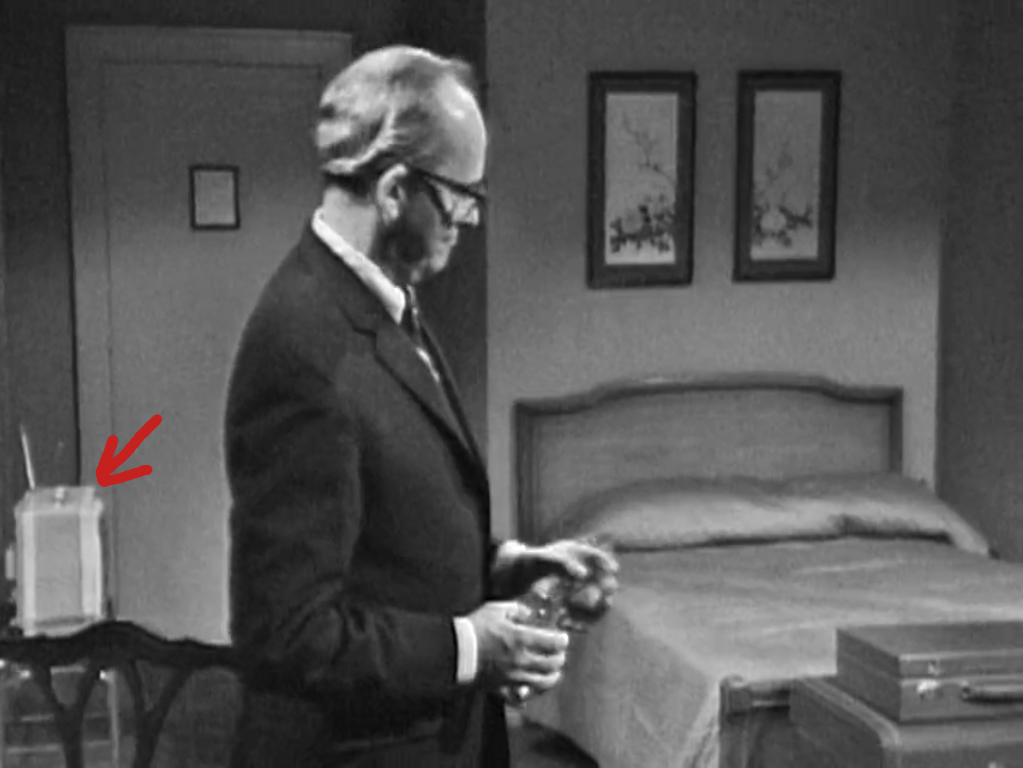
*In a comment on Danny Horn’s Dark Shadows Every Day, “TD” points out that the hotel room in Bangor has a television set, the first such device we see on Dark Shadows. We will not see another until 1970. That one will be in a parallel universe. We never do see a TV set in the Collinsport of the main continuity.

Evidently Mr Bronson had the hotel send a TV up to his room.

Episode 19: If it isn’t Burke Devlin, it’s somebody else

Most of this one consists of people worrying about each other’s attitudes towards Burke. Bill and Sam see each other, first in the Blue Whale, later in the restaurant, and in each place they share beverages while Bill needles Sam about Burke. In between these scenes, Joe and Carolyn are alone in the restaurant- completely alone, Joe apparently has to go behind the counter and prepare their meal himself- and they quarrel about Carolyn’s bold approaches to Burke before and during their date. At the end, Carolyn goes home, where her mother tells her about Roger’s wreck and about why she oughtn’t to be friendly with Burke.

Burke himself doesn’t appear in the episode, and none of the characters who do appear know as much about him as they think they do. What we get is a portrait of an isolated, gossipy little town, where rumors can start rapidly and grow in any direction. To the extent that “soap operas are approximately 90% information management,” as Danny Horn says, the typical setting of the gossipy little town, and its outgrowth, the false accusation, are the heart of the genre. As we watch these characters gossip and jump to conclusions, suspense forms as to how justice might miscarry if it isn’t stopped soon enough.

Episode 1: Who’s talking?

In 281 of the posts that follow, I link to comments I made on Danny Horn’s great blog Dark Shadows Every Day. Danny starts with episode 210 and makes only a handful of remarks, most of them highly disparaging, about the first 42 weeks of the show. As a particular fan of that period of the show, that distressed me when I first started reading him, but I found that it gave me an opportunity to make substantial contributions to the comment section. I could always find something in those early stories that gave extra depth to whatever was going on in the later installments.

Now, Mrs Acilius and I are watching the show through a second time, again starting with episode 1. I’d so much enjoyed commenting on Danny’s site when we were watching 210-1245 from March of 2020 to April of 2021 that I decided to start commenting on a blog that covered the first 42 weeks. So I’ve left many comments on John and Christine Scoleri’s Dark Shadows Before I Die.

The Scoleris haven’t assembled the kind of community that made Danny’s comment section a big party. I still get responses to comments I left on Danny’s site, almost a year and a half after his final post. I have yet to get a reaction to any of my comments on Dark Shadows Before I Die. So I’m thinking of just recording my thoughts here.

The Scoleris aren’t the only bloggers who discuss the first 42 weeks of the show. There’s also Marc Masse, a.k.a. Prisoner of the Night, whose (fiercely controversial) Dark Shadows from the Beginning is occasionally viewable, usually private. And of course Patrick McCray, whose Dark Shadows Daybook set the standard for online commentary on the show. Neither of those sites has an open comments section, which is why I’ve been contributing to the Scoleris. There are also podcasts, Facebook groups, Reddit threads, etc, but I’m not into any of those.

Asking who to talk to and how to get through to them brings episode 1 to mind. Vicki comes to an unfamiliar town, and the audience comes to an unfamiliar show. She’s a stranger looking for someone to talk with; we’re viewers of a daytime soap, a genre that consists almost entirely of conversation. Everyone Vicki meets is talkative enough, but most of their talk is about how they aren’t speaking. The lady sitting next to her on the train goes on about what a nasty place Collinsport is. The fellow who gives her a ride from the train station responds to the innkeeper’s warm greeting with an ostentatious refusal even to acknowledge that he knows him, let alone to engage in conversation. The server at the lunch counter announces to Vicki, before she’s had a chance to say two sentences, that she regards her as a “jerk.” The family she will be working for is represented by a lady who won’t answer her brother’s questions as to who Vicki is and why she hired her, a reticence that is made all the more ominous when a private investigator reports on their strange, unfriendly ways. Dark Shadows fandom is far less forbidding than the situation Vicki faced!

The Back-Worlds

In 281 of the posts that follow, I link to comments I made on Danny Horn’s blog, “Dark Shadows Every Day.”

I added most of these comments in the months between the shutdown of live theater in March of 2020 and the completion of the blog in April of 2021. But I have added some since.

In the last few days, I’ve added four. They all discuss on the way the show shifts its focus, once the vampire story becomes a hit, in the direction that will come to define it as the months and years go on. The first three of these comments are on posts discussing episodes where Barnabas the vampire is holding Maggie the lovable girl prisoner and trying to brainwash her into becoming his late love Josette, so that he can kill her and turn her into a vampire. This comment is on the post for episode 253, in which the boy David has broken into Barnabas’ house and had a shouting match with Barnabas’ servant Willie:

The scene between David and Willie marks a definitive break from the pre-Barnabas show. David’s great concern is that Barnabas and Willie are “hurting Josette.” By which he means that he can no longer sense the presence of the ghost of Josette. On the contrary, the name “Josette” now refers to something horrible and that horrible thing is a part of Barnabas’ story.

In the first 42 weeks, the ghost of Josette had been the principal supernatural element in the show. Serene, mysterious, uncanny, the ghost fit perfectly into that series, which was something like 99% atmosphere and 1% story. And Josette came out of the background at two key moments, leading the rescue of Vicki from Matthew in 126 and informing the family of the danger Laura represents to David in 149 and 170. And of course when Barnabas first meets David in 212, David tells him that Josette protects the family.

So when Barnabas starts his rampage, regular viewers would at first be waiting for the ghost of Josette to make its move and stop him. By the time David sees the Josette-ified Maggie in 240 and 241, we know that the imperturbable Josette of the first 42 weeks is not coming back. If we do see Josette’s ghost again after we’ve seen Maggie in her wedding dress, it could not have the lightly amused smile in its voice with which it told Vicki not to be afraid of Matthew; it could return only as a terrifying spirit of vengeance. By the time David and Willie finish their confrontation in this episode, the show has told us that the protecting ghost won’t return at all.

This one is on the post for 255, in response to a comment from someone wondering what Barnabas was planning to do if he had succeeded in his evil plan for Maggie. How could he have gone on presenting himself to the rich Collinses as their long-lost cousin from England?:

I think we have to assume that all the “cousin from England” stuff would have gone by the boards if Barnabas had succeeded with Maggie. When they revisited Barnabas’ Josettifying project in HOUSE OF DARK SHADOWS, they had to ask what would come next, and the answer was “He kills everyone and turns the estate into an impenetrable outpost of Hell.”

Some time after they came back from making that movie, the show would send Barnabas and Julia on a two-week visit to the future, to the far-off year 1995, where they find that most of the family is dead, the rest of them are hopelessly insane, and no one dares go to the estate, all because of hideous supernatural doings that took place there a quarter century before. Those two weeks are sensational, the last genuinely great phase of the show, and part of what makes them so great is that they are a logical sequel to the part of the show everyone remembers most clearly.

This one is on the post for 256. In that episode, the hapless Maggie has seen a mysterious little girl playing outside the cell in which Barnabas keeps her. The girl’s name turns out to be Sarah:

I’d say Sarah’s introduction is the single most important moment in the whole show, more important than Barnabas coming out of the box, more important even than Barnabas’ first decision not to kill Julia.

From the beginning they’d been playing with the idea that there was another cast of characters hidden behind the characters we’ve been watching, supernatural characters who can make their influence felt at certain moments. The most prominent of these was the ghost of Josette…

So the show has discarded the old supernatural realm of Josette and the widows, a realm that was, as you say, never more than slightly accessible. With Sarah’s appearance, we are introduced to an entirely new part of the show. Once again we have a set of characters hidden in the supernatural background, but they can interact with the characters from the main continuity more directly and at greater length than Josette and the widows ever could.

The puzzle of Sarah’s connection to Barnabas, and her talk about looking for the members of her family, indicates that this new order of supernatural beings have complex and unsettled relationships with each other, and that characters from the main continuity can have an influence on those relationships. We will have to figure those relationships out in the weeks and months to come, but as soon as Sarah demands Maggie not tell her big brother that she saw her, we know that they might come to enmesh the living beings. Every scene with Sarah, then, is a step leading directly to the time-travel and parallel universe storylines that will come to define the show.

This one, on the post for 279, sums up the major points of the three comments above. It regards an episode in which Barnabas and Willie are planning to host a costume party in which members of the present-day Collins family will come dressed as their forebears from Barnabas’ time, the late eighteenth century. Barnabas has rather surprisingly claimed that this party will be “the most important night of [his] life”:

‘Dude… you rose from the dead. I think the prize for “most important night of my life” is pretty much taken.’

I think he has a point, though. While it is undoubtedly true that the writers, producers, and other creatives never had an elaborate plan that they had agreed on and that they would stick to regarding the future storylines of the show, they did have some memory of the storylines they had already developed. They spent the first 25 weeks building up the ghosts of Josette and of The Widows as presences in the show, a whole second cast of characters existing in a back-world behind the one in which the events we see take place…

Once the vampire story gets going, Josette and the Widows can’t come back. Their distant, mysterious, impassive qualities suited the slow, atmospheric early months of the show, but once you have a ghoul rampaging about sucking people’s blood there’s no place for remote and uncanny presences. To hold the stage while that’s going on, you need to be a dynamic character…

So the old supernatural order of Josette and the Widows is gone. But the idea of a second cast of characters, mostly invisible to us, properly associated with the distant past, but still wielding powerful influence over the events on screen. is stronger than ever. Barnabas had been hidden away, he belongs dead, yet he has irrupted into the present and taken over the story. Sarah is a denizen of the same back-world, she has broken through with Barnabas, and is steadily pulling aside the curtain that conceals their realm from that in which the established characters live and which the audience sees. The audience is going to have to be introduced to more characters from Barnabas and Sarah’s world, and the party is going to serve that function.

Once we’ve learned their names and how they relate to each other, the back-world characters and their time will have to become a concrete part of the show in a way that Josette and the Widows never could. In retrospect, the only way that could end is with an extended flashback. So the party does turn out to be a solid candidate for ‘the most important night of Barnabas’ life’, in that it is a major step towards the time-travel and parallel-universe stories that would come to define the show.

The time-travel and parallel-universe stories put the back-worlds into the foreground and the usual continuity into the background. Those reversal may not have been the only way to resolve the crisis they created by introducing Barnabas and Sarah, but certainly some kind of radical change in the relationship of back-world and usual continuity was unavoidable.

I’d like to say one more thing about a point I make in that final comment. “While it is undoubtedly true that the writers, producers, and other creatives never had an elaborate plan that they had agreed on and that they would stick to regarding the future storylines of the show, they did have some memory of the storylines they had already developed.” Throughout the blog, Danny repeatedly claims never to have seen most of the episodes from the first 42 weeks of the show. At times this claim seems like it must be an exaggeration- for example, at one point he catalogs all 21 episodes (between #42 and #108) which revolve around the questions of what kind of physical contact had with Burke Devlin’s pen and where Burke’s pen is, a catalog that could only have been made by someone who had seen all of those episodes and all those between. Be that as it may, he does vociferously disclaim any interest in the show as it was before the vampire comes along. Which is his privilege, Dark Shadows was a very different show pre-Barnabas and post-Barnabas and there is no reason to assume that a person who likes one of those shows will like the other.

He also stresses the point that there was no advance planning in the writing of the show, that they were making it all up from week to week, often dropping one story abruptly and expanding another just as abruptly as soon as the ratings came in. That should be obvious to anyone who watches the show for any length of time.

However, it can be misleading to stress the impromptu nature of the stories while ignoring the first 42 weeks, especially when you’re considering the period of the show immediately after those weeks. No one knew what was coming, but the producers, the directors, most of the writers, and many of the actors had been with the show from the beginning and knew exactly where they had been. So the idea of a ghostly back-world and the difficulties that come when you have to define the relationship of back-world to main world were very familiar to them, and it would have been clear that redefining that relationship would have major implications for the future of the show.

Another weakness of Danny’s is a tendency to both emphasize intentionality (a fine thing in itself!) and to reduce intentionality to what “the writers” had in mind. In my comments I usually play along with the focus on intentions, even though I don’t tend to favor that myself. -If it were just me, I wouldn’t be so concerned with proving that anyone associated with the show was thinking about the relationship of back-world to main-world in the summer of 1967- it would be enough that the logic of the show leaves them nowhere else to go. But Dark Shadows Every Day is Danny’s blog, so when I’m there I want to play his game as much as possible.

Where I can’t follow is with his tendency to reduce “intentionality” to “the writers.” A TV series has lots of creators- in addition to writers, there are producers, directors, actors, set designers, costumers, camera people, executives representing networks, executives representing studios, etc, etc. Each of those people has to make contributions, and each has a whole bunch of things to think about at any given time. So there’s always a multitude of intentions, and many levels of intentionality, to be considered.