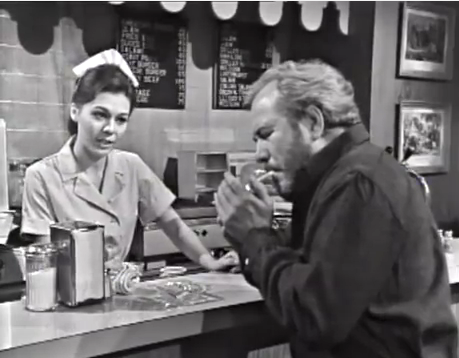
Episode 41: Working day

Three people expressed surprise in episode 40 that Roger Collins wasn’t at his office. He still isn’t there today, and three more people are surprised. He finally decides to go in when Liz presents him with the alternative of looking for Carolyn.

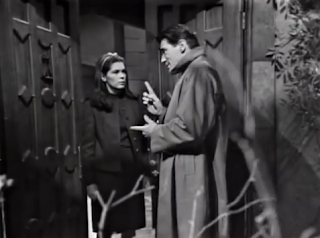
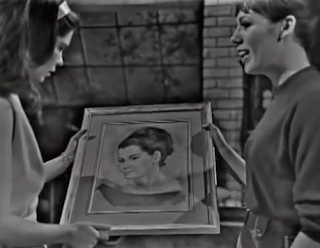
Bill Malloy isn’t at work either, hasn’t been all day. He and Roger have been taking turns inviting themselves into Sam Evans’ house. Sam is also not working, and in fact takes time out of his busy schedule of downing one glass of whiskey after another to destroy the only thing we’ve seen him make as part of a paying job, a sketch of Burke. Maggie pieces the sketch back together- she’s also at home when she’s supposed to be working.

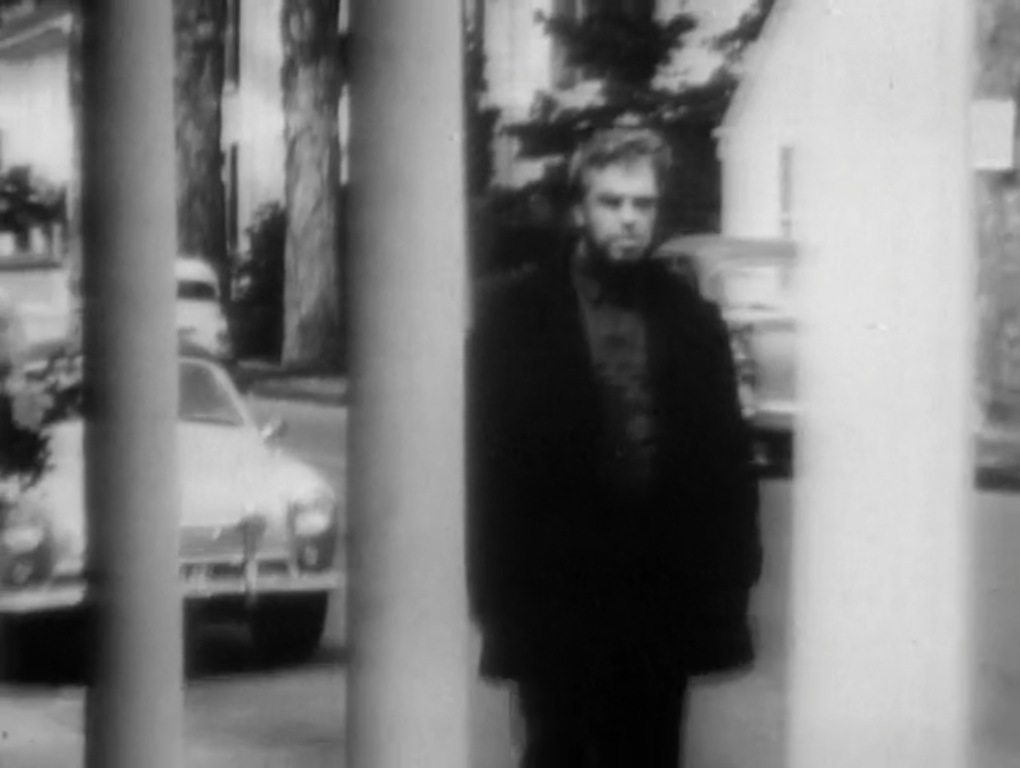
Telephones are unusually dynamic in this episode. Typically we see only one end of a phone call on Dark Shadows. This time, we cut back and forth between both ends of three telephone conversations this time. In the teaser Roger is browbeating Sam; Sam sets the phone down and walks off. While he gets another drink, the receiver is in the foreground and we hear Roger’s voice at the same volume as we did when Sam was listening. Sam comes back, returns the receiver to its cradle, and goes to sit down while it rings.

The bit when we see the phone and hear Roger’s voice, though Sam isn’t looking at the phone and can’t hear it, establishes the telephone as a character with its own relationship to the audience, independent of anyone who may or may not be paying attention to it. It’s a neat moment:

Screenshot by Dark Shadows Before I Die

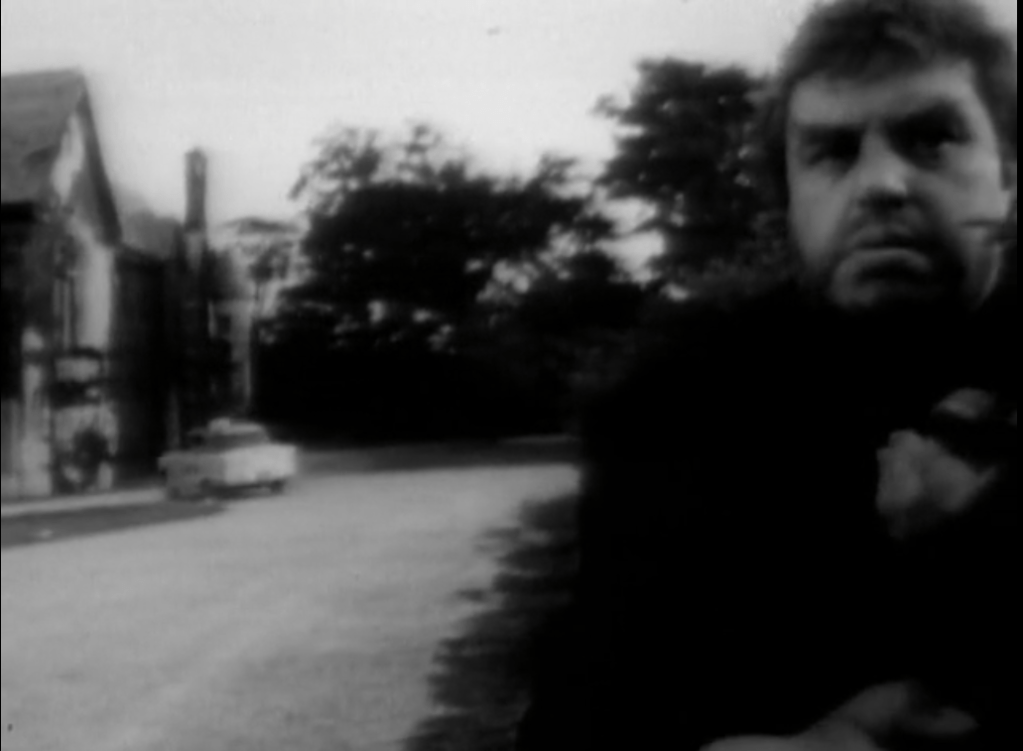
Liz calls the office and talks to Joe. Joe tells her Bill hasn’t been in all day. The stress in his voice, the papers piled on his desk, and the tight grip he has on the telephone receiver all make it credible that he’s the only person in town who showed up for work today:

Screenshot by Dark Shadows Before I Die

Liz mainly wants to talk to Joe about Carolyn. Joe tells her he hasn’t talked to Carolyn in some time, and that he has no idea what if anything she is thinking about their relationship. While he breaks this news to Liz, we see him continue working, then cut back to the look of distress on Liz’ face.

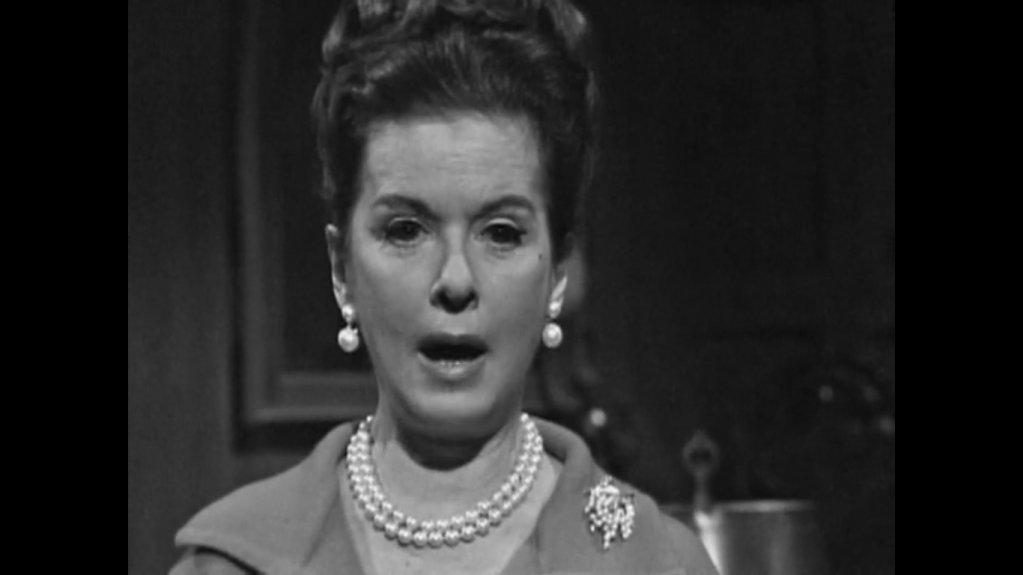
Maggie calls Collinwood. Vicki answers and is excited to talk to Maggie. I guess the show is telling us they’re friends now. Maggie asks to talk to Roger. Vicki says Roger is probably in the office at this time of day, Maggie somehow knows he isn’t, Vicki remarks that he isn’t in the habit of confiding in her. Roger overhears this and asks “Is there any reason why I should confide in you?” When Vicki holds the receiver out to him and says Maggie Evans is on the line, he takes it and hangs up without so much as putting the receiver to his ear. Vicki and Roger then have one of their little quarrels.

That’s the only thing Vicki does in the episode. Her character is heading into a danger zone. Through the first eight weeks, she was on all the time. She was our representative, the outsider who knew nothing about the other characters or the town they live in, and to whom everything had to be explained. Now she knows as much about the rest of the characters as they know about each other, and we know as much as we want to learn by hearing explanations.

The major characters all have their secrets, but the only two who know each other’s secret are Roger and Sam. Vicki isn’t any likelier than anyone else to uncover that one. She has no secrets of her own, and her original story-line- her quest to discover her origins- is dead in the water. What’s more, Vicki is no good at lying. Soap operas are mostly conversation, and the big events on them are lies and the exposure of lies. The only time Vicki has tried to lie to anyone- in episode 13, when she told Matthew that Liz knew she was in his cottage- she was immediately found out, with disastrous consequences. If she’s going to stay relevant to the show, something is going to have to change, and fast. It’s fun to watch Alexandra Moltke Isles bicker with Louis Edmonds, but the characters they play need something meatier to bicker about.

This is the first episode credited to writer Francis Swann, indeed the first episode credited to anyone other than Art Wallace. Swann’s teleplay finds humor in the idea that so many people have taken the day off. Each time another character remarks on a case of absenteeism it gets that much closer to raising a chuckle. And Roger’s line that looking for Carolyn would require him to “neglect my vital tasks at the office… Dear me, no” is genuinely funny, especially as Louis Edmonds delivers it. The telephone scenes are also an innovation, and promise a new source of visual activity. Those favorable omens are offset by Vicki’s scene and its suggestion that her character is about to be allowed to wither on the vine.

A couple of the blogs I read when I prepare my comments made remarks about this episode with which I disagree. John Scoleri of Dark Shadows Before I Die says this of the quarrel between Sam and Maggie:

I know Sam gets frustrated with Maggie, but I’m beginning to wonder about their relationship. If he’s that close to hitting Maggie when he gets drunk, there’s no way I’m believing he hasn’t done that before.

To which I replied:

It doesn’t look to me like Sam has hit Maggie. She’s inches from his face when he is at his angriest, yet she doesn’t flinch, doesn’t slump down, doesn’t show any sign of withdrawal or fear or anger or panic or sullenness or bewilderment or any other possible response to physical abuse.

Patrick McCray said this:

There hasn’t been much happening on DARK SHADOWS in the last few weeks, but that doesn’t mean the show hasn’t been moving forward. There’s been a growing sense of doom throughout the show, and it’s obvious that someone is going to die. In this episode Sam rips up his portrait sketch of Burke Devlin, he and Roger lob threats at each other, Liz begins to draw Joe’s attention to his girlfriend’s romantic intentions on the family rival, and Victoria has been pushed around by just about everyone in the cast. In theory, any one of them is eligible for a ride in the bone wagon, but the show has been implying that Devlin is headed for a fall. It’s interesting that the show decides to go in another direction: I don’t know when Bill Malloy checks in at Eagle Hill Cemetery, but it’s probably sooner rather than later.

While it is true that “in theory, any one of them is eligible for a ride in the bone wagon,” I do think there’s a clear front-runner to be the first Dark Shadows character to be killed. It’s Sam who is obsessed with the fear of death, Sam whom Roger has threatened, Sam who left a mysterious sealed envelope to be opened in the event “something happens.” And, from an out-of-universe perspective, it’s Sam who has a daughter played by an appealing actress who needs a story-line. Maggie seeking revenge for the killing of her father would be just the plot to elevate Kathryn Leigh Scott from the bottom of the second string to the starting lineup where she so obviously belongs.

No other character has anyone so well-positioned to play avenger if they’re killed. The only keen attachment Bill Malloy has shown is his devotion to Liz, and in her scene with Matthew in episode 38 Liz demonstrated that she sees devotion from people outside the family as a tool to use when time comes to protect the good name of those inside it. So if she suspects Roger killed Bill, she won’t become Bill’s avenger- if she could order Matthew to throw away his own good name to cover up the truth about David, we can hardly expect her to expose Roger to redress Bill’s grievance against him. Indeed, when Bill is murdered, they will introduce an entirely new character to seek revenge for him.

Vicki is an orphan, who tells us in today’s opening narration that before she arrived at Collinwood she had never known a home. No one is likely to avenge her, and besides, she still does the opening narration for every episode- she’s supposed to be important, even if the writers can’t quite figure out what to do with her. Burke is supposed to be rich and powerful. Presumably he has friends, but we haven’t seen any of them. Joe is Mr Nice Guy and he’s mentioned a friend or two, but again, we haven’t seen them. The series story bible calls for Roger to die when Burke finally gets his revenge, but every time Louis Edmonds’ performance is the most interesting thing in an episode it becomes so much the less likely that they will ever get around to playing that scene. So the smart money, at this point, would be on Sam to be the victim in the first Dark Shadows murder. So much so, indeed, that it might not be surprising enough if it does happen- they may think they have to kill someone else to keep the audience engaged.

Episode 34: You amaze me, Miss Winters

Everyone who is going to know that David tried to kill his father now knows it, and Liz has decreed that the incident will have no consequences. So we’re back to the basic story elements laid out in week one, as modified in subsequent episodes to make sure everyone had plenty of people to talk to.

Vicki is at the Blue Whale. Harvey Keitel is gone, but Burke is still there, so she sits with him. He asks her why she joined him. She looks off into space and says “Inches, feet, miles.” He tells her she reminds him of a drink that fizzes and foams, but he isn’t sure what kind. He asks what she’d like to have for dinner. She replies “I’d rather go to your hotel room.” He flashes the same dopey grin any fellow would in this situation, and says “You amaze me, Miss Winters.”

Vicki is supposed to be a street kid from NYC, so we can assume she knows how to go about finding inches when she wants them, and that she’s no stranger to feet, either. Miles may be in short supply in the city, but she’s willing to learn. It turns out that all she wants from Burke is a look at the report his private investigator prepared about her. In the hotel room, she tells him what the audience knows about her origins and about Liz’s refusal to give a straight answer to the question of why she hired her. She looks through the report, and says it doesn’t tell her anything she didn’t already know. He orders two steak dinners from the hotel restaurant.

A knock comes on the door. It isn’t room service; it’s Joe, come to repay Burke for settling his bar tab. Joe is about to tell Burke he still doesn’t like him, when Vicki comes out of the bathroom. Joe excuses himself, startled to see her. Vicki goes a moment later, leaving Burke alone, waiting for two steak dinners.

I summed up my reaction to this episode in a comment on John and Christine Scoleri’s Dark Shadows Before I Die:

“Miss Winters, you amaze me.” Me too! Any woman as young and attractive as Vicki in a town as small and gossipy as Collinsport would be the scandal of the month if she went unchaperoned to a bachelor’s hotel room. When the woman lives with and works for the richest family in town and the bachelor is their sworn enemy, “indiscreet” isn’t any fraction of the word needed to describe her boldness.

Burke has time and again talked about how gossipy Collinsport is. For example, in episode 27, he seemed almost unhinged as he told his associate Bronson about how deeply secretive his investigations of the Collins family holdings would have to be, since anything that happens in or near the town of Collinsport is immediately known to everyone there. So we have to assume that he plans to get everyone talking about his evening with Vicki.

At this point in the show, we usually have to guess what Burke’s plans are, and even when they are revealed we can’t decide whether they are good or evil. In the case of his attempt to get rumors going about himself and Vicki, I think it’s a little more straightforward. He keeps telling her she should get away from the Collinses and leave town. If the Collinses think she’s involved with Burke, Vicki is very likely to find herself on a train back to New York. Maybe not to the Hammond Foundling Home- Burke might have a little apartment in the East Village where Vicki can stay until she finds something…

Episode 28: Just curious

I think I said everything I wanted to say about this one in the comment I left on John and Christine Scoleri’s Dark Shadows Before I Die. So here it is:

“Idiot Plot” is a term for a story that can go on only if the characters in it are dumber than the average member of the audience. When Vicki left the valve where David could steal it in episode 26, Dark Shadows had its first Idiot Plot.

Now, just two days later, we have our second. The restaurant is open for business, and Maggie says in so many words that Roger is a frequent customer there. So he should walk right in and lay hold of David. But unaccountably, he waits for Maggie to let him in. She turns her back on David, calls Roger by name, and declares that she’s been tricking David into staying, all while David is a few feet away. Even worse, we have a number of scenes suggesting that Maggie had searched the hotel extensively for David and failed to find him, when he was simply hiding in the very telephone booth she herself had used a few minutes before.

Art Wallace is the only credited writer for the first eight weeks of the show. I’m sure he had some help, but not enough, apparently- these two episodes not only disappoint viewers who expect a well-constructed drama, but also do serious harm to the characters of Vicki and Maggie. Vicki has to be so sweet and innocent that unless she’s also as smart as she’s seemed in the first five weeks, she’ll get pretty cloying pretty fast. And Maggie, whether it’s the original wised-up dame who’s everybody’s pal but nobody’s friend or her successor, the nicest girl in town, has to produce witty dialogue and see through people’s attempts to deceive her if she’s to contribute to the story. Casting either of them as Designated Idiot is a sure way to put her on an ice floe to oblivion.

Two other things:

Interesting to see the first scene between Maggie and David. Especially so knowing that these characters will become important to each other later on, but already so as confirmation that the hostility Maggie had expressed towards the Collinses in general in Episode 1 isn’t going to define her character.

The picture of Lyndon Johnson in the sheriff’s office is apparently there to promote ABC’s coverage of the Luci Johnson’s wedding that weekend, but it’s a very odd choice of image. You’d expect the president’s photograph in a government office to show him from the chest up, showing his full face, with his eyes looking at the viewer and a calm or cheerful expression. But this picture is an extreme closeup of his face in profile, and he appears to be wincing. On a wall otherwise decorated with wanted posters, it communicates something less than unqualified admiration for President Johnson. If, as Roger implied in episode 26, the sheriff owes his office to the support of the Collins family, the picture would suggest that the Collinses were not LBJ fans.

I’ll also mention that Marc Masse’s entry for this episode on his Dark Shadows from the Beginning features one of his most outlandish accounts of a control room conversation between director Lela Swift and executive producer Dan Curtis. If you miss the sensibility of the 1970s National Lampoon, you’ll enjoy reading it.

Episode 26: I want that valve!

At the end of episode 25, Vicki found the bleeder valve in David’s room, evidence that the boy tried to murder his father. In this one, she tells David she has the valve and leaves it in a drawer in her own room while she goes to tell Elizabeth about it. When Vicki and Elizabeth go to look at the valve, it is of course missing. Elizabeth chooses to believe that this means that she does not have to think any more about what Vicki has told her.

I lamented this in as comment on John and Christine Scoleri’s blog Dark Shadows Before I Die:

Watching the series first time through, it bothered me that Vicki didn’t bring the valve to the drawing room and show it to Liz. She knows David is a clever, mechanically competent little fellow, and no respecter of private property. Why on earth would she leave the valve in a dresser drawer which she knows he likes to riffle through and to which he has had considerable time to find or make a key?

That time, I could come up with an explanation. She is in shock, bewildered by the confirmation of the dark suspicions we’ve seen forming in her mind, and isn’t thinking straight.

(SPOILERS FOLLOW)

This time, though, I’m coming to the episode having seen the series through. This is the first time they resort to Idiot Plot- a story that would resolve itself immediately if the characters behaved as intelligently as would the average member of the audience. And it’s Vicki supplying the idiocy. Later on, they will rely heavily on Idiot Plot, and because she is so much the point of view character Vicki winds up as the Designated Idiot. That will ultimately destroy her character and drive her off the show. So I can’t help but feel sad now when I see this first appearance of Dumb Vicki.

The other scene is between Roger and the sheriff. In Collinwood, Elizabeth is trying to protect her image of David by forcing Vicki to pretend she hasn’t seen the valve; at the sheriff’s office, Roger is trying to impose his image on Burke by forcing the sheriff to arrest him. Vicki resists Elizabeth throughout this episode, but we are in suspense how long she will be able to hold out. The sheriff resists Roger, making a display of his blase attitude while Roger is in the room but showing great unease as soon as he leaves.

Episode 23: The dignity of my badge

Roger has finally deigned to notify the police of his suspicion that Burke Devlin tampered with his brakes in an attempt to kill him. In story time, that was twelve hours ago. In the interim, both Roger and Bill Malloy have gone to Burke’s room and told him everything they know and think they know. Roger presented Burke with Vicki and her testimony. The newspaper has run a front-page story about it.

The sheriff is peeved that Roger is bringing him into it only now. Roger explains that his goal in giving Burke all the evidence in advance of any investigation was to persuade him to leave town, but that he never had the opportunity to present that idea to Burke.

Upstairs, Vicki is trying to teach David a lesson about the history of Maine. Considering that we learned in episode 13 that Vicki has never heard of Augusta, the capital of the state, it’s difficult to be optimistic about that instruction. But every scene between David and Vicki in his room is worth watching. No matter what lines they may be required to say, David Henesy and Alexandra Moltke Isles always use body language, facial expression, tone of voice, and spatial position to convey the emotions appropriate to their characters. As episode follows episode, those emotions shift from wild hostility on David’s part and patient solicitude on Vicki’s to genuine affection and trust. It’s the one story-line that really works in the first 42 weeks of the show.

David made some incriminating remarks to Vicki and his aunt the night of his father’s wreck; they both thought he was simply expressing his guilt over his hostility to his father. In this one, he asks Vicki if she ever tried to kill anyone. She tells a story of some fist-fighting she did at the Hammond Foundling Home, and says that’s as close as she got. She looks happy telling David that story, not because it’s a happy story, but because it’s a chance to make a connection.

She isn’t happy at the end of the episode- when David grabs at the bleeder valve and the other adults ignore his action, we see it dawn on her that he is the culprit.

I had a lot to say about this episode in the comments section of John and Christine Scoleri’s Dark Shadows Before I Die. Here it is:

I don’t agree that Constable Carter seems intelligent. He greets David by asking his name. If a cop has been on the job for over ten years in Collinsport, a town under the shadow of a big house called Collinwood, home of the the Collins Cannery and the Collins Fishing Fleet, and he still doesn’t know the four members of the Collins family, he’s an idiot.

Of course, he is sensible when he’s demanding to know why Roger waited twelve hours before coming to him and expressing incredulity at Roger’s visit to Devlin. Characters in soaps and suchlike productions are always declaring they have to do their own investigations before they can go to the police, and often this is treated in the story as if it were a reasonable thing to do. But every step of the way they’ve lampshaded the preposterousness of it. Vicki kept telling him it was a bad idea before he did it, last episode Sam reacted scornfully when he told him what he repeats to the constable here, that he wanted to give Devlin a chance to leave town and never come back. And the constable shows the same scorn for the idea today.

Those scenes make Vicki, Sam, and the constable look smarter than Roger, but we’ve seen enough of Roger to know that he isn’t a fool. Something is clouding his judgment, something more complicated and slipperier than the stories that have been suggested to us so far. Roger is hiding more than one thing, and he doesn’t trust himself with his own secrets.

David looks at the camera again today, when he’s eavesdropping on the conversation with the constable. An effective tactic- we the audience know what he knows, and he seems to be pleading with us to keep quiet.

Another meaningful look at the end of the episode. When the constable, who is an idiot, says cheerfully that now we’ll know how David’s fingerprints got on the wrench, Vicki gives David a grim little glance. Just for a second- but not only is it the last moment of the episode and therefore emphatic, it is also the second time we’ve seen her give David that look. The first time was in his room, when he was betraying himself with some remarks about how terrible it would be to go to prison. We can see a terrible idea starting to form in the back of Vicki’s mind.

Episode 18: Strange sounds and lonely echoes

Only three characters in this one- Roger, Vicki, and David. In the previous episode, Roger learned that his crash was no accident, that someone tampered with his brakes. Now he wants Vicki to tell him what she can that will help him prove that Burke Devlin was the one responsible. Which is a great deal- she saw him in the garage, with a wrench, next to Roger’s car. She had gone into the garage after hearing what she thought was a car door slam. She admits that the slam could have been the hood over the engine compartment, and since the car door next to Devlin was open, this seems likely. Since the reason Roger was on the road was that Devlin had invited him to town to discuss “business,” and the two of them do not seem to have any business together at all, the case against Devlin seems quite strong.

David will place rather a substantial difficulty in the way of Roger’s hope of sending Devlin back to prison. As the audience knows, it was he, not Devlin, who removed the valve from the braking system on his father’s car. We even see him handling the valve in this episode. In episode 17, he nearly confessed to his Aunt Elizabeth, and this time he makes an incriminating statement to Vicki. Both women had assumed he was merely expressing guilt for his hostility to his father, and tried to reassure him that his feelings and thoughts didn’t mean that he was to blame for what happened on the road. David even tries to talk to his father in this one, and Roger icily dismisses him. But we’ve seen enough mystery stories, including inverted mysteries where the audience knows who done it before the detective does, to be sure that Roger will learn the truth when he least expects it.

Roger not only has reason to suspect that Burke is responsible for his crash; he also has deep, complex, ungovernable feelings where Burke is concerned. Some of those feelings have to do with the testimony he gave at the trial ten years before which sent Burke to prison. Some go back before that, and have to do with the friendship that existed between them before that trial. All of them are deeply secret.

This show was being made in 1966, when Freudianism reigned supreme in much of American intellectual life, and the most respected of respectable novels was Proust’s À la recherche du temps perdu. All of the cast and much of the production staff comes from Broadway, where at that time Tennessee Williams was the undisputed king of serious playwrights. And the part of Roger was played by Louis Edmonds, who came out of the closet as a gay man as soon as it was possible to do so, and who was never in the closet as far as his friends and colleagues were concerned. So it seems likely that the secrets Roger is so desperate to conceal include some kind of homoerotic connection with Burke. This episode lampshades some standard soap opera craziness in order to call our attention to the irrational nature of Roger’s attitude towards Burke, and I think a mid-1960s audience would be likely to suspect that a repressed sexuality is driving that irrationality.

Here’s how I put it in a comment on John and Christine Scoleri’s Dark Shadows Before I Die:

When Vicki tells Roger what she saw Devlin doing in the garage, Roger asks her to come with him to confront Devlin at the hotel. That’s a typical soap opera character idea. What isn’t so typical is Vicki’s response, that it would be better to go to the police. She sticks with that rational idea until Roger tells her of his urgent need to see Devlin’s face. That picks up on Roger’s frantic behavior in Week One and sets him up for the whole saga of Where Burke Devlin’s Pen Is, in which we see that Roger’s attitude towards Burke is rooted in some deep and complicated emotions.

Episode 17: Such a strange question

Another of the diptych episodes in which Art Wallace excels. This time we have two pair of contrasting scenes.

David, thinking he has succeeded in his attempt to murder his father by tampering with the brakes on his car, awakes from a nightmare and walk out through a feature no nine-year-old boy’s bedroom should be without, a full window that opens on a ledge above a two hundred foot drop to the sea. Elizabeth stops him before he can jump. David is hysterical, Elizabeth frantic to console him.

Juxtaposed with the wrenching scene between David and Elizabeth is a very light scene between Roger and his doctor. Roger is in the doctor’s office, pitying himself for his minor injuries. The doctor is overly friendly and relentlessly makes little jokes at which he himself seems to be quite amused. Roger is annoyed with the doctor’s manner and impatient with his work. The self-contained, self-satisfied, ultimately trivial Roger seems to live in a different world than the one where his son is suffering so grievously.

Then we have two scenes of teacher and student. Bill Malloy explains hydraulic braking systems to Roger and a scene in the drawing room where Elizabeth tells stories from family history to David. Since Malloy’s explanation advances the mystery story that is the main thread of the show at the moment, it is fascinating, and since the early history of the family is not (yet!) relevant, Elizabeth’s stories are intentionally presented as tedious. Here’s how I put it in the comments on John and Christine Scoleri’s Dark Shadows Before I Die:

Bill Malloy was a talented guy. His explanation of a hydraulic braking system, supplemented by that admirably drawn schematic, was not only crystal clear, but genuinely interesting.

There’s a structural justification for it- Liz’s lecture to David about Isaac Collins in front of Isaac’s portrait is deliberately presented as boring. So including another lecture supported by a single illustration and making it urgently interesting shows that what’s boring isn’t the format, but the relevance of the content to the story.

That venture into educational programming is a fine example of the freewheeling experimentation the series was doing in these early weeks. Some of those experiments come up again. The final 2 seconds of the episode is the first time a character looks directly into the camera, a trick they will use to advantage many times down the line.

Also, the date 1690 is interesting, not only because the portrait is ludicrously anachronistic- the man is wearing clothes from and is painted in a style that date from 200 years after that date- but also because we will hear about that period again, near the end of the series. Most likely that’s a coincidence, but I suppose it’s possible someone connected to the show in its final months remembered that the 1690s were supposed to be important in the history of the family.

Episode 16: This is no place for young people

Dark Shadows begins its first mystery story as the characters try to figure out who tampered with Roger’s brakes, sending his car off the road but causing him only minor injuries. It is an inverted mystery, of the type that would a few years later be stamped with the name of Columbo. The audience knows who committed the crime, the suspense comes from wondering how and when the perpetrator will be caught.

In this case the would-be killer is the victim’s nine year old son David, a boy whose father openly tells him that he hates him and who is frantic with terror that he will be “sent away,” which to him brings up something frightening and unexplained about his mother. David removed the distributor valve from the brake system of his father’s car so that the brakes would fail at the moment when the car approached a particularly dangerous turn on the side of the steep hill leading down from the house.

David has kept the valve, intending to use it to frame someone else for his crime. His first choice of patsy is his governess, the point of view character for this part of the series, Victoria Winters. That plan was foiled when Vicki caught him trying to plant the valve in her underwear drawer. Later, David will try to plant the valve on someone else, but for now he is stuck keeping it in his possession.

I made some remarks about this episode on John and Christine Scoleri’s Dark Shadows Before I Die:

A few disconnected thoughts:

1. The dancers at the Blue Whale are so bizarre in this one it really feels like watching footage from an alien world. Considering that so many members of the cast came from Broadway or were on their way to Broadway, it is baffling that the extras defined “dancing” as something you do by violently jerking your shoulders from side to side while wearing a huge grin. A few years before, aspiring Broadway players might have assumed teenagers dancing to rock ‘n’ roll in a Maine fishing village would look like that, but by 1966 there were enough people in the New York theater world taking pop music seriously that it’s hard to explain what we see in the background of these scenes as anything but sincere ineptitude.

2. Carolyn’s fantasy about being hit over the head and dragged out of Collinwood goes a long way towards explaining the men she gets involved with later in the series…

3. This is only the second appearance of the kitchen/ dining area that was introduced in episode 5. I think we see more of it in this episode than in any other. Between Mrs Stoddard’s comings and goings, Vicki’s business with the tea things, and the scenes with Matthew, it’s established as a substantial space.

Episode 15: I think he’s beginning to trust me

I left two comments about this episode on John and Christine Scoleri’s Dark Shadows Before I Die. A long one about its place in the overall development of the show’s stories:

This is a vitally important episode. The scene in David’s room is the first of many in which David Henesy and Alexandra Moltke Isles act their way out of weak writing to establish a relationship between two characters who can always make a connection with each other. Their body language, tones of voice, etc, triumph over some remarkably tedious dialogue to show us what people look like when they’re starting to trust each other. The growth of that relationship is really the only story that works in the first 42 weeks of the show. The big events involving characters we’ve only heard about or who will soon be recast matter insofar as they represent developments in that story, and other events don’t matter at all.

The scene that Liz and Roger play out in the drawing room while Vicki and David are talking upstairs is important in its own way. That these conversations are going on simultaneously is an example of the mirroring of Vicki and Liz that is such a strong motif in the first 42. Vicki is open and uncomplicated as she tries to talk David down from his superheated hostility to his father; Liz is guarded and double-minded as she tries to talk Roger back up to fear of Devlin. In the contrast between the two women, we see the difference between the innocent one with no past, and the frightened one with nothing but a past.

The contrast between father and son plays out in those scenes, and also in the two brief scenes between them. Roger’s narcissism renders him utterly childish, making no effort to take his son’s feelings into account or to understand Devlin’s motives. David’s fear and pain drive him to mimic adult behavior with absurd and indeed horrifying results. Liz tries to make Roger grow up, as Vicki tries to free David to be a child, but Roger’s inability to take anyone’s feelings but his own seriously dooms both efforts.

The moments between Liz and Vicki call for comment. Later on in the series, these characters will be stuck in many frustrating scenes where they inexplicably fail to pass on information that would resolve story points. At first glance, Vicki’s failure to tell Roger about Burke’s presence in the garage and Liz’s failure to pass the word of it on to him after Vicki tells her may seem to be the first of those failures. But Vicki has no reason to trust Roger, and very little to suspect Burke of wrongdoing. On what she’s seen of Roger so far, she can only assume that if she tells him what she saw he will jump to the most sinister possible conclusion and enlist her in his mad campaign against Burke. Liz seems relatively reasonable, at least on the topic of Burke Devlin, so by telling her Vicki is both satisfying an obligation and reducing the likelihood that she will be a party to slander. Indeed, Liz and Vicki tell each other quite a bit about themselves, much more than they will later on.

And a short one about a point that bothers many viewers:

Oh, and Liz’s failure to repeat Vicki’s news to Roger isn’t a problem. Liz is deeply preoccupied, and Vicki’s report wouldn’t be particularly interesting to anyone who hadn’t been watching the show.

Episode 11: “‘Straight from the bean to you!’ I wonder who writes that junk.”

One of the great challenges of writing a serial is fitting enough recap of previous story points into each installment that new viewers can catch up without putting so much in that you bore the regulars. A time will come when Dark Shadows gives up recapping altogether, but in these early weeks they are scrupulous about soapcraft.

In episode 11, much of the recapping takes place in a scene between innkeeper Mr Wells (Conrad Bain) and drunken artist Sam Evans (Mark Allen.) The story justification for Mr Wells telling Sam everything the audience might need to know about Burke Devlin and the Collinses is that Sam’s daughter Maggie, who runs the restaurant in the inn, is about to return to work, and Mr Wells doesn’t want her to see her father drunk. He knows that as long as Sam thinks he might have something new to tell him about Burke, he will sit there and drink coffee.

The scene between Mr Wells and Sam is an example of something that becomes ever more important to Dark Shadows as it goes on: good acting trumping not-so-good writing. And good acting trumping bad acting- while Mark Allen is the worst actor on the show, Conrad Bain is phenomenally good. He single-handedly takes what must have looked in the script to be a terribly dull scene and makes it completely absorbing. I can imagine a show entirely composed of him looking into the camera and telling stories, and that show would be great. No wonder he went on to have such a big career in television!