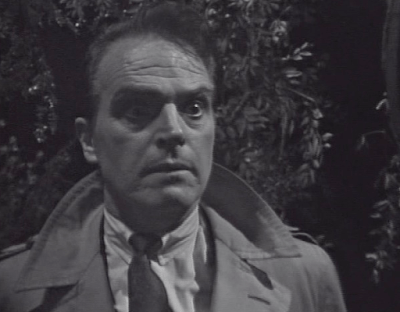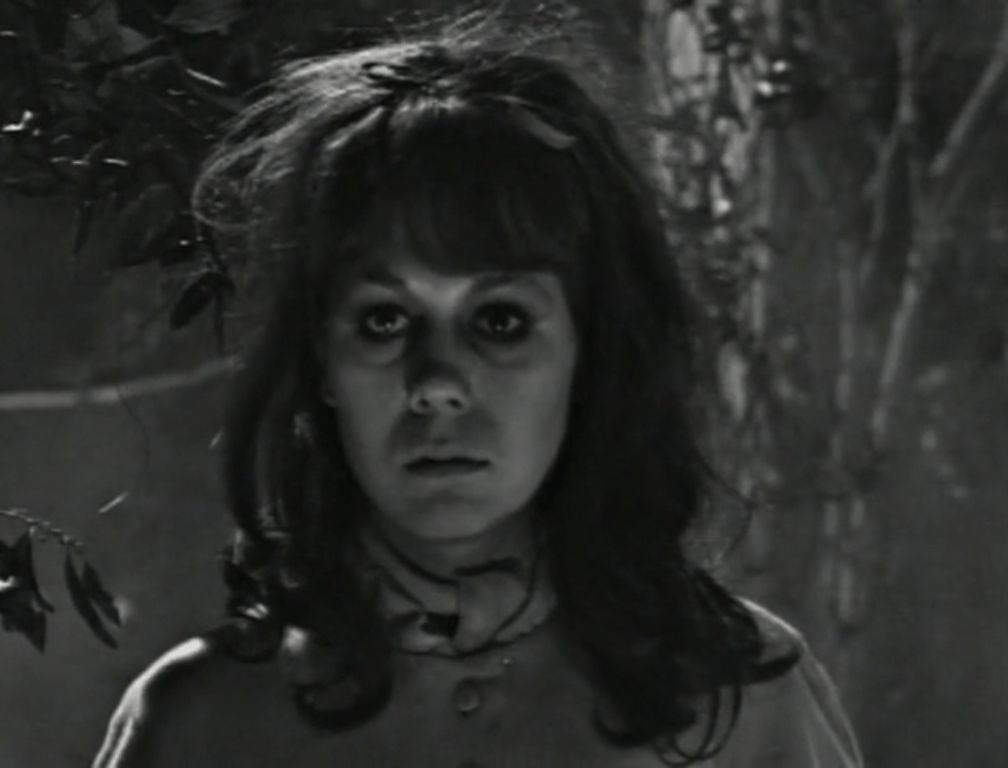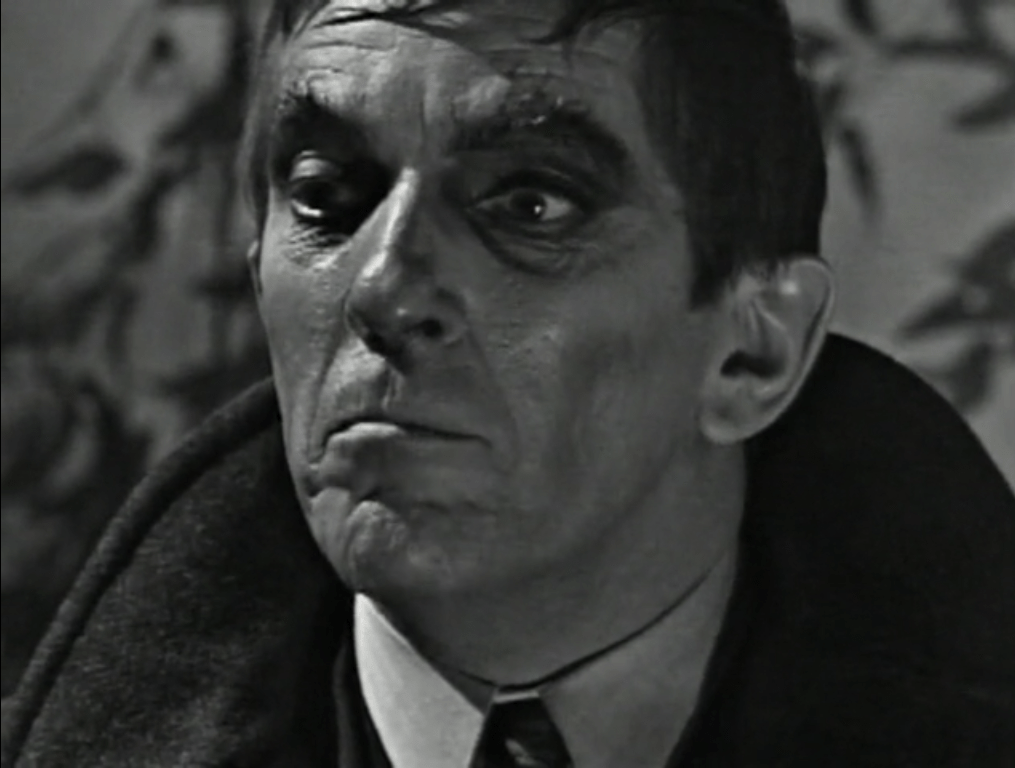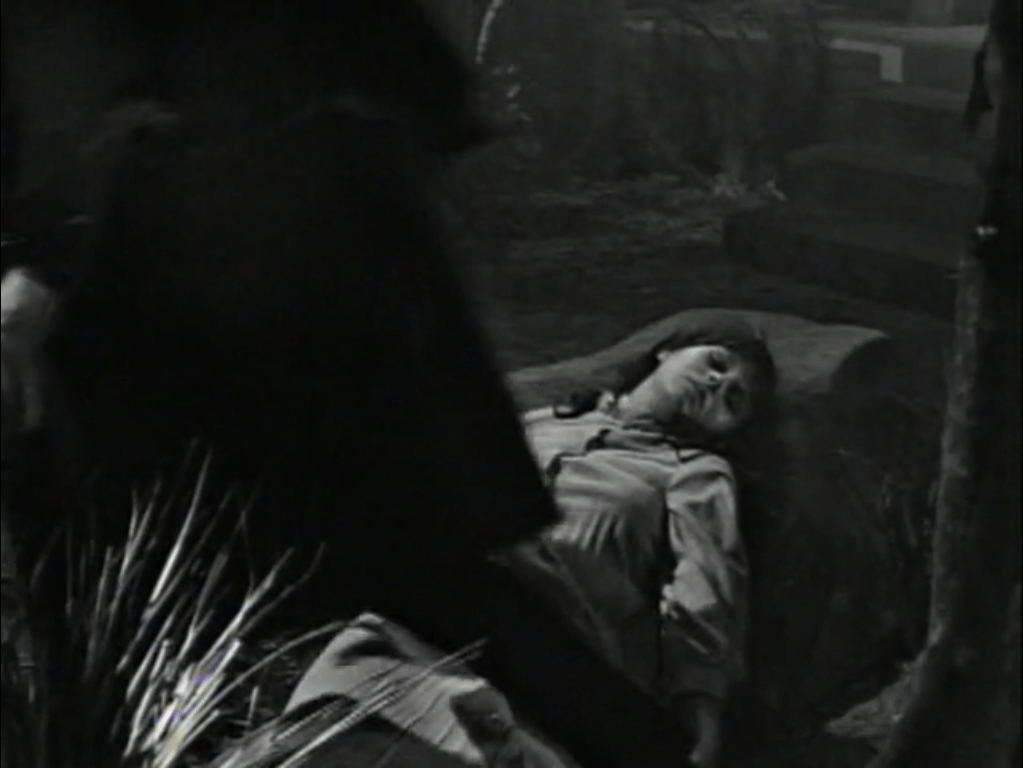
Episode 262: Hand the world over to madmen and murderers

On Thursday, reclusive matriarch Liz admitted to well-meaning governess Vicki that she is being blackmailed. Eighteen years ago, Liz killed her husband, Paul Stoddard. Seagoing con man Jason McGuire then buried Stoddard in the basement. Now, Jason is threatening to expose this secret unless Liz marries him.

Today, Liz asks Vicki to be the legal witness at her wedding to Jason. Vicki demurs, saying that she might be compelled to speak up when the officiant asks if there is anyone who present who knows why these two people should not be joined in matrimony. The conversation then shades off into Vicki urging Liz to share her secret with her daughter, flighty heiress Carolyn. Liz won’t look directly at Vicki when Carolyn’s name is mentioned.

Word is spreading that Maggie Evans, The Nicest Girl in Town, is dead. Vicki had just received that news when Liz brought up the wedding. Alexandra Moltke Isles does a fine job of expressing Vicki’s emotional tumult as she reels from one kind of shock to another. When Vicki breaks the news of Maggie’s death to Carolyn and then quarrels with Carolyn about her plan to marry motorcycle enthusiast Buzz, Mrs Isles reprises this transition from fresh bereavement to festering conflict, again quite effectively.

Carolyn goes out with Buzz, and Vicki goes for a walk on the beach with her boyfriend, Burke Devlin. Each episode begins with a voiceover which Mrs Isles delivers in character as Vicki. Typically, these consist of remarks about the sea and the weather which have some vaguely metaphorical connection to what’s happening on the show. While Vicki sits with Burke and stares out at the water, she launches into one of these monologues. In response, my wife, Mrs Acilius, started laughing so hard we had to pause the streaming. When Burke joins in with the observation that it is getting dark and “may get darker”- sometimes that happens as the evening goes on, seems to be some kind of pattern there- we both burst out laughing and had to pause it again. Before we restarted it that second time, Mrs Acilius asked “What does it say about us that we are sitting here watching this? That we choose to watch it when we’ve seen it before?” I’m not sure I want to know the answer to that one.

Vicki and Fake Shemp. Screenshot by Dark Shadows Before I Die

Vicki gets home shortly before Carolyn. Carolyn tells Vicki and Liz that after she saw Maggie’s boyfriend Joe walking down the street looking sad, she just wanted to go home and mourn. After Carolyn leaves them alone together, Vicki again urges Liz to tell her the truth. Vicki judges that Carolyn would listen to her sympathetically in the mood she is in now. Liz says she might tell Carolyn tomorrow, Vicki says that Carolyn might not be in the same frame of mind tomorrow, Liz says she can’t do it now.

In fact, Maggie is alive- her doctor decided to promote the story that she is dead as a lamebrained scheme to keep the person who tried to kill her from trying again. The blackmail plot, on the other hand, has barely shown a sign of life since it first arrived on the show ten weeks ago.

Jason is supposed to sweep away the last non-paranormal story elements left over from the period before Dark Shadows became a supernatural thriller/ horror story in December 1966. So far he has managed to disclose to the audience, but not to the other characters, why Liz hasn’t left home since the night Stoddard was last seen. That wasn’t an especially interesting question, as they have never shown us anyplace she would want to go, and it’s the only thing he has cleared up.

Another unanswered question is the one that led Vicki to come to Collinwood in the first place. She grew up in a foundling home, with no idea of who her parents were. The show has been hinting heavily that Liz is Vicki’s mother. Indeed, when Jason was brought on the show, the plan was that the grand finale of his storyline would confirm this. If that is still the plan, then the relationships among Vicki, Liz, and Carolyn are due for a drastic upheaval. That prospect lends a certain interest to the scenes among these characters today.

Closing Miscellany

This episode originally aired on 27 June 1967, the first anniversary of the broadcast of #1.

From #1 until #248, dashing action hero Burke Devlin was played by Mitchell Ryan. Ryan showed up at the set too drunk to work when they were supposed to tape #254 and was fired off the show. Today announcer Bob Lloyd tells us that “The part of Burke Devlin will be played by Anthony George.” There was never very much on Dark Shadows for a dashing action hero to do, and now that the most popular character on it is a vampire there isn’t going to be. It was only Ryan’s star quality that kept the character on the show so long.

Anthony George had appeared in feature films in the 1950s, had guest-starred in several prime-time shows, had been a regular cast member on the hit series The Untouchables, and had played one of the leads on a series called Checkmate. When the original audience saw him, many of them would have recognized him as a famous actor and would have expected the character to go on to do something important. Evidently they haven’t given up on Burke yet. But they had better come up with a story for him- George may have had a terrific resume, but he doesn’t have any fraction of Ryan’s charisma.

Unfortunately, they have given up on Buzz. He is on screen only briefly today, and we don’t see him again. Worst of all, while his first three episodes left us with the impression that he could not fail to be hilarious, he manages not to be even a little bit funny in this final appearance. He is just nasty and inconsiderate, demanding that Carolyn forget about whatever it is that’s bothering her and come to the loud party he’s planned.

Getting Buzz off the show the day Anthony George comes on as Burke does solve one problem. As of this episode, the three young women on Dark Shadows all have boyfriends. Maggie has Joe, played by Joel Crothers; Vicki has Burke, played by Anthony George; and Carolyn has Buzz, played by Michael Hadge. Those three actors were all gay. That wasn’t widely known at the time (except perhaps in the case of Mr Hadge, who really does not seem to be making an effort to keep the closet door shut while playing Buzz,) but now that everyone knows all about it, it does seem to be a sign that the show was spending a lot of energy on things that aren’t going anywhere.

Episode 256: Always choose the worst things to want

A mysterious little girl in eighteenth century garb shows up outside the dungeon cell where vampire Barnabas Collins is keeping his victim, Maggie Evans. The girl stands with her back to Maggie’s cell and sings a couple of verses of “London Bridge” over and over while tossing a ball. Maggie pleads with her to stop singing, to get away before Barnabas and his sorely bedraggled blood thrall Willie Loomis catch her, and to tell someone that she has seen her. The girl does not acknowledge Maggie in any way.

Seconds after the girl has strolled slowly away, Willie comes by the same path she had taken. Maggie is bewildered that Willie didn’t see her. She urges Willie to escape from Barnabas. Willie gives a big speech about how he thinks about escaping all the time, and that when he is in his car he has sometimes tried to keep driving. But Barnabas’ power keeps pulling him back. Regular viewers will be interested in this confirmation that Willie has a car.*

Willie’s big speech.
Screenshot by Dark Shadows Before I Die

At the great house of Collinwood, strange and troubled boy David Collins is impatient with the geography lesson his governess Vicki is trying to give him. In the first 39 weeks of the show, the only set which consistently saw interesting scenes was David’s room, where he and Vicki became friends during his lessons. They don’t have the studio space to build that set today, so this lesson is conducted in the drawing room. When flighty heiress Carolyn comes into the room, Vicki sends David to play outside. Since the interrupted lesson was about Australia, he hops away kangaroo-style.

Vicki and Carolyn talk about Carolyn’s boyfriend, motorcycle enthusiast Buzz. Buzz is a refugee from Beach Blanket Bingo, so broadly comic a figure that he might have been too silly even for the biker gang in that movie and its sequels. Unfortunately, Buzz doesn’t show up today, and Vicki and Carolyn’s conversation is a pure specimen of old-time soap opera earnestness. There is an odd moment when Vicki asks Carolyn “How far do you intend to go with Buzz?” and Carolyn answers “All the way!” At the end of the scene, Carolyn uses the phrase “all the way” again. She’s talking about her plan to marry Buzz, but “all the way” was such a familiar euphemism for sexual intercourse in the 1960s that it is hard to imagine it wasn’t intentional on some level. When Carolyn tells Vicki that she and Buzz will go “all the way” while Vicki watches, we wonder what weddings are like in Collinsport.**

David has gone to the yard around Barnabas’ house. We see a location insert of him on the swing set there. This footage is reused from #130, when we discovered that he was being watched by his mother, blonde fire witch Laura Murdoch Collins. Laura had died sometime previously, but it didn’t take.

Now, he is being watched again. The mysterious little girl from the dungeon has made her way up to the porch and calls to him as “Boy!” When he tells her his name is David, she says “I know.” She gives her name as Sarah, and asks him to play with her. They toss her ball back and forth, and he finds fault with her fondness for “London Bridge.” She says she used to go to school, a long time ago. She lives around there, but everyone she lives with went away and left her all alone. She excuses herself to go look for them. Willie then comes out of the house. David tells him about Sarah, and Willie shoos him away.

Playing catch as best you can when you’re on a tiny set, photographed in 4X3.
Screenshot by Dark Shadows Before I Die

That Sarah can come and go from the dungeon without being seen shows that she is one of the ghosts who haunt the house. David has seen several of these, but does not recognize her. Her behavior in the opening scenes leaves us wondering if she is aware of Maggie’s presence; if not, she may simply be an apparition, unable to interact with the living characters.

When Sarah meets David, not only is she able to converse with him, but her ability to play catch with him using the ball she brought with her shows that she has a physical body and that she can manipulate material objects. That makes it all the more puzzling that she did not answer Maggie. Was she ignoring her, or was she somehow less capable in the dungeon than she is on the porch?

When Sarah uses the words “a long time ago,” we suspect that she knows she is a ghost and she has been displaced to a future century. But then she becomes confused as to where her people are, and is filled with a terrible urgency to go look for them. Again it is ambiguous just what sort of being Sarah is and what she can do.

There is always a vagueness about the supernatural- if you could explain a phenomenon fully in words and measurements, it wouldn’t be in that category at all. The key to holding an audience’s attention with a story about ghosts and such is to intrigue them with questions that seem like they might have answers and to use them to lead to another, equally imponderable set of questions before the first set gets old. So it is a promising sign that Sarah is introduced while we are still asking what Barnabas can do, what he wants to accomplish, what he needs for survival, and how he got to be the way he is.

That we see David in a lesson with Vicki and then hear him talking with Sarah about how neither of them goes to school anymore is also interesting to regular viewers. Dark Shadows is just about a year old. It started with Vicki’s arrival at Collinwood, where reclusive matriarch Liz had summoned her to teach David. David and his father, Liz’ impecunious brother Roger Collins, had been living at Collinwood for about a month. Before then, they had lived in Augusta, Maine, where David went to school.

When Vicki showed up, Roger objected that he knew nothing about her, and Liz refused to tell him or Vicki how she knew that she existed or why she chose her to be David’s governess. The show has been hinting very heavily that Vicki is Liz’ biological daughter and that Liz is desperate to keep that relationship secret. It is also clear that Liz wants above all for David to grow into her idea of a male Collins, an idea to which her bratty little brother Roger does not in any way conform.

Barnabas’ plan for Maggie is a ghoulish parody of Liz’ for David. He wants to erase her personality and replace it with that of his long-lost love, Josette Collins. Over the generations since her death, Josette has become the patroness of the Collins family and the emblem of its perfect female member. And of course Barnabas is as anxious to hide the secrets in his basement as Liz is to hide those in hers. That Sarah appears to both Maggie and David emphasizes that Barnabas is a funhouse mirror reflection of Liz.

Back in the great house, David hears Buzz’ motorcycle and tells Carolyn that he is there for her. She can’t quite bring herself to tell David that she and Buzz are planning to get married, but does encourage his interest in going for a bike ride with Buzz. As she leaves, he brilliantly mimes motorcycle riding.

David gives Vicki a detailed account of his encounter with Sarah. She is disappointed he didn’t bring her home. Though it is her job to be David’s only friend, Vicki is no more enthusiastic about his isolation from playmates his own age than Willie is about Barnabas’ treatment of Maggie.

Back in the dungeon, Willie finds that Maggie has not eaten. They share a sad moment. He leaves, and Sarah reappears. Maggie talks to her. At first, she doesn’t respond. But then she turns to her and says “If you see my big brother, don’t tell him you saw me. He doesn’t like anybody to come down here.” Then she leaves, a spring in her step.

The last time a ghost spoke to an imprisoned woman was in the same house, in #126. That time, Vicki was bound and gagged and hidden in a secret room on the main floor by crazed handyman Matthew Morgan. When Matthew had gone to get an ax with which to decapitate Vicki, the ghost of Josette had appeared to her and said, in a perfectly cheerful voice,*** “Do not be afraid.” Josette didn’t untie Vicki or anything, she just told her that and vanished. Later in the episode, she and some other ghosts scare Matthew to death before he can kill Vicki. When Sarah goes away from the stunned Maggie and skips along the floor, regular viewers might remember that event and see a promise that Sarah has something up her sleeve.

Closing Miscellany

Sarah is identified in the closing credits as “Sarah Collins,” the name given in #211 for Barnabas’ sister who died in childhood. That rather blunts the surprise of her closing reference to her “big brother.”

Sarah’s identity raises a couple of other questions. Barnabas’ house was the original Collins family home, and he and Sarah would have lived there. The cell in which he keeps Maggie is covered with cobwebs, evidently a feature of the house from its beginning. When she tells Maggie that her big brother “doesn’t like anybody to come down here,” she is speaking from experience- the adults don’t like it when you go near the jail cell in the basement.

Slavery was a legal institution in Massachusetts**** until 1783, and indentured servitude under conditions not so far removed from those to which slaves were subject continued long after. The Old House has been described as a “huge mansion,” so presumably its owners would have held people under at least one of these statuses. As a Collins of the eighteenth century, Sarah’s blithe attitude towards someone held in the cell would seem to be chillingly appropriate.

Sarah’s address to David as “Boy!” when she knows his name is also interesting coming from her. To be sure, if she had called him by name before they met, he would have known right away that there was something very strange about her. Since he has seen many ghosts and knows that ghosts congregate in and around the Old House, he may have identified her as one right away.

On the other hand, during the “Revenge of Burke Devlin” storyline that ran from #1-#201, there was considerable doubt as to whether David was Roger’s natural son or Burke’s. That doubt came to a head when Laura was on the show. Laura only left 13 weeks ago, and Burke is still hanging around. As far as we know, the question may come back up, and David Collins may turn out to be David Devlin. In that case, Sarah may have chosen to call him “boy” because she is a Collins and therefore better than everyone who is not.

I posted a couple of long comments about this episode on Danny Horn’s Dark Shadows Every Day. I won’t copy them here, because they contain spoilers for people who haven’t seen the whole series. But I’ll link to them- under the post about this episode, I argued that Sarah’s introduction was the most important plot development in the entire series; and under a post about a much later episode, I wish one of the words in her closing line had been different.

*Regular viewers are interested in some weird stuff, what can I say.

**My wife, Mrs Acilius, is very much taken with the actresses’ recollections of how Louis Edmonds, who played Roger, would make them laugh so hard during rehearsals that it was sometimes difficult for them to stay in character during filming. She says it is just as well that Roger wasn’t in this episode, because there is no way they could have got through this scene if he had been.

***Provided by Kathryn Leigh Scott, who also plays Maggie.

****Maine was part of Massachusetts until 1821.

Episode 255: My fair lady

Accustomed to Her Face

Imperious eccentric Barnabas Collins wants to reinvent working girl Maggie Evans as a member of his class- genteel in manner, florid in speech, thirsty for the blood of the living. Willie Loomis does not believe Barnabas’ plan will work, but because of the nature of their relationship he of course helps him with it. Living in their house, Maggie sometimes seems to be well on her way to developing the traits Barnabas is trying to inculcate in her, but at other times protests that she will never change.

Maggie’s father Sam is a drinking man. He comes to the house today to get some cash from Barnabas. Sam doesn’t know about Barnabas’ project; his visit has nothing to do with Maggie. He is an artist, and is delivering a portrait Barnabas commissioned him to paint.

The episode ends with a musical number. Maggie is in the basement prison cell where Barnabas keeps her between elocution lessons. Through the bars of her door, she sees and hears a little girl in eighteenth century garb singing “London Bridge is Falling Down.” The girl sings an obscure variant of the song with a verse that runs “Take the key and lock her up, lock her up, lock her up. Take the key and lock her up, my fair lady.”

Falling down.
Screenshot by Dark Shadows Before I Die

Up to this point, the Barnabas story has been a mashup of Dracula with the 1932 film The Mummy. There isn’t any particular reference to vampirism today. Maggie’s neck is uncovered throughout the episode, and we don’t even see the bite marks. It’s all about The Mummy and its possible sources.

Imhotep’s attempt in The Mummy to turn Helen Grosvenor into Princess Ankh-esen-amun may have been inspired in part by George Bernard Shaw’s Pygmalion. Imhotep only has Helen in his custody for a few minutes of screen time and those minutes are so heavy with images of Egyptian antiquities, suggestions of magic, and the threat of extreme violence that they never find time for an explicit comparison.

Dark Shadows, on the other hand, keeps Maggie in Barnabas’ house for weeks and weeks, so it’s inevitable that sooner or later they would explore the connection. Thanks to Lerner and Loewe, the story of Pygmalion was very familiar to American audiences in 1967. It’s only surprising that Sam isn’t getting married in the morning, Maggie’s boyfriend Joe doesn’t tell us that he’s often walked down Barnabas’ street before, and Maggie never shouts at a race horse to move its bloomin’ arse. Considering the alarmingly awkward movements people in Collinsport make when music is playing, there was never any prospect she could have danced all night.

Just You Wait

Maggie uses the word “undead” to describe Barnabas. The first time we heard that word on Dark Shadows was in #183, when parapsychologist Dr Guthrie told blonde fire witch Laura Murdoch Collins that he believed her to be “the undead.” Though Laura’s story owed many structural elements to Bram Stoker’s Dracula, not least Guthrie’s own depiction as a Van Helsing-like figure, she was not a vampire. So “undead” is not simply a euphemism for “vampire” on this show, though it is true they will avoid saying “vampire” until Barnabas’ 41st week.

Regular viewers who find a reminder of Laura in the word “undead” will be especially interested in today’s ending. When Laura was first on the show, she was a vague presence. There were indications that she wasn’t so much a person as she was a whole collection of phenomena, some of them physical, some of them purely spectral, each of them with its own purposes. As Laura became more dynamic, those phenomena resolved themselves into the deadly fire witch and her adversary, the benevolent ghost of Josette Collins.

Like Laura, Barnabas seems to have stirred up numerous uncanny forces with his arrival. The clearest indication of this so far has been the howling of dogs when he is forming an evil plan, a howling which is not related to his physical location and which, often as not, hampers his efforts. There have also been some shenanigans with the doors in his house which don’t seem to have a natural explanation and which he wouldn’t have had a motive to arrange. The appearance of the mysterious girl* suggests that this time, the antagonist will pull a whole new cast of characters out of the supernatural back-world behind the main setting of the show.

*The girl is a lot less mysterious than she ought to be, since the closing credits identify her as “Sarah Collins.” That’s enough to tell even first-time viewers that she is a member of the ancient and esteemed Collins family that is at the center of the show. It gives more away to regular viewers. The tomb from which Barnabas emerged has marked graves for his parents, Joshua and Naomi, and his sister, Sarah, who died in childhood.

And right before Sarah appears, Barnabas was looking at Josette’s portrait. From #70 to #191, that portrait would glow when the ghost of Josette was about to do something. So if we didn’t know her name, we might think that the girl was an ally Josette had recruited, or perhaps Josette herself in a different form than the adult ghost we have seen before. That in turn would send us into the weekend speculating about the ghostly adversaries who might be lining up to oppose Barnabas. Giving the name, even to viewers who’ve forgotten about Barnabas’ sister, limits our speculations to possible one-on-one confrontations.

Episode 254: As much fun as a bag of spiders

Reclusive matriarch Liz and well-meaning governess Vicki are in the drawing room of the great house of Collinwood. Liz is depressed because her daughter Carolyn is dating motorcycle enthusiast Buzz. She asks Vicki if she has any idea how to break Carolyn and Buzz up, then answers her own question. Liz knows that Carolyn is protesting her engagement to seagoing con man Jason McGuire, and that only by breaking it off with Jason can she change things with Carolyn.

When Liz claims that she is marrying Jason because she wants to, Vicki says it’s none of her business. Vicki has seen abundant evidence that Jason is blackmailing Liz, and won’t pretend she hasn’t. She manages to be quite respectful to her employer without backing down an inch. Despite herself, Liz is impressed with Vicki’s firmness and diplomacy.

Alexandra Moltke Isles was cast as Vicki because she and Joan Bennett looked so much alike, and this is one of the scenes that uses their resemblance to show Vicki as a reflection of Liz. As Vicki is finding tactful ways to express her suspicions, she says things that we have heard Liz say and that we know she is thinking. Each time she does so, Joan Bennett does a quarter turn one direction from the shoulders and a quarter turn the other direction from the neck, as if she were being twisted open. When Liz tells Vicki to stop, she calls her “Victoria,” a name we haven’t heard her use since 1966, and when Vicki asks permission to leave the room she responds, in a near-whisper, with the usual “Vicki.” This alternation also suggests twisting, and to regular viewers who remember that Liz has a secret connected with the fact that “Her name is Victoria” it is another twisting open.

Meanwhile, Jason is entering the Blue Whale tavern with his former henchman, Willie Loomis. Jason wants to confront Willie with the fact that he saw him in town earlier in the day selling a piece of jewelry. Willie says that he was selling it on behalf of his employer, wealthy eccentric Barnabas Collins. Jason knows of Willie’s obsessive fascination with jewels and his tendency to steal them, and does not believe that Barnabas would entrust him with such a task. What Jason does not know is that Barnabas is a vampire and Willie is his sorely bedraggled blood-thrall. As such, Barnabas has a power over Willie that makes it rational to entrust the most remarkable tasks to him.

Carolyn and Buzz enter. They almost leave when Carolyn sees Jason and Willie. Jason and Willie rise and meet them at the door. Jason assures Carolyn that they were just going. Before they do, he taunts Carolyn with his engagement to Liz.

On Tuesday, Carolyn and Buzz started dancing together in the drawing room. Buzz made a few very graceful moves, saw Carolyn going into the Collinsport Convulsion, and sat down to observe. Today, Buzz sees two background players twitching awkwardly while the jukebox plays and declines Carolyn’s invitation to join her on the dance floor. He wants to stop drinking, saying that he is looking for something that will make him feel like he’s never lived before, while “drinking only makes you feel drunk.” It sounds a little bit like he’s going to offer Carolyn a drug stronger than alcohol, but by the end of the scene he just wants to get back on his bike. Liz’ fears to the contrary, Buzz seems pretty darned wholesome.

While Carolyn and Buzz are on their way out of the tavern, hardworking young fisherman Joe comes in. Carolyn asks Buzz to wait outside while she talks with Joe. Buzz reluctantly agrees to spend a few minutes alone with his bike.

Carolyn and Joe were dating when the show started, and there was a whole storyline about how they were tired of each other and couldn’t get themselves sufficiently organized to break up. Their scenes together reminded us that the 1960s were the decade in which Michelangelo Antonioni used the cinema to explore the nature and significance of boredom.

But they are far from boring today. After he and Carolyn finally called it quits, Joe started seeing Maggie Evans, The Nicest Girl in Town. Maggie is now missing and feared dead. Carolyn sits next to Joe at the bar and expresses her sympathies. When I say that Nancy Barrett’s acting style was to throw herself unreservedly into whatever the script gave her character to do that day, it may sound like I’m saying she was undisciplined or that she lacked subtlety. That is not at all what I mean, and in this scene she does one of the most delicate drunk acts I’ve ever seen. Carolyn sits a fraction of an inch too close to Joe, tilts her head back a fraction of a degree too far, opens her eyes the tiniest bit too wide, and speaks ever so slightly too slowly. No one of those signs would even be noticeable by itself, but together they make it very clear why Buzz was anxious that he and Carolyn should leave their drinks unfinished.

Back in the drawing room, Jason is badgering Liz into setting the date for their wedding. Carolyn and Buzz come back, and Jason tells them he and Liz will be married two weeks from tonight. Carolyn says that she and Buzz ought to get married the same night. Buzz is delighted when she first says this, and is still smiling when she insists she is being serious.

Buzz delighted with Carolyn’s proposal.
Screenshot by Dark Shadows Before I Die

My wife, Mrs Acilius, urged me to call this one “A piece of that action,” something Jason says to Willie. Trekkie that she is, that seemed irresistible to her. But Joe’s line that Buzz seems to be “about as much fun as a bag of spiders” is the funniest of the many witty lines in today’s script, and when you remember that Dark Shadows has, since December of 1966, been basically a horror story, you have to think that in its terms a bag of spiders might be a lot of fun. So that had to be the title.

Episode 245: Microscopic views of hideous malignancies

Two of the best blogs about Dark Shadows share the same web address. One is Dark Shadows Every Day, a series of more than a thousand well-crafted, insightful, often hilarious essays by Danny Horn about episodes #210 through #1245 and related topics. The other is the group blog that Danny’s readers maintain in the comment threads under each of his posts. The commenters outdid themselves in their remarks on Danny’s post about this episode.

At the beginning of the episode, addled quack Dr Woodard has figured out that the two victims of vampire Barnabas Collins, sorely bedraggled blood thrall Willie Loomis and missing local girl Maggie Evans, have something in common. He hopes that if he can compare a sample of Willie’s blood with Maggie’s he will figure out what that is. Willie is terrified that this will lead to the exposure of Barnabas. Puzzlingly, Barnabas is unworried and orders Willie to cooperate. Only after Willie has given the blood and the doctor has left do we learn that Barnabas switched Willie’s sample with a normal one. “DS Willie” comments:

Barnabas is seriously messing with Willie’s mind in this one. So much of what Barnabas says has double meanings, even triple. Of course he’s playing with Woodard too, but Woodard never realizes it.

For one thing, just after Willie’s blood is taken, Barnabas makes creepy blood comments, ending with “…surrendering your utmost self” and his next line “Now, you had no choice.” I suspect this is all meant more for Willie than for the doctor. Willie had no choice but to surrender his utmost self.

Barnabas delights in repeatedly demonstrating his control over Willie, all to the doctor’s approval. When Willie flares up momentarily at Dr. Woodard’s remark about understanding being frightened, Barnabas immediately brings Willie to heel with a harsh word and harsher look.

Later Barnabas jerks Willie’s chain some more, just because he can, and to tighten his control even more. It’s classic Stockholm syndrome type stuff. The victim is abused and in absolute fear for his life, and yet any lessening of the captor’s threats or violence can be perceived as mercy, bonding the victim to his captor.

His shirt in Barnabas’ menacing grasp, Willie swears he would never, never betray Barnabas. He is only thrown to the ground instead of being choked or beaten. Barnabas proceeds to make Willie feel stupid and disloyal and dishonorable and undeserving of future protection. Add enthrallment on top of that. Oh, and the police having Willie as their top suspect, and Jason having beaten and threatened to kill Willie, even though Willie was trying to protect him.

It is actually pretty amazing that Willie has held up under the strain. He is in full-on survival mode, and yet still has the decency to try to shield Maggie and others insofar as he can, given his powerlessness.

Hey, what was up with Barnabas saying Willie’s blood is a “delicate little flower painted on glass”? He says it twice (once to Woodard and once to Willie) while looking directly at the slide. That doesn’t come across as a remark about blood in general.

“DS Willie,” on Dark Shadows Every Day, 13 October 2018 at 12:38 AM Pacific time

He adds another comment:

Oh. Barnabas was using yet another method to get Willie under his thumb: verbally emasculating him with the “delicate little flower” reference to Willie’s blood on the slide. But I think Willie was so relieved that he missed the diss.

“DS Willie,” on Dark Shadows Every Day, 26 December 2018 at 5:57 PM Pacific time

I made a contribution of my own to the thread. In response to Danny’s unfavorable comparison of Dr Woodard with Bram Stoker’s Professor Van Helsing, I commented:

Screenshot by Dark Shadows Before I Die

I don’t think Woodard is Van Helsing at all. He’s Dr John Seward, treating Lucy and Renfield and baffled by the whole thing until he calls in his brilliant old professor. The mysterious Hoffman, one of the best men in the field, that’s the expert who is going to shake things up.

Seward is young, dynamic, and ready for adventure, while Woodard is middle aged, pudgy, and ready for an afternoon tee-time at the local country club. But that change is necessary. Readers of the novel have plenty of time to think about the sort of group that might go on the expedition Van Helsing organizes, and will expect a bunch of high-spirited youths. On a soap, a character like Seward would be the heroine’s new love interest, and Dark Shadows is flailing about trying to figure out what to do with the love interests Vicki and Maggie have now. The last thing they want right now is another bold, handsome young man who is apparently under a vow of celibacy.

“Acilius,” on Dark Shadows Every Day, 19 May 2023 at 7:26 PM Pacific time

In response to Danny’s remark that Jonathan Frid’s bobbles make it hard to guess what lines the script originally gave vampire Barnabas Collins, commenter “TD” replies:

#1. “Now, in a way, isn’t that understandable?

#2. “After all, blood is the life force.

#3. “It reaches into the deepest recesses of both the heart, and the brain.

#4. “It is the familiar of our complete being.

#5. “To surrender even one drop of it is to suggest a partial surrender of one’s utmost self.”

I’m not so sure this is actual Fridspeak. Yes, it’s kind of gibberishy, but it does make grammatical sense and some sort of syntactical sense. Frid delivers it smoothly and with confidence, unlike his halting fumblings when he can’t remember his lines. When he says this, it’s in a close-up shot, and he’s looking down. My guess is that he is reading it directly from a script. Also, this is Joe Caldwell’s first script (or first credited script–he did some writing on earlier Ron Sproat scripts, if another website is accurate). Maybe this is Caldwell exhibiting the enthusiasm of a first solo outing. Dr. Woodard has a couple of hi-falutin’ and rhetorically “poetic” (and gibberishy) speeches of his own in this episode.

Also, might this episode be marked as the first one to demonstrate the “reluctant” or “sympathetic” vampire in Barnabas’s character? In this episode (in another speechy series of lines), when Dr. Woodard and Barnabas are discussing the “madman” who broke into Woodard’s office and stole the blood sample, we get this exchange:

Dr. Woodard: You know, it’s the peculiar magnificence of the human spirit that’s required to provide the potential for such corruption. [See? This is like the Barnabas “blood is the life force” speech–who talks like this???]
Barnabas: Yes, I know what you mean. Whoever he is, he must certainly be, at one and the same time, more than a man…and less than a man.
Dr. Woodard: You seem almost sorry for him.
Barnabas: Sorry? No, I’m not sorry. The truth is, I loathe him. I loathe him very, very deeply.

“TD” on Dark Shadows Every Day, 2 June 2017 at 11:06 AM Pacific time

I agree with “TD” that today’s dialogue is marred by purple passages; I would go so far as to say that none of the lines would have survived a rewrite. Not among the lines delivered by the human actors, anyway- our beagle was fascinated when the hound howled on the soundtrack.

I should mention that at least one perceptive critic of Dark Shadows disagrees with me and “TD” about the script. Patrick McCray’s Dark Shadows Daybook is in its own way the equal of the two blogs at Dark Shadows Every Day. Patrick wrote two posts about this episode. In one from 2016, he wrote that “The language is poetic and evocative. Barnabas has moments of self-loathing and ambiguity that are gorgeously, hauntingly phrased, and the same can be said for Woodard’s exploration of science and mystery.” In 2019, he went so far as to call it “the best written episode of the series.”

John and Christine Scoleri also include some interesting material in the post about this episode on their recap-heavy blog Dark Shadows Before I Die. I particularly liked the series of screenshots at the end of the post captioned with some of the purple prose from today’s dialogue.

Episode 237: Seemingly dead

Maggie Evans, The Nicest Girl in Town, has gone missing. The audience knows that she is in the keeping of vampire Barnabas Collins and Barnabas’ sorely bedraggled blood thrall Willie Loomis, but the show isn’t ready for any of the characters to get suspicious of Barnabas. So today is taken up with people bemoaning their ignorance of Maggie’s whereabouts.

To keep from stumbling upon information that might advance the plot, the sheriff and the doctor have to be idiots, and they both get particularly embarrassing scenes today. Not only does a frequently caustic commentator like Danny Horn mock them, but even the recap on the Dark Shadows wiki takes some potshots at their stupidity. It cites, as the sheriff’s most brilliant insight, that if Maggie is no longer where she was last seen, she “either got out… herself or was taken out by someone.” And it points out that the doctor goes on at length about the absolutely unique nature of Maggie’s ongoing illness, only to be reminded that Willie exhibited exactly the same symptoms a few weeks before.

Our point of view character in the first months of Dark Shadows was well-meaning governess Vicki. The other day Vicki received a phone call about Maggie from Willie, with whom she had spoken minutes before and who was not disguising his voice in any way. Somehow she failed to recognize him. They bring this up again today. They don’t replay the call, and she says that the voice was “muffled,” so people watching for the first time may not bracket her with the sheriff or the doctor among the show’s dum-dums. Regular viewers, however, will see further reason to despair that the characters will learn enough any time soon to get the story going again.

Seagoing con man Jason McGuire goes to Barnabas’ house and calls on Willie, who was originally his henchman. Jason is worried that Willie is attracting official attention, something which cannot be good for his own nefarious purposes. He refers to Barnabas as “His Nibs,” a phrase indiscreet housekeeper Mrs Johnson had applied to Jason himself in #185, and demands Willie leave town. Willie tells him he can’t do that. Willie threatens Jason with a hammer. Jason disarms Willie and beats him to the floor. As Jason leaves the house, he is surrounded by howling dogs and looks frightened.

Screenshot by Dark Shadows Before I Die

Episode 234: The people who inspire the questions

We open with the sight of sorely bedraggled blood thrall Willie Loomis broken and crumpled on the floor of the Old House on the estate of Collinwood. He is under the heavy cane which vampire Barnabas Collins carries and which he uses to beat Willie. Barnabas demands Willie confess that he played a part in preventing him from taking full possession of Maggie Evans, The Nicest Girl in Town. Willie at first tries to deny his responsibility, but finally swears that he won’t disobey Barnabas again. Barnabas gives him some orders and dismisses him.

Willie under the Willie-beater. Screenshot by Dark Shadows Before I Die

At the Evans cottage, Maggie is sick in bed. When her friend, well-meaning governess Vicki, comes to sit with her, she makes Vicki promise she won’t leave her alone no matter what she says or does. She won’t even let Vicki go as far as the kitchen to fetch her a glass of milk- she doesn’t dare spend one second by herself.

Maggie’s father, artist Sam, has called Vicki because he himself has had to go to the Old House to work on the portrait he is painting of Barnabas. He is working on some problems in the background, and encourages Barnabas to take a walk. While Barnabas is away, Willie comes into the room and asks Sam where he is. Sam is concentrating hard on his work and responds to Willie’s questions with irritated grunts.

When Willie asks Sam how his daughter is doing, Sam turns to him and angrily snaps “Don’t mention her name!” He didn’t mention her name, but he was very rude to Maggie more than once in the days before he met Barnabas, when he was still dangerously unstable ruffian Willie Loomis. In #207, Willie was so crass in his behavior towards Maggie and Sam in The Blue Whale tavern that dashing action hero Burke Devlin had to beat him up and order him to leave town, the incident that prompted Willie to launch the grave-robbing expedition that released Barnabas. Sam was unhappy to see Willie again at the end of #222. By #225/226, he was willing to tell Burke that Willie had reformed, but that doesn’t mean he wants him to have anything to do with Maggie.

Of course, Maggie has already become Willie’s colleague, Barnabas’ second blood thrall. That’s the point of showing us the results of the beatings Barnabas inflicts on Willie. We’ve known Maggie for over 46 weeks and have liked her the whole time, so the idea that she is on her way to suffer that kind of abuse horrifies us. Willie’s determination to help Maggie, asking Sam about her even after the beatings, shows us how much he wants to spare Maggie the fate that has befallen him.

Back in the Evans cottage, Maggie has had another mood swing. These are familiar to readers of Bram Stoker’s Dracula, where the vampire’s victims Lucy and Mina are at one moment desperate to be rescued from him and at the next equally desperate to go to him. Maggie has been displaying these swings for several days now, and it is only because Kathryn Leigh Scott is a highly trained actress with a big bag of tricks that the scene where she demands Vicki leave is not painfully repetitious. My wife, Mrs Acilius, was particularly impressed with the way Maggie enunciates the word “leave” in her commands to Vicki.

Dogs make alarming noises near the french windows, sending Vicki into a state of panic. Maggie denies that she hears them at all. When the windows rattle and it seems that a pack of fierce dogs are about to burst in, Vicki runs to the next room to telephone Burke. When she is out, the door to Maggie’s room slams shut and Vicki finds that she is unable to open it.

Some wonder why Vicki goes to the next room to make her call when there is a telephone next to Maggie’s bed. Maggie used it to make a call in #225/226, and it was prominently featured in several shots in #231. I think it makes sense, though. Maggie is between Vicki and that telephone, and she is being extremely uncooperative. Vicki doesn’t want to take the time to fight her, she wants to call for help at once. Besides, Vicki is so terrified that we wouldn’t expect her to look around, and she has used the telephone in the other room before.

Others might wonder why she calls Burke rather than calling the police. Considering what we have seen of the Collinsport sheriff’s office, I don’t think this is a difficult decision to defend. Vicki tried to call the sheriff from the Evans cottage the other day, and no one was there to answer the phone. Nor have they managed to solve any of the crimes that have been committed on the show so far, even though the perpetrators left so much evidence lying around that Vicki herself, while going about her business, has accidentally stumbled on the solutions to one murder and two attempted murders.

The final shot of the episode, with Vicki banging on Maggie’s door and pleading with her, is not very compelling, and brings a wince to the faces of viewers who remember #84-#87, when Vicki was locked in a room in an abandoned part of the great house of Collinwood and spent several hundred hours of screen time* banging on the door and calling for help. Today’s ending isn’t exactly a Dumb Vicki moment, but it certainly isn’t an interesting moment, and we hope there aren’t any more like it.

*An approximation. It seemed like at least a thousand hours, but since the whole story played out in three and a half episodes lasting 22 minutes each I don’t suppose it could actually have been quite that long.

Episode 233: Very clever girl

Well-meaning governess Vicki and flighty heiress Carolyn are in the drawing room of the great house of Collinwood talking about how nervous the electrical storm outside is making them. Vicki describes her reactions while driving a car a few moments before. This deepens a mystery that opened yesterday- what car? They’ve so often made a point of having Vicki ask to borrow Carolyn’s car, or accepting rides from people, or catching the bus, or walking much further than people thought was sensible that you’d expect them to have mentioned something if she got a car of her own.

The lights go out, and the women get even more nervous. A figure appears in the doorway and frightens them. They are relieved to discover that it’s just cousin Barnabas. Barnabas is getting to be such a familiar presence that one suspects they might have been relieved to see him even if they knew he is a vampire.

Barnabas looks out the window at the storm and talks about how fierce the storms are on the hilltop Collinwood occupies. He mentions something we haven’t heard about for months, the “Widows’ Wail.” The wind makes a peculiar sound as it blows over Widows’ Hill, and there is a legend that it is really the disembodied voices of the widows whose menfolk died on the fishing boats of the cruel Collins family. We heard the sound effect several times in the first ten weeks of the show, and the legend often came up in those days.

Barnabas then goes on at great length about a woman who leapt to her death from the cliff on Widow’s Hill well over a century before. He makes it clear that the woman was alone with her lover, then describes particular words and gestures in such detail and with such feeling that only the lover himself could provide them. He assures the women that “every word” of his account is true, including the parts about the woman unable to face a future in which she would be transformed into something she found intolerable, the lover putting his lips on the woman’s neck, her growing faint as a result, her finding a last burst of energy to fling herself to death on the rocks below, and her body found bloodless, but with a look of serenity on her face.*

Carolyn was on edge to start with, and the story deepens her anxiety. She excuses herself to go to bed. Vicki was even more anxious than Carolyn before Barnabas started his tale, but as he goes on her fear vanishes. She tells Barnabas that she wonders if there is a connection between the “bloodless” body and the recent incidents of blood loss involving cows, Barnabas’ servant Willie, and Maggie Evans, the Nicest Girl in Town. Barnabas reminds her that his story took place in an earlier century. She says she knows that, but that she is thinking that the ordinary logic of the natural world may not be enough to solve the ongoing mysteries. Regular viewers will remember that Vicki has had extensive experience with the paranormal, and have been expecting her to be the first to consider the possibility that Willie, Maggie, and the cows have encountered something that is not subject to the same laws that describe ordinary phenomena.

Vicki updates Barnabas on her thinking. Screenshot by Dark Shadows Before I Die

Barnabas squirms, and at one point drops his “cousin from England” mask altogether. As Vicki is explaining her thinking, he says in a bland voice that she is a “very clever girl” and should be careful lest the same thing happen to her that happened to Willie, Maggie, and the cows. Then he looks up and starts to walk away from her, leading to an ominous music sting and a commercial break.

After the break, we see that Barnabas is still in the drawing room with Vicki. She looks startled, and asks him what he meant by his remark. He says that he merely meant that whatever happened to them might happen to anyone. If that is intended to retroactively veil his unveiled threat, it fails miserably- it sounds even more menacing.

Among the representatives of the show’s supernatural back-world whom Vicki has already met, none is more important than the ghost of Josette Collins. The woman Barnabas is describing threw herself to her death off Widow’s Hill in a previous century while wearing a white dress, as Josette did. Other women have jumped from there in the years since, but Josette is still the most famous. When Maggie’s father, artist Sam Evans, saw the portrait of Josette in #185, he asked if she was the lady who went over the cliff. Vicki’s excited reaction to the story suggests that she thinks Barnabas might be talking about Josette.

If he is, it is a major retcon. When we first saw Barnabas in the Old House in #212, he told strange and troubled boy David Collins that she was “our ancestor,” meaning a forebear both of David’s branch of the family and of “the original Barnabas Collins,” that is, himself. After David left, he told the portrait that the house was his now, and that the spirits of his father Joshua and of Josette have no more power there. When he refers to Josette as his ancestor and brackets her with his father, he implies that she sided with his father against him. Since we know that Joshua’s wife, Barnabas’ mother, was named Naomi, and that Josette’s husband was named Jeremiah Collins, the likeliest explanation of these lines would be that Josette was Barnabas’ grandmother. Just a few weeks later, they seem to have reinvented her as his lover.

Barnabas’ story is also a bit of a departure from the usual depiction of vampires. Bram Stoker’s Dracula may have been a revenant form of Vlad III of Wallachia, but he doesn’t mope around obsessing over the good old days in the fifteenth century when he could stay up all day impaling people to his heart’s content. He is entirely focused on the task before him. Dracula’s colleagues in film and on stage had likewise tended to be killing machines, not given to nostalgia or introspection.

Barnabas’ claims to be a devotee of the late eighteenth century have so far been a technique for shifting the conversation from current events, of which he is after all comprehensively ignorant, to the deep past, in discussion of which he can show that he knows so much about the Collins family that he must be a member of it. Even when he gets carried away, as in #214 when he was telling Vicki about the construction of the Old House and started laughing maniacally about the word “death,” it’s a reminder that the events he is talking about seem quite recent to him, since he emerged from his coffin not long ago. But today, he seems to be brooding over the past in a way that has less to do with previous vampires than it does with the character Boris Karloff played in The Mummy (1932). Indeed, Jonathan Frid’s voice and movements are so strongly reminiscent of Karloff that one wonders if Barnabas will turn out to be a merger of Dracula with Imhotep.

Seagoing con man Jason McGuire enters. Vicki hates Jason, who is flagrantly blackmailing reclusive matriarch Liz. She likes Barnabas, but the encounter with him is getting extremely awkward. She quickly excuses herself to go to bed. When Barnabas says that he too must be going, Jason insists that he stay.

Barnabas’ reaction to Jason is pretty funny. When Jason says he wants to discuss something with him, Barnabas tenses and rolls his eyes. Suddenly the drawing room is the scene of a drawing room comedy, and Barnabas is the classic snob forced to deal with an uncouth bounder. For regular viewers, their scene is not just a well-played, if not particularly well-written, specimen of this genre. Barnabas is the latest of the supernatural beings who have been driving the action of the show for six months, while Jason is a throwback to the days when Dark Shadows was a noir-ish crime drama centered on the search for Burke Devlin’s fountain pen. Barnabas’ disdain for Jason mirrors our lack of interest in reviving that phase of the show.

Jason reveals to Barnabas that he had seen Willie earlier that night, that he suspects Willie is involved somehow in the troubles afflicting Maggie, and that he knows Willie has been visiting Eagle Hill cemetery. All of this is unsettling to Barnabas. He goes home to the Old House on the estate, shouts “Willie!,” and raises the cane he had earlier used to give Willie a severe beating.

*John and Christine Scoleri transcribe Barnabas’ whole story in their post about this episode on their Dark Shadows Before I Die.

Episode 230: Some explaining to do

The Body in Question

Dark Shadows has been a supernatural thriller ever since the ghosts of Josette and the Widows scared Matthew Morgan to death in December 1966. But today’s episode is the first one that is structured like a horror movie.

Horror movies tend to focus on the visible damage done to the bodies of the female victims of the monster. The current victim is Maggie Evans, The Nicest Girl in Town, and the monster is vampire Barnabas Collins. We open with Maggie’s father, artist Sam Evans, looking helplessly around the house. Sam doesn’t know it, but Maggie was compelled to leave by the power that Barnabas has gained over her by drinking her blood.

What Sam does know is that Maggie was in extremely poor health. He cannot understand how she could have gone anywhere under her own power. We then see Maggie looking awful and wandering around the graveyard. Later, a closeup of a professional headshot of actress Kathryn Leigh Scott will dissolve into an image of Maggie among the tombstones, contrasting her usual fresh-faced beauty with her present ghastly haggardness.

Maggie’s professional headshot
The dissolve
Bride of the monster

The monster who has reduced her to this sorry state, vampire Barnabas Collins, emerges from the fog. Barnabas has been on the show for four full weeks now, but this is the first time we see his face not in the pleasant disguise of a wealthy gentleman visiting from across the sea. He is wearing a more extreme version of the makeup Maggie has on, and his fangs feature prominently. This is the introduction of the monster, a key element on any horror film, and it suggests that Barnabas is now what Maggie will become.

Barnabas inspects Maggie
Two of a kind?
Fangs on display.
Screenshot by Dark Shadows Before I Die

When Barnabas hears Maggie’s friends approaching before he can complete his evil plan, he drops her on the ground and steps over her, again treating her body as a thing.

Barnabas steps over Maggie

After she is carried home, Maggie moans about her pain but can say nothing about what has happened to her, who is responsible for it, or what she is thinking. Again, we can connect only with her physical being, not her social relations or her inner life or the events that have involved her. At the end, the handkerchief tied around her neck is removed without her permission or objection, as if she were inanimate. The camera zooms in on open wounds on her neck, isolating that area and leaving us with the image of the wounds as things available to us to examine apart from Maggie’s personality or the rest of her body.

The Source of the Evil

The episode is an adaptation of elements from Bram Stoker’s Dracula. Early in that novel, the vampire’s victim Lucy rose from her sickbed and wandered off to a graveyard. As Lucy is found by her friend Mina, so Maggie will be found by her friend, well-meaning governess Vicki. As Mina would spend the second half of the novel as the only female member of a group of stalwart and dynamic men doing battle with the evil Count, so Vicki is working with an otherwise all-male search party led by dashing action hero Burke Devlin. As Mina’s colleagues exclude her from their activities and thereby come close to total failure, so the men leave Vicki behind in the Evans cottage to wait by the phone, only to find that she is the one who will have the most to offer when she joins them in the field.

After Lucy dies and her undead form is destroyed, Mina becomes Dracula’s victim. Mina ends up as the precursor of the “Final Girl” in the mad slasher movie, playing a key part in Dracula’s final defeat, though unlike those movies Dracula ends with a successful team effort.

Since Vicki has been our point of view character from the beginning, was an effective protagonist in the “Phoenix” storyline, and is as relentlessly wholesome as the Final Girl typically is, we might expect that she will be Barnabas’ last victim. That expectation in turn suggests that Maggie, like Lucy, will die, rise as a vampire, and be destroyed by those who love her most. Maggie is one of every viewer’s favorite characters, so the prospect that she might turn into a monster and then leave the show altogether brings keen suspense.

Barnabas Beats His Willie

Vicki does have two important conversations with sorely bedraggled blood thrall Willie Loomis while she is in the Evans cottage. The first occurs when Willie comes to the door to bring a message that his master Barnabas will not be available at the usual time to sit for the portrait Maggie’s father is painting of him. Vicki tells Willie that Sam is out searching for Maggie, and Willie becomes very upset to learn that Maggie is missing.

The second conversation comes a few minutes later, when Willie, not disguising his voice in any way, telephones the Evans cottage and tells Vicki that Maggie is in the cemetery and that she is in extreme danger. Somehow Vicki doesn’t recognize his voice. I suppose there were lots of people it might have been- maybe it was Detective Mary Beth Lacey’s husband Harvey from Cagney and Lacey, or Stefan from Daughters of Darkness, or Jock Porter from Love is a Many Splendored Thing, or Geoffrey Fitton from the original Broadway cast of All in Good Time, or any of dozens of policemen and criminals who were in single episodes of cop shows in the 1970s and 1980s.

Willie’s call to Vicki made me wonder about the extent of Barnabas’ powers. When we first saw Barnabas with Willie, his power over him was so extreme that it cost Willie a great effort even to ask Barnabas an unwelcome question, and a look was enough to drive Willie to scurry off and perform the most hateful of tasks. An act of defiance like this was out of the question. Perhaps Barnabas can only keep one blood thrall under total control at a time, and by adding Maggie to his diet he has weakened his hold over Willie.

Willie intrudes on Barnabas’ encounter with Maggie in the cemetery to warn him that Maggie’s friends are on their way. Barnabas instantly suspects that Willie told them where to look for her. When Vicki’s party arrives in the cemetery, Barnabas and Willie run away and hide in the back room of the Collins family tomb where Barnabas was trapped for about 170 years until Willie accidentally released him. This is a departure from Dracula– the Count would have attacked whoever interrupted him, no matter how many of them there were, and fled only if they were armed with crucifixes or consecrated communion wafers or other objects he couldn’t tolerate. But, as my wife Mrs Acilius pointed out, Barnabas has gone a long time without using his vampire powers, so he’s probably rusty.

Barnabas and Willie listen as Burke looks around the outer room of the mausoleum. Once they are sure he is gone, Barnabas confronts Willie with his suspicions. Willie’s lies do not satisfy him, and he lifts his heavy cane and starts beating Willie with it. All we see of this beating is Jonathan Frid’s face and the cane in his hand, but those images, coupled with sound of John Karlen’s cries, imply a violence that shocks us.

In the secret room.
Screenshot by Dark Shadows Before I Die

Closing Miscellany

Burke picks Maggie up off the ground, grunting audibly as he does so. He carries her into her house, again with a lot of grunting. If I had been Kathryn Leigh Scott’s agent, the production staff would have received a very hot letter about that grunting. The good-looking young women on a soap opera aren’t supposed to weigh anything at all, certainly not enough to cause a dashing action hero to grunt like that even if he carried her all the way from the cemetery.*

In his post about this episode, Danny Horn has some lines about the ineffectiveness of the Collinsport police that I can’t resist quoting:

Sam tells the Scooby gang that he’s alerted the police — the sheriff and his deputies are out looking for Maggie. But, as everyone knows, the police department in Collinsport is 100% useless, so by now the deputies have probably arrested each other, and the sheriff’s all tangled up in a clothesline somewhere…

Vicki tries to call the sheriff, but there’s no answer; apparently every single person associated with the police department is out searching for Maggie, or falling down wells, or buying magic beans, or whatever the hell it is that Collinsport police officers do in a crisis. 

Danny Horn, “Episode 230: The Transylvania Twist,” Dark Shadows Every Day, 27 September 2013

When I first read about “the sheriff all tangled up in a clothesline somewhere” a few years ago, I laughed for about five minutes and knew I would be reading Danny’s blog to the end. I’m glad I did, it’s so much fun it inspired me to start this one.

*Mrs Acilius and I remembered a story Miss Scott tells nowadays. Early in the production of the show, Joan Bennett saw her eating a cheese Danish and said “The figure you have now can be your career for the rest of your life.” She put the cheese Danish down immediately, and hasn’t eaten another since. Our response to the story has been to eat cheese Danish on Miss Scott’s behalf at regular intervals.

Episode 227: The nature of her illness

Vampire Barnabas Collins enters the bedroom of Maggie Evans, The Nicest Girl in Town. We see a closeup of him in profile, his mouth open to expose his fangs. This shot might have been effective if it had flashed on the screen for a fifth of a second or less and been followed by some kind of action, but we linger on it for a couple of seconds and cut to the opening credits. The result is laugh-out-loud funny. It makes him look like he’s pretending to be a dog in a cartoon. It’s bad enough when Barnabas reminds us of a Scooby-Doo villain without pushing him over the line into imitating Scooby-Doo.

Ruh-roh!
Screenshot by Dark Shadows Before I Die

The rest of the episode is composed of scenes that go on too long, though none quite as disastrously as this. In the morning, Maggie’s father, artist and former alcoholic Sam, wakes her. She is ill and moody. Kathryn Leigh Scott maintains just the right level of intensity, and David Ford plays Sam quietly enough to stay out of her way. But they make all their points in the first minute or two, and it just keeps going.

Later, Maggie is sitting at the counter at her place of employment in the restaurant at the Collinsport Inn.* She’s wearing a scarf and feeling awful. Her boyfriend, hardworking young fisherman Joe, comes in. He teasingly asks her how a paying customer can get a cup of coffee. She tells him to pour it himself. He’s about to do it when she drags herself to her feet. She drops the cup. He makes a little joke about seeing her use a broom and she says she’ll sweep it up later. He is shocked, and she snaps at him.

She continues to have trouble with basic tasks, and Joe grows concerned. Sam comes in and reminds her that he told her she shouldn’t have gone to work. He says he’ll call the doctor, and she yells at him. Then, she faints.

That’s probably the best scene in the episode. Miss Scott holds on at the level she had established in the previous scene, while Joel Crothers matches Ford’s steady, understated support. With three actors, there’s enough action to keep us interested. My wife, Mrs Acilius, praised the choreography that allowed Miss Scott to make such a memorable turn unencumbered by Malcolm Marmorstein’s dialogue. Still, they could have done all that in about half the time and we wouldn’t have missed a thing.

Then Maggie’s back in her room, this time with Joe sitting on the side of the bed while she lies in it. The body language between them is affectionate, but after about a minute and a half you can’t help but notice them complying with the requirements of the Standards and Practices office. Sick as Maggie is, it is jarring to see Joe keep his distance from her quite so scrupulously.

Night falls, and we see Barnabas in his house. He peers out his window, and we cut to Maggie. She’s still in her room, but now she is out of bed, brushing her hair, and grinning. Sam enters and is surprised at the change in her.

Maggie’s up.
Screenshot by Dark Shadows Before I Die

After a meandering conversation, Maggie volunteers to drive Sam to Barnabas’ house where Sam will be working on a portrait of Barnabas. Evidently Sam agrees, because the two of them enter there together.

Maggie and Barnabas exchange looks and conversation loaded with double meanings while Sam sets up. Jonathan Frid plays Barnabas’ part in this so heavily that it is laughable Sam doesn’t notice something is going on between him and Maggie.

Barnabas and Maggie murmuring to each other.
Screenshot by Dark Shadows Before I Die

I’m always reluctant to complain about Frid’s acting. It’s so hard to explain just what it was that made Barnabas such an enormous hit that you can never rule out the possibility that any given thing might have been indispensable to it. Still, seeing him ham it up so shamelessly today, especially after the other three members of the cast have shown such strict discipline, I did have to wonder what he was thinking. It’s hard to imagine anyone would have directed him to play the part that way.

I can see one advantage to Frid’s overacting. Maggie sticks around his house a couple of minutes after the point of the sequence has been made, and the time is filled with repetitious dialogue about her illness. When Barnabas says that the house is an unhealthy place for someone in her condition, Frid leans so hard on the line and makes himself look so silly that you don’t really notice that there is no reason for the scene still to be going on.

After Maggie has gone home and got back into bed, Sam tells Barnabas he’s tired and thinks it’s time to stop for the night.** Barnabas wants him to keep going for a while and to take the next night off. They discuss this fascinating topic at length. Sam decides to spend an hour working on the background. Their conversation has already taken so long that we fear they might show that hour of painting in real time, and it is a relief when Barnabas says he will go outside while Sam paints. We can assume he’s going to pop into Maggie’s room for a snack.

*The last appearance of this set, alas.

**Barnabas’ sorely bedraggled blood-thrall, Willie Loomis, will be driving Sam home. At this point they’ve settled on the idea that Willie has a car.