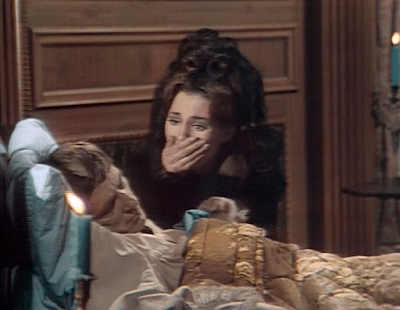
Episode 419: Collins as in Collinsport?

When gallant gentleman Barnabas discovered that his wife Angelique was a wicked witch who had been casting spells to ruin the lives of everyone he knows, she forbade him to disclose this information. If he did, she would kill his true love, the gracious Josette.

Now, Angelique has turned Barnabas into a vampire. When he found out about this, he killed her. Sadly, that didn’t take. For the last few days Angelique’s disembodied head has been floating around foiling all of Barnabas’ attempts to contain the damage he has been doing.

Today, we open in the Collins family mausoleum. Barnabas’ coffin is hidden in a secret chamber inside the mausoleum. He and Josette are in the publicly-known outer chamber, where she found him yesterday. He pleads with her to leave him and forget she ever knew him, but will not tell her why. Angelique has made it obvious that she is already working to kill Josette, so obvious that Barnabas and his friend Ben were talking about it yesterday. So Barnabas has no reason to withhold any information from Josette, and every reason to tell all. But he continues to keep everything back that might persuade her to flee from him. This does fit with his pattern of behavior- half the reason they are in this situation is that Barnabas wouldn’t tell Josette that he and Angelique had had an affair long ago. But it is still frustrating.

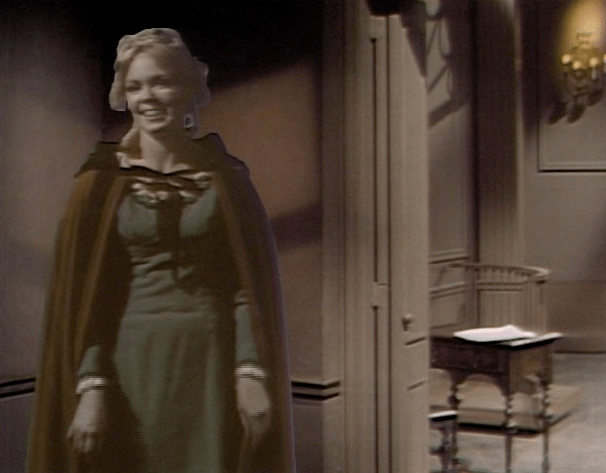
Back in the great house of Collinwood, Josette runs into the two characters who have been keeping the show watchable for the last couple of weeks, fluttery heiress Millicent Collins (Nancy Barrett) and caddish naval officer Nathan Forbes (Joel Crothers.) After a series of delightfully played comedy scenes, Millicent and Nathan have become engaged. They break their happy news to Josette. She is so preoccupied with her encounter with Barnabas that she barely reacts.

Nathan leaves. In the drawing room, Josette tells Millicent that she saw Barnabas tonight. Millicent knows that, according to Barnabas’ parents, Barnabas has gone to England. She is therefore certain that Josette could not have seen Barnabas, and she patiently explains this impossibility to Josette. The difficulties Millicent knows about are nothing to what Josette knows- she saw Barnabas die.

Millicent lost at the threshold of thought. Screenshot by Dark Shadows Before I Die.

In the parts of Dark Shadows set in the 1960s, Nancy Barrett plays another heiress, Carolyn Collins Stoddard. In those same parts of the series, Joel Crothers plays hardworking young fisherman Joe. In 1966, Carolyn and Joe were dating each other for no reason they could discern, and the audience was afflicted with scene after scene of them out on dates staring at each other in boredom. Millicent and Nathan are as much fun to watch together as Carolyn and Joe were dull. They are pursuing objectives we can understand, and we can also be sure that their plans will not work out as they expect.

Nathan is clever, charming, and unscrupulous. He was uninterested in Millicent until he found out she was rich, then immediately began an assiduous pursuit of her hand and her inheritance. In addition to greed, he has also shown a keen eye for opportunities to bed the women on the household staff. When his naval career is threatened by the villains, he shows no sign of courage. Yet we have also seen him behave admirably, even heroically, in trying to help bewildered time-traveler Vicki. And when Barnabas was alive, Nathan was a trustworthy friend to him. So for all we know, by the time he gets his hands on Millicent’s money, this complex man might have fallen in love with her and made up his mind to be a good husband.

Millicent is not a “smart character” in an IQ-test sense, but her limitations translate into an accidental wisdom. Her ideas of life have been shaped by plays she has seen and novels she has read, leading her to think she is a character in a florid melodrama. But of course that is exactly what she is, and so her behavior is, if anything, more situationally appropriate than are the actions of the more superficially rational people around her. Certainly it is jarring when Josette starts telling Millicent about Barnabas, when she knows that Barnabas wants to keep his presence secret. Considering what will happen to Josette if she keeps approaching Barnabas, Millicent does quite the sensible thing when she insists on leaving the official story alone.

Nathan has gone to the local tavern. In the 1960s, this same set will be a tavern known as The Blue Whale. Joe will be a regular customer, and the man who will preside behind the bar is played by actor Bob O’Connell. In #319, a character pretending to be drunk called the bartender “Bob-a-roonie,” leading fans of the show to call the character “Bob Rooney,” a name never used in the series.

Now, in 1796, the tavern is called The Eagle. Bob O’Connell again plays the man who pours the drinks. His name is Mr Mooney. “Mooney” sounds enough like “Rooney” that I wonder if the “Bob Rooney” gag circulated among the production staff. Mr Mooney gets more lines today than Bob the bartender ever did, and his name is listed in the credits for the first time at the end of his 57th episode.

O’Connell did a lot of very good work in those first 56 appearances. He was especially good with facial expressions that showed he had overheard enough of a conversation to think he ought to be more aggressive about refusing to serve drinks to customers before they lose all sense, but not enough to have anything substantial to report to the police. I’m sorry to say that his delivery of dialogue today is not on that level. Partly that’s because he has to put on some kind of Anglo-Celtic accent that he is none too sure of. But that isn’t the only problem. He delivers his lines much too fast and too loud, and does not modulate his voice in response to anything his scene-mates do. He isn’t interacting with the others at all, just waiting for his cues and making sure the microphone picks up the words. His scene is a major letdown for Bob the bartender fans everywhere. O’Connell’s previous successes as a working guy who knows more than others assume he does leave me wishing they could have done another take of the scene with some fresh guidance from the director.

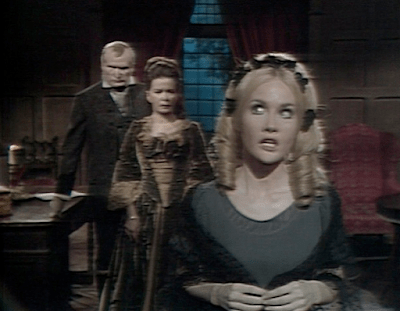
Fortunately, the same scene introduces one of the most magnificent characters in all of Dark Shadows. She walks in, tells Mr Mooney she’s with Nathan, and gives her name as Suki Forbes. That’s Forbes as in “Mrs Nathan Forbes.”

Suki takes command. Screenshot by Dark Shadows Before I Die.

Nathan tries out a series of lies on Suki, each of which she bats away effortlessly. He offers to pay her to leave town; she lets him go collect his money, while she stays in the tavern and gets all the relevant information from Mr Mooney. Nathan has been away for about ten seconds by the time Suki finds out he plans to marry into the family that owns the town. She is quite pleased by the prospects this introduces.

Suki thinks of how much she might earn by pimping Nathan out. Screenshot by Dark Shadows Before I Die.

Our hopes that Nathan would eventually make Millicent happy are thus reduced to a very low order of probability. Regular viewers are again reminded of Carolyn, in this case of Carolyn’s absentee father Paul Stoddard. Paul was a charming, dishonest, and cruel man who married Carolyn’s mother Elizabeth only for her money.

We haven’t seen Paul, and know very little about his background. What we do know is that he was not from the village of Collinsport, had no money of his own, and that his best friend was a merchant seaman named Jason McGuire. We got to know Jason quite well when he showed up and blackmailed Liz for a long dull stretch of the show. Poor men would have few opportunities to meet young women of Liz’ lofty station, and even fewer means of persuading them they were acceptable marriage partners. Since the marriage took place in 1945 or 1946, when a sizable fraction of American men were on active duty in the armed forces, and since Paul was connected to Jason and therefore to the sea, it would seem likely that Paul was a Navy officer. After all, an officer’s uniform can get a man admitted to any social circle, as Nathan illustrates. So the miserable marriage that Liz endured might have echoed a similarly ill-conceived match a collateral ancestor of hers made in the late 18th century.

Suki is played, sensationally, by Jane Draper. In his June 2014 post about #420, Danny Horn wrote that Ms Draper was “a bit mysterious.” The lady herself saw that post and commented on it in August 2020. She wrote:

Hi
I am the Jane Draper who played Suki on Dark Shadows! Thought I’d be on it longer but got killed off by Barnabas. I worked on Broadway, film and this soap opera. Now, I play Bluegrass, always my passion, on guitar and upright bass. Born in Illinois, grew up mostly in Southern Indiana and moved to NYC in my teens.

thank you for your kind words.

Jane Draper, comment left 13 August 2020 on “Episode 420: The Stalking Dead,” Dark Shadows Every Day.

Episode 418: Wind in the woods

In yesterday’s episode, Barnabas Collins extracted a promise from his friend, much put-upon servant Ben Stokes. Barnabas had decided that the curse that has made him a vampire and condemned whoever loves him to death must end. Ben reluctantly agreed to come back after dawn to the secret chamber in the Collins mausoleum where Barnabas’ coffin is hidden and drive a stake through his heart.

The curse was the work of wicked witch Angelique. Eight minutes after Barnabas discovered he was a vampire, he killed Angelique. But when Ben was about to keep his promise and end Barnabas’ curse, her disembodied head appeared before Ben’s eyes, her voice resounded in his ears, and the mallet and stake vanished from his hands. Angelique declared that the curse would be fulfilled in its entirety, and ordered Ben to take that word to Barnabas after dusk.

Every viewer who has seen even one episode of Dark Shadows knows that Barnabas will react to this news by choking Ben. If we’ve been watching the 11 weeks so far that the show has been set in the years 1795 and 1796, we know that he won’t kill Ben or seriously injure him, since that would leave the main character without anyone to talk to. So there is no need for today’s opening scene, in which Ben gives Barnabas the news, he chokes him for a little bit, then lets him go.

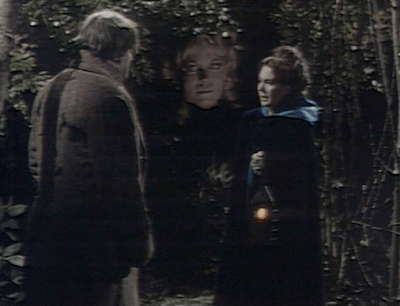
After Barnabas leaves Ben alone in the secret chamber of the Collins mausoleum, Angelique’s disembodied head floats into view again. The floating head gag was reasonably effective when it was used for undead fire witch Laura Murdoch Collins in late 1966 and early 1967, because there were so few special effects of any kind on Dark Shadows at that time that associating one with Laura set her apart from the other characters and showed that she was an invader in the world in which they operated. But double-exposures and Chromakey and puppetry and other gimmicks have become routine these last several months, so it isn’t very impressive now. It certainly isn’t powerful enough to justify its use in three scenes today.

While still with Ben in the secret chamber, Angelique says that she will cause the gracious Josette to go to Barnabas so that Barnabas may be the death of her. She starts calling Josette’s name, and her voice morphs into Barnabas’. They do an impressive job syncing her lips with his voice. We dissolve to Josette’s bedroom, where the voice of Barnabas continues to call her name. Then all of a sudden we hear Angelique’s laugh. Does Josette hear that part too? It messes up the only really effective part of the episode.

Angelique’s floating head appears again and gives an intricate explanation of a dream Josette is about to have. This echoes the sequences we saw in 1967 in which mad scientist Julia Hoffman hypnotized imperiled heroines and made them forget information that might have led to the exposure of the many crimes she and Barnabas have committed. After Angelique’s long preface, Josette finally has the dream. It is shown to us in a luridly colored sequence, and in it Angelique shows Josette the mausoleum where Barnabas’ coffin is hidden.

Apricot dream. Screenshot by Dark Shadows Before I Die.

As we might have predicted, Josette goes to the mausoleum when she wakes up. Just as predictably, she meets Ben on the way, and he tries to talk her out of going there. Of course Angelique’s floating head appears yet again and forces Ben to scurry off.

The floating head of Angelique silences Ben. Screenshot by Dark Shadows Before I Die.

We’ve known since #5 that Josette will die by jumping off the precipice known as Widow’s Hill. In #185, we learned that in the 1960s she was still famous in the village of Collinsport as “the lady who went over the cliff.” In #233, Barnabas revealed that she jumped because he frightened her while she was up there. So when Barnabas finds Josette in the outer room of the mausoleum and tells her that she is in grave danger, there is no real suspense- we know that she is not going to die this way. Like everything else we see today, it is filler.

Frustrated by the failure of the episode to advance the plot, Danny Horn devotes his post about it to a discussion of the 1845-1847 serialized novel Varney the Vampire. I sympathize; I toyed with the idea of posting a two-sentence summary of the action followed by an essay about the greatest of all moving pictures about a floating head, John Boorman’s 1974 masterpiece Zardoz. But I don’t want to work that hard. Danny may have called his blog Dark Shadows Every Day, but he lavished so much effort on each post that they were often separated by weeks or months. I want the episode commentaries here to appear on the 56th anniversary of their original broadcast, and so I’m not going to do the kind of extra work Danny used to do.

Episode 417: Distant laughter

The terrace at the great house of Collinwood is a set where characters often behave as if things are possible that the audience knows won’t happen. Couples make dates we know they will never keep and talk about weddings we know one of them won’t live to see. Today, much put-upon servant Ben sees grand lady Josette there. He urges her to leave Collinwood, and she says she is planning to do so. Ben is overjoyed. He, and he alone, knows that Josette’s lost love Barnabas has become a vampire and is obsessed with her. When Josette talks about leaving, Ben hopes she will escape from the danger Barnabas represents.

The placement of this scene at the terrace is one of several pieces of evidence that Ben’s hopes will be dashed. We have known since #5 that Josette is fated to jump to her death from the precipice known as Widow’s Hill. We learned in #233 that she did this because she saw Barnabas up there and was horrified by what he had become. Josette’s death is such an important part of the show’s backstory that we are sure she will not escape her doom. Moreover, we have seen bewildered time-traveler Vicki try to persuade Josette to go away before it is too late. Everything Vicki has done since arriving in the year 1795 has backfired, so that is another sign that Josette will not leave.

Toward the end of the scene on the terrace, Josette asks Ben if he can hear a sound of distant laughter. He says that he didn’t hear it, and neither did she. He urges her to get some sleep, and they go their separate ways.

After sunrise, Ben goes to the secret chamber in the Collins family mausoleum where Barnabas’ coffin is hidden. Obeying Barnabas’ command, he has brought a stake made of holly wood and a mallet. When he was alive, Barnabas had been a friend and benefactor to Ben. Ben finds it difficult to stake him, but is just about to do so when a loud sound of laughter, punctuated by sharp intakes of breath, comes on the soundtrack. The head of wicked witch Angelique floats onto the screen. This visual effect had been a signature of undead fire witch Laura Murdoch Collins when she was on Dark Shadows late in 1966 and early in 1967; it is the first time we have seen it since Laura went up in smoke in #191.

Floating head. Screenshot by Dark Shadows Before I Die.

It was Angelique who cursed Barnabas to become a vampire. As her head floats in front of Ben, we hear her recorded voice telling him her curse will be fulfilled. When Ben says she can’t stop him, she points out that the stake and mallet have vanished from his hands. She orders him to leave the chamber. He is to come back tonight and tell Barnabas that they will never escape her power.

In his post about this episode on Dark Shadows Every Day, Danny Horn argues that since Barnabas just killed Angelique in #411, she hasn’t been gone long enough to make her return particularly effective. I agree. Even if the scene were well-conceived and well-executed in every other way, that alone would make it disappointing. But there are some other substantial problems. Angelique regretted the curse she put on Barnabas, and her last mortal act was to try to stake him to keep him from rising as a vampire. Nothing she says today explains the reversal of her attitude.

The repetition of the effect from the Laura story isn’t much of a problem, not only because it has been a long time since they’ve used it, but also because the show had such low ratings when Laura was on that most viewers watching now never saw it then. What is a problem is the execution of the effect. Angelique’s voice is a tinny recording that sounds very bad when she laughs, and they keep sliding the floating head around in the frame trying to square it with Ben’s line of sight. So far from terrifying us, the result simply irritates.

Episode 415: Sarah Collins

Sarah dies. Screenshot by Dark Shadows Before I Die.

When Dark Shadows first aired in June 1966, it kept hinting that behind the action we saw there was a back-world of supernatural presences some of whom might eventually interact with the characters. Often these hints occurred in conversations between a character native to the village of Collinsport and newly arrived governess Vicki. The local would use the word “ghost” metaphorically to refer to unresolved conflicts around the estate of Collinwood, Vicki would shriek “You don’t mean you believe in ghosts!?,” and the other would say that he damn well did believe in ghosts and that if Vicki stuck around long enough she would, too.

The first ghost whose name we heard was Josette, mentioned in #5 as a grand lady from France who came to town to marry Jeremiah Collins, was unhappy with him, and threw herself to her death from the precipice known as Widows’ Hill. Josette manifested herself on camera in #70 and rescued Vicki from murderous groundskeeper Matthew Morgan in #126. In that climactic encounter, we saw Josette and a group of other wraiths. Joining the ghosts of women who jumped from Widows’ Hill at various points in the 19th century was the ghost of Bill Malloy, who had been a living character in the first ten weeks of the show and had shimmered into view as a ghost and sang a song in #85. This assemblage suggests that the spectres haunting Collinwood know each other and act with a common purpose at least occasionally.

The first supernatural menace to appear on the show was undead fire witch Laura Murdoch Collins, mother of strange and troubled boy David. Josette warned several characters of the threat Laura posed to David. Josette herself was unable to fight Laura directly. In #165, she manifested in the room where Laura held the sleeping David, but had to retreat when Laura ordered her to go. Thereafter it was up to Vicki, advised by Josette, to organize the opposition to Laura. If #126 showed that the benevolent spirits can act together to defeat a threat from a mortal man, #165 and its aftermath showed that they must withdraw into the back-world when the enemy is of an uncanny nature.

In April of 1967, vampire Barnabas Collins succeeded Laura as the show’s new danger from beyond the grave. In #212, Barnabas went to the Old House at Collinwood, the place where Josette is most present, and told her portrait above the mantel that her power was at an end. In #223 and #240, Josette’s friend David felt her absence from the Old House and lamented that the family had lost its tutelary spirit. With that, we bid farewell to the wispy presences we had seen in #126. A vampire is too dynamic an adversary for them. It seemed for a period that the show had simplified its ontology- there are those who live by the laws of nature we know, there is Barnabas, and that is that.

That period ended in #255. Barnabas has passed himself off as a cousin from the Collins family’s long-lost English branch and settled in to the Old House. He is keeping Maggie Evans, The Nicest Girl in Town, as a prisoner in a barred cell in the basement. Maggie looks out her window and sees a little girl in 18th century garb sitting in the corridor. The girl is holding a doll and singing “London Bridge.” She does not respond to Maggie’s attempts to get her attention.

In the next several episodes, we learn that the little girl’s name is Sarah, that she has a big brother, and that she can’t find anyone she knows. Even if the closing credits hadn’t immediately given away the fact that she is the ghost of Barnabas’ little sister, we would be able to gather that she is a supernatural being who was pulled out of the back-world when Barnabas rose from the grave. For the next 22 weeks, Sarah keeps popping up in the world of 1967. We wonder what she will do next, when she and Barnabas will confront each other, and what other paranormal beings are waiting to erupt into the visible world.

In #365, the major characters held a séance to contact Sarah and ask her what she was trying to tell them. Sarah spoke through Vicki and said that she would not appear to them again. She also said that she wanted to “tell the story from the beginning.” With that, Vicki vanished from the table and a woman in an 18th century dress appeared in her place. The woman identified herself as Phyllis Wick, governess to Sarah Collins, and demanded to know where she was. Meanwhile, Vicki found herself in the year 1795, in Phyllis’ place. At a stroke, the back-world and the foreground are interchanged.

Now it is 26 January 1796, Sarah’s eleventh birthday. She is not having a happy one. Last night she found Barnabas in the family mausoleum with blood smeared on his face. She may not know that he has become a vampire, but she knows that something has gone horribly wrong with him. She runs off and hides behind a tombstone. By the time faithful servant Ben finds her and carries her home, she is severely weakened by exposure. She cannot speak, but mouths Barnabas’ name and looks distressed. Her mother Naomi and cousin Millicent keep vigil at her bedside.

Night falls; Barnabas rises again, and Ben tells him that Sarah is gravely ill. Barnabas resolves to visit her. Unable to talk him out of this plan, Ben offers to help him get into her room unobserved.

Ben relieves Naomi and Millicent, then ushers Barnabas into the room. Barnabas tries to reassure Sarah. Eventually she warms to him. She regains the power of speech, and with her first words she asks her brother to hold her. He does. She tells him she will always love him, then dies in his arms.

This is Sharon Smyth’s last appearance on Dark Shadows. As a child, she had some rather obvious limitations as an actress, a fact Sharon Smyth Lentz cheerfully acknowledges nowadays. During her first 22 weeks, she was playing a ghost, so there were many scenes where all she had to do was seem vague and detached and she could be effective. The story moved very slowly during that period, giving the writers and directors time to figure out her strengths. Near the end of it, she excelled in two scenes with a lot of dialogue. In #348 she had a complicated, serious conversation with heiress Carolyn Collins Stoddard, and in #364 she had her confrontation with Barnabas. Supported by Nancy Barrett and Jonathan Frid, she executed those scenes very well indeed.

In 1795, Sarah is alive and the plot moves at a breakneck pace. Under those conditions, it would have taken intricate advance planning to craft scenes that would have been in Sharon Smyth’s range. But the writers of Dark Shadows rarely had time to do any advance planning. When the show was moving slowly enough, they could usually hit all the major points the audience would expect to see, but there are some glaring omissions in 1795. Young Daniel Collins will be played by David Henesy, who also plays David Collins. Since the relationship between Vicki and David had been the core of the first 39 weeks of the show and the relationship between Sarah’s ghost and David had been one of the most intriguing elements of the 22 weeks she was haunting Collinwood, it is particularly disappointing that we barely see Vicki with Sarah and never see Sarah and Daniel together at all.

I first saw Dark Shadows on the SciFi Channel, as it was then called, in the 1990s. I saw a handful of episodes on random mornings when I happened to be off work. They whetted my curiosity about the show, but I left it to chance until I saw an episode with Sarah’s ghost. Then I decided to set my VCR and watch regularly until I found an explanation for what was going on with her. The whole idea of supernaturalism is that there are phenomena which defy explanation, so of course I never reached that point. Naturally, I got hooked on the show within a couple of weeks.

On his Dark Shadows Every Day, Danny Horn rather unfairly, albeit hilariously, griped that “Sharon stopped acting after Dark Shadows, or possibly during.” When she looks back on her days as a child actress, Mrs Lentz talks about how excited her mother was to meet show biz celebrities, and says that her main gratification was in pleasing her. But she has fond memories of many castmates, and says that her favorite person to run lines with was Jonathan Frid. So there is something sweet about her ending her time on the show in his arms.

Episode 409: Some of the facts

When well-meaning governess Victoria Winters came unstuck in time and tumbled from 1967 to 1795, she brought with her a copy of the Collins family history. We first saw this book in #45, when flighty heiress Carolyn Collins Stoddard read this excerpt aloud:

Jeremiah Collins, sixth generation descendant of the founder of Collinsport. In 1830 married Josette Lafrenière of Paris, France. The construction of Collinwood, the family mansion, was begun the same year.

Right up to the last few weeks before Vicki left for the past in November 1967, Dark Shadows kept equivocating about whether Josette, Jeremiah, and the rest of them lived in 1830 or in the late 18th century. The name “Lafrenière” was not mentioned again after #45, but neither was any other surname given for her birth family until the name “DuPrés” was introduced during the 1795 segment. Likewise, #45 is the only time we hear that Josette was from Paris. Her association with the island of Martinique is established in #239, when the vampire Barnabas Collins tells his victim Maggie that he met Josette there and taught her English on the journey to Collinsport, where she was to marry Jeremiah. That Josette was the daughter of the richest French planter on Martinique, a condition that in 1795 in our time-band characterized the lady who would become the Empress Josephine, is something the show commits itself to during the flashback segment.

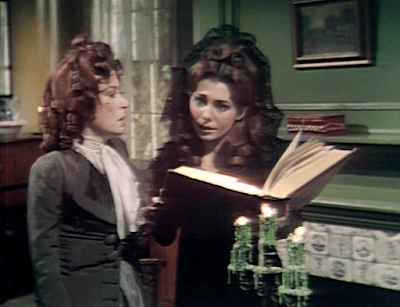
These were only a few of the myriad revisions and retcons the show went through in regard to Barnabas and Josette’s time as living beings. Today, Josette and her aunt, the Countess DuPrés, go through the book and remark on its many inaccuracies. The episode ends with a shock when they realize that at least one of these inaccuracies is the result of a conscious decision by haughty overlord Joshua Collins to falsify the record of events.

Josette and the countess read The Book. Screenshot by Dark Shadows Before I Die.

I was going to write about how meta this all is, but then I reread Danny Horn’s post about the episode on Dark Shadows Every Day and found that he had already done it. I would just add that the very idea of traveling back in time is a metaphor for rewriting, so that the whole storyline is an exercise in self-reference by the writers and producers.

This episode features the death of Barnabas Collins. Barnabas has been the show’s main draw for a long time, but he was already dead when we met him in April 1967, and he’s been dying for the last four days of this flashback, so that’s less of a milestone than it might seem. The event is presented as another exercise in continuity. In #345, vampire Barnabas told mad scientist Julia Hoffman that before his death he had vowed to Josette that he would someday return to her. Indeed, Josette is at his bedside in his last moments as a human, and he does make that vow.

Barnabas dies. Screenshot by Dark Shadows Before I Die.

Barnabas accompanies his vow with a plea for Josette to wait for him. That, too, is a continuity moment. Josette is played by Kathryn Leigh Scott, who also played Maggie. When Barnabas returned as a vampire in 1967, he kept Maggie prisoner and tried to replace her personality with that of Josette. Whatever the living Barnabas may have been thinking in his last moments, the vampire Barnabas expected to find Josette waiting for him, 172 years after his death, and that expectation motivated the first major crime we saw him commit.

Episode 408: My imperfect science

Late in 1966, the ghost of Josette Collins emerged from the supernatural back-world behind the action of Dark Shadows and rescued well-meaning governess Vicki from homicidal groundskeeper Matthew Morgan. Early in 1967, Vicki and several other characters worked closely with the ghost of Josette to thwart the evil plans of undead fire witch Laura Murdoch Collins. After these experiences, Vicki felt so close to the ghost that, to some, it seemed possible that her personality might disintegrate and she might become a sort of reincarnation of Josette.

In November 1967, the back-world and the foreground traded places. Vicki came unstuck in time and found herself in 1795, where Josette and others whom she had met as uncanny entities are alive and she is the alien interloper from another world. Vicki did not in any way adapt to her new surroundings, and immediately brought suspicion on herself. Now she is in jail, spelled “gaol,” awaiting trial on charges of witchcraft.

Josette visits Vicki today and begs her to lift the curse that has brought a mysterious and apparently terminal illness to gallant gentleman Barnabas Collins. Despite her situation, Vicki is shocked that Josette believes her to be a witch. Unable to persuade her of her innocence, Vicki tells Josette that she is a time-traveler and sends her off to look for a book she brought with her from the future. Josette interprets this as a confession of witchcraft, and when she finds the book makes it clear that she could not possibly have interpreted it as anything else.

Vicki makes Josette cry. Screenshot by Dark Shadows Before I Die.

If the show had kept the memory of Vicki’s friendship with Josette’s ghost fresh, this might have been a powerful scene. But Josette’s ghost receded from the action after the Laura story ended in #191, and in #223 and #240 it was made explicit that she is no longer a palpable presence on the estate of Collinwood. We’ve barely heard of Vicki’s connection to Josette in recent months. By this point, even viewers who have been with the show from the beginning are unlikely to make a connection between Vicki’s behavior in her scene with Josette and those old stories. Instead, we see yet another case of Vicki being a tiresome fool.

Disappointing as that scene is, it is not the low point of the episode. That came in the scene immediately before. Actor Jack Stamberger appears as a doctor called to treat Barnabas. Doctors on Dark Shadows are ineffectual figures brought on to fill time, unless they are mad scientists who take a bad situation that is troubling one or a few characters and make it so much worse that it can be a major narrative arc. Stamberger’s part is of the former sort.

It is a particularly objectionable specimen of the category. The other G.P.s usually started with at least a theoretical possibility that they might do something to advance the plot, or turn out to be old friends with established characters who could show a new facet of their personalities in interaction with them, or at least bring out some unusual medical equipment that would be fun to look at. They’ve already foreclosed all of those possibilities before this doctor appears, so the scene is advertised as a waste of time.

One of these is not like the others. Screenshot by Dark Shadows Before I Die.

Worse, watching Stamberger’s performance is like sticking your head in a bucket of itching powder. His scene partners, Kathryn Leigh Scott, Lara Parker, and Grayson Scott with dialogue, and Jonathan Frid with moans and anguished facial expressions, are all totally committed to the period setting, and really do seem like gentlefolk inhabiting a mansion in a previous century. Stamberger doesn’t even try to do what they are doing. He puts on a growly voice that might have been acceptable if he were playing a trail-boss in a Western, but that doesn’t have much place in any scene set indoors. It certainly doesn’t make sense for a man in genteel surroundings who talks about nothing but how helpless he is. He doesn’t maintain eye contact with any of the ladies long enough to put himself into the same space with them. He bungles most of his lines, and even those he speaks as written he follows by shuffling his feet, breathing heavily, and looking around. Dark Shadows was, for all practical purposes, done live; if videotape editing had been freely available, it’s hard to imagine director Lela Swift wouldn’t have stopped the scene and taken the time to smack him upside the head.

On his Dark Shadows Every Day, Danny Horn argues that Addison Powell was, as he stylizes it, THE WORST ACTOR EVER TO APPEAR ON DARK SHADOWS. I’m not sure who deserves that title, but today Stamberger locks up the award for Most Irritating Performance.

Episode 404: I forgot you were here

When I was a kid in the 80s, a friend of mine liked watching syndicated reruns of the tongue-in-cheek Western series Alias Smith and Jones on Saturday afternoons. I didn’t much care for it, but sat through a few of them with him. Eventually they got to some episodes in which the actor who played the character with the alias “Smith” was replaced by a man who was always smiling as if he had just said something terribly clever, even if he hadn’t said anything at all. After a few minutes of that bozo’s inane mugging, my friend couldn’t stand it either, and we could go back outside and play. So that worked out to my benefit.  

In those same years, I was a great fan of The Twilight Zone. The man whose pointless self-satisfied smile ruined Alias Smith and Jones for its fans showed up in one of those episodes, but he was used intelligently there. The episode was called “Spur of the Moment.” In it, a young woman has to choose between two lovers, one of them a prosperous fellow whom her father likes, the other a penniless dreamer whom the whole family hates. Any audience will have seen that story countless times and will assume that we are supposed to root for the penniless dreamer. But The Twilight Zone mixed that up for us by casting the likable Robert E. Hogan as daddy’s choice and the man with what we nowadays call an “instantly punchable face” as the poor boy. When the twist ending shows us that the woman was horribly wrong to marry the poor boy, it’s our dislike of the actor playing him that makes it a satisfying resolution.

So, when I first saw this episode of Dark Shadows some years ago, it was with some apprehension that I met the sight of that same repellent man on screen. His name is Roger Davis. In later years, Joan Bennett would look back at her time on Dark Shadows and would refer to Mr Davis as “Hollywood’s answer to the question, ‘What would Henry Fonda have been like if he had had no talent?'” Mr Davis’ head is shaped like Fonda’s, and his character turns out to be a defense attorney, a common occupation among the roles Fonda played.

The first line addressed to Mr Davis is “I forgot you were here,” spoken by bewildered time-traveler Vicki. When his character Peter, a jailer who is reading for the bar, tells her that he can hear her in her cell at night, she tells him she didn’t know he was there. Vicki’s repeated failure to notice Peter’s existence may not sound like an auspicious start to what is supposed to be a big romance, but it isn’t as bad as what happens when he is escorting her back to her cell. He puts his hand on her elbow, and she reflexively recoils.

Mr Davis is just awful in his scene today. He spits each of out his lines as if they were so many watermelon seeds, stops between them to strike poses almost in the manner of a bodybuilder, and looks at the teleprompter. The last was a near-universal practice on Dark Shadows, but I mention it for two reasons. First, because this is his debut on the show- even Jonathan Frid, whose relationship with the teleprompter is the true love story of Dark Shadows, didn’t start reading from it until he’d been on the show for a week or two. Second, in his attempts to defend what he did on Dark Shadows, Mr Davis has many times claimed that he “always” knew his lines, that he “never” used the teleprompter.

Mr Davis is going to be a heavy presence on the show for what will seem like a very, very long time to come. He, more than anyone else, prompted me to make a habit of what I call “imaginary recasting.” When Joan Bennett was stuck playing a scene with him, she evidently made the experience endurable by thinking back to the days when she was a movie star playing opposite the original, talented Henry Fonda. When I am watching him butcher a scene, I think of other actors who actually appeared on Dark Shadows or who would likely have accepted a part on it if offered, and try to visualize what they would have done in his stead.

Harvey Keitel was a background player in #33, and surely he would have accepted a speaking role on the show at this point in his career. Mr Davis’ invariably, pointlessly belligerent tone of voice makes Peter seem like a guy with a lot of anger. Mr Keitel is of course a master of playing men who have issues with anger but are still deeply sympathetic. When it’s time to sit through one of Mr Davis’ scenes as Peter, I have enough fun imagining what Mr Keitel could have done with the part that I am not too sorely tempted to give up.

Closing Miscellany

This is the first episode to show that the sign outside the town lockup is labeled, in a period-appropriate spelling, “Collinsport Gaol.”

Ballad of Collinsport Gaol.

The Bil Baird bat puppet appears in this episode, but is so close to the camera it looks like a felt cutout. Bit of a disappointment.

In his post about this episode on Dark Shadows Every Day, Danny Horn discusses the performance Addison Powell gives as a lawyer who meets with Vicki and decides he can’t take her case. He claims that Powell was THE WORST ACTOR EVER TO APPEAR ON DARK SHADOWS. Powell isn’t one of my favorites, but I don’t think he deserves that title. Of those we’ve seen so far, I’d say Mark Allen, who played drunken artist Sam Evans in the first weeks of the series, was the most consistently worthless performer, while Michael Hadge, who was motorcycle enthusiast Buzz for a while in 1967, was the most endearingly inept. Powell is awkward in his scene today, but Roger Davis is even more so, and he, unlike Powell, is so naturally unpleasant that he has to be flawless to earn the audience’s toleration.

Episode 401: The A V club

At the top of the episode, much-put-upon servant Ben is locked in a barred cell in the basement of the great house of Collinwood. Haughty overlord Joshua Collins and his family just moved into the house a week or two ago, and parts of it are still under construction. Evidently the basement cells are an essential part of any well-appointed home in the area, and had to be among the first amenities installed.

Until November of 1967, Dark Shadows was set in contemporary times, largely in this house. We saw the basement several times, but never had any indication that there were prison cells there. The old manor house had a cell in its basement, and in June 1967 vampire Barnabas Collins kept the lovable Maggie Evans prisoner in that cell. Maggie escaped when the ghost of Barnabas’ little sister Sarah appeared to her in #260 and told her a riddle that pointed to a secret passage out of it. Sarah told Maggie that her father had forbidden her to tell anyone about the passage, and that even Barnabas doesn’t know about it.

Joshua is Sarah and Barnabas’ father, so when he, they, and their mother Naomi moved out of the Old House in #393 without any reference to the cell downstairs we wondered if the show had decided to retcon away Sarah’s knowledge of it. The first indication that there were not going to do this came in #399, when Sarah visited her sometime governess, Vicki. Vicki had been accused of witchcraft and was hiding in the Old House as the guest of Barnabas, who is at this time alive and gallant. During their conversation, Vicki needs a place to hide while the house is being searched, and Sarah leads her to a room upstairs that Sarah says “everyone else has forgotten about- even Barnabas.” That Sarah knows parts of the house that are secret even from Barnabas is an unmistakable reference to #260, and shows that her knowledge was not a postmortem development. When we see today that Joshua has installed a cell in the basement of the new house, it is confirmed for us that there is one in the basement of the Old House as well.

Dark Shadows is set in and near the fictional town of Collinsport, Maine. This segment of the show takes place in 1795, when Maine was part of Massachusetts. Slavery was abolished in Massachusetts in the early 1780s, at which point the Old House would have been in use for many years. It is never made clear whether the Collinses held any African or indigenous people as slaves, but indentured servants like Ben were subject to beatings and confinement at the command of those who had purchased their labor. Their obligation was limited to a term of years and was not passed on to their offspring, unlike the status of slavery, but the treatment Joshua routinely metes out to Ben makes it clear that he was accustomed to regarding humans as his property. So it is hardly surprising that he maintains a dungeon to which he confines members of his household establishment who have displeased him.

Vicki has been caught and is now a prisoner in Collinsport’s public jail. Barnabas meets her there. He has come to suspect that his new wife, Angelique, is the real witch. During their visit, Vicki makes some remarks which convince him that this is so.

Barnabas believes that Angelique has put a spell on Ben to force him to do her bidding. The audience knows that this is correct. He finds Ben hiding in a fishing shack on the Collins family property. Angelique’s spell prevents Ben from speaking her name, but he does manage to draw her initial in the dust on a barrel top when Barnabas asks him to indicate the real witch’s name.

Ben writes a letter. Screenshot by Dark Shadows Before I Die.

We spent a fair bit of time in the fishing shack in February and March of 1967. It was introduced in #173 as a favorite haunt of strange and troubled boy David Collins, and in #191 David’s mother, undead fire witch Laura Murdoch Collins, tried to burn him to death in the flames which destroyed the shack. There was a clear echo of #191 at the moment when Vicki was captured in Friday’s episode, and the return of the fishing shack today amplifies that echo for regular viewers. Today’s script is credited to Ron Sproat, the only writer from those days who was still with the show at this point. Sproat would have remembered that #191 marked the end of the first version of Dark Shadows, and would have known that by invoking it he would be telling regular viewers that the events taking place in these episodes are going to have major consequences for the show.

Sproat’s script is clean and direct, one of his best contributions. Lela Swift’s direction is typically crisp and tight. But what really elevates this episode is Jonathan Frid’s performance. Barnabas is alternately transparent and opaque. In the first scene he is open with Ben about his doubts concerning Vicki and Angelique. In the second he talks with Joshua and holds back all the most important information. In the third he is open with Vicki about his problems with her story. In the last, he knows exactly what he wants from Ben, and gets it by deceiving him about his attitude towards Vicki and Angelique. Whether Barnabas is showing his mental processes or hiding them, he is equally fascinating. In the transparent scenes, he draws us into his struggle to choose between two apparently impossible alternatives, and in his guarded ones he prompts us to try to discern his hidden thoughts. It’s a wonderful job, and well worth seeing.

Danny Horn’s post about this episode on his Dark Shadows Every Day is an essay about the similarities between Angelique on Dark Shadows and Samantha on Bewitched. He provides such an extensive and detailed list that there can be no doubt that the connection was intentional and that the audience was supposed to recognize it. I’m not sure what the makers of Dark Shadows wanted us to think when they drew so heavily on that popular prime-time show; in tone, Bewitched was light and silly, Dark Shadows absurdly serious, so I guess it could have been whatever the opposite of satire is. Or the reference to Bewitched could be a sign to the audience that Angelique’s relationship with Barnabas, horribly and all-consumingly destructive as it is now, might eventually settle into something that will run for years and years, as that show already had.

Episode 384: What is the truth, Barnabas?

It is 1795, and we are on the great estate of Collinwood. Under the influence of wicked witch Angelique, the kindly Jeremiah and the gracious Josette have eloped, breaking the heart of Josette’s fiancé, Jeremiah’s nephew and best friend Barnabas Collins. Barnabas, up to that point an idealistic man of the Enlightenment, responded by going against his beliefs and challenging Jeremiah to a duel.

Angelique is a lady’s maid. She was introduced as maid to Josette’s aunt, the Countess DuPrés, but today it seems she is Josette’s maid. She comes to Barnabas’ room. He demands to know why her mistress has sent her, meaning Josette, to which she replies she has come on her own account.

Angelique asks Barnabas why he has challenged Jeremiah to a duel, since he has never fought a duel or even seen one before. He explains that he could not stand being an object of pity- “I couldn’t be poor Barnabas.” In 1967, Barnabas will be a vampire. We saw him in that year, in #345, telling his sometime associate mad scientist Julia Hoffman the story of his relationship with Josette. The story he told was different from other versions he had told previously, for example in #233 and #236, and radically different from what we have seen play out in this extended flashback. In the story he told Julia, as in all other versions we had heard before coming to 1795, Josette was originally Jeremiah’s fiancée. One theme developed that resonates here was that all he could be to Josette was a faithful friend, and that he found that role humiliating. He was “poor Barnabas” in that version of the story, and he implies that it was to escape from that identity that he did whatever it was that made him the undead monster he became.

Angelique cast her spell on Josette and Jeremiah because she wanted Barnabas for herself. Now that she sees that he is likely to get himself killed before she can make her play for him, she asks him to wear a medallion of hers, one which she says will bring good luck. In the 1960s, a portrait of Barnabas hangs in the foyer of the great house of Collinwood. He is wearing a medallion in that portrait. Is Angelique’s medallion the one in the portrait? We can’t be sure.

Josette and Jeremiah have a conversation. They try to figure out what came over them. They don’t love each other, and regret hurting Barnabas. As their conversation goes on, Josette realizes that Jeremiah regrets it so deeply that he is planning to let Barnabas kill him in the upcoming duel. She is horrified by this. She doesn’t want anyone to die, and has accepted the fact that Jeremiah is the only husband she’s got. Nevertheless, she cannot dissuade him.

Josette’s father arranges for Jeremiah to have a final talk with Barnabas. Barnabas accuses Jeremiah of lusting for Josette all along, saying that “you wanted her the moment you saw her.” This is not true of Jeremiah, but in #345 it is exactly what Barnabas tells Julia he himself did. In that version, he conceived a wild passion for Jeremiah’s bride-to-be the moment he first saw her.

Barnabas tells Jeremiah “You must have hated me all your life.” As we have seen over these last few weeks, Jeremiah and Barnabas have been dear friends all their lives. But from his early days on the show in the spring of 1967 until we left for our voyage to the past in #365, Barnabas consistently said that he hated Jeremiah from his earliest days. The overall effect of comparing Barnabas’ various accounts of the past with each other and with what we are seeing in this flashback is something like reading the accounts of the patient’s memories in a case study by Freud. Not only does the order of the events jumble as retcon follows retcon, but guilt floats from one person to another and back again.

When Jeremiah tries to explain how he and Josette found themselves stricken with intermittent attacks of intense desire for each other and how they struggled against those attacks during the intervals between them, Barnabas asks “Why didn’t you come to me then?” That’s a good question, and it suggests another, equally good question. Angelique is casting spells because she and Barnabas had a brief affair before he became engaged to Josette. Why hasn’t he come clean to Josette about his past? If he had, Josette would not have put herself so completely in Angelique’s hands that she could bind her with her spells at leisure.

Jeremiah and Barnabas have their duel. We see them back to back, getting ready to pace off the prescribed distance. On Jeremiah’s face, we see his resolution to let Barnabas kill him.

Resigned to his fate. Screenshot by Dark Shadows Before I Die.

The men are in place when Josette comes running up, pleading with them to stop. She arrives just in time to see Barnabas shoot Jeremiah. Some say they hear only one shot, but I hear two. I think Jeremiah deloped.

Josette goes to Jeremiah’s crumpled body and shouts at Barnabas. “You monster! You madman! You killed the only man I ever loved!” She claims that she and Jeremiah were happy together, and that in his pride Barnabas could not let them be happy. She refuses Barnabas’ offer to help move Jeremiah and get a doctor for him.

Angelique had rubbed Josette’s forehead with some of the rose water in which she had put her love potion not long before this, so Josette’s declarations that Jeremiah is “the only man [she] ever loved” and that they were happy together could be a sign of that influence. It could also be rooted in Josette’s realistic assessment of her situation. Earlier, she had told Jeremiah that she would never again allow herself to say that she loved Barnabas, and when Jeremiah said that his own death would make her a free woman she rejected the idea. Whatever the circumstances that led to the marriage, she is Jeremiah’s wife, and if she becomes his widow she will have an obligation to keep up certain appearances.

This was Anthony George’s last episode. George was woefully miscast when he first joined the show in #262 as the second actor to play Burke Devlin. Writers Ron Sproat and Malcolm Marmorstein kept writing Burke as if he were still being played by the explosively exuberant Mitch Ryan. George’s style was the exact opposite of Ryan’s. He was a cold actor whose characters keep us guessing as to their motives and intentions. He was utterly lost as the hot-headed Burke.

When Gordon Russell joined the writing staff in #292, things looked up for George. Russell understood what actors could do, and gave George some scenes he played very well indeed. In Jeremiah Collins, Russell and Sam Hall created a character who was perfect for George. It’s fascinating to watch Josette scrutinize Jeremiah until she gradually realizes that he has decided to throw his life away to do penance for the offense he and she have committed against Barnabas. It is also credible that, while we can see what Jeremiah is doing, Barnabas, who has known him all his life, would not catch on. George was so bad as Burke in the Sproat/ Marmorstein era that it seemed anything that got him off the show would be welcome. But Russell and Hall know so well how to take advantage of his strengths that it is sad to see him go.

All of the actors have trouble with their dialogue today, even the usually reliable Kathryn Leigh Scott and Lara Parker. Jonathan Frid always struggles, but is especially rough this time, and as for David Ford, what can we say. He mangles virtually every line. His character is supposed to be French; he doesn’t sound French, but doesn’t exactly speak English, either. Danny Horn transcribes many of Ford’s flubs in his post about the episode on Dark Shadows Before I Die, but you really have to hear it for yourself to absorb the sheer bizarreness of the speechlike sounds that come out of Ford’s mouth. I always enjoy watching Ford, and I think he made a major contribution to Dark Shadows‘ acting style when he first came on the show, but when he is off he is way, way off.

Episode 378: Cat got your tongue

Wicked witch Angelique is trying to prevent young gentleman Barnabas Collins from marrying his fiancée Josette. To that end, she has cast a spell on Josette and on Barnabas’ uncle Jeremiah, causing them to conceive a mad passion for each other. Jeremiah resists the feeling, and is resolved to leave town until Barnabas and Josette are safely wed.

Angelique decides that she will keep Jeremiah around by causing his brother, haughty overlord Joshua, to disappear. When she makes this decision, she is with Ben, an indentured servant of Joshua and bewitched thrall to Angelique. Ben is miserable when Angelique compels him to act against Barnabas, since Barnabas has always been most kind to him. However, Joshua treats Ben with relentless cruelty, and when Angelique announces that she will transform him into an animal, Ben is gleeful at the idea of the tyrant getting his comeuppance. Ben pleads with Angelique to make Joshua into a jackass, so that he can whip him while they plow the fields.

Ben gleefully suggests Joshua be made into a jackass. Screenshot by Dark Shadows Before I Die.

Angelique ignores Ben’s idea, and makes Joshua into a small cat instead. This transformation takes place while Joshua and Jeremiah are in the front parlor, arguing about Jeremiah’s plan to go away. Jeremiah turns to look out the window for a second, and when he turns back Joshua is gone and the cat is in his place.

The cat formerly known as Joshua. Screenshot by Dark Shadows Before I Die.

When I was a graduate student in Classics lo those many years ago, I made a study of Apuleius’ Metamorphoses, more commonly known as The Golden Ass, an ancient novel about a man who trifles with a witch and is transformed into a jackass in consequence. So I was more interested than most would likely have been by Ben’s suggestion.

We can see why it had to be a cat rather than a jackass. For one thing, they didn’t have the budget to get a jackass into the studio at 433 West 53rd Street in Manhattan. But there are other reasons. A jackass is a large animal, not graced with the gift of stealth, and if one had materialized out of thin air in the front room it would have been obvious that magic was at work. That would have been bad for the plot, because the characters would have had no choice but to admit that witchcraft was a likely explanation. Even Jeremiah and Josette might well have realized that their sudden attraction was the result of a spell, and have set about fighting it directly. By contrast, a cat is a small creature, known for silence, and on a rolling estate bordering on the wilderness any number of them would be likely to slip into the manor house on a cold night. Its presence would attract little notice from anyone not already convinced witchcraft was in progress.

In addition to the plot trouble that would have resulted had Angelique turned Joshua into a jackass rather than a cat, there would also have been a tonal misstep. At this point they are still developing stories that show us what life was like around the Collins estate before Angelique came. Those are comedies of manners, tales of romance, melodramas about family tensions, and other genres that generate light amusement. That light amusement can keep going if the uncanny phenomena people see are little oddities that elicit impatient demands for a Logical Explanation, but if Angelique conjures up something as big and distinctive as a jackass the natural reaction would be terror, a strong enough feeling that everything else would feel irrelevant until it was resolved.

Also, jackasses have large, expressive eyes. It is difficult to look at the face of one and not to think you know how it is feeling. Joshua is enough of a villain that we simply laugh at the idea of him being put out of the way in this bizarre fashion, and the enigmatic face of a cat does not undercut this laughter. But if we look in the animal’s eyes and see longing and sorrow, which are always easy to find in the eyes of a jackass, we would feel pity for him. That pity would sound a discordant note at this point in the story, distracting us from the suspense about how Angelique’s evil plans will work and our interest in the other story elements we will be seeing.

It is true that there is nothing very catlike about Joshua. For Danny Horn, that is a flaw, one so severe that the whole story of Joshua’s catification “doesn’t work.” He writes:

The cat thing just doesn’t work. But it doesn’t work for interesting reasons, so let’s break it down a little…

A truly satisfying witch-vixen scheme needs to get two things right — it needs to make sense tactically, and it needs to be metaphorically coherent.

For example, spiking Josette’s rose water perfume with love potion totally works, on a strategic level. Josette and Jeremiah find themselves drawn to each other, but they have no idea why. There’s no evidence that leads back to Angelique; everybody just thinks they’re unable to control their forbidden attraction to each other…

And then there’s the cat. Tactically, this is another clear mistake. Yes, Angelique’s goal was to keep Jeremiah from leaving town, and striking Joshua down is an effective way of doing that.

But the actual circumstances don’t allow for any kind of cover story — Joshua apparently disappeared in the middle of a conversation in the drawing room. He wasn’t even walking in the woods, or alone in the basement. Jeremiah knows exactly where Joshua was at that moment, and there’s no way that he could have silently left the house, even if he had a reason to, which he didn’t. Again, this just puts everybody on guard, and hunting around for a malign influence.

And as a metaphor, it’s even worse… What does “cat” mean, in this context?

There’s no sense in which Joshua was a “cat”; the concept doesn’t connect to anything. There’s no symbolic resonance that would make it narratively satisfying, and so it just feels random and silly.

Danny Horn, “Episode 379: Nine Lives to Live,” Dark Shadows Every Day, 24 April 2014

I disagree. Jeremiah is the only person who knows that there is no possible way Joshua could have left, and Angelique’s plan is that he himself will soon run away with Josette, a circumstance which will render his testimony about anything suspect. Further, Joshua and Jeremiah’s sister Abigail and Josette’s aunt the Countess DuPrés are already “hunting around for a malign influence,” prompting everyone else to think they are being ridiculous. If those two seize on Jeremiah’s account of Joshua vanishing and being replaced by a cat, that division within the household will only deepen, bringing greater confusion and setting Angelique’s victims against each other.

The characters look at Joshua and see a tyrant who dominates their lives. We know enough about the major events upcoming to know that he will be utterly powerless to influence them in any way. So when we see his attempt to impose his will on his brother come to an abrupt end when he is reduced to the form of a furry little animal, we see the whole logic of the story in a nutshell.

Moreover, Joshua is played by Louis Edmonds, who in the parts of Dark Shadows set in the 1960s plays high-born ne’er-do-well Roger Collins. The contrast between Roger and Joshua marks the decline of the Collinses from the zenith of their power in the eighteenth century to its nadir in the twentieth. Roger has many of Joshua’s mannerisms, most of his sense of superiority, and all of his taste for expensive things and grand surroundings. But where Joshua is a dynamic businessman, a dominating patriarch, and a self-righteous advocate of Jeffersonian republicanism, Roger has squandered his entire inheritance, lives as a parasite upon his sister, and is frankly and shamelessly nihilistic. Joshua would be shocked if he were told that his commanding self-assurance was an outgrowth of narcissism; Roger cheerfully admits that he is utterly selfish. Joshua may see himself as the lion of upper New England; Roger endears himself to us with a talent for sarcastic remarks that might well be called catty. So when Angelique turns Joshua into a house cat, she is doing what we already know history will do to his descendants.