Episode 256: Always choose the worst things to want

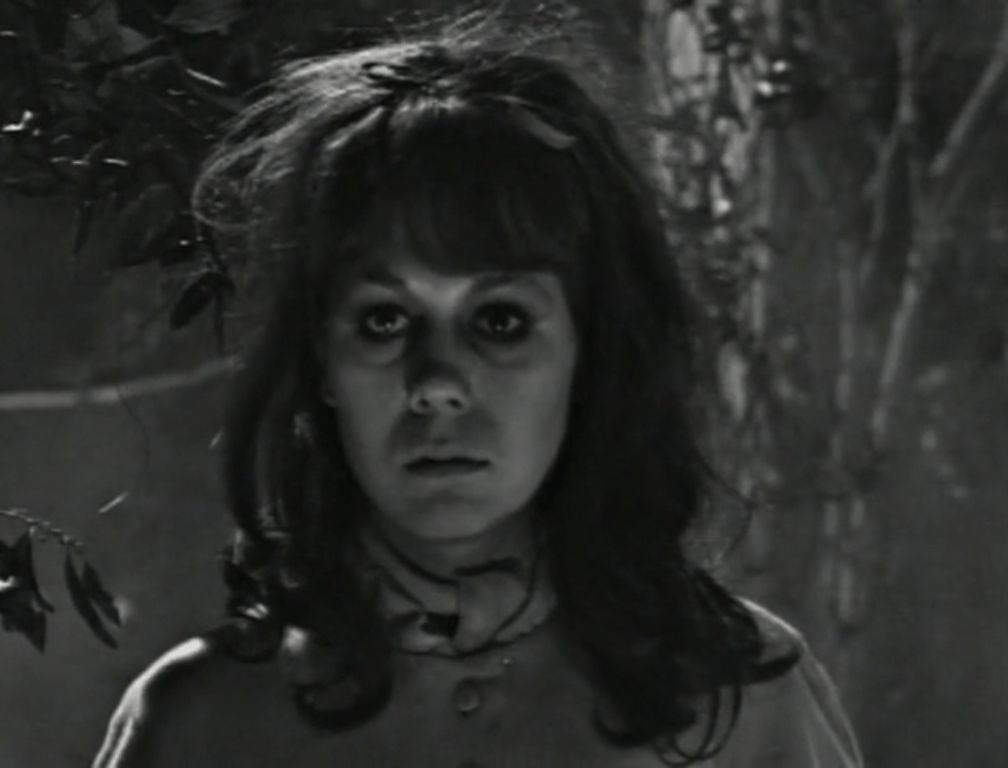
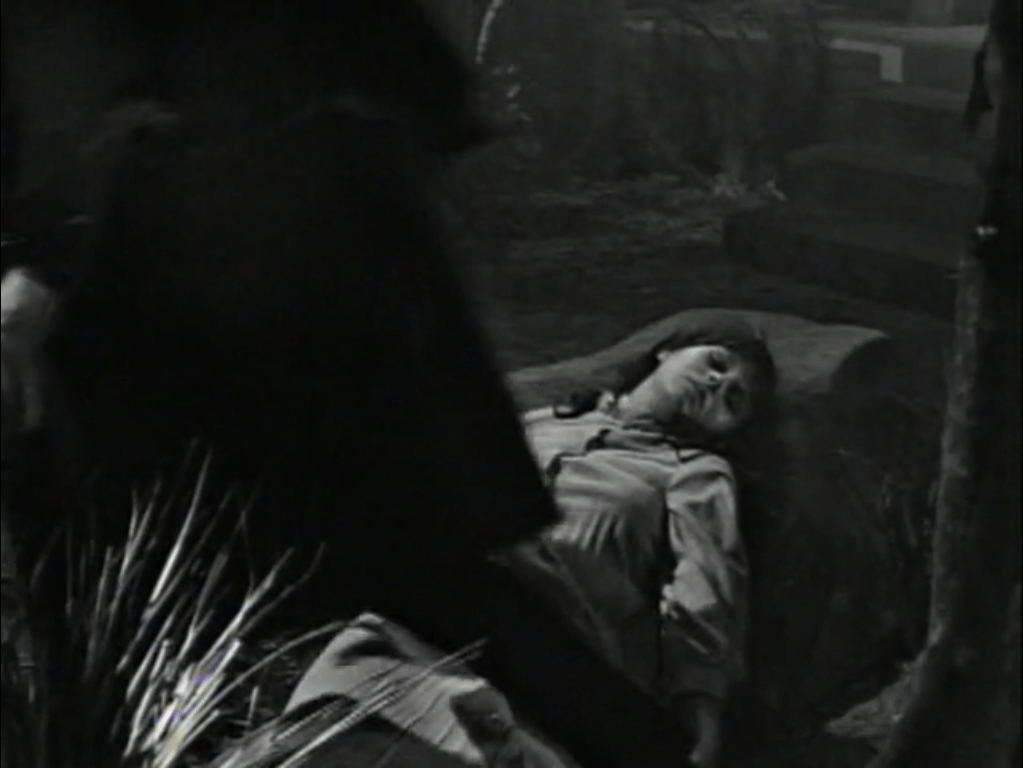
A mysterious little girl in eighteenth century garb shows up outside the dungeon cell where vampire Barnabas Collins is keeping his victim, Maggie Evans. The girl stands with her back to Maggie’s cell and sings a couple of verses of “London Bridge” over and over while tossing a ball. Maggie pleads with her to stop singing, to get away before Barnabas and his sorely bedraggled blood thrall Willie Loomis catch her, and to tell someone that she has seen her. The girl does not acknowledge Maggie in any way.

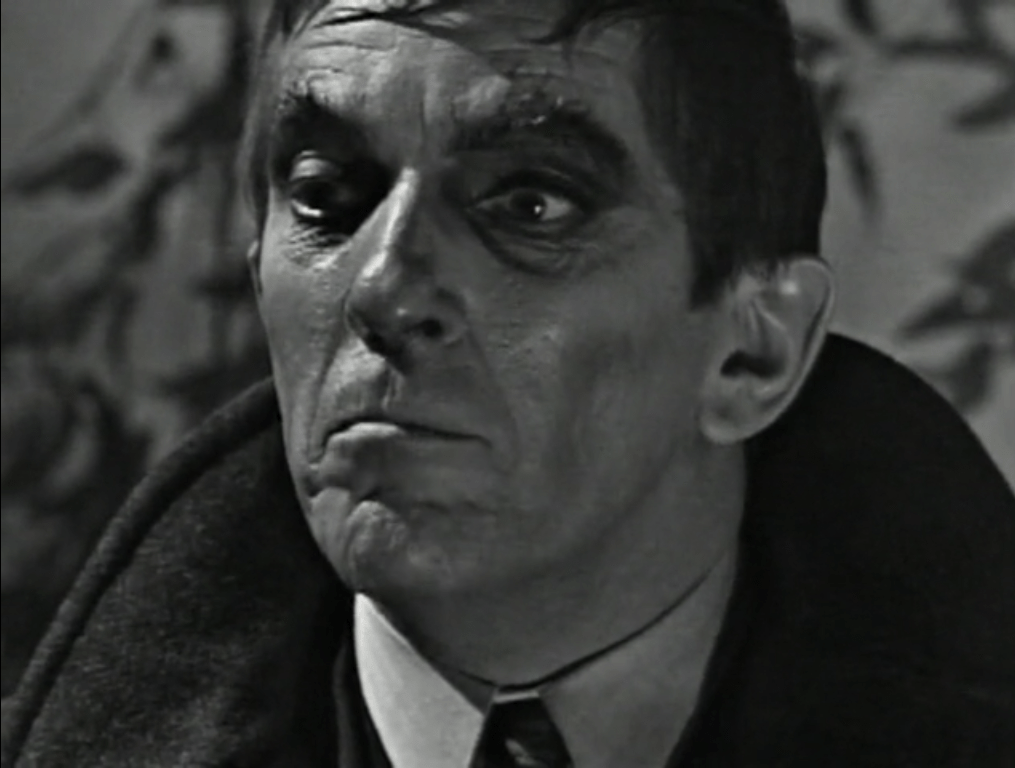
Seconds after the girl has strolled slowly away, Willie comes by the same path she had taken. Maggie is bewildered that Willie didn’t see her. She urges Willie to escape from Barnabas. Willie gives a big speech about how he thinks about escaping all the time, and that when he is in his car he has sometimes tried to keep driving. But Barnabas’ power keeps pulling him back. Regular viewers will be interested in this confirmation that Willie has a car.*

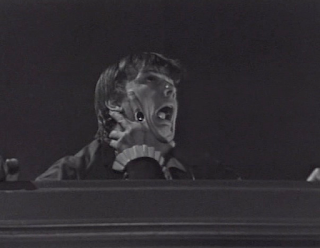
Willie’s big speech.
Screenshot by Dark Shadows Before I Die

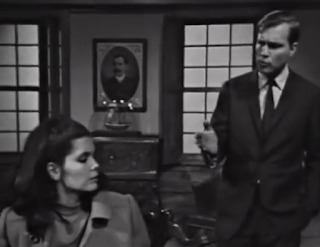
At the great house of Collinwood, strange and troubled boy David Collins is impatient with the geography lesson his governess Vicki is trying to give him. In the first 39 weeks of the show, the only set which consistently saw interesting scenes was David’s room, where he and Vicki became friends during his lessons. They don’t have the studio space to build that set today, so this lesson is conducted in the drawing room. When flighty heiress Carolyn comes into the room, Vicki sends David to play outside. Since the interrupted lesson was about Australia, he hops away kangaroo-style.

Vicki and Carolyn talk about Carolyn’s boyfriend, motorcycle enthusiast Buzz. Buzz is a refugee from Beach Blanket Bingo, so broadly comic a figure that he might have been too silly even for the biker gang in that movie and its sequels. Unfortunately, Buzz doesn’t show up today, and Vicki and Carolyn’s conversation is a pure specimen of old-time soap opera earnestness. There is an odd moment when Vicki asks Carolyn “How far do you intend to go with Buzz?” and Carolyn answers “All the way!” At the end of the scene, Carolyn uses the phrase “all the way” again. She’s talking about her plan to marry Buzz, but “all the way” was such a familiar euphemism for sexual intercourse in the 1960s that it is hard to imagine it wasn’t intentional on some level. When Carolyn tells Vicki that she and Buzz will go “all the way” while Vicki watches, we wonder what weddings are like in Collinsport.**

David has gone to the yard around Barnabas’ house. We see a location insert of him on the swing set there. This footage is reused from #130, when we discovered that he was being watched by his mother, blonde fire witch Laura Murdoch Collins. Laura had died sometime previously, but it didn’t take.

Now, he is being watched again. The mysterious little girl from the dungeon has made her way up to the porch and calls to him as “Boy!” When he tells her his name is David, she says “I know.” She gives her name as Sarah, and asks him to play with her. They toss her ball back and forth, and he finds fault with her fondness for “London Bridge.” She says she used to go to school, a long time ago. She lives around there, but everyone she lives with went away and left her all alone. She excuses herself to go look for them. Willie then comes out of the house. David tells him about Sarah, and Willie shoos him away.

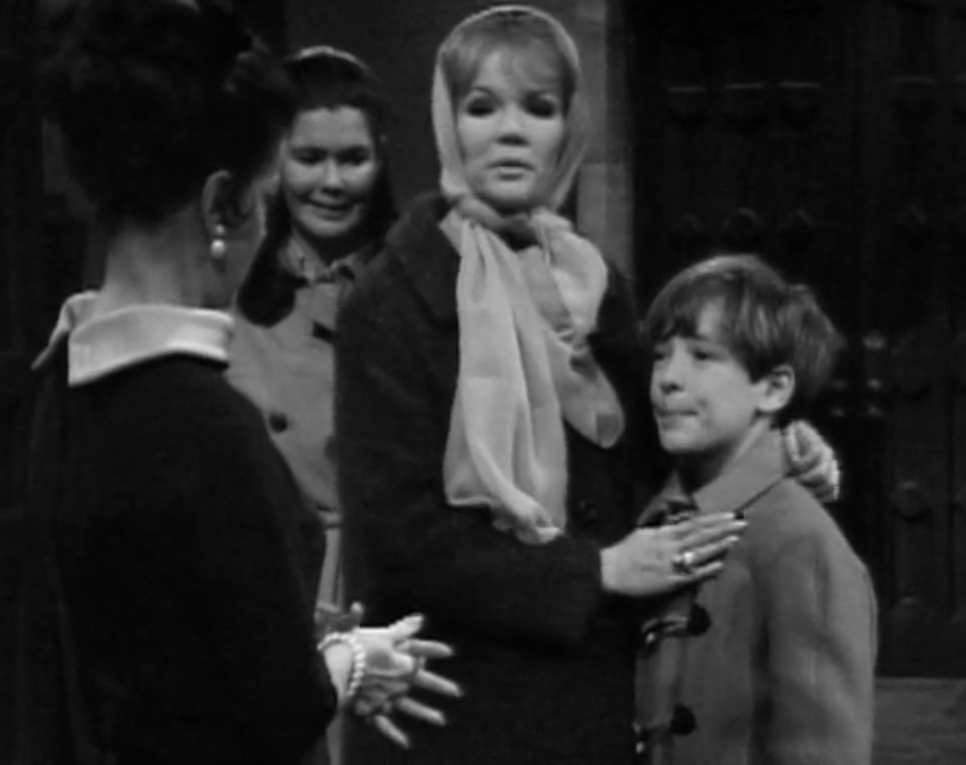
Playing catch as best you can when you’re on a tiny set, photographed in 4X3.
Screenshot by Dark Shadows Before I Die

That Sarah can come and go from the dungeon without being seen shows that she is one of the ghosts who haunt the house. David has seen several of these, but does not recognize her. Her behavior in the opening scenes leaves us wondering if she is aware of Maggie’s presence; if not, she may simply be an apparition, unable to interact with the living characters.

When Sarah meets David, not only is she able to converse with him, but her ability to play catch with him using the ball she brought with her shows that she has a physical body and that she can manipulate material objects. That makes it all the more puzzling that she did not answer Maggie. Was she ignoring her, or was she somehow less capable in the dungeon than she is on the porch?

When Sarah uses the words “a long time ago,” we suspect that she knows she is a ghost and she has been displaced to a future century. But then she becomes confused as to where her people are, and is filled with a terrible urgency to go look for them. Again it is ambiguous just what sort of being Sarah is and what she can do.

There is always a vagueness about the supernatural- if you could explain a phenomenon fully in words and measurements, it wouldn’t be in that category at all. The key to holding an audience’s attention with a story about ghosts and such is to intrigue them with questions that seem like they might have answers and to use them to lead to another, equally imponderable set of questions before the first set gets old. So it is a promising sign that Sarah is introduced while we are still asking what Barnabas can do, what he wants to accomplish, what he needs for survival, and how he got to be the way he is.

That we see David in a lesson with Vicki and then hear him talking with Sarah about how neither of them goes to school anymore is also interesting to regular viewers. Dark Shadows is just about a year old. It started with Vicki’s arrival at Collinwood, where reclusive matriarch Liz had summoned her to teach David. David and his father, Liz’ impecunious brother Roger Collins, had been living at Collinwood for about a month. Before then, they had lived in Augusta, Maine, where David went to school.

When Vicki showed up, Roger objected that he knew nothing about her, and Liz refused to tell him or Vicki how she knew that she existed or why she chose her to be David’s governess. The show has been hinting very heavily that Vicki is Liz’ biological daughter and that Liz is desperate to keep that relationship secret. It is also clear that Liz wants above all for David to grow into her idea of a male Collins, an idea to which her bratty little brother Roger does not in any way conform.

Barnabas’ plan for Maggie is a ghoulish parody of Liz’ for David. He wants to erase her personality and replace it with that of his long-lost love, Josette Collins. Over the generations since her death, Josette has become the patroness of the Collins family and the emblem of its perfect female member. And of course Barnabas is as anxious to hide the secrets in his basement as Liz is to hide those in hers. That Sarah appears to both Maggie and David emphasizes that Barnabas is a funhouse mirror reflection of Liz.

Back in the great house, David hears Buzz’ motorcycle and tells Carolyn that he is there for her. She can’t quite bring herself to tell David that she and Buzz are planning to get married, but does encourage his interest in going for a bike ride with Buzz. As she leaves, he brilliantly mimes motorcycle riding.

David gives Vicki a detailed account of his encounter with Sarah. She is disappointed he didn’t bring her home. Though it is her job to be David’s only friend, Vicki is no more enthusiastic about his isolation from playmates his own age than Willie is about Barnabas’ treatment of Maggie.

Back in the dungeon, Willie finds that Maggie has not eaten. They share a sad moment. He leaves, and Sarah reappears. Maggie talks to her. At first, she doesn’t respond. But then she turns to her and says “If you see my big brother, don’t tell him you saw me. He doesn’t like anybody to come down here.” Then she leaves, a spring in her step.

The last time a ghost spoke to an imprisoned woman was in the same house, in #126. That time, Vicki was bound and gagged and hidden in a secret room on the main floor by crazed handyman Matthew Morgan. When Matthew had gone to get an ax with which to decapitate Vicki, the ghost of Josette had appeared to her and said, in a perfectly cheerful voice,*** “Do not be afraid.” Josette didn’t untie Vicki or anything, she just told her that and vanished. Later in the episode, she and some other ghosts scare Matthew to death before he can kill Vicki. When Sarah goes away from the stunned Maggie and skips along the floor, regular viewers might remember that event and see a promise that Sarah has something up her sleeve.

Closing Miscellany

Sarah is identified in the closing credits as “Sarah Collins,” the name given in #211 for Barnabas’ sister who died in childhood. That rather blunts the surprise of her closing reference to her “big brother.”

Sarah’s identity raises a couple of other questions. Barnabas’ house was the original Collins family home, and he and Sarah would have lived there. The cell in which he keeps Maggie is covered with cobwebs, evidently a feature of the house from its beginning. When she tells Maggie that her big brother “doesn’t like anybody to come down here,” she is speaking from experience- the adults don’t like it when you go near the jail cell in the basement.

Slavery was a legal institution in Massachusetts**** until 1783, and indentured servitude under conditions not so far removed from those to which slaves were subject continued long after. The Old House has been described as a “huge mansion,” so presumably its owners would have held people under at least one of these statuses. As a Collins of the eighteenth century, Sarah’s blithe attitude towards someone held in the cell would seem to be chillingly appropriate.

Sarah’s address to David as “Boy!” when she knows his name is also interesting coming from her. To be sure, if she had called him by name before they met, he would have known right away that there was something very strange about her. Since he has seen many ghosts and knows that ghosts congregate in and around the Old House, he may have identified her as one right away.

On the other hand, during the “Revenge of Burke Devlin” storyline that ran from #1-#201, there was considerable doubt as to whether David was Roger’s natural son or Burke’s. That doubt came to a head when Laura was on the show. Laura only left 13 weeks ago, and Burke is still hanging around. As far as we know, the question may come back up, and David Collins may turn out to be David Devlin. In that case, Sarah may have chosen to call him “boy” because she is a Collins and therefore better than everyone who is not.

I posted a couple of long comments about this episode on Danny Horn’s Dark Shadows Every Day. I won’t copy them here, because they contain spoilers for people who haven’t seen the whole series. But I’ll link to them- under the post about this episode, I argued that Sarah’s introduction was the most important plot development in the entire series; and under a post about a much later episode, I wish one of the words in her closing line had been different.

*Regular viewers are interested in some weird stuff, what can I say.

**My wife, Mrs Acilius, is very much taken with the actresses’ recollections of how Louis Edmonds, who played Roger, would make them laugh so hard during rehearsals that it was sometimes difficult for them to stay in character during filming. She says it is just as well that Roger wasn’t in this episode, because there is no way they could have got through this scene if he had been.

***Provided by Kathryn Leigh Scott, who also plays Maggie.

****Maine was part of Massachusetts until 1821.

Episode 245: Microscopic views of hideous malignancies

Two of the best blogs about Dark Shadows share the same web address. One is Dark Shadows Every Day, a series of more than a thousand well-crafted, insightful, often hilarious essays by Danny Horn about episodes #210 through #1245 and related topics. The other is the group blog that Danny’s readers maintain in the comment threads under each of his posts. The commenters outdid themselves in their remarks on Danny’s post about this episode.

At the beginning of the episode, addled quack Dr Woodard has figured out that the two victims of vampire Barnabas Collins, sorely bedraggled blood thrall Willie Loomis and missing local girl Maggie Evans, have something in common. He hopes that if he can compare a sample of Willie’s blood with Maggie’s he will figure out what that is. Willie is terrified that this will lead to the exposure of Barnabas. Puzzlingly, Barnabas is unworried and orders Willie to cooperate. Only after Willie has given the blood and the doctor has left do we learn that Barnabas switched Willie’s sample with a normal one. “DS Willie” comments:

Barnabas is seriously messing with Willie’s mind in this one. So much of what Barnabas says has double meanings, even triple. Of course he’s playing with Woodard too, but Woodard never realizes it.

For one thing, just after Willie’s blood is taken, Barnabas makes creepy blood comments, ending with “…surrendering your utmost self” and his next line “Now, you had no choice.” I suspect this is all meant more for Willie than for the doctor. Willie had no choice but to surrender his utmost self.

Barnabas delights in repeatedly demonstrating his control over Willie, all to the doctor’s approval. When Willie flares up momentarily at Dr. Woodard’s remark about understanding being frightened, Barnabas immediately brings Willie to heel with a harsh word and harsher look.

Later Barnabas jerks Willie’s chain some more, just because he can, and to tighten his control even more. It’s classic Stockholm syndrome type stuff. The victim is abused and in absolute fear for his life, and yet any lessening of the captor’s threats or violence can be perceived as mercy, bonding the victim to his captor.

His shirt in Barnabas’ menacing grasp, Willie swears he would never, never betray Barnabas. He is only thrown to the ground instead of being choked or beaten. Barnabas proceeds to make Willie feel stupid and disloyal and dishonorable and undeserving of future protection. Add enthrallment on top of that. Oh, and the police having Willie as their top suspect, and Jason having beaten and threatened to kill Willie, even though Willie was trying to protect him.

It is actually pretty amazing that Willie has held up under the strain. He is in full-on survival mode, and yet still has the decency to try to shield Maggie and others insofar as he can, given his powerlessness.

Hey, what was up with Barnabas saying Willie’s blood is a “delicate little flower painted on glass”? He says it twice (once to Woodard and once to Willie) while looking directly at the slide. That doesn’t come across as a remark about blood in general.

“DS Willie,” on Dark Shadows Every Day, 13 October 2018 at 12:38 AM Pacific time

He adds another comment:

Oh. Barnabas was using yet another method to get Willie under his thumb: verbally emasculating him with the “delicate little flower” reference to Willie’s blood on the slide. But I think Willie was so relieved that he missed the diss.

“DS Willie,” on Dark Shadows Every Day, 26 December 2018 at 5:57 PM Pacific time

I made a contribution of my own to the thread. In response to Danny’s unfavorable comparison of Dr Woodard with Bram Stoker’s Professor Van Helsing, I commented:

Screenshot by Dark Shadows Before I Die

I don’t think Woodard is Van Helsing at all. He’s Dr John Seward, treating Lucy and Renfield and baffled by the whole thing until he calls in his brilliant old professor. The mysterious Hoffman, one of the best men in the field, that’s the expert who is going to shake things up.

Seward is young, dynamic, and ready for adventure, while Woodard is middle aged, pudgy, and ready for an afternoon tee-time at the local country club. But that change is necessary. Readers of the novel have plenty of time to think about the sort of group that might go on the expedition Van Helsing organizes, and will expect a bunch of high-spirited youths. On a soap, a character like Seward would be the heroine’s new love interest, and Dark Shadows is flailing about trying to figure out what to do with the love interests Vicki and Maggie have now. The last thing they want right now is another bold, handsome young man who is apparently under a vow of celibacy.

“Acilius,” on Dark Shadows Every Day, 19 May 2023 at 7:26 PM Pacific time

In response to Danny’s remark that Jonathan Frid’s bobbles make it hard to guess what lines the script originally gave vampire Barnabas Collins, commenter “TD” replies:

#1. “Now, in a way, isn’t that understandable?

#2. “After all, blood is the life force.

#3. “It reaches into the deepest recesses of both the heart, and the brain.

#4. “It is the familiar of our complete being.

#5. “To surrender even one drop of it is to suggest a partial surrender of one’s utmost self.”

I’m not so sure this is actual Fridspeak. Yes, it’s kind of gibberishy, but it does make grammatical sense and some sort of syntactical sense. Frid delivers it smoothly and with confidence, unlike his halting fumblings when he can’t remember his lines. When he says this, it’s in a close-up shot, and he’s looking down. My guess is that he is reading it directly from a script. Also, this is Joe Caldwell’s first script (or first credited script–he did some writing on earlier Ron Sproat scripts, if another website is accurate). Maybe this is Caldwell exhibiting the enthusiasm of a first solo outing. Dr. Woodard has a couple of hi-falutin’ and rhetorically “poetic” (and gibberishy) speeches of his own in this episode.

Also, might this episode be marked as the first one to demonstrate the “reluctant” or “sympathetic” vampire in Barnabas’s character? In this episode (in another speechy series of lines), when Dr. Woodard and Barnabas are discussing the “madman” who broke into Woodard’s office and stole the blood sample, we get this exchange:

Dr. Woodard: You know, it’s the peculiar magnificence of the human spirit that’s required to provide the potential for such corruption. [See? This is like the Barnabas “blood is the life force” speech–who talks like this???]
Barnabas: Yes, I know what you mean. Whoever he is, he must certainly be, at one and the same time, more than a man…and less than a man.
Dr. Woodard: You seem almost sorry for him.
Barnabas: Sorry? No, I’m not sorry. The truth is, I loathe him. I loathe him very, very deeply.

“TD” on Dark Shadows Every Day, 2 June 2017 at 11:06 AM Pacific time

I agree with “TD” that today’s dialogue is marred by purple passages; I would go so far as to say that none of the lines would have survived a rewrite. Not among the lines delivered by the human actors, anyway- our beagle was fascinated when the hound howled on the soundtrack.

I should mention that at least one perceptive critic of Dark Shadows disagrees with me and “TD” about the script. Patrick McCray’s Dark Shadows Daybook is in its own way the equal of the two blogs at Dark Shadows Every Day. Patrick wrote two posts about this episode. In one from 2016, he wrote that “The language is poetic and evocative. Barnabas has moments of self-loathing and ambiguity that are gorgeously, hauntingly phrased, and the same can be said for Woodard’s exploration of science and mystery.” In 2019, he went so far as to call it “the best written episode of the series.”

John and Christine Scoleri also include some interesting material in the post about this episode on their recap-heavy blog Dark Shadows Before I Die. I particularly liked the series of screenshots at the end of the post captioned with some of the purple prose from today’s dialogue.

Episode 236: The future, for the first time

Maggie Evans, The Nicest Girl in Town, has vanished from her hospital bed. We start with a long succession of characters talking about this fact with Maggie’s father Sam. Had David Ford played Sam as effectively as he did in his first weeks on the show, one such exchange might have made for a good scene. But Ford is overacting today, and the first part of the episode drags on and on.

We cut to the Old House on the great estate of Collinwood, where Maggie’s boyfriend Joe and dashing action hero Burke Devlin have gone. Vampire Barnabas Collins resides in the Old House along with his sorely bedraggled blood thrall, Willie Loomis. Joe and Burke have no clue there is anything odd about Barnabas, but they don’t like Willie and suspect he may know what happened to Maggie.

Barnabas lets Joe and Burke in the house and explains that he sent Willie to run some errands for him out of town. When they tell him about the evidence that has led them to think Willie might be connected with Maggie’s disappearance, he persuades them that there is nothing to their suspicions. Once they are gone, he calls out “It’s all right, they’ve gone. You’re safe here- safe here with me.” Maggie walks into the room.

Barnabas talking to Burke

This scene is very good. Barnabas is made up to look much more like The Vampire than he has been in previous encounters with characters he was trying to fool into thinking he was a harmless eccentric recently arrived from overseas. He is polite enough to Joe and Burke that they can chalk his appearance up to the lateness of the hour, but as the audience watches him extract information from them point by point, until he knows exactly what they do and don’t know, we can see him calculating when and how he will have to kill them. It is as good a scene as Jonathan Frid has had since he debuted as Barnabas.

Frid’s performance in this scene benefits from his flawless line delivery. Not so, unfortunately, the scene that follows. His bobbles are not especially bad by Dark Shadows standards, but his task is far more fragile than any he has taken on before. We’ve seen him pretending to be the Collins family’s mild-mannered cousin from England; in those moments, Barnabas himself is taking on a challenging acting job, and Frid’s difficulties sometimes dovetail with troubles we might expect Barnabas to have in his performance. We’ve seen him abusing Willie; in those moments, we might expect him to sputter a bit, and Frid can hide some of his memory lapses in that mannerism. But now, he is telling Maggie what his plans are for her. As he does so, we realize he is a crazy man spilling out his deepest and sickest obsession. That context leaves nowhere to conceal even the slightest flub. As a sign of triumphant psychosis, the lines have to flow without interruption. Every time Frid stumbles for a fraction of a second, he breaks character.

Nor can Kathryn Leigh Scott bail him out. As Maggie, her part is to wander around in a stupor and occasionally repeat the last word or two of whatever is said to her. She makes that a lot more interesting to watch than you might expect, but there’s only so far it can take you.

Barnabas’ plan takes us outside the themes we are familiar with from vampire fiction. He wants to brainwash Maggie into thinking that she is Josette Collins, who has now been retconned into the woman Barnabas loved in his human days. His goal is that Maggie Evans will cease to exist, and that in her body Josette will live again.

Dracula never wanted to do anything like that, though after Dark Shadows has a hit with this storyline it will become part of vampire lore. Prince Mamuwalde, the menace in the 1972 film Blacula, kidnapped the heroine and tried to turn her into his long-dead love. Another undead fictional man from Africa had tried the same thing in 1932, when Imhotep, played by Boris Karloff, had spent the bulk of The Mummy trying to turn the heroine into a revived form of his adored Princess Ankh-esen-amun. Frid’s face and coloring were somewhat similar to those of Bela Lugosi, a fact often remarked in connection with his casting as a vampire. But his voice and movements are strongly reminiscent of Boris Karloff, and as a mashup of Dracula and Imhotep he is a synthesis of these two actors.

Barnabas gives Maggie a music box that he had intended to give Josette. He says that he bought it for Josette in his travels in “the Orient,” intending to give it to her “on a very special day,” and “this is that day.” This leaves us wondering why the day never came when he could give it to Josette. Did he become a vampire before he returned from his travels? Did he come back from his travels to find that she was no longer available to him? Or was it supposed to be a present at their wedding, a wedding that never occurred?

Barnabas also produces Josette’s wedding dress and tells Maggie that she, as the new Josette, will wear it. When Imhotep produces Ankh-esen-amun’s clothing and jewelry, we remember that royal personages in ancient Egypt were buried with their possessions and assume that he has retrieved them from her tomb. The show did lead us to wonder if the Collinses once had a similar practice. Willie released Barnabas because he had heard a story that some of the Collinses were buried with expensive jewelry and so was trying to rob a grave. The story of the buried jewels was framed as an echo of the Gothic romances that inspired the first weeks of Dark Shadows, but has now become an anticipation of the show’s journey into Universal Pictures’ back catalogue of horror movies.

If Barnabas does manage to somehow erase Maggie and bring Josette back to life in her body, it won’t be the first time Miss Scott has played Josette. In #70, Miss Scott was the ghost who emerged from Josette’s portrait and danced outside the Old House. Miss Scott put Josette’s veil on again in #126 when she led the ghosts who scared maniacal handyman Matthew Morgan to death before he could murder well-meaning governess Vicki. In that one, she delivered a few lines as Josette. Miss Scott’s name did not appear in the credits as Josette in either of those episodes, and the only time we caught a glimpse of Josette’s face was in #149, when she was played by stand-in Rosemary McNamara. But if by any odd chance a viewer does know that Miss Scott has played Josette before, the final dissolve from a closeup of Miss Scott to one of Josette’s portrait suggests a definite possibility that Barnabas’ plan, nonsensical though it seems, will somehow succeed.

Danny Horn’s post about this episode on his Dark Shadows Every Day is particularly good. He compares its visual strategy to that of the one surviving contemporary segment of General Hospital, and praises the ambitious approach director Lela Swift took to composing images. I should also mention Patrick McCray’s Dark Shadows Daybook post, in which he analyzes the way the story alienates us from our rooting interest in Maggie’s safety by promising a more exciting story if Barnabas has his way with her for an extended period.

Episode 231: Anyone’s blood

Today is only the second time we hear a voice announce a recast over the opening title. The first time was in #35, when David Ford took over the part of drunken artist Sam Evans from wildly incompetent actor Mark Allen. This time Robert Gerringer is taking over the part of addled quack Dr Woodard from Richard Woods. Woods only played the role twice, and neither time could he find a way to distract the audience from the ignorance of medicine that the writers showed in their scripts.

Gerringer’s lines don’t make much more sense than did the ones they dumped on Woods, but he acts up a storm. Woodard is examining Sam’s daughter Maggie Evans, The Nicest Girl in Town. Unknown to Sam or Woodard, vampire Barnabas Collins has been sucking Maggie’s blood. Woodard is firm with Maggie when she resists his examination. He seems to be somewhat on edge, just enough that we wonder if there is more to it than the difficulties we can see Maggie giving him. Perhaps he is thinking something he isn’t saying. Woods never managed to make us wonder if his version of the doctor was doing that.

When Woodard and Sam leave Maggie’s room, Woodard assumes an alarmed tone. He tells Sam that Maggie is on the point of death and needs a blood transfusion at once. By showing us that Woodard was concealing the true nature of his concern when he was with Maggie, Gerringer gives substance to our hopes that the character’s nonsensical words and deeds will turn out to be a screen hiding something interesting.

Maggie’s boyfriend, hardworking young fisherman Joe, joins Sam and Woodard. Woodard asks if either Sam or Joe has blood type A. Joe does. Woodard doesn’t ask about Rh factors or Joe’s medical history or anything else, he simply marches Joe into Maggie’s room and the bodily fluids start pumping right away. Joe holds Maggie’s hand at first, but her violent protests force him to let go.

Transfusion

In Bram Stoker’s Dracula, Professor Van Helsing and Dr John Seward give blood transfusions to the vampire’s victims. That novel was written in 1897, and blood types weren’t discovered until 1900, so Van Helsing and Seward take blood indiscriminately from all the men cooperating in the effort to defeat Dracula. Van Helsing is particularly enthusiastic when he learns that Arthur Holmwood has given blood to Lucy Westenra, because Arthur “is the lover of her!” Van Helsing is Dutch, and speaks in a vaguely comical broken English. Woodard doesn’t seem particularly excited that Joe is “the lover of her,” but audiences who had read the book will recognize the allusion.

At this point in the production of Dark Shadows, the tentative plan was that Dr Woodard would become something like the expert on paranormal dangers that Dr Peter Guthrie had been during the Phoenix storyline, and that Barnabas would be destroyed in episode 275. Like Stoker’s Dracula, the Phoenix arc had featured a group of stout-hearted men and one valiant young woman coming together to do battle with an undead menace. Dr Guthrie had been their Van Helsing, an expert from out of town who leapfrogs over some weaknesses in the evidence actually available to the protagonists to get them to the same level of understanding that the audience has been given. Also like Van Helsing, Guthrie is the first to realize that the one female member of the team is the key to the success of their efforts, and so he insists on putting her in situations the other men regard as too dangerous for her. As Mina had been instrumental in the destruction of Dracula, so well-meaning governess Vicki is the person who finally thwarts the plans of the Phoenix.

If Woodard and Vicki are going to destroy Barnabas in #275, we have to wonder what story the show will have to tell in #276. The only other plotline going at the moment is the blackmail of reclusive matriarch Liz by seagoing con man Jason McGuire, and that can’t continue indefinitely. Not only will Liz run out of things for Jason to take away from her, but Dennis Patrick, the actor playing Jason, will leave the show no later than the end of June. Since the end of June is when #275 will be airing, we can hardly expect Jason to take the show over after that time.

In fact, Jason is an in-betweener brought on the show to clear away the last non-paranormal plot elements left over from the period before the show became a supernatural thriller in December 1966. By the time he leaves, both the reason for Liz’ long self-immuration in the great house of Collinwood and the identity of Vicki’s parents are supposed to be laid bare for all to see. Neither of those secrets ever generated an interesting story, but as long as they are around it is at least theoretically possible that the show will become a conventional daytime soap opera again. Without them, they are altogether committed to the spook show route. Destroy Barnabas, and you just have to come up with yet another menace from beyond the grave.

I remember Gerringer’s acting style from the first time I saw Dark Shadows. That was back in the 90s, when it was on what was then called the SciFi Channel. He so perfectly represented the doctor characters on the soaps my mother used to watch when I was a kid twenty years before that seeing him in the middle of a story about a vampire told me everything about the strangeness of a conventional daytime serial switching to a horror theme. If that guy is the one to drive the stake through Barnabas’ heart, or if he is even part of the team that finishes him off, it will be a statement that the makers of Dark Shadows have decided to stop being silly and start imitating The Guiding Light.

My wife, Mrs Acilius, was particularly frustrated with the dialogue in this episode. As Maggie, Kathryn Leigh Scott does a good job with nonverbal communication creating the image of a reluctant patient trying to get out of her skin, but her lines consist chiefly of repeating whatever is said to her. The other members of the cast are equally effective at projecting concern for a loved one whose grave illness they don’t understand and can’t help, but their lines too are so heavily loaded with repetition that we started to suspect that Malcolm Marmorstein was writing for a cast of myna birds. In particular, Woodard’s lines to Sam in the living room repeat the word “shock” so many times that they start to sound like he’s stuttering.

The original choices for the roles of Sam, Joe, Dr Woodard, and Maggie.
Photo by Bird Ecology Study Group

In his post about this episode, Danny Horn complains that there is not a single interesting still image in it. I agree with that, though I would say that the actors’ movements tell a story. Granted, it is a story that could have been told in a tiny fraction of the actual running time, but they deserve credit for holding the show together when the script gave them zero support.

Danny says that the episode would have been just as good if it were a radio show. Mrs Acilius says that it would have been “a thousand times better” than it is if it were a silent movie. Maybe they could compromise, and it could be presented with neither audio nor video, and the audience could spend the 22 minutes doing something else.

Episode 230: Some explaining to do

The Body in Question

Dark Shadows has been a supernatural thriller ever since the ghosts of Josette and the Widows scared Matthew Morgan to death in December 1966. But today’s episode is the first one that is structured like a horror movie.

Horror movies tend to focus on the visible damage done to the bodies of the female victims of the monster. The current victim is Maggie Evans, The Nicest Girl in Town, and the monster is vampire Barnabas Collins. We open with Maggie’s father, artist Sam Evans, looking helplessly around the house. Sam doesn’t know it, but Maggie was compelled to leave by the power that Barnabas has gained over her by drinking her blood.

What Sam does know is that Maggie was in extremely poor health. He cannot understand how she could have gone anywhere under her own power. We then see Maggie looking awful and wandering around the graveyard. Later, a closeup of a professional headshot of actress Kathryn Leigh Scott will dissolve into an image of Maggie among the tombstones, contrasting her usual fresh-faced beauty with her present ghastly haggardness.

Maggie’s professional headshot
The dissolve
Bride of the monster

The monster who has reduced her to this sorry state, vampire Barnabas Collins, emerges from the fog. Barnabas has been on the show for four full weeks now, but this is the first time we see his face not in the pleasant disguise of a wealthy gentleman visiting from across the sea. He is wearing a more extreme version of the makeup Maggie has on, and his fangs feature prominently. This is the introduction of the monster, a key element on any horror film, and it suggests that Barnabas is now what Maggie will become.

Barnabas inspects Maggie
Two of a kind?
Fangs on display.
Screenshot by Dark Shadows Before I Die

When Barnabas hears Maggie’s friends approaching before he can complete his evil plan, he drops her on the ground and steps over her, again treating her body as a thing.

Barnabas steps over Maggie

After she is carried home, Maggie moans about her pain but can say nothing about what has happened to her, who is responsible for it, or what she is thinking. Again, we can connect only with her physical being, not her social relations or her inner life or the events that have involved her. At the end, the handkerchief tied around her neck is removed without her permission or objection, as if she were inanimate. The camera zooms in on open wounds on her neck, isolating that area and leaving us with the image of the wounds as things available to us to examine apart from Maggie’s personality or the rest of her body.

The Source of the Evil

The episode is an adaptation of elements from Bram Stoker’s Dracula. Early in that novel, the vampire’s victim Lucy rose from her sickbed and wandered off to a graveyard. As Lucy is found by her friend Mina, so Maggie will be found by her friend, well-meaning governess Vicki. As Mina would spend the second half of the novel as the only female member of a group of stalwart and dynamic men doing battle with the evil Count, so Vicki is working with an otherwise all-male search party led by dashing action hero Burke Devlin. As Mina’s colleagues exclude her from their activities and thereby come close to total failure, so the men leave Vicki behind in the Evans cottage to wait by the phone, only to find that she is the one who will have the most to offer when she joins them in the field.

After Lucy dies and her undead form is destroyed, Mina becomes Dracula’s victim. Mina ends up as the precursor of the “Final Girl” in the mad slasher movie, playing a key part in Dracula’s final defeat, though unlike those movies Dracula ends with a successful team effort.

Since Vicki has been our point of view character from the beginning, was an effective protagonist in the “Phoenix” storyline, and is as relentlessly wholesome as the Final Girl typically is, we might expect that she will be Barnabas’ last victim. That expectation in turn suggests that Maggie, like Lucy, will die, rise as a vampire, and be destroyed by those who love her most. Maggie is one of every viewer’s favorite characters, so the prospect that she might turn into a monster and then leave the show altogether brings keen suspense.

Barnabas Beats His Willie

Vicki does have two important conversations with sorely bedraggled blood thrall Willie Loomis while she is in the Evans cottage. The first occurs when Willie comes to the door to bring a message that his master Barnabas will not be available at the usual time to sit for the portrait Maggie’s father is painting of him. Vicki tells Willie that Sam is out searching for Maggie, and Willie becomes very upset to learn that Maggie is missing.

The second conversation comes a few minutes later, when Willie, not disguising his voice in any way, telephones the Evans cottage and tells Vicki that Maggie is in the cemetery and that she is in extreme danger. Somehow Vicki doesn’t recognize his voice. I suppose there were lots of people it might have been- maybe it was Detective Mary Beth Lacey’s husband Harvey from Cagney and Lacey, or Stefan from Daughters of Darkness, or Jock Porter from Love is a Many Splendored Thing, or Geoffrey Fitton from the original Broadway cast of All in Good Time, or any of dozens of policemen and criminals who were in single episodes of cop shows in the 1970s and 1980s.

Willie’s call to Vicki made me wonder about the extent of Barnabas’ powers. When we first saw Barnabas with Willie, his power over him was so extreme that it cost Willie a great effort even to ask Barnabas an unwelcome question, and a look was enough to drive Willie to scurry off and perform the most hateful of tasks. An act of defiance like this was out of the question. Perhaps Barnabas can only keep one blood thrall under total control at a time, and by adding Maggie to his diet he has weakened his hold over Willie.

Willie intrudes on Barnabas’ encounter with Maggie in the cemetery to warn him that Maggie’s friends are on their way. Barnabas instantly suspects that Willie told them where to look for her. When Vicki’s party arrives in the cemetery, Barnabas and Willie run away and hide in the back room of the Collins family tomb where Barnabas was trapped for about 170 years until Willie accidentally released him. This is a departure from Dracula– the Count would have attacked whoever interrupted him, no matter how many of them there were, and fled only if they were armed with crucifixes or consecrated communion wafers or other objects he couldn’t tolerate. But, as my wife Mrs Acilius pointed out, Barnabas has gone a long time without using his vampire powers, so he’s probably rusty.

Barnabas and Willie listen as Burke looks around the outer room of the mausoleum. Once they are sure he is gone, Barnabas confronts Willie with his suspicions. Willie’s lies do not satisfy him, and he lifts his heavy cane and starts beating Willie with it. All we see of this beating is Jonathan Frid’s face and the cane in his hand, but those images, coupled with sound of John Karlen’s cries, imply a violence that shocks us.

In the secret room.
Screenshot by Dark Shadows Before I Die

Closing Miscellany

Burke picks Maggie up off the ground, grunting audibly as he does so. He carries her into her house, again with a lot of grunting. If I had been Kathryn Leigh Scott’s agent, the production staff would have received a very hot letter about that grunting. The good-looking young women on a soap opera aren’t supposed to weigh anything at all, certainly not enough to cause a dashing action hero to grunt like that even if he carried her all the way from the cemetery.*

In his post about this episode, Danny Horn has some lines about the ineffectiveness of the Collinsport police that I can’t resist quoting:

Sam tells the Scooby gang that he’s alerted the police — the sheriff and his deputies are out looking for Maggie. But, as everyone knows, the police department in Collinsport is 100% useless, so by now the deputies have probably arrested each other, and the sheriff’s all tangled up in a clothesline somewhere…

Vicki tries to call the sheriff, but there’s no answer; apparently every single person associated with the police department is out searching for Maggie, or falling down wells, or buying magic beans, or whatever the hell it is that Collinsport police officers do in a crisis. 

Danny Horn, “Episode 230: The Transylvania Twist,” Dark Shadows Every Day, 27 September 2013

When I first read about “the sheriff all tangled up in a clothesline somewhere” a few years ago, I laughed for about five minutes and knew I would be reading Danny’s blog to the end. I’m glad I did, it’s so much fun it inspired me to start this one.

*Mrs Acilius and I remembered a story Miss Scott tells nowadays. Early in the production of the show, Joan Bennett saw her eating a cheese Danish and said “The figure you have now can be your career for the rest of your life.” She put the cheese Danish down immediately, and hasn’t eaten another since. Our response to the story has been to eat cheese Danish on Miss Scott’s behalf at regular intervals.

Episode 229: A very sick girl

The opening voiceover tells us that “Evil reaches deeply into man’s soul, turning his heart to stone, transforming him into a vile monstrosity, and it is horrible to observe this process in an innocent and not be able to recognize it or prevent it.” Without that introduction, first-time viewers would have no reason to assume that Maggie Evans, The Nicest Girl in Town, is going through anything other than an ordinary sickness that has her looking bad and snapping at people.

Kathryn Leigh Scott does play Maggie’s moodiness very well. She does an especially admirable job in the scene where she yells at her boyfriend, hardworking young fisherman Joe, and orders him out of the house. After Joe goes, Maggie looks directly into the camera, and returning viewers will recognize that she is well on her her way to becoming the undead.

Bloofer lady

Meanwhile, well-meaning governess Vicki and dashing action hero Burke are dressed up and having dinner in Collinsport’s only night spot, The Blue Whale. Most of the time, The Blue Whale is a waterfront dive with frequent bar fights. But when Burke and Vicki dine there in their good clothes, the place transforms into a respectable restaurant, as it did in #189.

Burke and Vicki recap some plot points surrounding the great estate of Collinwood. Later, Maggie’s father Sam comes in and tells them of her condition. Vicki replies to Sam’s description with “Now let me see if I understand this. You said that yesterday she was sick and she collapsed, and last night she was up and around, and this morning she was sick again?”

In his post about this episode on his great blog Dark Shadows Every Day, Danny Horn’s response to this line is “IT IS NOT OKAY TO SUMMARIZE A RECAP THAT HE JUST SAID ONE SENTENCE AGO.” It’s true that the episode is heavy on recapping. A defter writer than Malcolm Marmorstein probably would have started the scene with Vicki putting this question to Sam, leaving out the recap that it re-recaps. But Vicki’s question itself is a good moment. As she delivers it, Alexandra Moltke Isles uses her face to show Vicki coming to a realization that has so far eluded everyone else.

The moment of recognition

Vicki recognizes that Maggie’s symptoms are identical to those which sorely bedraggled blood-thrall Willie Loomis displayed a couple of weeks ago. As she explains this, we see Burke gradually catch on and Sam absorb the information. Up to this point, everyone has been remarkably obtuse in failing to make this connection- the same doctor who examined Willie examined Maggie today, and doesn’t give any sign of recognizing it, or for that matter of understanding anything else relating to medicine.

As Vicki was the only character yesterday who escaped the long-running Idiot Plot that goes on because everyone fails to notice the abundant evidence that reclusive matriarch Liz killed her husband and buried him in the basement, so she is the only character today who spots the obvious similarity between the cases of the two victims of the vampire. The show is still sputtering along, but in a Smart Vicki turn like this we can find a glimmer of hope that it will start moving soon.

Episode 216: First the boy is sorry, then the boy is sick, now the boy must stay

Seagoing con man Jason McGuire finds his old henchman, the sorely bedraggled Willie Loomis, in a bar and drags him back to the great house of Collinwood. He orders Willie to apologize to reclusive matriarch Liz and her daughter Carolyn for, among other things, trying to rape Carolyn. The ladies distrust Willie at first, and Carolyn has occasion to remind Willie that she had to fend him off by pointing a loaded pistol at him and promising to blow his brains out. After a few minutes, though, Carolyn realizes that Willie is strangely changed and seriously ill.

Carolyn leaves, and Liz and Jason have a scene together in the drawing room while Willie and the portrait of Barnabas Collins have a scene in the foyer. Willie and the portrait have some fresh material to explore; Willie tries to evade the portrait’s gaze. When he cannot, he screams and faints. A closeup of the portrait emphasizes its grim look of command. It was Willie’s obsession with the portrait that drew him to his doom, and now a sinister force calls to him through it.

Willie loses his fight with the portrait. Screenshot by Dark Shadows Before I Die

The scene in the drawing room is anything but fresh. Jason makes a demand of Liz, in this case that she let Willie stay in the house; Liz resists the demand; Jason threatens to expose her terrible secret; Liz capitulates. This is the eleventh time we have seen this particular ritual, and it is no more interesting than were the previous ten.

Writing from the perspective of someone who started watching Dark Shadows with #210, Danny Horn praises the acting of Joan Bennett and Dennis Patrick and declares this the first good scene on the show. Bennett and Patrick were outstanding performers to be sure, but those of us who have seen this same scene so many times before will be less enthusiastic. Besides, there have been some other good scenes in the last few days, even if most of them involved actors triumphing over weak scripts. And in the first months of the series, there were whole episodes that were good, one of them as recently as eight weeks ago.

It is by no means clear why Jason wants Willie in the house. Jason’s whole plan seems to be to blackmail Liz and squeeze her for whatever he can get, and Willie plays no part in that. On the contrary, the danger he represents to Carolyn and to well-meaning governess Vicki very nearly prompts Liz to call the police and put an end to the whole situation.

In #204 and #205, Willie threatened to expose Jason’s guilty secrets if he didn’t deliver a large sum of money right away, suggesting that Jason is keeping his own blackmailer close at hand. But yesterday, Willie said he didn’t want any money, and today he says that he wants to go far away and never see Collinwood again. So it would seem Jason is off whatever hook Willie may have been keeping him on.

Liz breaks it to Carolyn that Willie is going to be back in the house while he recovers from his illness. Carolyn at once agrees that this is as it should be. She is deeply concerned about Willie’s sorry state and believes that his apology is sincere. She asks Liz if she also believes this. Joan Bennett plays her response for a laugh- Liz is so surprised that Carolyn is actually convinced by Willie that she momentarily forgets to pretend to be convinced herself.

Viewers who saw all of Willie’s depredations will appreciate Carolyn’s response. If someone as thoroughly loathsome as he was can inspire this much sympathy after falling under the malign influence he has released, how much more poignant will it be when the same influence starts to work on a character we actually like?

The episode ends with a scene between Willie and Jason. Willie is in bed, moaning that he wants to get away from Collinwood, while Jason bullies him to stay and tries to find out what’s wrong with him. When Willie snarls at him to stay away from the bite on his wrist, all those scenes with Liz become retroactively easier to tolerate. Willie was hard to watch when he was trying to rape the female characters, but now that he has been brought low by the fell powers of darkness he’s likable enough. Jason’s insistence on probing into Willie’s doings suggests he too will get his comeuppance sooner or later.

The contrast between Carolyn’s final speech to Liz, with its reference to Willie’s apparently “spiritual” disorder and her remark that she isn’t sure she wants to know what is going on with him, and Jason’s final interrogation of Willie, with its assumptions that Willie has committed a specific crime and sustained a specific injury in the course of it, shows the difference between Carolyn and Jason as characters. Carolyn has been on Dark Shadows from the beginning and knows that the ghosts have been getting more and more intrusive. She remembers that her Aunt Laura visited recently and turned out to be a murderous fire witch from beyond the grave, and that by the end of Laura’s time no one could be sure if anything that has happened in Collinsport has been entirely of this earth. She knows that she is part of a supernatural thriller/ horror story, and has an eye out for the uncanny.

Jason showed up only a few weeks ago, immediately after Laura vanished. He is an in-betweener, meant to sweep away some leftover story elements, get the vampire onto the show, and fill time before the deadline for departure the actor gave the producers when he took the part. But as far as Jason knows, he is the leading character in a show about blackmail plots, whodunits, and missing fountain pens. He is a throwback to a phase of the show that ended in November of 1966, and he is speeding towards his doom.

Episode 210: He’d want to say goodbye

Dangerously unstable ruffian Willie Loomis is under the impression that Dark Shadows is still the show ABC originally bought, a Gothic romance. So when he hears a tale of a grand lady in a manor house who fell in love with a pirate and is buried with a fortune in jewels that he gave her, he takes the story at face value and sets out to find and rob her grave.

Willie’s associate, seagoing con man Jason McGuire, believes that Dark Shadows is now the crime drama it more or less became for a couple of months after the Gothic romance approach petered out. He is blackmailing reclusive matriarch Liz, and refers to his incessant threats against her in their first conversation today.

Yesterday, the Caretaker of Eagle Hill cemetery tried to warn Willie that Dark Shadows has changed direction, and has been developing as a supernatural thriller/ horror show since December. Willie wouldn’t listen to him, but regular viewers know that all the old storylines are finished, and even people tuning in for the first time today will notice that the emphasis is on the uncanny.

At the end of today’s episode, Willie finds a hidden coffin and forces it open. It doesn’t have the jewels he was seeking, but something is in there that will bring great wealth to ABC and Dan Curtis Productions.

Screenshot by Dark Shadows Before I Die

This is the first episode of Dark Shadows most people see. Posting commentary on episodes 1-209 is a bit like driving down a quiet, picturesque country road. By contrast, googling “Dark Shadows episode 210” is like merging onto a busy highway. I want to respond to two of the many, many commentators on this one, Patrick McCray and Danny Horn.

On his great Dark Shadows Every Day, Danny writes:

Elizabeth calls Jason into the drawing room and throws an envelope of money at him — she’s paying Willie to leave town. She tells Jason to count it, but he turns on the charm, assuring her, “It’s all there. I can tell by the feel of it.” She barks at him that his friend should leave the house immediately. He apologizes: “I wanted this to be kept quiet. You know, the same way you wanted something kept quiet?” She walks out, and as soon as her back is turned, he opens the envelope and counts the money. Jason is funny. We like Jason.

Danny Horn, Dark Shadows Every Day, “Episode 210: Opening the Box,” 2 September 2013

Danny makes a point of ignoring the first 42 weeks of the show, often claiming never to have seen most of it. As his blog goes on, it becomes clear that he has seen a lot more than he wants to let on, but he is consistent enough about writing from the point of view of someone who started from this episode that I could always find a place in his comment section to add remarks about the connections to the early months.

And indeed, it is easy to see how someone tuning in for the first time today could say “We like Jason.” He is trying to keep control of the situation when he doesn’t understand what’s going on and he can’t afford to tell anyone the truth, so he has to keep coming up with fresh lies that will keep the ladies of the house from calling his bluff and new ways of pretending to be scary that will keep Willie from laughing at him. That’s a winning formula for a character, as witness the history of theater all the way back to the Greek New Comedy. Actor Dennis Patrick has the craft and the charisma to sell it beautifully.

Returning viewers may well have a far less enthusiastic response to Jason. His conversations with Liz today are the first time the two of them talk without falling into a pattern where Jason makes a demand, Liz resists, he threatens to expose her terrible secret, and she capitulates. They’ve enacted that depressing ritual ten times in the weeks Jason has been on the show, sometimes twice in a single episode. In Jason’s scenes with Willie and some of the other characters, we’ve had hints of the breezy charm Dennis Patrick exudes today. But the Jason/ Liz exchanges are so deadly that we get a sinking feeling every time either of them appears. Since blackmail has been the only active storyline going for the last two weeks and the two of them are the only full participants in it, that’s a lot of sinking feelings.

Patrick McCray’s Dark Shadows Daybook entry focuses on Jason’s opening scene with Willie:

Jason is harassing Willie. The big one is abusing the little one, demanding that he account for his whereabouts and doing so violently. David and Goliath. Shrill and meek. Had we started earlier, it would be tougher to be on Willie’s side. Starting here? Jason is the villain. He accuses the bruised kid of having a scheme, and the kid obviously lies to the Irish galoot, gazing at the portrait conspiratorially. It’s as if he and the man in the painting already have a relationship. Cut to opening credits.

A lovable weasel. A bully. A silent and stern third party, hanging on the wall like a watchful ally, holding his action. Only a few lines, but resonantly human to anyone who’s been victimized by a know-it-all lout. Somehow, we know this power dynamic is bound to change, and that, for once, the know-it-all knows zip.

Patrick McCray, The Collinsport Historical Society, “Dark Shadows Daybook: April 13,” 13 April 2018

Willie has been a frantically violent character, showing every intention of raping every woman he meets and picking fights with every man. Some of Willie’s attempted rape scenes, especially in his first five appearances when he was played by Mississippian method actor James Hall, were so intense that they were very difficult to watch. Nor has Willie become less menacing since John Karlen took the part over. Just yesterday, Jason had to pounce on Willie as he was creeping up on well-meaning governess Vicki. It is indeed tough for anyone who has seen the previous episodes to be “on Willie’s side” in the sense of hoping that he will be the victor, even if we find him interesting enough that we want him to stay on the show.

But I think Patrick McCray overstates the degree of sympathy Willie is likely to gain from an audience watching Jason’s attempt to bully him today. At no point does Willie seem the least bit intimidated by Jason. He chuckles at him throughout the whole scene, and keeps his head up and his eyes open. The bruise Willie still has around his eye from a bar fight he lost the other day is faint enough that it does not give him any particular look of vulnerability. It’s true Willie is smaller than Jason, but he’s also younger and in good shape, so there is no reason to suppose he would be at a significant disadvantage were they to come to blows.

Returning viewers will also notice that the carpenters have been busy. Today we get a look inside the Tomb of the Collinses, a new set introduced yesterday. We also see a much more modest structural addition for the first time, a second panel of wall space downstage from the doors to the great house of Collinwood.

During the first weeks of the show, the foyer set ended right by the doors. When they added a panel to represent a bit more wall space, they decorated it at first with a metal contrivance that looked like a miniature suit of armor, then with a mirror, then alternated between these decorations for a while. When Jason first entered the house in #195, the mirror reflected a portrait, creating the illusion that a portrait was hanging by the door.

Episode 195

By #204, a portrait was in fact there, one we hadn’t seen before, but that they must have been painting when Jason first came on the show.

Episode 204

In #205, the portrait is identified as that of Barnabas Collins, and it is accompanied by special audio and video effects. Sharp-eyed viewers remembering #195 may then suspect that the point of Jason and Willie is to clear out the last remnants of the old storylines and to introduce Barnabas Collins.

Today, a second panel is added to the wall next to the portrait, and the mirror is mounted on it. Liz and Vicki are reflected in the mirror. The split screen effect not only puts the painting in the same shot as their reactions to it, but also establishes a visual contrast between the present-day inhabitants of the house and another generation of Collinses.

Screenshot by Dark Shadows Before I Die

Episode 148: A sane and adult level

Writer Ron Sproat stayed with Dark Shadows too long, and fans of Danny Horn’s great blog Dark Shadows Every Day will have fond memories of his frequent denunciations of Sproat. It is true Sproat had many glaring weaknesses. For example, he was pretty bad at inventing stories to tell, which you might think would get in the way of building a career as a fiction writer. But one strength Sproat undoubtedly had was a sense of structure. There might not be anything happening in one of his episodes, but you can count on him to make it clear why it isn’t happening, where it isn’t happening, to whom it isn’t happening, and who isn’t making it happen. Today there are some events, and between Sproat’s script and the work of the actors, it is plain to see what purpose each of those events serves in keeping the story on track.

As the episode opens, Lieutenant Dan Riley of the Maine State Police is visiting instantly forgettable young lawyer Frank Garner in an office. Regular viewers will be confused; we’ve seen this set several times, with exactly these decorations, as high-born ne’er-do-well Roger Collins’ office at the headquarters of Collins Enterprises. We haven’t seen the set since #69, and Roger wasn’t there at that time. So apparently Frank has moved in.

Frank hasn’t even moved the portrait of the Mustache Man from the spot where Roger had it when he was in the office. Screenshot by Dark Shadows Before I Die

Lieutenant Riley wants to pass along to Frank the information that the Phoenix, Arizona police have given him about a fire in Laura Collins’ apartment in that city. Laura is Roger’s estranged wife, and Frank is representing Roger in their upcoming divorce. It isn’t clear why Riley wants to tell Roger’s lawyer what he has heard about Laura. Later in the episode, Frank will tell well-meaning governess Vicki that Riley came to him because he is a “lawyer for the Collins family.” Perhaps that means he believed that Frank represented Laura. Throughout their conversation, Frank repeatedly protests that no one has any grounds for accusing Laura of anything, encouraging Riley in such a belief. I suppose it’s a lawyer’s job to collect damaging information about the opposition, but Frank does seem to be pushing an ethical boundary here.

The charred body of a woman was found in what was left of Laura’s apartment. Since the woman appeared to be the same age, height, and build as Laura, the room was locked from the inside, and everyone associated with the building other than Laura was accounted for, the body was initially identified as hers. Riley now tells us that the police have determined that the fire started in Laura’s apartment, and that a witness claims to have seen Laura in the building the day of the fire.

Laura checked into the Collinsport Inn the day of the fire and has been in and around town ever since, as many witnesses can testify. Riley says that there is no indication that Laura has been on an airplane recently, and it would seem impossible to travel from Phoenix, Arizona to central Maine in a few hours any other way.

The lieutenant goes on to say that because the room was locked from the inside and the woman who died in the fire made no attempt to escape, the police suspect murder. This is nonsense. An attempt to escape might have been evidence of murder, not the lack of such an attempt. And if the room was locked from the inside, how did the murderer get out?

Frank doesn’t raise these objections, but just blusters through a lot of verbiage as he protests against any suggestion that Laura should be suspected of murder. The lieutenant keeps pointing out that Arizona isn’t his jurisdiction, so he doesn’t have anything to do with it. He’s just a messenger.

Some scholar of acting really ought to make a frame-by-frame study of Conard Fowkes portrayal of Frank in this scene. He has plenty of dialogue, he’s challenging statements made by a policeman, he raises his voice, makes gestures, moves around the room, looks down moodily and up excitedly. Yet he is still so bland that it is difficult to remember a word he says. It is far beyond my understanding of the actor’s craft to explain how Fowkes manages to be so consistently dull no matter what the character is doing.

When Frank is a small part of an episode, I think of his blandness as a note of pure realism. He is just the sort of person you would expect to meet in a small-town law office in 1967, and indeed it is reassuring to think that someone who has obviously never thought of putting himself in the spotlight would handle your sensitive legal affairs. The last person anyone should want as a lawyer is some guy who habitually makes himself interesting to watch on television.

Today, Frank is the leading man of the first half of the episode, and comes back with a key part in the second half. Giving that much time to a performer with such a bland screen presence does serve a purpose. None of the characters has really committed to the notion that they have to worry about crimes and physical danger, much less that they are facing a challenge from the realm of the supernatural. As far as they know, the whole story today is about a couple of romances and a child custody matter. That’s the right speed for dull, amiable Frank Garner.

That the characters don’t yet know the true dimensions of what they are facing in the storyline is one of the points this scene has to make. The other is that we will be hearing more about the investigation in Phoenix, and that it will advance the plot.

I think an acting problem muddies this second point. Today Vince O’Brien takes over the part of Lieutenant Dan Riley from John Connell, who played him in #143 and #144. As Connell played him, Riley was an out-of-town cop, not the least bit awed by the Collinses of Collinsport. His matter-of-fact speaking and impatient listening made it clear that the family’s connection to the case in Phoenix was not going to result in the discreet, abbreviated treatment that the local authorities have given them. But O’Brien’s version of the character is noticeably quick to agree when Frank makes a statement. When Frank does a TV lawyer “may I remind you” about the elements of a murder charge (elements which he gets wrong, but hey, it’s TV, not law school,) O’Brien’s Riley is agitated. He shows defiance by declaring “You don’t have to remind me” in a harrumphing voice, but his wide eyes and trembling legs show that he is intimidated to be in a discussion with the representative of the mighty Collinses. There’s no point in bringing in an out-of-town character if that’s what you’re going for- the residents of Collinsport can show you what it’s like to live under the thumb of the people in the big house on the hill. And it introduces a doubt as to whether anything will come of the investigation, a doubt which leaves us wondering why we just spent so much time watching these two guys talk to each other.

Meanwhile, Vicki is visiting dashing action hero Burke Devlin in his hotel suite. Burke has asked her to come. Yesterday, she told him that she was suspicious there was something sinister about Laura, and he had listened attentively. Later, he met with Laura and the love he once felt for her had flared back into life. So today, he wants to tell Vicki that Laura is A-OK and she should do everything she can to help her.

Like the scene with Frank and Lieutenant Riley in Roger’s office, this scene has two points to make. First is to establish Vicki as a credible protagonist for the rest of the storyline about the danger Laura presents to her son, strange and troubled boy David. Second is to show that Burke is so smitten with Laura that he won’t be much help in protecting David.

Burke guides Vicki into his kitchen, a cozy space where people can confide in each other. Last time they were in this space, she made coffee for him; this time, he makes coffee for her. He’s remarkably dainty about it, sifting cream and sugar in separate cups. He makes a pitch about how remarkable Laura is, how he’s rethought everything they said yesterday, and how a fine woman like her deserves Vicki’s trust and support.

Burke making coffee for Vicki. Screenshot by Dark Shadows Before I Die

Vicki is unimpressed. She was in the room when Laura telephoned Burke yesterday, and heard him agree to meet her at one of their old places. She presses him to explain what has changed his mind, and he won’t give a clear answer. She asks how well he really knows Laura, and he looks dreamily off into space and says that he knows her better than anyone else. She asks if his feelings for Laura might be clouding his judgment, and he demands she change the subject. When Burke urges her to persuade David to grow closer to his mother Laura, Vicki replies “I’ll do what I can for David.” Burke says “You’re hedging.” Vicki replies coolly, “I can’t help it.” When he repeats his urging, he tells her she doesn’t look convinced. She replies, “I can’t help how I look, either.”

Vicki’s strength and intelligence and Burke’s dreamy infatuation should impress anyone watching this scene, but especially viewers who just saw yesterday’s episode. When Vicki is asking Burke what happened between yesterday and today to change his mind, she is waiting for him to talk about the meeting he arranged with Laura while she was right next to him. He never mentions it, and his repeated statements that all he has done is think more deeply implies that he does not remember that Vicki heard him talking to Laura. He is so captivated with Laura that the sound of her voice erases his awareness of everyone else, even of someone he is trying hard to persuade of an important idea.

Shortly after Vicki leaves, Burke receives another visitor from the great house of Collinwood. Flighty heiress Carolyn shows up. Carolyn is pouting because Burke hasn’t been paying attention to her since her Aunt Laura showed up.

This scene has one major point to make, which is that the budding Burke/ Carolyn romance is not going to be blooming this winter. Nancy Barrett’s Carolyn bursts off the screen as she bounces from one extreme to another, trying to attract Burke by pushing her breasts at him, trying to anger him by suggesting that her mother Liz and her Uncle Roger were right when they said he was just using her to get at them, trying to embarrass him by bringing up the obstacles between him and Laura, trying to break through his reserve by flinging her arms around his neck and pleading with him to love her.

Carolyn flings herself at Burke. Screenshot by Dark Shadows Before I Die

Burke tries to let Carolyn down easy, smiling at her, caressing her face, hugging her, kissing her on the forehead. But signs of boredom and irritation keep slipping out. He tells her that the time has come for them not to see each other any more, and there can be no doubt he means it.

Burke, bored with Carolyn

Vicki goes to visit Frank. Frank blabs everything to her that the lieutenant had told him.

Vicki and Frank in Roger’s office. Screenshot by Dark Shadows Before I Die.

Vicki is deeply concerned about the idea that Laura might be a murderer. Frank keeps telling her that there’s probably nothing to that idea, but Vicki resolves at the end of the episode to do whatever she can to keep Laura away from David. Having established Vicki as a character strong enough and smart enough to square off with Laura in her previous scene, this scene shows us her decision to do just that.

Episode 140: Some call it Paradise

On his blog Dark Shadows Every Day, Danny Horn discussed the soap opera term “supercouple”:

This is the thing that people miss when they talk about soap opera couples. Two characters don’t have to be in love with each other to be a “couple” — although they often are, which is why people think that’s the definition.

Two characters are a “couple” when a scene with them together is way more interesting than a scene with them apart. It makes absolutely no difference whether they love each other, or hate each other, or they’re partners, or best friends. Kirk and Spock are a couple. Ernie and Bert are a couple.

Dark Shadows Every Day, Episode 473: The Twin Dilemma

By Danny’s definition, Dark Shadows‘ first supercouple is well-meaning governess Vicki and her charge, strange and troubled boy David Collins. Most of the storylines the series started with- Vicki’s quest for her origins, dashing action hero Burke Devlin’s quest for revenge on high-born ne’er-do-well Roger, reclusive matriarch Liz’ insistence that certain parts of the house never be entered, the doomed romance between flighty heiress Carolyn and hardworking young fisherman Joe, etc- either dribble away to nothing or never really get started. But Vicki’s attempt to befriend David is interesting every time we see the two of them together on screen.

That is entirely down to the actors. The scripts give David the same viciously hostile lines of dialogue over and again, require Vicki to read aloud from textbooks about the geography of Maine, and lock Vicki up in windowless rooms for what seem like eons. But David Henesy and Alexandra Moltke Isles, with their facial expressions, tones of voice, gestures, use of space, etc, create the impression of a relationship steadily growing in emotional complexity and importance. When David finally looks up into Vicki’s eyes and declares “I love you, Miss Winters!” in #89, this body language gives us a context within which we can feel that a plot-line has moved forward. In the months since that statement, David and Vicki have grown closer, and now they are quite cozy.

So much so, in fact, that there is a danger that they might end up recreating the interpersonal dynamic that Liz and Roger model and that will become Dark Shadows’ signature- a relationship between a bossy big sister and her bratty little brother. Liz continually tries to control Roger’s behavior so that he will not be bad, and when her efforts fail, as they invariably do, she covers up for him and shields him from accountability. Earlier this week, as Vicki explained David to himself and he clutched at her for support after he had done shocking things, we could see how after a time they might fall into that pattern.

Today, they seem to put that danger behind them once and for all. David’s mother, the mysterious and long-absent Laura, has come back and wants to take David to live with her. David has wanted this for years, but in the days since Laura’s return has come to be deathly afraid of her. Vicki has met with Laura and arranged to cross paths with Laura when she and David take their afternoon walk. Vicki’s theory, which has quite a bit of evidence behind it, is that David is only afraid of rejection, and that if he can see his mother in a setting where nothing will be expected of him he will start to relax.

The first result of this encounter is that David slips off a high cliff, clinging for his life to a crumbling rock on its edge. This would seem to be a negative outcome. Vicki rescues him, embraces him, and talks him into going to his mother.

Vicki holds David and urges him to go to his mother

David sees that Laura is crying and apologizes to her. They embrace and warm to each other. David, Laura, and Vicki walk back to the house together. David’s father, Roger, and his aunt, Liz, are impressed with the progress Vicki has made.

Happy at home

Dark Shadows began on a sort of 14 week schedule. Coming at the end of the first 14 weeks, episode 70 gave us our first visit to the haunted Old House and our first unambiguous sighting of a ghost. At the end of the third 14 weeks, episode 210 will end with a hand darting out of a coffin and rebooting the show entirely. Today, the conclusion of the second 14 week period is perhaps less spectacular, but in its own way just as pivotal as those other milestone episodes.

With David’s apology for making his mother cry and his resolution to open up to her, he is becoming significantly less bratty. With her handing of David off to Laura, Vicki is renouncing her opportunity to be bossy, and indeed to become a surrogate sister to him. With that danger out of the way and an untroubled friendship established between them, the Vicki/ David arc seems to have reached a logical conclusion. The series will have to find a new supercouple, or a clutch of new storylines, if it is to hold our attention in the long term.

Perhaps Laura and David will be the new pair at the center of the show. They are together at the beginning and end of the second half of the episode, and in between Laura gets some information about David to which she gives an intriguing reaction.

At the beginning of that second half, the five characters in today’s episode share a meal in the kitchen at Collinwood. The richest people in town live in a huge mansion, and this is their dining room:

Family dinner

I suppose Liz and her daughter, flighty heiress Carolyn, lived alone in the house for 18 years, ending with Roger and David’s arrival sometime last spring. So perhaps there is a bigger dining room sealed off somewhere. Be that as it may, the smallness of the kitchen is one of its most valuable features as a set. Scenes there have an intimacy that makes it natural for characters to share important information with each other. Indeed, almost every time we’ve seen the kitchen, we’ve seen someone pick up information that led them to take action that advanced the plot.

Liz and Roger mention that Laura hasn’t eaten anything. Roger follows that with jokes about the cooking abilities of Mrs Johnson, Collinwood’s housekeeper. Laura not eating is a familiar theme to the audience. The first several times we saw Laura she was in the restaurant at the Collinsport Inn. Maggie Evans, keeper of that restaurant, remarked that Laura never ate during any of her visits there, and yesterday she didn’t touch the breakfast Vicki brought her. The emphasis they keep putting on this point is one of many signs they’ve offered that there is something uncanny about her.

After the others have left the little table, Liz exchanges a few words with Laura. She mentions that David is a highly imaginative child, who even supposes that he talks with the ghosts of Collinwood. At this, Laura opens her eyes wide, shifts in her seat, looks straight ahead, and says that that does sound like pure fantasy. Liz adds that he spends a lot of time with the ghosts. Laura glances back in Liz’ direction and says that perhaps now he will spend more time with her.

One might imagine that a long-absent mother, hearing that her son thinks he spends a lot of time in conversation with ghosts, would be concerned for his mental health. A reaction like the one Laura gives Liz might be a sign of such concern. But we’ve had so many hints that Laura is herself somehow connected to the supernatural that this does not seem to be a likely explanation. More probably, her discomfort is a sign that David’s sensitivity to the uncanny and his communication with the ghosts might lead him to learn something about her that she does not want him to know.

Laura and David sit by the fire in the drawing room. Vicki has scolded David for his habit of standing at the doors to the drawing room and eavesdropping on conversations taking place inside. Now, it’s Vicki’s turn to stand on the same spot and eavesdrop on a conversation involving David.

Vicki listens in

David has asked Laura to tell him about the place she comes from. “Some call it Paradise,” she says. She starts describing a hot, sunny place with palm trees. Her last known address before appearing in Collinsport was Phoenix, Arizona, so maybe that’s what she’s talking about. But as she goes on, the description sounds less and less like that city, and more and more like the places we hear about in the legends of the Holy Grail. The air is always fragrant with the flowers that bloom continually, and the trees are the proper nesting places of a creature that figures prominently in the Grail legends, the Phoenix. David has never heard of the Phoenix, and Laura tells him an elaborate version of its story.

In episode 128, Maggie sat at Laura’s table in the restaurant and Laura told her the story of the Phoenix. When Maggie told her father, drunken artist Sam, that a mysterious blonde woman who used to live in Collinsport had told her that tale, Sam had reacted as if he recognized the story as one Laura used to tell. The version she told Maggie, though, was a relatively brief one, and was by way of an etymology for the name of her most recent hometown. The version she tells David today is much more elaborate. It evokes a whole world, claims that world as her home and therefore as David’s, and invites David to take his rightful place under the sign of the Phoenix.

As Vicki hears Laura reach the climax of the story, a sudden wind blows the front doors open, and a fraction of a second later blows the drawing room doors open as well. Laura looks up and sees Vicki eavesdropping. She is a bit startled to see her, though not as startled as Vicki is to be seen:

Vicki caught eavesdropping

After a brief moment- less than a second- Laura turns from Vicki and to the fire. She and David peer into the flames.

Peering into the flames together

Laura turns from the flames and looks at David. The episode closes with her look of satisfaction as she sees her son fascinated by the fire.

Watching David watch the fire

The doors have blown open before when the show wanted us to think that supernatural forces are at work in the house. Laura herself may control some supernatural forces, but it seems unlikely that she is the author of this incident. It interrupts her story just as she is declaring that “The Phoenix is reborn!,” her reaction shows that she didn’t know or particularly care that Vicki was eavesdropping, and her turn to the fire would suggest that she is concerned the wind might have extinguished the flames. Perhaps we are supposed to think that Laura’s presence and her plans have stirred up one or more of the ghosts Liz mentioned to Laura after dinner, and that the gust of wind was a sign of their presence. That would in turn suggest that the weeks ahead will feature a conflict between Laura’s uncanny powers and those of the spirits lurking in the back-world implicit in the action of the show.