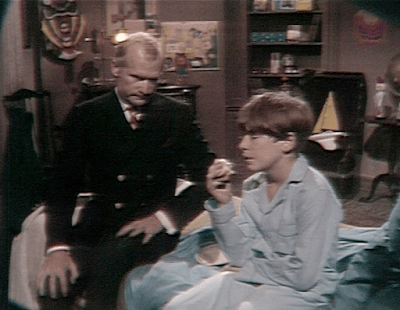
We open on a set we haven’t seen since #180, the archives of the old cemetery north of town. There, a scene plays out between two actors who aren’t really on the show. Daniel F. Keyes created the role of the Caretaker of the cemetery; Robert Gerringer took over the role of Dr Dave Woodard some months ago and did as much with it as anyone could. But neither of those men was willing to cross a picket line and break the National Association of Broadcast Engineers and Technicians strike, and so they were replaced with a couple of stooges.
The stooges are both terrible. Patrick McCray, Danny Horn, and John and Christine Scoleri all go into detail documenting non-Woodard’s incompetence, but the non-Caretaker is just as bad. Patrick McCray memorably described the Caretaker, in Keyes’ realization, as a “refugee from the EC comics universe.” This fellow has none of Keyes’ zest or whimsy; he simply recites his lines.
At one point, the non-Caretaker tells non-Woodard that it will take some time for him to locate the document he is asking about. Non-Woodard replies “Take your time!” We then have about ninety seconds of the non-Caretaker sorting through papers. The show is moving away from the real-time staging that had often marked its earlier phases, so this comes as a surprise.
The episodes in which the archive set was introduced included a lot of talk about the geography of the cemeteries around the town of Collinsport. They told us that the old cemetery north of town was the resting place of the Stockbridges, Radcliffes, and some other old families, but that most of the Collinses were buried in their own private cemetery elsewhere. They also mentioned a public cemetery closer to town where the remains of less aristocratic Collinsporters might be found. In today’s opening scene, non-Woodard tells the non-Caretaker that they had met previously in Eagle Hill Cemetery. Eagle Hill is the name now associated with the old cemetery north of town. So perhaps this building, which also houses a tomb in which several of the Stockbridges were laid to rest, is not in Eagle Hill Cemetery, but one of the others.
Reading roomStacksThe Tomb of the Stockbridges.
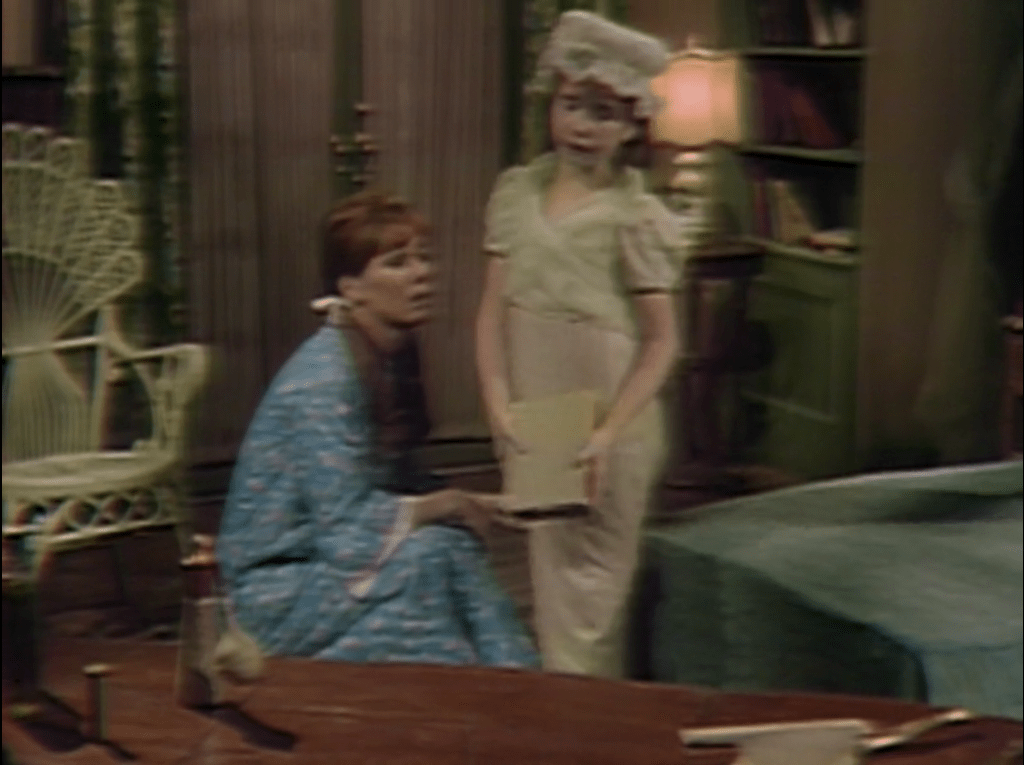
In his last few episodes, Robert Gerringer had a couple of scenes in which he and David Henesy established a close relationship between Woodard and strange and troubled boy David Collins. Today, non-Woodard sits on the couch in the drawing room at Collinwood and tells David he has come to believe everything he has been saying, including the stories that have led the other adults to call in a psychiatrist. As my wife, Mrs Acilius, pointed out, that would have been a great payoff from Gerringer’s earlier scenes if he had been in it. It might have been effective enough if any competent actor had played the part of Woodard. Certainly Mr Henesy’s performance gives non-Woodard plenty to respond to. But he barks out his lines as if they were written in all-caps with randomly distributed exclamation points. It is a miserable disappointment.
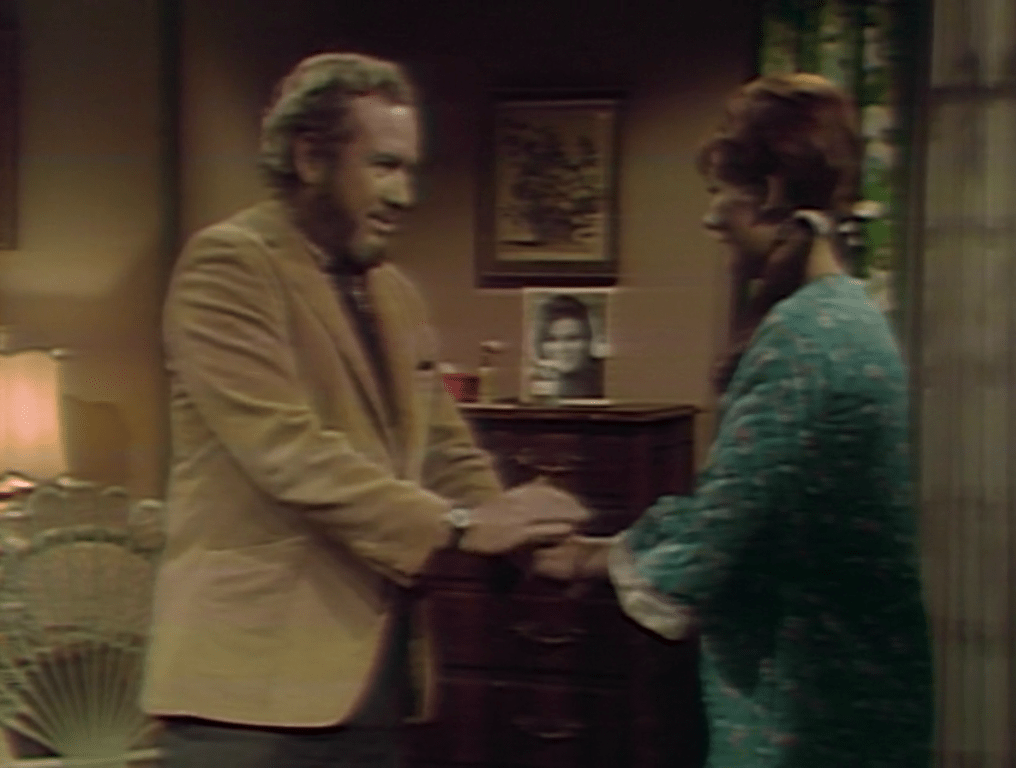
There is also a scene where David’s father, high-born ne’er-do-well Roger, tries to convince his sister, matriarch Liz, that they ought to send David to military school. This both harks back to the first 39 weeks of Dark Shadows, when Roger openly hated his son and jumped at every chance to send him away, and illustrates the changes that have taken place since then, as Liz acknowledges that Roger is motivated by a sincere concern for David’s well-being. The scene is intelligently written and exquisitely acted. The high caliber of their work makes it all the more distressing to see Joan Bennett and Louis Edmonds on a scab job. David Henesy was ten years old, and had a stereotypical stage mother, so you can excuse his presence and marvel at his accomplished performance. But these two old pros don’t have any business on the wrong side of a strike.
Nor does Jonathan Frid. When non-Woodard goes to confront Barnabas, there are moments when Frid seems to be showing his own irritation with his scene-mate more than his character’s with his adversary. As well he might- neither man knows his lines particularly well, but even when Frid stops and looks down he expresses emotions Barnabas might well be feeling, and he is fascinating to watch. When non-Woodard doesn’t know what words he’s supposed to bark, he drifts away into nothing. But it serves Frid right to have to play off this loser- by this point, he knows full well that without him the show wouldn’t be on the air. He had no excuse at all for crossing that picket line.
The cemetery’s combination archive/ tomb was a prominent part of the storyline of undead fire witch Laura Murdoch Collins. That storyline approached its climax in #183 when Peter Guthrie, PhD, confronted Laura in her home about being “The Undead,” prompting her to kill him. An episode beginning on that set and ending with someone holding a doctoral degree confronting an undead menace would seem to be an obvious callback to that story. Guthrie’s confrontation had a point- he wanted to offer to help Laura find a place in the world of the living if she would desist from her evil plans, an idea which Woodard’s old medical school classmate Dr Julia Hoffman picked up in her quest to cure Barnabas of vampirism. By contrast with Guthrie and Julia, Woodard is just being a fool.
Strange and troubled boy David Collins is at his wit’s end. A bat entered his room and menaced him. He can’t even convince the adults in the great house of Collinwood that the bat existed. Still less can he get a hearing for his correct surmises that his cousin, courtly gentleman Barnabas Collins, used magical powers to send the bat against him.
David’s aunt and father call the family doctor, addled quack Dave Woodard. Woodard gives David a sleeping pill, waits a few minutes, and starts asking him questions. David tells him about his friend, mysterious girl Sarah. He asks if Woodard believes that Sarah is a ghost. Several times, the audience has seen Woodard wrestle with evidence pointing in this direction, so we know that he is telling the truth when he answers David’s question with “I don’t know what I believe.” Robert Gerringer does a fine job of acting today, and draws the audience into Woodard’s struggle to come to terms with the idea that he lives in a world where supernatural forces are at work.
Later, Sarah wakes David up. She says she’s angry with him. In her last apparition, she specifically told him to stay away from Barnabas’ house, but the very next morning he went there, sneaked in through a window, and was trying to get into the basement when Barnabas’ co-conspirator Julia Hoffman caught him. He keeps asking for more information, and she complains that he asks too many questions. She keeps insisting that he stay away from Barnabas’ house.
Sarah gives David an antique toy soldier and tells him to keep it with him. She says it belonged to someone who played with it long ago, and that it will keep David safe as long as he has it with him. Returning viewers know that Sarah is the ghost of Barnabas’ sister, so the “someone” must be Barnabas himself. Also, we saw Sarah give a doll of her own to Maggie Evans, The Nicest Girl in Town, with the same instructions, so we know this is her usual mode of operation.
When Sarah is complaining that David asks too many questions, she says that she isn’t always sure of the answers. This makes an interesting contrast with Woodard’s earlier remark that she seems to know everything. It also brings up a mystery from recent episodes. In #325, David had a dream in which Sarah led him to a basement where they saw Barnabas rise from a coffin. This must have been a dream visitation, since it includes information only she would have. But in #327, David sees Sarah in the woods and surprises her when he tells her about the dream. Later in that same episode, she makes it clear that she does not want him to know the information he gained from it.
The sight of Sarah in the corner of David’s room, lit from below, might cast the minds of regular viewers back to the first supernatural being to make an entrance in that spot. David’s mother, undead fire witch Laura Murdoch Collins, drove the story from #126 to #191. In the early part of the Laura arc, the show made a great deal out of the uncertainty about how the various events and appearances associated with her related to each other. There was a more or less substantial, apparently living woman who comes to stay in the cottage on the estate of Collinwood; an image of the same woman that occasionally flickers on the lawn of the estate; and a scorched corpse in the morgue in Phoenix, Arizona. These three, and an undetermined number of other phenomena, might all be aspects of the same being, or they may not. They may be pursuing the same objective, or they may be working at cross-purposes. They may be organs of a single mind, or they may be entirely unaware of each other. As the story went on, Laura became an ever-more dynamic personality, but it was never made altogether clear just how many of her there were.
The difference between the Sarah who led David to Barnabas in his dream and the Sarah who demands that he stay away from Barnabas when he is awake raises the same question. Sarah used to be a little girl, and she still looks and sounds like one. But she isn’t really that, nor is she anything else that belongs in our world anymore, and she can’t be expected to follow any rules we can understand. She is a focal point around which uncanny phenomena gather, and through which information passes into our world from an alien plane of existence. Sarah is not only a messenger- she is herself the message.
The uncertainty Sarah admits to today, along with our uncertainty about how her various manifestations fit with each other, show that David is wrong if he finds her a reassuring presence. She is part of a world in which the living have no place, and her irruption into David’s experience thrusts him into the company of the dead. David cannot fully understand Sarah’s world, much less control it. If he keeps trying to find his own way to safety, he will quickly meet his doom.
Dangerously unstable ruffian Willie Loomis spent a week staring at the eighteenth century portrait of Barnabas Collins in the foyer of the great house of Collinwood back in April, then tried to rob Barnabas’ grave. That turned out to be an awkward situation when Willie found that Barnabas wasn’t entirely dead. Barnabas was a vampire who bit Willie, turned him into his sorely bedraggled blood thrall, and had lots of conversations with him. Yesterday, Willie was written out of the show.
Today we open with strange and troubled boy David Collins staring at the same portrait. As Willie was obsessed with the idea that there were jewels hidden in the Collins mausoleum in the old cemetery north of town, where in fact Barnabas’ coffin was hidden, so David is preoccupied with the idea that Barnabas has something terrible stashed in the basement of the Old House on the estate, where in fact his new coffin is hidden. As Willie sneaked off to the cemetery on his ill-starred expedition, David will sneak off to the Old House today and try to search Barnabas’ basement.
Unlike Willie, David is not driven by greed. He is afraid of Barnabas, and his friend, the ten year old ghost of Barnabas’ sister Sarah, has told him that he must not go to the Old House. But his aunt Liz and his father Roger dismiss his attempts to warn them about Barnabas, and he thinks it is his duty to provide them with evidence. So he screws up his courage and makes his way across the property.
David lets himself into the Old House by opening the parlor window. Not only have we seen David do this before, but Willie’s sometime friend, seagoing con man Jason McGuire, got into the house the same way in #274. Barnabas would kill Jason when he reached the basement in #275, so you might think he’d have put a lock on that window by now.
Jason’s fate is certainly on the minds of returning viewers when David tries to open the basement door. It comes as a relief when he finds the door locked. Barnabas’ co-conspirator, mad scientist Julia Hoffman, catches him there.
Julia demands to know what David is doing in the house, and he tries to brazen it out. He claims that he has a right to be there, since it belongs to his Aunt Liz. This is a bit of a murky point- we never see Liz transfer title to Barnabas, but she and others act as if he owns the place and its contents. Julia doesn’t clarify it when she responds that Liz gave the house to Barnabas- she doesn’t deny that it still belongs to Liz, only says that it also belongs to Barnabas.
Back in the great house, Roger is banging away at the piano. We saw Liz play the piano in #47 and #91, a reference to the conception of her character writer Art Wallace developed in his original story bible, titled Shadows on the Wall, in which she, like similar characters in a couple of TV plays he wrote in the 1950s under the title “The House,” gave piano lessons. Since then, Liz’ daughter Carolyn tried her hand at “Chopsticks” in #119 and used the piano as a prop in a teen rebel scene in #258, and Jason poked at a few keys in #198. Roger isn’t exactly Vladimir Horowitz, but he’s the first one we’ve seen who actually achieves a melody.
Liz comes in and tells Roger that David isn’t in his room. They fret over David’s attitude towards Barnabas. Julia brings David home and tells Liz and Roger where she found him. After an angry scene between father and son, David goes upstairs, and Liz scolds Roger for his inept parenting. In these as in all of Liz and Roger’s scenes together, we see a bossy big sister who tries to govern her bratty little brother, but who ultimately abets all of his worst behavior.
In the Old House, Barnabas notices that Julia is troubled. He keeps asking what’s on her mind, and she has difficulty deflecting his questions. This is odd- Julia has been established as a master of deception, and Barnabas is the most selfish creature in the universe. All she has to do is start talking about something that does not affect him directly, and he will lose interest at once. Rather than talk about her personal finances, or the job from which she is apparently on an indefinite leave of absence, or some ache or pain she might have, or how sad she is to miss her Aunt Zelda’s birthday, she brings up Willie. That does get Barnabas’ mind off her tension, but it also reminds him of David. He thinks David knows too much about him, and is thinking of murdering him. Julia assures him that the boy doesn’t know so very much, that whatever he does know he hasn’t told anyone, and that if he does say something his reputation as an overly imaginative child will lead the adults to ignore him.
From the beginning of the series, we’ve heard people say that David is “imaginative.” The audience finds an irony in this, since we have never seen David show any imagination whatsoever. All his stories of ghosts are strictly literal accounts of apparitions he has seen. We’ve seen some drawings he has done and heard quotes from some essays he has written. Some of these are technically accomplished for a person his age, but they are just as literal as his ghost stories. And when he tells lies to cover his various misdeeds, he tells simple little tales that fall apart at once.
In #327, well-meaning governess Vicki became the first character to dissent from the “David is a highly imaginative child” orthodoxy. Liz and local man Burke Devlin were dismissing David’s laboriously accurate account of his latest encounter with Sarah as a sign of his “imagination,” and Vicki interrupted with “I don’t think it has anything to do with his imagination.” Now, Barnabas goes a step further. After pronouncing the word “imaginative” in a truly marvelous way that makes it sound like something I’ve never heard before, he tells Julia that she has given him an idea. Frightened, she asks what he means. All he will say is “You’ll see.”
Roger goes to David’s room and has a friendly talk with his son. Throughout the conversation and afterward, David is thinking intensely, trying hard to figure out what his next step should be.
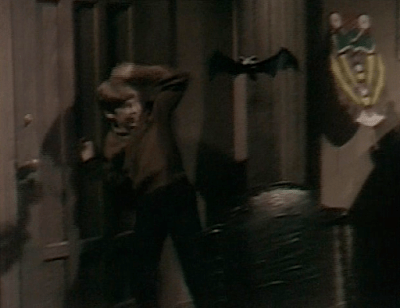
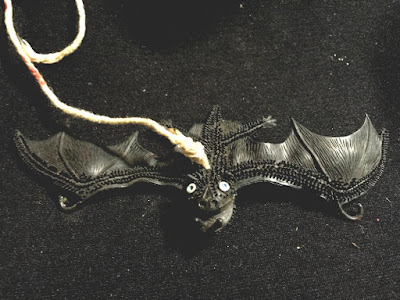
Once he is alone in the room, the window blows open and a bat enters. More precisely, a bat-shaped marionette is brought in on clearly visible strings by a pole that casts a shadow we can see the entire time, but no one who has been watching the show up to this point will doubt for a second that David’s fear, as depicted by David Henesy, is fully justified. David tries to flee from the bat, but he cannot open the door to escape from his room. His back against the door, David slides onto the floor and screams as the bat comes near him.
When Barnabas is about to attack someone, dogs start howling. Sometimes this works to his advantage, but it so often puts his intended victims on their guard that it doesn’t really seem to be something he is doing on purpose. So this bat represents something new. Perhaps Barnabas is using magic to control a bat- if so, it marks the first time we have seen Barnabas use magic to project influence over something other than a human mind. Or perhaps he himself has assumed the form of a bat. If so, that is the first indication we’ve had that he has shape shifting powers. In either case, Barnabas’ powers have just gone up a level.
Closing Miscellany
The bat was created by famed puppeteer Bil Baird. Most famous today for the puppets he created for “The Lonely Goatherd” sequence in The Sound of Music, Baird was a frequent guest on television programs like The Ed Sullivan Show, and Jim Henson cited Baird’s own TV series, the short lived Life with Snarky Parker, as a major influence on the Muppets. In December 1966, Baird opened a marionette theater in New York City, at 59 Barrow Street in Greenwich Village; it operated until 1978, and many leading puppeteers, including dozens who would go on to work with Henson, were members of its company in those years.
This is the last episode to end with ABC staff announcer Bob Lloyd saying “Dark Shadows is a Dan Curtis production.” We do hear the announcement again in February of 1969, but that won’t be because Lloyd has returned- they used an old recording for the music under the closing credits that day, and they picked one with him on it.
Fans of Dark Shadows will often talk about “the early episodes” which ended with Lloyd making that announcement. So I suppose #330 is the last of “the early episodes.”
Danny Horn’s post about this one on Dark Shadows Every Dayincludes a morphology of episode endings. He divides them into five categories, Haiku,* Restatement of Threat, ** New Information,*** Crisis Point,**** and Spectacle.***** It’s an intriguing scheme, and he makes a good case for it.
*Danny explains that “Haiku” “aren’t necessarily recognizable as endings in the traditional sense, because nothing is resolved and no progress is made. It’s just a little moment when a character pauses, and possibly has a feeling about something… In some extreme cases, the audience may not realize that the episode is over until halfway through The Dating Game.”
**Restatement of Threat, at this period of Dark Shadows, usually means Barnabas looking at us through his window and saying that someone or other “must die!” Which of course means that you can safely sell a million dollar life insurance policy to that character.
***”A New Information ending provides an actual plot point, which either advances the story another step, or tells us something that we didn’t know.”
****”The Crisis Point cliffhanger is the big game-changer, and for best effect, it should come at the end of a sequence that’s been building up for a while. This is a big turn in the story, and it should feel satisfying and thrilling… The defining feature of a Crisis Point ending is that the resolution marks a change in the status quo, ending one chapter and setting up the next.”
***** “Obviously, plot advancement is always welcome, but every once in a while the show needs to set its sights a little higher. These are the moments when the show goes above and beyond, in order to surprise and dazzle you… The point of a Spectacle is: You can’t take your eyes off the screen. Housewives in the audience have put down the iron, and switched off the vacuum. Teenagers have stopped swatting at their siblings… A Crisis Point cliffhanger will bring you back for the next episode, because you want to see what happens next. But a Spectacle cliffhanger is bigger than that — you’ll be coming back for the next episode, but it’s because you can’t believe what you’re seeing, and maybe tomorrow they’ll do it again.”
We open in the Old House on the great estate of Collinwood, home to courtly gentleman Barnabas Collins. In a bedroom there occupied by Barnabas’ servant Willie, Sheriff George Patterson and artist Sam Evans have found evidence that convinces them they have solved the case of the abduction of Sam’s daughter Maggie. They found Maggie’s ring hidden in a candlestick. The room is in Barnabas’ house and he has unlimited access to it. Further, the house is the only place Willie could possibly have kept Maggie if he had held her prisoner. But for some unexplained reason, they are sure that the ring proves that Willie and only Willie abducted Maggie. When Barnabas says that he feels somehow responsible, Sam rushes to tell him that he mustn’t blame himself.
The sheriff says that he will be going to the hospital, where Willie is recovering from gunshot wounds the sheriff’s deputies inflicted on him when they were looking for a suspect. Barnabas hitches a ride with him.
At the hospital, Willie’s doctor, addled quack Dave Woodard, is conferring with his medical colleague Julia Hoffman. When he steps out of the room for a moment, we hear Julia’s thoughts in voiceover. She is thinking about killing Willie before he can regain consciousness and tell a story that will make it impossible for her ever to practice medicine again. She thinks of Barnabas’ voice demanding that she kill Willie. She is reaching for the catheter through which Willie is receiving fluids when Woodard comes back in. She tells him she was checking it, and he is glad when she confirms it is working correctly.
Returning viewers know that Barnabas is the one who abducted Maggie and committed the other crimes of which Willie is suspected, that he is a vampire, that Julia is a mad scientist trying to cure him of vampirism, and that in pursuing her project she has become deeply complicit in Barnabas’ wrongdoing. We also know that she has several times told him that she will draw the line at killing anyone herself, but that she has involved herself in so many other evil deeds that it was just a matter of time before she found herself on the point of crossing that line.
Barnabas and the sheriff arrive at the hospital. In the corridor, Barnabas is bewildered to find that the sheriff will not allow him to be present while he questions Willie. The sheriff has been so careless about treating miscellaneous people as if they were his deputies- for example, enlisting Sam yesterday to help him search Willie’s room- that Barnabas’ puzzlement is understandable. The conversation goes on for quite a while.
Note the poster that reads “Give Blood.” That’s a message Barnabas could endorse. Screenshot by Dark Shadows Before I Die.
The sheriff enters Willie’s room, and greets Julia as “Dr Hoffman.” Woodard thinks Julia has come to Collinsport to investigate Maggie’s abduction, and so he has agreed to keep her professional identity secret from most people in town, including the sheriff for some reason. Therefore, she is startled at this form of address. Woodard explains that now that Maggie’s abductor has been identified, he doesn’t see a point in keeping law enforcement in the dark.
Julia meets Barnabas in the corridor. When she tells him that she didn’t kill Willie, he fumes and calls her a “bungling fool.” He says he will do the job himself, but Julia points out that Woodard and the sheriff are in the room with Willie now. They wind up staring at the clock for hours.
Willie regains consciousness. He doesn’t recognize Woodard. When the sheriff shows him Maggie’s ring, his eyes gleam and he claims that it is his. Returning viewers will remember that before Willie ever met Barnabas, he was obsessed with jewelry. He is terrified when he learns that it is night-time, and says that he knows why he is afraid.
The sheriff and Woodard go out into the corridor to talk with Julia and Barnabas. Woodard tells Julia that she was right- Willie is hopelessly insane. Apparently when they asked him what he was afraid of, he mentioned “a voice from a grave. Nothing else made more sense than that.”
Julia and Barnabas go into Willie’s room. He looks at Barnabas and asks “Who are you?” Barnabas shows surprise that Willie doesn’t know him. Willie asks if he is a doctor. “Yes,” replies Barnabas. “I am a doctor.”
Sheriff Patterson is played by Dana Elcar today. It is Elcar’s 35th and final appearance on Dark Shadows. He would go on to become one of the busiest and most distinguished character actors of his generation.
Elcar had his work cut out for him with the part of Sheriff Patterson. If a police officer on the show ever solved a case, or followed any kind of rational investigative procedure, or interpreted a clue correctly, the story would end immediately. So all the sheriffs and constables and detectives have to be imbeciles. Elcar reached into his actorly bag of tricks almost three dozen times, and always came out with some way to make it seem as if something more was going on in Sheriff Patterson’s mind than we could tell.
My wife, Mrs Acilius, exclaimed “I’m so glad Dana Elcar is playing this scene!” when Barnabas and the sheriff had their long conversation in the hospital corridor. This week’s episodes were shot out of sequence, so yesterday’s was made after Elcar had left. It featured Vince O’Brien as Sheriff Patterson. O’Brien was by no means a bad actor, but he didn’t make the character seem any smarter than the script did. Elcar seems so much like he has something up his sleeve that Jonathan Frid’s insistent pleading makes sense as a cover for a mounting panic. Without Elcar to play against, it might just have come off as whining.
With the conclusion of Willie’s story, this is John Karlen’s last appearance for a long while. Beginning shortly after Barnabas’ introduction to the show in April, his conversations with Willie have been the main way we find out what he is thinking and feeling. More recently, Willie and Julia have been having staff conferences in which they come up with new ideas and add a new kind of flexibility and dynamism to the vampire storyline. From time to time, Willie’s conscience gets the better of him, and he adds an unpredictable element to the story as he tries to thwart one of Barnabas’ evil plans. For all these reasons, removing Willie from the show drastically reduces the number of possible outcomes in any situation they might set up involving Barnabas. His departure, therefore, seems to signal that some sort of crisis is at hand.
In fact, Karlen wanted to leave Dark Shadows because he had a better offer from a soap called Love is a Many Splendored Thing. But the producers knew that no one else could play Willie after the audience had got used to Karlen, and so they wrote the character out until they could get him back. Still, losing Willie puts Barnabas’ story on a much narrower track. So far, each development has led us to speculate about an ever-growing list of directions the story might possibly take. From now on, we are entering a phase where we will often be stumped as to what might be coming next.
In the Old House on the great estate of Collinwood, vampire Barnabas Collins frets that his sorely bedraggled blood thrall, Willie Loomis, is failing to die. A couple of weeks ago, the police shot Willie and jumped to the conclusion that he was responsible for the abduction of Maggie Evans, The Nicest Girl in Town, among many other crimes that Barnabas actually committed. He’s been in a coma ever since, and if he dies, Barnabas will be off the hook.
Barnabas tells his co-conspirator, mad scientist Julia Hoffman, that he will go to the hospital and murder Willie. Her assurances that Willie will soon die of natural causes don’t stop Barnabas, but her news that the sheriff is on his way to the house does. Barnabas then orders her to go to the hospital and carry out the murder, but she refuses.
Meanwhile, Sheriff George Patterson, addled quack Dr Dave Woodard, and Maggie’s father Sam are hanging around Willie’s hospital room recapping the story so far. The sheriff wonders where Willie could have kept Maggie during the weeks she was held prisoner. Willie lives in Barnabas’ house and does not appear to have access to any other building. You might think this would be grounds for suspecting Barnabas of involvement, but no such thought crosses the minds of any of the three luminaries keeping Willie company. They just take it for granted that no crime could have taken place in Barnabas’ house.
George, Dave, and Sam, or their intellectual equivalents.
Back in the Old House, Barnabas has had an inspiration. He took a ring from Maggie in #253, and today he hides it in a candlestick in Willie’s bedroom. When the sheriff and Sam come to search that room (but no other part of the house,) Barnabas watches until they’ve given up, then knocks the candlestick over and exclaims in a ridiculously fake voice “Look! A ring!” Sam recognizes it as Maggie’s, and he and the sheriff are convinced it is conclusive evidence of Willie’s guilt.
For her part, Julia has made her way to Willie’s hospital room. She is there with Woodard when Willie shows signs of regaining consciousness. Woodard rushes out to tell the deputy to get the sheriff, and leaves Julia alone with Willie. She looks at Willie’s IV and remembers Barnabas urging her to kill him.
The sheriff and Sam are leaving Barnabas’ house with the ring when the deputy comes to the front door. He announces that Willie is coming to and is likely to start talking at any moment. We end with a closeup of a horrified Barnabas.
During the opening titles, announcer Bob Lloyd tells us that the part of Sheriff Patterson will be played by Vince O’Brien. This week’s episodes were shot out of broadcast sequence, so we will see Dana Elcar as Patterson one more time. O’Brien was on the show four times in January and February of 1967 as the second actor to play Lieutenant Dan Riley of the Maine State Police, an officer attached to an investigation concerning undead fire witch Laura Murdoch Collins. Patterson isn’t much of a character, and even an actor as distinguished as Elcar had trouble making him interesting. If we remember O’Brien from his time as Dan Riley Number Two, we know that he was a competent professional, but we won’t have much hope that he will outdo Dana Elcar.
O’Brien does show beyond all doubt that he belongs on Dark Shadows, though. While the closing credits are rolling, he strolls onto the set behind technical director J. J. Lupatkin’s name.
The Collinsport police have solved the case of the abduction of Maggie Evans, The Nicest Girl in Town. The investigation has been stalled for months, because Maggie is suffering from amnesia covering the entire period of her captivity. So the authorities spread a rumor that Maggie’s memory was returning, camped out on her lawn, shot the first guy who strayed onto the property, and declared him to be the culprit.
Though this method would appear to be impeccably scientific, strange and troubled boy David Collins is unconvinced. The wounded man is the luckless Willie Loomis, servant of David’s cousin, old world gentleman Barnabas Collins. David is sure that Willie wouldn’t hurt anyone, and has developed an intense aversion to Barnabas.
David’s aunt, matriarch Elizabeth Collins Stoddard, is discussing this situation with his well-meaning governess Vicki. Liz mentions that Willie originally came to the estate of Collinwood as a friend of seagoing con man Jason McGuire. She says that she is prepared to believe any bad thing about any friend of Jason’s.
This is the third day in a row we have heard Jason’s name mentioned. That marks quite a departure from recent months of the show. In #275, Barnabas killed Jason, and in #276 he forced Willie to help him bury the body. He was forgotten, apparently forever, shortly thereafter.
It is not clear at all where the show is heading. A few weeks ago, David learned that the secret chamber where Jason is buried exists, that Barnabas and Willie know about it, and that there is something hidden in it that makes Willie uncomfortable. Barnabas knows that David has been in the chamber, and is thinking of killing him. So perhaps the next storyline will involve Barnabas trying to do away with David lest Jason’s death be discovered.
Bolstering that expectation is the fact that Willie has survived the shooting. When he was first shot, day before yesterday, the police said he had five bullets in his back and that only a miracle could keep him alive. Yesterday, we heard that he was in a coma and that the preliminary medical report on his case gave him virtually no chance of living. Today, his doctor, addled quack Dave Woodard, tells his medical colleague Julia Hoffman that the odds are a hundred to one against Willie seeing another day. Experienced soap opera viewers will know that when a man has been declared dead so many times, he will be with the series for years to come. Willie does feel bad about what happened to Jason, so if David manages to lead the authorities to the secret chamber, that might bring matters to a head.
The scene between Woodard and Julia marks an interesting first. Julia is, among other things, a psychiatrist, and Maggie was her patient for a time. Woodard believes that she is at Collinwood in order to find out who abducted Maggie. He is surprised she plans to stay on now that Willie has been named. She claims that she is trying to keep her cover story intact, that she is an historian studying the old families of New England. This doesn’t make much sense to him, but he doesn’t expect it to- he thinks he knows her real motive. He thinks she is in love with Barnabas. Julia smiles, and doesn’t deny it.
Returning viewers know that Julia’s actual motives are infinitely less wholesome. She is a mad scientist, and Barnabas is a vampire. She is conducting an experimental treatment which, if successful, will relieve him of that condition. For the sake of that experiment, she has become Barnabas’ accomplice. She induced Maggie’s amnesia, she has lied to everyone she has met, including the sheriff, and she is happy that Willie is likely to die and take the blame for Barnabas’ crimes. Woodard’s idea that she is in love with Barnabas delights her because it helps conceal her true role. It also starts us wondering if it is the beginning of a story in which the two of them avoid awkward questions by pretending to be a couple, then perhaps really do fall in love.
Maggie Evans, The Nicest Girl in Town, is not allowed to leave home. The yard outside her door is full of policemen. They are hoping that a rumor that her amnesia is breaking and she will soon remember who abducted her and held her prisoner will draw that person out of hiding. If he approaches the house, they will… it isn’t clear what they will do, exactly. Whatever they do, Maggie hopes that it will end the danger so that she can get back to her normal life.
Maggie and her father Sam talk about the situation. This conversation doesn’t advance the plot or give the audience new information, but it is somewhat interesting to people who have been watching the show from the beginning. For the first 40 weeks of the show, Sam was an alcoholic and Maggie’s attempts to keep him out of trouble were a substantial part of the story. Adult Child of an Alcoholic (ACoA, in the lingo of the twelve step movement) mannerisms such as advertising that she is happy by starting utterances with a laugh and stressing whatever syllables have a rising pitch are still a major part of Maggie’s characterization.
Father and daughter
But Sam isn’t an alcoholic anymore. Not only doesn’t his drinking cause him problems, but we’ve seen him function as a social drinker. He keeps a bottle of whiskey in the living room of the Evans cottage and occasionally takes a drink or two; he often goes to The Blue Whale tavern and enjoys happy hour there. But he declines drinks when they are offered at inconvenient times, doesn’t get drunk, doesn’t have trouble with his work, and Maggie doesn’t have any complaints. The other day, the show referred back to Sam’s drinking days. He and the sheriff went to The Blue Whale, where Sam started the rumor about Maggie’s memory. Sam pretended to be drunk and the sheriff pretended to hush him while he declared that Maggie would be leading the police to her captor any day now. But he was stone sober the whole time, even though he had had a drink at home before leaving for the tavern.
The show dropped the theme of Sam’s alcoholism when it gave up on the storyline of “The Revenge of Burke Devlin.” Sam had started drinking because of the events behind that storyline and his drunkenness made it unpredictable what role he would play in it. Since that ended in #201, the writers don’t seem to see a point in presenting Sam as an alcoholic, even as one in recovery. But I think that is a mistake. The actors and directors remember that Sam has that history, and it adds depth to both David Ford’s portrayal of Sam and Kathryn Leigh Scott’s of Maggie. You wouldn’t have to spend any more screen time presenting Sam as a recovering alcoholic than they spend now presenting him as a social drinker. All he’d have to do is reply to a remark about booze by saying that he never touches the stuff anymore, and you’ve made the point.
Viewers who have been with the show from the beginning will look at Sam and Maggie’s heart-to-heart talk and remember the scenes from the first 40 weeks where Maggie wound up playing the parent in the parent-child relationship. Seeing him really function as a father here will not only reassure us that they are free of that now, but will also explain why Maggie kept falling into all of the patterns of behavior that enabled Sam when he was a drunk. Today, he’s the Daddy she knew before alcohol got the better of him, the one she was always sure was still in there someplace.
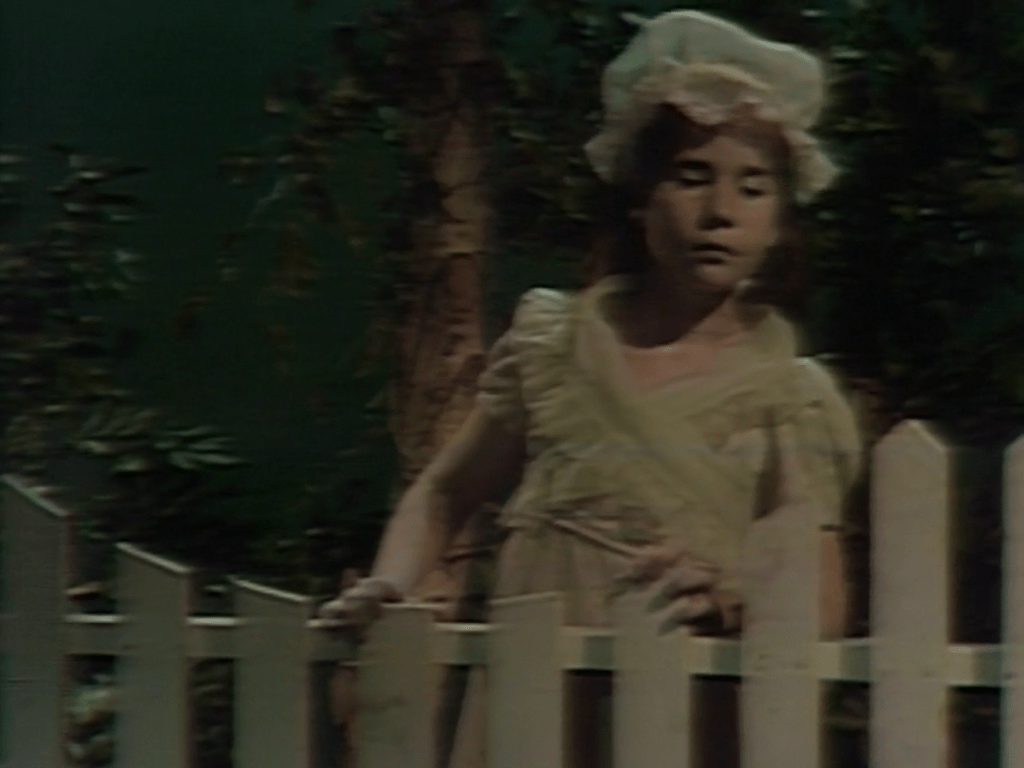
Sam leaves the room, and Maggie gets a visitor. After Sam had assured Maggie that the house was so well-guarded no one could get in, we saw a shot of the permanently nine year old ghost of Sarah Collins outdoors, peering over a picket fence.
Looking for a friend
Maggie falls asleep, and wakes to find Sarah in the room with her. Maggie repeatedly asks Sarah how she got in, and Sarah keeps declining to answer. Maggie keeps trying to get her father into the room, and Sarah keeps telling her that if a third person comes in, she will have to go away. Sarah finds that Maggie is not in possession of the doll she gave her, and tells her that she will have to get it back as soon as possible and keep it with her at all times. Maggie asks more than one question about that as well, and Sarah again tells her that she can’t explain. Sarah gets to be quite exasperated that she has to keep reviewing the ghost rules with Maggie.
Sarah can not believe Maggie still doesn’t get it.
Several characters have entertained the possibility that Sarah might be a ghost, among them Maggie and Sam. They keep snapping back from really believing that she is. In the early months of the show, characters had speculated that there might be ghosts on and around the great estate of Collinwood, but they couldn’t let go of the idea that they lived in a world that basically made sense according to the usual natural laws. So no matter what they saw, they kept retreating from the full implications of the supernatural events that came to be a more and more obvious part of their experiences. Sarah’s impatience with Maggie today is reflected in the impatience many viewers of the show express when characters who have had encounter after encounter with the paranormal won’t stop droning on about how there must be a perfectly logical explanation.
Sarah keeps repeating herself and Maggie keeps missing the point. Maggie tells Sarah that she will like Sam, who likes little girls. That again is a poignant line to those who are thinking about the happy life Maggie had with her father before he started drinking and that has only recently resumed, though it is lost on newer viewers. We also know that Sarah already likes Sam- she visited him in this house in #260 and told him where to find Maggie.
But in the world of Dark Shadows, ghosts cannot appear to more than one person at a time. For example, in #141 strange and troubled boy David Collins took his mother, undead fire witch Laura Murdoch Collins, to the Old House on the grounds of Collinwood, hoping that the ghost of Josette Collins would appear to her. He left her alone in the house, explaining that Josette appears only to one person at a time. Josette did communicate with Laura after David left, though Laura concealed that fact from her son.
We’ve seen only two exceptions to the rule that ghosts appear to one person at a time. The first case was in #165, when Josette manifested herself in a room with David and Laura. The second time was in #294, when Sarah herself helped Maggie escape from the mental hospital where mad scientist Julia Hoffman was keeping her for evil reasons. Both Maggie and her nurse could see Sarah that time.
But those were special occasions. It was such a strain for Josette to present herself to two people that she could shimmer into view only when David was asleep, and a few words from Laura were enough to shoo her away before he could wake up, though he did feel her presence afterward. And Sarah’s appearance to Maggie and the nurse lasted for only a few seconds. Viewers reminded of Sarah’s earlier appearance to Sam will remember that she vanished before he finished a sketch of her that she very much wanted him to give her, so however great a power she might represent, we know that it is not entirely under her control. She can do what she is supposed to do and tell people what they are supposed to know, but she cannot simply do as she wishes, and when she has completed an assigned task or entered an uncongenial situation she will disappear.
Eventually Maggie insists on opening the door and calling to Sam. Of course Sarah has vanished when he enters, of course the men guarding the house didn’t see her, and of course Sam and Maggie fret that if Sarah could come and go unobserved so could the person they are trying to catch. Those bits bring on our frustration with characters who don’t get that they are living in a universe pervaded with supernatural beings. If they were proceeding from the premise that Sarah was a ghost and considering the possibility that Maggie’s captor may also have been some kind of uncanny being, that would indicate that the action is about to start moving a lot faster. As it is, it’s just filler.
Meanwhile, Julia has left her hospital and come to Collinwood, where she is in league with Maggie’s captor, vampire Barnabas Collins. Barnabas has heard the rumor that Maggie is recovering from her amnesia. Julia induced that amnesia to keep Maggie from exposing him and inconveniencing her.
In Friday’s episode, Julia tried to talk Barnabas out of killing Maggie. He had calmly and suavely told her that he had no choice but to yield to her arguments, and she had been satisfied that she had persuaded him. Today, he tells his sorely bedraggled blood-thrall Willie Loomis that he will set out for the Evans cottage as soon as the clouds cover the moon and give him a deep enough cover of darkness.
Willie sneaks over to the terrace at the great house of Collinwood, where he informs Julia of Barnabas’ intentions. Julia cannot believe that her powers of persuasion failed to win Barnabas away from his plan to kill Maggie. Willie has to repeat himself time and again, until he grows as exasperated with Julia as Sarah was with Maggie.
This is the first time we have seen Julia in denial. It’s understandable that she would overestimate her ability to bend Barnabas to her will- not only has she had a great deal of success so far at dominating their relationship, but she is usually able to manipulate people to a fantastic degree. When she induced Maggie’s current amnesia, she took her in a matter of minutes from a state in which she remembered everything that had happened to her to one in which an impenetrable mental block covered exactly the period in which Barnabas abused her. Someone who can do that might well have difficulty grasping the fact that she has not turned someone to her way of thinking.
Barnabas stares out the window of his house in the direction of the Evans cottage and thinks murderous thoughts about Maggie. My wife and I often laugh about the comment Danny Horn made on this scene in his post about this episode on his blog Dark Shadows Every Day:
Meanwhile, the dogs are howling, and Barnabas is standing at the window, staring out into the night.
“Goodbye, Maggie Evans,” he thinks. “I might have loved you. I might have spared you. Now… you must die.”
Man, what a diva. He even has backup singers.
Danny Horn, “Episode 321: What We Talk About When We Talk About Ghosts,” Dark Shadows Every Day, 3 February 2014
When the show dwells on the dog-noise, Mrs Acilius and I often turn to each other, say “the backup singers!,” and laugh. When we watched this episode yesterday, we laughed louder than usual because our beagle joined in with them, right on cue. He often looks up when the howling starts, the backup singers are the stars of the show as far as he is concerned, but it is unusual for him to sing along. They must be in particularly good voice in this one.
Maggie Evans, The Nicest Girl in Town, is sick of being cooped up at home all the time. But the person or persons unknown who abducted her and held her prisoner is still at large, and has bothered another girl. She herself cannot help in the investigation, since she has amnesia covering the entire period of her captivity. So when addled quack Dr Woodard says he has a plan that might catch the villain, she jumps at it.
Woodard put forward his last plan when Maggie had escaped from her captor. That plan was to tell everyone Maggie was dead and hide her in a mental hospital, in the hope that the abductor would think that he had got away with his crime and would therefore… become a nice guy? It was never very clear how that was supposed to solve the problem.
This plan has the same shortcoming that one had. Maggie’s father, artist Sam Evans, is supposed to start a rumor that her memory is returning and that everyone will soon know who abducted her. That is supposed to prompt the guy to come after Maggie again. When he does, they will… find him outside the house and charge him with trespassing? Let him kill Maggie and charge him with murder? Woodard isn’t good at the end-game.
Maggie persuades Sam and the sheriff to go along with Woodard’s half-baked scheme. Sam and the sheriff go to Collinsport’s only night spot, The Blue Whale Tavern. Sam, who for the first 40 weeks of Dark Shadows was an alcoholic, pretends to be drunk. He throws out one broad hint after another that Maggie’s memory is returning, and the sheriff pretends to hush him.
The important plot point in this scene is that Willie Loomis is in the tavern. Willie is the servant of old world gentleman Barnabas Collins. Unknown to the people of Collinsport, Barnabas is a vampire, and it was he who abducted Maggie. Willie hustles off to report the news to Barnabas.
But what really matters in the scene are the thirteen lines delivered by Bob the Bartender. This is Bob’s 42nd appearance, but only the sixth time he has spoken audibly. It is by far his meatiest part, but alas, it is the last time we will hear him speak. Actor Bob O’Connell will play other bartenders in later stories, and one of them will have a substantial speaking part in an episode, but Bob will be mute from now on.
This episode marks another landmark in Bob’s development. During his drunk act, Sam says “Bob-a-roonie, give me a double mar-toonee… on the rocks!” Picking up on that, many Dark Shadows fans have decided that Bob’s last name is “Rooney.” The Dark Shadows wiki lists him that way, and one of Big Finish Productions’ Dark Shadows audio dramas incorporates that name.
*The first five were #3, #156, #186, #269, and #270.
When Dark Shadows began, one of the most important relationships was that between matriarch Elizabeth Collins Stoddard and her brother, high-born ne’er-do-well Roger Collins. Liz and Roger each had a terrible secret to hide. In the work of hiding, they embodied opposite extremes. Liz was motivated to conceal her secret by a fear that she would damage the reputation of the Collins family and the fortunes of its members. Her morbidly intense concern for the family’s position both made her a prisoner in her home and gave her a certain air of nobility. Roger’s motives for hiding his secret were wholly selfish, and he was a symbol of lack of family feeling. So much so that he squandered his entire inheritance, jumped at a chance to sell the ancestral seat to his sworn enemy, and openly hated his own son.
Since Roger was living in Liz’ house as her guest and working in her business as an employee, it fell to her to rein in her impossibly irresponsible younger brother. But the very quality that led her to try to exercise authority over him undercut her efforts to do so. Liz’ devotion to the Collins family compelled her to try to keep Roger on the strait and narrow path, but that same devotion prevented her from taking any action against him so harsh that it might actually deter him from misconduct. Further, her own secret compromised her moral authority and kept her from engaging with anyone outside the family. So she wound up less as a commanding matriarch than as a bossy big sister.
Liz and Roger both let go of their secrets, Roger in #201, Liz in #270. Roger is still far from heroic, but he no longer gives Liz the nightmares he once did. Liz is still mindful of the family’s good name, but there is nothing keeping her from following through on whatever orders she might give. So Liz and Roger’s Bossy Big Sister/ Bratty Little Brother dynamic is no longer a productive story element.
Now, the show is reintroducing the same dynamic with another pair of characters. Mad scientist Julia Hoffman is conducting an experiment which she hopes will turn vampire Barnabas Collins into a real boy. When Barnabas threatens to murder her, she becomes impatient and tells him to stop being ridiculous. When he threatens to murder other people, she threatens to discontinue the experiment unless he starts behaving. He usually responds to Julia’s orders by pouting, sulking, and giving in to her.
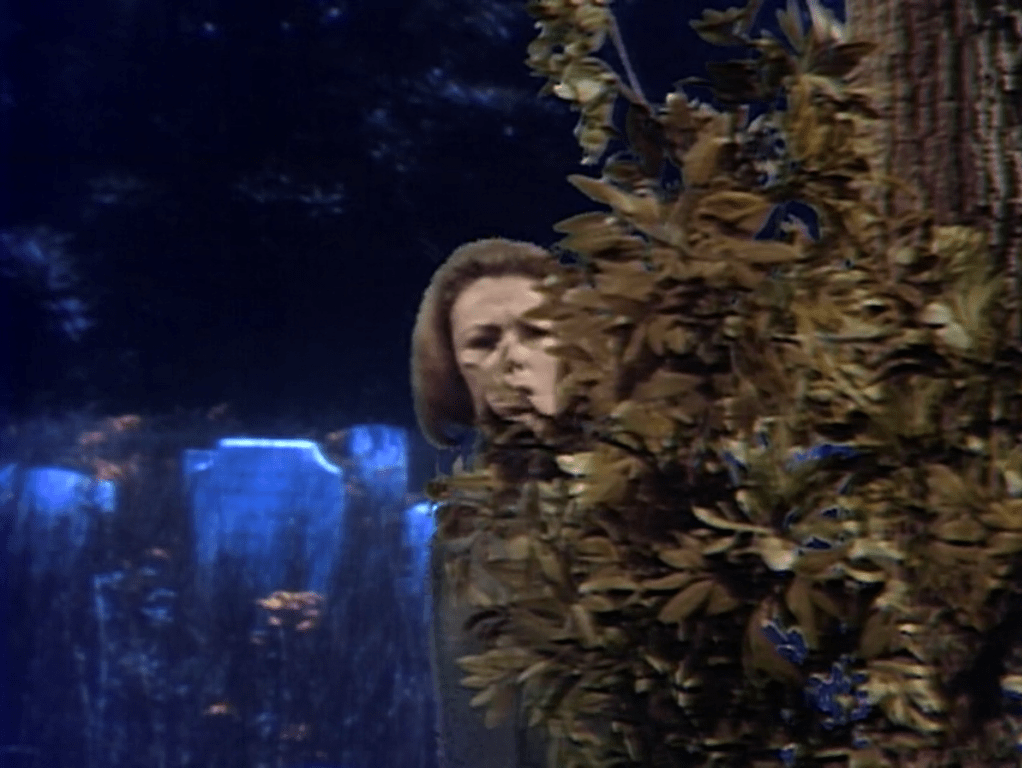
In the opening scene, Julia was in Barnabas’ house. He told her that he was likely to kill Roger’s ten year old son David because he thinks David might know that he is a vampire. Julia demanded that he leave David alone, prompting him to walk out of his own house. She then followed him to the old cemetery north of town, where Barnabas heard her footsteps in the distance and she hid behind a tree.
This woman holds a medical doctorate and is qualified in two unrelated specialties.
Barnabas enters the Tomb of the Collinses. Julia confronts him there, insisting he tell her what secret about the place he is keeping from her. He demands that she leave and threatens to kill her if she does not. He tells her that he ought to stash her corpse nearby, “along with”- then interrupts himself. Regular viewers know that Barnabas killed seagoing con man Jason McGuire in #275 and buried him in the secret chamber inside the tomb in #276. Jason has barely been mentioned since, not once in any scene featuring Julia. When she asks Barnabas what he is talking about, he says “Never mind.”
Julia presses Barnabas with “You’ve shared all your other secrets with me. You have no choice but to share this one with me too.” The logic of this statement eludes me, but all Barnabas can do when Julia has made it is to walk backward away from her, staggering into a corner and pouting at her.
Barnabas, stunned by the force of Julia’s reasoning.
Meanwhile, Sam and Dave are walking through the cemetery.
No, not that Sam and Dave. Local artist Sam Evans and addled quack Dr Dave Woodard have noticed that a series of odd occurrences have taken place in the vicinity of the tomb lately and have come to the cemetery to investigate. They run into the old caretaker, who delays them with his usual warnings about the unquiet spirits of the dead.
Alas, the final appearance of Daniel F. Keyes as the Caretaker.
Back in the tomb, Barnabas is telling Julia everything she wants to know. He lets her into the secret chamber and explains that he was imprisoned there in a coffin for many years, freed only when the luckless Willie Loomis accidentally released him to prey upon the living. Julia listens, showing pity as Barnabas recounts his woes.
Barnabas finds David’s pocket knife, proving that the boy was in the chamber and convincing Barnabas that he must kill him. He takes the knife close to Julia in a gesture that might be threatening, were its blade intact. The broken blade negates the threat and emphasizes Barnabas’ powerlessness before Julia. Since 1967 was the heyday of Freudianism in the USA, it is likely that many in the original audience would have seen it not only as a useless tool, but also as a phallic symbol. As such, not only its brokenness, but also the fact that it was made to be carried by a little boy, would make the point that Barnabas brings no sexual potency to his relationship with Julia. Her own behavior towards him may be childlike, but in her eyes he is a smaller child than she is.
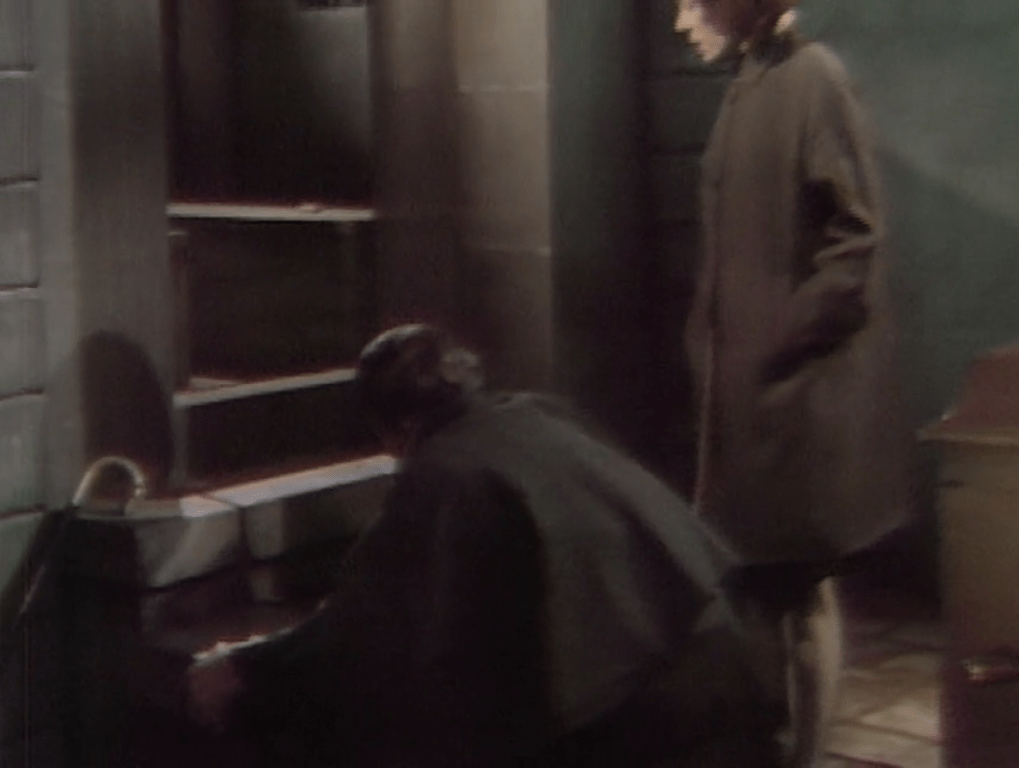
Julia protests, claiming that someone else might have left the knife there. Barnabas dismisses her assertions, but does not regain control of the situation. As they prepare to leave the chamber, he kneels and she stands over him, watching him open the panel.
On his knees before her.
They hear Sam and Dave approach. (Still not the cool ones.) They scurry back into the secret chamber, as David had done when he heard Barnabas and Willie approaching the tomb in #310. They listen to the men discuss the facts that have brought them to the tomb, and grow steadily more alarmed as they realize how close they are to discovering Barnabas’ terrible secret.
This is the first episode not to include any actors who were signed to the show at the time production began. The character of Sam Evans was at that time played by a loud man called Mark Allen; Allen’s last episode was #22, taped on 12 July 1966, and David Ford’s first was #35, taped on 29 July. The Caretaker was introduced in #154, Barnabas in #210,* Dave Woodard in #219,** and Julia in #265.
*As the hand of stand-in Alfred Dillay- Jonathan Frid wouldn’t appear until #211. Though the portrait he sat for was on screen in #204, and was identified as that of Barnabas Collins in #205.
**Played by Richard Woods. Robert Gerringer took over the part in #231.
Strange and troubled boy David Collins got himself trapped in the secret chamber of the old Collins mausoleum in #310, and everyone has been searching for him ever since. Most of them want to get him home safe, but his distant cousin, Barnabas, has a different agenda. He suspects that David has learned that he is a vampire, and is determined to be the first to find him so that he can kill him.
Friday, David got out of the secret chamber and walked outside, straight into Barnabas’ hands. Today, we open with a reprise of that scene. After Barnabas greets his young cousin with a richly sinister “Hel-lo, David!,” he questions him sharply. He expresses dissatisfaction with David’s answers, then tells him that because no one is at home in the great house of Collinwood, he will be taking David to his own house. David grows more and more uncomfortable. Just as he is coming to be really frightened, the voice of local man Burke Devlin calls his name.
When Burke reaches them, David throws his arms around him and Barnabas squirms guiltily. Burke dislikes Barnabas, and gives him a suspicious look while he and David explain what has happened. When Burke says that there are people at home in the great house, David flashes a look of alarm at Barnabas. Barnabas says that no one had answered when he knocked on the door earlier, so he assumed everyone had joined the search. The two men take David home.
There, David eats a sandwich in his room while his father Roger asks him where he has been. This conversation is just magnificent. Roger is trying to be stern, but is such a flagrantly neglectful father that David knows full well that he can’t be bothered to punish him. So while Roger puts a series of pointed questions to him, David ignores him and muses aloud about Barnabas. “Barnabas is mysterious, isn’t he, Father?…You know, we don’t know anything about him. He just showed up one night.” Roger keeps urging David to forget about Barnabas and start answering his questions, but gets nowhere. Louis Edmonds and David Henesy were both talented comic actors, and they worked well together, so it’s no surprise this scene is laugh-out-loud funny.
Along with the comedy comes the thrill of a potential change in the show. In his post about this episode, Danny Horn writes: “It’s a great moment. It’s like the ‘logical explanation’ spell was suddenly broken, and David just realized how bizarre his life is.” The structure of Dark Shadows’ storylines has been that someone has a terrible secret, they are deep in denial about the extent to which the secret is deforming their lives, and when they finally let go of their secrets they are free. So matriarch Liz had a terrible secret that kept her from leaving her house for over eighteen years, she revealed the secret in #270, and now she’s happy to go anywhere. She’s on an extended visit to Boston at the moment. Roger had a secret connected with an incident for which Burke went to prison years ago and he spent all his time making a fool of himself as he struggled to keep it hidden; he admitted the truth in #201, and since then he has been a carefree fellow who can make anyone laugh. So the Collins family curse that Barnabas embodies is made up chiefly of denial, and it can be defeated by facing facts. If David has seen through all the lies and is willing to reckon with the truth, he has the power to bring everything to a conclusion. So when he says that Barnabas “just showed up one night,” we catch a glimpse of what it would be like if the entire series came to its ultimate climax.
We end with David still in his room, telling well-meaning governess Vicki that he feels someone evil is watching him. We cut to Barnabas in his own house, staring out the window at the great house in the distance, thinking his sinister thoughts. David’s feeling should be familiar to him- when his mother, undead fire witch Laura Murdoch Collins, was staying in the cottage in the estate, she often stared out her window and caused David to have nightmares.
Laura was a threat to David because the basic conditions of her existence drove to kill her son. Barnabas’ threat to him is a result of circumstances that were always likely to arise, but that might not have, and that might yet be changed. So when Laura was on the show, the suspense was how she would be destroyed before she could kill David. Now with Barnabas, there is a question whether he will try to kill David at all. So the suspense is more complicated, and there are more options for pacing. The plot doesn’t have to be either glacial or rapid, as it did with Laura, but can move at any of a variety of speeds depending on which of the many possible directions they decide to take the story.









 Dark Shadows Commentary