Vampire Dirk Wilkins has bitten neurotic intellectual Rachel Drummond, fugitive schoolteacher Tim Shaw, and wealthy spinster Judith Collins. As we open, it is early morning and all three of them are gathered in Dirk’s hiding place. At Dirk’s command, Judith shoots Rachel. Tim does not know of Dirk’s wishes for Rachel, whom he loves. He is shocked by Judith’s deed, and takes Rachel to the Old House on Judith’s estate, Collinwood. The Old House is currently home to Judith’s distant cousin, Barnabas Collins. Tim knows that Barnabas is fond of Rachel, and hopes he will help them. But Barnabas is not available, and Rachel dies in Tim’s arms.
In the great house on the estate, Judith’s brother Edward and overwhelmingly evil charlatan Gregory Trask are fretting about the situation. Edward says that Barnabas believes that the vampire is Dirk; Trask replies “Then I would tend to believe it is not.” In #774, Trask found that Judith was bleeding from wounds on her neck and was in a robot-like daze; he had heard her calling Dirk’s name, and drew the conclusion that Dirk was the vampire. But his prejudice against Barnabas is so strong that he forgets about that.
Judith comes back, holding her revolver. Edward takes the gun and finds that it has recently been fired, and three chambers are missing their bullets. Edward leads Judith to her bedroom, and Trask goes into the drawing room, where by himself and in evident sincerity he calls on God to help him smite the forces of evil.
Returning viewers might be amazed at Trask’s attitude. He just completed a deal with a Satanist to use black magic to murder his wife; how can he believe himself to be God’s chosen instrument for this sort of work? But we have already seen that Trask’s hypocrisy is so extreme that it has given rise to its opposite. He has fooled himself, and is capable of the most earnest faith. In this he is the mirror image of his ancestor, whom we came to know between November 1967 and March 1968, when the show was set in the 1790s. That Rev’d Trask was such a true-believing fanatic that he became a hypocrite, so convinced of the rightness of his ends that he could not see how rotten the means were by which he was pursuing them.
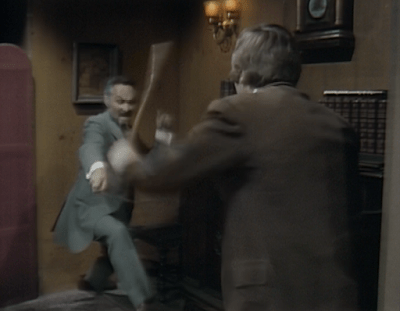
Later, Dirk summons Judith. Edward follows her to Dirk’s hiding place, where he manages to stake the vampire, destroying him. He strikes quite a few inches below the heart, pretty well in the mid-gut region, but that apparently suffices.
This is perhaps the bloodiest episode of Dark Shadows so far. Rachel’s blouse is covered with blood, and blood spurts out of Dirk’s mouth while Edward is driving the stake into his belly. There is a good deal of discussion of this in the comments section of Danny Horn’s post about the episode on Dark Shadows Every Day. Many who were too young to remember the original broadcast wondered if there was public pushback against the graphic violence. The original fans among the commenters responded that no, to the extent that people were worried about the content of daytime TV at the time their concerns were focused on sex, not violence. One of the most memorable responses came from Friend of the Blog Percy’s Owner:
Not really. My dad remarried a woman with very conservative ideas about what I should watch and read. She had to prescreen everything. She worked and got home after DS, so she couldn’t have stopped me from watching it, but once I assured her that no one was having sex, she was FINE with it. She actually asked me if this was the soap with the woman who didn’t know who the father of her baby was. When I was able to say with absolute truth that there were no babies at all on DS she didn’t care.
Comment left by “Percy’s Owner,” 24 November 2015, on Danny Horn, “Episode 776: Blood Sports,” Dark Shadows Every Day, 23 November 2015.
I didn’t participate in that part of the discussion, but I did join in on another topic. Some commenters expressed the opinion that the portion of Dark Shadows set in the year 1897 went on too long, and that too many actors played multiple roles in it. I said that I was of the opposite view:
Oh, I disagree- I wish 1897 had gone on longer and had included a lot more doubling. For example, I’d have liked to see John Karlen come back as a suave, smooth-talking fellow. And Don Briscoe as a straight-up imitation of W. C. Fields, in the same way that Tony Peterson gave Jerry Lacy a chance to do a straight-up imitation of Humphrey Bogart. And Clarice Blackburn as the diametric opposite of Abigail/ Minerva- she could have been Magda’s black sheep cousin, the shameless woman.
Comment left by “Acilius” 9 November 2020 on Danny Horn, “Episode 776: Blood Sports,” Dark Shadows Every Day, 23 November 2015.
Tim Shaw, uptight teacher turned victim of brainwashing turned fugitive murder suspect, makes his way into an abandoned root cellar. He finds a coffin there. Naturally, he opens the coffin. That’s what everyone does on Dark Shadows when they find a coffin where one shouldn’t be. You meet the most interesting people that way.
Tim finds that the coffin is empty, and goes into a dark corner to hide. Someone comes to the door, and Tim gets up to greet whoever it might be. He hasn’t been a fugitive very long, and hasn’t quite perfected all the skills that the status calls for.
Tim sees Dirk Wilkins, a dimwitted servant of the ancient and esteemed Collins family who has been missing for several days. Tim calls out “Dirk!” This is the first time we learn the two men know each other. They are unlikely to have been friends. Tim rarely left the school where he worked. The school has been housed in a building on the Collins family’s estate for several weeks, so it makes sense that he and Dirk would have met, but Dirk has been unpleasant to everyone we have seen him with, including his employers and pretty girls he wants to attract. It is hard to imagine the painfully shy Tim befriending him.
Dirk turns out to be a vampire, and he bites Tim. We then cut back to the school. The headmaster, the overwhelmingly evil Gregory Trask, is browbeating Tim’s fellow teacher and onetime girlfriend, neurotic intellectual Rachel Drummond. Returning viewers will recall that Trask has made flagrant passes at Rachel, and also know that Trask conspired with a local Satanist to cast a spell on Tim which caused him to kill Trask’s wife Minerva. Trask is pretending to be upset about Minerva’s murder and to believe that Rachel plotted with Tim to commit it. He tells Rachel that if she does not leave the school, he will accept that she is innocent. She goes to her room, distraught. Later in the episode, Trask will telephone his co-conspirator, gloating that the authorities are on their side.
Spinster Judith Collins, sole proprietor of all her family’s great wealth, shows up to offer her condolences to Trask. They find that Rachel is gone, and he tells her that she must have gone with Tim. Trask realizes that Tim and Rachel have no money, and wonders if there is anyone who might give them enough to allow them to flee the state. Judith says that her distant cousin Barnabas Collins, who is currently staying at the Old House on the estate, is very fond of Rachel and that he might give them some money. She says that she will get in her carriage and go to the Old House before Rachel can get there. She will tell Barnabas about the murder and about Tim and Rachel’s involvement in it, thereby ensuring that he will not give them any money.
Judith knocks on the front door of the Old House and gets no answer. She enters, and finds the house empty. She is still in the front parlor when Dirk enters. She chastises him for staying on her property after she dismissed him, and tells him she will call the police if he is not gone within 24 hours. He walks towards her, backing her against the wall and ignoring her demands that he let her leave. He says that he is no longer her servant, but that she will soon be his. He bites her.
Judith was right when she told Trask that Rachel would go to the Old House. Rachel does go there. She peeks in the window, sees Judith sitting in a chair, and scurries off. This is rather an odd moment- Judith told Trask just a few minutes before that she would go to the Old House in her carriage. It seems unlikely that she drove her own carriage and there is no driver waiting outside, but even if if she did the carriage must still be sitting there in full view. How did Rachel fail to notice it?
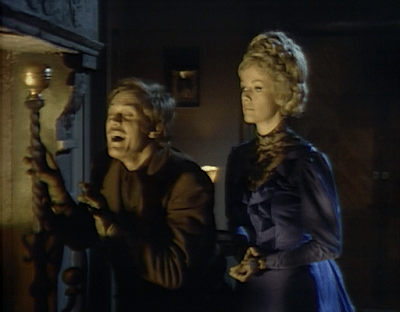
Trask comes to the Old House and tells Judith he wanted to offer her his support in her conversation with Barnabas. Trask knows how fond Barnabas is of Rachel, and may well suppose that he would want more details about Minerva’s death than Judith could offer before he agreed to regard Rachel as a criminal. Judith says Dirk’s name when Trask enters, and when Trask notices the bleeding wounds on her neck he quickly realizes that Dirk inflicted them.
We cut back to the root cellar, which we see Rachel entering. She sees the coffin, and of course opens it. That’s just good manners. She turns, and sees Dirk in the entryway.
In his post about this episode at Dark Shadows Every Day, Danny Horn transcribes a conversation among Roger Davis, Jerry Lacy, and director Lela Swift captured on video when the three were on a panel at a convention:
Roger Davis: I do remember being very excited when I got to be a vampire on the show, so excited, and the first person that I got to bite was Joan Bennett, and I was so enthusiastic and excited I knocked her over — flat on her back!
Jerry Lacy: I remember when you did it, it was rehearsal in the morning.
Roger: Was it?
Jerry: Yeah. You grabbed her, and you bit her, and then you just threw her. And she was already sixty years old then.
Lela Swift: Then we had to pick Joan up and put her together again.
Danny Horn, “Episode 774: What’s Up, Dirk,” posted at Dark Shadows Every Day, 21 November 2015.
To which my comment is, fuck that guy. I don’t make a habit of swearing, but there are not enough curse words in the language to express my reaction to Mr Davis chortling through his reminiscences of physically abusing his female scene partners. He can fuck off straight to hell.
This story gives an extra dimension to the scene between Judith and Trask in the Old House. Mr Lacy plays Trask’s relentless evil so effectively that he is difficult to watch; my wife, Mrs Acilius, refuses to watch his episodes this time through the series. It usually makes a viewer’s skin crawl to see Trask posing as a representative of something good. But knowing that behind Trask in the position of standing by Judith after she had been attacked by Dirk was Jerry Lacy standing by Joan Bennett after she had been attacked by Roger Davis, our response is much more complex. After all the times we might have wondered how anyone could fail to see through Trask’s blatant hypocrisy, this time enough of the thoroughly decent humanity of Jerry Lacy peeks through that we can understand why Judith has been so supportive of Trask.
The cast went into makeup after the morning rehearsal. From the looks of Dirk’s fake mustache and artificial pallor, makeup artist Vincent LoScalzo must not have brought his usual enthusiasm to his work when Mr Davis sat in his chair. The mustache in particular is so crudely affixed that it looks like Mr Davis might have done his own makeup today.
A little over two weeks ago, Dark Shadows started an homage to The Manchurian Candidate, with some touches added from Pushkin’s The Queen of Spades. The overwhelmingly evil Rev’d Gregory Trask, keeper of a sadistic cult disguised as a boarding school, coerced Satanist Evan Hanley into casting a spell on Tim Shaw, one of the teachers at the school. When Tim sees the Queen of Spades, he will be prompted to poison Trask’s wife Minerva.
The whole point of employing an assassin is to give yourself an unbreakable alibi. Since Tim will not remember Evan or the spell once he has killed Minerva, the logical thing would seem to be to arrange it so that Tim poisons Minerva in front of several witnesses and that he still has the vial of poison on him when he is caught. But instead, Evan himself turns up as Minerva is in her death throes, and he is the only witness. After Evan erases Tim’s memory, Tim defeats Evan in a sword fight, then runs away, taking the poison with him. Tim flees to his only friend, fellow teacher Rachel Drummond, and tells her that if it is a matter of Evan’s word against his, he will have no chance in court. Later, Evan confronts Rachel and roughs her up, trying to intimidate her out of helping Tim in any way.
Absent witnesses to accuse Tim on his behalf or an alibi for himself, Evan may as well have skipped the whole brainwashing bit. Had he simply strangled Minerva and claimed he saw Tim do it, he would be in exactly the position he is in now.
The problem for Evan’s plan is that it is taking place at this point in the series. The segment of Dark Shadows set in the year 1897 is stuffed to bursting with vivid characters, each of them involved in at least one dynamic storyline. That makes it, from most points of view, the best part of the show, but it also makes it very difficult to get a bunch of people together. Any two characters you put in the same scene are likely to join plot threads together in new and consequential ways. That makes for a lot of excitement, but it makes it very difficult to do just one thing at a time.
For example, say Tim had insisted on bringing Minerva the poisoned tea while in the drawing room at the great house of Collinwood with rich spinster Judith Collins, Judith’s brother Edward, and Minerva’s daughter Charity, while maidservant Beth waits on the company. Trask is apparently scheming to marry Judith and get her money once Minerva is out of the way. Put her in Minerva’s death scene, and you accelerate that part of the story, perhaps beyond the pace you are prepared to follow up. Edward is starting to suspect that his distant cousin, recently arrived Barnabas Collins, might be a vampire. Those suspicions are the result of two qualities in which Edward is no more than average, his ability to notice the obvious and his concern for his son. But if you make him a participant in another story about a crime, any remarks he might make that would display any brainpower whatever would transform him into the show’s resident sleuth. Beth and Charity are both blood thralls of Barnabas’; if either of them were in the room while the poisoning took place, we would therefore expect them to go directly to him and start wondering how he would react to the news. That would shift our focus to him, subordinating the Tim and Minerva story to the Barnabas story. Virtually every other character is disqualified from serving as a witness for similar reasons, leaving Evan to do the honors himself.
Two of the things that make THE MANCHURIAN CANDIDATE work so well are that we don’t see any of Raymond Shaw’s training, and that when he sees the Queen of Diamonds he goes into a trance that strips him of all personality.
The training scenes here show why the first of those was so important. Not only are the scenes tedious, they force us to realize that the very idea we most have to take seriously is in fact preposterous. Whatever power you might imagine hypnosis or drugs or other conditioning techniques to have, they obviously couldn’t turn a human brain into a digital computer.
And Tim’s talkativeness while in his trance shows why the second element is essential. Raymond might do absolutely anything when he’s in his hyper-suggestible state. A bartender mentions the phrase “Go jump in a lake” and Raymond jumps in the nearest lake. That’s terrifying, because it is terrifying to think of what people might do who had no mind or will controlling their actions from moment to moment. But Tim’s endless chit-chat doesn’t suggest a soulless automaton. There seems to be a mind in there, it just isn’t a very nice or very interesting mind.
Don Briscoe’s performance doesn’t add much to this unpromising material. I can’t think of anything he might have done to make it work, and neither could he. Anyway, I’m glad it’s over.
Comment left 8 November 2020 by Acilius on “Episode 773: The Persecution and Assassination of Minerva Trask as Performed by Tim Shaw under the Direction of the Marquis de Sade,” Danny Horn, Dark Shadows Every Day, 21 November 2015
Second consecutive episode ruined by Roger Davis’ performance as crazed groundskeeper Dirk Wilkins. Crazy Dirk has more fans than do any of Mr Davis’ other roles on Dark Shadows, which I do not understand. He is such a swivel-eyed loon from the first shot to the last that he is useless as a character- he doesn’t respond to anything anyone else does or says, just carries on with a chortling mania. The unvarying bombast suggests a desperate actor, and it leaves Mr Davis’ scene partners with nothing to do.
In a comment I left under Danny Horn’s post about the episode on Dark Shadows Every Day, I talked about my mental habit of imagining different actors playing parts that were not well executed:
I amuse myself during weak bits by wondering how characters would have come off if played by other actors. A character as well-written as Dirk, played by an actor as competent as Robert Rodan? Second only to Quentin Collins among the fans! Played by David Groh? Bigger breakout star than Barnabas! Played by Harvey Keitel? Such a hit the show is still in production!
Who knows how they would actually have done- maybe they would have made some kind of unfortunate choice and bungled it. And who knows what effect they would have had on the rest of the show- maybe if Dirk had been a massive hit and they’d rebuilt Dark Shadows around him, the result would have been a less interesting show. But the imaginary show in my head is good enough to get me through some pretty dire segments.
This time through I’ve been imagining Edward Marshall, who wore some of the wardrobe that became Dirk’s when he was cast as petulant ex-convict Harry Johnson in #669, in Mr Davis’ place. Mr Marshall took over the part of Harry from the not reliably brilliant Craig Slocum. He preserved the attitude and a great many of the mannerisms Slocum had given the part, but was substantially more interesting than Slocum ever was. Before he became violently insane, Dirk shared so many of Harry’s qualities that Mr Marshall would have been an obvious choice for the role. I’m sure he would have been better than Mr Davis, though perhaps not on a par with Robert Rodan, David Groh, or Harvey Keitel.
Today’s big plot point comes when Dirk tells twelve year old Jamison Collins that he has killed Barnabas Collins and that Barnabas was a vampire. Dirk is mistaken about the first of these points; he did not harm Barnabas at all. But he is right that he is a vampire.
This part of Dark Shadows is a costume drama set in the year 1897. Barnabas traveled to that year from 1969 while doing battle with some supernatural menaces. In the parts of the show set in the 1960s, the adults in the great house of Collinwood are Jamison’s daughter Liz and son Roger. Liz and Roger have accepted Barnabas’ story that he is their distant cousin from England and have let him take up residence in the Old House on the estate. If Jamison finds out that Barnabas is actually a bloodsucking ghoul, it is unlikely that his children will be sufficiently hospitable to him to allow the parts of the show in contemporary dress to exist. So when Jamison goes to the Old House to check on Dirk’s story and finds a coffin in the basement, we know that something will have to change if the show is to continue.
In the spring of 1969, the twin crises created by the malign ghost of Quentin Collins and the werewolf curse upon drifter Chris Jennings had combined to kill a number of people, bring others to the point of death, and make life on the estate of Collinwood utterly intolerable. Recovering vampire Barnabas Collins and his friends found some I Ching wands in Quentin’s old room and tried to use them to communicate with the ghost. Instead, they caused Barnabas to come unstuck in time. In #701, Barnabas found himself in the year 1897, his own curse of vampirism once again in full force.
Today, Barnabas bites Quentin’s girlfriend, maidservant Beth Chavez, and makes her tell him everything she knows about the werewolf curse. He was in a position to know all of this before he bit her; much of it he could have figured out if he had been paying attention to the information available to him in the late 1960s. But the show has been gaining lots of new viewers lately, and they probably appreciate the recap.
Quentin was married to a woman named Jenny, who unknown to him was the sister of ethnic stereotype Magda Rákóczi. Quentin left Jenny in 1895. Neither Quentin nor Magda knew at that time that Jenny was pregnant. Quentin’s siblings Edward and Judith put the story out that Jenny had gone away, and locked her up in a room hidden in the house. They enlisted Beth, her former maid, to be Jenny’s keeper. By the time she gave birth to boy-girl twins, Jenny had gone entirely insane.
In #720, Jenny escaped and stabbed Quentin. She escaped again in #748, and Quentin strangled her. When Magda found out that Quentin had killed Jenny, she cursed him and his male descendants to be werewolves. In #763, Beth told Magda about the twins; Magda’s reaction made it clear to Beth that she was powerless to lift the curse. Regular viewers already know that. The audience first heard Magda’s name months before she appeared on the show, when she spoke at a séance in #642 and expressed deep regret about “my currrrrse,” which we knew to be connected to both Quentin and the werewolf. In #684 and #685, Barnabas found a silver pentagram that Quentin and Beth bought in 1897 on a chain around the neck of a dead baby, and identified it as an amulet to ward off werewolves. Barnabas learned yesterday that Beth had bought the pentagram, and she confirms today that it is for Quentin’s son to wear. She also bought a similar pendant for herself, and is wearing it.
There is a full moon tonight, and most of the episode is taken up with the mechanics of people getting ready to go into the woods to hunt the werewolf, coming back from the woods where they have been hunting the werewolf, and telephoning to ask others to join in hunting the werewolf.
Magda has a pistol and loads it with silver bullets. Some wonder where Magda came up with silver bullets, but in a comment on Danny Horn’s post about the episode at Dark Shadows Every Day someone posting as “cslh324” reminds us that in #757 Magda persuaded undead blonde fire witch Laura to give her the money to buy silver bullets with which to shoot Barnabas. One of Magda’s purposes in putting this plan forward was to get Laura to leave her alone in the room so that she could steal a magical doodad from her, but it turns out Magda really did buy the silver bullets.
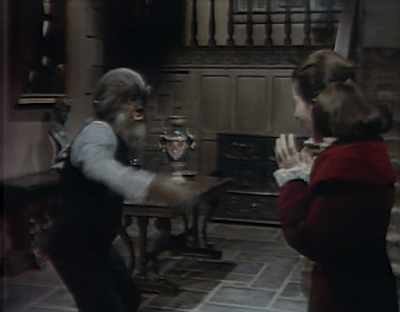
The werewolf gets into the great house of Collinwood and attacks Judith. Beth shows up in the nick of time and shows the werewolf her pentagram. He flees. Judith asks why the werewolf would run away from her, and Beth refuses to explain. At first she denies that it happened, then she asserts that the werewolf is probably as afraid of them as they are of him.
The confrontation between Judith and the werewolf includes a spectacular stunt. The werewolf jumps over the railing on the walkway above the foyer and holds a stationary two-point landing on the floor twelve feet below. Alex Stevens deserves high praise for that.
When we hear the sound effects associated with the werewolf or see the consequences of his attacks or catch a glimpse of him as a blur in the middle of a cloud of shattering glass, we can be afraid of him. Unfortunately, the show often gives us a long look at him, and he is not scary at all. They didn’t have the schedule or the makeup budget to cover his whole body in fur, so he wears Quentin’s suit. Seeing him standing there in that little outfit you don’t want Magda to shoot him with her silver bullets. At most, you might swat him with a rolled-up newspaper and tell him he is a bad doggie.
You have to stop killing people, or you won’t get any more bickies! Screenshot by Dark Shadows Before I Die.
Beth does not want Judith to suspect that Quentin is the werewolf, but it really doesn’t make any sense that she won’t tell her about the apotropaic power of the silver pentagram. You’d think she would want everyone on the estate and in the neighboring village of Collinsport to wear such pendants for the duration of Quentin’s curse. Surely she could come up with some explanation as to how she knew about the silver pentagram that wouldn’t invite questions she couldn’t answer.
The name “Magda” was first mentioned on Dark Shadows in #642, broadcast and set in December 1968. At that time, the residents of the great house of Collinwood had noticed unaccountable goings-on, and as they often do they held a séance to appeal to the spirits of the dead for guidance. The spirit they reached in that one identified herself as Magda. She repeated two things- “My curse!” and “He must not return!” Magda said enough to suggest that she had cursed someone and regretted doing so, and that she knew that the Collinses were threatened by the return of someone from her own period, but that was all. Since the Collinses of 1968 had never heard of anyone associated with their house named Magda and could find no record of such a person, those suggestions remained vague and useless to them.
They meant a good deal more to regular viewers. We already knew that the malign ghost of Quentin Collins had appeared in a room in the long-deserted west wing of the great house, that children David Collins and Amy Jennings were falling under the ghost’s influence, and that Quentin lived at Collinwood near the end of the nineteenth century. We therefore assume that Quentin is the one who “must not return!,” and that Magda, whoever she was, must have known Quentin and therefore also have lived sometime in the 1890s.
Among the participants in the séance was Amy’s older brother, mysterious drifter Chris Jennings. Chris broke the séance off before Magda could go into enough detail to help the others. The show had long since established that the person who ends a séance prematurely is the one who harbors a dreadful secret that the voice from beyond might uncover. Even the characters have caught on to this pattern; they treat Chris with suspicion. They do not know what we do, that Chris is a werewolf. So he is indeed under a curse, and we can take it that his curse originated when Magda placed it on one of his ancestors.
Over the next few months, Quentin’s power steadily grew, and at the same time Chris’ periods in his animal form grew longer and more frequent. These two developments moved in such close tandem that we had to suspect that there was some causal relationship between them. This suspicion was reinforced when, in #683, another ghost associated with Quentin, that of a tall, thin, blonde woman named Beth, led Chris to what proved to be the unmarked grave of an infant. That infant was wearing an amulet meant to ward off werewolves. The records of the silversmith who made the amulet showed that it was commissioned and paid for in 1897 by Quentin Collins and Beth Chavez. Thus we learned that a werewolf was active in the area of Collinwood when Beth and Quentin were alive, and that they cared about a baby who died at that time. The logical inference would be that the curse under which Chris labors originated at that time, that Beth and Quentin had something to do with it, and that the baby was related to someone who became one of Chris’ ancestors.
Now, the show has become a costume drama set in 1897. Quentin and Beth are alive. Beth is a maidservant who first came to Collinwood in the train of Quentin’s estranged wife, Jenny. Quentin left Jenny and was banished from the house the previous year; word was put about that Jenny responded to the desertion by going away and leaving no forwarding address. When Quentin returned to Collinwood in #701, he was surprised to find Beth still on staff, and he set to work trying to seduce her.
In #720, Quentin discovered that Jenny had not in fact gone so far away as he and everyone else had been led to believe. She turned up and stabbed him. He then learned that Jenny had become violently insane when he left her and that his sister Judith and brother Edward had responded to her illness by locking her up in a room hidden inside the great house. They kept Beth in their employ because she was the one entrusted to care for Jenny.
Now, Beth has given in to Quentin’s charms. The other night Jenny was hiding in Beth’s room while Beth and Quentin shared a tender moment, and she reacted by coming at them with a knife. Quentin disarmed Jenny, restrained her, and then put his hands around her throat. While Beth pleaded with him to stop, he choked Jenny to death. He keeps protesting that, because Jenny at one point had a knife, this was an act of self defense, but the audience and Beth both saw what happened, and she won’t agree with him any more than we will.
Edward and Judith have decided to shield Quentin from the legal consequences of his actions, and in the village of Collinsport the will of the Collinses supersedes the laws of the state of Maine. But Quentin finds no comfort in his immunity from criminal prosecution. Just hours before he murdered Jenny, Quentin discovered that he knew nothing about her origins. He thought she was some kind of Anglo, but she was passing. She was actually a Romani woman. Her sister is one of the neighbors, broad ethnic stereotype Magda Rákóczi.
In Wednesday’s episode, Edward convinced Magda the police and courts would do nothing to punish Quentin, and so Magda threatened to place a curse on him to avenge Jenny’s death. Edward, a rational-minded modern man, dismissed Magda’s threat as “words.” But Beth and Quentin know things about the universe they occupy that Edward does not know. When Beth heard Magda’s threat, she looked wide-eyed at Quentin, walked backwards away from him, and ran off. Quentin, who is obsessed with the occult, was immediately terrified, and has been dissolving into a puddle ever since.
Yesterday, Quentin fell into a trap Magda set for him and brought a curse upon himself. Today, Magda stands with her husband Sandor by Jenny’s grave, watches the full Moon rise, and recites an incantation specifying that Quentin’s male descendants will suffer from the same curse he does. So far as Magda knows, Quentin does not yet have any descendants, male or female, and so that proviso is just an abstraction for her.
We know more than Magda does. Not only have returning viewers heard her spirit say that she regrets the curse and been led to the conclusion that it fell on Chris Jennings, but even those who are watching the show for the first time today know that Quentin and Jenny are the parents of twin infants whom Judith is paying a Mrs Fillmore to raise in her home in the village of Collinsport. Mrs Fillmore’s name was first mentioned in #707, and it comes up today when Judith is firing Beth.
Judith explains to Beth that, since Jenny is no longer around, she no longer has any work to do at Collinwood. She indicates her dissatisfaction with Beth, and says that it is only through Edward’s influence that she included a severance payment with her letter of dismissal. Beth mentions her task of taking money to Mrs Fillmore to pay her for taking care of Jenny and Quentin’s children; Judith does not see a need to retain an employee simply to carry an envelope full of cash to the village every now and then.
Beth objects that Judith is terminating her employment because she has become involved with Quentin; Judith takes that as an opportunity to castigate her for the impropriety of that relationship. Joan Bennett plays Judith’s reaction to Beth quite effectively; in a comment on Danny Horn’s post about the episode at Dark Shadows Every Day, “Rev Velveteen” writes:
I wanted to mention a Judith Collins, er, Joan Bennett acting moment I found particularly entertaining here. When she’s giving Beth the boot and the servant attempts to “innocently” inquire as to why she’s being let go, Judith turns around and gives her SUCH a look! Huge eyes, a stifled gasp, then bright pursed lips…Her expression goes from incredulous (Are you freaking KIDDING me?) to amused (Just how stupid does she think we are?) to triumphantly satisfied (Fine, we shall just both play out this little charade and I’ll soon be rid of you.) Her chin goes up as she turns away snarkily-“Let’s just say that now Jenny’s gone, your services are no longer needed,” which everyone on and off screen knows is a total lie. It’s such a sweet piece of work by Ms. Bennett, I need to keep an eye out to see if she repeats that expression because it just sums up the whole character of any Collins she plays when as the perpetual straight man, she’s faced with yet another absurd situation. And is also just stunning in that gorgeous green dress.
Comment left by “Rev Velveteen” at 12:43 am Pacific time, 25 June 2020, on Danny Horn, “Episode 750: Gypsy Ascendant,” 18 October 2015, Dark Shadows Every Day
Yesterday, Judith gave the penniless Quentin $10,000 on condition that he leave Collinwood forever and induce Sandor and Magda to do the same. Quentin had hoped to use the money to bribe them into forgoing Jenny’s vengeance, but they only pretended to take it to lure him into bringing the curse on himself. Magda contemptuously threw the cash at him after he did so.
Quentin has told Judith that Magda took the money and agreed to go. Today, Magda comes to the house to ask for Jenny’s things. Judith starts in with lecture about how she must go at once, since she and Sandor have been paid so well to leave, and Magda reveals that she did not take the money. Enraged at Quentin’s childish lie, Judith demands he return the $10,000. He tells her to sue him, and stalks off. Judith fumes, knowing that she has been cheated and that she cannot assert her rights without creating the public scandal that she fears above all else.
Quentin finds Beth packing Jenny’s things. He tells her he has to leave tonight, and announces that she will be coming with him. She responds in a mild tone that she doesn’t seem to have any say in the matter. She tells Quentin that she has lost her job, and says that she will give him her decision in the afternoon.
Sandor comes for Jenny’s things. Quentin offers him the $10,000 all for himself if he can lift the curse. He says he doesn’t know how. Quentin says he will give it all to him if only he will tell him what form the curse will take. Sandor shakes his head at Quentin’s desperation and says that knowing that would be of no benefit to him.
As night falls, Quentin goes to Beth’s room. She agrees to go with him, but insists on running a personal errand first. Even though she just told him that they have to be honest with each other, she will not tell him what it is. She is still honoring Judith and Edward’s decree that Quentin must not know that Jenny gave birth to his twin children after he left her, and that they are in Mrs Fillmore’s care.
Quentin keeps saying there is no time left to do anything but run. We might wonder why he didn’t stop by Beth’s room earlier. She is on her way out the door when Quentin cries out and collapses in severe pain. Regular viewers recognize Quentin’s pains as the same Chris had when he turned into a werewolf. When we see the rising moon and hear the baying of the hounds, we know who Chris’ forebears are, and why Magda came to regret her curse.
In September and October 1967, well-meaning governess Vicki and her depressing boyfriend Burke wanted to buy a long-disused property that everyone referred to as “The House by the Sea.” Collinsport is a coastal village, so many of its houses would lie by the sea, but at that point only that one was so designated on Dark Shadows. It was important that The House by the Sea lay on the other side of Collinsport from the great estate of Collinwood. When it was first introduced, matriarch Liz was eager to go there, signaling that the show was done with an old and unproductive theme presenting Liz as a recluse. And Burke was willing to live there with Vicki, whom he is determined to get away from Collinwood and the Collins family.
The house belonged to the Collinses, and the show suggested that it might be haunted in such a way that if Burke and Vicki lived there they would become possessed by the unquiet spirits of its former occupants, Caleb Collins and his wife, whom we know only by the initials “F. McA. C.” When Liz found in #335 that for legal reasons she would not be able to sell Vicki and Burke the house for a few years, the whole story vanished without a trace. We did not hear the phrase “The House by the Sea” again until #679, in January 1969.
At that point, the show was in fact running a story about ghosts taking possession of the living, a coincidence that leads me to wonder if the writers were making an inside joke about a story that was in the flimsies early in 1967, that was reflected in the talk about “The House by the Sea” that autumn, and that went nowhere. At the beginning of January 1969, strange and troubled boy David Collins was intermittently possessed by the ghost of his Aunt Liz’ great-uncle Quentin, and when Liz questioned him about some of his odd doings he made up a story about The House by the Sea to persuade her that he was just being silly.
In between those two stories, we did hear a great deal about another place called “A House by the Sea.” From #549 in August 1968 until #633/634 in November, this house was rented by suave warlock Nicholas Blair. At first it was said to be located at some distance from Collinwood, and it seemed that it might be the house Burke and Vicki had been interested in. But as we saw it, we could see that it was in quite a different architectural style. And as time went on, the house moved closer and closer to Collinwood. After a while, the opening narrations referred to it as “Another house on the same great estate.” That did not stop Big Finish Productions from conflating Vicki and Burke’s “The House by the Sea” with Nicholas’ “A House by the Sea” in their 2012 drama The House by the Sea, but the houses remained distinguishable on the show as of early 1969.
Now, Dark Shadows has become a costume drama set in the year 1897. Well-meaning time-traveler/ bloodsucking fiend Barnabas Collins has gone to that year, when Quentin was a living being, in hopes of preventing the events that made him into the all-destroying evil spirit of 1969. Barnabas does not have the slightest idea what those events were, and in the absence of that information he has decided that the best course of action is to antagonize as many people as possible.
Among the enemies Barnabas has made is the evil Rev’d Gregory Trask, head of a boarding school/ abusive cult called Worthington Hall. Another of Barnabas’ new enemies has, for reasons of her own, burned Worthington Hall to the ground. Trask has captivated the current mistress of Collinwood, spinster Judith Collins, and in #739 Judith offered Trask the use of a “small house on the estate” as a temporary base for the school until she can finance the restoration of the previous site. Today, Judith instructs a servant to take steps to prepare “the house by the sea” for this purpose.
Perhaps this means that Trask’s cruelty center will occupy the house Burke and Vicki wanted to buy. That Judith said it was “on the estate” would suggest that it is the one where Nicholas lived, and they have decided that so few people remember the dead-end storyline of autumn 1967 that they no longer need to keep the two houses distinct by calling only one of them “The House by the Sea.”
No More Knife
While Quentin was haunting Collinwood in late 1968 and early 1969, he showed himself to be a peculiarly corporeal sort of ghost. In addition to the usual ghostly business of materializing and dematerializing inside closed rooms, possessing children, and making noises resound from everywhere and nowhere all at once, he also poisoned one person, choked another, and came and went through a secret passage. Occasionally this served to show that Quentin’s power started small and grew steadily until he was irresistible, but it also left the impression that Quentin simply enjoyed feeling like he had a body. Now that we see Quentin as a living being, the impression that he revels in the flesh is frequently confirmed.
Quentin’s estranged wife Jenny has gone mad and is being kept prisoner in the great house by Quentin’s sister Judith and brother Edward, with the assistance of a couple of the servants. Quentin learned of Jenny’s continued presence at Collinwood only when she escaped and stabbed him a few weeks ago, and he still can’t figure out where in the house she is locked up. He has vowed to kill her once he does find her.
Jenny is on the loose again today. Judith has a close call in the drawing room. She finds Jenny there. Jenny menaces Judith with a knife; just as she gets Judith into a helpless position and it looks like she is about to stab her to death, Jenny picks up a candlestick and knocks Judith unconscious. Shortly after, Quentin comes in and finds Judith recovering from the blow. Judith tells him what happened. He gets a gun and goes out to hunt Jenny down.
Jenny makes her way to the Old House on the estate. She knocks on the door, and Barnabas answers. They introduce themselves to each other. His name means nothing to her; he arrived only nine weeks ago, long after she lost her marbles and was consigned to a hidden cell. No one has told her that Judith invited a distant cousin from England to stay in the Old House. But Barnabas knows exactly who Jenny is, and he listens to her every word and watches her every move with vivid interest.
Jenny announces that she has come to find Quentin. Barnabas says that Quentin is not there, and invites Jenny to search the house. As she walks through the front parlor, Jenny announces that “Sometimes he makes himself invisible.” That line will strike a chord with regular viewers who remember the ghostly Quentin of the 1960s, though Jenny is apparently thinking of a psychotic break she had earlier in the episode when she hallucinated his voice coming from various pieces of furniture in the drawing room. Nonetheless, Jenny is confident that she will know if Quentin is nearby.
Jenny talks about her “children”; Barnabas visited one of her former cells, and saw that there were dolls there. He asks twice if the children she is talking about are dolls, and each time she angrily insists that she has real live children and that they are in her room at Collinwood. She sings a lullaby in a minor key; she forgets the lyrics halfway through, and asks Barnabas if he knows them. She has a lovely voice, and he seems to be sincere when he says he is sorry that he cannot help her finish the song.
As Jenny talks about her children, it dawns on Barnabas that she may in fact have had children who were taken from her. His reaction to this is an important moment. In 1969, Barnabas learned that in 1897 a baby died and was buried in an unmarked grave on the grounds of Collinwood with an amulet meant to ward off werewolves. So far in his trip back to that year, he has found no babies and there is no werewolf. His response to Jenny’s talk of her children looks like a man making a wild surmise. If the baby in the unmarked grave was one of Jenny’s children, the werewolf must be coming very soon.
Barnabas makes the connection.
Jenny is sitting on the staircase for part of this conversation with Barnabas. Ever since Barnabas first met David in #212, he has had his most human moments while standing on the floor and talking to people on that staircase, and his talk with Jenny is an outstanding example. He talks to her very gently. Perhaps he has the presence of mind to try to befriend someone who might be useful to him, but whatever he is thinking he shows a real warmth.
Jenny tries to stab Barnabas; he takes the knife from her. She cowers in a heap on the floor, wailing that now he will kill her. He throws the knife in the fire and tells her she has nothing to fear. Of course, a metal blade could not harm a vampire, so it was easy enough for Barnabas to remain unruffled during the attack.
Barnabas vetoes Jenny’s demand to search the basement, where his coffin is, and takes her upstairs to a bedroom once occupied by his lost love Josette. In 1967, he restored that bedroom to the condition it was in when Josette lived there, and for some reason he has done the same this time. By the time they get to Josette’s room, Jenny thinks that she and Quentin are on their honeymoon and that Barnabas is a bellhop. She apologizes that she has no money to give him as a tip.
Jenny looks into the mirror and is revolted by the terrible person she sees there. Barnabas points to an assortment of lady’s toiletries and assures her that the terrible person will go away if she uses them. He locks her in the room and calls for his servant Magda.
Jenny is so crazy we can never be sure what she will make of any set of facts she encounters, and Barnabas is, for once, keeping his thoughts to himself throughout his scene with her. But however much ambiguity may be built into Barnabas and Jenny’s interactions with each other, there is no question what Marie Wallace and Jonathan Frid are doing. She is supposed to play Jenny without restraint, and she makes the most of that opportunity to be larger-than-life. He also seizes his chance to show what he can do when he has time to really learn his part. He is not only letter-perfect with his lines, but also subtle and precise in his characterization of Barnabas’ reactions and intentions. It is a fascinating performance.
Jenny hears Barnabas calling Magda’s name. She not only repeats it, but also says the name of Magda’s husband Sandor. Magda and Sandor have been in the Old House for quite some time, well before Barnabas showed up and forced them into his service, so it is no surprise that Jenny remembers them. It is interesting that she seems to have strong feelings about them, though. Before she left the great house, Jenny was talking to herself, saying that her father was “a king in India.” Sandor and Magda are Romani, and the Romani people originated in India. Their ethnicity may be what brought that part of the world to Jenny’s mind.
Magda and Sandor are out. The sun is rising. Barnabas leaves a note for Magda, and goes to his coffin for the day. Quentin enters, brandishing his pistol. He finds the note and a key, and goes upstairs. We close with him standing outside Josette’s room. He and Jenny talk to each other through the locked door. He tells her that he is coming to her and that they will never be separated again.
In a comment about Danny Horn’s post about this episode on Dark Shadows Every Day, David Pierce makes an interesting observation:
My favorite line was from Quentin to Judith when he wants to know how Jenny escaped: “What, did she leave by fasting and prayer?” He was misquoting Jesus from the New Testament, Matthew Chapter 17, verse 21 “Howbeit this kind goeth not out but by prayer and fasting.”
David Pierce, comment left at 12:01 PM Pacific time 13 January 2021 on Danny Horn, “Episode 744: Crazy Little Thing,” Dark Shadows Every Day, 9 October 2015
Quentin does paraphrase the Bible quite often, a habit which, combined with his penchant for Satanist ceremonial practice and his gleeful libertinism, suggests that he won’t pass up any potential source of delights.
We open in the cottage on the grounds of the estate of Collinwood, where the rakish Quentin Collins has triumphantly confronted his sister-in-law and sometime lover, Laura Murdoch Collins, with a telegram from the authorities in Alexandria, Egypt, declaring that she died in that city the year before. Laura points out that the fact that she is standing in front of him and breathing would tend to limit the credence such a document might be expected to command. Quentin hadn’t thought of that. He looks puzzled for a moment, then says that even if no one else is convinced, he is now sure that she is dead.
Laura, unable to believe that Quentin really is this stupid. Screenshot by Dark Shadows Before I Die.
Viewers who have been with Dark Shadows from the beginning will particularly enjoy this exchange. Another iteration of Laura, also played by Diana Millay, was on the show from December 1966 to March 1967, when the dramatic date was contemporary with the broadcast date. In those days, the authorities in Phoenix, Arizona, kept sending messages to the residents of the great estate of Collinwood concerning their reasons for believing that Laura was dead. Most of those messages were received with a laugh, then with irritation that a bunch of brain-dead bureaucrats wouldn’t stop pestering them with reports that were obviously false. But there were a few times when characters took them with an inexplicable seriousness. It’s a relief to see that this part of the show, set in the year 1897, will not include any of those jarringly foolish reactions.
Quentin and Laura argue about her children. She wants to take them and leave Collinwood; he asks what she will accept instead. Quentin’s pretense that he would have anything to offer her that might be tempting so amuses Laura that she doesn’t bother to be insulted. When he says that he will give her money, she laughs. The penniless Quentin says that he will steal any amount she names. He claims to “have powers.” Before Laura returned to Collinwood in #729, we twice saw Quentin take part in unholy summoning rituals on this set (#711 and #718,) each of which did result in communication with the spiritual forces of darkness. It does seem to be a bit of an exaggeration for him to claim to “have powers,” though. Especially so when he is talking to someone whom he believes to have transcended death.
A male servant comes to the door. Quentin believes this man to be Laura’s lover, and nearly says so today. In fact, Quentin has severely underestimated Laura in every way. She did die in Alexandria. But she has also died in other places, at other times, and will do so again. She is an undead fire witch who periodically incinerates herself and rises from the ashes as a humanoid Phoenix. The man is not her lover in any human sense. Rather, one of the ways she keeps herself more or less alive is by draining heat from his body in a kind of dry vampirism.
Quentin leaves Laura alone with the servant. Opposite David Selby, Diana Millay had shown her gift for dry comedy to great advantage. Once he exits and she is alone with the servant, her manner shifts abruptly. She suddenly starts overacting and sounding false. I think that is down to the actor who plays the servant, Roger Davis. Mr Davis was notoriously abusive of his female scene partners, and she has to play her scene in his arms. It would have been difficult for anyone to relax sufficiently to give a good performance when she was stuck in that unenviable position.
Laura is not the only vampiric presence at Collinwood these days. Time-traveler Barnabas Collins is the old-fashioned blood-sucking kind, and we see him rise from his coffin. He summons his blood thrall Charity Trask to come to him at the Old House on the estate. Charity comes. Several of Barnabas’ female victims have gone through a particular series of stages. First, they are elated at their new connection with Barnabas, and want to devote themselves to him as slavishly as possible. Then, they become reluctant to go on serving as his breakfast, and make anguished protests about wanting to return to their previous lives. Finally, they rebel. Charity has entered the second stage. She says that her father expects her. Barnabas has seen all this before, and has learned to have fun with it. He tells Charity that he needs her more than her father does. He bares his fangs and bites her, after which she is back to elated servility.
Barnabas tells Charity that she will be assisting him in a ceremony. She waits in the Old House while Barnabas goes to the great house on the estate to fetch something he needs for that ceremony.
We cut to Quentin’s room in the great house, where we see a mirror. It shows the reflection of Quentin kissing maidservant Beth. When we first saw them talk to each other in #701, Beth was fighting her attraction to Quentin and trying to resist his attempts to seduce her. That’s what was supposed to be going on, anyway, but we didn’t actually see it. Terrayne Crawford played Beth’s lines according to the literal meaning of the words, with the result that for the first six weeks of the part of Dark Shadows set in 1897 Beth seemed sincerely uninterested in Quentin, and his overtures were just sexual harassment. Now Ms Crawford no longer has to play conflicting emotions. Beth is simply in love with Quentin. She gets that point across adequately.
Beth pulls away from Quentin, explaining that she has to get back to work. He talks about ending his marriage so that they can be together permanently; he says that it may serve their cause to stop being so discreet, since a little scandal may prompt the rest of his family to drop their opposition to any change in the status quo. While they get ready to part, we see the window, outside of which a bat is squeaking incessantly. They exit, and Barnabas appears.
Barnabas rummages through Quentin’s desk and finds a book. Beth reenters and catches him. He tells her he came for the book and was planning to leave a note. A smirk on her face, Beth says that it will not be necessary to do so, as she will tell Quentin all about what she has seen.
Beth goes downstairs and meets Quentin in the foyer. Quentin asks what book it was Barnabas took. She says that all she saw of the title was the word “dead.” Evidently Quentin has quite a few books with the word “dead” in the title, because he has to ask where exactly Barnabas found it. She says it was in the desk, and he rushes off to the Old House.
It was the Egyptian Book of the Dead, and Barnabas used it to perform a rite calling on Amun-Ra to cause the spirit of one of Laura’s previous incarnations to appear before him. At that, we cut to the cottage, where the currently alive-ish Laura grows weak and vanishes. Back in the Old House, we see the ghost take shape. Charity sees it too, and runs screaming out the front door. Quentin enters just in time to see the end of Barnabas’ conversation with the phantasmal Laura. The phantom looks at Quentin, screams, and disappears.
On Friday, Laura said that no one knew just how deeply Quentin was obsessed with the occult. His own absurd claim today to “have powers” so great that he could make it worth Laura’s while to leave without her children confirms that he is very far gone in this obsession. So when he sees that Barnabas is not only doing battle with the same adversary whom he is trying to confront, but is also able to conjure up spirits from the vasty deep, we can be confident that Quentin’s hostility to his recently arrived “cousin from England” will soon be evaporating. As Tony Peterson might say, I think this is the beginning of a beautiful friendship.
This episode ends with one of the most thrilling moments in all of Dark Shadows.
The show’s first supernatural menace was undead blonde fire witch Laura Murdoch Collins, who was on it from December 1966 to March 1967. Its second was vampire Barnabas Collins, who first appeared in April 1967. Laura herself was presented with many tropes that conventionally mark vampires; for example, they laid great emphasis on the fact that Laura was never seen eating or drinking. And Laura’s story was structured very much like Bram Stoker’s Dracula, with well-meaning governess Vicki taking Mina’s role as the driving force behind the opposition to her. Presumably, if Barnabas had been staked and destroyed as the original plan envisioned, Vicki would have led the fight against him as well, and in #275 driven the stake into his heart. But Barnabas brought the show a new audience, and so Vicki was never called on to go to battle with him. Her character withered and was written out, and he replaced her as its chief protagonist.
In early 1967, Vicki learned that Laura had appeared at least twice before, and had died in strikingly similar ways each time. In 1767, Laura Murdoch Stockbridge was burned to death with her young son David; in 1867, Laura Murdoch Radcliffe was burned to death with her young son David; and in 1967, Vicki found Laura Murdoch Collins beckoning her young son David to join her in the flames consuming a wooden building. At the last second, Vicki broke through David’s trance and he ran to her, escaping the flames.
In November 1967, the show established that Barnabas lived on the great estate of Collinwood as a human in 1795, and that he became a vampire as a result of the tragic events of that year. If Barnabas were the same age in 1795 that Jonathan Frid was in 1967, he would have been born late in 1752, meaning that he would have been a teenager when Laura Murdoch Stockbridge and little David Stockbridge went up in smoke. The Stockbridges were a very wealthy family, so they would likely have been on familiar terms with Barnabas and the other rich Collinses of Collinsport, and the deaths of Laura and David would have been one of the major events in the area in those days. So longtime viewers have been wondering ever since whether Barnabas knew Laura, and if so what he knew about her.
Now Barnabas has traveled back in time to the year 1897, and there he meets another incarnation of Laura. He is thunderstruck at the sight of her. In her bland, enigmatic way, she expresses curiosity about his reaction, and he collects himself sufficiently to make some flattering remarks about her beauty. As soon as he is alone with his blood thrall, Miss Charity Trask, he declares that Laura has been dead for over a hundred years. So has he, but apparently when a woman rises from the dead to prey on the living that’s different, somehow. We saw this same old double standard a couple of weeks ago, when libertine Quentin Collins expressed shock at Laura’s return from the dead, when he himself had died and been a zombie just the week before.
If Laura did know Barnabas when she was as she is now and he was an adolescent, it is no wonder she does not seem to recognize him. She knows that there is a Barnabas Collins on the estate, and has heard that he is a descendant of the eighteenth century bearer of the same name. She would expect him to resemble the boy she knew, but would not necessarily know what that boy looked like when he was in his forties.
This is the first time we’ve seen Charity since Barnabas bit her in #727. She lives in the town of Rockport, which in the 1960s was far enough away from Collinwood that in #521 it was worthy of note that you could dial telephone numbers there directly. In 1897, when automobiles were rare and roads weren’t made for the few that did exist, a long-distance relationship between vampire and blood thrall would seem quite impractical. Still, in #732 we saw a character make two round trips between Rockport and Collinwood in a single evening, so I suppose it could be managed.
Barnabas’ recognition of Laura is a fitting conclusion to a fine episode. Much of it is devoted to a three-cornered confrontation between Laura, her twelve year old son Jamison Collins, and her brother-in-law/ ex-lover/ mortal enemy, Quentin. Danny Horn analyzes this in his post about the episode at Dark Shadows Every Day. I recommend that post highly. All I would add is that as it plays out today, the confrontation makes me suspect that the writers of the show may have done more planning than Danny usually credits them with. Jamison is the only person Quentin loves, and so far we have seen that Jamison loves Quentin back. When he learns that Quentin is his mother’s foe, Jamison turns against Quentin. Barnabas traveled back in time after Quentin’s ghost had made life impossible for everyone in 1969. The evil of Quentin’s spirit fell heaviest on David Collins, whom Quentin had possessed, turned into another version of Jamison, and was in the process of killing. Nothing yet has explained why Quentin’s ghost would focus its malignity on the image of Jamison. Actress Diana Millay used to claim that Laura was added to the 1897 segment at the last minute because she told Dan Curtis she wanted to work, but Millay famously enjoyed testing the credulity of Dark Shadows fans with outlandish remarks. I wonder if a falling-out between Quentin and Jamison over Laura was in the flimsies all along.
Charity makes her first entrance in the great house of Collinwood. Quentin is apologizing to her for some boorish behavior when he realizes she hasn’t been listening to him at all. She is completely absorbed in the eighteenth century portrait of Barnabas that hangs in the foyer. She excuses herself and wafts out the front door.
In Barnabas’ house, Charity says that he makes her feel beautiful, and that she wants to see herself in a mirror. Barnabas is a bit sheepish about the particulars of vampirism, and so he changes the subject. We cut from this exchange to Laura’s room in the great house, where she is with a servant named Dirk whom she has enthralled to serve as a source of body heat. That scene opens with a shot in a mirror, making the point that Laura’s relationship with Dirk is a reflection of Barnabas’ relationship with Charity. Earlier, there had been a clumsy attempt at an artsy shot of Laura reflected in Quentin’s sherry glass. That does show us that Laura casts a reflection and that her relationship with Quentin has been affected by his drinking, but it calls too much attention to itself to do much more than that.
The portrait in the foyer is hugely important to Barnabas. It made its debut on the show in #204, the day before his name was first mentioned and more than a week before he himself premiered. His thralls stare at it and receive his commands through it. He himself uses it as a passport, appealing to his resemblance to it as proof that he is a descendant of its subject and therefore a member of the Collins family. Today, Barnabas is surprised when Charity comes to his house; he wasn’t transmitting a message through the portrait summoning her. Instead, it was functioning as another mirror, in which Charity, who has become a part of Barnabas, could see the motivating force within her own personality.
Dirk is played by Roger Davis, a most unappealing actor. At one point he makes this face while Dirk is involved in some kind of mumbo-jumbo:
At one point today, Quentin tells Jamison that he shouldn’t be afraid of telling the servants what to do, since after all he will someday be the master of Collinwood. Jamison takes this altogether too much to heart, and spends the rest of the episode ordering everyone around. David Henesy is a good enough actor to extract the comic value from this. For example, when he turns to Quentin, says “I’ll talk to you later!,” and keeps walking, we laughed out loud.
Yesterday, we were in the great house on the estate of Collinwood when dying nonagenarian Edith Collins met mysterious newcomer Barnabas Collins. She told Barnabas that she recognized him. Edith had been entrusted with the Collins family’s darkest secret, which was about Barnabas. He is a vampire, entombed in the 1790s to be kept forever away from the living. Now it is 1897, and Edith sees that the family has failed. She must tell the secret to her eldest grandchild, Edward Collins. Edward comes into the room and Edith tries to tell him what has happened. She has difficulty speaking. Edward asks Barnabas to excuse them. He replies “Of course,” and leaves the room. He does stand at the door and listen to their conversation, apparently waiting to see if Edward will come out with a crucifix and a sharpened stake.
Today, we find that Edith was so shocked by the sight of Barnabas that she has lost her sense of her surroundings. Barnabas was kept in a chained coffin in an old family mausoleum, and Edith does manage to say the word “mausoleum” to Edward, but that’s as far as she gets with the secret. Thereafter, she weaves in and out of the moment, reliving several periods of her life, some as far back as the time of her wedding to Edward’s grandfather.
At the word “mausoleum,” Barnabas rushes back to the Old House on the estate, where he has been staying. He tells his unwilling servant, a woman named Magda Rákóczi, that she must fetch her husband Sandor and that she and Sandor must go to the mausoleum at once, take the coffin out of the secret chamber where it is hidden, leave no trace of any kind in the chamber, and carry the coffin to the house. Magda points out one of several facts that make it impossible to comply with these orders, which is that Sandor is in town where Barnabas sent him. Barnabas refuses to acknowledge this or any other insuperable difficulties, and goes back to the great house.
While Barnabas is sitting in the drawing room clenching his fists on the armchair where he is waiting to see what Edward will do when he learns that he is a vampire, a hidden panel opens and a man carries a pistol into the room. The man holds the pistol at Barnabas’ head and demands he tells him who he really is. The man identifies himself as Carl Collins, one of Edward’s brothers. Barnabas yields nothing. The man discharges the pistol, from which emerges a flag labeled “Fib.” He laughs. Barnabas is not amused. The audience may not share Carl’s sense of humor either, but the subsequent scene in which Carl claims to see that Barnabas has a kind face, predicts that the two of them will become close friends, and offers to let him borrow the pistol and play jokes with it himself, is hilarious. Jonathan Frid plays Barnabas’ icy reaction to Carl perfectly, and as Carl John Karlen does not betray the least glimmer of awareness of Barnabas’ affect.
Carl goes to the Old House to call on Magda. The scene there begins with Magda showing her palm to Carl. He wants her to read the Tarot cards; she says the cards will not speak unless she has money in her hand. Like his siblings, Carl is convinced that the secret which Edith keeps and which she has vowed to disclose only to Edward is the key to control of the family fortune. Magda knows better, but she goes through the cards anyway. They tell her that the family’s fortune is even larger than anyone knows, that when Edith’s will is found it will come as a surprise to everyone, that the surprise will lead to murder, and that the person who inherits the money will not keep it. The Queen of Cups turns up in a position that indicates Edith is still in control, but the last card Magda draws leads her to gasp and stand. She reels about the room, and declares that Edith is dead. “The cards are silent.”
Back in the house, Edward lets Barnabas into Edith’s room. He closes his grandmother’s eyes, and tells Barnabas that she did not tell him the secret. He vows to learn the secret even “if it’s the last thing I do!” We cut to Barnabas, looking uncomfortable. No doubt he is thinking of how inconvenient it would be if Edward were to find out the secret and he had to see to it that it was indeed the last thing he ever did.
This is the sixth consecutive installment to which I have given the “Genuinely Good Episode” tag, a record so far. Like the preceding five, it is stuffed with wonderful things. The acting is all very very good. Isabella Hoopes does a marvelous job as the delirious Edith, as Edward Louis Edmonds gives a master class in how to play a stuffy man, and the pairings of Grayson Hall, John Karlen, and Jonathan Frid with each other all unfold brilliantly, full of laughs but never losing their dramatic tension. So many of the episodes fans most enjoy would be drab for people coming to the show for the first time that it is always a memorable occasion when we see one like this, that anyone should be able to recognize as an outstanding half hour of television. It’s true the visual side lets us down a little; even by the standards of 1960s daytime television, the color is murky and there are too many closeups. But Sam Hall’s script and the performances are so good that no fair-minded person will complain very much about those problems.
Fans will take a special interest in Edith’s ramblings. When it first aired, viewers had no way of knowing how much of what she says about the family’s history will be reflected in upcoming episodes. The writers themselves probably didn’t have a much clearer idea about that than we do. But watching the series through for the first time, our default assumption about each of her lines is that it will have some significance as we go, so if we are committed to watching the show we listen closely.
We’ve already learned that Edith is over 90, so the very latest she could have been born is 1807. More likely she was born a bit before that, sometime between 1801 and 1806. She says today that her father-in-law was Daniel Collins. From November 1967 to March 1968, Dark Shadows was set in the late 1790s, and we saw Daniel. He was about 11 in 1795, so he would have been born in 1784 or thereabouts. So he could have been no more than 23 years old when Edith was born. Presumably his son Gabriel was the same age as his bride, though he might have been significantly younger. Edith does say that she always hated Daniel; perhaps she was a good deal older than Gabriel, and Daniel disapproved of her initially for that reason.
Edith tells us that Gabriel has been dead for 34 years, placing his death date in late 1862 or early 1863. She does not mention his cause of death or say anything about their son who was the father of Edward, Carl, and the others. It is firmly fixed that Edward and Carl’s brother Quentin was born in 1870, so Gabriel’s son must have survived him by several years.*
Edith says several times that the secret has been passed down from generation to generation and that she must tell it to Edward because he is the oldest. That seems to imply that Daniel told his oldest child, whom we presume to have been Gabriel, and that Gabriel told his oldest child, whom we presume to have been the unnamed father of Edith’s four grandchildren. He would then have told Edith before he died, either because Edward was not yet old enough to hear it, or because he was not available at the time.
But that implication is not at all secure. Edith says that Edward must be the keeper of the secret because he is the oldest- she doesn’t say what the connection is between being the oldest and keeping the secret. For all we know, she could have decided on her own to invent that tradition, starting with Edward and continuing with Edward’s oldest child. And when she says that it was passed down from generation to generation, she does not specify how many generations have been involved or which member of each generation did the passing. All we know is that someone of one generation learned it from someone else of a different generation, and that Edith believes it is the family’s responsibility to keep Barnabas from preying upon the living.
I think it’s reasonable to assume that sometime between 1897 and 1967 the secret was lost and not continually passed down. Perhaps in the original timeline Quentin was successful in killing Edith before Edward arrived, or maybe Edward died later in life before he was able to pass it on.
As far as Joshua passing the secret on, maybe he did, or maybe it was the elderly Ben Stokes who started the tradition?
Joshua was Barnabas’ father, and Ben Stokes was a much-put-upon indentured servant who was Barnabas’ devoted friend. They were the two people who knew that Barnabas was a vampire and that he was entombed in the secret chamber of the mausoleum. I replied to “Mike”:
I love that idea. Edith’s desire to tell the oldest son may lead us to assume that it has been handed down to the oldest son generation after generation, and it does lead the “Fab Four”** to assume that it brings with it some kind of power and access to riches. But their assumption is wrong, and ours may also be. Perhaps Joshua never told anyone. Perhaps the first person to tell the secret was Ben Stokes, and the person he told was Edith.
The scene between Barnabas and Magda brought another question to my mind. In #334, Barnabas was able to lock the panel in the mausoleum that leads to the secret room. Why doesn’t he just do that? It has also been made clear that as a vampire he is far stronger than are humans- if he wants to move the coffin from the mausoleum to the Old House, surely he could pick it up himself and do it more quickly and with less risk of detection than could Magda and Sandor. My wife, Mrs Acilius, agrees that we don’t know why Barnabas doesn’t lock the panel, but she says that it is perfectly clear why he can’t move the coffin- that is manual labor, and he is an aristocrat. His servants must do that.
*In a later episode, Quentin will mention that he knew Gabriel, throwing the 1862/3 date into question. But they never get around to any stories that depend on anything that happened in Gabriel’s later years. By the time we get to that one, only obsessive fans will remember his name. Eventually we meet two characters named Gabriel Collins, one in episodes that will air in 1970 and the other in the 1971 film Night of Dark Shadows, but a death date in the 1860s is not relevant to anything we learn about either of them.
**The “Fab Four” are Edith’s grandchildren, Edward, Carl, Quentin, and their sister Judith.







 Dark Shadows Commentary