Episode 56: World of horror

We’ve been watching each episode of Dark Shadows on the 56th anniversary of its original broadcast. Today was the 56th anniversary of the broadcast of episode 56, so a milestone of sorts.

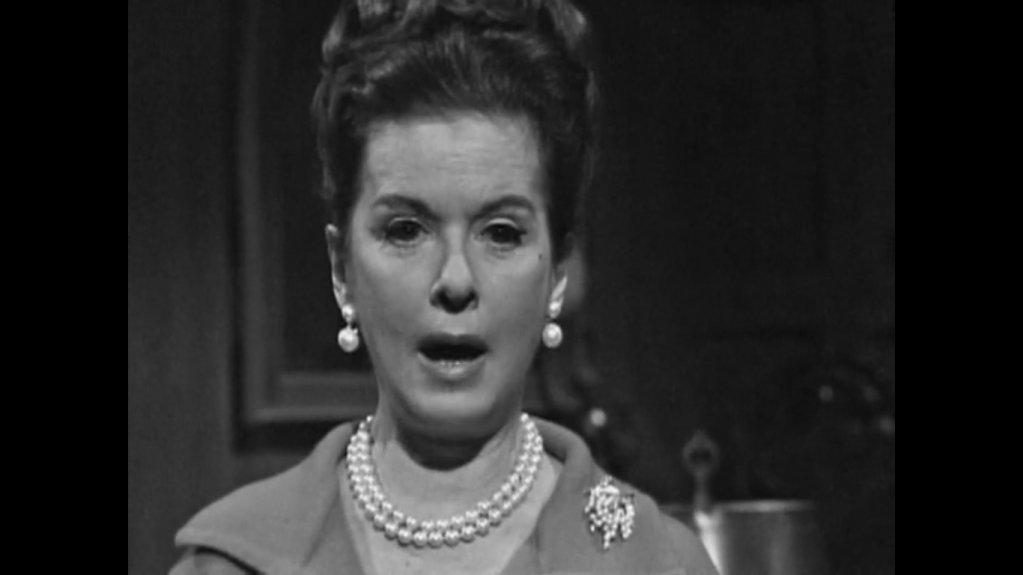
Word is making its way around the town of Collinsport that the Coast Guard has found the body of Bill Malloy, manager of the fishing fleet and cannery that between them employ most of the men in town and sustain the Collins family in their big dark house on the hill. In the opening, reclusive matriarch Liz is stumbling over her words trying to break the news of Bill’s death to her daughter Carolyn. The phone rings. Carolyn answers it, and gets the Coast Guard’s report. Liz is shattered.

Carolyn tells well-meaning governess Vicki that Bill’s body has been found. In episode 52, Carolyn had told Vicki that Bill was like a father to her. Carolyn, as played by Nancy Barrett, does indeed seem as upset in this scene as would someone who had just heard that her father’s body had washed up on shore. Vicki, as played by Alexandra Moltke Isles, is very calm and deliberate as she listens to Carolyn, letting her say what she has to say and emote as she needs to emote. It’s quite a well-turned bit of drama.

In the Blue Whale, Collinsport’s tavern, Liz’ ne’er-d-well brother Roger finds drunken artist Sam Evans, his co-conspirator in a long-ago crime. Sam tells Roger that the Coast Guard has found Bill’s body. Roger first takes a very lofty tone and announces that he will do whatever he must to ensure that Bill’s killer is brought to justice. After Sam asks him what he means by this, Roger coaches him on the lies the two of them should tell to ensure that neither of them is convicted of killing Bill.

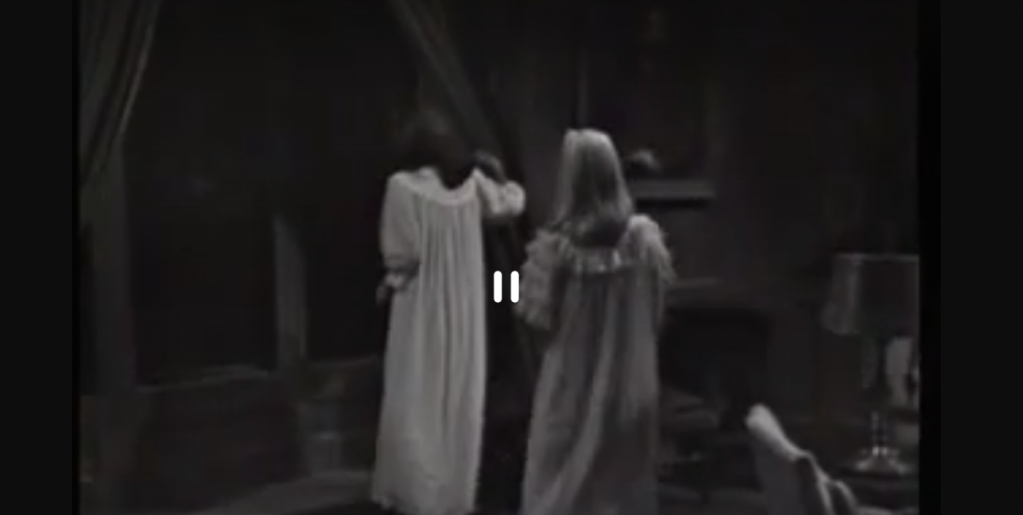
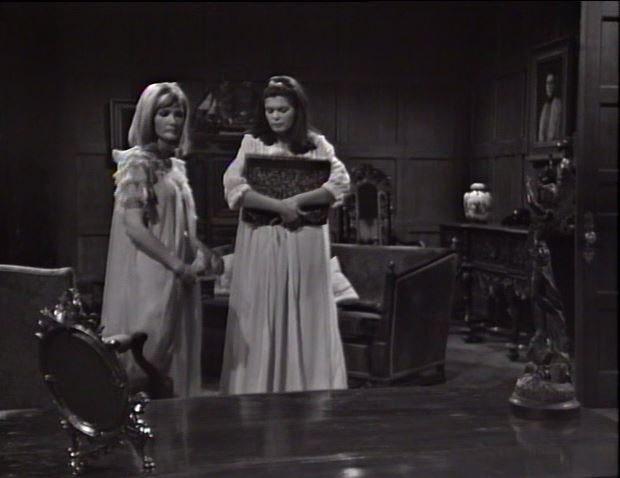
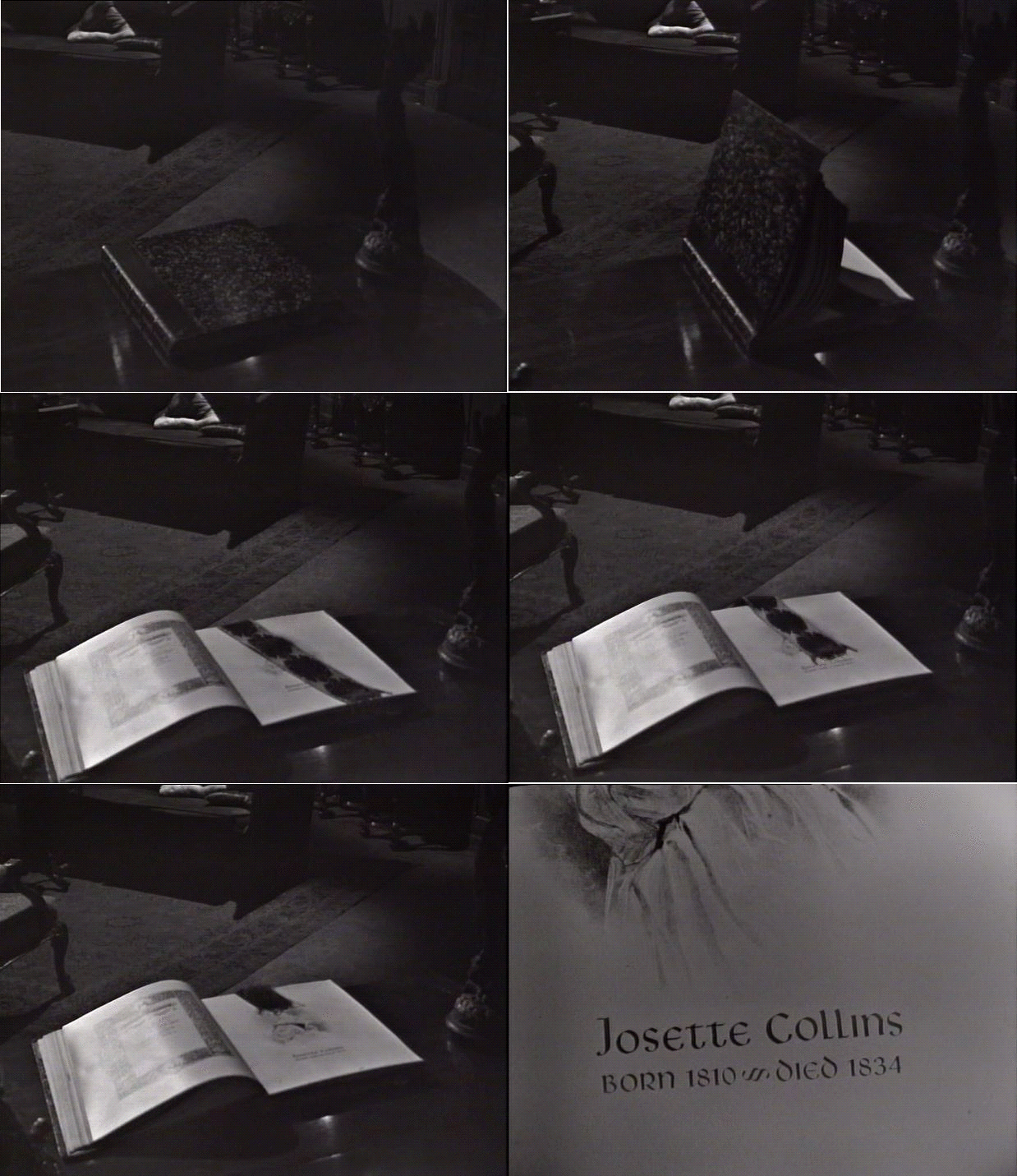
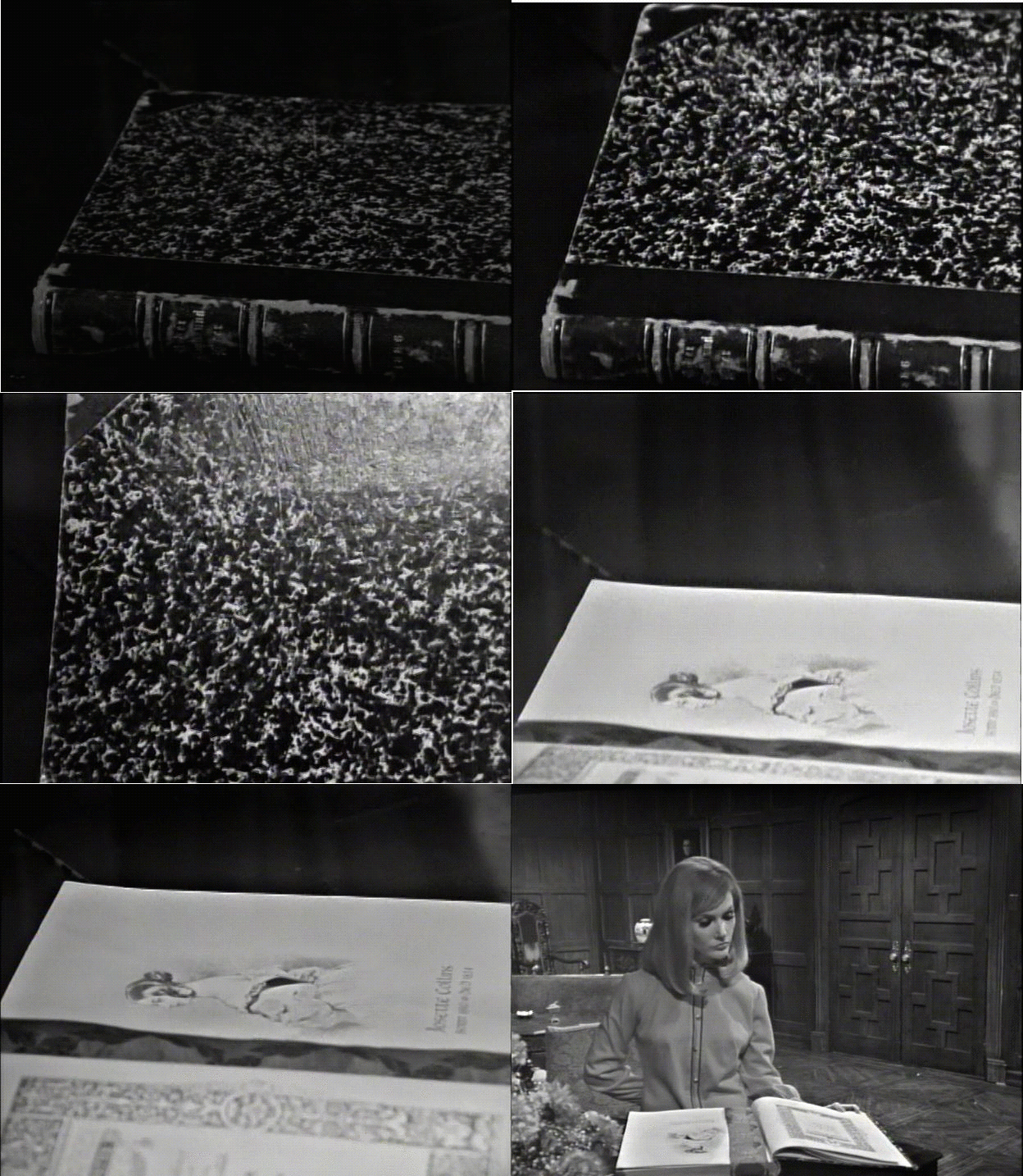
Back at the great house on the estate of Collinwood, we see the Collins family album open to the page with the picture and name of Josette Collins. The last time we saw this was in episode 52, when the book opened to that page without the aid of any visible hands. Now we see that Carolyn is opening the book. That is followed immediately by the drawing room doors opening. That too has been the prelude to a ghostly apparition, but this time turns out to be Vicki’s doing.

Screen capture by Dark Shadows from the Beginning

The first few weeks, several characters used the word “ghosts” in metaphorical senses when talking with Vicki. Each time, she behaved as if they were talking about literal ghosts and said something like “Surely you don’t believe in ghosts!” To which they said that they damn well did believe in them, and that if she goes on living in the house at Collinwood for any length of time she will, too. Reminding us of ghostly manifestations and then showing mortal agency behind them harks back to this kind of open question. Art Wallace, who was the only writer credited on the first 40 episodes, is the writer today as well. Evidently he wants to remind us of the supernatural themes and to keep us guessing where they will take us.

Episode 55: We are the only ones here, unless you include the ghosts of your past

Sheriff Patterson is at the mansion on the estate of Collinwood, talking with reclusive matriarch Liz and Liz’ ne’er-do-well brother Roger about the mysterious death of plant manager Bill Malloy. Liz listens as Roger answers the sheriff’s questions, seeming every bit the trusting sister. The minute the sheriff leaves, she turns to Roger and asks in an icy voice “How much of what you told him was the truth?” She confronts Roger with the differences between what he told the sheriff and what he’d told her. Roger is upset, and finally tells Liz she has to trust him. Liz looks sadly off into the distance and says that yes, she does have to do that.

Liz saying she has to believe Roger
“Yes, I do have to do that.”

I’m always interested to watch actors play characters who are themselves acting. When she’s concealing her doubts about Roger from the sheriff, Joan Bennett has her first chance to show us what sort of actress she thinks Liz would be. She’s a skillful one- she does have some subtle reactions to Roger’s evolving story when the sheriff isn’t looking at her, but her abrupt, contemptuous turn to Roger is the removal of a convincing enough mask that it shocks the audience. And her statement that she does have to believe Roger, coming after she has made it clear that she knows he has been lying to her and is likely to go on lying, is a performer’s resolution to go on playing a part, however unpromising that part may be.

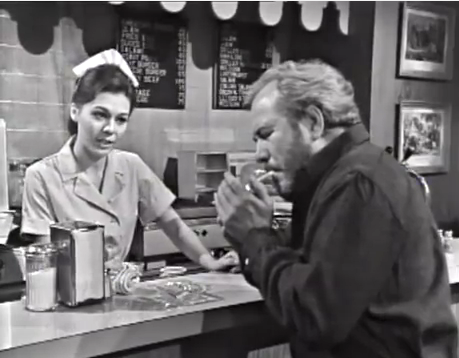
Intercut with the scenes at Collinwood are scenes in the restaurant at the Collinsport Inn. Waitress Maggie Evans is serving one customer, her father Sam Evans. Sam wants Maggie to return a sealed envelope he gave her some time ago. He won’t tell her what’s in the envelope, why he wants it back, or why he gave it to her in the first place. She won’t give it back to him without answers to at least some of those questions.

Maggie and Sam at the restaurant
Screenshot by Dark Shadows Before I Die

Francis Swann is the writer credited with today’s script, but the contrast between the scenes at Collinwood and those in the restaurant form a diptych of the sort Art Wallace specialized in. Sister Liz demands information which brother Roger won’t give; Roger is a fountain of lies and evasions, and finally tells Liz that her idea of family loyalty requires her to behave as if he were telling her the truth. Daughter Maggie demands information which father Sam won’t give; Sam mutters little lies, stonewalls, and begs her to forget about the whole thing.

The two family pairs are both unhappy, but in different ways. The Evanses aren’t having any fun, but you can imagine them reopening communication and re-establishing trust, if only Sam can get off the hook in this crisis. Liz and Roger don’t seem ever to have trusted each other, but they are so much fun to watch that you can see how they might choose to go on fighting these battles indefinitely.

No one has told Maggie or Sam or anyone else that Bill Malloy is dead. When Maggie wonders if Bill might be able to help Sam with whatever troubles he’s refusing to tell her about, Sam replies that yes, Bill might be the only one who can help him. Dashing action hero Burke Devlin telephones the restaurant to order delivery of a meal; he asks if Maggie has seen Bill. Maggie tells Sam that everyone has been asking about Bill.

The sheriff comes in to the restaurant. Roger had told him that he was with Sam and Burke the night Bill disappeared, and the sheriff mentioned then that he’d be talking to both of them. The sheriff reacts strongly when he sees Sam, and tries to strike up a friendly conversation with him. Before the sheriff can elicit much of a response, he gets a telephone call. He rushes out of the restaurant as soon as he’s hung up. On his way out, he casually mentions to the Evanses that it was the Coast Guard calling to say they’d found Bill Malloy’s corpse. They are shocked at the news.

The sheriff doesn’t seem to be watching Sam’s reaction to the news about Bill’s death. That’s odd- while viewers know that Roger is the show’s principal villain at this point, Sam seems to be an equally likely suspect in the case of Bill Malloy. Casually mentioning such a terrible piece of news would seem to be a tactic that a policeman might use to gauge a suspect’s emotional state. Unless it is a tactic of some kind, it would be a spectacularly unprofessional way of announcing to the people of a small town that a highly respected local man was dead. Up to that point the sheriff hadn’t been presented as a blundering fool, so I wonder what they were saying by having him do that.

Miscellaneous:

Marc Masse’s blog posts about the first 54 episodes of Dark Shadows include promotions for Kathryn Leigh Scott’s novel Dark Passages. His post for episode 55 is the first that doesn’t include one of those, and is also the first in which he refers to Miss Scott as “the actress who plays Maggie Evans.” As in “scenes like this emphasize the great and natural chemistry for the father-daughter relationship being portrayed as embodied by David Ford and the actress who plays Maggie Evans.” I wonder if Miss Scott was alienated by “The Dan and Lela Show,” the dialogues between executive producer Dan Curtis and director Lela Swift that he claims to have heard in the background of the episodes. Many Dark Shadows fans were indignant about these, and I’m sure they let Miss Scott know about their objections. Perhaps she pulled her ads from Masse’s blog, and he couldn’t bring himself to mention her name afterward.

While I’m reporting on blog posts, I should mention that the “Collinsport Historical Society” post for this episode is hilarious. Here’s a quote:

Sam Evans is starting to regret writing his Get Into Jail Card that confesses his role in Devlin’s railroading. He tries to get Maggie to return it to him, but she’s not stupid. Maggie is probably a better avatar for the show’s audience than Victoria, and if there’s anything we like more than a mystery, it’s learning the solution to said mystery. While there’s genuine concern for her father’s latest alcohol, caffeine and tobacco binge, she suspects she’s in possession of the final few pages in the mystery novel the whole town is talking about. And she’s running out of reasons not to take a peek and see how things end.

Sam is doing his usual “I’m not looking suspicious by trying not to look suspicious, am I?” thing at the restaurant when Patterson arrives. There’s something of a performer in Sam, who brings his sketchiest A-game when he sees the sheriff, and gets twitchier than Peter Lorre with a pocket full of letters of transit. Luckily for him, the sheriff has other things on his mind. The Coast Guard has found Bill Malloy. Dead.

I’m beginning to lose track of how often we’ve been given the news that Malloy is dead.

Episode 54: A proper charge

At the end of yesterday’s episode, dour caretaker Matthew admitted to reclusive matriarch Liz that he had found a drowned man on the beach, that the man was missing plant manager Bill Malloy, and that he had pushed the body out to sea and watched it float away. Liz then called the sheriff.

As today’s episode opens, Liz’ ne-er-do-well brother Roger doesn’t know about Matthew’s confession. We see him in his office, countermanding orders Bill Malloy had given and acting like he has Malloy’s job. On his blog Dark Shadows from the Beginning, Marc Masse interprets this as an indication of guilty knowledge on Roger’s part:

Roger has evidently just implemented a new system that has effectively replaced Bill Malloy’s previous methods for operations at the plant. This indicates that Roger knows for certain that Malloy will not be returning as plant manager, which enshrouds him with an additional layer of suspicion given how as of the close of episode 53 only two people knew for certain that Bill Malloy was in fact dead: Matthew Morgan and Elizabeth Stoddard, and as of today’s episode the sheriff. Roger will be informed of Malloy’s demise later on that day when his sister calls him away from the office to have him return to Collinwood, and Roger will feign surprise upon hearing the news, but it’s evident from his phone conversation above that he was somehow already aware of Malloy’s fate.

That’s a possible interpretation, and I certainly thought of it the first time I saw the episode. On the other hand, Malloy has been missing for more than a day, and was last seen drinking in a bar. So even if he were to walk in the door in prime physical condition at this very moment, he would be in a poor position to defend himself in workplace politics. Roger could easily claim that he was simply moving to fill a vacuum. The show is keeping Roger viable as a suspect, but is not committing itself to the idea that he is the guilty party.

Whatever Roger knows about the situation, dashing action hero Burke knows less. But Burke seems to think of himself as very knowledgeable. He storms into Roger’s office and confronts him with the fact that Malloy was trying to prove that Roger, not Burke, was responsible for the killing that sent Burke to prison years before. Burke makes many accusations against Roger, some of which the audience knows to be true, but none of which he is yet in a position to prove.

The scenes in Roger’s office are intercut with scenes in the drawing room in the mansion at Collinwood. There, the sheriff is talking with Liz and Matthew about Matthew’s confession. Matthew asks the sheriff if he will be arrested now. To which the sheriff replies, “I can’t think of a proper charge.” He jokes about “burial without a license,” then goes on to warn Matthew that he has laid himself open to suspicion.

This is a moment when you can tell you’re watching a show made in 1966. Seven years later, coverage of investigations into the Watergate affair would give the American public an intensive eighteen-month tutorial in criminal law concerning obstruction of justice and related offenses. Ever since that time, residents of the USA have known that you are risking jail any time you make things difficult for the police. Prior to that, however, this was not well-known even among lawyers who practiced in areas other than criminal law.

Watergate itself illustrated this. Several of the major figures in that matter were lawyers, and many of them, including Richard Nixon himself, genuinely did not know that it was an offense for a person who had not been involved in a crime to cover that crime up. You can hear Nixon on the White House tapes telling his legal aide John Dean that because Dean didn’t know about the Watergate burglary in advance, the things Dean had done to hinder the investigation of the burglary can’t possibly put him in danger of prosecution. In his memoirs, Dean admits his own ignorance of the relevant law, confessing that he first read the federal statutes on obstruction of justice not when he was in law school, not when he was studying for the bar, not when he was a staffer for a commission tasked with rewriting the federal criminal code, but in his office at the White House, after he’d been running the Watergate cover-up for nine months. He reports in that same book that several other White House staffers who were lawyers shared his ignorance. Many of them would go on to confirm this aspect of his account.

In light of the legal education that Watergate provided the people of the USA, the sheriff sounds like an idiot. That same education ruined other old shows. Perry Mason, for example- ridiculous as it is that every episode ends with the guilty party jumping up in court and shouting “I did it!,” if you’re into the story you feel enough poetic justice in those endings that they don’t really bother you. But Mason himself can hardly make it through five minutes without committing every crime with which Haldeman, Ehrlichman, Mitchell, and Dean would be charged and a few more besides. Perry Mason broadcast its final episode in May of 1966, so that show, not the Watergate news, was the law school the original audience had attended.

Miscellaneous:

The episode opens with footage of Louis Edmonds walking around outdoors on a waterfront. They play some nice sound effects of sea-birds over it.

The sheriff we see in this episode is Sheriff Patterson, the first of that name. He is played by Dana Elcar, a fine actor who would be ubiquitous on American television and cinema screens in the 1980s. If we’re heading into a major story arc dominated by a mystery story, it’s a relief to know that the policeman role will be in such trustworthy hands. The part will be re-cast many times in the years to come, and never again as well. Then again, none of the subsequent Sheriffs Patterson will be as important as is this first.

Since there is a good deal of overlap between fans of Star Trek and fans of Dark Shadows, I might mention that this was the episode that aired on the day Star Trek premiered.

There was a great deal of Anglophilia involved in the making of Dark Shadows: the mid-Atlantic accents, the plots lifted from English literature, etc. So it may not be a coincidence that a dark-haired, small-chinned matriarch named Elizabeth presides over the family at the center of it. Indeed, Joan Bennett looked enough like the northern European royals that when they wanted to cast an actress who resembled her closely enough to set the audience wondering how their characters were related, they settled on the daughter of a Danish count. So I might also mention that I am writing this on the day Britain’s Elizabeth II died.

There are two big flubs. At one point when they’re about to cut from the drawing room back to the office, we hear a loud noise and some garbled voices in the background. My wife, Mrs Acilius, wondered if this was Josette Collins trying to make herself heard.

At the very end of the episode, as announcer Bob Lloyd is intoning “Dark Shadows is a Dan Curtis production,” a figure walks in front of the camera. You can just see the top of his head. The Dark Shadows wiki refers to the figure as “a crew member.” Marc Masse says it’s probably Mitch Ryan. John and Christine Scoleri speculate on their blog Dark Shadows Before I Die that it might be Dan Curtis himself. To me it looks like more the hairdo Thayer David is wearing as Matthew Morgan than like either Ryan’s hairdo as Burke or Dan Curtis’ hair- there seems to be some grey in it, and it looks to be more matted than either wavy or curly.

Episode 52: The very atmosphere

We intercut between two contrasting scenes: in the mansion at Collinwood, Vicki the governess and Carolyn the heiress pour their hearts out to each other, while in the Evans cottage drunken artist Sam refuses to answer any of the questions his adult daughter Maggie puts to him.

The disappearance of doughty plant manager Bill Malloy looms over both conversations. Vicki and Carolyn can’t avoid the conclusion that the body they saw face-down on the beach at the end of Friday’s episode was Malloy’s. Sam tells Maggie that the reason he can’t sleep is that he’s worried about Malloy.

The two settings connect when Sam telephones Collinwood in hopes the dastardly Roger will answer. The call prompts Vicki and Carolyn to break up their slumber party in Vicki’s room and come to the telephone outside the drawing room.

Vicki answers the telephone. Sam says “Collins,” Vicki asks to whom she is speaking, he hangs up. They then hear a noise from inside the drawing room. They go in and search to see if anyone is hiding there. Vicki goes directly to the window and pays special attention to the area behind the curtain on her right, a spot that will become a frequent hiding place much later in the series. I suppose it makes sense that people would eventually start hiding there- the camera has a great angle on it. Smart of Vicki to know that’s the first place to look.

Vicki knows where to look

The girls find a book open on the floor. Vicki demonstrates that the noise they heard was the sound of the book falling, but she cannot explain how it moved several feet from the table where it was kept to the spot where she and Carolyn found it. Carolyn insists that they consider the possibility that a ghost put it there. Since they had heard the same sound at least once while they were still in Vicki’s room, it would make sense to consider that someone or something must have been involved in picking it up and dropping it again.

Vicki holds the book several feet from the table
Screenshot by Dark Shadows from the Beginning

Vicki and Carolyn leave the drawing room, and we see the book reopen itself to the same page. The camera zooms in, and we see that the page bears the name and likeness of Josette Collins. This is the first supernatural manifestation that the audience sees when no character is looking. We’ve been hearing about the ghost of Josette Collins from week one; we have to assume that she is leaving us her carte de visite.

The book opens by itself
Screen capture by Dark Shadows from the Beginning

Each of the previous supernatural manifestations had marked a moment when off-screen events were stirring up the spirits that inhabit the back-world behind the universe the characters inhabit. When troubled rich boy David had tampered with the brakes on his father Roger’s car in an attempt at patricide, reclusive matriarch Liz was asleep and ghosts were trying to reach her in her dreams. That same night, Vicki saw a door open and close itself inexplicably, and saw a shrouded figure on the threshold of the drawing room. At the beginning of this episode, Carolyn admitted to Vicki that while Collinwood has always been a strange place, it was only when she and Burke came to town that the really weird stuff started happening. So we have to take it that Vicki’s presence in the house is itself a matter of concern to Josette and the other ghosts, and that what is happening off-screen in connection with the body on the beach and the secrets Sam refuses to share with Maggie are going to bring the phantoms out of the back-world into the foreground.

It’s also interesting that the first character we see after the ghost of Josette announces herself is Maggie. At this point and for some months to come, the show will be developing a connection between Vicki and the ghost of Josette. But later on, both Maggie the character and Kathryn Leigh Scott the actress will be very much involved with Josette. The series involved very little advance planning, nothing at all like daytime serials of the present day that have their stories sketched out in detail months in advance, so that is probably just something you’d expect to happen when you only have four actors in the studio. Still it’s an eldritch moment for repeat viewers.

Within the context of the show as it actually was at this period, I think there is a point to the juxtaposition of the ghost of Josette with the scene between Maggie and Sam in the Evans cottage. Vicki and Carolyn are girls at a slumber party scaring each other with ghost stories. Even when the slumber party takes place in a mansion on a great estate belonging to the family that gave the town its name, that’s a silly situation. When the ghost stories turn out to be true, though, you’re suddenly vaulted into an elevated realm of fantasy. Turn to a small house where the adult child of an alcoholic is wearing her late mother’s night-gown and trying fruitlessly to prise some useful information out of her drunken parent, and you land back in the real world with a thud. Nothing here seems to be either silly or fantastic. Sam’s association with Roger’s secret, and therefore with the unknown events that are roiling the supernatural world, suggests that the mundane struggles of the Evanses and the fantastic doings at Collinwood will sooner or later collapse into each other.

I should mention Marc Masse’s post about this episode on his always intriguing, usually inaccessible blog Dark Shadows from the Beginning. Masse meticulously demonstrates the influence of the 1944 film The Uninvited on the show in general and this episode in particular with close analysis and multiple screenshots, and then does the same thing with an episode of Alfred Hitchcock Presents called “The Gentleman from America.” It’s a very impressive and thoroughly convincing work of scholarship.

Masse’s blog is infamous among many Dark Shadows fans because of what he presents as transcripts of conversations between director Lela Swift, executive producer Dan Curtis, and others that he claims were picked up by the control room microphone and that he has recovered by some more or less magical technique unknown to other audio technicians. In this one he includes such a “transcript,” in which Swift (who didn’t direct this episode, but is supposed to be in the control room anyway) tells Curtis that she thinks it’s a terrible idea to do a ghost story or a Hitchcock story on daytime TV.

That installment of “The Dan and Lela Show” is pretty tedious to read, but in a way it’s a relief. In previous posts Masse has presented Swift as maniacally driven by lust for the female cast members, a presentation that her husband and their children might have found surprising. His post for episode 48 brings that presentation to a sort of crescendo. Since this one includes two shots of Vicki and Carolyn in bed together, I braced myself for Masse to outdo himself in that line, but there isn’t a bit of it there.

Episode 45: Where Burke Devlin’s pen is

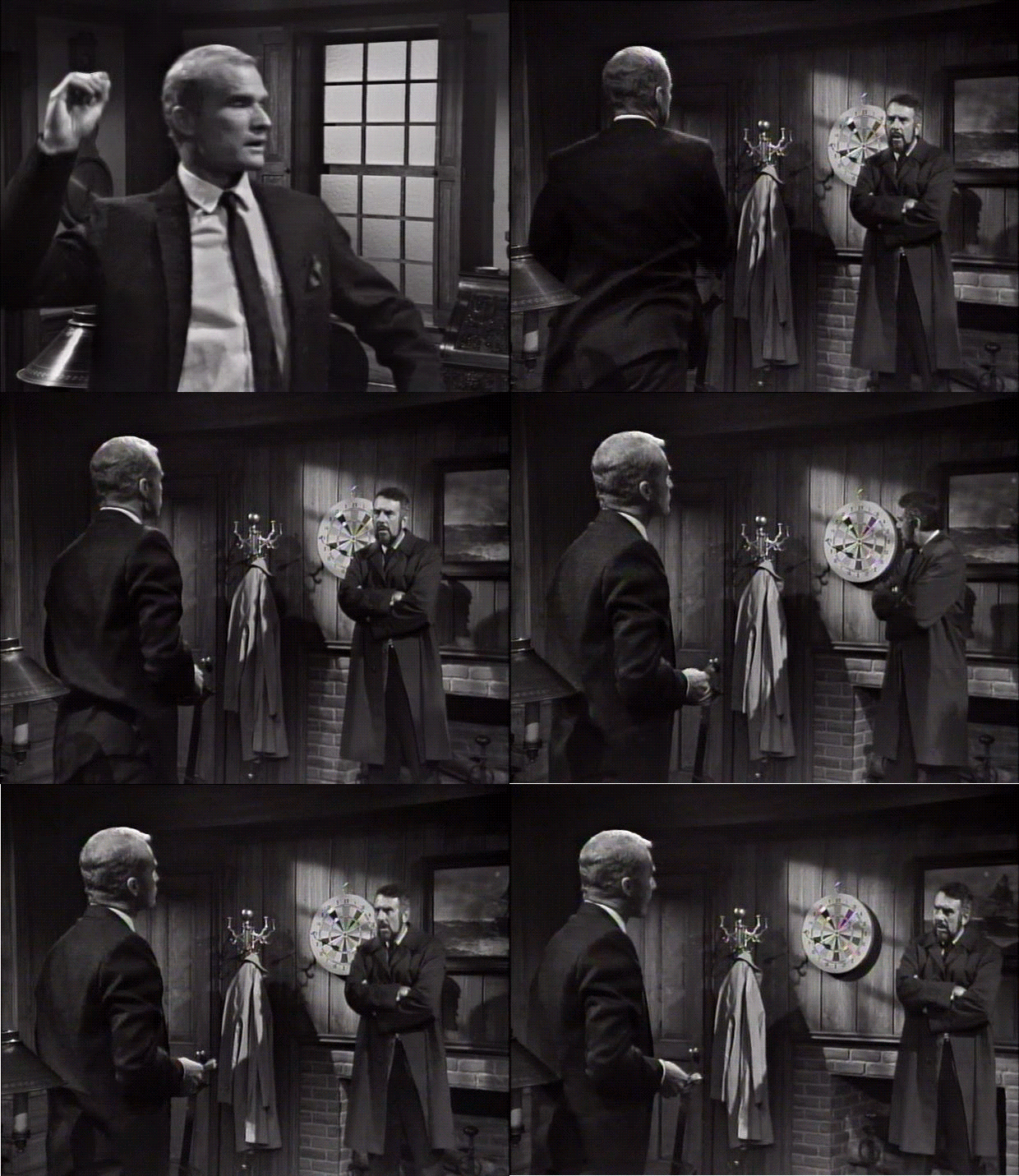
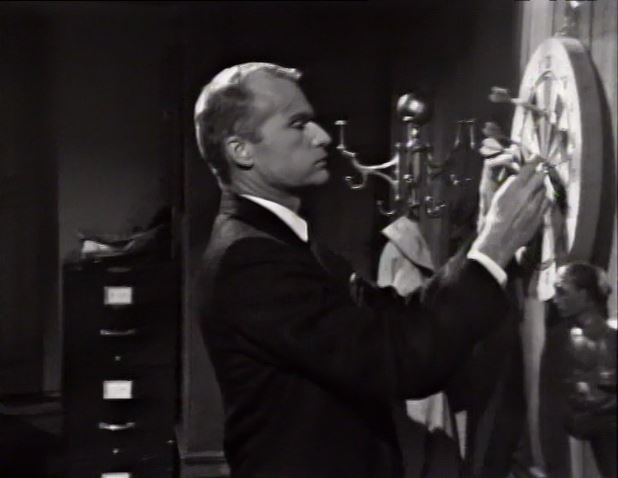
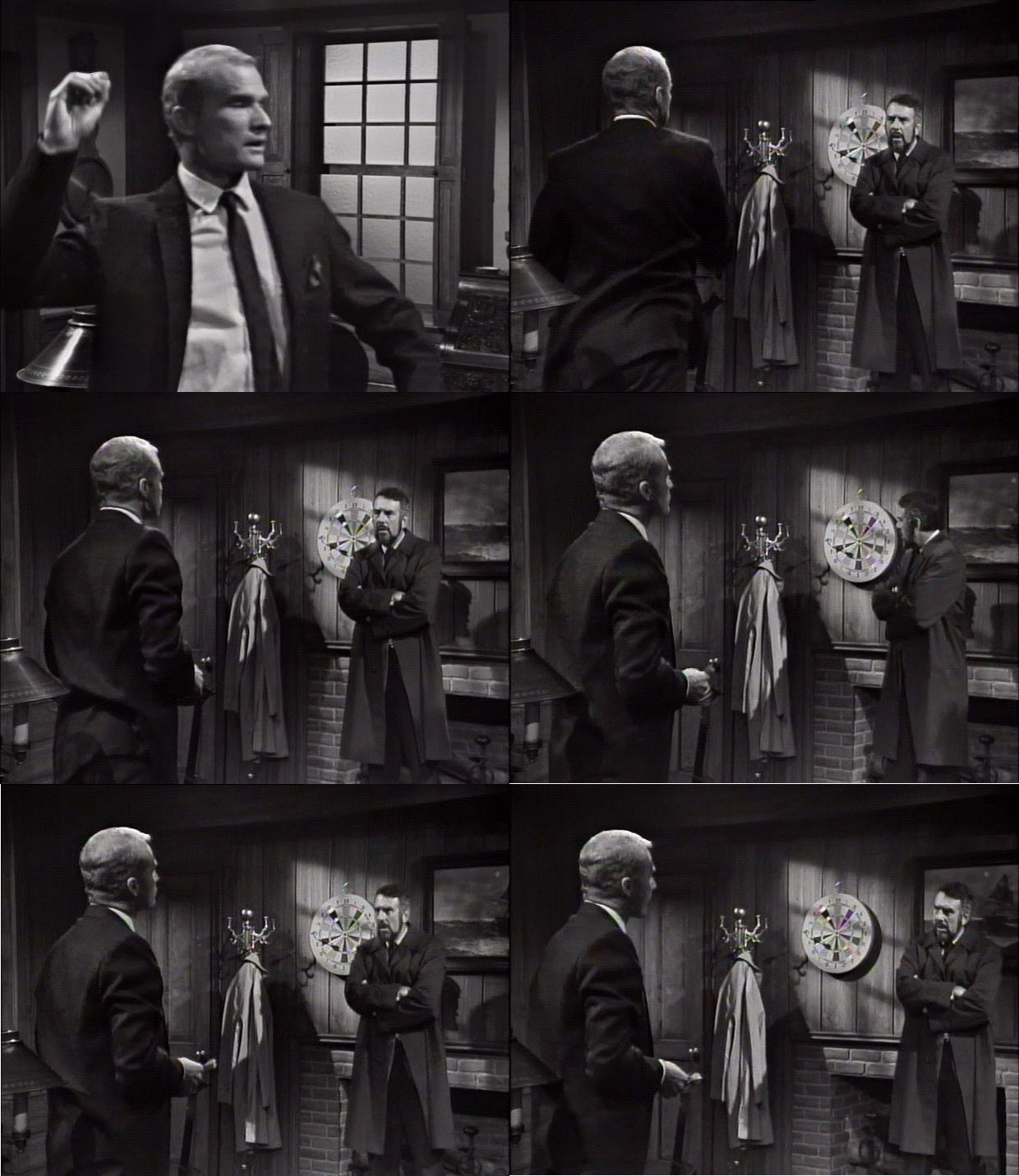
Roger is trying to keep his hands busy today. Our first look at his office focuses on his dart board, and he spends a great deal of time handling the darts.

Roger pulling the darts out of the dartboard on the wall in his office
Screenshot by Dark Shadows from the Beginning

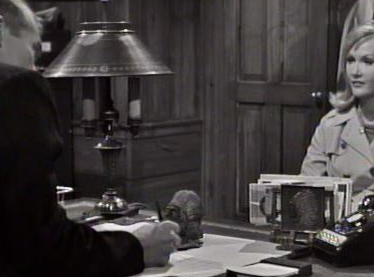
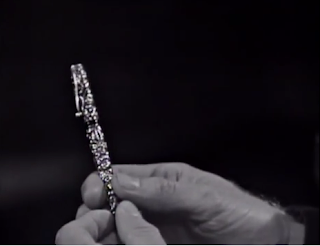
Carolyn stops in the office. Roger hugs her, calls her “Kitten,” and doodles with his pen while he and his niece flirt pretty daringly.

Roger and Carolyn flirting with each other while Roger plays with his pen
Screenshot by Dark Shadows from the Beginning

Bill, whom we just saw in the Blue Whale giving Burke a stern talking-to, comes to Roger’s office to continue his stern talking-to concert tour. He drives Carolyn away. Roger stops handling the pen playfully and handles the darts menacingly.

Roger throws a dart in Bill's direction
Screen capture by Dark Shadows from the Beginning

Later, Roger sees Carolyn at home. He finds out she had lunch with Burke and that Burke gave her his pen. He explodes at this and demands that she give up the pen. After a phone call from Bill (stern talking-to #3) and a commercial break, Roger simmers down. He apologizes and calls Carolyn “Kitten” again. She admits that she’s probably just hanging around Burke out of curiosity. She also tells Roger about the evidence that Burke is trying to put the family out of business. Roger takes this news calmly- after all, the Collinses’ cannery, fishing fleet, and other financial interests can hardly compare to the significance of who gets to touch Burke’s pen.

Roger's hands fondling Burke's pen
Screenshot by Dark Shadows Before I Die

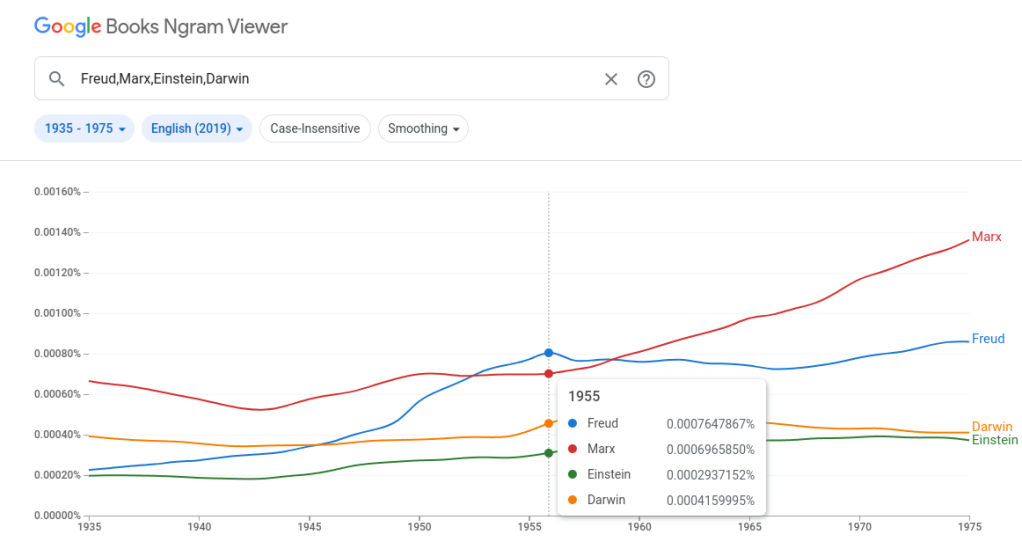
Roger’s obsession with where Burke Devlin’s pen is will become the show’s obsession for a couple of months. Anyone unsure whether there is some symbolic significance to this might have a look at the books, plays, and movies the makers of Dark Shadows and other intellectually ambitious New Yorkers were likely to be paying attention to in the summer of 1966. Maybe we can learn something about the ideas that were in the air if we look up the some famous thinkers on Google NGrams:

Google Ngram tracing the relative prominence of the names Marx, Freud, Darwin, and Einstein in English language books from 1935 to 1975

Looks like Marx was a biggie in those days- maybe Roger’s obsession with where Burke’s pen is illustrates the Marxist concept of commodity fetishism. That might also explain Roger’s relative disregard for the family’s capital holdings- he’s so caught up in the fantasy of value as something inherent in a physical object that he has lost sight of the actual source of his wealth.

Darwin was on people’s minds as well. Perhaps Roger’s fixation on Burke’s pen is the result of his genealogy- maybe the Collinses have been bred to their little niche for so many generations that they have emerged as a new species, one which does not have the same survival strategies as other humans and so does not share values and concepts which we would understand.

And there’s Einstein, also a popular preoccupation among people who aspired to advanced learning back then. One of Einstein’s most famous ideas was that time passes at different rates for different observers depending on how fast those observers are moving through space. There will be twenty or more episodes of Dark Shadows that focus largely or entirely on the question of where Burke’s pen is, and as we move through that narrative space there will be many occasions when it seems that time itself is about to grind to a halt. Could be that, I guess!

That leaves Freud. Hmm, looks like Dark Shadows was written and acted chiefly by people from Broadway, and that Freudianism was a major inspiration on Broadway in the 1950s, 60s, and 70s. I suppose we’ll have to figure out what Freud would have made of a fascination with where Burke’s pen is. Then maybe we’ll have some idea what’s really going on with Roger.

Episode 42: The anticipation of doing it

In these early months of the show, the Collinses are in danger of running out of money and losing their position. In yesterday’s episode, we learned that Roger blew his half of the inheritance and Liz drew heavily on hers to keep the business in the family; in this one, we learn that the house is a moldering ruin and the rest of the family’s assets are leveraged to the hilt. Burke plans to take his revenge in part by buying up their debts and making himself their master, which it appears he is in a position to do.

Burke and his investigator are at a table in a restaurant in Bangor when they discuss these matters. Carolyn has followed Burke to the restaurant. Burke spots her, invites her to his table, and sends the investigator away. Burke flirts with Carolyn as he makes sure she didn’t overhear any important information. He makes a show of his elaborately filigreed pen. When she admires it, he makes a gift of it to her.

The last time Carolyn made her way to Burke’s luncheon table, she played with her ring, called his attention to it, and left it behind as a deliberate stratagem to prompt him to call her. She seemed altogether unconcerned with the fact that the ring was a gift from Burke’s sworn enemy, her Uncle Roger, even after Burke indicated that he found it significant; and went ahead to keep an appointment to get the ring back from Burke even after Burke had given it to Roger and Roger had returned it to her. This strange obliviousness in all things having to do with Roger recalls the equally strange blitheness with which Carolyn told Vicki about her crush on her Uncle Roger when they first met “he sends me, he really does!”)

This time the object that passes from one to the other is another distinctive bit of metal associated with some important relationships. Burke tells Carolyn how few pens there are like it in the world, that he had them made to distinguish their bearers as key people in his life. When he makes the pen a gift to Carolyn, he implies that what he is giving her is not just a thing, but a new connection between them.

I made some remarks about these scenes in a comment on John and Christine Scoleri’s Dark Shadows Before I Die:

Carolyn comes to Burke’s table at one restaurant and leaves a special ring with him; she comes to his table at another restaurant and he gives a special pen to her. Even if the mid-60s weren’t the Age of Freud among intellectually ambitious people in the USA, the flirty tone of the two encounters would make it difficult not to see these tokens as body part symbols.

…As for the pen, it is going to become a more and more unmistakable phallic symbol over the next several weeks, leading us to wonder what the show is trying to tell us about the relationship between Burke and Roger and what was really going on between them before that accident ten years ago.

There’s also a scene between Sam and Liz. Yesterday’s episode ended with a big cliffhanger when Liz opened the doors and saw Sam waiting outside, suggesting that he is going to unburden himself of the secret he and Roger share. In true soap opera fashion, once the cliffhanger has brought the audience back to watch the next episode it has served its purpose. It is then to be got out of the way as quickly and anticlimactically as possible.

Today’s anticlimax sheds an unexpected light on Sam’s position. Sam’s extreme reluctance to tell his secret grew out of his assumption that whenever and wherever he started talking, he would find a hyper-attentive audience who would listen to his his every word and lose no time putting them into far-reaching and disastrous action. What he actually meets in Liz is personal dislike for him and impatience with anything he might want to say. Once Sam starts to talk about Roger, she assumes he has come to blackmail her with some sordid information about her no-good brother, and she makes it clear she will not be having it. Joe comes to the house, Liz mentions Bill, and Sam crumbles, his secret untold and unwanted. If the audience is expecting Sam to murdered, this result will add an extra touch of bathos to his plight- a man carrying a secret that spells his doom, but that does not attract the attention of a suitable listener.

Ray Stewart, later to gain a place in history as part of the gay couple on Barney Miller, appears in this episode as a featured extra. He’s the head-waiter in the restaurant in Bangor. Both the Dark Shadows wiki and his imdb page list his role as “Customer,” but here you see him telling the server which table to go to first:

Screenshot by Dark Shadows from the Beginning

And here you see him greeting Carolyn when she arrives at the restaurant:

Screenshot by Dark Shadows from the Beginning

Ray Stewart is still alive, maybe he should complain about his role being mislabeled. In all seriousness, I’d like to see him and other onetime background players on one of those panel discussions they used to have at Dark Shadows cons and now have on Zoom. I’d like to know what it was like being an extra on the show. And of course some of them went on to become big names.

Episode 37: Fatigue lines

Roger’s mounting anxiety about what Burke may learn from Sam leads him to alternate in each scene between yelling and begging. Depicting this, Louis Edmonds’ chews the scenery so hard that he momentarily loses track of Roger’s mid-Atlantic accent and slips into his native Louisiana drawl, yelling at Vicki “Jes supposin’ you a-tell me how long you wah standin’ in that doah-way?” Perhaps this is Marc Masse’s “David Ford Effect”– Ford came to the show from a long engagement as Big Daddy in Cat on a Hot Tin Roof, maybe they’ve decided to transport Collinsport from Maine to the Mississippi Delta.

At the Evans cottage, Sam gives Maggie a sealed envelope to be opened in event of his death. Maggie is bewildered and upset. Surmising that her father’s trouble is to do with Collinwood, she wishes that the mansion would burn to the ground. Sam waxes philosophical, opining that “Ghosts of the past don’t live inside a home. They live inside each man. They fight for his soul.. twist it into something unrecognizable.”

Moments later we find out that Sam is wrong, ghosts totally live inside a home. In the middle of the night, Vicki is awakened by the same strange sobbing she had heard in episode 4. She follows it to the basement. Last time she was in the basement, in episode 6, Matthew found her there and spoke sharply to her. Now Roger finds her there and yells at her. As she had stood up to Roger in the drawing room earlier, so she stands up to him now. After their showdown, he even admits that he has heard the sobbing woman many times, and says that she may be “one of our ghosts.”

I divide the series into several periods, the first of which I call “Meet Vicki.” The major story-lines of the Meet Vicki period are all in a down-cycle during this episode. Roger’s panic and Sam’s melancholy are part of the Revenge of Burke Devlin story, but Roger’s activities today do nothing to advance that story, and Sam’s letter will become one of the most tedious MacGuffins in a series that is notorious for forcing the audience to sit through overlong contemplation of its MacGuffins. Roger’s angry reaction to finding Vicki in the basement touches on the Mystery of the Locked Room, which is connected with the question of why Liz became a recluse. Those stories haven’t advanced for weeks. The sobbing woman revives the question of whether the house is haunted. While Roger’s admission that he has heard the sobbing marks the first time one character knows what another is talking about concerning the ghostly happenings, it does not prompt any further action. The question of Vicki’s origins is at a stalemate, the romance between Carolyn and Joe is dead in the water, and David is so alienated right now that they can’t do much with Vicki’s attempts to befriend him.

So the Meet Vicki period has reached a dead end. Tomorrow we’re going to meet someone else, and a new period is going to begin.

Episode 36: Politeness is a passing phase

The actors all go big in this one. Marc Masse calls it “The David Ford Effect” and concentrates on Louis Edmonds’ thunderous performance in Roger’s confrontation with Liz, but since the entire cast has turned up the volume, I think it is more likely a response to direction coming from the people who hired David Ford (and, to be seen in a couple of days, Thayer David) than to David Ford himself.

Masse isn’t the only commentator who tends to ignore the directors and producers as influences on the acting. Perhaps that tendency goes back to an interview John Karlen gave in which he says that he doesn’t recall ever getting any direction at all on Dark Shadows. His first day, Lela Swift said “Go!” and that was it, he just did whatever he wanted for the next four years. On the other hand, Joel Crothers said that he left the show because the directors were so busy with special effects they no longer had any time to work with actors, implying that they had worked with them at one point. Since Crothers was there from the beginning and Karlen joined the cast ten months in, I can only assume that it was during these first months that the directors told the actors what they wanted.

Why would Lela Swift and the other masterminds behind the scenes start hiring actors like David Ford and Thayer David and tell the existing cast members to start hamming it up at this point? Well, the saga of the bleeder valve has wrapped up, and there is no other story going on that wasn’t there in episode 1. Some of those stories are starting to look pretty pointless. There’s “The Revenge of Burke Devlin”- they haven’t told us what exactly he wants revenge for, but if he ever takes it we will see either the death of Roger, which would have the disastrous effect of requiring Louis Edmonds to leave the show, or Burke taking control of the Collins family assets, which will bring the equally disastrous requirements of a showing a bunch of episodes about various forms of debt and building a new set for Joan Bennett to play her scenes on. So we’re starting to suspect that Burke will just keep going in circles. Roger’s angry scene with Sam in this episode is fun to watch because Edmonds and Ford play well off each other, but as part of The Revenge of Burke Devlin story it doesn’t take us to any new ground.

There’s “Vicki Seeks Her Origin.” We might expect that one to lead somewhere, eventually, but if that happens it won’t be for a good while. In this one, Vicki tells Liz that she’s decided she can’t help David and replies to Liz’ plea with her to stay with “Why am I so important?” She doesn’t renew her inquiries into how Liz knew about her and why she hired her. Of course not- that was getting tedious. So Alexandra Moltke Isles and Joan Bennett just emote furiously while exchanging lines that don’t add up to much.

We don’t see Carolyn or Joe in this one, but their romance is another dead end. Joe is a nice guy who wants to get married, Carolyn is a rich girl who doesn’t. There aren’t that many ways to make a story out of that.

The one story that works in the first 42 weeks is the growing friendship between Vicki and David. Right now there isn’t much to do with that one, either. David has just been caught trying to murder his father- he isn’t going to be particularly reachable. Today, he openly threatens Vicki at the beginning of the episode, then comes out of hiding after Liz persuades her to stay and declares that he doesn’t want her to stay. We have to see them at rock bottom today for the gradual rise in the months ahead to grip us the way they will, but not a lot happens while you’re at rock bottom.

So, maybe the producers and directors decided to dial the acting up to 11 because they knew they didn’t have much of a story to tell. This is Art Wallace’s final week as the sole credited writer on the show; I don’t know how much help he had in those first eight weeks, how much involvement he really had in episodes attributed to him in the nine weeks after, and whether anyone is already around whose name will be printed on the screen in that period. But they don’t have a story to tell right now. So it falls to the cast to distract us while they wait for the next phase.

Episode 35: I got a million recipes how to cure it. None of ’em work.

David Ford joins the cast as Sam Evans, replacing the woeful Mark Allen. Ford was always one of my favorites. He was one of the reasons I started watching the show when it was on the Sci-Fi channel in the 90s- I remembered him from one of my favorite movies, the musical 1776, where he plays John Hancock.

Marc Masse made a point in his Dark Shadows from the Beginning that I hadn’t thought of before. I’d always thought of Thayer David as the founder of the Dark Shadows house style of acting (“Go back to your grave!”) That isn’t wrong, as we will see when Thayer David joins the cast next week. But David Ford made a much bigger contribution than I realized. Several members of the cast, especially Louis Edmonds and Nancy Barrett,* tend to play their roles in a big, stagy manner, but Ford represents a step beyond them.

Masse writes:

To this point Dark Shadows has been written, directed, and acted solely as a vehicle for television.

Here in episode 35, the style of acting on Dark Shadows takes a theatrical turn with the debut of David Ford, who, with one grand and sweeping wave of the arm and eloquent turn of phrase, will single-handedly transform the acting approach from that of a standard television show to that of a teleplay:

“A façade, my dear boy!”

David Ford_gesturing GIF_ep35

You have to wonder if that line was an ad lib; it fit in perfectly with the gesture, and thus far Art Wallace has never written with such a fanciful flourish.

Masse also gives some very interesting information about what Ford was doing when he landed the role of Sam Evans, information that points towards an approach to casting that will become a marked feature of the show in the years ahead:

In the year preceding Dark Shadows, Ford was performing on the Hartford Stage in a successful production of the Tennessee Williams play Cat on a Hot Tin Roof in the role of Big Daddy. That’s why when he first appears on Dark Shadows he has that half a beard type style, having fashioned his performance of Big Daddy after the one made famous in the 1958 motion picture adaptation, especially the way he scrunches up his eyes for the effect of dramatic intensity, giving it his best Burl Ives.

There is indeed a good deal of Burl Ives in today’s iteration of Sam, enough that we can assume that Ford was hired in part as a Burl Ives imitator. In future years, we’ll see Jonathan Frid, who looks like Bela Lugosi and walks and talks like Boris Karloff, playing a character who is a mashup of Lugosi’s Dracula and Karloff’s Imhotep.** And Jerry Lacy, who was most famous for his Humphrey Bogart imitation, and whose first role on the show was as a Bogart-inflected lawyer. And David Selby, who, if you listen to him with your eyes closed, you’d swear was Joseph Cotten. And Roger Davis, who Joan Bennett famously described as show business’ answer to the question “What would Henry Fonda be like if he had had no talent?” Ford is the first of that company of mimics, and among the best.

This is also the first episode where Carolyn and David have a scene together, rather odd considering we’ve had 34 episodes mostly set in the house where they are two of the five residents. Carolyn can’t stand the boy to start with, and in this one she’s just found out he tried to murder his father, her beloved uncle Roger. Besides, she’s in a bad mood because Joe called her up and told her he found Vicki in Burke’s hotel room. So they have a shoving match, she tells him he’s a monster, etc. Nancy Barrett and David Henesy ham these scenes up so grandly that it’s hard to imagine why they haven’t been on camera together before, it’s tremendous fun.

This is a bad episode for Alexandra Moltke Isles. Carolyn is nasty to Vicki about Burke, then apologizes and gets mad at herself, all while Vicki stands perfectly still with a smile plastered on her face. Vicki’s own lines are patronizing and inappropriate, starting with “Carolyn, you idiot” and going downhill from there. When Carolyn makes the painful admission that she has a tendency to grab for everything, Vicki delivers a smugly sanctimonious “That’s a good way to end up with nothing.” At the end of the episode, Vicki has a brief confrontation with David, which Mrs Isles plays well enough, but there isn’t much to it.

I think Mrs Isles’ technique was to start with the emotions the character was supposed to be feeling and to project those through whatever dialogue she is given. That’s served her well so far. Dark Shadows was her first professional acting job, and she fits right in with old pros like Joan Bennett and Broadway up-and-comers like Mitch Ryan. But she’s just awful in these scenes. My guess is that she couldn’t figure out what Vicki was feeling or thinking, since no one would do or say the things she does or says in today’s show, and so she just tried to stay out of Nancy Barrett’s way. Or maybe she read the script, thought Vicki was being an ass, and decided to play the character in the most asinine way possible. Either way, I winced to see it.

*Both natives of Louisiana. I doubt that means anything, but as the series goes on and gradually loses all interest in creating an illusion of being Down East someplace near Bar Harbor, I get more and more interested in the geographical origins of the actors. I’ll try to confine that topic to footnotes for the next three years, but when we hear David Selby’s voice we’re going to talk about the idea of a New England Brahmin with a West Virginia accent.

**Imhotep is the title character from The Mummy. Originally I was going to say that Frid moves and sounds “like Boris Karloff’s Mummy,” but that rather overstates the feminine side of his role.

Episode 33: The one with Harvey Keitel

At Collinwood, Liz tells Carolyn that David won’t be going away just because he tried to murder his father. “Things will go on just as before.” On the other hand, Carolyn should marry Joe and leave the house, because “You’re the only one of us who can have a sane, happy life.” I suppose we’ve all seen that in real life, someone swinging wildly between deep denial and exaggerated despair. Two forms of learned helplessness, I guess.

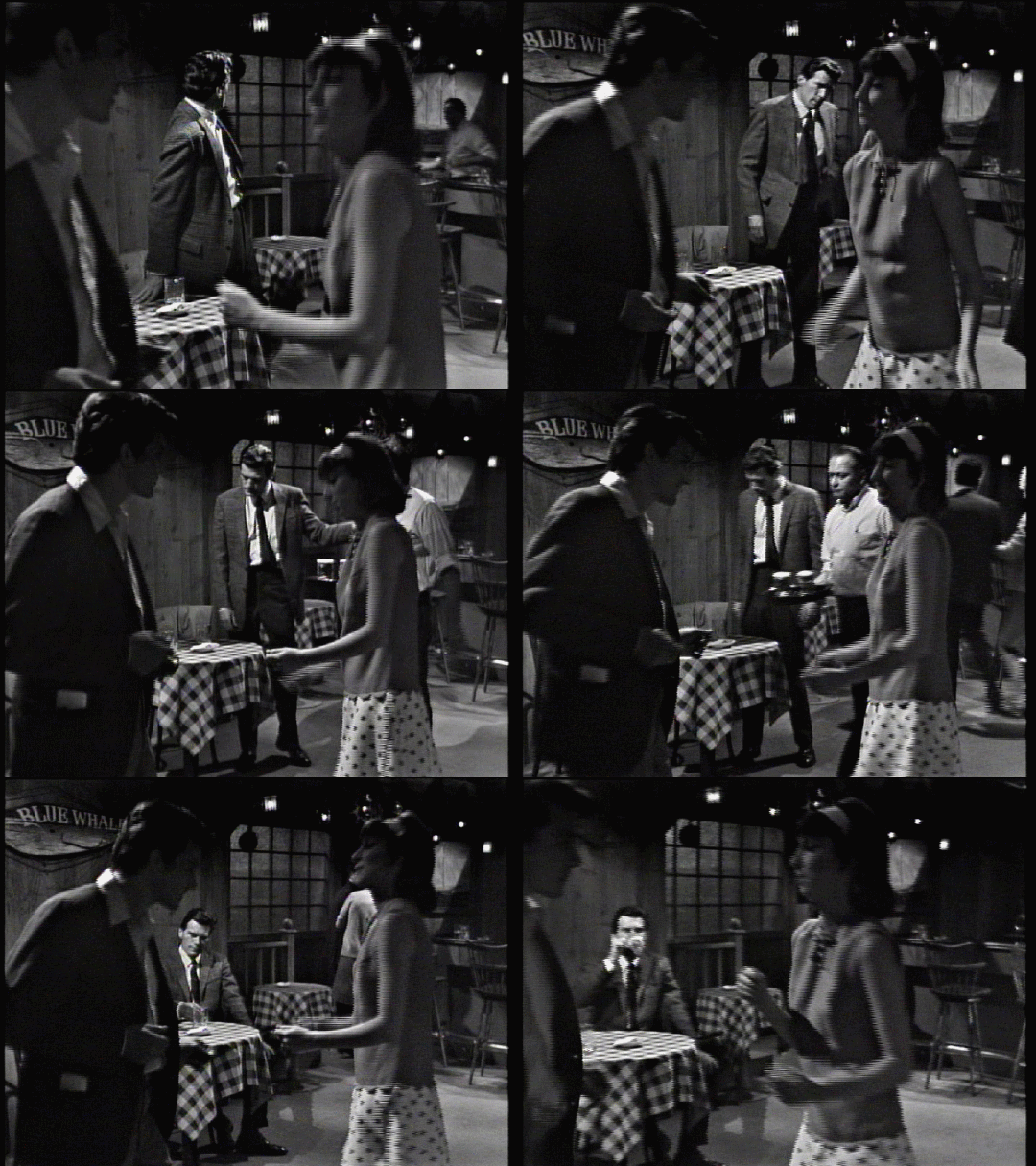
At the Blue Whale, Joe is getting well and truly sloshed. Burke joins him at his table, interrupting a conversation between Joe and his whiskey glass. Joe tells Burke that he doesn’t like him, expresses his frustration with Carolyn’s refusal to get married, then goes to Collinwood, roaring drunk, and tells Carolyn, Liz, and Vicki what he thinks of them.

One thing Joe thinks is that Carolyn is doomed to be a spinster. Considering that she’s supposed to be about seventeen, that does call to mind Barnabas’ line to Carolyn in the 2012 Dark Shadows movie, “Fifteen? And no husband?

Marc Masse brings this point out well on his Dark Shadows from the Beginning, and argues that the depiction of Carolyn may be one of the things that sunk the show with young viewers between the end of the first month and the introduction of the vampire:

You have to wonder what kind of impression the character of Carolyn Stoddard would have made to young viewers in 1966. Here she is having grown up in a mansion with forty rooms and her only option in life is to be married off before her eighteenth birthday to a local fisherman, or else face a life of lonely spinsterhood. In that respect, Dark Shadows seems to belong to the sensibilities of previous decades.

This paragraph is part of an in-depth discussion of Dark Shadows’ place on ABC’s schedule, its ratings, the show that preceded it in its time-slot, and Art Wallace’s rather antiquated view of the world. It’s all very informative, highly recommended.

When Joe passes out on the couch, Vicki goes to town. She goes to the Blue Whale, where Burke asks if she’s looking for someone. “I just found him,” she replies. Obviously, she’s talking about Harvey Keitel, who is dancing a few feet away from her.

That Harvey Keitel was once an extra on Dark Shadows is pretty interesting. If he took that job, clearly he would have taken a speaking part. I gave some thought to parts I wish he had taken in comments on Danny Horn’s Dark Shadows Every Day four times: here (on episode 470,) here (on episode 769,) here (on episode 1057,) and here (on episode 1137.)