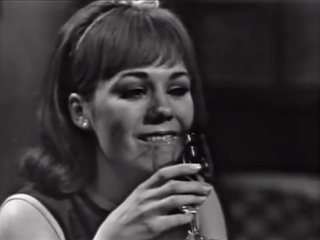
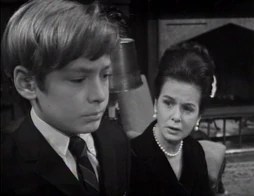
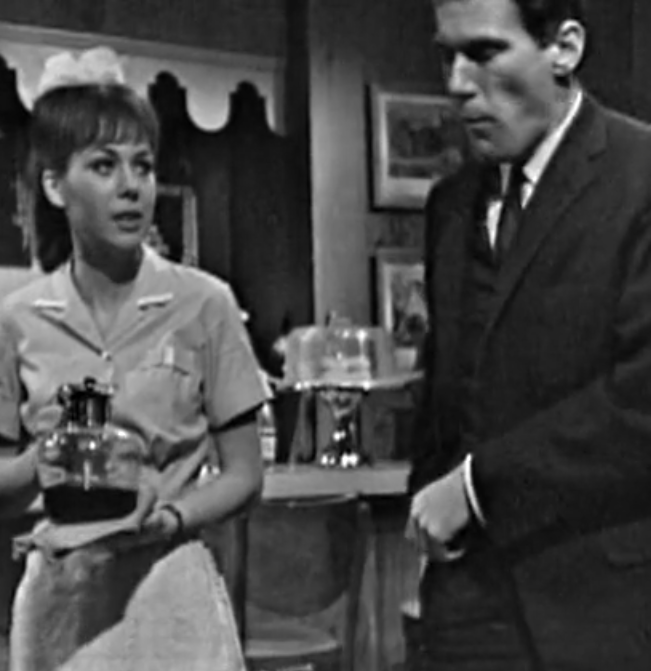
Episode 212: Haunting the rooms

We’ve spent over 42 weeks with the ancient and esteemed Collins family of Collinsport, Maine- reclusive matriarch Liz, high-born ne’er-do-well Roger, flighty heiress Carolyn, strange and troubled boy David, and David’s well-meaning governess Vicki. Liz owns all the biggest things in and around the town, but the family is isolated and embattled. Someone bought up Liz’ debts and tried strip her of all her assets, her only servant went on a killing spree and was stopped only by the intervention of ghosts, Roger’s ex-wife showed up and turned out to be a murderous fire witch from beyond the grave, and now Liz herself is being blackmailed by seagoing con man Jason McGuire. Jason even forced Liz to share her home with his rapey henchman, dangerously unstable ruffian Willie Loomis.

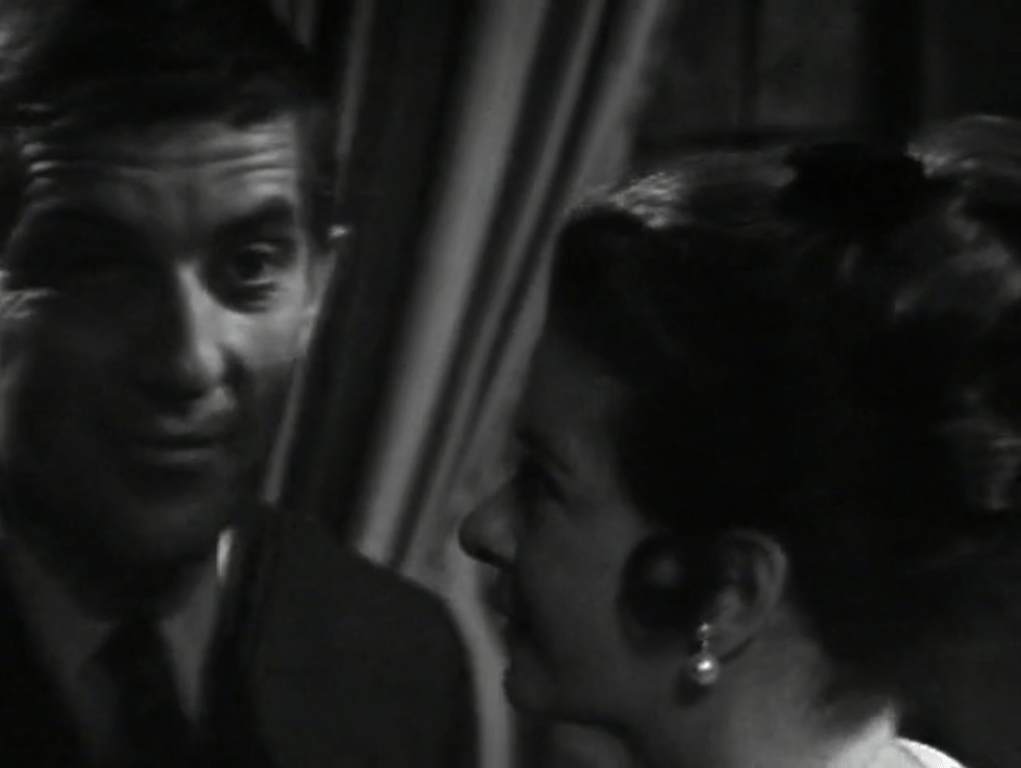
Today, an unexpected visitor comes to call on Liz at the great house of Collinwood. He identifies himself as her distant cousin, Barnabas Collins, the last survivor of the English branch of the family. This is the first Liz has heard of the existence of such a branch, but Barnabas’ resemblance to an eighteenth century portrait that hangs in the foyer is strong enough to make his claim plausible. He charms her with his old world manners. Regular viewers, knowing how lonely Liz must be, are not surprised that she is delighted with him.

Liz taking in in the information about her previously unknown relative
Liz warming to Barnabas’ company
Liz falling a little bit in love with Barnabas

Many commentators think it strange that this cousin from England does not have an English accent. I don’t see why. The last character on Dark Shadows to speak with an accent that had anything to do with the show’s setting in central Maine was killed off in #186, and Barnabas has the same mid-Atlantic accent Liz and Roger use. Since he goes on at length about himself as a typical member of the Collins family, we might assume they’ve all been talking like that for hundreds of years.

David plays in the long-abandoned Old House on the grounds of the estate. He sees Barnabas silhouetted in the doorway and greets him. Barnabas enters only after David has spoken to him.

David sees Barnabas

David thinks that Barnabas is the ghost of the man in the portrait. When David tells him that he is on intimate terms with several ghosts, Barnabas gives him a hard look and takes a step towards him.

David thinks Barnabas is a ghost

Barnabas reacts to David’s remarks with such a stiffly attentive face and such a deliberate movement of the body that we might sense menace. A man preparing a deadly attack might look like this. But David does not pick up on any danger. He chatters happily away about his ghost friends. As he does, Barnabas relaxes.

David chatters happily to Barnabas

Returning viewers know that Barnabas is not in fact from England, but that Willie released him from a coffin where he had been confined for many years. He resembles the portrait painted in the eighteenth century because he sat for it. He embodies a malign supernatural force that we heard calling to Willie through the portrait and that the caretaker of the old cemetery has said creates a palpable aura of evil that emanates from the tomb where, unknown to him or anyone else, Barnabas’ coffin lay hidden.

None of the characters in today’s episode knows these things, but when David goes back to the great house he shows that he is onto something. He tells Liz and Vicki that he thinks “there’s something funny” about Barnabas. After Liz leaves, David explains to Vicki that Barnabas does not seem angry, as does the man in the portrait, but sad, terribly sad, as if he were “haunting the rooms” of the Old House. Evidently David is rehearsing the part of Captain Shotover in Shaw’s Heartbreak House, with his famous speech about how “We don’t live in this house, we haunt it.”

Vicki functions as an internal audience in her scenes today. She is the recipient of some flowery gibberish from Barnabas about the loveliness of the syllables in her name, and afterward agrees with Liz that Barnabas is very charming. She has a conversation with Liz about whatever is happening in the Jason/ Willie story, and reacts with alarm when Liz says things we are supposed to find alarming. Finally, she is someone in front of whom David can speak freely enough to tell the audience that we’re going to wind up feeling sorry for Barnabas.

Passive as Vicki is in her time on screen today, her opening voiceover is a bit more intriguing. The first 270 episodes of Dark Shadows open with brief monologues by Alexandra Moltke Isles in character as Vicki. Usually, these monologues allude to events in the story. The implication would seem to be that Vicki either knows what is going on or will eventually find out, and that she is speaking to us from the future, where she is looking back on the events we are about to see. This has very much included the advent of Barnabas. In the opening of #202, Vicki told us that Willie was destined “to awaken and unleash a force that will affect the lives of everyone”; in #209, she said that he had “stumbled onto the darkest and strangest secret of all”; and in #210 and #211, she again referred to his grave-robbing expedition and its fell consequences.

We’ve had two major breaks so far from the pattern that establishes Vicki the speaker of the opening voiceover as the person who already knows what we are in the process of finding out. Vicki opened #15 by saying that she had at that point in the story befriended David, something she was in fact months from doing. She opened #102 telling us that Roger was the only person she had to fear, when in fact Roger was the least of her problems. Now, we break from it a third time.

Today’s opening voiceover runs thus:

My name is Victoria Winters. Night is drawing nearer and nearer to Collinwood, and the man who disappeared into another night has not been found. But out of the falling dusk, another man has come, a stranger who is not a stranger, a man with a face long familiar to those who live at Collinwood, a man who has come a great distance but who still bears deep within him a soul shaped by the far country from which he came.

Some may argue (as the Dark Shadows wiki does) that “the far country” might be a reference to death, and so this monologue might be delivered by someone who knows that Barnabas has risen from the grave. But if you know that, you aren’t likely to say that he “bears deep within him a soul,” since we usually hear that vampires don’t have souls.

Vicki has been, not only the narrator, but the point of view character and the chief protagonist of Dark Shadows up to this point. So when we ask whether her voiceover suggests that she might remain unaware of Barnabas’ nature, we are asking if she will continue in that role.

The blackmail storyline was the only one going on Dark Shadows between #201 and the arrival of Barnabas. It has an expiration date, not only because Liz will eventually run out of stuff to surrender to Jason, but also because actor Dennis Patrick agreed to play Jason on condition that he be allowed to leave whenever he wanted, but in no case later than the end of June. The show has been trending heavily toward the supernatural thriller/ horror story genre since December. Indeed, Jason’s first entry into Collinwood in #195 comes with a hint of the portrait of Barnabas, suggesting that his purpose was to introduce Barnabas to the show.

So, while they could not possibly have foreseen that Barnabas would be the hit he actually became or how they would go about rebuilding the show around him, it was likely that if ABC renewed Dark Shadows and it continued beyond #260, Barnabas would have to be a presence in one way or another.

This might offer Vicki a way back in. The previous deadly threats, crazed handyman Matthew Morgan and blonde fire witch Laura Murdoch Collins, were both thwarted by Vicki’s relationship with the ghost of Josette Collins. Josette’s portrait hangs at the Old House, and her spirit is strongest there. Since Barnabas is already at the Old House, perhaps we should expect Josette to help Vicki defeat him as she helped her defeat Laura.

The first question that expectation brings to mind is whether Barnabas is also connected to Josette, and if so how. Today, he identifies Josette to David as “our ancestor.” It has been established that Barnabas is the son of Joshua and Naomi Collins, that Joshua and Naomi continued to live in the Old House after David’s ancestor Jeremiah Collins built the great house, that Jeremiah was not the son of Joshua and Naomi, and that Josette was married to Jeremiah. In the closing scene today, Barnabas makes a speech to the portrait of Josette, telling her that he claims the Old House for himself and that she and Joshua no longer have power there.

Barnabas’ bracketing of his father and Josette as the two relatives who thwarted him would suggest that those two were closely related. I think the likeliest explanation at this point is that Jeremiah and Josette were the parents of Joshua and Naomi, and that Barnabas’ grandmother took his father’s side against him in their climactic battle. All of that is subject to change, of course- Jeremiah, Joshua, and Naomi are only names, and for all the heavy lifting Josette’s ghost has done in the story since December of 1966 she has spoken only a few words and barely shown her face. So even a drastic retcon wouldn’t require explaining any memorable images away.

If Josette is Barnabas’ grandmother, it would seem that he would know a lot more about her than even her friends Vicki and David do. So Vicki is going to have to be on her toes to recruit Josette and deploy her in a battle against Barnabas as effectively as she did in her showdown with Laura. If, as the opening voiceover suggests, Vicki is going to remain oblivious to what Barnabas is all about, Barnabas’ declaration that Josette’s power is ended will prove correct. In that case, Vicki’s future on the show would appear to be sharply limited.

Episode 161: Something in the atmosphere

This episode consists entirely of conversations in which the characters recap events we have already seen. To the extent that it has a point, it is that while flighty heiress Carolyn seems to be in charge of the house, well-meaning governess Vicki actually is. Vicki made her boyfriend, instantly forgettable young lawyer Frank, take the idea of the supernatural seriously enough to call in an expert on the subject, Dr Peter Guthrie of Dartmouth College. Vicki then made Dr Guthrie agree to conceal from everyone else information he would normally share freely. She has made Carolyn go along with Dr Guthrie’s activities. Today, Carolyn’s uncle, high-born ne’er-do-well, Roger, asks Carolyn about Dr Guthrie. Carolyn tells Roger that it was her idea to call Dr Guthrie in. She directs Roger to cooperate with Dr Guthrie, not mentioning Vicki, but invoking the authority her ailing mother, reclusive matriarch Liz, has entrusted to her.

To explain how the performances and the visual composition keep it from being excruciatingly dull, you’d have to go over the whole thing frame by frame and analyze each of hundreds of decisions the actors and director made that held the episode together. Impressive as their efforts were, the result is far from exciting. So even if I had the expertise to provide that kind of commentary, I would not for a moment consider doing it.

One thing I will mention is that we see a lot of the kitchen at Collinwood in this episode. Usually this set is one where the characters exchange story-productive information. No such information is exchanged today. The scenes play out in a way to soften that disappointment for us.

The kitchen is typically a small space where the characters share a meal, giving rise to a natural intimacy. There’s no meal today- Vicki and Carolyn are sitting in front of the coffee things, but it isn’t until Dr Guthrie enters that it becomes clear that there is any coffee. There certainly isn’t any food to be had. Nor does the space seem particularly small. The plants are as extravagant as we ever see them, creating a sense of luxuriant growth. In the course of her conversation with Vicki, Carolyn manages to move around the room so much that she gives us the feeling of a large space. Even for someone as short as Nancy Barrett, there are very few patterns of movement that can leave us with that impression. She and the director* worked out one such pattern, and she executes it flawlessly.

Carolyn among the plants
Vicki and Carolyn in the jungle
By the pantry
Long shot

*There seems to be some question as to who directed this episode. John Sedwick has the credit on screen, but the Dark Shadows wiki says it was Lela Swift. Sometimes the wiki is edited by people who have seen the original paperwork from the making of the show, so occasionally it is right and the credits are wrong.

Episode 156: Why is my baby crying?

At the end of Friday’s episode, we saw reclusive matriarch Liz start to fall down the stairs, then saw her sprawled on the floor below. Today begins with a recreation of that scene, but instead of merely starting to fall, actress Joan Bennett tumbles far enough forward that she must really have gone down. It’s an impressive stunt.

Dark Shadows first stunt performer: Joan Bennett

Most of the episode is taken up with Liz’ demented condition and the reactions of the members of the household to it. The audience knows that Liz’ troubles are the result of a spell cast on her by blonde fire witch Laura. At moments Liz is almost able to figure that out herself, but no one else has a clue what is going on. The whole episode is full of standout moments for Liz. If there had been Daytime Emmy Awards in 1967, this would have been the episode Dan Curtis Productions would have sent to the voters to get Joan Bennett her Best Actress award.

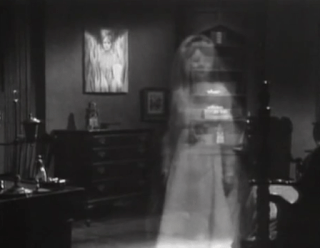
At one point, Liz begins to recover her memory and is about to take action against Laura. Before she can reach anyone, a ghostly figure appears in her room. Afterward, she has a mad scene, indicating that she has been rendered powerless.

The ghostly sighting raises some questions about Laura. Is it Laura’s ghost she sees? Or another ghost allied with Laura? Or has her abuse of Liz’ brain led it to produce this hallucination on its own? The show is very indefinite about what exactly Laura is and how she operates, giving us the chance to have a lot of fun speculating about her.

This episode is replete with notable firsts. In addition to the first real stunt of the series, it features the first scene in which Bob O’Connell, as the bartender in The Blue Whale, has lines to deliver.

In that same scene at The Blue Whale, we hear music coming out of the jukebox that we haven’t heard before. It is a medley of Lennon-McCartney tunes rendered in “smooth jazz” style by Bud Shank.

It’s also the first time a conversation on the landing at the top of the stairs leading up from the foyer is photographed straight-on. Several times, we had seen characters talking to each other up there, but always before the camera had been angled up from the floor below. That had created the sense that the conversation was removed from the main course of the action. Today, it’s just another part of the set.

It is the first time we see Liz’ room. Two notable firsts take place there. A favorite prop of Dark Shadows fandom, the so-called “Ralston-Purina lamp,”* has been seen several times in the Collinsport Inn. In Liz’ room today, it makes the first of many appearances in the great house of Collinwood.

The Ralston-Purina lamp

The ghostly figure in Liz’ room is played by Susan Sullivan, who has been acting in primetime on network television more or less continuously for the last 55 years. During the other hours, she writes plays and performs in Dark Shadows audio dramas.

A play she wrote under the title “What Friends Do” was produced by Smartphone Theater and posted on Youtube. The cast is made up of Dark Shadows alums Susan Sullivan, Kathryn Leigh Scott, Mitch Ryan, and David Selby. It’s about four friends in a retirement community during the Covid pandemic, and it’s terrific. The Q & A after includes a lot of stuff that Dark Shadows fans will find irresistible, including a little bit about today’s episode.

The voice that says “Dark Shadows is a Dan Curtis production” at the end of the closing credits does not sound like ABC staff announcer Bob Lloyd. It’s higher-pitched and faster than his delivery, and the vowels are flatter than he articulates them. Perhaps it’s a tape fault distorting Lloyd’s voice, or perhaps he had a cold that day. If it was someone else, it’s another first. The Dark Shadows wiki doesn’t say anything about it, so I assume the surviving records and the published books that use them don’t say it was someone else.

*So-called because its red-and-white checked pattern looks like the logo of the Ralston-Purina animal food company.

Episode 149: The scent of jasmine

Yesterday’s episode gave writer Ron Sproat six major points to communicate to the audience:

  1. None of the characters yet believed that the relationship between mysterious and long-absent Laura Collins and her son, strange and troubled boy David, involved physical danger or crime, much less a threat from the supernatural realm.
  2. An police investigation taking place off-screen and centered in Phoenix, Arizona will advance the plot.
  3. Well-meaning governess Vicki is a credible protagonist in the storyline about Laura.
  4. Dashing action hero Burke Devlin is too smitten with Laura to be of much help to Vicki in her efforts to protect David from Laura.
  5. The budding romance between Burke and flighty heiress Carolyn is at an end.
  6. Vicki has decided the time has come to start fighting Laura.

With more help from the actors than he really deserved, Sproat managed to get all six of these points across. Today, Malcolm Marmorstein has only two themes to deal with. First, he shows us Carolyn processing her feelings about Burke. Then, he shows us the characters discovering that they are living in a ghost story.

Carolyn comes home to the great house of Collinwood in a grim mood. Vicki asks Carolyn who has upset her. She says that Burke has put an end to their budding romance. She asks Vicki to guess who has caught Burke’s eye now, and Vicki names Laura.

Later, Carolyn puts the same question to Laura’s estranged husband, her uncle, high-born ne’er-do-well Roger Collins. Roger also names Laura, also without batting an eye. When Carolyn is surprised at his calm reaction, he assures her he has no interest in anything Burke and Laura might get up to.

In her anguish, Carolyn tells Roger that he would take an entirely different attitude if he could see Burke from a woman’s point of view. As Roger, Louis Edmonds replies to this remark by raising an eyebrow ever so slightly.

Not-so-straight faces

The episodes Art Wallace and Francis Swann wrote in the first twenty weeks of Dark Shadows gave more than a few hints that Burke and Roger’s enmity has its roots in a past homoerotic relationship. In the months since Sproat and Marmorstein took over the writing duties, that idea has only cropped up a couple of times in Sproat’s scripts, and not at all in Marmorstein’s.

Edmonds’ raised eyebrow here will bring a chuckle to regular viewers who have caught on to the theme. As the look passes from his face, Carolyn turns to look at her uncle. When Nancy Barrett saw Louis Edmonds, she must have been glad the scene was ending, as she didn’t have to worry about keeping herself from laughing out loud.

In the village of Collinsport, drunken artist Sam Evans and his daughter Maggie, The Nicest Girl in Town, are at home. Maggie is trying to cheer her father up after a recent mishap with fire injured his hands, leaving him temporarily unable to hold either a paint brush or a whiskey glass. Losing his ability to paint is not as upsetting to Sam as it might be at another time. Lately, an occult power has compelled him to paint nothing but pictures of Laura, naked and in flames, a subject which he and everyone else, especially the lady herself, finds horrifying.

Maggie tries to talk sense to Sam. Screenshot by Dark Shadows Before I Die

What is weighing most heavily on Sam at the moment is a mystical feeling that something is happening to the first of these paintings. It now hangs at Collinwood in the bedroom of Laura and Roger’s son, strange and troubled boy David. An occult power, presumably the same one that took possession of Sam, made Vicki take it back to Collinwood and show it to David. David took the painting because it depicted the scene of a recurring nightmare that had afflicted him and that Sam had no way of knowing about. In the nightmare, Laura had beckoned David to join her in the flames. Again, the nightmare seems to be a communication from an occult power, and there is no reason why it could not be the same one that possessed Sam and Vicki.

The painting has a blank spot the size and shape of David. Sam’s mystical feeling suggests to him that the painting is being completed. He goes to Collinwood to investigate.

While Sam is on his way, we see David’s room. The painting glows, as both it and the portrait of Josette Collins hanging in the long-abandoned Old House have done when supernatural beings were about. Josette herself manifests. She looks around. She turns to the painting and touches the blank spot.

Josette’s ghost is played here by stand-in Rosemary McNamara. We get a fair glimpse of her face. Her hair and makeup looks very much like those we just saw Kathryn Leigh Scott wearing as Maggie. Miss Scott has played the ghost of Josette several times already and will be closely associated with Josette later in the series. If resemblance is intentional, as it would seem it must be,* why not simply have Miss Scott play Josette today?

The ghost of Josette in David’s room. Screenshot by Dark Shadows Before I Die

Roger, Carolyn, and Vicki are gathered in the drawing room, talking about the painting. Carolyn reminds Roger that David is out of the house, and suggests that he take the painting now and destroy it. Vicki objects that David would take that as a grave betrayal.

A knock comes at the door. Vicki answers it and greets Sam. She shows concern for his injured hands, and very gently takes his coat. She tells him that she is as mystified by her own actions in taking the painting and giving it to David as Sam is mystified by his compulsion to paint it in the first place. Sam asks to speak with Roger. Vicki ushers him into the drawing room, where he meets Roger and Carolyn.

Roger and Sam hate each other, but in front of the young ladies they behave almost correctly. Certainly their hostility doesn’t slow down the exchange of story-productive information. Sam asks to see the painting. Roger and Carolyn send Vicki up to David’s room to fetch it.

That’s an interesting moment. When Sam knocked, Vicki had gone to answer the door at once, and had presented him to Roger and Carolyn very much in the person of a household servant. When Roger and Carolyn send her for the painting, she is all smiles, happy to be on the job. Yet when she and Carolyn were in the drawing room earlier discussing Burke, Vicki was functioning entirely as Carolyn’s equal. The two of them sound like old friends, or like the sisters the show has been hinting they might be. Vicki can move with remarkable facility between the roles of servant and family member. That extraordinary flexibility is one of the qualities that we can imagine will come in handy as she confronts the spiritual forces of darkness gathering in the background.

When Vicki enters David’s room, spooky music starts to play. Vicki walks in slowly, looking from side to side. She senses an eerie presence. She looks at the painting, and sees that where it once was blank it now sports an image of David. She screams.

Roger, Carolyn, and Sam are momentarily stunned by Vicki’s scream. By the time they leave the drawing room, Vicki is already on the stairs holding the painting. Seeing David’s face depicted there, Roger exclaims that he saw the painting earlier that day, and that the spot was still blank then. Sam touches it, and says that is impossible- it is oil paint, and would take days to dry. Roger says that the painting now shows the whole scene of David’s nightmare.

As the four of them try to figure out what could have happened, Vicki says that when she entered the room she felt a weird presence. She says there was a specific perception accompanying this vague feeling- she could smell jasmine perfume. None of the ladies in the house wear that scent. Vicki says that she smelled it once before- in #126, when she saw the ghost of Josette Collins. The association of Josette with the scent of jasmine will continue throughout the series.

Vicki and Carolyn wonder how David will react to his own likeness in the painting, and Roger replies that he never will see it. He throws it in the fireplace. As it burns, the sound of a woman’s scream rings through the room.

Screen capture by the Dark Shadows wiki

This episode is a turning point. Hints of supernatural activity have been cropping up in the show from week one, the audience has been seeing evidence of it for months, and both Vicki and David have seen and talked with ghosts. But the completed painting and the scream that emerges from the fireplace are the first unambiguous tokens of the occult that have been presented to a group like these four.

The only other time more than one person had seen anything like it came in #88, when Roger and his sister, reclusive matriarch Liz, found seaweed on the spot where Vicki reported that the ghost of beloved local man Bill Malloy had dropped it. But Roger and Liz both want to keep the stories of Collinwood’s haunting to a minimum, and they threw the seaweed into the fire without telling Vicki or anyone else that they had found it. Denial, the psychological defense mechanism, is the ruling passion of their lives, and when the two of them found the evidence it was a foregone conclusion that it would be destroyed.

There is no such unity among Sam, Vicki, Carolyn, and Roger. Now that the only way any of them can deny that supernatural powers are operating in connection with Laura and David is to lie, we see that the four of them are strikingly ill-appointed to be the members of a plot to keep a secret. Sam is an outsider and no friend of the Collinses. Vicki is too conscientious to be part of a coverup. Carolyn is a loose cannon, and might tell anyone anything. Roger is unburdened by a conscience and is quite happy to tell lies, but he is also so cowardly and irresolute that he might be the weak link in any conspiracy he might join. So, not only do these characters now know that spirits are at work in connection with Laura’s relationship with David, but everyone else is likely to find out as well.

*Rosemary McNamara’s face is of the same general type as Kathryn Leigh Scott’s, but I think the hair and makeup above emphasize the similarity. Here’s the picture from her imdb profile:

Rosemary McNamara, from imdb

Episode 121: Ghosts and ghosts-to-be

Each of the 1225 episodes of Dark Shadows features one name under the credit “Written by.”* A total of nine names rotate in that spot. While we know that some episodes included writing from uncredited contributors, the only such contributors we can identify come from among that tiny group of eight men and one woman. For example, Malcolm Marmorstein, credited with today’s script, wasn’t officially named among the writers until #115, but he may well have written additional dialogue as far back as #46. Joe Caldwell’s name doesn’t appear on-screen until #245, but he will actually be writing some of the scripts attributed to Ron Sproat starting this month, maybe this week.

Opinions will of course vary as to which of the nine identifiable writers was better and which was worse. Few, however, will find a place for Marmorstein on a list of Dark Shadows’ eight best writers. Although he had extensive experience in the theater, Marmorstein had none of the sense of what actors can do that Art Wallace and Francis Swann brought to the first nineteen weeks of the show. Nor did he know how to structure a drama, write crisp dialogue, or invent fresh story points. Directors Lela Swift and John Sedwick collaborate with a uniformly strong cast to put Marmorstein’s scripts on such a strong footing that at moments they seem like they are about to be good. Those brief flashes of hope are invariably, cruelly, disappointed.

There are indeed some bright spots in today’s episode. Reclusive matriarch Liz is in the drawing room of the great house of Collinwood. Well-meaning governess Vicki and homicidal fugitive Matthew are both missing, and Liz is worried that Vicki may have fallen into Matthew’s hands. Wildly indiscreet housekeeper Mrs Johnson shares her conviction that Matthew has killed Vicki, and won’t stop talking about this belief even after Liz expressly orders her to do so. Clarice Blackburn plays Mrs Johnson as a woman with no self-awareness whatsoever, and no screen actor has ever had a more effective way of showing horror at displays of social maladroitness than did Joan Bennett. In their hands, this scene is laugh-out-loud funny.

A knock at the door rescues Liz from Mrs Johnson’s untrammeled morbidness. The sheriff has come to report to Liz on the state of the searches for Vicki and Matthew. Mrs Johnson answers the door and won’t let the sheriff see Liz until she’s given him a piece of her mind about the incompetence of his department. There aren’t any memorable lines in this exchange, but the contrast between Blackburn’s highly animated movements and Dana Elcar’s cheerful placidity is so obviously suitable for comedy that it feels funny.

Back in the drawing room, the episode starts to fall apart. Liz and the sheriff talk about the searches for Vicki and Matthew. The dialogue is full of repetition and wasted words. Liz asks if the sheriff has an idea where Matthew might be, to which he replies, “He could be anywhere, and everywhere.” Might he hurt Vicki? “He might, but on the other hand he might not.” After all, “he’s very unpredictable.” Then, “you know how unpredictable he is.” Yep, unpredictable, let’s repeat that word five or six more times, that’ll keep us busy until the commercial break.

They could have cut some of that smoke-blowing and replaced it with lines about what the sheriff has done. My wife, Mrs Acilius, wishes the sheriff had mentioned telephoning Vicki’s former residence, the Hammond Foundling Home, and asking people there about where Vicki might have gone and whom she might have tried to contact. That might not have led to any action, but at least it would invite us to imagine that something might be going on somewhere.

The scene between Liz and the sheriff does have an effective ending. She asks him if he holds out much hope for Vicki. He replies, “Frankly, no.” She turns to leave the room. We break for commercial on that downbeat, which lets the bleakness of the situation sink in.

Strange and troubled boy David Collins comes home. David is the one person who knows that Matthew is hiding in the long-abandoned Old House on the grounds of the estate. He has been delivering supplies to him. Even David does not know that Matthew is holding Vicki prisoner in a hidden chamber. David sees that the sheriff is in the house, and asks Mrs Johnson if the sheriff has any news about Vicki or Matthew. Mrs Johnson seizes this opportunity to resume denouncing the sheriff’s incompetence, saying that the only clue he can recognize one that tells him it is time to eat and make himself even fatter than he already is.

David is about to move on when Mrs Johnson questions him about the pack of cigarettes he stole from her earlier. She sets some punchlines up for David in this exchange. She mentions that she lit a cigarette while serving David his breakfast, to which David replies by asking if she is supposed to smoke while working. She says she knows that she set her pack of cigarettes on the table when she and David were alone in the kitchen, and that she hasn’t seen it since. He suggests it walked away by itself. She tells him he’s the only one who could have taken them; he says that if he wanted cigarettes, he wouldn’t steal them, he’d buy them. None of these lines is much on the page, but as delivered by Blackburn and David Henesy, they are genuinely funny.

Mrs Johnson looks for nicotine stains on David’s fingers. Screenshot by Dark Shadows Before I Die.

David goes into the drawing room and talks with the sheriff. Picking up on Mrs Johnson’s remark about the sheriff’s vigilant observation of meal-times, David asks him what it means when the whistle blows at the cannery. “Lunch,” says the sheriff. Again, not a world-class piece of comic material, but Henesy and Elcar make it land.

David then asks the sheriff for the details of his search for Matthew. The sheriff happily answers all of David’s questions in detail, as if he were giving a briefing to the state police. He tells David that anyone who might be hiding Matthew will go to jail.

This scene shows the limits of what a good actor can do with bad material. David is going to return to the Old House at the end of the episode. He will be prompted to go back there because he has learned information from the sheriff that Matthew will want to know. While there, he will set up suspense by revealing to Matthew that the sheriff has triggered his intense phobia of jail. That locks the sheriff into playing his scene with David as a babbling oaf.

In Elcar’s first episodes as the sheriff, he had made indiscreet remarks to David, but as we saw him observing the reactions those remarks elicited from David and others he seemed to be using them as ploys to advance his investigations. For example, in #59, he had given David some information that excites him and unnerves his father, high-born ne’er-do-well Roger Collins.

We can see how he might use similar tactics in this situation. After all, Vicki is David’s governess, and David has spent more time with her than has anyone else. Matthew had been the caretaker in the house where David lives, and David knows him quite well also. In this conversation, when the sheriff refers to Matthew as unlikable, David becomes very excited and exclaims “I like him! Er, I did like him, I mean.” If the sheriff knows his business he might well pay very close attention to everything David says, and keep encouraging David to say more. He will certainly notice David’s terrified reaction to the idea that someone helping Matthew will go to jail, and test his reaction to further comments on related themes. But if he takes any note at all of David’s attitude, the current storyline will end within minutes. So in this scene, Marmorstein leaves Elcar no way to play the sheriff as an intelligent character.

After the sheriff leaves, David and Liz have a scene in the drawing room that builds up to a tremendously frustrating moment. David keeps asking his aunt one question after another about Matthew and Vicki, Vicki and Matthew, does Matthew have Vicki, is Vicki in danger from Matthew, then without taking a breath “Do you know any secrets about the Old House?” Liz responds “I wish that someday you’d ask an important question.”

Granted, we know that Matthew is holding Vicki prisoner in the Old House and Liz does not, but it is hard to imagine anyone failing to see the connection between these two thoughts. Joan Bennett and David Henesy had a fine rapport that made the scenes between Liz and David Collins a delight, and you can see them trying to save this exchange. David is in a panic at the beginning of the scene and gets steadily more worked up as it goes along. We see Liz observing his agitated emotional state, paying such close attention to his facial expressions, tone of voice, and frantic bodily movements that she misses key elements of his words. It’s a valiant attempt on their part to make the scene work.

David wants to go to the Old House to see Matthew. In the foyer, Mrs Johnson again confronts him about the cigarettes. He yells at her to “Get off my back!” and runs out. This might have been an attempt to show that David feels his world closing in on him, but it doesn’t succeed. We’ve already seen those two characters say everything they had to say about that topic on that set. Repeating it just feels like filler.

*There are reference works that draw on the original paperwork produced by the makers of the show; even these list one writer per episode. That’s how the Dark Shadows wiki manages to list a writer for every episode, including those that don’t show writing credits on-screen.

Episode 78: Such fascinating company

High-born ne’er-do-well Roger Collins talks on the phone with his sometime partner in crime, drunken artist Sam Evans. They agree to meet in Collinsport’s tavern, The Blue Whale. After Roger gets off the phone, well-meaning governess Vicki passes by. He invites her to come with him to the tavern. Up to this point Roger has often been quite unpleasant to Vicki and she has been wary of him. Also, he is a married man, and she has reason to suspect that he is her uncle. On the other hand, he is no longer a suspect in an active homicide investigation, and she hasn’t had a date in months. So she accepts.

Roger caressing Vicki. Screenshot by Dark Shadows Before I Die
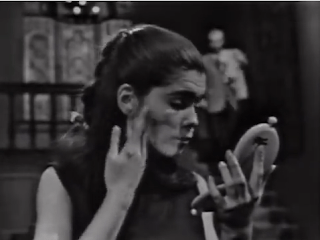
Vicki putting her face on. Screenshot by Dark Shadows Before I Die

Most of the episode takes place in the Blue Whale. Sam is there with his daughter, Maggie, The Nicest Girl in Town. Hardworking young fisherman Joe joins them, and they invent a drinking game. Every time someone mentions the name “Collins,” the table must drink a toast to “Collins of Collinsport!” Getting into a situation where you have to take a drink every time Sam wants one isn’t a particularly prudent thing to do, but Maggie and Joe are in a daring mood.

Maggie has clearly set her cap for Joe. She gives him a frankly aggressive look that is startling to see in the face of The Nicest Girl in Town. Startling, but most welcome- Joe is still trapped in a useless storyline where he is boyfriend to flighty heiress Carolyn. But when we see him having a good time with Maggie, we can finally see the light at the end of that tunnel.

Girl knows what she wants. Screenshot by Dark Shadows Before I Die

Roger and Vicki show up. Roger and Sam go off and talk about something or other having to do with their dark doings. This conversation is meaningful only to the two of them. At this point, even the sheriff has lost interest in Roger and Sam’s little conspiracy. The actors are fun to watch- Louis Edmonds and David Ford always enjoyed playing off each other- but the audience certainly can’t be expected to keep track of whatever they’re talking about.

Vicki joins Maggie and Joe for some pleasant chatter about a couple of plot points the audience might want to keep in mind. Roger, frustrated by his talk with Sam, comes to the young people’s table and insults them. Joe, though he is an employee of the Collins family business, offers to fight Roger in defense of Maggie’s honor. Vicki and Sam break the fight up before Joe can throw his first punch. Roger announces that he has a headache and takes Vicki home.

Once there, Vicki thanks Roger for the evening, with no apparent sarcasm in her voice. He apologizes, and promises to take her out again. She sounds genuinely excited by the idea of another such outing. Who knows, next time maybe she will get something to eat, or a drink, or more than three minutes of conversation before she has to stop a fistfight and go home.

If Roger really is Vicki’s uncle- that is, if his sister, reclusive matriarch Liz, is secretly Vicki’s mother, as the show has been hinting pretty heavily- then a romance between Vicki and Roger would seem to be a soap opera cliche. Liz has struggled to keep Vicki from finding out anything about her origins. If Liz sees Vicki about to enter into an incestuous marriage, she might feel forced to stand up at the wedding when the minister asks if anyone present knows why these two may not be joined in lawful matrimony and to expose the secret.

The jukebox at the Blue Whale plays some music we haven’t heard before. The Dark Shadows wiki identifies it as a series of tracks from Les and Larry Elgart’s album “The New Elgart Touch.” It’s a step down from the tracks by Robert Cobert the jukebox has played so far, but it is a fitting accompaniment to the dancing of this guy. In most places he would be thought awkward, but by the standards of Collinsport he is indistinguishable from Fred Astaire:

Screen capture by Dark Shadows Before I Die

Episode 77: Burke Devlin, Burke Devlin, Burke Devlin!

Screenshot by the Dark Shadows wiki

Yesterday, dashing action hero Burke Devlin announced to the ancient and esteemed Collins family that he intends to drive them out of business and take all their holdings. He then muddied the waters by offering to pay them an inflated price for their dilapidated old house. Still, everyone came away with the impression that Burke had openly declared himself to be the deadly enemy of the Collinses.

Problem child David Collins wasn’t in that episode, and he refuses to believe the characters who were when they tell him that his idol Burke has said that he is out to strip the Collinses of their assets. The only person David likes, aside from Burke, is his aunt, reclusive matriarch Liz. He struggles when forced to choose sides between them. His misery and frustration grow palpably throughout the episode.

At least David can still do something he likes. His cousin, flighty heiress Carolyn, tries to get him to return a photograph of Burke that he stole. While she is in his room, he taunts Carolyn with the idea that Burke isn’t really attracted to her, but that he prefers well-meaning governess Vicki. This infuriates Carolyn, much to David’s satisfaction.

The photo itself is a bit of a mystery. It shows Burke striking oil:

Screenshot by The Collinsport Historical Society

The show has repeatedly told us that Burke grew up poor, that he was still poor when he went to prison, and that he was penniless, despised, and alone in the world when he got out of prison just five years ago. Yet now, he owns a corporate raiding firm, and is a millionaire many times over. They’ve dwelt on this time frame so much that even a soap opera audience is likely to start wondering how he got so rich so quickly. The photo may be an attempt to answer that question. Everyone knows that if you strike oil, you can become a millionaire overnight. Of course, you would have to own the mineral rights to the land the oil is on to profit from such a discovery, and would also need to secure drilling equipment and to hire a crew to operate it if you’re going to make the strike in the first place. How an indigent person fresh out of the state penitentiary is supposed to have paid for those things is not really easier to explain than how he could start a private equity concern.

Both yesterday’s episode and today’s include references to Liz’ estranged husband, Carolyn’s father Paul Stoddard. Yesterday’s included a reference to another character we have yet to see, Laura Collins. Laura is David’s mother, the estranged wife of high-born ne’er-do-well Roger Collins, and the onetime fiancee of Burke. These two had been mentioned only a handful of times in the first months of the show, and neither was given a name until well into it. That they are coming up more often now might lead us to wonder if we will be meeting one or both of them sooner or later.

Episode 67: I was fresh out of arsenic

This one belongs to Maggie Evans, the nicest girl in town. We open with her doing some work in the restaurant she runs. She isn’t feeling so nice today- dashing action hero Burke Devlin has accused her father, drunken artist Sam Evans, of various crimes, including the murder of beloved local man Bill Malloy. When flighty heiress Carolyn comes into the restaurant, Maggie tells her that it might be a good idea to flavor Burke’s coffee with rat poison.

Burke does show up. When he complains about the coffee, Maggie picks up on the idea she had floated to Carolyn and apologizes for not adding arsenic.

Maggie apologizing to Burke for failing to give him arsenic
No arsenic today, sorry

Not that she’s going to let her father off without a piece of her mind. When he comes in and tells her some lies, she discards her usual adult-child-of-an-alcoholic manner of exaggerated patience and calmly asks him if he minds that she doesn’t believe him. He mumbles that there’s no reason why she should.

The sheriff comes into the restaurant to ask Maggie if she can confirm her father’s whereabouts at the time of Bill’s death. She gives him a sarcastic answer. When he asks what she is prepared to swear to on the witness stand, she makes it clear that she will swear to whatever she damn well pleases. Sam then tells the sheriff that Maggie doesn’t actually know where he was that night. At that, she declares that Sam has no idea what she does or doesn’t know. If she wants to perjure herself, it will take more than Sam and the sheriff to stop her.

In the sheriff’s office, we meet Mrs Sarah Johnson, housekeeper to the late Bill Malloy. Mrs Johnson is furious with the Collinses, the family in the big dark house on the hill who own half the town. She more or less blames them for Bill’s death. She very much blames them for his life, which he spent doing nothing but working for their interests. Mrs Johnson is even more indignant than Maggie, but the only person she interacts with is the sheriff. So we have a contrast between a character who gives us several distinct shades of outrage, one for each person she puts in their place, and another who spends her time bringing one specific shade of anger into perfect focus.

In between there’s a scene with Sam and the sheriff, and at the end one between Carolyn and Burke. These offset the studies in indignation from Maggie and Mrs Johnson, both giving the audience a bit of a breather and giving their fiery turns time to sink in.

Miscellaneous:

There’s a moment when the sheriff goes to the water cooler and finds the paper cup dispenser empty. He apologizes that he can’t offer Mrs Johnson a drink. All the websites list this as a production fault, but I’m not sure- it goes on for a while, longer than I imagine it would if he were actually drawing two drinks of water and giving her one, and the timing doesn’t seem off afterward. I don’t know if it was in the script- I suppose they might have noticed they were out of cups and improvised the scene before or during dress rehearsal. At any rate, I don’t think actor Dana Elcar was actually surprised by the absence of cups during the taping.

This episode was recorded on the Sunday before it aired. The Dark Shadows wiki quotes Kathryn Leigh Scott (Maggie) explaining that this was because one of her fellow cast members had shown up drunk on the day they were originally supposed to record it. Mitchell Ryan and David Ford both have important parts in it, and they were both alcoholics. After he stopped drinking, Ryan admitted that he showed up on the set of Dark Shadows drunk on more than one occasion. Ford never stopped drinking, and booze was apparently part of the reason he died in 1983 at the age of 57. Also, while Ryan and Ford are the two actors in this period of the show who usually have the most trouble with their lines, they are both nearly letter-perfect today, as if they had been in trouble and knew they had to be good boys or else. So it could have been either of them.

Clarice Blackburn joins the cast as Mrs Johnson today. As Mrs Johnson, Blackburn will be crucial at certain moments in the years ahead, and she will also be cast as other important characters in the later run of the show. When Mrs Johnson was cast, Blackburn was told to model her on Judith Anderson’s performance as Mrs Danvers, the frightening housekeeper in Hitchcock’s Rebecca. That instruction didn’t last very long, and when four years later they actually got round to including an homage to Rebecca, Blackburn didn’t play the Mrs Danvers part.

On his blog Dark Shadows from the Beginning, Marc Masse develops a theory that set designer Sy Tomashoff was influential in casting Dark Shadows. He focuses on a guest spot Clarice Blackburn had on an earlier series where Tomasheff did the sets, a primetime show called East Side, West Side:

The version of Mrs. Johnson we see today in episode 67 is based on an even earlier role as Gert Keller in the critically acclaimed but greatly overlooked groundbreaking series East Side, West Side, in a 1964 episode called The Givers. Perhaps the biggest surprise to those not familiar with the series would be its leading actor, featuring George C. Scott as a… social worker.

It should be noted that both of these earlier productions had Dark Shadows scenic designer Sy Tomashoff as the “art director”; in the East Side, West Side episode The Givers, the cast list even featured Bert Convy, the original early choice for casting as Barnabas Collins on Dark Shadows. Tomashoff held the same production role in For the People. Both of these series are notable for a good many cast member crossovers with Dark Shadows, often several in a single given episode; and because Sy Tomashoff worked so closely with executive producer Dan Curtis on Dark Shadows, it is likely that he played a significant part in a number of the key casting decisions in the early days of Dark Shadows.

Especially curious as noted in the introduction to today’s post is how Mrs. Johnson comes across as the grieving widow, indicating that she may have been more than just a housekeeper to Bill Malloy even if Malloy himself was never aware of this. If you see her as Gert Keller in the East Side, West Side episode, she seems to be reprising this earlier role…

An even more striking parallel between the portrayals of Gert Keller and Sarah Johnson are the similarities in character dialogue between the speech patterns and emotional tone… [I]n each instance, vocal delivery of dialogue as provided by the actress shows a similar shift between the emotional extremes of tearful despair and bitter resentment at the injustice of each character’s passing, first over Arthur Keller in East Side, West Side with an almost identical pattern and tone evident today on Dark Shadows over Bill Malloy.

In East Side, West Side, Art Keller is a business man struggling with elusive opportunities due to a past bankruptcy situation. Despite the best efforts of Neil Brock [George C. Scott] and his resources and contacts, Keller winds up ending his life soon after Brock drops by with the news that despite the availability of a possible deal for work in connection with a local congressional office, he had to intervene on Keller’s behalf because of the shady nature of the congressman’s methods of operation.

Two years later on Dark Shadows, Gert Keller is transplanted from East Side, West Side to make her debut as Bill Malloy’s bereaved housekeeper, Sarah Johnson.

It’s plausible, but not conclusive- after all, both East Side, West Side and Dark Shadows were cast with New York actors at a time when there was already more national television production, and therefore more proven acting talent, in Los Angeles. Many of the relatively well-established actors who were in New York in the 1960s were there because they were busy with specific projects and weren’t in a position to commit the time for a recurring role on a five-day-a-week TV show. So if you’re casting Dark Shadows and you’re looking for someone you can trust to give you a performance with a particular quality, of course you’re going to look at a lot of people who were on East Side, West Side, whether Sy Tomashoff recommended them or not.

Episode 42: The anticipation of doing it

In these early months of the show, the Collinses are in danger of running out of money and losing their position. In yesterday’s episode, we learned that Roger blew his half of the inheritance and Liz drew heavily on hers to keep the business in the family; in this one, we learn that the house is a moldering ruin and the rest of the family’s assets are leveraged to the hilt. Burke plans to take his revenge in part by buying up their debts and making himself their master, which it appears he is in a position to do.

Burke and his investigator are at a table in a restaurant in Bangor when they discuss these matters. Carolyn has followed Burke to the restaurant. Burke spots her, invites her to his table, and sends the investigator away. Burke flirts with Carolyn as he makes sure she didn’t overhear any important information. He makes a show of his elaborately filigreed pen. When she admires it, he makes a gift of it to her.

The last time Carolyn made her way to Burke’s luncheon table, she played with her ring, called his attention to it, and left it behind as a deliberate stratagem to prompt him to call her. She seemed altogether unconcerned with the fact that the ring was a gift from Burke’s sworn enemy, her Uncle Roger, even after Burke indicated that he found it significant; and went ahead to keep an appointment to get the ring back from Burke even after Burke had given it to Roger and Roger had returned it to her. This strange obliviousness in all things having to do with Roger recalls the equally strange blitheness with which Carolyn told Vicki about her crush on her Uncle Roger when they first met “he sends me, he really does!”)

This time the object that passes from one to the other is another distinctive bit of metal associated with some important relationships. Burke tells Carolyn how few pens there are like it in the world, that he had them made to distinguish their bearers as key people in his life. When he makes the pen a gift to Carolyn, he implies that what he is giving her is not just a thing, but a new connection between them.

I made some remarks about these scenes in a comment on John and Christine Scoleri’s Dark Shadows Before I Die:

Carolyn comes to Burke’s table at one restaurant and leaves a special ring with him; she comes to his table at another restaurant and he gives a special pen to her. Even if the mid-60s weren’t the Age of Freud among intellectually ambitious people in the USA, the flirty tone of the two encounters would make it difficult not to see these tokens as body part symbols.

…As for the pen, it is going to become a more and more unmistakable phallic symbol over the next several weeks, leading us to wonder what the show is trying to tell us about the relationship between Burke and Roger and what was really going on between them before that accident ten years ago.

There’s also a scene between Sam and Liz. Yesterday’s episode ended with a big cliffhanger when Liz opened the doors and saw Sam waiting outside, suggesting that he is going to unburden himself of the secret he and Roger share. In true soap opera fashion, once the cliffhanger has brought the audience back to watch the next episode it has served its purpose. It is then to be got out of the way as quickly and anticlimactically as possible.

Today’s anticlimax sheds an unexpected light on Sam’s position. Sam’s extreme reluctance to tell his secret grew out of his assumption that whenever and wherever he started talking, he would find a hyper-attentive audience who would listen to his his every word and lose no time putting them into far-reaching and disastrous action. What he actually meets in Liz is personal dislike for him and impatience with anything he might want to say. Once Sam starts to talk about Roger, she assumes he has come to blackmail her with some sordid information about her no-good brother, and she makes it clear she will not be having it. Joe comes to the house, Liz mentions Bill, and Sam crumbles, his secret untold and unwanted. If the audience is expecting Sam to murdered, this result will add an extra touch of bathos to his plight- a man carrying a secret that spells his doom, but that does not attract the attention of a suitable listener.

Ray Stewart, later to gain a place in history as part of the gay couple on Barney Miller, appears in this episode as a featured extra. He’s the head-waiter in the restaurant in Bangor. Both the Dark Shadows wiki and his imdb page list his role as “Customer,” but here you see him telling the server which table to go to first:

Screenshot by Dark Shadows from the Beginning

And here you see him greeting Carolyn when she arrives at the restaurant:

Screenshot by Dark Shadows from the Beginning

Ray Stewart is still alive, maybe he should complain about his role being mislabeled. In all seriousness, I’d like to see him and other onetime background players on one of those panel discussions they used to have at Dark Shadows cons and now have on Zoom. I’d like to know what it was like being an extra on the show. And of course some of them went on to become big names.