Episode 642: Stop thinking of Jeff

Heiress Carolyn comes back to the great house of Collinwood with her date for the evening, a mysterious drifter named Chris. He keeps trying to excuse himself, but she insists he stay. Carolyn is frightened because the barmaid who served them when they were at the Blue Whale tavern the night before was killed in an ultraviolent incident a few hours after they left, and the police are, as usual, stumped. Chris is uncomfortable because he is the killer. He is a werewolf, a fact which he has so far managed to conceal from all the characters he hasn’t already killed.

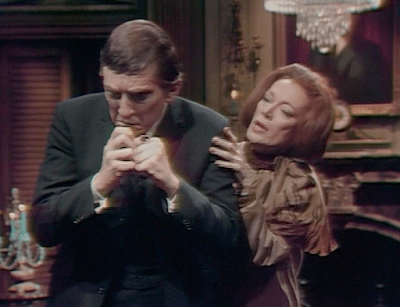
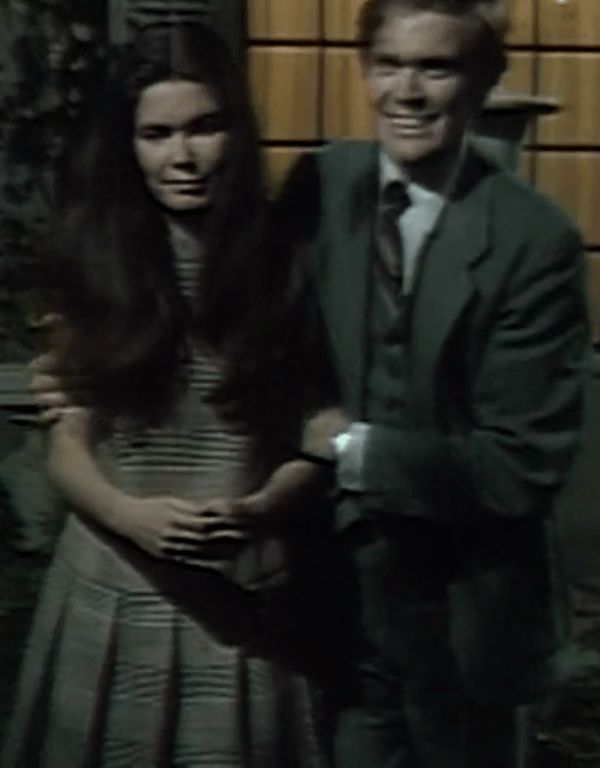
Carolyn’s mother, matriarch Liz, enters. She is followed by occult expert Professor Stokes and governess Vicki. Vicki is wearing a bright green overcoat that matches Carolyn’s dress. It seems likely that the two items are part of the same outfit, and that one of the women borrowed what she is wearing from the other. Carolyn is significantly shorter than Vicki, so it is unlikely Vicki’s dress would fit her as snugly as does this one. We can assume, therefore, that Vicki is wearing Carolyn’s coat.

Carolyn in the green dress, Vicki in the matching coat. Screenshot by Dark Shadows Before I Die.

Vicki is sobbing because Liz and Stokes prevented her from flinging herself to her death from the cliff near the house. What Vicki’s plan would have meant for Carolyn’s coat we need hardly describe. If I were Carolyn, I would keep Vicki away from my closet from now on.

Vicki is suicidal because her husband, an unpleasant man known variously as Peter and Jeff, vanished into thin air the other day, going back in time to the 1790s. Stokes and Liz are with Vicki in her bedroom when a white dot surrounded by a blue halo appears on screen, representing Peter/ Jeff’s ghost. Had Peter/ Jeff been played by a white dot all along, he might have been considerably more tolerable than he was as portrayed by Roger Davis, but that’s just another of the what-ifs we have to think about when we reflect on the show.

“Today, the part of Jeff Clark will be played by a white dot.” Screenshot by Dark Shadows Before I Die.

Stokes decides to hold a séance to contact Peter/ Jeff. Chris and Liz are both reluctant to join, but Stokes insists. Carolyn goes into the trance and channels, not Peter/ Jeff, but someone named “Magda.” Magda doesn’t seem to recognize Peter/ Jeff’s name. She talks about “my curse”; Peter/ Jeff was not represented as being under a curse. She says “You must stop them!” and “He must not come back!”; returning viewers know that Chris’ little sister Amy and Liz’ young nephew David have contacted a ghost named Quentin and are bringing him back into the affairs of the house. So we can conclude that Magda’s message has nothing to do with Peter/ Jeff.

As Carolyn channels Magda, she gets more and more agitated. Chris grabs her and breaks the trance. Vicki appears to be disappointed that they didn’t reach Peter/ Jeff. She resumes sobbing and runs off, and Liz follows her. Chris clutches the dazed Carolyn to him, while Stokes angrily tells him he wishes he knew why he cut the trance short.

Angry Stokes. Screenshot by Dark Shadows Before I Die.

The first séance on Dark Shadows took place in #170 and #171. In that one, Vicki was medium for the gracious Josette. We had been hearing about Josette since #5, had seen her ghost in #70, had met her when she led the other ghosts out of the supernatural back-world to rescue Victoria from crazed handyman Matthew in #126, and were aware of her as she played a central role in opposing the machinations of the show’s chief menace for the months that followed, undead fire witch Laura. It was exciting to think of Josette entering into conversation with multiple characters at once. Many of the subsequent séances (today’s is the ninth by the count of the Dark Shadows Wiki‘s “Séance” page) had brought up voices we were just as eager to introduce to society.

But no one wants to hear more from Peter/ Jeff. He was a drag from his first appearance, and only got harder to take the more we saw of him. Vicki’s inexplicable attachment to him dealt her character the last of the many blows that alienated her from the audience. When Liz, Stokes, and others order Vicki to stop bringing this dreary personage up they speak for all of us who would very much like to forget he ever existed. The result of today’s séance gives us hope that the makers of the show have caught on to our distaste for Peter/ Jeff, and that they will be keeping future references to him to a minimum.
Episode 610: You are the angel of death

A woman named Eve sees a man standing on the terrace of the great house of Collinwood. She addresses the man as “Peter Bradford.” Regular viewers know that this is indeed his name, but we also know that he prefers to be called “Jeff Clark.” Peter/ Jeff has died and came back to life since he was first known as “Peter Bradford,” so I suppose you could say that’s a case of deadnaming. But while most transfolk tend to be patient when people inadvertently deadname them, Peter/ Jeff is a huge jerk about correcting people who use his former name. Yesterday twelve year old David Collins called him “Peter Bradford,” and he grabbed the boy and shook him until it looked like he had given him a concussion.

Eve is also a returnee from the world of the dead. Doubly so; her body is a Frankenstein creation made of parts salvaged from corpses, while her memories and personality are those of eighteenth century homicidal maniac Danielle Roget. Peter lived in that same era, and when Eve/ Danielle recognizes him we learn that they knew each other then. Peter/ Jeff doesn’t assault her as he did David; she’s his own size. He doesn’t recognize her, which she attributes to the fact that she looks different than she did when they knew each other. He keeps whining that his name is “Jeff Clark,” but she isn’t having it.

Meanwhile, Peter/ Jeff’s fiancée, well-meaning governess Vicki, is in the drawing room, having a conversation with matriarch Liz. There is a blooper in the middle of this conversation. Liz is supposed to say something like “Then you’ve resolved all your difficulties,” but Joan Bennett stumbles over the words. Alexandra Moltke Isles improvises a response that makes sense of it. That response is smooth enough, but she delivers the rest of her lines very quickly and with unusually little eye contact with her scene partner. Perhaps that is because she was afraid the improvised line was going to put the scene over time, or maybe she realized she had called attention to Bennett’s flub and was nervous because she had embarrassed a big star.

Or maybe Mrs Isles was nervous because her next scene was going to be with Peter/ Jeff, and she knew it would involve Roger Davis putting his hands on her. As they exit, Peter/ Jeff clutches Vicki by wrapping his arms around her in a remarkably awkward fashion, and she visibly squirms. This is most likely Mrs Isles’ discomfort arising from Mr Davis’ habit of physically assaulting his scene partners. A charitable viewer just might be able to believe that it is Vicki’s discomfort because Peter/ Jeff just spent the whole scene telling her transparent lies. He doesn’t want to tell her about his encounter with Eve/ Danielle, and makes up totally unconvincing excuses for his distracted state. Perhaps Mrs Isles channeled her unhappiness at being yoked with Mr Davis into her expression of Vicki’s dissatisfaction with the loathsome little man she is engaged to marry.

Peter/ Jeff steers Vicki offscreen.

Once Vicki and Peter/ Jeff are gone, Eve/ Danielle emerges from the bushes whence she had been spying on them. Liz comes out to the terrace and sees Eve/ Danielle. She asks who she is. When she does not answer, Liz tells her that she knows- she is the angel of death. Eve/ Danielle is startled by this, and hurries away.

The next scene takes place in the house of suave warlock Nicholas Blair. Nicholas has been keeping Eve/ Danielle there since she came to life. She has returned from Collinwood. Nicholas is upset with her for going out without his permission. She taunts him, and he slaps her. He threatens to kill her, and she says that while she does not know what his plans are, it is clear to her that she figures too prominently in them for him to do that.

Coming so shortly after we saw an actress give strong signs of unease at contact with Roger Davis, Nicholas’ slap to Eve/ Danielle’s face is a lesson in how professional actors handle scenes involving physical violence. Eve/ Danielle is relaxed before the slap and in shock after it. Her reaction gives the scene its energy. If Marie Wallace had reason to believe Humbert Allen Astredo would actually hit her, she may well have been as tense before the slap as Mrs Isles was before Roger Davis slithered his arms around her, and the scene would have dribbled out as lifelessly as does Peter/ Jeff’s scene with Vicki.

Once Nicholas concedes that Eve/ Danielle is important to his plans, she relaxes again and decides she may as well tell him about her encounter with Peter/ Jeff. Nicholas is intrigued, and disturbed. He tells Eve/ Danielle that “If it is true that they are one and the same, then there are forces at work here that I don’t know about.” Eve/ Danielle’s memory of her previous existence is very incomplete, and she wants Nicholas to help her to learn more about herself. Once he has heard about Peter/ Jeff, he is eager to oblige. He hypnotizes her.

At this point, my wife, Mrs Acilius, expressed frustration. “He’s going to hypnotize her and afterward she won’t remember anything! It’s only interesting if she remembers.” Eve/ Danielle does have a flashback to 1795, but at the end she seems to come out of the trance on her own. She turns to Nicholas, calls him by name, and says that she remembers Peter Bradford and she loves him. Since Nicholas doesn’t give her a post-hypnotic suggestion and snap his fingers, it seems likely she will remember her past with Peter.

When Danielle was introduced, I assumed that the name “Roget” was a case of deadline-induced selection. She is based on Madame DuFarge from A Tale of Two Cities, so she had to be French. But the writer didn’t have a list of French surnames at his fingertips, so he looked at his desk, saw a copy of Roget’s Thesaurus, and went with that. Perhaps that was what happened, but today Eve/ Danielle lives up to her namesake and goes into the synonym business. She calls Peter/ Jeff by his original name. She is on the receiving end of synonymy from Liz, since “the angel of death” is as good a name for her as any. And one of the memory gaps Eve/ Danielle wants Nicholas to help her fill is her previous name.

Marie Wallace plays Danielle in the flashback, even though she had mentioned in the first act that she looked different in those days. This occasions much discussion on the fansites. Here is the debate on the Dark Shadows Wiki:

During the fiashback scene, Danielle Roget should have been played by Erica Fitz instead of Marie Wallace. Fitz had previously portrayed Danielle Roget in episode 594, so it would have made sense and for character continuity to continue using the same actress. [Addendum: There are strong reasons to argue otherwise as well. One could argue that this is a memory that Nicholas is conjuring in Eve, so it’s from Eve’s perspective, and she would naturally see herself in her current guise, not even knowing what Danielle Roget looked like. This is also a reasonable place for dramatic license to prevail. The scene is very short, and it wouldn’t have been especially practical to have an additional actress. It’s also possible that viewers may have been confused if another actress was in the scene–Erica Fitz was on the show for only two episodes, so viewers at the time might not even have seen or not fully remembered what she looked like. Aside from that, it’s also possible Erica Fitz was not available.]

Discussion under “Bloopers and Continuity Errors” in “610” on The Dark Shadows Wiki.

In a comment on his own post about the episode on Dark Shadows Every Day, Danny Horn puts it more succinctly:

Yeah, I think the in-universe explanation is that the flashback pictured at the top of this post is Eve’s hypnosis-assisted memory of the event, so she’s picturing herself as she is now.

The real-world explanation is that Marie Wallace is playing Eve/Danielle now, and exactly nobody wants Erica Fitz to come back and appear in the flashback.

Comment left 23 March 2015 by Danny Horn on “Episode 610: Inexplicable You,” Dark Shadows Before I Die, 21 March 2015.

For my part, I’m sure Erica Fitz Mears is a very nice lady, and we should all give her money to help with her health problems. But no, she was not a good actress and I do not regret that she did not get more work on screen. Since Mrs Mears was only in two episodes, today’s flashback might have been an opportunity to give some other actress a chance to show what she could do as Danielle. But Miss Wallace does a very good job, and rounding the episode with two confrontations between the same pair of performers does a great deal to strengthen its structure. It would probably have been a mistake to cast anyone else in the flashback.

The flashback scene does come as bad news to longtime viewers, for reasons that have nothing to do with the casting of Danielle. When in November 1967 the show needed to develop a backstory for vampire Barnabas Collins, it took us back to 1795 and introduced Angelique, a maniacal ex-girlfriend who was determined to disrupt Barnabas’ new romance. That was a triumph that turned Barnabas from a stunt that boosted their ratings sufficiently to ward off cancellation into one of the major pop-culture phenomena of the 1960s, and Angelique herself became one of the show’s most important characters. That they are trying the same tactic with Peter/ Jeff, right down to a dramatic date of 1795, leads us to fear that they see him as a permanent part of the cast, and that they want to tie Eve/ Danielle as closely to him as Angelique is tied to Barnabas.

Episode 525: Tree in the forest

Beginning in #365, well-meaning governess Vicki Winters spent nineteen weeks in the 1790s. Ever since Vicki brought Dark Shadows back to a contemporary setting in March 1968, the show has been dealing with the consequences of her journey.

Today, we open with a dream sequence. The boyfriend who followed Vicki from the 1790s, a man named Peter, came to the twentieth century with total amnesia and a belligerent personality that kept him from listening when Vicki tried to explain who he was. His dream is about people and events from 1796, and it finally breaks down his insistence that he is someone else. That insistence was never at all interesting- it wasn’t as if his name were Watt Iduno Hu, in which case he and Vicki could at least have done a version of Abbott and Costello’s “Who’s on First?” But now that it is over, there are no obstacles at all between Peter and Vicki, and no reason for either of them to be on the show.

Meanwhile, suave warlock Nicholas Blair has carried a portrait of wicked witch Angelique from the bedroom where he is staying in the great house on the estate of Collinwood down to the drawing room. He makes a tremendous display of effort as he concentrates on the portrait, talks to it in an urgent voice, and makes many movements with his hands, all in an attempt to make contact with Angelique’s spirit so that he can reconstitute her body. Vicki walks in on him as he is doing this, and he breaks off, embarrassed. He finds out that Vicki owns the portrait, and she refuses him permission to borrow it.

Nicholas caught in the act.

Later, Nicholas finds out about Vicki’s visit to the 1790s. He is intrigued that in those days the same witchfinder who has disincorporated Angelique mistook Vicki for a witch and tried to perform an exorcism on her. He decides that the spot on which this rite took place must be the same as that where Angelique’s ashes are now deposited. So he casts a spell on Vicki, causing her to lead him to the place.

Other fansites feature complaints that Nicholas could just have cast a spell on Vicki during their first scene together. In his post about the episode on Dark Shadows Every Day, Danny Horn writes of their first scene that “Nicholas actually has the power to mesmerize Vicki and get her to do whatever he wants, so technically he could just put the whammy on her right now, and tell her to clear the room.” And on Dark Shadows Before I Die, Christine Scoleri wonders “If Blair could make Vicki ‘listen and obey’ so easily, then why didn’t he just make her give him the portrait instead of getting all pissy when she refused to loan it to him?”

That didn’t bother me. When Vicki walked in on Nicholas in the drawing room, he was straining himself to make contact with the spirit of Angelique. He again puts himself deeply into his mumbo-jumbo when he casts his spell on Vicki. So it seemed perfectly reasonable to me that he couldn’t just drop what he was doing with the portrait and go directly into another spell.

The obvious sexual symbolism of the scene in the drawing room reinforces that point. On the Dark Shadows Daybook, Patrick McCray describes the display Nicholas makes while interacting with the painting depicting his putative sister as suggestive of incestuous feelings;* and the awkwardness Humbert Allen Astredo and Alexandra Moltke Isles bring out when Vicki walks in on Nicholas getting all worked up as he stares at a woman’s picture and puts all his energy into imagining her physical presence will likely seem familiar to anyone who has ever had a room-mate. Since Nicholas’ mind is so intensely engaged with the idea of Angelique, it isn’t hard to imagine that he would need time to redirect his attention to Vicki.

*His actual words were “uncomfortably Kentuckian,” but Mrs Acilius was born in Kentucky and is tired of incest jokes about her onetime neighbors. [UPDATE: Patrick points out his own Kentuckian heritage, and protests that his little joke was an irony fondly intended.]

Episode 461: Crosses in life

Nineteen weeks ago, well-meaning governess Vicki disappeared from a séance in the drawing room of the great house at Collinwood and found herself in the year 1795. Her miserable failure to adapt to her new surroundings led to her conviction on charges of witchcraft. At the end of Friday’s episode, we attended her hanging.

Today we begin with an unusually long opening voiceover. These typically end before we see the actors; only a couple of times have they picked up again after a scene. This episode marks the first and only time the narration resumes after the opening title. It is necessary- they have to explain that what’s happening to Vicki in the 1790s is somehow simultaneous with the séance in the 1960s.

An unexpected guest in the drawing room. Screenshot by Dark Shadows Before I Die.

When Vicki disappeared in #365, a woman named Phyllis Wick materialized in her place. Now, we cut back and forth between the hanging and the séance. Phyllis clutches her neck and cries out in pain as the rope tightens around Vicki’s neck. Then Victoria reappears in the drawing room, wearing the dress she wore in the 1790s and bearing the wounds she sustained then. Back in the eighteenth century, the hangmen remove the hood they had put on Vicki and see Phyllis’ dead face underneath.

It’s a standard of stage magic for the magician to get into a box, for the box to be sealed tight, and for the magician’s assistant to be the one who gets out when the box is opened. That gag may not have been so familiar in the eighteenth century, but the inexplicable substitution can hardly undermine the certainty the executioners feel that Vicki was a witch.

By the end of the scene in the drawing room, first time viewers will be very largely caught up on what was going on when Vicki left in November. Before Vicki even appeared, we learned that Barnabas Collins recognized Phyllis Wick and was alarmed to see her, telling us that he is an interloper from the past trying to conceal a secret. Permanent house-guest Julia Hoffman announces that she is a medical doctor. Julia apologizes to Liz for having concealed this fact, which not only lets us know that she did conceal it but also tells us that the house belongs to Liz. Julia and Carolyn exchange frosty words, making it clear that they are enemies. Julia is even chillier to Barnabas, while Barnabas and Carolyn exchange a conspiratorial look. In contrast to all of these promises of drama, the reasonable observations Roger makes and his straightforward helpfulness suggest that he hasn’t been an active part of a storyline for some time.

The scene in the drawing room does not match the one Vicki left. Everyone is sitting in a different spot, the conversation after Vicki disappeared doesn’t seem to have played out the same way, and Phyllis is played by another actress. The Dark Shadows wiki has some fun with this, saying that the changes “can be rationalized as a changed history due to Victoria’s presence in [the] past.” This is the kind of theory that I enjoy very much, but I’m afraid it doesn’t work. If Vicki has come to a later stage of the time-band in which she spent the last nineteen weeks, Barnabas would remember her, not Phyllis, as his little sister’s governess.

As it is, Barnabas is desperate to find out what Vicki learned when she was in the era that holds the key to his secret. Julia leaves Vicki alone for a moment, and Barnabas appears at her bedside. She talks to him in a quiet, urgent voice about her fragmentary recollections of the 1790s. Alexandra Moltke Isles’ performance in this scene is so beautiful that I can’t imagine it failing to touch even the most shriveled hearts.

Vicki tells her tale to Barnabas. Screenshot by Dark Shadows Before I Die.

We end with Barnabas telling Carolyn that if Vicki knows enough to be a threat to him, he will stop at nothing to silence her. When Carolyn asks what he means, he repeats his ominous vow.

There are many line bobbles and a couple of physical stumbles today. Most obvious is a moment when Grayson Hall, as Julia, stumbles over a piece of metal equipment while entering Vicki’s room. But the whole thing is so well-structured and the actors are so completely into it that none of them bothered us.

Episode 364: Barnabas, Barnabas

Vampire Barnabas Collins has been part of Dark Shadows at least since we first saw his portrait on the wall of the great house of Collinwood in #204, more properly since they went to great lengths to make it look like there was a portrait on that spot in #195. He is now the main force driving the action of the show, and pretty much the only reason people are tuning in to watch it. The ghost of Barnabas’ ten year old sister, Sarah, first appeared in #255; ever since, we’ve been waiting for the two of them to meet. At the end of yesterday’s installment, they finally did.

Barnabas was in his living room, trying to choke the life out of his only friend and would-be lover, mad scientist Julia Hoffman. Sarah materialized, and he let Julia go.

This echoes a scene in #341. Barnabas and Julia were in the act of murdering her medical school classmate and onetime friend, Dave Woodard, when Woodard claimed to see Sarah. At that, Barnabas almost let Woodard escape. Only when Julia called out “Stop him!” did Barnabas take hold of Woodard and kill him. Not only is he murdering a good-guy character, he has coerced Julia into taking part in the crime and will gloat over her new status as a murderer. But in the middle of all that loathsome cruelty, we see a flash of his longing for his baby sister. It is a tribute to actor Jonathan Frid that we can feel Barnabas’ loneliness and want to like him even in the middle of one of the character’s very darkest moments.

This time, Sarah really is there, and she really does stop a murder. There is a puzzle as to why. In #360 and #361, Julia knew that Barnabas wanted to destroy her, and appealed to Sarah for help. Sarah refused, saying that she liked Dr Woodard and knew what Julia did to him. We heard Sarah’s “London Bridge” theme on the soundtrack during the murder of Woodard, so it is clear that she witnessed that crime. But if she can stop Barnabas killing Julia, why couldn’t she stop him killing Woodard?

Today is only the second time Sarah has appeared to more than one person at a time. When Barnabas’ ex-victim Maggie Evans, The Nicest Girl in Town, wanted to escape from the hospital where Julia was keeping her locked up in #294, both she and her nurse could see and hear Sarah. Maybe it is difficult for Sarah to manifest herself to two people, and impossible for her to show herself to three. In that case, Julia’s presence would have stopped Sarah from saving Woodard.

It’s also possible that Sarah can’t do anything that will lead to Barnabas’ capture. She has appeared to many people and given all of them clues about the strange goings-on, but she has referred directly to Barnabas only when speaking to his partners in crime Willie and Julia. Time and again she has stopped short of giving information that would expose her big brother. When Barnabas and Julia moved against Woodard, he was calling the sheriff. Woodard might have placed himself beyond Sarah’s protection when he picked up the telephone.

Indeed, if Barnabas does kill Julia now, he will probably be caught. Julia has given a notebook full of incriminating evidence about Barnabas to a local attorney to be handed over to the authorities in case anything happens to her. Besides, everyone knows she spends a great deal of time at Barnabas’ house, so if she suddenly goes missing he will be investigated. By preventing Barnabas from killing Julia, Sarah is protecting him from exposure.

Sarah tells Barnabas that he taught her the first lessons she ever received in morality, and that he has now forgotten them himself. He begs her to stay, showing at length the vulnerability and need that have been so effective at recruiting our sympathy when we have glimpsed them before. She says she will never appear to him again, not until he learns to be good. We’ve known him long enough to know that this will be an extremely long wait.

Barnabas begs Sarah to stay while Julia looks on. Screenshot by Dark Shadows Before I Die.

Sarah vanishes. Julia sees her friend shattered. She approaches him. She addresses him, for the first time, as “Barnabas, Barnabas.” He recoils from her. He does not renew his attempt to strangle her, but he does tell her in the coldest imaginable voice that he could kill her as easily as he could crush a moth. It hasn’t been two minutes since his little sister reduced him to tears, and he has snapped back into his place as death itself.

“Barnabas, Barnabas.” Screenshot by Dark Shadows Before I Die.

Some say that Barnabas’ frequent references to his longing for Sarah during these weeks are meant to make him easier for the audience to sympathize with. I think this scene shows that the opposite is more nearly the case. They’ve undercut every other ground for liking Barnabas, leaving us only his love for Sarah. When we see that not even a visit from Sarah can thaw him out for any length of time, not only do we have to give up any hope that there is a nice guy hidden inside him, but we also hear the door slamming shut on any possibility that his character will develop in a way that will surprise us. Since he is the show, the closing of that door means that Dark Shadows 2.0 is all but over.

In the great house, matriarch Liz breaks the news to well-meaning governess Vicki learns that the authorities in Brazil have identified one of the corpses found in the wreckage of an airplane that crashed outside Belem as that of Vicki’s depressing fiancé, Burke Devlin. It has been clear for some time that Burke probably died in that crash, so Liz is worried that Vicki’s refusal to accept their verdict is a sign that she is in an unhealthy denial about the facts of the situation.

In the first 25 weeks of Dark Shadows, Burke was a major figure, the arch-nemesis of the Collins family. His storyline never really took off, though, and when undead fire witch Laura Murdoch Collins was on the show from #126-191 his issues were all absorbed into her arc. He formally renounced his grudge against the Collinses in #201, and has been surplus to requirements ever since.

There is just one thing I wish they had done differently about Burke’s death. During the early period of the show, there was a story about high-born ne’er-do-well Roger Collins trying desperately to hide a custom-made filigreed fountain pen of Burke’s. That dragged on for months, and dominated 21 whole episodes. It would have been a nice Easter egg for those of us who sat through those not-very-interesting installments if Liz had said the authorities were able to identify Burke’s body in part because that pen was on it.

There is a bit of intentional comedy this time that works very well. Telling Barnabas of Vicki’s refusal to accept Burke’s death, Liz exclaims “She can’t go on loving a dead man all her life!” Barnabas is clearly offended by this remark, quite understandably since he is deceased himself. He responds that “It has been known to happen.” But he manages to keep cool enough that Liz doesn’t notice.

“It has been known to happen.” Screenshot by Dark Shadows Before I Die.

Closing Miscellany

This episode marks the last appearance of Sharon Smyth as the ghost of Sarah Collins.

Episode 1-274 of Dark Shadows each began with the words “My name is Victoria Winters,” delivered in voiceover by Alexandra Moltke Isles and leading into a few sentences vaguely related to the plot of the show. Beginning with #275, these voiceovers might be delivered by any actress with a speaking parts in that episode, and do not involve their character’s names. Many are written in the first person, however, as is today’s:

There has been a homecoming in the great house of Collinwood, and those who have returned have found that very little has changed. We still live within a ring of fear, a fear that is generated by the one who lives in the Old House, where on this night a kind of madness prevails, a madness that will lead to the threat of murder.

Every time this happens, the Dark Shadows wiki complains that “by this time in the series, the narrations are no longer spoken in character.” That complaint might have made sense if only a few of the episodes since #275 included first person pronouns, but dozens of them do. So we would have to say that they often are spoken in character, but that it isn’t always clear who the character is. The wiki editors will be glad from now on, because this is the last time a narrator says “we.”

Episode 341: A fatal curiosity

Mad scientist Julia Hoffman and vampire Barnabas Collins are visiting Dr Dave Woodard in his office. Woodard has stolen the notebook in which Julia has recorded the truth about Barnabas and is planning to hand it over to the sheriff. At Barnabas’ insistence, Julia has prepared a hypodermic with a potion that will induce a heart attack. He orders her to give Woodard the lethal injection.

In her reluctance to kill her onetime friend, Julia suggests that Barnabas turn Woodard into a vampire. Julia believes she will soon find a cure for vampirism. So, Woodard will just be one more patient who will benefit from her imminent success. Neither he nor Barnabas receives her brainstorm with any great enthusiasm.

Woodard claims that, even if he became a vampire, he would have free will and would be able to fight Barnabas and destroy himself. He then asserts that Barnabas, too, has the ability to do the right thing. As viewers of drama, we are predisposed to believe that characters whom we hear talking and who have motivations we can understand are at liberty to choose what they will do, so we may believe that Woodard is right. But we haven’t seen any evidence to support his contention.

Julia keeps trying to postpone the killing. Exasperated with her procrastination, Barnabas tells her to hand him the hypodermic. She does so. As he is about to give the shot, Woodard claims to see the ghost of Barnabas’ little sister Sarah. Barnabas is so desperate to see Sarah that he falls for this and lets Woodard go. Julia calls out “Stop him!”

Barnabas is furious that Woodard has hit him at his most sensitive spot. As he regains his grip on Woodard, he jabs him in the shoulder with the needle. While Woodard crumples at his feet, Barnabas picks up on the words Woodard had earlier used to describe him, exclaiming “Loathsome I am, and evil! You can mock me for that, but leave my pain alone!” Even after that exclamation, Barnabas asks Julia if Sarah really was there. We don’t see her, but we do hear the strains of “London Bridge,” a song that has always before told us that Sarah is present.

Barnabas places Woodard’s corpse in the desk chair. He appears to be enjoying himself hugely while he taunts Julia for her squeamishness. He asks her, as a medical doctor, to verify that Woodard is dead; she can’t bring herself even to look at the body. She wants to leave immediately; he asks if she plans to leave the needle on Woodard’s desk. Once she puts the murder weapon in her purse, she again wants to rush out; he asks if she is planning to leave the notebook in Woodard’s pocket.

Even after they return to his house, Barnabas continues tormenting Julia. He tells her she will soon grow accustomed to her new identity as a murderer. She resists the label, and he magnanimously agrees to share half the responsibility for the killing. She says she will stop trying to cure him and go away; he tells her that will no longer be possible. They need each other more than ever now. When he tells her that he is her only friend, she hears Woodard’s voice saying “You no longer have friends.” As those words sound, so do the notes of “London Bridge.”

Barnabas is at his most compelling in these scenes, thanks to the actor who plays him. Jonathan Frid’s style of acting was rather old-fashioned even in 1967, but his achievement today is extraordinary. He takes us on a dizzying ride from horror at the brutal killing of Dr Woodard, to pity for the vastly lonely man longing for his little sister, and back to horror at Barnabas’ glee in bestowing the title of murderer on Julia. I can’t imagine any performer doing a better job.

The killing of Dr Woodard is quite a shock. It is only the second premeditated murder we see on Dark Shadows. Undead fire witch Laura Murdoch Collins used black magic to cause parapsychologist Peter Guthrie to have a fatal car crash in #186. There’s no magic this time- this is a plain old death by poisoning. We also saw Barnabas kill seagoing con man Jason McGuire, but that was not a premeditated act. Jason opened Barnabas’ coffin at sunset, and Barnabas, apparently by reflex, strangled him. That’s a reflex many of us might understand, I’m certainly not at my best when I first wake up. So when Barnabas wrestles with Woodard and jabs him with the needle, we are entering new territory.

When Julia and Barnabas are back in his house, she throws the needle into the fireplace. The Dark Shadows wiki disapproves of this action:

The destruction of the murder weapon was taken more lightly in this scene than it would have been in real life. The heat from a normal fireplace would not be hot enough to melt glass. The metal needle would have been blackened, and if someone looked through the ashes thoroughly, it would have been discovered. Had the syringe been discovered, Woodard’s death would have been ruled a homicide.

Dark Shadows wiki, episode 341.

I don’t see why the presence of a warmed-over medical sharp in Barnabas’ fireplace would mean that “Woodard’s death would have been ruled a homicide.” The police haven’t made any connection between Woodard’s death and Barnabas’ house. Even if they had, they would have no reason to suppose a hypodermic needle in his fireplace would have anything to do with Woodard. Julia is keeping it quiet that she is a medical doctor, but it isn’t a secret from the authorities. She spends most of her time at Barnabas’ house and is treating him for what she believes to be a rare blood disease, so she’s likely to have all sorts of medical supplies there. It is never specified what the chemical was that caused Woodard’s death, but if it was potassium chloride, it would have had the effects Julia describes and the heat of the fireplace would be sufficient to cause it to disappear without a trace in a little flash of dark purple flame. And of course potassium chloride dissolves in the bloodstream so completely that even a large dose of it cannot be detected in a normal postmortem examination. Unless they had dripped some of it into Woodard’s ashtray, Julia and Barnabas would have no reason to believe that the police would be looking for potassium chloride.

Julia moves to throw her notebook into the fire after the needle. Barnabas intercepts it in a move that looks so much like what you’d see on a basketball court that I count it as a blooper.

“Hoffman goes up, and is DENIED by Collins!” Screenshot by Dark Shadows Before I Die.

In between the scenes with Barnabas and Julia, there is some stuff with the sheriff and artist Sam Evans. The sheriff ambles into The Blue Whale tavern and finds Sam starting his fourth shot of whisky. They talk about Woodard, and Sam insists they go to his office to look for him. For the first 40 weeks of Dark Shadows, Sam’s alcoholism was a substantial story element, part of the “Revenge of Burke Devlin” arc. When that arc finally dried up in #201, Sam’s alcoholism went away. He’s a social drinker now. Still, he used to be the town drunk, and apparently that’s a higher post than sheriff. The sheriff follows Sam’s orders and accompanies him to Woodard’s office.

They knock on the office door. There is no answer. Sam suggests they break the door down. They haven’t tried to turn the knob, so they have no reason to suppose it is locked. Returning viewers will recall that yesterday Julia just walked into the office, without even knocking, and she and Barnabas did not lock the door behind them. So we can be fairly sure it is not locked. Still, orders are orders, so when the Town Drunk (Retired) says it’s time to break the door down, the sheriff watches him respectfully. Of course the whole set is made of a sheet of plywood, so when Sam “flings himself” against the door, he has to maintain a ludicrous gentleness to keep any part of it standing.

Inside, they find Woodard dead in his chair. Their response is bewildering. At first they are going to call for help, but then decide that because Woodard is dead there is no point. Eventually the sheriff remembers that he ought to call the coroner. They also take turns declaring that they believe Woodard’s death was the result of foul play.

Episode 323: Partly responsible

Maggie Evans, The Nicest Girl in Town, has amnesia and can’t remember who abducted her in episode #235 and held her prisoner until #260. So the police started a rumor that her memory was returning, camped out in her yard, shot the first guy who strayed into it, and declared him to be the guilty party.

The man with five bullets in his back is Willie Loomis, servant to Old World gentleman Barnabas Collins. Sheriff Patterson tells Maggie, her father Sam, and her boyfriend Joe that he will be going to visit Barnabas and break the news to him about Willie. Maggie expresses sympathy for “poor Barnabas,” who will no doubt be heartbroken to hear ill-tidings about Willie. Sam is sorry to hear the sheriff will have to blight the dear fellow’s night, but the sheriff says Barnabas must be told. Willie lives in Barnabas’ house and, so far as anyone knows, has no access to any other building. So if he held Maggie prisoner for five weeks, you’d think the sheriff would have more to do on a visit to Barnabas’ place than simply deliver a message.

As it happens, Barnabas is the one responsible for Maggie’s plight. Willie was trying to get to Maggie to warn her that Barnabas had heard that her memory was coming back and was on his way to kill her. When the sheriff gets to Barnabas’ house, he finds him with his co-conspirator, mad scientist Julia Hoffman. Julia explains that she just came to the house to borrow a book. It’s four o’clock in the morning, by the way, but the sheriff takes that in stride and tells them what happened to Willie. He apologizes for disturbing them and says he can come back later if they would like. Barnabas says he wishes he could talk to Maggie, and the sheriff offers to take him and Julia to the Evans cottage. They accept this offer, and the sheriff goes outside to wait for them. Barnabas has long since cleaned up the evidence left over from Maggie’s weeks in his dungeon, so he doesn’t have to spend the time the sheriff so thoughtfully provides in tidying up. He and Julia can devote all of it to further conspiring.

Screenshot by Dark Shadows Before I Die.

Only Julia knows that Barnabas was the one who abducted Maggie in May, and only she knows that he has been planning to kill her ever since. But the sheriff and the Evanses drift into their own odd little conspiracy to shelter Barnabas from accountability.

Barnabas tells Maggie that he can’t help but “feel partly responsible” for what happened to her. She and Sam fall over themselves assuring him that he has nothing to feel bad about, that it was wonderful of him to try to rehabilitate Willie and that everyone was very impressed with how far he seemed to have got with that project.

Barnabas goes home. Julia accompanies him. She assures him that Willie will probably die, and urges him to relax, because he is “completely in the clear.” He bids her goodnight, by which I mean he grabs her throat and threatens to kill her if she is wrong. Once he is alone in the house, he thinks of the various people who might be able to bring his secrets to light. He settles on his ten year old cousin David, and resolves that “something must be done to keep him from exposing me, and it must be done soon!”

There is a touch of social satire in the deference everyone pays Barnabas. In #26, high-born ne’er-do-well Roger Collins wanted a particular service from Sheriff Patterson’s predecessor, the hapless Constable Jonas Carter. He told Carter that “My family is responsible for over half the jobs in this town,” and made a dark reference to an upcoming election. In #32, Carter went along with the Collins family’s cover-up of a case involving David, and in #272 and #273 Sheriff Patterson himself showed a mind-bending amount of solicitude to matriarch Elizabeth Collins Stoddard when she called to report that she had murdered her husband and that his body was buried in her basement.

Among the jobs for which the town has the Collinses to thank was an important one of Sam’s. In #222, Barnabas commissioned Sam to paint his portrait. When he offered to pay $1000, Sam and Maggie’s electrified reactions showed that this was more money than they had seen in a long time. They have good reason to think as highly of Barnabas as they possibly can.

Not only is Barnabas a member of the Collins family of Collinsport, but he is, again unknown to any of his protectors but Julia, a vampire. As such, he is a symbol both of extreme selfishness and of the dead past holding back people who want to make a new future. Dark Shadows does not often explore political themes in depth, to put it mildly. But today it does give us a glimpse of the way working people can find themselves defending the position and privileges of their very deadliest enemies.

Closing Miscellany

Barnabas looks at a “portrait” of his little sister Sarah, who died in 1796. We’ve seen this “portrait” many times, but usually it was at something of a distance from the camera, often at an oblique angle, and rarely shown for more than a brief moment. The typical TV set in 1967 would have allowed the viewer to believe it was a painting. But this time it fills the screen and is stationary for several seconds. Even though this episode only survives in an especially low-quality kinescope, it is impossible to overlook the fact that it is a photograph of Sharon Smyth, the child actress who plays Sarah’s ghost, taken at least 30 years before Joseph Nicéphore Niépce built his first camera.

Sarah Collins, d. 1796

This episode has an unusually large cast. In addition to the six regular actors, three of Sheriff Patterson’s deputies appear. None of them is credited, but the Dark Shadows wiki names them as Ed Crowley, Ted Beniades, and Dennis Johnson.

Episode 319: Police baffled

Maggie Evans, The Nicest Girl in Town, is sick of being cooped up at home all the time. But the person or persons unknown who abducted her and held her prisoner is still at large, and has bothered another girl. She herself cannot help in the investigation, since she has amnesia covering the entire period of her captivity. So when addled quack Dr Woodard says he has a plan that might catch the villain, she jumps at it.

Woodard put forward his last plan when Maggie had escaped from her captor. That plan was to tell everyone Maggie was dead and hide her in a mental hospital, in the hope that the abductor would think that he had got away with his crime and would therefore… become a nice guy? It was never very clear how that was supposed to solve the problem.

This plan has the same shortcoming that one had. Maggie’s father, artist Sam Evans, is supposed to start a rumor that her memory is returning and that everyone will soon know who abducted her. That is supposed to prompt the guy to come after Maggie again. When he does, they will… find him outside the house and charge him with trespassing? Let him kill Maggie and charge him with murder? Woodard isn’t good at the end-game.

Maggie persuades Sam and the sheriff to go along with Woodard’s half-baked scheme. Sam and the sheriff go to Collinsport’s only night spot, The Blue Whale Tavern. Sam, who for the first 40 weeks of Dark Shadows was an alcoholic, pretends to be drunk. He throws out one broad hint after another that Maggie’s memory is returning, and the sheriff pretends to hush him.

The important plot point in this scene is that Willie Loomis is in the tavern. Willie is the servant of old world gentleman Barnabas Collins. Unknown to the people of Collinsport, Barnabas is a vampire, and it was he who abducted Maggie. Willie hustles off to report the news to Barnabas.

But what really matters in the scene are the thirteen lines delivered by Bob the Bartender. This is Bob’s 42nd appearance, but only the sixth time he has spoken audibly. It is by far his meatiest part, but alas, it is the last time we will hear him speak. Actor Bob O’Connell will play other bartenders in later stories, and one of them will have a substantial speaking part in an episode, but Bob will be mute from now on.

The star of the show. Screenshot by Dark Shadows Before I Die.

This episode marks another landmark in Bob’s development. During his drunk act, Sam says “Bob-a-roonie, give me a double mar-toonee… on the rocks!” Picking up on that, many Dark Shadows fans have decided that Bob’s last name is “Rooney.” The Dark Shadows wiki lists him that way, and one of Big Finish Productions’ Dark Shadows audio dramas incorporates that name.

*The first five were #3, #156, #186, #269, and #270.

Episode 313: You must rest

This one is an exercise in nostalgia for people who have been watching Dark Shadows from the beginning.

We remember the days when high-born ne’er-do-well Roger Collins was the show’s chief villain, a man with so little sense of family loyalty that he openly hated his own son. That son, strange and troubled boy David, repaid his father’s hatred by trying to murder him. Roger has been off-screen for over six weeks; when he comes back today, the first thing he sees is the sheriff’s car in the driveway, and the first thing he hears is that the sheriff has come about David. He stiffens, and in a voice dripping with distaste asks “What about David?” When well-meaning governess Vicki explains that David is not suspected of a crime, but is missing, Roger scolds her for failing to earn her pay by keeping track of the boy. He seems to be far more irked by the money wasted on Vicki’s salary than by David’s disappearance.

When heiress Carolyn and hardworking young fisherman Joe come to report on their fruitless search for David, Roger turns his disdain on them, berating them for letting him get away in the first place. Seeing Joe and Carolyn together brings back memories of the early months of the show, when the two of them were dating and there was a whole storyline about how bored they were with each other. For that matter, we were reminded of the first 40 weeks when Vicki hesitated to tell Roger that she had been on a date with her depressing fiancé Burke Devlin- Burke had been Roger’s sworn enemy until he decided to peace out in #201.

Roger agrees to go with Joe on a search of the countryside. When Vicki and Carolyn are left alone in the drawing room, they have a conversation about how tired they both are. Each of them urges the other to take a nap, and each responds that she can’t sleep. Writer Malcolm Marmorstein was fired off the show a few days ago; he was perfectly capable of taking a conversation like that and making a whole episode out of it. Today’s episode is filler from the point of view of the overall plot, but the ludicrous pointlessness of this conversation is a rarity in the post-Marmorstein era.

Roger and Joe’s search is represented in a couple of shots done in front of a green screen showing outdoor locations. That casts our minds back to the black and white episodes, which occasionally spliced in location inserts. Most of that footage was taken before the series started principal photography, and none of it can be reused now that the show is in color. The last of these inserts came in #275, when Carolyn took a walk on the beach. Now Dark Shadows is shut within the doors of 442 West 54th Street forever, and its only memory of the outside is in these green screen shots.

Joe and Roger in front of a green screen. Screenshot by Dark Shadows Before I Die.
A less successful use of the same process. Screenshot by Dark Shadows Before I Die.

Roger continues his flagrant display of indifference to David throughout this sequence. When he sees men in blue uniforms searching for David, he makes some acerbic comments about the incompetence of the local police.* When Joe points out a nearby cemetery where odd events have been taking place of late, Roger remarks on its dreariness and on the generally low aesthetic standard of cemeteries in central Maine. When Joe suggests searching there, Roger is appalled, and joins him only with loud reluctance.

After Roger says “down” meaning “up,” which is a feature of Collinsport English we heard in #12, In the cemetery, we get another reminder of the show’s past. The Caretaker, a doddering old fool played hilariously by Daniel F. Keyes, had a significant part in the story of Roger’s ex-wife, undead fire witch Laura Murdoch Collins, appearing in #154, #157, #179, and #180, and appeared again in episodes #209 and #211, which dealt with the introduction of vampire Barnabas Collins.

When we find him today, the Caretaker is inspecting the area around the Tomb of the Collinses. Unknown to him, there is a secret chamber hidden inside this tomb. David is trapped in that chamber. The Caretaker opens the door to the visible part of the tomb and asks if anyone is there. He hears David’s voice calling for help from the other side of the wall, and jumps to the conclusion that he is hearing a bunch of ghosts. “There is no help for you!” he cries out. As he hurries away, he shouts, “You must rest!”

David is nothing if not obedient. A minute after the Caretaker told him he must rest, he sits down and falls asleep.

The Caretaker runs into Roger and Joe. He asks them if they are alive. As “You must rest!” harked back to his constant refrain in his previous appearances that “The dead must rest!,” so this greeting echoes his first line in his first scene, when he asked Vicki and her instantly forgettable boyfriend Frank if they were alive. Frank responded to that one calmly; with his personality, it was a question he probably got from a lot of people. By contrast, Joe is disbelieving and Roger scoffs.

When they tell the Caretaker they are looking for a boy named David, he replies “Yes, he is here,” then describes the death of a boy named David who is buried in one of the graves. His compulsion to tell us the circumstances of people’s deaths is another trait of his we remember from the Laura days, especially in his oft-repeated phrase “died by fire!”

The Caretaker tells them that he heard the voices of the dead in the tomb. He urges Roger and Joe to stay away from it. Roger tells him he will be happy to oblige, but Joe insists they search there. Roger declares that he is embarrassed by the very idea of going inside such a place, and says that if anyone finds out he did he will blame Joe. Again, Roger can barely restrain his eagerness to give up the search for David.

David is too deeply asleep to hear Roger and Joe in the outer chamber. Since they are there, Roger decides to take a moment and look at the plaques naming the people buried in the tomb. After all, they are his “incestors – incestors! I mean ancestors.” This is one of the most famous bloopers in the entire series. If Louis Edmonds hadn’t stopped, glanced back at Joel Crothers, repeated “incestors,” and corrected himself, I doubt many people would have noticed it. It was a suprisingly unprofessional moment, but who would have it otherwise? To the extent that the episode is a retrospective of Dark Shadows so far, it wouldn’t be complete without an attention-grabbing mess-up. If the camera isn’t going to drift away from the mark and show a crew member eating a sandwich, “incestors” is the least we can expect.

Since the episode is so much a review of the show’s bygone themes, it is understandable that some viewers are disturbed by a line in the first scene. Roger mentions to Vicki that, while he has just returned from a trip to Boston, matriarch Liz is staying on in that city a while longer. The Dark Shadows wiki objects: “Elizabeth has decided to stay in Boston. This is incredible, since she was still afraid to leave Collinwood a few weeks ago, even hesitant to go to the Old House.”

I don’t find it incredible. Liz’ hesitation about going out was last mentioned in #280, and by #298 she was not only quick to accept Burke’s suggestion that she go with him to inspect a property on the other side of town, but she was the one who talked Carolyn into coming along with them. Neither Carolyn nor Burke expressed surprise that Liz was the one who was enthusiastic about getting out of the house. With that, Dark Shadows told us that it had no further use for the “Liz is a recluse” theme. They may be taking us on a stroll down memory lane today, but they aren’t going to take us all the way to that particular dead end.

*In all fairness, the Collinsport police are exceptionally incompetent.

Episode 261: Nine, ten, home again

Maggie Evans, The Nicest Girl in Town, has solved a riddle posed by the ghost of nine year old Sarah Collins. The solution led Maggie to a secret panel through which she has escaped from the cell in which she has been imprisoned by Sarah’s big brother, vampire Barnabas Collins. Barnabas is chasing Maggie through the corridors on the other side of the panel.

Maggie has reached two doors, both of which appear to be locked. The other day, Sarah had visited Maggie in the cell and played “London Bridge” on her recorder. Maggie hears a few notes of that same tune, and one of the doors opens. She runs through the door, closing it behind her. She finds herself in another maze of corridors. She hears the music again, and follows it to a stairway. A moment later, we cut to Barnabas going through the other door and heading in Maggie’s direction.

Maggie finds herself on the beach. She staggers about and collapses. Apparently her escape took more strength than she had left after her long imprisonment. Barnabas makes his way to the beach and stands over Maggie, declaring that he has defeated her. She screams.

Maggie’s father, Sam Evans, is on the beach. Sarah had visited him at home and told him he might find Maggie if he went there that night. Sam hears Maggie’s scream and calls out. Barnabas retreats while Sam runs to Maggie.

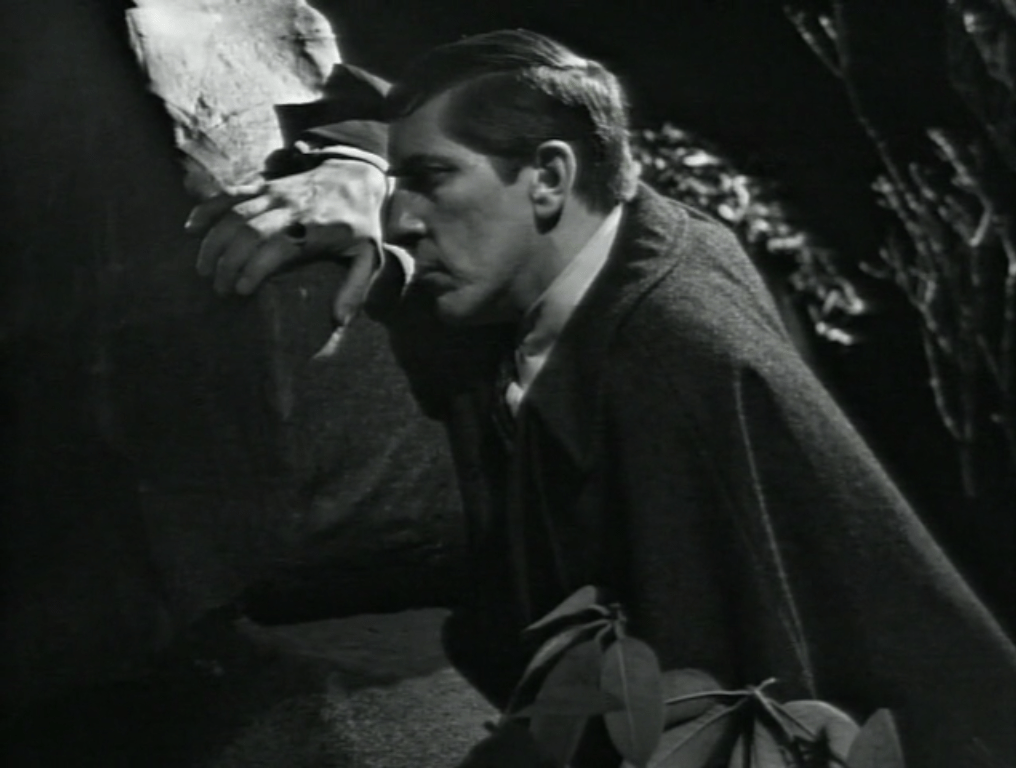
Barnabas hides behind a rock and stares hard at Maggie. When he first sucked Maggie’s blood, Barnabas gained great power over her mind. She has shaken free from that to the point where she can try to kill him and run away from him, but maybe he still thinks he can put some kind of zap on her.

Evil eye

In the hospital, Sam, addled quack Dr Woodard, and Maggie’s boyfriend Joe discover that Maggie has amnesia and thinks she’s ten years old. She greets Sam as “Papa,” a title Sam says she hasn’t used in “a long time.” She did call him that in #200, but that was an ultra-dramatic moment, so maybe he means it has been a long time since she used it when she was calm and cheerful. Sam tells Woodard about Sarah. Maggie reacts to Sarah’s name, which is surprising since Sarah never gave it to her. Maggie has Sarah’s doll, which the men find puzzling but don’t ask her about.

Woodard has an idea. The three of them will tell everyone that Maggie is dead, and she will go to Windcliff, a nursing home a hundred miles north of town, which would put it someplace near Mount Katahdin. There, she will be in the hands of Dr Woodard’s colleague Julia Hoffman.

After Sam and Joe have agreed to this, we see Barnabas enter the hospital. A clock prominently featured on the wall shows that it is 3:30 AM. Barnabas asks to see Maggie. Dr Woodard asks him how he knew she was in the hospital. He claims that he has heard a rumor to that effect from everyone in town. Woodard says he isn’t surprised. Collinsport must be rather an odd place if everyone is up and exchanging rumors at that hour.

Woodard tells Barnabas that Maggie is dead. She never recovered consciousness, so she wasn’t able to tell anyone what happened to her. Barnabas manages to keep from smiling until after he turns his face away from the doctor.

Barnabas’ obvious relief when Woodard tells him that Maggie is dead makes an interesting contrast with the shot of him behind the rock on the beach. Maggie’s amnesia is such a stark change from her mental state in the last couple of weeks that it seems Barnabas must have made a successful attempt to project psychic power against her. But those transmissions go in only one direction- he can’t sense that Maggie is still alive.

This is the first time we hear the name “Julia Hoffman.” Woodard first mentioned Dr Hoffman in #242, when she was a blood specialist and a man. Julia still has expert knowledge about blood, but is now primarily a psychiatrist.

There is a legend among fans of Dark Shadows that Julia transitioned from male to female as the result of a typographical error. Ron Sproat is supposed to have put the name “Julian Hoffman” in the script, but a typist left the “n” off the end of the first name. Executive Producer Dan Curtis liked the idea of a female Dr Hoffman, and they ran with it.

The Dark Shadows wiki explains that the evidence does not support this charming tale. Various members of cast and production staff told various stories over the years to explain the switch, and no surviving paperwork can settle the question for us. It certainly is true that the storylines sometimes took wild U-turns based on last-minute decisions by Curtis and others, and some of those decisions were so whimsical that they may as well have been based on typographical errors. But it is also true that we’ve never heard the name “Julian,” and the near-rhyme of “Julian Hoffman” would be the first awkward-sounding name on Dark Shadows. Further, Woodard stopped mentioning Hoffman weeks ago, likely before ABC had decided to renew the show beyond #260.

If they are going to make another 13 weeks of Dark Shadows, they are going to need new characters and new storylines. They must have responded to the renewal with some story conferences during which the producers, the writing staff, and others tried to flesh out some possibilities.

The writers appear to have decided there would be a secret passage from the Old House to the beach by #238, when well-meaning governess Vicki mentions that the Old House is very close to the sea. That was a retcon that would startle viewers who remembered previous episodes that suggested it was deep in the woods. But it wasn’t clear then that Maggie would be the one escaping by that passage. She was ranging freely through the house at that point, and wasn’t locked up in the cell until #251. Until that point, it was possible Maggie would become a vampire and be destroyed like Lucy in Dracula, leaving Vicki to be the Final Girl who escapes from Barnabas’ clutches and defeats him.

Months ago, they brought parapsychologist Dr Peter Guthrie on the show to help fight undead fire witch Laura Murdoch Collins. In #183 and #184, Guthrie offered to help Laura if she would renounce evil and participate in his research. That suggested the possibility that a complex relationship might arise between the male visiting expert and the undead female menace. Laura was a one-shot monster, on a mission to burn her son David to death and bound to vanish after the attempt, and so could not stay on the show indefinitely. She could respond to Guthrie’s offer only by killing him the night after he made it. But now an undead male menace is here for the duration, so a female visiting expert might be able to pick up the marker Guthrie laid down.

There are a lot of jokes in Dark Shadows fandom about Julia’s two specialties. Psychiatry and hematology don’t usually go hand in hand. I’ve dreamed up a little fanfic that satisfies me about this. I shared it in a comment on Danny Horn’s Dark Shadows Every Day:

The story I made up for myself is that Julia started out as a blood specialist but switched to psychiatry. She was interested in rare diseases, the rarer the better. She found that in hematology, there’s so much money to be made from developing treatments for the most widespread disorders that a researcher with an emphasis in the exotic is constantly fighting an uphill battle for funding and recognition.* Even those colleagues who had an abstract appreciation of the importance of studying rare disorders had to work within a system where all the institutions push them towards the biggest projects possible.

Psychiatry, on the other hand, always had room for the unusual.** In fact, Julia discovered that high-strung rich people would pay a great deal of money to be told that whatever happens to be bothering them at the moment is not the same kind of problem that one of their servants might have, but is a mental aberration hitherto unattested in the annals of psychiatry.*** So she switched to that field and quickly made enough money to open her own, hugely profitable, mental hospital. But she never stopped working in rare blood diseases, and the experiments she was able to finance by flattering the vanity of her wealthier patients earned her such a reputation in a male-dominated field that even her old acquaintance Dave Woodard would commit sexist slips of the tongue and say of “Hoffman” that “he” is “the top man in the field” of rare blood diseases.

Lucrative as Windcliff was, Julia’s true love was never money, or even science per se, but the exotic. When she found herself as the best friend/ frequent accomplice/ bossy big sister of an honest-to-wickedness vampire, surrounded by ghosts and witches and werewolves and Frankensteins and time travelers and interdimensional anomalies and who knows what else, there was never any question of her going back to the office.

*I have no reason to believe this was true in the real world in the middle decades of the twentieth century, or that it is true today. It’s simply part of the fictional world in which I see Julia.
**(Same note)
***(Same note)

“Acilius,” comment left 23 January 2021 on “Episode 1042: Still Another Murderer,” Dark Shadows Every Day, Danny Horn, 2 July 2017