The entire episode is taken up with the thirteenth iteration of something that wasn’t especially appealing the first time we saw it: seagoing con man Jason McGuire makes a demand of reclusive matriarch Elizabeth Collins Stoddard; Liz resists; Jason threatens to expose her terrible secret; Liz capitulates.
Today, Jason makes the ultimate demand, that Liz marry him. In response, she laughs merrily, the first time we have seen her do this. She takes her resistance to the very point of calling the sheriff’s office and admitting that, eighteen years ago, she killed her husband Paul Stoddard and Jason buried him in the basement.
Jason stops her, telling her that the first person who ought to hear her confession is her daughter Carolyn. Liz agrees to this. Jason goes to summon Carolyn from the study, warning her that her mother is “on edge.”
Carolyn comes in. When Liz tells her that she has something important to discuss, Carolyn tries to lighten the mood by joking that it’s a bit late to break the news to her about the birds & bees. When Liz goes into detail about how Paul was a terrible man who never loved her, Carolyn is so upset that she refuses to listen to any more. She hurries out. This is the first time in months that flighty heiress Carolyn has had an opportunity to behave in a flighty manner.
Carolyn returns to the study. Jason is waiting for her there. She asks Jason how her father felt about her. He spins tales about what a loving father Stoddard was, which Carolyn eats up.
Jason returns to Liz. He stands over her, while she tells him Carolyn wouldn’t listen to her. We can see that her resistance is at an end. She asks him to give her time. He answers that he will give her time, but not much.
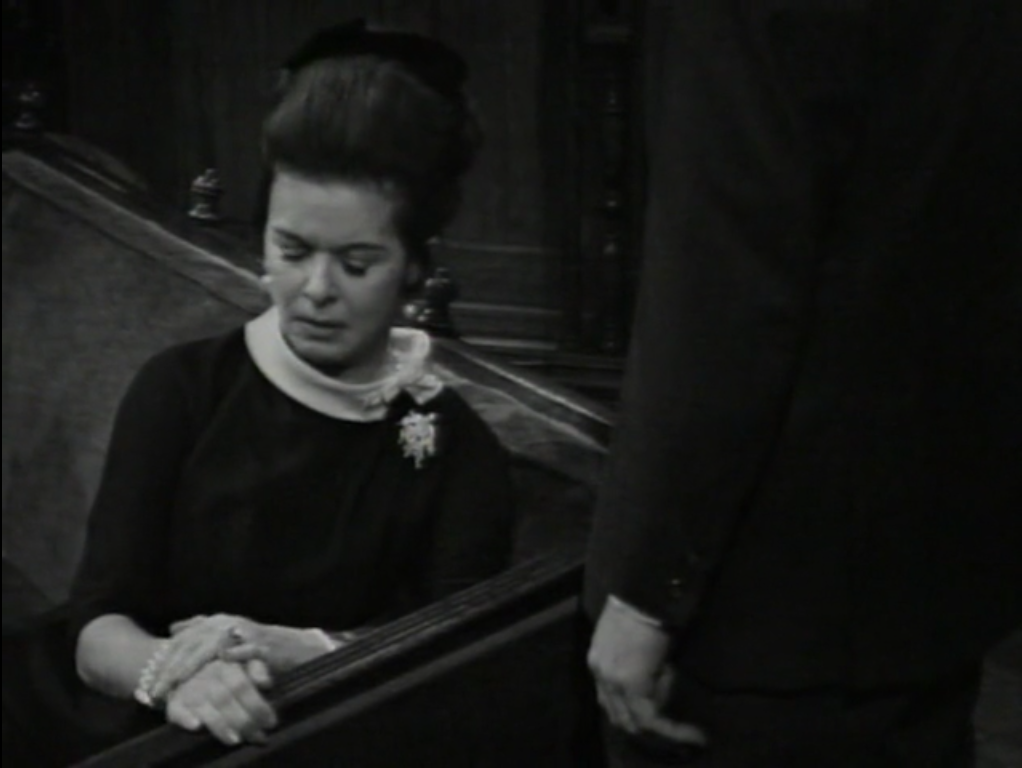
Liz, brokenLiz, still examining Jason for vulnerabilities
Over the last several weeks, we’ve seen Jason doing things other than enacting his liturgy with Liz. He and Liz have even shared a few scenes where they don’t perform it. When Dennis Patrick gets to play a charming swindler who has to think on his feet, he is fun to watch. We’ve come to like Jason enough that seeing him twist Carolyn into a fetter binding Liz to his will is a genuinely horrifying moment.
Barnabas Collins has a problem. He wants people to think of him as a mild-mannered and highly respectable English gentleman, but he is in fact a vampire from central Maine. So he leaves it to his sorely bedraggled blood thrall, Willie Loomis, to keep people away from his house while he himself apologizes for Willie’s curtness.
Today, addled quack Dave Woodard has come to Barnabas’ house asking Willie to help him investigate the case of Maggie Evans, The Nicest Girl in Town, who fell gravely ill and then vanished from the hospital. Willie refuses, but Barnabas promises Dr Woodard he will try to persuade Willie to cooperate. Since Barnabas is keeping Maggie in his house and doing various abominable things to her, we wonder how he will contrive to appear helpful.
Elizabeth Collins Stoddard has a problem. She wants people to think of her as an able businesswoman and a faultless model of virtue, but she is in fact being blackmailed. People have started to notice the money Liz is giving seagoing con man Jason McGuire, and they are certainly talking about the fact that Jason is living in her house. Today, Jason tells Liz that the solution to these problems is for the two of them to get married. Liz is not enthusiastic.
Jason has a problem. Before Barnabas enslaved Willie, Willie was Jason’s dangerously unstable henchman. So Jason doesn’t want people to think of Willie at all. But many do remember his violent ways, and suspect him of wrongdoing in connection with Maggie. Jason visits Barnabas’ house and the two of them talk about Willie and the case of Maggie Evans. Jason urges Barnabas to get Willie to cooperate with Dr Woodard.
Barnabas dislikes Jason; Jonathan Frid and Dennis Patrick play all their scenes together as a drawing room comedy about a snob burdened by the presence of an insufferable bounder. The script doesn’t always give them funny lines- today’s certainly doesn’t- but their nonverbal communication is enjoyable to watch. Frid and Patrick have so much fun with their scenes together that you never notice Frid stumbling over his lines. He is so deeply in character that you’d have to follow along with a copy of the script to catch any bobbles. He caps today’s scene with a moment when Barnabas watches Jason leave. His potentially comic expression of pained politeness gives way to a much colder look, the look of someone planning a drastic action.
Before Jason announces to Liz that he is engaged to her, he talks to her about some of Barnabas’ quirks, suggesting that he intends to continue probing into her cousin’s doings. The hour may be coming very soon when Barnabas will decide he has to deal with Jason permanently.
Today is only the second time we hear a voice announce a recast over the opening title. The first time was in #35, when David Ford took over the part of drunken artist Sam Evans from wildly incompetent actor Mark Allen. This time Robert Gerringer is taking over the part of addled quack Dr Woodard from Richard Woods. Woods only played the role twice, and neither time could he find a way to distract the audience from the ignorance of medicine that the writers showed in their scripts.
Gerringer’s lines don’t make much more sense than did the ones they dumped on Woods, but he acts up a storm. Woodard is examining Sam’s daughter Maggie Evans, The Nicest Girl in Town. Unknown to Sam or Woodard, vampire Barnabas Collins has been sucking Maggie’s blood. Woodard is firm with Maggie when she resists his examination. He seems to be somewhat on edge, just enough that we wonder if there is more to it than the difficulties we can see Maggie giving him. Perhaps he is thinking something he isn’t saying. Woods never managed to make us wonder if his version of the doctor was doing that.
When Woodard and Sam leave Maggie’s room, Woodard assumes an alarmed tone. He tells Sam that Maggie is on the point of death and needs a blood transfusion at once. By showing us that Woodard was concealing the true nature of his concern when he was with Maggie, Gerringer gives substance to our hopes that the character’s nonsensical words and deeds will turn out to be a screen hiding something interesting.
Maggie’s boyfriend, hardworking young fisherman Joe, joins Sam and Woodard. Woodard asks if either Sam or Joe has blood type A. Joe does. Woodard doesn’t ask about Rh factors or Joe’s medical history or anything else, he simply marches Joe into Maggie’s room and the bodily fluids start pumping right away. Joe holds Maggie’s hand at first, but her violent protests force him to let go.
Transfusion
In Bram Stoker’s Dracula, Professor Van Helsing and Dr John Seward give blood transfusions to the vampire’s victims. That novel was written in 1897, and blood types weren’t discovered until 1900, so Van Helsing and Seward take blood indiscriminately from all the men cooperating in the effort to defeat Dracula. Van Helsing is particularly enthusiastic when he learns that Arthur Holmwood has given blood to Lucy Westenra, because Arthur “is the lover of her!” Van Helsing is Dutch, and speaks in a vaguely comical broken English. Woodard doesn’t seem particularly excited that Joe is “the lover of her,” but audiences who had read the book will recognize the allusion.
At this point in the production of Dark Shadows, the tentative plan was that Dr Woodard would become something like the expert on paranormal dangers that Dr Peter Guthrie had been during the Phoenix storyline, and that Barnabas would be destroyed in episode 275. Like Stoker’s Dracula, the Phoenix arc had featured a group of stout-hearted men and one valiant young woman coming together to do battle with an undead menace. Dr Guthrie had been their Van Helsing, an expert from out of town who leapfrogs over some weaknesses in the evidence actually available to the protagonists to get them to the same level of understanding that the audience has been given. Also like Van Helsing, Guthrie is the first to realize that the one female member of the team is the key to the success of their efforts, and so he insists on putting her in situations the other men regard as too dangerous for her. As Mina had been instrumental in the destruction of Dracula, so well-meaning governess Vicki is the person who finally thwarts the plans of the Phoenix.
If Woodard and Vicki are going to destroy Barnabas in #275, we have to wonder what story the show will have to tell in #276. The only other plotline going at the moment is the blackmail of reclusive matriarch Liz by seagoing con man Jason McGuire, and that can’t continue indefinitely. Not only will Liz run out of things for Jason to take away from her, but Dennis Patrick, the actor playing Jason, will leave the show no later than the end of June. Since the end of June is when #275 will be airing, we can hardly expect Jason to take the show over after that time.
In fact, Jason is an in-betweener brought on the show to clear away the last non-paranormal plot elements left over from the period before the show became a supernatural thriller in December 1966. By the time he leaves, both the reason for Liz’ long self-immuration in the great house of Collinwood and the identity of Vicki’s parents are supposed to be laid bare for all to see. Neither of those secrets ever generated an interesting story, but as long as they are around it is at least theoretically possible that the show will become a conventional daytime soap opera again. Without them, they are altogether committed to the spook show route. Destroy Barnabas, and you just have to come up with yet another menace from beyond the grave.
I remember Gerringer’s acting style from the first time I saw Dark Shadows. That was back in the 90s, when it was on what was then called the SciFi Channel. He so perfectly represented the doctor characters on the soaps my mother used to watch when I was a kid twenty years before that seeing him in the middle of a story about a vampire told me everything about the strangeness of a conventional daytime serial switching to a horror theme. If that guy is the one to drive the stake through Barnabas’ heart, or if he is even part of the team that finishes him off, it will be a statement that the makers of Dark Shadows have decided to stop being silly and start imitating The Guiding Light.
My wife, Mrs Acilius, was particularly frustrated with the dialogue in this episode. As Maggie, Kathryn Leigh Scott does a good job with nonverbal communication creating the image of a reluctant patient trying to get out of her skin, but her lines consist chiefly of repeating whatever is said to her. The other members of the cast are equally effective at projecting concern for a loved one whose grave illness they don’t understand and can’t help, but their lines too are so heavily loaded with repetition that we started to suspect that Malcolm Marmorstein was writing for a cast of myna birds. In particular, Woodard’s lines to Sam in the living room repeat the word “shock” so many times that they start to sound like he’s stuttering.
The original choices for the roles of Sam, Joe, Dr Woodard, and Maggie. Photo by Bird Ecology Study Group
In his post about this episode, Danny Horn complains that there is not a single interesting still image in it. I agree with that, though I would say that the actors’ movements tell a story. Granted, it is a story that could have been told in a tiny fraction of the actual running time, but they deserve credit for holding the show together when the script gave them zero support.
Danny says that the episode would have been just as good if it were a radio show. Mrs Acilius says that it would have been “a thousand times better” than it is if it were a silent movie. Maybe they could compromise, and it could be presented with neither audio nor video, and the audience could spend the 22 minutes doing something else.
Dennis Patrick was a fine actor, but so far he has had very little to do as seagoing con man Jason McGuire. Jason’s endlessly repeated blackmail threats against reclusive matriarch Liz are tedious in the extreme, and his attempts to charm others limit Dennis Patrick to the acting choices we might expect Jason to make. Things get livelier when he has to rein in his sidekick, Willie Loomis. Willie was introduced as a dangerously unstable ruffian, and Jason had to scramble to keep up with Willie’s moods. When Jason has to think fast, Patrick has room to maneuver.
Now, Willie is strangely changed. He is ill, and is for a second time a house guest in the great mansion of Collinwood. Flighty heiress Carolyn and well-meaning governess Vicki talk about Willie’s new demeanor, and Carolyn says that it is as if Willie has become another person. Considering that Willie tried to rape each of them the last time he stayed at Collinwood, you might think just about anyone else would represent an improvement, but Carolyn is for some reason distressed.
The episode really belongs to Dennis Patrick. It has never been clear why Jason wanted Willie around, and today there is only one possible answer- he cares about him. Even when Jason has a scene alone with Carolyn and confirms a threat he made a few days ago to make “serious trouble” for her mother Liz if Carolyn didn’t stop asking questions, he never stops being a man concerned for his friend.* It is interesting to see him combine that admirable quality with Jason’s overall rottenness.
Willie is very sick all day, barely able to stay awake, stumbling as soon as he tries to get out of bed. But at nightfall, he seems to gain strength. He hears the sound of a heartbeat. He gets up, goes downstairs, and gets past Jason. We hear a car squeal away while Jason calls after him to come back.
It is unclear whose car this is. The other day Carolyn mentioned “Willie’s car,” but before and after the idea of Willie leaving town had always been mentioned in connection with bus fare. Perhaps we are back to the idea that Willie has a car- he started it so quickly he must have had the keys. Since whatever car it is is parked by the house on what is supposed to be a large estate, its owner may have left the keys on the dashboard, but since Willie seems to have expected to have them it is at least as likely that it is his car and they were in his pocket.
Jason follows Willie to the old cemetery north of town, where he shines a flashlight directly into the camera. Willie disappears into the Tomb of the Collinses, and Jason loses his trail there.
Flashlight halo
*My wife, Mrs Acilius, phrased it this way. She also developed the idea of the episode as a glimpse of a different side of Jason, and called my attention to the phrase “a terrible beating” as the best title for a post about it.
In episode 1 of Dark Shadows, dashing action hero Burke Devlin returned to his home town, the isolated fishing village of Collinsport, Maine. He’d left Collinsport in poverty and disgrace, and returned as a millionaire many times over, the master of a financial empire. He had vowed to use his great wealth to exact vengeance on the ancient and esteemed Collins family. In #201, he gave up his quest for revenge, which had never been very interesting to watch anyway, and now is unconnected to any storyline. He’s still in town though, spending his evenings in The Blue Whale, a waterfront tavern where he has appointed himself to act as bouncer.
In #207, dangerously unstable ruffian Willie Loomis was rude to some other patrons at the Blue Whale. Burke defeated Willie in a fight and ordered him to leave town. Today, Burke comes back to the tavern. No one has seen Willie for a week or so, but neither is it clear that he has left Collinsport for good. Burke is looking for Willie, planning to beat him up again if he finds him.
When Burke enters, he sees Maggie Evans, The Nicest Girl in Town, sitting alone at a table. While she waits for her boyfriend, hardworking young fisherman Joe, Maggie talks with Burke about not knowing where Willie is.
Willie’s associate, seagoing con man Jason McGuire, comes into the tavern. Burke goes up to him. They also talk about not knowing where Willie is.
Joe shows up. He’s been helping his uncle search, not for Willie, but for a missing calf. They found remains of the little guy, far from the farm and completely drained of blood by some mysterious process. They are baffled by this development.
Willie drifts in. He sits down at the bar and starts drinking. Burke goes up to confront him, but is confounded by Willie’s broken demeanor. After a few moments, his hostility gives way to compassion, and he speaks gently to Willie.
Jason returns, and Burke tells him he’s worried that Willie seems to be very ill. Jason then confronts Willie, and is astounded when Willie tells him he doesn’t want the $500 in cash Jason is holding for him. Jason also notices that Willie has some bloodstains on his sleeve.
I like this one. Sure, the writing has its flaws, and there are a couple of shots where it’s hard to tell what the visual composition was supposed to be. And Mitch Ryan is obviously drunk. But they rise beyond all that.
Kathryn Leigh Scott plays Maggie throughout as an understated version of her original wised-up conception, very apt for the barroom setting and a fine offset to the intensity all the male characters have to show this time. She doesn’t have many lines, but she has everything she needs to keep the show on track.
Dennis Patrick’s face and voice show at least two emotions in every shot, and he and Mitch Ryan do a terrific job as two men who don’t like each other but can’t help getting absorbed in a puzzle that fascinates them both. The music that builds throughout that scene and reaches its crescendo as Jason leaves the bar matches the complex emotional palette with which the actors are working; it doesn’t sound anything like the usual Dark Shadows music, and I don’t think we ever hear it again.
Joel Crothers’ turn as the messenger announcing the tragedy of the calves is as tense as the dialogue between Patrick and Ryan, but his studiousness and deliberation change the pace sufficiently to keep the scenes from blurring together. Ryan and Scott deliver their responses to him with a calm intelligence that emphasizes those qualities and makes Willie’s stumbling entrance a real surprise.
Ryan’s scene with John Karlen is a turning point in the series. Burke’s shift from a menacing demand that Willie leave town to an alarmed concern for his well-being marks the end of Scary Violent Willie and the arrival of Wretched Broken Willie, and his conference with Jason confirms that change. Everything Karlen does on the show from this point on, right up to his performance as Kendrick, begins with this scene.
If that looks familiar, it may be because I linked to it on tumblr.
I should also link to a characteristically insightful post in which Patrick McCray explains how this episode, in which Barnabas Collins is neither seen nor mentioned, contributes substantially to the sense of danger surrounding him. The story Joe tells about his uncle’s calf is the show’s first reference to blood-sucking, and it comes after we’ve started to wonder whether Barnabas really is a vampire, or is some less familiar type of hobgoblin.
There is only one ongoing story on Dark Shadows right now, and it doesn’t seem to have much of a future. Seagoing con man Jason McGuire is blackmailing reclusive matriarch Liz, threatening to reveal that she killed her husband Paul Stoddard eighteen years ago and that he buried Stoddard’s body in the basement of the great house of Collinwood. Not only was all of that clear when Liz and Jason had their first conversation several days ago, but yesterday we heard Jason on the telephone making it clear that he is bluffing. If Liz calls the police, he will get out of town as fast as he can. So whatever Liz does in response to Jason’s so-frequently repeated threat, the story can go only so far before it reaches a dead end.
Looking at Jason, audiences at the time would have recognized actor Dennis Patrick as a frequent guest star on prime time television shows and might have suspected that he was too big a name to stay on a daytime soap opera for very long. They would not have known that Patrick always made it a point to have an end date in place anytime he agreed to guest on a soap or that when he played Jason he did not have a contract, and was free to walk away any time he wanted. Seeing him share so many scenes with Joan Bennett, who had been a major movie star for a number of years, they might have thought it was possible he could stick around, but the show so quickly burned through what little story the two of them had that it wouldn’t have seemed likely.
So, what comes next? Alexandra Moltke Isles’ opening voiceover, delivered as always in character as well-meaning governess Vicki, gives us a hint:
My name is Victoria Winters. The foundations of Collinwood house a frightful secret, a secret that has lain dormant for eighteen years, a secret awakened by a stranger. But there is another stranger, one who is to awaken and unleash a force that will affect the lives of everyone.
This other stranger is Jason’s henchman, dangerously unstable ruffian Willie Loomis. At the beginning of this episode, Willie is drinking at the bar in Collinsport’s only night spot, The Blue Whale. There are three other customers in the tavern, an old man at the bar and a young couple in the background* bowing to each other at irregular intervals. If we assume, as I suppose we must, that these movements represent an attempt at dancing, we might wonder if the force Willie is destined to awaken and unleash is choreography.
Maggie Evans, The Nicest Girl in Town, enters. She looks around for a long moment, then slowly makes her way to a table. Willie tells Bob the bartender he wants to buy Maggie a drink. Bob goes to her table, and we see them have a conversation in the course of which Bob gestures to Willie and Maggie shakes her head no. When Bob returns to the bar, Willie tells him that “A good bartender wouldn’t have asked any questions!” Not even what kind of drink the lady would like, apparently. So maybe he’s going to awaken and unleash the force of unconsumed beverages.
Willie goes to Maggie’s table and sits down. When she protests that she’s waiting for someone, he sneers that no one tells him where to sit.** As Willie, James Hall is doing a great job of establishing himself as a clear and present danger to everyone he meets. Maybe Willie was right about one thing- a good bartender would notice Maggie’s discomfort and order Willie out of the bar. It’s obvious that Willie wants to awaken and unleash the force of sexual assault.
Maggie’s boyfriend, hardworking young fisherman Joe, enters. Willie refuses to leave the table and tells Joe to go wait at the bar. Joe squares up for a fight. He and Willie are about to start throwing punches when Jason comes into the bar and commands Willie to back off. At that, Willie awakens and unleashes the force of doing as he is told.
Jason apologizes to Maggie and Joe for Willie’s behavior and tells Bob he wants to treat everyone to a round of drinks. Joe mentions that Maggie’s father, drunken artist Sam, will be sad he missed a free drink. Maggie says that Sam won’t be drinking tonight, because New York art dealer Portia Fitzsimmons is pressing him for more paintings. Evidently Sam will be working more and drinking less now that he is no longer connected to any ongoing storyline.
At the bar, Willie complains to Jason that he’s come to help him, but hasn’t got any money out of the operation yet. Jason gives him some cash and tells him to be patient. The time has not yet come for Willie’s brawn to complement Jason’s brains.
Hall’s Willie does not spend any time processing his emotions or any energy concealing them. When he is getting ready to fight, he displays unfiltered rage; the instant he has to forgo the idea of beating up Joe and raping Maggie, he lowers his eyes and a look of deepest despair comes over him. Much as we hate Willie when he is menacing our friends, the transparency and intensity of his feelings makes it easy to watch him when he is feeling sorry for himself. Why is this strange, horrible man the way he is, and what will he do next? So when he awakens and unleashes the force of whining, it proves to be a strong enough force to keep us watching for a few minutes.
Those are good minutes for Dennis Patrick as well. Monotonous as Patrick’s scenes with Joan Bennett were, his scenes with other members of the cast usually had some element of unpredictability. We don’t know what is going on between Jason and Willie, and Jason himself doesn’t really know what Willie is going to do from one moment to the next. So it’s fun to watch Jason scramble to keep his associate in line. Also, we have a chance to root for Jason, at least for the duration of his two shots with Willie, since his control over Willie is what prevents violence against characters we care about.
Jason’s remark about Willie’s brawn raises the question of what exactly he wants Willie for. Liz is giving Jason everything she has, bit by bit, in response to his blackmail. If that is the whole plan, there doesn’t seem to be any need for brawn at all. Of course, Hall is a short, slender man, so much so that only his well-realized portrait of a violent felon keeps Willie’s confrontation with the substantially taller and more muscular Joe from looking ridiculous. Only Jason’s intervention prevented Willie from awakening and unleashing the force of badly losing a bar fight. Still, we keep wondering what the next phase of Jason’s evil plan will be.
Back at Collinwood, Jason is in the study, smoking a fine cigar. Flighty heiress Carolyn enters, and remarks that the cigar is one of her Uncle Roger’s favorites. Jason says that he knows of even finer cigars, and says that his whole philosophy of life is finding the good things and squeezing whatever he can out of them. Carolyn agrees that he has described himself well, neither hiding her disgust nor disturbing his complacent attitude.
Jason has identified himself as a friend of Carolyn’s father, the long-missing Paul Stoddard. Carolyn explains that she knows very little about her father, and asks Jason to tell her about him. He doesn’t really tell her anything she doesn’t already know, but does remark that “Paul Stoddard and I were very much alike.” He delivers that line in a way that suggests it might become significant. Once Carolyn gets up to go, Jason assures her that he does have stories about Stoddard to tell her some other time. Once she is gone and we are wondering if he really knew Stoddard at all, he steals three more of Roger’s cigars.
When we were watching this episode, my wife, Mrs Acilius, surmised that Carolyn asked Jason about her father less because she wanted to learn about him than because she wanted to figure Jason out. It is strange that she follows her obvious disapproval of Jason’s “philosophy of life” with “I never knew my father…,” unless it is a ploy to get Jason to talk about himself. And indeed, he does tell her far more about himself than about Stoddard. So that may well have been on Nancy Barrett’s mind when she was playing the scene.
A knock comes at the front door. Carolyn opens it to find Willie, identifying himself as a friend of Jason’s and announcing that he has decided to accept Jason’s invitation to stay at Collinwood. Jason is crestfallen to see that he has lost his control over Willie, and we are appalled to see Maggie’s would-be assailant moving into Carolyn’s house.
*This is the man in that couple. He would be a very familiar face on TV for a long time after this. He isn’t listed on either the Dark Shadows wiki or the imdb entry for this episode, and I can’t quite place him.
Hey look, it’s that guy! The one who was on those cop shows, you remember.
UPDATED 7 February 2024: I just spotted him in an episode of Columbo! His name is Paul Jenkins.
Paul R. Jenkins as Sergeant Douglas and Peter Falk as Lieutenant Columbo in The Most Dangerous Match (1973)
Jenkins appeared in a number of feature films, among them Rosemary’s Baby, Chinatown, and Network, and did guest spots on dozens of TV shows, among them the Dark Shadows-adjacent Falcon Crest. Evidently he was friends with Sidney Poitier, the two of them worked together on multiple projects, including Poitier’s 1992 film Sneakers. Most of the images of Jenkins I can find online come from a 1972 episode of M*A*S*H where he played an American NCO who keeps a Korean woman as a slave. This still from The Secrets of Isis illustrates his Wikipedia entry, and the civilian clothing from the 1970s is more typical of his on-screen appearance than was the 1950s Army uniform he wore on M*A*S*H:
Paul R. Jenkins, 1975.
**For some reason, Willie addresses Maggie as “Speedball.” “Listen, Speedball!” he commands. I wonder if Vladimir Nabokov considered Listen, Speedball as the title for a sequel to his Speak, Memory.
The first shot of the first episode of Dark Shadows featured well-meaning governess Vicki sitting on a train next to a window in which we saw the reflection of dashing action hero Burke Devlin. Vicki was on her way to the great estate of Collinwood, where she hoped to learn who her birth parents were. Burke was on his way to the village of Collinsport, where he hoped to exact revenge on high-born ne’er-do-well Roger Collins and other residents of Collinwood.
Vicki’s quest to learn her origins never took off, and hasn’t been mentioned for months. Burke’s pursuit of revenge drove a lot of action in the first twenty-one weeks of the show, but has been fading ever further into the background in the nineteen weeks since. Today, it fizzles out altogether.
In his original story bible for Dark Shadows, titled Shadows on the Wall, Art Wallace had proposed that Burke’s pressure on Roger would culminate in Roger’s death. Roger was to inadvertently reveal to Vicki that he was guilty of the crime that sent Burke to prison long ago. Roger would then try to push Vicki off the cliff at Widow’s Hill, but would miss her and go over the edge himself. The show discarded this resolution when Roger’s relationships with several other characters proved to be consistently interesting, particularly the Bossy Big Sister/ Bratty Little Brother dynamic between him and reclusive matriarch Liz. Besides, Louis Edmonds had such a gift for comic dialogue that he could get a laugh out of even the lines in which Malcolm Marmorstein attempted to be funny. So they couldn’t afford to kill Roger off.
Further, they have gone over Roger’s crime so frequently and made all the details so clear to everyone concerned that a trial wouldn’t give the audience any new information about what happened or show us any characters reacting to shocking news. It would be like a real trial, where all the evidence has gone through a discovery process and there are no surprise witnesses. No one is going to put that on commercial television in 1967.
So when Burke shows up at the great house of Collinwood with drunken artist Sam Evans, who has finally admitted that he saw what happened and took Roger’s bribe to keep quiet about it, the only real question is how Burke can leave the status quo in place.
Burke demands that Roger and Liz meet with him and Sam in the drawing room. Burke demonstrates his mastery by closing the drawing room doors, something that Liz, the mistress of Collinwood, usually does, and that Vicki did several times during the weeks when Liz was away and she was effectively in charge of the place.*
Roger of course tries out a series of lies in his attempts to deny Burke and Sam’s charges, but Liz is convinced. When she picks up the telephone and calls the sheriff, Burke reaches in and disconnects her. He says that she doesn’t have to turn Roger in- it is enough for him to know that she really would do it. She declares that she won’t let Burke keep coming back and using Roger’s guilt to blackmail the family, apparently intending to place another call. Burke says that he will never bring it up again, provided Roger confesses here and now in front of the three of them. He does. Burke tells Roger that he used to want to see him rot in jail but that now he realizes that “People like you rot wherever they are.” Burke and Sam leave, and that’s that as far as they are concerned.
During a few scenes scattered throughout the first forty weeks of Dark Shadows, Burke had considered relenting from his quest for vengeance. Those scenes hadn’t been developed in any great depth, and hadn’t been connected to each other. Only in the climactic week of the “Phoenix” storyline, when Burke and Roger briefly joined forces to save Roger’s young son David from death at the hands of his mother, blonde fire witch Laura Murdoch Collins, did we have a sustained glimpse of something other than all-consuming enmity between the two men. That was such an extreme situation, and was followed so quickly by a renewal of their hostilities, that Burke’s decision to peace out cannot be said to have any foundation in what we have seen the characters do so far. It is simply a convenient way of discarding a story element that has outlived its usefulness.
Most episodes of Dark Shadows have a cast of five actors. The rest are almost evenly divided between casts of six and casts of four. Today is a rarity with eight on screen. Six of these eight have been deeply involved in the Revenge of Burke Devlin storyline, and are at loose ends now that it has reached its abrupt conclusion. Burke, Roger, and Sam suddenly find themselves with nothing in particular to do. Also, flighty heiress Carolyn had a mad crush on Burke that alarmed her mother Liz and terrified her uncle Roger; that ended months ago, and she’s been a utility player ever since. Vicki is starting to date Burke; if Burke is no longer a threat to the family, there’s no obvious drama in that relationship, and she doesn’t have much else going on. David was as fascinated by Burke as Carolyn was; now that Laura is gone and he is happy with Vicki as his substitute mother, he’s pretty well settled in too.
We don’t see wildly indiscreet housekeeper Mrs Johnson today. She had come to Collinwood as Burke’s secret agent. Now that Burke is satisfied, presumably that’s over. Nor does Sam’s daughter Maggie, The Nicest Girl in Town, appear. She’s been dating hardworking young fisherman Joe, rebuffing his suggestions that they think about marriage because she is worried about what is going on with her Pop. Now that Sam’s conflict with Roger has come to its conclusion, there isn’t any reason the two of them shouldn’t get married, or stay unmarried, or whatever. So today’s episode leaves nine of the eleven major characters with no specific connection to any unresolved storyline.
Indeed, there is only one ongoing narrative arc. Long before he wrote Shadows on the Wall, Art Wallace wrote “The House,” a 1954 episode of The Web, an anthology series produced for CBS by Mark Goodson and Bill Todman.** Wallace recycled the story of “The House” for a 1957 installment of an hourlong anthology, Goodyear Playhouse, on NBC. Alternating with Alcoa Theatre in a window known collectively as A Turn of Fate, Goodyear Playhouse featured many pilots. The only one that seems to have been picked up was My World and Welcome to It, which went to series after an interval of more than a decade. I haven’t seen Wallace’s Goodyear Playhouse episode, but the 1954 version is too thin to fill a half hour, so I can’t see that an hourlong reworking would have been likely to catch the eyes of networks that passed on so many other pilots presented in that series, including teleplays by Rod Serling and Paddy Chayefsky. Wallace incorporated the story of “The House” in Shadows on the Wall, and a couple of weeks ago Dark Shadows dredged it up.
Seagoing con man Jason McGuire presented himself at Collinwood, to Liz’ great dismay. So far, they have had five conversations, two of them in Friday’s episode. All have followed the same pattern. Jason and Liz meet in the drawing room; he makes a demand of her; she resists; he threatens to expose her terrible secret; she capitulates. It’s true that on Friday they varied this a bit. Roger was with them during the first session, so that they had to veil their meanings, and in the second session Jason finds that Liz is unable to meet his initial demand, so that he shifts to a second one. In the first scene, they have a lot to show us as Liz and Jason manage to communicate their usual messages without letting Roger in on anything, and in the second they show us that Jason puts a higher priority on keeping Liz under his control than on any particular item he might want her to give him, so they managed to be interesting that day.
Today, Jason and Liz have their sixth conversation. It isn’t in the drawing room this time, but in the basement. While looking for David, Vicki had caught Jason listening at the doors of the drawing room at the moment when Liz was talking about going to the police, and he had rushed up to his room and telephoned*** his associate Willie, telling him they should be ready to get out of town fast. This conversation lets the audience know that Jason’s threat to Liz is a bluff. David had then caught Jason trying to get into the locked room in the basement. David told Liz what he saw Jason doing. Liz then goes down to the basement herself and shines a flashlight directly into the camera. We can see her in the halo, but Jason cannot. He seems helpless while she shines the light at him.
Jason blinded by the light
Jason scrambles a bit to regain control of the situation. Liz tells him he must leave the house immediately. He finally puts into words what the audience has long since figured out is on Liz’ mind, that she killed her husband Paul Stoddard eighteen years ago, that Jason buried him in the room, and that Jason will take this information to the police if she does not comply with his demands. She yields.
Liz’ reaction is interesting in the light of her scenes with Roger. When Burke was in the room, she explained her determination to call the police by saying that blackmail is no life for anyone to live. After Burke and Sam have gone, Roger starts begging Liz to let him and David keep living in her house. She doesn’t seem to know what he is talking about. She says that “Everyone does terrible things,” a remark she had also made to Burke and that is certainly true of characters who last on soap operas. He wants to go on pleading with her, but she just walks off, deep in thought about something else.
Remembering those scenes, we see Liz not simply giving in to Jason, but making a decision to keep going along with him. That makes today’s iteration of Jason Threatens Liz a bit more worthwhile than were the first three, if not quite as lively as the two we saw Friday. We can see something going on in her mind that raises the possibility she might do something different next time.
Two actors have bad trouble with lines today. When Burke is supposed to be saying something very dramatic and powerful about “hypocrites,” Mitch Ryan is actually blabbering about “hippie-crippie… er… hippie-crizz.” And when David Collins meets his Aunt Liz on the stairs and tells her he saw Jason in the basement, David Henesy stumbles over so many lines he falls out of character. Eventually he gets enough of the words out that you can tell what he’s trying to say, but he never really recaptures David Collins’ rhythm and intonations.
This latter slip-up leads to a reminder that there are always people in the audience checking in to a series for the first time with any given episode, so that actors are subject to judgments that don’t take into account what they have done before. At the bottom of their post on this episode, John and Christine Scoleri transcribe a conversation with a friend of theirs who hadn’t seen any of the episodes before this one. He says “Those who think the kid playing David went to any kind of acting school, raise your hand. Now leave the auditorium, please.”
In fact, David Henesy had been working steadily as a professional actor for four years before joining the cast of Dark Shadows at the age of nine. During that time, he had studied under many teachers, among them Uta Hagen. Usually, that background shows through, even when a particular script gives him problems. For example, he had a lot of difficulty with his lines in #191, and I rated that one as one of his weaker efforts. But here’s what Patrick McCray said about it on his Dark Shadows Daybook:
The success of this installment rests on the narrow shoulders of David Henesy. At the end of a big Henesy episode or scene, it’s common to announce that the kid nailed it, and this episode is no exception. His scene partners have it easy. They have straightforward, high stakes objectives to pursue. Either David goes into the fire or he doesn’t. There are only so many ways that people can implore the kid to come to them. On the other hand, Henesy has to stretch out indecision and keep it fresh for twenty minutes… with the help of an “ancient legend” that he recites. Not only does he succeed like a champ, but he concludes one of his better Hagen Days with a tearful catharsis that reads as properly-uncomfortably authentic.
Patrick McCray, Dark Shadows Daybook, 7 March 2018
I disagree with McCray overall about #191- I think Henesy’s line troubles in that one are bad enough that he doesn’t “succeed like a champ,” but I do agree that there are also some good things in his performance, particularly the way he uses his eyes and his posture. And there is no doubt that the last two minutes are very good.
Not even McCray comes to Henesy’s defense regarding #201, though the scene in the basement is all right. David Collins has a pleasant little conversation with Jason, and David Henesy gives sufficient support to Dennis Patrick that we can see just how badly wasted that talented actor is in all of those scenes where Jason repeats his threat to Liz.
*When we were watching the episode, my wife, Mrs Acilius, noticed the significance of Burke’s closing the drawing room doors. She had a lot to say about it, I wish she could remember her WordPress password and write her observations here.
**Later to become game show specialists, Goodson and Todman would be the producers of Match Game, which in the 1960s was on CBS 4:00-4:30 PM Monday through Friday opposite Dark Shadows, and of Password, a version of which would replace Dark Shadows on ABC in that timeslot when the show was canceled in April 1971.
***Just a few weeks ago, Laura nearly succeeded in killing David because there were no telephones upstairs. Apparently that has led Liz to have some new lines installed.







 Dark Shadows Commentary