Episode 868: The man we thought he was

In October 1897, sorcerer Count Petofi has used his powers to steal the body of handsome young Quentin Collins and to trap Quentin in his own aging form. I refer to the villainous Petofi who looks like Quentin as Q-Petofi, and to the forlorn Quentin who looks like Petofi as P-Quentin.

Q-Petofi

We open outside a cave near the estate of Collinwood, where Q-Petofi’s henchman Aristide is on the ground, gradually coming back to consciousness. Q-Petofi had ordered Aristide to hold wicked witch Angelique prisoner in the cave. Shortly after Q-Petofi left, Angelique slipped out of the cave and ran past him. Aristide followed her, and she bashed him on the head with a rock.

Aristide’s eyes focus, and he sees time-traveling vampire Barnabas Collins standing over him. The last time he saw Barnabas was in #842. Barnabas threatened to kill Aristide then, and he was so terrified that he ran away and didn’t come back until he heard that Barnabas had been staked in his coffin. The coffin is in the cave, and Aristide just saw Barnabas in it, the stake still in his heart, so he is shocked to see him up and about.

We cut to the great house of Collinwood, where Q-Petofi and Quentin’s stuffy but lovable brother Edward are recapping another storyline. Edward exits, and a telephone call comes from Ian Reade, MD. Dr Reade says that a strange man is in his office, asking for Edward. When he describes the man, Q-Petofi recognizes him as Barnabas. He takes a gun and goes to Dr Reade’s.

Q-Petofi finds Barnabas lying on Dr Reade’s exam table. He orders Dr Reade to leave. Dr Reade reminds Q-Petofi that they are in his office and refuses to comply with his commands. He does leave for a moment to call Edward again; when he comes back, he finds Q-Petofi holding Barnabas at gunpoint. He bravely tells Q-Petofi that if he wants to kill Barnabas, he will have to shoot him first.

Edward comes. Dr Reade trusts Edward and agrees to leave the room while he is there. After dawn breaks, Edward is astonished to see that Barnabas is still alive. Barnabas tells his old story that he is their cousin from England come to pay his respects. He says that when he first arrived, a man approached him in the dark woods, a man who, when he emerged from the shadows, proved to be his exact double. Until, that is, he opened his mouth and showed two long fangs. Barnabas says that he does not know what happened next or how much time has passed. All he knows is that this strange man kept him captive and dominated his will, from time to time appearing to him and repeating his original assault.

Edward is inclined to believe this story, Q-Petofi to shoot Barnabas on the spot. They compromise, and agree to take him to the cave. If Barnabas’ coffin is empty, they will shoot him. Dr Reade sees Edward and Q-Petofi carrying Barnabas out of his office, and objects that in his condition Barnabas may die if he is subjected to any exertion. When the question is asked if he is willing to go, Barnabas weakly croaks out a “yes.” At that, Dr Reade is willing to wash his hands of the whole thing. For someone who was willing to be shot a few minutes before, it’s quite a startling capitulation.

Q-Petofi does not know that Angelique and Aristide are no longer in the cave, so he insists on leading the way in. He finds that they are gone and the chains around Barnabas’ coffin have been broken. He invites Edward and Barnabas in. He takes it as obvious that the broken chains prove that the coffin is empty, but Edward, with his sense of fair play, insists on opening the coffin before they shoot Barnabas. The body is still there, the stake still in the chest. Barnabas reacts with horror, the others with amazement.

Doppelgänger time.

In #758, Angelique created a Doppelgänger of herself to trick an enemy into thinking that she had killed her, and in #842 she agreed to help Barnabas’ friend Julia Hoffman, MD in a plan to allow him to reestablish himself as a member of the Collins family. Julia was working on a medical intervention to free him of the effects of vampirism, and now we can see that Angelique contributed the grounds for the Collinses to believe that their cousin never labored under that curse.

When Dark Shadows was in production in the 1960s, the legends of King Arthur, the Knights of the Round Table, and the Holy Grail had been fashionable topics in English departments for decades. That vogue was reflected not only in the coursework the writing staff likely did when they were in college, but also in the popularity of novels like The Once and Future King and the Broadway show based on it, Camelot. When I was hanging out in used book stores in the 1980s and 1990s, mass market paperbacks printed in that era collecting the Grail sagas were still a staple.

The coffin in the cave recalls a prominent figure in one of those sagas, a king named Amfortas. In Heinrich of Turlin’s The Crown, Amfortas did not requite the love the mighty sorceress Orgeluse had for him. The humiliated Orgeluse inflicted a wound that both paralyzed Amfortas and made him immortal. In that state, Amfortas was confined to a coffin that was hidden in a cave. Sir Gawain found the coffin and freed Amfortas both of his paralysis and of his immortality.*

Longtime viewers of Dark Shadows will see many parallels to the story of Barnabas and Angelique in Heinrich’s story of Amfortas and Orgeluse. During the part of the show made and set in 1968, two mad scientists played the role of Sir Gawain in returning Barnabas to humanity. The first was a man named Eric Lang, the second was Julia. Now, Angelique herself, who was the original source of the curse that made Barnabas a vampire, combines the functions of Orgeluse and of Gawain. She not only frees Barnabas, but also redeems herself. The Grail legends also abound in other elements that figure prominently in this part of the show. For example, Count Petofi was originally on the show as a severed hand with magical powers, later to be reunited with the rest of its body. Gawain’s most famous story is of his battle with the Green Knight, who starts off as a severed head. Doppelgänger abound in the Grail legends, especially the so-called Vulgate Lancelot where a double of Queen Guinevere sets off a whole arc.

Dr Reade is played by Alfred Hinckley. Hinckley was in plays on and off Broadway, and when the networks ran a lot of programming produced in New York, his was a frequent face on American television. He was in Dark Shadows episode #1 as the conductor of the train that brought well-meaning governess Vicki Winters and dashing action hero Burke Devlin to Collinsport. Longtime viewers were reminded of that train in #850; maybe the production staff was reminded of it too, and that was why they called Hinckley to make his second appearance on the series today. It’s also his final appearance.

*Richard Wagner’s opera Parsifal features another version of the Amfortas legend, calling the sorceress by a different name, omitting Amfortas’ paralysis, leaving out the coffin in the cave, and giving the honor of healing Amfortas and succeeding him as king of the Grail to Percival rather than Gawain.

Episode 862: Reexamine your loyalties

Know Yourself

In yesterday’s episode, Kitty Soames, the dowager countess of Hampshire, found a note on the dresser in the room where she has been staying in the great house of Collinwood. It read “Know yourself, be who you must be.” The dramatic date is 1897, 1504 years after the Delphic oracle went out of business, so it is unlikely that its management sent the message as a translation of and commentary on their motto γνῶθι σεαυτόν.* It was also 83 years before the US Army adopted the slogan “Be all you can be,” so we can rule out the idea that a recruiting sergeant was trying to get Kitty to enlist. The US Army didn’t even accept countesses in those days, not even if, like Kitty, they originally came from Pennsylvania and are now in Maine.

Ever since she arrived at Collinwood in #844, the ghost of the gracious Josette has been taking possession of Kitty from time to time. The note prompts another spell of Josettification. Kitty puts on Josette’s wedding dress and wraps a red cloak around it. She mutters that “He is waiting for me,” not specifying who “he” is. She goes to the top of Widows’ Hill, the precipice from which Josette flung herself to her death a century before.

Josette was married to Jeremiah Collins. Jeremiah’s ghost appears to Kitty/ Josette. He urges her to leave Collinwood at once, lest “he” kill her. By this time the possession has worn off, and Kitty has no more idea who Jeremiah means by “he” than anyone overhearing her earlier would have known who Kitty/ Josette meant when she said that “he” was waiting for her.

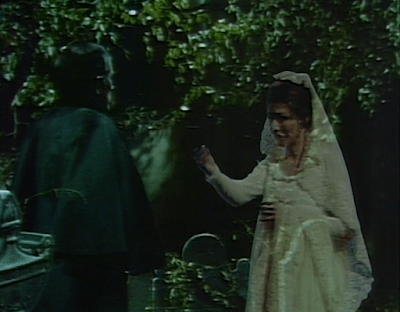
Jeremiah’s ghost reaches out to Kitty.

Be on Guard Against Your Enemies**

Jeremiah vanishes, and Kitty is joined by a man she believes to be Count Petofi, the sorcerer who drove her husband to suicide. She fears Petofi and hates him, and is unhappy to find herself standing next to him at the top of a cliff, especially when she is in a confused frame of mind.

In fact, the man is not Petofi. Two weeks ago, Petofi used magic to force the devastatingly handsome Quentin Collins to change bodies with him. Now Petofi occupies Quentin’s strong young form, while Quentin is trapped in Petofi’s aging and feeble one. While this predicament lasts, I refer to Quentin as played by Thayer David as P-Quentin, and Petofi as played by David Selby as Q-Petofi.

P-Quentin meets Kitty.

P-Quentin tells Kitty that he saw Jeremiah’s ghost and assures her he did not cause it to appear. He tells her he is going to Collinwood, and firmly recommends she accompany him. She waits a moment, but seeing no alternative, she goes his way.

Do Not Fight an Absent Foe***

When P-Quentin first found himself estranged from his own body and encased in Petofi’s, he was too stunned to show much tactical sense. He went around blurting out what had happened, earning nothing but a reputation as a lunatic. Now he has learned to let people believe he is Petofi and to conduct himself as befits that role. So yesterday, he found that his sister, Judith Collins Trask, had returned to the house after a long absence. She had not met Petofi, so he introduced himself to her by that name and used his memories of their childhood to befriend her.

Back at Collinwood, P-Quentin enters the drawing room and tells Judith that Kitty is resting comfortably upstairs. Judith is impressed with his thoughtfulness, and leaves him alone in the drawing room while she goes to Kitty’s room. He sees that she is preparing a note for her attorney, Evan Hanley. It occurs to him that Evan can be of use to him, and he sets out for his house.

Give the Advice the Time Calls For ****

P-Quentin knocks on Evan’s door. Evan never met Petofi, and does not recognize him. He and Quentin were for a long time close friends and fellow Satanists, and when he identifies himself as Quentin he does not gain credence. He pushes his way in, and eventually persuades Evan to take him seriously. Evan agrees to go to Collinwood and see if the man who appears to be Quentin knows him, and, if he does not do so, to trick him into participating in a ceremony to reverse the body-swap.

Judith comes. While P-Quentin hides on the terrace, she tells Evan that she wants to revoke the power of attorney she granted to her husband, the odious Gregory Trask, while she was away. Evan makes excuses, but she insists, and he agrees to follow her directions. She exits.

P-Quentin returns, and tells him that if he has involved himself with Trask’s evil schemes, it is time for him to disentangle himself from them.

Act Like a Stranger, If You Are One*****

Back at Collinwood, Q-Petofi opens the drawing room door and sees Judith. Petofi never met Judith, and Quentin has not seen her since she left more than thirteen weeks ago. Not knowing who she is, Q-Petofi simply apologizes, says he didn’t know anyone was in there, and leaves. Thinking he is her brother, Judith is of course indignant.

Q-Petofi walks in on Judith.

Judith goes to the foyer and says she expected a warmer greeting. Not having the faintest idea who she is, the best Q-Petofi can manage is “Welcome to Collinwood.” When she protests that even their rather distant brother-sister relationship entitles her to expect better than that, the light comes to him and he calls her by name. This does not appease her.

There is a knock at the front door. Judith is enraged to see Q-Petofi standing still, and orders him to answer it. He does, and lets Evan in. When he does not speak to his old friend, Judith demands to know if he doesn’t recognize Evan either. Q-Petofi pretends to know him, and is powerless to do anything but agree when Evan asks him if he remembers the meeting at his house tonight.

Q-Petofi had been cruising along unchallenged so far. How could he not, when the secret he is concealing is so bizarre? But his interaction with Judith, though it has not exposed his identity, has antagonized someone whose support would be useful to him, and now Evan knows that P-Quentin was telling him the truth.

Know Your Chance ******

Q-Petofi shows up at Evan’s. After some verbal jousting, Evan tells Q-Petofi to take a seat with his back to the room. He says that he has been chosen to preside over the festivities. P-Quentin sneaks up and chloroforms him. Evan says that he doesn’t know how long the chloroform will last, so they must proceed with the ceremony at once.

Honor Good Men *******

When Jeremiah’s ghost fades away, we see Timothy Gordon for the last time. Gordon was a frequent stand-in and background player starting in July 1966. His right hand, which he extends to Kitty in the screenshot above, was the hand that shot out of the coffin Willie Loomis was trying to plunder in #210. In mischievous moments, I think that makes him “Barnabas Collins #1,” in imdb terms. Then again, Jonathan Frid had posed for the face of the portrait of Barnabas some weeks before, and producer Robert Costello modeled for the portrait’s body before that. Many of his fellow extras went on to big careers, but Gordon’s turn as Jeremiah’s ghost made him the only performer to graduate from background player to credited member of the main cast of Dark Shadows. So I think of him as their representative.

*Greek for “Know yourself,” one of 150 maxims inscribed in the walls at the oracle. Γνῶθι σεαυτόν (gnōthi seauton) was one of two inscribed at the entrance, the other being Μηδεν ἄγαν (mēden agan,) “nothing in excess.” The maxims are preserved in a book by a fifth century CE author named Stobaeus; many of them appear on stones that archaeologists have found at Delphi. There’s a handy list of them on Wikipedia, pairing the Greek with some more or less OK translations. The eighth maxim on Stobaeus’ list is Σαυτον ἴσθι (sauton isthi,) “Be who you are,” which sounds a bit like the second half of the note on Kitty’s dresser.

**Stobaeus’ twenty-ninth maxim is Ἐχθρους ἀμύνου (ekhthrous amynou,) “Be on guard against your enemies.”

***Stobaeus’ 125th maxim is Ἀπόντι μὴ μάχου (aponti mē makhou,) “Do not wage a battle against one who is absent.”

****Stobaeus’ 103rd maxim is Βουλεύου χρόνῳ (bouleuou kronoi,) “Give the advice right for the time.”

*****Stobaeus’ twelfth maxim is Ξένος ὢν ἴσθι (xenos ōn isthi,) which we would translate word for word as “Stranger being, be.” The idiom plays on two senses of the verb εἰμί- the participle ὢν means “If you in fact are,” while the imperative ἴσθι is “assume the character of.” It is the same kind of play on words that you see in the word “like” in the English sentence “Time flies like an arrow, but fruit flies like a banana.”

******Stobaeus’ tenth maxim is Καιρον γνῶθι (kairon gnōthi,) “Know the proper time.”

*******Stobaeus’ sixty fifth maxim is Ἀγαθους τίμα (agathous tima,) “Give honors to the good.”

Episode 860: I just say things

Edward Collins isn’t what he seems. His stuffy manner is real enough, as are his kind impulses when he sees people in distress. But he allows those who meet him to believe that he is the heir to the vast Collins family fortune, which in fact belongs in its entirety to his sister Judith. Judith is currently an inmate in a mental hospital. During her absence, her husband, the odious Gregory Trask, exercises control of all the family’s assets. Edward hopes to get out from under Trask’s thumb by marrying the dowager countess of Hampshire, a young American woman named Kitty Soames. He befriended Kitty while a houseguest of the late Earl’s, and now that she is widowed and is his guest at the great house of Collinwood he sees an opportunity to take over the Hampshire interests.

Kitty isn’t what she seems. The Earl was bankrupt when he died. He had lost all his wealth and been driven to suicide by sorcerer Count Petofi. Kitty wrote a letter to her mother the other day saying that unless she marries Edward and becomes the mistress of Collinwood she didn’t think she could raise train fare from central Maine to her home in Pennsylvania. Nor is this all. If Kitty were simply without funds, she and Edward would be on an even footing. But she is not what she seems in a metaphysical sense as well as a financial one. She is intermittently possessed by the ghost of the late Josette Collins. Regular viewers have reason to believe that she is Josette’s reincarnation, and that the fits of possession are part of the process by which Josette is reuniting her spirit with her body. But the characters don’t know what we know. As far as they are concerned, Kitty seems to be a plain lunatic.

At rise, Edward catches Kitty in his brother Quentin’s room. She is rummaging through an armoire, apparently looking for something. He asks her what she is doing, and she feigns one of her fits. Kitty is not nearly as good an actress as Kathryn Leigh Scott; she doesn’t fool us for a minute. But Edward believes her. He gently escorts her out of the room. As they leave, we see a face peering at them from the shadows. It is Quentin’s face.

Downstairs, we hear Kitty’s thoughts as she takes satisfaction in having fooled Edward into thinking she was having a fit. Mental health professionals often talk about how people learn to use the resources they have, so that patients who carry diagnoses of major disturbances will sometimes find ways to exaggerate their symptoms for effect. It’s true that psychotic episodes are not usually an asset in the husband-hunting business, but everyone in the segment of Dark Shadows set in 1897 has some issue or other, and Edward really does have a soft spot for mentally ill women (unless they are married to Quentin, but that’s another thing altogether.) So Kitty may as well play up her particular case of dissociative identity disorder.

Kitty was in Quentin’s room trying to steal a portrait of him. She was doing this from her fear of Petofi, whom she believed to have ordered her to bring him the portrait before 9 PM lest he use his magical powers and make her vanish. It is almost that time now, and she has no idea how to find the portrait, let alone get it to him before the deadline. While she is worrying about this situation, a woman named Angelique enters.

Angelique isn’t what she seems. She is one of Quentin’s fiancées, and Edward takes her to be an innocent woman, about 30 years old, who has been hard done by in the course of the supernatural doings of the last several months. In fact, she is a wicked witch who wrought immense destruction the first time she was at Collinwood, in the 1790s, and again the second time, in 1968. She has traveled back in time to 1897, and has been one of the most powerful participants in all of the strange goings-on.

Kitty tells Angelique that she saw Petofi in the vacant rectory on Pine Road, and that he told her the woman who had been squatting there vanished into thin air before his eyes. At this, Angelique turns and rushes off to investigate. It dawns on Kitty that Angelique knows more than she is saying. We cut to the drawing room, where Edward is bracing for a conversation with Quentin.

Quentin isn’t what he seems. In fact, he isn’t Quentin at all. Petofi forcibly swapped bodies with him a few days ago. It is Petofi, using Quentin’s body as a disguise, who confronts Edward and demands to know what he and Kitty were doing in the room. I refer to this form of Petofi as Q-Petofi, and the Quentin who looks like Petofi as P-Quentin.

Q-Petofi confronts Edward. Screenshot by Dark Shadows Before I Die.

Edward tells Q-Petofi that Kitty had had a “seizure.” Q-Petofi expresses skepticism about this claim. He proceeds to tell Edward that Kitty’s late husband died in poverty, shortly after being released from prison for a jewel theft. Edward is thunderstruck. He calls the story a lie, and forbids Q-Petofi from repeating it to anyone.

Kitty goes to the village of Collinsport, and pays a visit to The Blue Whale, the local tavern. She wants to see the entertainer, Miss Pansy Faye.

Pansy isn’t what she seems. She has met the Collinses twice. Miss Charity Trask, daughter of Gregory and enforcer in his operation, came to the great house in #727 and took up residence when her father married Judith. Pansy Faye, mentalist and Cockney showgirl, came to the estate in #771 as the coldly cynical fiancée of the childlike Carl Collins. Pansy was killed the night she arrived. A few weeks later, Pansy started to take possession of Charity, and in #819 Petofi erased Charity’s personality altogether and gave her body over to Pansy.

When Kitty enters, Pansy is alone in the bar. She is picking out her theme song on the piano. When Petofi was in the process of switching bodies with Quentin, Quentin was with Pansy in this room. Petofi took control of him briefly and played the same song on this piano. He played it very impressively.

Kitty is desperate to find out what is happening to her, and she knows that Pansy has powers. Once Pansy assures her that she doesn’t work for Count Petofi, Kitty offers her a diamond-encrusted brooch in return for information. Pansy is offended. She says that she will take a gift in return for her services after she has rendered them, but that she does not accept payment in advance. She tells Kitty that there is one way to find out what is happening to her, which is to have a séance. Kitty gets up to leave, and Pansy presses the brooch on her.

The diamond brooch is a puzzle. Perhaps Kitty was lying to her mother when she said that she couldn’t buy a train ticket to Pennsylvania? Or perhaps the brooch is part of the late Earl’s ill-gotten gains, and Kitty doesn’t want to show it to anyone more reputable than Pansy.

Nancy Barrett’s approach to all her roles on Dark Shadows was to throw herself completely into whatever the character was doing at any given moment. That isn’t to say that her performances lacked nuance or that she didn’t support her scene partners, but that her method was to take her part from the outside in, letting the action supply the motivation. As Kitty, Miss Scott has opportunities to take this same approach. But in Kitty and Pansy’s scene in the Blue Whale, she deliberately lets Miss Barrett drive the action. Since Pansy has already completed a process of possession and transformation like that into which Kitty is now entering, Miss Scott can convey a great deal of information about Kitty’s state of mind by giving rather subtle reactions to Pansy’s behavior.

Back at Collinwood, Edward and Q-Petofi are drinking. Edward shakes his head at his brother’s ability alternately to enrage him and charm him. Q-Petofi asks him to be the best man at his wedding to Angelique; Edward agrees at once. Angelique enters, and Edward exits.

Angelique says that she doesn’t want to get married after all. Q-Petofi insists they go ahead. She points out that it was her idea, and he was extremely reluctant to agree to it. This is true- the engagement was part of Angelique’s price for invoking the power of Satan to break spells Petofi had cast on Edward and his son Jamison. While Q-Petofi has managed to copy Quentin’s behavior towards Edward almost exactly, his behavior towards Angelique has been radically different than was Quentin’s. We don’t know what Angelique has made of this.

Edward finds Kitty and Pansy preparing the séance. After an initial protest, he declares he will join them. It ends with a visual quote from Dark Shadows‘ first séance, back in #170. As in that episode, a hooded figure appears in the doorway.

The hooded figure in #170 turned out to be undead blonde fire witch Laura Murdoch Collins. Another iteration of Laura was on the show as Edward’s estranged wife in April and May. It seems unlikely she is coming back, so longtime viewers are in suspense as to the significance of the allusion.

The hooded figure today is Natalie Norwick, making the last of her seven appearances as an uncredited stand-in on Dark Shadows. Norwick was in many plays on Broadway, as the lead in more than one, appeared in three feature films, and worked steadily in television from 1945 until the mid 1960s. She retired from acting in 1982, returning to the Broadway stage as understudy to her friend Julie Harris in 145 performances of The Gin Game from 1997 and 1998 when she was in her mid-70s. When Harris had a fall in 1999, Norwick took over the part, playing it in Florida and Washington, DC. She was chiefly based in Los Angeles in the late 1960s; perhaps she took the stand-in work to pay some bills during visits back east.

Norwick is best remembered for a single supporting performance on television in 1966. She appeared in “The Conscience of the King,” an episode of the original Star Trek, as Martha Leighton, the wife of Captain Kirk’s troubled friend Tom. She didn’t get much screen time, but she made the most of it. After Tom is murdered, she plays Martha’s understated reaction with a quietness that startles you no matter how many times you’ve seen it. Norwick is another of the significant talents one wishes Dark Shadows had found more to do with.

Episode 859: Not this grownup

Nine year old Nora Collins enters the drawing room of the great house of Collinwood. She walks in on her father, the stuffy but lovable Edward, embracing Kitty Soames, the dowager countess of Hampshire. She gives them a dirty look and says she supposes Edward is too busy to join her in a game of checkers. He says he does have to run an errand, but suggests that Nora play with Kitty.

Kitty is eager to ingratiate herself with Nora, who clearly wants nothing to do with her. Nora asks, in an icy voice, if the reason Kitty wants to be her friend is that she is planning to marry her father. Returning viewers suspect she is right. Kitty and Edward have more in common than they know. Both are penniless, each is sure the other is very rich, and each imagines marriage to the other will solve all their problems. Kitty can’t very well level with Nora about this, so she claims that the women in the Collins family, being outnumbered by the men, have to stick together. Nora does not hide her distaste at Kitty’s inclusion of herself among the women of the family. Kitty asks Nora if she wants her father to be happy. Nora drills her eyes into Kitty’s face and says in a firm, flat voice “I want that.”

Nora asks Kitty if she is just letting her win at checkers. While she is asking this, Nora moves twice in one turn and takes three of Kitty’s pieces. Kitty watches this without protest and denies that she is letting her win. She then says she wants to concede the game and listen to whatever information Nora is willing to share about the family.

Nora is not impressed with Her Ladyship. Screenshot by Dark Shadows Before I Die.

Edward comes back from his errand to find Nora packing up the checkers and the board. He asks if she enjoyed her game with Kitty. Not looking up, Nora says they never finished it. Kitty hastens back in and asks if she wants to finish it now. Edward points out that it is getting close to Nora’s bedtime. He kisses her, and bids her say goodnight to Lady Hampshire. Kitty asks Nora to call her by her first name. Nora pointedly says “Good night, Lady Hampshire.”

It doesn’t show in her scenes with Nora, but Kitty seems to be suffering from a severe mental health crisis. Returning viewers know that the ghost of Josette Collins is taking possession of her, and suspect that she will turn out to be a reincarnation of Josette. Edward knows enough about the supernatural doings on the estate of Collinwood that he might give Kitty the benefit of the doubt when, for example, she comes running in today and is shrieking about a haunted house, a vanishing woman, and a curse that follows her everywhere. But she is so often so highly distraught that Nora must have noticed that she is not right in the head, and she can hardly look forward to having such a person as a stepmother.

Shortly before Nora enters, Edward calls Kitty “Katie.” This is a small enough slip of the tongue, but Kathryn Leigh Scott’s friends call her Katie, so it is a case of an actor’s name in place of the character’s. I think I can see Louis Edmonds blush a little when he realizes what he has done.

This episode marks the final appearance of Nora, and very nearly the last time we will hear Nora’s name. I think she was badly underused, disappointingly so after the outstanding work Denise Nickerson did as Amy Jennings in the months leading up to the segment set in 1897. She will be back later, in other parts.

Director Henry Kaplan was not much of a visual artist, and his deficiencies are particularly glaring today. Especially during Kitty and Nora’s first scene, the camera keeps drifting up to the actors until we see a randomly selected two-thirds of their faces in extreme closeup. Once the shot excludes the eyes or the mouth, it abruptly pulls back. Even the successfully framed closeups are rarely in focus, and you can forget about finding coherent visual storytelling in any kind of shot other than a closeup. The actors themselves do a good job, in spite of Kaplan’s notoriously unpleasant behavior towards them, but aside from a few evocative facial expressions, most of them by Nickerson, it may as well have been a radio play.

Episode 856: Like a new man

Evil sorcerer Count Petofi has cast a spell causing his mind to take over the body of rakish Quentin Collins, while Quentin is confined to Petofi’s own body. So David Selby begins playing a youthful and handsome Petofi, while Thayer David plays an aging and pudgy Quentin.

In their post about the episode on Dark Shadows Before I Die, John and Christine Scoleri use a wide variety of expressions to refer to the characters Thayer David and David Selby play today. I will just call Thayer David’s character P-Quentin and David Selby’s Q-Petofi.

Both of those actors give superb performances today; David Selby makes Q-Petofi’s preening arrogance suitably repellent, while the 42 year old Thayer David shows us P-Quentin reduced to the total helplessness of a despised man in extreme old age. There is a scene that Mrs Acilius and I found particularly hard to watch when Q-Petofi’s henchman Aristide takes the thick glasses without which P-Quentin is effectively blind and holds them away from him.

Q-Petofi and Aristide’s gleeful cruelty to P-Quentin make us wonder how the count and his henchman feel about the body they are looking at. The show’s earlier body swap story, in which vampire Barnabas Collins had hoped to die and come back to life in the form of Frankenstein’s monster Adam, led Adam to ask Barnabas in #587 “How could you hate yourself so much that you wanted to change your body?” We hadn’t known that that the count hated himself at all until we saw this scene, but he must have done to take such delight in tormenting P-Quentin, and Aristide’s revelry shows that he, too, harbors more hostility to his master than he ever dared expose.

Q-Petofi taunts P-Quentin. Screenshot by Dark Shadows Before I Die.

P-Quentin staggers away from the lair of Q-Petofi and Aristide and meets broad ethnic stereotype Magda Rákóczi in the woods. He tries to explain his true identity to Magda, who has experience with magic and has for some time now been his ally. But Magda’s fear of the count keeps her from listening to the far-fetched tale, and she rushes off.

P-Quentin makes his way to the door of his home, the great house of Collinwood. He stands there, and we hear his thoughts, in David Selby’s voice. He tells himself he cannot go in, because no one there would believe him if he told them who he was. He slinks off to the caretaker’s cottage, where he meets maidservant Beth, who is his sometime fiancée. He tries to tell her the story, but she too is terrified of the count. When Q-Petofi shows up, she leaves with him.

Magda is a wonderful character, and what we have seen has given us every reason to hope she will be a substantial part of the show for a while yet. Unfortunately, this is her final on-screen appearance. We will hear her voice once more, six weeks from now. The show has always been visually ambitious, and lately they’ve managed to pull some neat tricks with videotape that led me to hope we would see at least one scene in which Grayson Hall appears opposite herself as both Magda and time-traveling physician Julia Hoffman. When Hall appeared in the 1970 film End of the Road, she said that it was a relief from playing Julia, to whom she apparently referred as “that tight-ass doctor.” Magda is earthy enough that it would have been fun to see how Hall would have used her to demonstrate the same attitude towards Julia, even if she had to stick to words approved by the ABC network’s Standards and Practices office, and Julia’s reaction to Magda would doubtless have been just as much fun.

Episode 838: Your part in this drama is finished

In #836, the ghost of maidservant Beth Chavez appeared to Julia Hoffman in the year 1969. Beth told Julia what happened on the night in 1897 when she shot the rakish Quentin Collins to death.

Regular viewers would have recognized the events Beth described as different from what would have happened when Quentin originally died in 1897. For the last 28 weeks, the show has been set in that year because Julia’s friend, recovering vampire Barnabas Collins, accidentally traveled back in time while trying to figure out why Quentin had become a ghost bringing death and misery to everyone on the estate of Collinwood. In 1897, Barnabas met the living Quentin and befriended him, but also changed the history of the period substantially. So a wicked witch named Angelique, who was not at Collinwood the first time through 1897, is there on this iteration of events. Beth’s night took the turn that would lead her to shoot Quentin when Angelique told her that her engagement to Quentin was off and that Angelique would be marrying Quentin instead.

After Beth told her what happened in the latest version of 1897, Julia herself traveled back in time, determined to rescue both Quentin and Barnabas. Once she got to her destination, she was too dazed to speak. But Quentin found a letter in her pocket that Barnabas had written, and it led him to Barnabas. Barnabas was able to tell Quentin that he was fated to be killed tonight, after his nephew Jamison rejected him. He had no more to tell him, nor could he restore Julia’s ability to speak.

We open today with Quentin holed up in his room, waiting for midnight to come and go. Sorcerer Count Petofi knocks on his door; Quentin jumps to the conclusion that it is Petofi who will kill him. In fact, Petofi has learned of Quentin’s current fate, and offers to help save him. Quentin has ample reason to distrust Petofi, and refuses the offer.

Jamison then knocks. Quentin lets him in; the two have a happy talk about how much they enjoy each other’s company, and Quentin decides he won’t stay in his room after all. This leads directly to the reenactment of the scenes Beth had described, including Beth’s conversation with Angelique, Jamison’s discovery of Beth in the act of attempting suicide, Jamison’s consequent rejection of Quentin, and Beth’s pointing a loaded pistol at Quentin while she declares that she has decided to kill him.

Quentin’s time in his room shows that his behavior afterward is the direct result, not only of Barnabas’ intervention, but of Julia’s as well. So what we are seeing today is not what happened the first time through 1897 or the second, but is yet a third version of events. It does end quite differently- Petofi turns up in the nick of time and prevents Beth from shooting Quentin. The whole basis of the fantasy of going back in time to change events is the experience of rewriting stories, of what fandoms call “retroactive continuity” (“retcons” for short.) In the contrast between the two versions of the night of 10 September 1897 that Dark Shadows shows us, and in the contrast between each of those and the original events that we never saw, the story merges into the process of writing the scripts, and the characters explicitly create their own retcons.

Petofi tells Beth that she ought to leave Collinwood at once and go as far away as possible, because “Your part in this drama is ended.” The incorporation of retcons as an overt story element shows that metatheatricality can be fun, but I have to say it was pretty cold of Dan Curtis to delegate the job of firing actress Terrayne Crawford to the character Petofi.

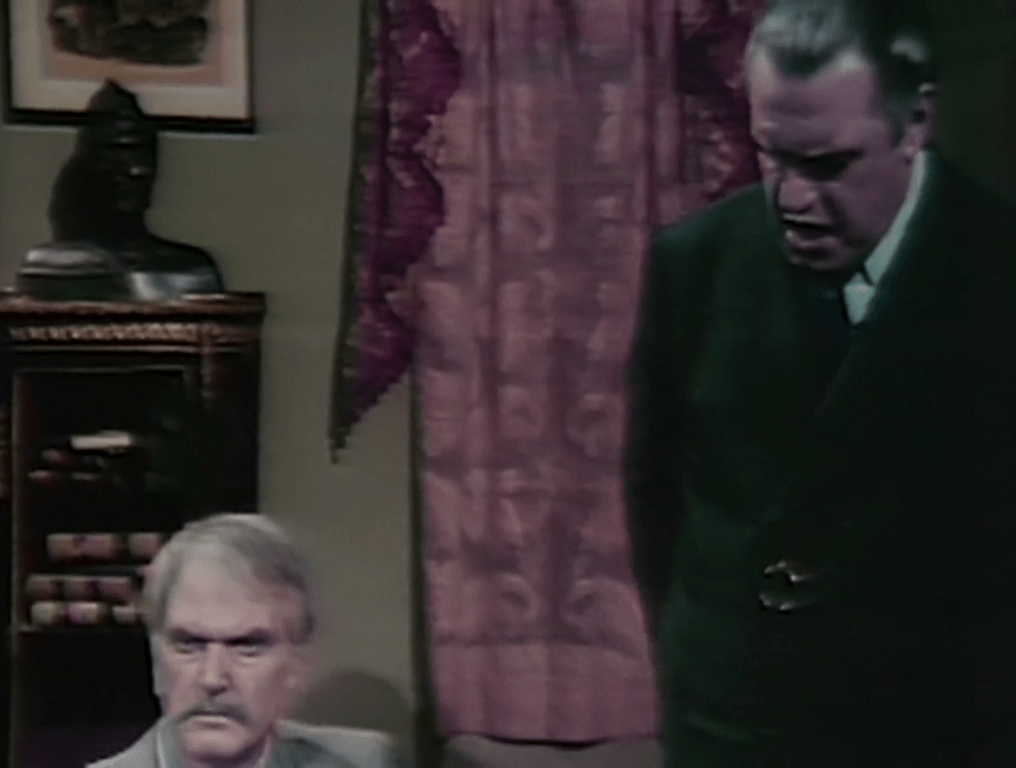
Count Petofi tells Terrayne Crawford she won’t be getting another contract.

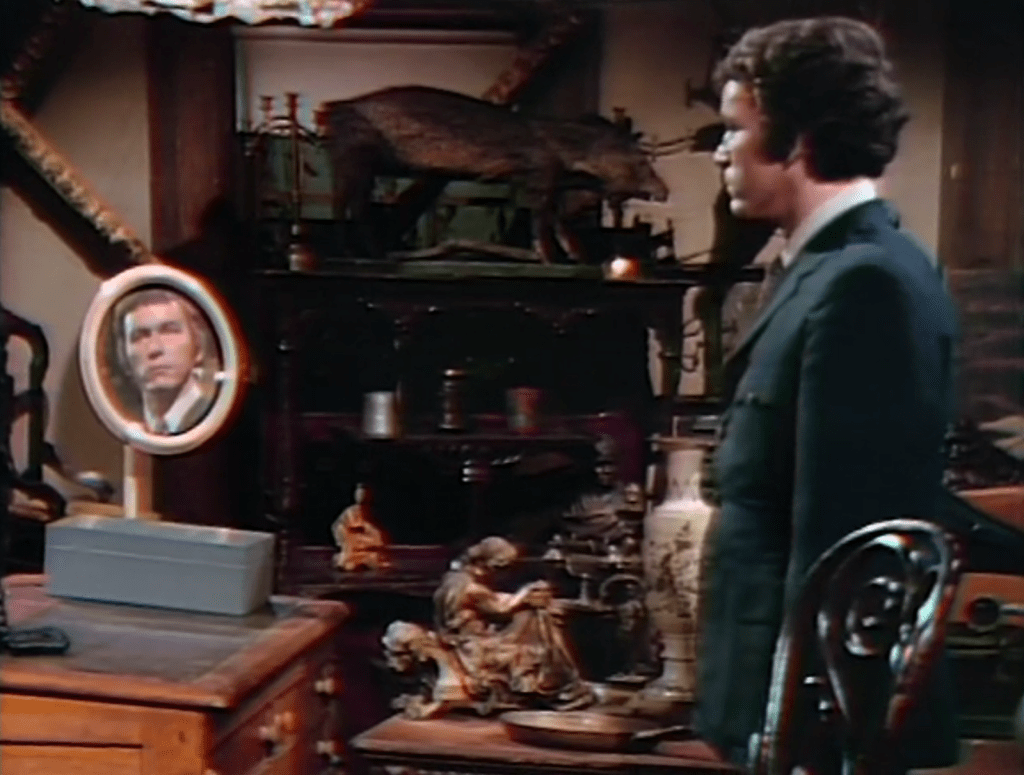
Petofi then goes to Quentin’s room and tells him the price for his services- Quentin must betray Barnabas. Quentin resists this demand until Petofi shows what else he has already done for him. Petofi commissioned a portrait of Quentin. Quentin saw the portrait the other night when there was a full Moon, and he was horrified by what he saw. The portrait bore, not his usual features, but those of a wolf. Since Quentin is a werewolf, he thought the portrait was a cruel reminder of his curse. But when Petofi bids him look at the portrait again tonight, Quentin sees his accustomed face. Petofi explains that the reason Quentin remained human that previous night was that the portrait changed, and that as long as the portrait remains intact Quentin will be free of the effects of the curse. Quentin’s blissful reaction to that news suggests that Petofi was right to tell him that he belonged to him now and would be able to refuse him nothing.

Sadly, this episode marks the last appearance of the character Jamison Collins. David Henesy plays the same scenes with the same dialogue he had on Monday, but he did a great job then and does an equally great one today. He’ll be back tomorrow for a brief appearance as his 1960s character, David Collins, then will be absent from the cast for almost 11 weeks. We’ll miss him while he is away.

Episode 830: Up in the tower room, all bloody

We open in the woods on the estate of Collinwood, where a young woman in heavy makeup and bright clothing is crying. Another woman in even heavier makeup and even brighter clothing approaches and asks her what is wrong. The first woman says that she had a vision which told her that the rakish Quentin Collins will die of stab wounds twelve days from now, on 10 September 1897.

The first woman used to be Charity Trask, the miserably repressed daughter of the evil Gregory Trask. She is now possessed by the spirit of Cockney showgirl Pansy Faye. Charity knew that Quentin was a werewolf, and wanted nothing to do with him. Evidently Pansy did not acquire that knowledge when she took up residence in Charity’s body, and has decided that she will marry Quentin. Quentin has no interest in either Charity or Pansy, and already has two other fiancées, one of whom he loves, at least after his fashion, and the other of whom is sealed to him by a pact with the Devil. Yesterday Charity/ Pansy learned of the second engagement, and tried to kill Quentin to prevent it coming about; week before last, she tried to end the first engagement by killing the fiancée. Pansy had her faults, but she wasn’t inclined to physical violence. That part seems to be Charity’s contribution to the symbiont.

The other woman is broad ethnic stereotype Magda Rákóczi. Magda was the one who made Quentin a werewolf in the first place. She cursed him for murdering his wife Jenny, who was her sister. It was only after she had placed the curse that Magda learned that Jenny had given birth to Quentin’s twin children, a boy and a girl. Since the curse is hereditary, Magda is now desperate to lift it, and she and Quentin have become allies.

Some time ago, we learned that if Quentin dies, there will be no hope of lifting the curse. So Magda is terrified when Charity/ Pansy tells her of her vision of Quentin’s death.  She takes her back home to the great house on the estate, where her father and Quentin are bickering while they recap yesterday’s story. Trask tries to deny that Charity/ Pansy is insane or that she is capable of killing, but when she enters and announces that she will murder the first person who comes between her and Quentin he has to admit that it might be time to find a place for her in residential care.

We turn our attention to the upstairs of the great house. We see Charity/ Pansy in bed, with Magda sitting in a chair beside. The gramophone is playing a record of Pansy Faye’s theme song. Regular viewers will wonder where Charity/ Pansy could possibly have found such a thing. Charity never met the living Pansy, who was killed the very evening she arrived at Collinwood. Perhaps Pansy’s fiancé, the childlike Carl Collins, bought the record when he met Pansy in Atlantic City and brought it back with him. Carl himself was killed well before the possession began, but perhaps Charity or Charity/ Pansy found it among Carl’s effects.

Charity asks Magda if she likes the tune. “I only like Gypsy music,” she replies. Charity/ Pansy and Quentin both reiterate their theme songs endlessly, but few other characters in the 1897 segment have so much as a dedicated entrance cue. This line of Magda’s makes us wonder what the show might have been like if they had given every major character a theme song.

Trask has a crisis in the drawing room. He hears a ghostly voice warning him that there will be another killing soon. He starts shouting the name “Minerva!” and pleading for mercy. First time viewers might not know what to make of this. Those who have been with the show for a while know that Minerva was Trask’s wife and Charity’s mother, and that he instigated a plot to murder her so that he could marry wealthy spinster Judith Collins and become master of Collinwood. When the voice starts to talk about “the beast that walks like a man,” Trask says “You’re… not Minerva?” Jerry Lacy is an expert comic actor, and his delivery of that line is laugh-out-loud funny.

The same ghost appears visibly to Quentin in his room. He recognizes it as that of Tessie Kincaid, a woman he killed in a recent fit of lycanthropy. He knows that she is appearing to him because tonight there will be a full Moon.

Tessie appears to Quentin. Screenshot by Dark Shadows Before I Die.

Magda enters and finds Quentin writing a suicide note. She tells him he must not kill himself. She chains him to a post in his room and stands by with a pistol. Trask enters and finds them in this compromising position. Mrs Acilius and I laughed as we imagined how Magda and Quentin might have claimed they were planning to spend the evening.

But there is no point in lying to Trask. Between what Tessie’s ghost told him and what he overheard while eavesdropping on a conversation Quentin and Magda had earlier in the drawing room, he has figured out Quentin’s problem. He takes the gun from Magda and recognizes the bullets with which it is loaded as silver. He announces that he will wait until the Moon rises and see what happens.

Tessie’s turn today marks Deborah Loomis’ third and final appearance on Dark Shadows. Miss Loomis didn’t get to do very much, but she made the most of all of it, and I wish we had seen more of her.

Episode 828: Sovereign of the worms

In 1897, King Johnny Romana is the hereditary chieftain of a Rroma tribe that has long been at war with ancient sorcerer Count Petofi. King Johnny is at the supreme moment of his destiny, standing over Petofi with his scimitar raised, ready to deal the ultimate blow, when a creepy little guy ruins it all for him. Petofi’s henchman Aristide throws a knife and catches King Johnny in the back. Aristide has a dagger with a curved blade that he sometimes calls “The Dancing Girl,” other times “The Dancing Lady”; he makes a big deal of it, the thing fascinates him. But when he kills King Johnny, Aristide doesn’t even use his special knife. It’s a brutal anticlimax for King Johnny.

King Johnny does live long enough to tell Petofi that he isn’t safe yet. After nine days pass, he will appear to another Rroma, somewhere in the world, and will pass on to that person his immunity to Petofi’s magical powers and his mission to kill him. After Aristide buries King Johnny, he finds that the scimitar has vanished. Evidently it will go to the new avenger.

Meanwhile, at the great house of Collinwood, twelve-year old Jamison Collins is dying. Petofi cast a spell causing Jamison to be possessed by the spirit of his grandson David Collins, who will live in 1969. But David won’t live at all unless the spell is broken, because it is killing Jamison. Jamison’s devoted uncle, rakish libertine Quentin Collins, makes a deal with wicked witch Angelique. He will marry her if she manages to break Petofi’s spell and save Jamison. They made a similar bargain previously, but that time her magic failed.

Petofi senses that his spells are being challenged. He marches to Collinwood and orders Quentin to make Angelique stop what she is doing. Angelique herself enters; she and Petofi confront each other, then she goes back to the study to resume her attempts to free Jamison. We end with Petofi preparing to cast a spell against her.

Petofi confronts Angelique in the drawing room at Collinwood while Quentin looks on. Screenshot by Dark Shadows Before I Die.

This is an entertaining, fast-paced episode. It’s too bad it is the final appearance of actor Paul Michael in the series. He played the most unpromising part of King Johnny so skillfully that we barely noticed he was little more than a menacing pose, an evil laugh, and an ethnic stereotype. He does return with a small part in the feature film House of Dark Shadows, but it would have been fun to see what he could do with a really meaty role.

Episode 819: You’re a bit of all right, you are!

Evil sorcerer Count Petofi tells the disastrously repressed Charity Trask that he will show her a vision of her own death. He’s tried that twice before on other characters, with mixed success, and it doesn’t work at all with Charity. He can’t see the visions he causes her to have; when she describes them to him, he is afraid that she has seen, not her own impending demise, but his. He casts a spell on her and rushes out.

Petofi meets his boyfriend Aristide and takes him on a shopping trip through the cemetery. What he wants with the body he orders Aristide to exhume is not made clear.

The importance of the episode is in the spell Petofi casts on Charity. He effectively murders her. For the rest of the segment of Dark Shadows set in the year 1897, Nancy Barrett will play, not Charity, but Pansy Faye, Cockney showgirl who came to the great estate of Collinwood as the fiancée of the daffy Carl Collins. The show often tends towards the somber, so it is a joyous thing to see Charity/ Pansy enthusiastically shake her moneymaker.

It is sometimes said that Petofi makes Charity believe that she is Pansy, but this is not correct. Charity never met Pansy, and barely knew the late Carl. She certainly never saw Pansy perform on stage. Yet she sings Pansy’s theme song word for word and note for note as she did, and does the dance that went with it just as Pansy did it. She has Pansy’s garish sense of style, her not-very-convincing East London accent, and her memories of Carl. Petofi has caused Pansy to take possession of Charity and to live again through her body, as he has caused David Collins, strange and troubled boy indigenous to the mid-twentieth century, to take possession of his grandfather Jamison Collins. While David’s spirit is killing Jamison’s body, Pansy seems to be having a wonderful time in Charity’s person, certainly far more than Charity ever had herself. As for Charity’s mind, that seems no longer to exist.

Episode 797: I do not like death at all

Vampire Barnabas Collins, werewolf Quentin Collins, and broad ethnic stereotype Magda Rákóczi hold a séance to contact the spirit of Rroma maiden Julianka. This is the thirteenth séance we have seen on Dark Shadows. It deviates from the previous ones in three important ways. First, no one objects in the middle of it and has to be sternly hushed by the séance-leader. Second, it doesn’t matter that the physical contact among the participants is broken- previously it had been a fatal error if anyone stopped touching the fingers of the people on either side of them, but this time Quentin jumps up and runs out and it’s no problem. Third, Julianka does not choose one of the participants as a medium and speak through them, but manifests as a ghost.

Julianka appears. Screenshot by Dark Shadows Before I Die.

Perhaps because they are rewriting the rules of the Dark Shadows séance, they make a reference to an earlier milestone in the show’s development. The séance is held in the parlor of the Old House on the estate of Collinwood. That isn’t unusual; séances have been held there on three previous occasions, including the second and in some ways most dramatic one, held in #186. What makes the location noteworthy is Julianka’s movement when she first appears. She comes in as a green screen effect hovering somewhat above floor level, then takes several steps down an unseen staircase.

We have seen that same movement on this same set. It was in #70, when the ghost of the gracious Josette was the first supernatural being to become visible to viewers of Dark Shadows. Aside from the reuse of that footage, we have not seen a ghost move that way since. Compared with the changes that began when Josette walked down from her portrait in #70 and brought the supernatural back-world that had been implicit in the show from its first week into the foreground, these changes to the rules for séances are small potatoes.

Barnabas and Magda hoped to persuade Julianka to give them some information they needed to lift the curse from Quentin and cure his lycanthropy, but she isn’t interested. She blames them for her death, and will not even let them ask questions, let alone answer them. They try to protest that they weren’t the ones who killed her, but she ignores them. So far from helping them end Quentin’s curse, she places a new curse, this one on Magda. She decrees that everyone who loves Magda will die. That was the same curse wicked witch Angelique pronounced on Barnabas in #405 when she made him a vampire. Longtime viewers will be unsure how Julianka’s curse will operate- Magda doesn’t seem likely to become a vampire, but perhaps they are suggesting she will turn into a monster of some other kind.

Unfortunately, Julianka’s appearance today is the last time we will see Diana Davila. In her approach to the role, Miss Davila concentrated very much on her eyes. She kept them open wider than I would have imagined a person could open her eyes, did not blink, and when she looked from side to side she did not turn her eyes in their sockets, but instead turned her head. This dictated a rigidity of movement for the rest of her body and a narrow range of inflection for her voice. Taken as a unit, these mannerisms made for a perfectly logical way of expressing Julianka as a strange, unreachable person, an emissary not only of the tribe of King Johnny Romana, but of another world altogether. In practice, this style had a drawback given the conditions under which actors had to work on Dark Shadows. In the three episodes where Julianka was a living being, Miss Davila did not have quite enough time to learn her lines. She did better than did most cast members, but the particular illusion she was trying to create could be shattered by the slightest bobble. This time, though, she is letter-perfect, and as a result the scene with Julianka’s ghost is one of the most effective in the series.