Wicked witch Angelique made her first appearance in #368/369, set in the year 1795. We first saw Angelique when she entered the doors of the Old House on the estate of Collinwood, working as a lady’s maid and hiding her powers.
Today, it is 1970 and Angelique is back in the Old House. Her ex-husband, vampire Barnabas Collins, has summoned her and asked her to lift a curse she placed on Jabe, the husband of his distant cousin Carolyn. Barnabas tells Angelique that her quarrel was never with Jabe, but with suave warlock Nicholas Blair. Earlier in the episode we had seen Angelique and Nicholas having a discussion about how much they hate each other. He taunted her by claiming she has not changed in the last 200 years. When Barnabas invites Angelique to redirect her wrath towards Nicholas, she perks up. She orders Barnabas to fetch Carolyn’s husband and leave him alone in the Old House with her.
Angelique sits by the fire with Jabe and explains that she cannot simply liquidate the curse. It must end with someone’s death. But the good news is that it does not have to be his death. He can transfer it to someone else. He says he doesn’t want to kill anyone. She tells him that the person she has in mind is Nicholas. Suddenly he’s all ears as she explains the process for handing the curse over.
Angelique finds the limit of Jabe’s newfound reverence for life. Screenshot by Dark Shadows Before I Die.
Longtime viewers know that Nicholas was quite wrong to say Angelique has never changed. She was monomaniacal and utterly narcissistic in 1795. She wasn’t so very different when we next saw her in 1968, though the show’s pace was a bit slower at that point and so Lara Parker was free to play her with more nuance. That made a difference that the show underlined early in 1969, when Barnabas took a brief trip back in time to the 1790s and ran into Angelique as she was when first we knew her. Even though they were still enemies in 1968, they occasionally had to tell each other the truth, and occasionally had to leave each other alone to fight other adversaries. The unbending hostility the eighteenth century version of Angelique showed Barnabas startled him and us after we had seen the relatively circumspect approach she took to conducting a cold war against him.
Throughout most of 1969, Dark Shadows was set in 1897. Angelique showed up then, and she remembered the events of 1968. Barnabas and his friend, mad scientist Julia Hoffman, were there as time travelers. Julia actually befriended Angelique, and Angelique became Barnabas’ ally in the battles he attempted to wage in that period. Angelique even let go of her erotic obsession with Barnabas, transferring her affections to his distant cousin Quentin Collins.
After the show came back to contemporary dress, Julia stumbled upon Angelique. She found that Angelique had sworn not to use her powers, had married a man who made her happy, and had lost all interest in Barnabas or anyone else at Collinwood. She was as relaxed and attentive to others as in 1795 she had been frantic and self-absorbed. Only after it turned out the same supernatural enemies Barnabas and Julia were fighting had corrupted her husband did Angelique start casting spells again, and then in pursuit of more rational, identifiable goals than she had ever sought in the eighteenth century.
That arc of character development ends with this episode. We will see Lara Parker as several more characters up to and beyond the end of the series, some of them named Angelique, but none of whom went through the transformations we have seen.
Today also marks the final appearances of werewolf Chris Jennings and his girlfriend Sabrina Stuart. Evidently the makers of the show planned to bring them back in a few months, after an upcoming story plays out, but by that time actor Don Briscoe was unable to work. He had bipolar personality disorder and tried to self-medicate with street drugs.
Quentin was such a big hit in 1897 that they had a magic spell put on him that immunized him against aging and brought him intact to the contemporary setting. Today, Barnabas takes Quentin to a room in the long disused east wing of Collinwood where you can occasionally catch glimpses of an alternate universe. The effect manifests while they are looking in, then winks out, leaving the dark, bare room that is in that space in their universe. Once that happens, Barnabas announces “You have just seen Parallel Time.” Those of us who have been watching from the beginning know that he got the line wrong. You’re supposed to say “Parallel Time is a Dan Curtis Production.”
When Dark Shadows began, its most dangerous villain was high-born ne’er-do-well Roger Collins. Since the plan was to kill Roger off after his crimes were exposed, writer Art Wallace and actor Louis Edmonds were free to present him as gruesomely as they pleased. That turned out to be so much fun for all concerned that it soon became impossible to imagine the show without Roger, and the plan changed.
Once Roger was established as a permanent part of the ensemble, they toned his wickedness down. He still did and said awful things, but they would pull him back whenever he might risk alienating the audience. So, he at first openly expressed his hatred for his young son, strange and troubled boy David, and in #68 and #83 coldly exploited David’s mental health problems to manipulate him into trying to murder well-meaning governess Vicki. But when David got Vicki into a situation that might actually have resulted in her death, Roger rescued her. When Roger’s estranged wife Laura showed up and wanted to take David away with her, Roger was so delighted at the prospect of getting rid of the boy that he willfully ignored one sign after another that something was seriously wrong with Laura. But when Vicki finally proved to him that Laura was an undead fire witch who intended to incinerate David, Roger joined in the effort to save him, and was so shaken by the experience that he would never again be overtly hostile to David.
Nor was his attitude towards David the only sign of Roger’s pathological lack of family feeling. He had squandered his inheritance, selling his half of the family business to finance his extravagant lifestyle. His sister, reclusive matriarch Elizabeth Collins Stoddard, went deep into debt buying back what Roger had sold. When Roger ran out of money, Liz took him and David in at the great house of Collinwood. When in #41 Liz reproved Roger for the difficult position she had put him in, he proudly declared that he had “enjoyed” his inheritance, and twitted her for her dreary ways. Liz gave Roger a job in the business, but the only time we saw him visiting his office he answered his phone and told the caller that what he was asking was someone else’s job. When in #273 Roger found that seagoing con man Jason McGuire had tricked Liz into believing that she had a terrible secret that she could keep only by surrendering her whole fortune to him in blackmail payments, he admitted to his sister that if she had confided her troubles in him, he would probably have done the same thing.
When vampire Barnabas Collins succeeded Laura as Dark Shadows‘ supernatural Big Bad, Roger was pushed to the margins of the story. From that time on, he had two things to contribute. The first were sarcastic remarks, many of them very funny, that established him as the show’s sardonic gay uncle. The second, which gave him what little function he retained in the plot, were ostentatious refusals to believe the evidence piling up on all sides that the family was beset by a procession of bloodthirsty monsters. Since several other characters, Liz among them, also refused to face these facts, the show could go long periods of time without featuring Roger at all.
In November 1967, Vicki came unstuck in time and found herself in the year 1795. From then until March 1968, Dark Shadows was a costume drama set in that period. The segment was a hit in the ratings, and a triumph for Louis Edmonds, who was cast as haughty overlord Joshua Collins. Joshua was the opposite of Roger- as protective of the family’s position as Roger was careless of it, as committed to making money as Roger was thoughtless in spending it, as courageous in the face of physical danger as Roger was cowardly. The 1790s segment became The Tragedy of Joshua Collins, as we saw how Joshua’s best qualities led him to create the dark and twisted world in which his descendants would grow up to be weak, selfish men like Roger.
When the show came back from the 1790s, Roger was obsessed with a portrait painted in those days. The portrait’s subject was Angelique, the wicked witch who precipitated the disasters that annihilated Joshua’s family. Before long, Angelique herself returned, wearing a wig, using a false name, and married to Roger. The spell Angelique cast to win Roger occasionally caused him to think he was Joshua, and by the time that story ended Roger had become, if not the imperious tycoon Joshua was, certainly a hard-working, conscientious family man. He still had a languid manner and a way with a quip, but was otherwise unrecognizable as the show’s original Man You Love to Hate.
Evil spirits drove the Collinses out of the great house of Collinwood in #694. That episode marked the end of Roger’s function as one of the “There must be a logical explanation!” people. He was the last member of the family to insist that everyone else was being silly, but when he finally accepted the reality of the situation and was on his way out of the house, he turned to declare to the ghosts that the living would be back to reclaim what was rightfully theirs. From that moment on, Roger was no longer a narrative brake pad.
For most of 1969, Dark Shadows was set in 1897. In that year, we got to know Quentin Collins, who as a ghost would be chiefly responsible for the haunting that had driven the Collinses out of Collinwood. We saw that the living Quentin was a charming rogue, a spendthrift who cheerfully tells his sober-minded sister Judith that he can waste money faster than she can give it to him, inclined to violence when it serves his purposes and quick to run away when he is in danger of being called to account for his crimes. In short, he is what Roger originally was, only played by a younger, sexier actor, and with an unlimited future on a show that has discovered the characters won’t alienate the audience by being evil, only by being dull.
In the 1897 segment, Edmonds played Quentin’s brother Edward, who was not dull, but not evil either. Edward was stuffy and hypocritical. He was occasionally cruel, sometimes because of greed, sometimes because of prejudice, and sometimes because he flew into a panic in the face of an unexpected danger. But he was sincerely devoted to his children, and he had a sense of decency that would assert itself even after he had done awful things. For all his faults, Edward was ultimately one of the most lovable characters Dark Shadows ever created. If 1795 was The Tragedy of Joshua Collins, 1897 was largely the Comedy of Edward.
After 1897, Dark Shadows spent several months bogged down in an attempt to make a story out of some themes drawn from the tales of H. P. Lovecraft. Roger showed up in this part of the show just a few times. Quentin, brought into contemporary dress intact due to his great popularity in the 1897 segment, told Roger what was going on in #958. Rather than scoff as he would have in 1967 or 1968, Roger accepted Quentin’s account at once and helped him in the battle. Roger had by that point turned into Edward. His habit of denial was gone, and with it all of his languor and most of his wit.
Now the show is clearing out the last villains left over from the Lovecraft project and launching a story about a parallel universe that is occasionally visible through a doorway in the long-disused east wing of the great house. Roger is active in both of these plots today.
Even when he was a villain who cared nothing for his son, his sister, his family name, or Collinsport Enterprises, Roger very much enjoyed the company of his niece, Carolyn Collins Stoddard. On Friday, he was hugging Carolyn while she wept about the difficulties she was having in her new marriage; he called her “Kitten,” a term of endearment he has used with her since #4. In those early days, the show was heavy with hints that Roger and Carolyn’s relationship verged on incest. She often answered to “Kitten” in the moments when those hints were most insistent. But there was nothing unwholesome about Roger’s embrace of Carolyn on Friday, and he is irreproachably fatherly in his attitude towards her today.
At rise, Carolyn is in a trap. A man named Bruno, one of the leftover villains introduced while the show was dealing with the Lovecraft-derived material, has tricked her into entering a room where he has already imprisoned her old friend Chris Jennings. Bruno locked the door, and Carolyn saw that Chris was on the floor, writhing in pain. She asks him what is wrong, he won’t answer. Carolyn doesn’t know it, but Chris is a werewolf. The moon is rising, and his pains are the first stage of his transformation.
Bruno’s master wants Carolyn’s husband dead, and has decided that if the werewolf kills Carolyn he will lose the will to live. Since it would have been at least as easy to get the husband into the room as it was to get Carolyn there, and since one of the main things they have told us about the husband is that he is vulnerable to werewolf attacks, this scheme is unnecessarily complicated, marked for the audience as likely to fail. Indeed, since Bruno, his master, and Carolyn’s husband are all short-timers who don’t really need to be on the show anymore, while Carolyn has been a core member of the cast since #2, we can be quite sure it will fail, and if we have spent time over the weekend wondering about the cliffhanger, we’ve spent it wondering what will save Carolyn.
What saves Carolyn turns out to be well-timed intervention by her Uncle Roger. Roger was worried that she wouldn’t tell him why she was crying about her marriage, and followed her to Bruno’s place. He saw her enter, and after a few minutes let himself in. He confronted Bruno in his parlor, heard Carolyn and Chris in the back room, and found that the door to the back room was locked. When Bruno told him the door would stay locked, Roger hit him on the head with a candlestick, knocking him out. He took Bruno’s key, unlocked the door, and freed Carolyn. While Roger telephoned Collinwood to ask for permanent houseguest Julia Hoffman, MD, Chris jumped out of the back room’s window. Roger then decided that he and Carolyn should go home.
It may strike first-time viewers as odd that Roger calls Julia and not the police. Established fans will be unsurprised, knowing that the Collinsport Sheriff’s office is one of the world’s most useless organizations and that Julia is a mad scientist whose powers know few limits. Still, once Roger gets Carolyn home he does tell her they should call the sheriff. She refuses, and also forbids him to tell her mother Liz anything about what has happened.
Roger finds Liz moping in the drawing room. He strikes up a conversation about Carolyn’s troubles. He says that he and Liz both made unhappy marriages, and that it is disappointing to see that the next generation seems determined to repeat their mistakes. He says that he wishes Carolyn would confide in one of them. Liz says that all she knows is that someone or something is threatening Carolyn’s husband, and that she refuses to discuss it. The camera pulls back, and we see that Carolyn is right there. Director Henry Kaplan was pretty bad at moving the actors around and even worse at figuring out where to point the camera, but he deserves credit for this shot. When we suddenly see Carolyn standing there, we realize that Roger and Liz are so deep in their worries that they are oblivious to their surroundings.
Carolyn insists on going to the carriage house on the grounds of the estate to see her husband. Since Bruno is at large, Roger objects. He can’t mention Bruno in front of Liz, since Carolyn has decreed that her mother must not be told what happened earlier in the evening, so he is powerless to stop her going.
Bruno does catch up with Carolyn, and he tells her he is going to kill her. Before he can do so, the werewolf springs out, pushes Carolyn aside, and slashes Bruno. She goes home and tells Roger and Liz what happened. From Carolyn’s description, Liz recognizes the werewolf as the same creature they encountered in late 1968 and early 1969, and Roger rushes out.
Roger finds Bruno on the ground. He tells Bruno he will call a doctor. Bruno says it’s too late. He says a few words (“animal… not an animal…”) and loses consciousness.
Back in the great house, Roger says that the police are searching the grounds for the werewolf. He says it’s terrible that Carolyn should have met with such an incident on top of what has already happened to her. Liz asks what he means, and Carolyn glares at him, appalled at his indiscretion. He stammers out something about how she’s having marital problems, then announces he has to go because he promised to do something for Barnabas.
Roger and Liz never have figured out that Barnabas is a vampire, and though Carolyn was briefly his blood thrall she’s forgotten all about it. So far as the Collinses are concerned, their distant cousin Barnabas is just a night person. Several times now, Barnabas has looked into a room in the east wing and has seen, not the dark space, bare floor, and sparsely decorated walls that are there in his universe, but an alternative version of the room, brightly lit, fully furnished, and heavily decorated. He has seen people with the same looks, voices, and names as people he knows, but with different personalities and relationships. He has reported this to Julia and her friend, Professor Timothy Eliot Stokes, who have explained to him the many-worlds hypothesis.
On Friday, Barnabas told Roger about the room and about Julia and Stokes’ theory. The Roger of 1967 and 1968 would have jeered at Barnabas before he had spoken five words, but in 1970 he believed him readily enough. Barnabas expressed surprise at Roger’s openness to his outlandish account, and Roger acknowledges that “a year ago” he would have dismissed it. It was thirteen months ago that Roger turned and told the ghosts that the living would someday reconquer the great house; when he says “a year ago,” perhaps Roger is rounding down. Roger agreed then to come back and check the room.
When Barnabas showed Roger the room on Friday, it was bare. When Roger goes there himself today, he finds that the parallel universe is there. He cannot pass the invisible barrier in the doorway to enter it, nor can he communicate with the people there, but he can see them and hear them.
The first resident of the parallel universe Roger sees is Bruno’s counterpart. Astonished, he exclaims “I just saw him die!” Parallel Bruno is looking at the portrait of Parallel Angelique that dominates the room and telling it that the music he wrote for her will make her immortal. Roger does not appear to recognize the portrait’s resemblance to his second wife, much less to remember that he himself used to carry on similarly one-sided conversations with her eighteenth century portrait.
Parallel Liz enters and demands to know what Parallel Bruno is doing in the room. He says he belongs there. She tells him he is the only one who thinks so. She tells him that the master of the house, who is Quentin’s counterpart, will be coming home soon, and that he will never tolerate Bruno’s presence. Bruno says that he has heard that Quentin has remarried. When Liz says this is so, Bruno declares that Angelique will never allow another woman in the house. Liz is exasperated that people keep talking about Angelique as if she were still alive. Bruno exits.
Stunned by what he has seen, Roger looks away for a moment. He thinks of going to fetch Barnabas. His attention returns when he hears a conversation between Liz’ counterpart and his own.
Barnabas saw Parallel Roger on Friday; he was talking to the portrait in a way that suggested an obsession not so different from the one which the eighteenth century portrait had inspired in the Roger we knew. Today, Parallel Roger talks to Parallel Liz about Parallel Bruno in an airy, superior manner quite out of keeping with what we have had from our Roger today, but which sounds exactly like him as he was in 1967 and 1968.
PARALLEL ROGER: Was that Bruno, the terrible-tempered boy wonder I saw just now?
PARALLEL LIZ: Yes, he’s come back.
PARALLEL ROGER: Back to compose more of his morbid music and bore us with his tiresome memories of her? Well… It’ll be worth seeing the look on Quentin’s face when he finds out, won’t it?
Alliterative series such as “terrible-tempered” and “more morbid music” were characteristic of the old Roger’s verbal cleverness, as sarcastic expressions like “boy wonder” and complaints of boredom were typical of his habit of advertising his contempt for everyone and everything. Even Parallel Roger’s closing hope of “seeing the look on Quentin’s face,” as opposed to any thought of action he might himself take, is of a piece with the old Roger’s cowardice and laziness. Our Roger is horrified by the sight of his double.
Evidently the makers of the show have decided that Roger’s development has brought him to a dead end, and they are going to use the journey into “Parallel Time” to reintroduce the original villain. That Parallel Roger shares a scene with Parallel Liz suggests that we will again see the dynamic that their counterparts in the main “time-band” pioneered on the show, the conflict between Bratty Little Brother and Bossy Big Sister. This type of conflict is still one of Dark Shadows‘ signature elements, represented most prominently by Barnabas and Julia. The 1897 segment benefited from a similar conflict between Quentin and Judith; the 1795 segment lacked such a conflict, and in its absence they had to lean pretty hard on stories that put individual characters into isolation from the rest of the cast, burning them up one by one. Perhaps they plan to use the old standoff between Bratty Roger and Bossy Liz to keep the Parallel Time story spinning if the overall narrative hits some rough patches.
This episode marks the final appearance of the main “time-band” version of Bruno; the werewolf really did kill him. It is also the last time we will see the werewolf. Alex Stevens was billed as “Stunt Coordinator” when he played the werewolf. He will stay with the show as a stuntman, but won’t get his name in the credits again.
Vampire Barnabas Collins inadvertently killed his victim Megan Todd the other night, turning her into a creature like himself. Now his chief enabler, mad scientist Julia Hoffman, is browbeating his ex-blood thrall Willie Loomis into destroying Megan. Willie is horrified by the prospect of driving a stake through a woman’s heart, and Julia gives him a pep talk. She says that staking Megan is the only way to free her of the curse and to free her blood thrall, Barnabas’ distant cousin Roger Collins, from bondage. But it is necessary to finish Megan off “most of all, for Barnabas.”
The premise of Willie’s character at this point in Dark Shadows is that he regards Barnabas as a dear friend and valued patron. When Willie first knew Barnabas, from April to September 1967, Barnabas drank his blood, beat him savagely when he defied his fiendish commands, and framed him for his crimes. Barnabas had Julia fetch Willie back from the mental hospital she controls in May 1968, so he could use him to steal bodies to use in making a Frankenstein’s monster. Barnabas’ vampirism was in remission at that time, so he did not have any supernatural control over Willie. Willie’s attitude towards Barnabas then was rather insouciant, so he and Julia kept threatening to send him back to the ward for the criminally insane unless he obeyed them. Barnabas only seemed happy during this time once. That came in #560, when he saw the agony Willie went through when he persuaded him that it would be his fault if the monster murdered Maggie Evans, The Nicest Girl in Town. I suppose people do rewrite their own pasts to make them bearable, so it is understandable that Willie has chosen to believe that his abuser was really his best buddy. Still, it does seem a bit much for Julia to tell Willie that he should destroy Megan “most of all, for Barnabas.”
Julia accompanies Willie to Megan’s hiding place in the long-disused east wing of the great house of Collinwood. Willie breaks down outside the room where Roger is guarding her coffin, and Julia has to give him another motivational speech. She tells him he “mustn’t think of Megan as a person,” but as “a creature, an evil thing,” and besides that “You must help her to rest” and that staking is “the best thing for her.” While Willie struggles to hold back his tears, she warns him against waking Roger. By the time they enter the room, Roger is awake. He fights Willie and Julia to protect Megan, and Willie defeats him only by breaking a bottle over the back of his head.
Julia and Willie take Roger out of the room. Julia tends to Roger while we hear Megan’s screams. Once the staking is complete, Roger comes to, with no recollection of how he got to the east wing or what Megan did to him. This recovery tells us Megan is destroyed.
Later, Barnabas will tell Willie to bury Megan and all her belongings in a hole in the ground somewhere out in the woods. This shows longtime viewers that Barnabas has improved his post-murder game considerably. The first time he forced Willie into helping him cover up a killing came in #276. Barnabas had strangled Willie’s sometime friend, seagoing con man Jason McGuire. He had Willie help him bury Jason in the secret room in the old Collins family mausoleum, which would eventually cease to be much of a secret and which several people could connect with Barnabas. He also neglected to do anything about Jason’s belongings. Everyone thought Jason was leaving town and was glad to see him go, so there was no investigation. But in #277, Roger mentioned to his sister, matriarch Elizabeth Collins Stoddard, that all of Jason’s stuff was still in the room he had been occupying at Collinwood. He told Liz that even Jason’s razor was still there. It was strictly a matter of luck that no one asked any questions about Jason- had they done so, Barnabas would have been in trouble almost immediately.
This episode marks, not only the end of Megan’s career as a vampire, but Marie Wallace’s final appearance on Dark Shadows. Miss Wallace was one of the most exuberant practitioners of the Dark Shadows house style of acting, a hyper-vehement manner of performance previously unknown in the history of the dramatic arts. It can take a bit of getting used to. But once Megan became a vampire, she suddenly became quiet and subtle, almost understated. Miss Wallace explains that by saying that the dentures they gave her to wear as fangs didn’t stay in her mouth very well, so she had to go small to keep them from flying across the room. As a result, her last few episodes are a revelation. The first time we watched the show I was impatient with Miss Wallace’s ultra-intense technique; I can appreciate it now, but her miniaturizing approach to Vampire Megan is so very effective that I wish we could have seen a couple hundred more episodes of her doing that kind of thing.
Miss Wallace tells the story of the day they shot this episode. She got a telephone call from her agent that they wanted her for a part on a soap called Somerset. She was thrilled, since there was no new part planned for her after Megan’s demise. From the few surviving bits of video showing her on Somerset, it doesn’t look like she decided to become a miniaturist.
In With the New
Megan is left over from an exhausted story. The new one is starting in another room in the east wing. The Collinses cram all of the deserted rooms in their buildings full of stuff- vases, paintings, books, furniture of all sorts. This room outdoes all the rest, and contains a whole parallel universe.
Barnabas has been peeping in on the doings in the parallel universe room for couple of days, but there is an invisible barrier which prevents him entering it or communicating with the people he sees and hears there. At the opening today, he sees Julia’s counterpart and Liz’ continuing a quarrel they had been having when he observed them before; at the close, he sees Willie’s counterpart and Julia’s having a similar quarrel.
Parallel Julia wears a maid’s uniform, but is full of commands for Parallel Liz and Parallel Willie. Parallel Liz’ response to her commands shows that she is not the mistress of the house, and cannot control Parallel Julia. Parallel Willie wears an ascot and a smoking jacket, and regards Parallel Julia with amused contempt.
Parallel Willie finds a book in the room that he wanted; Parallel Julia takes it from him, and tosses it into the hallway. The book passes through the barrier, and lands at Barnabas’ feet. The doors to the room close. Barnabas opens them again, and finds that the room is empty, devoid of the people, furnishings, and lights that had been visible there a moment before. Carrying the book, he goes in.
The title and author of the book stun him. It is titled The Life and Death of Barnabas Collins; its author is William Hollingshead Loomis.
In #326, Willie had been shot by the police, who blamed him for some of Barnabas’ crimes. Barnabas grew anxious as the hours passed and Willie failed to die. He complained to Julia of Willie’s “leech-like persistence” in remaining alive. Julia tried to reassure Barnabas that Willie was unlikely to survive much longer, and in response he raged that Willie might just as easily recover from his wounds and “write his memoirs!”
That line found an echo in #464, when we learned that Barnabas’ eighteenth century servant Ben Stokes had indeed written a memoir, though the extant manuscript was missing some parts about Barnabas. In #756, undead blonde fire witch Laura Murdoch Collins heard that Ben had secrets about Barnabas which he “took to his grave,” so she dug the grave up and, by golly, there were the missing passages explaining that Barnabas was a vampire. Now the same line is going to give rise to another William Loomis, one who has written a book about his world’s counterpart of Barnabas.
In #808, set in the year 1897, the chief villain was sorcerer Count Petofi. Petofi’s henchman Aristide threatened an enemy with “the mysterious shadow he can cast, the shadow that isn’t your own that follows you.” That suggested a borrowing from George MacDonald’s once-famous 1858 novel Phantastes, one of the forerunners of the “fantasy” genre. MacDonald’s protagonist, Anodos (whose name comes from the Greek for “No Way,”) travels through Fairyland. Anodos falls afoul of an ash tree, which uses its magical powers to plague him with an autonomous shadow. The shadow comes and goes as Anodos makes his journey; at times he finds himself morbidly attached to it, at other times full of despair at the sight of it. In a climactic section, he is trapped in a tower, alone with the shadow and afraid he will remain solitary forevermore. He is freed of the shadow in the end.
Though MacDonald’s popularity faded as the years went on, he was still quite popular in some circles in the 1960s, a beneficiary of the enthusiastic endorsements of writers like C. S. Lewis, J. R. R. Tolkien, and W. H. Auden, who admired not only his manner of evoking a dream but also his intense Christian fervor. He still has a following today. Writer Meredith Finch and artists Christine Norrie and Andrew Pepoy adapted Phantastes into a graphic novel in 2022.
Shortly after the shadow is attached to him, Anodos happens upon a cottage in the woods. He enters, and meets a wise woman. She tells him what has happened:
The woman never raised her face, the upper part of which alone I could see distinctly; but, as soon as I stepped within the threshold, she began to read aloud, in a low and not altogether unpleasing voice, from an ancient little volume which she held open with one hand on the table upon which stood the lamp. What she read was something like this:
“So, then, as darkness had no beginning, neither will it ever have an end. So, then, is it eternal. The negation of aught else, is its affirmation. Where the light cannot come, there abideth the darkness. The light doth but hollow a mine out of the infinite extension of the darkness. And ever upon the steps of the light treadeth the darkness; yea, springeth in fountains and wells amidst it, from the secret channels of its mighty sea. Truly, man is but a passing flame, moving unquietly amid the surrounding rest of night; without which he yet could not be, and whereof he is in part compounded.”
As I drew nearer, and she read on, she moved a little to turn a leaf of the dark old volume, and I saw that her face was sallow and slightly forbidding. Her forehead was high, and her black eyes repressedly quiet. But she took no notice of me. This end of the cottage, if cottage it could be called, was destitute of furniture, except the table with the lamp, and the chair on which the woman sat. In one corner was a door, apparently of a cupboard in the wall, but which might lead to a room beyond. Still the irresistible desire which had made me enter the building urged me: I must open that door, and see what was beyond it. I approached, and laid my hand on the rude latch. Then the woman spoke, but without lifting her head or looking at me: “You had better not open that door.” This was uttered quite quietly; and she went on with her reading, partly in silence, partly aloud; but both modes seemed equally intended for herself alone. The prohibition, however, only increased my desire to see; and as she took no further notice, I gently opened the door to its full width, and looked in. At first, I saw nothing worthy of attention. It seemed a common closet, with shelves on each hand, on which stood various little necessaries for the humble uses of a cottage. In one corner stood one or two brooms, in another a hatchet and other common tools; showing that it was in use every hour of the day for household purposes. But, as I looked, I saw that there were no shelves at the back, and that an empty space went in further; its termination appearing to be a faintly glimmering wall or curtain, somewhat less, however, than the width and height of the doorway where I stood. But, as I continued looking, for a few seconds, towards this faintly luminous limit, my eyes came into true relation with their object. All at once, with such a shiver as when one is suddenly conscious of the presence of another in a room where he has, for hours, considered himself alone, I saw that the seemingly luminous extremity was a sky, as of night, beheld through the long perspective of a narrow, dark passage, through what, or built of what, I could not tell. As I gazed, I clearly discerned two or three stars glimmering faintly in the distant blue. But, suddenly, and as if it had been running fast from a far distance for this very point, and had turned the corner without abating its swiftness, a dark figure sped into and along the passage from the blue opening at the remote end. I started back and shuddered, but kept looking, for I could not help it. On and on it came, with a speedy approach but delayed arrival; till, at last, through the many gradations of approach, it seemed to come within the sphere of myself, rushed up to me, and passed me into the cottage. All I could tell of its appearance was, that it seemed to be a dark human figure. Its motion was entirely noiseless, and might be called a gliding, were it not that it appeared that of a runner, but with ghostly feet. I had moved back yet a little to let him pass me, and looked round after him instantly. I could not see him.
“Where is he?” I said, in some alarm, to the woman, who still sat reading.
“There, on the floor, behind you,” she said, pointing with her arm half-outstretched, but not lifting her eyes. I turned and looked, but saw nothing. Then with a feeling that there was yet something behind me, I looked round over my shoulder; and there, on the ground, lay a black shadow, the size of a man. It was so dark, that I could see it in the dim light of the lamp, which shone full upon it, apparently without thinning at all the intensity of its hue.
“I told you,” said the woman, “you had better not look into that closet.”
“What is it?” I said, with a growing sense of horror.
“It is only your shadow that has found you,” she replied. “Everybody’s shadow is ranging up and down looking for him. I believe you call it by a different name in your world: yours has found you, as every person’s is almost certain to do who looks into that closet, especially after meeting one in the forest, whom I dare say you have met.”
Here, for the first time, she lifted her head, and looked full at me: her mouth was full of long, white, shining teeth; and I knew that I was in the house of the ogre. I could not speak, but turned and left the house, with the shadow at my heels. “A nice sort of valet to have,” I said to myself bitterly, as I stepped into the sunshine, and, looking over my shoulder, saw that it lay yet blacker in the full blaze of the sunlight. Indeed, only when I stood between it and the sun, was the blackness at all diminished. I was so bewildered—stunned—both by the event itself and its suddenness, that I could not at all realise to myself what it would be to have such a constant and strange attendance; but with a dim conviction that my present dislike would soon grow to loathing, I took my dreary way through the wood.
The Visionary Novels of George MacDonald: Lilith and Phantastes, edited by Anne Fremantle (Noonday Press, 1954) pages 311-314*
Petofi never got round to casting the mysterious shadow on any of his enemies or doing anything else to remind people of MacDonald’s works. But today wicked witch Angelique picks up on Aristide’s suggestion. One-man wrecking crew Jeb Hawkes, alias Jabe, comes home to the carriage house on the estate of Colllinwood and finds Angelique waiting for him. She tells Jabe she blames him for something that happened to her husband. He denies responsibility. Ignoring his protests, she trims a piece of black construction paper into a crude figure. She places the figure on his chest and tells him it will spell his doom.
Jabe has no idea how this could be. Angelique thinks aloud for a moment about keeping him guessing, then decides she may as well tell him. She instructs him to look into the fire. When he does, he has a vision of himself asleep in bed (fully clothed, of course, it’s Collinsport) when a shadow in the form of Angelique’s cutout appears, engulfs him, and makes him scream. We cut back to the carriage house, where Jabe keeps telling Angelique that she while she may be able to make him have visions, she can’t cause such a thing to happen in reality. She assures him she can.
The carriage house is a cottage in the woods, so in this scene Angelique combines the roles of the wise woman who explains the shadow curse to Anodos and the ash tree that places it. The cutout is a much sillier visual than was the image Anodos saw in chapter four of Phantastes, when his curse began:
When [the Moon] shone out again, with a brilliancy increased by the contrast, I saw plainly on the path before me—from around which at this spot the trees receded, leaving a small space of green sward—the shadow of a large hand, with knotty joints and protuberances here and there. Especially I remarked, even in the midst of my fear, the bulbous points of the fingers. I looked hurriedly all around, but could see nothing from which such a shadow should fall. Now, however, that I had a direction, however undetermined, in which to project my apprehension, the very sense of danger and need of action overcame that stifling which is the worst property of fear. I reflected in a moment, that if this were indeed a shadow, it was useless to look for the object that cast it in any other direction than between the shadow and the moon. I looked, and peered, and intensified my vision, all to no purpose. I could see nothing of that kind, not even an ash-tree in the neighbourhood. Still the shadow remained; not steady, but moving to and fro, and once I saw the fingers close, and grind themselves close, like the claws of a wild animal, as if in uncontrollable longing for some anticipated prey. There seemed but one mode left of discovering the substance of this shadow. I went forward boldly, though with an inward shudder which I would not heed, to the spot where the shadow lay, threw myself on the ground, laid my head within the form of the hand, and turned my eyes towards the moon. Good heavens! what did I see? I wonder that ever I arose, and that the very shadow of the hand did not hold me where I lay until fear had frozen my brain. I saw the strangest figure; vague, shadowy, almost transparent, in the central parts, and gradually deepening in substance towards the outside, until it ended in extremities capable of casting such a shadow as fell from the hand, through the awful fingers of which I now saw the moon. The hand was uplifted in the attitude of a paw about to strike its prey. But the face, which throbbed with fluctuating and pulsatory visibility—not from changes in the light it reflected, but from changes in its own conditions of reflecting power, the alterations being from within, not from without—it was horrible. I do not know how to describe it. It caused a new sensation. Just as one cannot translate a horrible odour, or a ghastly pain, or a fearful sound, into words, so I cannot describe this new form of awful hideousness. I can only try to describe something that is not it, but seems somewhat parallel to it; or at least is suggested by it. It reminded me of what I had heard of vampires; for the face resembled that of a corpse more than anything else I can think of; especially when I can conceive such a face in motion, but not suggesting any life as the source of the motion. The features were rather handsome than otherwise, except the mouth, which had scarcely a curve in it. The lips were of equal thickness; but the thickness was not at all remarkable, even although they looked slightly swollen. They seemed fixedly open, but were not wide apart. Of course I did not remark these lineaments at the time: I was too horrified for that. I noted them afterwards, when the form returned on my inward sight with a vividness too intense to admit of my doubting the accuracy of the reflex. But the most awful of the features were the eyes. These were alive, yet not with life.
They seemed lighted up with an infinite greed. A gnawing voracity, which devoured the devourer, seemed to be the indwelling and propelling power of the whole ghostly apparition. I lay for a few moments simply imbruted with terror; when another cloud, obscuring the moon, delivered me from the immediately paralysing effects of the presence to the vision of the object of horror, while it added the force of imagination to the power of fear within me; inasmuch as, knowing far worse cause for apprehension than before, I remained equally ignorant from what I had to defend myself, or how to take any precautions: he might be upon me in the darkness any moment. I sprang to my feet, and sped I knew not whither, only away from the spectre. I thought no longer of the path, and often narrowly escaped dashing myself against a tree, in my headlong flight of fear.
The Visionary Novels of George MacDonald: Lilith and Phantastes, edited by Anne Fremantle (Noonday Press, 1954) pages 284-286
The only images of the sky we ever see on Dark Shadows are stock footage and stills; a massive translucent figure looming in front of the moon, an immense shadow itself casting a shadow on the ground below, is far beyond anything they have attempted. So we can understand why they decided to go to the opposite extreme, and try to build an initially unprepossessing prop into something powerful. Moreover, the show at this point has an audience consisting very largely of elementary school students, so the sight of a major character using scissors to trim a figure out of construction paper will be relatable.
The shadow that follows Anodos does not develop the ability to cause physical harm to him. It wears him down psychologically, and is the Reverend MacDonald’s allegory for anxiety resulting from sin. Jabe’s vision tells us that this story will deviate from the source material, and that his shadow will grow in size and intensity until it kills Jabe.
Of course, a story about a dark shadow involves the show making reference to its own title. Around the time Dark Shadows was on the air, it was a fad for teenagers in movie theaters to cheer whenever a character said the title of the film. I wonder if the appearances of Jabe’s unwanted companion prompted many members of the original audience to cheer.
Closing Miscellany
There is a moment that may not mean much to first-time viewers, but that will astonish confirmed fans. Jabe goes into the drawing room of the great house of Collinwood. Matriarch Elizabeth Collins Stoddard introduces him to Angelique, whom she knows only as a fellow rich lady. When Liz starts telling Jabe about Angelique’s stately home, Angelique volunteers that Jabe has been there and that he is close to her husband. Throughout the preceding 193 weeks, characters have been able to count on their enemies to keep their secrets for them. Disclosing information relevant to the plot to Liz is particularly inconceivable, even in the most desperate circumstances. When Angelique disregards these rules, she is going so far against the grain that my wife, Mrs Acilius, wondered for a second if Lara Parker had decided to throw the script away and blow up the show.
Today marks the final appearance of two actors on Dark Shadows. Roger Davis first appeared in #404 as an unpleasant man named Peter Bradford; today he is Peter’s ghost. Mr Davis played several other parts in the interval, all of them selfish, handsy men with an irritating habit of shouting their lines in a voice rising, not from the diaphragm, but from tightened rectal sphincters. Making matters even worse, Mr Davis is a highly trained, accomplished actor who is capable of doing excellent work. Once in a rare while, he deigns to put his skills to use on Dark Shadows, and he was part of one or two of the best scenes on the show. But most of the time, he chooses to put all of that aside and instead assaults his female scene partners on camera and subjects us to his unvarying anal screech. When Angelique dismisses him, we forgive her all her past misdeeds. Mr Davis will be back as the juvenile lead in the feature House of Dark Shadows, but at least we no longer have to dread 4:00 PM on weekdays.
Christopher Bernau also makes his departure as Philip Todd, Jabe’s onetime foster father. The part of Philip didn’t give Bernau much to work with, and he compounded the difficulties by playing him as if he were Jack Benny. But Bernau, too, was a very capable actor, and he was a true professional. A few times he has shown us what he can do, and he will be missed. Later in the 1970s Bernau achieved fame in two parts that harked back to Dark Shadows. He played Dracula on Broadway in 1977. That same year, he joined the cast of The Guiding Light as womanizing rogue Alan Spaulding, a part he played for several years until his death, of AIDS, in 1989. I reminisced about Bernau’s Alan Spaulding on Danny Horn’s great Dark Shadows Every Day:
I was a kid when Bernau joined GUIDING LIGHT. My mother watched that show, and I had several times attempted to watch it with her, but it always defeated me after 5 or 10 minutes. It just seemed like a window into the deepest level of Hell, the frozen cavern where absolutely nothing happens. But Bernau caught my imagination. I could watch entire episodes if he was in them.
Years later, when I watched DARK SHADOWS on the Sci-Fi Channel, I realized what made Bernau so compelling on GUIDING LIGHT. He was doing a Jonathan Frid imitation. Within moments of first seeing Barnabas, I exclaimed “Alan Spaulding!” It was only years later that I learned Bernau had been on DARK SHADOWS.
Comment left 10 December 2020 by Acilius, on Danny Horn, “Episode 888: Little Shop,” 26 June 2016, Dark Shadows Every Day.
Alan Spaulding was such a hit for Bernau that there can be no doubt a Jonathan Frid imitation was a better starting place for him than was a Jack Benny imitation, at least in daytime.
The closing credits run over a view of the landing at the top of the foyer stairs. We see this space straight-on, an unusual angle. Typically they tilt the camera way back and look up at it. Perhaps they are showing off some new equipment.
*I first heard of Phantastes from a January 2022 episode of God and Comics, a podcast that three Episcopal priests did until shortly after one of them flaked off and became a Roman Catholic. When they talked about Anodos’ shadow, I wished I had a Dark Shadows blog, so I could tell people about the connection to this story.
My copy of The Visionary Novels of George MacDonald is one I came across at a charity book sale in May of 2025. I’ve had it on the table next to the spot where I sit when I write these posts ever since. It isn’t my kind of writing. I usually enjoy dry, matter-of-fact prose, while MacDonald was rarely less florid than in the passages above. Besides which, MacDonald was a sometime clergyman whose evangelistic zeal led even the Reverend Misters hosting God and Comics to admit that his books reminded them too much of their day jobs for their taste. For my part, I say there’s a place for everything, and the proper place for MacDonald’s heavy-handed style of preaching is a pulpit in a church I don’t attend.
**As the saying goes, people who call Twitter “X” would have turned you in to the Stasi.
The Leviathan People, a race of Elder Gods, are planning to retake the Earth from humanity. Like all stories of Elder Gods, this one raises the question of why they lost the Earth in the first place. The answer seems to be clear. The first Leviathan to manifest himself is a shape-shifting monster who spends most of his time in the form of a tall young man who, when we were introduced to him, asked to be called “Jabe.” No one would call him that, so he settled for “Jeb.” The Leviathans have assembled a cult of people to serve them; Jabe’s personality has alienated many of them already, and seems likely to alienate more.
Among the ex-followers who were glad to join a plot to exterminate homo sapiens but who found Jabe too obnoxious to stomach are vampire Barnabas Collins and a crazed sadist known only as Bruno. Jabe’s onetime foster mother, Megan Todd, lost her allegiance to the Leviathans after Barnabas bit and enslaved her. Since Barnabas’ current bout of vampirism is the result of a curse Jabe placed on him during a tantrum, the cult’s loss of Megan is another strike against Jabe.
The Leviathans have two principal vulnerabilities. They can be destroyed by ghosts or by werewolves. Since they have chosen to start their campaign on the great estate of Collinwood, which is the world capital of both ghosts and werewolves, this would suggest that they are as bad at strategic planning as Jabe is at team-building.
Bruno has captured the current werewolf and lures Jabe to him. He also discovers that Megan is Barnabas’ blood thrall. Everything else today is filler, but it does give the actors a chance to show off. Bruno beats the werewolf with a whip to ensure that he will be angry enough “to rip a man to shreds!” He’s a werewolf, the whole idea is that he’s already disposed to rip anyone he meets to shreds, but as Bruno Michael Stroka puts so much zest into the whipping scene that we forget how ridiculous the furry rig Alex Stevens is wearing looks and feels sorry for the poor widdle doggie.
Barnabas summons Megan to his house and gives her some instructions that don’t make sense and that she won’t have the chance to follow. While she is there, she says she just wants him to suck her blood. He does. Marie Wallace plays Megan in this scene as if she is having a sexy dream.
Bruno left the late Sheriff Davenport, whom Jabe killed and then brought back as a zombie slave, to guard the werewolf. To keep the zombie from getting in the way of his plan to use the werewolf against Jabe, he tricks him into letting the werewolf destroy him. Davenport is the most garrulous zombie of all time; in his first postmortem appearance, when Jabe set him to hold prisoner Maggie Evans, The Nicest Girl in Town, Davenport rambled on and on about everything he saw and heard, at one point launching into an explanation of some things his wife used to do that annoyed him. Today he has to argue with Bruno, demanding to know whether he has authorization from Jabe to leave the werewolf alive and giving his opinion that it isn’t a good idea to take too much initiative. Ed Riley does as much as anyone could to overcome the ludicrous overwriting of his part. No one could make a chatterbox like Zombie Davenport seem like a partially reanimated corpse, but when he isn’t saddled with excessive dialogue Riley manages to create the impression that he is at least somewhat weird. It’s too bad he won’t be back.
The residents of the estate of Collinwood are divided. Matriarch Elizabeth Collins Stoddard, her nephew David Collins, and their distant cousin, eleven year old Amy Jennings, have been brought under the power of the Leviathan People, an unseen race of Elder Gods who mean to retake the Earth from humankind. Liz has invited the harbinger of the Leviathans, a shape-shifting monster who in his human form is a young man who once revealed he wanted to be known as Jabe, to live in the carriage house on the estate. Jabe’s onetime foster mother Megan Todd is living as Liz’ guest in the main house.
The main house is also home to mad scientist Julia Hoffman and governess Maggie Evans, who have ranged themselves against the Leviathans. Yesterday Jabe was about to kill Maggie when he saw something outside Collinwood’s Tower Room that scared him off. Wanting to know what it was Jabe was afraid of, Julia went to the scene to investigate, and found Jabe lurking there. Before he could attack her, the mysterious presence returned, and Jabe ran off. Today, we see the presence- it is a dark shadow. It makes perfect sense that a reminder of which show he is on would terrify Jabe. The writers keep painting his character into a corner so that he won’t be able to continue once the current storyline ends.
The shadow appears to be that of a slim man wearing a comically oversized hat and a cape. The only character who dressed that way was painter Charles Delaware Tate. Tate was killed by a werewolf in #922. It seems unlikely that Tate’s ghost would haunt Jabe, since werewolves and Leviathans are each other’s implacable enemies. Granted, the Leviathans are also hostile to humans, but Tate was always something of a post-humanist himself. For a while he had magical powers that he used to blur the boundary between humans and their portraits, and in his later years he tried to replace himself with a robot. Besides, Tate was always such a jerk to every individual person he met that it is difficult to imagine him taking much trouble to defend humanity in the mass.
Jabe has murdered three people so far. He raised one of these, Sheriff Davenport, from the dead. He made Davenport into a peculiarly garrulous zombie and forced him to do his bidding. I don’t know of any stories where the same person manifests after death as both a zombie and a ghost, but then I’m no expert on tales of the supernatural. So I guess the shade could be Davenport’s.
Jabe also murdered Paul Stoddard, Liz’ ex-husband and father of her daughter Carolyn. Last week Jabe was afraid Paul’s ghost would come after him, so he dug his body up and burned it. Today we hear that the village of Collinsport is buzzing with talk about the fact that Paul’s body went missing. So Paul is a possibility. The third victim, Maine state police investigator Lawrence Guthrie, was a one-time character. It would seem a bit late to start developing him now.
At the end of the episode, the ghost appears to David in the form of a man hanging from the ceiling. We get a clear look at the ghost’s trouser legs and boots. This rules out, not only Davenport, Paul, and Guthrie, but almost all characters from the parts of Dark Shadows set in contemporary times. The only women who have worn trousers were Carolyn, in a couple of 1966 episodes, and Megan. Both of them are still alive. The only man who wore boots was motorcycle enthusiast Buzz, who dated Carolyn for a little while in 1967. Those longtime viewers who remember Buzz might be amused if it were to turn out that he was the Leviathans’ mightiest foe.
This episode also features Roger Collins, who is Liz’ brother and David’s father. Roger meets his distant cousin Quentin Collins. From December 1968 to September 1969, Quentin was a ghost who haunted Collinwood, rendering the place uninhabitable and killing David. There was a time travel story going on for most of that period, and in September 1897 events played out differently than they had the first time through. The result of that difference was that Quentin did not die. The haunting broke and David came back to life on the anniversary of the change. Some magic spells cast on him have kept Quentin alive and apparently twenty nine years old ever since, but the haunting still happened and Roger’s memory of it gives him a shock when he sees the living Quentin. He quickly composes himself; he has already heard of Quentin’s claim to be his own great-grandson, and accepts it cheerfully.
Amy is Quentin’s actual great-granddaughter, and she is not so easily persuaded. Both as a living being in the 1890s and as a ghost in the 1960s, Quentin was obsessed with a phonograph recording of a sickly little waltz and inflicted endless replays of it on the residents of Collinwood. While Quentin and Roger are chatting in the drawing room, she starts playing the waltz. Amy asks Quentin if he likes it. He zones out, and after a long interval declares that he likes it very much. She says she is going to play it again, and Roger forbids her.
Amy says she doesn’t have anything to do. Roger puts his hand on her shoulder, tells her that the house is full of good books, and marches her off to find one. I had remembered this scene with David as the one Roger takes to the library, and moreover had remembered it as their last scene together. When the show started, Roger was a villain and David was a budding psychopath, so it would have been touching to end their story on this note of loving paternal firmness.
Later, Amy goes upstairs to David’s room. David has for several weeks been using a wheelchair because of a broken leg, but it hasn’t occurred to anyone to move him to one of the vacant rooms on the first floor. She tells him about Quentin, and he tells her to get the sacred book of the Leviathan people from its hiding place on the top shelf of his bookcase. They search the book for guidance. Just as they find something promising, they feel a ghostly chill. The book flies off David’s desk and bursts into flames. The ghost has done its work; David observes that “The chill is gone.”
David keeps ordering Amy around the whole time they are on together. This is quite a change from the beginning of Amy’s time on the show, in the early days of Quentin’s haunting, when they bickered like an old married couple and took turns being the one in charge. Since then, Amy has been in steep decline, absent from the cast and unmentioned for months at a time. Indeed, today is the last episode in which Denise Nickerson will appear only as Amy Jennings. Amy will make two brief appearances in upcoming episodes where Nickerson plays another character, but this is the end of the road for her as a significant presence on the show. She started so strong and Nickerson was so talented that it is very sad to see her go like this. The chill is gone, baby.
Roger doesn’t know about the Leviathans, but he has caught on that something very strange is going on. He goes to the Old House on the estate, home to his distant cousin Barnabas Collins. He finds Quentin there. Quentin tells him Barnabas is not in. Roger tells Quentin about the strange goings-on, and Quentin says that he can explain them. He warns Roger that the knowledge he is about to impart to him will put him in deadly jeopardy.
Once Roger has heard the story, he says he wants to take David and flee. Quentin tells him this will not work- the Leviathans will kill both of them if they try it. All they can do is fight them. Roger is unconvinced of their chances, but does not have a better idea.
Roger was one of the last characters to hold out against the evidence that the show had become a supernatural thriller. Even after he was forced to accept that he was up against uncanny forces of evil, he would snap back to “Surely there is a logical explanation!” mode the minute the danger had passed. That changed when Quentin’s ghost forced the family out of the main house in #694. When he accepts Quentin’s story today, we can see that it will no longer be Roger’s function to slow the story down. That is good news and bad news- Dark Shadows long had too many speed bumps, and like all of Louis Edmonds’ characters, Roger is too delightful to be related to such a lowly rank. But not since he ceased to be a villain in #201 have the writers come up with anything else for him to do. We may be losing Roger altogether before much longer.
Old world gentleman Barnabas Collins has fallen afoul of a shape-shifting monster from beyond time and space who once hoped people would call him “Jabe.” The monster, who has settled for the name “Jeb,” turns Barnabas back into what he was from the 1790s until 1968, a vampire.
Re-vamped, Barnabas suddenly gets a lot of gray in his hair and a much darker complexion. Makeup artist Vince Loscalzo deserves a lot of credit for these bits of color, they are placed perfectly to emphasize the look of anguish as Barnabas realizes what has happened to him and struggles to resist his urges. The actors’ faces were the medium of Loscalzo’s art, and he outdid himself with these complements to Jonathan Frid’s face.
People talk endlessly about the heroic makeup work Dick Smith did with Jonathan Frid one week in October 1967 and again on a feature film, but Vince Loscalzo did great stuff like this day in and day out for years. Screenshot by Dark Shadows Before I Die.
We see Barnabas sitting at a table in The Blue Whale, the tavern in the village of Collinsport. He is the only patron in the room. He has a glass of reddish liquid in front of him, and the bartender is moving around the room. The bartender looks at Barnabas, as if to ask, “How do you like your glass of AB negative, Mr Collins?” But he turns away and moves on.
A young woman enters. Barnabas invites her to join him at his table. He sees that she is wearing a pendant that identifies her as a member of the secret cult that serves Jabe and other creatures who intend to seize control of the Earth, supplanting humankind. Barnabas introduces himself, and says that he was the one who made it possible for Jabe to come to life. This is true, but it is also true that he has become disaffected from the cult. Even after Jabe turned him back into a vampire, Barnabas is still determined to thwart it.
The young woman introduces herself as Nelle Gunston, who was recruited into the cult while living a dreary life with her parents in Virginia. Nelle tells Barnabas that everything has changed for her since she joined the cult. She says that she will gladly do anything she can to advance its objectives, including murder. They have this conversation in nice loud voices while the bartender is nearby.
Barnabas’ friends, mad scientist Julia Hoffman and recovering werewolf Quentin Collins, enter. He introduces them to Nelle, then explains to them that he and Nelle have a private matter to discuss. Quentin and Julia go to the bar, where Quentin orders brandies. They talk about Nelle’s pendant and their fear that Barnabas is falling back under the power of the cult while the bartender is in their space serving them drinks. Evidently they’ve learned to rely on his discretion. They are still deep in conversation when Barnabas leaves with Nelle.
Barnabas takes Nelle back to his place on the pretext that Jabe will meet them there. She asks him why it is so dark in there; he asks her how she got into the cult. She catches on that Jabe is not coming and that Barnabas is not loyal to him. She draws a knife and is about to stab Barnabas when he bares his fangs to her.
Quentin and Julia let themselves into Barnabas’ house. They find Nelle dead on the floor and Barnabas wallowing in self-pity next to her. Julia takes a second look at Nelle and sees the puncture wounds on her neck. She tells Barnabas she will renew the treatments that first put his vampirism into remission two years before; he says there is something else he has to do first. After he rushes out, Quentin and Julia talk about how they will hide Nelle’s body.
Nelle was the perfect victim for Barnabas- no one in town knew her, no one expected her to come, no one will notice she is missing. And he is determined to weaken the cult, so reducing its numbers by one fits his goals.
Barnabas goes to the antique shop in the village. Jabe is in an upstairs room; Barnabas is convinced that Jabe can assume his true form and lay it down only in that room. We saw him do that in a house on an island many miles away in #946, and he told Barnabas that he had done so in #947, but apparently that doesn’t count, somehow. Jabe is far more powerful in his true form than he is when he is man-shaped, but he cannot mingle with humans in that form. So Barnabas believes that he will limit Jabe’s options if he destroys the room. He pours gasoline all around the first floor of the shop and sets a match to it.
Nelle is played by Elizabeth Eis, in her first appearance on Dark Shadows. They say that the first thing actors have to do to work effectively is to pay attention to each other. Eis shows how far this can take you. She listens ravenously to everything Frid says and never takes her eyes off him. The script doesn’t give her a huge amount to work with, but simply by giving her scene partner her total attention she creates a sensational performance. The producers noticed; she will be back later this year in two quite different roles.
This episode is the last time we see either the Blue Whale or Bob O’Connell as the Bartender. The Blue Whale was an important part of the show from its debut in June 1966 until the first costume drama insert began in November 1967. O’Connell appeared as the Bartender in 60 episodes (three of them as other bartenders in other periods of history) and had speaking parts in 6. It’s too bad he doesn’t get to say anything today, but at least he is in the closing credits.
Hail and farewell to Bob the Bartender, the jukebox, and the tavern. Screenshot by Dark Shadows Before I Die.
Ten year old Amy Jennings is at home in the great house on the estate of Collinwood. Evidently she’s in a literal mood- she’s in the drawing room, so she’s drawing. Heiress Carolyn Collins Stoddard sees Amy’s work and asks why she is doing it. Amy says she thinks the design is “pretty”; Carolyn replies that “pretty” is the last thing she would call it. That may seem rather rude, but as Amy hasn’t been seen since #912 I suppose she’ll take what she can get.
The design is one which on Dark Shadows is called simply a Naga. It is the secret emblem of a secret cult serving the Leviathan People, a race of Elder Gods. Secret cultist Megan Todd wears the Naga on a large pendant around her neck; Megan’s husband, secret cultist Philip, wears it on a shining ring; Carolyn’s mother, secret cultist Elizabeth Collins Stoddard, wears it as an oversized broach. Amy herself is a secret member of the secret cult, but she hasn’t yet acquired any conspicuous jewelry emblazoned with the secret symbol, leaving her to do her own artwork. Carolyn wonders aloud why so many people are so preoccupied with the design.
Quentin Collins enters. Amy is terrified. Starting in December 1968, Quentin’s ghost haunted Collinwood. By March, the house was uninhabitable and strange and troubled boy David Collins was near death. Old world gentleman Barnabas Collins tried some mumbo-jumbo in hopes of communicating with Quentin; he came unstuck in time and found himself in the year 1897, where he remained for eight months. While Barnabas was flailing about in the late Victorian era, time continued to pass in 1969, and Quentin’s obsession of David finally killed him in September. But a sequence of events with which Barnabas had a tenuous connection changed the circumstances on the night in September 1897 when Quentin originally died, causing him to survive. That night, as it happened, was exactly 72 years before David’s death. On Dark Shadows, anniversaries have the power that laws of nature have in our world, so that caused the haunting to break and David to come back to life. Due to a series of spells cast on him during Barnabas’ sojourn in the past, Quentin is still alive and still apparently in his late twenties in 1970. But the haunting still happened between December 1968 and September 1969, and everyone who lived through it still remembers it.
Quentin has introduced himself to Carolyn as his own great-grandson. Since Carolyn never actually saw his ghost, she is willing to accept this. But Amy had more dealings with the ghost than anyone but David, and it is obvious to her that they are one and the same. She clings to Carolyn.
Carolyn laughs at Amy’s fear and tells her that this Quentin is not the ghost, but is “a cousin of ours.” This is intriguing to regular viewers. It was during the 1897 segment that the audience learned that Quentin was the great-grandfather of Amy and her brother Chris, and just a few weeks ago that Chris learned about that relationship. It is through their descent from Quentin that Amy and Chris are cousins to Carolyn. So if Amy knows she is a Collins, she must have been told that the ghost that tormented her and David was that of her great-grandfather. A scene in which someone gave her that information might have been a good use of Denise Nickerson’s considerable acting talent, but they didn’t bother to produce one.
Quentin tells Carolyn to leave him alone with Amy. Still chuckling, she complies. Once they are alone in the drawing room, Quentin kneels and touches Amy’s face, assuring her that he is “not that Quentin Collins.” David Selby brought immense charm to the role of Quentin, so this scene isn’t as revolting as it might have been, but it is still pretty bad, and we can’t be surprised that Amy is not satisfied.
Amy goes to the village of Collinsport to seek guidance from her spiritual advisor. He is a shape-shifting monster from beyond space and time who usually takes the form of a very tall young man. When he first assumed that form, he invited people to “Call me Jabe,” but no one did. They call him “Jeb” instead, and he answers to it.
Jabe lives in a room above Megan and Philip’s antique shop, and when Amy enters the shop she finds him looking after the place. Apparently shape-shifting monsters from beyond space and time aren’t above doing a little work in retail now and then. She tells Jabe about her encounter with Quentin, and then tells him about a dream she had. In the dream, she went into the long-disused room where she and David first met Quentin. Quentin’s theme song, a sickly little waltz, was playing; she exclaims “It was terrible!” Longtime viewers know the feeling. The tune played incessantly during the “Haunting of Collinwood” period, and when they went back to 1897 characters kept complaining to the living Quentin that he was making them miserable by playing it on his phonograph all the time.
In the dream, Quentin appeared to Amy wearing the nineteenth century clothing and the angry scowl that he wore when he was a ghost. But when he was a ghost, he never spoke words the audience could hear. The only exception was a dream sequence in #767, when Quentin’s ghost spoke to David. That was also the only other dream sequence to be presented as this one is, in flashback as the dreamer is recounting it after the fact. That sequence marked a watershed, the first attempt to explain how Quentin the cranky ghost emerged from Quentin the charming scoundrel we had got to know in the 1897 segment.
This episode, also, has to do with the relationship between these two iterations of Quentin. Amy tells Jabe that Quentin’s ghost in the dream warned her against him by name, and says that she is therefore convinced that the living man she met in the drawing room today is in some way identical to the ghost who haunted the house for those ten months. Amy’s dream marks the final appearance of Quentin’s ghost, but we can see the ghost will not be forgotten.
A state police investigator named Lawrence Guthrie is in town looking into two murders Jabe has committed, those of Carolyn’s father Paul and of a law enforcement officer whose gravestone revealed that his given name was “Sheriff Davenport” (we never learn what Mr Davenport’s title was.) Jabe orders Philip to kill Guthrie. Philip calls Guthrie and asks him to come to the antique shop when Jabe will be out. Once Guthrie is there, Philip tells him that the upstairs room where Jabe stays is an important part of the story of the murders. He shows Guthrie into the room. He stays outside, and locks Guthrie in. Guthrie encounters Jabe there in his true form; Jabe kills him. This is quite effectively handled. My wife, Mrs Acilius, was completely caught off guard by the killing. She believed Philip really was trying to break free of the Leviathan cult, and wondered what Guthrie was supposed to find in the room.
Neither Jabe nor Philip is an especially well-developed character, but Christopher Bernau and Christopher Pennock were both fine actors, and they play off each other very well today. It is a tribute to their performances that Guthrie’s death scene comes as a surprise.
At the end, Quentin is at Collinwood trying to tell Carolyn that it was Jabe who killed her father and Mr S. Davenport. Inexplicably, Carolyn is interested in dating Jabe, and is unwilling to listen to this. Jabe bursts in and announces that there has been another murder, that the murderer is in custody, and that he has confessed to it and to the killings of Paul and Sheriff. That murderer, Jabe says, is Philip. That’s another surprise- after the murder of Guthrie, Jabe did tell Philip that he had another task to perform, and once we hear that he has confessed to the killings it makes perfect sense that that would have been what Jabe meant. But I don’t think anyone could have predicted it. It makes for a strong ending.
Danny Horn’s post about this episode on his great blog Dark Shadows Every Day is a lovely little bit of fanfic proceeding from the assumption that Lawrence Guthrie is the brother of Dr Peter Guthrie, the parapsychologist whom undead blonde fire witch Laura Murdoch Collins killed in March 1967.
The closing credits again misspell writer Violet Welles’ name as “Wells.” They started doing that last week, around the same time the misspelling of wardrobe house Ohrbach’s as “Orhbach’s,” a frequent goof in the show’s first year, reappeared after a long absence.
The first ghost we saw on Dark Shadows was that of the gracious Josette Collins, who came down from her portrait and danced around the outside of the Old House on the grounds of the estate of Collinwood in #70. We had first heard of Josette in #5, when drunken sad sack Sam Evans told well-meaning governess Vicki Winters about her, and she had been mentioned many times in the first fourteen weeks. From #70 until #191, Josette’s ghost became a steadily bigger part of the story. She rallied the other ghosts of Collinwood to rescue Vicki from crazed handyman Matthew in #126, and from that point until #191 guided Vicki in her battle with undead blonde fire witch Laura Murdoch Collins. By the end of the Laura story, Josette was firmly established as the chief figure in the show’s supernatural back-world, a world which the action is continually tugging into view.
Vampire Barnabas Collins succeeded Laura as the show’s supernatural Big Bad. Josette was well-suited to do battle with the distant and indefinable Laura, but was too wispy to be very effective against the more dynamic Barnabas. In #212, Barnabas addressed Josette through her portrait in the Old House, which we had seen strange and troubled boy David Collins use to carry on conversations with her in #102 and #162. Barnabas spoke to Josette then as if she were his grandmother, who had sided with his father against him in a fateful conflict, and told her he was kicking her out of the house. Over the next few weeks, there were several episodes when David lamented Josette’s absence from the Old House, suggesting that Barnabas had succeeded in banishing her.
As it became clear Barnabas was a hit and would be kept on the show for a while, they decided to connect him to Josette. So they borrowed the story of the 1932 film The Mummy. As Boris Karloff’s undead Imhotep decided that Helen Grosvenor was the reincarnation of his lost love Princess Ankh-Esen-Amun, so Barnabas decided that Josette, retconned as his lost love, had been reincarnated as Maggie Evans (Kathryn Leigh Scott,) daughter of Sam. As Imhotep abducted Helen and tried to turn her into Ankh-Esen-Amun, so Barnabas abducted Maggie and tortured her in an attempt to erase her personality and upload Josette’s in its place.
In the movie, Helen and Ankh-Esen-Amun were both played by Zita Johann. The original viewers wouldn’t have known it, but Miss Scott, wearing a veil, played the ghost of Josette in #70 and voiced Josette’s lines to Vicki in #126. In the scenes during the Laura story when we caught glimpses of Josette’s face, the ghost was played by frequent stand-in Rosemary McNamara, who looked enough like Miss Scott that viewers may have wondered if she was playing the role. So the idea of a connection between Maggie and Josette had been rattling around the writers’ room for a while. In #240, David saw Maggie wandering around Barnabas’ house. She was wearing Josette’s dress but no veil, in a daze and answering to Josette’s name. Afterward, David said that he had seen Josette and that she looked exactly the same as she did when he had seen her as a ghost. That confirmed that Maggie was at least a Josette lookalike, if not her reincarnation.
Maggie eventually escaped from Barnabas. Her psychiatrist, Julia Hoffman, saw in Barnabas her chance to make a career as a mad scientist, and so she sold Maggie out, using her magical power of hypnosis to delete her memory of what Barnabas did to her and leave her with a feeling of goodwill towards Barnabas. By that time, Barnabas had turned his attentions to Vicki, toying with the idea of Josettifying her. Josette’s ghost made it clear to him that she would try to stop any such effort when she spoke through Vicki at a séance in #280 and 281; after that, Barnabas gave her portrait another talking-to, telling her that she was lost to him forever and must let him live in the present. It sounded like he was going to stop trying to turn girls into Josette, but he kept pushing Josette’s hypnotic music box on Vicki, so if that’s what he meant he didn’t stick with it.
In November 1967, Vicki went back in time to the days when Barnabas and Josette were living human beings. From then until March 1968, Dark Shadows was a costume drama set in the 1790s. Miss Scott was cast as the living Josette, completing the parallel with the flashbacks to ancient Egypt in The Mummy and suggesting that Barnabas, though he was appallingly cruel and thoroughly crazy, was onto something when he told Maggie she was Josette.
The whole idea of supernaturalism is that what appears to be powerless is in fact most powerful and vice versa, so having been powerful as a ghost, Josette has to be at least somewhat understated as a living being. Making matters worse for her, the 1790s segment moved at a breakneck speed, piling one bizarre disaster on top of another, so that there was no time to develop the kind of subtle strength a lady of her sort might be expected to have or to give us much of a look at Josette and Barnabas as a loving couple before everything went horribly wrong for them. She winds up as a pleasant but ineffectual person. The 1790s period was the show’s first great triumph, but it did knock Josette out of the spotlight permanently.
A couple of weeks after Dark Shadows returned to contemporary dress in March 1968, Barnabas’ vampirism went into remission and he tried to function as a good guy. His bumbling attempts at heroism generated as much trouble for everyone as had his villainy. Julia had made herself a permanent houseguest at Collinwood, and she was the one who was busiest with the work of containing his damage. Throughout the part of the show made and set in 1968, Josette was all but forgotten.
Early in 1969, Barnabas came unstuck in time and found himself in 1897, once more subject to the vampire curse. During his eight months in that period, he met two more characters played by Miss Scott. Each of them led him into a fresh bout of Josettery. He gave the music box to neurotic intellectual Rachel Drummond; after her death, he met Kitty Soames, dowager countess of Hampshire, who despite her title was a young woman from Pennsylvania. The music box showed up in Kitty’s room at a time when Barnabas could not possibly have been around, and it became clear that this time, it was Josette herself who was trying to take possession of Kitty.
In #884, airing in November 1969, Kitty was assumed bodily into Josette’s portrait. Barnabas saw this happen. He then returned to the 1790s, to the night when Josette originally flung herself to her death from the cliff at Widows’ Hill rather than let Barnabas turn her into a vampire. Josette had only the vaguest memory of 1897 or of Kitty; as far as she is concerned, she was living through this night for the first time, and was experiencing time in the usual linear fashion.
Barnabas tried to prevent Josette’s suicide, but succeeded only in changing the method she used to do herself in. By the time he returned to the twentieth century, he had fallen under the sway of the Leviathan People, a race of Elder Gods who are trying to retake the Earth from humankind. For a time he led a cult that served them in this goal, but eventually became disaffected. He hesitates to take any very definite action against the Leviathans, because they told him they were “holding Josette prisoner in the past” and that they would inflict on her a more horrible death than either of those she has already died if he defied them in any way.
Vicki was written out of the show in 1968, and Maggie succeeded her as governess to the children at Collinwood. The Leviathans have sent a shape-shifting monster from beyond space and time as the harbinger of their conquest. The monster usually takes the form of a young man who initially asked people to call him “Jabe,” but whom everyone instead calls “Jeb.” Jabe is always obnoxious and often homicidal, and has alienated many people from the Leviathans, including Barnabas. He abducted Maggie and thought he had brainwashed her into joining the cult; once he let her go, she made an alliance with Barnabas and Julia to fight the Leviathans.
Barnabas is convinced Jabe is about to do something especially horrible, and so he wants to open the battle. But his concern for Josette is still holding him back. He and Julia talk about this. It dawns on them that the Leviathans may have been lying, and that they may not have the power to make Josette re-die. The only way they can be sure is to ask Josette, so they decide to hold a séance. They enlist Maggie to be the third member of the circle.
The typical Dark Shadows séance involves three roles- the convener, who gives detailed instructions and barks about the importance of following them, even if everyone in the room has attended multiple séances already; the medium, who goes into the trance and channels the voice from the realm of the dead; and the objector, who tries to interrupt and is sternly hushed by the convener. Recent séances have omitted the objector; today, Julia keeps up a running commentary from the time Barnabas starts the incantations until Maggie goes into the trance, but she doesn’t object and Barnabas doesn’t hush her.
Through Maggie, Josette says she had a hard time getting to the séance, but that it had nothing to do with the Leviathans. She says she doesn’t even know the Leviathans. Barnabas doesn’t believe her, and she says that if he wants proof he should come to her grave.
He does. The tinkling tune of the music box plays on the soundtrack; Barnabas does not mention the original signature of Josette’s presence, the scent of jasmine. Her ghost manifests before him:
THE GHOST OF JOSETTE: It is I. And I will tell you what you must know, now and forever. You asked me if the Leviathans held me prisoner. They do not. But you hold me, just as I hold you with my love. But now the time has come for us both to go free.
BARNABAS: I cannot be free without you.
GHOST: But you must. For I belong to the past. For you there is a future with someone else.
BARNABAS: But I don’t want anyone else.
GHOST: Then you must be lonely, for you cannot have me. But you will find someone else. I know it. And when you do, give her this. The ring that you gave to me, give to her, whoever she may be. This ring is a sign of your freedom and of mine. (Returns her engagement ring to him and vanishes.)
This is Josette’s final appearance on Dark Shadows, not counting a parallel universe version of Josette who will feature in the last weeks of the show, played by another actress. As for the “someone else,” it would be logical for Barnabas to get with Julia, since the two of them are so deeply complicit in each other’s crimes that neither of them will ever be able to make a life with anyone else. But there have been some hints lately that romance might be budding between Barnabas and Maggie, and if that’s going to happen they are going to have to keep us from thinking very clearly about Josette and Barnabas’ attempts to recreate her. We might suppose that her farewell is meant to clear the path for such a development.
There’s also some business about the Leviathan story. In the opening reprise, Jabe catches a bat, which he plans to use to turn Barnabas back into a vampire.
After Barnabas gets the green light from Josette, he meets with Philip Todd, another person whom Jabe has driven out of the Leviathan cult. Philip tells Barnabas how much he hates Jabe and agrees to steal the Leviathan box, an object which does not play music but which is a lot more effective at controlling the minds of people who open it than was that box of Josette’s. At the end of the episode, Jabe catches Philip with the box.
A commenter on Danny Horn’s great Dark Shadows Every Day who identifies herself as “Melissa”* wrote this lyric about Jabe in twocomments about the post covering today’s episode:
Come and listen to my story ’bout s man named Jeb, Poor Leviathan, barely kept his evil web. Then, one day, he and Barney had a spat, And out from the cage came a rubberized bat. (Vampire bat, that is: Nylon string, Terror teeth.)
Next thing you know,ol’ Jeb has got a girl. Cult folk said, “Jeb, come and rule the world!” They said, “In the attic is the place you want to be,” So they threw themselves a seance and they called on J.D.C. (Josette Collins, that is. Swimming fail. Newly scarred.)
Comments left 31 October 2016 by “Melissa” on Danny Horn “Episode 948: War Games,” posted 30 October 2016 at Dark Shadows Every Day.
I’m singing that aloud right now. I realize you might be reading this years after I wrote it, but believe me, I’m singing it right now.
We open with a reprise of the end of yesterday’s episode. Quentin Collins and Amanda Harris are reenacting the myth of Orpheus and Eurydice. As in the ancient Greek story, they will live together if they can escape all the perils on the road from the realm of the dead to that of the living. Unlike that story, they are allowed to look at each other along the way, but they are not allowed to touch.
The teaser ends where Wednesday’s episode ended, with Amanda falling through a gap in a footbridge and Quentin crying out in anguish. After the opening title, we are surprised to find ourselves at the same scene. Amanda is not yet lost. Quentin pulls her up from the ravine she fell into. But that involves touch, so the ceiling of the cavern collapses and buries her. Suddenly, Quentin finds himself lying on the ground, in the upper world, with no sign of any way back to the place from which he just came.
Amanda’s demise marks Donna McKechnie’s final appearance on Dark Shadows. Miss McKechnie left to be in the original cast of Stephen Sondheim’s Company, paving the way for her enormous success on Broadway in the 1970s. Much later, Miss McKechnie would reprise the role of Amanda in a couple of Big Finish Productions’ Dark Shadows audio dramas, and nowadays she appears at the Dark Shadows conventions.
Any account of Donna McKechnie’s last day at 433 West 53rd Street would be incomplete without this story from Hamrick and Jamison’s book Barnabas and Company:
In rehearsal, we went through the scene with a few Styrofoam boulders and a little peat moss, no big deal. Nobody told me there was going to be ten times as much dropped during the taping. So, when it was time to tape the scene, I was looking up, and I just got buried. I got peat moss in my eyes and in my mouth and ears and nose… and I was covered in rocks. The way things worked at the studio, at the end of that scene, the lights went out, and the camera and crew and actors all moved on to the next scene, in another part of the studio. So there I was, laying under all those Styrofoam rocks and peat moss, and nobody helped me get out. I had to dig myself out, and that was my last experience on Dark Shadows.
Craig Hamrick and R. J. Jamison, BARNABAS AND COMPANY: THE CAST OF THE TV CLASSIC DARK SHADOWS (2nd edition, 2012) page 245.
They’ve been doing a bit of videotape editing recently, as several awkward cuts have made clear. One might think that the whole Underworld sequence, pre- and post-title, was edited in from tape left over from yesterday’s shoot. But Miss McKechnie’s story proves that is not so. The episodes were done in sequence, so if the last bit of tape they shot yesterday had been the crushing of Amanda there wouldn’t have been any next scene to run off to and Miss McKechnie would have had plenty of help digging herself out from under.
Some Sort of Monster was After Him
Meanwhile, the sheriff is at the home of occult expert Timothy Eliot Stokes. Stokes and his friend, mad scientist Julia Hoffman, have called him in because a monster wrecked Stokes’ bedroom, in the process killing a man named Paul Stoddard.
No law enforcement officer on Dark Shadows has yet solved a case, and Sheriff Davenport seems likely to prove the most useless member of the fraternity yet. At no point does he interrogate Stokes and Julia, or even show much interest in what they were doing while Paul was being killed. He refuses to believe Julia when she says that he should be looking for a monster, even though Collinsport has been overrun with monsters for years now and he has acknowledged that the wreckage at Stokes’ is like nothing he has ever seen. Julia tells him that the monster lives in the room at the top of the stairs in the antique shop operated by Megan and Philip Todd. In response, he flatly states that “They wouldn’t have anything to do with his death.” He finally agrees to get a search warrant for the Todds’ place, but when he presents it to Philip he says that he will execute it “unless of course, you don’t want me to?”
The meatiest part of the episode is a long scene between Megan and Philip. She is exultant that the monster has killed Paul and certain that it will go on to do other, even more wonderful things. He’s scared to death of what the monster will do to them if it is not defeated and of the retribution that will come to them if it is. She sneers at him as a coward. He admits that he is a coward, but insists that they run away and count themselves fortunate if they can escape with their lives.
In her first role on Dark Shadows, as Eve, The Fiancée of Frankenstein, Marie Wallace was called upon to show an unbending, unvarying contempt for Adam, the patchwork man she was supposed to marry. Since that was the only feeling Eve had ever shown for Adam, it wasn’t very interesting. But Megan loved Philip when we first met them. The other day, when she told the monster that she had loved Philip for a long time, we could believe her. So her scorn today does carry some force, and no one knows better how to play scorn and play it to the hilt than does Miss Wallace.
The part of Philip has not been a particularly congenial one for Christopher Bernau up to this point, but he too excels in the scene. He has lots of lines you would expect a man to find it hard to say, calling himself a coward and so on, but he speaks them smoothly and fluently. He shows his hesitancy and anguish not in his delivery of the lines, but in his facial expressions and movements while Megan is speaking. You can see him deciding to put aside all male ego and say something that might get through to Megan, no matter how humiliating it is for him to say it. With lines proclaiming his cowardice, Bernau creates the image of a remarkably brave Philip.
That in turn makes it possible for the episode to end on a suspenseful note. The closing cliffhanger has Sheriff Davenport turning the doorknob to the monster’s room, while Philip is frenziedly trying to come up with a way to talk him out of entering it. When we watched that, my wife, Mrs Acilius, said to the screen “If you don’t tell him what’s in there, it’s murder,” in a tone that suggested she thought Philip actually might tell the sheriff the truth. That such an idea could even form is a testament to Bernau’s outstanding performance in this episode.

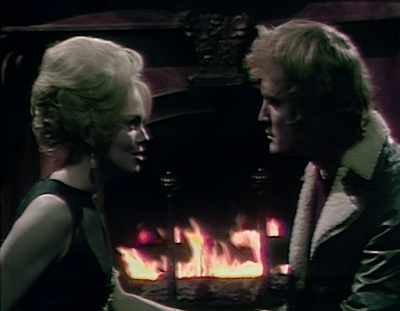
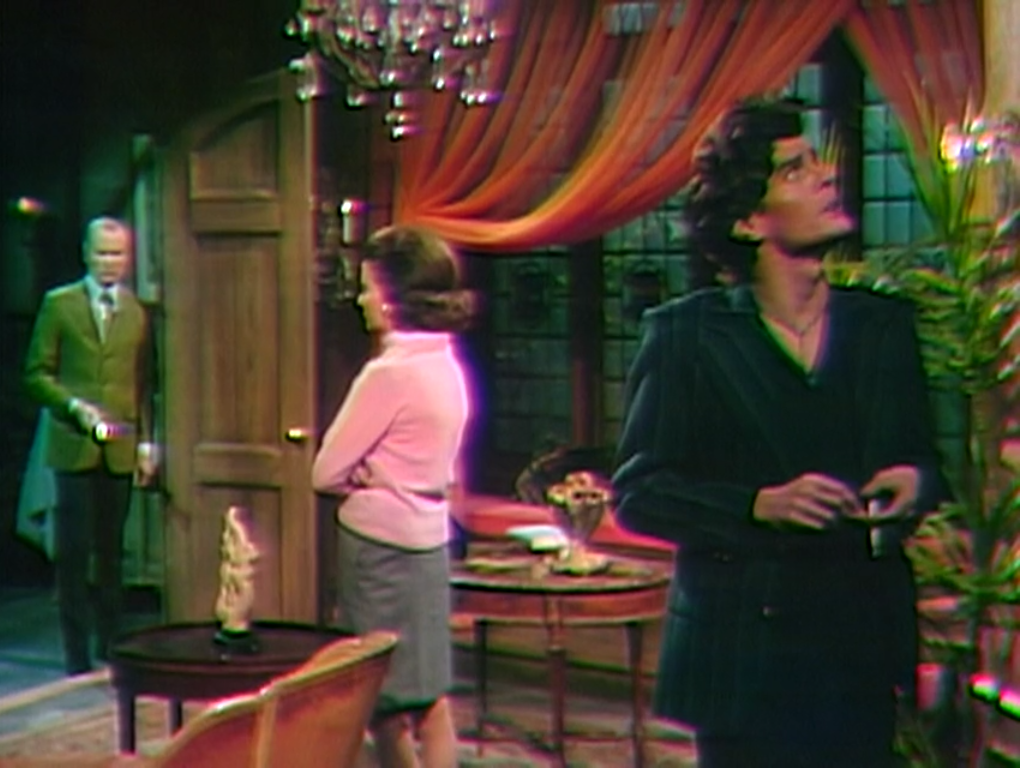
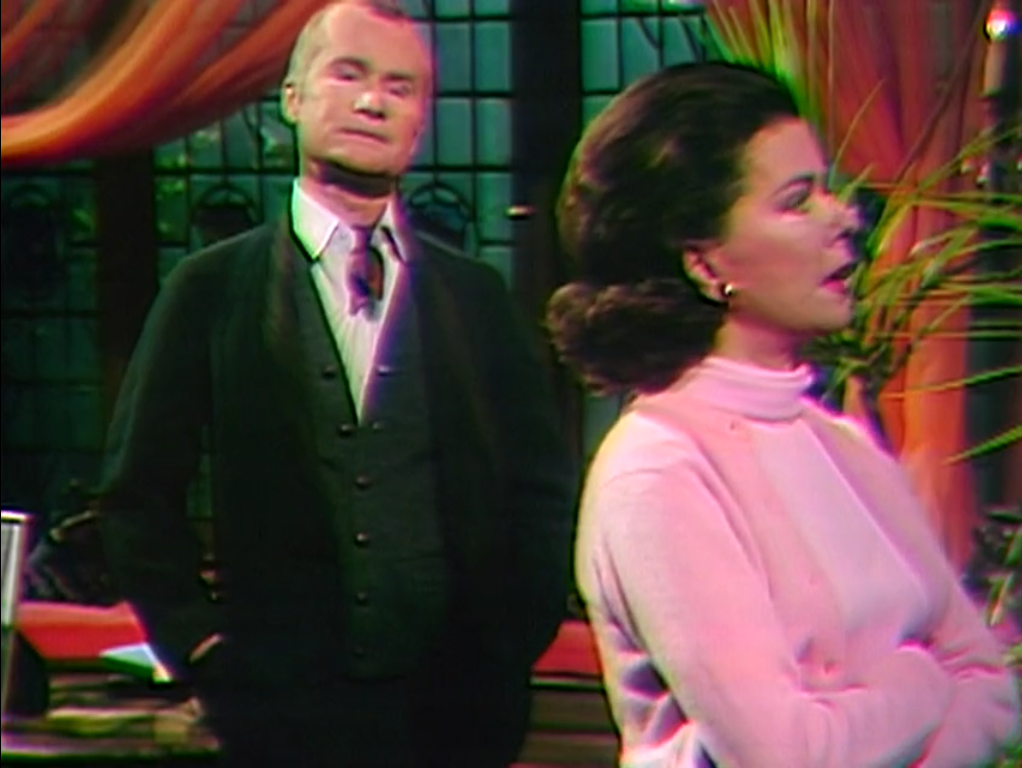
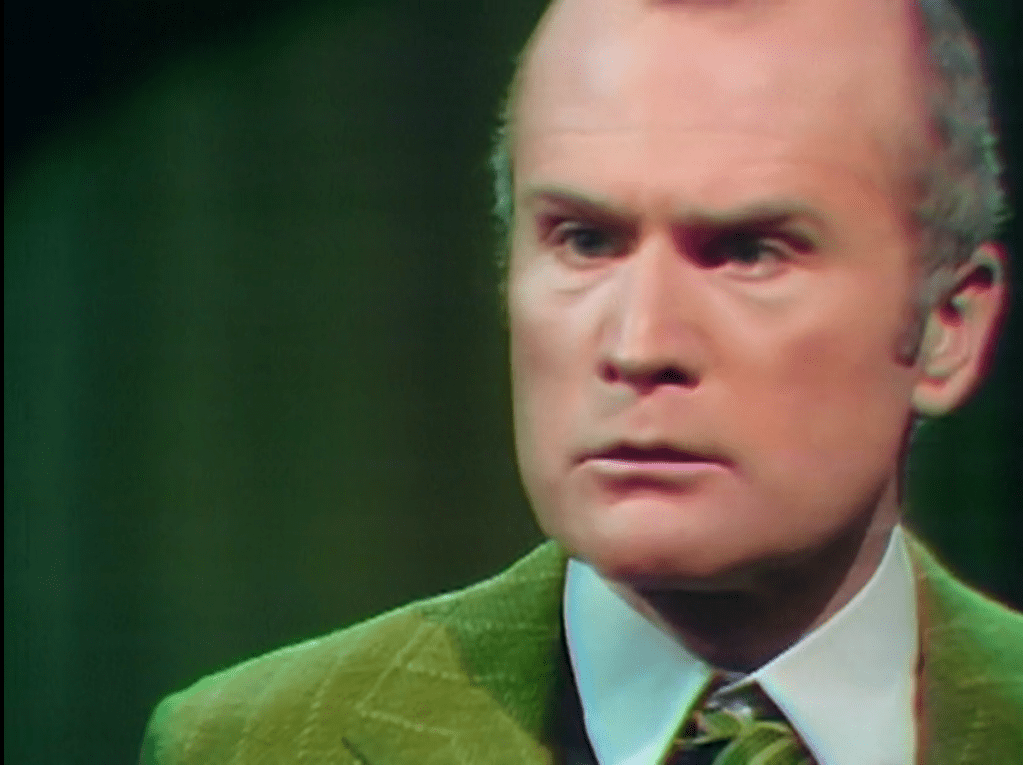
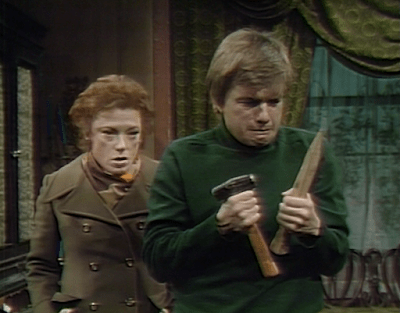
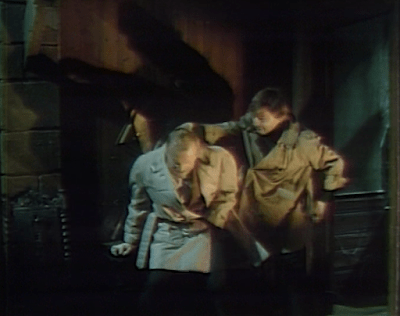
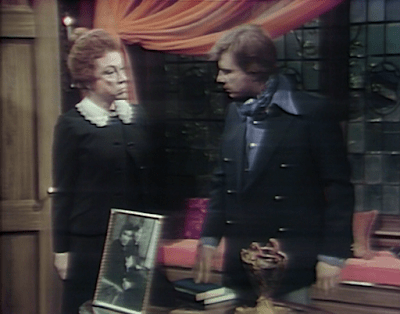
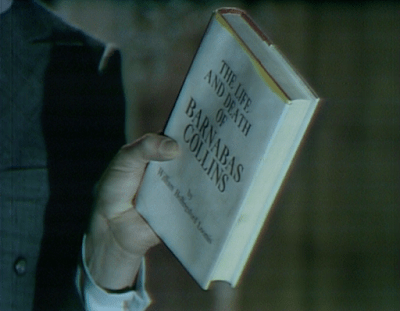
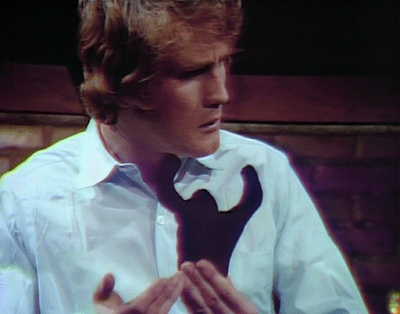
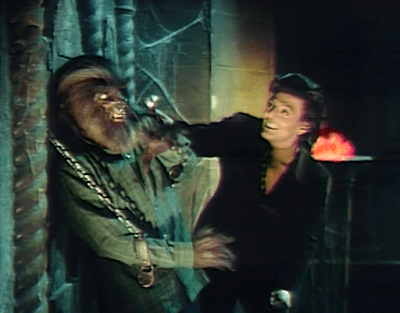
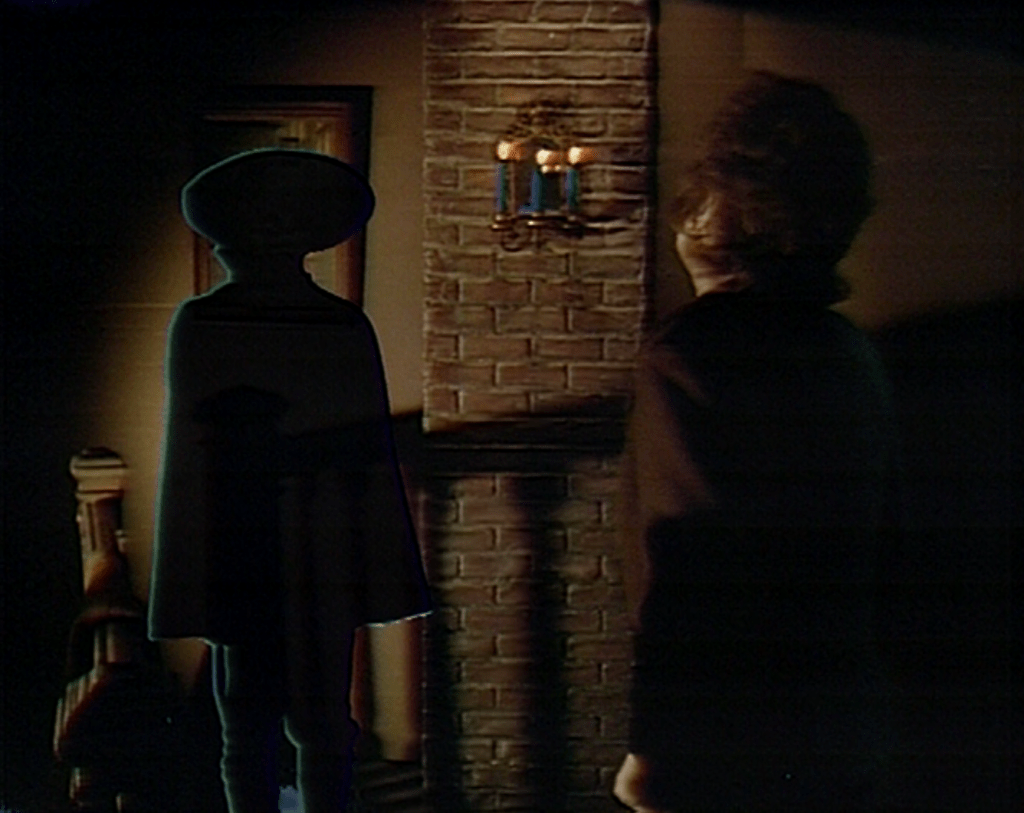
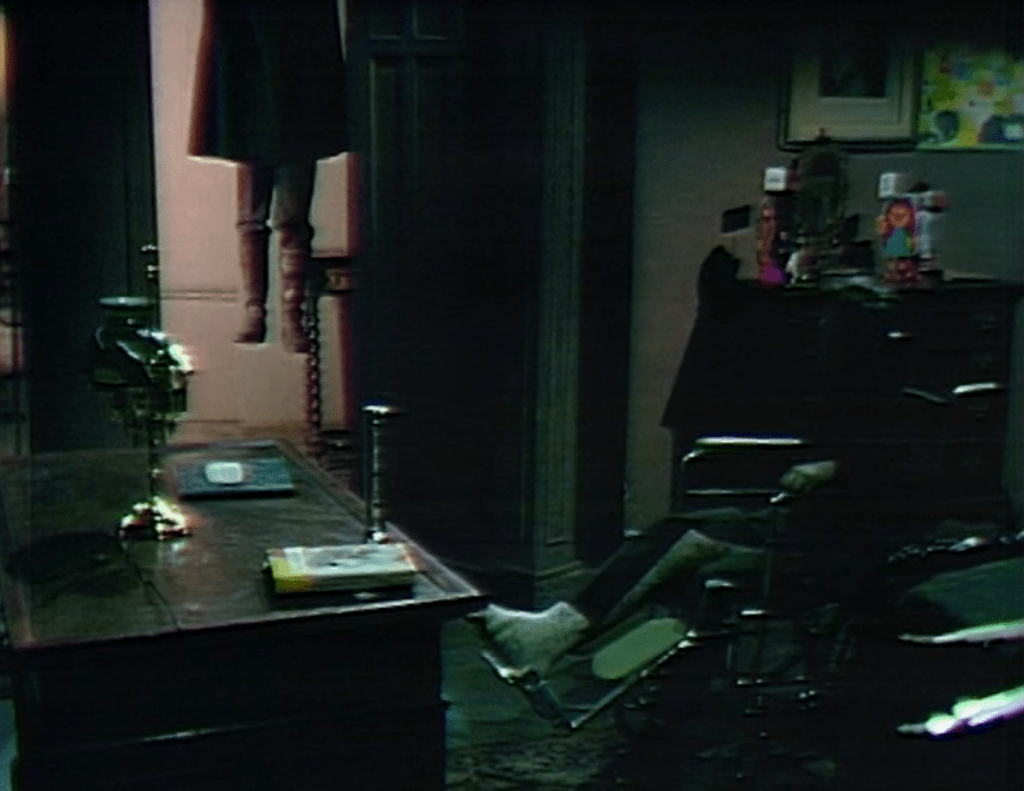
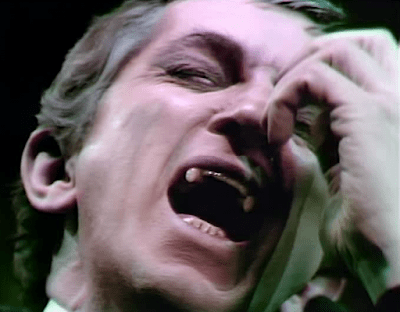
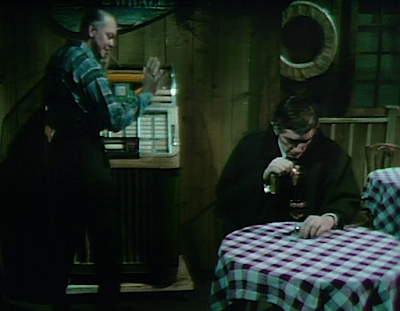
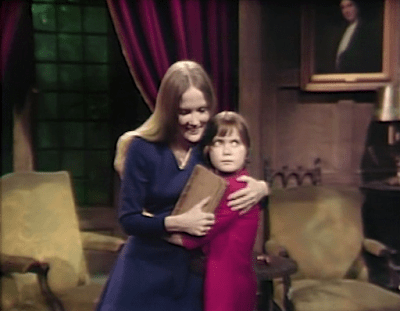
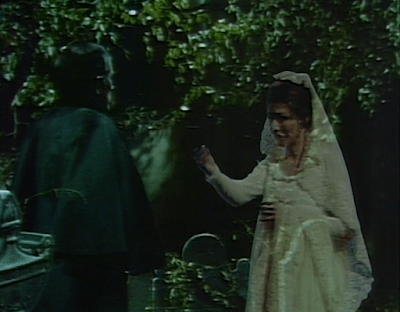
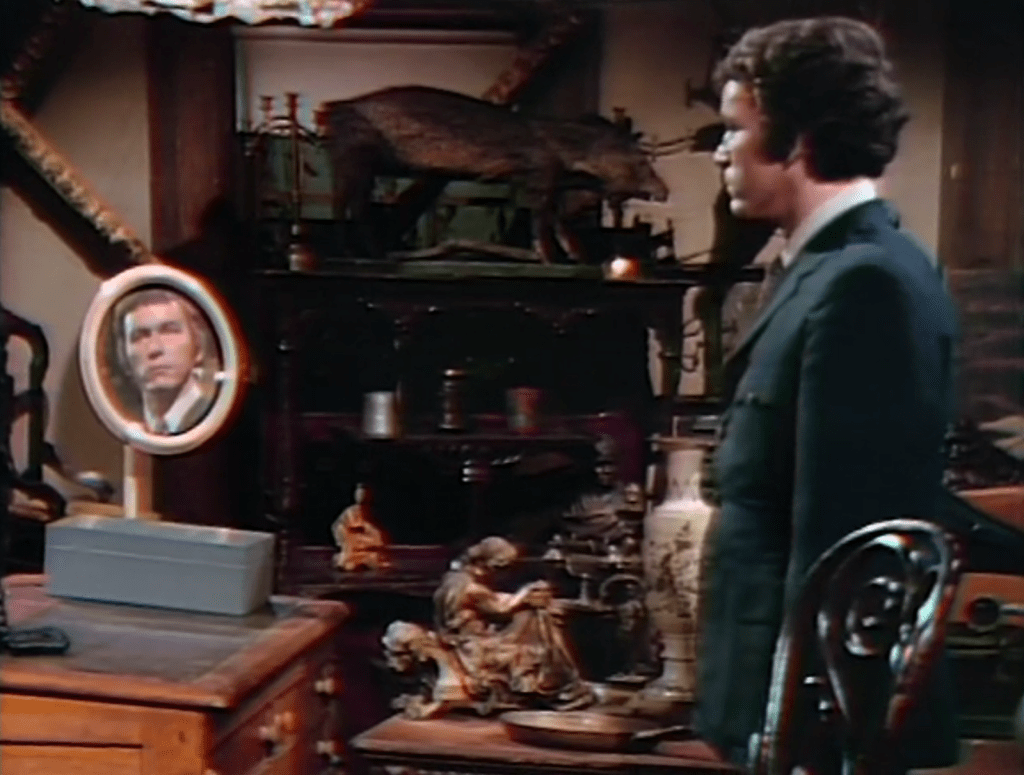
 Dark Shadows Commentary