Mad scientist Cyrus Longworth developed a potion that changed his appearance so drastically that even people who knew him well cannot recognize him when he is under its influence. He used this disguise to carry out beatings, rapes, and murders. Now, he has spontaneously transformed in front of his fiancée, Sabrina Stuart. Cyrus had fooled Sabrina into thinking that his disguise was a separate person named “John Yaeger.” Sabrina had reason to hate Yaeger and fear him. She was shocked to learn that Yaeger and Cyrus were one and the same, and Cyrus ridiculed her for her continued attachment to him. Nonetheless, Sabrina pledged to support Cyrus come what may, and she does keep his secret today. Even after he threatens her with the sword in his cane, a threat which seems all too real since Christopher Pennock holds the prop too close to Lisa Blake Richards’ face when he pops the sharp blade out, she still stands by her man.
Cyrus has slipped into the great house of Collinwood and entered the master bedroom. He is watching the lady of the house, Maggie Evans Collins, while she sleeps. Cyrus tried to rape Maggie in a dark alley last week, and apparently he has decided to finish the job while she is in her own bed. At the last moment, Maggie’s stepson, strange and troubled teen Daniel Collins, enters. Cyrus hides behind the curtains while Daniel asks for his father.
Cyrus has ot chosen a particularly good hiding place. The light is on him, and he is directly in Daniel’s line of sight. It is preposterous enough that an armed intruder as physically prepossessing and as unscrupulous as Cyrus would hide from Maggie and Daniel, and this slip emphasizes that Cyrus, however much he may revel in the harm he has done as when in his disguise, is basically a coward.
Hey Daniel, notice that very tall man peeking out from behind the curtains directly in front of you? Screenshot by Dark Shadows Before I Die.
Daniel has been bitterly hostile to Maggie up to this point. Today they are suddenly great friends. He says sadly that he sometimes gets a premonition when something evil is about to happen in the house, and that he has such a premonition now. She talks to him affectionately, so softly that we can’t tell whether she is calling him “Daniel” or “Dan,” and touches his hair. Regular viewers have seen these two actors play friends in the first 196 weeks of Dark Shadows, when the action took place in a different universe and they were various other characters. It’s good to see them pick up where they left off, and exciting to think of what they might be able to do to breathe more life into Maggie’s stories. Alas, this is the last time we will see Daniel.
Later, Cyrus meets with someone we’ve never seen before. The closing credits will identify this man as Aldon Wicks. Cyrus says he wants to buy an old farmhouse from Wicks. He is particularly interested in a room in the basement, which he wants to outfit with an extra-heavy door. Wicks puts the door Cyrus wants on the room. When the time comes to pay up, Cyrus asks Wicks a bunch of questions, the answers to which all imply that no one knows where he is or will miss him if he disappears. So Cyrus stabs him to death with his cane. That’s certainly one way to cut costs on a real estate transaction.
The opening voiceover is delivered by associate director Ken McEwen. In the first 54 weeks of Dark Shadows, every voiceover was delivered by Alexandra Moltke Isles in character as well-meaning governess Victoria Winters, whether Vicki was in the episode or not. Between them and today, the narrator has always been an actor who appears in the episode. McEwen was drafted to appear in a few episodes as lawyer Larry Chase when Don Briscoe’s health problems caught up to him and forced him to leave the cast. Maybe they gave McEwen a contract to appear in three episodes more than turned out to include parts for Larry, and that explains his voice responsibilities in this one, #1079, and #1082.
A third pair of videotape editors are credited today, Carl Pollack and Fred Labib, joining the teams of Indra Sadoo and Chuck Gardner and Dan Rosenson and Robert Steinback.
Barmaid Buffie Harrington sees a man assaulting a woman in the alley next to the tavern. She recognizes the man as ruffian John Yaeger. Yaeger used to buy Buffie gifts, then beat her and laugh at her bruises. She recognizes the woman as her childhood friend Maggie Evans. Maggie moved away from the village of Collinsport when she was very young, and came back recently as the wife of Quentin Collins, drunken sourpuss and master of the estate of Collinwood. Buffie orders Yaeger to unhand Maggie. He sneers at the women, threatening to make a stink if they go to the police. Buffie stands her ground, and at length Yaeger backs down and leaves.
Buffie and Maggie see Yaeger off.
Maggie goes to Quentin’s friend Cyrus Longworth in his laboratory. She tells Cyrus that Buffie rescued her from Yaeger. She asks Cyrus if it is true that Yaeger is his friend. Cyrus looks pained, and says that for some time he has considered Yaeger his enemy. Maggie had never seen Yaeger before; she was at the docks because he called her anonymously and promised her some information relevant to her suspicion that Quentin murdered his first wife, Angelique Stokes Collins. Nor did he identify himself to her. Buffie did not call him by name. So Maggie and Buffie must have had a conversation afterward in which she told him who Yaeger was and that he and Cyrus are connected to each other.
What neither Buffie nor Maggie knows is that Yaeger does not exist. He is simply a disguise Cyrus assumes when he wants to hurt someone. Cyrus never meant to tell Maggie anything about Quentin; he called Maggie to meet him at the docks because he wanted to rape and abduct her. Cyrus has devised a potion that causes his hair to turn darker and sprout all over his body, his shoulders to broaden, and his skin tone to change. John Yaeger is the alias he uses when in this disguise. After Maggie leaves, he tells himself that he and Yaeger are the same person, and that he is responsible for all of Yaeger’s crimes. He smashes up his lab equipment and burns his notes. All he really needed to do was pour out the potion. One of the essential ingredients is a compound he can’t make himself. He murdered the only known supplier, so once it is gone, it will be gone for good.
Cyrus is only the first character today to use Maggie’s need for information about Quentin to trap and hurt her. Quentin’s brother, high-born ne’er-do-well Roger Collins, keeps baiting her with references to the cause of Quentin’s current fit of bad temper. She finally insists he tells her what he means, and he says it is the anniversary of his wedding to Angelique.
The other character is Angelique herself. Unknown to any other character in today’s episode, Angelique has risen from the grave, murdered her identical twin sister Alexis, and taken Alexis’ place as Quentin’s houseguest in his mansion, the great house of Collinwood.
Maggie turns to “Alexis” for information about Quentin and Angelique’s marriage. When she asks if Angelique often wrote her when she was living in Florence, “Alexis” replies “Not often, but when she did she made up for it.” We know this is a lie, and Maggie should too. When the real Alexis first came to the Collinwood, housekeeper Julia Hoffman asked if she received the letter she sent informing her of Angelique’s death. She said she did not. It turned out that the last address Angelique had for Alexis was in Tangier, a city she had left some time before moving to Florence. Maggie takes “Alexis'” statement at face value, and also believes her when she says that Angelique wrote only of how wonderful her marriage to Quentin was. Further, she believes that Angelique was telling the truth in those supposed letters. Since her own marriage to Quentin has been miserable from the first day we saw them together, this depresses Maggie.
Maggie goes to sleep, and Angelique casts a spell to send her a dream. In the dream, Maggie goes to Angelique’s old bedroom and opens a hidden compartment in a small table. She finds a packet of letters there. She wakes up, goes to the room, and finds not only that there is such a compartment but that it does contain the letters. Presumably she will read these and add to her misery.
As Yaeger’s former punching bag and current blood thrall of vampire Barnabas Collins, Buffie is central to two of the ongoing stories. When she rescues Maggie, we can assume that they will renew their friendship, putting her close to the heart of all the other stories. The episode thus promises to usher in the Age of Buffie. But in fact, this is the character’s final appearance.
I suspect that the writers and producers were impressed with Elizabeth Eis’ performance and expanded Buffie’s part beyond what they originally intended. There were several cast members whom Dan Curtis Productions was contractually obligated to use in a certain number of episodes per month, and for the first weeks of the current segment most of those were off in Tarrytown, New York, doing principal photography on the feature House of Dark Shadows. That gave the show a greater flexibility with new performers than they have now that those people are back.
Moreover, the writers projected the plot out thirteen weeks at a time, in documents divided into 65 parts for the 65 episodes of that period. These projections were known in the soap opera business as “flimsies.” The show would scrap its plans completely when a story drew a different reaction from the audience than they had expected, most famously when Barnabas was introduced in April 1967 and was such a hit that they dropped the original idea to stake him at the end of a number of weeks. But Buffie isn’t that kind of a hit, and with the return to the jigsaw puzzle they have to solve every day to get the name actors their required appearances, the writers have to stick close to the flimsies for a while. By the time they could find room for Eis, the story had moved on and Buffie was no longer particularly relevant. Eis will be back later, when the show is set in a different version of Collinsport, playing a character who shows up in only three episodes.
Angelique Stokes Collins has risen from the dead, but her renewed existence may end within seconds. She is overwhelmingly cold, and can warm up only by draining the heat from the body of a living person. Someone is coming in the front door, just in time to be her victim and die in her stead. She wonders who it will be.
Almost all the characters currently on Dark Shadows are either so important to an ongoing story that their deaths would end a major arc or have so many connections to everyone else that their deaths would start a new one. So if she kills mad scientist Cyrus Longworth, his fiancée Sabrina Stuart, or barmaid Buffie Harrington, Angelique will be ending the Jekyll and Hyde story, or at least shifting it into a radically new phase. If she kills drunken sourpuss Quentin Collins, his wife Maggie Evans Collins, or housekeeper Julia Hoffman, she will be ending the adaptation of Rebecca. If she kills Carolyn Loomis or her husband Will, she will be ending the restaging of Who’s Afraid of Virginia Woolf?
If Angelique kills woebegone homebody Elizabeth Collins Stoddard or her brother, sardonic dandy Roger Collins, she won’t be ending any ongoing stories. But Liz and Roger are the counterparts of characters who were central to the life of the great house of Collinwood in the first 196 weeks of Dark Shadows, when it was set in another universe, and are played by actors who have substantial followings. If either of them is murdered, the audience will expect major consequences. Angelique’s son Daniel Collins and Daniel’s cousin Amy Collins aren’t doing much just now, but if Angelique kills a child, especially her own son, the ABC network’s office of Standards and Practices would join the audience in insisting she face a serious reckoning that would take up a lot of screen time. This fit of heat vampirism came on Angelique too suddenly to make sense as the start of a new arc, so we can rule all of those candidates out.
There are also a couple of characters who were introduced to fill in for actors who were away the previous couple of months filming their parts in the theatrical feature House of Dark Shadows. Among those are Angelique’s Aunt Hannah and butler Mr Trask. They are possibilities, but are both played by actors who have enough going for them that it would be a bit surprising to bring them back just to kill them off. There are also a few miscellaneous day players whose characters would have no reason to let themselves into the great house of Collinwood- a bartender we saw in #991, a landlady we saw in #997, etc.
So it would seem that there are only two people who could be Angelique’s next meal. One is sleazy musician Bruno Hess, a former boyfriend of hers who lives in the cottage on the grounds of Collinwood and is friends with Cyrus, but who has been neither seen nor missed for some time. The other is Larry Chase, attorney at law.
Bruno is played by the dynamic Michael Stroka, who twice made a mark when cast in stories set in the other universe. Larry was written into the show as a last-minute substitute for a part played by an actor whose health problems made it impossible for him to continue. They didn’t have time for auditions, so they drafted associate director Ken McEwen for the part. McEwen was in the building, and he had a guild card because of some small parts he’d taken in TV shows he’d worked on in the 1950s. When he has enough time to rehearse, which is to say when he has had more time to rehearse than actors usually got on a show like Dark Shadows, McEwen gets his lines right, except for adding “Well…” at the beginning of every single one. You can tell he is making a sincere effort not to ruin the show. But that’s about all you can say for him. Even at his best he’s stiff and distracted, and when he hasn’t been able to get his part down, he disintegrates completely. So it isn’t much of a surprise that Larry is the one who opens the door. It wasn’t a surprise to me, I should say; writing these posts keeps all the details fresh in my mind. My wife, Mrs Acilius, looked at him for about thirty seconds and asked “Who’s that?”
Larry plays the same scene with Angelique that her second victim, Fred the transient handyman, had played with her in #1003, right down to telling her that he had wanted to hold her since he first saw her. Fred was played by Edmond Hashim, and anyone who sees the two versions of this scene side by side will come away with a new appreciation for Hashim’s talents as an actor. This is McEwen’s final on-screen appearance, though he will pinch hit as the opening narrator in three upcoming episodes. He will continue as an associate director through episode 1179/1180 in December.
Will enters to find Angelique screaming and Larry dead. Angelique, who is impersonating her late identical twin sister Alexis, claims that Larry was just standing there when he had an attack of some kind and dropped dead. Will touches the corpse and says that he is so cold he must have been dead for hours. “Alexis” insists he just died a moment before. Will calls Cyrus, who is the Collins family physician.
Cyrus is in his lab, looking at the potion which turns him into the Mr Hyde-like John Yaeger. He is about to capitulate to his craving when the telephone rings. Will tells him that Larry is dead and asks him to come to Collinwood. Cyrus puts the potion back in his safe and rejoices that he is “Saved!” Larry was Cyrus’ lawyer and apparently a social friend as well. We’ve already seen Cyrus do enough horrible things that this sociopathic reaction is no shock.
Back at Collinwood, Will and “Alexis” are talking with Barnabas Collins. Unknown to “Alexis,” Barnabas is a visitor from the other universe. Her counterpart in his world was the wicked witch who turned him into a vampire, so Barnabas cannot keep a hostile edge out of his voice and manner when he is talking to her. Will is one of Barnabas’ victims, and knows all of his secrets.
When they are alone in the drawing room, “Alexis” questions Will about Barnabas. Will denies knowing him particularly well. Barnabas is staying at Will’s house, and several years ago Will wrote a biography of Barnabas’ counterpart in this universe, a man who lived a quiet life and died a natural death in 1830. Barnabas claims to be a descendant of that Barnabas Collins, and to have come to Collinwood to meet the author of the biography. Will becomes more and more disturbed as “Alexis” presses him harder and harder for information. She is perplexed that he won’t tell her anything. Lara Parker and John Karlen have both been on the show for a long time, but this is the first substantial two scene between them, and it is terrific. Their acting styles were very different, but they couldn’t have meshed better.
Barnabas is sitting at a table in the Eagle tavern. There is a glass of reddish liquid in front of him. In view of his condition, one wonders what that liquid might be.
Barnabas invites Buffie to sit with him. Since there are no other customers, she agrees. He tells her he is from South America. The son of this universe’s Barnabas Collins whom he claims as his great-grandfather went to Peru; when he introduced himself to the family, he said that his forebear did not die in that country. But evidently his imaginary descendants stayed on the continent, somewhere.
The Eagle is the counterpart of the Blue Whale in the other continuity. In #3, Burke Devlin was sitting at a table in the Blue Whale with hard-working young fisherman Joe Haskell when he said that his success in life began when a strange man picked him up in a bar in Montevideo. That was the show’s only reference to Uruguay, but Burke, the Blue Whale, and Brazil came to be strongly associated with each other. The song “Aquarela do Brasil,” a big hit in the English speaking world in the 1960s under the title “Brazil,” played on the jukebox at the Blue Whale, and it became Burke’s theme song. Ultimately Burke would die on a business trip to Brazil. Barnabas and Burke were enemies; when he sits at this table and claims to have a South American background, longtime viewers may wonder if he is thinking that the new universe is a place where he can try out a new personality and maybe he will start by imitating Burke’s.
Burke was a dashing action hero, attractive to women. Barnabas’ attempt to imitate him breaks down almost immediately. He winds up mimicking another prominent bachelor from his native universe, Professor Timothy Eliot Stokes, when he asks Buffie if she’s ever heard of the theory of “Parallel Time.”
Buffie shakes her head no. Barnabas says that some people believe that there are many universes, and that a copy of each of us can be found in each of them. They may look the same, but they lead different lives because they have made different choices. Buffie laughs and says that she hopes her other selves are having more fun than she is. She hastens to say that she doesn’t mean she isn’t having fun at the moment, sharing a table with Barnabas; she means that her life in Collinsport, as viewed from the most all-encompassing perspective and analyzed in the most thorough philosophic manner, well and truly sucks shit. Barnabas says that the other Buffies in the multiverse might have left Collinsport* and had wonderful adventures.
Longtime viewers saw one of those other Buffies in #951, when we were still in the original continuity. She had a different name; she went by Nelle Gunston. And as befits a mirror universe, she moved in the opposite direction. Rather than leaving Collinsport to look for something new as Buffie wishes she had done, Nelle left her parents’ home in Virginia and went to Collinsport because she had joined a cult dedicated to the destruction of the human race and its replacement by a loathsome breed of Elder Gods known as the Leviathan People. Barnabas had been the leader of the Leviathan cult, and when Nelle came to town she sat with him by the same table where Buffie and Barnabas sit today. They even take the same seats.
Buffie is charmed by Barnabas’ talk; between the suavity that Jonathan Frid brings to his part today and the energy with which Elizabeth Eis presents Buffie’s enthusiasm for him, it is far easier than it usually is to believe that Barnabas is a sexy dude. Maybe we are supposed to think that role-playing as Burke has enabled him to loosen up.
The conversation is really warming up when the bell attached to the front door rings. “Customer,” Buffie ruefully says to Barnabas as she rises. It is Cyrus.
Barnabas invites Cyrus to sit with them. He declines, saying that he came only to ask Buffie if she had seen John Yaeger lately. She tenses up. Yaeger used to beat her up and force her to help him with his crimes. She says that Cyrus himself had told Buffie that Yaeger wouldn’t be back in Collinsport. Cyrus says that he did, but that he is worried he might not be able to predict Yaeger’s movements as well as he thought he could. He offers Barnabas a lift back to Collinwood. That’s a bit surprising, since Cyrus got uptight when he saw Barnabas. As Yaeger, Cyrus discovered that there is a coffin in the basement of Will and Carolyn’s house, and he suspects that Barnabas spends his days there. But longtime viewers can remember the days Barnabas and Burke had conversations at the Blue Whale that were just as tense as the one he and Cyrus have in the Eagle, and Burke never failed to observe the small graces. It’s just the done thing, I suppose.
Cyrus leaves, and Buffie remains standing. She and Barnabas keep talking. He gets close, and goes in for a bite. He stops himself at the last second, to her surprise and disappointment. She was apparently ready for a kiss on the neck. He says he has to go. She is even more disappointed by that, but he promises to come back at closing. He asks to walk her home, and she happily agrees.
Will and Cyrus are in the drawing room at Collinwood. Will urges Cyrus to join him in a drink. When Cyrus declines, Will reminisces about the old days at Collinwood, when the party would just be getting started at this hour. In those days, people would leave the great house in the small hours of the morning and continue their revels at the Eagle. Cyrus says he won’t find much company there tonight. When he says that the only people in the place earlier were “the girl who works there” and Barnabas, Will looks alarmed. All of his mannerisms that suggest drunkenness drop away, and he rushes out.
Will gets to the tavern, and finds Buffie alone. The alcoholic author is obviously one of her favorite and most lucrative customers, so even though she has already blown out the candles she tells him he is in time for last call. To her amazement, he is not interested in a drink. He asks her where Barnabas is. She says he’ll be back and that he is taking her home. He says no, and she asks what’s wrong. Before he can answer, Will hears Barnabas’ voice behind him, echoing Buffie’s question. Laboring under the vampire’s power, Will has no choice but to leave Buffie alone with Barnabas.
Nelle, too, had agreed left the tavern with Barnabas. She expected to meet the leader of the Leviathans at his place, and was unhappy to find that the two of them were alone. Buffie is again an inverted mirror image of her counterpart. She takes Barnabas to her place, and is quite happy to be alone with him. The two close in for an embrace. He bites her neck, and she collapses. He had bitten Nelle, too. At that moment, Cyrus enters the room.
Cyrus does not exactly have a counterpart in the other continuity, but Christopher Pennock did play the Leviathan leader whom Nelle expected to meet. Like Cyrus, that character was a murderous shape-shifter. So Cyrus’ unexpected arrival mirrors the Leviathan leader’s unexpected absence.
When we first cut to Buffie’s room, the camera lingers for several seconds on an extremely unusual prop. It is a television set. The only other time we have seen a television set on Dark Shadows was in #27, in the other universe, when Burke visited investigator Stuart Bronson in a hotel room in Bangor, Maine where there was a small portable unit. It looks like it might be the same set.
Bronson’s TVBuffie’s TV
The shot goes on so long, and the set is such an odd thing to see in the context of the show, that they must be making some kind of point with it. We have wondered why Buffie submitted to Yaeger’s abuse, when she is such a strong and intelligent person. Her reflection in Nelle suggests a partial answer. Nelle was drawn to the Leviathans, who offered to destroy her and all other humans. We can assume that Buffie, too, was following a self-destructive urge when she went along with Yaeger. Associated with her, the television is a symbol of the annihilation of the self. Turn the idiot box on, turn your mind off. If you aren’t careful, you may even wind up spending your weekdays staring glassy-eyed at ABC’s daytime lineup.
*He actually says “Collinwood.” Which is a blooper, but since Buffie mentioned in her first episode that she used to work at Collinwood it is kind of an interesting one. Maybe when another Buffie left her position as an upstairs maid or whatever she was, she got further than the nearest tavern.
Wicked witch Angelique has returned from the dead, murdered her twin sister Alexis, and assumed Alexis’ identity. Angelique’s widower Quentin had already welcomed Alexis as a more or less permanent guest at the great house of Collinwood. Quentin’s new wife, the former Maggie Evans, has left him. Angelique wants Quentin back, but has decided that she cannot overcome his obsession with Maggie unless Maggie returns to Collinwood, where she will be able to fight her directly. So she has cast a spell on Quentin to inflame his feelings for Maggie. Angelique expects this will cause him to bring Maggie home. Once she is there, Angelique will be able to complete her evil plan, which the writers don’t seem to have come up with yet.
Angelique’s spell goes awry. At the beginning of the episode, Quentin slashes a portrait of Maggie; at the end, he believes he has killed her, and is getting ready to hang himself so that he can join her in death. In between, he goes off and tells his friend, mad scientist Cyrus Longworth, how miserable he is. Angelique and Cyrus have a conversation about how sad Quentin is.
The performances are all good, but the only one that serves a purpose in the story is Christopher Pennock’s as Cyrus. Cyrus has devised a potion that changes his appearance so drastically that even the people who know him best do not recognize him when he is under its influence. This is supposed to be a Jekyll and Hyde story in which the innocent Cyrus is being consumed by his evil alter ego, “John Yaeger.” But it is all too obvious that Yaeger is just a disguise Cyrus puts on when he has decided to commit acts of rapine and slaughter. Today, Pennock really makes Cyrus seem like a well-intentioned nerd. When he puts the potion back in his safe and resolves never to become Yaeger again, we can believe that he is a better person when his hair is red than he is when it is dark.
Cyrus resolves to break his addiction to “Do Not Touch” juice. Screenshot by Dark Shadows Before I Die.
Also, he and Lara Parker have a fun moment when Cyrus and Angelique are talking about Quentin’s feelings. He gets carried away with a mad scientist rant about the horrible evil that dwells at the base of every human heart, prompting her to give him a puzzled look. It’s an effective comic take.
This episode marks the last appearance of Paula Laurence as Angelique’s aunt, Hannah Stokes. As Hannah, Laurence imitated some of the most recognizable mannerisms Parker incorporated in her portrayal of Angelique. This helped longtime viewers believe she was related to Angelique, and when she had scenes with Alexis the contrast showed us that Parker really was playing a different character. But the show isn’t big enough for two Angeliques, so Hannah’s days have been numbered for a while.
Mad scientist Cyrus Longworth has devised a potion that alters his appearance so that even the people who know him best, including his fiancée Sabrina Stuart and his attorney Larry Chase, cannot recognize him. When he is thus disguised he calls himself “John Yaeger” and indulges his sadistic impulses. One of his favorite hobbies is beating and intimidating a woman named Buffie Harrington, who submits to his abuse for psychological reasons the show never explains, but for clues to which Elizabeth’s Eis’ performance keeps us watching closely. Buffie does not know that Yaeger is really Cyrus. As Sabrina and Larry have not recognized Cyrus when they saw him as Yaeger, so Buffie has not recognized Cyrus when she has met him undisguised.
The only person who has so far figured out Cyrus’ secret is chemist Horace Gladstone. Cyrus bought a vital ingredient for his potion from Gladstone, who knows that it can be used to change a person’s appearance. He has had dealings with Cyrus when he was presenting himself as Yaeger, has seen his handwriting in both states, and has questioned both Sabrina and Buffie. Combined with several other pieces of evidence, Gladstone was able to build an overwhelming case that Yaeger is merely Cyrus in disguise. Yesterday he demanded Cyrus pay him $10,000 in return for a continued supply of the ingredient and his silence. Cyrus responded by drinking the potion to assume his disguise, going to a dark alley where he had gleaned from an indiscretion on Larry’s part Gladstone would be waiting, and murdering him. Larry arrived at the scene a moment later and pursued “Yaeger” on foot from the alley to the courtyard behind Cyrus’ place. He saw “Yaeger” jump the fence into the courtyard.
As Yaeger, Cyrus enters his laboratory through the door in the courtyard. He is about to take the antidote to change his appearance back to normal when he hears Sabrina and Larry coming downstairs. He hastens out the way he came. Eavesdropping through the courtyard door, he is relieved to hear Larry say that he did not get a good enough look at him to be able to make a positive identification. He hears Larry place a call to the police, and exits.
Cyrus goes back to the alley where he killed Gladstone. Buffie enters, getting off her shift as a barmaid at the Eagle tavern. The tavern abuts the alley, but evidently the police didn’t think it was necessary to bother her with news of the murder. He demands she do him a favor. She says she is too tired to do anything tonight; he says it’s better to be tired than dead. Whatever it is that compels Buffie to keep coming back to Cyrus in his Yaeger form is strong enough that this death threat does not drive her away. She protests that she does not have a criminal record and wants to keep it that way; he tells her she won’t get caught. He gives her the keys to his lab and the combination to his safe and orders her to take the bottle containing the antidote. He tells her to bring the bottle to him in a cave on the beach below the estate of Collinwood.
Buffie goes to the courtyard door. She is about to open it when she hears Sabrina and Larry inside the lab, talking about Gladstone’s murder. When the name “John Yaeger” comes up as a suspect, she looks down. We can see a forlornness in her face. She is as much addicted to his hard domination of her as Cyrus is addicted to violence, but she still does not want to think of herself as a criminal, certainly not as an accessory to murder.
Buffie hears about Yaeger as a murder suspect. Screenshot by Dark Shadows Wiki.
When Sabrina and Larry go upstairs, Buffie lets herself in to the lab. She has removed the painting that covers the safe and is starting to turn the dial for the combination when she hears Sabrina tell Larry she has to go back downstairs to retrieve something she left in the lab. Buffie hides by the door while Sabrina collects her purse. The purse is right next to the painting, but the room is dark. We are in suspense whether Sabrina will see it. She doesn’t, she leaves, and Buffie gets the bottle.
In the cave, Cyrus notices footprints going up to a pile of stones that appear to be a natural part of the cave wall. He realizes that the stones must be hiding a secret passage. He is curious where it leads, and figures it will be at least half an hour before Buffie comes. So he starts pulling the stones down.
Cyrus follows the path into the basement of the Old House on the grounds of Collinwood. This house is currently occupied by writer Will Loomis and his wife, the former Carolyn Collins Stoddard. Cyrus realizes where he is, and finds a chained coffin. He wonders what secret Will might be hiding from the world. He decides that if the secret is shameful enough, it might come in handy. He breaks the first chain, intending to open the coffin.
The opening voiceover, delivered arrestingly by Eis, told us what is in the coffin. It is a visitor from a parallel universe. He is named Barnabas Collins, and he is a vampire. Will is holding Barnabas prisoner in the coffin and taking an oral history from him, which he plans to use as the basis of his next book. Longtime viewers of Dark Shadows are familiar with Barnabas’ native universe; the first 196 weeks of the show were set there. As Will put chains on Barnabas’ coffin in the hope of finding a fortune in his stories, Will’s counterpart, dangerously unstable ruffian Willie Loomis, took the chains off Barnabas’ coffin in hopes of finding a fortune in jewels. In his universe, Barnabas is the master of the Old House and he keeps his coffin in the space where Will has it here. It has occasionally been opened by intruders; the first time we saw that happen was in #275, when Willie’s sometime friend, seagoing con man Jason McGuire, lifted the lid at sunset, only to be greeted by Barnabas’ hand darting out and crushing his throat. If Cyrus gets the coffin open, Gladstone’s death might be avenged sooner than anyone could expect.
Gladstone’s death marks the final appearance of John Harkins. Harkins’ first appearance was in #174, in which he played Lieutenant Costa of the Arizona State Police. The most famous of his dozens of screen roles was in The Mary Tyler Moore Show, when he played the clergyman who officiates at the funeral of Chuckles the Clown. He also had a recurring role on Cagney & Lacey as Mansfield the drug kingpin. Harkins didn’t have any scenes with John Karlen, who was a regular both on that show and on Dark Shadows.
The Dark Shadows Wiki tells us that this is one of only six episodes with no cast member who appeared in 200 or more episodes. It lists the others as 168, 172, 180, 1141, and 1182. It also says that there is no one in it who joined the cast before David Selby’s debut as Quentin, but since Harkins was on almost two years before Mr Selby that is not so.
The show has been spending a lot of time lately trying to interest us in the ghost of Dameon Edwards, a man who doesn’t seem to have had much going for him even when he was alive. They went through the motions of a murder mystery concerning Dameon’s death. The episode that introduced him also hinted that he was killed by sleazy musician Bruno Hess with the complicity of butler Mr Trask, and those hints are confirmed today. So the mystery was never much of a puzzle. Besides, Bruno and Trask are the counterparts of homicidal villains whom we saw in the universe where Dark Shadows was set for its first 196 weeks, so we’ve expected all along that they would turn out to have someone’s blood on their hands. And neither of them is the central figure in an ongoing story, so even if they had been brought to justice for their crimes it would only be an easy way for the writers to dispose of characters who were going to be written out anyway.
Today, wicked witch Angelique finds Dameon’s skeleton sealed up in an alcove in the basement of the great house of Collinwood. She summons his ghost and dismisses him. That’s it for Dameon. What will happen to the skeleton, or to Bruno, or to Trask, or to the alcove, we don’t yet know.
The sight of the skeleton standing in the alcove does remind us of one of Trask’s alternate universe counterparts, a fanatical witchfinder who was sealed up in a basement alcove elsewhere on the estate in 1796. Since Trask is involved in this little arc, it’s a nice touch to connect it to that other Trask.
Most of the episode is devoted to a far more interesting story, an adaptation of Jekyll and Hyde. They’ve been focusing on the addiction angle. Mad scientist Cyrus Longworth is hooked on the potion that changes his appearance and allows him to fool even people who know him well into believing that he is a separate person by the name of John Yaeger. He enjoys the violence that he commits as Yaeger.
Today, three people try to save Cyrus from himself. Lawyer Larry Chase resists Cyrus’ instructions to transfer $5000 to Yaeger and to rewrite his willin Yaeher’s favor; chemist Horace Gladstone is reluctant to keep selling Cyrus a volatile synthesis he needs for the potion, and figures out that he and Yaeger are one and the same; and Buffie Harrington, who is exploring her masochistic side by submitting to beatings from Cyrus as Yaeger but still thinks the two are different people, goes to Cyrus to urge him to be more careful in his dealings with Yaeger. Dark Shadows has dealt intelligently and sensitively with the theme of addiction from its earliest days, and today’s focus on people who care about the addict trying to help him achieves a real poignancy.
We may wonder if drug abuse was a particularly timely topic behind the scenes of Dark Shadows at this point. Larry is a substitute for the character of Chris Collins, who was played by Don Briscoe. Briscoe would eventually be diagnosed with bipolar personality disorder, and in 1970 was trying to self-medicate with street drugs.
The makers of the show didn’t give up on Briscoe until the absolute last minute. This episode was taped very close to airtime, after episodes that would be broadcast weeks later were already in the can, giving Briscoe as much time as possible to get himself together. The part of Larry was played by Ken McEwen. McEwen joined the show in August 1968 as an associate director. He had a guild card due to small parts he had taken in a couple of TV shows in the 50s, but had never been an actor full-time. And he clearly hasn’t had much time to learn his dialogue. He is perfectly competent in the first of his two scenes, when Larry is in The Eagle tavern with Yaeger, Gladstone, and Buffie. There are no major bobbles and you can tell exactly what is on his mind. But when Larry returns and meets with Cyrus in his laboratory, McEwen stumbles over every line and never develops a coherent attitude.
The music is interesting today. The Eagle in the current universe corresponds to the Blue Whale, Collinsport’s tavern in the main continuity, and while we are there we hear the jukebox music that was prominent in the show’s first year. There is a scene between Gladstone and Buffie in her apartment; when that opens, we hear some music I don’t believe we’ve heard before. If they’ve written a theme for Buffie, it gives us hope we will see a lot more of Elizabeth Eis’ excellent performance in this role.
The original videotape master of this episode was lost. We have it on a kinescope. I love the kinescopes; I wish all the episodes were available in that format, as well as the videotapes. We haven’t seen one since #813, and will see only one more, #1017. You can always set the options on your device to display in black and white, but the kinescope comes with some visual blurring and sound distortions. Those are usually flaws, of course, but when the show has already given you the feeling that you are catching a glimpse of another reality they can add to the eeriness and yearning for what might have been.
Wealthy socialite Alexis Stokes is looking at her identical twin sister, the late Angelique Stokes Collins. Angelique has been dead and in her coffin these six months, but hasn’t decayed visibly. This has led Angelique’s widower, drunken sourpuss Quentin Collins, to the conclusion that Angelique is an uncanny being whose remains must be burned. Quentin’s friend, foolish scientist Cyrus Longworth, heartily concurs with this opinion. Alexis sits by the coffin and tells her late sister that she has, with great regret, come to share Quentin and Cyrus’ conclusion. She touches Angelique’s shoulder. At this, Angelique’s eyes pop open. She speaks, and tells Alexis that she is half right. Someone must be destroyed, but it will be Alexis, not Angelique.
Angelique and Alexis stand facing each other in the tomb. Angelique explains that all she needed to come back to life was a touch. Now that Alexis has given her that, the warmth has begun to drain from her body into Angelique’s. Soon all of Alexis’ body heat will be transferred to Angelique. She will then die, and Angelique will trade places with her. The “heat vampire” idea was one the show explored briefly in April 1969, when undead blonde fire witch Laura Murdoch Collins drained the warmth from the bodies of the living to keep herself alive. Now Angelique will return from the grave as another heat vampire. Alexis will lie in the coffin, and Angelique will move back in to the great house of Collinwood, where Alexis has for the last three weeks been staying as Quentin’s guest.
Footage of the dress rehearsal for this scene survives. The only other surviving videotape from any episode of Dark Shadows not originally released for broadcast are the opening slates of the episodes.* The confrontation between Alexis and Angelique not only involves the most complicated videotape editing they’ve done so far, it also requires Lara Parker to do some intricate acting work as she plays off a version of herself she can neither see nor hear. In the rehearsal footage, she several times breaks character and turns to director Lela Swift to report on things that aren’t going right. We can hear Swift’s responses over the control room microphone. Some crew members are in and out of the shot, and at the end two people come to help Parker out of the coffin. It’s fascinating for hard-core fans, a must-watch:
By the time Mr Trask, the butler in the great house at Collinwood, comes to the mausoleum to see what’s taking so long, Angelique has changed into Alexis’ short bluish gray suit and chignon hairstyle with a tight spiral twist at the back, the look that the mysterious Madeleine wore in Alfred Hitchcock’s Vertigo. She has changed Alexis into her own gown and loose hairdo, and has put Alexis into her coffin. She is closing the lid of the coffin when Trask enters. Trask asks if she is ready to return to Collinwood, and she says she is looking forward to it.
We cut to the drawing room at Collinwood, where Quentin is yelling at the wind. He is convinced that it is really a ghost expressing discontent, and he demands to know what the trouble is. He doesn’t get any answers.
Angelique and Trask enter the house. Posing as Alexis, Angelique dismisses Trask, and tells Quentin she now agrees with him and Cyrus. The body in the tomb must be destroyed.
Cyrus is in his laboratory. He is talking with his lawyer, Quentin’s cousin Chris Collins. Chris has questions about Cyrus’ instructions to open a bank account in the name of John Yaeger and deposit $5000 in it. He asks if Yaeger is a pseudonym Cyrus is planning to use. Cyrus denies this, and says that Yaeger is a man he met recently who is helping him with his current experiments. In #985, Cyrus responded to Chris’ questions about these experiments with a lot of mad scientist ravings that alarmed him. Since Cyrus offers no information about Yaeger aside from his connection to this dubious project, Chris is reluctant to comply with Cyrus’ directives. Cyrus agrees that Chris should meet Yaeger first. Chris says “I’m looking forward to meeting him. See you, Cyrus,” and exits. This is the last time we will ever see Chris. Actor Don Briscoe’s health problems were catching up to him, and he was not able to return to the show.
While Quentin and Cyrus burn the coffin, Angelique is in her old bedroom. Alexis had been staying there, so Angelique is right at home. Trask tells her it is as if Angelique never left. Later, Quentin comes to invite her to join him and Cyrus for a drink downstairs. She declines, saying she would like to be alone.
Lara Parker’s performance as the newly returned Angelique is marvelous, her best work so far. We can see that she is a different person than the one who left the house earlier in the evening, and we can believe that the other characters don’t see it. In a closeup, she wrinkles her face like the Grinch, suggesting that Angelique has come to steal Christmas. The supernatural element of her confrontation with Alexis suggests Edgar Allan Poe’s “Ligeia,” which the show has been drawing on for the last few weeks, and reminds longtime viewers of Laura’s April 1969 storyline. But the idea of a woman killing her identical twin and taking her place would have been familiar to much of the audience from the 1964 film Dead Ringer, in which Bette Davis played the sisters in that sad situation. Bette Davis is one of the people frequently mentioned when film buffs name The Greatest Screen Actor of All Time, but not even she could have done better than Parker does today.
In the drawing room, Cyrus is alone. He was reluctant to accept Quentin’s invitation to stay for a drink, and is pacing and fidgeting. What Quentin does not know is that Cyrus is in the middle of a Jekyll and Hyde project, and he wants to get back to his lab to take the potion and change himself into the brutal John Yaeger. He revels in Yaeger’s cruelty and is addicted to the transformation.
Music begins playing on the soundtrack we have not heard before, a jagged piano theme. Cyrus suddenly feels the pains that he has felt after taking the potion. He sees Yaeger’s dark hair springing into place on his arms. He looks in the mirror and sees that he has become Yaeger, without taking the potion. He goes to flee the house, but realizes Quentin is already approaching. He retreats to the drawing room and locks the door. Quentin knocks, asking what on earth is wrong with Cyrus.
This is not only the first time Cyrus has changed without drinking the potion, it is also the first time he has appeared without a putty appliance precariously attached to the bridge of his nose. He looks far more convincing without it, though of course he is even more instantly recognizable as Cyrus.
In his post about the episode at his great Dark Shadows Every Day, Danny Horn points out both that the videotape editing is extremely ambitious today, with the confrontation between Alexis and Angelique at the beginning and the pretaped sequence of the Cyrus-to-Yaeger transformation at the end, and that that the editing in between these heroic shots looks ragged. The jump cut to Cyrus and Quentin’s approach to the mausoleum makes it look like Cyrus’ laboratory opens onto the cemetery, the first sequence of Angelique in her old room begins and ends with unusually long sequences of her pruning some extremely unhealthy looking flowers, and Cyrus spends a surprisingly large amount of time in the drawing room pacing about. Danny guesses that they did not know how long the process shots would run, so they inserted filler that could be removed if they went long.
That could be, but I like the episode the way it is. The jump cuts give the whole thing a dreamlike quality that works well with the subject matter. That’s certainly the case with the cut to the cemetery- we don’t know where Cyrus’ lab is, but we do know that only death is likely to come from the work being done there, so that jump makes a grim symbolic sense. Moreover, the actors use the sequences Danny identifies as filler to shed light on the characters and situate the scenes in the story. Angelique is so absorbed in her plant that you can believe she came back from the dead specifically to work on it, and nothing Trask or Quentin has to say is going to distract her for long. Cyrus’ pacing makes it clear he feels trapped at Collinwood, which adds considerably to the force of the moment when, as Yaeger, he has to hide from Quentin.
*I should mention that we have the dress rehearsal for #584. What we don’t have is a finished episode- they never made one. They just sent the tape of the dress rehearsal to the ABC network, and that was broadcast.
We are in the fourth week of an arc set in a different universe than the one we saw in the first 196 weeks of Dark Shadows. This universe, which the show insists on calling “Parallel Time,” was originally introduced as a realm populated by Doppelgänger of the characters we have known. They are the same people, but have made different choices and are therefore living different lives.
Some of the Parallel Time characters fit this description. So, we have known matriarch Elizabeth Collins Stoddard and her brother Roger Collins from episode #1. In the early days of the show, much was made of the Collinses’ straitened financial circumstances, the result of Roger squandering the half of the family’s assets he had inherited and Liz scrambling to keep control of the business. Roger lived in Liz’ house as her guest and worked in the business as her employee, and she kept a wary eye on any move he made to get his hands on her money. In #981, Parallel Liz mentions that she used to be quite wealthy, but that she entrusted her share of the Collins fortune to Roger, and as a result they are both penniless. Original Liz saw that fate as a distinct possibility, every time Roger was in the same wing of the house as her bank account information.
Parallel Liz and Parallel Roger live in the great house of Collinwood as the guests of their brother Quentin. Parallel Quentin is not at all the same person as Original Quentin. He is an entirely different person. Original Quentin was born in 1870, died in 1897, became a ghost haunting Collinwood in 1968 and 1969, and as the result of a time travel storyline in 1969 was both spared death and immunized against aging. Original Quentin was a riff on the early conception of Roger as a villain, and he was a huge hit with the viewing public during the part of the show set in 1897. Ever since Dark Shadows returned to contemporary dress in late 1969, they’ve been at a loss what to do with him. Parallel Quentin is an attempt to reinvent the character to let him keep enough of his vices that he retains the roguish charm that the fans liked, but at the same time use those vices as motivation for him to act the part of the hero from time to time.
There is need for an action hero today. Quentin’s friend, dippy mad scientist Cyrus Longworth, has invented a Jekyll-and-Hyde potion and taken a swig of it. As the darkly mustachio’d John Yaeger, he has been persecuting barmaid Buffie Harrington and Buffie’s unlucky boyfriend, big galoot Steve. We open with Yaeger choking Buffie and telling her she needs to be beaten into submission. Later, Yaeger gets the jump on Steve in a dark alley behind the Greenfield Inn, an establishment that also fronts a sinister alley in the main continuity. He threatens him with his sword cane. Steve manages to get that weapon away from him, but Yaeger beats him down. Yaeger is choking Steve, apparently with the intention of murdering him, when he hears a police whistle and runs away.
Cyrus Longworth and John Yaeger are played by Christopher Pennock.* In the main continuity, Pennock played a character who asked to be called Jabe but wound up answering to “Jeb.” Jabe appeared to be a man in his twenties, but was in fact a shape-shifting monster who was only a few months old when he was destroyed. We’ve heard a good deal about what Cyrus was doing six months ago and more, and there are diplomas on the walls of his laboratory that show his history is nothing like Jabe’s.
Among the very few choices in Jabe’s short life was an attempt to renounce his shape-shifting abilities so that he could remain in human form at all times. In that way, he is the opposite of Cyrus, who chooses to take his potion knowing it will change him into Yaeger.
Also, Jabe was so obnoxious that even people brainwashed to regard him as a divine being come to fulfill a plan that more than justified the extermination of the human race found his personality too much to take and turned against him after a few encounters. But by the end of Jabe’s time on the show, it had become undeniable that there was a kernel of sweetness in his personality. In this regard, too, Cyrus is the opposite of Jabe. We hear his soft voice and see his diffident manner, and we assume that the single-minded scientist in his lab coat, toiling all hours on a project that he keeps saying will benefit humankind, is a well-meaning sort, though perhaps dangerously naïve. Cyrus’ dutiful assistant and devoted fiancée, the lovely Sabrina Stuart, encourages us in that assumption, insisting that Cyrus is thoroughly good, if hopelessly unworldly. But as the initially insufferable Jabe turned out to be endearing at the end, so the apparently innocent Cyrus is deliberately choosing to turn himself into Yaeger even after he knows what Yaeger is capable of. What’s more, he refuses to let anyone at all help him with his experiment, meaning there is no one to restrain Yaeger’s sprees.
Sabrina’s counterpart in the main continuity was the fiancée, not of Jabe, but of another dangerous shape-shifter. She was engaged to werewolf Chris Jennings. As this Sabrina is convinced Cyrus is good, so that one kept insisting Chris was good, even after she had learned that he repeatedly refused to be restrained on nights of the full Moon, so that the killings he committed in his lupine form were premeditated murders on his part. This Sabrina does not know the nature of Cyrus’ work, and she believes that Yaeger is an enemy of his who is holding him prisoner. Sabrina would appear to stand with Roger and Liz as a character who is in a meaningful sense the same person in both timelines, so we are in suspense as to how she might react if she finds out the truth about her man.
Sabrina’s part makes us wonder if the original plan were to cast Don Briscoe, who plays Chris in the main continuity, as Cyrus and Yaeger. At this time Briscoe was struggling with bipolar disorder. He was trying to self-medicate with street drugs, which not only made matters worse in itself, but also led him to get a severe beating one night while trying to score a fix in Central Park. Briscoe appears in Parallel Time as lawyer Chris Collins and has a small part in the concurrently filmed feature House of Dark Shadows, but his health problems ruled out a part as crucial as the lead in the Jekyll and Hyde story.
Buffie is played by Elizabeth Eis, who appeared in one episode set in the main continuity as Nelle Gunston. Nelle was a young woman from Virginia, bored by life with her parents, who had joined the cult that was meant to serve Jabe and the world-wrecking plan to which he was central. When she was asked if she would commit murder if that was what the cult required, she smiled pleasantly and said “Even that.” Nelle was killed before she could meet Jabe.
Buffie is not at all the same person as Nelle. She is not from Virginia, for one thing. When she thinks about leaving Collinsport to get away from Yaeger, she realizes she has only $13.40 to her name, and laughs at herself for a plan that wouldn’t get her any further than Worcester, Massachusetts. Naming Worcester as a synonym for “nowhere” would suggest that she is a New England girl, which would fit with her employment in a bar in a fishing village in central Maine. Buffie is the opposite of what they originally told us the characters in Parallel Time would be- she is not Nelle after she has made a different choice, she is a person who began differently than Nelle and is making a similar choice.
Buffie is in her room when her landlady, Mrs Duvall, comes for the rent. Buffie has a check ready. Mrs Duvall thanks Buffie for recommending her boarding house to a gentleman who has rented her four best rooms at a very handsome price. She tells Buffie that the man is a big step up from Steve. Buffie has no idea what she is talking about. Yaeger shows up, and Buffie realizes he is Mrs Duvall’s new prize boarder. Buffie is horrified, and demands her rent check back. Mrs Duvall refuses to return it. Yaeger points to a print hanging on the wall and instructs Mrs Duvall to take it away and burn it. She is doing so when Buffie protests that it is hers. At that, Mrs Duvall stops short of the door, but she does not put the print back on the wall. Eventually, Mrs Duvall does take Buffie’s print, and leaves her with Yaeger.
Mrs Duvall leaves with Buffie’s print.
The telephone rings. It is Quentin, asking Buffie about Yaeger. Yaeger stands next to her and forces her to answer Quentin’s questions with lies. Later, Steve will come to Buffie’s room. She will tell him to give up on her and not to take any more beatings from Yaeger on her behalf. Steve asks if Yaeger is a superman; Buffie widens her eyes and says that he might be. This brings us back to Nelle, who renounced her life in Virginia and her connection to the human race because she was looking for a superman and thought she would find one in Jabe. Steve may not have had much to offer, but it’s a cinch he wasn’t as bad as Yaeger, and he’s gone from Buffie’s life after this scene.
The emptiness of Buffie’s life is represented today by a prop we have seen only once before on Dark Shadows, a television set. There was a set in a motel room in Bangor in #27; we never do see one in the Collinsport or the Collinwood of the main continuity. Perhaps the makers of the show are suggesting that people who have nothing better to do than to watch the idiot box are likely to fall prey to any fella who offers physical abuse and verbal intimidation.
Mrs Duvall is played by Camila Ashland. Ashland was a very distinguished stage actress who appeared in #928 as someone called Mrs Hutchins. A man from the cult around Jabe hired Mrs Hutchins to tell some lies to throw mad scientist Julia Hoffman off their trail. That didn’t work, but Julia admired Mrs Hutchins’ performance, as we suspect Grayson Hall admired Ashland’s. When the man from the cult paid Mrs Hutchins for her work, he was unpleasantly surprised at her questions and the uneasy conscience it reflected, responding roughly that she is being paid for a job and should leave it at that. He didn’t realize he was dealing with an artist. Mrs Duvall’s eagerness to please the obviously horrible Yaeger shows that she really is the crude mercenary the man from the cult assumed Mrs Hutchins was.
We cut to Cyrus’ laboratory. Yaeger has fled there from the police. He is about to take the re-Jekylling formula when Quentin shows up and demands to know where Cyrus is. We end with them in that standoff.
*Billed twice in the closing credits- as Christopher Pennock for Cyrus, and as Chris Pennock for Yaeger. Adorable!
Heiress Carolyn Collins Stoddard has had a dream in which her new husband, whom she knows as Jeb Hawkes but who when we first saw him asked to be called Jabe, was in a fight on top of Widows’ Hill. His opponent, a stooge named Sky Rumson, threw him off the precipice to his death. When she awoke, Carolyn ran to the hill in search of Jabe. Instead, she found Sky. He told her that her dream was not complete, because it did not show her death. He then grabbed her by the throat.
Jabe rushes up and knocks Carolyn out of Sky’s grip. He and Sky fight, and Sky does throw him off the precipice. Carolyn escapes.
Back home at the great house of Collinwood, Carolyn finds her mother, matriarch Elizabeth Collins Stoddard, and permanent houseguest Julia Hoffman, MD. It takes her a while to compose herself sufficiently to tell Liz and Julia what happened. Julia offers Carolyn a sedative, which prompts her to jump up and shout a verbal refusal. By the time Carolyn starts telling the story, her distant cousin, old world gentleman Barnabas Collins, has joined them in the drawing room. She interrupts herself to yell at Barnabas that he always hated Jabe and is probably glad he’s dead. When Carolyn finishes, Barnabas slips out. Liz calls the police, and Julia is surprised neither of them saw Barnabas leave.
For the last nineteen weeks, the show has been trying to make a story out of some themes drawn from the writings of H. P. Lovecraft. That segment is usually called “the Leviathans,” after a race of Elder Gods who are behind the action. Jabe was central to the Leviathan segment. Sky is the only other character remaining from it. Barnabas appears in the house where Sky has been crashing and finds him packing his bag. Sky does not understand how Barnabas got in. Barnabas dismisses his question, merely saying that Sky knows there are things he can do that ordinary people cannot. Sky draws a revolver and fires two rounds at Barnabas point blank, without effect. Sky exclaims “Oh, no!” Barnabas is amused that none of Sky’s late colleagues told him that he is a vampire. He takes Sky’s hand, curls his arm back so that the gun is pointing at his heart, and squeezes Sky’s finger onto the trigger.
Back at the great house, Liz gets a telephone call from the sheriff. The police haven’t found Jabe’s body, and have surmised that it washed out to sea. They have found Sky, and have tentatively ruled his death a suicide. Later, Carolyn has another dream. In this one, Jabe shows up and confirms his death. That marks the end of the Leviathan segment. Carolyn will go on using the name “Mrs Hawkes” and saying she misses Jabe, but otherwise the last nineteen weeks will be forgotten.
Before killing Sky, Barnabas had mentioned that he almost regrets not leaving him to the other person who is on her way to do him in. That is Sky’s estranged wife, wicked witch Angelique. Had the Leviathan segment been more successful, or had Geoffrey Scott been even marginally competent in his performance as Sky, they might have made something of the parallels between Sky and Jabe. They are both very tall men with blonde wives who are dissatisfied with them. Angelique is dissatisfied that Sky is a tool of the Leviathans and that he tried to set fire to her on the orders of their representative, and Carolyn is dissatisfied with Jabe because he keeps running away from dangers he has brought on himself by his rebellion against the Leviathans and he won’t tell her anything about himself. Sky is a mortal man, while Angelique may once have been human but has long since become a creature of the supernatural. Carolyn is a mortal woman, while Jabe is now human but was originally a shape-shifting monster from beyond space and time.
But the ratings have been sinking throughout the Leviathan period, and the whole narrative structure of the arc keeps collapsing around them every time they try to do anything with it. So they are in too much of a hurry to move on to the next thing to do any exploring of the characters. Also, Scott is hopeless. As my wife, Mrs Acilius, put it, it isn’t that he is an actor with just one strategy. He keeps trying different things, and none of them comes close to working. We won’t see him again.
The new story has to do with an alternate universe that is occasionally visible in a room in the long disused east wing of Collinwood. Barnabas, Julia, and others have been spying on its inhabitants, and Barnabas is fixated on the idea that if he can cross over into it his vampirism will disappear. Since his bloodlust is overwhelming him, he is desperate to pursue this forlorn hope. He goes to the room when the alternate universe cannot be seen there, and a moment later finds that it has changed with him in it. Julia is in the hallway, looking in. At first she and Barnabas can see each other, and she can hear him, though he cannot hear her. After a moment, Carolyn’s alternate universe counterpart enters and demands to know who Barnabas is and what he is doing in the house.
Barnabas took Carolyn as his blood-thrall in October 1967. The show went back in time to 1795 the following month. In the 1790s segment, Nancy Barrett played fluttery heiress Millicent Collins. We saw that Barnabas first became a vampire in 1796; not long after, he took Millicent as his blood thrall. Shortly after the show returned to contemporary dress in March 1968, one of Julia’s colleagues in the mad science profession applied a treatment that put Barnabas’ vampirism into remission. That freed Carolyn of her connection to him, and at some point she forgot it ever happened.
For most of 1969, Dark Shadows was set in 1897. In that segment, Miss Barrett played repressed schoolmarm Charity Trask. Barnabas bit her, too. Carolyn’s counterpart in “Parallel Time,” known by her married name Carolyn Loomis, is the fourth character* Miss Barrett played on Dark Shadows; considering that Barnabas is so frantically hungry, it looks like she will follow in the footsteps of her predecessors and serve as his breakfast.
*Or fifth- in #819, sorcerer Count Petofi found Charity’s personality to be an irritant, so he erased it and replaced it with that of the late Pansy Faye, a Cockney showgirl/ mentalist. From that time on, Miss Barrett played Pansy, not Charity.
Suave warlock Nicholas Blair first joined the cast of characters in June 1968, posing as the brother of Cassandra, wife of Roger Collins. Since Cassandra was an alias that 200 year old wicked witch Angelique was using, we knew right away this could not be so. Nicholas asserted himself as Angelique’s boss, faced down the ghost of the fanatical Reverend Trask, and kept saying that he had a plan that was far more important than Angelique’s petty little scheme to establish herself in the great house of Collinwood and turn Roger’s distant cousin Barnabas Collins back into a vampire. As played by Humbert Allen Astredo, Nicholas kept us believing for weeks that we would be in awe once we heard his plan.
Eventually, Nicholas stumbled upon the fact that Barnabas’ best friend, mad scientist Julia Hoffman, had constructed a Frankenstein’s monster in the course of a project to keep his vampirism in remission. From that point on, Nicholas declared that his plan was to force Julia to make a female Frankenstein’s monster, to mate the already existing monster to her, and thereby to breed a new race of people loyal only to his master, Satan. He’d been on the show so long at that point that his sudden parachuting into the Frankenstein story only revealed that up to that point, all his talk about his grand design had been empty boasting.
Moreover, Nicholas’ plan for the patchwork people did not make sense in the context of the show. In a novel or movie like Rosemary’s Baby, the audience sees the heroine raped with the acquiescence of her husband, and our horror at that crime gives force to the premise that she will bear Satan’s only begotten son, who, in an inversion of the Christian story, will transform the whole world by the very fact of his birth. Stealing fresh corpses, chopping them up, and stitching them together isn’t the same horror as rape, but it is a pretty disgusting way to spend an evening, so I suppose that will get you off to some kind of start. But if your show is on the air for half an hour a day across the board Monday through Friday, your audience has time to sit with Nicholas’ scheme and think through all of the practicalities it implies. The new race is going to take many years to grow and multiply and overtake H. Sap., even if its members all have Soap Opera Rapid Aging Syndrome. What are we all supposed to do in the interim, watch the Frankenbabies through nanny cams? It isn’t an idea for series television.
Nicholas not only saddled himself with a plan that obviously wasn’t going to work, he didn’t deliver on his claim to be a surpassingly talented sorcerer. In #528, Angelique asked him to slip a potion to one of her adversaries. He complained that “I am much too talented to spend my time drugging drinks,” but he complied with the request. Not only did that turn out to be a waste of time, later he would on his own initiative drug a couple of other people’s drinks, again without the results he wanted.
Eventually, Nicholas fell in love with Maggie Evans, The Nicest Girl in Town. That amused Angelique, who taunted him with all the times when he had sneered at her for the humanity she showed in her emotional attachment to Barnabas. As Nicholas grew fonder of Maggie, his powers became less reliable, and his involvement with the main plot became more tenuous. No longer able to make Angelique obey him, Nicholas was reduced to using unsightly ex-convict Harry Johnson as his henchman. By the time the Frankenstein project collapsed and Satan called Nicholas back to Hell, not even Astredo’s considerable acting talent could make us take him seriously.
Nicholas returned in February 1970, just over five weeks ago. At that point the show was mainly concerned with an attempt the writers were making to take some material from the tales of H. P. Lovecraft and make a story out of them. The Leviathan People are Elder Gods who want to reconquer the Earth and destroy humankind. Their harbinger was a shape-shifting monster who had taken the form of a tall young man and invited people to call him Jabe. Jabe was supposed to join with Roger’s niece Carolyn to produce a new race of people.
The Lovecraft material never came together, and by the middle of February the makers of the show were scrambling to find a new direction. Nicholas appears to have been a last-minute replacement for a different sort of villain who was supposed to take over as the chief menace in the second half of the segment. Now they have thrown out that second half and are trying to get to something else before the ratings drop any further. So they brought back an already established character and plugged him into the scenes originally meant to be played by the one they never got around to introducing.
Bringing Nicholas in to the Leviathan arc makes it hard for longtime viewers to ignore the similarities between the Leviathans’ plan to breed a new race and his 1968 plan for the patchwork people, including the shared weakness that if either plan were successful, it wouldn’t leave you anything to put on a daytime soap. Also, Nicholas explicitly acknowledges that he has already failed in one such project, lampshading the problem but not alleviating it. He also keeps bringing up his “Master,” who is clearly still Satan. No other character in the Leviathan arc makes reference to any themes derived from Christianity- everyone else is living in the determinedly non-Christian world of Lovecraft’s imagination. So he seems out of place from the beginning.
The Leviathans’ plan was already nearing collapse when Nicholas showed up. Every time Jabe has used his powers, the results have backfired on him. His personality has alienated all of his allies. And now he doesn’t even want to be a shape-shifting monster anymore- he fell in love with Carolyn, and just wanted to take her on dates and then marry her. Nicholas is supposed to be the trouble-shooter who will turn this troubled operation around, but nothing about him inspires confidence that he is the right person for that job.
Since Nicholas arrived, things have gone downhill for the Leviathan cause even faster than they had been before. In #966, Nicholas watched in horror as Jabe smashed the box from which he originally emanated, causing all of the Leviathans’ other visible belongings to vanish. Nicholas then declared that everything was over, and that the time of the Leviathans was no more. But they still didn’t have another story ready to go, so he and Jabe have continued to hang around. Nicholas still has one follower, Angelique’s estranged husband Sky Rumson, but since there is no reason for Sky to be on the show either, that isn’t much of a basis for Nicholas’ continued presence. On his great blog Dark Shadows Every Day, Danny Horn called Nicholas a “failure demon”; all in all, that would seem an apt classification.
Today, Jabe turns up at Nicholas’ place. Nicholas knows that Angelique cursed Jabe to be plagued by a mysterious shadow not his own that follows him and drives him mad. This much is borrowed from George MacDonald’s 1858 novel Phantastes, but unlike the Reverend MacDonald’s allegory of sin and anxiety this shadow is a physical weapon that will kill Jabe when it grows strong enough. Jabe asked Nicholas to use his powers to lift Angelique’s spell the other day, but Nicholas refused, even though he claimed that he could and he acknowledged that it would have been to his advantage to do so. The opening voiceover today reminds us that Nicholas knows all about the shadow.
Now, Jabe is telling Nicholas that he was wrong to turn against him, wrong to smash the box, wrong to give up his destiny of leading the Leviathans to global dominion. Nicholas dwells on his exhaustive knowledge of the shadow and tells Jabe he can take the shadow from him and set it on Angelique. He begins to hypnotize Jabe. When he seems to have Jabe in a trance, he tells him he does not give second chances, and that he is going to kill him and Carolyn. Jabe suddenly produces the paper cutout Angelique used to place the shadow curse on him and places it on Nicholas’ jacket. He then runs out of the room. The shadow appears and envelopes Nicholas, who collapses. Even though he knew in advance exactly what was going on, Nicholas still could not avoid death as the result of getting slapped on the chest with a piece of construction paper. He dies as he lived, a failure demon to the end.
Sky enters. Jabe returns, and Sky tells him Nicholas is dead. Sky whines that because Nicholas was not human, his death will not be the end of him and Jabe will not get away with killing him. Geoffrey Scott’s appallingly bad acting reinforces the image of Nicholas as a colossal loser- if this was the only ally he had left at the end, he must have been an even more hopeless stumblebum than we had thought. Jabe exits. A moment later, Nicholas’ ghost appears to Sky and tells him to kill Jabe.
Jabe goes back to the great house of Collinwood to tell Carolyn that he is rid of the shadow. They are married now, but have spent very little time together because the shadow has kept chasing Jabe off. She is puzzled by the whole thing, in part because Jabe refuses to tell her anything about his situation, and is unenthusiastic about Jabe’s renewed insistence that they go away immediately. She agrees to leave with him in the morning.
Carolyn goes upstairs. In the drawing room, Jabe hears Nicholas’ voice telling him that he will never escape. Roger’s son, strange and troubled boy David Collins, enters; Jabe tells him that he and Carolyn are going on a trip tonight.
Jabe sent Carolyn upstairs with orders to pack and tell her mother they were leaving, but it would seem she has not complied. She is snoozing in a chair in her room. She has a dream. It begins with Nicholas’ voice rasping at her that it will all end at Widows’ Hill. She then sees Jabe and Sky, lit in groovy psychedelic colors, arguing about Nicholas and fighting near the precipice. Sky throws Jabe over the edge.
Carolyn awakens, calls for Jabe, and rushes out. On her way she tells David that she is going to Widows’ Hill. A moment later Jabe comes along, and David relays this information to him.
Carolyn gets to the top of Widows’ Hill, where Sky is waiting for her. He tells her that the dream Nicholas sent her stopped short of its end, because he did not want her to see her own death. He grabs her by the throat.
Meanwhile, in another universe…
While Jabe, Nicholas, and Carolyn are cleaning up the messes the Leviathan segment left behind, Roger is busy getting the new storyline off the ground. There is a room in the long disused east wing of the great house in which an alternate universe is occasionally visible. Roger goes there, and sees the counterparts of Carolyn and David. They are talking about the boy’s parents, whom Roger ascertains to be, not himself and undead blonde fire witch Laura Murdoch, but the counterparts of his distant cousin Quentin Collins and of Angelique. Everyone else we have seen in “Parallel Time” has the same first name as their counterpart in the main continuity, but David’s is named “Daniel.”
Roger never found out who Cassandra really was, so it is a puzzle for longtime viewers how he knows Angelique’s name. Carolyn and her mother met her under that name at the house she and Sky shared, but somehow did not recognize her as Cassandra. She visited them at Collinwood after her marriage to Sky broke up, but did not see Roger there.
Arrivals and Departures
This is the first time we see this Daniel Collins, but not the first time we are exposed to his name. The closing credits for #958 billed David Henesy not as David Collins, the role he played that day, but as Daniel Collins. I don’t know whether they had already decided that would be his name in Parallel Time and the person making up the credit roll got confused about it, or if the writers thought the goof was funny and gave the character the name as an inside joke.
Also, Mr Henesy played a character named Daniel Collins in February and March 1968, when the show was set in the year 1796. Since they have established that the two universes diverged during that Daniel’s lifetime, he may be this Daniel’s namesake. There is another connection, an accidental one I’m sure but an accident with a bit of an eldritch quality to it. In #350, three weeks before the 1790s segment began and more than sixteen weeks before Daniel made his first appearance, a slip of Nancy Barrett’s tongue left Carolyn referring to David as “Daniel.” It’s odd that the two Daniels were both heralded by these small inadvertences.
This episode marks, not only the final appearance of Nicholas, but also that of Roger. Louis Edmonds will play Roger’s counterpart in the Parallel Time segment, and as these episodes are being taped he is playing still another iteration of Roger on the feature film House of Dark Shadows. He will also be back in another role later on. But all the character development Roger has gone through since we first saw him in episode 1 is at an end.
Monday’s episode gave Roger his real sendoff, and my post about it summed up his history. I will just mention here that when I first saw Dark Shadows, Roger was something of a puzzle to me. That was the 1990s, when I saw it on what was then The SciFi Channel. The first episode I saw was #193, featuring art dealer Portia Fitzsimmons, but I didn’t have a chance to watch it at all regularly until a month or so after that, when Barnabas had already joined the cast. By that point Roger was already very much confined to the margins.
Curious as to when the dazzling Mrs Fitzsimmons would return, I looked online and found what is now the Dark Shadows wiki. I was disappointed to find that she was a one-off character. I also found that her function was to bring to a head a major story centering on Roger. I then looked through the episode summaries of the first weeks of the show. Those were quite terse and indigestible, meant to remind people who had seen the episodes of points they had forgotten. But one thing I did gather from them was that Roger had been a major character when the show started, indeed its chief villain. I couldn’t imagine the sardonic but lovable Roger of 1967 and 1968 in that capacity, and when I finally saw those episodes many years later I was thrilled by Edmonds’ performance.
One of the strongest themes of Roger’s character in his early days as a villain was his open hatred of David. It is nice for longtime viewers that he makes his final exit with an affectionate fatherly hand on David’s shoulder.

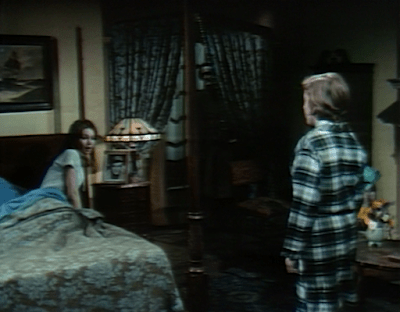
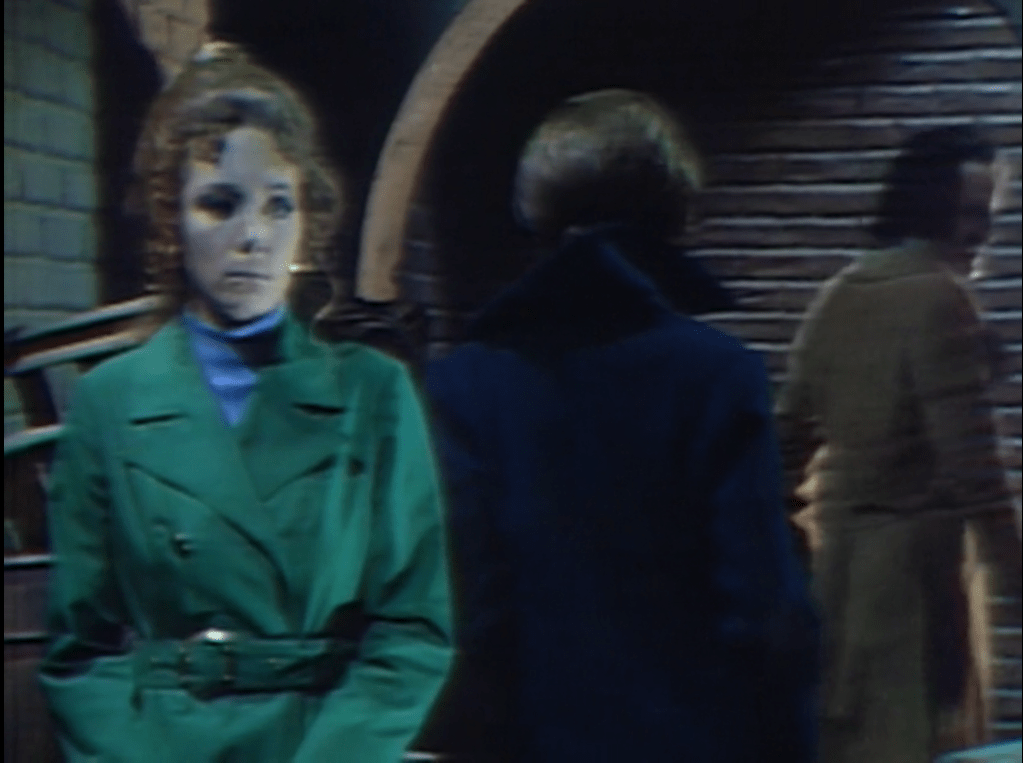
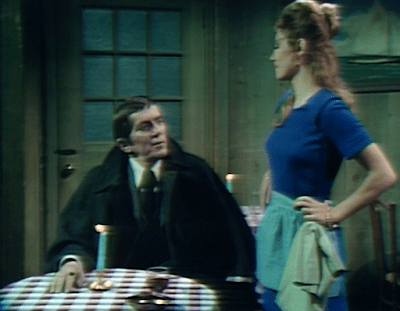
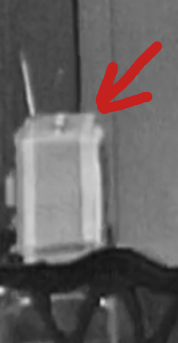

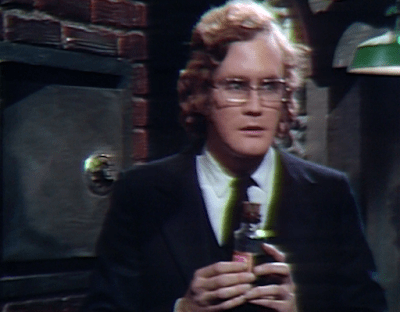
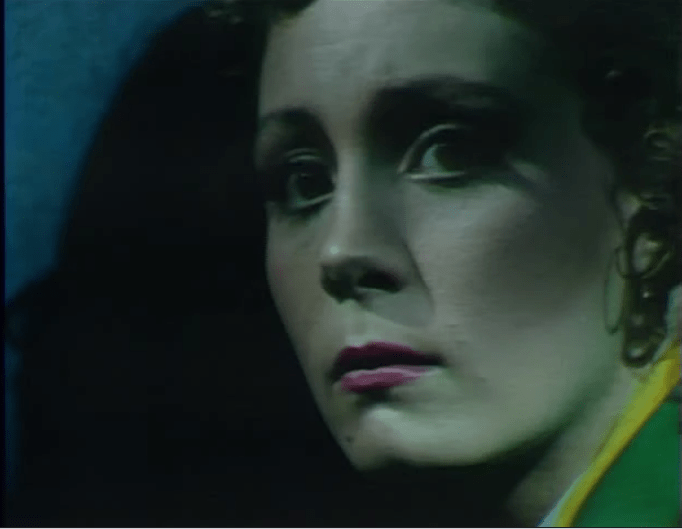
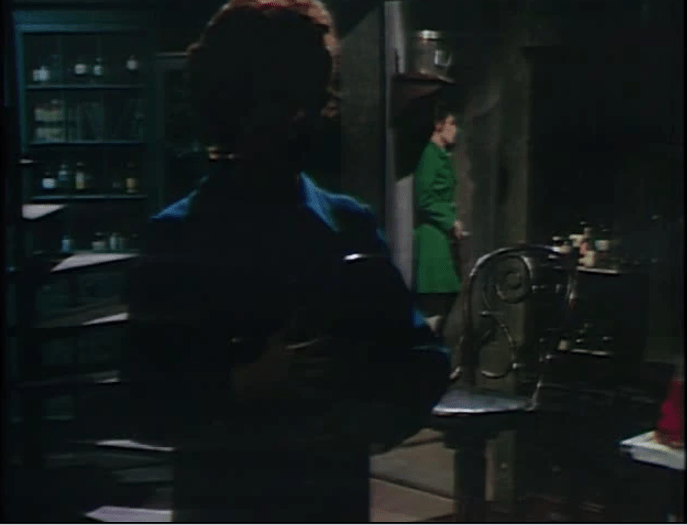
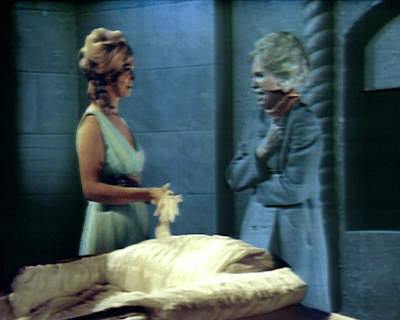
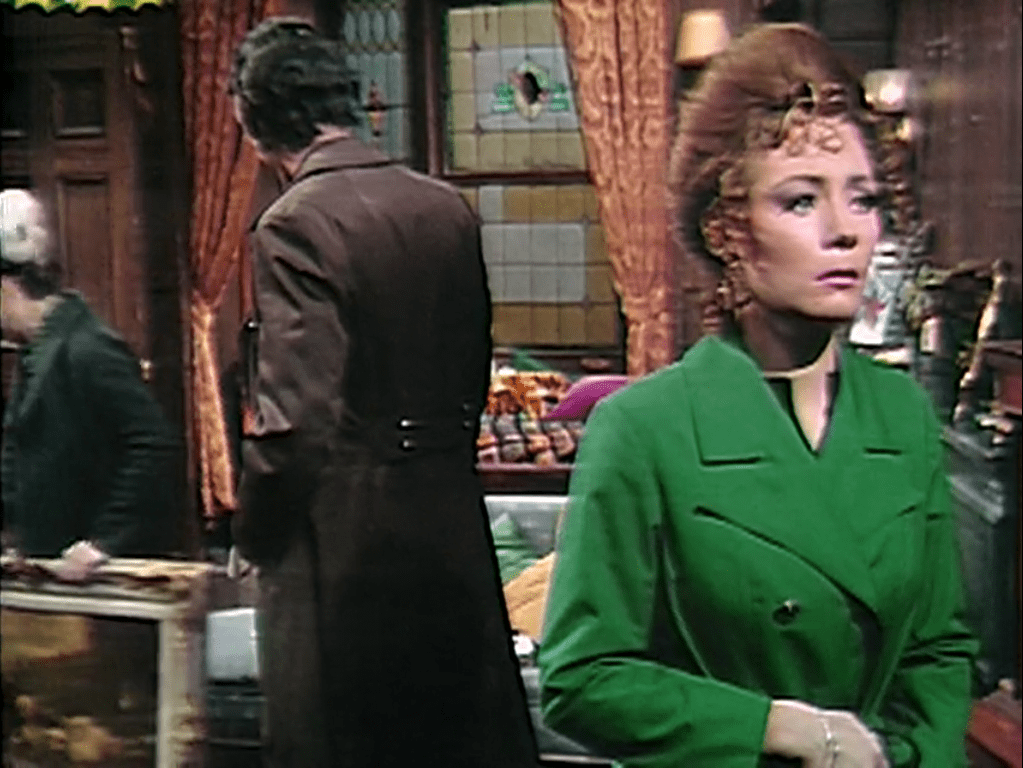
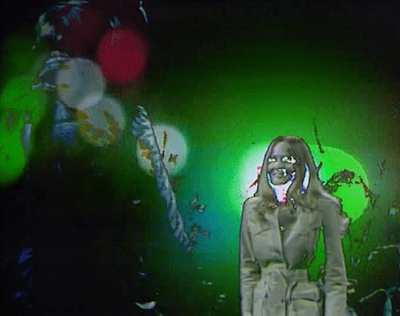
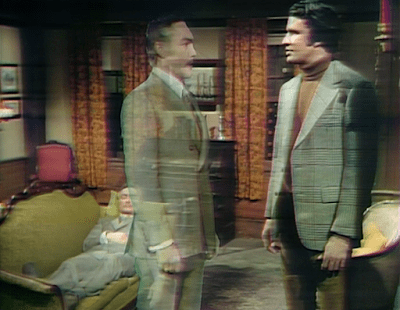
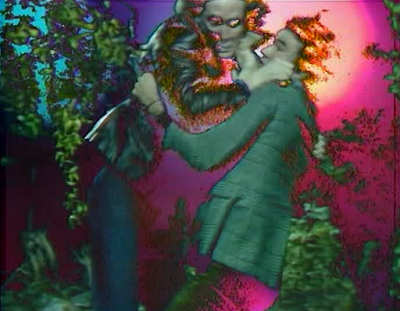
 Dark Shadows Commentary