Episode 69: I believe in signs and omens

Mrs Sarah Johnson, longtime housekeeper to the late Bill Malloy, shows up in the hotel room of dashing action hero Burke Devlin. She tells Burke that she believes his enemy, high-born ne’er-do-well Roger Collins, killed Bill. Her principal evidence for this is the fact that Bill’s body washed ashore near Roger’s home on the estate of Collinwood, and “I believe in signs and omens!”
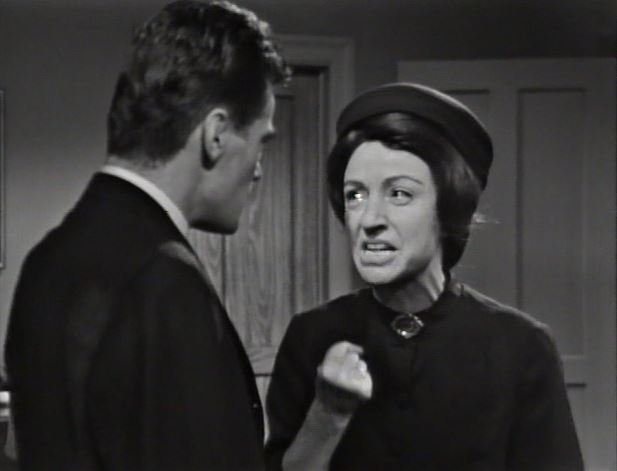
Mrs Johnson believing in signs and omens. Screenshot by Dark Shadows from the Beginning

This line is a bit of an omen itself- Clarice Blackburn will be an important part of the show, not only as Mrs Johnson, but as other characters who believe in signs and omens, and who make things happen in the name of that belief.

Meanwhile, hardworking young fisherman turned hardworking young clerk Joe Haskell is called into Roger’s office at the cannery. There, he finds flighty heiress Carolyn behind her uncle’s desk, looking seductive, or at least highly available.
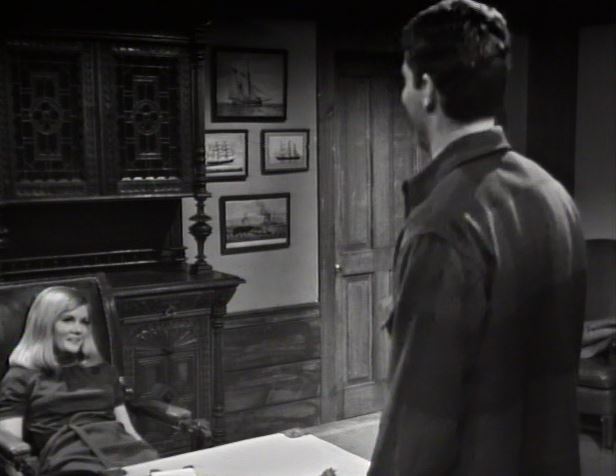
Carolyn coming on to Joe. Screenshot by Dark Shadows from the Beginning

Nancy Barrett’s way of throwing herself completely into whatever her character is supposed to be doing at any given moment sometimes makes Carolyn seem even more scattered than her persona as Flighty Heiress required, but it does come in handy when the character is supposed to be sexy. That makes her stand out- even by the standards of an American television show of the 1960s, Dark Shadows is remarkably un-sultry. Sometimes it’s a marvel that they can put so many good-looking young people in close proximity to each other and still project an image of total chastity.

Joe and Carolyn kiss, and she asks him to go away with her. He tells her that he can’t just leave work in the middle of the day. She explains that she is troubled by the doings of Joe’s bête noire, Burke. This leads to a lively conversation, which in turn leads Carolyn to resume her attempts to persuade Joe to take the rest of the day off. When Joe’s boss calls for him, she offers to use her clout as the owner’s daughter to persuade him to let Joe go. He won’t let her do this. She leaves, frustrated by his refusal.

Back at the hotel, Burke and Mrs Johnson are devising a plan in which she will get a job at Collinwood and act as a secret agent for him. We get a glimpse of Burke’s persuasive abilities. When Mrs Johnson is showing reluctance to follow his plan, Burke mentions that well-meaning governess Vicki has given Roger an alibi. She immediately declares that Vicki is lying. Burke won’t agree, leading her to demand that he set aside his personal feelings and devote himself wholeheartedly to making the case against Roger. Not only does the audience see Burke showing kindly feelings towards Vicki, keeping the idea alive that they might become a couple, but we also see Mrs Johnson commit herself to going along with Burke’s plan. Whatever Burke’s actual feelings for Vicki, his emotional display at this moment is timed to lock Mrs Johnson into doing what he wants.

There is a knock on the door. It’s Carolyn. Mrs Johnson hides in Burke’s kitchen and listens as he gives Carolyn the idea of hiring her as housekeeper at Collinwood. This isn’t very hard- Burke simply mentions that Mrs Johnson needs a job, and Carolyn at once says that she will tell her mother to hire her as housekeeper at Collinwood. Even so, Burke’s skillful handling of Mrs Johnson is so fresh in our minds that we don’t need to see him actually do anything to enlist Carolyn in his scheme for this scene to reinforce his image as master manipulator.

Mrs Johnson listens in. Screenshot by Dark Shadows from the Beginning

The sight of Mrs Johnson lurking in the shadows, eavesdropping on Burke and Carolyn, further reinforces this image. A guileless woman comes into his room proclaiming her every thought at the top of her lungs, as she had done when she was introduced at the sheriff’s office in episode 67. We can hardly imagine so straightforward a personality becoming an effective undercover operative Yet within minutes of meeting Burke, he has her working as a spy.

Writer Francis Swann is credited with the script for today’s episode. He is particularly good with installments that, like this one, have only four characters. Swann’s ability to slip substantial amounts of plot exposition into natural-sounding dialogue makes a minimalist drama seem busy. In this one, it also helps us to feel that we have seen Burke perform great feats of persuasion. Burke may not have had to work very hard to plant ideas in the minds of Carolyn and Mrs Johnson, but we are aware that the scripted dialogue has planted ideas in our minds, and know that someone on the other side of the screen is good at subtle communication.

Swann and director Lela Swift also make effective use of the sets in today’s episode. This is our first look at the kitchen in Burke’s room. He’s gone in and out of there several times, most notably in episode 29 when he prepared a nonalcoholic mixed drink, the “Burke Devlin Special,” for Roger’s son, problem child David. Regular viewers might have started to wonder what it might look like, and might pay close attention when we get our first look at it. What we do see is a complex pattern of shadows that signals Mrs Johnson’s initiation into the world of film noir.

In today’s scenes with Carolyn and Joe, we spend as much time in Roger’s office as we have in any other episode. It’s the only part of the Collins’ business location we see, standing in for the whole enterprise. Played on that set, Carolyn’s flippant attitude towards Joe’s job and his mixed feelings about the demands she makes lead us to wonder if she’s going to wreck the whole business. Her persistent friendliness towards family nemesis Burke gives substance to that thought. Regular viewers will remember that Roger’s self-indulgent behavior nearly annihilated the business; seeing his favorite niece play-act as him in his office leads us to wonder if she will finish the job.
Episode 68: Only friend in the world

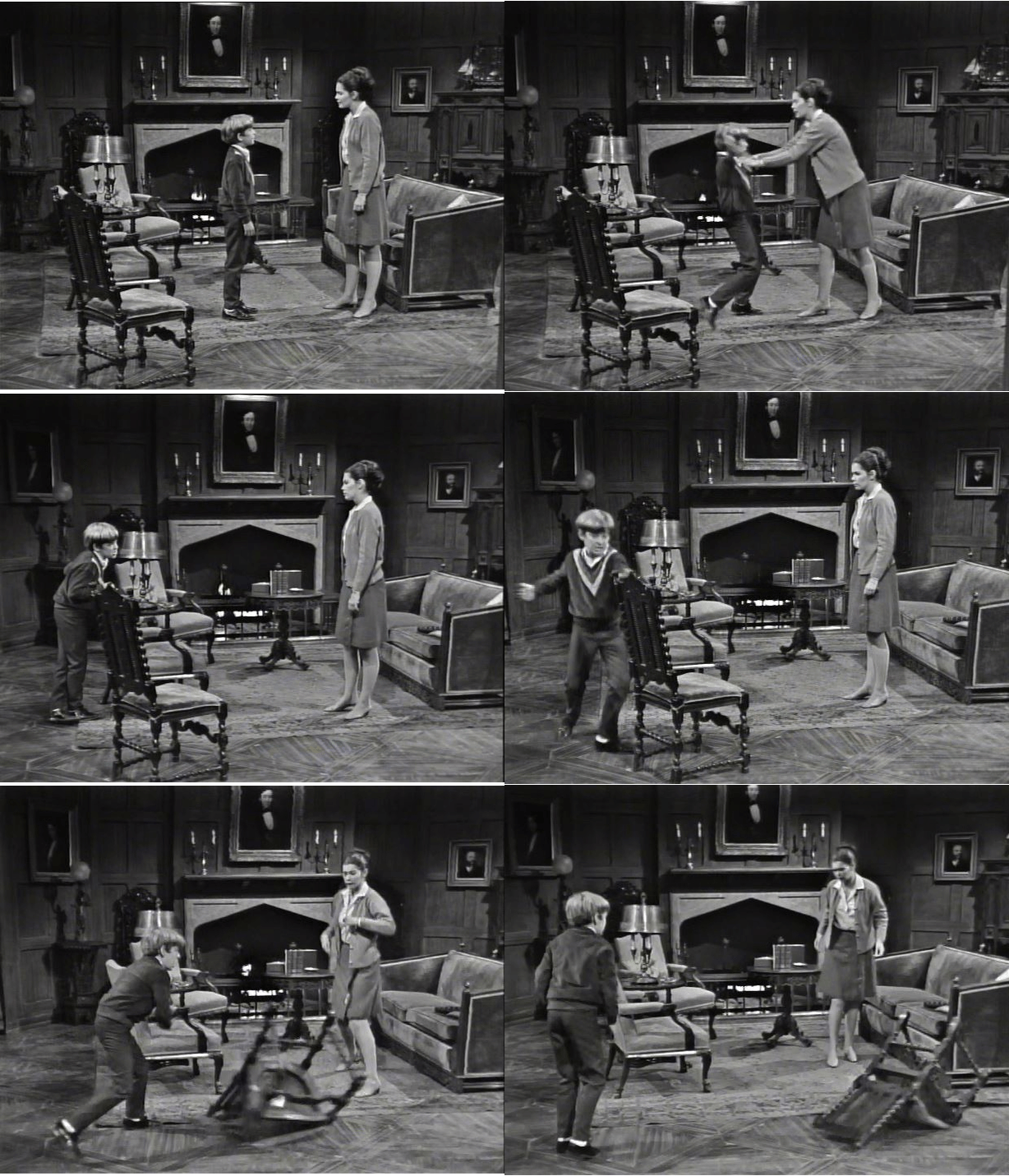
Well-meaning governess Vicki is determined to befriend her charge, problem child David Collins. In today’s episode, David throws a violent tantrum. Vicki looks genuinely frightened:

David throws a chair in Vicki's direction
Screen capture by Dark Shadows from the Beginning

Meanwhile, David’s father, problem adult Roger Collins, has decided to charm Vicki so as to reduce the likelihood that she will testify against him. Roger walks in on David’s tantrum. After scolding the boy and letting him go, he talks sweetly to Vicki. She tells him that she will do anything she can to understand David. He invites her to a lobster dinner. We see David, who has been eavesdropping on his hated father making friends with his hated governess, looking troubled.

David confronts his father about what he heard. Roger responds with the same charm he showed Vicki, acknowledging that he has been difficult to live with, taking the blame for all of it, and promising to be a new man in the future. He agrees with all of David’s baseless accusations against Vicki, and says that the reason he was being nice to her a few minutes before was to disarm her against David. David says that he wants to frame Vicki for some terrible misdeed that will prompt reclusive matriarch Liz to fire her; Roger replies that he doesn’t want to know what David does about that matter. He asks the boy to consider which he wants more- to be rid of him, or rid of Vicki.

These are outstanding scenes. As Vicki and David, Alexandra Moltke Isles and David Henesy both developed acting styles that built strongly on eye contact. Those styles mesh perfectly and produce an electric effect. As Roger, Louis Edmonds does everything well, but is peerless as a charming sophisticate. When Roger’s scene with Vicki begins, we don’t know that he has any especially sinister plans for her, so that scene plays as a pleasant interlude. We do know that Roger loathes David, so when we see him turning on the charm with his son, and especially when we see him agreeing with all sorts of statements from David that he knows to be false, the effect is alarming. By the time he is instructing David to keep him out of the loop when he acts against Vicki, Roger takes on a Satanic quality. His cold way of asking David his final question demonstrates that he knows David hates him and is unmoved by the fact. It’s heartbreaking to see David Henesy’s little face and imagine him as a child whose father shows that ultimate disregard for him, one of the bleakest endings of any episode in the entire series.

Episode 59: He sort of talked me out of it

Yet another G. G. E.- Genuinely Good Episode. There have been several of those this week.

The sheriff is in the big dark house on the estate of Collinwood, questioning high-born ne’er-do-well Roger about the mysterious death of plant manager Bill Malloy. Roger’s sister, reclusive matriarch Liz, joins them. They deny knowing anything, including things we’ve seen them find out in previous episodes. Much of the conversation is to do with drunken artist Sam Evans and the idea that Sam might be keeping a secret.

Roger’s son, nine year old problem child David, is all smiles when he drops in on his well-meaning governess Vicki. Convinced that she can befriend David, Vicki responds instantly to his smile. She asks why he’s so chipper. He says that it’s because he will never see his father again. The sheriff has come to arrest him for murder.

Vicki asks him if the sheriff said that he was going to arrest Roger, and David admits that he did not. But David is sure that he will. He is sure he is guilty. He lists the three sources of information he has that confirm for him that his father killed Bill- the ghosts of the Widows told him, he saw it in his crystal ball, and he used a tide table to calculate the spot at which Bill fell in the water. When Vicki insists that he doesn’t know what he’s talking about, he says she’s just refusing to face facts because she’s afraid his father will kill her, too. By the end of what had begun with the sound of a very cozy conversation, David tells Vicki that he might not be unhappy if his father does murder her.

Vicki keeps her eyes on David throughout this conversation, listens carefully even when he keeps talking after she’s told him to stop, and looks thoughtful after he leaves the room. As Vicki and David, Alexandra Moltke Isles and David Henesy play a wide enough range of emotions in this scene that we, in spite of the dialogue, can see why Vicki is still sure she and David will someday be friends.

Vicki trying to think of a way to reach David

David goes downstairs in time to see the sheriff leaving. He asks him if he’s arresting his father. The sheriff says he’d thought about it, but that Roger talked him out of it. That’s a pretty weird thing for a policeman to tell a boy, but Dana Elcar, as the sheriff, is such an engaging presence that we can accept it, somehow. I think it’s because he makes a show of choosing his words carefully and plays the scene with an eye on Roger, so that we can regard his strange words as a tactic to unsettle his suspect.

David gives the sheriff the book of maps and tide tables, open to the page where he marked the spot at which he believes Bill went into the water. The sheriff thanks David and tells him to keep up the detective work. David and Roger stare daggers at each other. In this staring match, David Henesy and Louis Edmonds, as Roger, do such a compelling job of embodying filial hate that the audience can respond in only one of two ways- either it will send a chill down your spine, or you’ll laugh out loud. This time we laughed, because we’ve seen so much of the show we feel we know the actors and know that they had great fun with scenes like this. I think we were chilled the first time through, though.

David and Roger stare at each other
Staring contest

After the sheriff leaves, Liz tells Roger that she has now lied to the sheriff for him, and demands that he tell her the truth. Roger says that he, not dashing action hero Burke Devlin, was responsible for a killing ten years ago, that his testimony at the trial that sent Burke to prison was a lie, and that he murdered Bill because he was afraid Bill would expose that lie. Liz trembles, sits down, says “It can’t be true,” then Roger bursts out that of course it can’t be true, not one word of it is true. Having heard the story out loud, Liz is happy to disbelieve it.

David listened to this conversation through the keyhole. When Vicki catches him listening, David declares that he had heard his father admit his crimes. He heard the denial as well, but that did not make the impression on him that it made on his aunt. He is as highly motivated to accept the confession as Liz is to reject it.

After David is sent to his room, Liz and Roger ask Vicki what he told her he heard. Vicki says it was nothing- “His imagination.” She is on her way into town to have dinner with friends. Liz asks who those friends are. Vicki tells her they are Maggie Evans and Maggie’s father.

Vicki leaves, and Liz asks Roger if Maggie Evans’ father is Sam Evans. Yes, says Roger. Why does that bother you, asks Liz. Roger denies that it bothers him, and stomps away up the stairs. Liz looks thoughtful, much as Vicki had looked thoughtful when David talked about her as a potential murder victim and walked out of her room.

Liz wonders about Roger

Denial, the psychological defense mechanism, presents a rich challenge to an actor. Liz cannot allow herself to believe that Roger is guilty of the crimes that have been discussed in this episode, and so she gladly accepts his declaration that “not one ugly word” of his confession to her was true. Yet Liz is an intelligent woman, and she knows her brother extremely well. She certainly knows him well enough to know that he is a scoundrel through and through, and it is obvious he has a great deal to hide in connection with these events. So as Liz, Joan Bennett has to play a person who simultaneously rejects an idea and accepts it. That’s a challenge to which she rises brilliantly.

The comparison between Vicki’s pensive moment after David leaves her room and Liz’ pensive moment after Roger leaves the foyer highlights the similarities between Roger and David. Those similarities are prominent this week. In yesterday’s episode, David was cool as a cucumber while others stormed and raged. Today, Roger plays it cool while confessing to a list of serious crimes, some of which he actually committed, and then exposes that list as a tactic to force Liz to deny his guilt. When David is in Vicki’s room, Vicki compares him to his father, to which David replies that he never killed anyone. If she were less concerned with winning David’s friendship, Vicki could have told him it wasn’t for lack of trying- he did tamper with the brakes on his father’s car and cause him a serious wreck, after all.

We can only assume that Roger has always been like this, that he once was what David is, and that unless something changes David will someday be what Roger is. Vicki’s pensiveness is all about the future, about the difference she might be able to make for David. Liz’ reaches into the past, back to all the times she, as Roger’s bossy big sister, tried to keep her bratty little brother out of trouble, and to cover up for him when he slipped beyond her influence. Whatever approach Vicki comes up with in her quest for David’s friendship, then, will have to be different from the approach Liz took to Roger throughout their early days.

Episode 50: He wasn’t there again today

This one is so good that I can’t resist going over it scene by scene. It has a wide variety of mood and image, tautly structured in a clearly told story, subtly realized by highly accomplished acting, and memorably presented in superb photography and imaginative sound design.

Well-meaning governess Vicki, out for a night-time stroll, makes her way to the crest of Widow’s Hill, where flighty heiress Carolyn stands looking down at the ocean swirling a hundred feet below. “Advance and be recognized! Friend or foe?” Carolyn challenges. Seeing Vicki, she remarks “Even the tutors are out tonight.”

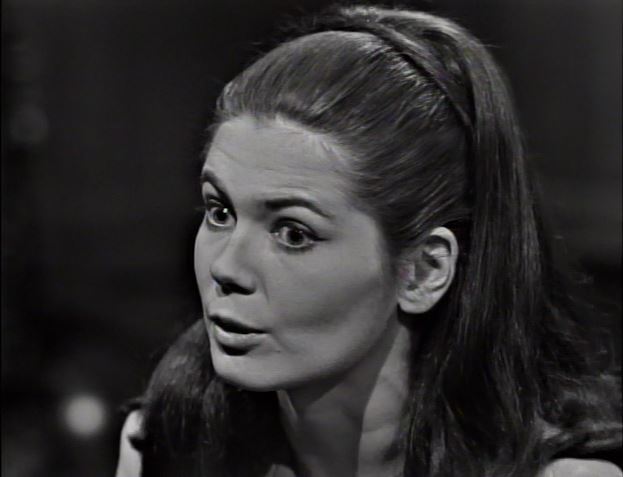
Despite her whimsical greeting, Carolyn is in a low mood. She’s wondering at her own inability to take hardworking young fisherman Joe Haskell’s desire to marry her seriously. She tries to interest Vicki in some of the ghost stories that surround the great estate of Collinwood, while the wind whips around the hill making the eerie sound known as “The Widows’ Wail.” Vicki stoutly insists on reducing all of Carolyn’s tales to psychology and asking her about her feelings. You can really see Nancy Barrett’s Carolyn trying to maintain a light tone despite her gloom, and in Alexandra Moltke Isles’ Vicki you can just as easily see a determination to cut through the nonsense and stick to what’s real, a determination fueled partly by her empathy for Carolyn and partly by her reflexive rejection of the weirdness of her new home in the old dark house.

In the house, troubled rich boy David Collins is complaining to his aunt Liz that the ghosts won’t let him sleep. Liz tells him to turn the lights on and chase them away. Unsatisfied by that response, David persists. Liz tells him that she has no time for him now and sends him to his room. Ten year old David Henesy trades these well-written lines with veteran movie star Joan Bennett as her professional equal. David Collins continually does nasty things to characters we like, refuses to take responsibility for any of his wrong-doing, and becomes violently surly when interrupted in his endless bouts of self-pity. He ought by rights to be a difficult character to take. But David Henesy finds something lovable in him, and brings that out clearly enough that he’s always a welcome presence on screen.

Vicki and Carolyn come to the house. Liz is disappointed they aren’t her ne’er-do-well brother Roger. Liz had ordered Roger to leave his desk at her company and come home early in the afternoon. She has questions about the disappearance of plant manager Bill Malloy, and about Roger’s lie that he hadn’t seen Malloy the night before. It’s well after 10 PM now, and no one has seen or heard from Roger since Liz called him.

Carolyn and Vicki have tea and try to take Liz’ mind off her worries, but without success. Liz scolds Carolyn for bringing up the ghost stories at a time when everyone is worried about Bill Malloy, but she can’t long keep herself from drifting off into the tale of the two women who died falling off the cliff, and the third who will someday follow them. That drifting, as Joan Bennett plays it, speaks volumes about Liz’ state of mind. She’s agitated about Bill Malloy, about Roger, about the possible connection between their two absences. That agitation gives way to hopelessness.

Roger comes home. Liz greets him with a demand for explanations. He responds with perfect insouciance, informing his sister, in whose house he lives as a guest and from whose business he draws a salary on her sufferance, that he is going to the kitchen to make a sandwich. Louis Edmonds’ delivery of Roger’s lines is brilliantly funny- we laughed out loud.

Liz most definitely does not see the humor. She has a brief scene by herself after he goes off to prepare his snack. All she does is watch him leave the foyer, turn, walk a few steps to the drawing room, and take a seat. With no dialogue and no mugging for the camera, she shows anger, disbelief, exasperation, and despair. It is a wonderfully economical performance, quite as extraordinary as is Edmonds’ comic turn preceding it.

In Vicki’s room, we see the word “death” scrawled on her mirror in all caps. Vicki enters, dragging David behind her. She demands to know who wrote it. He insists that the ghosts of the Widows did it. Vicki remarks that it is surprising that the Widows have the same handwriting as David. Carolyn enters, sees the word, and scolds David. Vicki silences Carolyn with a glance and asserts control of the situation. Only when Vicki threatens to tell Liz about the word does David erase it, though he still insists it was the Widows who wrote it, not him.

After David has left the room, Carolyn tells Vicki how horrid David is. Vicki perks up and makes a series of jokes about the Widows. She’s in such a chipper mood as soon as David is out of earshot that she must have been putting on an act presenting herself to him as angry. Much to Carolyn’s mystification, Vicki likes David and is confident that sooner or later she will make friends with him.

At another point in the series, this scene might have been padded out to fill a whole episode. Today, Art Wallace writes a quick and forceful interlude, showing us everything we need to know about what the three characters in it are like and where they stand in their relationships to each other, shedding some light on the idea of the ghosts of the Widows, then moving on to the next story point. The writing is as economical as the acting, and as absorbing.

Liz and Roger have a confrontation in the drawing room. Liz asks why Roger didn’t come home when she told him to. He tells her that he went to Bill Malloy’s cousins’ house to see if Bill had been there, and that he simply forgot to tell her he would be making the trip. This response is so unsatisfactory that it seems to double the anger with which Liz puts her next question- why did he lie to her when he denied having seen Bill Malloy last night? Roger tries to weasel out of answering that question, and does manage to get Liz to give him some information he can use to craft more plausible lies, but does not get himself off the hook.

The relationship between Liz and Roger is the first of Dark Shadows’ several relationships between a Bossy Big Sister and a Bratty Little Brother. In Liz and Roger’s case, they are literally older sister and younger brother; the most important such relationship will be a figurative one, between Julia and Barnabas. But it’s Liz and Roger who set the pattern. Roger’s impossible behavior in this scene is certainly among the finest examples of brattiness among all the little brothers, and Liz shows with crystal clarity the limitations of the power of the Bossy Big Sister when confronted with a truly horrid Bratty Little Brother.

Carolyn and Vicki come downstairs. They are going back to the crest of the hill to look for Carolyn’s wristwatch. Once they’ve left, Liz meets David at the top of the stairs. She tells David that they are looking for a wristwatch. “That’s not what they’ll find- they’ll find death” replies the boy. Last episode, David received the gift of a crystal ball; that marked the beginning of his career as a clairvoyant.

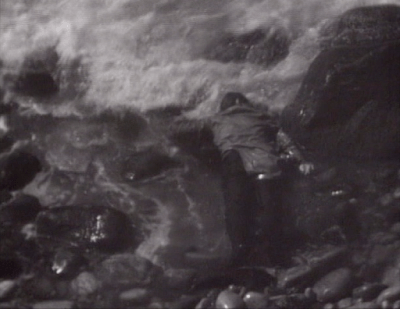
No sooner has the seer made his prediction than we hear Vicki screaming. Looking down from the cliff, she and Carolyn see a figure on the beach- a man face-down in the water. We hear the tide and the wind, sounds of nature on a large scale, and the immobile figure seems to represent something vast and inevitable.

Face down in the water, wearing an overcoat, with a flask in his back pocket
Screenshot by Dark Shadows Before I Die

Episode 32: Where all criminals belong

In today’s compare-and-contrast, we see the sheriff and Bill Malloy demonstrating how mentally healthy people might react to the idea that a nine year old boy has devised and executed a plan to murder his father. Then we go to Collinwood, where we see how Liz and Roger react to the idea.

The sheriff can’t bring himself to say out loud what the evidence is leading him to suspect David has done. Bill can say it only in part, and then only to express shock and bewilderment.

The scenes between Liz and Roger in this episode are among the strongest in the entire series. Roger is quite drunk, almost giddy, almost laughing at the fact that his son tried to kill him. Liz cycles through a half dozen intense emotions before finally accepting the fact that David is the culprit. She orders Roger to lie to the sheriff and say that what happened to his car was a simple accident, that no one was at fault.

In response to her explanation that this is the sort of thing the Collinses have always done, Roger brings up his suspicion that David may not be a Collins at all. David was born less than nine months after Roger and Laura* were married; she’d been Burke’s girl… Liz won’t hear such things, and insists that David is a Collins, that he belongs to all of the ancestors. She blames Roger for raising David in a home where he knew nothing but hate from the moment he was born, hate he couldn’t understand or cope with.

Roger insists that David be sent away to a mental hospital; Liz says no, that he will stay in the house, that “Miss Winters and I” will give him the home life he needs. Her mention of “Miss Winters” in this connection makes it clear that Vicki is central to Liz’ plans for the future, whatever those might be.

The sheriff shows up. He’s taking his time to get to the point. Roger cuts him off: “Is it about David?” At that, even the background music falls silent. The sheriff starts talking. Liz jumps in and says that the sheriff should drop the investigation, that it was all just an accident. The sheriff looks uneasily from Liz to Roger and back again, and finally agrees to do so.

In the coda, Roger tells Liz that she will regret covering up for David. He gives her a look of contempt that is among the most powerful things I’ve ever seen on a screen. Liz is totally alone now; Roger will obey her, but he’ll never respect her again. Joan Bennett was pushed to the margins of the show in later years, but she really did fill her “Starring” credit in these first months. It isn’t every show that would present us the leading lady devastated like this.

*Aside from the prologue delivered by Alexandra Moltke Isles, there are no surviving cast members in this episode. As of 9 August 2022, it is the earliest episode of which that can be said.

**Laura’s name is first mentioned here.

Episode 25: A neat way of managing people

The episode revolves around a letter to Victoria from the Hammond Foundling Home. The letter reports that no one connected with the Home had ever heard of the Elizabeth Collins Stoddard or any of the other Collinses before the letter came offering Vicki the job as David’s governess. This letter has set Elizabeth into a panic, since it exposes as a lie her story that Roger was friends with someone connected to the Home and that that person had recommended her. It sets David into an even more extreme panic, since he is terrified that his father will send him away to some kind of institution where children are kept and the Hammond Foundling Home is such an institution.

In her panic, Elizabeth demands that Roger sit down with Vicki and corroborate her lie. Roger is worried that Burke, who has hired private investigators to look into Vicki’s background, will discover some piece of information that will damage the family, and wants Elizabeth to confide in him. He is insistent enough about this to raise the audience’s hopes that in some future episode, we will get answers about Vicki through dialogue between the two of them. For now, she shuts him down by threatening to throw him out of the house unless he obeys her.

When Roger does talk with Vicki, she reminds him that she had asked him if she knew anything about her or about the reason she was hired when they first met. He had said no, and in every way showed bafflement about how Elizabeth heard of her. He tries to explain that away by saying that he was distracted by worry about Burke, and tries to deflect further questions by saying that his contact is a donor who wishes to remain anonymous.

Vicki is obviously unconvinced. Alexandra Moltke Isles has strabismus, and in her closeups during the scene with Roger she turns this to her advantage. Her eyes seem to be moving independently of each other, a more polite expression than eye-rolling, but just as effective at communicating disbelief. Marc Masse captured the effect quite well in this still image, on his Dark Shadows from the Beginning:

Roger’s remark to Elizabeth in this line, that she has “a neat way of managing people,” applies equally well to Vicki in her scene with him. At the end of the conversation, she knows that he was lying, and he knows that she knows. She also knows that he is under his sister’s thumb, not a threat to her position no matter how uncomfortable he may find her presence on the staff, and he knows that she knows that.

David’s panic leads him to take a less devious path than does his aunt, but ultimately an even more disastrous one. He steals the letter from Vicki. His father catches him with it and returns it to her.

Vicki herself is less concerned with the letter than with a thought we saw take shape in the back of her mind at the end of episode 23. She asks David about the magazines on auto mechanics he likes to read, about how he learns to put things together and take them apart. David responds with a denial that he sabotaged his father’s car; Vicki calmly replies that she hadn’t accused him of that.

Vicki comes into the drawing room and tells Elizabeth that David has been acting strangely ever since his father’s car went off the road, that when the sheriff came he was overwhelmed with the thought that he would be arrested, etc. Elizabeth dismisses the topic brusquely, seeing no significance in it. Vicki persists in the topic, reminding her that the sheriff said they should try to think of someone other than Burke who might want to kill Roger. Elizabeth declares “There is no one else”; at that, Roger sashays into the room and declares “Except my loving son, of course.”

Elizabeth has even less patience with this remark from Roger than with whatever it is Vicki is saying, and moves along so that Roger can tell Vicki the lie she has ordained. In the course of that conversation, she again says that they don’t actually know that Burke was the saboteur, a point that is no more meaningful to Roger than it had been to his sister.

Afterward, she goes back to her room and finds that David has stolen the letter again. She goes to his room to look for it. She doesn’t find it. Instead, she finds the bleeder valve, evidence that her suspicions are correct.