Episode 400: Fire knows your name

The Rev’d Mr Trask, a cleric of sorts, is convinced that there is a witch in the Old House on the great estate of Collinwood. He is right about this. He is also convinced that the witch is the eccentric Victoria Winters. He is wrong on this point. The real witch is Angelique Collins, wife of the master of the house, the gallant Barnabas. Barnabas, who as a man of the Enlightenment asserts that there are no witches, is hiding Vicki, and has reluctantly agreed to let Trask perform a rite of exorcism, believing that once he is finished he will have to go away and everyone will have to admit that Vicki is innocent.

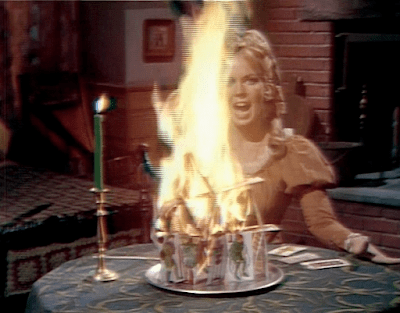
At the top of the episode, we see Angelique building a house of cards and delivering a soliloquy about her plan to cast a spell to make it look like Trask’s fraudulent ritual has proven Vicki’s guilt. There is an element of suspense as we wonder what the character’s actions will lead to, and an even more powerful suspense as we marvel at the courage it took for the actress to remain calm enough build a house of cards on what is essentially a live television show. Forget the Daytime Emmys, Lara Parker deserved a medal for this feat.

Angelique recites a spell over the house of cards, then sets it on fire. The first time they used an incompletely contained fire on Dark Shadows was in #191, and as a result of that daring experiment a load-bearing beam caught fire and collapsed in the middle of a scene. They finished taping before putting the fire out, and somehow everyone survived. There was also an off-camera fire during a conversation between Barnabas and Vicki in #290, and Jonathan Frid and Alexandra Moltke Isles just kept delivering their lines while we heard fire extinguishers blasting in the background. As a result of an excessive pre-treatment of the cards with lighter fluid, today’s fire burns faster and expels debris over a wider area than had been intended. I suppose a technical term for a rapid fire that expels debris is an “explosion.” Parker keeps up her incantation while this explosion progresses directly in her face. That shows an entirely different kind of courage than she showed with the house of cards, but she exhibits it in an equally rare degree.

The fire starts. Screenshot by Dark Shadows Before I Die.

Downstairs, Trask is standing at the threshold of the house, doing his own fire ceremony. He draws Vicki’s initials on the doorstep, holds up a dowsing rod, and jabbers for a while. Then he sets fire to the rod. In her room, Vicki sees flames erupting from the floor. She shouts in panic.

Barnabas is upstairs. He hears Angelique shouting “Eye of fire, heart of ice!” Her shouts grow louder and louder as she repeats the phrases faster and faster. My wife, Mrs Acilius, said that the pattern of Angelique’s voice sounded to her like someone having an orgasm. The willingness to risk the laugh that pattern might bring represents a third form of courage; by this point, we would have to admit that whatever we may think of Angelique, Lara Parker was one of the bravest people imaginable.

Barnabas is about to investigate, but then he hears Vicki shouting “Fire!” Between these two shouting women, he goes to the one who doesn’t sound like she’s enjoying herself. By the time he gets to Vicki’s room, she is gone. He sees no sign of fire.

Vicki runs out the front door, into Trask’s arms. He shouts “I’ve caught the witch!” and forces her to the ground. He looks delighted that his shtick actually worked, for once.

“I caught the witch!” Screenshot by Dark Shadows Before I Die.

This moment is an odd inversion of the ending of #191. That episode ends with strange and troubled boy David running out of the burning building where his mother, undead fire witch Laura Murdoch Collins, was trying to immolate him, and finding refuge in Vicki’s arms. At that moment, life triumphs over death, and Dark Shadows version 1.0 reaches its conclusion.

When Vicki runs out of the house and into Trask’s arms, death and folly win a victory over life and reason. Nothing comes to a conclusion- the story just gains new layers of complexity. We don’t even go to a commercial break, but get a reaction from Angelique first.

Barnabas talks with Angelique, mystified by what just happened. When he mentions that he heard her in her old room shouting strange words, she lies and says she was in the sewing room. After she leaves, we hear his thoughts- he had searched the sewing room, and knows she is lying. He now believes that there is a witch. He would find it much easier to believe that Vicki, a strange girl who claims to be displaced in time from the year 1967, 172 years in the future, is that witch than to face the prospect that his own wife is, but he can neither overlook the lie she has told nor the sheer improbability that so flagrant a quack as Trask came up with the right answer to any question. He remembers that indentured servant Ben claimed to have been enslaved by the witch, and resolves to find out what Ben can tell him.

We first got to know Barnabas in the months between April and November of 1967, when he was a vampire preying on the living in Vicki’s native time. In those days, he never mentioned Angelique, and there was no indication that he suspected any of the witchcraft we have seen since we embarked on our journey to 1795. Perhaps in the original timeline, when the place Vicki has taken was occupied by a woman named Phyllis Wick, Angelique had to proceed more slowly and carefully, with the result that Barnabas was turned into a ghoul without ever picking up on what was going on. If so, it would be Vicki’s complete failure to adapt to her new time in any way that accelerated the pace of events and thereby exposed Angelique to Barnabas’ suspicions.

Episode 399: Fraud in this house

Little Sarah Collins misses her governess, the well-meaning Vicki. Unknown to Sarah or her elders, Vicki is a time-traveler, displaced from 1967 by Sarah’s own ghost to come to this year 1795 and see how the troubles that will afflict the Collins family in days to come began. Vicki has utterly failed to adapt to her new surroundings, and is now in hiding, suspected of witchcraft.

Vicki is secreted in the Old House on the great estate of Collinwood, the guest of its owner, gallant gentleman Barnabas Collins. Unfortunately for her, Barnabas’ new wife Angelique is the real witch, and by her harebrained behavior Vicki has volunteered for the role of Angelique’s patsy. Angelique takes advantage of Vicki’s presence in the house to cast spells directing ever more suspicion her way and increasing the likelihood she will be caught.

We see Sarah in the foyer of the great house, tossing a ball in the air. Tossing a ball was one of her favorite pastimes as a ghost in 1967. In those days, she usually sang “London Bridge” while playing ball, but she is silent now. Indeed, we have yet to hear the tune in connection with the living Sarah. She is interrupted by Vicki’s disembodied voice calling her to the Old House. Regular viewers, remembering Sarah as the calmest and most adroit of ghosts, will be intrigued to see the living Sarah bewildered by a supernatural phenomenon.

The voice stops, and we cut to the Old House, where a puzzled Barnabas catches Angelique doing something weird with candles. She makes up a story about having needed the light to search a dark corner for a piece of jewelry she dropped. In the course of the story, she says that she was crawling about “like a cat.” It’s a bit startling to hear her compare herself to a cat, since in #378 she turned Barnabas’ father, haughty overlord Joshua, into a cat. It doesn’t make an impression on Barnabas, though, and he quickly disregards the whole thing.

Back in the great house, repressed spinster Abigail meets her brother Joshua in the drawing room of the great house. She is sure Vicki is a witch and that Barnabas is sheltering her in the Old House. Joshua had earlier given Abigail and her favorite divine, the Rev’d Mr Trask, free rein to investigate Vicki; he now seems to regret that decision, and on no account does he want any member of the family to go to his disowned son Barnabas’ house. When Abigail finds Sarah and forces her to tell the story about hearing Vicki’s voice calling her to the Old House, she seizes the high ground. She insists that Sarah go to the Old House and that she and Joshua follow her there. When Abigail says “Come, Joshua,” she leaves him little choice but to comply.

Sarah enters the Old House through the front door, and for the first time in 1795 the strains of “London Bridge” play on the soundtrack. Apparently Sarah’s visit to her former home marks a step towards her postmortem fate. She calls for Vicki. Barnabas asks Sarah what she’s doing there. Abigail and Joshua appear at the threshold and ask to be admitted. Angelique, as lady of the house, invites them in and offers to make tea. Abigail refuses the offer and announces their purpose. While the adults quarrel, Sarah slips out. We cut to Vicki’s room; evidently Sarah went directly to her, for they are already in the middle of a conversation.

In 1967, the spectral Sarah was an expert in the arts of concealment and escape. She has some of those talents already in her living form. She takes Vicki to a compartment in the attic that none of the adults, not even Barnabas, remembers. Vicki hides there while Abigail and Joshua search the house.

Having found Sarah, Abigail questions her closely. Sarah stands with her back to her aunt; it is uncharacteristic of Abigail to allow this, and we wonder why she does. Young Sharon Smyth plays the scene so well that we are glad to see her face. Abigail asks if Sarah knows that “curious and terrible forces” beset them; Sarah replies with a crisp “Yes, ma’am!” She asks if she knows what happens to little girls who lie, especially to their elders; “Yes, ma’am!” We see the struggle on Sarah’s face as she denies having seen Vicki.

Sarah makes herself lie to Abigail. Screenshot by Dark Shadows Before I Die.

After they complete their search, Joshua agrees that Vicki is not there and is embarrassed by the whole thing. Abigail insists that she is there, citing Sarah’s lies as proof. Now we understand why she let Sarah turn her back on her- she didn’t intend to extract the truth from her, since a lie would serve equally well. Abigail demands that Trask be brought back to perform a rite of exorcism. Joshua reacts to this demand with distaste, Barnabas with indignation, but Angelique persuades her husband to allow it.

After the visitors have left and Barnabas has gone to be alone, Angelique gives a soliloquy about how she will turn Trask’s fraudulent mumbo-jumbo to her own purposes. Vicki’s face is superimposed over hers in an effect we have not seen since the days of blonde fire witch Laura Murdoch Collins. Laura’s face was superimposed over those of people on whom she cast spells, most significantly over parapsychologist Dr Peter Guthrie in #185. Laura’s spell killed Guthrie; evidently Angelique’s plans for Vicki are equally final.

Episode 394: Not a simple woman

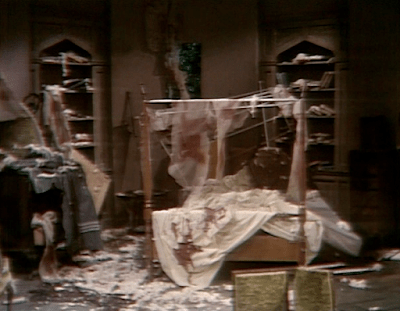
The ghost of Jeremiah Collins has gone to the newly built great house of Collinwood and made a terrible mess in the bedroom that was to be occupied by a house-guest of the Collins family, the Countess DuPrés. Among those who discover the mess is Angelique, who was the countess’ maid before she became the fiancée of Jeremiah’s nephew, Barnabas. Not everyone in the house knows of the change in Angelique’s station, so it is unclear whether she ought to stick with her former role and clean the room herself or start functioning as a member of the family by calling for a servant to do it. Since Angelique is also the wicked witch who raised Jeremiah from the grave, putting her in this awkward position would seem to be a passive-aggressive way for him to get back at her.

Messy room. Screenshot by Dark Shadows Before I Die.

Repressed spinster Abigail Collins, sister of the master of the house, comes into the room. She insults Angelique’s former master, the countess’ brother André, prompting him to leave the room in a huff. Angelique begins to follow André, but Abigail orders her to to stay.

Angelique has taken no care to cover her tracks, and it is obvious to all that something very unusual has been happening around the estate of Collinwood since she arrived. Most of those who have witnessed the strange goings-on are rational, modern people who are reluctant to believe in the supernatural, and the rest have settled on the idea that eccentric governess Victoria Winters is the witch. But Abigail has learned of Angelique’s engagement to Barnabas, has realized that every bizarre occurrence has contributed to making it possible, and has concluded that Angelique is in league with Vicki and the devil.

Up to this point, Abigail has been a figure who did ridiculous things but whom we came to respect as we saw that a person of her time and place might well have interpreted the information available to her as she does. In this scene, she isn’t ridiculous at all. She is mistaken about Vicki, who is a well-meaning innocent. But she has figured Angelique out long before anyone else has even begun to suspect her. Abigail emerges as a character who is smart enough to turn the story in fresh and surprising directions.

Abigail interrogates Angelique. Screenshot by Dark Shadows Before I Die.

Once Abigail has left the room, Angelique summons Jeremiah and tells him she has something for him to do before she will let him return to his grave. Jeremiah has already gone beyond the instructions she gave him, not only in befouling the countess’ room but also in repeatedly showing himself to Naomi Collins, the lady of the house. But I suppose Angelique has such a limited staff she can’t afford to let someone go for overenthusiasm.

We see Barnabas in his new room in the great house. His friend Nathan comes and asks him about the report that he is going to marry Angelique. Barnabas confirms that it is true, and assures Nathan that Angelique is not pregnant.

Nathan is puzzled that Barnabas wants to marry Angelique. Screenshot by Dark Shadows Before I Die.

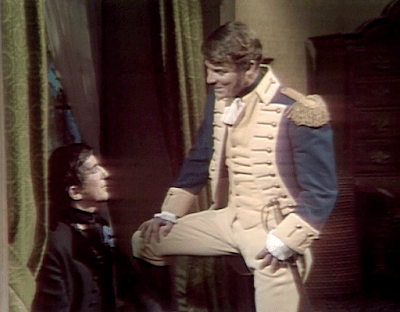
As written, the scene is a bit of a throwaway, but the actors flirt with each other pretty blatantly throughout the scene. As the screenshot above shows, it begins with Nathan thrusting his crotch into Barnabas’ face while Barnabas smiles appreciatively, and it continues along that line. Considering that Nathan is puzzled that Barnabas wants to marry a woman, even a beautiful one, and that viewers know that Barnabas intends it to be a sham marriage, the flirty tone makes it hard not to recognize a comment on a familiar closet situation. Jonathan Frid and Joel Crothers were both gay, but they had many scenes together and never seemed to be flirting at any other time, so perhaps this comment was intentional on their part and that of director John Sedwick.

After Nathan leaves, Jeremiah appears in Barnabas’ room. He denounces Barnabas for killing him in a duel over the gracious Josette and vows to haunt Barnabas and Josette forever if they marry.

This does not at all reflect the attitude Jeremiah had in life. Jeremiah and Josette married under the influence of a spell Angelique cast on them, and they deeply regretted the pain their elopement brought Barnabas. In his last conversation with Josette before the duel, Jeremiah made it clear that he was going to let Barnabas kill him and that it was all right with him if Josette and Barnabas went on to marry. Jeremiah’s rantings to Barnabas today are Angelique’s words, not his own. This leads us to wonder if she is simply manipulating him as a puppet, or if some fragment of her personality took up residence in Jeremiah when she raised him from the dead. We’ve seen several times that supernatural beings on Dark Shadows are complex phenomena made of parts that work independently and often at cross-purposes with each other, so perhaps when Angelique casts a spell she is dividing herself into parts that will thwart each other’s goals.

Regular viewers know that the segment of the show set in 1795 will show us Barnabas becoming a vampire. We assume that Angelique will be responsible for this transformation. Since the Barnabas we knew in 1967 showed many of the personality traits that Angelique has shown in 1795, seeing her at least use Jeremiah’s reanimated corpse as a mouthpiece for her words and perhaps turn it into a part of herself makes us speculate if the vampiric Barnabas we thought we knew was really Angelique all along.

After Jeremiah leaves Barnabas’ room, Angelique comes in. She tells Barnabas that Abigail is making trouble for them, he tells her about Jeremiah’s apparition, and they decide to marry at once. This three-part sequence in Barnabas’ room- his scenes with Nathan, with Jeremiah, and then with Angelique- mirrors a sequence in Josette’s room in yesterday’s episode, in which she is visited by Jeremiah, then by the countess, then by Angelique. That sequence ended with Angelique telling Josette that she and Barnabas were to be married and thus represented a step towards the wedding. The echo of its structure at the end of today’s installment gives us a sense that the wedding is approaching with irresistible momentum.

Episode 387: Just how does one go about sensing an evil spirit?

Lady’s maid Angelique is keeping busy, even though none of the ladies is on the show today, by carrying tea trays in and out of the front parlor of the manor house on the great estate of Collinwood. As she does so, she hears the Rev’d Mr Trask, a professional witch hunter visiting from Salem, Massachusetts, lay out his plan for uncovering what he believes to be a coven of witches operating in the house. Since Angelique spends her non-tea related time being a wicked witch and causing all the suffering that everyone has undergone on the show since we arrived in this year 1795, it is unsurprising that she reacts to Trask’s plan with concern.

We see the servants’ entrance to the manor house. Not only is this a new set, it is a new kind of set for Dark Shadows. So far, we have seen at most one entrance for any building. Since we are in the middle of the 78th week, we have come to expect that’s all we ever will see, so it comes as a bit of a jolt to see this doorway.

Angelique sees caddish naval officer Nathan Forbes coming out of the servants’ entrance. She remarks that the family and their guests never use it; he jokes about breaking rules. She asks what he has in his hands; he asks what hands she means, then admits that he stole some food from the kitchen. He claims to be on his way to a picnic, and invites her to join him. He is typically uninhibited in his dealings with young women, and he certainly doesn’t try to keep Angelique from thinking that if she accepts his invitation she will have her work cut out for her if she wants to remain fully clothed. She declines, insisting that she has duties to attend to.

Angelique sees through Nathan. Screenshot by Dark Shadows Before I Die.

She watches him go, and in a soliloquy says that she sees through him. He is taking the food to Victoria “Vicki” Winters, governess to young Sarah Collins and Trask’s prime suspect, who is in hiding. Perhaps Nathan was leveraging his reputation as a lecher by presenting his invitation to Angelique in terms he knew she would have to decline.

Back in the front parlor, Trask is asking the master of the house, haughty overlord Joshua Collins, why Angelique did not report when the servants were summoned for his questioning. Joshua replies that she is not the Collinses’ servant, but that she belongs to their house-guests, the DuPrés family. Trask rails against the DuPrés, and Angelique enters, meekly saying that her mistress told her she was wanted.

Even though Angelique was bustling around the room in the opening teaser, Trask does not recognize her. It may not have been customary to take much notice of servants in the eighteenth century, but Angelique is rather a hard person to miss. For one thing, she looks exactly like Lara Parker. A person would have to be pretty intensely focused not to notice someone who was so obviously meant to be a movie star.

Trask asks Angelique where she was when the other servants came. When she tells him she was walking alone in the woods, he asks if she went there to meet with someone- “perhaps the DE-VIL!!!” Jerry Lacy is an accomplished sketch comic, and the laughs he raises when Trask shouts about “The DE-VIL!!!” and “THE ALMIGHTY!!!!” must be intentional.

Trask questions Angelique closely, and for a fraction of a second it seems like he might know what he is doing. That produces mixed feelings in the audience- if he exposes Angelique, he will save Vicki and other characters we care about from the terrible fates that are apparently in store for them. On the other hand, Dark Shadows might then become The Adventures of the Heroic Reverend Trask, and that would be so ridiculous that no writing staff in the world could possibly keep it going for more than a few episodes.

Angelique sees through Trask as easily as she had seen through Nathan. She falls to her knees and claims to be having a vision. She hams it up shamelessly.

At first Trask says that she is either a complete charlatan or is speaking under divine inspiration; before Joshua can express a doubt as to which it is, he proclaims it genuine. She has claimed to hear the voices of a man and a woman speaking in a large new house that is otherwise vacant. Trask and Joshua decide it is the new house under construction on the estate, and rush off. We see Angelique with a weary look on her face, as if she can’t believe she is up against such a load of idiots.

In the drawing room of the new house, Vicki is eating the food Nathan has brought. She starts talking about her situation. As it happens, Vicki is not native to 1795 at all. She was thrust back to that year from a séance she was attending in 1967, after Sarah’s ghost took possession of her and said she wanted to tell “the story from the beginning.” Vicki hasn’t told anyone about this, but she is continually saying and doing things that make it obvious she doesn’t belong in this world. She tells Nathan that “In order to get here, I had to transcend time and space.” Nathan says he doesn’t know what she’s talking about, but that if she keeps saying things like that even her friends will think she’s a witch.

Vicki natters away. Screenshot by Dark Shadows Before I Die.

There was a time when Vicki was an intelligent, dynamic character. Apparently she left her brain in 1967, because what Nathan says comes as news to her. A few days after Vicki arrived, kindly gentleman Jeremiah Collins befriended her; when she answered his questions about her past by claiming to have amnesia, he bluntly told her she would have to make up a better story than that. Someone who needs advice at that level is not likely to do well in a situation where only a con artist could survive.

Vicki and Nathan hear voices in the foyer. Trask and Joshua have arrived. Nathan goes out to meet them, claiming to have come to inspect the architecture of the house. Joshua is appalled that Nathan has not asked his permission to enter the house, and Trask is sure he has come to visit Vicki.

Trask, Joshua, and Nathan go into the drawing room. Vicki is not there. A window is open, and there is a piece of fresh food wrapped in a cloth on a crate. Nathan doesn’t claim that he opened the window or that he was eating the food; Trask and Joshua are left to conclude that Vicki had been there.

Episode 383: Between men now

In 1966 and the early weeks of 1967, the Collinsport Inn was an important place on Dark Shadows. The restaurant there, presided over by Maggie Evans (Kathryn Leigh Scott,) The Nicest Girl in Town, was a place where people could meet each other unexpectedly and characters new to town could be introduced. Dashing action hero Burke Devlin (Mitch Ryan) lived in a suite at the inn, and the place often represented his territory, the base from which he conducted his war against the ancient and esteemed Collins family.

The sign. Screenshot by Dark Shadows Before I Die.

We haven’t seen Burke’s room since #206, at which point he had given up his vendetta against the Collinses and proceeded far down the road to irrelevance. We haven’t seen the restaurant since vampire Barnabas Collins (Jonathan Frid) met Maggie there in #221. By the time Anthony George took over the part of Burke in #262, Burke seemed to live in the Blue Whale tavern. He made business calls from the pay phone there, and in one episode apparently stayed behind when the bartender locked the place up for the night.

The inn makes a return appearance at the top of today’s episode. It is 1795, and Jeremiah Collins (Anthony George) is sharing a suite with Josette DuPrés (Kathryn Leigh Scott.) They are on their honeymoon.

Jeremiah and Josette eloped from the estate of Collinwood on the night when Josette was supposed to marry Jeremiah’s nephew, kindly gentleman Barnabas Collins (Jonathan Frid.) Josette truly loved Barnabas and Jeremiah was his dearest friend, but they were under a spell cast by wicked witch Angelique, who wanted Josette out of the way so she could have Barnabas for herself. The power of the spell waxes and wanes. When Josette and Jeremiah are in the grip of it, a trident shaped mark appears on their hands; when they return to their senses, the mark disappears.

Tridents showing. Screenshot by Dark Shadows Before I Die.

When the episode begins, the tridents are showing, and the newlyweds are inflamed with passion. Shortly after, Josette’s mark is gone, Jeremiah’s still showing. She is filled with regret, he is still ardent.

Back in the manor house of Collinwood, Barnabas has a conversation with Josette’s father André and his own father Joshua. He resists André’s suggestion that Josette and Jeremiah must have left together, and resists even more strenuously Joshua’s declaration that they did so because they are the victims of witchcraft. Joshua says that his sister Abigail and André’s sister, the Countess DuPrés, found a blasphemous trinket in the quarters of governess Victoria Winters, and that a witch-hunting divine, the Reverend Trask, is coming to investigate the matter. Barnabas is appalled at the notion of an inquiry into witchcraft, and vows to defend Victoria if Trask comes. Joshua forbids him to do so.

Barnabas’ reaction to the idea of a witchcraft trial, coupled with what we have seen of him so far in the 1795 segment, looks like a retcon. In #358, only a week and a half before we began this uncertain and frightening journey to the past, vampire Barnabas told a story about studying witchcraft under a warlock on Barbados who taught him “the secret magic number of the universe.” Events are moving so fast that it doesn’t look like Barnabas will have time to sail to the Caribbean before he becomes a vampire, and he won’t be crossing any waters after that. But now he is a man of the Enlightenment, who scoffs at the idea of witchcraft today as he scoffed at the tarot when the countess introduced him to it in #368/369.

Jeremiah returns to the house. There is an exquisite little scene with a servant, Riggs, who is uncomfortable at the sight of the disgraced Mr Jeremiah. Riggs stands in for the establishment of Collinwood and the whole working class of the town of Collinsport, and in his reaction we see the disquiet that bad news from the big house on the hill would spread among the people whose livelihoods are at stake when trouble comes to the family there. Riggs makes haste when Jeremiah tells him to go out and fetch Joshua.

When Riggs is gone, Josette enters. The audience sees that the mark is gone from Jeremiah’s hand, and Josette can tell that his passion for her is gone. She tells him that he no more loves her than she loves him. He begins with a protest against this remark, but ends by saying that they must be kind to each other.

Joshua and André enter. André embraces his daughter and tells her everything will be all right; Joshua looks at his brother with distaste and demands an explanation.

Jeremiah says that he and Josette are married. He further says he realizes they are not welcome, and that they will return to the inn. This raises the prospect of a recreation of the early days, with the inn as a territory separate from and opposed to Collinwood. Joshua rejects the idea at once. He will not have the scandal of Jeremiah and his new wife living in town because they have been estranged from the rest of the Collinses. He decrees that they will live at Collinwood and put on a happy face for the townsfolk.

Barnabas enters. Joshua tells him that Jeremiah and Josette are married. He refuses to believe it until Josette confirms it herself. He takes the glove from Jeremiah’s hand and slaps him in the face. He gives him a choice of weapons.

Dueling may have been as alien to the ideals of the Enlightenment as were Barbadian warlocks, but so too is Joshua’s plan of forcing the whole family to commit itself to a massive lie in order to preserve its hereditary privileges. Joshua, the proud apostle of Jeffersonian republicanism, is simply being a hypocrite, but Barnabas is a more complicated figure. Seeing his every hope turned to dust before him, his ideals have become useless. He has only a moment to choose among the evils the Enlightenment had promised to stamp out, and he chooses the most macho one available.

Joshua forbids the duel, but Barnabas disregards his father’s authority and insists on it. In 1795 and for some time after, dueling was widely practiced in much of the United States, and particularly in the South and West a gentleman lost face if he refused a challenge. No such stigma attached in New England, where dueling was condemned by law and religion. Had Joshua or Jeremiah gone to the police, Barnabas would have been arrested. In 1719, Massachusetts, of which Maine was a part until 1821, passed a law making it an offense punishable by a fine of £100 (equivalent to about $7000 today) to challenge someone to a duel. Massachusetts law already considered it murder to kill someone in a duel, and prescribed death by hanging as punishment. Of course, Joshua’s declaration that Jeremiah and Josette will live in the house and the family will present a “united front” to deter scandal makes it clear he will never turn his son over to the police, and the pattern of cover-up with the support of law enforcement we saw among the Collinses in 1966 and 1967 leads us to doubt that anything a member of the family does will ever be a matter for the courts to judge.

There is a missed opportunity in the show’s lack of interest in Massachusetts’ actual laws about dueling. The 1719 law was amended to be even stricter in 1730. Among the provisions added to the law at that time was a requirement that anyone who had either been killed in a duel or been put to death for winning a duel would “be given an unchristian burial at a gallows or crossroads, with a stake driven through their body.” Since the audience knows that Barnabas is fated to become a vampire, there is a chilling irony in seeing him volunteer for a staked burial.

Episode 375: Decisions melt like ice

Last night Josette DuPrés, fiancée of young gentleman Barnabas Collins, slipped into the bedroom of Barnabas’ uncle and best friend Jeremiah and propositioned him. This morning, Jeremiah thinks he must tell Barnabas that his intended is not the virtuous maiden he thought her to be.

Jeremiah finds Barnabas teaching kindly indentured servant Ben Stokes the alphabet. Ben marvels that children are able to learn something he finds so difficult. After struggling a while with the letter Q, Ben says he thinks it unlikely that he would ever say a word with a Q in it anyway. When Jeremiah says he has something important to discuss with Barnabas, Ben is excused from his lesson.

Minding Ben’s Ps and Qs. Screenshot by Dark Shadows Before I Die.

When Jeremiah sees how devoted Barnabas is to Josette, he can’t bring himself to break the bad news. He simply declares that no one must come between them. and Barnabas happily says that he is sure no one would want to do that.

Jeremiah sees Josette entering the house. She tries to hurry away, ashamed to face him, but he insists they go outside and talk. She swears that she has never before approached a man as she did him, that she is utterly mystified as to what came over her, and that rather than hurt Barnabas she would kill herself.

“Before I did that, I would kill myself.” Screenshot by Dark Shadows Before I Die.

Josette’s aunt, the Countess Natalie DuPrés, is a house-guest at Collinwood. She meets Josette in the front parlor. She wonders why Josette has been out of the house and alone from dawn until after lunch. Josette will not explain, and when Barnabas enters she runs away and shuts herself in her room. The Countess tells Barnabas that Josette is suffering from the sort of jitters girls often have before they become brides, and insists he take her rather than Josette on a furniture-shopping expedition.

Josette, Barnabas, Jeremiah, and the Countess are all unaware of the true situation. The Countess’ maidservant, Angelique, is a witch who has cast a spell on Josette so that she will conceive a mad passion for Jeremiah. She has cast another spell on Ben to make him her henchman. Angelique’s plan was that after Josette threw herself at Jeremiah, Jeremiah would tell Barnabas of the advance and the wedding would be off. Angelique would then be in a position to renew the affair that she and Barnabas had before he became engaged to Josette, and she would end up as the new Mrs Collins.

When Ben reports to Angelique that Jeremiah could not bring himself to tell Barnabas what Josette had done, she is shocked. She comes up with another plan- she will make Jeremiah reciprocate Josette’s feelings. She orders Ben to pour a love potion into the hot toddy he serves Jeremiah at night.

The other day, Angelique had Ben put a sleeping potion into Jeremiah’s hot toddy while he was in his room getting ready for bed. This time, Jeremiah is in the front parlor with Barnabas and the Countess. That makes for a more complicated scene, as Ben has to slip the potion in when none of the three are looking. Moreover, at one point the Countess asks for a drink other than sherry, and at another she urges Barnabas to have a drink. Since Jeremiah has asked for a smaller drink than usual, it seems possible at both of these moments that he might give the hot toddy away, foiling Angelique’s plan. It is all very well handled, and of course it ends with Jeremiah taking the drink and falling into the trap.

The Countess is still playing cards in the front parlor when everyone else is in bed. She sees Josette coming downstairs. Her niece tells her she can’t sleep and is going for a walk. The Countess offers to go with her, an offer Josette firmly declines.

We cut to a new set, a gazebo on the grounds of the estate. Jeremiah is there. He tells Josette that he was compelled to go there, he knew not why, but that some time ago he realized he was waiting for her. Josette says she was compelled to come also. They profess their love for each other and kiss. We turn to the bushes, and see the horrified face of the Countess watching their ominous embrace.

The Countess shocked. Screenshot by Dark Shadows Before I Die.

In place of episode 369: “Genuinely Good Episodes” and “Stinkers” in Dark Shadows 1.0 and 2.0

As I’ve gone along making these notes, I’ve occasionally been moved to tag episodes as “Genuinely Good” or “Stinkers.” Since no episode of Dark Shadows aired 56 years ago today- 23 November 1967 was Thanksgiving Day in the United States, so ABC showed football games instead of its regular programming- I’m taking the opportunity to list the installments to which I gave these labels.

Genuinely Good Episodes

#25. Written by Art Wallace. Vicki finds an incriminating piece of evidence in David’s room.

#32. Written by Art Wallace. Roger and Liz face the fact that it was David who tried to kill Roger.

#50. Written by Art Wallace. Vicki and Carolyn see Bill Malloy’s body below the cliff.

#59. Written by Art Wallace. The sheriff comes to Collinwood and questions Roger.

#68. Written by Francis Swann. Roger encourages David to murder Vicki.

#69. Written by Francis Swann. Mrs Johnson visits Burke in his hotel room.

#87. Written by Francis Swann. Roger finds Vicki in the sealed room and releases her.

#102. Written by Francis Swann. David has a conversation with the portrait of Josette.

#103. Written by Francis Swann. Vicki and Burke investigate Roger.

#112. Written by Ron Sproat. Liz rescues Vicki from Matthew.

#126. Written by Ron Sproat. The ghosts of Josette and the Widows, accompanied by that of Bill Malloy, rescue Vicki from Matthew.

#146. Written by Malcolm Marmorstein. Sam burns his hands.

#182. Written by Ron Sproat. Roger begins to suspect that Laura might really be a supernatural being and a threat to David.

#253. Written by Joe Caldwell. Maggie gives Willie her ring. The first really good episode of Dark Shadows 2.0.

#254. Written by Joe Caldwell. Carolyn and Buzz announce their engagement.

#258. Written by Malcolm Marmorstein. Maggie talks with Sarah.

#260. Written by Ron Sproat. Maggie escapes from Barnabas.

#265. Written by Malcolm Marmorstein. First appearance of Dr Julia Hoffman.

#318. Written by Gordon Russell. Barnabas and Julia hide in the secret room of the mausoleum while Sam and Woodard search the outer part.

#325. Written by Gordon Russell. Sarah comes to David in a dream.

#327. Written by Gordon Russell. David communicates with two aspects of Sarah that don’t communicate with each other.

#333. Written by Ron Sproat. Burke and Woodard search Barnabas’ basement.

#344. Written by Joe Caldwell. David knows what’s going on and has given up hope of changing it.

#345. Written by Gordon Russell. Burke is missing and feared dead.

#348. Written by Joe Caldwell. Julia tries to save the experiment. The first episode of Dark Shadows to fully integrate color into a coherent visual strategy, and probably the best episode of the series up to this point.

#351. Written by Gordon Russell. Barnabas adds Carolyn to his diet.

#363. Written by Gordon Russell. Tony catches Carolyn going through his safe, then Sarah appears to Barnabas.

#364. Written by Gordon Russell. Sarah confronts Barnabas.

#365. Written by Sam Hall. A séance at Collinwood has an unexpected result. This is the final episode of Dark Shadows 2.0.

I credit the writers, because there were only two directors in this period of Dark Shadows, Lela Swift and John Sedwick, and they didn’t differ sharply in approach. The rest of the production staff was the same in every episode, so the writers were the only ones whose names seemed like they might give a clue as to what set the best episodes apart from the worst ones.

I’m very surprised to see Marmorstein’s name in this list three times. Joe Caldwell was making uncredited contributions to the writing from #123 on; #146 is very much in his style, and I suspect he was its true author. But Caldwell was getting on-screen credit by the time of #258 and #265, so I think those must actually have been Marmorstein’s handiwork. Granted, neither of them is all that close to the top of the all-time great list, and the actors and directors do a lot to elevate them. Even so, they do prove that Marmorstein was not the total incompetent he so often seemed to be.

One thing I notice is that many of these episodes feature long-delayed confrontations in which the character learns information they hadn’t expected and can’t use right away. So in #25, David talks with Vicki and for the first time makes an explicit statement about his father’s accident, while Liz talks with Roger and for the first time makes an explicit statement about Vicki’s origins. In each case, the explicit statement is an obvious lie and the person telling it demands that the other go along with it. Hearing the characters talk about issues they’ve been evading for a long time relieves some worn-out suspense, while the actual content of the conversation builds fresh suspense as we wonder what use Vicki and Roger will make of the knowledge that David and Liz are lying. And of course the similarity between David’s behavior and his aunt’s shows that the boy is carrying on a family tradition.

In #32, Roger and Liz finally admit to themselves and each other the fact that David caused the accident. While they set to work covering this up, Roger tells Liz that he isn’t sure David really is his son. Liz refuses to entertain the question, but it sets us up for the storyline centering on David’s mother Laura.

Jumping ahead to #258, the conversation between Maggie and Sarah shows that Sarah is able to interact with the living and suggests that she wishes Maggie well, but is just as inconclusive as were the conversations in #25 and #32. Sarah’s conversation with Barnabas in #364 shows that she is angry with him and trying to rein him in, but also shows that she has little direct influence over him.

Stinkers

#223. Written by Ron Sproat. David runs around and screams.

#249. Written by Ron Sproat. The family looks in the locked room and doesn’t find anything.

#266. Written by Ron Sproat. Liz is depressed.

#268. Written by Ron Sproat. Liz is still depressed.

#272. Written by Joe Caldwell. Liz has revealed her secret, and no one knows what to do about it.

#298. Written by Ron Sproat. It seems as if Maggie is going to remember what Barnabas did to her, but then she doesn’t.

#299. Written by Ron Sproat. It seems as if Barnabas is going to bite Vicki, but then he doesn’t.

#356. Written by Gordon Russell. Julia sticks her notebook in the clock, giving the clock the star turn it has been waiting for.

I suppose the first thing you’ll notice is that I didn’t come up with the “Stinkers” label until after Barnabas joined the show. If I’d thought of it sooner, Malcolm Marmorstein’s name would have graced the list many times. Also, there probably would have been some episodes there that aired on Fridays, as they didn’t really start to make an effort to do anything special at the end of the week until about halfway through Laura’s arc.

But I’m not going to go back and add the label to episodes from the first 42 weeks. I didn’t have any particular thought of making “Best” and “Worst” lists when I put them on; I was just marking some of my posts as raves or pans. So I’d be imposing a false organization on them if I went back through and did that.

Episode 365: Respectable houses

For the fourth time, Dark Shadows is about to show us a séance. Each of the previous séances served to accelerate an ongoing storyline. The first, held in the drawing room of the great house at Collinwood, took place in #170. It had become clear to the audience and to well-meaning governess Vicki that Laura Murdoch Collins, estranged wife of high-born ne’er-do-well Roger and mother of strange and troubled boy David, was part of a complex of inexplicable phenomena. The ghost of grand lady Josette Collins spoke through Vicki and warned the company that a boy was in danger. Laura first interrupted the séance, then joined it and did occult battle with Josette’s ghost for control of Vicki’s voice. The séance marked the moment at which those phenomena coalesced into a purposive unit, all embodied in Laura.

The second séance was held in the front parlor of the long-abandoned Old House on the grounds of Collinwood in #185 and #186. There, Vicki, David, and artist Sam gathered. The spirit of David Radcliffe, a boy whom Laura had killed in one of her earlier incarnations, spoke through David Collins and led Vicki to believe that his fate lay in store for David unless she and her friends could save him. That took place while Laura was casting a spell that killed Dr Peter Guthrie, a parapsychologist whom Vicki had brought in as the Van Helsing figure in what had by then become Dark Shadows’ first pass at a dramatization of Bram Stoker’s Dracula. It brought the Laura story to its climactic phase.

The third séance was held in #280 and #281, again in the front parlor of the Old House. No longer is the Old House the long-abandoned wreck over which the ghost of Josette long presided. Now it is home to Barnabas Collins, a distant relative of the family in the great house and, unknown to them, a vampire. Barnabas and his blood thrall Willie have restored the house to its eighteenth century magnificence, and the Collinses have gathered there to celebrate their work. They are costumed as people who lived in the house in the days when Barnabas was alive. Over Barnabas’ objections, they hold a séance in which Josette again speaks through Vicki. After Vicki comes out of the trance, she sees the ghost of Barnabas’ ten-year old sister Sarah at the top of the stairs. This begins a period of the show when Vicki’s relationship to Barnabas is unsettled and drives much of the action.

Now, there is no ongoing story to intensify. The only open question is whether Barnabas will kill his sometime friend, mad scientist Julia Hoffman. He has spent enough time scheming to do Julia in that he would lose credibility as a villain if he didn’t, but he is so much more interesting with her to talk to and plot with and be cruel to that if she does disappear from the show they will have to replace her with another character who will be as much like her as possible. So the question of Julia’s fate is as much a dead end as are all the other exhausted narrative elements lying around.

It is a dark and stormy night. Gathered around the table in the drawing room of the great house are Vicki, Barnabas, blonde heiress Carolyn, Julia, matriarch Liz, and Liz’ brother Roger. They are attempting to contact the ghost of Sarah.

Carolyn, who has settled comfortably into a new life as Barnabas’ blood thrall, pretends to speak for Sarah. Vicki goes into the trance and speaks, not with the voice of Josette this time, but with that of Sarah. She says that Carolyn is lying. Carolyn tries to keep up her act, but her mother Liz scolds her; she has fooled no one. Through Vicki, Sarah declares that she will never appear to any of the company again. She drifts in and out of engagement with the séance, several times talking, not to Barnabas as he is sitting at the table, but to him as he was in the eighteenth century. She says that perhaps she will be able to accomplish something if she can tell the whole story “from the beginning.”

Watching this episode for the first time on cable TV in the 1990s, I was gripped by the panache with which they did the whole thing, but I could not see any possible way forward for the story. I couldn’t imagine what Sarah meant by telling the whole story from the beginning- was she about to give a multi-hour recital through Vicki there in the drawing room? That didn’t sound very likely, but I could not think of anything else it could mean.

What actually happens is that the candles go out and the room is plunged into complete darkness. Liz directs Barnabas to switch the lights on. When he does, we see that Vicki is gone. In her place is a woman we have not seen before, wearing a dress from the eighteenth century. She identifies herself as Phyllis Wick, come to be governess of Sarah Collins, and she is appalled by the outlandish clothing of the people around her.

Phyllis wonders where she is. Screenshot by Dark Shadows Before I Die.

For her part, Vicki finds herself outdoors, in broad daylight. She is holding a large book and looking at the Old House. She notices that the Old House looks somehow different. She has no idea how she got there or what is going on. When I first saw the show, I was as bewildered as she was.

Vicki wonders where she is. Screenshot by Dark Shadows Before I Die.

Closing Miscellany

Many in the original audience might not have been as baffled by this ending as I was. ABC ran a promotional spot for the show for some time before this episode aired giving away the big surprise that Vicki is about to have. I, for one, am glad that I had not seen that spot and was caught absolutely unprepared.

Episode 364: Barnabas, Barnabas

Vampire Barnabas Collins has been part of Dark Shadows at least since we first saw his portrait on the wall of the great house of Collinwood in #204, more properly since they went to great lengths to make it look like there was a portrait on that spot in #195. He is now the main force driving the action of the show, and pretty much the only reason people are tuning in to watch it. The ghost of Barnabas’ ten year old sister, Sarah, first appeared in #255; ever since, we’ve been waiting for the two of them to meet. At the end of yesterday’s installment, they finally did.

Barnabas was in his living room, trying to choke the life out of his only friend and would-be lover, mad scientist Julia Hoffman. Sarah materialized, and he let Julia go.

This echoes a scene in #341. Barnabas and Julia were in the act of murdering her medical school classmate and onetime friend, Dave Woodard, when Woodard claimed to see Sarah. At that, Barnabas almost let Woodard escape. Only when Julia called out “Stop him!” did Barnabas take hold of Woodard and kill him. Not only is he murdering a good-guy character, he has coerced Julia into taking part in the crime and will gloat over her new status as a murderer. But in the middle of all that loathsome cruelty, we see a flash of his longing for his baby sister. It is a tribute to actor Jonathan Frid that we can feel Barnabas’ loneliness and want to like him even in the middle of one of the character’s very darkest moments.

This time, Sarah really is there, and she really does stop a murder. There is a puzzle as to why. In #360 and #361, Julia knew that Barnabas wanted to destroy her, and appealed to Sarah for help. Sarah refused, saying that she liked Dr Woodard and knew what Julia did to him. We heard Sarah’s “London Bridge” theme on the soundtrack during the murder of Woodard, so it is clear that she witnessed that crime. But if she can stop Barnabas killing Julia, why couldn’t she stop him killing Woodard?

Today is only the second time Sarah has appeared to more than one person at a time. When Barnabas’ ex-victim Maggie Evans, The Nicest Girl in Town, wanted to escape from the hospital where Julia was keeping her locked up in #294, both she and her nurse could see and hear Sarah. Maybe it is difficult for Sarah to manifest herself to two people, and impossible for her to show herself to three. In that case, Julia’s presence would have stopped Sarah from saving Woodard.

It’s also possible that Sarah can’t do anything that will lead to Barnabas’ capture. She has appeared to many people and given all of them clues about the strange goings-on, but she has referred directly to Barnabas only when speaking to his partners in crime Willie and Julia. Time and again she has stopped short of giving information that would expose her big brother. When Barnabas and Julia moved against Woodard, he was calling the sheriff. Woodard might have placed himself beyond Sarah’s protection when he picked up the telephone.

Indeed, if Barnabas does kill Julia now, he will probably be caught. Julia has given a notebook full of incriminating evidence about Barnabas to a local attorney to be handed over to the authorities in case anything happens to her. Besides, everyone knows she spends a great deal of time at Barnabas’ house, so if she suddenly goes missing he will be investigated. By preventing Barnabas from killing Julia, Sarah is protecting him from exposure.

Sarah tells Barnabas that he taught her the first lessons she ever received in morality, and that he has now forgotten them himself. He begs her to stay, showing at length the vulnerability and need that have been so effective at recruiting our sympathy when we have glimpsed them before. She says she will never appear to him again, not until he learns to be good. We’ve known him long enough to know that this will be an extremely long wait.

Barnabas begs Sarah to stay while Julia looks on. Screenshot by Dark Shadows Before I Die.

Sarah vanishes. Julia sees her friend shattered. She approaches him. She addresses him, for the first time, as “Barnabas, Barnabas.” He recoils from her. He does not renew his attempt to strangle her, but he does tell her in the coldest imaginable voice that he could kill her as easily as he could crush a moth. It hasn’t been two minutes since his little sister reduced him to tears, and he has snapped back into his place as death itself.

“Barnabas, Barnabas.” Screenshot by Dark Shadows Before I Die.

Some say that Barnabas’ frequent references to his longing for Sarah during these weeks are meant to make him easier for the audience to sympathize with. I think this scene shows that the opposite is more nearly the case. They’ve undercut every other ground for liking Barnabas, leaving us only his love for Sarah. When we see that not even a visit from Sarah can thaw him out for any length of time, not only do we have to give up any hope that there is a nice guy hidden inside him, but we also hear the door slamming shut on any possibility that his character will develop in a way that will surprise us. Since he is the show, the closing of that door means that Dark Shadows 2.0 is all but over.

In the great house, matriarch Liz breaks the news to well-meaning governess Vicki learns that the authorities in Brazil have identified one of the corpses found in the wreckage of an airplane that crashed outside Belem as that of Vicki’s depressing fiancé, Burke Devlin. It has been clear for some time that Burke probably died in that crash, so Liz is worried that Vicki’s refusal to accept their verdict is a sign that she is in an unhealthy denial about the facts of the situation.

In the first 25 weeks of Dark Shadows, Burke was a major figure, the arch-nemesis of the Collins family. His storyline never really took off, though, and when undead fire witch Laura Murdoch Collins was on the show from #126-191 his issues were all absorbed into her arc. He formally renounced his grudge against the Collinses in #201, and has been surplus to requirements ever since.

There is just one thing I wish they had done differently about Burke’s death. During the early period of the show, there was a story about high-born ne’er-do-well Roger Collins trying desperately to hide a custom-made filigreed fountain pen of Burke’s. That dragged on for months, and dominated 21 whole episodes. It would have been a nice Easter egg for those of us who sat through those not-very-interesting installments if Liz had said the authorities were able to identify Burke’s body in part because that pen was on it.

There is a bit of intentional comedy this time that works very well. Telling Barnabas of Vicki’s refusal to accept Burke’s death, Liz exclaims “She can’t go on loving a dead man all her life!” Barnabas is clearly offended by this remark, quite understandably since he is deceased himself. He responds that “It has been known to happen.” But he manages to keep cool enough that Liz doesn’t notice.

“It has been known to happen.” Screenshot by Dark Shadows Before I Die.

Closing Miscellany

This episode marks the last appearance of Sharon Smyth as the ghost of Sarah Collins.

Episode 1-274 of Dark Shadows each began with the words “My name is Victoria Winters,” delivered in voiceover by Alexandra Moltke Isles and leading into a few sentences vaguely related to the plot of the show. Beginning with #275, these voiceovers might be delivered by any actress with a speaking parts in that episode, and do not involve their character’s names. Many are written in the first person, however, as is today’s:

There has been a homecoming in the great house of Collinwood, and those who have returned have found that very little has changed. We still live within a ring of fear, a fear that is generated by the one who lives in the Old House, where on this night a kind of madness prevails, a madness that will lead to the threat of murder.

Every time this happens, the Dark Shadows wiki complains that “by this time in the series, the narrations are no longer spoken in character.” That complaint might have made sense if only a few of the episodes since #275 included first person pronouns, but dozens of them do. So we would have to say that they often are spoken in character, but that it isn’t always clear who the character is. The wiki editors will be glad from now on, because this is the last time a narrator says “we.”

Episode 363: Very honorable guy

When Dark Shadows debuted in June 1966, it was a Gothic romance in which characters sometimes equivocated about whether they were using the word “ghost” metaphorically to refer to present troubles caused by past conflicts or literally to refer to things that go bump in the night.

That version of the series ended with the story of undead fire witch Laura Murdoch Collins. In Laura’s months on the show, her arc absorbed such major plot elements as the conflict between high-born ne’er-do-well Roger Collins and local man Burke Devlin, the psychological problems of strange and troubled boy David, David’s relationship with his well-meaning governess Vicki, and the tensions between the ancient and esteemed Collins family and the working class people of the town of Collinsport. By the time Laura went up in smoke in #191 and #192, there was no life remaining in any open narrative thread, and Dark Shadows 1.0 was at an end.

Dark Shadows 2.0 launched in #193 with the introduction of seagoing con man Jason McGuire. Jason was an in-betweener who would tie up the loose ends remaining from the 25 weeks before Laura joined the gallery of characters and facilitate the introduction of Laura’s successor as a major supernatural menace, vampire Barnabas Collins. Jason kept himself busy blackmailing reclusive matriarch Elizabeth Collins Stoddard, his sidekick Willie Loomis accidentally released Barnabas, and the show kept dropping hints that when Liz finally stood up to Jason all of the original secrets would be laid bare.

The makers of Dark Shadows didn’t do much advance planning, so they kept Jason on the show for 13 weeks after Barnabas premiered while they tried to come up with some other way to fill the time. When Jason’s plan finally blew up in his face, they even left some of the old secrets still buried, most notably the question of where Vicki originally came from.

Barnabas finally killed Jason in #275, and he hasn’t been mentioned in a while. But he is not forgotten. As we open today, lawyer Tony Peterson has caught heiress Carolyn Collins Stoddard in his office, rummaging through his safe. Tony has been dating Carolyn and is clearly very much attracted to her. He invites her to tell him a story that will give him an excuse not to call the police. She has to think fast to come up with one, and what she settles on is a version of the story of Jason and Liz.

Tony knows that Carolyn was trying to steal a notebook that he had put in his safe. This notebook was the property of his newest client, Julia Hoffman, a permanent guest at the great house of Collinwood. Carolyn tells Tony that Julia was blackmailing Liz. The notebook, she claims, is a diary kept by a man with whom Liz had an affair, and it contains proof that the man was Carolyn’s father. Julia knew the man and knew that he was planning to come to Collinwood to squeeze money out of Liz in return for his silence, but he died before he could do so. Julia took the diary and picked up where he left off.

Since Tony’s professional ethics will not allow him to be a party to blackmail, this is the one story that could give him a plausible reason not to report Carolyn’s crime to the police. It also gives him a reason to feel sorry for the Collinses, whom he hated when we first saw him, removing an obstacle to the possibility he might fall in love with Carolyn.

The echo of the Jason/ Liz story in the image of Liz forced to accept a blackmailer as a member of the household offers a great deal more than narrative convenience to regular viewers. The audience knew what Jason was threatening to tell if Liz did not submit to his demands, but the characters did not. One idea that some among them seemed to suspect was that Jason was Vicki’s father and Liz was her mother. Indeed, the makers of the show did plan to explain Vicki’s paternity at the end of the blackmail arc, a plan they abandoned so late that the climactic episode runs some minutes short. When Carolyn brings up the idea of her mother being blackmailed to keep it secret that she bore a child out of wedlock, those of us who have been watching all along will realize that she was among those who suspected that this was the secret that gave Jason his hold over her.

The audience knows that there will be no romance between Tony and Carolyn, because we know that she is Barnabas’ blood thrall. Barnabas sent her after Julia’s notebook, because it contains the records of an experiment in which she tried to cure him of vampirism. It would expose him were it to fall into the hands of the authorities. Since Barnabas wants to rid himself of Julia, perhaps by killing her, perhaps by driving her totally insane, he cannot leave such a document out of his possession.

Dark Shadows has come to as much of a dead end now as it had when Laura’s arc was ending. None of the ongoing stories has room for more than a few steps of further development, and if they keep running through those steps at the current pace everything will be resolved in a couple of days. Bringing up Jason, whose introduction marked the beginning of Dark Shadows 2.0, leads us to wonder if they have something up their sleeves that will launch Dark Shadows 3.0.

Tony takes Carolyn home to Collinwood, where he confronts Julia. He tells her what Carolyn told him. She denies it, and says that she will write a letter entrusting the notebook to him to remain unread unless something happens to her, in which case he will read it and hand it over to the authorities. That satisfies him that he isn’t a party to blackmail, and he agrees to her terms.

For the last couple of days, Barnabas has been using black magic in an attempt to break Julia’s grip on sanity. Her clear thinking and calm demeanor in this scene prove that this attempt has failed. The only open question in the only ongoing conflict is, therefore, whether Barnabas will try to murder Julia. She is such a valuable character that it is hard to feel any real suspense about whether he will succeed in killing her, but there is a chance that he will make an attempt.

David and Vicki have come home from a trip to Boston. David enters the drawing room, sees Julia, and greets her. She can barely pay attention to him long enough to say hello. He asks if she is all right; again, she is clearly not at all focused on him. She excuses herself, saying she has to go to Barnabas’ house.

David’s relationships to the other characters were the engine that drove Dark Shadows 1.0, and when Barnabas began to pose a danger to David that same engine accelerated the pace of Dark Shadows 2.0. Julia has been central to the plot for some time; that she can’t be bothered to take any notice of David tells us that that engine has fallen apart. Whatever they are planning to do next week, David won’t be at the heart of it.

David leaves the drawing room. He gets as far as the foyer. There, he sees his friend, the ghost of Barnabas’ ten year old sister Sarah. He tells Sarah that he has been on a trip. She asks where he went. He says he went to China. “Oh,” she responds, blandly. “You’re not impressed?” “No, my father’s friends used to go to China on their ships.” “Well, I didn’t really go to China. I went to Boston.” “BOSTON!!!” Sarah exclaims. “I went to Boston once!” She’s electrified. It’s adorable beyond belief.

Suddenly, Sarah looks disturbed and says she has to go. David asks why, and she says there is trouble brewing at the Old House. Again, David has been sidelined. If there is going to be any more action, it will have to come from fresh sources.

The Old House is Barnabas’ house, and that’s where we go next. We see Julia arriving there. She tells Barnabas that Vicki is back. He is mildly interested. She then tells him that she has seen Sarah. Barnabas longs to see Sarah, and is tormented that she will appear to others but not to him. He accuses Julia of lying. She insists that she is not, and taunts him with Sarah’s refusal to appear to him. He grabs Julia by the throat. He has done this before as a threat, but this time it looks like he really means to strangle her. Before he can, a wind blows the door open and the candles out, and Sarah walks in. She approaches her brother, glaring at him.

Sarah has had it with Barnabas. Screenshot by Dark Shadows Before I Die.