Heiress Carolyn Collins Stoddard has had a dream in which her new husband, whom she knows as Jeb Hawkes but who when we first saw him asked to be called Jabe, was in a fight on top of Widows’ Hill. His opponent, a stooge named Sky Rumson, threw him off the precipice to his death. When she awoke, Carolyn ran to the hill in search of Jabe. Instead, she found Sky. He told her that her dream was not complete, because it did not show her death. He then grabbed her by the throat.
Jabe rushes up and knocks Carolyn out of Sky’s grip. He and Sky fight, and Sky does throw him off the precipice. Carolyn escapes.
Back home at the great house of Collinwood, Carolyn finds her mother, matriarch Elizabeth Collins Stoddard, and permanent houseguest Julia Hoffman, MD. It takes her a while to compose herself sufficiently to tell Liz and Julia what happened. Julia offers Carolyn a sedative, which prompts her to jump up and shout a verbal refusal. By the time Carolyn starts telling the story, her distant cousin, old world gentleman Barnabas Collins, has joined them in the drawing room. She interrupts herself to yell at Barnabas that he always hated Jabe and is probably glad he’s dead. When Carolyn finishes, Barnabas slips out. Liz calls the police, and Julia is surprised neither of them saw Barnabas leave.
For the last nineteen weeks, the show has been trying to make a story out of some themes drawn from the writings of H. P. Lovecraft. That segment is usually called “the Leviathans,” after a race of Elder Gods who are behind the action. Jabe was central to the Leviathan segment. Sky is the only other character remaining from it. Barnabas appears in the house where Sky has been crashing and finds him packing his bag. Sky does not understand how Barnabas got in. Barnabas dismisses his question, merely saying that Sky knows there are things he can do that ordinary people cannot. Sky draws a revolver and fires two rounds at Barnabas point blank, without effect. Sky exclaims “Oh, no!” Barnabas is amused that none of Sky’s late colleagues told him that he is a vampire. He takes Sky’s hand, curls his arm back so that the gun is pointing at his heart, and squeezes Sky’s finger onto the trigger.
Back at the great house, Liz gets a telephone call from the sheriff. The police haven’t found Jabe’s body, and have surmised that it washed out to sea. They have found Sky, and have tentatively ruled his death a suicide. Later, Carolyn has another dream. In this one, Jabe shows up and confirms his death. That marks the end of the Leviathan segment. Carolyn will go on using the name “Mrs Hawkes” and saying she misses Jabe, but otherwise the last nineteen weeks will be forgotten.
Before killing Sky, Barnabas had mentioned that he almost regrets not leaving him to the other person who is on her way to do him in. That is Sky’s estranged wife, wicked witch Angelique. Had the Leviathan segment been more successful, or had Geoffrey Scott been even marginally competent in his performance as Sky, they might have made something of the parallels between Sky and Jabe. They are both very tall men with blonde wives who are dissatisfied with them. Angelique is dissatisfied that Sky is a tool of the Leviathans and that he tried to set fire to her on the orders of their representative, and Carolyn is dissatisfied with Jabe because he keeps running away from dangers he has brought on himself by his rebellion against the Leviathans and he won’t tell her anything about himself. Sky is a mortal man, while Angelique may once have been human but has long since become a creature of the supernatural. Carolyn is a mortal woman, while Jabe is now human but was originally a shape-shifting monster from beyond space and time.
But the ratings have been sinking throughout the Leviathan period, and the whole narrative structure of the arc keeps collapsing around them every time they try to do anything with it. So they are in too much of a hurry to move on to the next thing to do any exploring of the characters. Also, Scott is hopeless. As my wife, Mrs Acilius, put it, it isn’t that he is an actor with just one strategy. He keeps trying different things, and none of them comes close to working. We won’t see him again.
The new story has to do with an alternate universe that is occasionally visible in a room in the long disused east wing of Collinwood. Barnabas, Julia, and others have been spying on its inhabitants, and Barnabas is fixated on the idea that if he can cross over into it his vampirism will disappear. Since his bloodlust is overwhelming him, he is desperate to pursue this forlorn hope. He goes to the room when the alternate universe cannot be seen there, and a moment later finds that it has changed with him in it. Julia is in the hallway, looking in. At first she and Barnabas can see each other, and she can hear him, though he cannot hear her. After a moment, Carolyn’s alternate universe counterpart enters and demands to know who Barnabas is and what he is doing in the house.
Barnabas took Carolyn as his blood-thrall in October 1967. The show went back in time to 1795 the following month. In the 1790s segment, Nancy Barrett played fluttery heiress Millicent Collins. We saw that Barnabas first became a vampire in 1796; not long after, he took Millicent as his blood thrall. Shortly after the show returned to contemporary dress in March 1968, one of Julia’s colleagues in the mad science profession applied a treatment that put Barnabas’ vampirism into remission. That freed Carolyn of her connection to him, and at some point she forgot it ever happened.
For most of 1969, Dark Shadows was set in 1897. In that segment, Miss Barrett played repressed schoolmarm Charity Trask. Barnabas bit her, too. Carolyn’s counterpart in “Parallel Time,” known by her married name Carolyn Loomis, is the fourth character* Miss Barrett played on Dark Shadows; considering that Barnabas is so frantically hungry, it looks like she will follow in the footsteps of her predecessors and serve as his breakfast.
*Or fifth- in #819, sorcerer Count Petofi found Charity’s personality to be an irritant, so he erased it and replaced it with that of the late Pansy Faye, a Cockney showgirl/ mentalist. From that time on, Miss Barrett played Pansy, not Charity.
Suave warlock Nicholas Blair first joined the cast of characters in June 1968, posing as the brother of Cassandra, wife of Roger Collins. Since Cassandra was an alias that 200 year old wicked witch Angelique was using, we knew right away this could not be so. Nicholas asserted himself as Angelique’s boss, faced down the ghost of the fanatical Reverend Trask, and kept saying that he had a plan that was far more important than Angelique’s petty little scheme to establish herself in the great house of Collinwood and turn Roger’s distant cousin Barnabas Collins back into a vampire. As played by Humbert Allen Astredo, Nicholas kept us believing for weeks that we would be in awe once we heard his plan.
Eventually, Nicholas stumbled upon the fact that Barnabas’ best friend, mad scientist Julia Hoffman, had constructed a Frankenstein’s monster in the course of a project to keep his vampirism in remission. From that point on, Nicholas declared that his plan was to force Julia to make a female Frankenstein’s monster, to mate the already existing monster to her, and thereby to breed a new race of people loyal only to his master, Satan. He’d been on the show so long at that point that his sudden parachuting into the Frankenstein story only revealed that up to that point, all his talk about his grand design had been empty boasting.
Moreover, Nicholas’ plan for the patchwork people did not make sense in the context of the show. In a novel or movie like Rosemary’s Baby, the audience sees the heroine raped with the acquiescence of her husband, and our horror at that crime gives force to the premise that she will bear Satan’s only begotten son, who, in an inversion of the Christian story, will transform the whole world by the very fact of his birth. Stealing fresh corpses, chopping them up, and stitching them together isn’t the same horror as rape, but it is a pretty disgusting way to spend an evening, so I suppose that will get you off to some kind of start. But if your show is on the air for half an hour a day across the board Monday through Friday, your audience has time to sit with Nicholas’ scheme and think through all of the practicalities it implies. The new race is going to take many years to grow and multiply and overtake H. Sap., even if its members all have Soap Opera Rapid Aging Syndrome. What are we all supposed to do in the interim, watch the Frankenbabies through nanny cams? It isn’t an idea for series television.
Nicholas not only saddled himself with a plan that obviously wasn’t going to work, he didn’t deliver on his claim to be a surpassingly talented sorcerer. In #528, Angelique asked him to slip a potion to one of her adversaries. He complained that “I am much too talented to spend my time drugging drinks,” but he complied with the request. Not only did that turn out to be a waste of time, later he would on his own initiative drug a couple of other people’s drinks, again without the results he wanted.
Eventually, Nicholas fell in love with Maggie Evans, The Nicest Girl in Town. That amused Angelique, who taunted him with all the times when he had sneered at her for the humanity she showed in her emotional attachment to Barnabas. As Nicholas grew fonder of Maggie, his powers became less reliable, and his involvement with the main plot became more tenuous. No longer able to make Angelique obey him, Nicholas was reduced to using unsightly ex-convict Harry Johnson as his henchman. By the time the Frankenstein project collapsed and Satan called Nicholas back to Hell, not even Astredo’s considerable acting talent could make us take him seriously.
Nicholas returned in February 1970, just over five weeks ago. At that point the show was mainly concerned with an attempt the writers were making to take some material from the tales of H. P. Lovecraft and make a story out of them. The Leviathan People are Elder Gods who want to reconquer the Earth and destroy humankind. Their harbinger was a shape-shifting monster who had taken the form of a tall young man and invited people to call him Jabe. Jabe was supposed to join with Roger’s niece Carolyn to produce a new race of people.
The Lovecraft material never came together, and by the middle of February the makers of the show were scrambling to find a new direction. Nicholas appears to have been a last-minute replacement for a different sort of villain who was supposed to take over as the chief menace in the second half of the segment. Now they have thrown out that second half and are trying to get to something else before the ratings drop any further. So they brought back an already established character and plugged him into the scenes originally meant to be played by the one they never got around to introducing.
Bringing Nicholas in to the Leviathan arc makes it hard for longtime viewers to ignore the similarities between the Leviathans’ plan to breed a new race and his 1968 plan for the patchwork people, including the shared weakness that if either plan were successful, it wouldn’t leave you anything to put on a daytime soap. Also, Nicholas explicitly acknowledges that he has already failed in one such project, lampshading the problem but not alleviating it. He also keeps bringing up his “Master,” who is clearly still Satan. No other character in the Leviathan arc makes reference to any themes derived from Christianity- everyone else is living in the determinedly non-Christian world of Lovecraft’s imagination. So he seems out of place from the beginning.
The Leviathans’ plan was already nearing collapse when Nicholas showed up. Every time Jabe has used his powers, the results have backfired on him. His personality has alienated all of his allies. And now he doesn’t even want to be a shape-shifting monster anymore- he fell in love with Carolyn, and just wanted to take her on dates and then marry her. Nicholas is supposed to be the trouble-shooter who will turn this troubled operation around, but nothing about him inspires confidence that he is the right person for that job.
Since Nicholas arrived, things have gone downhill for the Leviathan cause even faster than they had been before. In #966, Nicholas watched in horror as Jabe smashed the box from which he originally emanated, causing all of the Leviathans’ other visible belongings to vanish. Nicholas then declared that everything was over, and that the time of the Leviathans was no more. But they still didn’t have another story ready to go, so he and Jabe have continued to hang around. Nicholas still has one follower, Angelique’s estranged husband Sky Rumson, but since there is no reason for Sky to be on the show either, that isn’t much of a basis for Nicholas’ continued presence. On his great blog Dark Shadows Every Day, Danny Horn called Nicholas a “failure demon”; all in all, that would seem an apt classification.
Today, Jabe turns up at Nicholas’ place. Nicholas knows that Angelique cursed Jabe to be plagued by a mysterious shadow not his own that follows him and drives him mad. This much is borrowed from George MacDonald’s 1858 novel Phantastes, but unlike the Reverend MacDonald’s allegory of sin and anxiety this shadow is a physical weapon that will kill Jabe when it grows strong enough. Jabe asked Nicholas to use his powers to lift Angelique’s spell the other day, but Nicholas refused, even though he claimed that he could and he acknowledged that it would have been to his advantage to do so. The opening voiceover today reminds us that Nicholas knows all about the shadow.
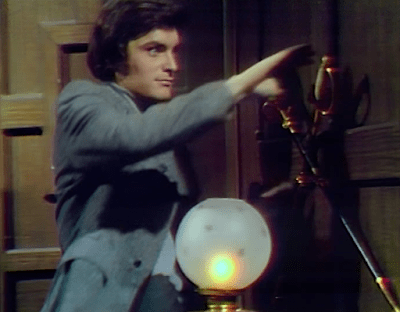
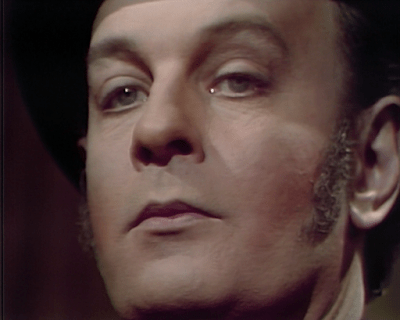
Now, Jabe is telling Nicholas that he was wrong to turn against him, wrong to smash the box, wrong to give up his destiny of leading the Leviathans to global dominion. Nicholas dwells on his exhaustive knowledge of the shadow and tells Jabe he can take the shadow from him and set it on Angelique. He begins to hypnotize Jabe. When he seems to have Jabe in a trance, he tells him he does not give second chances, and that he is going to kill him and Carolyn. Jabe suddenly produces the paper cutout Angelique used to place the shadow curse on him and places it on Nicholas’ jacket. He then runs out of the room. The shadow appears and envelopes Nicholas, who collapses. Even though he knew in advance exactly what was going on, Nicholas still could not avoid death as the result of getting slapped on the chest with a piece of construction paper. He dies as he lived, a failure demon to the end.
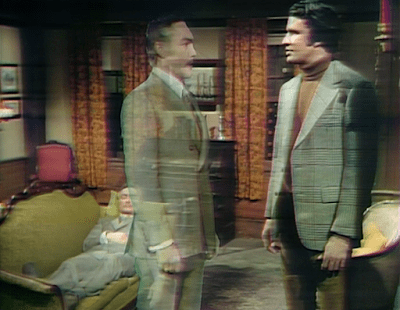
Sky enters. Jabe returns, and Sky tells him Nicholas is dead. Sky whines that because Nicholas was not human, his death will not be the end of him and Jabe will not get away with killing him. Geoffrey Scott’s appallingly bad acting reinforces the image of Nicholas as a colossal loser- if this was the only ally he had left at the end, he must have been an even more hopeless stumblebum than we had thought. Jabe exits. A moment later, Nicholas’ ghost appears to Sky and tells him to kill Jabe.
Jabe goes back to the great house of Collinwood to tell Carolyn that he is rid of the shadow. They are married now, but have spent very little time together because the shadow has kept chasing Jabe off. She is puzzled by the whole thing, in part because Jabe refuses to tell her anything about his situation, and is unenthusiastic about Jabe’s renewed insistence that they go away immediately. She agrees to leave with him in the morning.
Carolyn goes upstairs. In the drawing room, Jabe hears Nicholas’ voice telling him that he will never escape. Roger’s son, strange and troubled boy David Collins, enters; Jabe tells him that he and Carolyn are going on a trip tonight.
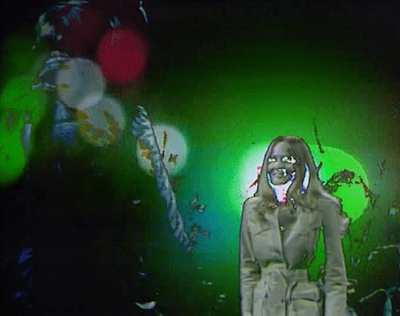
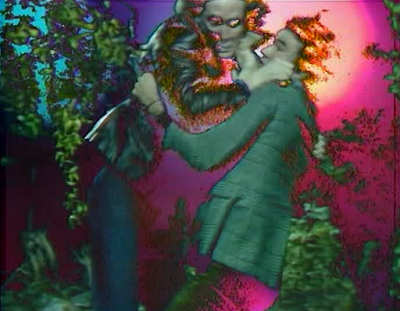
Jabe sent Carolyn upstairs with orders to pack and tell her mother they were leaving, but it would seem she has not complied. She is snoozing in a chair in her room. She has a dream. It begins with Nicholas’ voice rasping at her that it will all end at Widows’ Hill. She then sees Jabe and Sky, lit in groovy psychedelic colors, arguing about Nicholas and fighting near the precipice. Sky throws Jabe over the edge.
Carolyn awakens, calls for Jabe, and rushes out. On her way she tells David that she is going to Widows’ Hill. A moment later Jabe comes along, and David relays this information to him.
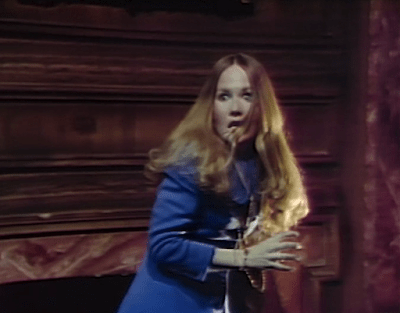
Carolyn gets to the top of Widows’ Hill, where Sky is waiting for her. He tells her that the dream Nicholas sent her stopped short of its end, because he did not want her to see her own death. He grabs her by the throat.
Meanwhile, in another universe…
While Jabe, Nicholas, and Carolyn are cleaning up the messes the Leviathan segment left behind, Roger is busy getting the new storyline off the ground. There is a room in the long disused east wing of the great house in which an alternate universe is occasionally visible. Roger goes there, and sees the counterparts of Carolyn and David. They are talking about the boy’s parents, whom Roger ascertains to be, not himself and undead blonde fire witch Laura Murdoch, but the counterparts of his distant cousin Quentin Collins and of Angelique. Everyone else we have seen in “Parallel Time” has the same first name as their counterpart in the main continuity, but David’s is named “Daniel.”
Roger never found out who Cassandra really was, so it is a puzzle for longtime viewers how he knows Angelique’s name. Carolyn and her mother met her under that name at the house she and Sky shared, but somehow did not recognize her as Cassandra. She visited them at Collinwood after her marriage to Sky broke up, but did not see Roger there.
Arrivals and Departures
This is the first time we see this Daniel Collins, but not the first time we are exposed to his name. The closing credits for #958 billed David Henesy not as David Collins, the role he played that day, but as Daniel Collins. I don’t know whether they had already decided that would be his name in Parallel Time and the person making up the credit roll got confused about it, or if the writers thought the goof was funny and gave the character the name as an inside joke.
Also, Mr Henesy played a character named Daniel Collins in February and March 1968, when the show was set in the year 1796. Since they have established that the two universes diverged during that Daniel’s lifetime, he may be this Daniel’s namesake. There is another connection, an accidental one I’m sure but an accident with a bit of an eldritch quality to it. In #350, three weeks before the 1790s segment began and more than sixteen weeks before Daniel made his first appearance, a slip of Nancy Barrett’s tongue left Carolyn referring to David as “Daniel.” It’s odd that the two Daniels were both heralded by these small inadvertences.
This episode marks, not only the final appearance of Nicholas, but also that of Roger. Louis Edmonds will play Roger’s counterpart in the Parallel Time segment, and as these episodes are being taped he is playing still another iteration of Roger on the feature film House of Dark Shadows. He will also be back in another role later on. But all the character development Roger has gone through since we first saw him in episode 1 is at an end.
Monday’s episode gave Roger his real sendoff, and my post about it summed up his history. I will just mention here that when I first saw Dark Shadows, Roger was something of a puzzle to me. That was the 1990s, when I saw it on what was then The SciFi Channel. The first episode I saw was #193, featuring art dealer Portia Fitzsimmons, but I didn’t have a chance to watch it at all regularly until a month or so after that, when Barnabas had already joined the cast. By that point Roger was already very much confined to the margins.
Curious as to when the dazzling Mrs Fitzsimmons would return, I looked online and found what is now the Dark Shadows wiki. I was disappointed to find that she was a one-off character. I also found that her function was to bring to a head a major story centering on Roger. I then looked through the episode summaries of the first weeks of the show. Those were quite terse and indigestible, meant to remind people who had seen the episodes of points they had forgotten. But one thing I did gather from them was that Roger had been a major character when the show started, indeed its chief villain. I couldn’t imagine the sardonic but lovable Roger of 1967 and 1968 in that capacity, and when I finally saw those episodes many years later I was thrilled by Edmonds’ performance.
One of the strongest themes of Roger’s character in his early days as a villain was his open hatred of David. It is nice for longtime viewers that he makes his final exit with an affectionate fatherly hand on David’s shoulder.
We are approaching the end of the sixteenth week of a segment made up of material drawn from the tales of H. P. Lovecraft. Central to this is the idea of the Leviathan People, a race of Elder Gods who want to retake the Earth and eliminate humankind. There has been a lot of good stuff in these episodes, but it hasn’t come together as a unit. At this point, the narrative seems to be falling apart completely.
The harbinger of the Leviathans, who appears to be a tall man in his mid twenties named Jeb but is in fact a four-month old shape-shifting monster who would rather be called Jabe, has lost interest in the plan and wishes he could be a real boy. Jabe has alienated virtually everyone with whom he has come into contact, including people who were under heavy mind-control meant to turn them into his slaves, and has been reduced to raising four recently deceased men to serve him as zombies.
Yesterday, he ordered the zombies to kill five of his enemies. The targets he listed were mad scientist Julia Hoffman, vampire Barnabas Collins, Barnabas’ servant Willie Loomis, and Barnabas’ distant cousins Roger Collins and Quentin Collins. The zombies have abducted Julia and brought her to Jabe’s house. She is welcomed there by a man named Sky Rumson. Sky is not a zombie, but may as well be for all the skill Geoffrey Scott brings to the role. When Scott recites his dialogue, you get the impression that he is telling you what an actor would say had they cast one in the part. Grayson Hall could fill any stage without support, making Julia’s scene with Sky relatively painless, but if it was meant to have any significance the audience will never know what that was.
Sky and a zombie force Julia into the back room of the house, where Jabe is in the squamous, rugose, and paleogean form of the true Leviathan. She is terrified by the sight. Jabe resumes his human shape. He and Julia go back to the living room, where he confides in her that he doesn’t want to take his Leviathan form ever again. He wants to renounce his powers and become human. He knows that Julia is giving Barnabas treatments to put his vampirism into remission, and that she succeeded with such treatments when Barnabas was under a different vampire curse in 1968. He asks her to help him rid himself of his Leviathan side. She is unsure she will be able to do so, but can’t resist the challenge. By the end of the scene, she is figuring out what tests she will have to run to diagnose the biochemical basis of Jabe’s condition.
Christopher Pennock really was a fine actor, and he is outstanding in this scene. He sounds like a deeply lonely, helplessly confused young boy who can’t figure out how to overcome the consequences of his own abuse of the people around him. Jabe’s request for Julia’s help and his agreement to lay off Barnabas as the price for it doesn’t fit with the orders he gave the zombies yesterday, the actions he takes later today, or anything else in the Leviathan story, and is a sign that the plot is falling apart faster than the writers can patch it up. But he and Hall are so splendid in showing Jabe’s neediness and Julia’s response to it that it doesn’t matter.
Meanwhile, Sky is at the great house of Collinwood, looking for Jabe’s foster mother-turned-makeout partner Megan Todd (it was 1970, everyone took Freud very seriously.) He meets Roger and Quentin there. They hold him at sword point until he tells them where Julia is and how to get past the zombies. To the extent that there is a reason for Sky to be on the show, it is to illustrate how total the control is the Leviathans have over the minds of the people they have co-opted, so when he gives in so quickly to Quentin’s threat to give him a scar (not even to kill him, just to compromise his potential as a model for deodorant ads) he dissolves the last prospect that the Leviathans themselves will be a danger we can care about.
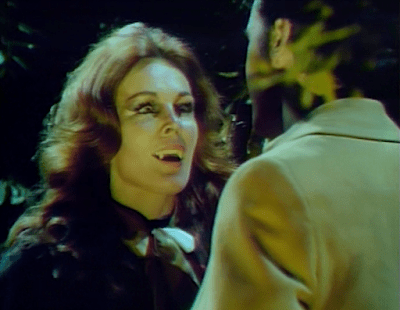
Quentin goes off to rescue Julia, and Roger assumes responsibility for holding the sword. He is momentarily distracted when he sees Megan in the window, and Sky takes advantage, disarming Roger and running out of the house. Outside, he meets Megan and tells her that Jabe is upset with her for some reason. She asks if he is afraid of her. He is puzzled by the question, and tells her she is very beautiful. She invites him to look at her. As he does, she opens her mouth, revealing vampire’s fangs. She bites him.
Quentin arrives at Jabe’s house. Jabe is surprised to see him, but not surprised Sky was too chicken to keep any of his secrets. He orders the zombies to seize Quentin. The tall, portly, shaven headed zombie, who wears a mustache that keeps him from being mistaken for Tor Johnson in Plan 9 from Outer Space, slaps Quentin in the face a single time. With this, Quentin instantly loses consciousness. Yesterday, other zombies slapped Julia and Roger in the face, each a single time, and each of them instantly lost consciousness as well. Great ones with slaps, the zombies.
Jabe instructs the zombies to stuff Quentin into a coffin that is about three feet too short for him, and then has them carry it all the way to the cemetery. He has them bury Quentin in a grave that one of them had recently vacated. I suppose real-estate flipping has been interesting to TV viewers for longer than I had thought.
There is a famous goof in today’s episode. When Quentin grabs the sword out of its display on the wall of the Collinwood drawing room*, the lamp underneath it falls off the table and smashes on the floor. You know this wasn’t supposed to happen because it takes place out of frame and you can hear the stagehands sweeping the floor while Sky is pinned to the wall. Also, Dan Curtis was way too tight with a buck to break a lamp for the sake of a scene that’s mainly about a character as minor as Sky Rumson. It’s a shame they couldn’t have pulled the camera back and shown the lamp shattering, it would have been perfectly suited to the moment. And if they had to sweep up the wreckage right then, well, it would have been hilarious if housekeeper Mrs Johnson had come in with her broom and dustpan, taken care of the mess, and left without a word about what Quentin and Roger were doing to Sky.
Old world gentleman Barnabas Collins comes home shortly after dawn and finds that the window of his front parlor has been smashed in. Entering the house, he finds two young men passed out. He knows both of these men, and knows that neither is what he seems to be. The taller of them, who once asked to be called Jabe, is in his true form an indescribable monster from beyond space and time, the harbinger of the Leviathan People, a race of Elder Gods who mean to retake the Earth and destroy humankind. The other, Chris Jennings, is a werewolf. The Leviathans are vulnerable to werewolves, and Barnabas realizes that Chris reverted to his human form when the sun rose, just as he was about to kill Jabe.
Chris comes to, and Barnabas hustles him out of the house. He then wakes Jabe. He tells Jabe that he fought the werewolf off, killing it and saving Jabe’s life. Barnabas was the original leader of a cult devoted to serving the Leviathans, but has since become disaffected. Jabe had seen evidence of this, and set out for Barnabas’ house meaning to punish him for his disloyalty. But by the time the werewolf chased him into the house he was crying out for Barnabas to help him, so he is ready to believe the story. Taking credit for things he had nothing to do with is one of Barnabas’ core competencies, so it is no surprise to longtime viewers that Jabe decides that he can trust Barnabas after all.
Barnabas’ ex-wife Angelique is now married to a man named Sky Rumson. She does not believe that Sky knows anything about her past or about anything supernatural, but the audience has seen over the last few episodes that he is an agent of the Leviathans. Angelique put Barnabas’ distant cousin Carolyn up in a house she and Sky have on an island to help Barnabas in his fight against the Leviathans while Sky was away on a business trip. At the end of that trip, Sky called to ask Angelique to pick him up at an airport far from the island house. When she got to the airport, she found he had already left. She wound up spending several hours alone on the road. Returning viewers know that Sky’s call was a trick to get her away from the house so Jabe could come and have his way with Carolyn. We also know that Jabe chickened out of his evil plan when he actually saw Carolyn, and that she is fine now.
Angelique comes home from her long wild goose chase and asks Sky what happened. He said he had an important phone call coming at the house, so he had to leave early. Angelique accepts this surprisingly easily. Barnabas shows up to take Carolyn home. He and Sky meet. After Barnabas is gone, Sky asks what the deal is with Carolyn. He presses the point, and Angelique tells him everything she knows about Barnabas and the Leviathans, including that he is now “their most dedicated enemy and he means to use every power he has to stop them.”
This scene is bad news for Barnabas, but it is worse for the audience’s image of Angelique. She used to be a wicked witch of vast destructive power, and was supposed to be the ultimate Soap Opera Vixen. But you wouldn’t have to be a witch, or even a vixen, to avoid the situation Angelique puts herself in. Leaving the airport when he knew she was on the way was a colossal act of thoughtlessness, and no husband who committed it could expect to hear a word from his wife about anything else for at least a week. After that, there will be a long period when she will have an unanswerable source of material to keep him off his guard any time he tries to bring up topics she doesn’t want to discuss. By the time Sky is able to start asking questions about why Angelique had Carolyn spend the night, it will probably be another full moon.
That isn’t even the worst of it. Angelique believes that Sky is simply a denizen of the sunlit world known to us in our everyday experience and explained well by science, and she further believes that he sees her in the same way. That makes it all but impossible for her to tell him what she tells him here. She launches right in with “the Leviathans, they’re terribly dangerous creatures, completely evil and they mean to start a whole new society.” If he really were a total naïf in supernatural matters, this story would lead him to pick up the telephone and call the men in the white coats to come and take Angelique to a place where she could get a good long rest.
I don’t think Angelique’s scene with Sky could have worked in any case, but Geoffrey Scott’s limitations as an actor make it even worse than it had to be. He underacted so severely that he could hardly be said to be giving a performance at all. That makes a stark contrast with Lara Parker, who as Angelique fully embraced the hyper-intense Dark Shadows house style of acting, which, in honor of her own hilarious explanation of it, is sometimes known as “Go back to your grave!” That contrast is interesting at a technical level. It goes a long way towards explaining what Orson Welles meant when he said that hamminess was not overacting, but false acting. Parker goes as far over the top as she can, but there is rarely anything false about Angelique, while every tinny note Scott strikes in his flat recitation of his lines is thoroughly fake.
A charismatic actor might have been wasted as Sky, as Parker is wasted today. But the audience might have been able to meet the show halfway if we could believe that Sky was so fascinating to Angelique that she didn’t realize what she was saying. As it is, Scott looks so much like he is modeling menswear for the Sears catalogue that it is always a bit of a surprise when he moves and speaks. However much Angelique might enjoy Sky’s company, it never occurs to us that he would be a match for her in any sense.
Sky goes to Jabe and repeats what Angelique told him about Barnabas. There is an exchange which looks fine in print, but which Scott’s delivery makes sound like a blooper:
JABE: So everything he told me this morning was a lie! And I thought he had saved my life!
SKY: Evidently, everything he told you was a lie.
You would deliver Sky’s line with an emphasis on “everything,” as would I, as would anyone else. But Scott emphasizes “Evidently” and pauses slightly after “you,” making it sound as if he hadn’t heard Jabe. For a fraction of a second, you can see the amazement in Christopher Pennock’s face as he reacts to this clanger.
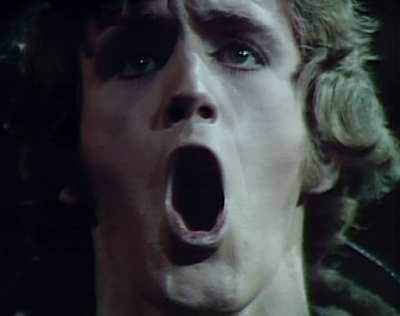
Jabe carries a cage with him as he goes to an old graveyard. The camera locks in on him in closeup as he shouts that, while death might be an adequate punishment for a mere murderer, Barnabas must suffer “More! MORE! MO-O-O-ORE!!!” More, more, more, how do you like it, how do you like it….
The first time I saw this scene, I regarded it as a low point- I imagined someone tuning in to Dark Shadows for the first time at that moment, and instantly turning it off, believing ever after that only people of an extremely low mentality could like the show. I still think it’s pretty embarrassing writing, but having seen him in other roles I’ve come to realize that Pennock was in fact a good actor and that as Jabe he was saddled with an impossible task. Also, I’ve seen video of him on panels of original cast members at Dark Shadows conventions, and it is obvious that he was as sweet as Jabe is vicious. So watching the scene today, I ignored Jabe and looked at Christopher Pennock, studying his face to see what he was thinking as he struggled to find a way to give the audience something worth their while.
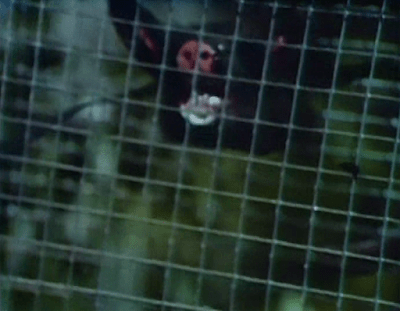
Jabe makes an incantation, and a bat comes flying to him. He catches it in the cage. We get a closeup of the bat puppet in the cage, which looks very much like a humane trap from Havahart. We know that Jabe plans to use the bat to make Barnabas back into a vampire, which he was for 172 years, but the realistic cage and the adorable little puppet prevent the situation from generating any terror. Dan Curtis said that when he was producing Dark Shadows, his young daughters used to urge him to make the show more frightening. When we were chuckling at the sight of the bat today, Mrs Acilius imitated a child saying “Make it scary, Daddy!”
In May and June of 1967, vampire Barnabas Collins held Maggie Evans, The Nicest Girl in Town, prisoner. He drank her blood, tortured her, and drove her insane. When Maggie escaped, he turned his attentions to well-meaning governess Vicki Winters. Maggie’s imprisonment was the storyline that first made Dark Shadows a hit, but it was bleak and often difficult to watch, and if its horrors had shortly after been reenacted with Vicki as the victim many viewers would likely have given up on the show. So Barnabas decided that he wanted Vicki to come to him of her own will. That avoided the problem, but left the show stuck in a rut. For the next several months, Barnabas did not have a coherent goal. Since he was the main figure in the A story, that left Dark Shadows spinning in circles.
They escaped from that rut in November 1967, when Vicki went back in time to the 1790s. The audience followed her there, and we found out how Barnabas first became a vampire. He had fallen afoul of wicked witch Angelique. Angelique wanted Barnabas to love her. Since her enormous powers were explicitly shown to include the ability to make people fall in love with each other, we wondered why she didn’t simply use that ability on Barnabas. They answered that question by having Angelique declare that she wanted him to come to her of his own will. She tried to attract his love by casting a series of spells on everyone around him, spells that resulted in death and ruin for the people he most cared about. When Barnabas found out what was going on and tried to kill Angelique, she turned him into a vampire.
Now it is January 1970, and Barnabas’ vampire curse is in abeyance. A race of Elder Gods called the Leviathan People are trying to retake the Earth from humankind, and have threatened to reactivate the curse if he does not help them. The Leviathans control a group of people whom they have formed into a cult devoted to their service. The Leviathans have brought a shape-shifting monster to life, and it is written that the monster will marry Barnabas’ distant cousin Carolyn Collins Stoddard and turn her into a creature like himself.
Angelique has renounced her powers and is trying to live as a mortal woman. The other day, Barnabas asked her to help him protect Carolyn from the Leviathans. Angelique no longer wants anything to do with Barnabas or anyone else from the estate of Collinwood, but she understands the threat the Leviathans pose and is willing to help Barnabas against them, provided she can do so without losing what she has in her current life. Barnabas arranged for Carolyn and her mother, matriarch Elizabeth Collins Stoddard, to hide out at Angelique’s house while he tried to figure out a way of fighting the monster. Liz is a dedicated member of the cult, and believes Barnabas to be its faithful leader, so when Barnabas told her to take Carolyn to Angelique’s she complied at once.
Unknown to Angelique, her husband, hard-charging businessman Sky Rumson, is himself a member of the Leviathan cult. Thursday, he telephoned the monster and told him Carolyn was at the house; Friday he opened the door to the monster, and the monster went to Carolyn. Today, the monster decides that he will not impose the transformation on Carolyn after all. Instead, he will wait for her to come to him of her own will. This keeps the story from ending here, but it makes it unclear where it can go.
The monster’s decision poses a deeper problem for him as a presence on the show than the similar decisions did for Barnabas and Angelique. They pursued identifiable goals, and were influenced by thoughts and feelings they had while they interacted with others. The only goal the monster has is to take possession of Carolyn, and now it is unclear what that means. Nor is anything at stake for him in any encounter with another person. He keeps saying that he doesn’t need anyone, and that seems to be true- there is no reason to pay attention to him in any scene. He has, in short, been established not as a character at all, but simply as a function. All he has ever been is Threat. Now that he has decided to be nice to Carolyn, he will no longer even fulfill that function. His future would appear to be quite limited.
Sky also appears to be a short-timer. When Dark Shadows started, one of its most dynamic characters was hard-charging businessman Burke Devlin, played ably by the charismatic Mitchell Ryan. Despite all of Ryan’s magnetism, they could never come up with anything very interesting for Burke to do. Hard-charging businessman just isn’t a type they have much use for. They signal that Sky won’t be around long by casting Geoffrey Scott in the role. Scott was very handsome and would go on to a long career on screen, but in early 1970 he did not appear to have any skills of any kind as an actor. Not only does he deliver his dialogue as if he were reading a series of nonsense syllables aloud, but he is noticeably bad at hitting his mark. For example, on Friday Sky at one point backed away from Carolyn during a conversation. He took a step too far, with the result that his rear end was a few inches from a hearth with a vigorously burning fire. It was hard not to watch the seat of his pants and wait for it to ignite. There were times when they cast actors who still needed a lot of training and kept them around for quite a while, but Scott was at this point in his career so amazingly inept that it is hard to imagine they meant to use him for anything more than the decorative value his good looks offered.
Liz is at home in the great house of Collinwood when a man she has not seen before appears on the walkway above the foyer and starts giving her orders. He comes down and introduces himself to her by the name Bruno. He shows her that he is wearing a ring that identifies him as a member of the Leviathan cult. Liz says that he must have come to give her instructions. He confirms that this is so.
A howling resounds outside, and Bruno asks Liz about it. She tells him that she long ago met a wolf-like creature in the woods, and she suspects the howling comes from that creature. Returning viewers know that the Leviathans are vulnerable to werewolves and that the monster is terrified of them. Bruno knows this too, so he goes out to hunt for it.
The monster, in the form of a tall young man, comes to the great house to introduce himself to Liz. She is concerned when he tells her to stop taking orders from Barnabas, but delighted when he says that Carolyn has a future with “us.” Carolyn telephones from Angelique’s house, and Liz puts the monster on the phone.
Carolyn is all smiles when she is talking to the monster. They’ve met a few times, and he has been nothing but a jerk to her. She had objected to his behavior, and his responses had ranged from frightening to slimy. That she is all of a sudden attracted to him undercuts her character almost as badly as nerfing his threat to her undercuts his position on the show.
After the phone call, Bruno returns. He tells the monster he couldn’t find the werewolf. The monster declares that he will go to the Old House on the estate to confront Barnabas, whom he labels a traitor. Bruno points out that it is almost daybreak, and if he waits just a little while he will not be in danger from the werewolf. The monster says that it is too important to wait.
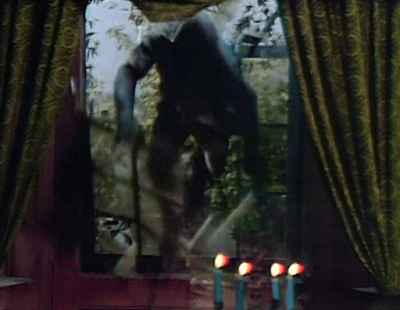
The werewolf chases the monster through the woods. By the time the monster gets to the Old House, he is shouting for Barnabas, the “traitor” he was planning to deal with, to come and help him. Barnabas is nowhere to be seen, and we end with the werewolf bursting through the window. The werewolf got a few closeups earlier in the episode, when he was nosing around in the woods. These always make him look like a cute widdle doggie. If they hadn’t given us those ridiculous images, his entrance through the window might have been a genuinely scary moment.
Carolyn’s scene at the beginning involves a couple of notable wardrobe-related points. She went to bed Friday fully dressed, even wearing shoes, and is still that way when she is back in bed today. Several times we have seen men go to bed shoes and all, but usually the women wear nighties. I think this is the first time we have seen a shod woman asleep in bed.
Carolyn falls on her back in the opening reprise. She is wearing a very short skirt, and this fall exposes her underwear. She is lying on the bed in several subsequent shots, and it must have taken some doing to keep the undies from making another unscheduled guest appearance.
Episode 361 was virtually a one-woman show, featuring Grayson Hall as Julia Hoffman, MD. Julia was being tormented by haunted house-style effects resulting from her involvement with a supernatural entity. The script, by Ron Sproat, was largely a recycling of an episode Sproat had written for Never Too Young, the soap opera that ran on ABC at 4 PM before Dark Shadows premiered.
Episode 658 consisted largely of a one-man show, featuring Joel Crothers as fisherman Joe Haskell. Joe was being tormented by haunted house-style effects resulting from his involvement with a supernatural entity. The script, by Gordon Russell, owed a good deal to Sproat’s work on #361.
Episode 897 ended with a long scene that amounted to a one-woman show, featuring Marie Wallace as antique shop owner Megan Todd. Megan was being tormented by haunted house-style effects resulting from her involvement with a supernatural entity. The script, by Violet Welles, drew from both #361 and #658.
Many fans consider #361 to be The Worst Episode of Dark Shadows, and many consider Megan’s turn at the end of #897 to be The Worst Scene on Dark Shadows. To the extent that #658 is remembered at all, it is because it is one of Crothers’ last appearances on the show. The memory of this fine and well-loved actor makes the fans so weepy that no one can be very harsh about his final star turn.
Today, the second half of the episode is virtually a one-woman show featuring Nancy Barrett as heiress Carolyn Collins Stoddard. Carolyn is being tormented by haunted house-style effects resulting from her involvement with a supernatural entity. The script, by Gordon Russell, recycles elements of #361, #658, and #897.
Russell was usually one of the most careful writers on Dark Shadows, but this one is remarkably shoddy. Carolyn and her mother, matriarch Liz, are staying at the home of a woman named Angelique. Angelique tells them that she has to drive to the airport to pick up her husband, and that she will be away for “several hours.” A couple of minutes later, Liz is also called away, and she tells Carolyn that she is sure “Angelique will only be gone an hour or so.”
Worse, all the action of the episode is completely, flagrantly unnecessary. The calls that leave Carolyn alone in the house are part of a monster’s scheme to get at Carolyn. But Liz is the monster’s loyal servant- if he had told her to bring Carolyn to him, she would gladly have done so.
Carolyn’s torments aren’t quite a monodrama, since they are interrupted by a couple of brief scenes with other actors. But one of those is a dream sequence in which she talks to the monster while we see him silhouetted in darkness. The interaction between them is so limited he may as well be a recorded voice. She also has a few interactions with Angelique’s husband. Since he is played by Geoffrey Scott, he may as well be a cardboard standee.
One advantage this episode has over #361 is that Nancy Barrett was excellent at screaming, second only to Clarice Blackburn in her ability to produce a true blood-curdler. Grayson Hall, accomplished as she was, had asthma and was physically incapable of controlling the timbre of her voice when she raised its volume above a certain level. Sproat’s script for #361 required Julia to scream several times, and every time she tried it Hall emitted a croaking sound that raised a bad laugh. Miss Barrett’s closing scream today, by contrast, really puts the “opera” in “soap opera,” it sounds great.
This is one of the few episodes with no scenes on the estate of Collinwood, and one of very few to take place primarily in a location many miles from the village of Collinsport.
There’s also an interesting moment when Angelique claims to have met Liz and Carolyn’s distant cousin Barnabas while they were both living in England. Barnabas never lived in England, that’s a lie he has been telling his relatives to conceal the fact that he is a recovering vampire who hasn’t left Maine since George Washington was president. Liz is part of the current supernatural storyline and Carolyn has at various times known all about Barnabas, so we don’t expect to be reminded that he’s still peddling the “cousin from England” bit.
Mad scientist Julia Hoffman finds that wicked witch Angelique has married a businessman who has a house on an island off the coast of central Maine. Angelique tells Julia that her husband’s love has freed her to live as a human being, and that for the sake of that love she has renounced her powers. In #882, set in the year 1897, Angelique said that she would soon have to return to the underworld unless she could find a man who would love her. The show has since returned to a contemporary setting, and she met her husband less than a year before, sometime in 1969. Evidently her time wasn’t running as short as she led us to believe it was.
In the 1897 segment, the show was quite clear that Angelique was aligned with Satan and that the underworld she was talking about was a Hell that Dante or Milton or other Christians would have recognized. The deal she described with her master therefore made little sense then. But Dark Shadows has drawn freely on the mythologies of many cultures and has made up stories about supernatural worlds of its own. The borrowings from the Christian tradition are a relatively minor part of the universe they have been patching together, and they have recently given us reason to suspect it is something they are backing away from. So I don’t think we are under any obligation to reconcile Angelique’s account of the lord of the damned with the teachings of any church.
Angelique is afraid that Julia has come to reenlist her in the cosmic battles surrounding the estate of Collinwood. In fact, Julia had no idea she would find Angelique. She went to the island because she had figured out that a painting she was looking for was there. It is a magical portrait of rakish Quentin Collins, obscured by a landscape painted over it. Quentin has amnesia, and Julia apparently thinks that if she shows him the portrait she will be able to jar some memories loose.
Angelique agrees to let Julia take the painting and expose Quentin’s portrait, on condition that the overpainting be exactly reproduced on another canvas and brought back to the house on the island before her husband knows it was gone. Julia suggests they tell him a lie that will give them more flexibility, but Angelique says he is “a very thorough man” and would ask too many follow-up questions if they gave him any information at all.
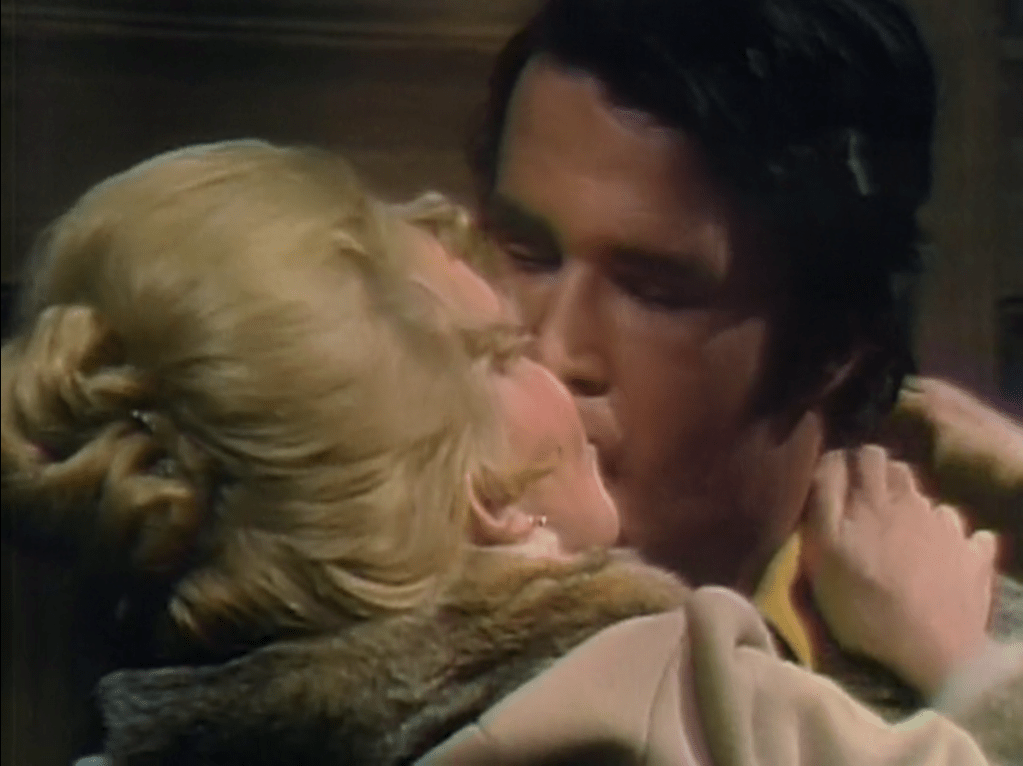
Before and after her scene with Julia, we see Angelique with her husband. The first scene begins with some very awkward kissing. The awkwardness is partly due to Geoffrey Scott’s total incompetence as an actor; he stands stiffly while Lara Parker simultaneously kisses him and nudges him to his mark, making it look like she is moving a couch. But part of the blame must rest with director Lela Swift, who set up the shot from an angle that puts the emphasis on the straining muscles in Parker’s neck and back. Perhaps Swift overestimated Scott’s abilities.
“Move three inches back and to the right, dummy, you’re supposed to be in the center of the frame!”
This scene is accompanied by some music for a small string ensemble; I don’t believe we have heard the track since the very early days of the show. It feels jarringly old-fashioned. All of Dark Shadows’ orchestral score strikes 21st century viewers as a relic of an earlier era, but it set it apart from other daytime soaps of the 1960s and early 70s, most of which had an organ playing on the soundtrack. Compared to the organ accompaniment, which today’s audiences would find simply intolerable, I suppose even these creaky old violins are relatively modern.
The second scene ends with a more successful kiss. It is accompanied by a woodwind piece that used to be associated strongly with well-meaning governess Vicki and her doomed love for dashing action hero Burke Devlin. Burke was written out of the show in 1967, Vicki in 1968, and this music cropped up occasionally in 1969 during sentimental moments. It is still noticeably more old-fashioned than the rest of the score, albeit more dynamic than the string serenade that went along with the first kiss.
Meanwhile, in the great house at Collinwood, strange and troubled boy David Collins is coming down with a cold. David’s governess, Vicki’s successor Maggie Evans, is trying to get him to take his schoolwork seriously. A boy known as Michael appears in the house and announces that he and David will be playing now. Maggie explains that it is not a good time, and Michael bullies both her and David into giving him his way.
Michael is not really human, but is a manifestation of a supernatural force that has subjugated David and many other people. Seeing Michael push Maggie around, we might remember May and June of 1967, when Maggie was the prisoner of vampire Barnabas Collins. Those episodes were bleak and at moments painful to watch, but they also drew a new audience and made Dark Shadows, for the first time, a hit.
Barnabas attracted a crowd, not simply because he was cruel to Maggie, but because we wondered how others would react to his evil deeds, because his motives were unbelievably zany, and because actor Jonathan Frid took a visible joy in playing him. He became a breakout star, familiar to millions who never saw a single episode of Dark Shadows or knew anything else about it, because he generated stories that allowed the whole cast to shine, followed his crazy ideas to the point where many of them became the realities of the show’s narrative universe, and had quirks that dovetailed perfectly with Frid’s strengths.
Michael has none of these things going for him. When he is nasty to Maggie, he does not produce any suspense as to what others will do. Not only do most characters assume that as a teacher she will be able to handle an obstreperous child by herself, but most of the people to whom she would likely turn for support are among Michael’s subordinates. There are no crazy ideas bursting out of him- he is just a little tyrant, who at no point seems to have any hidden motives or nuances of feeling. And Michael Maitland seems depressed the whole time he is on screen. As a result, Michael is as straightforward and tedious as Barnabas was luridly intriguing.
When Barnabas was holding Maggie prisoner, his blood-thrall Willie felt sorry for her. He occasionally made efforts to help her, none of which did anything but make her situation even worse. John Karlen’s portrayal of the feckless Willie brought him almost as much fan mail as Jonathan Frid received during that period. Today it is David’s turn to play Willie to Michael’s Barnabas, and he does not disappoint. Thirteen year old David Henesy plays David Collins’ conflicted feelings more subtly than Karlen had played Willie’s, and as a result we watch him very closely. Disappointed as we may be in Michael, Mr Henesy’s triumph in these scenes brings the episode to a strong close.
Yesterday, Amanda Harris told the story of a suicide attempt she made in 1897. A supernatural being whom she calls “Mr Best” thwarted this attempt, and told her that he would arrange for her not only to avoid death, but to remain young, for the years that it had been ordained she would live. If in that time she could reconnect with her lost love, rakish Quentin Collins, she and he would never die. Now it is 1970, and Amanda’s time is up. Mr Best is at her door. Amanda has found Quentin, but he has amnesia and is not ready to resume their relationship as Mr Best’s terms require.
Mr Best has changed startlingly since we met him in the flashback that showed us Amanda’s story. Then he was warm and solicitous; today he is truculent and cold. Even his makeup is different. A pale coloring suggests sunken cheeks, making him look corpse-like.
Amanda has reversed her own attitude as well. In 1897, Mr Best lamented her wish for death and pleaded with her to stay alive; now it is Amanda’s turn to beg Mr Best for more time while he shows impatience with her. When she tells him about Quentin’s amnesia, he asks brusquely “Are you making this up?” It merits a laugh that the story of Dark Shadows has become so far-fetched that even Death Incarnate finds it hard to believe. But Mr Best does soften, and gives Amanda seven more days to get Quentin to tell her he loves her.
Quentin’s own perpetual youth is the result of a magical portrait that immunized him from the effects both of aging and of the werewolf curse that was placed on him in 1897. Quentin’s great-grandson Chris Jennings has inherited that curse. Mad scientist Julia Hoffman had learned that artist Charles Delaware Tate was still alive, and hoped he would paint a portrait of Chris that would free him from lycanthropy. Tate told Chris he no longer had the gift, but Chris forced him to paint his picture anyway. The moon rose, Chris transformed, and as the wolf he murdered Tate.
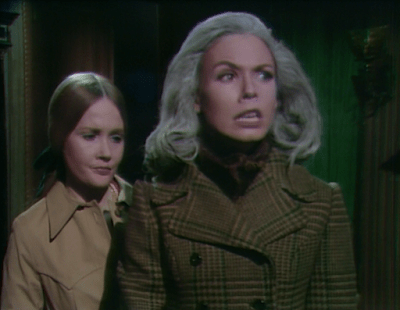
One of Chris’ surviving victims is his ex-fiancée, Sabrina Stuart. Sabrina saw him transform, and as a result was struck dumb for years and went prematurely gray. She can talk now, but she’s still gray. She shows up today at the great house of Collinwood where she calls on heiress Carolyn Collins Stoddard. Carolyn tells Sabrina that she doesn’t love Chris and never will, but that she realizes Sabrina loves him. This adds to a growing list of reasons the show has given us to doubt that Chris will be on much longer. His premeditated murder of Tate establishes him as a pure villain. A villain’s function is to create problems for other characters to solve, and Chris has been too passive and too dependent on Julia to be an interesting villain. His relationship with Carolyn gave him a connection to the core cast, but Carolyn’s conversation with Sabrina makes it clear that that is gone now.
Sabrina insists Carolyn go on a road trip with her. She takes her to Tate’s house and leads her into the room where Chris murdered the artist. She tells her that a man was just killed there. Carolyn asks Sabrina if Chris did it. Sabrina looks pained, and says “Not Chris!” This further undermines Chris’ position. As long as Sabrina was mute, we could wonder whether she would blow the whistle on Chris once she regained the power of speech and if so what the consequences of that would be. But now we see that she is still in denial about him, and can set aside any hope that she might generate a story for him.
Carolyn asks Sabrina how she knows about the murder. No answer is forthcoming, and there doesn’t seem to be any way she could know. Evidently Sabrina has now developed some kind of clairvoyance about Chris’ murders. Since she is apparently determined to use that power to limit Chris’ relevance to the story, it is yet another reason to suspect he will be written out soon.
Julia enters the crime scene. She and Carolyn are surprised to see each other. Sabrina announces that Julia knows all about Chris, and gets upset about it. Julia, a psychiatrist by profession, slaps her in the face, the accepted treatment for angry women in 1960s television shows. Sabrina quiets down, and Julia sends her away with Carolyn. Once they are gone, she settles in at Tate’s desk and starts rummaging through his papers.
Julia wants to cure Quentin of his amnesia. She looked through an old Collins family photo album, and found that two pictures of him had gone missing. She is puzzled as to who took them; this is a continuity error, since in #686 and #687 there was a whole thing about ghosts removing photos relevant to Quentin from albums after Julia had looked through them. Be that as it may, Julia discovers in Tate’s papers that he had painted over Quentin’s portrait and that it is now in a big house on an island nearby.
We see a man holding a telephone and reciting lines of dialogue. He puts the phone down, looks at Julia, and recites more lines in the same unmodulated voice. Grayson Hall stays in character with her responses, and plays Julia asking to see the painting, but the man does not do anything that could be called acting. Dark Shadows has featured its share of lousy performances, but I cannot recall a member of the cast simply enunciating words as if he were in a neurologist’s office demonstrating that he had memorized the unrelated syllables given him to reproduce. It is genuinely bizarre.
The man’s name is Geoffrey Scott, and if anyone had told him he was supposed to act he would be playing a character called Sky Rumson. I suppose “Rumson” is a good name for a character who is identified with a house on the beach, since beach houses are what Rumson, New Jersey is known for, though the beach might not be front of mind in early January in central Maine. Sky is a go-go businessman, and his lines to Julia are about what a great hurry he is in.
Sky shows Julia the painting that covers the portrait of Quentin. He tells her that it isn’t very good. Indeed it is not particularly distinguished, but it is far superior to any of Tate’s other works, some of which they want us to regard as museum pieces. Sky says that he bought the painting for his wife, who has an unaccountable fondness for it. He shows Julia a painting of Mrs Rumson. Julia has seen the painting before, and knows the model very well. It is a portrait of her old frenemy, wicked witch Angelique.
For regular viewers, this ending will be as satisfying and as logical as Geoffrey Scott’s phonetic rendering of his dialogue is disconcerting and inexplicable. Eight weeks ago, the show returned to contemporary dress after a long stay in 1897, beginning a new clutch of stories. Angelique is often absent from the show for extended periods, but she always turns up sooner or later. None of the three major storylines- Chris’ werewolf curse, Amanda’s attempt to rekindle her romance with Quentin, and the menace of the secret cult devoted to supernatural beings known as the Leviathans- is very closely connected to either of the other two, and none of them has any particular sense of urgency. Angelique’s vast powers and maniacal narcissism make it easy for the writers to inject her into every plot and accelerate them all towards a common resolution. In the 1897 segment, they moderated both her might and her mania, so that they can now keep her on indefinitely without overwhelming the show. Angelique is not what Julia expected to find, but she may be just what the doctor ordered.

 Dark Shadows Commentary