This teleplay badly needed another trip through the typewriter.
In the opening scenes, seagoing con man Jason McGuire demands his friend and former henchman, the sorely bedraggled Willie Loomis, leave the estate of Collinwood and the town of Collinsport. He mentions that he saw Willie’s car the night before at the cemetery. He then orders Willie to get on a bus and leave town. Then he starts talking about Willie’s car again. Does Willie have a car or not? They’ve gone back and forth on this from one episode to another, but today they can’t keep it straight from one line of dialogue to the next.
A doctor shows up to examine Willie. He tells Jason that Willie is not sick at all. The reason he is so weak is that he has lost “an enormous amount of blood.” What does the doctor think the word “sick” means if it doesn’t apply to a person who is doing badly because of an “enormous” loss of blood?
Whatever meaning the doctor attaches to “sick” apparently also applies to “ailment.” High-born ne’er-do-well Roger Collins asks what Willie’s ailment is, and the doctor says he has no ailment. He is simply immobilized due to an enormous loss of blood.
The doctor tells first Jason, then Roger, that Willie will be fine if he gets some rest and fluids and food. The idea of a blood transfusion doesn’t cross his mind, nor do Jason or Roger bring it up. It would be one thing if the doctor, Jason, and Roger were played by the Three Stooges, but there is no sign that we are supposed to think that they are a load of idiots.
An actor who has repeatedly triumphed over bad writing reappears after an absence of sixteen weeks. This is Dana Elcar as Sheriff George Patterson. The sheriff’s activities don’t always make a great deal of sense, but Elcar’s acting choices and his zest for performance make him a pleasure to watch no matter how dire the script he has to work with.
Today, the sheriff is telling Roger that a number of cows on the farms owned by the Collins family have been destroyed. A person or persons unknown somehow sucked every drop of blood out of these cows through small punctures in their hides. Roger is deeply unsettled by this strange news, and the sheriff sympathizes with him.
Roger repeatedly asks the sheriff why he is the one telling him about the cows. He says that he would have expected the veterinarian to call him. The sheriff says that the veterinarian called his office, because he determined that the cows were killed by someone’s deliberate act. That doesn’t explain why the veterinarian, whose bill the Collinses will presumably be paying, didn’t call him. We were so glad to see these fine actors working together that the senselessness of the scene didn’t bother us while we were watching it, but as soon as it was over we were left with a feeling of confusion.
Regular viewers do wonder what farms the sheriff and Roger are talking about. The only previous reference to the word “farm” in connection with the Collinses was in #64, when Sheriff Patterson told their servant Matthew Morgan to “work their farm for them” and stay out of trouble. Today’s conversation repeatedly refers to “farms,” plural, more than one of which are big enough to have cows. That’s an operation much too complicated for Matthew, who had many other duties, to have handled by himself. Besides, Matthew left his job in #112 and was scared to death by ghosts in #126, and hasn’t been replaced. Whatever farm Matthew was working must have been so small that the Collinses can take care of it themselves in whatever time they can spare from their main occupation, keeping secrets and being sarcastic.
Writer Ron Sproat specialized in inventorying disused storylines and getting them out of the way. Back when Matthew was on the show, the Collinses were heavily in debt and running out of money. Dashing action hero Burke Devlin spent the first 40 weeks of the show trying to avenge himself on the Collinses by driving them into bankruptcy. All of that has gone by the boards, and we aren’t hearing any more about troubles concerning the business. So it’s time for Dark Shadows to reconceive the family as financially secure, indeed as imposingly rich. Talking about their many farms and the herds of livestock on them helps Sproat open up space in his narrative warehouse, but it doesn’t offer much to interest the audience.
My wife, Mrs Acilius, thought up a little fanfic that might have introduced the same points more intriguingly. The trouble with the cows first came up in #215. Hardworking young fisherman Joe Haskell told the story of a calf belonging to his uncle that was found drained of blood. That suggested that an evil has been loosed that is spreading throughout the town and beyond. Why not stick with Joe as the point of view character in connection with the mystery of the desiccated cows? Not only would that give a badly under-utilized character something to do, but would also give us the sense that the fate of a whole community is at stake in the action.
If they needed to connect the Collinses to the cow story, they could have come up with a way to oblige them to join with Joe to figure out what’s going on. That in turn would raise the prospect of a story structured like Bram Stoker’s Dracula, in which one character after another joins the team opposing the malign Count. The formation of the group that resisted blonde fire witch Laura Murdoch Collins in the months leading up to #191 very much followed the pattern set in Stoker’s novel. Of course, the ending could be modified. The Laura story ended, not with the triumphant team-work that defeats Dracula, but with well-meaning governess Vicki cut off from her allies and left to confront Laura alone. But the team-work leading up to that point was full of interest, as characters shared information with each other, reconfigured their relationships, and found themselves doing things neither they nor we would have expected. Simply reintroducing the topic of the cows and leaving Joe and the Collinses siloed off from each other is easy for the writers, but it doesn’t take the story anywhere.
Dennis Patrick was a fine actor, but so far he has had very little to do as seagoing con man Jason McGuire. Jason’s endlessly repeated blackmail threats against reclusive matriarch Liz are tedious in the extreme, and his attempts to charm others limit Dennis Patrick to the acting choices we might expect Jason to make. Things get livelier when he has to rein in his sidekick, Willie Loomis. Willie was introduced as a dangerously unstable ruffian, and Jason had to scramble to keep up with Willie’s moods. When Jason has to think fast, Patrick has room to maneuver.
Now, Willie is strangely changed. He is ill, and is for a second time a house guest in the great mansion of Collinwood. Flighty heiress Carolyn and well-meaning governess Vicki talk about Willie’s new demeanor, and Carolyn says that it is as if Willie has become another person. Considering that Willie tried to rape each of them the last time he stayed at Collinwood, you might think just about anyone else would represent an improvement, but Carolyn is for some reason distressed.
The episode really belongs to Dennis Patrick. It has never been clear why Jason wanted Willie around, and today there is only one possible answer- he cares about him. Even when Jason has a scene alone with Carolyn and confirms a threat he made a few days ago to make “serious trouble” for her mother Liz if Carolyn didn’t stop asking questions, he never stops being a man concerned for his friend.* It is interesting to see him combine that admirable quality with Jason’s overall rottenness.
Willie is very sick all day, barely able to stay awake, stumbling as soon as he tries to get out of bed. But at nightfall, he seems to gain strength. He hears the sound of a heartbeat. He gets up, goes downstairs, and gets past Jason. We hear a car squeal away while Jason calls after him to come back.
It is unclear whose car this is. The other day Carolyn mentioned “Willie’s car,” but before and after the idea of Willie leaving town had always been mentioned in connection with bus fare. Perhaps we are back to the idea that Willie has a car- he started it so quickly he must have had the keys. Since whatever car it is is parked by the house on what is supposed to be a large estate, its owner may have left the keys on the dashboard, but since Willie seems to have expected to have them it is at least as likely that it is his car and they were in his pocket.
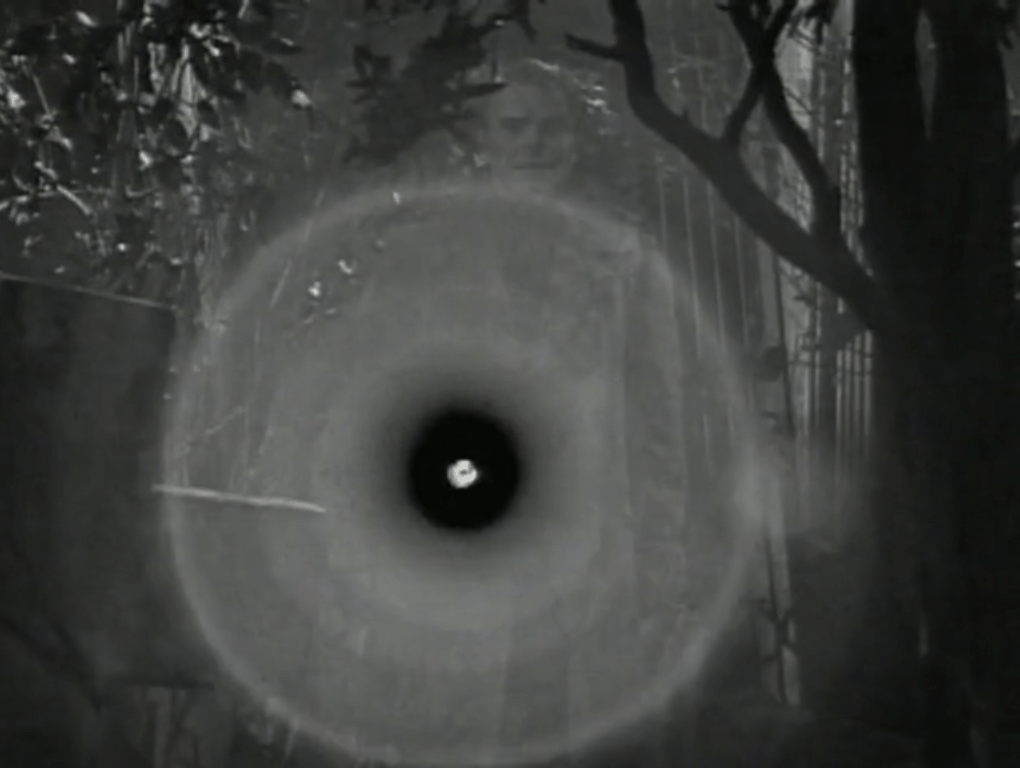
Jason follows Willie to the old cemetery north of town, where he shines a flashlight directly into the camera. Willie disappears into the Tomb of the Collinses, and Jason loses his trail there.
Flashlight halo
*My wife, Mrs Acilius, phrased it this way. She also developed the idea of the episode as a glimpse of a different side of Jason, and called my attention to the phrase “a terrible beating” as the best title for a post about it.
In episode 1 of Dark Shadows, dashing action hero Burke Devlin returned to his home town, the isolated fishing village of Collinsport, Maine. He’d left Collinsport in poverty and disgrace, and returned as a millionaire many times over, the master of a financial empire. He had vowed to use his great wealth to exact vengeance on the ancient and esteemed Collins family. In #201, he gave up his quest for revenge, which had never been very interesting to watch anyway, and now is unconnected to any storyline. He’s still in town though, spending his evenings in The Blue Whale, a waterfront tavern where he has appointed himself to act as bouncer.
In #207, dangerously unstable ruffian Willie Loomis was rude to some other patrons at the Blue Whale. Burke defeated Willie in a fight and ordered him to leave town. Today, Burke comes back to the tavern. No one has seen Willie for a week or so, but neither is it clear that he has left Collinsport for good. Burke is looking for Willie, planning to beat him up again if he finds him.
When Burke enters, he sees Maggie Evans, The Nicest Girl in Town, sitting alone at a table. While she waits for her boyfriend, hardworking young fisherman Joe, Maggie talks with Burke about not knowing where Willie is.
Willie’s associate, seagoing con man Jason McGuire, comes into the tavern. Burke goes up to him. They also talk about not knowing where Willie is.
Joe shows up. He’s been helping his uncle search, not for Willie, but for a missing calf. They found remains of the little guy, far from the farm and completely drained of blood by some mysterious process. They are baffled by this development.
Willie drifts in. He sits down at the bar and starts drinking. Burke goes up to confront him, but is confounded by Willie’s broken demeanor. After a few moments, his hostility gives way to compassion, and he speaks gently to Willie.
Jason returns, and Burke tells him he’s worried that Willie seems to be very ill. Jason then confronts Willie, and is astounded when Willie tells him he doesn’t want the $500 in cash Jason is holding for him. Jason also notices that Willie has some bloodstains on his sleeve.
I like this one. Sure, the writing has its flaws, and there are a couple of shots where it’s hard to tell what the visual composition was supposed to be. And Mitch Ryan is obviously drunk. But they rise beyond all that.
Kathryn Leigh Scott plays Maggie throughout as an understated version of her original wised-up conception, very apt for the barroom setting and a fine offset to the intensity all the male characters have to show this time. She doesn’t have many lines, but she has everything she needs to keep the show on track.
Dennis Patrick’s face and voice show at least two emotions in every shot, and he and Mitch Ryan do a terrific job as two men who don’t like each other but can’t help getting absorbed in a puzzle that fascinates them both. The music that builds throughout that scene and reaches its crescendo as Jason leaves the bar matches the complex emotional palette with which the actors are working; it doesn’t sound anything like the usual Dark Shadows music, and I don’t think we ever hear it again.
Joel Crothers’ turn as the messenger announcing the tragedy of the calves is as tense as the dialogue between Patrick and Ryan, but his studiousness and deliberation change the pace sufficiently to keep the scenes from blurring together. Ryan and Scott deliver their responses to him with a calm intelligence that emphasizes those qualities and makes Willie’s stumbling entrance a real surprise.
Ryan’s scene with John Karlen is a turning point in the series. Burke’s shift from a menacing demand that Willie leave town to an alarmed concern for his well-being marks the end of Scary Violent Willie and the arrival of Wretched Broken Willie, and his conference with Jason confirms that change. Everything Karlen does on the show from this point on, right up to his performance as Kendrick, begins with this scene.
If that looks familiar, it may be because I linked to it on tumblr.
I should also link to a characteristically insightful post in which Patrick McCray explains how this episode, in which Barnabas Collins is neither seen nor mentioned, contributes substantially to the sense of danger surrounding him. The story Joe tells about his uncle’s calf is the show’s first reference to blood-sucking, and it comes after we’ve started to wonder whether Barnabas really is a vampire, or is some less familiar type of hobgoblin.
Reclusive matriarch Liz is in a catatonic state, and her doctor is at a loss to explain why. Well-meaning governess Vicki has confided in her boyfriend, instantly forgettable young lawyer Frank, that she thinks Liz is the victim of blonde fire witch Laura. Frank has sent for a Dartmouth psychology professor, Dr Peter Guthrie, whose research concentrates on reports of paranormal phenomena.
Keeping vigil in Liz’ room, Vicki tells Liz’ daughter, flighty heiress Carolyn, that she and Frank have sent for another doctor. When Carolyn asks what Dr Guthrie specializes in, Vicki claims not to know. A few minutes later, Dr Guthrie shows up and has a brief conversation alone with Vicki. He asks her if she knows what he specializes in, and she immediately gives the correct answer. Now that the audience knows without doubt that Vicki was lying to Carolyn, she asks Dr Guthrie what she should tell the others in the house if they ask about him. He says that he is in fact a psychologist who studies psychosomatic ailments, so she can tell them that. When he says that he is uncomfortable with secrecy, Vicki asks him if he understands why absolute secrecy is necessary in this case. She doesn’t leave him much choice but to agree.
Dr Guthrie takes his first look at the drawing room
The whole episode is very awkwardly written. There’s so much repetition, unnecessary dialogue, and unexplained change of attitude from scene to scene* that it’s hard to avoid the conclusion that it could have been five minutes long. But the actors make me glad it went the full twenty-two minutes. It’s interesting to see Vicki manage Dr Guthrie in the same way Liz manages everyone- at first she is understated and demure, and before you know it she is so fully in command that you would feel like a ruffian if you were to disobey her.
John Lasell’s performance as Dr Guthrie is tremendous. He disappears into the character- I’ve never had a harder time recognizing the same actor in two roles than when I found out that the same man who played the quiet, methodical, entirely trustworthy scientist from upper New England in Dark Shadows also played the floridly romantic, flamboyantly sinister, and emphatically Southern John Wilkes Booth in the Twilight Zone episode “Back There.” Every fine muscle of his face and eyes represents a well-thought-out acting choice. When it is Lasell’s turn to take the spotlight, he not only commands the screen, but creates a whole new atmosphere- when he’s on, the show suddenly feels like a primetime broadcast or a feature film. And when he’s around, the whole cast, even Joan Bennett who spends the entire episode being absolutely still, is obviously having fun giving a performance.
*For example, a few minutes after acquiescing in Vicki’s insistence on secrecy, Guthrie demands of the apparently reluctant Vicki and Carolyn that they maintain secrecy. In the interval, we saw Guthrie so absorbed in his examination of Liz and the young women so distraught about her condition that it doesn’t feel like a contradiction, but that’s a credit to the actors, not to the script.
Writer Ron Sproat stayed with Dark Shadows too long, and fans of Danny Horn’s great blog Dark Shadows Every Day will have fond memories of his frequent denunciations of Sproat. It is true Sproat had many glaring weaknesses. For example, he was pretty bad at inventing stories to tell, which you might think would get in the way of building a career as a fiction writer. But one strength Sproat undoubtedly had was a sense of structure. There might not be anything happening in one of his episodes, but you can count on him to make it clear why it isn’t happening, where it isn’t happening, to whom it isn’t happening, and who isn’t making it happen. Today there are some events, and between Sproat’s script and the work of the actors, it is plain to see what purpose each of those events serves in keeping the story on track.
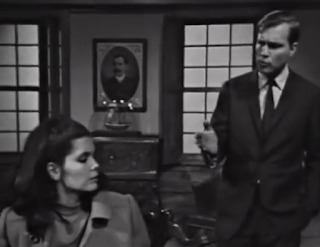
As the episode opens, Lieutenant Dan Riley of the Maine State Police is visiting instantly forgettable young lawyer Frank Garner in an office. Regular viewers will be confused; we’ve seen this set several times, with exactly these decorations, as high-born ne’er-do-well Roger Collins’ office at the headquarters of Collins Enterprises. We haven’t seen the set since #69, and Roger wasn’t there at that time. So apparently Frank has moved in.
Frank hasn’t even moved the portrait of the Mustache Man from the spot where Roger had it when he was in the office. Screenshot by Dark Shadows Before I Die
Lieutenant Riley wants to pass along to Frank the information that the Phoenix, Arizona police have given him about a fire in Laura Collins’ apartment in that city. Laura is Roger’s estranged wife, and Frank is representing Roger in their upcoming divorce. It isn’t clear why Riley wants to tell Roger’s lawyer what he has heard about Laura. Later in the episode, Frank will tell well-meaning governess Vicki that Riley came to him because he is a “lawyer for the Collins family.” Perhaps that means he believed that Frank represented Laura. Throughout their conversation, Frank repeatedly protests that no one has any grounds for accusing Laura of anything, encouraging Riley in such a belief. I suppose it’s a lawyer’s job to collect damaging information about the opposition, but Frank does seem to be pushing an ethical boundary here.
The charred body of a woman was found in what was left of Laura’s apartment. Since the woman appeared to be the same age, height, and build as Laura, the room was locked from the inside, and everyone associated with the building other than Laura was accounted for, the body was initially identified as hers. Riley now tells us that the police have determined that the fire started in Laura’s apartment, and that a witness claims to have seen Laura in the building the day of the fire.
Laura checked into the Collinsport Inn the day of the fire and has been in and around town ever since, as many witnesses can testify. Riley says that there is no indication that Laura has been on an airplane recently, and it would seem impossible to travel from Phoenix, Arizona to central Maine in a few hours any other way.
The lieutenant goes on to say that because the room was locked from the inside and the woman who died in the fire made no attempt to escape, the police suspect murder. This is nonsense. An attempt to escape might have been evidence of murder, not the lack of such an attempt. And if the room was locked from the inside, how did the murderer get out?
Frank doesn’t raise these objections, but just blusters through a lot of verbiage as he protests against any suggestion that Laura should be suspected of murder. The lieutenant keeps pointing out that Arizona isn’t his jurisdiction, so he doesn’t have anything to do with it. He’s just a messenger.
Some scholar of acting really ought to make a frame-by-frame study of Conard Fowkes portrayal of Frank in this scene. He has plenty of dialogue, he’s challenging statements made by a policeman, he raises his voice, makes gestures, moves around the room, looks down moodily and up excitedly. Yet he is still so bland that it is difficult to remember a word he says. It is far beyond my understanding of the actor’s craft to explain how Fowkes manages to be so consistently dull no matter what the character is doing.
When Frank is a small part of an episode, I think of his blandness as a note of pure realism. He is just the sort of person you would expect to meet in a small-town law office in 1967, and indeed it is reassuring to think that someone who has obviously never thought of putting himself in the spotlight would handle your sensitive legal affairs. The last person anyone should want as a lawyer is some guy who habitually makes himself interesting to watch on television.
Today, Frank is the leading man of the first half of the episode, and comes back with a key part in the second half. Giving that much time to a performer with such a bland screen presence does serve a purpose. None of the characters has really committed to the notion that they have to worry about crimes and physical danger, much less that they are facing a challenge from the realm of the supernatural. As far as they know, the whole story today is about a couple of romances and a child custody matter. That’s the right speed for dull, amiable Frank Garner.
That the characters don’t yet know the true dimensions of what they are facing in the storyline is one of the points this scene has to make. The other is that we will be hearing more about the investigation in Phoenix, and that it will advance the plot.
I think an acting problem muddies this second point. Today Vince O’Brien takes over the part of Lieutenant Dan Riley from John Connell, who played him in #143 and #144. As Connell played him, Riley was an out-of-town cop, not the least bit awed by the Collinses of Collinsport. His matter-of-fact speaking and impatient listening made it clear that the family’s connection to the case in Phoenix was not going to result in the discreet, abbreviated treatment that the local authorities have given them. But O’Brien’s version of the character is noticeably quick to agree when Frank makes a statement. When Frank does a TV lawyer “may I remind you” about the elements of a murder charge (elements which he gets wrong, but hey, it’s TV, not law school,) O’Brien’s Riley is agitated. He shows defiance by declaring “You don’t have to remind me” in a harrumphing voice, but his wide eyes and trembling legs show that he is intimidated to be in a discussion with the representative of the mighty Collinses. There’s no point in bringing in an out-of-town character if that’s what you’re going for- the residents of Collinsport can show you what it’s like to live under the thumb of the people in the big house on the hill. And it introduces a doubt as to whether anything will come of the investigation, a doubt which leaves us wondering why we just spent so much time watching these two guys talk to each other.
Meanwhile, Vicki is visiting dashing action hero Burke Devlin in his hotel suite. Burke has asked her to come. Yesterday, she told him that she was suspicious there was something sinister about Laura, and he had listened attentively. Later, he met with Laura and the love he once felt for her had flared back into life. So today, he wants to tell Vicki that Laura is A-OK and she should do everything she can to help her.
Like the scene with Frank and Lieutenant Riley in Roger’s office, this scene has two points to make. First is to establish Vicki as a credible protagonist for the rest of the storyline about the danger Laura presents to her son, strange and troubled boy David. Second is to show that Burke is so smitten with Laura that he won’t be much help in protecting David.
Burke guides Vicki into his kitchen, a cozy space where people can confide in each other. Last time they were in this space, she made coffee for him; this time, he makes coffee for her. He’s remarkably dainty about it, sifting cream and sugar in separate cups. He makes a pitch about how remarkable Laura is, how he’s rethought everything they said yesterday, and how a fine woman like her deserves Vicki’s trust and support.
Vicki is unimpressed. She was in the room when Laura telephoned Burke yesterday, and heard him agree to meet her at one of their old places. She presses him to explain what has changed his mind, and he won’t give a clear answer. She asks how well he really knows Laura, and he looks dreamily off into space and says that he knows her better than anyone else. She asks if his feelings for Laura might be clouding his judgment, and he demands she change the subject. When Burke urges her to persuade David to grow closer to his mother Laura, Vicki replies “I’ll do what I can for David.” Burke says “You’re hedging.” Vicki replies coolly, “I can’t help it.” When he repeats his urging, he tells her she doesn’t look convinced. She replies, “I can’t help how I look, either.”
Vicki’s strength and intelligence and Burke’s dreamy infatuation should impress anyone watching this scene, but especially viewers who just saw yesterday’s episode. When Vicki is asking Burke what happened between yesterday and today to change his mind, she is waiting for him to talk about the meeting he arranged with Laura while she was right next to him. He never mentions it, and his repeated statements that all he has done is think more deeply implies that he does not remember that Vicki heard him talking to Laura. He is so captivated with Laura that the sound of her voice erases his awareness of everyone else, even of someone he is trying hard to persuade of an important idea.
Shortly after Vicki leaves, Burke receives another visitor from the great house of Collinwood. Flighty heiress Carolyn shows up. Carolyn is pouting because Burke hasn’t been paying attention to her since her Aunt Laura showed up.
This scene has one major point to make, which is that the budding Burke/ Carolyn romance is not going to be blooming this winter. Nancy Barrett’s Carolyn bursts off the screen as she bounces from one extreme to another, trying to attract Burke by pushing her breasts at him, trying to anger him by suggesting that her mother Liz and her Uncle Roger were right when they said he was just using her to get at them, trying to embarrass him by bringing up the obstacles between him and Laura, trying to break through his reserve by flinging her arms around his neck and pleading with him to love her.
Burke tries to let Carolyn down easy, smiling at her, caressing her face, hugging her, kissing her on the forehead. But signs of boredom and irritation keep slipping out. He tells her that the time has come for them not to see each other any more, and there can be no doubt he means it.
Burke, bored with Carolyn
Vicki goes to visit Frank. Frank blabs everything to her that the lieutenant had told him.
Vicki is deeply concerned about the idea that Laura might be a murderer. Frank keeps telling her that there’s probably nothing to that idea, but Vicki resolves at the end of the episode to do whatever she can to keep Laura away from David. Having established Vicki as a character strong enough and smart enough to square off with Laura in her previous scene, this scene shows us her decision to do just that.
A few times in the early months of Dark Shadows, writers Art Wallace and Francis Swann found themselves in a corner. The story could move forward only if a character took a particular action, but they couldn’t come up with a reason to explain why any character would take that action. So they had the character do whatever it was simply because it was in the script, and hoped the actors or director or somebody would come up with sleight of hand to conceal their desperation.
Since well-meaning governess Vicki was on screen more than anyone else, she was the one most often required to behave without motivation. Sometimes, Alexandra Moltke Isles finds a way to make Vicki’s behavior intelligible in spite of the writers. The scenes in which Vicki tries to befriend her charge, strange and troubled boy David Collins, are Dark Shadows‘ premier example of good acting trumping bad writing, and there are smaller examples as well. But there are three times in the Wallace/ Swann era- in episodes 26, 38, and 83– when Vicki simply looks like an idiot. This “Dumb Vicki” will appear more and more often as the series goes on, and will eventually ruin the character and do grave damage to the show.
Some weeks ago, Wallace and Swann were succeeded as the principal writers of the show by Ron Sproat and Malcolm Marmorstein. Sproat was a cut below Wallace and Swann, and Marmorstein was far less talented even than Sproat. Today, we get a succession of Dumb Vicki moments resulting from basic incompetence on Marmorstein’s part.
Vicki is visiting her friend Maggie Evans, The Nicest Girl in Town. Maggie has shown her a canvas that her father, drunken artist Sam, was possessed by an unexplained force to paint. Sam hates the painting and is surprised as he watches it take shape under his brush, but is powerless to stop working on it. It depicts Laura Collins, mother of David. Laura is shown as a winged figure, nude and engulfed in flames.
Sam has had several scenes in which he was shown in closeup delivering speeches about his hatred for the painting and going through convulsions while spooky music plays on the soundtrack. He has also had scenes with Maggie and with Laura’s husband, high-born ne’er-do-well Roger Collins, in which he tries to explain what is going on with him and the painting. Yesterday, Maggie recapped much of this to Vicki, sharing the suspicion that Laura is somehow responsible for Sam’s compulsion to paint the picture. Since the show has also given us loads of hints that Laura is connected to the supernatural, this all adds up to a very heavy-handed way of telling the audience that Sam is possessed.
Once you can say that your characters are possessed by unseen spirits, you get a lot of extra latitude as to what constitutes motivation. Once they have shown us that he is possessed, all we need to know about Sam for his actions to make sense is that he has some kind of connection to Laura and that Laura has some connection to the supernatural. The results of the possession hold our interest as we compare them with other events in the story and look for a pattern we can fit them into.
As far as the supernatural beings responsible for the possession go, we don’t need much information at all about their motivation. Far less than for human characters. Most audiences have more or less definite ideas as to what human beings are and what makes them do the things they do. We’re more flexible as to what supernatural beings are, and are willing to spend a long time searching for coherence hidden in story elements that don’t seem to have a logical connection once we have seen that there are uncanny forces in operation.
To get the benefit of that audience participation, a writer does have to show that supernatural forces are at work. Today, Vicki seems to be possessed, but there is no scene showing us that this has happened. Vicki looks at the painting and says she wants it. Asked why, she says she doesn’t know. Nothing she says makes much sense, or much impression.
Three seconds of Vicki staring at the painting while we hear a theremin cue on the soundtrack would have sufficed to tell us that she was falling under a spell. Not only don’t we get that, Mrs Isles never gets a chance to show us what is happening to Vicki. When Vicki first looked at the painting, she was partially obscured, standing behind Maggie; examining it later, she has her back to the camera. During her dialogue with the loudly agitated Sam, only a few brief shots focus on her. Sam gives Vicki the painting. When Maggie says she wonders how Laura will react when Vicki brings the painting into the house, Vicki mumbles that she doesn’t know.
Had we seen Vicki falling under the spell, the result could have been a powerful moment. As a supernatural storyline goes on, the mysterious forces behind it spread their influence from one character to another. The first moment in this one when we could see that sort of contagion at work is when the powers that have been controlling Sam take hold of Vicki. To hide that moment from us is to hide the whole development of the narrative arc.
Moreover, that this particular development takes place on this set among these characters is quite significant. When Vicki and Maggie first met, Maggie told her that she was a jerk for taking a job at the great house of Collinwood. She told Vicki that Collinwood was a source of trouble for the town of Collinsport. As the weeks went on, Maggie and other Collinsport natives made it clear that a big part of that trouble comes from the ghosts and ghoulies that are housed in Collinwood and that threaten to break out and take over the town. This will indeed become the major theme of the show in the years ahead.
Now Vicki has lived in Collinwood for over six months, and the only ghosts she has seen are the friendly, protective spirits of Josette Collins and beloved local man Bill Malloy. The first time a supernatural being does something frightening to Vicki is in the town of Collinsport, in Maggie’s own house.
Indeed, the Phoenix storyline is the only one in the whole series to invert the usual pattern of Collinwood as hell-mouth and Collinsport as a beleaguered outpost of normality. There are other storylines where evil powers came from far away, from across the sea or from another dimension, and settled in Collinwood before spreading out to threaten Collinsport, but in this story the source of the disturbance is Laura. While she may tell David in episode 140 that she comes from one of the realms described in the legends of the Holy Grail, that origin applies only to her uncanny side. When Laura first came to town, she had told Maggie that she was originally from Collinsport, and in episode 130, Laura’s estranged husband Roger, and Roger’s sister, reclusive matriarch Liz, had mentioned that Laura’s family had moved away from town.
The episode also leaves us on our own trying to figure out what Vicki is thinking. Regular viewers might take some time during the commercial break to puzzle it out, put it in the context of what we’ve seen previously, and wonder if Vicki is in a stupor because she too is possessed. That might help us to get through the rest of the episode, but if we are to feel a live connection to the character we have to understand what she is feeling while we are watching her. A theory we come up with after the fact is no substitute for empathy we experience during the scene. And of course people tuning in to Dark Shadows for the first time will simply think that Vicki is some kind of idiot.
Many fans of Dark Shadows, especially those who haven’t seen the first 42 weeks of the show or who didn’t see them until later episodes had given them fixed impressions, blame Alexandra Moltke Isles’ acting for Dumb Vicki. But today’s scene in the Evans cottage shows how deeply unfair that is. If an actor doesn’t have lines to deliver, she can’t use her voice to create a character. If the camera isn’t pointed at her, her body language is no use. And if the director is telling her to play the scene quietly while the others are going over the top, she’s likely to fade into the background. Without even a musical sting on the soundtrack to support her, there is nothing Mrs Isles could have done to communicate to the audience what Vicki is going through in this scene.
It is easy for me to denounce Malcolm Marmorstein, since his scripts are so often so bad. I am reluctant to place a share of the blame on director John Sedwick, since I am always impressed with Sedwick’s visual style and usually with his deployment of actors. But I can’t believe anyone would have stopped him pointing a camera at Mrs Isles at the appropriate moment, giving her a chance to play her part.
Back at the great house of Collinwood, David and Laura are sitting by the fire. David asks his mother about her old boyfriends. He wants to know if she ever dated dashing action hero Burke Devlin. She admits that she did. When David lets on that he wishes Burke, rather than Roger, were his father, Laura squirms. We’ve had a number of indications that Burke might in fact be David’s biological father, and Laura is alarmed that David is raising the topic.
The front door opens, and David and Laura are glad to see their friend Vicki. They are intrigued by the package Vicki is carrying. David begs to see what’s inside. Laura, in a light and cheerful voice, tells him that if Vicki wanted him to see it, she would have shown it to them. He continues to beg. Vicki says “All right!,” and unveils it. When we were watching the episode, Mrs Acilius exclaimed “All right!?,” appalled at Vicki’s nonsensical decision to yield to David’s pleas despite the cover Laura was giving her. Again, the idea that Vicki’s weird decisions and vague, distracted manner might be symptoms of possession was somewhere in our minds, but since nothing had been shown to give direct support to that idea our emotional reaction suited a Dumb Vicki moment.
As Maggie had suggested she might be, Laura is horrified to see herself depicted in this fiery image. David is thrilled- he had been plagued by a recurring nightmare, one he had described in detail to the deeply concerned Vicki, in which his mother stood in a sea of flames and beckoned him to join her. He asks how Sam knew about his dream- did he have the same dream? Vicki mumbles that he didn’t, that he didn’t know anything about the dream or even why he was painting the picture. The audience may have wondered why Vicki didn’t remember the dream until now- the explanation that fits best with the story is that she has been possessed by the same spirit that possessed Sam, but with so little attention given to Vicki as she was reacting to the painting some very insightful critics have taken it as another Dumb Vicki moment.
David points to a white space in the painting, one the shape of his own head, and asks what goes there. Vicki mumbles that she doesn’t know, and that Sam himself didn’t know. David is delighted with the painting and wants to hang it in his room. He asks Vicki to give it to him. Vicki tells him that his mother will have to rule on that question. Laura hates the painting and tries to talk David out of hanging it, but he is nothing deterred. She finally caves in.
While David goes upstairs with the painting, Laura asks Vicki what she was thinking bringing such a terrible thing into the house. Vicki says she doesn’t know- something just came over her. That goes to show that the writer wanted us to think that Vicki was possessed, which in turn makes it all the more exasperating that he didn’t let us in on it at the appropriate time. The fact that we know the writer wants us to have a reaction doesn’t mean that we actually have it. Confusion pushes people away from a story, and merely intellectual explanations offered after the fact don’t draw us back in.
Vicki, seeming to regain some of her brainpower, goes to David’s room and tries to talk him out of keeping the painting. He dismisses her concerns immediately, without even changing his delighted manner, and hangs it on his wall. Looking at it, Vicki admits that it looks like it belongs there.
Laura enters, and tells David she has changed her mind. She thinks it would be bad for him to have such an image on display, and asks him to get rid of the painting. David responds by threatening never to speak to her again. Laura has just been reunited with David after years of separation, and his initial reaction to her return was confused and traumatic. So it is understandable that she capitulates to this extortion.
It is more surprising that Vicki responds by turning away and wringing her hands after Laura leaves. Usually Vicki scolds David after he is nasty to people, and she has been on a particular mission to break down the barriers between him and his mother. If it were clear that Vicki was under the influence of a spirit and was not herself, this uncharacteristically diffident response might have carried a dramatic punch, at least for regular viewers. As it is, it slides past as yet another Dumb Vicki moment.
Back in the Evans cottage, Sam comes back from his usual night of drinking at the local tavern. Maggie is infinitely weary of her father’s alcoholism, but does smile to hear him reciting poetry and talking about a seascape he is planning to paint. At least he’s happy. Sam goes to his easel to start that seascape, only to recoil as he realizes that he is in fact painting another version of the picture of Laura in flames.
David is asleep in his room. The painting starts to glow. Then Laura’s painted likeness is replaced with a video insert of her face. The insert grows and grows, and David screams for it to stay away.
Maggie’s suspicion that Laura is behind the portrait fits with the many signs the show has given us of Laura’s uncanny nature. Laura’s reaction when Vicki brings the painting home, though, shows us that what has been happening to Sam does not serve Laura’s interests, any more than David’s nightmare did.
I think there are three possible explanations for the origin of the compulsion Sam had to paint the picture, the compulsion Vicki had to claim it, and David’s nocturnal disturbances. It could be that by exposing David time and again to the image of him following her into flames, Laura is gradually wearing down David’s resistance to a horrible idea that will lead to his destruction. In support of this interpretation, we remember the first night Laura was at Collinwood. She was calling David’s name in a quiet voice at the window of her cottage, far from the great house. Yet the sound of her voice penetrated David’s mind as he slept. He writhed on his bed, and went into the nightmare. Laura’s objection to the painting militates against this explanation.
When we were watching the episode, Mrs Acilius suggested a second reading. There might be a lot to Laura. Maybe in addition to the physical presence in the house that wants David to come away with her, there is also a ghostly presence that wants to warn him and everyone else of the danger that implies. That interpretation would fit with David’s sighting, the night Laura first came to the house, of a flickering image on the lawn that looked like Laura. David longed for that Laura to come to him, but reacted with terror when he saw the fleshly Laura in the drawing room. Perhaps there are two of her, and one is trying to protect David from the other. It is also possible that the two Lauras are not aware of each other, or even fully aware of themselves. So this interpretation is easier to reconcile with apparently contradictory evidence.
Vicki’s involvement suggests a third possibility. The ghost of Josette Collins appeared to her and comforted her in episode 126, and an eerie glow had emanated from the portrait of Josette when David left Laura alone in the Old House yesterday. Laura was alarmed to hear that David was interested in the ghosts of Collinwood, had not wanted to go to the Old House, and lies to David when he asks if he saw any sign of Josette’s presence. Perhaps Josette is intervening to thwart Laura’s plans, and it is her power that is benumbing Vicki today. Josette’s previous interventions have been intermittent and subtle, suggesting that it is difficult for her to reach the world of the living. So if she is preparing for a showdown with Laura, we might it expect it to take her some time to recruit her strength.
Again, this is the kind of search for patterns that an audience will gladly go into once you’ve let them know that there are supernatural forces at work in your story. Since Josette has been in the background of the show from week one, has appeared repeatedly, has a set devoted to her in the Old House, and has established connections with both Vicki and David, we might expect her to be the first of the uncanny presences we think of when we enter a supernatural storyline. That she is a tutelary spirit presiding over Collinwood brings it into sharp focus that the estate is under assault from a supernatural force emanating from the town of Collinsport. Today’s failure with Vicki kicks Josette’s ghost out of the spotlight, and that is one of the major faults with the episode.
This is the thing that people miss when they talk about soap opera couples. Two characters don’t have to be in love with each other to be a “couple” — although they often are, which is why people think that’s the definition.
Two characters are a “couple” when a scene with them together is way more interesting than a scene with them apart. It makes absolutely no difference whether they love each other, or hate each other, or they’re partners, or best friends. Kirk and Spock are a couple. Ernie and Bert are a couple.
By Danny’s definition, Dark Shadows‘ first supercouple is well-meaning governess Vicki and her charge, strange and troubled boy David Collins. Most of the storylines the series started with- Vicki’s quest for her origins, dashing action hero Burke Devlin’s quest for revenge on high-born ne’er-do-well Roger, reclusive matriarch Liz’ insistence that certain parts of the house never be entered, the doomed romance between flighty heiress Carolyn and hardworking young fisherman Joe, etc- either dribble away to nothing or never really get started. But Vicki’s attempt to befriend David is interesting every time we see the two of them together on screen.
That is entirely down to the actors. The scripts give David the same viciously hostile lines of dialogue over and again, require Vicki to read aloud from textbooks about the geography of Maine, and lock Vicki up in windowless rooms for what seem like eons. But David Henesy and Alexandra Moltke Isles, with their facial expressions, tones of voice, gestures, use of space, etc, create the impression of a relationship steadily growing in emotional complexity and importance. When David finally looks up into Vicki’s eyes and declares “I love you, Miss Winters!” in #89, this body language gives us a context within which we can feel that a plot-line has moved forward. In the months since that statement, David and Vicki have grown closer, and now they are quite cozy.
So much so, in fact, that there is a danger that they might end up recreating the interpersonal dynamic that Liz and Roger model and that will become Dark Shadows’ signature- a relationship between a bossy big sister and her bratty little brother. Liz continually tries to control Roger’s behavior so that he will not be bad, and when her efforts fail, as they invariably do, she covers up for him and shields him from accountability. Earlier this week, as Vicki explained David to himself and he clutched at her for support after he had done shocking things, we could see how after a time they might fall into that pattern.
Today, they seem to put that danger behind them once and for all. David’s mother, the mysterious and long-absent Laura, has come back and wants to take David to live with her. David has wanted this for years, but in the days since Laura’s return has come to be deathly afraid of her. Vicki has met with Laura and arranged to cross paths with Laura when she and David take their afternoon walk. Vicki’s theory, which has quite a bit of evidence behind it, is that David is only afraid of rejection, and that if he can see his mother in a setting where nothing will be expected of him he will start to relax.
The first result of this encounter is that David slips off a high cliff, clinging for his life to a crumbling rock on its edge. This would seem to be a negative outcome. Vicki rescues him, embraces him, and talks him into going to his mother.
Vicki holds David and urges him to go to his mother
David sees that Laura is crying and apologizes to her. They embrace and warm to each other. David, Laura, and Vicki walk back to the house together. David’s father, Roger, and his aunt, Liz, are impressed with the progress Vicki has made.
Happy at home
Dark Shadows began on a sort of 14 week schedule. Coming at the end of the first 14 weeks, episode 70 gave us our first visit to the haunted Old House and our first unambiguous sighting of a ghost. At the end of the third 14 weeks, episode 210 will end with a hand darting out of a coffin and rebooting the show entirely. Today, the conclusion of the second 14 week period is perhaps less spectacular, but in its own way just as pivotal as those other milestone episodes.
With David’s apology for making his mother cry and his resolution to open up to her, he is becoming significantly less bratty. With her handing of David off to Laura, Vicki is renouncing her opportunity to be bossy, and indeed to become a surrogate sister to him. With that danger out of the way and an untroubled friendship established between them, the Vicki/ David arc seems to have reached a logical conclusion. The series will have to find a new supercouple, or a clutch of new storylines, if it is to hold our attention in the long term.
Perhaps Laura and David will be the new pair at the center of the show. They are together at the beginning and end of the second half of the episode, and in between Laura gets some information about David to which she gives an intriguing reaction.
At the beginning of that second half, the five characters in today’s episode share a meal in the kitchen at Collinwood. The richest people in town live in a huge mansion, and this is their dining room:
Family dinner
I suppose Liz and her daughter, flighty heiress Carolyn, lived alone in the house for 18 years, ending with Roger and David’s arrival sometime last spring. So perhaps there is a bigger dining room sealed off somewhere. Be that as it may, the smallness of the kitchen is one of its most valuable features as a set. Scenes there have an intimacy that makes it natural for characters to share important information with each other. Indeed, almost every time we’ve seen the kitchen, we’ve seen someone pick up information that led them to take action that advanced the plot.
Liz and Roger mention that Laura hasn’t eaten anything. Roger follows that with jokes about the cooking abilities of Mrs Johnson, Collinwood’s housekeeper. Laura not eating is a familiar theme to the audience. The first several times we saw Laura she was in the restaurant at the Collinsport Inn. Maggie Evans, keeper of that restaurant, remarked that Laura never ate during any of her visits there, and yesterday she didn’t touch the breakfast Vicki brought her. The emphasis they keep putting on this point is one of many signs they’ve offered that there is something uncanny about her.
After the others have left the little table, Liz exchanges a few words with Laura. She mentions that David is a highly imaginative child, who even supposes that he talks with the ghosts of Collinwood. At this, Laura opens her eyes wide, shifts in her seat, looks straight ahead, and says that that does sound like pure fantasy. Liz adds that he spends a lot of time with the ghosts. Laura glances back in Liz’ direction and says that perhaps now he will spend more time with her.
One might imagine that a long-absent mother, hearing that her son thinks he spends a lot of time in conversation with ghosts, would be concerned for his mental health. A reaction like the one Laura gives Liz might be a sign of such concern. But we’ve had so many hints that Laura is herself somehow connected to the supernatural that this does not seem to be a likely explanation. More probably, her discomfort is a sign that David’s sensitivity to the uncanny and his communication with the ghosts might lead him to learn something about her that she does not want him to know.
Laura and David sit by the fire in the drawing room. Vicki has scolded David for his habit of standing at the doors to the drawing room and eavesdropping on conversations taking place inside. Now, it’s Vicki’s turn to stand on the same spot and eavesdrop on a conversation involving David.
Vicki listens in
David has asked Laura to tell him about the place she comes from. “Some call it Paradise,” she says. She starts describing a hot, sunny place with palm trees. Her last known address before appearing in Collinsport was Phoenix, Arizona, so maybe that’s what she’s talking about. But as she goes on, the description sounds less and less like that city, and more and more like the places we hear about in the legends of the Holy Grail. The air is always fragrant with the flowers that bloom continually, and the trees are the proper nesting places of a creature that figures prominently in the Grail legends, the Phoenix. David has never heard of the Phoenix, and Laura tells him an elaborate version of its story.
In episode 128, Maggie sat at Laura’s table in the restaurant and Laura told her the story of the Phoenix. When Maggie told her father, drunken artist Sam, that a mysterious blonde woman who used to live in Collinsport had told her that tale, Sam had reacted as if he recognized the story as one Laura used to tell. The version she told Maggie, though, was a relatively brief one, and was by way of an etymology for the name of her most recent hometown. The version she tells David today is much more elaborate. It evokes a whole world, claims that world as her home and therefore as David’s, and invites David to take his rightful place under the sign of the Phoenix.
As Vicki hears Laura reach the climax of the story, a sudden wind blows the front doors open, and a fraction of a second later blows the drawing room doors open as well. Laura looks up and sees Vicki eavesdropping. She is a bit startled to see her, though not as startled as Vicki is to be seen:
Vicki caught eavesdropping
After a brief moment- less than a second- Laura turns from Vicki and to the fire. She and David peer into the flames.
Peering into the flames together
Laura turns from the flames and looks at David. The episode closes with her look of satisfaction as she sees her son fascinated by the fire.
Watching David watch the fire
The doors have blown open before when the show wanted us to think that supernatural forces are at work in the house. Laura herself may control some supernatural forces, but it seems unlikely that she is the author of this incident. It interrupts her story just as she is declaring that “The Phoenix is reborn!,” her reaction shows that she didn’t know or particularly care that Vicki was eavesdropping, and her turn to the fire would suggest that she is concerned the wind might have extinguished the flames. Perhaps we are supposed to think that Laura’s presence and her plans have stirred up one or more of the ghosts Liz mentioned to Laura after dinner, and that the gust of wind was a sign of their presence. That would in turn suggest that the weeks ahead will feature a conflict between Laura’s uncanny powers and those of the spirits lurking in the back-world implicit in the action of the show.
Each of the 1225 episodes of Dark Shadows features one name under the credit “Written by.”* A total of nine names rotate in that spot. While we know that some episodes included writing from uncredited contributors, the only such contributors we can identify come from among that tiny group of eight men and one woman. For example, Malcolm Marmorstein, credited with today’s script, wasn’t officially named among the writers until #115, but he may well have written additional dialogue as far back as #46. Joe Caldwell’s name doesn’t appear on-screen until #245, but he will actually be writing some of the scripts attributed to Ron Sproat starting this month, maybe this week.
Opinions will of course vary as to which of the nine identifiable writers was better and which was worse. Few, however, will find a place for Marmorstein on a list of Dark Shadows’ eight best writers. Although he had extensive experience in the theater, Marmorstein had none of the sense of what actors can do that Art Wallace and Francis Swann brought to the first nineteen weeks of the show. Nor did he know how to structure a drama, write crisp dialogue, or invent fresh story points. Directors Lela Swift and John Sedwick collaborate with a uniformly strong cast to put Marmorstein’s scripts on such a strong footing that at moments they seem like they are about to be good. Those brief flashes of hope are invariably, cruelly, disappointed.
There are indeed some bright spots in today’s episode. Reclusive matriarch Liz is in the drawing room of the great house of Collinwood. Well-meaning governess Vicki and homicidal fugitive Matthew are both missing, and Liz is worried that Vicki may have fallen into Matthew’s hands. Wildly indiscreet housekeeper Mrs Johnson shares her conviction that Matthew has killed Vicki, and won’t stop talking about this belief even after Liz expressly orders her to do so. Clarice Blackburn plays Mrs Johnson as a woman with no self-awareness whatsoever, and no screen actor has ever had a more effective way of showing horror at displays of social maladroitness than did Joan Bennett. In their hands, this scene is laugh-out-loud funny.
A knock at the door rescues Liz from Mrs Johnson’s untrammeled morbidness. The sheriff has come to report to Liz on the state of the searches for Vicki and Matthew. Mrs Johnson answers the door and won’t let the sheriff see Liz until she’s given him a piece of her mind about the incompetence of his department. There aren’t any memorable lines in this exchange, but the contrast between Blackburn’s highly animated movements and Dana Elcar’s cheerful placidity is so obviously suitable for comedy that it feels funny.
Back in the drawing room, the episode starts to fall apart. Liz and the sheriff talk about the searches for Vicki and Matthew. The dialogue is full of repetition and wasted words. Liz asks if the sheriff has an idea where Matthew might be, to which he replies, “He could be anywhere, and everywhere.” Might he hurt Vicki? “He might, but on the other hand he might not.” After all, “he’s very unpredictable.” Then, “you know how unpredictable he is.” Yep, unpredictable, let’s repeat that word five or six more times, that’ll keep us busy until the commercial break.
They could have cut some of that smoke-blowing and replaced it with lines about what the sheriff has done. My wife, Mrs Acilius, wishes the sheriff had mentioned telephoning Vicki’s former residence, the Hammond Foundling Home, and asking people there about where Vicki might have gone and whom she might have tried to contact. That might not have led to any action, but at least it would invite us to imagine that something might be going on somewhere.
The scene between Liz and the sheriff does have an effective ending. She asks him if he holds out much hope for Vicki. He replies, “Frankly, no.” She turns to leave the room. We break for commercial on that downbeat, which lets the bleakness of the situation sink in.
Strange and troubled boy David Collins comes home. David is the one person who knows that Matthew is hiding in the long-abandoned Old House on the grounds of the estate. He has been delivering supplies to him. Even David does not know that Matthew is holding Vicki prisoner in a hidden chamber. David sees that the sheriff is in the house, and asks Mrs Johnson if the sheriff has any news about Vicki or Matthew. Mrs Johnson seizes this opportunity to resume denouncing the sheriff’s incompetence, saying that the only clue he can recognize one that tells him it is time to eat and make himself even fatter than he already is.
David is about to move on when Mrs Johnson questions him about the pack of cigarettes he stole from her earlier. She sets some punchlines up for David in this exchange. She mentions that she lit a cigarette while serving David his breakfast, to which David replies by asking if she is supposed to smoke while working. She says she knows that she set her pack of cigarettes on the table when she and David were alone in the kitchen, and that she hasn’t seen it since. He suggests it walked away by itself. She tells him he’s the only one who could have taken them; he says that if he wanted cigarettes, he wouldn’t steal them, he’d buy them. None of these lines is much on the page, but as delivered by Blackburn and David Henesy, they are genuinely funny.
David goes into the drawing room and talks with the sheriff. Picking up on Mrs Johnson’s remark about the sheriff’s vigilant observation of meal-times, David asks him what it means when the whistle blows at the cannery. “Lunch,” says the sheriff. Again, not a world-class piece of comic material, but Henesy and Elcar make it land.
David then asks the sheriff for the details of his search for Matthew. The sheriff happily answers all of David’s questions in detail, as if he were giving a briefing to the state police. He tells David that anyone who might be hiding Matthew will go to jail.
This scene shows the limits of what a good actor can do with bad material. David is going to return to the Old House at the end of the episode. He will be prompted to go back there because he has learned information from the sheriff that Matthew will want to know. While there, he will set up suspense by revealing to Matthew that the sheriff has triggered his intense phobia of jail. That locks the sheriff into playing his scene with David as a babbling oaf.
In Elcar’s first episodes as the sheriff, he had made indiscreet remarks to David, but as we saw him observing the reactions those remarks elicited from David and others he seemed to be using them as ploys to advance his investigations. For example, in #59, he had given David some information that excites him and unnerves his father, high-born ne’er-do-well Roger Collins.
We can see how he might use similar tactics in this situation. After all, Vicki is David’s governess, and David has spent more time with her than has anyone else. Matthew had been the caretaker in the house where David lives, and David knows him quite well also. In this conversation, when the sheriff refers to Matthew as unlikable, David becomes very excited and exclaims “I like him! Er, I did like him, I mean.” If the sheriff knows his business he might well pay very close attention to everything David says, and keep encouraging David to say more. He will certainly notice David’s terrified reaction to the idea that someone helping Matthew will go to jail, and test his reaction to further comments on related themes. But if he takes any note at all of David’s attitude, the current storyline will end within minutes. So in this scene, Marmorstein leaves Elcar no way to play the sheriff as an intelligent character.
After the sheriff leaves, David and Liz have a scene in the drawing room that builds up to a tremendously frustrating moment. David keeps asking his aunt one question after another about Matthew and Vicki, Vicki and Matthew, does Matthew have Vicki, is Vicki in danger from Matthew, then without taking a breath “Do you know any secrets about the Old House?” Liz responds “I wish that someday you’d ask an important question.”
Granted, we know that Matthew is holding Vicki prisoner in the Old House and Liz does not, but it is hard to imagine anyone failing to see the connection between these two thoughts. Joan Bennett and David Henesy had a fine rapport that made the scenes between Liz and David Collins a delight, and you can see them trying to save this exchange. David is in a panic at the beginning of the scene and gets steadily more worked up as it goes along. We see Liz observing his agitated emotional state, paying such close attention to his facial expressions, tone of voice, and frantic bodily movements that she misses key elements of his words. It’s a valiant attempt on their part to make the scene work.
David wants to go to the Old House to see Matthew. In the foyer, Mrs Johnson again confronts him about the cigarettes. He yells at her to “Get off my back!” and runs out. This might have been an attempt to show that David feels his world closing in on him, but it doesn’t succeed. We’ve already seen those two characters say everything they had to say about that topic on that set. Repeating it just feels like filler.
*There are reference works that draw on the original paperwork produced by the makers of the show; even these list one writer per episode. That’s how the Dark Shadows wiki manages to list a writer for every episode, including those that don’t show writing credits on-screen.
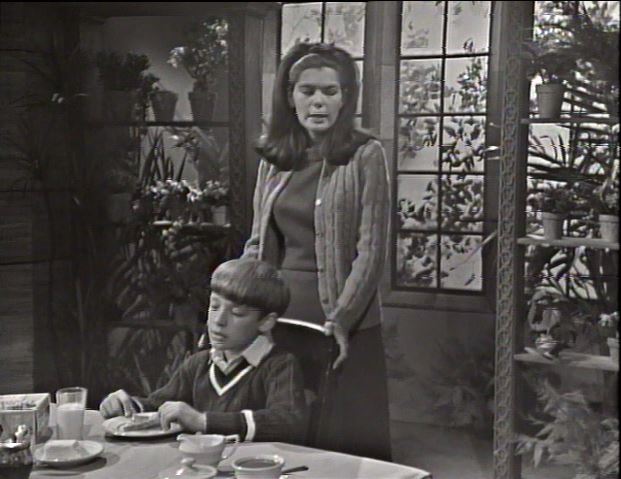
Well-meaning governess Vicki and troubled rich boy David Collins are having breakfast in the kitchen at Collinwood. David had heard Vicki and his cousin Carolyn screaming outside the night before, and saw them running back to the house. He keeps badgering Vicki for an explanation of these events, which Vicki refuses to give. In his frustration, he accuses Vicki of trying to replace his mother, and tells her that when she dies, he won’t even go to her funeral.
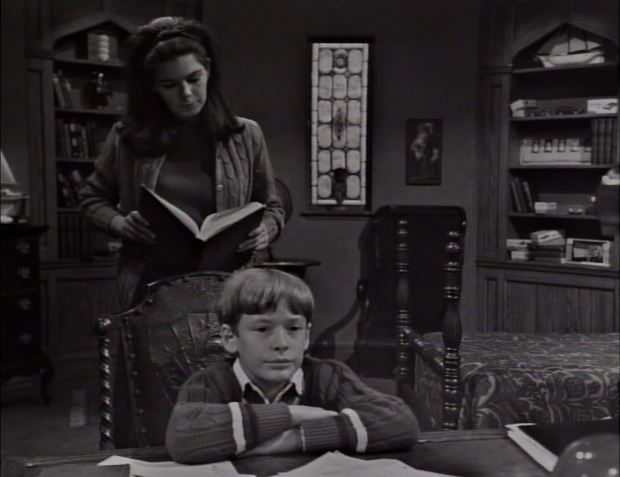
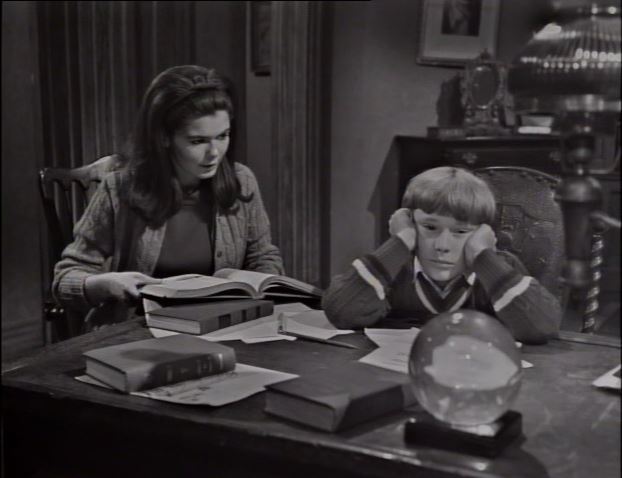
Later in the episode, after David has overheard Vicki telling hardworking young fisherman Joe that she and Carolyn thought they saw a dead man on the beach, he has another scene with Vicki, this time in his room. She’s trying to teach him about the importance of rivers in the economic development of the USA. He continues to demand information about what happened last night. He resists answering her questions about North America’s rivers, she resists answering his questions about what she saw on the beach.
These scenes are full of repetitious dialogue, conversational dead-ends, and descriptions of the Mississippi-Missouri river system. They could have been quite dull. Thanks to the actors, they are engrossing. As David Collins, child actor David Henesy uses an utterly flat voice and affect, to which Alexandra Moltke Isles as Vicki responds with a nuanced slow burn. When David makes common-sense observations (e.g., “Was something chasing you?… Then why were you running?”) his flatness seems to be a sign of sober intelligence. When he says terrible things (“When you’re dead, I won’t even come to your funeral,”) the same flatness is far more disquieting than a display of anger would be. As Vicki very gradually loses patience with David, her eyes never leave his face for more than a second- we can see her searching for something she can empathize with, some opening hinting at a relatable emotion, and not finding it. The two of them are irresistible together.
Director John Sedwick deserves a lot of credit as well. We see Vicki and David in the kitchen and in David’s room, the two most intimate spaces on the show. In each of these spaces, David is sitting still while Vicki moves about. David’s stillness allows him to keep his voice perfectly level, while Vicki’s movements give her opportunities to show signs of the emotional reaction she’s trying to keep in check as she tries to be nothing but a conscientious teacher. The camera catches David’s crystal ball to emphasize the boy’s baleful preoccupations.
Reclusive matriarch Liz meets with dour handyman Matthew in the drawing room. Liz revisits the question of the dead man on the beach. She says that she doesn’t believe Matthew has ever lied to her; he vows he never will. Liz points out that Matthew chose his words carefully last night when he came back from searching the beach, and asks if there was in fact a dead body there. He admits that there was, that it was the body of missing plant manager Bill Malloy, and that he put Malloy’s body in the water and watched as the tide carried it out to sea Horrified, Liz asks what Matthew was thinking. All he will say is that he thought it was for the best. Liz calls the police.
In his scene with Liz, Matthew mentions that before he came to Collinwood to be the handyman he worked for Liz’ father on the fishing boats. I’ve seen several websites claiming this is an inconsistency, since in episode 6 Matthew had said that he was sweeping the floors in the Collins cannery when he was called up to the big house. Those could both be true, though. He might have been a fisherman who had to leave the boats for some reason and then took the job at the cannery.
Maybe the reason was Matthew’s personality. As Liz told Vicki in episode 13, Matthew is a “strange, violent man”- it’s easy to imagine him alienating the rest of the crew of a small boat to the point where they would refuse to set out with him on board. A history like that would go a long way towards explaining Matthew’s extreme gratitude to Liz for giving him a job, especially a job where he’s alone almost all the time.
This is a vitally important episode. The scene in David’s room is the first of many in which David Henesy and Alexandra Moltke Isles act their way out of weak writing to establish a relationship between two characters who can always make a connection with each other. Their body language, tones of voice, etc, triumph over some remarkably tedious dialogue to show us what people look like when they’re starting to trust each other. The growth of that relationship is really the only story that works in the first 42 weeks of the show. The big events involving characters we’ve only heard about or who will soon be recast matter insofar as they represent developments in that story, and other events don’t matter at all.
The scene that Liz and Roger play out in the drawing room while Vicki and David are talking upstairs is important in its own way. That these conversations are going on simultaneously is an example of the mirroring of Vicki and Liz that is such a strong motif in the first 42. Vicki is open and uncomplicated as she tries to talk David down from his superheated hostility to his father; Liz is guarded and double-minded as she tries to talk Roger back up to fear of Devlin. In the contrast between the two women, we see the difference between the innocent one with no past, and the frightened one with nothing but a past.
The contrast between father and son plays out in those scenes, and also in the two brief scenes between them. Roger’s narcissism renders him utterly childish, making no effort to take his son’s feelings into account or to understand Devlin’s motives. David’s fear and pain drive him to mimic adult behavior with absurd and indeed horrifying results. Liz tries to make Roger grow up, as Vicki tries to free David to be a child, but Roger’s inability to take anyone’s feelings but his own seriously dooms both efforts.
The moments between Liz and Vicki call for comment. Later on in the series, these characters will be stuck in many frustrating scenes where they inexplicably fail to pass on information that would resolve story points. At first glance, Vicki’s failure to tell Roger about Burke’s presence in the garage and Liz’s failure to pass the word of it on to him after Vicki tells her may seem to be the first of those failures. But Vicki has no reason to trust Roger, and very little to suspect Burke of wrongdoing. On what she’s seen of Roger so far, she can only assume that if she tells him what she saw he will jump to the most sinister possible conclusion and enlist her in his mad campaign against Burke. Liz seems relatively reasonable, at least on the topic of Burke Devlin, so by telling her Vicki is both satisfying an obligation and reducing the likelihood that she will be a party to slander. Indeed, Liz and Vicki tell each other quite a bit about themselves, much more than they will later on.
And a short one about a point that bothers many viewers:
Oh, and Liz’s failure to repeat Vicki’s news to Roger isn’t a problem. Liz is deeply preoccupied, and Vicki’s report wouldn’t be particularly interesting to anyone who hadn’t been watching the show.









 Dark Shadows Commentary