Strange and troubled boy David Collins got himself trapped in the secret chamber of the old Collins mausoleum in #310, and everyone has been searching for him ever since. Most of them want to get him home safe, but his distant cousin, Barnabas, has a different agenda. He suspects that David has learned that he is a vampire, and is determined to be the first to find him so that he can kill him.
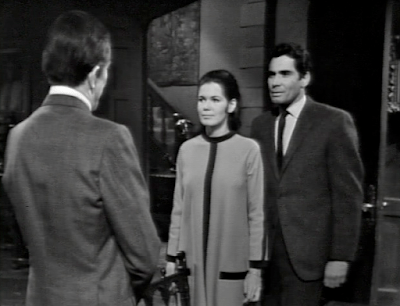
Friday, David got out of the secret chamber and walked outside, straight into Barnabas’ hands. Today, we open with a reprise of that scene. After Barnabas greets his young cousin with a richly sinister “Hel-lo, David!,” he questions him sharply. He expresses dissatisfaction with David’s answers, then tells him that because no one is at home in the great house of Collinwood, he will be taking David to his own house. David grows more and more uncomfortable. Just as he is coming to be really frightened, the voice of local man Burke Devlin calls his name.
When Burke reaches them, David throws his arms around him and Barnabas squirms guiltily. Burke dislikes Barnabas, and gives him a suspicious look while he and David explain what has happened. When Burke says that there are people at home in the great house, David flashes a look of alarm at Barnabas. Barnabas says that no one had answered when he knocked on the door earlier, so he assumed everyone had joined the search. The two men take David home.
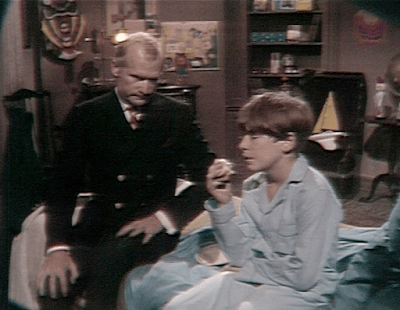
There, David eats a sandwich in his room while his father Roger asks him where he has been. This conversation is just magnificent. Roger is trying to be stern, but is such a flagrantly neglectful father that David knows full well that he can’t be bothered to punish him. So while Roger puts a series of pointed questions to him, David ignores him and muses aloud about Barnabas. “Barnabas is mysterious, isn’t he, Father?…You know, we don’t know anything about him. He just showed up one night.” Roger keeps urging David to forget about Barnabas and start answering his questions, but gets nowhere. Louis Edmonds and David Henesy were both talented comic actors, and they worked well together, so it’s no surprise this scene is laugh-out-loud funny.
Along with the comedy comes the thrill of a potential change in the show. In his post about this episode, Danny Horn writes: “It’s a great moment. It’s like the ‘logical explanation’ spell was suddenly broken, and David just realized how bizarre his life is.” The structure of Dark Shadows’ storylines has been that someone has a terrible secret, they are deep in denial about the extent to which the secret is deforming their lives, and when they finally let go of their secrets they are free. So matriarch Liz had a terrible secret that kept her from leaving her house for over eighteen years, she revealed the secret in #270, and now she’s happy to go anywhere. She’s on an extended visit to Boston at the moment. Roger had a secret connected with an incident for which Burke went to prison years ago and he spent all his time making a fool of himself as he struggled to keep it hidden; he admitted the truth in #201, and since then he has been a carefree fellow who can make anyone laugh. So the Collins family curse that Barnabas embodies is made up chiefly of denial, and it can be defeated by facing facts. If David has seen through all the lies and is willing to reckon with the truth, he has the power to bring everything to a conclusion. So when he says that Barnabas “just showed up one night,” we catch a glimpse of what it would be like if the entire series came to its ultimate climax.
We end with David still in his room, telling well-meaning governess Vicki that he feels someone evil is watching him. We cut to Barnabas in his own house, staring out the window at the great house in the distance, thinking his sinister thoughts. David’s feeling should be familiar to him- when his mother, undead fire witch Laura Murdoch Collins, was staying in the cottage in the estate, she often stared out her window and caused David to have nightmares.
Laura was a threat to David because the basic conditions of her existence drove to kill her son. Barnabas’ threat to him is a result of circumstances that were always likely to arise, but that might not have, and that might yet be changed. So when Laura was on the show, the suspense was how she would be destroyed before she could kill David. Now with Barnabas, there is a question whether he will try to kill David at all. So the suspense is more complicated, and there are more options for pacing. The plot doesn’t have to be either glacial or rapid, as it did with Laura, but can move at any of a variety of speeds depending on which of the many possible directions they decide to take the story.
When new writers start working on Dark Shadows, they do some inventorying of ongoing and disused storylines. When Ron Sproat came aboard in November of 1966, he contrived a lot of scenes that served to mark storylines as “To be developed” or “To be discarded.” Now Gordon Russell has begun to be credited with scripts. He addresses continuity questions with brief lines of dialogue.
For example, for the last forty weeks the show has been equivocating about when it was that Barnabas Collins lived as a human being. Sometimes they say that he died and became a vampire in the 1830s. That fits with the original idea that Jeremiah Collins built the great house of Collinwood for his bride Josette in that decade, because Barnabas is supposed to have loved Josette and hated Jeremiah. At other times, they have pushed Barnabas, Josette, and Jeremiah back into the eighteenth century.
Now Barnabas has risen from the grave. Mad scientist Julia Hoffman has developed a series of injections to cure him of vampirism and turn him into a real boy. When Julia finds that Barnabas has heard the ghostly voice of his sister, nine year old Sarah, she declares that “The injection can wait!” and wants to talk all about Sarah. When Barnabas tries to avoid the subject, saying that Sarah has been dead for nearly 200 years, Julia replies “So have you.” That would seem to nail down that continuity question.
Julia speculates that Barnabas has subconsciously willed Sarah to return to the living, because she symbolizes the kindly side of his nature. There have been a bunch of possible explanations for why Sarah emerged shortly after Barnabas did; evidently this is the one we will be going with, at least for a while.
Barnabas has been looking through an album of family portraits, Sarah’s among them. He tells Julia that he is particularly intrigued by another portrait in the same volume, that of Jeremiah. He says that Burke Devlin, depressing boyfriend of well-meaning governess Vicki, bears a striking resemblance to Jeremiah. This point was first made in #280, when Burke came to a costume party at Barnabas’ in Jeremiah’s clothing and Barnabas was shocked by the resemblance. Barnabas says that he will be a happy man when Burke is as dead as Jeremiah. This tells us, not only that Barnabas is serious about his hostility to Burke, but also that we can expect some connection between Jeremiah and Burke to be developed.
Julia chases Barnabas around his living room until he hangs his head and mutters a promise not to hurt anyone, not even Burke, as long as there is a chance the injections will work. This helps both to explain why Barnabas has been so harmless lately and to reinforce the Bossy Big Sister/ Bratty Little Brother dynamic that is forming between him and Julia.
Julia goes to the great house. Matriarch Liz is under the impression that Julia is an historian writing a book about the old families of New England, and letting her stay in the mansion on the understanding that she is doing research into the Collinses. Liz asks about Julia’s previous books. Julia evades the question, saying that only scholars have ever heard of them. Liz mentions that she was a recluse for eighteen years, during which time she read so widely that she became aware of many scholarly books. Julia seizes on Liz’ reference to her time as a recluse, and asks a series of questions about it. Observing Julia’s facility at deflecting questions she doesn’t want to answer, Liz says that “If you are as nimble with the written word as you are with the spoken, you must be a very interesting writer.” This conversation not only marks Liz’ period of seclusion as an extinct topic, but also shows that Julia’s cover story is not going to be solid enough to cover her operations indefinitely. Moreover, it gives Joan Bennett a chance to show what Liz sounds like when she is smart.
Vicki meets Burke in the courtyard of the great house. She asks him why he’s late. He says he had a meeting with his lawyer, James Blair (a character we last saw in #95 and last heard mentioned in #133.) The reference to Blair tells regular viewers that Burke’s business interests may have something to do with an upcoming storyline.
Vicki asks what the meeting was about. Burke says it was to do with a message from London, then declares he didn’t come to talk about business. At the end of yesterday’s episode, Burke placed a call to London to initiate an investigation of Barnabas, so we know that he has already received some information about him. We also know that he is keeping the investigation secret from Vicki.
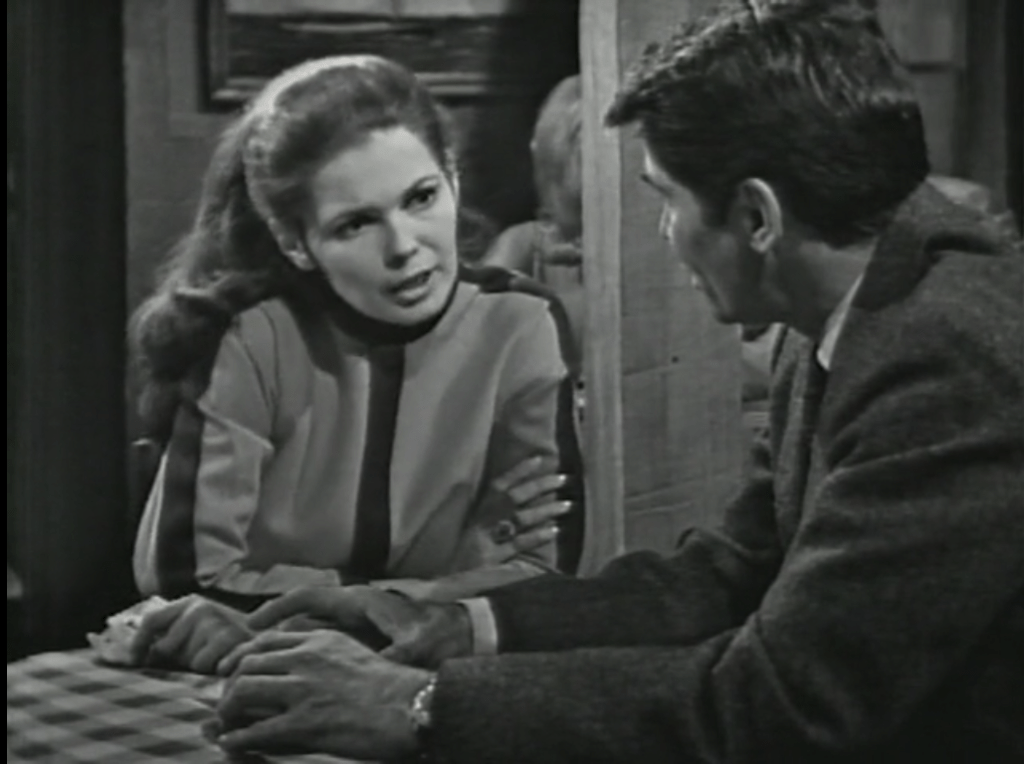
Burke brings up the marriage proposal he made to Vicki when last they saw each other. She says that she doesn’t know enough about him to be comfortable making a decision. In particular, she doesn’t know how he made his money or who his business associates are. In response to that, he launches into a speech dismissing those concerns as matters of “the past,” saying that he wants her to think only about “the future.” Considering that Burke won’t even tell Vicki what business he was conducting twenty minutes ago, “the past” that is off limits to her stretches right up to the present. This tells even first time viewers that Burke is a secretive and untrustworthy man likely to drag a wife into some shady enterprises.
It rings even louder warning bells for regular viewers. At this point in Dark Shadows, “the past” is how the characters refer to the vampire arc, which is the only ongoing storyline. Several times, Burke has angrily demanded Vicki renounce interest in “the past,” by which he means her attempts to stay relevant to the plot. As he has made those demands, he has accused her of being crazy when she told him that she saw and heard phenomena that we also saw and heard, in some cases phenomena that Burke himself is in a position to know are real. On Thursday, Burke enlisted Julia’s support in his effort to gaslight Vicki; in that conversation, Julia asked Burke if, when he said Vicki must “live in the present,” he meant that she must live with him, and he confirmed that he did. So Burke’s evasiveness in this scene shows that he is likely to be an abusive husband who will devote himself to controlling Vicki and stifling her contributions to the story.
The show is making something of an effort to launch a storyline in which Vicki and Burke will get married and move into a long-vacant “house by the sea” that has some kind of association with Barnabas and therefore with the supernatural. So the parade of red flags that Burke sends marching in front of his proposal may tell us to expect a story in which Vicki, the long-suffering wife confined to a haunted house, loses contact with the world of the living.
Perhaps that is where we will see Burke’s connection to Jeremiah. Maybe Burke will be possessed by the spirit of Jeremiah, and under that possession his abuse of Vicki will intensify. It is also possible that Burke will be revealed as a descendant of Jeremiah. On Friday, the story of Burke’s childhood was retconned, introducing the idea that his father left the family when Burke was nine. Perhaps it will turn out that he did this after he found out that Burke was the product of an extramarital dalliance with a Collins. That in turn might revive another paternity question concerning a nine year old boy. For months, the show hinted that Burke, not Liz’ brother Roger, was the father of strange and troubled boy David Collins. If Burke is a Collins bar sinister, then David can be his natural son and still retain his symbolic importance as the last in the male line of the family.
Whatever the nature of Burke’s connection to Jeremiah, Vicki’s eventual flight from him might lead her into the vampire story. Since Barnabas thinks he wants Vicki to be his next victim, he has been solicitous towards her, and she regards him warmly. My wife, Mrs Acilius, points out a sort of visual pun implicit in the prospect of Vicki choosing Barnabas over Burke. As played by Anthony George, Burke is an astonishingly poor kisser. As a vampire, Barnabas gives what might be called “the kiss of death.” A woman might prefer a single kiss of death to a lifetime of the impossibly awkward kisses of George.
Vicki caves in and agrees to marry Burke, even though he won’t answer any of her questions. They go into the drawing room and announce this ominous news to Liz, Barnabas, and Julia. Barnabas responds by looking off into space and exclaiming “Jeremiah!” Again, whatever relationship develops between Burke and Jeremiah, we know that Barnabas is committed to resisting its influence on Vicki.
Barnabas cannot conceal his dismay. He and Julia leave, explaining that they had planned to spend the evening together in town. Liz remarks that Barnabas was happy when he came, and sad when he left. Still, the idea that he and Julia might be going on a date is enough to keep Burke smiling.
In the courtyard, Barnabas tells Julia that he will give her his full cooperation as she tries to cure him of vampirism. He explains he wants to become human again so that he can prevent Vicki from marrying Burke.
This is rather alarming for the viewers. Dark Shadows became a hit when a vampire joined the cast. If the Burke/ Vicki/ Barnabas story is going to be just another daytime soap love triangle among humans, you may as well watch The Guiding Light. The foreboding dun dun DUNN! that ends each episode has rarely seemed more apt than it does coming on the heels of this grim prospect.
Maggie Evans, The Nicest Girl in Town, is a patient in a mental hospital run by a mad scientist who is in league with the vampire who kept her prisoner. So there are bars on the windows of her room, and a lock on the outside of the door. The vampire, Barnabas Collins, scrambled her memories before she escaped from him, and the mad scientist, Julia Hoffman, intends to keep her in her amnesiac state.
We see Maggie at the barred window, begging for someone to help her go home. At that, her friend, the ghost of nine year old Sarah Collins, materializes in the room. Maggie hugs Sarah, and Sarah apologizes for taking so long to find her. Sarah assures Maggie that she can help her get home, but tells her she will have to do what she says.
Sarah apologizes for taking so long to come
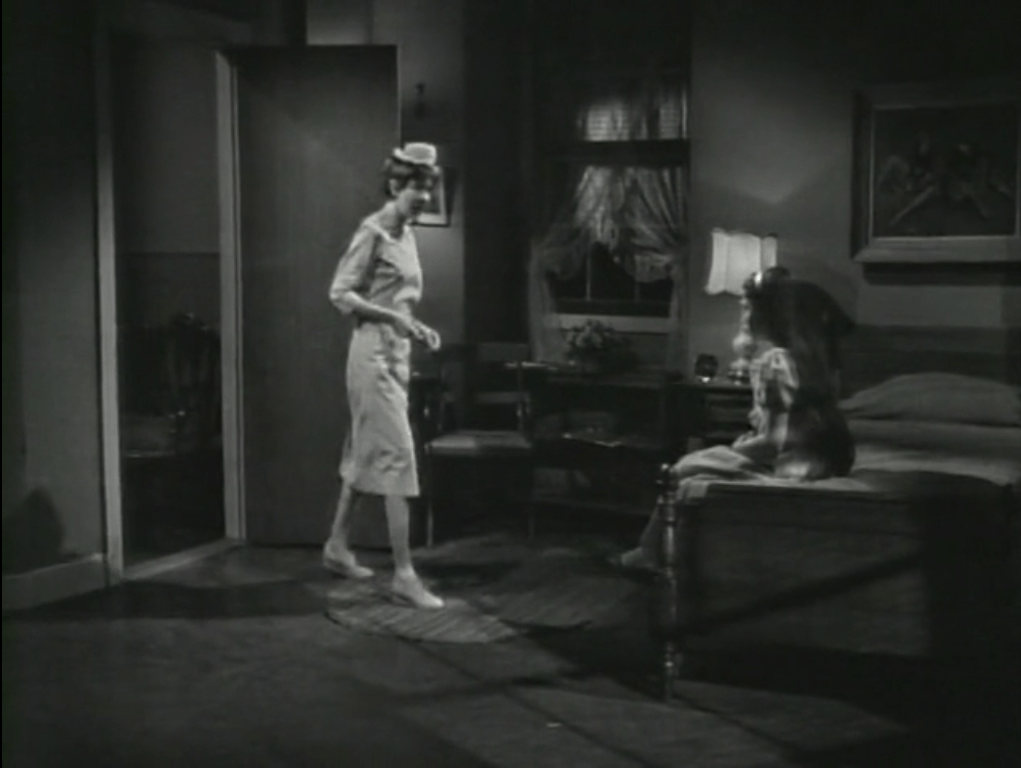
At Sarah’s direction, Maggie stands in the corner behind the door and calls the nurse while Sarah sits on the bed. The nurse opens the door and sees Sarah, but not Maggie. Maggie slips out and closes the door behind her, locking Sarah and the nurse in the room. The nurse tries the door, looks back, and sees that Sarah is nowhere to be found. The camera stays with her for a long moment as she looks around in bewilderment. As Nurse Jackson, Alice Drummond does a great job with this stage business.
Meanwhile, back in Collinsport, there is a misdemeanor in progress. Well-meaning governess Vicki, her depressing boyfriend Burke, and Barnabas are sneaking into an old vacant house that has captured Vicki’s fancy. Barnabas astounds Burke with his ability to see in the dark as he describes the “No Trespassing” sign, and refers to the same ability as he volunteers to explore the upper storey of the house while Burke and Vicki stand around on the ground floor.
Burke has taken Vicki’s interest in the house as a marriage proposal, and keeps talking about how they should furnish it when they live there together. The only thing he says that gets much of a reaction from her is a disparaging remark about Barnabas, which elicits flash of anger. Yesterday’s episode included a couple of clues that Vicki’s infatuation with “the house by the sea” might lead her, not to Burke and irrelevance, but to Barnabas and the center of the action. Her forceful response to Burke’s Barnabas-bashing renews those hopes.
Burke has spoken ill of Barnabas
Barnabas comes back from the upstairs with a handkerchief bearing the initials “F. McA. C.” He makes a present of it to Vicki. When she objects to this act of theft, he assures her that whoever it belonged to would want her to have it. That too picks up on hints from yesterday, when Barnabas indicated by his typical slips of the tongue that he had a connection to the house that he didn’t want the other characters to know about. We haven’t yet heard of anyone living or dead with the initials “F. McA. C.,” so presumably we are supposed to start waiting to hear a fresh story about Barnabas’ earlier existence.
Somewhere to the north, Maggie and Sarah are sitting in the woods. In recent days, we have heard several times that the mental hospital is a hundred miles from Maggie’s home in Collinsport, so if they are going to walk the whole way and take breaks it will be a while before they get back.
Maggie asks Sarah how she got into her room. “Do you really want to know?” Maggie says she does. “The same way I got out.” How did she get out? “The same way I got in!” At that, Maggie laughs. Sarah first met Maggie when she was Barnabas’ prisoner, and she remarks that this is the first time she has heard her laugh. She tells her she ought to do it all the time.
Apparently, an early draft of the script called for a truck driver to pick Maggie up and take her back to town. But that couldn’t be. How will Sarah get Maggie to Collinsport from the hospital? The same way she got to the hospital from Collinsport, of course.
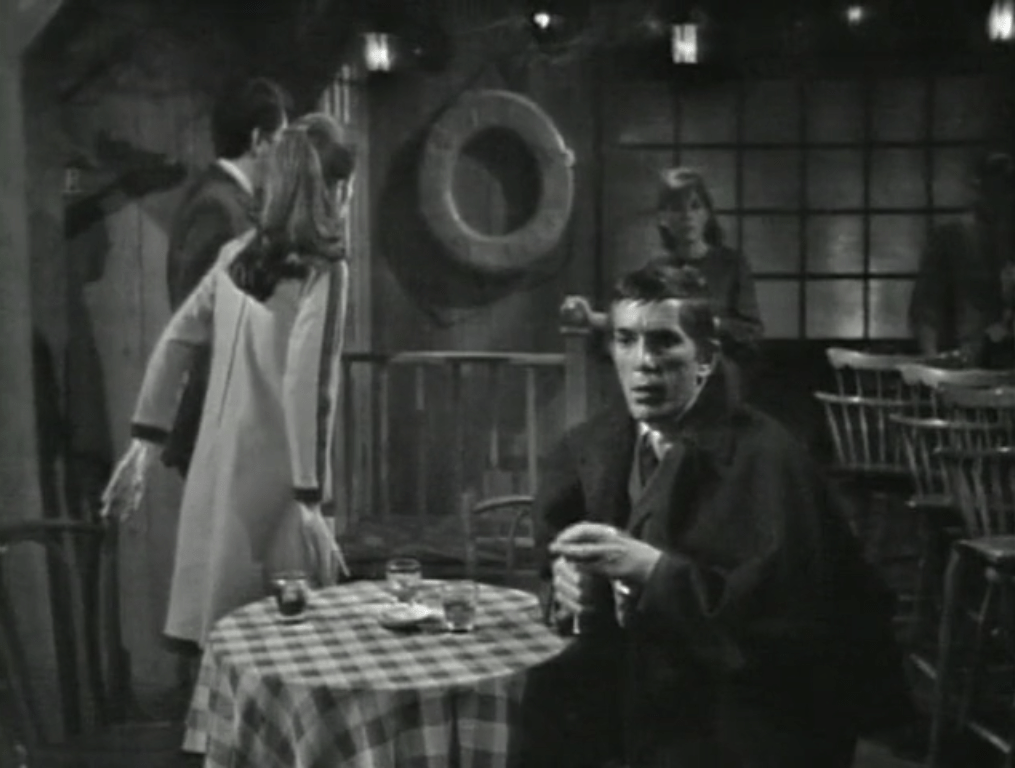
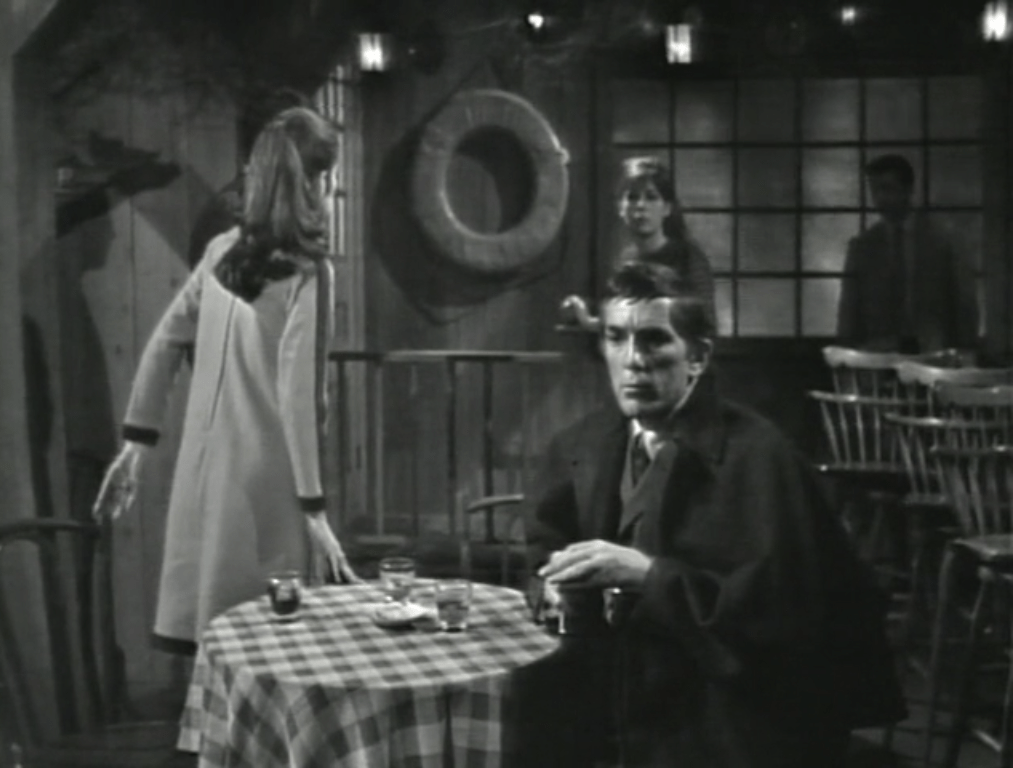
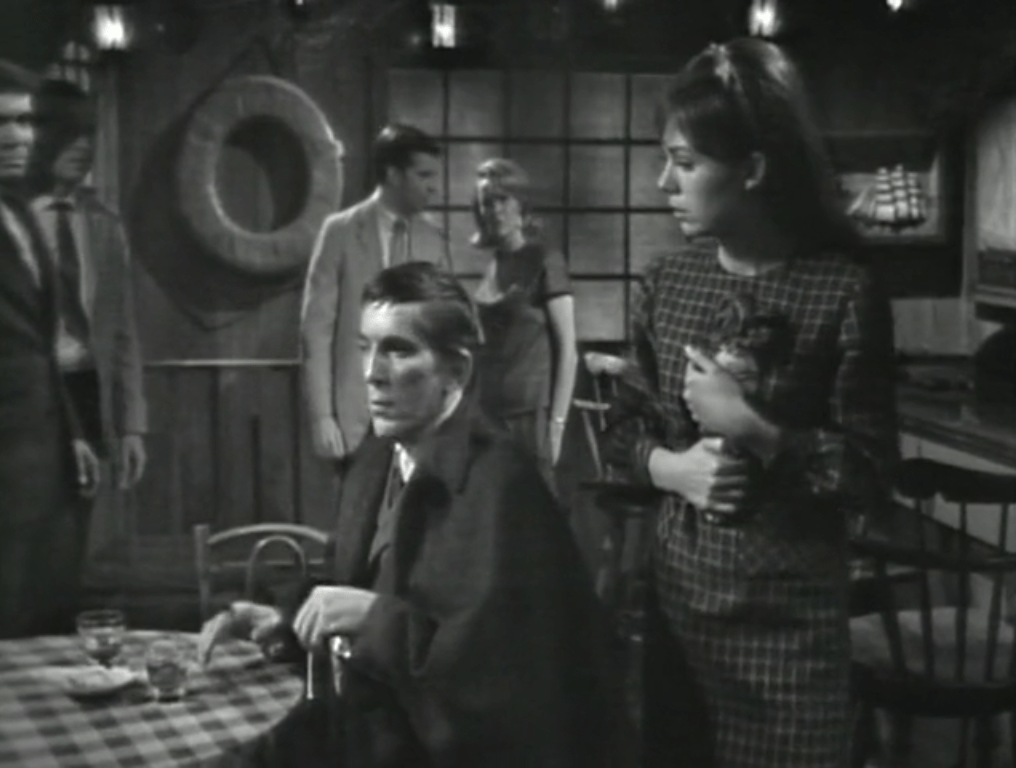
In Collinsport, Vicki, Burke, and Barnabas are sitting at a table in the Blue Whale tavern. While Barnabas gets the drinks, Vicki tells Burke that he and Barnabas are extraordinarily unalike. Burke says he takes that as a compliment, a remark to which Vicki reacts with displeasure.
Burke has repeated his offense
We can sympathize- sure, Barnabas is a vampire, and that is sub-optimal in a potential husband. But it doesn’t make him the opposite of Burke, who has been draining the life out of Vicki lately with his demands that she steer clear of anything that might be interesting to the audience and become as dull as he is. The real difference between Burke and Barnabas is that Barnabas drives one exciting plot point after another, while Burke makes nothing happen.
Barnabas comes back to the table, and the conversation returns to the “house by the sea.” Burke is about to propose marriage to Vicki. Suddenly, the jukebox stops playing and everyone falls silent. It is as if something has entered the room that everyone can feel but no one can see. The door opens, and in walks Maggie.
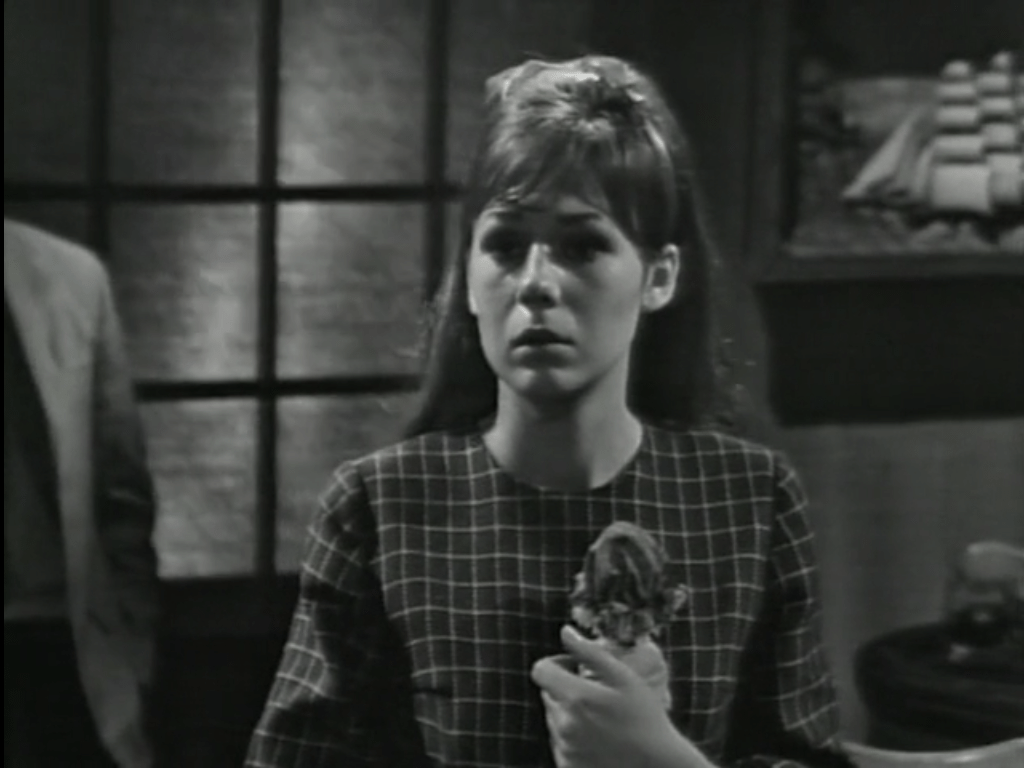
Vicki is the first to see her. She calls her name. Barnabas reacts with alarm. Maggie walks slowly towards their table. She approaches Barnabas, who tries to remain very still. She takes a long look at him, walking around to get the best angle. She touches her head, calls out “No!,” and faints. And that is what you call a “cliffhanger ending.”
Well-meaning governess Vicki was the main character of Dark Shadows in its first 39 weeks, and themost interesting storyline was her relationship to her charge, strange and troubled boy David Collins. That story came to its climax when David chose life with Vicki over death with his mother, blonde fire witch Laura Murdoch Collins, in #191, and Vicki hasn’t had much to do since.
Yesterday, Vicki told her depressing boyfriend, fake Shemp Burke Devlin, about an old vacant house that excites her. Since Vicki’s work with David is compensated mainly with room and board, the only way her interest in an empty house could lead to anything happening on the show would be if she quit her job, married Burke, and moved there with him. Since Burke has even less connection to the ongoing narrative arc than Vicki does, and has been spending his time lately demanding that she stop trying to attach herself to the story and settle in with him in his dead end far away from the plot, that is a dismal prospect.
All the action on the show is centered on vampire Barnabas Collins. In the opening scene, Barnabas talked with his sorely bedraggled blood thrall Willie Loomis about two women. One was Vicki. Willie was agitated that Barnabas is planning to bite Vicki. This is an odd thing to worry about- Vicki has gone out of her way to make herself available to Barnabas for biting, even contriving to spend the night in his house. But she still has all her blood, and no foothold in the vampire story. When Barnabas tells Willie that he does not intend to harm Vicki in any way, those of us who hope she will stay relevant to Dark Shadows have a sinking feeling that he might be telling the truth.
The other woman Barnabas and Willie discuss is mad scientist Julia Hoffman. In contrast to his assurances that he means no harm to Vicki, Barnabas muses openly that he might have to kill Julia at any moment. Observing Willie’s reactions, Barnabas comments that it is interesting that Willie is so concerned about Vicki, but utterly indifferent to Julia. If we remember Willie as he was before Barnabas enslaved him, this may not be so odd.
Before he became sorely bedraggled blood thrall Willie Loomis, he was dangerously unstable ruffian Willie Loomis, menace to womankind. Willie tried to rape Vicki, among others, and his guilt over the use he made of his freedom when he had it is reflected in his solicitousness towards those whom he once used so ill. By the time he met Julia, he had been under Barnabas’ power for months, so he has made no choices concerning her that he can regret.
Barnabas shows up as Vicki and Burke are getting ready to visit “the house by the sea.” Barnabas slips a couple of times as he talks with them about it, revealing to the audience that he is familiar with the house. This raises our hopes- perhaps Vicki’s fascination with the house will lead her to Barnabas and relevance, not to Burke and oblivion. Vicki invites Barnabas to come along with her and Burke as they tour the house, and he agrees.
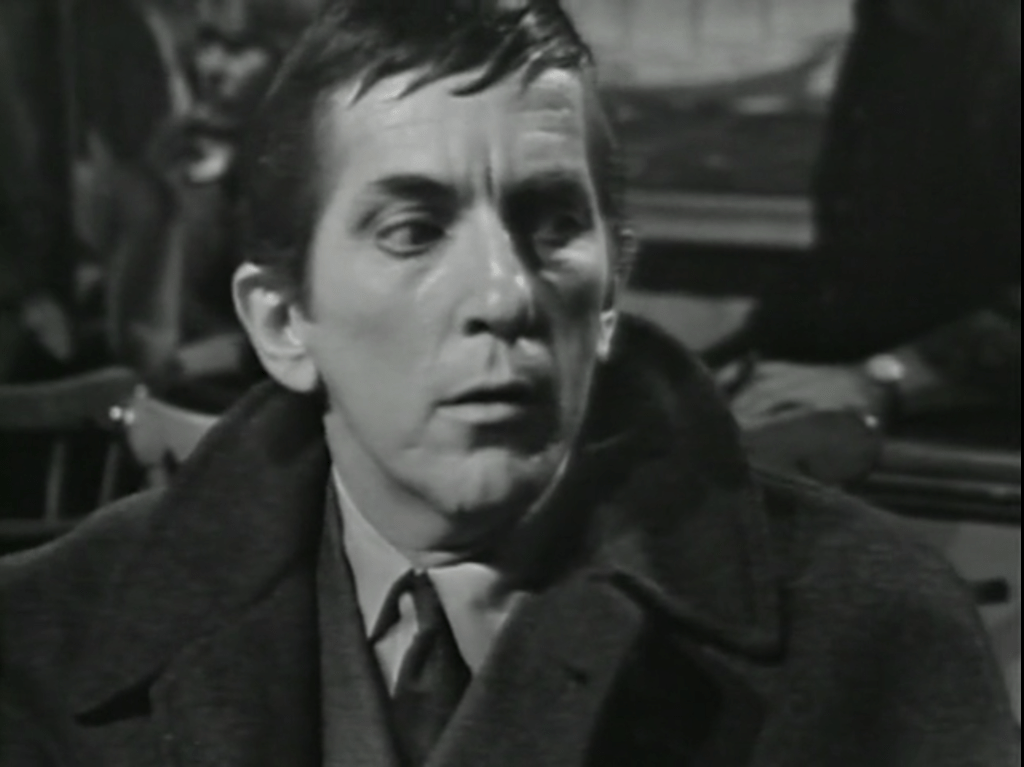
While Vicki is upstairs changing her clothes, Barnabas and Burke talk in the drawing room. Barnabas points out that little is known of how Burke became so rich so quickly in the years before he came back to Collinsport. Burke responds that far less is known of Barnabas than of him, that his entire life before this year is perfectly obscure to everyone. As Barnabas, Jonathan Frid plays this scene with more variety and subtlety of expression than any previous one, and as Burke, Anthony George gives a tight, forceful performance. It is the first time Dark Shadows viewers have glimpsed the reason George had such a long and busy career as an actor.
George was a cold actor who excelled at characters whose intelligence and determination were obvious, but whose feelings and intentions the audience could only guess at. That would have made him a fine choice for the part of Burke in the early months of the show, but these days he spends most of his time giving big reactions to bewildering news and the rest in passionate love scenes with Vicki. George was just awful at both of those. But in today’s duel with Barnabas, Burke is choosing his every word and gesture with care, putting him right in the center of George’s wheelhouse. Opposite the much warmer Jonathan Frid, the effect is electric.
It leaves me wondering what might have been. Mitch Ryan was compelling as Burke #1, but his hot style of acting pushed Burke’s emotions to the surface and took away some of the mystery that would have been needed to make the “Revenge of Burke Devlin” storyline a success. With George in the part, that story would probably still have fizzled, but it might have taken a bit longer to do so. And of course the part George has been struggling with, until this scene in vain, was written for Ryan. If the two had just traded places and the scripts had stayed the same, Burke #1 and Burke #2 might both have been strong characters.
Of course, they wouldn’t have stayed entirely the same. The writers watch the show and are influenced by what they see the actors doing. But they may not have changed as much as you might expect. Neither Ron Sproat nor Malcolm Marmorstein seemed to have much sense of what actors could do. It’s no wonder that George’s first good scene comes in the second episode credited to Gordon Russell. Perhaps if Russell had been with the show earlier, Burke #2 might have been more of a success.
The scene also brings up one of my favorite fanfic ideas. People are going to wonder about Barnabas’ background, and Burke needs to be written off the show. Why not solve both of those problems by having Barnabas enslave Burke, make Burke set up businesses in Barnabas’ name and use his shadier contacts to get Barnabas false identification papers, then kill Burke off once he has exhausted his resources? You could do that in such a way that the other characters would think Barnabas was a nice guy who was using his wealth to prop Burke up, consolidating his position in their eyes. You could also use it to connect Barnabas to the wider world beyond the estate, suggesting that he poses a menace not only to one family but to a whole community.
At length, Vicki comes back downstairs. Burke greets her first, but she barely acknowledges him. She has eyes only for Barnabas. Barnabas may not be in any hurry to bite Vicki, but she is bursting with readiness to get into the vampire story and back into the main action of the show.
Mad scientist Julia Hoffman is hanging around her new base of operations, the Old House on the great estate of Collinwood. She is getting ready to perform an experiment which, if successful, will convert vampire Barnabas Collins into a real boy. She learned of Barnabas’ existence when treating his former victim Maggie Evans, The Nicest Girl in Town. Julia answers a knock on the front door, and sees her old acquaintance, addled quack Dave Woodard.
Woodard has no idea what Julia is up to. So far as he knows, she is still on board with his own idiotic scheme, in which he, along with Maggie’s father Sam and her fiancé Joe, has told everyone in town that Maggie is dead in hopes that her captor would forget about imprisoning girls and draining their blood. In fact, Julia has told Barnabas that Maggie is alive and has lured him into cooperating with her project by promising to keep Maggie in a state of amnesia so that she will not represent a threat to him.
In yesterday’s episode, Sam and Joe called on Woodard and complained that Julia is staying at Collinwood while Maggie is a hundred miles away. They demanded that Woodard take her out of Julia’s care. Woodard tells Julia today that her conduct is growing “more and more unethical.”
Last week, Julia was able to forestall Woodard’s threat to take her off the case by playing dumb. This time, she has to take him partly into her confidence, telling him that Maggie encountered the supernatural and that her case represents an opportunity to find a crossing point on the boundary between life and death. She dangles the possibility of great fame before him, saying that the doctors who make the breakthrough she sees coming will go down in history. When he presses for details, she says that there is great danger in what she already knows, and that she must not tell him more.
Woodard has been on the show for months, and has been stuck in just two modes the whole time. When he’s with a patient, he makes a show of brisk dissatisfaction, as if trying to convince them that they oughtn’t to take their disease so seriously that they give up. This mode was as far as Richard Woods, the first actor to play Woodard, got in his two appearances (in #219 and #229.) When he is talking with someone else, Woodard struggles to find the words to express his bafflement at the terrible case he is treating. These two modes didn’t make Woodard a source of suspense. They were just filler between his announcements of what the script called for him to do next.
When Julia asks Woodard if, when he was in school, he dreamed of making a major contribution to the science of medicine, he gets a thoughtful look and says “Well, of course.” This is the first moment we have seen Woodard outside his two modes. When Julia tempts him with the idea that he will go down in history as the co-discoverer of the most fundamental truth imaginable, he displays an emotion that might lead to him to any of a number of exciting, story-productive actions. The first scene in the first episode credited to writer Gordon Russell manages the astounding feat of turning Dr Woodard into an interesting character.
We cut to the woods on the estate. We see the ghost of Barnabas’ nine year old sister Sarah sitting on a rock crying. All of Sarah’s previous scenes started with some other character on camera, then proceeded to Sarah making a mysterious entrance. That’s what we would expect of a ghost, after all. This time, Sarah is all by herself at rise. The first time we saw a ghost was in #70, when the ghost of Josette Collins emerged from her portrait and danced around the columns of the Old House. That was a solo appearance as well, but people had been in the Old House talking about Josette immediately before, so she was manifesting herself in response to attention from the living. Here, we see a ghost on her own, processing her emotions, hoping someone will come and hang out with her.
Strange and troubled boy David Collins shows up and asks Sarah why she is crying. She says she can’t find Maggie. David breaks the news to her that Maggie is dead. Sarah laughs, and assures David that she is still alive. When David insists that Maggie is dead, Sarah tells him that he may know “about leaves and everything,” but she knows “who’s dead, and who isn’t.”
Less than a week ago, in #288, David saw a portrait of Sarah and wondered aloud if the girl he has met is her ghost. In the first 39 weeks of the show, he was on intimate terms with Josette and some of the other ghosts. When he first met Barnabas in #212, he asked him if he were a ghost, and was disappointed to hear that he was not. So returning viewers expect David to ask Sarah the same question. Indeed, David has always interacted with ghosts as if they were people with whom he could pass the time of day, share thoughts and feelings, and get to know better from one encounter to the next. Seeing Sarah crying by herself should validate this attitude. But instead, David has developed Soap Opera Goldfish Syndrome, forgetting information which everything we have seen has led us to expect he will remember.
David insists Sarah come home with him to the great house of Collinwood and have dinner with the family. She tries to decline politely, but he will not take “I’ve been dead for centuries” for an answer. He gets Sarah into the foyer, then goes to the drawing room to announce her presence. He finds Julia there, with well-meaning governess Vicki and Vicki’s depressing boyfriend, fake Shemp Burke Devlin. By the time David gets the adults into the foyer, Sarah has disappeared.
Vicki is suffering from an even more frustrating version of Soap Opera Goldfish Syndrome. She had had extensive dealings with the ghosts of Collinwood on many occasions between #85 and #191, and that had been the basis of her bond with David. Vicki’s interactions with the supernatural reached a climax when she led the opposition to David’s mother, undead fire witch Laura Murdoch Collins, from #126 to #191. Since then, Josette has spoken through Vicki at a séance and she has seen Sarah.
But lately, Vicki has started to deny that there are ghosts. This is in response to Burke’s demands. Burke lost his connection to the story months ago, and he’s been trying to gaslight Vicki into dismissing all of her spectral encounters as signs of mental illness so that she will join him on the show’s discard pile of useless characters. In Friday’s episode, Vicki had apparently decided to give in to Burke and make herself believe that there were no supernatural beings at work around Collinwood. As a result, her scenes in that episode were unbearably dreary.
Before David brought Sarah home, Vicki had been dreary again. She’s excited about some old house she saw, and wants Burke to go look at it with her. As David’s governess, Vicki’s compensation consists largely of room and board, so as long as she has her job her interest in any particular piece of real estate isn’t going to lead to story development. If she quits the job and marries Burke, she will be giving up on ever being part of the action again. So her rambling about “the house by the sea” is suspenseful only to fans of Vicki who are afraid she will vanish into the background of the show.
When David starts telling the adults about Sarah, Vicki launches into the same garbage Burke has been giving her, talking down to him about imaginary friends and insinuating that anyone who believes in ghosts is soft in the head. Burke, who had previously been David’s great friend, joins in this abusive behavior. After David indignantly stalks away, Julia gets very uptight and lectures Vicki and Burke about the need to stifle David’s imagination and discourage him from telling them things they don’t already know. This scene is effective, but the effect is claustrophobic- by the end of Julia’s little speech, we feel like the mad scientist is holding us prisoner.
Vicki and Burke decide to leave to look at the house, and Vicki finds Sarah’s cap on the floor. That’s such a great moment that not only do we leave the episode no longer disappointed in David’s goldfish memory, we can even forgive Vicki’s.
The closing credits run over an image of the foyer with Sarah’s cap on the table. My wife, Mrs Acilius, thought it would have been hilarious if Sarah had marched in and taken the cap while the credits were rolling. I’d have liked to see that too, especially if, after putting it back on, Sarah had turned to the camera and put her finger to her lips, telling the audience to keep quiet about what we had seen.
I analyze the stories in final nine weeks of Dark Shadows as a series of traps to immobilize the characters and the audience, and speculate that they reflect writer Gordon Russell’s desperate position as the sole author responsible for five teleplays a week












 Dark Shadows Commentary