Recovering vampire Barnabas Collins has determined to let himself into a house occupied by suave warlock Nicholas Blair. He knows that Nicholas is harboring Frankenstein’s monsters named Adam and Eve, that Eve is the reincarnation of a homicidal maniac, and that Nicholas has sinister plans for the pair. Once in the house, he intends to kill Eve.
Most of the episode is taken up with Barnabas’ preparation for this mission. He works with his friends, mad scientist Julia Hoffman and occult expert Timothy Eliot Stokes, to ensure that Nicholas will be out of the house when Barnabas gets there. When he goes into the room where he expects to find Eve, Barnabas discovers that she is not there. Instead, he is greeted by his erstwhile wife, Angelique. Angelique is now a vampire. We end with her baring her fangs at him.
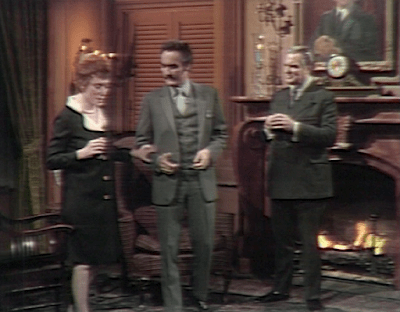
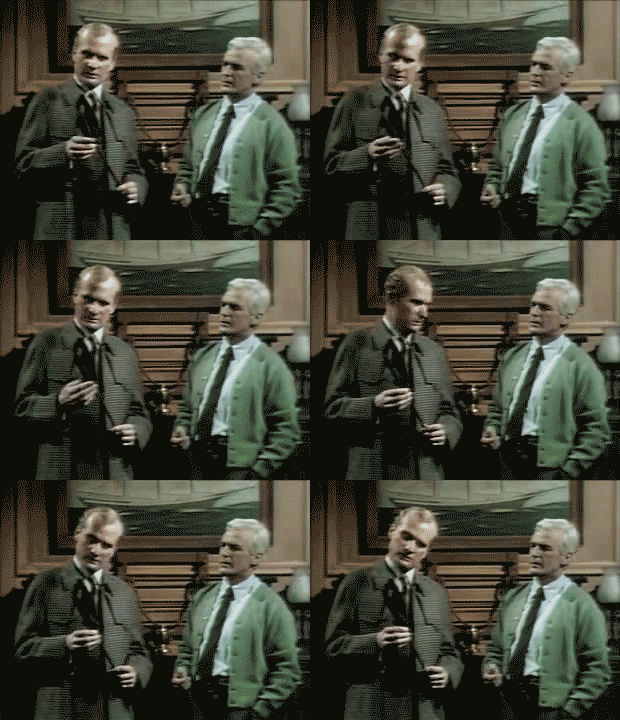
Beneath all the homicidal and fantastic elements is a classic situation of farce. A man sneaks into a house hoping to meet a young woman, only to come face to face with his ex-wife. There are several notes of intentional comedy. Keeping Nicholas distracted, Stokes gives him a long lecture about the history of the Collins family. When he starts in on the details of their shipping interests, Nicholas squirms, jumps up, and thinks of someplace else he ought to be. Stokes and Julia destroy that excuse, and Nicholas sinks sadly back into his chair, bracing himself to hear more.
It dawns on Nicholas he will have to listen to the rest of Stokes’ disquisition. Screenshot by Dark Shadows Before I Die.
When Barnabas first enters Eve’s room, he thinks he sees a figure in her bed, only to find that there are pillows piled up under the covers. Angelique pulled that on him in #403, and Julia did the same thing in #291. Longtime viewers are left wondering when he will fall for the same trick a fourth time.
I do wish writer Gordon Russell had called on his frequent collaborator Violet Welles for help with this one. There are four or five nice laughs, but the tone immediately subsides back to seriousness between them. Welles had a gift for glittering dialogue that could have kept us chuckling throughout.
Today is devoted to non-supernatural stories. More precisely, we should call them post-supernatural, because they show people dealing with the aftermath of spells and curses.
The episode consists largely of solo performances. As troubled matriarch Liz, Joan Bennett has two scenes in which she is alone with her own voice in a recorded monologue. Dark Shadows has long used these monologues when characters were alone on screen and their faces would silently show how they felt about the thoughts their voices expressed on the soundtrack, but recently it has been experimenting with new ways of deploying them. For example, #581 marked the first time this device was used to share the thoughts a character was having in the middle of a conversation. Today Liz has a remarkably intense debate with her own recorded voice, first in her bedroom, later in an old graveyard.
Some time ago, wicked witch Angelique cast a spell causing Liz to be obsessed with death. Since then, Angelique lost her power and died. But Liz had been the victim of similar spells before, and is prone to depression in any case, as witness the fact that she once holed up in her house for eighteen years. So even if the spell broke when Angelique was de-witched, it makes sense Liz would continue to suffer the psychological damage it inflicted on her.
Between Liz’ two solo scenes, her brother Roger knocks on her bedroom door, This scene lasts less than a minute, but Louis Edmonds shows us a variety of emotions as he talks to Liz through the door, then opens it and finds she is not there. His discovery that he was giving a soliloquy when he thought he was having a conversation makes for a different kind of solo scene.
The other post-supernatural story concerns well-meaning governess Vicki and her ex-fiancé, an unpleasant man named Peter who insists on being called Jeff. Angelique became a vampire after her most recent death, and for a time she took Peter/ Jeff as her victim. The effects of the vampire’s bite made it impossible for Peter/ Jeff to sustain his relationship with Vicki. Peter/ Jeff has been freed from Angelique’s influence, and even his memory of the experience has been erased. Today he comes to ask Vicki to take him back. But he can explain nothing to her about what happened to him. Vicki is frustrated with Peter/ Jeff. Feeling that he does not trust her enough to tell her what happened, Vicki rejects Peter/ Jeff’s attempt at reconciliation. Alexandra Moltke Isles plays Vicki’s frustration with great force. Considering that her scene partner is the lamentable Roger Davis, this, too, qualifies as a solo performance.
Dark Shadows never had more than three credited writers producing scripts at a time. Often it had only two, and there were stretches when a single writer would have to crank out a script every day for weeks. Since they worked under those conditions, the writers’ methods would often be made obvious. So, Art Wallace, who was credited as the writer of the first 40 episodes, started by crafting the structure of an episode, and fitted incidents and information into that structure as time permitted. Ron Sproat, another very prolific contributor, also put structure first, sometimes resulting in a slow-paced script. Today’s author, Gordon Russell, seems to have taken the opposite approach, cramming each script with action and letting the material shake itself out as best it could. So there is some interesting stuff in this one that doesn’t really connect to anything.
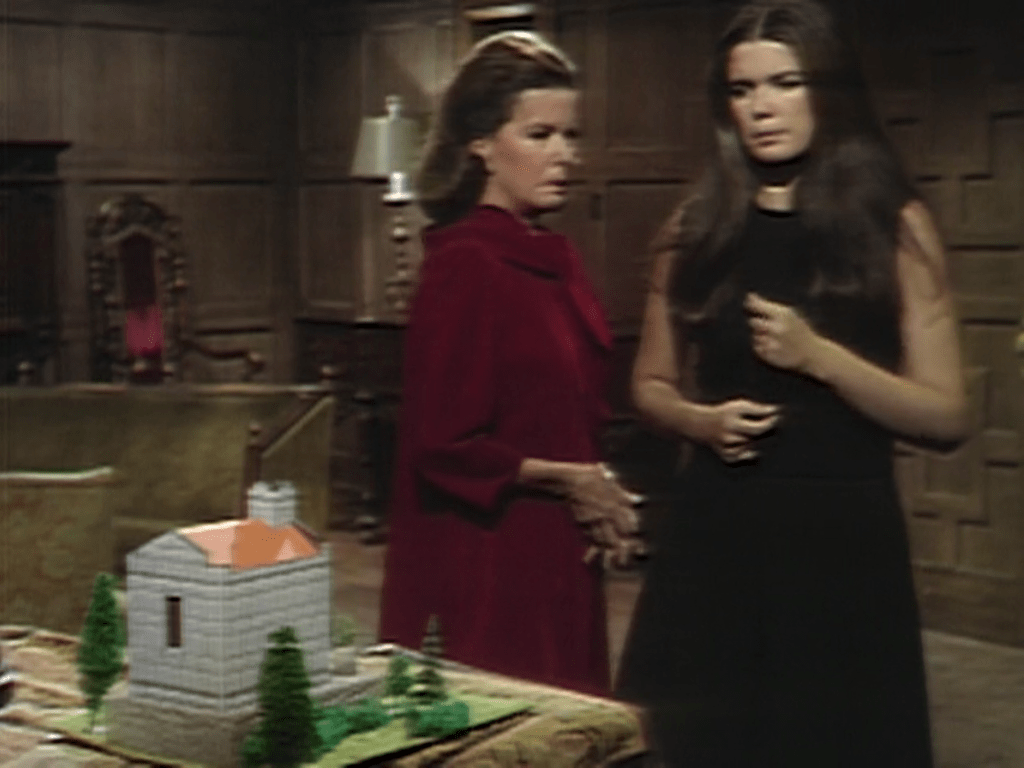
For example, we open today with Liz contemplating an architects’ model of a mausoleum. It really is a lovely little thing.
We have a scene where Vicki is horrified by the idea of the mausoleum. Liz insists Vicki be her voice after her death and stand up to her family for her, seeing to it that she is buried in the mausoleum as she wishes. The show hinted very heavily for a long time that Vicki is Liz’ unacknowledged daughter, but they dropped that a long time ago. As it stands, Vicki is a member of the household staff. As such, she would put herself in an awkward position were she to oppose the family’s wishes after Liz’ death.
Roger enters, demands that Liz forget about everything related to death, and smashes the model. That’s all very dramatic, but it doesn’t make any sense. Though he might well be distressed at Liz’ fixation on the idea that she will soon be buried alive, everyone dies eventually, and rich people often build elaborate mausoleums. Roger’s assertion that the architects must think they are humoring an insane woman and the villagers are all laughing at her is just as nonsensical as his domineering attitude is unconnected to his character as it has been developed up to this point. All of it is entirely irrelevant to the progress of the story.
After that, Liz leaves the room, and Roger talks to Vicki for a bit. He says that Liz’ trouble seemed to start when he married a woman named Cassandra. Unknown to him, Cassandra was actually Angelique in a wig. He tells Vicki “We’ve never been very lucky in love, you and I, have we?,” and edges closer to her. This may come as a bit of a jolt to longtime viewers. In the early days of Dark Shadows, there were a few hints that Vicki and Roger, who are after all modeled on Jane Eyre and Mr Rochester, might strike up a romance. Since they are both single, all of a sudden it seems possible they might get together after all.
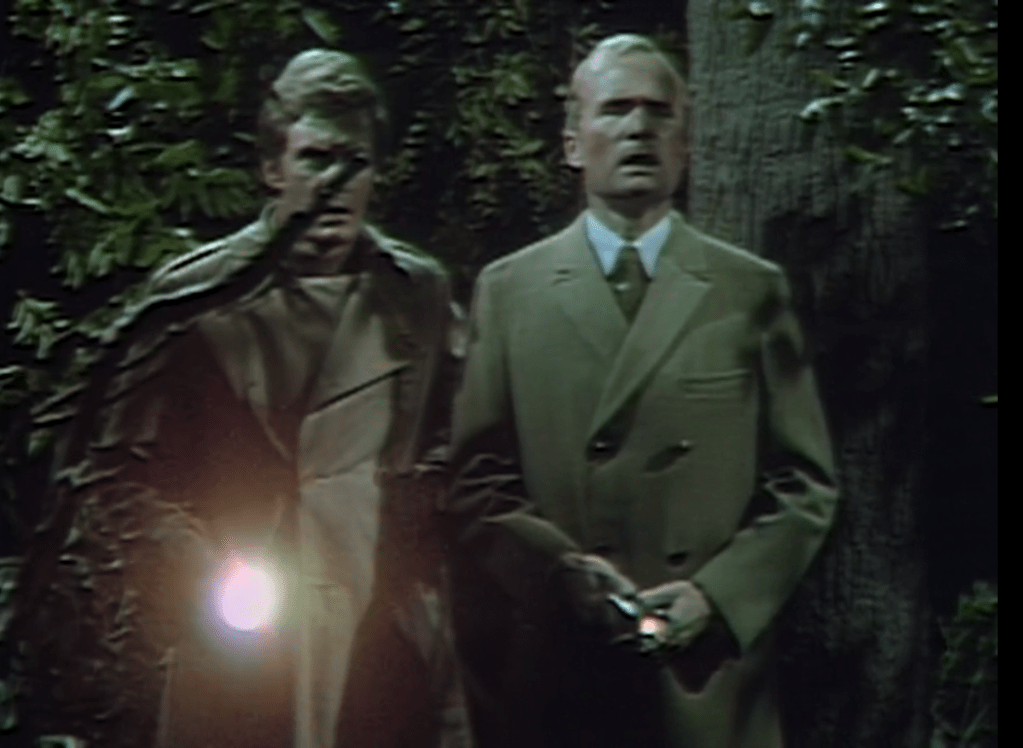
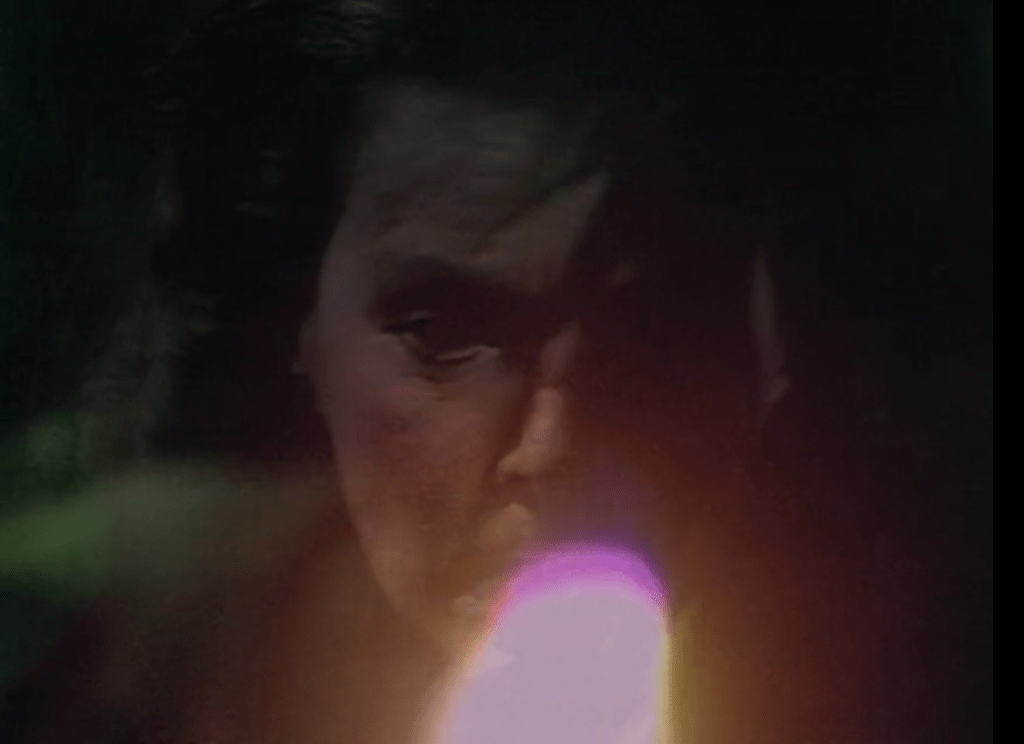
Later, Roger and Peter/ Jeff are outdoors looking for Liz. Each of them shines his flashlight directly into the camera. This is a Dark Shadows trademark. Sometimes it is clearly accidental; Peter/ Jeff does it once, briefly, and that may be an accident. But Roger does it twice, and each time the camera lingers on it. The first time comes as we cut from Liz in the graveyard to Roger and Peter/ Jeff, the second time as we dissolve from them back to Liz.
Cut to a closeup on Roger’s flashlightPeter/ Jeff accidentally shines his flashlight directly into the cameraDissolve to Liz from a second closeup on Roger’s flashlight
Liz is at the grave of Peter Bradford, which is to say Peter/ Jeff. He died in the 1790s and returned from the dead in March, a fact which is obvious to the audience and to Vicki but which he persistently denies. These denials are pointless and dull, but are the closest thing Peter/ Jeff has to a personality, so we can’t very well blame him for sticking to them. Peter/ Jeff finds Liz at his grave; she recognizes him as the dead man and faints. He carries her home. If there is any significance to any of this, it is apparently none of the audience’s business. The script certainly isn’t going to show us what it is.
Suave warlock Nicholas Blair has a job for a woman. Talking to his subordinate, vampire Angelique, he says that the job must go to “the most evil woman who ever lived.” At this, Angelique breaks into a smile, then raises her head proudly. Nicholas then says, “Someone like Lucrezia Borgia.” At this, Angelique’s face falls, and she protests that Lucrezia is dead.
Angelique, flattered when she thinks Nicholas is describing her as “The most evil woman who ever lived.”
Nicholas brushes this objection off, saying that “The spirit of evil can be made to live again.” Longtime viewers may have been wondering whether Lucrezia Borgia would make an appearance, since her name has come up more than once. In #152, sarcastic dandy Roger insulted his sister, reclusive matriarch Liz, by comparing her to Lucrezia; in #178, Roger insulted his niece, heiress Carolyn, in the same way; and in #523, Carolyn brought up Lucrezia to insult Angelique, whom she knew when Angelique was calling herself Cassandra and was married to Roger. Perhaps we might have imagined some kind of story where Roger turns out to have some kind of supernatural connection to Lucrezia.
Nicholas continues teasing Angelique, bringing up the Countess Elizabeth Bathory, alleged serial killer and blood drinker of the 16th and 17th centuries. Angelique calls that lady “a vile woman,” in a tone that suggests she knew her personally. From November 1967 through March 1968, Dark Shadows was a costume drama set in the 1790s, and Angelique was its chief villain. She was not a vampire then, but a witch. Her spells were very powerful, but she was quite clumsy in her use of them, suggesting that she was a young woman new to witchcraft. Perhaps this line is meant to open the door to a retcon, one which will make it possible to tell stories about Angelique set in even earlier periods than the 1790s segment.
Nicholas agrees that the countess was “a vile woman,” and repeats that epithet as the first in a list of her qualifications for the job he has in mind- “ambitious, cunning, devious, unprincipled, decadent!” He finally concludes his teasing of Angelique and tells her that he will not hire her for the job. She is disappointed, as one of the benefits of the job is release from vampirism. She leaves the room. In the corridor, she flashes a smile which regular viewers recognize as a sign that she is going to defy Nicholas and try to seize what he would not give her.
The Only Filthy Way It Could Be Done
The job is an unusual one. Nicholas has persuaded Frankenstein’s monster Adam to confront old world gentleman Barnabas Collins and mad scientist Julia Hoffman with a threat. If Julia and Barnabas do not repeat the procedure that created Adam and produce a woman who will be his mate, Adam will kill everyone in and around the great house of Collinwood. Subjected to that extortion, they undertake the project.
The procedure not only involves building a body from parts of corpses and running electrical charges through it, but also requires that the body be somehow connected to a person who will serve as its “life force.” It is energy drained from this person that will animate the body. Barnabas was Adam’s “life force.” Before the procedure, Barnabas was a vampire. Serving as Adam’s “life force” put his vampirism into remission. Nicholas talked about this with Angelique, raising her hopes that he would let her escape from vampirism the same way, only to dash those hopes cruelly.
Julia completed the experiment that brought Adam to life after the death of another mad scientist, Eric Lang. Lang had built the body and the apparatus, and had left detailed notes. Julia had studied those notes for some time before she knew which switches to throw and which dials to turn. Under Adam’s threat, Julia has rebuilt the apparatus in Barnabas’ basement and she has a cadaver there which she is using for parts. Barnabas has ordered his servant Willie to help with the grave robbing. Barnabas has also enlisted the aid of Lang’s former grave robber, an unpleasant man named Peter who prefers to be called Jeff. The equipment needs a lot of tending, and Peter/ Jeff is the lab tech on that detail.
A Nice, New, Clean Slab of Flesh
Peter/ Jeff is by himself in the basement lab when Professor Timothy Eliot Stokes walks in. It’s news to Peter/ Jeff that Stokes is aware of the project, but he tells him that he knows everything about it. Stokes stays so calm as he examines the apparatus and looks at the cadaver that one supposes he must know a great deal.
Stokes asks Peter/ Jeff how the equipment runs when Barnabas’ house has no electricity. Peter/ Jeff says that Julia installed a generator. This must be some unusual kind of generator, since it runs in absolute silence. Later in the episode, Stokes will have a conversation with another character about how Barnabas doesn’t have a telephone.
When Barnabas was a vampire, he didn’t want meter readers or other workers dropping by unannounced and he had no use for modern conveniences. So of course he did not connect his house to the electric grid or to telephone service in those days. As for other utilities, it is a fairly prominent bit of lore that vampires cannot tolerate running water, so of course he wasn’t going to have any plumbing. But he’s been unvamped for almost six months now, so he may as well just update his house. Stokes’ lines today lampshade the problems he creates by refusing to do so.
Another unannounced visitor interrupts Stokes’ conversation with Peter/ Jeff. It is Adam. He is upset to find Stokes in the lab. Stokes once took Adam in and taught him English, and in those days Adam considered Stokes to be his best friend. But Stokes shocked Adam when he broke the news to him that he was an artificially constructed man, and has thoroughly alienated him by trying to talk him out of the violent lifestyle Nicholas has persuaded him to adopt.
Adam goes on a self-pitying rant when Stokes tries to reason with him. Peter/ Jeff interrupts and tells Adam something Stokes left out of his birds and bees talk, that he was built out of parts of dead bodies. Peter/ Jeff taunts Adam about this in a speech that is full of such gems that I suspect it was written, not by the credited author of today’s script, Gordon Russell, but by Russell’s frequent uncredited collaborator Violet Welles. Welles’ name will start to appear in the credits in 711, and fans of the show recognize the sparkle that marks her dialogue.
Peter/ Jeff tries to stab Adam. Adam easily disarms him and holds the knife at his throat. Stokes tells Adam that without Peter/ Jeff the project will be delayed. Adam then flings Peter/ Jeff to the floor. Peter/ Jeff is played by Roger Davis, an actor who had a big television career and was irritating in every part. Mr Davis is so annoying on Dark Shadows that Mrs Acilius and I can’t be the only ones who are disappointed when Adam doesn’t kill his character off the show and who cheer when he throws him to the floor.
Peter/ Jeff gets up and leaves the lab. Adam demands Stokes bring him back to resume working. Knowing how violent Adam is, Stokes follows Peter/ Jeff to the great house of Collinwood. Peter/ Jeff is meeting his fiancée, well-meaning governess Vicki, there, planning to take her out for a date. Stokes tells him that they will be in grave danger from Adam unless he goes back to the lab at once. Peter/ Jeff looks out the window, and sees Adam peering in. Adam actually opens the window and reaches into the drawing room while Vicki and Peter/ Jeff are there; it is hard to understand how Vicki doesn’t notice him. Peter/ Jeff makes an excuse, and goes back to the lab.
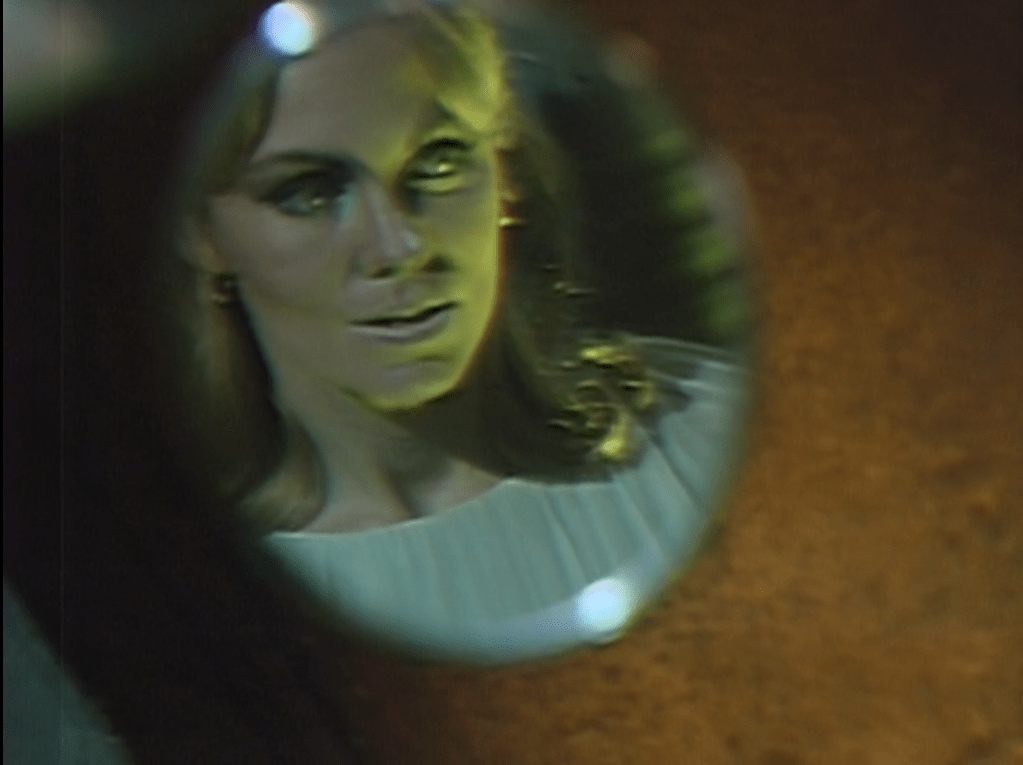
We see him back at work. The camera pans up to a mirror. It holds on the mirror for several seconds while we see Angelique’s reflection. Previously, they have stressed that vampires do not cast reflections. There have been several moments when actors have missed their marks or other production faults have occurred that left us seeing a vampire in a mirror, but this is obviously intentional, and it is jarring to regular viewers.
Angelique’s reflection
Angelique and Peter/ Jeff talk for a moment, then she bites him. Evidently she plans to enslave him and use his access to the laboratory to force her way into the role of “life force” for Adam’s mate. So far, almost every victim of a vampire we have seen has been left unable to do the work s/he was doing before being bitten, so regular viewers might suspect that Angelique’s ploy will simply incapacitate Peter/ Jeff from helping with the project. This expectation becomes all the more substantial when we remember the many times Angelique’s schemes have blown up in her face. The less likely it seems to us Angelique will succeed, the less effective this week-ending cliffhanger will be.
Act One consists of recovering vampire Barnabas and mad scientist Julia standing around Barnabas’ front parlor recapping various ongoing storylines.
Danny Horn devotes his post about this episode to a detailed analysis of this scene. He shows that Jonathan Frid’s performance and Grayson Hall’s are open to many objections. They fall short in such technical categories as “knowing their lines” and “standing on their marks” and “having the slightest idea what is going on.” But they are fascinating to watch nonetheless. Danny declares that “[t]he point of these scenes is to see how long two adults can stand around in a room saying preposterous things to each other.” Frid and Hall operate at such a high level of tension that the prospect of either of them breaking character generates enough suspense to keep us on the edge of our seats.
Patrick McCray wrote two separate posts about this episode. In the one that went live 13 September 2017, he too focuses on the performances in Act One. He writes:
Poor Jonathan Frid. He must have had a rough night. I am usually oblivious to his infamous (and completely understandable) line trouble, but in this one, it is so palpable that I totally understand why he retired from TV after DARK SHADOWS left the air. In his early dialogue with Grayson Hall, you can see sheer terror in the eyes of both performers as Barnabas haltingly recalls a trip to the hospital. This is followed by the “Frid Surge,” where Barnabas becomes far more committed and energetic when he turns to face the teleprompter. Of course, this gives him that great sense of vulnerability that was the secret to Barnabas’ success.
This is the only post on the Collinsport Historical Society tagged “Frid Surge”; that’s too bad, I’d like to see that phenomenon tracked throughout the series. I should also mention that Patrick goes on in this post to express his “confidence that Frid could have acted the doors off the collected ensemble had the poor guy just been given another frickin day to study his sides.”
Barnabas and Julia’s recap scene ends when an unexpected visitor barges in. He is an unpleasant man named Peter, who prefers to be called Jeff. Peter/ Jeff is fiancé to well-meaning governess Vicki, whom Barnabas and Julia know to have been abducted by Frankenstein’s monster Adam. Adam came to Barnabas’ house yesterday and threatened to kill Vicki unless Barnabas and Julia created a mate for him.
Peter/ Jeff was assistant to Eric Lang, the mad scientist who created Adam, and he knows that Barnabas and Julia were connected to the experiment. He does not know for sure that Adam is Lang’s creation, that Barnabas and Julia brought Adam to life after Lang’s death, or that Adam has abducted Vicki. He does, however, have grounds to suspect that each of these things might be true. In this scene, he announces his suspicions to Barnabas and Julia. They huddle in one corner of the room while he shouts his lines in his singularly irritating voice. They deny all three of his points. One of the commenters on Danny’s post, “Straker,” summed up their reaction admirably:
Frid and Hall were too professional to show it but I sensed they were both annoyed when Roger Davis marched in and started yelling. It’s kind of like how you feel when you’re at a party and the host’s five year old son throws a tantrum. Sort of an embarrassed tolerance.
Comment left by “Straker” at 6:21 am Pacific time 31 July 2020 on “Episode 557: A Race of Monsters,” by Danny Horn, Dark Shadows Every Day, 1 January 2015
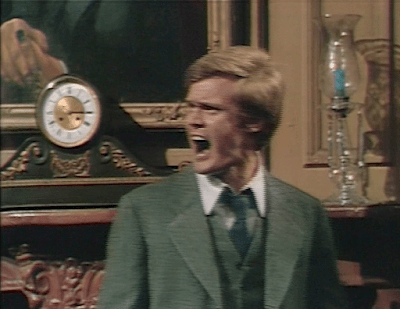
Roger Davis as Peter/ Jeff, in one of the most subtle moments of his performance. Screenshot by Dark Shadows Before I Die.
After Peter/ Jeff’s scene, it is Barnabas’ turn to be an unwelcome guest. He calls on occult expert Timothy Eliot Stokes. Barnabas and Julia suspect that Stokes may be the evil mastermind who has turned the previously gentle Adam toward evil plans. When Stokes hears Barnabas knocking on his door, he looks up and rasps to himself “Go away… No one is home…” This is one of my favorite lines in the whole series. Stokes was quite cheerful when he first involved himself in the strange goings-on, but as he has found himself drawn deeper and deeper into the unholy world of Collinsport he has come to regret his decisions.
Stokes is quite impatient with Barnabas’ demands that he tell him what he knows and his refusal to reciprocate with information about himself. It is only because Vicki is in danger that Stokes tells Barnabas anything at all.
Stokes already knows how Adam came into being, and Barnabas tells him about Adam’s conversation with him. This brings up a question about the scene with Peter/ Jeff. Why couldn’t Barnabas and Julia have trusted Peter/ Jeff with as much information as Barnabas here gives Stokes? Peter/ Jeff can no more go to the police than Stokes can, he will not tell Vicki anything about Lang’s experiment, and Barnabas and Julia have no reason to suspect him of being behind Adam’s turn to evil. These questions don’t come to mind during the scene with Peter/ Jeff, partly because he is so disagreeable a presence that we want him off screen as soon as possible, and partly because it has long been Barnabas’ habit to tell his enemies everything he knows while he zealously guards his secrets from potential helpers.
Patrick McCray’s second post about this episode, published 30 July 2018, includes an analysis of Thayer David’s portrayal of Stokes:
Professor Eliot Stokes gains fascinating dimension in 557. Normally, jovial and helpful, we see his protectiveness of Adam reveal an irascible and sternly just man within. Anton LaVey extolled “responsibility to the responsible,” and there are few other places where Barnabas gets both barrels of that. Stokes is perhaps the most inherently good man in Collinsport since his fellow freemason, Bill Malloy, took his last diving lesson. (Ironically, at the hands of Thayer David’s first character.) Stokes’ prime reason for siding with Adam and not Barnabas? The former vampire and Julia have withheld vital information for months. Yes, they have necessary trust issues, but this is Stokes we’re talking about. Adam may be a wildly unpredictable man-beast, capable of leveling Collinsport to sand before breakfast, but he’s also (until later in the episode) a prime graduate of Rousseau’s Finishing School for Noble Savages. He’s nursed greedily on the milk of morality that spurts abundantly from the ripe and straining teat of of Eliot Stokes’ moral tutelage. It takes a Nicholas Blair — so often Stokes’ foil — to teach him the less savory lessons in humanity. Stokes knows that there’s only so much danger in which Adam can find himself… Victoria Winters is another matter.
Barnabas passes the baton to Stokes, who becomes the third character in the episode to pay an unwelcome visit. He goes to Adam. He asks the big guy who has taught him to be cruel and amoral, and gets nothing but lies in return. He tries to persuade him that he must not hurt an innocent person, and Adam angrily declares that it is “fair” for him to make Barnabas watch him kill Vicki if Barnabas will not make a mate for him.
In Patrick McCray’s 2017 post, he praises Robert Rodan’s performance as Adam:
Robert Rodan issues a highly cerebral, emotionally packed performance. Rodan never receives the credit he deserves. Much of Adam’s stint on the show finds him equipped with an eloquent, even sesquipedalian command of the language. His inner conflict is as existential as it gets… Where do you turn? Rodan balances this absurd chimera of conflicts with effortless aplomb that makes Cirque du Soleil look as clumsy as a Matt Helm fight scene.
Robert Rodan is an unsung hero of an actor, delivering his existential angst with passion and truth. It’s a shame that his identification with an eventually unpopular character was probably a factor in Rodan not being recycled by Dan Curtis, despite being the dark-haired, blue-eyed “type” that typified the ruggedly handsome, DS norm (such as Selby, Lacy, Crothers, George, Ryan, Prentice, Storm, Bain, etc.)
While I always found the sight of Conrad Bain a guarantee of a fine performance, I can’t say it ever occurred to me to class him as “ruggedly handsome” in the way that one might class the other men Patrick lists. There’s no accounting for taste, I suppose.
Sarcastic dandy Roger, possessed by the spirit of wicked witch Angelique, visits mad scientist Dr Lang. The village of Collinsport was once a whaling center, and Lang is mindful enough of that long-ago history that he collects harpoons. Roger appears to be fascinated by Lang’s collection. He holds one of the finer pieces, admires it, fondles it, and tries to kill Lang with it. At the last moment, the murder is prevented by recovering vampire Barnabas and Julia, who is a scientist as mad as Lang but infinitely more interesting. As is typical of supernatural beings on Dark Shadows, Angelique projects her power through a portrait of herself; the portrait also has some adventures today.
There is a lot of great stuff in this one, as other bloggers have well explained. The 1960s were the heyday of Freudianism in the USA, and in the first year of the show the influence of that school of thought could often be traced in the scripts of Art Wallace and Francis Swann. Patrick McCray documents in his post on The Dark Shadows Daybook that this was an episode where writer Gordon Russell allowed himself to cut loose and have fun with the sillier side of the Freudian approach.
On his Dark Shadows Every Day, Danny Horn focuses on the scene where Barnabas and Julia decide to go and stop Roger. He points out that it is the first conversation they have had about something other than themselves, the first time Barnabas shares with Julia the secret of how he became a vampire, the first time they take heroic action, and the first time they are recognizably friends. It is that friendship that will drive the action of the show from now on.
In their meticulously detailed summary of the action of the episode on their Dark Shadows Before I Die, John and Christine Scoleri capture the effect on the audience of the steady accumulation of one absurdity upon another as the episode goes on. Reading their unfailingly matter-of-fact description of the ever-mounting lunacies we witness in this half-hour is almost as exhilarating as it was watching them in the first place.
Barnabas calls Julia’s attention to the closing cliffhanger. Screenshot by Dark Shadows Before I Die.
Dark Shadows often signaled a commercial break by playing an ominous three note motif on the soundtrack. Even in 1968, DUN DUN DUNNNN! was a pretty corny way to punch up your dramatic values. It was even cornier when, as was often the case, it followed a three syllable clausula. So today’s first act ends with vampire Barnabas Collins vowing that he will kill the Rev’d Mr Trask, a visiting witchfinder whose fanatical pursuit of bewildered time-traveler Vicki has helped precipitate many disasters. After Barnabas says Trask is “Going To Die!,” Mrs Acilius and I sang along with the motif- “Going- To- Die!” The missus pointed out that many among the 8-13 year olds who made up so much of the show’s original audience probably sang exactly the same refrain when the episode was first broadcast.
There are a couple of missing transitions in quick succession today. The opening scene between Barnabas and Ben takes place in the Old House on the estate of Collinwood; they take care to show a clock to establish the time of this scene as 4:00 AM. We then cut to the great house on the same estate, where it appears to be dark out. A knock comes at the door; the mistress of the house, Naomi Collins (Joan Bennett,) answers and finds Trask. It isn’t 4:00 AM anymore- Ben enters after a moment, and mentions that the sun is about to set. Inserting a still photo of a daytime scene would have been enough to tell us that many hours have passed, and the lack of that insert really is confusing.
Trask has come demanding the keys to the Old House so that he can gather Vicki’s things and burn them. A different kind of transition is omitted in the scene this demand initiates. Lately, Naomi has become assertive and independent, primarily in her refusal to go along with the persecution of Vicki. She does that for a while in her response to Trask, ordering him to leave, telling him he disgusts her, slapping him in the face, and daring him to hit her. But when Trask threatens to go to her husband, haughty tyrant Joshua, and enlist him against her, she gives in immediately, without any visible change in affect. That is puzzling, and not at all in keeping with Joan Bennett’s usual style. Typically, she makes the most of every chance she gets to show us why she was one of the biggest movie stars of the late 1930s.
Rough patches like these, along with the many many line bobbles from all the actors throughout the episode, make me wonder if writer Gordon Russell was late delivering the script. The show never had more than three credited writers at a time, and there must have been occasions when they couldn’t get the documents to the directors and actors early enough that they could get everything nailed down. It would take considerable thought for any performer to choose the best way to play a brief moment within which Naomi moves from fearless defiance to capitulation. Perhaps the reason she wound up doing nothing was that she didn’t have time to think about the question.
Ben accompanies Trask to the Old House. While Trask goes to Vicki’s old room, Ben meets Barnabas emerging from the basement and apprises him of the situation. We see Trask upstairs and hear Ben and Barnabas’ voices in the distance. Trask reacts, but goes ahead with his mission. He waits until he is downstairs with all of Vicki’s stuff in a bundle before confronting Ben and demanding to know who else is in the house. Ben claims that he was talking to himself. Trask is unconvinced.
Later, we see Trask in his own room at a nearby inn. He hears the rattling of chains and the disembodied voice of Barnabas taunting him. After a while, Barnabas’ hand comes floating towards him. When this happened, Mrs Acilius called out “Got your nose!” We both burst out laughing and were still laughing hard when the closing credits started to roll.
Despite the rough spots and the bad laugh at the end, this installment was a lot of fun. I can’t give it the “Genuinely Good Episode” tag, but we won’t be tempted to skip it if we do another watch-through of the series someday.
It is 1795. In the foyer of the great house of Collinwood, young gentleman Barnabas Collins stands on the staircase, his father Joshua stands on the floor. Joshua forbids Barnabas to marry lady’s maid Angelique on pain of disinheritance; when Barnabas declares he will marry her anyway, Joshua announces that they are no longer father and son.
In 1967, Barnabas will return to Collinwood as a vampire. In that year, in episode #214, he will take well-meaning governess Vicki on a guided tour of the foyer of the old manor house, indicate the staircase there, and say that “On these stairs, a father and son hurled words at each other, words that would lead to the death of the son.” He will then begin laughing maniacally and repeat the words “The death!,” seeing the desperate irony of referring to his own death in the past tense.
By today’s episode, the Collinses have moved out of the old manor house without any shocking scenes between Barnabas and Joshua playing out on the stairs there. That isn’t so surprising- that one remark eight months ago was the only reference to the stairs as the site of a fateful quarrel between Barnabas and Joshua, and the writer responsible for that day’s script, Malcolm Marmorstein, has been gone and forgotten since August. Neither today’s screenwriter, Gordon Russell, nor his colleague, Sam Hall, was with the show when Barnabas gave that speech to Vicki, and the third member of the writing staff, Ron Sproat, has been in the background for most of the 1795 segment so far.
But they do go out of their way to put Barnabas on the stairs of the new house for his showdown with Joshua today. It seems likely that they are hoping that at least some viewers will remember Barnabas’ remark in #214 and look for a significance in the connection. They did that sort of thing all the time in the early months of the show. For example, when they were developing a murder mystery about the death of beloved local man Bill Malloy in the last four months of 1966, they would show us a clock face in one episode, then weeks later have a character lie about the time established by that clock. Sproat more or less put a stop to those kinds of wild over-estimations of the audience’s attention span when he joined the writing staff near the end of 1966, but ever since the vampire story began in April of 1967 they had acquired obsessive fans who sent letters and gathered outside the studio. So they do have a reason to try to close the loop on a very long and very slender thread. What might the significance be of this particular nod to Barnabas’ first days on the show?
The 1795 segment began when the ghost of Barnabas’ little sister Sarah took possession of Vicki at a séance in #365, announced she wanted to “tell the story from the beginning,” and hurled Vicki back to her own time as a living being. But it is not simply a flashback explaining what made Barnabas a vampire. Vicki has completely failed to adapt to her new environment, and as a result has made significant changes to the timeline. She is now in hiding, suspected of witchcraft because of her endless stream of bizarre words and actions.
In fact, there is a witch at Collinwood. It is Angelique. Presumably, the first time these events took place Angelique pinned responsibility for her crimes on Sarah’s proper governess, Phyllis Wick. We caught a glimpse of Phyllis in #365; we could tell, not only that she was indigenous to the eighteenth century, but that she was quite cautious about anything that might suggest the paranormal. It would have taken Angelique some time and effort to set Phyllis up as a patsy, while Vicki volunteered for the role without any action at all on Angelique’s part. So maybe Vicki has speeded everything up. Maybe the family was still in the Old House when Joshua disowned Barnabas in the original sequence of events, but Vicki’s blunderings have accelerated matters so that they moved out before the conflict between them came to a head.
There is another puzzle about the writers’ intentions in this episode. It is established that without his inheritance or his position in the family business, Barnabas will be in a most parlous state. In separate scenes, both Barnabas and Joshua talk about the impossibility of Barnabas finding a job in Collinsport. Barnabas tells Angelique they will have to go at least as far as Boston before they can find anyone who will risk Joshua’s displeasure by hiring him. Later, Joshua tells Naomi that Barnabas won’t even be able to reach Boston- he doesn’t have enough money and won’t be able to get enough credit to stay in an inn, and he has no friends who will so much as put him up for a night if they know he doesn’t have an inheritance coming.
Barnabas’ mother, Naomi, has a solution to his financial problems. She gives him the Old House. The Old House is supposed to be a huge mansion, which it takes a very substantial income to maintain. How a man who can’t even afford a room for the night is going to meet those expenses is not made clear.
The frustrating thing about this is that they dwell at such length about the hard realities of dollars and cents immediately before, and then again after, Naomi makes her gift. By the laws of Soap Opera Land, a character who possesses a symbol of wealth such as a mansion does not need an income. We can accept that convention, and do in the 1967 segment, when a moneyless Barnabas occupies the Old House and can pay for all sorts of expensive things. But today they keep rubbing our faces in the implausibility of it.
My wife, Mrs Acilius, suggested they could have presented both themes if they’d dealt with the realistic financial problems in one episode and in a subsequent episode had gone back to the fantasy world. Maybe Joshua disinherits Barnabas on a Friday, he worries about getting a job on Monday, Tuesday we watch someone try to introduce Vicki to the concept of “lying,” Wednesday we see caddish naval officer Nathan woo feather-headed heiress Millicent, Thursday much-put-upon servant Ben Stokes tries to escape from the spell with which Angelique controls him, and then comes another Friday, when Naomi waves her magic wand and gives Barnabas the house. But as it stands, Barnabas talks to Angelique about how they have to go hundreds of miles to eke out a bare subsistence, Joshua talks to Naomi about Barnabas’ impending poverty, and then all of a sudden they remember that none of that matters, sorry sorry we shouldn’t have bothered you with it.
There were times in 1966 and 1967 when Dark Shadows only had one viable storyline, and no readily apparent means of starting others. But now they have several stories in progress, and an abundance of lively characters with whom they can make as many more as they like. There is no need for events in any one plot-line to move so quickly that incompatible themes crash into each other with such an unfortunate result.
Naomi’s gift to Barnabas was legally impossible in 1795. Until 1821, Maine was part of Massachusetts, and married women could not own property in Massachusetts until 1822. Maine did not pass its own Married Women’s Property Act until 1844. The show never brings this up, so it isn’t the same kind of problem as Barnabas’ lack of income.
Still, it does represent a missed opportunity. If Naomi’s family of origin had owned the house, they might have placed it in a trust over which she would have enough influence to deliver it to her son against her husband’s wishes. In fact, the show never makes the slightest allusion to where Naomi came from. If they’d given her relatives of her own, she would have had potential allies in a clash with Joshua and potential goals to pursue independently of him. As it stands, they have put her firmly in his shadow, so that the category of possible stories about Naomi is a subset of stories about Joshua. That’s a sad situation for a character who is capable of the dynamism she shows today, and a criminal waste of the talents of an actress as accomplished as Joan Bennett.
When Dark Shadows debuted in June 1966, it was a Gothic romance in which characters sometimes equivocated about whether they were using the word “ghost” metaphorically to refer to present troubles caused by past conflicts or literally to refer to things that go bump in the night.
That version of the series ended with the story of undead fire witch Laura Murdoch Collins. In Laura’s months on the show, her arc absorbed such major plot elements as the conflict between high-born ne’er-do-well Roger Collins and local man Burke Devlin, the psychological problems of strange and troubled boy David, David’s relationship with his well-meaning governess Vicki, and the tensions between the ancient and esteemed Collins family and the working class people of the town of Collinsport. By the time Laura went up in smoke in #191 and #192, there was no life remaining in any open narrative thread, and Dark Shadows 1.0 was at an end.
Dark Shadows 2.0 launched in #193 with the introduction of seagoing con man Jason McGuire. Jason was an in-betweener who would tie up the loose ends remaining from the 25 weeks before Laura joined the gallery of characters and facilitate the introduction of Laura’s successor as a major supernatural menace, vampire Barnabas Collins. Jason kept himself busy blackmailing reclusive matriarch Elizabeth Collins Stoddard, his sidekick Willie Loomis accidentally released Barnabas, and the show kept dropping hints that when Liz finally stood up to Jason all of the original secrets would be laid bare.
The makers of Dark Shadows didn’t do much advance planning, so they kept Jason on the show for 13 weeks after Barnabas premiered while they tried to come up with some other way to fill the time. When Jason’s plan finally blew up in his face, they even left some of the old secrets still buried, most notably the question of where Vicki originally came from.
Barnabas finally killed Jason in #275, and he hasn’t been mentioned in a while. But he is not forgotten. As we open today, lawyer Tony Peterson has caught heiress Carolyn Collins Stoddard in his office, rummaging through his safe. Tony has been dating Carolyn and is clearly very much attracted to her. He invites her to tell him a story that will give him an excuse not to call the police. She has to think fast to come up with one, and what she settles on is a version of the story of Jason and Liz.
Tony knows that Carolyn was trying to steal a notebook that he had put in his safe. This notebook was the property of his newest client, Julia Hoffman, a permanent guest at the great house of Collinwood. Carolyn tells Tony that Julia was blackmailing Liz. The notebook, she claims, is a diary kept by a man with whom Liz had an affair, and it contains proof that the man was Carolyn’s father. Julia knew the man and knew that he was planning to come to Collinwood to squeeze money out of Liz in return for his silence, but he died before he could do so. Julia took the diary and picked up where he left off.
Since Tony’s professional ethics will not allow him to be a party to blackmail, this is the one story that could give him a plausible reason not to report Carolyn’s crime to the police. It also gives him a reason to feel sorry for the Collinses, whom he hated when we first saw him, removing an obstacle to the possibility he might fall in love with Carolyn.
The echo of the Jason/ Liz story in the image of Liz forced to accept a blackmailer as a member of the household offers a great deal more than narrative convenience to regular viewers. The audience knew what Jason was threatening to tell if Liz did not submit to his demands, but the characters did not. One idea that some among them seemed to suspect was that Jason was Vicki’s father and Liz was her mother. Indeed, the makers of the show did plan to explain Vicki’s paternity at the end of the blackmail arc, a plan they abandoned so late that the climactic episode runs some minutes short. When Carolyn brings up the idea of her mother being blackmailed to keep it secret that she bore a child out of wedlock, those of us who have been watching all along will realize that she was among those who suspected that this was the secret that gave Jason his hold over her.
The audience knows that there will be no romance between Tony and Carolyn, because we know that she is Barnabas’ blood thrall. Barnabas sent her after Julia’s notebook, because it contains the records of an experiment in which she tried to cure him of vampirism. It would expose him were it to fall into the hands of the authorities. Since Barnabas wants to rid himself of Julia, perhaps by killing her, perhaps by driving her totally insane, he cannot leave such a document out of his possession.
Dark Shadows has come to as much of a dead end now as it had when Laura’s arc was ending. None of the ongoing stories has room for more than a few steps of further development, and if they keep running through those steps at the current pace everything will be resolved in a couple of days. Bringing up Jason, whose introduction marked the beginning of Dark Shadows 2.0, leads us to wonder if they have something up their sleeves that will launch Dark Shadows 3.0.
Tony takes Carolyn home to Collinwood, where he confronts Julia. He tells her what Carolyn told him. She denies it, and says that she will write a letter entrusting the notebook to him to remain unread unless something happens to her, in which case he will read it and hand it over to the authorities. That satisfies him that he isn’t a party to blackmail, and he agrees to her terms.
For the last couple of days, Barnabas has been using black magic in an attempt to break Julia’s grip on sanity. Her clear thinking and calm demeanor in this scene prove that this attempt has failed. The only open question in the only ongoing conflict is, therefore, whether Barnabas will try to murder Julia. She is such a valuable character that it is hard to feel any real suspense about whether he will succeed in killing her, but there is a chance that he will make an attempt.
David and Vicki have come home from a trip to Boston. David enters the drawing room, sees Julia, and greets her. She can barely pay attention to him long enough to say hello. He asks if she is all right; again, she is clearly not at all focused on him. She excuses herself, saying she has to go to Barnabas’ house.
David’s relationships to the other characters were the engine that drove Dark Shadows 1.0, and when Barnabas began to pose a danger to David that same engine accelerated the pace of Dark Shadows 2.0. Julia has been central to the plot for some time; that she can’t be bothered to take any notice of David tells us that that engine has fallen apart. Whatever they are planning to do next week, David won’t be at the heart of it.
David leaves the drawing room. He gets as far as the foyer. There, he sees his friend, the ghost of Barnabas’ ten year old sister Sarah. He tells Sarah that he has been on a trip. She asks where he went. He says he went to China. “Oh,” she responds, blandly. “You’re not impressed?” “No, my father’s friends used to go to China on their ships.” “Well, I didn’t really go to China. I went to Boston.” “BOSTON!!!” Sarah exclaims. “I went to Boston once!” She’s electrified. It’s adorable beyond belief.
Suddenly, Sarah looks disturbed and says she has to go. David asks why, and she says there is trouble brewing at the Old House. Again, David has been sidelined. If there is going to be any more action, it will have to come from fresh sources.
The Old House is Barnabas’ house, and that’s where we go next. We see Julia arriving there. She tells Barnabas that Vicki is back. He is mildly interested. She then tells him that she has seen Sarah. Barnabas longs to see Sarah, and is tormented that she will appear to others but not to him. He accuses Julia of lying. She insists that she is not, and taunts him with Sarah’s refusal to appear to him. He grabs Julia by the throat. He has done this before as a threat, but this time it looks like he really means to strangle her. Before he can, a wind blows the door open and the candles out, and Sarah walks in. She approaches her brother, glaring at him.
Mad scientist Julia Hoffman must hide her notebook from vampire Barnabas Collins and Barnabas’ blood thrall, his distant cousin Carolyn. The notebook documents Barnabas’ vampirism, and he does not want it to fall into the hands of the authorities. Once he gets hold of it, he plans to kill Julia.
The last time Dark Shadows devoted as much story time to attempts to hide and find an object as they have to this notebook was when high-born ne’er-do-well Roger Collins was frantically trying to hide local man Burke Devlin’s filigreed fountain pen, a story that dragged on from August to November of 1966. Few remember that storyline fondly, but at least the pen was a unique piece of evidence that might connect Roger to a homicide. The notebook is less satisfactory as a focus of attention, since there is nothing unique about it- Julia could easily have written a hundred documents detailing Barnabas’ secret and stashed them all over the world, and for all Barnabas knows she may have done. There are several strong episodes during this period, but the inadequacy of the notebook as a MacGuffin, combined with the fact that Julia could at any moment hop in her car and drive someplace where Barnabas wouldn’t be able to hurt her, prevents any momentum carrying over from day to day.
There are two important things about this installment. It is the first episode written chiefly by Sam Hall,* who will become far and away the most important member of Dark Shadows‘ writing staff. Hall would write hundreds of episodes, right up to the final one, would write the two theatrical features based on the show that were produced in the early 1970s, and would stick with producer Dan Curtis for years afterward, even contributing a script to the ill-fated 1991 primetime reboot of Dark Shadows. The husband of Grayson Hall, who played Julia, he would develop the show into something as different from its November 1967 incarnation as that version is from the show that premiered in June 1966.
On his blog Dark Shadows Every Day, Danny Horn argued that Hall’s contribution was to see Dark Shadows as, first and foremost, a “mashup” of various stories. The example he gives in his post about this episode are the scenes in the office of Tony Peterson, a local attorney whom Julia has hired to keep the notebook locked up in his safe. Tony is played by Jerry Lacy, who in the 1960s and 1970s was chiefly known for his Humphrey Bogart imitation. He would do that imitation on Broadway in 1969 in Woody Allen’s Play It Again, Sam and again in the 1972 film version of that play; here he is doing it in a 1980 commercial for the Long Beach California Press-Telegram.
In the scenes Danny focuses on, Mr Lacy imitates Bogart as Sam Spade or Philip Marlowe meeting a succession of mysterious women in his office. Grayson Hall plays Julia as a frightened and barely coherent client and Nancy Barrett plays Carolyn as the blonde you’d be a fool to trust, even if she does have a pair of gams that won’t quit. They’re all having a great time with their pastiche of The Maltese Falcon, The Big Sleep, and other staples of the Late Late Show.
I do have to demur from Danny’s claim that Hall pioneered Dark Shadows as a mashup. It was that from #1, when Jane Eyre met the Count of Monte Cristo and they both found Art Wallace trying to remake a script he’d already sold to television twice. Nor is he the first to mash up disparate genres. The story of Burke’s fountain pen led into a police procedural that merged with a ghost story; Burke’s typically soapy conflict with Roger dissolved into the story of Roger’s ex-wife, undead fire witch Laura Murdoch Collins, a story which was Dark Shadows’ first and most detailed adaptation of Dracula. The difference in Hall’s approach to mashups is that always before, one of the genres was Gothic melodrama. Today, a vampire story is meeting a film noir, and there are some elements of conventional daytime soap opera in the margins. Hall is letting go of Dan Curtis’ original idea of chasing viewers who read Gothic romances.
We get a clue as to what that might mean for the existing characters when Tony asks Julia if she is afraid of Roger Collins. Julia laughs loud and long at the idea that Roger is any kind of danger. For the first 25 weeks, Roger was indeed a deadly menace, but ever since Laura came through he has been reduced to occasional comic relief. Viewers who find a reminder of Burke’s fountain pen in the business with the notebook will see that even the villainous early Roger is a minor threat compared to the supernatural force Barnabas represents. So we are not to assume that any character or theme surviving from the show’s original conception is safe.
*The credits on screen say Gordon Russell wrote it, but evidently the paperwork from the show demonstrates that Hall did. Also, some of last week’s episodes sounded and felt as much like Hall’s work as this one does, but none of the experts tries to credit him with those, so I’ll defer to the consensus and say that while his influence may have been visible some days ago, this one marks his debut on Dark Shadows as the principal author of a teleplay.
Blonde heiress Carolyn Collins Stoddard is under the power of her distant cousin, Barnabas the vampire. She begins today’s episode in the foyer of the great house of Collinwood. She stares at Barnabas’ portrait, lifting her scarf to bare the marks of his fangs to it. She is eager to comply with Barnabas’ commands. He has ordered her to do two things- stop strange and troubled boy David Collins from sounding the alarm about him, and induce well-meaning governess Vicki to become his bride.
Ever since she stopped being a vicious narcissist in February, Carolyn has spent her time trying to protect her family members against threats she didn’t quite understand. She’d been trying to protect David, a first cousin who has come to be something like a little brother to her, when she stumbled upon Barnabas in his lair and became his slave. Her glad willingness to help Barnabas do whatever it takes to silence David shows how complete her subjection to him is.
Today, Carolyn wakes David before 6 AM. David asks “Are you sick or sum’thin?” David Henesy had a real gift for comedy, and Mrs Acilius and I laughed out loud at this line. Carolyn tells David that she does not believe any of the things he has been saying about Barnabas, that she never saw the ghost of ten year old Sarah Collins, and that if he keeps talking about supernatural menaces he will have to be sent to a mental hospital.
David’s reaction will puzzle regular viewers. Last Wednesday, in #348, Carolyn told David she had seen Sarah and was inclined to believe him about the other things. He was horrified. He said that local physician Dr Woodard saw Sarah, believed him, and died as a result. He begs Carolyn to say that she doesn’t believe him and that she didn’t see Sarah, and when she can’t he sobs in her arms. On Friday, David overheard matriarch Liz telling Carolyn he might have to be sent away to an institution, to which Carolyn responded that she had seen Sarah and did not think David was mentally ill. Afterward, David invited Carolyn to believe that he was crazy rather than accept the stories he had told before Woodard’s death. So when Carolyn shows up and tells David that she has decided to disbelieve the things he was desperate she disbelieve, and that the only danger will come if he repeats stories he wasn’t going to repeat anyway, he ought to be happy.
But David goes to pieces. He is as upset by Carolyn’s newfound disbelief as he was a few days ago by her belief. The actors do such a good job with the material that I am reluctant to complain about it, but if people are going to be watching the show every day the writers really should keep track of what’s in each other’s scripts.
As David is the functional equivalent of a brother to Carolyn, so Vicki is the equivalent of a sister. In fact, Art Wallace’s original story bible for Dark Shadows, titled “Shadows on the Wall,” called for a story that would climax with the revelation that Vicki was Carolyn’s half-sister, the daughter of Carolyn’s father Paul Stoddard. Well before the show went into production, the part of Vicki had been cast with Joan Bennett-lookalike Alexandra Moltke Isles, setting up the hints that run heavily throughout the first 92 episodes that Vicki is Liz’ daughter by some man other than Paul. Whichever half of her genealogy Vicki has in common with Carolyn, Liz has been tacitly treating her as a daughter all along. Liz has referred to Vicki and Carolyn as “the girls” for a long time, and now she is even encouraging Vicki to restore the west wing of the great house, which sounds very much like a project a person undertakes on something she is set to inherit. For a time Carolyn showed some resentment and jealousy towards Vicki, but the last clear indication of that was in #263. Since then, Carolyn has been treating Vicki as if she had always known her as a sister.
The enthralled Carolyn is as happy serving Vicki up to Barnabas as she was betraying David for his sake. Or she would be, if she had the chance.
Barnabas’ co-conspirator, mad scientist Julia Hoffman, is staying in the house. Julia has been passing herself off as an historian studying the old families of New England while secretly trying an experimental treatment meant to cure Barnabas of vampirism. That treatment reached an impasse before Barnabas bit Carolyn, and he has decided to discontinue it. Yesterday, Julia persuaded Barnabas to let her stick around to help guard him when he lies in his coffin during the day.
A few days ago, in #347, Julia hypnotized Vicki and showed her Barnabas in his coffin. By a post-hypnotic suggestion, she kept Vicki from consciously remembering what she had seen, but left her with an emotional aversion to Barnabas. That hypnosis gag is reenacted today, with Julia taking Vicki to the room in Barnabas’ house which he has prepared for her when she becomes his bride. There, she tells Vicki the details of Barnabas’ plans for her. Again, she gives a post-hypnotic suggestion confining this knowledge to her subconscious mind.
The difference between #347 and today is that Carolyn is working for Barnabas now. In that one, Julia had free rein to take hypnotized governesses in and out of Barnabas’ house all day long, without a care in the world. But now, Carolyn is watching. Even before Julia did her thing with Vicki, Carolyn confronted her and asked a series of pointed questions. That scene set up an interesting take on the whole idea of a relationship triangle- Carolyn and Julia are in conflict over Barnabas’ attentions, though neither is going to be his lover in any conventional sense. Triangles are so important in soap operas that this clash calls our attention to how Dark Shadows is rewriting the rules of the genre.
Carolyn sees Vicki and Julia leave the house. After they have returned, she asks Vicki about the walk she and Julia took. Vicki doesn’t know what she’s talking about. Carolyn says that she saw them down by Barnabas’ house, implying that she followed them. Vicki is still baffled. In a recorded voiceover monologue, Carolyn wonders why Vicki would lie. She concludes that she wouldn’t, and that Julia must be up to some kind of hocus-pocus.
Carolyn then asks Julia about her walk with Vicki. Julia feigns ignorance. Carolyn says she saw them leave the house together. Julia is defensive, but Carolyn waits patiently for an answer. Julia claims that they just stepped outside the door for fresh air, and Carolyn leaves it at that. Julia exits, and Carolyn ends the episode as she began- staring at the portrait of dear cousin Barnabas.