We start with the twelfth iteration of a ritual that has been numbing our minds since March. Seagoing con man Jason McGuire makes a demand of reclusive matriarch Liz, in this case a position as Director of Public Relations for the Collins family business. Liz resists. Jason threatens to expose her terrible secret. Liz capitulates.
Liz’ daughter, flighty heiress Carolyn, is fed up with Jason’s endless impositions on her mother and everyone else in and around the great house of Collinwood. She knows that Jason was a friend of her long-absent father, Paul Stoddard. When her uncle, high-born ne’er-do-well Roger Collins, tells her that some belongings of Stoddard’s are kept in the mysterious locked room of the basement of Collinwood, Carolyn decides she wants to go into the room and examine them.
Liz has the only key to the room, and hasn’t let anyone in it in the 18 or 19 years since Stoddard disappeared. She is shocked when Carolyn asks for the key. She tells her that they have nothing of Stoddard’s and that the room is empty. Roger and well-meaning governess Vicki are there when Carolyn presses Liz on the subject and Liz becomes agitated.
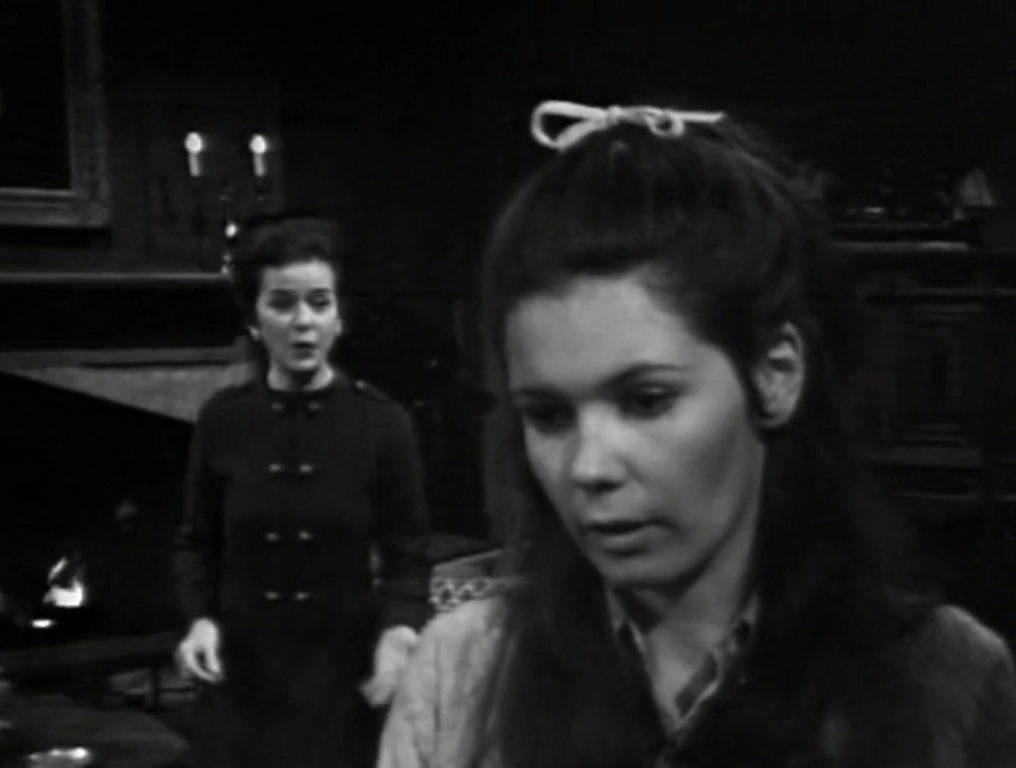
Later, Liz talks to Vicki privately and apologizes for her tone in that conversation. Vicki can’t believe that the locked room is empty. Vicki turns away from Liz, looks down, and says she can understand that it would be painful for her if Carolyn went through Stoddard’s belongings. We’ve seen Vicki try to lie on several occasions. She has always been unsuccessful at it, in part because she has mannerisms like these that give her away.
Vicki lying to Liz
Liz is so desperate to recruit an ally that she ignores Vicki’s tells, and immediately confirms that she is keeping things of Stoddard’s in the room. She must not realize that Vicki is an inept liar, because she asks her to back up her own lie and to persuade Carolyn that the room is empty.
Liz choosing to believe Vicki
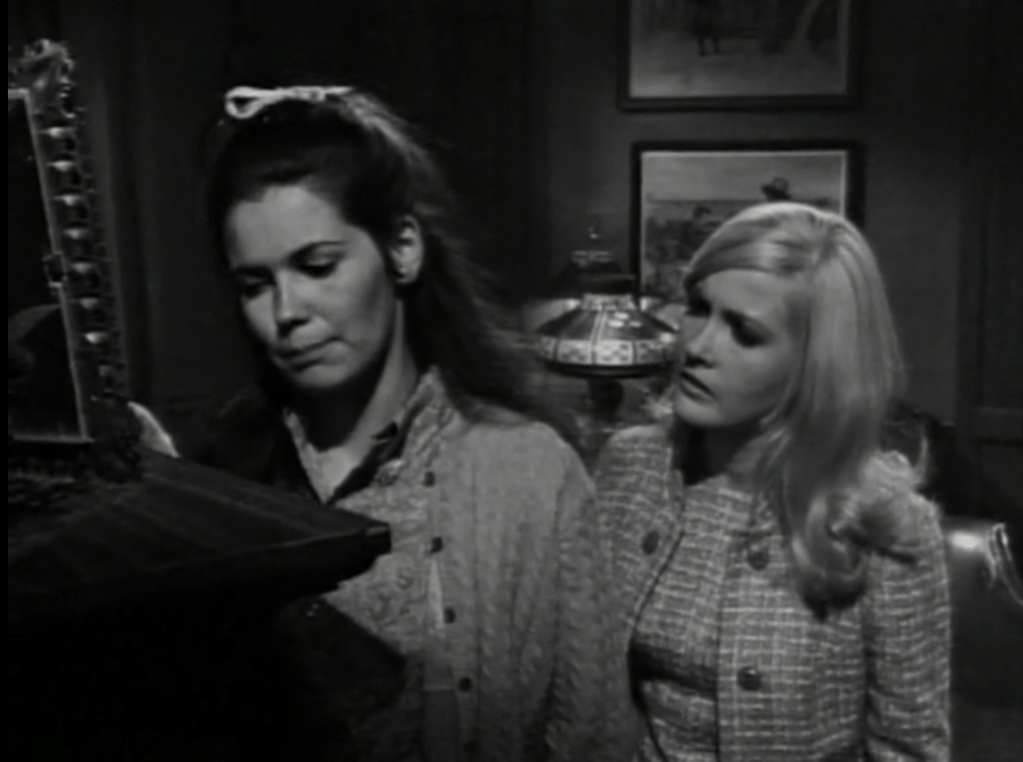
In the study, Vicki finds Carolyn searching for the key to the locked room. The two women argue a bit about whether Carolyn ought to let herself into the room. Vicki turns away from Carolyn, looks down, and asks her to consider that her father’s things might not be in the room at all. Since these are the same mannerisms that told us she was lying to Liz, at first we think she is getting ready to repeat Liz’ lie to Carolyn.
Vicki looking like she’s about to lie to Carolyn
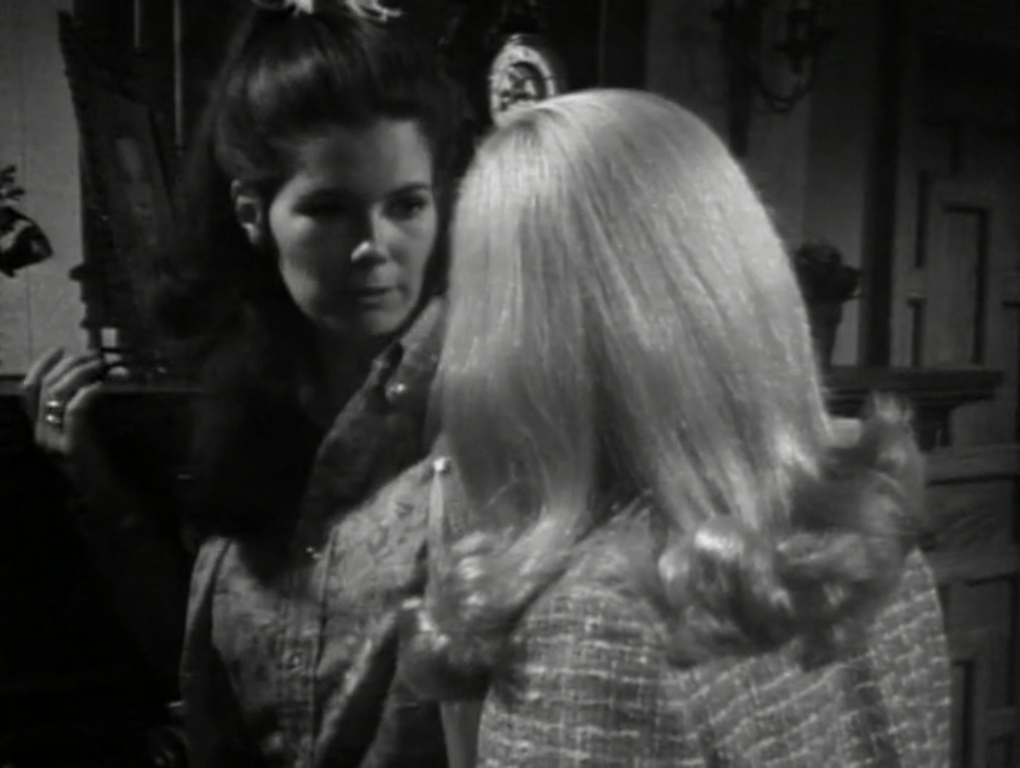
Carolyn asks Vicki what she is talking about. She turns to Carolyn and says that she wonders if there is something hidden in the room that would be far worse to uncover than a few random possessions of Paul Stoddard’s could be. With that, we cut to the closing credits.
Vicki not lying to Carolyn
The whole story of the locked room is a case of what Roger Ebert famously called “Idiot Plot,” a story that would end immediately if any of the characters were as smart as the typical member of the audience. No one has seen or heard from Stoddard since he disappeared. Liz hasn’t left the house since that night. She fired all the household staff, replacing them with a single extremely unsociable man, and discouraged strangers from entering the house. She is terrified of anyone entering a room in the basement that she locked shortly after Stoddard left, and is now flagrantly being blackmailed by a man who was around at that time.
It’s refreshing that Vicki is the one who seems to be figuring out that Stoddard’s corpse might be buried in the locked room. Again and again, the writers have painted themselves into a corner and found themselves able to get from one story point to the next only by having a character disregard all available facts and logic and do something inexplicably foolish. Since Vicki gets more screen time than anyone else, it has usually fallen to her to be Designated Dum-Dum. Indeed, the writers will eventually rely on Dumb Vicki so often that the character becomes unusable. But today, we get a look at Smart Vicki, and that version of her is terrific.
Each of the 1225 episodes of Dark Shadows features one name under the credit “Written by.”* A total of nine names rotate in that spot. While we know that some episodes included writing from uncredited contributors, the only such contributors we can identify come from among that tiny group of eight men and one woman. For example, Malcolm Marmorstein, credited with today’s script, wasn’t officially named among the writers until #115, but he may well have written additional dialogue as far back as #46. Joe Caldwell’s name doesn’t appear on-screen until #245, but he will actually be writing some of the scripts attributed to Ron Sproat starting this month, maybe this week.
Opinions will of course vary as to which of the nine identifiable writers was better and which was worse. Few, however, will find a place for Marmorstein on a list of Dark Shadows’ eight best writers. Although he had extensive experience in the theater, Marmorstein had none of the sense of what actors can do that Art Wallace and Francis Swann brought to the first nineteen weeks of the show. Nor did he know how to structure a drama, write crisp dialogue, or invent fresh story points. Directors Lela Swift and John Sedwick collaborate with a uniformly strong cast to put Marmorstein’s scripts on such a strong footing that at moments they seem like they are about to be good. Those brief flashes of hope are invariably, cruelly, disappointed.
There are indeed some bright spots in today’s episode. Reclusive matriarch Liz is in the drawing room of the great house of Collinwood. Well-meaning governess Vicki and homicidal fugitive Matthew are both missing, and Liz is worried that Vicki may have fallen into Matthew’s hands. Wildly indiscreet housekeeper Mrs Johnson shares her conviction that Matthew has killed Vicki, and won’t stop talking about this belief even after Liz expressly orders her to do so. Clarice Blackburn plays Mrs Johnson as a woman with no self-awareness whatsoever, and no screen actor has ever had a more effective way of showing horror at displays of social maladroitness than did Joan Bennett. In their hands, this scene is laugh-out-loud funny.
A knock at the door rescues Liz from Mrs Johnson’s untrammeled morbidness. The sheriff has come to report to Liz on the state of the searches for Vicki and Matthew. Mrs Johnson answers the door and won’t let the sheriff see Liz until she’s given him a piece of her mind about the incompetence of his department. There aren’t any memorable lines in this exchange, but the contrast between Blackburn’s highly animated movements and Dana Elcar’s cheerful placidity is so obviously suitable for comedy that it feels funny.
Back in the drawing room, the episode starts to fall apart. Liz and the sheriff talk about the searches for Vicki and Matthew. The dialogue is full of repetition and wasted words. Liz asks if the sheriff has an idea where Matthew might be, to which he replies, “He could be anywhere, and everywhere.” Might he hurt Vicki? “He might, but on the other hand he might not.” After all, “he’s very unpredictable.” Then, “you know how unpredictable he is.” Yep, unpredictable, let’s repeat that word five or six more times, that’ll keep us busy until the commercial break.
They could have cut some of that smoke-blowing and replaced it with lines about what the sheriff has done. My wife, Mrs Acilius, wishes the sheriff had mentioned telephoning Vicki’s former residence, the Hammond Foundling Home, and asking people there about where Vicki might have gone and whom she might have tried to contact. That might not have led to any action, but at least it would invite us to imagine that something might be going on somewhere.
The scene between Liz and the sheriff does have an effective ending. She asks him if he holds out much hope for Vicki. He replies, “Frankly, no.” She turns to leave the room. We break for commercial on that downbeat, which lets the bleakness of the situation sink in.
Strange and troubled boy David Collins comes home. David is the one person who knows that Matthew is hiding in the long-abandoned Old House on the grounds of the estate. He has been delivering supplies to him. Even David does not know that Matthew is holding Vicki prisoner in a hidden chamber. David sees that the sheriff is in the house, and asks Mrs Johnson if the sheriff has any news about Vicki or Matthew. Mrs Johnson seizes this opportunity to resume denouncing the sheriff’s incompetence, saying that the only clue he can recognize one that tells him it is time to eat and make himself even fatter than he already is.
David is about to move on when Mrs Johnson questions him about the pack of cigarettes he stole from her earlier. She sets some punchlines up for David in this exchange. She mentions that she lit a cigarette while serving David his breakfast, to which David replies by asking if she is supposed to smoke while working. She says she knows that she set her pack of cigarettes on the table when she and David were alone in the kitchen, and that she hasn’t seen it since. He suggests it walked away by itself. She tells him he’s the only one who could have taken them; he says that if he wanted cigarettes, he wouldn’t steal them, he’d buy them. None of these lines is much on the page, but as delivered by Blackburn and David Henesy, they are genuinely funny.
David goes into the drawing room and talks with the sheriff. Picking up on Mrs Johnson’s remark about the sheriff’s vigilant observation of meal-times, David asks him what it means when the whistle blows at the cannery. “Lunch,” says the sheriff. Again, not a world-class piece of comic material, but Henesy and Elcar make it land.
David then asks the sheriff for the details of his search for Matthew. The sheriff happily answers all of David’s questions in detail, as if he were giving a briefing to the state police. He tells David that anyone who might be hiding Matthew will go to jail.
This scene shows the limits of what a good actor can do with bad material. David is going to return to the Old House at the end of the episode. He will be prompted to go back there because he has learned information from the sheriff that Matthew will want to know. While there, he will set up suspense by revealing to Matthew that the sheriff has triggered his intense phobia of jail. That locks the sheriff into playing his scene with David as a babbling oaf.
In Elcar’s first episodes as the sheriff, he had made indiscreet remarks to David, but as we saw him observing the reactions those remarks elicited from David and others he seemed to be using them as ploys to advance his investigations. For example, in #59, he had given David some information that excites him and unnerves his father, high-born ne’er-do-well Roger Collins.
We can see how he might use similar tactics in this situation. After all, Vicki is David’s governess, and David has spent more time with her than has anyone else. Matthew had been the caretaker in the house where David lives, and David knows him quite well also. In this conversation, when the sheriff refers to Matthew as unlikable, David becomes very excited and exclaims “I like him! Er, I did like him, I mean.” If the sheriff knows his business he might well pay very close attention to everything David says, and keep encouraging David to say more. He will certainly notice David’s terrified reaction to the idea that someone helping Matthew will go to jail, and test his reaction to further comments on related themes. But if he takes any note at all of David’s attitude, the current storyline will end within minutes. So in this scene, Marmorstein leaves Elcar no way to play the sheriff as an intelligent character.
After the sheriff leaves, David and Liz have a scene in the drawing room that builds up to a tremendously frustrating moment. David keeps asking his aunt one question after another about Matthew and Vicki, Vicki and Matthew, does Matthew have Vicki, is Vicki in danger from Matthew, then without taking a breath “Do you know any secrets about the Old House?” Liz responds “I wish that someday you’d ask an important question.”
Granted, we know that Matthew is holding Vicki prisoner in the Old House and Liz does not, but it is hard to imagine anyone failing to see the connection between these two thoughts. Joan Bennett and David Henesy had a fine rapport that made the scenes between Liz and David Collins a delight, and you can see them trying to save this exchange. David is in a panic at the beginning of the scene and gets steadily more worked up as it goes along. We see Liz observing his agitated emotional state, paying such close attention to his facial expressions, tone of voice, and frantic bodily movements that she misses key elements of his words. It’s a valiant attempt on their part to make the scene work.
David wants to go to the Old House to see Matthew. In the foyer, Mrs Johnson again confronts him about the cigarettes. He yells at her to “Get off my back!” and runs out. This might have been an attempt to show that David feels his world closing in on him, but it doesn’t succeed. We’ve already seen those two characters say everything they had to say about that topic on that set. Repeating it just feels like filler.
*There are reference works that draw on the original paperwork produced by the makers of the show; even these list one writer per episode. That’s how the Dark Shadows wiki manages to list a writer for every episode, including those that don’t show writing credits on-screen.
Strange and troubled boy David Collins has managed to lock his well-meaning governess, Vicki, in a room in the long-abandoned west wing of the great house of Collinwood. David’s father, high-born ne’er-do-well Roger and his aunt, reclusive matriarch Liz, have noticed that Vicki is missing and are beginning to make inquiries.
It is inexplicable that Vicki fell into David’s trap, and her efforts to escape are embarrassingly inept. Today, Liz also behaves inexplicably. In David’s room, she finds the key to the closed part of the house where David is keeping Vicki, and she confronts David with it. When he denies that he locked Vicki up, she says she believes him and drops the subject. I’m afraid this has to be classified as an instance of what Roger Ebert called “idiot plot,” a story that goes on only because the characters are dumber than the audience. It’s especially frustrating to see characters like Liz and Vicki, who up to now have used their intelligence to make plot points happen, suddenly do things that can be explained only by saying that the script told them to do it.
Roger doesn’t appear to be fooled, but neither is he in any hurry to rescue Vicki. He sees her as a threat to his evil plans, and wants her out of the way. We see him alone in the drawing room, smiling broadly and drinking a toast to “Miss Victoria Winters… wherever you are.” He’s so deliriously happy with Vicki’s absence that he’s standing around not wearing any pants.*
Southern exposure
Meanwhile, Liz’ daughter, flighty heiress Carolyn, is sharing a cozy moment with the family’s arch-nemesis, dashing action hero Burke Devlin. In Friday’s episode, the two of them crossed paths at the tavern, and today they are sitting cozily on the couch in Burke’s hotel room. Burke gives Carolyn alcoholic drinks she isn’t of legal age to have, charms her with stories of his time in Brazil, and kisses her goodbye. He seems to be drunk, but as soon as she leaves the room he looks into the camera and in a sober voice vows that his vengeance will destroy her along with the rest of the Collins family.
There is one moment when Carolyn is still in the room when Burke slips out of his drunk act and forgets his charm. Carolyn asks if he’s ever been in love. He springs up from the couch, his face contorted with rage, looks away from her, and spits out the word “Once!” Startled, Carolyn asks if it’s always so painful. Then he remembers himself and resumes the role of the marginally amorous drunk.
Dark Shadows is very literal in its cutting in these early months. They often use scene connectors in the dialogue, moments when the last word of a scene they cut away from is one of the first words of the scene they cut to. And a question at the end of a scene will often be answered by the visual to which the scene jumps- so if someone asks “Who tampered with the brakes on Roger’s car?,” we will cut to a shot of David. At the end of this little exchange about the single, painful, time Burke fell in love, we cut to… Roger.** It’s 1966, and it’s American television, so it is unlikely that the show will actually tell us that Burke and Roger were lovers. On the other hand, it’s 1966, and the actors, writers, and directors are from the New York theater, so it is all but certain that they wanted some segment of the audience to wonder about that.
There’s also a bit of trivia. The drawing room scene among David, Liz, and Roger marks the first time David refers to Vicki as “Vicki.” Up to now he has always called her “Miss Winters.”
*In fact, this is the scene that actor Louis Edmonds famously played without the lower part of his costume.
In the great house of Collinwood, strange and troubled boy David Collins tricks his well-meaning governess, Vicki, into a room where he locks her up. Hardworking young fisherman Joe comes to the house to tell his sometime girlfriend, flighty heiress Carolyn, that he can’t spend the evening with her because he has a date with someone else.
I suppose this is one of writer Art Wallace’s diptych episodes, in which the contrast between a pair of intercut scenes tells us more about the characters than we would gather watching either scene straight through. Most such episodes are powerful and engrossing. Unfortunately, both of today’s topics are deadly dull. The pointlessness of the one multiplies the tedium of the other.
Joe and Carolyn’s relationship has never been interesting for one second. Their scenes are divided between Carolyn’s flagrant displays of contempt for Joe, quarrels that begin when Joe objects to those displays, and the occasional conversation about how the two of them don’t have a future. Today’s conversation between them is a break-up scene. An actual breakup would be welcome, but they’ve raised our hopes that way before. Since the only emotion Carolyn and Joe have managed to arouse in the audience is impatience, we don’t have any of the mixed feelings that could make the scene poignant or exciting.
The contrast at the hinge of the diptych is between, on the one hand, David taunting the suddenly brainless Vicki with the prospect that she will be in her prison for the rest of her life and, on the other, Carolyn dismissing the suddenly self-assertive Joe with the prospect that they will never see each other again. Joe’s uncharacteristic strength is more appealing, and better grounded in what we’ve seen so far, than is the uncharacteristic stupidity that led Vicki into David’s trap. But even if the breakup is the real thing this time, it’s hard to feel much relief when we know that we’re going to be locked up and miserable with Vicki.
There is some trivia in this one that will appeal to confirmed fans of Dark Shadows. It’s the first time we go inside the west wing; we get a look at a corridor and at the room where Vicki will be confined. Vicki and David talk about the long, twisting way they have taken, suggesting that it is a very large place. Much larger than reclusive matriarch Liz suggested in episode 2, when she told Vicki that the whole house, including the closed-off portions, has a total of 40 rooms.
Also, Vicki mentions that the west wing has been closed for 50 years. David picks up on “50 years” in a story he tells to frighten Vicki, ensuring that it will stick in the audience’s mind. Yet Liz, who is supposed to be in her 40s, has a conversation with her daughter Carolyn in which she remembers a time when far “fewer rooms were closed off.” That suggests that there is not only a locked-up west wing, but perhaps an east wing as well. That won’t be confirmed for four years, but it is implicit here.
Reminiscing about the way the house used to be, Liz says “There’s nothing in those rooms now but ghosts and memories.” In fact, the rooms in the west wing, like the abandoned Old House and the basement, are stuffed to bursting, not only with antique furniture, books, trunks, vases, paintings, rugs, and other things that could be sold at a high enough price to finance a considerable amount of work on the house, but also with old newspapers, tattered clothing, helpless governesses, and other unsaleable items that should not be kept in storage. For his part, David tells us that the west wing is full of mice, and we see so many cobwebs that the air quality in the occupied parts of the house must be severely affected by its dust. The Collinses really ought to empty their disused spaces and hire a couple to keep them clean.
No abandoned corridor would be complete without a full-sized metal candelabra in front of a porcelain vase resting on a dedicated stand
Apparently executive producer Dan Curtis insisted as a point of visual style that abandoned buildings be shown crammed with stuff. Today, that means that Vicki’s failure to pick up any of the blunt objects surrounding her and start beating the door down makes her look like an even bigger idiot than she already does for falling into the trap in the first place. The window is too high for her to reach, but with so much furniture and so many other objects in the room it would be no trick for her to stack something up she could climb on. After all, animal behaviorists give intelligence tests in which they get baboons to pile one thing on top of another so that they can reach a piece of fruit dangling from the ceiling. Too bad Vicki doesn’t have a baboon with her to give her some guidance.
In the great house of Collinwood, well-meaning governess Vicki makes unsuccessful attempts to reason with strange, troubled boy David and with David’s father, high-born ne’er-do-well Roger. At the restaurant in the Collinsport Inn, it dawns on hardworking young fisherman Joe that Maggie, The Nicest Girl in Town, would like to date him.
A fancy fountain pen Vicki found on the beach has gone missing from David’s room. After the two of them have spent a few relaxed moments looking for it, David declares it isn’t in the room. He suggests a ghost might have taken it. Rejecting this possibility out of hand and seeing no other explanation, Vicki concludes that David must be hiding the pen from her. She calmly asks him to return it; he indignantly denies having taken it. Exasperated with him, she raises her voice.
We cut to an outdoor setting, where we see Roger burying the pen. The audience saw him steal the pen at the end of yesterday’s episode. Roger is afraid the pen will be a piece of physical evidence implicating him in a homicide, so he is desperate to get everyone to forget that it exists. Why he doesn’t throw it in the ocean, or in a trash can, is never explained.
Roger returns to the house and hears Vicki and David yelling at each other about the pen. He goes upstairs to make inquiries. He takes David’s side, leaving both David and Vicki staring at him in astonishment. Roger then talks privately to Vicki, and urges her to forget about the whole thing. She reluctantly agrees never to speak of the pen again, to anyone. Roger visits David in his room, extracting the same promise from him. David tells Roger that he will get even with Vicki for her false accusation against him. Roger, eager as ever to get Vicki out of the house, has no objection to that idea. David glares out the window, looking directly into the camera and muttering to the audience that he will settle his score with Vicki.
The B-plot is much friendlier. Joe and Maggie are nice, attractive young people who have known each other for a long time, have fun together, and share many interests. Maggie is single, and Joe is at the end of a dull and mismatched relationship with flighty heiress Carolyn. There is no reason why they shouldn’t become a couple.
In fact, that is their biggest problem. As soap opera characters, they can have a romance if and only if there is some obstacle between them they will have to overcome in a dramatic fashion. Maggie and Joe are so obviously well-matched that generating such an obstacle will require the writing staff either to dig deep into the characters’ psychology and to expound that psychology in a superlatively well-crafted plot, or, if that is beyond them, to do something dumb like have them get bitten by vampires.
Joe stops by Collinwood to see if he can talk to Carolyn. Vicki tells him that Carolyn isn’t around, but asks him to stay for a while anyway. Vicki is nervous. She explains that “You don’t know what it’s like to be alone in this house with David.” Joe asks Vicki if she thinks he is an idiot for trying to resuscitate his relationship with Carolyn. When she can’t say he isn’t, he announces that he’s resigning from the idiot’s union and leaving for a dinner date. We know that he’s going to Maggie’s house, but he doesn’t tell Vicki that.
Joe may be resigning from the idiot’s union, but it looks like Vicki is ready to fill his place. David looks at her with undisguised hostility and tells her that he has indeed hidden her pen. When she asks where it is, he points to the closed-off part of the house. Vicki tells him no one can get in there; he shows her a key, and says that no one but he can. She is clearly on edge throughout the whole scene. After some protest, she follows this person she has just said she fears into a locked area to which he has said only he has the key. All that’s missing is a gigantic sign made of electric lights spelling out the words THIS IS A TRAP.
Future writing teams will gradually transform Vicki from the intelligent, appealing young woman we have come to know into a fool who will get them from one story point to another by doing or saying something stupid. We’ve seen Dumb Vicki in one or two fleeting moments already, but those moments haven’t really damaged the character yet. She is just on screen so much of the time, and is so consistently the innocent party in whatever conflict is going on, that when the writers paint themselves into a corner she is the only person available to take some insufficiently motivated action that will solve their problems for them.
This time, though, the episode is credited to not to any of those future writing teams, but to Vicki’s creator, Art Wallace. And her inexplicable action is going to stick us with her in a frustrating situation for days to come. As Vicki, Alexandra Moltke Isles follows David into the place of confinement with slow steps and her neck bent, as if she has resigned herself to being sacrificed. That’s an intriguing acting choice, but there is nothing at all in the writing to suggest that her spirit has been broken in that way. My theory is that Wallace, who will be leaving the show in a few days, is losing interest in the work, and Mrs Isles is trying to salvage what she can from a weak script.
Vicki to the slaughter
Monday’s episode was so washed-out I thought it was a kinescope, and I said in my post that it was the first one of the series. Apparently it wasn’t- that episode is taken from a surviving videotape, just one that is in bad shape. This one really is the first episode to come down to us on kinescope. It really doesn’t look any worse than do prints like Monday’s.
PS- This is the only episode from the first 42 weeks that Danny Horn discussed on his tremendous blog Dark Shadows Every Day. He includes an analysis of it in the middle of a long riff about #1219, the “missing episode.” His remarks are hostile, unfair, misleading, and absolutely brilliant. I recommend it to everyone.
Vicki first met Matthew in the basement of Collinwood, back in episode 6. So the basement is Matthew’s territory. Not even the cottage where he lives is more so. Before we ever saw it, we heard him go on about how it was a gift from Liz. When we do see him there he’s having an uncharacteristic moment, baking muffins. The basement is the dusty, forbidding workspace is where we expect to find a dusty, forbidding workman like Matthew.
In his remarks on episode 37, Patrick McCray complained about “writing shortcuts that occasionally make Victoria look like a moron.” I didn’t quote him in my post on that episode, because I don’t agree with his assessment of the scene- he thinks Vicki is falling for Roger’s obvious lies, I think she is disregarding them because she knows she has him where he wants him and is about to squeeze some information out of him. But this opening scene is definitely a case of Idiot Plot. Vicki chased David into the basement in episode 6, only to be menaced by Matthew and scolded by Elizabeth; she followed the sound of the sobbing woman there in 37, to be yelled at by Roger. Those were moments of hot pursuit, when she could claim that in the heat of the moment she forgot Elizabeth’s prohibition on going to the basement. But now, she’s just looking for some books. There’s no reason she couldn’t have asked Liz about the books before going to the basement. What’s more, she’s going after those books only because David, last seen telling her he’d make her wish she had never come to the house, suggested she go after them. I realize she’s had a stressful few days, but unless she’s had a massive head injury off-camera, going to the basement at David’s suggestion is inexplicable.
Of course, the out-of-universe explanation is obvious- a new actor is taking over the role of Matthew, and they want to introduce him on this set. On the one hand, the scene is a reprise of the first introduction of Matthew, thereby making it clear that this is a new start for the character. On the other hand, because it is his territory, and our point of view character is trespassing there, he is all the more menacing to us than he would be if we met him in someone else’s space.
I think Danny Horn described Thayer David’s acting style well when he said that “He’s loud, and disruptive, and he plays to the balcony. Not this balcony, naturally; I mean the balcony in the theater next door.” He’s relatively subdued in his first outing as Matthew, but the appliances the makeup shop constructed on his face prepare us for the titanic approach he’ll be taking in the weeks ahead.
Matthew goes upstairs. In the foyer, a more or less neutral space among the residents of the estate, Liz gives him a shopping list to take into town. She then asks him into the drawing room, her home base. There, she asks him to do something horrible- take the blame for Roger’s car crash. He is shocked at the request, and asks for an explanation. She doesn’t give him one, but he agrees anyway. Thayer David’s anguished face shows the terrible price Matthew is paying for Liz’ insistence on covering up what really happened between David and Roger.
This encounter closes the story of Roger’s crash. Along with the Mystery of the Locked Room, Vicki’s search for something David might like, and the talk about ghosts, it ties Thayer David’s Matthew in to four of the stories we’ve been following.
We next see him in town, ordering coffee at the restaurant in the Collinsport Inn. There he’s tied in to a fifth story, The Revenge of Burke Devlin. The Inn is Devlin’s territory, and Matthew encounters him there. Still unhappy because of Liz’s shocking request, Matthew is in no mood to be diplomatic with the known enemy of the family he is sworn to serve. He tells Devlin that if he makes trouble for Liz, “I’ll kill you.” Devlin tries to reason with him, asking if it makes a difference whether the family deserves trouble, to which Matthew does not respond kindly.
Even before Matthew came to town, Devlin had met another Collinwood resident at the restaurant. Carolyn sits at his table and notices he is reading The Count of Monte Cristo. She summarizes the plot, and realizes that it is one of the sources of The Revenge of Burke Devlin story-line. She’s so self-aware it wouldn’t be surprising if she and Burke started gossiping about what the new writers coming on board next week have in mind for their characters. She drops the subject, and immediately starts wheedling him for a date. When he begs off, she deliberately leaves a ring behind.
Back at Collinwood, Carolyn and Vicki talk on the landing overlooking the foyer. This is the first conversation we’ve seen in that space. A couple of times, we’ve seen David Collins standing up there by himself, looking menacing, or as menacing as a not-very-tall nine year old boy could. In the years to come, a succession of villains will take turns declaring themselves to be Master of Collinwood by standing on this spot and looking at the camera. The last of these will be the ghost of Gerard, played by an adult actor about the same height as the nine year old David.
This time, the space is not being used to suggest menace, even though the camera is shooting up at the same drastic angle. Instead, it is a relatively intimate place, separated from the public-facing foyer by the stairs and leading to the bedrooms. Carolyn and Vicki are there because they are at home. Carolyn confides in Vicki about her plan to leave the ring where Burke would find it, obligating him to call her and return it. Vicki confides in Carolyn about the sobbing woman, and Carolyn admits to having heard her many times, and to having lied when Vicki asked her about the sounds her first morning in Collinwood. The friendship between Carolyn and Vicki is settling in as a wide-open information exchange, a regular channel not only to keep the audience up to date on what’s happened in previous episodes, but to make it possible for characters to learn enough about what’s going on to make plans and take action.
Back down in the foyer, Liz talks to Vicki about the basement. Vicki tells her that she can’t believe in ghosts; Liz assures her there’s no one being held in the locked room. Liz offers Vicki the key to the room and invites her to let herself into it and search it. Vicki declines the offer. Liz repeats it, doing everything she can to show that she has nothing to hide. Vicki declines again, and turns away. As soon as Vicki can’t see her, Liz’ face resolves into an expression of immense relief.
Over the closing credits, ABC staff announcer delivers the usual blurb for “Where the Action Is.” He trips over the title. It sounds like he’s stifling a laugh or is distracted or something. Unusual to hear him commit a blooper!
I think I said everything I wanted to say about this one in the comment I left on John and Christine Scoleri’s Dark Shadows Before I Die. So here it is:
“Idiot Plot” is a term for a story that can go on only if the characters in it are dumber than the average member of the audience. When Vicki left the valve where David could steal it in episode 26, Dark Shadows had its first Idiot Plot.
Now, just two days later, we have our second. The restaurant is open for business, and Maggie says in so many words that Roger is a frequent customer there. So he should walk right in and lay hold of David. But unaccountably, he waits for Maggie to let him in. She turns her back on David, calls Roger by name, and declares that she’s been tricking David into staying, all while David is a few feet away. Even worse, we have a number of scenes suggesting that Maggie had searched the hotel extensively for David and failed to find him, when he was simply hiding in the very telephone booth she herself had used a few minutes before.
Art Wallace is the only credited writer for the first eight weeks of the show. I’m sure he had some help, but not enough, apparently- these two episodes not only disappoint viewers who expect a well-constructed drama, but also do serious harm to the characters of Vicki and Maggie. Vicki has to be so sweet and innocent that unless she’s also as smart as she’s seemed in the first five weeks, she’ll get pretty cloying pretty fast. And Maggie, whether it’s the original wised-up dame who’s everybody’s pal but nobody’s friend or her successor, the nicest girl in town, has to produce witty dialogue and see through people’s attempts to deceive her if she’s to contribute to the story. Casting either of them as Designated Idiot is a sure way to put her on an ice floe to oblivion.
Two other things:
Interesting to see the first scene between Maggie and David. Especially so knowing that these characters will become important to each other later on, but already so as confirmation that the hostility Maggie had expressed towards the Collinses in general in Episode 1 isn’t going to define her character.
The picture of Lyndon Johnson in the sheriff’s office is apparently there to promote ABC’s coverage of the Luci Johnson’s wedding that weekend, but it’s a very odd choice of image. You’d expect the president’s photograph in a government office to show him from the chest up, showing his full face, with his eyes looking at the viewer and a calm or cheerful expression. But this picture is an extreme closeup of his face in profile, and he appears to be wincing. On a wall otherwise decorated with wanted posters, it communicates something less than unqualified admiration for President Johnson. If, as Roger implied in episode 26, the sheriff owes his office to the support of the Collins family, the picture would suggest that the Collinses were not LBJ fans.
I’ll also mention that Marc Masse’s entry for this episode on his Dark Shadows from the Beginning features one of his most outlandish accounts of a control room conversation between director Lela Swift and executive producer Dan Curtis. If you miss the sensibility of the 1970s National Lampoon, you’ll enjoy reading it.
At the end of episode 25, Vicki found the bleeder valve in David’s room, evidence that the boy tried to murder his father. In this one, she tells David she has the valve and leaves it in a drawer in her own room while she goes to tell Elizabeth about it. When Vicki and Elizabeth go to look at the valve, it is of course missing. Elizabeth chooses to believe that this means that she does not have to think any more about what Vicki has told her.
Watching the series first time through, it bothered me that Vicki didn’t bring the valve to the drawing room and show it to Liz. She knows David is a clever, mechanically competent little fellow, and no respecter of private property. Why on earth would she leave the valve in a dresser drawer which she knows he likes to riffle through and to which he has had considerable time to find or make a key?
That time, I could come up with an explanation. She is in shock, bewildered by the confirmation of the dark suspicions we’ve seen forming in her mind, and isn’t thinking straight.
(SPOILERS FOLLOW)
This time, though, I’m coming to the episode having seen the series through. This is the first time they resort to Idiot Plot- a story that would resolve itself immediately if the characters behaved as intelligently as would the average member of the audience. And it’s Vicki supplying the idiocy. Later on, they will rely heavily on Idiot Plot, and because she is so much the point of view character Vicki winds up as the Designated Idiot. That will ultimately destroy her character and drive her off the show. So I can’t help but feel sad now when I see this first appearance of Dumb Vicki.
The other scene is between Roger and the sheriff. In Collinwood, Elizabeth is trying to protect her image of David by forcing Vicki to pretend she hasn’t seen the valve; at the sheriff’s office, Roger is trying to impose his image on Burke by forcing the sheriff to arrest him. Vicki resists Elizabeth throughout this episode, but we are in suspense how long she will be able to hold out. The sheriff resists Roger, making a display of his blase attitude while Roger is in the room but showing great unease as soon as he leaves.




 Dark Shadows Commentary