Episode 781: Sympathy somewhat disturbing

When vampire Barnabas Collins first appeared on Dark Shadows in April 1967, regular viewers may have thought they knew what to expect. They had just spent four months focused on undead blonde fire witch Laura Murdoch Collins, mother of strange and troubled boy David. David’s well-meaning governess Victoria Winters gradually realized that Laura was a deadly threat to him. After some initial confusion, Vicki rallied the other characters in opposition to Laura. Ultimately Laura went up in smoke and David escaped her clutches, choosing Vicki and life over his mother and death.

In many ways, the Laura story was modeled on Bram Stoker’s Dracula. So when Laura’s successor as supernatural menace was an out and out vampire, we may have expected further mining of that source. Barnabas bit and abducted Vicki’s friend Maggie Evans. As the daughter of drunken artist Sam, Maggie had played a key role in the “Revenge of Burke Devlin” storyline. But that storyline fizzled in the show’s early months, and by #201 even Burke Devlin lost interest in it. Maggie was at that point surplus to requirements, and when Barnabas added her to his diet we might have suspected that she would die and rise as a vampire. As Mina and the group she led in Dracula had to destroy her friend Lucy when Lucy rose as “the Bloofer Lady,” so Vicki and her friends would have to destroy Maggie. Vicki herself would then stake Barnabas. The average viewer would have expected this to be the sign to move on to the next menace; those who were aware of TV ratings and programming decisions might think it would be Dark Shadows‘ way of going out with a flourish before its impending cancellation.

Barnabas turned out to be a hit. The idea of a vampire on a daytime soap was such an oddity that a sizable new audience tuned in out of curiosity, and Jonathan Frid’s portrayal of Barnabas’ scramble to impersonate a living man native to the twentieth century resonated with so many of them that he became a breakout star. So they had to figure out a way to make him a permanent part of the cast. That meant Maggie couldn’t die. In the first place, they couldn’t risk making Barnabas responsible for the death of so likable a character. Second, as the survivor of the horrendous abuse Barnabas inflicts on her Maggie would have a new function, as the witness who might emerge to expose him and wreck the show. Third, while Maggie was in Barnabas’ clutches Kathryn Leigh Scott proved herself such a versatile actress that it would obviously damage the show to lose her. So Barnabas not only failed to kill Maggie, he completed only two homicides in the whole of 1967. Each of his two victims was a male character who had run out of story. As a result, the killings and the victims were quickly forgotten.

Barnabas’ nonlethal vampirism made it easier to keep the cast intact, but it also drained him of the lurid novelty that had made him such a draw. To reassure the audience that Barnabas really was a bloodthirsty fiend from the depths of Hell, the show had Vicki come unstuck in time in #365. She found herself in the 1790s, when Barnabas first became a vampire. That gave us a whole cast of characters whom we did not expect to see again once the show returned to contemporary dress. So Barnabas was free to slaughter people to his heart’s content.

The 1790s flashback was a hit in the ratings. When Vicki brought us back to 1968 in #461, the makers of the show had to figure out a way to keep the momentum going. They cured Barnabas of the effects of the vampire curse and surrounded him with a hectic parade of other refugees from 1930s horror movies- mad scientists, Frankensteins, witches, werewolves, and a couple of fresh vampires. After that Monster Mash period exhausted itself, they took us through a long, deliberately paced segment focusing on just two stories, one about a tormented werewolf and the other about a ghost who takes possession first of two young children, then of the whole estate of Collinwood. Barnabas, who has come to see himself as a good guy and the protector of the family, tries to cure the werewolf and reason with the ghost. His efforts instead transport him back in time to 1897.

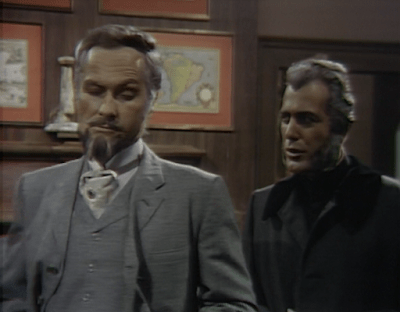
In that year, Barnabas is a vampire again. He keeps saying that his only goal is to prevent the evils that will befall the family in 1969, but he is as uninhibitedly murderous as he ever was in the periods when he was unambiguously a villain. In Friday’s episode, he murdered one of the principal members of the Collins family, prankster Carl Collins, uncle of the Jamison Collins whose daughter and son are the adults at Collinwood in the 1960s. Barnabas had become so careless after so many killings that he left Carl’s body propped up behind the curtains in the windows of the drawing room, where it fell into plain view moments after Barnabas’ foe the Rev’d Gregory Trask entered. In this episode, Trask enlists Edward Collins, brother of Carl and father of Jamison, to help him hunt Barnabas.

My wife, Mrs Acilius, points out that when we see a character closing the doors to the drawing room, that person is in charge of the house. So in the early months of the show matriarch Liz was the one to close the doors; when Liz was taken to a hospital and her daughter Carolyn was in charge, Carolyn closed the doors. When Vicki was fully in command of the campaign against Laura, she closed the doors to consult privately with her lieutenants. When Trask and Edward go into the drawing room to discuss the situation, it is Trask who closes the doors. Vicki was good, so consistently so that she had to be written out of the show months ago. But Trask is overwhelmingly evil. That he has ascended to the rank of door-closer means that virtue has no stronghold anywhere.

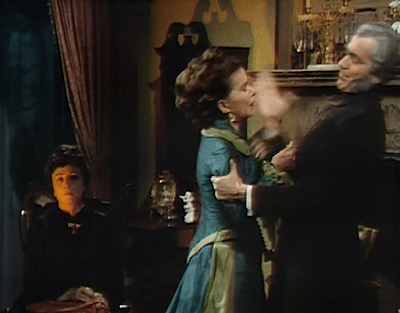
Edward and Trask go to the Old House on the estate, where Barnabas has been staying. They find Barnabas’ reluctant sidekick, broad ethnic stereotype Magda Rákóczi. Magda denies that Barnabas is in the house and pretends not to know what Trask and Edward are talking about when they say that Barnabas is a vampire. Trask slaps Magda in the face; we have seen many face-slaps on Dark Shadows, but so far as I can recall this is the first delivered while the slap-ee has her back to the camera. Since he does not have to swing his hand very close to Grayson Hall’s face, Jerry Lacy can therefore put full force into the gesture, making it look like Trask is delivering a truly brutal blow to Magda. Afterward, Magda rubs her face and vows revenge on Trask. She quotes a rather confusing “old gypsy saying”: “Walk fast and the Devil will overtake you; walk slow and misfortune will catch you. You’d better not walk slow, because I will never be far behind.”

Edward and Trask search the Old House and find nothing. At dusk, Barnabas emerges from the secret room behind the bookcase in the front parlor. Magda hadn’t thought to look there, and Trask and Edward didn’t know the room existed. Barnabas says he will have to find a new hiding place for his coffin. Magda says she will do whatever she can to help him. Barnabas is surprised at her support for him; after all, he has bitten and enslaved her husband Sandor, and his destruction would mean Sandor’s restoration. Magda has an atypical moment of speechlessness, after which she says that Trask is an “animal” and must be punished at all costs.

Trask and Edward went back to the main house early in the morning to look for the plans to the Old House. It apparently took them all day to find them. By the time they have gone through them and identified all of its secret rooms, Barnabas is already up. They come back to the Old House and find the empty coffin in the secret room. Trask says that he will make the coffin “unusable” for Barnabas before daybreak. He leaves Edward, who is carrying a gun loaded with silver bullets, to guard the house.

Barnabas goes to one of his blood-thralls, Trask’s daughter Charity. He tells Charity that he is “in serious trouble” and commands her to go to the basement of the Old House. There, she will find some soil from his original grave, which he needs to prepare his new resting place. He tells her about a tunnel from the beach to the basement which she can use to elude detection by Edward. Since Barnabas has just materialized in Charity’s room and will shortly materialize in the secret room in the Old House while Edward is standing on the other side of the bookcase, we wonder why he can’t use that same power to get into the basement himself.

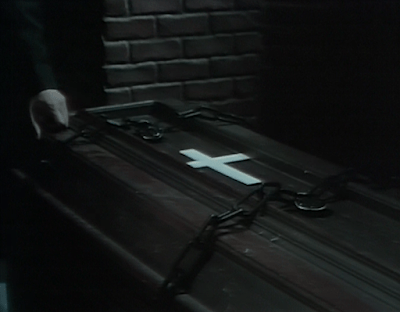
Barnabas finds that the coffin is topped with a cross. He can’t get close enough to take hold of the coffin and move it, so presumably even after he gets the soil he needs he will have to plunder a mortuary showroom to get a fresh resting place before dawn.

The unusable coffin. Screenshot by Dark Shadows Before I Die.

Charity does go to the basement. She puts some soil in her purse, then knocks over a crate, attracting Edward’s attention. She does not run away, but merely hides in an alcove until Edward comes down, sees her in shadow, and orders her to show herself.

Episode 774: Sometimes people change their roles in life

Tim Shaw, uptight teacher turned victim of brainwashing turned fugitive murder suspect, makes his way into an abandoned root cellar. He finds a coffin there. Naturally, he opens the coffin. That’s what everyone does on Dark Shadows when they find a coffin where one shouldn’t be. You meet the most interesting people that way.

Tim finds that the coffin is empty, and goes into a dark corner to hide. Someone comes to the door, and Tim gets up to greet whoever it might be. He hasn’t been a fugitive very long, and hasn’t quite perfected all the skills that the status calls for.

Tim sees Dirk Wilkins, a dimwitted servant of the ancient and esteemed Collins family who has been missing for several days. Tim calls out “Dirk!” This is the first time we learn the two men know each other. They are unlikely to have been friends. Tim rarely left the school where he worked. The school has been housed in a building on the Collins family’s estate for several weeks, so it makes sense that he and Dirk would have met, but Dirk has been unpleasant to everyone we have seen him with, including his employers and pretty girls he wants to attract. It is hard to imagine the painfully shy Tim befriending him.

Dirk turns out to be a vampire, and he bites Tim. We then cut back to the school. The headmaster, the overwhelmingly evil Gregory Trask, is browbeating Tim’s fellow teacher and onetime girlfriend, neurotic intellectual Rachel Drummond. Returning viewers will recall that Trask has made flagrant passes at Rachel, and also know that Trask conspired with a local Satanist to cast a spell on Tim which caused him to kill Trask’s wife Minerva. Trask is pretending to be upset about Minerva’s murder and to believe that Rachel plotted with Tim to commit it. He tells Rachel that if she does not leave the school, he will accept that she is innocent. She goes to her room, distraught. Later in the episode, Trask will telephone his co-conspirator, gloating that the authorities are on their side.

Spinster Judith Collins, sole proprietor of all her family’s great wealth, shows up to offer her condolences to Trask. They find that Rachel is gone, and he tells her that she must have gone with Tim. Trask realizes that Tim and Rachel have no money, and wonders if there is anyone who might give them enough to allow them to flee the state. Judith says that her distant cousin Barnabas Collins, who is currently staying at the Old House on the estate, is very fond of Rachel and that he might give them some money. She says that she will get in her carriage and go to the Old House before Rachel can get there. She will tell Barnabas about the murder and about Tim and Rachel’s involvement in it, thereby ensuring that he will not give them any money.

Judith consoles he new widower. Screenshot by Dark Shadows Before I Die.

Judith knocks on the front door of the Old House and gets no answer. She enters, and finds the house empty. She is still in the front parlor when Dirk enters. She chastises him for staying on her property after she dismissed him, and tells him she will call the police if he is not gone within 24 hours. He walks towards her, backing her against the wall and ignoring her demands that he let her leave. He says that he is no longer her servant, but that she will soon be his. He bites her.

Judith was right when she told Trask that Rachel would go to the Old House. Rachel does go there. She peeks in the window, sees Judith sitting in a chair, and scurries off. This is rather an odd moment- Judith told Trask just a few minutes before that she would go to the Old House in her carriage. It seems unlikely that she drove her own carriage and there is no driver waiting outside, but even if if she did the carriage must still be sitting there in full view. How did Rachel fail to notice it?

Trask comes to the Old House and tells Judith he wanted to offer her his support in her conversation with Barnabas. Trask knows how fond Barnabas is of Rachel, and may well suppose that he would want more details about Minerva’s death than Judith could offer before he agreed to regard Rachel as a criminal. Judith says Dirk’s name when Trask enters, and when Trask notices the bleeding wounds on her neck he quickly realizes that Dirk inflicted them.

We cut back to the root cellar, which we see Rachel entering. She sees the coffin, and of course opens it. That’s just good manners. She turns, and sees Dirk in the entryway.

In his post about this episode at Dark Shadows Every Day, Danny Horn transcribes a conversation among Roger Davis, Jerry Lacy, and director Lela Swift captured on video when the three were on a panel at a convention:

Roger Davis:  I do remember being very excited when I got to be a vampire on the show, so excited, and the first person that I got to bite was Joan Bennett, and I was so enthusiastic and excited I knocked her over — flat on her back!

Jerry Lacy:  I remember when you did it, it was rehearsal in the morning.

Roger:  Was it?

Jerry:  Yeah. You grabbed her, and you bit her, and then you just threw her. And she was already sixty years old then.

Lela Swift:  Then we had to pick Joan up and put her together again.

Danny Horn, “Episode 774: What’s Up, Dirk,” posted at Dark Shadows Every Day, 21 November 2015.

To which my comment is, fuck that guy. I don’t make a habit of swearing, but there are not enough curse words in the language to express my reaction to Mr Davis chortling through his reminiscences of physically abusing his female scene partners. He can fuck off straight to hell.

This story gives an extra dimension to the scene between Judith and Trask in the Old House. Mr Lacy plays Trask’s relentless evil so effectively that he is difficult to watch; my wife, Mrs Acilius, refuses to watch his episodes this time through the series. It usually makes a viewer’s skin crawl to see Trask posing as a representative of something good. But knowing that behind Trask in the position of standing by Judith after she had been attacked by Dirk was Jerry Lacy standing by Joan Bennett after she had been attacked by Roger Davis, our response is much more complex. After all the times we might have wondered how anyone could fail to see through Trask’s blatant hypocrisy, this time enough of the thoroughly decent humanity of Jerry Lacy peeks through that we can understand why Judith has been so supportive of Trask.

The cast went into makeup after the morning rehearsal. From the looks of Dirk’s fake mustache and artificial pallor, makeup artist Vincent LoScalzo must not have brought his usual enthusiasm to his work when Mr Davis sat in his chair. The mustache in particular is so crudely affixed that it looks like Mr Davis might have done his own makeup today.

Episode 762: You called the Devil, and you got me

In December 1967, Dark Shadows was a costume drama set in the 1790s. In that month it introduced the Rev’d Mr Trask, a witch-hunter from Salem, Massachusetts, came to central Maine* to drive witchcraft out of the village of Collinsport and off the estate of Collinwood. Trask was bad at this job; wicked witch Angelique easily deceived him into blaming well-meaning governess Victoria Winters for her own crimes, leading to Vicki’s hanging and exacerbating the consequences of Angelique’s evil spells.

Now the show has relocated to the year 1897, and a descendant of Trask is among the villains. He is the Rev’d Mr Gregory Trask, and he runs a boarding school along lines dictated by his own sadistic delight in punishing innocent children.

Fans often say that while the original Trask** was a sincere believer who did harm because of his fanaticism, Gregory is a hypocrite who uses a pretense of religion to enable his perversions and his greed. I think the truth is more complicated, and more interesting, than this. In #441, the original Trask found the strangled body of a professionally agreeable lady named Maude Browning in his bed; it had been placed there to frame him for Maude’s murder. Trask’s principles, were he to follow them, would seem to imply that he should go directly to the authorities. If the worst happened and they hanged him, to the extent that he was targeted because of his Christian witness his death would win for him an everlasting crown of martyrdom. But fear got the better of Trask. He enlisted a man named Nathan Forbes to help him hide Maude’s remains, and went on from there to expand his conspiracy to suborn Nathan’s perjured testimony against Vicki. Considering the emphasis the Reformed movement put on the Ten Commandments, Trask could not have been unaware of the sinfulness of bearing false witness against a neighbor.

I think Trask’s fanaticism led him to overestimate the importance of the success of his mission in this world. It is not enough that he will be vindicated in the courts of God; God must be vindicated through Trask’s success in the courts of Massachusetts. Thus it is his very sincerity that turns Trask into a hypocrite. Eric Hoffer’s book The True Believer was one of the most influential publications of the 1960s; Trask, the fanatic-turned-hypocrite, could easily have found a home in its pages.

Gregory Trask is certainly a hypocrite. Today we hear Gregory’s wife Minerva talk about women he has dallied with over the years. Gregory comes upon Satanists Quentin Collins and Evan Hanley in the act of summoning the Devil; Gregory’s response is to blackmail Evan into using his command of the black arts to cast a spell to brainwash hapless schoolteacher Tim Shaw into murdering Minerva. We have seen in previous episodes that Gregory has plans for spinster Judith Collins and her enormous fortune; Minerva’s death, if it can be arranged just so, will leave him well-positioned to marry Judith and become the Master of Collinwood.

Trask tells Evan the price of his silence. Screenshot by Dark Shadows Before I Die.

As his ancestor’s very sincerity turned him into a hypocrite, so Gregory’s hypocrisy occasionally turns him into a sincere believer in his own powers, if not exactly in God. We saw in #735 that Gregory does not take the same pleasure in reading the Bible that he does in leafing through his “Punishment Book,” a ledger which evidently details his abuse of the children attending his school. But he does read it and quote it, and when in #726 he encountered a case of possession, he immediately and with untroubled self-assurance set to work performing an exorcism. The possession was real, and so far as Gregory could tell his exorcism was successful. He reacted to that apparent success with a serenity that betrayed no suggestion that he had ever doubted that he was the right person to cast out the spiritual forces of darkness.

As the original Trask was a stranger to the routine play-acting that makes ordinary social life bearable and therefore gave himself permission to become a party to the most horrendous deceptions, so Gregory wears his mask so tightly that his face grows to fit it. Dark Shadows was often very self-conscious about showing characters who were acting; its greatest success, vampire Barnabas Collins, won over the audience when they saw him trying desperately hard to play the role of a living man native to the twentieth century. In the Trasks, we see men who do not know that they are acting and therefore cannot manage the effect that the parts they play in everyday life have on their personalities.

Gregory does have a tight mental focus on his projects. When he goes to Evan with his blackmail demands, Evan has learned of his eye for the ladies, and is hoping to use that information to lower his price. So his opening gambit is to describe himself as a man who drifts from one idea to another as other men drift from one woman to another. Three times he says the word “woman,” in each case as the last word of a sentence, in each case about twice as loudly as the words before it. Gregory is unimpressed, and Evan realizes he doesn’t have anything definite to use against Gregory. He crumbles and agrees to Gregory’s extreme demand.

Gregory’s academic standards seem considerably less exacting than are his expectations of his co-conspirators. He mentions to Tim today that when he was a young teacher, the first class he ever taught was in elementary Latin. He challenges Tim to translate the words amo, amas, amat; Tim wearily replies “I love, you love, he loves.” “Very good!” exclaims Gregory. Traditionally the first words students learned on the first day of Latin class were amo, amas, amat, amamus, amatis, amant– I love, you love, s/he loves, we love, you (plural) love, they love. “Very good!” would seem to be an outrageously inflated appraisal to apply to someone who has merely recognized the first three of those six words.

Gregory sends Tim to Evan’s house to read a Latin document that has some bearing on a legal matter that has come up in Evan’s work as an attorney. As it happens, I went to graduate school in ancient Greek and Latin at the University of Texas at Austin, and local attorneys would sometimes call our department asking for someone to help them translate Latin they had found in old Spanish legal documents. They would usually refer those calls to the ablest Latinists among us, since the legal Latin used in the Spanish Empire in the days it ruled Texas was rather a specialized form of the language. Tim can virtually speed-read Evan’s document, suggesting that “amo, amas, amat” was not a particularly stringent test of his abilities.

*Maine was part of Massachusetts until 1821.

**Who is never given a first name. One of the Big Finish audio dramas refers to him as “Vilorus Trask” and actor Jerry Lacy once said he thought his name should have been “Orville.” Neither of those sounds like a very plausible name for a junior-grade Puritan divine of the late eighteenth century. So we are left calling him “the original Trask.” My wife, Mrs Acilius, points out that this seems to suggest that Gregory should be “the extra-crispy Trask.” Maybe he will die by fire, as others have done.

Episode 735: Defenseless souls

The highlight of today’s episode is a confrontation between two of Dark Shadows‘ most effective villains.

Laura Murdoch Collins (Diana Millay) was on Dark Shadows from December 1966 to March 1967, when the show took place in a contemporary setting. She emerged from the supernatural back-world behind the action, and at first she was as vague and indefinite as are the beings who lurk out of our sight there. Eventually she took on a forceful enough personality that Diana Millay could display her gift for dry comedy, but that personality was only a mask that Laura wore. The real Laura was something entirely different, unreachable, unknowable. The visible Laura marks the boundary between the world we can hope to understand and one where humans would find no points of reference, no standards of comparison. As such, she represents the danger that we might lose our way and find ourselves in a place where our minds will be useless to us. That is to say, she inspired the fear that comes from a well-told ghost story.

Now the dramatic date is 1897, and another iteration of Laura is the mother of twelve year old Jamison and nine year old Nora. Laura’s estranged husband, the stuffy Edward Collins, and Edward’s sister, spinster Judith, have sent Jamsion and Nora to Worthington Hall, a boarding school which doubles as a particularly cruel cult. Laura’s plans for Nora and Jamison require them to be home on the estate of Collinwood, and so she sets out to release them from Worthington Hall.

The headmaster/ cult leader of Worthington Hall is the vile Gregory Trask (Jerry Lacy.) Trask is at the opposite pole from Laura. She is terrifying because we can never understand her or the realm whose existence she implies; he is an overpoweringly oppressive presence because he is so thoroughly comprehensible. It is perfectly obvious what Trask has done, what he plans to do next, and why he wants to do it, but knowing all that is of absolutely no use in stopping him.

In today’s opening scene, Trask confronted fugitive teacher Rachel Drummond, whom he is extorting into coming back to work at Worthington Hall. He kept sidling up to Rachel and touching her, telling her that perhaps the two of them were destined to change each other. He could not make it clearer that he wants to exploit his power over Rachel to coerce her, not only into returning to her old job, but into a sexual relationship.

Trask has been in a position of authority over Rachel since she was a small child, suggesting that his unrelentingly punitive approach to his students and the undisguised joy he takes in being cruel to them are also sexual in their origin. Rachel even used the word “sadist” to describe Trask the other day, a word coined only in 1892. Someone using it in 1897 would certainly have seen it in its original clinical context, and the neurotic intellectual Rachel undoubtedly understood it very well in its technical sense.

We see Laura on a dark set. She looks at a candelabra. She points at its three candles, one by one. As she points at each candle, it lights. Thus first time viewers learn that Laura is a supernatural being with a relationship to fire.

At Worthington Hall, Nora wanders into a room where a fireplace is alight. Nora can hear her mother’s voice urging her to look into the flames, but cannot see her. She is afraid until she looks into the flames and sees Laura’s face. Nora begins to enter a deep trance. Before she can, a teacher finds her and interrupts her. We cut back to Laura, who is pleading with Nora not to look away from the fire. Nora does, and the candles on Laura’s candelabra go out.

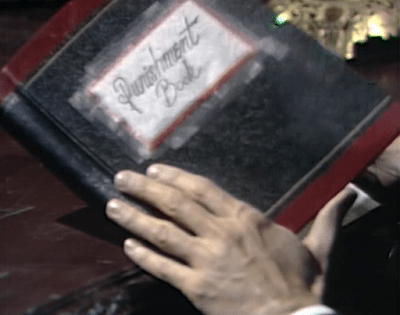
We see Trask in his study, browsing through a Bible. He returns that to his bookshelf and finds more congenial reading. He picks up a ledger and brightens. We see its cover, on which is taped a label reading “PUNISHMENT BOOK.” Trask smiles blissfully and sits down to examine its contents.

The volume that takes Trask to his happy place. Screenshot by Dark Shadows Before I Die.

A knock comes at the door, pulling Trask out of his sun-kissed dream of past cruelties. Irritated, he demands to know who it is, but receives no answer. When the knocking continues, he opens the door and sees Laura.

LAURA: Are there no servants at Worthington Hall? I’m not accustomed to letting myself in.

Longtime viewers will remember that when Laura was first on the show, they made a big deal out of the fact that she never ate or drank. So much so that they had the next uncanny menace, Barnabas Collins, drink a cup of coffee in #221. Even though Barnabas was a vampire and Laura was not, they had used up the traditional indicator of vampirism. non-consumption of food or drink, on Laura. Laura’s inability to open the door herself may be another borrowing from the same stock of imagery, from the idea that the vampire cannot cross a threshold without being invited.

TRASK: Who are you?

LAURA: I am Laura Collins and I come for my children. You are Mr. Trask, of course.

TRASK: Reverend Trask!

LAURA: Anyone can call themselves anything. I knew a woman in Brooklyn, once. Insisted she was a countess.

This is an inside joke. There was quite a well-known fashion correspondent-turned-executive in Brooklyn in 1969 named Mabel Wilson Gross. Mrs Gross’ first husband was a Danish nobleman named Count Carl Adam von Moltke, known to his friends as “Bobby.” Mrs Gross was known professionally as “Countess Mab Moltke.” She and “Bobby” were the parents of Alexandra Moltke Isles, who appeared in 333 episodes of Dark Shadows as well-meaning governess Vicki. I don’t believe Mrs Isles has ever used the title “Countess” herself, though under the laws of Denmark she would have the right to do so. Since it was Vicki who led the battle against Laura in 1967, a remark from Laura twitting Mrs Isles and her family might raise quite a laugh from longtime viewers who get the reference.

LAURA: (Goes to Trask’s desk and leafs through the “Punishment Book.”) But you are Trask. Yes, there’s no doubt about that.

TRASK: But you could be anyone as far as I’m concerned, anyone at all. I have too much respect for the defenseless souls in my charge.

LAURA: Oh, please, don’t be dreary.

TRASK: Dreary, Madam?

LAURA: Surely you know the word. Simply have my children brought down here, if there’s anyone to bring them.

TRASK: And how am I to know that you are their mother?

LAURA: Oh, what a trusting man you are.

TRASK: There is no question of the children leaving the school.

LAURA: Jamison possibly. Nora will leave here tonight. I’m willing to take them one at a time.

TRASK: As far as I know, Madam, their mother is away.

LAURA: You should keep more in touch.

TRASK: My wife returned from Collinwood this afternoon. She made no mention of your return.

LAURA: Hmm. How odd. I thought her a great gossip.

TRASK: Minerva? Madam.

That Minerva appeared to be “a great gossip” will also amuse longtime viewers. She is played by Clarice Blackburn, who in the parts of Dark Shadows set in the 1960s played housekeeper Mrs Johnson. After a brief period in which Mrs Johnson was supposed to be a spy planted in the house by an enemy of the Collins family, she settled into the role of a benevolent but excitable woman whose chief function was to blab everything she knew to the character likeliest to use the information to advance the plot.

LAURA: Now, will you have Nora sent down.

TRASK: I will not. Not without proper orders from Miss Judith Collins or Mr. Edward Collins. I shall call Collinwood and verify your strange appearance.

LAURA: Do.

(TRASK picks up the telephone receiver. Shows pain and drops it.)

LAURA: What’s wrong, Mr. Trask?

TRASK: It burned my hand.

LAURA: I’ve always thought the telephone an instrument of the devil, haven’t you?

TRASK: I have not!

Many times on Dark Shadows, as recently as this week, we have seen men forcibly intervene to stop a woman from talking on the telephone. I believe this is the first time we have seen a woman turn the tables and do this to a man.

TRASK: What a ridiculous conversation. I don’t know what I could have been thinking of to call Mr. Edward Collins. We have rules at Worthington Hall, Madam.

LAURA: Ah, rules are made to be broken.

TRASK: Not here. The children are asleep. They shall remain asleep. We do not encourage visits even from members of the immediate family unless of course it’s an emergency.

LAURA: Then you won’t reconsider?

TRASK: No.

LAURA: Not wise. Not wise at all.

TRASK: Are you threatening me?

LAURA: My children will not spend one more night in this school.

Laura remains perfectly calm throughout this conversation. Even her closing threat is delivered in a light tone, with an easy smile. Trask is agitated at the outset, and becomes ever more so as he realizes he cannot intimidate Laura. Since Diana Millay and Jerry Lacy are two of the most capable comic actors on Dark Shadows, the result is hilarious.

We first saw the effect of Laura’s imperturbability on an earnest interlocutor in #183 and #184, when she confronted a profoundly different character. In those installments, visiting parapsychologist Peter Guthrie called on Laura at the same cottage where she is staying in 1897. He introduced a new word to Dark Shadows‘ lexicon when he told her that he had concluded that she was “The Undead.” He said that he knew of her evil intentions, and said that if she abandoned them and turned to good, he would make every effort to help her live a different kind of life. Guthrie’s offer meant exactly nothing to Laura, and she responded to it with the same sardonic indifference Trask elicits from her today. Her next act was to cast a spell that caused Guthrie to crash his car and die in a ball of flame.

Trask gets off easier. Laura just sets his school on fire. The closing shot shows Nora apparently surrounded by flames. Laura does not want to burn Nora to death, at least not yet, but she is not one of your more detail-oriented otherworldly menaces. It will not surprise longtime viewers that she is blithely assuming that her children will somehow escape alive from the blaze she has started.

Episode 727: The lost lamb

Well-meaning time-traveler/ bloodsucking abomination from the depths of Hell Barnabas Collins has found himself in the year 1897, where he must take action to prevent his distant cousin Quentin from becoming a malevolent ghost who will ruin everything for everyone on the estate of Collinwood in 1969. He has no idea what that action will be, so has decided to intrude as aggressively as he can in as much of the family’s business as he can until something turns up.

At the moment, Barnabas is strenuously trying to keep Judith Collins, the mistress of Collinwood, from sending her twelve year old nephew Jamison to a boarding school called Worthington Hall. Worthington Hall is run by the Rev’d Gregory Trask, a descendant of one of Barnabas’ old nemeses. Yesterday, Trask had an unsettling encounter with Jamison during which the camera dwelt heavily on Jamison’s nervous habit of fiddling with his belt, prompting us to wonder why Trask gives Jamison the feeling that he ought to make very sure he remains fully clothed.

Today, Trask’s daughter Charity shows up. Nancy Barrett, who previously played the sometimes-capricious, always likable heiress Carolyn and the fragile, highly comic heiress Millicent, makes Charity just as imposing a heavy as her father.

Jamison’s governess, neurotic intellectual Rachel Drummond, tells Barnabas that she was a student at Worthington Hall for many years, and that the place was gruesome. The Trasks kept the children separated from one another, locked them in cupboards for weeks on end when they incurred their displeasure, and generally exploited and abused them. She herself was forced to stay at the school as a teacher when Trask lied to her and claimed that she owed him money, and she escaped with the aid of a fellow sufferer.

Trask confronts Rachel in the drawing room. She tries to stand up for herself, but he breaks her resistance down expertly. Trask’s one moment of weakness comes when he starts talking about Rachel’s lovely hair, and he suddenly turns away. The mask has slipped, and the audience has seen that Trask’s interest in Rachel is sexual. But Rachel is too intimidated to recognize what has happened, and when he resumes his righteous tone she crumbles. When she next sees Barnabas, she rushes away in tears.

Rachel is terrified by Trask. Screenshot by Dark Shadows Before I Die.

Rachel had another traumatic experience over the last few days. Quentin died, turned into a zombie, and abducted her. No one has given her the news yet, but Quentin came back to life yesterday. She is horrified when he comes into the drawing room and sees Quentin. At first he takes on a lumbering gait, and she screams. Then he laughs and starts walking normally. He explains what happened, as best he can, and they have a strangely pleasant conversation. Again, this is a testament to the high quality of the acting. It is hard to imagine that anyone less charming than David Selby could make us believe a woman would be so comfortable with Quentin after what Rachel has been through.

Barnabas takes on the form of a bat and bites Charity in her bedroom. Presumably he does this so that he can use her as an agent against her father. This raises the question of why he didn’t just bite Trask and put an end to the whole thing. Of course, the real-world explanation is that the writers wanted to keep the story going, but usually they take care to maneuver Barnabas into a situation where he is compelled to bite one person rather than another. So it’s rather sloppy to end the episode this way.

Still, this is a very good installment. Too good for some viewers; my wife, Mrs Acilius, refuses to watch the Gregory Trask episodes, because Jerry Lacy plays him so effectively that it ruins her day to spend half an hour in the presence of such an overpowering evil. Kathryn Leigh Scott brings Rachel’s self-doubts and final defeat vividly to life as well. By the time I got to the end of their scene, I was shouting at the screen “Bring back the zombies and werewolves and witches!” So I cheered when Barnabas bit Charity.

Episode 726: A boy’s dislike

When Dark Shadows began in June 1966, strange and troubled boy David Collins (David Henesy) was frantically afraid that he would be sent away from the great house of Collinwood. In #10, David overheard his father Roger (Louis Edmonds) telling his aunt Elizabeth Collins Stoddard (Joan Bennett) that they ought to do just that. As the owner of the house and holder of all the family’s wealth, it is up to Liz to make the decision. Hearing his father press to send him away, David responded by sabotaging the brakes on Roger’s car, nearly killing him.

Roger told Liz that David belonged in an “institution,” but David was just as terrified when it was suggested that he might go to an ordinary school. It was not entirely clear why he had this attitude. David and Roger had only lived in the vast gloomy house for a few weeks when the show started. Roger openly hated David, as did Liz’ daughter Carolyn. Liz loved him, but as a recluse and an aging grande dame had little in common with a young boy. Moreover, David hated his governess, the well-meaning Vicki, as much as he could hate any school. His mother, who did not live in the house and whose name was in those days was never to be mentioned there, was the only person for whom David expressed fondness; when in #15 David watched Roger drive off in the car whose brakes he had sabotaged, we saw him standing by himself, saying “He’s going to die, mother. He’s going to die!” So it is difficult to see why David was so intensely committed to staying at Collinwood.

Today, we see a suggestion that David may have been influenced by an ancestral memory of bad times at a boarding school. It is 1897, and David’s grandfather Jamison Collins (David Henesy) is twelve. Jamison’s father Edward (Louis Edmonds) has asked the Rev’d Mr Gregory Trask to come to Collinwood to urge his sister, Judith Collins (Joan Bennett,) to send Jamison and his nine-year old sister Nora to be students at Worthington Hall, a boarding school Trask runs. As the house’s owner and holder of all the family’s wealth, it is up to Judith to make the decision.

Trask wins Judith’s confidence by performing a ceremony after which Jamison and her brother, Jamison’s uncle Quentin, are restored to themselves after a spell that had made Quentin a zombie and put his spirit in possession of Jamison. Recently arrived, thoroughly mysterious distant cousin Barnabas Collins sputters with rage at the very sight of Trask, and exasperates Judith with his insistence that Trask is evil. Judith does not trust Barnabas, and Barnabas’ inability to either explain or contain his hostility only confirms her favorable judgment of Trask.

Once Quentin and Jamison are themselves again, Trask sends Barnabas and Quentin out of the drawing room. Quentin raises his eyebrows in response to Trask’s order and asks his sister “Are you sure you’re still in charge of this house, Judith?” She does not respond.

Judith makes a remark about Quentin’s influence on Jamison, saying that “He’s been like this ever since [Quentin] came home.” Since Jamison was just freed from possession a few minutes before, it is unclear what she could mean, and Jamison objects “That’s not true!” Trask unctuously replies “Now, your aunt does not tell lies, Jamison.” Returning viewers know that Judith lies constantly. Nor is Trask unaware that Judith is less than perfectly truthful. When he first arrived in Friday’s episode, Judith and Barnabas tried to conceal the situation with Quentin and Jamison from him, and she told a series of lies in pursuit of that objective.

When Jamison continues his attempts to tell the truth, Trask silences him with “Now, there is only one who is constantly right, Jamison, and He is not on this earth, but above. Now, I want you to go out into the hall and consider all the wonderful things your aunt has done for you recently. I am sure you will have much to think about.” Jerry Lacy brings such an inflexible authority to Trask’s personality that we cannot imagine a rebuttal to this sanctimonious little speech. We share Jamison’s helplessness and frustration.

Alone with Trask, Judith agrees to let him take Jamison and Nora to Worthington Hall. Jamison barges back in and declares that he will not go. Trask assures him that he will not take him unless he is willing to go. He then obtains Judith’s permission to talk with Jamison alone in his room.

While Jamison is taking Trask upstairs, we cut to the study. Quentin and Barnabas are alone there. Quentin asks Barnabas if Trask really was his “savior.” Barnabas replies “Apparently.” Quentin asks Barnabas what he thinks really happened; he sidesteps the question. Quentin keeps probing for Barnabas’ interpretation of his recent experience; Barnabas alludes to Quentin’s adventures in Satanism, saying “You dabble in odd things, perhaps one of your interests resulted in this.” Quentin observes that this is “Delicately put,” and goes on to remark on “what an interesting life” he has had.

Barnabas then takes his turn as the questioner. He asks Quentin about his wife, a tall, beautiful, homicidally crazed woman named Jenny who is being held prisoner somewhere in the house. Quentin grows tense, and does not give direct answers. He explodes at Barnabas, saying that he has no interest in making a friend of him. Barnabas observes that he has in fact made an effort to turn him into an enemy; Quentin interjects “Your fault!” Barnabas says they could be useful to each other; Quentin exclaims “Wrong!” When he thinks of Barnabas, Quentin says, only one question comes to mind- “What does he want from me?”

Jonathan Frid said that his favorite scene in Dark Shadows was one he had with Anthony George in #301. Barnabas tells local man Burke Devlin that their relationship to each other is like that of “two superb swordsmen with highly sharpened blades. You thrust, and I parry. I thrust, you parry.” That scene has never impressed me. The Barnabas/ Burke conflict did not have enough grounding in the story to come to life, and having the characters tell the audience that they were like “superb swordsmen” does not make it so. But this showdown really does pay off. Barnabas and Quentin are the show’s two great breakout stars, and we are in the middle of a long run of episodes where everything works. This scene brings out all the values they might have hoped that Burke and Barnabas’ confrontation would put on screen when they planned it.

We return to Jamison’s room, the same bedroom David Collins occupied in the 1960s. Trask is still being friendly. When Jamison says that he would miss his pony if he had to go away to Worthington Hall, Trask says “You must bring him with you!” When Jamison refuses to tell Trask his pony’s name, the friendliness vanishes. Trask darkens, tells him “You’re going to have to learn to answer questions, boy,” and insists they pray together. When Jamison resists, Trask tells him that he must change his ways lest he go on being a disappointment to his father. Jamison protests that his father loves him, and Trask asks incredulously “Does he?” He asks Jamison if he wants his soul to be saved. Jamison can’t very well say anything but yes to that, and so Trask says “Then I think I can help you.” Jamison is trapped.

After a scene in the drawing room where Quentin demands Judith tell him where Jenny is locked up, we return to Jamison’s room. The scene begins with a closeup of the rope belt of Jamison’s robe. Jamison is retying it. He keeps fiddling with it, perhaps a nervous habit, but it is the first thing we see and they hold the shot for a long time. We cannot but wonder whether the belt was untied at some point while Jamison and Trask were alone off camera.

Jamison fiddles with his belt.

Trask orders Jamison to tell Judith that he wants to go to Worthington Hall; Jamison says he will not. The dialogue does not explain how Jamison’s robe came undone, and neither he nor Trask seems concerned with the matter. Their blasé attitude turns an uncomfortable image into a lingering mystery.

In the drawing room, Trask announces to Judith that Jamison has something to say. Jamison says that Trask threatened him and tried to make him lie. Trask says that Judith will have to find another school for him, and she declares that she will not. Jamison will go to Worthington Hall.

Trask exits. Jamison finds Quentin and asks him to help him escape the grim fate in store for him. Quentin promises to do so, and by the end of the episode Jamison will be safely hidden somewhere in the house. Meanwhile, Barnabas throws a fit before Judith, saying that he cannot understand why “You would believe that maniac before you believe Jamison.” Judith scolds him and tells him to treat Trask with respect.

Trask returns. Barnabas asks him if his family is from Salem, Massachusetts. Trask affirms that it is so. Barnabas claims to have seen ink drawings of a Rev’d Trask who was at Collinwood in the 1790s; Trask says that he was his ancestor. He says that the earlier Rev’d Trask disappeared shortly after leaving Collinwood, and that his disappearance was never explained.

Longtime viewers know that Barnabas is a vampire who lived in the 1790s, and that the original Trask is one of those he blames for the many misfortunes that befell the family in those days, including his own transformation into a bloodsucking abomination. We remember the first Trask as a case study of a type much on people’s minds in the 1960s, Eric Hoffer’s “True Believer.” That Trask was so deeply and unshakably convinced of his own understanding of the situation around him that when he set out on a witch hunt, the real witch was easily able to manipulate him into doing her work for her. Barnabas murdered the original Trask in #442 by bricking him up in an alcove, one of the most famous moments in all of Dark Shadows. He seems pleased to hear that people are still wondering what became of the late witchfinder.

Gregory Trask seems to be a different sort. He can change his tune in a way that his forebear never could, putting on a friendly mask when it serves his interests to do so. While the original Trask was single-mindedly trying to live up to his own twisted idea of virtue, the second sometimes responds to bad news with a delighted grin, suggesting that he sees an opportunity to profit from it. The first Trask’s fanaticism sometimes led him to hypocrisy, when he thought that his ends were so good that they justified dishonest means, but this Trask seems to be a hypocrite who has kidded himself into acting like a fanatic. Mr Lacy’s performance makes him a formidable presence; the writers have made him a powerful adversary.

Episode 578: The misplaced

Nancy Barrett was taken ill not long before shooting began for this episode, and she was replaced in the role of Carolyn Stoddard by Diana Walker. Miss Walker had her sides letter perfect; her only flub comes when she delivers a line in a level conversational tone, and a moment later has to apologize for shouting. She doesn’t seem to have much idea of what was going on in the story, though. Her Carolyn is a calm, practical-minded homemaker of the sort you might find on another daytime soap of the period, not someone who is keeping a stray Frankenstein’s monster in the spare room. Besides, Miss Barrett is probably Dark Shadows’ most reliably entertaining performer, an impossible act for anyone to follow.

Diana Walker wonders where she is. Screenshot by Dark Shadows Before I Die.

Aside from the two actors who at various times filled in for Vince O’Brien in the famously disposable role of Sheriff Patterson, I believe Miss Walker is the only person to have served as a substitute for a temporarily unavailable cast member. Many times, the makers of the show went out of their way to rearrange the shooting schedule or rewrite scripts to avoid substitutions. Many of the show’s fans were extremely young and extremely intense, so I suspect Miss Walker’s mail after this appearance would have included some ugly items that would have confirmed the producers in their reluctance to call up the reserves.

Today is the last time we see Jerry Lacy as lawyer Tony Peterson. Mr Lacy will be back in other roles. In 1969 and 1970, he and Diana Walker were reunited in the original Broadway cast of Play It Again, Sam, in which Mr Lacy scored a triumph with the same Humphrey Bogart imitation that is the basis of Tony’s character, while Miss Walker played Sharon and understudied Nancy.

Episode 523: Back to Hell, from whence thee came!

The first episode of Dark Shadows, broadcast on ABC-TV on 27 June 1966, was a moody, atmospheric Gothic drama, characterized above all by its hushed tone. For months afterward, the show was almost an essay on the theme of quietness. Now we come to the second anniversary of that premiere, and quietness is the last thing we hear.

This installment marks the final farewell of the show’s single loudest character, revenant witchfinder the Rev’d Mr Trask. In #519, Trask performed an exorcism on the witch variously known as Angelique Bouchard Collins and Cassandra Blair Collins. The exorcism seemed to be a great success; it ended with Angelique/ Cassandra vanishing into thin air, and she has not been seen since. That might have left someone watching Dark Shadows for the first time with the impression that it is a specifically Christian show and Trask is one of its heroes.

Today, they take steps to correct that impression. A man calling himself Nicholas Blair and claiming to be Angelique/ Cassandra’s brother has turned up on the great estate of Collinwood. In the basement of the Old House on the estate, he finds Trask’s skeleton. He conjures Trask up and interrogates him. Trask declares Nicholas to be a tool of the devil. Regular viewers know that this is something Trask says to all the fellas, but this time he is obviously correct. He goes into the same exorcism rite that produced such spectacular results with Angelique/ Cassandra. Nicholas simply turns around and gives him a sarcastic little round of applause. Nicholas keeps making demands of Trask. Trask takes a cross from under his cloak. Nicholas recoils from that. Trask vanishes, but his skeleton is still missing, suggesting that he has not found peace.

Trask draws his secret weapon. Screenshot by Dark Shadows Before I Die.

That Trask’s exorcism worked on Angelique/ Cassandra but not on Nicholas suggests that it is not a means through which God acts in the world, but is just another magical weapon that can be wielded with greater or lesser effect depending on the skill and strengths those involved. His loyalty to “THE ALMIGHTY!!!” has given Trask enough power to defeat Angelique/ Cassandra, but Nicholas ranks higher than she does in the hierarchy of “THE DE-VILLL!!!,” high enough that Trask’s mumbo-jumbo cannot reach him. The cross has its effect, but with that Trask is setting aside his own efforts and calling directly on the boss. Nicholas is quite certain that he can undo the effects of the exorcism, so for all we know, he might be able to call his own home office for help sufficient to overcome his aversion to the sign of the cross.

The show not only puts Christianity and the spiritual forces of darkness on a par as sources of magical power, they aren’t even the only such sources. Though we don’t hear about any of them today, scientists and doctors Peter Guthrie, Julia Hoffman, Eric Lang, and Timothy Eliot Stokes apparently acquired supernatural abilities along with their advanced degrees. We even know that Guthrie was a professor of psychology at Dartmouth College. So the Dartmouth Department of Psychological and Brian Sciences joins Christianity and diabolism as reservoirs of uncanny might.

In the great house on the estate, heiress Carolyn Collins Stoddard tells Nicholas that Angelique/ Cassandra alienated the Collins family by her dalliance with local attorney Tony Peterson. Nicholas goes to the village of Collinsport and calls on Tony, whom he realizes Angelique/ Cassandra ensorcelled into serving as her cat’s paw. Angelique/ Cassandra put Tony into a trance by having him strike his cigarette lighter; Nicholas achieves the same effect by opening his cigarette case. Tony really needs to stop smoking.

When he first sees Tony, Nicholas is stunned by his resemblance to Trask. They are both played by Jerry Lacy, and Angelique/ Cassandra told him that she chose him because he reminded her of her old acquaintance. We already know that there is a mystical connection between Tony and Trask; Tony was the medium through whom Trask spoke at the séance which led to his return to the world of the living. While he has Tony entranced, Nicholas extracts information from him that only Trask could have known. This suggests a notion of reincarnation that would have reminded viewers of what many of them probably thought Hindus and Buddhists believed, and would thus suggest a syncretistic approach to religion that would represent another step away from the Sunday-morning flavor that the ending of #519 might have left.

We return to the great house. Well-meaning governess Vicki opens the front door and finds her boyfriend, an unpleasant man named Peter who prefers to be called Jeff. With this, a Christian world-view is pushed still further into the background, as a scene featuring Peter/ Jeff is enough to make anyone doubt the existence of a just and loving God.

Vicki and Peter/ Jeff talk about various events that don’t have anything to do with the show. He paws her awkwardly, and his hands dart to her neck as if he were about to strangle her. While he is out of the room for a moment, Trask materializes and tries to warn Vicki that “THE DE-VILLL!!!” is nearby. Before he can tell her that it’s Nicholas she should be worried about, Peter/ Jeff comes back in and starts yelling. At the sight of Peter/ Jeff, Trask wrinkles his nose and fades into nothingness, never to be seen again. Peter/ Jeff probably got a lot of that.

Episode 519: Poor suffering servant of Satan!

Roger Collins is on the telephone in the foyer of the great house of Collinwood. He is assuring the caller that it will be fine if Maggie, whom returning viewers know to be The Nicest Girl in Town, comes to stay. He says that he and Cassandra will be glad to have her for as long as she wants to be with them, and that he is sure Liz will approve. First time viewers thus learn that Roger has a wife named Cassandra, and that they live as guests in a house belonging to someone called Liz. A moment later, Liz enters, and is too distracted to hear anything Roger says to her.

Roger ends the phone call, and follows Liz into the drawing room. She stares out the window and makes a gloomy remark about death. He says he understands she must be very upset about Sam Evans. Returning viewers know that Sam was Maggie’s father, and that he died in yesterday’s episode. Roger goes on about how it is natural to be grieved at the loss of a friend like Sam, but soon learns that Liz’ mood has nothing to do with Sam’s demise- it’s news to her that he is dead.

Roger’s lines will startle longtime viewers. For the first 40 weeks of the show, Roger and Sam were united by a deep and abiding mutual hatred, and since then they have had no contact at all. Roger’s words about Sam as a family friend are so far from what we have previously seen that they should be considered a retcon.

Liz and Roger spend several minutes in the drawing room. She keeps going on about the all-pervasive reality of death, and he keeps urging her to see a doctor. There isn’t much to their lines, but Joan Bennett and Louis Edmonds were such extraordinary screen performers that it’s always fun to watch them together. This scene might be a particular pleasure to longtime viewers, who have rarely seen Roger as the responsible adult in any encounter.

We dissolve to a bedroom where a young woman in a black wig is sifting through some powders, looking directly into the camera, and telling Liz that her obsession with death will become even worse than it already is and will have dire consequences. Liz will believe that she is someone else, a woman who lived and died in another century, and may die by the same poison that killed that person.

There is a knock at the door. It is Roger. The woman hides her powders and lets him in. He addresses her as Cassandra and asks why the door was locked. Thus first-time viewers learn that she is his wife, that this is their room, that she is a witch, and that Liz’ problem is the result of a spell she has cast.

Cassandra tells Roger that she locked the door because David kept pestering her about Sam’s death and she wanted a moment to herself. With that, first-time viewers find out that David is Roger’s son, that Cassandra is his stepmother, and that she expects Roger to consider locking him out of the room an appropriate response to his grief about Sam.

Roger does not so consider it, and is bewildered by what Cassandra tells him. He tells Cassandra that Liz is in a bad way, and he is worried about her. Cassandra says she did not know that Roger was so concerned about his family. Baffled by this, Roger says that of course he is concerned, Liz is his sister. This tells first time viewers both what Roger’s relationship to Liz is, and that Cassandra has so little sense of family that she cannot imagine how other people feel.

Regular viewers will learn more. In the first year of the show, Roger’s keynote was his lack of loyalty to the family. That has now been set aside once and for all, and his normal attachment to his son and his sister provide a contrast with Cassandra’s apparently sociopathic coldness. Further, we saw a great deal of Cassandra from November 1967 through March 1968, when the show was a costume drama set in the 1790s and she was called Angelique. We saw then that Angelique had no conception of family or friendship, and that her idea of love begins and ends with her control over a person.

Cassandra promises to join Roger downstairs for a game of bridge in half an hour. He leaves, and she gets back to work spellcasting. As she does so, a figure in a black cassock materializes behind her. She turns, and the figure vanishes. In a quizzical tone, she says Roger’s name, revealing that she did not see the figure or realize that it is a supernatural presence. Together with her locking the door, scrambling to hide her magical paraphernalia when Roger knocked, lying to cover what she was doing, and failing to understand what a person with a reasonable amount of human empathy would consider acceptable behavior, her puzzlement shows that whatever her powers may be, they have definite limits.

Back in the foyer, another young woman with black hair lets a man into the house. She calls him Joe, and he calls her Vicki. Joe and Vicki talk about Sam’s death and about Maggie. Joe says that he wants to marry Maggie as soon as possible and to move away. Vicki is all for their marriage, but does not want them to go. Joe talks about how close he and Sam were. Longtime viewers will remember that when Sam and Roger were enemies, Sam was the town drunk. Even then, Joe was always happy to help him in whatever way he could, and did not see his condition as any obstacle to marrying Maggie.

Liz enters and angrily addresses Joe as “Lieutenant Forbes.” Joe has never heard of Lieutenant Forbes, and cannot understand why Liz, who knows him well, would not recognize him. Vicki clearly does know who Liz is talking about, and manages to calm her down. After Liz apologizes and hastens away, Vicki answers Joe’s questions only by saying that Forbes is someone from “the past.” Since we heard Cassandra talk about Liz taking on the personality of someone who lived in “another century,” this suggests that Vicki, too, has an unnatural familiarity with that same century.

Joe wants to go upstairs to the room where Maggie is sleeping so that he will be the first person she sees when she wakes up. Vicki is about to lead him to Maggie when Cassandra insists she join her in the drawing room to talk about David. Vicki tells Joe which door to open, and complies with Cassandra’s directions. This shows that Vicki is a member of the household staff whose responsibilities have to do with David. Regular viewers know that she is his governess, and that they are very close.

Cassandra tells Vicki that David has been asking about Sam’s last words. Vicki says that he addressed them to Maggie, not to her, and implies that she did not hear them. When Cassandra continues probing, Vicki protests. She asks if Cassandra can’t see that she is upset. Considering how clueless Cassandra was about human feelings in her conversation with Roger, it is entirely possible that she cannot. Vicki tells her that Liz is deeply depressed; Cassandra feigns ignorance. Vicki says in a cold voice, “You wouldn’t know anything about that,” then leaves.

Longtime viewers know that it was Vicki who came unstuck in time in #365 and took us with her to the 1790s. During her nineteen weeks in the past, Vicki came to know not only Forbes, but Angelique. She knows perfectly well that Angelique and Cassandra are the same person, that she is a witch, and that she is a deadly menace to everyone. She likely suspects that Liz’ depression is the consequence of one of Cassandra’s spells, and the tone of her parting remark would suggest that she does. Further, those who saw the show yesterday know that Vicki is lying about Sam’s last words. They were addressed to her, and she heard them clearly. She is choosing not to repeat them to Cassandra lest Cassandra use them for her nefarious purposes.

Cassandra is alone in the drawing room for only a few seconds. She is joined there by the same figure who had appeared in her room. This time she sees him. He confronts her.

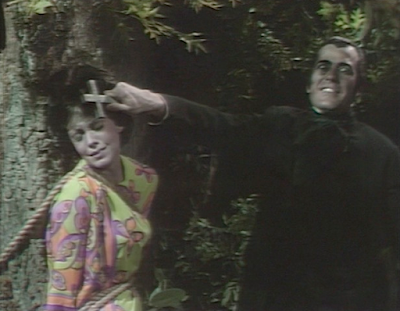
Regular viewers know that the figure is the Rev’d Mr Trask, a fanatical witchfinder who mistook Vicki for the witch in the 1790s and sent her to the gallows. He tells Cassandra that he now has the opportunity to correct that error. He shows her a cross, from which she recoils. We cut to a scene in the woods. Trask has tied Cassandra to a tree and performs an exorcism on her. This is Trask’s go-to technique; he tied Vicki to a tree in #385 and performed an exorcism on her in #386. Since Cassandra actually is in league with the devil (or as Trask would say, THE DE-VILLL!!!,) he has more success this time. Cassandra vanishes and leaves the ropes hanging on the tree.

Trask exorcises Cassandra. Screenshot by Dark Shadows Before I Die.

A first-time viewer might take this climax as an indication that Dark Shadows is a Christian show and Trask is its hero. Not only is Trask going after the right target, he is clearly making some headway. He says all the right things about casting the evil out of Cassandra and saving whatever good is left in her. His delivery of his lines is so fervent that Mrs Acilius, a vigorous Christian, cheered him on. In fact, Trask’s wild incompetence throughout the 1790s segment led to one disaster after another, and was of a piece with the show’s light regard for religion. Not until #450 did a cross provoke a reaction from a monster; that was the first suggestion the show gave that there might be anything to Christianity, and the scenes between Cassandra and Trask today are the second.

Dark Shadows borrows story points freely from all sorts of books, plays, movies, and folklore. So far, it has steered clear of Christianity as a source. For obvious reasons- most of the audience is at least nominally Christian, and Christianity is, in one way or another, a live option for the rest. So it’s a topic that can take over very quickly once it is introduced. I suppose a specifically Christian version of Dark Shadows could have worked, but I can’t imagine that the staff they had would have been particularly interested in making a show like that. So when it looks like they are going to let Trask have even a temporary win, we see the show running one of its boldest risks yet.

Episode 510: One passion in death

Yesterday, wiggéd witch Angelique/ Cassandra sent her cat’s paw Tony to kill sage Timothy Eliot Stokes. Stokes pulled “the old switcheroo” on him, and Tony drank from the glass into which he had put Angelique/ Cassandra’s poison. Today, we learn that Stokes gave Tony an emetic to save his life. Stokes calls mad scientist Julia Hoffman, MD to examine Tony and assist with the next stage of the battle against Angelique/ Cassandra.

Recovered, Tony has no idea why he obeyed Angelique/ Cassandra’s command to kill Stokes, and is ready to surrender to the police. Stokes tells him he is under the power of a witch, and enlists him in the battle against her.

Stokes takes out the memoirs of his ancestor Ben, who was Angelique’s cat’s paw in the eighteenth century. He does some automatic writing in Ben’s hand and finds that they must contact the spirit of the Rev’d Mr Trask, a witchfinder who inadvertently helped Angelique in those days. Fortunately, Trask, like Tony, was played by Jerry Lacy, so it shouldn’t be too hard to get hold of him. Stokes also finds that Trask was walled up in “the coffin room,” which Julia tells him is for some mysterious reason a nickname given to the space at the foot of the stairs in the basement of the Old House on the estate of Collinwood. Stokes decrees that he, Julia, and Tony must go to this room and hold a séance there.

On his way to the Old House, Tony follows Stokes’ instructions and stops at the main house on the estate and tells Angelique/ Cassandra that Stokes is dead. This follows a scene between Angelique/ Cassandra and her husband, sarcastic dandy Roger, in which Roger complains about her lack of interest in him. Her mind isn’t on the game of chess they are playing, she hasn’t been attentive to him for several nights, and she refuses to go on a honeymoon. Angelique/ Cassandra ensorcelled Roger into marrying her so that she could have a perch at Collinwood, and he seems to be slipping out of the spell’s power.

Stokes, Julia, and Tony gather in the coffin room. They begin the séance. This is the fifth séance we have seen on Dark Shadows, but the first that does not include well-meaning governess Vicki. In four of the previous five, it had been Vicki who went into the trance. On the other occasion, it was strange and troubled boy David who became the vessel through which the dead spoke to the living. The first three times Vicki served as the medium, she channeled the gracious Josette Collins, and when David filled that role he gave voice to David Radcliffe. In those days, Vicki was closely connected to Josette, perhaps a reincarnation of her, as David was another version of the cursed boy David Radcliffe. The final time Vicki spoke for the dead, she spoke for nine year old Sarah Collins, with whom she was no more closely connected than were any of a number of other characters. Sarah has no present-day counterpart, so her appearance at a séance suggested that Dark Shadows was moving away from its use of necromancy as a way of connecting characters from different time periods.

This time, Tony goes into the trance. In #481, Angelique/ Cassandra told Tony that she chose him as her cat’s paw because he resembled Trask, so when he is the medium through whom Trask speaks we are returning to Dark Shadows‘ original conception of how séances work. Trask mistakes Stokes for Ben, as Angelique did in a dream visitation last week. The brick wall behind which Trask’s remains are hidden bulges and is about to crumble when we fade to the credits.

True fans of Dark Shadows know that the episode’s real climax comes during those credits. Thayer David strolls onto the set under Louis Edmonds’ credit for Roger. He even looks into the camera when he realizes what he has done.

Screenshot by Dark Shadows Before I Die.