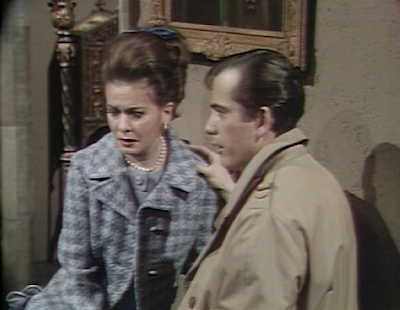
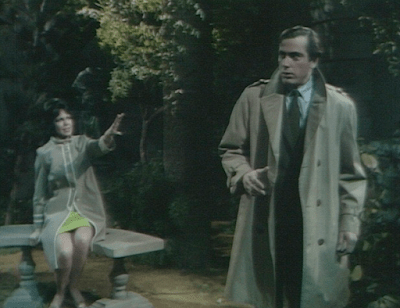
Yesterday, wiggéd witch Angelique/ Cassandra sent her cat’s paw Tony to kill sage Timothy Eliot Stokes. Stokes pulled “the old switcheroo” on him, and Tony drank from the glass into which he had put Angelique/ Cassandra’s poison. Today, we learn that Stokes gave Tony an emetic to save his life. Stokes calls mad scientist Julia Hoffman, MD to examine Tony and assist with the next stage of the battle against Angelique/ Cassandra.
Recovered, Tony has no idea why he obeyed Angelique/ Cassandra’s command to kill Stokes, and is ready to surrender to the police. Stokes tells him he is under the power of a witch, and enlists him in the battle against her.
Stokes takes out the memoirs of his ancestor Ben, who was Angelique’s cat’s paw in the eighteenth century. He does some automatic writing in Ben’s hand and finds that they must contact the spirit of the Rev’d Mr Trask, a witchfinder who inadvertently helped Angelique in those days. Fortunately, Trask, like Tony, was played by Jerry Lacy, so it shouldn’t be too hard to get hold of him. Stokes also finds that Trask was walled up in “the coffin room,” which Julia tells him is for some mysterious reason a nickname given to the space at the foot of the stairs in the basement of the Old House on the estate of Collinwood. Stokes decrees that he, Julia, and Tony must go to this room and hold a séance there.
On his way to the Old House, Tony follows Stokes’ instructions and stops at the main house on the estate and tells Angelique/ Cassandra that Stokes is dead. This follows a scene between Angelique/ Cassandra and her husband, sarcastic dandy Roger, in which Roger complains about her lack of interest in him. Her mind isn’t on the game of chess they are playing, she hasn’t been attentive to him for several nights, and she refuses to go on a honeymoon. Angelique/ Cassandra ensorcelled Roger into marrying her so that she could have a perch at Collinwood, and he seems to be slipping out of the spell’s power.
Stokes, Julia, and Tony gather in the coffin room. They begin the séance. This is the fifth séance we have seen on Dark Shadows, but the first that does not include well-meaning governess Vicki. In four of the previous five, it had been Vicki who went into the trance. On the other occasion, it was strange and troubled boy David who became the vessel through which the dead spoke to the living. The first three times Vicki served as the medium, she channeled the gracious Josette Collins, and when David filled that role he gave voice to David Radcliffe. In those days, Vicki was closely connected to Josette, perhaps a reincarnation of her, as David was another version of the cursed boy David Radcliffe. The final time Vicki spoke for the dead, she spoke for nine year old Sarah Collins, with whom she was no more closely connected than were any of a number of other characters. Sarah has no present-day counterpart, so her appearance at a séance suggested that Dark Shadows was moving away from its use of necromancy as a way of connecting characters from different time periods.
This time, Tony goes into the trance. In #481, Angelique/ Cassandra told Tony that she chose him as her cat’s paw because he resembled Trask, so when he is the medium through whom Trask speaks we are returning to Dark Shadows‘ original conception of how séances work. Trask mistakes Stokes for Ben, as Angelique did in a dream visitation last week. The brick wall behind which Trask’s remains are hidden bulges and is about to crumble when we fade to the credits.
True fans of Dark Shadows know that the episode’s real climax comes during those credits. Thayer David strolls onto the set under Louis Edmonds’ credit for Roger. He even looks into the camera when he realizes what he has done.
Unloved Frankenstein’s monster Adam has survived a plunge from the cliff at Widow’s Hill and made his way into the home of blind ex-artist Sam Evans. Sam realizes that Adam is badly hurt and cannot speak much English; with great kindness, he tries to clean and bandage Adam’s wounds.
Sage Timothy Eliot Stokes comes in. Adam, who in his few weeks of life has had little but hostility from humans, is alarmed by the sight of another one, and flees. Stokes explains to Sam who Adam is, and Sam’s sympathy for the big guy only deepens. This retelling of the creature’s encounter with the blind hermit in The Bride of Frankenstein is affectingly done.
Wicked witch Angelique, calling herself Cassandra, has made her way into the apartment of local man Tony Peterson. Tony is agitated by the presence of Angelique/ Cassandra and keeps telling her he wants her to go home to her husband and leave him alone. She tells Tony he is “Quite a Puritan,” reminding us that when Dark Shadows was a costume drama set in New England in the 1790s, actor Jerry Lacy played the Rev’d Mr Trask, a fanatical but utterly inept witchfinder who inadvertently served Angelique’s darkest purposes. Mr Lacy plays Tony quite differently than he did Trask, but Angelique/ Cassandra told Tony in #481 that she chose him as her cat’s paw because he reminded her of Trask. She gets him to strike his cigarette lighter, sending him back into the trance in which he can deny Angelique/ Cassandra nothing.
Well-meaning governess Vicki has made her way to Stokes’ apartment. It was Vicki who took Dark Shadows back in time to the 1790s, when she came unstuck in time during a séance in #365. It seemed at the beginning of the costume drama segment that Vicki would regain the position she held in the first months of the show as our point of view character, that she would again provide the emotional anchor of the show in her scenes as governess alone with the young children of the house, and that she would drive the action as she had to think on her feet and come up with plausible lies to secure a place in an unfamiliar century. As it happened, she did none of those things. She was shut out of all the main action, was never seen giving a lesson to either of her charges, and when she was on camera spent her time telling everyone she met that they were played by an actor who had another part in the first 73 weeks of the show. Long before Vicki came back to the 1960s in #461, the character had become all but insupportable.
The action now revolves around recovering vampire Barnabas Collins, and Barnabas steadfastly refuses to include Vicki in his life. Faced with that blank wall, Vicki has spent some time hanging around with a man named Peter whose only story point is that he wants to be called Jeff. This does not make for much drama. Vicki learned a great deal in the 1790s, and recognized Angelique/ Cassandra as soon as she showed up in 1968. But she can’t fight her by herself, and so she has responded to Barnabas’ aloofness by trying to forget what she knows.
Stokes has called Vicki to his apartment to enlist her help against Angelique/ Cassandra. Longtime viewers will remember that Vicki led the fight against Dark Shadows’ first supernatural menace, undead blonde witch Laura Murdoch Collins, and that for support in that battle she was the one who recruited the services of the show’s first sage, parapsychologist Peter Guthrie. This much diminished Vicki is now subordinated to the sage. He calls her in, he commands her to tell her story, he tells her that her story is true, and he requires her services. He shows her a silhouette of Trask and insists she overcome her reluctance to look at it. When a knock comes at the door, he even sends her out the back way and tells her that his next visitor must not know of her connection with him, as if he were dismissing a prostitute.
Stokes tells Vicki he can’t afford to be seen with her.
Oddest of all, Stokes already seems to know everything Vicki does before they talk. In #507, he laid out a theory that would be plausible to someone who knew exactly what Vicki knows about the strange goings-on, but not to anyone who knows one thing more or less than she does. Yet today we see that he is talking with Vicki about them for the first time. It is unclear what he could learn from her, or what contribution she could make to his efforts.
The visitor from whom Stokes wants to hide Vicki is Tony, giving his name as “Arthur Hailey,” perhaps in honor of the novelist whose Airport was topping the bestseller lists when the episode was made. Stokes is quite relaxed around Tony, offering him first brandy and then cheese. Tony accepts both. He exclaims “I like cheese!” in an awkward voice that makes it clear we are listening, not to Jerry Lacy’s acting, but to Tony’s. While Stokes is out of the room fetching the cheese, Tony sprinkles a powder Angelique/ Cassandra gave him into Stokes’ glass. Tony looks away from the table before they take their drinks. When they do, it is Tony who chokes and collapses, not Stokes.
This is the second time we’ve seen that staple of farce, “The Old Switcheroo.” In #402, Barnabas tried to poison Angelique, and had to think fast when she passed her glass to his mother. That use of the trope confirmed that, while Barnabas is undeniably a villain, he is a comic villain who endears himself to us as we watch him scramble through one failed scheme after another, while Angelique is a menace to be taken seriously. Now, Angelique has settled in for the long term, and the show will quickly run out of characters if she maintains the kill rate she had in the eighteenth century. They have to dial her threat level down considerably. One way of doing that is to give her a henchman who is, most of the time, unaware of her power over him, and who is consistently luckless when she activates him; another is for her to use comically unreliable means to pursue her evil ends. She does not yet cut the Wile E. Coyote-esque figure that Barnabas does, but neither is she in imminent danger of vaporizing the whole story and leaving ABC with thirty minutes of dead air on weekday afternoons.
This was the first episode directed by John Weaver. Except for one week in March 1968 when executive producer Dan Curtis took the helm, directing duties for the first 497 episodes of Dark Shadows alternated between Lela Swift and John Sedwick. Now Sedwick is about to leave the show. Associate director Jack Sullivan stepped up to direct #504 and will direct dozens more; Weaver, an associate director on some early episode, will only be credited as director four times before leaving in July. Several more directors will have similarly brief stints as fill-ins before Henry Kaplan joins the show as Swift’s alternate in December.
Yesterday, matriarch Elizabeth Collins Stoddard and her daughter Carolyn were in their drawing room quarreling about some family matters when a strange man stumbled into the house. The man was 6’6″ tall, his face was scarred, he trailed a length of chain from a shackle he wore on one ankle, and could speak only a few words. When Carolyn tuned the radio to an Easy Listening station, the man found that the listening was not at all easy for him. Saying “Not music!,” he smashed the radio. This prompted Liz to threaten him with a letter opener. Frightened, the man clutched at Carolyn. The situation escalated when Liz’ distant cousin Barnabas burst in and pointed a rifle at the man. Finally, the man ran out of the house, carrying Carolyn with him.
Today, Liz is moping in the foyer. Local man Tony Peterson, who had gone on a few dates with Carolyn some months ago, comes to the door. He and Liz discuss the situation. Liz laments the harsh tone she took with Carolyn during their argument. She tells Tony that she supposes there is a generational difference between them. He and Carolyn hide their feelings, while Liz expresses hers. This is an exceedingly strange thing for Liz to say- the whole foundation of her character is denial. In the first months of Dark Shadows, Liz was a central character, and the show was largely a study of that psychological defense mechanism and its consequences. She has moved to the margins of the action since then, but hasn’t changed her personality. Indeed, Liz’ conversation with Carolyn took a harsh turn precisely because she refused to face the unpleasant facts Carolyn was reporting to her.
Liz and Tony go to the Old House on the grounds of Liz’ estate, home to Barnabas. They find Barnabas’ servant Willie on the ground by the front door of that house; the door is open, and Willie is nursing a recent head wound. He confirms that the man had been there and that he was carrying Carolyn in his arms. He says that Carolyn appeared to be unconscious. Tony announces that he will go after them, and Willie tells him he will need a gun. “He’s strong, that Adam,” says Willie.
Liz demands to know why Willie called the man “Adam.” Willie denies that he did. That only irritates Liz, who insists that Willie tell her what he knows about the man. Willie repeats his denial, and says that he is worried about a nightmare. He keeps going on about this topic, to which Liz angrily responds “I don’t want to hear any more about your dream!”
Adam has taken Carolyn to an abandoned root cellar somewhere in the woods. This is a new set. Regular viewers, knowing what a rarity new sets are on a show with this one’s budget, will expect something important to happen there. What happens there today is that Adam and Carolyn struggle to communicate with each other. She asks him what he wants; he manages to say “Kill Barnabas!,” a goal which people who have been watching for the last several weeks will agree he has excellent reasons to pursue. He holds a burning pine cone and is surprised to find that it hurts when the fire reaches his hand; she is startled to find that he didn’t know that, and says that he is like a baby. She tries to leave the root cellar, but he won’t let her get to the door.
Liz spoke for the audience when she said she didn’t want to hear any more about Willie’s dream, but it is dramatized for us anyway. It ends with the image that frightens Willie the most, a wolf’s head. Longtime viewers can well understand why this might be a terrifying symbol to Willie. When Willie first worked for Barnabas, Barnabas habitually beat him with his heavy wooden cane topped with a metal handle in the shape of a wolf’s head. In those days, Barnabas was a vampire, and when he felt bloodlust dogs would howl. As Barnabas’ blood thrall, that sound would therefore tell Willie that either he himself would soon be drained of more blood, or that he would be forced to help Barnabas prey on someone else. So it makes sense that for Willie, terror has a canine face.
From #133, artist Sam Evans was compelled to paint a series of pictures that explained the evil intentions of undead blonde witch Laura Murdoch Collins, estranged wife of sarcastic dandy Roger Collins. In #146, Laura put a stop to Sam’s work by starting a fire that burned his hands so badly it seemed for a time he might never be able to paint again.
Sam shares his home, the “Evans cottage,” with his daughter Maggie, who is The Nicest Girl in Town and a waitress at the diner in the Collinsport Inn. Between her earnings there and the paintings Sam sells, the Evanses make a living, but it isn’t such a grand living that he can turn down any commissions, even very eccentric ones. Moreover, his work space entirely dominates the interior of the cottage. In the early days of the show, Sam’s old friend Burke Devlin often stopped by, and the conversation always turned to reminiscences of Burke’s youthful days of honest poverty. Nowadays the most frequent visitor is Maggie’s fiancé, hardworking fisherman Joe Haskell. Sam is delighted with the prospect of this upwardly mobile laborer as a son-in-law. When a representative of the moneyed world visits Sam or Maggie at home, as New York art dealer Portia Fitzsimmons did in #193 and old world gentleman Barnabas Collins did in #222, the contrast between their manner and the humble surroundings is meant to jolt us. The Evans cottage is therefore our window on the working class of Collinsport. When the troubles of the ancient and esteemed Collins family have an effect there, Dark Shadows is telling us that the whole town is dependent on the businesses they own and suffers as a result of their problems.
Yesterday, Barnabas came back to the cottage and brought Sam a very odd commission indeed. He presented a painting of a lovely young woman in eighteenth century garb and offered Sam $500* to paint over the image so that before morning the woman would look to be “about 200 years old.” Sam wasn’t in a position to refuse that much money, even though Barnabas wouldn’t explain why he wanted him to do such a thing.
If Sam knew what the audience knows, he would likely have turned the job down even if Barnabas had offered $500,000,000. The woman in the portrait is Angelique, and like Laura she is an undead blonde witch. In the 1790s, Angelique cursed Barnabas and made him a vampire. In #466, Barnabas’ vampirism went into remission. Shortly thereafter, the portrait made its way to the great house of Collinwood, where Roger became obsessed with it. In #473, Roger returned from an unexplained absence with a new wife. She is Angelique, wearing a black wig and calling herself Cassandra. From #366-#461, Dark Shadows had been a costume drama set in the 1790s; during this segment, we saw that Angelique was a far more dynamic and brutal menace than Laura ever was. Sam would hardly want to involve himself in a battle with this wiggéd witch.
For his part, Barnabas first appeared on camera in #210 and #211. But his portrait was first seen hanging in the foyer at Collinwood in #205, having been prefigured in #195. Dangerously unstable ruffian Willie Loomis became obsessed with the portrait of Barnabas. Willie could hear a heartbeat pounding from the portrait in #208 and #209, and followed its sound to the crypt where Barnabas was trapped in his coffin. As Roger’s obsession with Angelique’s portrait would bring her back to the world of the living, so Willie’s obsession with Barnabas’ portrait led to his return.
In the opening teaser, we see Sam working on the painting. He tells it that he can’t understand why Barnabas would want to disfigure such a pretty face, then resumes his task. The camera zooms in on the painting, as it had zoomed in on Barnabas’ portrait in #208 and #209, and the soundtrack plays the same heartbeat. Sam doesn’t react- he can’t hear it. It is addressed to the audience, especially to those members of the audience who remember the show as it was 13 months ago.
Angelique/ Cassandra is in the gazebo on the grounds of Collinwood. She is wearing a hooded cloak to conceal the aging she has already experienced as a result of Sam’s work. Her cat’s paw Tony Peterson, a local attorney, shows up, responding to her psychic summons. She entrances him with a flame and he tells her that the artist who has been in touch with the Collinses most frequently of late is Sam Evans. From this she concludes that Sam is aging her portrait at Barnabas’ bidding. Before Angelique/ Cassandra and Tony can go their separate ways, heiress Carolyn Collins Stoddard comes upon them.
Tony and Carolyn met in #357. In that episode, he was an instance of Jerry Lacy’s Humphrey Bogart imitation. A hard-boiled materialist, Tony had grown up in Collinsport as a working-class boy. He resented the Collinses and attributed all of their unusual characteristics to their wealth and social prominence. At that time, Barnabas was still a vampire and Carolyn was under his power. As a blood thrall, she knew that there was more to life than could be explained by Tony’s reductive logic, but she wasn’t free to offer any explanations. When Tony saw Barnabas biting Carolyn in #463, he interpreted their embrace as a sign of a sexual relationship.
Now their roles are reversed. It is unclear what Carolyn remembers from her time under Barnabas’ control; Nancy Barrett often plays the character as if she remembers everything, but the dialogue doesn’t give her much support for that, and in this scene she is as this-worldly as Tony was in the Autumn of 1967. She interprets Tony and Angelique/ Cassandra’s meeting at the gazebo as proof positive of an adulterous liaison, and declares she will report it to Roger. When Tony tells her that Angelique/ Cassandra has some mysterious power, Carolyn is dismissive, declaring that the Collinses are the ones who have all the power in this town. Tony tries to explain that the power Angelique/ Cassandra has is of an entirely different order from the power their ownership of capital gives the Collinses, and Carolyn responds with unconcealed contempt.
Angelique/ Cassandra knocks on the door of the Evans cottage. Sam opens the door. She ignores his objections and enters. While he keeps ordering her to get out of his house, she stands next to the portrait as he has aged it and points out her resemblance to it. He is astounded, but keeps telling her to leave. She says that she has no grievance against him and that no harm will come to him if he hands the painting over to her. He refuses. She heads out.
Angelique/ Cassandra has barely closed the door behind her when Sam has trouble seeing. After a moment, he realizes he has been struck blind. She comes back in, takes the painting, tells him she warned him, and leaves.
Over the years, several members of the cast said on the record that Sam’s blindness was actor David Ford’s idea. He thought that if he could wear dark glasses it wouldn’t bother the audience that he read all his lines off the teleprompter.
In 2022, a commenter on Danny Horn’s post about this episode on his blog Dark Shadows Every Day identified the portraits of Angelique as the work of ABC Art Department specialist Joseph Guilfoyle:
You asked if anyone knew who painted these portraits. I can verify that the portraits of Angelique were painted by Joseph Guilfoyle. He was an artist in the Art Department at ABC. He was my Godfather and his daughter remembers this very well as it made her a bit of a celebrity at the time. Portraits were not commissioned out but instead were created in the Art Department as it was filled with many talented artists.
Also worthy of note are the two facial makeups representing Angelique’s aging. It’s no wonder they didn’t have the personnel to make David Ford’s fake mustache look convincing when they were lavishing all the work on turning Lara Parker into two quite distinct old crones.
The costumers were involved in a famous production error in the final scene. Angelique/ Cassandra’s hooded cloak cuts off above her knees. There is no old age makeup on her legs, which are featured from every angle, making a ludicrous contrast with her face and wig.
Dr Julia Hoffman is in the front parlor of the house of her fellow mad scientist, Eric Lang. She is on the telephone, asking the operator to connect her with the police. Even though she has lived in the Collinsport area for months now, she is still surprised that the sheriff’s office doesn’t have an emergency number.
Julia locked the door to the parlor; Lang is outside it with a gun, and recovering vampire Barnabas Collins is knocking and calling her name. They want to stop her reporting to the police that Lang is building a Frankenstein’s monster with body parts retrieved from the cemetery, and that he was planning to cut a living man’s head off to use as the last piece of the creature. Lang plans to bring the body to life by draining Barnabas’ “life-force” into it. Barnabas hopes this will free him of the vampire curse once and for all, and is desperate to complete the experiment.
Barnabas shouts that Julia should remember “someone.” When he can’t come up with the name, Lang prompts him with a yell of “Dave Woodard!” Barnabas and Julia killed local physician Dave Woodard in #341; Julia hangs up the phone, realizing that if the operator ever does manage to find a police officer any investigation of Lang would likely expose her as a murderer.
Barnabas has told Lang a great deal about himself. For example, in #467, Lang was the first person Barnabas told that his vampirism was the result of a curse placed on him by wicked witch Angelique. So returning viewers can believe that Barnabas might have confided in Lang about the murder of Dr Woodard. But it would be strange for him to have done so off-screen. And just Friday, Barnabas explained to Lang that the reason he thinks Julia can be trusted with the secret of the experiment is that she has a crush on him.* He hasn’t had much time to share more information with Lang since then, and if Lang had already known that Julia couldn’t call the cops without exposing herself to a murder charge Barnabas wouldn’t have needed to mention her crush on him. The likeliest explanation is that the loud and clear exclamation of “Dave Woodard!” is not Lang prompting Barnabas at all; rather, it was Addison Powell prompting Jonathan Frid. The result is a blooper that seriously confuses the relationships among Lang, Barnabas, and Julia. It’s early enough in the episode that it really is odd they didn’t stop tape and start over.
At any rate, they never mention Woodard again. He was introduced early in the vampire storyline. He was the counterpart to Dr John Seward, the physician in Dracula who realizes that all the patients who are suddenly showing up with puncture wounds on their necks and massive blood loss need care he is not trained to provide, and calls in his old med professor, Dr Van Helsing. Julia was the Van Helsing analogue, but she wound up siding with the vampire and killing her onetime friend. It is appropriate that the last reference to Woodard comes in this, the second episode of Dark Shadows with no cast members introduced before Barnabas. From now on, the daylight world Woodard represented and tried to restore is no longer present even as a memory.
Julia lets Barnabas and Lang into the parlor, and asks Lang to promise that he won’t kill anyone. He gives such a promise. She is unconvinced, but agrees not to call the police. She also tells Lang she will continue to oppose the experiment.
On the terrace of the great house of Collinwood, Barnabas and Julia talk about Lang’s experiment. Angelique, wearing a black wig and calling herself Cassandra, lives in the house as the wife of sarcastic dandy Roger, and the terrace is surrounded by trees, fences, and other prime screens for eavesdroppers. Barnabas and Julia know this well, as each of them has eavesdropped on important conversations here themselves.
Of course Angelique/ Cassandra comes by and hears everything. Barnabas does catch her, grab her, call her by her right name, and vow that she won’t stop him. After he lets her go, he moans to Julia that it was foolish of them to discuss their plans there. That underlines the foolishness of an idea key to the plan, that after Lang’s creature has been animated Angelique will never realize that Barnabas is dwelling within it and place a fresh curse on it. Barnabas assumes that Angelique, who has transcended time itself to pursue him, will just give up and go away once she sees that his original body is dead, and won’t have any questions about the new guy living at his doctor’s house.
Angelique summons her new cat’s paw, lawyer Tony Peterson. Jerry Lacy plays Tony. From #365 to #461, Dark Shadows was a costume drama set in the 1790s. In that phase of the show, Mr Lacy played the Rev’d Mr Trask, a fanatical witchfinder who inadvertently gave Angelique a great deal of assistance in her campaign to destroy the Collins family and those close to them. Most of the characters in the 1790s segment represent a commentary of some kind on the characters the same actors play in the parts of Dark Shadows set in the 1960s. Tony and Trask have seemed to be an exception. In 1967, Tony was introduced through his profession and served mainly as an instance of Mr Lacy’s famous Humphrey Bogart imitation. Trask did end up functioning as a lawyer in a witchcraft trial, and his lunatic shouting about “THE ALMIGHTY!!” and “THE DE-VILLLL!!!!” were occasionally suggestive of what Bogart might have ended up doing if Captain Queeg’s testimony before the court-martial in The Caine Mutiny had gone on for nineteen weeks. Otherwise, there didn’t seem to be any fruitful points of comparison between the two.
Angelique tells Tony that the reason she chose him as her servant was that he reminded her of Trask. She orders him to go to Lang’s and steal a talisman that can guard against witches. At that, Tony shouts “Against you!,” and he sounds very much like Trask. Perhaps we are to think that a secular education and a steady diet of Hollywood movies could have turned the farcically warped Trask into a basically reasonable fellow like Tony, but that there is no strength in those things to stand up to a force like Angelique.
The talisman was a gift to Lang from Barnabas. Lang refuses to keep it on his person, even though it saved his life to clutch it when Angelique was making his heart beat so fast it was about to burst. Lang shows up at Barnabas’ house, under the false impression he received a telephone call from Barnabas. Barnabas, who has no telephone in his house, explains to Lang that Angelique has lured him away. When he learns that Lang has left the talisman in his desk drawer at home, he insists on accompanying him back there.
It is too late. Tony has already stolen the talisman and delivered it to Angelique. She looks at it and says that Lang will not be able to save either Barnabas or himself. Presumably, not even by reminding him of his lines.
The more efficient a means of communication is, the sooner it is likely to be choked with unwanted messages, some of them harmful to recipients who engage with them. We describe this tendency by saying that eventually, everything turns into email.
One of the most potent means of communication on Dark Shadows have been dream visitations from supernatural beings. As early as #10, matriarch Liz, who in waking life resolutely denied that any paranormal phenomena could be found on the estate of Collinwood, writhed as she slept in her armchair, muttering about ghosts. Since then, we’ve seen undead fire witch Laura Murdoch Collins and the spirit of the benevolent Josette send competing dreams to influence strange and troubled boy David; the mysterious Widows have beckoned Liz to a watery grave; the ghost of little Sarah Collins visited David and told him all about her big brother, then-vampire Barnabas; revenant Jeremiah Collins and phantom Nathan Forbes have given important information to well-meaning governess Vicki; and several characters have had vivid dreams of unspecified, but obviously supernatural, provenance.
Today, wicked witch Angelique visits Barnabas in a dream and tells him that she is launching a malware attack on the dreamers of Collinsport. It’s going to be sequential; it will take over each user’s wetware in turn, compelling them to forward it to someone else. With each iteration, the worm will become more complex, until it reaches Barnabas in a dream of his own. When he accesses it, he will revert to vampirism.
On his Dark Shadows Every Day, Danny Horn made a detailed comparison of Angelique’s explanation of the Dream Curse with the introduction to the 1931 film Frankenstein. He’s convinced me that the reference was intentional. Since there is a version of Frankenstein playing out on Dark Shadows right now, they are assuring us that the Dream Curse storyline will intersect with that one.
Angelique’s explanation only takes up the last act of the episode. There is a lot of other good stuff in the earlier parts, most revolving around Jerry Lacy’s character Tony Peterson. Tony was first introduced as a showcase for Mr Lacy’s famous Humphrey Bogart imitation; he has discarded that now. He still wears a brown suit and a tan overcoat, but sounds like Jerry Lacy.
Tony quarrels with heiress Carolyn about her relationship with Barnabas. She tells him that she and Barnabas have no romantic interest in each other, and tells him to go ask Barnabas if he doesn’t believe her. He goes to Barnabas’ house, and gives Jonathan Frid a rare opportunity to play intentional comedy.
Angelique, who, under the name Cassandra, has married sarcastic dandy Roger Collins and is living with him in the great house at Collinwood, steals Tony’s lighter and uses it to cast a spell on him. She needs a helper, and has decided to enslave Tony. Mr Lacy and Lara Parker are such fun together that, decades after the show, a company called Big Finish brought them back as Tony and Cassandra in a series of audio dramas. Called The Tony and Cassandra Mysteries, they were among the most popular of the Dark Shadows-themed plays Big Finish put out. I haven’t heard any of them- I’m too stingy to pay $37.41 to download an audio file- but if the scene the two of them play in the gazebo at Collinwood today is any indication, I’m sure they’re wonderful.
The very beginning of the episode is good too. Carolyn is coming back from a trip and has her hands full of luggage, so she knocks on the front door of the great house rather than look for her key. Angelique/ Cassandra answers. Carolyn has no idea who she is. When Angelique/ Cassandra identifies herself as Roger’s wife, Carolyn is shocked that Roger has remarried. She is even more shocked when Angelique/ Cassandra says that she and Roger had known each other only a day when they were married. Nancy Barrett is a high-energy actress, and a tightly-focused one. Her reactions to Angelique/ Cassandra’s successive announcements are like a laser light show on the theme of stunned disbelief.
Carolyn mentions that David decided to stay on in Boston for a few days. Since David is about ten years old, we might expect some explanation as to his lodging, but none is forthcoming. Some time ago we heard about an “Aunt Catherine” in Boston; I suppose he might be at her house, but hey, if the alternative is Collinwood he wouldn’t be any less safe if he were roughing it around Mass and Cass.
We open in the old cemetery north of town, where well-meaning governess Vicki and matriarch Liz are looking for the grave of Vicki’s old boyfriend Peter. Vicki last saw Peter this past Friday, which was over 170 years ago. That discrepancy was the result of some time travel she did in between. Vicki met Peter while spending nineteen weeks in the late eighteenth century. She came back home on Monday. By the end of her visit to the past, Vicki and Peter were both scheduled to be hanged for their many crimes. Vicki was whisked back to 1968 at the last possible instant, escaping by such a narrow margin that she had rope burns on her neck.
Vicki and Liz find Peter’s grave marker. Liz remarks that his date of death is the same as today’s date- 3 April. This sets Vicki off. She says that the hangings took place at dusk, that it’s dusk now, and that Peter is therefore being hanged even as they speak. Liz declares that this is gibberish. The date on the stone is 3 April 1795, and today’s date is 3 April 1968. Vicki tries to explain that everything that ever happened is happening over and again someplace. Yesterday, Liz heard similarly opaque verbiage from her distant cousin Barnabas. She didn’t buy this line when Barnabas was pitching it, and she isn’t any more impressed when she hears it from Vicki.
Longtime viewers of Dark Shadows are likely to make a connection. From December 1966 to March 1967, Vicki led the battle against the show’s first supernatural menace, undead fire witch Laura Murdoch Collins. When she saw the dates on which Laura’s previous incarnations immolated themselves along with their young sons, Vicki realized that she acted at intervals of exactly one hundred years. Laura was an embodiment of the cyclical nature of time; fighting her, Vicki is trying to break the cycle of death and rebirth, like a comely young Buddha.
I don’t think the show is making a serious metaphysical point by developing this theme. When you’re telling a story about a place where the usual laws of nature don’t apply, you need to substitute some other set of rules the audience can understand in order to create suspense. The power of anniversaries will do as well as anything else.
Back in the great house of Collinwood, we see Liz’ daughter Carolyn come in the front door wearing riding clothes and carrying a crop. This is the first indication that the Collinses have horses. In the early months of Dark Shadows, the family was running out of money, the estate was decrepit and mortgaged to the hilt, and they were barely holding onto control of their business. The stories those circumstances generated never went anywhere, and they’ve gradually been retconning the Collinses to be richer and richer. If they’re up to horse ownership now, by next year they might have a luxury yacht and a private jet.
The drawing room doors open, and lawyer Tony Peterson emerges. He quarrels with Carolyn about their last encounter. That was two weeks ago in story time, but we saw it before Vicki left for the past in November. It’s an even deeper dive for us than that makes it sound, because our view of Tony has changed profoundly in the interim. He was first introduced as an example of Jerry Lacy’s famous Humphrey Bogart imitation, and he still is that. But in the 1790s segment, Mr Lacy played the Rev’d Mr Trask, the fanatical witchfinder who hounded Vicki to her death and occasioned many other disasters. By now, we have come to see most of the 1960s characters as the (not necessarily dark) shadows cast by their eighteenth century counterparts. When Tony shows up today we find ourselves trying to figure out what it is about Collinsport in the twentieth century that could turn a holy terror like Trask into a basically nice guy like Tony.
Carolyn browbeats Tony into coming back at 8 pm to take her to dinner. He leaves, and Carolyn’s distant cousin, Barnabas the vampire, enters. Barnabas asks Carolyn if she’s noticed a change in Vicki. She has no idea what he’s talking about. He asks if she’s “more like you.” Thus first-time viewers learn that Carolyn is under Barnabas’ power. Returning viewers learn something, too. Yesterday’s episode ended with Barnabas about to bite Vicki, but cut to the closing credits before he sank his teeth into her. We’ve seen that before. Now we know that he has finally gone through with it.
In the opening scenes, Vicki showed absolutely no sign that anything had happened to her; Carolyn hasn’t noticed any change in her either. Soon, Vicki and Liz come home, and Vicki doesn’t react to Barnabas any differently than she had before he bit her. The people Barnabas has bitten have shown a wide variety of effects afterward. Perhaps Vicki will be the first victim who just can’t be bothered.
Vicki has a painting with her that she bought in town after she and Liz visited Peter’s grave. It turns out to be a portrait of Angelique, the wicked witch whose curse made Barnabas a vampire in the 1790s. That portrait first appeared in #449, a sign to the characters that Angelique’s evil spirit was still at work and to the audience that actress Lara Parker would be back on the show after the costume drama insert ended. Barnabas is upset to see this token of his old nemesis, and leaves the house. Vicki does not consciously remember the events she saw during her visit to the past, but when she sees Barnabas go she tells Liz that it makes sense that he would not like the picture.
Tony returns and spends a few moments twitting Carolyn for her glamorous attire, describing the homely pastimes in which a working class boy like himself whiles away his idle moments. This prompts her to tease him back. Viewers who remember Tony and Carolyn’s previous interactions will recognize this as their style of flirtatious banter. They agree to go to dinner.
Before Tony and Carolyn can leave, we cut to Barnabas, standing in the window of his own house and staring at the great house. He calls to Carolyn, summoning her to come to him immediately. We cut back to the great house, and see Carolyn’s face go blank while Tony is still talking. She excuses herself, telling him she will meet him later. He is outraged, and vows he will not wait for her.
In Barnabas’ house, Carolyn tells Barnabas she objects to his summons. Irritated by this, he starts talking about Vicki. He says that he couldn’t understand why biting her did not bring her under his power, but that seeing the portrait explained it to him. The witch is interfering with his efforts. Carolyn laughs at the idea of a witch. This is a bit odd. Carolyn has lived her whole life up to this point in a haunted house and is having a conversation with a vampire. It wouldn’t seem to be a stretch for her to believe in witches.
Barnabas has a bad habit of leaving his front window uncovered. Many times, we have seen people peer into that window and discover Barnabas’ secrets. Now, Tony sees Barnabas bite Carolyn’s neck.
Carolyn goes home to the great house and finds Tony in the foyer. She is delighted at the idea that he is waiting to go on their date, but such is not the case. He is there to berate her for her perverse relationship with her cousin Barnabas and to storm out.
In this, we see the first point of similarity between Tony and Trask. Trask was right that there was a witch at Collinwood and right that the witch was the source of all the troubles afflicting the Collinses. But he was wrong about her identity, and wrong about the means to combat her. Likewise, Tony is right that Carolyn and Barnabas are manipulating him, and is right that their relationship is unwholesome. But he has no understanding of their goals, and his belief that their relationship is sexual is quite mistaken.
Carolyn’s protest that Barnabas is merely her cousin, like Tony’s indignant implication that their family relationship makes what they are doing incest, is rather strained. In the cemetery, Liz mentioned that Daniel Collins was her great-great grandfather, which would make Daniel’s sister Millicent Carolyn’s great-great-great-great aunt. When Millicent and Daniel were introduced during the 1790s segment, Barnabas’ father Joshua identified them as his second cousins. That was a distant enough relative that Joshua considered Millicent a potential marriage partner for either Joshua’s brother Jeremiah or for Barnabas himself. Since Barnabas and Carolyn are second cousins five times removed, nothing going on between them could very well be called incestuous.
Later, Barnabas goes to the drawing room in the great house and looks at the portrait of Angelique. To his surprise, Carolyn is waiting for him. She tells him that she doesn’t want to be his blood thrall anymore. She declares that he loves Vicki and that she has her own life to live. He is too busy to discuss the matter with her, and she leaves.
Barnabas cuts the portrait out of the frame, and throws it into the fireplace. He gives a little speech about how this is the only way Angelique can be destroyed. He turns from the fire, and sees that the portrait has regenerated. Angelique’s laughter sounds in the air, and Barnabas realizes that she is present.
This is not the first time a portrait of an undead blonde witch has been thrown into the fire in the drawing room, prompting a woman’s disembodied voice to make itself heard. In #149, Laura’s estranged husband, Roger Collins, threw into it a painting featuring her with their son, strange and troubled boy David. When that painting burned, we heard a scream coming from no one we could see. Whether the screamer was Laura or benevolent ghost Josette was never explained. What was clear was that burning the painting accomplished none of the goals Roger may have had in mind, as Barnabas’ incineration of this painting serves none of his purposes.
When vampire Barnabas Collins rose from his grave to prey upon the living in April 1967, he was a bleak, frightening presence. As the show went on, we saw him spend a great deal of time ruminating on murders he might like to commit, but he had few opportunities to act on those thoughts. By November, when well-meaning governess Vicki came unstuck in time and wound up in the year 1795, Barnabas had killed only two people, only one of them with premeditation. Both of those victims, seagoing con man Jason McGuire and addled quack Dave Woodard, had long since lost their relevance to the plot, and neither has been mentioned more than a few times since his death. As a result, Barnabas’ talk of killing comes to seem like nothing more than a series of hostile fantasies.
Soon, Dark Shadows will have to return to a contemporary setting. It was the frightening impression Barnabas created in his first weeks that made Dark Shadows a hit, and to keep it going the show will have to make him seem dangerous again. In the fifteen and a half weeks they have been in the 1790s, he has killed at least six people, including his uncle, his aunt, his wife, two streetwalkers, and a woman named Suki. That’s an adequate rate of murders to reestablish Barnabas as a fiend, but volume will only get you so far. They need to give us some shocking images of cruelty, preferably as the result of crimes committed with slender motives, to get him back in place as a truly scary creature.
Today, the show addresses both that need and the need to give a fitting sendoff to a character who has been one of the standouts of the eighteenth century flashback. The Rev’d Mr Trask, visiting witchfinder, was, along with repressed spinster Abigail, one of the two bright lights of the show’s otherwise dreary reworking of Arthur Miller’s The Crucible. Now the witch trial is over, Vicki has been convicted, and she is waiting to be hanged. In #437, Vicki gave a speech which left little doubt that at the moment appointed for her execution she would return to the 1960s and the costume drama period would end. Therefore, Trask can hardly reopen the case without confusing the whole plot. As a personality totally warped by fanaticism, he can’t very well branch out into other kinds of stories without a long buildup, much longer than they are likely to stay in the 1790s. Yet Trask has been so much fun that the audience would feel cheated if he simply went back where he came from.
So Barnabas lures Trask to his basement, ties him to the ceiling, and seals him up behind a brick wall. Unfortunately, this homage to Edgar Allan Poe’s “Cask of Amontillado” does not adapt the most celebrated line of that story and have Trask cry out “For the love of God, Mr Collins!”
In a moment of black humor, the closing credits run over an image of the completed brick wall. We might imagine Jerry Lacy still dangling from the ceiling behind the wall. Mr Lacy was often a model of an actor’s devotion to his craft, but I very much doubt that even he took matters that far.
A recording of Jonathan Frid reading “The Cask of Amontillado” made in the spring of 1992 can be found on YouTube, posted by Frid’s longtime business partner Mary O’Leary.
In #264, high-born ne’er-do-well Roger Collins visited Barnabas at home. When it was time for a drink, Barnabas offered him a glass of amontillado. Poe’s story is so famous and amontillado is such an unusual variety of sherry that it must have been a deliberate reference. Perhaps the idea of Barnabas sealing someone up behind bricks was floating around among the writing staff for months and months.
Several fansites label it a continuity error that Trask reacts to the sight of Barnabas by exclaiming that he is dead. The family has been covering up Barnabas’ death, putting word about that he went to England. Many think Trask should not be among those privy to the Collinses’ secret. But as Danielle Gelehrter points out in a comment on Danny Horn’s Dark Shadows Before I Die, Trask and the gracious Josette discussed Barnabas’ death in #412.
I am writing this post on 19 February 2024. In a bit of synchronicity, yesterday, I saw this post on the site that all normal people still call Twitter:
When well-meaning governess Vicki came unstuck in time and found herself in the year 1795, regular viewers of Dark Shadows could expect certain plot points to be resolved before she returned to the 1960s. We would learn how Barnabas Collins became a vampire, and how he wound up trapped in a chained coffin in the secret chamber of the Collins family mausoleum. We would learn how Barnabas’ little sister Sarah died. We would see Barnabas’ lost love, gracious lady Josette, marry his uncle Jeremiah Collins. We would see Josette jump to her death from the precipice atop Widows’ Hill. And we would see Vicki escape from some dangerous situation and find herself back in her own time.
Now, the only items on that list left unresolved are Barnabas’ chaining and Vicki’s return. The show has made it clear to people paying close attention how each of those events will happen, and they could fit them both into one episode. Into any given episode, in fact- they’ve given us all the foundation we need for both stories.
But they aren’t going home to a contemporary setting quite yet. The eighteenth century segment has been a ratings hit, Dan Curtis Productions owns the period costumes, and several fun characters are still alive. So they have decided to restart some storylines they had shut down earlier and to build up some new ones.
The main thing that happens today is the first step towards restarting an apparently concluded story. Fluttery heiress Millicent Collins had shared a series of wonderful comedy scenes with untrustworthy naval officer Nathan Forbes, become engaged to him, and discovered that he was already married to someone else. Since that discovery, Millicent has been grimly determined to exact revenge on Nathan, and the rest of the Collins family has regarded him with icy disdain.
Nathan has made a discovery of his own. He has learned that Barnabas did not go to England, as his family has been telling everyone, but that he is still in Collinsport, and is the serial killer preying on the young women of the town. Last week, he made it clear to the audience he had a plan to turn this information into money, apparently by blackmailing the Collinses. Today, we learn that his plans are more complicated, and involve a renewal of his relationship with Millicent. Late at night, he shows up at the lodgings of a visiting witchfinder, the Rev’d Mr Trask. He asks Trask to take a letter to Millicent.
Trask does not want to let Nathan into his room, since the corpse of a prostitute is sprawled across his bed. She is Maude Browning. Barnabas murdered her in Friday’s episode. As part of his campaign to make life difficult for Trask, he deposited her remains at his place.
Nathan won’t take no for an answer, so Trask throws a blanket over Maude and lets him in. Nathan notices Maude’s arm sticking out from under the blanket and is delighted to think that Trask is not the fanatical ascetic he seems to be. Trask breaks down and starts telling Nathan what happened. He tells him that he was astounded to find Maude’s body on his bed, and he asks him to help get rid of it. Nathan agrees to do so on condition he deliver the letter to Millicent.
We then cut to the great house at Collinwood, where Millicent is studying a layout of Tarot. All the Dark Shadows fansites point out that Millicent misidentifies the Queen of Cups as the High Priestess. This is not the fault it is often made out to be. On Dark Shadows Before I Die, Christine Scoleri reminds us that the Countess DuPrés made the same mistake in #368. Since the countess introduced the Tarot to Collinwood and presumably taught Millicent how to read the cards, it would have been a break in continuity had she called it anything else.
Millicent looks at the cards and addresses the absent Nathan, telling him that she is filled with hatred for him and that he faces certain destruction as punishment for his mistreatment of her. Naomi Collins, mistress of the house, enters and asks Cousin Millicent to whom she is speaking. When she answers that she is talking to Nathan, Naomi tells her Nathan is not there. Millicent replies that he does not need to be present to hear her voice. Since Barnabas was able to magically project his own taunting voice across space into Trask’s hearing in Thursday and Friday’s episodes, this claim of Millicent’s has a curious resonance for returning viewers.
Trask shows up with Nathan’s letter. He wants to meet with Millicent alone in the drawing room to give it to her, but Naomi insists on being present. They stay in the foyer. When Naomi forces Trask to tell them that the letter is from Nathan, Naomi takes it and tears it to pieces. Millicent says that she approves of Naomi’s action, but we can see a flicker in her eye and hear a quiver in her voice that suggest the hatred of Nathan she spoke of a few minutes before may not be quite so undiluted as she would like to believe. Trask leaves the house, Naomi leaves the foyer, and Millicent gathers up the shredded pieces of the letter.
Back in his room, Trask goes to sleep. He has a dream. The dream sequence begins with an image reminiscent of pieces moving in a kaleidoscope.
That kaleidoscopic pattern was part of a visual effect we saw when Dark Shadows was still set in 1967. That effect introduced scenes that took place in #347, #352, and #354, when mad scientist Julia Hoffman hypnotized Vicki and took her to the Old House at Collinwood. At Collinwood, Barnabas’ helper Carolyn spotted Julia and Vicki, putting Julia in great danger.
The echo of those episodes is startling coming on the heels of the scene we just saw, in which Millicent figures as a student of the countess. Julia and the countess are both played by Grayson Hall, and Millicent and Carolyn are both played by Nancy Barrett. The relationships between their characters are different now, shifted as the colored pieces shift in a turning kaleidoscope. But remembering those earlier episodes, we might remember that what is seen in a semiconscious state might be a message sent to manipulate and deceive, and we certainly remember that people who go to the Old House are in danger from Barnabas.
Trask’s dream brings him face to face with the ghost of Maude, accusing him of having her remains dumped in the sea, so that she cannot rest. She predicts that everyone will learn that her dead body was in his bed. He denies both her accusation and her prediction, but does not convince either her or himself.
Another ghost then appears. It is that of Trask’s great supporter, repressed spinster Abigail Collins. Trask tries to tell Abigail that he is innocent of Maude’s charges, but she tells him she has no idea what he is talking about. She wants to tell him that there is a great evil he must destroy. Trask has a vision telling him the evil is lurking in the Old House. He resolves to go there.
All of the acting is excellent in this one. That’s no more than we would expect from most of the cast members we see today, but Vala Clifton’s two turns as the living Maude were pretty bad, so that it is a pleasant surprise that she is so good as Maude’s ghost. The physical space gives her a hard job. She is standing a very few feet in front of Jerry Lacy with only a couple of wispy stage decorations indicating that she is separated from him, but she strikes a pose and maintains a degree of stillness that really does create the sense that she is speaking to him from another realm. She also manages to keep up an ethereal quality while making it clear that Maude is determined to be avenged. I wonder what her first appearances would have been like if she had had more time to rehearse. If they had been as good as this one, Ms Clifton and Maude would be among the more fondly remembered parts of the eighteenth century segment.
Dark Shadows often signaled a commercial break by playing an ominous three note motif on the soundtrack. Even in 1968, DUN DUN DUNNNN! was a pretty corny way to punch up your dramatic values. It was even cornier when, as was often the case, it followed a three syllable clausula. So today’s first act ends with vampire Barnabas Collins vowing that he will kill the Rev’d Mr Trask, a visiting witchfinder whose fanatical pursuit of bewildered time-traveler Vicki has helped precipitate many disasters. After Barnabas says Trask is “Going To Die!,” Mrs Acilius and I sang along with the motif- “Going- To- Die!” The missus pointed out that many among the 8-13 year olds who made up so much of the show’s original audience probably sang exactly the same refrain when the episode was first broadcast.
There are a couple of missing transitions in quick succession today. The opening scene between Barnabas and Ben takes place in the Old House on the estate of Collinwood; they take care to show a clock to establish the time of this scene as 4:00 AM. We then cut to the great house on the same estate, where it appears to be dark out. A knock comes at the door; the mistress of the house, Naomi Collins (Joan Bennett,) answers and finds Trask. It isn’t 4:00 AM anymore- Ben enters after a moment, and mentions that the sun is about to set. Inserting a still photo of a daytime scene would have been enough to tell us that many hours have passed, and the lack of that insert really is confusing.
Trask has come demanding the keys to the Old House so that he can gather Vicki’s things and burn them. A different kind of transition is omitted in the scene this demand initiates. Lately, Naomi has become assertive and independent, primarily in her refusal to go along with the persecution of Vicki. She does that for a while in her response to Trask, ordering him to leave, telling him he disgusts her, slapping him in the face, and daring him to hit her. But when Trask threatens to go to her husband, haughty tyrant Joshua, and enlist him against her, she gives in immediately, without any visible change in affect. That is puzzling, and not at all in keeping with Joan Bennett’s usual style. Typically, she makes the most of every chance she gets to show us why she was one of the biggest movie stars of the late 1930s.
Rough patches like these, along with the many many line bobbles from all the actors throughout the episode, make me wonder if writer Gordon Russell was late delivering the script. The show never had more than three credited writers at a time, and there must have been occasions when they couldn’t get the documents to the directors and actors early enough that they could get everything nailed down. It would take considerable thought for any performer to choose the best way to play a brief moment within which Naomi moves from fearless defiance to capitulation. Perhaps the reason she wound up doing nothing was that she didn’t have time to think about the question.
Ben accompanies Trask to the Old House. While Trask goes to Vicki’s old room, Ben meets Barnabas emerging from the basement and apprises him of the situation. We see Trask upstairs and hear Ben and Barnabas’ voices in the distance. Trask reacts, but goes ahead with his mission. He waits until he is downstairs with all of Vicki’s stuff in a bundle before confronting Ben and demanding to know who else is in the house. Ben claims that he was talking to himself. Trask is unconvinced.
Later, we see Trask in his own room at a nearby inn. He hears the rattling of chains and the disembodied voice of Barnabas taunting him. After a while, Barnabas’ hand comes floating towards him. When this happened, Mrs Acilius called out “Got your nose!” We both burst out laughing and were still laughing hard when the closing credits started to roll.
Despite the rough spots and the bad laugh at the end, this installment was a lot of fun. I can’t give it the “Genuinely Good Episode” tag, but we won’t be tempted to skip it if we do another watch-through of the series someday.