Episode 432: Cousin Abigail’s religion

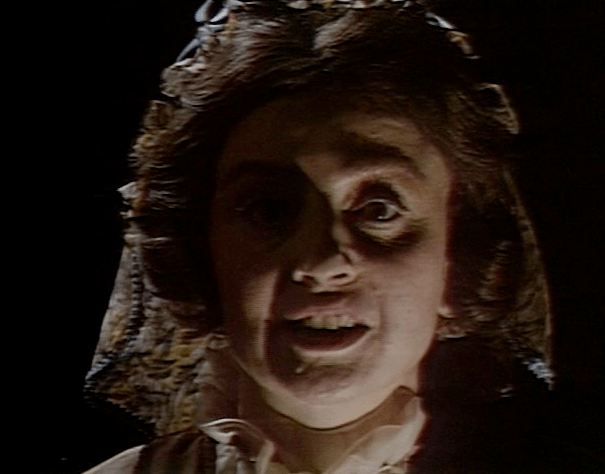
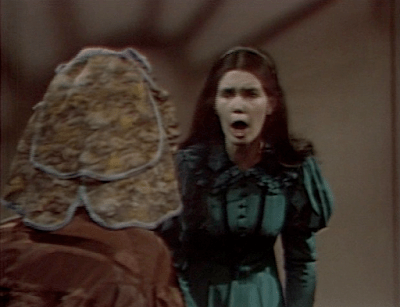
In the deserted Old House on the great estate of Collinwood, repressed spinster Abigail Collins has stumbled upon the coffin in which her nephew Barnabas spends his days. She arrives just as he is rising for the evening. Abigail knows that Barnabas is dead, but she has never heard of vampires, so she has no idea what to make of what she sees.

Barnabas taunts Abigail. When she cries that the Devil is trying to touch her, he cynically asks why she thinks that the Devil always wants to touch her. The broadcast date is 1968, when Freudianism was riding high in the circles frequented by the sort of people who wrote and produced Dark Shadows. The dramatic date is 1796, when that school of thought was undreamed of. Still, there were various strands of folk wisdom about the adverse psychological effects of celibacy, so Barnabas’ smirking comment undoubtedly means exactly what the original audience would have taken it to mean.

From the moment Barnabas saw Abigail at the end of yesterday’s episode, we’ve wondered how he would go about killing her. She is his aunt, after all; the vampire’s bite is so widely recognized a metaphor for the sexual act that we could hardly expect the ABC censors to have allowed him to make a meal of her. In the end, he simply bares his fangs and she dies of fright.

Barnabas scares Abigail to death. Screenshot by Dark Shadows Before I Die.

Abigail has been a villain; even the opening voiceover refers to her as “a woman who has been responsible for much grief.” During their confrontation, Barnabas tells Abigail many truths that, had she known them earlier, would have kept her from causing that grief. If she accepts them now, she will be remorseful. To the extent that we want Abigail to know what she has done, we identify with Barnabas during this scene. That might lead us to think that her death by fright is a way of letting us see Barnabas as the good guy, since he does not kill her by physical contact. But throughout the confrontation he has been telling her that she is about to die. Before he bares his teeth, he makes a dramatic announcement that clearly tells us that he is bringing matters to their climax, and when he sees her die he does not look the least bit unhappy. He seems to have known that the sight of his teeth had the power to kill his aunt, and to have deliberately used that power.

Abigail is the sister of Barnabas’ father, haughty overlord Joshua Collins. Before he even became a vampire, Barnabas killed Joshua’s brother Jeremiah in a duel. By his clumsiness, Barnabas inadvertently caused the death of his own sister, little Sarah Collins. Things are getting rather lonesome for Joshua.

In the great house on the same estate, young Daniel Collins is trying to slip out into the night. Yesterday, he arranged to meet secretly with much put-upon servant Ben so Ben could give him pointers on how to run away from this depressing house. The lady of the house, Joshua’s wife Naomi, intercepts Daniel. She asks if he plays whist, and he complains that he isn’t allowed to play cards because that is “against cousin Abigail’s religion.” Naomi says that so long as it isn’t against his religion, it’s no problem for her.

This isn’t the first indication that Abigail’s religion is different from that of the rest of the family. As rich New England landowners in the eighteenth century, we can assume they are all Congregationalists, but the loose polity of Congregationalism left room for a lot of variation from one congregation to another. She may well have attended a stricter meeting than did the other members of the family, though she seems to have taken her greatest satisfaction in imposing her austere ways on the other members of the household.

Naomi suggests that Daniel and his older sister Millicent might stay at Collinwood with her and Joshua indefinitely. Daniel is clearly not a fan of this idea, and struggles to find a polite way to say that he is desperate to go back home to New York City. He is still struggling when a knock comes at the door. It is the Rev’d Mr Trask, whom Abigail called in from out of town to find witches. Trask is currently prosecuting Victoria Winters, former governess to Daniel and the late Sarah. Abigail asked Trask to meet her because she thought she would find evidence against Vicki in the Old House. Since she found Barnabas instead, she will not be keeping the appointment.

While Naomi goes to look for Abigail, Trask takes the opportunity to work on Daniel. At first Trask seems to be far more agreeable than we have ever seen him before. So when Daniel apologizes for telling him that he looks like the Devil and that he sees no reason they should exchange any words, Trask smiles and calmly says that he appreciates his honesty. Trask holds Abigail up as an exemplar of Christian virtue; Daniel says that he cannot bring himself to want to emulate Abigail, since she “is always so, so unhappy, as if whatever she has eaten doesn’t agree with her.” Trask takes this remark in good turn.

Daniel keeps insisting that Vicki is not a witch, but is very nice. Trask takes everything he says as evidence against Vicki. For example, when he tells Trask that Vicki extolled the virtues of curiosity, Trask exclaims that “Curiosity is the Devil’s money! What you buy with it is disbelief in everything it is right to believe in!” Even in this portion of their encounter, Trask seems far smoother than the screaming fanatic we’ve seen up to now. Daniel complains that Trask keeps talking about the Devil when “I want nothing to do with him.” At that, Trask leans in and says that if Daniel feels that way, he can still be saved. When Daniel asks how he can be saved, we can see how Trask might have managed to win a new follower, if he hadn’t gone straight to a demand that Daniel testify against his friend Vicki.

Trask and Daniel have a man-to-man talk. Screenshot by Dark Shadows Before I Die.

Trask finally loses his temper. Naomi returns and is appalled when she hears Trask telling Daniel that he bears the mark of the Devil. Daniel runs out into the night, and Naomi tells Trask he is to blame for that.

Daniel wanders about in the woods, looking for Ben. He quickly concludes that he must have missed Ben, and he thinks of going back to the house. Remembering that Trask is there, he chooses to stay outside.

Naomi is in the woods looking for Daniel; Trask joins her, much to her displeasure. Daniel sees Abigail’s corpse propped against a tree. He shouts for Naomi. She and Trask come, and he points the corpse out to them.

Daniel shares his gruesome discovery. Screenshot by Dark Shadows Before I Die.

Abigail is the second character Clarice Blackburn has played on Dark Shadows. She joined the cast in #67 as housekeeper Mrs Johnson. In her first months on the show, Mrs Johnson was out to get revenge on the Collins family for their treatment of her former employer and the object of her unrequited love, the late Bill Malloy. Blackburn was told to think of the character as if she were Mrs Danvers, the terrifying housekeeper in Daphne DuMaurier’s Rebecca. After the Death of Bill Malloy storyline ended, Mrs Johnson transformed into a warm-hearted old biddy whose wildly indiscreet chatter gave the other characters just the information they could use to advance the plot.

Mrs Johnson was always fun to watch, and one of the reasons to look forward to the show’s return to a contemporary setting is that she is waiting for us in 1968. But after her first few weeks, her appearances were rare and usually brief. Abigail gave Blackburn her first chance to show viewers of Dark Shadows what she could do when she had the chance to work on a big canvas. In later storylines, she will have more such opportunities, but we will always miss Abigail.

Episode 427: I object

The opening voiceover melds into a sequence in which we cut back and forth between repressed spinster Abigail Collins and the fanatical Rev’d Mr Trask standing in front of black backgrounds, looking directly into the camera, and declaring that the trial of bewildered time-traveler Vicki for witchcraft must begin at once.

Soap Opera Land famously does not observe the legal codes that prevail elsewhere. If that is going to bother you, you probably aren’t in the right frame of mind to enjoy the show at all. But there is an art to depicting a fictional trial. You can deviate as much as you like from the rules that prevail in the real world, but there have to be some kind of rules the audience can understand. We can either see those rules applied with the result that a disorderly world is reduced to order, or see them flouted so that our heroes’ hopes of justice are cruelly dashed. If we aren’t aware of any rules, there is no point in setting the play in a courtroom.

That’s the first problem with Vicki’s trial. Now and then her lawyer/ gaoler/ boyfriend/ etc Peter will object to some question or move that a statement be stricken, and once or twice the judges will agree with him. But they are just as likely to respond to identical protests by ordering him to stop interrupting. The witnesses respond to questions with extended free association sessions. Vicki herself interrupts testimony repeatedly, usually to make self-incriminating remarks, and no one tries to stop her. Trask is for some reason simultaneously the prosecutor and one of the witnesses. Opposing counsel periodically engage in shouting matches with each other while the judges watch. The whole thing is so chaotic that it may as well be taking place in a bar-room or at the county fair or on the waterfront after dark.

The second problem with the trial is that it requires Peter to raise his voice repeatedly. Actor Roger Davis can deliver dialogue more or less competently when he is speaking in a normal conversational tone, but his loud voice always tends toward an ugly snarl. This is a major limitation for any performer on a show as shouty as Dark Shadows, but the opposition of Peter to Trask puts Davis head to head with Jerry Lacy, who is a virtuoso of shouting. Next to Lacy’s, Davis’ shouting is not recognizable as a performance.

When I’m watching a scene on Dark Shadows that suffers because of an actor’s shortcomings, I sometimes try to make it bearable by imagining what it would have been like had someone else who may have been available for the part been cast instead. Harvey Keitel was an extra on the show in #33; no doubt he would have accepted a speaking part if offered. Roger Davis plays Peter as a deeply angry man, and Mr Keitel is one of the very best at making audiences empathize with such characters. So it’s interesting to try to picture him as Peter.

On the other hand, there’s nothing in the scripts that requires Peter to constantly seethe with barely contained rage. That was Mr Davis’ contribution. Had the show gone with a more amiable Peter, they might have been able to cast Frederic Forrest in the part. In #137, Forrest was a background player. While Forrest played his share of angry men over the years, he also excelled as goofily cheerful characters, most famously as Chef in Apocalypse Now. I would have liked to see Peter played that way. I think he would have had some real chemistry with Alexandra Moltke Isles’ Vicki, and that we would have had protective feelings for him as he went up against the formidable Trask.

There is a third problem with the trial that neither Harvey Keitel nor the late Frederic Forrest could have done any more with than could Mrs Isles. That is that Vicki and Peter are written as phenomenally stupid. Vicki hasn’t done a single intelligent thing since arriving in the late eighteenth century in November,* but she has become, if anything, even dumber since 1795 gave way to 1796. Peter’s behavior has also been deeply foolish, and today he hits rock bottom when he blurts out to the court that he abused his position as gaoler to help Vicki sneak out, to commit a burglary at the great house of Collinwood, and to steal evidence against her so that it could not be presented to the court. Even under Soap Opera Law, that’s three felonies.

Some claim that the phrase “Dumb Vicki” is ableist. I disagree. “Dumb” really does not mean “mute” anymore, so that using it isn’t ableist against people who do not have the power of speech. And the intelligence characters like Peter and this version of Vicki lack is not the intelligence that IQ tests are supposed to measure. One of the most interesting characters in the part of Dark Shadows set in the eighteenth century is fluttery heiress Millicent Collins, who would probably fall far short of a triple digit score on a Stanford-Binet scale, but whose behavior makes sense to us because we tell what she wants out of life and how she thinks her actions will help her get it. That’s really all we mean when we talk about a “smart character.” A well-crafted story about someone with profound developmental disabilities can depict that person as a smart character, in that sense, as easily as can one about a great sage or a brilliant scientist. Vicki and Peter are not smart characters, no matter how what kind of school we might suppose would best suit them as students, because there is nothing for us to learn by observing their behavior and no suspense as to what their several actions will add up to. They just do one damn thing after another.

Clarice Blackburn and Jerry Lacy do some fine acting today, as does Grayson Hall in a brief turn as the Countess DuPrés. The pre-title bit with Blackburn and Lacy in front of the black backgrounds is so specific to theater in the 1960s that I can’t help but smile at it, but I’m glad it’s there. It isn’t as though you could ever really forget that the show is 56 years old, and I like to see that they preserved something that would have been so typical of the off-Broadway productions that would have been such a big part of the working lives of the cast and other creatives in those days.

*In her testimony today, Abigail gives the dramatic date of Vicki’s arrival in the past as 12 October 1795. The episodes in which the events she describes happened were broadcast on 17 November and 20 November 1967. In the last few weeks, the show has explicitly told us that the day and month of the dramatic setting in 1796 is the same as the broadcast date in 1968, so it’s confusing.

Episode 387: Just how does one go about sensing an evil spirit?

Lady’s maid Angelique is keeping busy, even though none of the ladies is on the show today, by carrying tea trays in and out of the front parlor of the manor house on the great estate of Collinwood. As she does so, she hears the Rev’d Mr Trask, a professional witch hunter visiting from Salem, Massachusetts, lay out his plan for uncovering what he believes to be a coven of witches operating in the house. Since Angelique spends her non-tea related time being a wicked witch and causing all the suffering that everyone has undergone on the show since we arrived in this year 1795, it is unsurprising that she reacts to Trask’s plan with concern.

We see the servants’ entrance to the manor house. Not only is this a new set, it is a new kind of set for Dark Shadows. So far, we have seen at most one entrance for any building. Since we are in the middle of the 78th week, we have come to expect that’s all we ever will see, so it comes as a bit of a jolt to see this doorway.

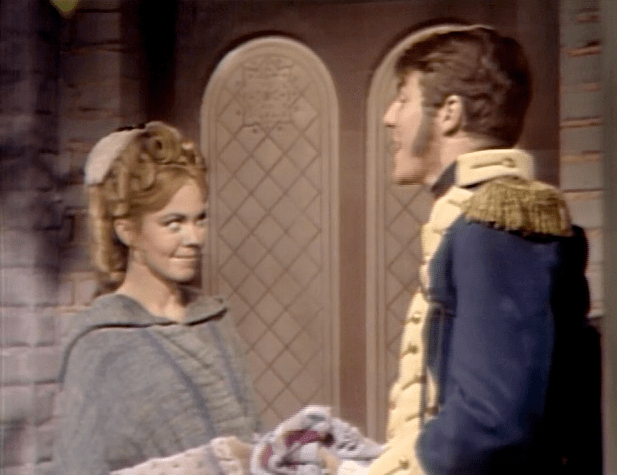
Angelique sees caddish naval officer Nathan Forbes coming out of the servants’ entrance. She remarks that the family and their guests never use it; he jokes about breaking rules. She asks what he has in his hands; he asks what hands she means, then admits that he stole some food from the kitchen. He claims to be on his way to a picnic, and invites her to join him. He is typically uninhibited in his dealings with young women, and he certainly doesn’t try to keep Angelique from thinking that if she accepts his invitation she will have her work cut out for her if she wants to remain fully clothed. She declines, insisting that she has duties to attend to.

Angelique sees through Nathan. Screenshot by Dark Shadows Before I Die.

She watches him go, and in a soliloquy says that she sees through him. He is taking the food to Victoria “Vicki” Winters, governess to young Sarah Collins and Trask’s prime suspect, who is in hiding. Perhaps Nathan was leveraging his reputation as a lecher by presenting his invitation to Angelique in terms he knew she would have to decline.

Back in the front parlor, Trask is asking the master of the house, haughty overlord Joshua Collins, why Angelique did not report when the servants were summoned for his questioning. Joshua replies that she is not the Collinses’ servant, but that she belongs to their house-guests, the DuPrés family. Trask rails against the DuPrés, and Angelique enters, meekly saying that her mistress told her she was wanted.

Even though Angelique was bustling around the room in the opening teaser, Trask does not recognize her. It may not have been customary to take much notice of servants in the eighteenth century, but Angelique is rather a hard person to miss. For one thing, she looks exactly like Lara Parker. A person would have to be pretty intensely focused not to notice someone who was so obviously meant to be a movie star.

Trask asks Angelique where she was when the other servants came. When she tells him she was walking alone in the woods, he asks if she went there to meet with someone- “perhaps the DE-VIL!!!” Jerry Lacy is an accomplished sketch comic, and the laughs he raises when Trask shouts about “The DE-VIL!!!” and “THE ALMIGHTY!!!!” must be intentional.

Trask questions Angelique closely, and for a fraction of a second it seems like he might know what he is doing. That produces mixed feelings in the audience- if he exposes Angelique, he will save Vicki and other characters we care about from the terrible fates that are apparently in store for them. On the other hand, Dark Shadows might then become The Adventures of the Heroic Reverend Trask, and that would be so ridiculous that no writing staff in the world could possibly keep it going for more than a few episodes.

Angelique sees through Trask as easily as she had seen through Nathan. She falls to her knees and claims to be having a vision. She hams it up shamelessly.

At first Trask says that she is either a complete charlatan or is speaking under divine inspiration; before Joshua can express a doubt as to which it is, he proclaims it genuine. She has claimed to hear the voices of a man and a woman speaking in a large new house that is otherwise vacant. Trask and Joshua decide it is the new house under construction on the estate, and rush off. We see Angelique with a weary look on her face, as if she can’t believe she is up against such a load of idiots.

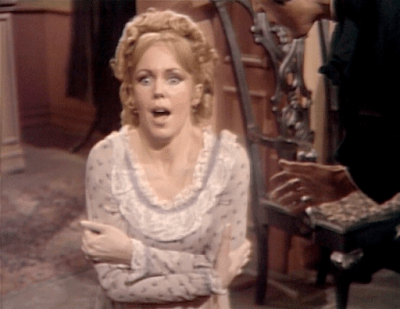
In the drawing room of the new house, Vicki is eating the food Nathan has brought. She starts talking about her situation. As it happens, Vicki is not native to 1795 at all. She was thrust back to that year from a séance she was attending in 1967, after Sarah’s ghost took possession of her and said she wanted to tell “the story from the beginning.” Vicki hasn’t told anyone about this, but she is continually saying and doing things that make it obvious she doesn’t belong in this world. She tells Nathan that “In order to get here, I had to transcend time and space.” Nathan says he doesn’t know what she’s talking about, but that if she keeps saying things like that even her friends will think she’s a witch.

Vicki natters away. Screenshot by Dark Shadows Before I Die.

There was a time when Vicki was an intelligent, dynamic character. Apparently she left her brain in 1967, because what Nathan says comes as news to her. A few days after Vicki arrived, kindly gentleman Jeremiah Collins befriended her; when she answered his questions about her past by claiming to have amnesia, he bluntly told her she would have to make up a better story than that. Someone who needs advice at that level is not likely to do well in a situation where only a con artist could survive.

Vicki and Nathan hear voices in the foyer. Trask and Joshua have arrived. Nathan goes out to meet them, claiming to have come to inspect the architecture of the house. Joshua is appalled that Nathan has not asked his permission to enter the house, and Trask is sure he has come to visit Vicki.

Trask, Joshua, and Nathan go into the drawing room. Vicki is not there. A window is open, and there is a piece of fresh food wrapped in a cloth on a crate. Nathan doesn’t claim that he opened the window or that he was eating the food; Trask and Joshua are left to conclude that Vicki had been there.

Episode 385: How long have you been in league with the devil?

Repressed spinster Abigail Collins has invited a visitor to the great estate of Collinwood. He is the Reverend Mr Trask. It’s 1795, so the Rev’d Mr T missed the big excitement in his hometown of Salem, Massachusetts by 103 years, but he’s trying to make up for it by hunting witches elsewhere.

Enter Trask. Screenshot by Dark Shadows Before I Die.

Both caddish naval officer Nathan Forbes and young gentleman Barnabas Collins are appalled by Trask, and each of them wants to defend the target of Abigail’s suspicions, governess Victoria Winters. They are powerless to do much for her. Barnabas cannot overrule his father, haughty overlord Joshua Collins, who is the master of the house and has given Abigail “full rein” in re Vicki. And Nathan cannot persuade Vicki to run away with him, because she distrusts his intentions and cannot believe that she is really in danger.

Unknown to any of the other characters, Vicki is a time-traveler displaced from 1967 by the ghost of Sarah Collins, who is now alive and studying under her direction. Vicki has been making one inexplicably foolish mistake after another since she began her uncertain and frightening journey to the past four weeks ago, and now they are all catching up with her.

It is hard to imagine what the writers were thinking when they made Vicki do such dumb things. Today, Trask, accompanied by his supporters Abigail and house-guest the Countess DuPrés, confronts Vicki in her room. At first, her behavior in that scene makes sense. He keeps putting his hands on her, prompting her to object; he asks her leading questions based on the assumption that she is guilty of witchcraft, to which she reacts with disbelief. But she has been in 1795 for nearly a month, and that whole time she has been a servant in the house of the tyrannical Joshua. She must know that she is subject to arbitrary exercises of power.

Further, we have seen Vicki in 1966 teaching history to her charge, strange and troubled boy David. You would think that she would have some appreciation of social context and would make some effort to play along with people who are native to the setting in which she finds herself. When Trask tells her to kneel and pray, he’s giving her the option to get out of trouble by doing something she wouldn’t have any reason to find objectionable. But she just gets angrier. She and Trask take turns slapping each other, and Abigail helps him bind and gag her.

Vicki slaps Trask. Screenshot by Dark Shadows Before I Die.

Later, Abigail and the countess are in the front parlor of the manor house. The countess has been pushing hard for action against Vicki, but she recoils from Trask’s methods. She tells Abigail that she wishes she knew where Trask had taken Vicki. Abigail reproves her, shocked that she would second-guess “a man of God!” The countess is played by Grayson Hall, who in the parts of Dark Shadows set in the twentieth century plays mad scientist Julia Hoffman. Like the countess, Julia is fascinated with the occult. Julia has expert knowledge that leads her to draw correct conclusions about this subject. Perhaps the countess’ misgivings about Trask show that she, too, is smart enough to see through the charlatans. Maybe Vicki will find herself with a more formidable ally than the irresponsible Nathan or the bumbling Barnabas.

Trask has tied Vicki to a tree deep in the woods. He tells her that if she is guilty of witchcraft, the tree will be dead by morning. He asks her to renounce Satan. In another Dumb Vicki moment, she refuses simply to say “I renounce Satan and all his works.” He leaves her tied up.

Trask leaves Vicki tied to a tree. Screenshot by Dark Shadows Before I Die.

Jerry Lacy joined the cast in #357 as lawyer Tony Peterson. In his performance as Tony, Mr Lacy did his famous Humphrey Bogart imitation. Bogart slips out once or twice today; when Trask looks away from Vicki and goes into monologues, he does sound like he is about to start explaining how he will find out who stole the strawberries from the officers’ mess. But what’s more important about his performance is how very far he goes over the top. Lara Parker famously described the Dark Shadows house style of acting by talking about the hyper-intense manner in which she was expected to deliver the line “Go back to your grave!”; Mr Lacy’s performance today is as intense as any we will ever see.

As Vicki, Alexandra Moltke Isles is usually one of the quietest and most interior-directed members of the cast. In Vicki’s scenes with Trask today, she shows that she can shout with the best of them. If Vicki had taken her brain with her to 1795, it might have been fun to see what Mrs Isles could do with the part under the new regime.

Mr Lacy wasn’t the first shouty actor to share a scene with Mrs Isles. For the first several weeks of the show, the cast included a man named Mark Allen. In alternate episodes, Allen either shouted all his lines or whined all of them. Mrs Isles responded to that memorably in #20 by growing ever more still and quiet as he bellowed at her. But while Allen’s shouting was simply a sign of incompetence, Mr Lacy’s is textured, nuanced, and funny. When other actors shouted back at Allen, the result was a lot of noise. When Vicki shouts back at Trask, she comes to life.

I do wonder about Trask’s name. Just a few days ago, I was looking through a book about Marvel Comics in the 1960s, and learned that a villain named Bolivar Trask was introduced in The X-Men in 1965 and was a big deal in several Marvel titles for the next few years. The writers, producers, and directors of Dark Shadows were all middle-aged, and it is unlikely that they were reading comic books for pleasure. But they had shown engagement with comics before- a graveyard scene in #209 includes a rather clear echo of the visual style of the horror comics EC was putting out fifteen years or so earlier. Since that is part of the lead-up to the vampire story, the directors would have been making an obvious move had they sent a production assistant to a flea market to look for some old horror comics to which they could slip in an homage.

Besides, Dark Shadows itself had been licensed to Dell for comic books by this time. It would only have been natural for people involved with the show to have been curious what might come of that. Maybe they were browsing through Marvel’s output to get a sense of what was going on in that medium.

Or an influence could have come through an even less unusual vector. Several members of the production staff had children who were teenaged and younger, as did writer Sam Hall. Those children might well have been fans of Marvel’s in those days. So it is possible that someone behind the scenes might have heard the name “Trask” mentioned around the house as a good one for a villain.

Episode 363: Very honorable guy

When Dark Shadows debuted in June 1966, it was a Gothic romance in which characters sometimes equivocated about whether they were using the word “ghost” metaphorically to refer to present troubles caused by past conflicts or literally to refer to things that go bump in the night.

That version of the series ended with the story of undead fire witch Laura Murdoch Collins. In Laura’s months on the show, her arc absorbed such major plot elements as the conflict between high-born ne’er-do-well Roger Collins and local man Burke Devlin, the psychological problems of strange and troubled boy David, David’s relationship with his well-meaning governess Vicki, and the tensions between the ancient and esteemed Collins family and the working class people of the town of Collinsport. By the time Laura went up in smoke in #191 and #192, there was no life remaining in any open narrative thread, and Dark Shadows 1.0 was at an end.

Dark Shadows 2.0 launched in #193 with the introduction of seagoing con man Jason McGuire. Jason was an in-betweener who would tie up the loose ends remaining from the 25 weeks before Laura joined the gallery of characters and facilitate the introduction of Laura’s successor as a major supernatural menace, vampire Barnabas Collins. Jason kept himself busy blackmailing reclusive matriarch Elizabeth Collins Stoddard, his sidekick Willie Loomis accidentally released Barnabas, and the show kept dropping hints that when Liz finally stood up to Jason all of the original secrets would be laid bare.

The makers of Dark Shadows didn’t do much advance planning, so they kept Jason on the show for 13 weeks after Barnabas premiered while they tried to come up with some other way to fill the time. When Jason’s plan finally blew up in his face, they even left some of the old secrets still buried, most notably the question of where Vicki originally came from.

Barnabas finally killed Jason in #275, and he hasn’t been mentioned in a while. But he is not forgotten. As we open today, lawyer Tony Peterson has caught heiress Carolyn Collins Stoddard in his office, rummaging through his safe. Tony has been dating Carolyn and is clearly very much attracted to her. He invites her to tell him a story that will give him an excuse not to call the police. She has to think fast to come up with one, and what she settles on is a version of the story of Jason and Liz.

Tony knows that Carolyn was trying to steal a notebook that he had put in his safe. This notebook was the property of his newest client, Julia Hoffman, a permanent guest at the great house of Collinwood. Carolyn tells Tony that Julia was blackmailing Liz. The notebook, she claims, is a diary kept by a man with whom Liz had an affair, and it contains proof that the man was Carolyn’s father. Julia knew the man and knew that he was planning to come to Collinwood to squeeze money out of Liz in return for his silence, but he died before he could do so. Julia took the diary and picked up where he left off.

Since Tony’s professional ethics will not allow him to be a party to blackmail, this is the one story that could give him a plausible reason not to report Carolyn’s crime to the police. It also gives him a reason to feel sorry for the Collinses, whom he hated when we first saw him, removing an obstacle to the possibility he might fall in love with Carolyn.

The echo of the Jason/ Liz story in the image of Liz forced to accept a blackmailer as a member of the household offers a great deal more than narrative convenience to regular viewers. The audience knew what Jason was threatening to tell if Liz did not submit to his demands, but the characters did not. One idea that some among them seemed to suspect was that Jason was Vicki’s father and Liz was her mother. Indeed, the makers of the show did plan to explain Vicki’s paternity at the end of the blackmail arc, a plan they abandoned so late that the climactic episode runs some minutes short. When Carolyn brings up the idea of her mother being blackmailed to keep it secret that she bore a child out of wedlock, those of us who have been watching all along will realize that she was among those who suspected that this was the secret that gave Jason his hold over her.

The audience knows that there will be no romance between Tony and Carolyn, because we know that she is Barnabas’ blood thrall. Barnabas sent her after Julia’s notebook, because it contains the records of an experiment in which she tried to cure him of vampirism. It would expose him were it to fall into the hands of the authorities. Since Barnabas wants to rid himself of Julia, perhaps by killing her, perhaps by driving her totally insane, he cannot leave such a document out of his possession.

Dark Shadows has come to as much of a dead end now as it had when Laura’s arc was ending. None of the ongoing stories has room for more than a few steps of further development, and if they keep running through those steps at the current pace everything will be resolved in a couple of days. Bringing up Jason, whose introduction marked the beginning of Dark Shadows 2.0, leads us to wonder if they have something up their sleeves that will launch Dark Shadows 3.0.

Tony takes Carolyn home to Collinwood, where he confronts Julia. He tells her what Carolyn told him. She denies it, and says that she will write a letter entrusting the notebook to him to remain unread unless something happens to her, in which case he will read it and hand it over to the authorities. That satisfies him that he isn’t a party to blackmail, and he agrees to her terms.

For the last couple of days, Barnabas has been using black magic in an attempt to break Julia’s grip on sanity. Her clear thinking and calm demeanor in this scene prove that this attempt has failed. The only open question in the only ongoing conflict is, therefore, whether Barnabas will try to murder Julia. She is such a valuable character that it is hard to feel any real suspense about whether he will succeed in killing her, but there is a chance that he will make an attempt.

David and Vicki have come home from a trip to Boston. David enters the drawing room, sees Julia, and greets her. She can barely pay attention to him long enough to say hello. He asks if she is all right; again, she is clearly not at all focused on him. She excuses herself, saying she has to go to Barnabas’ house.

David’s relationships to the other characters were the engine that drove Dark Shadows 1.0, and when Barnabas began to pose a danger to David that same engine accelerated the pace of Dark Shadows 2.0. Julia has been central to the plot for some time; that she can’t be bothered to take any notice of David tells us that that engine has fallen apart. Whatever they are planning to do next week, David won’t be at the heart of it.

David leaves the drawing room. He gets as far as the foyer. There, he sees his friend, the ghost of Barnabas’ ten year old sister Sarah. He tells Sarah that he has been on a trip. She asks where he went. He says he went to China. “Oh,” she responds, blandly. “You’re not impressed?” “No, my father’s friends used to go to China on their ships.” “Well, I didn’t really go to China. I went to Boston.” “BOSTON!!!” Sarah exclaims. “I went to Boston once!” She’s electrified. It’s adorable beyond belief.

Suddenly, Sarah looks disturbed and says she has to go. David asks why, and she says there is trouble brewing at the Old House. Again, David has been sidelined. If there is going to be any more action, it will have to come from fresh sources.

The Old House is Barnabas’ house, and that’s where we go next. We see Julia arriving there. She tells Barnabas that Vicki is back. He is mildly interested. She then tells him that she has seen Sarah. Barnabas longs to see Sarah, and is tormented that she will appear to others but not to him. He accuses Julia of lying. She insists that she is not, and taunts him with Sarah’s refusal to appear to him. He grabs Julia by the throat. He has done this before as a threat, but this time it looks like he really means to strangle her. Before he can, a wind blows the door open and the candles out, and Sarah walks in. She approaches her brother, glaring at him.

Sarah has had it with Barnabas. Screenshot by Dark Shadows Before I Die.

Episode 357: Hit the blood

Mad scientist Julia Hoffman must hide her notebook from vampire Barnabas Collins and Barnabas’ blood thrall, his distant cousin Carolyn. The notebook documents Barnabas’ vampirism, and he does not want it to fall into the hands of the authorities. Once he gets hold of it, he plans to kill Julia.

The last time Dark Shadows devoted as much story time to attempts to hide and find an object as they have to this notebook was when high-born ne’er-do-well Roger Collins was frantically trying to hide local man Burke Devlin’s filigreed fountain pen, a story that dragged on from August to November of 1966. Few remember that storyline fondly, but at least the pen was a unique piece of evidence that might connect Roger to a homicide. The notebook is less satisfactory as a focus of attention, since there is nothing unique about it- Julia could easily have written a hundred documents detailing Barnabas’ secret and stashed them all over the world, and for all Barnabas knows she may have done. There are several strong episodes during this period, but the inadequacy of the notebook as a MacGuffin, combined with the fact that Julia could at any moment hop in her car and drive someplace where Barnabas wouldn’t be able to hurt her, prevents any momentum carrying over from day to day.

There are two important things about this installment. It is the first episode written chiefly by Sam Hall,* who will become far and away the most important member of Dark Shadows‘ writing staff. Hall would write hundreds of episodes, right up to the final one, would write the two theatrical features based on the show that were produced in the early 1970s, and would stick with producer Dan Curtis for years afterward, even contributing a script to the ill-fated 1991 primetime reboot of Dark Shadows. The husband of Grayson Hall, who played Julia, he would develop the show into something as different from its November 1967 incarnation as that version is from the show that premiered in June 1966.

On his blog Dark Shadows Every Day, Danny Horn argued that Hall’s contribution was to see Dark Shadows as, first and foremost, a “mashup” of various stories. The example he gives in his post about this episode are the scenes in the office of Tony Peterson, a local attorney whom Julia has hired to keep the notebook locked up in his safe. Tony is played by Jerry Lacy, who in the 1960s and 1970s was chiefly known for his Humphrey Bogart imitation. He would do that imitation on Broadway in 1969 in Woody Allen’s Play It Again, Sam and again in the 1972 film version of that play; here he is doing it in a 1980 commercial for the Long Beach California Press-Telegram.

In the scenes Danny focuses on, Mr Lacy imitates Bogart as Sam Spade or Philip Marlowe meeting a succession of mysterious women in his office. Grayson Hall plays Julia as a frightened and barely coherent client and Nancy Barrett plays Carolyn as the blonde you’d be a fool to trust, even if she does have a pair of gams that won’t quit. They’re all having a great time with their pastiche of The Maltese Falcon, The Big Sleep, and other staples of the Late Late Show.

Carolyn fingers the notebook. Screenshot by Dark Shadows Before I Die.

I do have to demur from Danny’s claim that Hall pioneered Dark Shadows as a mashup. It was that from #1, when Jane Eyre met the Count of Monte Cristo and they both found Art Wallace trying to remake a script he’d already sold to television twice. Nor is he the first to mash up disparate genres. The story of Burke’s fountain pen led into a police procedural that merged with a ghost story; Burke’s typically soapy conflict with Roger dissolved into the story of Roger’s ex-wife, undead fire witch Laura Murdoch Collins, a story which was Dark Shadows’ first and most detailed adaptation of Dracula. The difference in Hall’s approach to mashups is that always before, one of the genres was Gothic melodrama. Today, a vampire story is meeting a film noir, and there are some elements of conventional daytime soap opera in the margins. Hall is letting go of Dan Curtis’ original idea of chasing viewers who read Gothic romances.

We get a clue as to what that might mean for the existing characters when Tony asks Julia if she is afraid of Roger Collins. Julia laughs loud and long at the idea that Roger is any kind of danger. For the first 25 weeks, Roger was indeed a deadly menace, but ever since Laura came through he has been reduced to occasional comic relief. Viewers who find a reminder of Burke’s fountain pen in the business with the notebook will see that even the villainous early Roger is a minor threat compared to the supernatural force Barnabas represents. So we are not to assume that any character or theme surviving from the show’s original conception is safe.

*The credits on screen say Gordon Russell wrote it, but evidently the paperwork from the show demonstrates that Hall did. Also, some of last week’s episodes sounded and felt as much like Hall’s work as this one does, but none of the experts tries to credit him with those, so I’ll defer to the consensus and say that while his influence may have been visible some days ago, this one marks his debut on Dark Shadows as the principal author of a teleplay.

In place of 131: “A Christmas Carol”

There never was an episode #131 of Dark Shadows. They made a point of giving numbers divisible by 5 to episodes that aired on Fridays, so on days when the show was not broadcast-as it was not broadcast on 26 December 1966- they just skipped the number that would have been used had it run that day.

Since that preemption was the result of Christmas-related programming,* this seems like the place to promote 2021’s big Dark Shadows Christmas event, a dramatic reading of the Orson Welles version of Dickens’ A Christmas Carol by ten surviving members of the original cast. Surviving at that time- it turned out to be Mitchell Ryan’s last performance before his death on 4 March 2022; Christopher Pennock had been involved in the early stages of the production, but he would die in February of 2021.

It is irresistible viewing for Dark Shadows fans. It makes extensive use of music from the show- rather too extensive for my taste, but Mrs Acilius liked it, and from what I gather she appears to be in the majority.

The acting is quite good. I was especially impressed by James Storm’s portrayal of Bob Cratchit. I had never seen Mr Storm in anything but Dark Shadows, where he was cast in the preposterously unplayable role of Gerard Stiles, so it was amazing to me to see what he could do when he had something to work with.

Another pleasant surprise was Alexandra Moltke Isles as the Ghost of Christmas Present. Readers of this blog know that I have a high opinion of Mrs Isles’ abilities, but this was her first part in 53 years. I held my breath to see how many steps she had lost in that interval. As it became clear that she could go as deep into her character as ever and pull up a treasure trove of dramatic insight, I was thrilled.

Mrs Isles appeared at one or two Dark Shadows conventions early in the 1980s. During the unpleasantness, she couldn’t very well make herself available for any event where she would be expected to take questions from the floor, but from time to time she sent greetings on video that would be played at conventions. And she sat for several interviews about Dark Shadows over the years. So you can’t say she made herself a complete stranger, but it is still quite a novelty to see her in this setting.

Many longtime fans describe Mrs Isles as the cast member who was least friendly to them when the show was in production, and there may be a reason for that. In the Q & A, she responds to the question about her first encounter with fandom by telling a story about a girl jumping her on the street and trying to rip her hair out of her head. After that introduction, it is remarkable that she’s been around as much as she has.

The person who had been absolutely disconnected from fandom the longest was David Henesy. He stuck with acting for a few years into the 1970s, but never attended a convention or had any connection with any Dark Shadows themed public events until a cast reunion on Zoom in October 2020. His performances as the child characters (he’s by far the youngest member of the cast, a mere 65 years old at the time of taping) are as letter-perfect as was his work in the series.

*A football match, but a football match usually held at Christmas-time.

My usual themes: Imaginary Recasting

In 281 of the posts that follow, I link to comments I made on Danny Horn’s blog, “Dark Shadows Every Day.”

Not all of these comments were absolutely unique. One of my most frequent themes was “Imaginary Recasting.” I explain what I mean by this in a comment on Danny’s post for episode 470:

During the slow moments, I recast the show in my head. Harvey Keitel was a background player on the show once, a dancer at the Blue Whale in #33. So I imagine him in Roger Davis’ place. And several Dark Shadows cast members (David Ford, Virginia Vestoff, and Daniel Keyes*) were in the original Broadway cast of 1776. So other members of that cast would have been available for parts on DS. I imagine Howard Da Silva in place of Addison Powell. With those changes, the version of the Jaff Clark**-Dr Lang scenes that plays in my head is quite good!

For the game to be fun enough to keep me going through the dire bits, it has to be plausible to me that the makers of Dark Shadows could actually have landed the actor in question. No doubt Laurence Olivier or Bette Davis or whoever would have been a valuable addition to the cast, but they were so unlikely to take such a part that I can’t make myself believe in the scenario strongly enough to distract from whatever it is I don’t like about what I’m actually watching.

The categories from which I draw imaginary cast members, then, include sometime non-speaking players like Keitel. In that group are also to be found Fredric Forrest, David Groh, Henry Judd Baker, and Susan Sullivan. A second category is people who appeared on the show in speaking parts but only briefly, such as Marsha Mason, Gail Strickland, Cavada Humphrey, Beverly Hope Atkinson, and Philip R. Allen. It’s easy enough to believe that people who accepted small parts on the show would also have taken bigger ones.

There are also several people who appeared on the show in major parts, but not enough for my liking. Among these I often mention Clarice Blackburn, Jerry Lacy, Alexandra Moltke Isles, Virginia Vestoff, and Robert Rodan.

There are also three categories of people who didn’t actually appear on the show, but who might well have. The first of these is the one I mention above, the cast of 1776. In addition to da Silva, I also mention Ken Howard, who was Thomas Jefferson in 1776 and who would have been an interesting choice for Morgan Collins in the dying days of Dark Shadows.

The other two categories each include just one person. If they could get Harvey Keitel and Fredric Forrest to dance in The Blue Whale, surely they could also have landed Robert de Niro to play a speaking role. I’m just as glad they didn’t- had he been cast as Carolyn’s motorcycle-riding boyfriend Buzz, the character might have been a big enough hit they would never have got round to making the spook show we all know and love.

The second one-person category is actors whom we know series creator Dan Curtis wanted to have in particular parts. The one person in that category is Bert Convy, Curtis’ first choice for the part of Barnabas Collins. I am glad Jonathan Frid was cast instead, but I do try to imagine what the show might have been like with Convy. I also try to imagine how Jonathan Frid might have done in Convy’s place as a game show host:

Which raises the further question of how Jonathan Frid would have done as the host of Tattletales. “Ladies, suppose you your fella, you- the two of you! Suppose you went to a kind of, well, a resort, a vacation place. And the beaches- multiple beaches, one of them as it happens a nude beach. A beach of nudeness! Suppose further that it was your choice and only yours- what I mean is, you must choose which beach to visit! The nude, or the other! Don’t give me your answer, you must not! But when I call for it, then, you will tell me which beach you choose!”

*I should also have mentioned Emory Bass and Peter Lombard

**For “Jaff,” read “Jeff,” not that it really helps