An extraordinarily uneventful outing. In yesterday’s episode it looked like heiress Carolyn would go to visit Chris the werewolf as he is in the middle of a transformation and would be attacked. But she didn’t go. Governess Maggie did go to Chris’ cottage, and at the end of the episode it looked like she might be attacked. As we open today, she is there and he is about to change, but she leaves and gets home safely while he is still in human form.
It again looks like Carolyn might be attacked when she walks through the woods to visit the mausoleum where her mother, matriarch Liz, is entombed. Liz was alive when she was mistakenly buried and is still alive now. Liz is unable to move or speak, but she somehow shares the audience’s thought that Carolyn might possibly be attacked. We see her in her coffin and hear her interior monologue as she thinks about the “terrible danger” her daughter is in.
As it happens, Carolyn makes it home fine. Later she goes out again; we see the werewolf prowling nearby, again raising the theoretical possibility that she will be attacked. But Carolyn hears Liz’ voice in her head, a telepathic warning that she should hasten off. The werewolf also reacts as if he can hear Liz’ voice, and he goes off in another direction. The screen goes dark and the credits start rolling. The werewolf hasn’t attacked anyone and no one has learned anything about him.
It appears that the werewolf is trying to figure out where Liz’ voice is coming from.
It’s kind of interesting that Liz can transmit telepathic messages now. She could use a supernatural power or two if she’s going to get into the swing of things on the show. It’s also interesting that the werewolf seems to be able to overhear the messages Liz sends to Carolyn. Chris’ little sister Amy lives in the great house of Collinwood now, and along with strange and troubled boy David she is falling under the power of the evil ghost of Quentin Collins. Quentin communicated with Amy before he could get through to David. David was miffed by this, since “Quentin is my ancestor.” That suggested that Quentin will turn out to be Amy’s ancestor as well, making her and Chris members of the Collins family. If so, that might explain why Chris, even in his lupine form, was able to pick up a telepathic transmission Liz directed to her blood relatives.
There is a wardrobe malfunction in this one of a type that showed up several times in the first year of the show. When Carolyn makes her first entrance, she walks down the stairs in the foyer. At each step, Nancy Barrett’s chest thrusts into her sweater with results that would probably not have made it on the air had anyone from the ABC network’s office of Standards and Practices been watching the show. In the early days, they put the actresses into very form-fitting tops often enough that I thought they were challenging the audience to take an adult attitude towards female anatomy, and so I did my best to rise to that challenge by leaving it unremarked when we could see the exact shape of their breasts. But it’s a rare occurrence now, so I think we have to list it among production faults.
Vampire Barnabas Collins has traveled back in time to the year 1796, where he plans to change what happened on one crucial night.
Yesterday’s episode was a clip show excerpted from #456-#460, the last full week of a period when Dark Shadows was a costume drama set in the 1790s. Today’s consists largely of reenactments of those scenes. It all pays off in the last minute, when a confrontation between Barnabas and roguish naval officer Nathan Forbes ends differently than it had the first time round. As before, Nathan loads a crossbow with a wooden bolt and waits for Barnabas to come to him, hoping that he will shoot the bolt through Barnabas’ heart and thereby achieve the same effect as a wooden stake. The first time, Nathan missed Barnabas’ heart and Barnabas killed him. Unlike the first time, Barnabas knows what Nathan is planning. So he opens the door, but does not enter the room. Nathan can hear Barnabas’ voice, but cannot see him. Finally Barnabas jumps Nathan from behind, evidently biting him.
Barnabas originally killed Nathan as revenge for Nathan’s role in his mother’s death. This time he is willing to let Nathan live. He wants to take control of him and force him to tell the authorities that he lied when he testified against governess Victoria Winters and her boyfriend, an unpleasant man named Peter. Victoria is herself a time-traveler, and Barnabas got to be quite fond of her in her original period, the 1960s. She is scheduled to be hanged tonight for her many crimes, and Peter is also condemned to the gallows. Barnabas has come to rescue them.
During the opening title sequence, Thayer David announces that “Today the part of Victoria Winters will be played by Carolyn Groves.” When we first see her, Victoria is asleep in her cell at the Collinsport gaol, and her face looks very much like that of Alexandra Moltke Isles, the original Victoria.
Barnabas wakes Victoria. She is puzzled to see him. He has never told her that he was a vampire; even when he was biting her on the neck and sucking her blood for a week in March 1968, she didn’t seem to catch on. She just seemed to think he had a particularly aggressive make-out technique. She thinks that the Barnabas she knew in the 1960s was a descendant of the one she knew in the 1790s, and that the one from the 1790s is dead. Barnabas would rather not get into the weeds about his personal history, such as the countless murders he has committed, and gives Victoria a truncated account of how he, the man from the 1790s, is laboring under a curse that made it seem that he was dead. He doesn’t explain how he got into her cell, how he knows who Peter is, or how he plans to free the two of them from their death sentences. He asks her to take all of that on faith.
Miss Groves plays Victoria as so happy to see Barnabas she smiles all through her account of her imminent and, she believes, inevitable execution. That’s odd to see, but it fits so perfectly with the delight Victoria always took in Barnabas’ company that it shouldn’t bother longtime viewers.
Mrs Isles was cast as the original Victoria in large part because she looked so much like Joan Bennett that Bennett famously mistook her for her daughter when she first saw her. In the Collinsport Historical Society’s 30 December 2017 post for this episode, Patrick McCray not only tells us that Miss Groves appeared in a play with Joan Bennett in 1960, but provides a still of the cast in which the two women look like they could be mother and daughter:
The show spent much of its first year hinting heavily that Victoria was the unacknowledged daughter of Bennett’s character, matriarch Elizabeth Collins Stoddard. They never collected those hints and built them into a story, and the question of Victoria’s parentage was left as one of Dark Shadows’ most annoying loose ends. Perhaps Miss Groves’ casting is a sign that the failure to resolve that question bothered the makers of the show as much as it did the audience.
There is some reason to believe that writer Ron Sproat was disaffected from the rest of the production staff at this time. Today’s script is so unbelievably bad that it is tempting to think he wrote it as an act of protest.
Children Amy and David have gone looking for the ghost of Quentin Collins and are now trapped in a room in the long deserted west wing of the great house of Collinwood. David’s father Roger, his aunt Liz, and his cousin Carolyn are moving about the house in a conga line trying to find them.
Quentin’s ghost is keeping the children locked up; the ghost of someone named Magda is trying to lead the adults to rescue them. At one point the adults watch a mirror while letters appear on it spelling out “Jamison,” the name of Liz and Roger’s father. This is plainly a supernatural manifestation, but it advances neither Magda’s goal nor Quentin’s. Perhaps Jamison’s ghost can’t rest with all the racket Quentin and Magda are making, and he just wants to say hello.
In the locked room, David bangs on a wall, finds it is hollow, and speculates about what is on the other side. Amy protests “We can’t go through a wall!” In response, he again bangs on the wall, again finds it hollow, again speculates about what’s on the other side, and Amy again protests “We can’t go through a wall!” Later in the episode, they start this scene a third time, but they stop before Amy has another chance to say “We can’t go through a wall!” It’s just as well she does stop short of saying this a third time. By the end of the episode, they’ve found a crowbar, which enables them to pry the paneling open and go through the wall quite easily.
Meanwhile, the adults have progressed to the drawing room, where they argue about whether to search the west wing. They troop upstairs and find the door to that part of the house locked. This leads them to conclude that David and Amy can’t have gone in there, and the parade goes back to the drawing room. There, they again argue about whether to search the west wing. They again troop upstairs, this time unlocking the door and conducting the search. After they fail to find the children, they return to the drawing room again, where Roger speaks for all of us when he says “Well, that was a waste of time.”
When the adults were shuffling around huddled in their little clump, I found it hard not to look at Liz’ face and see Joan Bennett thinking that she used to be a big movie star and now she’s reduced to this stage business that would have embarrassed the Three Stooges. This week’s episodes were directed by a mysterious figure billed as “Penberry Jones”; whoever Jones was, I don’t think s/he was to blame for the weird little parade the adult characters keep making through the house. The script calls for the actors to talk with each other constantly while walking together through narrow, awkward spaces such as stairways, darkened corridors, and a cluttered store-room, and so it would have taken more time than they had to choreograph a more fluid set of movements.
David and Amy hear a waltz. It has a creaky sound to it, as though it were being played on an old gramophone. This is introduced as a special effect. Unfortunately, Dark Shadows introduces special effects by ramping up the background music, so when the children first talk about the waltz we can barely hear it. After a commercial break, the background music calms down and the waltz is more audible. We will hear it a great many times over the next several months, so often that it will be ironic to think that there was a time when we wanted to hear it but could not. I suppose Penberry Jones probably did have the discretion to tone down the accompaniment, so that would be one strike against him or her.
Longtime viewers will notice a small deviation from continuity when David tells Amy that ghosts come out only at night. In the first year of the show, David often saw the ghost of the gracious Josette in the Old House of Collinwood during the day, and from June to November 1967 he and the ghost of nine year old Sarah played together in the sunlight several times.
Maggie Evans, The Nicest Girl in Town, is visiting the great house of Collinwood to sit with her sick friend Vicki. There, she meets mysterious drifter Chris Jennings. Maggie is furious with Chris, because he refuses to stay in Collinsport and take his little sister Amy in. Ever since their brother Tom died, Amy has been living at Windcliff, a mental hospital 100 miles north of town. Chris won’t explain to Maggie or anyone else why he keeps moving.
Julia Hoffman, MD, is the director of Windcliff, and she has been a permanent houseguest at Collinwood since last summer. Julia comes downstairs, and finds Maggie still reading the Riot Act to Chris. When she tells Maggie that Vicki is ready to see her, Maggie looks contemptuously at Chris, exclaims “Good!,” and stalks out.
Julia picks up where Maggie left off. Chris tells her he came to Collinwood to give her some money to pass on to Amy; Julia gives the money back to him, and says “She doesn’t need money, she needs you!” Chris won’t tell Julia where he is going or why. She asks if he will at least stop at the hospital on his way out; he says he will not.
In #632, we saw Chris visit Amy at Windcliff. Also in that episode, it became very clear that Chris is a werewolf. Returning viewers who remember that about him also know that Julia is an expert in vampires and Frankensteins with secondary interests in ghosts and witches, so if Chris came clean with her she might well have a prescription for him. But wherever Chris has been wandering, it isn’t a market where the ABC affiliate runs Dark Shadows, so he misses his opportunity to seek specialist medical attention.
Vicki has some symptoms that require Julia’s attention. On her way upstairs, she asks Chris not to leave before she comes back, since she has some more scolding to do. When Julia does come back down, she gets a telephone call from Windcliff. Amy has run away. She asks where Chris is, only to find that he did not comply with her request.
Matriarch Liz decides to go to the Old House on the estate, home of her distant cousin Barnabas. She explains that Barnabas and Vicki have always been close, so that she thinks he might be able to help calm her. Julia apologizes that she can’t accompany Liz on the walk through the woods, explaining that she has to wait by the telephone in case Windcliff calls again.
Liz is wearing a bright red dress we haven’t seen before, and as she leaves the house she puts on a bright red coat that is also new. This striking ensemble makes her look very much like Red Riding Hood. We see Chris skulking in the woods as Liz is walking nearby; he isn’t wearing character makeup, but is bending down and panting, suggesting The Big Bad Wolf. Liz hears him and calls out, asking who is there. She is looking into the camera, a look of alarm growing on her face, while we zoom in on her. Growling, snarling noises play on the soundtrack, suggesting that our point of view is that of the attacking werewolf. Liz has been a major character since episode #1; also introduced in #1 was the keeper of the Collinsport Inn, Mr Wells, whom we saw the werewolf brutally kill in #632. The show has been dropping major characters from the story and important actors from the cast recently, so it is not in fact impossible that this might really be the death of Liz.
When I was a teenager and first started reading long books, page 638 was always a milestone for me. When I’d read page 638, I was always sure I would make it to the end, no matter how many pages were left. Ever since, 638 has been my lucky number. I can’t claim to be certain I will carry this blog all the way to #1245-WordPress has been getting steadily buggier lately, blogging itself is an increasingly old-fashioned pastime, and who knows what might happen to me between now and April of 2027- but it does give me a boost to have reached this point.
No episode of Dark Shadows premiered 56 years ago today. That was Thanksgiving, and ABC was showing football at 4 PM.
At this point, Alexandra Moltke Isles had left the part of well-meaning governess Victoria Winters, marking the last step in the character’s long decline from her original position as the show’s chief protagonist. Vicki spent her childhood in a foundling home where she was left as a newborn with a note reading “Her name is Victoria. I cannot take care of her.” During Dark Shadows‘ first months, Vicki was on a quest to find out who her parents were. The show hinted pretty heavily that her mother was reclusive matriarch Elizabeth Collins Stoddard and her father was someone other than Liz’ long-missing husband, the scoundrelly Paul Stoddard, but the whole thing was dropped without any real resolution long ago.
In yesterday’s episode, Frankenstein’s monster Adam was on his way to Vicki’s room, apparently meaning to kill her. We understand Adam’s violence too well to regard him as a very cold villain. Most of the harm he has done is the result of his not knowing his own strength, and the rest is the predictable consequence of the abominable education he has received from his creators, mad scientist Julia Hoffman and recovering vampire Barnabas Collins, and from suave warlock Nicholas Blair. To longtime viewers, Vicki has been important enough for long enough that we do not see any prospect that a character as sympathetic as he is will become her murderer. On the other hand, Nicholas has now left the show, and there is nowhere for Adam to go within any of the ongoing storylines. If he simply disappears, he will be another significant loose end.
In September 2023, I left a long comment on Danny Horn’s Dark Shadows Every Day describing a fanfic idea that would at one stroke answer the questions of Vicki’s origin and of Adam’s fate. Below is a lightly edited version of that comment:
Here’s an idea I had today for a story that would save Vicki.
It would be a TV movie airing late in 1969. Start with a prologue set in Collinwood at that time. Adam returns, looking for Barnabas and Julia. He’s very well-spoken and accomplished now, but still socially awkward, still prone to fits of anger, and in need of help to get papers that he needs to establish a legal identity.
He finds that Barnabas and Julia are gone. He also happens upon some mumbo-jumbo that dislocates him in time and space.
It plops him down in NYC in 1945. With his facial scars, everyone assumes he’s a returning GI injured in the war. He meets a young woman, supporting herself working at a magazine about handheld machines, trying to establish independence from her wealthy family back in Maine. This woman, played by Alexandra Moltke Isles, is Elizabeth Collins.
Adam and Elizabeth slide into a love affair. She has another boyfriend, a dashing young naval officer named Paul Stoddard (Ed Nelson.)
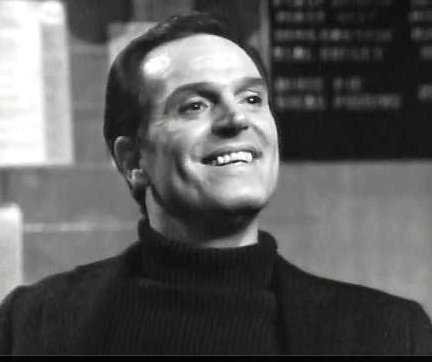
Ed Nelson as the Paul Stoddard of 1945 Dennis Patrick as the Paul Stoddard of 1969
Elizabeth is frustrated with both Adam and Paul; Adam refuses to talk about his background, and while Paul says many words when asked about himself, he doesn’t really give significantly more information than Adam does. Paul is slick, charming, and familiar with all the most fashionable night spots, but he does show signs of a nasty side. Besides, he rooms with a disreputable young sailor named Jason McGuire (John Connell) who keeps turning up at the most disconcerting moments.
From #143, John Connell, suggesting the Jason McGuire of 1945Dennis Patrick as the Jason McGuire of 1967
For his part, Adam is sincere, passionate, and attentive, but given to quick flashes of anger. He’s just as quick to apologize and sometimes blubbers like a giant baby with remorse for his harsh words, but he’s so big and so strong that when he is carried away in his fits of anger Elizabeth can’t help but be afraid of him. Besides, he’s not a lot of fun on a Saturday night. He doesn’t have a nickel to his name, and his idea of an exciting weekend is an impromptu seminar on Freud’s TOTEM AND TABOO, followed by a couple of games of chess.
Elizabeth’s mother (Joan Bennett) comes to town. Mrs Collins is appalled by Adam’s scars, impatient with his refusal to discuss his background, and contemptuous of his obvious poverty. Paul’s effortless charm and sparkling wit, packaged in the naval dress uniform he makes sure he’s wearing when she first sees him, fit far more tidily into her vision of a son-in-law. Mrs Collins presses her daughter to spurn Adam and pursue Paul, and for a time Elizabeth tries to comply with her wishes.
Yet she cannot forget Adam. Paul realizes this, and sees his chance at an easy life slipping away. We see him in a dive in Greenwich Village telling Jason McGuire that Elizabeth and her inheritance are going to end up with the scar-faced scholar. He and McGuire review Adam’s weaknesses, and decide they can exploit Elizabeth’s concern about his temper. They trick her into believing that Adam is on the run from the law, having beaten his wife to death. They lead her to believe that it’s just a matter of time before his occasional verbal outbursts give way to physical abuse, and that when that happens it will be too late- he will kill her. Believing this, Elizabeth gives Paul another chance, but still cannot break things off with Adam.
Adam does not know what Paul and Jason have led Elizabeth to believe. He knows only that she has become distant from him, and that she is still seeing Paul. He becomes angry and shouts at Elizabeth. He reaches for an object; she believes it is a blunt instrument with which he will kill her. In a moment of panic, she grabs a gun she has been studying for an article the magazine has assigned her to write and shoots him. As he lies motionless on her floor, she discovers that he wasn’t reaching for a weapon at all- he was reaching for a love letter that he had written to her. She realizes that he was no threat to her, that she has shot him for no reason.
She flees to Paul and Jason’s apartment, telling them that she has killed Adam. Paul calms her and promises to take care of matters so that she will not be suspected of any crime. Paul and Jason go to her apartment and find it empty. There are bloodstains on the carpet where Adam fell, and a trail of bloodstains leading down the hallway out the front door. They follow the stains and find Adam nursing a serious, but clearly not fatal, wound. They lead Adam back to Elizabeth’s apartment. They draw on their naval training to remove the bullet, clean and dress the wound. After a conversation. Adam admits that there is no point in his pursuing Elizabeth, and he agrees to leave town. Paul gives Adam some money and promises to tell Elizabeth that he is all right and that he doesn’t hold a grudge. Adam shakes Paul’s hand and leaves.
Paul and Jason clean the bloodstains. They then return to their own apartment. On the way they exchange a look that begins as nervous, and ends with two broad grins. Elizabeth asks why they were away so long. They tell her that it takes quite a while to dispose of a corpse. She sobs. Paul holds her.
Paul and Elizabeth announce their engagement. A few weeks later, the doctor informs Elizabeth that she is pregnant. The child must be Adam’s. Paul is not interested in raising any child, and certainly not interested in splitting the estate with a child not even his own. He orders Elizabeth to give the baby up. She refuses. He points out that she wouldn’t be able to do much mothering if she were in prison for murder. She sobs. In the final scene, we see Elizabeth outside on a snowy day, holding a basket and writing a note. In voiceover, we hear the contents of the note: “Her name is Victoria. I cannot take care of her.”
Today, we open with well-meaning governess Vicki in her room in the great house of Collinwood, wearing her wedding dress. Matriarch Liz enters, gives her a peck on the cheek, and tells her what a lovely bride she will be. Everything in their words and actions suggests to first-time viewers that they are mother and daughter; the strong resemblance between Joan Bennett and Alexandra Moltke Isles would tend to corroborate this impression. In a later scene, we hear Vicki call Liz “Mrs Stoddard.” Thus we learn she is one of the household staff.
Meanwhile, Frankenstein’s monsters Adam and Eve share a moment. Eve was created to be Adam’s mate, but she has wanted nothing to do with him. She has gone so far as to tell him to his face that she hates him and will kill him. Today, suave warlock Nicholas has ordered Eve to make nice with Adam, and so she tells him to forget all about her previous remarks. They sit facing each other on the floor in front of the fire, the first time we have seen potential lovers do that on Dark Shadows. They kiss.
A jump cut indicates the passage of time, and we see Adam and Eve snuggling on a little sofa and being pleasant to each other. We are free to surmise that they had sex. Perhaps there will be Frankenbabies after all. Adam leaves. In his absence, Eve again says that she cares nothing for him, but only for someone named “Peter.” Since Peter is the man Vicki is supposed to marry today, that sets up a conflict.
Back at Collinwood, Vicki opens a wedding gift she finds disturbing. The card enclosed is simply labeled “Peter” in all caps. In fact, Eve sent it, but Peter is such a tedious character that it is easy to imagine that he has never learned to use lower-case letters or to write more than his first name, so we can understand Vicki’s reaction.
A woman named Eve sees a man standing on the terrace of the great house of Collinwood. She addresses the man as “Peter Bradford.” Regular viewers know that this is indeed his name, but we also know that he prefers to be called “Jeff Clark.” Peter/ Jeff has died and came back to life since he was first known as “Peter Bradford,” so I suppose you could say that’s a case of deadnaming. But while most transfolk tend to be patient when people inadvertently deadname them, Peter/ Jeff is a huge jerk about correcting people who use his former name. Yesterday twelve year old David Collins called him “Peter Bradford,” and he grabbed the boy and shook him until it looked like he had given him a concussion.
Eve is also a returnee from the world of the dead. Doubly so; her body is a Frankenstein creation made of parts salvaged from corpses, while her memories and personality are those of eighteenth century homicidal maniac Danielle Roget. Peter lived in that same era, and when Eve/ Danielle recognizes him we learn that they knew each other then. Peter/ Jeff doesn’t assault her as he did David; she’s his own size. He doesn’t recognize her, which she attributes to the fact that she looks different than she did when they knew each other. He keeps whining that his name is “Jeff Clark,” but she isn’t having it.
Meanwhile, Peter/ Jeff’s fiancée, well-meaning governess Vicki, is in the drawing room, having a conversation with matriarch Liz. There is a blooper in the middle of this conversation. Liz is supposed to say something like “Then you’ve resolved all your difficulties,” but Joan Bennett stumbles over the words. Alexandra Moltke Isles improvises a response that makes sense of it. That response is smooth enough, but she delivers the rest of her lines very quickly and with unusually little eye contact with her scene partner. Perhaps that is because she was afraid the improvised line was going to put the scene over time, or maybe she realized she had called attention to Bennett’s flub and was nervous because she had embarrassed a big star.
Or maybe Mrs Isles was nervous because her next scene was going to be with Peter/ Jeff, and she knew it would involve Roger Davis putting his hands on her. As they exit, Peter/ Jeff clutches Vicki by wrapping his arms around her in a remarkably awkward fashion, and she visibly squirms. This is most likely Mrs Isles’ discomfort arising from Mr Davis’ habit of physically assaulting his scene partners. A charitable viewer just might be able to believe that it is Vicki’s discomfort because Peter/ Jeff just spent the whole scene telling her transparent lies. He doesn’t want to tell her about his encounter with Eve/ Danielle, and makes up totally unconvincing excuses for his distracted state. Perhaps Mrs Isles channeled her unhappiness at being yoked with Mr Davis into her expression of Vicki’s dissatisfaction with the loathsome little man she is engaged to marry.
Peter/ Jeff steers Vicki offscreen.
Once Vicki and Peter/ Jeff are gone, Eve/ Danielle emerges from the bushes whence she had been spying on them. Liz comes out to the terrace and sees Eve/ Danielle. She asks who she is. When she does not answer, Liz tells her that she knows- she is the angel of death. Eve/ Danielle is startled by this, and hurries away.
The next scene takes place in the house of suave warlock Nicholas Blair. Nicholas has been keeping Eve/ Danielle there since she came to life. She has returned from Collinwood. Nicholas is upset with her for going out without his permission. She taunts him, and he slaps her. He threatens to kill her, and she says that while she does not know what his plans are, it is clear to her that she figures too prominently in them for him to do that.
Coming so shortly after we saw an actress give strong signs of unease at contact with Roger Davis, Nicholas’ slap to Eve/ Danielle’s face is a lesson in how professional actors handle scenes involving physical violence. Eve/ Danielle is relaxed before the slap and in shock after it. Her reaction gives the scene its energy. If Marie Wallace had reason to believe Humbert Allen Astredo would actually hit her, she may well have been as tense before the slap as Mrs Isles was before Roger Davis slithered his arms around her, and the scene would have dribbled out as lifelessly as does Peter/ Jeff’s scene with Vicki.
Once Nicholas concedes that Eve/ Danielle is important to his plans, she relaxes again and decides she may as well tell him about her encounter with Peter/ Jeff. Nicholas is intrigued, and disturbed. He tells Eve/ Danielle that “If it is true that they are one and the same, then there are forces at work here that I don’t know about.” Eve/ Danielle’s memory of her previous existence is very incomplete, and she wants Nicholas to help her to learn more about herself. Once he has heard about Peter/ Jeff, he is eager to oblige. He hypnotizes her.
At this point, my wife, Mrs Acilius, expressed frustration. “He’s going to hypnotize her and afterward she won’t remember anything! It’s only interesting if she remembers.” Eve/ Danielle does have a flashback to 1795, but at the end she seems to come out of the trance on her own. She turns to Nicholas, calls him by name, and says that she remembers Peter Bradford and she loves him. Since Nicholas doesn’t give her a post-hypnotic suggestion and snap his fingers, it seems likely she will remember her past with Peter.
When Danielle was introduced, I assumed that the name “Roget” was a case of deadline-induced selection. She is based on Madame DuFarge from A Tale of Two Cities, so she had to be French. But the writer didn’t have a list of French surnames at his fingertips, so he looked at his desk, saw a copy of Roget’s Thesaurus, and went with that. Perhaps that was what happened, but today Eve/ Danielle lives up to her namesake and goes into the synonym business. She calls Peter/ Jeff by his original name. She is on the receiving end of synonymy from Liz, since “the angel of death” is as good a name for her as any. And one of the memory gaps Eve/ Danielle wants Nicholas to help her fill is her previous name.
Marie Wallace plays Danielle in the flashback, even though she had mentioned in the first act that she looked different in those days. This occasions much discussion on the fansites. Here is the debate on the Dark Shadows Wiki:
During the fiashback scene, Danielle Roget should have been played by Erica Fitz instead of Marie Wallace. Fitz had previously portrayed Danielle Roget in episode 594, so it would have made sense and for character continuity to continue using the same actress. [Addendum: There are strong reasons to argue otherwise as well. One could argue that this is a memory that Nicholas is conjuring in Eve, so it’s from Eve’s perspective, and she would naturally see herself in her current guise, not even knowing what Danielle Roget looked like. This is also a reasonable place for dramatic license to prevail. The scene is very short, and it wouldn’t have been especially practical to have an additional actress. It’s also possible that viewers may have been confused if another actress was in the scene–Erica Fitz was on the show for only two episodes, so viewers at the time might not even have seen or not fully remembered what she looked like. Aside from that, it’s also possible Erica Fitz was not available.]
Discussion under “Bloopers and Continuity Errors” in “610” on The Dark Shadows Wiki.
In a comment on his own post about the episode on Dark Shadows Every Day, Danny Horn puts it more succinctly:
Yeah, I think the in-universe explanation is that the flashback pictured at the top of this post is Eve’s hypnosis-assisted memory of the event, so she’s picturing herself as she is now.
The real-world explanation is that Marie Wallace is playing Eve/Danielle now, and exactly nobody wants Erica Fitz to come back and appear in the flashback.
Comment left 23 March 2015 by Danny Horn on “Episode 610: Inexplicable You,” Dark Shadows Before I Die, 21 March 2015.
For my part, I’m sure Erica Fitz Mears is a very nice lady, and we should all give her money to help with her health problems. But no, she was not a good actress and I do not regret that she did not get more work on screen. Since Mrs Mears was only in two episodes, today’s flashback might have been an opportunity to give some other actress a chance to show what she could do as Danielle. But Miss Wallace does a very good job, and rounding the episode with two confrontations between the same pair of performers does a great deal to strengthen its structure. It would probably have been a mistake to cast anyone else in the flashback.
The flashback scene does come as bad news to longtime viewers, for reasons that have nothing to do with the casting of Danielle. When in November 1967 the show needed to develop a backstory for vampire Barnabas Collins, it took us back to 1795 and introduced Angelique, a maniacal ex-girlfriend who was determined to disrupt Barnabas’ new romance. That was a triumph that turned Barnabas from a stunt that boosted their ratings sufficiently to ward off cancellation into one of the major pop-culture phenomena of the 1960s, and Angelique herself became one of the show’s most important characters. That they are trying the same tactic with Peter/ Jeff, right down to a dramatic date of 1795, leads us to fear that they see him as a permanent part of the cast, and that they want to tie Eve/ Danielle as closely to him as Angelique is tied to Barnabas.
Well-meaning governess Vicki is engaged to marry an unpleasant man named Peter who prefers to be called Jeff. Vicki knows that Peter/ Jeff has some kind of job that keeps him busy during the day. She does not know that he has been spending all night working at a second job. He is helping to build a Frankenstein’s monster. This second job is unpaid; his incentive is that if the monster is not built, an already existing Frankenstein’s monster named Adam has said that he will kill Vicki and everyone else in the great house of Collinwood.
As we open today, Peter/ Jeff is bitten by vampire Angelique. After Peter/ Jeff regains consciousness, Angelique starts giving him orders. He ignores them, and she bites him again. After that, he seems dazed and agrees to do whatever she commands. She wants him to hook her up to the body under construction and to use her “life force” to animate it. He tells her that he doesn’t know how to do that, and that the body isn’t ready to come to life in any case. Turns out she needn’t have bothered.
Meanwhile, Vicki gets some news. Roger, brother of matriarch Liz, tells her that he wants to send Peter/ Jeff on a six-week training program along with two junior executives from the Collins family business, and that if he works out there will be a job for him at the end of it. Vicki is dazzled by the offer.
Peter/ Jeff comes by. Roger meets him alone in the drawing room to make the offer. Peter/ Jeff can neither leave the Frankenstein project nor tell Roger about it. He has to turn the offer down without explanation, leaving Roger offended. Vicki then asks Peter/ Jeff what he was thinking, and he can’t explain the situation to her, either. She is frustrated that she tells him everything about herself, but she can’t get any information from him. She says that the offer must have represented a “family decision” on the part of the Collinses, implying that Peter/ Jeff’s refusal will reflect badly on both of them in their eyes.
When Dark Shadows started in June 1966, Vicki was its chief protagonist, Roger its most menacing villain, and the Collinses’ business interests a major part of the story. Vicki receded to the margins after her most interesting storyline, her difficult relationship with her charge David, was resolved in March 1967, and by that time Roger had become harmless and the business had long since ceased to be a source of interest. When we hear Roger talking about a job for Peter/ Jeff, for a moment it seems that he and the business might once again be important, and that Vicki might again have something to do with the plot. Vicki’s disappointment in her beau reminds us that the character doesn’t really have a place on the show any more.
Upstairs, Liz is taking clothes out of her closet and talking about them with her daughter Carolyn. They jar longtime viewers when they look at a particular dress and reminisce that they bought it on a trip to Boston. For the first 55 weeks of the show, Liz was a recluse who hadn’t left home since Carolyn was an infant. I suspect Liz had worn that dress during that period, and wish I’d looked for it when we were on those episodes during this watch-through. There certainly hasn’t been enough time since then for the trip to Boston to evoke the nostalgic tone in which they describe it, or for the dress to have fallen so far out of fashion that the ladies agree it is time to throw it away.
The Liz-is-a-recluse story was never exciting, and once they ditched it the show was quick to give us scenes of Liz happily going out. It is sometimes said that Dark Shadows is what Star Trek would have been if they had replaced space travel with agoraphobia, and Liz’ seclusion was the first exploration of this topic. Following the deep cut into the early days of the show in Roger’s offer to Peter/ Jeff with a moment when such a prominent part of its first year is simply forgotten is so typical of this period’s episodes that I wonder if some of the dialogue was written by uncredited contributors who weren’t up to date on bygone story points.
Carolyn is glad that Liz, who just recently escaped from a mental hospital, is taking an interest in her wardrobe. Liz lets her down hard when she says that she wants to get rid of as many belongings as possible in the short time before her death. Carolyn tries to tell her that she isn’t dying, but Liz refuses to listen. She demands that Carolyn promise to have an open casket at her funeral.
Liz was in the mental hospital because of a psychological disturbance with which Angelique afflicted her some months ago. When she did that, Angelique was a witch. Since then, Angelique has been stripped of her witchly powers, killed, and brought back to the world as a vampire. You might think Angelique’s spells would all have been broken when she was de-witched; that has been the pattern on Dark Shadows previously. For example, when blonde fire witch Laura vanished in #191, the spell she had cast that caused Liz to mope around and be obsessed with death until she was sent off to a hospital was broken. Longtime viewers wonder if Liz’ continuing obsession with death and her paranoid fear of being buried alive are natural symptoms of the trauma Angelique put her through, and if she just needs better therapy than she was getting in the hospital.
Liz has a dream. It opens with Angelique looking directly into the camera. Angelique is wearing the same costume she wore in the scene with Peter/ Jeff and laughing. When Liz knew Angelique, she never dressed that way, she wore a black wig, and so far as the audience knows she never let Liz hear her signature evil laugh. So it seems that Liz’ current troubles are indeed a part of Angelique’s ongoing spell.
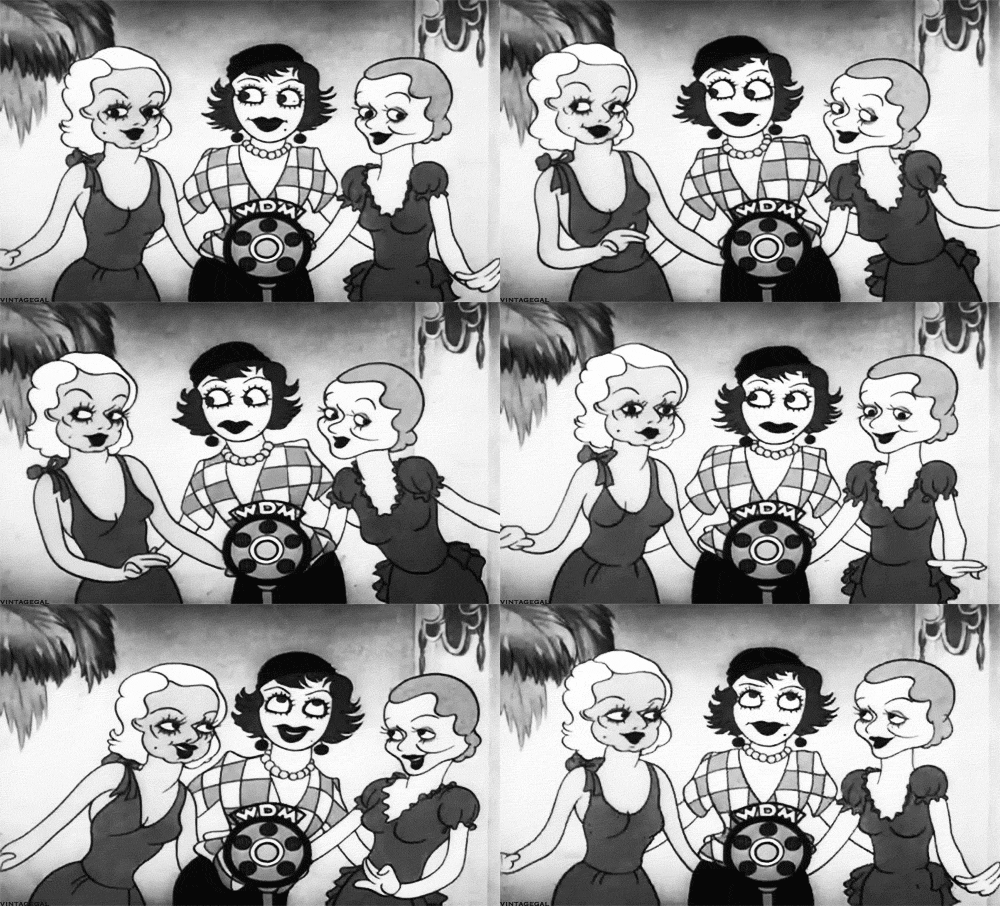
Facing us, Angelique tells Liz that she will be plagued by her obsessions until she dies. This is enough to trigger PTSD flashbacks in regular viewers. Twenty weeks ago, in #477, Angelique was looking at us when she described “The Dream Curse,” an abysmally repetitious, ultimately pointless storyline that dragged on for months. Joan Bennett was a fine actress and a great star, but there was only so much even she could do with a character who just mopes around and talks about death, and Dark Shadows has already made her do it more than once. In a comment on Danny Horn’s post about this episode, I wondered if Angelique couldn’t have cast a spell on Liz that isn’t just a retread of one we’ve seen before, and suggested one that would give her “a compulsion to put on a top hat and tails and sing and dance.” Here’s an animated gif of a cartoon showing Joan Bennett’s sister Constance dancing with Jean Harlow and Joan Crawford; it has more entertainment value than did the entire Dream Curse, and might serve as a consolation to those of us left shaking by Angelique’s threat to clog up the story again:
In #210, dangerously unstable ruffian Willie Loomis found an old coffin and broke into it, hoping to reap a harvest of hidden jewels. Instead a hand darted out, and Willie became the sorely bedraggled blood thrall of vampire Barnabas Collins.
The next person to open Barnabas’ coffin was Maggie Evans, The Nicest Girl in Town. Barnabas was keeping Maggie prisoner in his house on the great estate of Collinwood as part of his plan to persuade Maggie to forget her personality and turn into his lost love, the gracious Josette. In #250, Maggie decided to drive a stake through Barnabas’ heart, but had the bad luck to set to work a moment before sunset. He awoke, and spent the remaining two weeks of her captivity treating her even more cruelly than he had previously.
In #275, Willie’s onetime friend, seagoing con man Jason McGuire, made his way to Barnabas’ basement and found the coffin. As Willie had done 13 weeks before, Jason jumped to the conclusion the coffin was full of jewels. Willie tried to tell him this was not the case, but could not stop Jason looking inside. As when Maggie made her attempt to stake Barnabas, it is sunset. Again Barnabas’ hand darts forth; this time, he strangles Jason to death.
The first time someone opened Barnabas’ coffin during the day was in #289. Mad scientist Julia Hoffman had collected substantial evidence indicating that Barnabas was a vampire. As final confirmation, she slipped into his house one morning, made her way to the basement, opened the coffin, and reeled away, simultaneously shuddering and giving a look of triumph.
From November 1967 to March 1968, Dark Shadows was a costume drama set in the 1790s. In #410, wicked witch Angelique had just turned Barnabas into a vampire. She went to his coffin with a stake and mallet, regretting her curse and trying to cut its effects short. As Jason and Maggie would do in 1967, Angelique waited until sunset to open the coffin. Barnabas awoke, demanded to know what was going on, and killed her.
Since then, Barnabas’ vampirism has gone into remission and he and Julia have become fast friends. As we begin today, Barnabas is engaged in a desperate battle for Julia’s sake. The new vampire on the block, Tom Jennings, has been feeding on Julia. She is near death, and will herself rise as a vampire unless Tom is destroyed and she is freed from his influence. Barnabas has found Tom in a crypt next to a coffin, and the two of them have an embarrassingly awkward fight scene. The sun rises, and Tom has to leave Barnabas and get into his coffin.
Barnabas stands over Tom’s open coffin with a mallet and stake. He wonders if anyone ever looked down on him in his coffin when he was a vampire. He tells himself no one could have, for they would have destroyed him if they had. This is a strange thing for him to think. Julia eventually told him that she had sneaked a peek at him in his coffin, and he must remember Willie, Maggie, Jason, and Angelique.
Julia is back at Barnabas’ house. Elizabeth Collins Stoddard, mistress of Collinwood and escaped mental patient, is watching over her. She is telling Julia that Barnabas left her to die and that she will be dead any moment. This cheery behavior is the consequence of Liz’ fixation on death and her obsessive fear that Julia and others are part of a conspiracy to bury her alive.
As Barnabas drives the stake through Tom’s heart in the crypt, Julia cries out from her bed, then suddenly gains strength. She asks Liz to bring her a mirror; Julia is delighted to see that Tom’s bite marks are gone.
Barnabas comes back, sends Liz away, and tells Julia that she will be safe from Tom now. Barnabas and Julia are starting to get uncharacteristically mushy over each other when we cut to the downstairs, where Liz looks out the window and sees her brother Roger approaching.
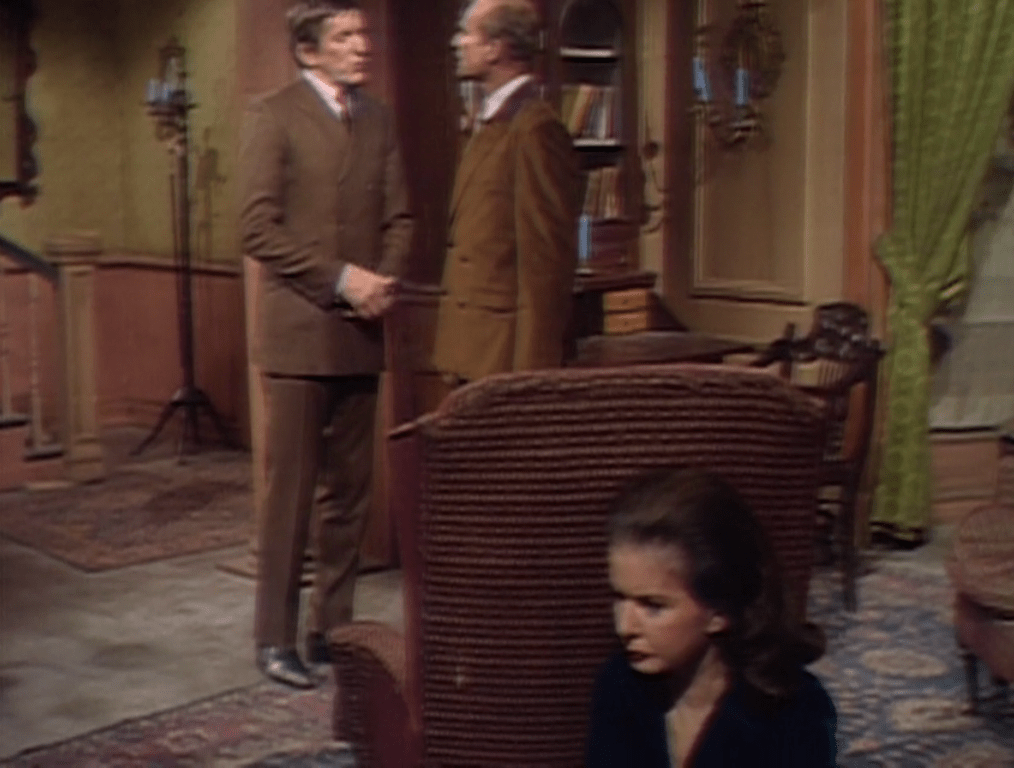
Roger wants to send Liz back to the psychiatric hospital from which she escaped. Liz believes Roger is part of the conspiracy to bury her alive, and that sending her to the hospital will further that goal. So she hides behind an armchair.
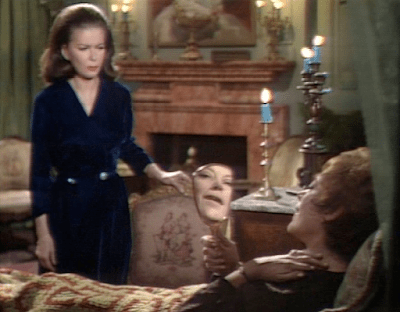
Liz hiding.
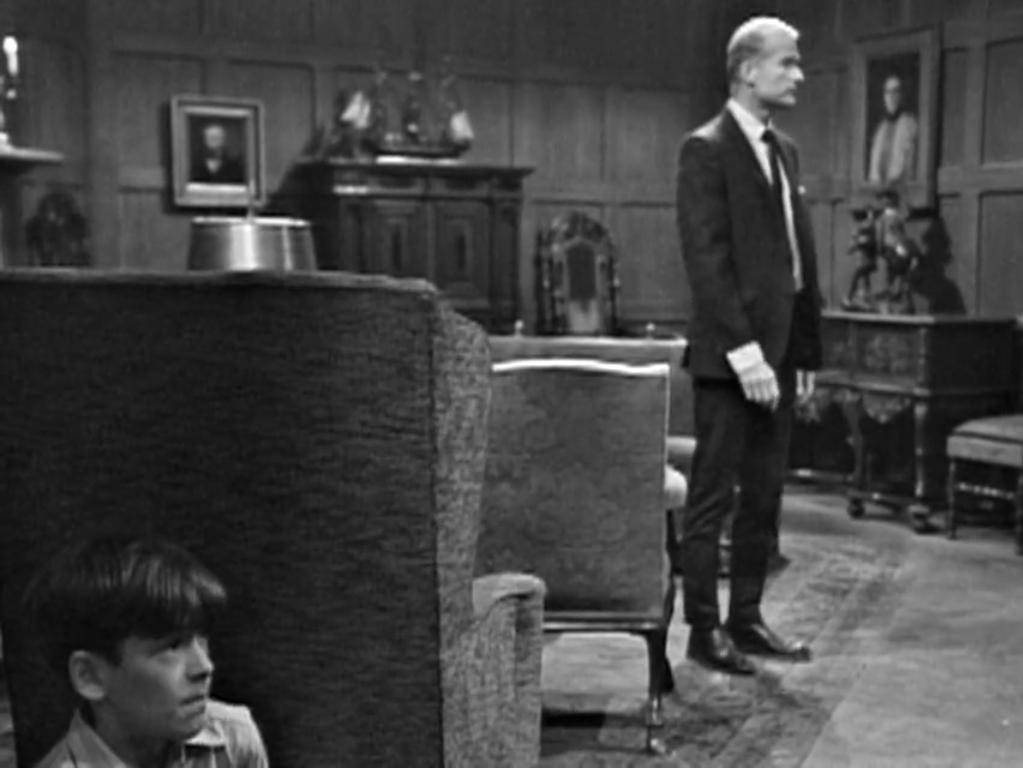
In #10, Liz and Roger had a conversation in the drawing room of the great house of Collinwood while Roger’s son David hid behind an armchair. In that conversation, Roger declared his belief that David should be sent to an institution, a plan which Liz forbade him to pursue. After Liz left the room, Roger caught David behind the armchair.
David found the prospect of institutionalization so terrifying that his next stop was the garage, where he tampered with the brakes of his father’s car in what very nearly turned out to be a successful attempt at patricide. Liz is too upset to develop such an intricate plan, and doesn’t seem to have David’s skills as an auto mechanic. But she shares her nephew’s horror of institutionalization. So after Roger and Barnabas have talked for a moment, she jumps up from behind the chair and starts making accusations.
Liz tells Roger and Barnabas that she saw Julia in a crypt in the family burial ground nearby, and that there was a coffin there. Barnabas is alarmed, since this is the coffin in which Tom’s staked remains now repose. Roger agrees to go to the crypt and to see if there is a coffin. Barnabas offers to go with him.
The suave Nicholas Blair shows up at the front door with a bouquet of flowers. We know that Nicholas is a warlock and that he is behind the renewed outbreak of vampirism, that he was watching while Barnabas staked Tom, and that he is also responsible for some other plots involving Barnabas and Julia. For their part, Barnabas and Julia have every reason to suspect that this is so, and have talked about their suspicions more than once. Nicholas tells Barnabas, Roger, and Liz that he has heard that Julia is ill and has come to visit her. At Liz’ insistence, Barnabas lets Nicholas see Julia while he and Roger go to the crypt.
Nicholas expresses his relief that Julia’s recovery will enable her to return to work soon. The only work Julia has done in the year she has been a houseguest at Collinwood has been in association with the supernatural goings-on she and Barnabas have been entangled in; currently, an agent of Nicholas’ is forcing them to build a Frankenstein’s monster. Nicholas may as well say explicitly that he is behind that scheme and the vampire troubles too. He tells Julia that he thinks he might fall ill and need her help as a doctor; she says that he seems indestructible, a word he receives with pleasure.
Barnabas comes back and tells Julia that the coffin has disappeared. He mentions that it is strange that Nicholas turned up when he did. Julia suggests that Nicholas may be the one who moved the coffin. All of a sudden Barnabas seems to forget everything he knows about Nicholas and dismisses that idea. It’s one of those frustrating moments when the characters seem to have the memory of a goldfish, and it ends the episode on a sour note.
When we first met Willie Loomis in March 1967, he was a dangerously unstable ruffian who came to the town of Collinsport and eventually to the great house of Collinwood in the train of seagoing con man Jason McGuire. Willie was such a violent and unpleasant fellow in those days that it was difficult to see why even a villain like Jason would choose to be associated with him.
The next month, Willie inadvertently freed vampire Barnabas Collins from his coffin. Barnabas bit Willie and transformed him into a sorely bedraggled blood thrall. That version of the character was so heavily beaten down and so sincerely remorseful that it was easy to wish him well, but he was so thoroughly dominated by Barnabas that no one else could get close to him.
In March 1968, Barnabas’ vampirism went into remission. His other victims regained their old personalities and apparently forgot about their time under his power. It is unclear just what effect Barnabas’ re-humanization has had on Willie. In #483, his first episode after Barnabas’ cure, Willie ran through the whole range of behavior he had shown in the preceding year. For a time, it seemed he might not remember that Barnabas had been a vampire. During that period, Barnabas assumed that Willie remembered everything, treated him as if he did, and after a couple of weeks of that treatment Willie and Barnabas were having the same kinds of conversations they had in the old days. Perhaps Barnabas accidentally gave Willie the therapy he needed to get his memory back.
Today, we open with Barnabas and Willie bickering in the front parlor of Barnabas’ house. They have been out hunting Tom Jennings, a vampire who has been feeding on Barnabas’ friend Julia. Willie says Barnabas has a reason for being so concerned about Julia, and Barnabas says that of course he does. He describes Julia’s current functions in the plot, and Willie says that isn’t what he’s talking about. Barnabas gets flustered, then asks “Are you being pro-fouuuund?”
Jonathan Frid lingers on the second syllable of “pro-fouuuund” until the whole audience is likely to be laughing. The whole scene is funny, because it shows us sides of Barnabas and Willie that we always suspected existed, but that we never expected to see. As my wife, Mrs Acilius, pointed out, Barnabas has been so phenomenally selfish for so long that it is excruciatingly difficult for him to admit that he is willing to put a friend’s interests ahead of his own. And seeing Willie tease him about his feelings shows that the former slave and master are now buddies. Willie is neither menacing nor cringing, but is sympathetic enough and self-confident enough that anyone could enjoy his company. At long last, we know why Jason fell in with him, and what Willie lost, at first by his descent into criminality, and later as Barnabas’ victim.
An unexpected visitor drops in. It is Elizabeth Collins Stoddard, mistress of Collinwood and escaped mental patient. Liz tells Barnabas that she saw Julia in a room with a coffin. Barnabas takes a while to put the pieces together, but it finally dawns on him that Liz is describing Tom’s lair. He goes there, and finds Julia unconscious on the floor next to the coffin.
Barnabas carries Julia into his house. Liz announces that Julia is dead. Barnabas assures her that she is still alive. Even though she is clearly breathing, Liz refuses to believe him.
Later, Liz goes up to Julia’s bedroom. She sits by Julia and tells her that she knows she was part of the conspiracy to bury her alive, but that she forgives her. The whole story of Liz’ fixation on this supposed conspiracy is pretty dull, but Joan Bennett was an extraordinary talent. When she has a scene like this, she can sell Liz as effectively as if she were at the center of an exciting arc.
Just before dawn, Barnabas and Willie go to Tom’s coffin with a mallet and stake. Willie keeps pointing out that the sun isn’t up yet, but Barnabas opens the coffin anyway. It’s empty. Willie panics and runs off. It’s unclear why Barnabas opened the coffin- maybe he turned in early in his time as a vampire, and assumed Tom would do the same. At any rate, the episode ends with a lot of rather awkward stage business as Barnabas and Tom wrestle and Tom bares his fangs. This poorly choreographed fight scene leaves us with a laugh as sour as the laughs from the intentionally funny scene between Barnabas and Willie at the opening were sweet.





 Dark Shadows Commentary