Episode 750: Hold back the night

Magda at Jenny’s grave. Screenshot by Dark Shadows Before I Die.

The name “Magda” was first mentioned on Dark Shadows in #642, broadcast and set in December 1968. At that time, the residents of the great house of Collinwood had noticed unaccountable goings-on, and as they often do they held a séance to appeal to the spirits of the dead for guidance. The spirit they reached in that one identified herself as Magda. She repeated two things- “My curse!” and “He must not return!” Magda said enough to suggest that she had cursed someone and regretted doing so, and that she knew that the Collinses were threatened by the return of someone from her own period, but that was all. Since the Collinses of 1968 had never heard of anyone associated with their house named Magda and could find no record of such a person, those suggestions remained vague and useless to them.

They meant a good deal more to regular viewers. We already knew that the malign ghost of Quentin Collins had appeared in a room in the long-deserted west wing of the great house, that children David Collins and Amy Jennings were falling under the ghost’s influence, and that Quentin lived at Collinwood near the end of the nineteenth century. We therefore assume that Quentin is the one who “must not return!,” and that Magda, whoever she was, must have known Quentin and therefore also have lived sometime in the 1890s.

Among the participants in the séance was Amy’s older brother, mysterious drifter Chris Jennings. Chris broke the séance off before Magda could go into enough detail to help the others. The show had long since established that the person who ends a séance prematurely is the one who harbors a dreadful secret that the voice from beyond might uncover. Even the characters have caught on to this pattern; they treat Chris with suspicion. They do not know what we do, that Chris is a werewolf. So he is indeed under a curse, and we can take it that his curse originated when Magda placed it on one of his ancestors.

Over the next few months, Quentin’s power steadily grew, and at the same time Chris’ periods in his animal form grew longer and more frequent. These two developments moved in such close tandem that we had to suspect that there was some causal relationship between them. This suspicion was reinforced when, in #683, another ghost associated with Quentin, that of a tall, thin, blonde woman named Beth, led Chris to what proved to be the unmarked grave of an infant. That infant was wearing an amulet meant to ward off werewolves. The records of the silversmith who made the amulet showed that it was commissioned and paid for in 1897 by Quentin Collins and Beth Chavez. Thus we learned that a werewolf was active in the area of Collinwood when Beth and Quentin were alive, and that they cared about a baby who died at that time. The logical inference would be that the curse under which Chris labors originated at that time, that Beth and Quentin had something to do with it, and that the baby was related to someone who became one of Chris’ ancestors.

Now, the show has become a costume drama set in 1897. Quentin and Beth are alive. Beth is a maidservant who first came to Collinwood in the train of Quentin’s estranged wife, Jenny. Quentin left Jenny and was banished from the house the previous year; word was put about that Jenny responded to the desertion by going away and leaving no forwarding address. When Quentin returned to Collinwood in #701, he was surprised to find Beth still on staff, and he set to work trying to seduce her.

In #720, Quentin discovered that Jenny had not in fact gone so far away as he and everyone else had been led to believe. She turned up and stabbed him. He then learned that Jenny had become violently insane when he left her and that his sister Judith and brother Edward had responded to her illness by locking her up in a room hidden inside the great house. They kept Beth in their employ because she was the one entrusted to care for Jenny.

Now, Beth has given in to Quentin’s charms. The other night Jenny was hiding in Beth’s room while Beth and Quentin shared a tender moment, and she reacted by coming at them with a knife. Quentin disarmed Jenny, restrained her, and then put his hands around her throat. While Beth pleaded with him to stop, he choked Jenny to death. He keeps protesting that, because Jenny at one point had a knife, this was an act of self defense, but the audience and Beth both saw what happened, and she won’t agree with him any more than we will.

Edward and Judith have decided to shield Quentin from the legal consequences of his actions, and in the village of Collinsport the will of the Collinses supersedes the laws of the state of Maine. But Quentin finds no comfort in his immunity from criminal prosecution. Just hours before he murdered Jenny, Quentin discovered that he knew nothing about her origins. He thought she was some kind of Anglo, but she was passing. She was actually a Romani woman. Her sister is one of the neighbors, broad ethnic stereotype Magda Rákóczi.

In Wednesday’s episode, Edward convinced Magda the police and courts would do nothing to punish Quentin, and so Magda threatened to place a curse on him to avenge Jenny’s death. Edward, a rational-minded modern man, dismissed Magda’s threat as “words.” But Beth and Quentin know things about the universe they occupy that Edward does not know. When Beth heard Magda’s threat, she looked wide-eyed at Quentin, walked backwards away from him, and ran off. Quentin, who is obsessed with the occult, was immediately terrified, and has been dissolving into a puddle ever since.

Yesterday, Quentin fell into a trap Magda set for him and brought a curse upon himself. Today, Magda stands with her husband Sandor by Jenny’s grave, watches the full Moon rise, and recites an incantation specifying that Quentin’s male descendants will suffer from the same curse he does. So far as Magda knows, Quentin does not yet have any descendants, male or female, and so that proviso is just an abstraction for her.

We know more than Magda does. Not only have returning viewers heard her spirit say that she regrets the curse and been led to the conclusion that it fell on Chris Jennings, but even those who are watching the show for the first time today know that Quentin and Jenny are the parents of twin infants whom Judith is paying a Mrs Fillmore to raise in her home in the village of Collinsport. Mrs Fillmore’s name was first mentioned in #707, and it comes up today when Judith is firing Beth.

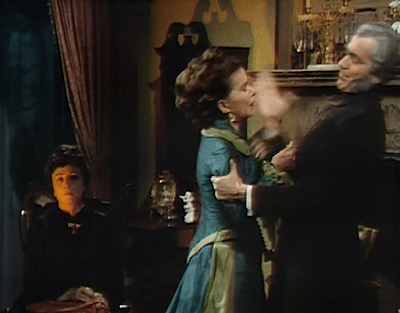
Judith explains to Beth that, since Jenny is no longer around, she no longer has any work to do at Collinwood. She indicates her dissatisfaction with Beth, and says that it is only through Edward’s influence that she included a severance payment with her letter of dismissal. Beth mentions her task of taking money to Mrs Fillmore to pay her for taking care of Jenny and Quentin’s children; Judith does not see a need to retain an employee simply to carry an envelope full of cash to the village every now and then.

Beth objects that Judith is terminating her employment because she has become involved with Quentin; Judith takes that as an opportunity to castigate her for the impropriety of that relationship. Joan Bennett plays Judith’s reaction to Beth quite effectively; in a comment on Danny Horn’s post about the episode at Dark Shadows Every Day, “Rev Velveteen” writes:

I wanted to mention a Judith Collins, er, Joan Bennett acting moment I found particularly entertaining here. When she’s giving Beth the boot and the servant attempts to “innocently” inquire as to why she’s being let go, Judith turns around and gives her SUCH a look! Huge eyes, a stifled gasp, then bright pursed lips…Her expression goes from incredulous (Are you freaking KIDDING me?) to amused (Just how stupid does she think we are?) to triumphantly satisfied (Fine, we shall just both play out this little charade and I’ll soon be rid of you.) Her chin goes up as she turns away snarkily-“Let’s just say that now Jenny’s gone, your services are no longer needed,” which everyone on and off screen knows is a total lie. It’s such a sweet piece of work by Ms. Bennett, I need to keep an eye out to see if she repeats that expression because it just sums up the whole character of any Collins she plays when as the perpetual straight man, she’s faced with yet another absurd situation. And is also just stunning in that gorgeous green dress.

Comment left by “Rev Velveteen” at 12:43 am Pacific time, 25 June 2020, on Danny Horn, “Episode 750: Gypsy Ascendant,” 18 October 2015, Dark Shadows Every Day

Yesterday, Judith gave the penniless Quentin $10,000 on condition that he leave Collinwood forever and induce Sandor and Magda to do the same. Quentin had hoped to use the money to bribe them into forgoing Jenny’s vengeance, but they only pretended to take it to lure him into bringing the curse on himself. Magda contemptuously threw the cash at him after he did so.

Quentin has told Judith that Magda took the money and agreed to go. Today, Magda comes to the house to ask for Jenny’s things. Judith starts in with lecture about how she must go at once, since she and Sandor have been paid so well to leave, and Magda reveals that she did not take the money. Enraged at Quentin’s childish lie, Judith demands he return the $10,000. He tells her to sue him, and stalks off. Judith fumes, knowing that she has been cheated and that she cannot assert her rights without creating the public scandal that she fears above all else.

Quentin finds Beth packing Jenny’s things. He tells her he has to leave tonight, and announces that she will be coming with him. She responds in a mild tone that she doesn’t seem to have any say in the matter. She tells Quentin that she has lost her job, and says that she will give him her decision in the afternoon.

Sandor comes for Jenny’s things. Quentin offers him the $10,000 all for himself if he can lift the curse. He says he doesn’t know how. Quentin says he will give it all to him if only he will tell him what form the curse will take. Sandor shakes his head at Quentin’s desperation and says that knowing that would be of no benefit to him.

As night falls, Quentin goes to Beth’s room. She agrees to go with him, but insists on running a personal errand first. Even though she just told him that they have to be honest with each other, she will not tell him what it is. She is still honoring Judith and Edward’s decree that Quentin must not know that Jenny gave birth to his twin children after he left her, and that they are in Mrs Fillmore’s care.

Quentin keeps saying there is no time left to do anything but run. We might wonder why he didn’t stop by Beth’s room earlier. She is on her way out the door when Quentin cries out and collapses in severe pain. Regular viewers recognize Quentin’s pains as the same Chris had when he turned into a werewolf. When we see the rising moon and hear the baying of the hounds, we know who Chris’ forebears are, and why Magda came to regret her curse.

Episode 747: Triumphant life behind a locked door

Madwoman Jenny, estranged wife of libertine Quentin Collins, is on the loose again, and she is the object of a madcap search by Quentin’s sister, spinster Judith, his girlfriend, maidservant Beth, and his distant cousin, secret vampire Barnabas. Quentin makes two contributions to the process. The less important is to serve as the bait in a cockamamie trap Barnabas and Judith lay for Jenny. The more important is to keep up a running commentary mocking the other characters for the silliness of their activities.

The trap itself involves a moment of intentional humor. Barnabas has returned to the year 1897 to prevent Quentin becoming a ghost who will ruin things for everyone on the great estate of Collinwood in 1969. One of the things Quentin did in that year that terrified the characters and tried the patience of the audience was to cause the strains of a sickly little waltz continually to resound from the walls of the great house. When the show became a costume drama and we got to know the living Quentin, we found that he too played a gramophone record of that same tune incessantly, annoying all and sundry. The trap requires Quentin to play the recording over and again until Jenny hears it and comes. After it has been going for half an hour, Barnabas tells Quentin that the plan didn’t work and they should stop playing the waltz. Quentin asks “Are you tired of hearing this music?” Barnabas speaks for all of us when he replies “Frankly, yes.”

Not only is this a successful comedy, it also gives the cast an opportunity for some of their best dramatic acting. As Judith, Joan Bennett at one point stops, looks at Barnabas, and asks “Can we trust you? Really trust you?” She apologizes for the bluntness of that question, then admits that she has long been busy putting a prettier face on the Collins family than the dark secrets Barnabas has discovered make plausible. “I’m not really very trusting. I try to pretend we’re nicer than we really are.” In the parts of Dark Shadows set in the 1960s, Bennett plays matriarch Liz, whose whole personality is about denial and the pretense that the Collinses are nicer than they really are. Liz latched onto Barnabas as soon as she saw him, and refuses to see any evidence that he is not quite normal. Nor does she ever really face her own habits of concealment and their implications. In this little exchange, we see Bennett playing a character whose superficial similarities to Liz point up her profound differences from her.

“Can we trust you? Really trust you?”

Joan Bennett had one of the most distinguished careers of any American actress of the twentieth century. Terrayne Crawford stands at something of the opposite pole, and her performance as Beth leads most fans to declare that she is the weakest of all the members of the cast of the portion of Dark Shadows set in the year 1897. I don’t really disagree with that, but she is fine today. Miss Crawford’s great limitation was that she could play only one emotion at a time, and she was on the show in a period when the scripts gave every character complex motivations in almost every scene. But today, all Beth has to play is Anguish, and Miss Crawford does a fine job.

Beth took care of Jenny during the year Quentin was away from Collinwood, and became very close to her. In the nine and a half weeks since Quentin’s return, she has fallen in love with him. In a scene at the close of today’s episode, Beth tearfully admits to Quentin that she wishes something would happen to Jenny so that he would no longer have a wife. Beth collapses into Quentin’s arms. Jenny has been hiding in a corner, eavesdropping; she comes out, holding a knife. There have been occasions when we might have rooted for Jenny to succeed in killing Beth, just to spare us the embarrassment of Miss Crawford’s flat, tedious performances. But this time, we want to see more of her, and the prospect that Beth might die makes for an effective cliffhanger.

Episode 746: Madness in her background

Vampire Barnabas Collins rises from his coffin in the basement of the Old House on the estate of Collinwood and calls for his unwilling sidekick, ethnic stereotype Magda Rákóczi. Magda has news for him. She has found madwoman Jenny Collins, estranged wife of libertine Quentin Collins, locked in an upstairs bedroom. Barnabas is not surprised about that. He was the one who locked Jenny there, and before dawn he left Magda a note telling her where Jenny was and instructing her to look after her until he came back to life. But Magda never saw the note. Quentin came to the house and read it before Magda came home. He tried to kill Jenny and was stopped by the timely intervention of his girlfriend, maidservant Beth Chavez. He came back later with another plan to kill Jenny, and that time Magda herself stopped him and threatened to place a curse on him unless he gave up.

Magda and her husband Sandor figured out that Quentin’s siblings, stuffy Edward and spinster Judith, have been keeping Jenny locked up in the great house ever since Quentin left her and she went mad over a year ago. They have also figured out that she escaped from the great house, made her way to the Old House, and that Barnabas saw that she was dangerous and trapped her in the room. They wanted to keep her there until they could make arrangements to take her to a Romani caravan where she could be taken care of. Magda and Sandor felt a responsibility to do this, because Jenny is Magda’s sister.

When Magda interrupted Quentin’s second attempt of the day to kill Jenny, she told him that Jenny was her sister. He was stunned. He had no more idea of this relationship than the audience did until we learned of it yesterday. He was so utterly shocked that his wife was a member of an ethnic group he despises that he went almost two full minutes before making a flip remark about it. That’s a record for Quentin.

Barnabas is also quite surprised to learn that Magda is connected to the Collins family by marriage, but it does nothing to change his plans. He has come to the year 1897 to prevent Quentin becoming a ghost who will ruin things for everyone at Collinwood in 1969, and he says that he dare not change anything that would prevent the events of the years in between from taking the shape they did originally.

This does not make much sense. Barnabas does not know why Quentin became a malevolent ghost, so he has no way of knowing how much history will have to change to prevent that outcome. Moreover, he has been quite reckless with the timeline in many other ways. In #704, Barnabas bit a girl named Sophie Baker, evidently killing her. Sophie wasn’t his only victim- in #740, Magda mentioned that Barnabas’ bite marks had been found on “girls”- plural- in the nearby village of Collinsport. Presumably those girls were dead when the marks were found. So he has already committed more than one homicide, ending the lives of people who would otherwise have worked, had children, and made who knows what other kinds of contributions to the history of central Maine. And he is continually picking fights with people and meddling in matters that don’t seem to have anything to do with Quentin’s future ability to rest in peace.

What Magda does not tell Barnabas is that Jenny at one point during the morning got away from her and Sandor, went downstairs, and saw him in his coffin. Magda frantically tried to persuade Jenny to keep this secret, but Jenny has so little contact with the world everyone else lives in that it would seem unlikely she will remember she promised not to talk about what she saw.

Barnabas is about to climb the stairs to go talk to Jenny when a knock comes at the door. It is Judith. Quentin has told her that Jenny and Magda are sisters. Judith and Magda have a testy exchange, ending when Barnabas orders Magda to go upstairs and see to her sister.

Judith probes to see what Barnabas knows and what he is planning to do. She says that he has seen the family at its worst, and knows all its most horrible secrets. He assures her that he is not interested in passing judgment. He mentions Jenny’s children; Judith tells him she has none, and he says that he thought she did only because she claims to have. The audience has known since #707 that Judith is sending money to a woman named Mrs Fillmore to take care of a problem relating to Jenny; it seems likely that this money is going to care for Jenny and Quentin’s twin children. After a few moments, it is clear to Judith that Barnabas has not penetrated very deeply into the secrets surrounding Jenny, and she begins to relax.

Joan Bennett plays Judith’s behavior very subtly. She is calm, quiet, a bit weary. She moves her eyes slightly from side to side, and occasionally purses her lips at the corners. Judith does not look like someone who has just learned shocking news, but like someone who is trying to figure out how to keep the rest of an old secret once part of it has leaked out. Bennett invites us to conclude that Judith has known of Jenny’s family background for a long time.

Judith getting her story straight.

Jenny bursts in, sees Barnabas, and declares that he is dead. She saw him in his coffin, she exclaims. This is not much of a cliffhanger ending. Jenny’s whole life is one long mad scene. If anyone starts to doubt whether Barnabas is quite what he seems, all he or Magda or anyone else who might be on his side now has to do is point out that the doubter is echoing Jenny, and they will be instantly discredited. This winds up as another in the long series of strokes of luck that have enabled Barnabas to keep operating for so long.

Episode 737: The suffering of some people

Laura Collins is the estranged wife of stuffy Edward and the mortal enemy of Edward’s brother, libertine Quentin. Only Quentin knows that Laura is an undead fire witch. He has found the Egyptian urn housing the magic flame that gives life to Laura, and has extinguished the flame.

In the great house of Collinwood, Quentin and Edward’s spinster sister Judith notices that Laura has taken ill. Judith goes off to order a servant to prepare a hot cup of tea for Laura, and is alarmed when she returns to the drawing room and finds that Laura has gone. Quentin enters, and Judith asks him if he saw Laura. Judith explains that Laura is ill, and is appalled at Quentin’s indifference.

Laura has gone to the gazebo on the grounds, where she hid her urn under an armillary sphere. She finds that the urn is gone. Surly groundskeeper Dirk Wilkins chances upon her; she clutches at him. He is shocked at how cold she is, and is afraid of how the scene would be interpreted if anyone saw them in each others’ arms.

Dirk takes Laura back to the great house. Quentin insists on walking her upstairs to her bedroom. While she lies in bed, he taunts her with her doom, reminding her that she had treated him the same way a few nights ago when she thought he was dying. Quentin’s behavior is really abominable in this scene, but as David Selby plays him he keeps the audience’s affection. He visibly thinks about each line before he says it, so that we can really believe he is finding his way through what is after all a bizarre situation and is deciding what to say to Laura. He is relaxed and easy in his physical movement, and modulates his delivery subtly in response to every cue.

After Quentin leaves, Laura prays to the gods of ancient Egypt to take possession of Dirk and send him to her room. They oblige; Dirk finds himself standing by the fire in the drawing room and speaking a few words of old Egyptian, then heads upstairs.

Dirk and Laura take hold of each other while she is in bed. There are a few moments of dissonance when Diana Millay has to reposition herself to get Roger Davis’ hands onto more broadcast standards-friendly parts of her body while Laura insists Dirk hold her ever closer and he protests he must not, but it isn’t as bad as we might expect considering Mr Davis’ usual practice of assaulting his female scene partners. They speak each line more rapidly and more breathily than the one before. Mr Davis has both feet on the floor, but the result is still the most sex-like encounter we have seen so far on Dark Shadows.

Dirk takes hold of Laura while she is in bed. Screenshot by Dark Shadows Before I Die.

Mr Davis’ performance is the opposite of Mr Selby’s. He is as stiff as Mr Selby is relaxed, holding himself rigidly still even when he is grappling with Diana Millay in bed. He tends to take a deep breath and deliver each speech as a single exhalation, making it impossible for him to show thought or adjust his approach while speaking. So even though today’s action shows us Quentin at his most despicable and Dirk at his most innocent, our loyalties are firmly with Quentin.

Joan Bennett famously said that Mr Davis was show business’ answer to the question “What would Henry Fonda have been like if he had had no talent?” Not only does his face resemble Fonda’s, but by his own admission he often mimicked Fonda while acting. There is nothing wrong with mimicry- John Gielgud was as good an actor as any, and he used to say that from the time he first saw Claude Rains in a play, his acting style consisted of imitating Claude Rains. He also said that imitating Rains was a great improvement over his previous style, which was imitating Noel Coward. Mr Davis’ readings of his one-line speeches today are distinctly Fonda-like, and the longer speeches may also have been if he had been breathing normally while delivering them. Today Mr Selby also sounds very much like the actor he tends to mimic, Joseph Cotten. I suspect Cotten would have been more flattered than Fonda had the two of them watched this episode!

Episode 733: From pocket to pocket

A lot of business about a magical urn that belongs to undead blonde fire witch Laura Collins. This is Laura’s second tour on Dark Shadows; she didn’t have an urn the first time around, but the plot is much busier these days and she needs a MacGuffin for her enemies to chase after if she’s going to stay afloat.

There are also a couple of moments when characters deride spinster Judith Collins as “plain Judith,” envious of the “pretty wives your brothers brought home.” This is ridiculous. Judith isn’t even Hollywood ugly; she’s played by Joan Bennett, one of the great beauties of the screen in her youth and still, in her late 50s, a remarkably attractive woman.

But all in all, the episode is quite good. The highlight is a confrontation between governess Rachel Drummond and a villain who makes her first appearance today, Minerva Trask. Minerva is the wife of the loathsome Rev’d Gregory Trask, and with him she runs a boarding school called Worthington Hall. Rachel grew up at Worthington Hall, and like all other children there she was subjected to continual abuse at the hands of the Trasks. We haven’t seen Gregory for several days; as played by Jerry Lacy, he is so overwhelmingly evil a presence that the makers of the show wisely decided to use him sparingly. It looks like Rachel will soon be forced to go back to Worthington Hall as a teacher.

Minerva is played by Clarice Blackburn, whom many consider to be the single best actor in the whole series. For example, Nancy Barrett gave her that title in her interviews with the authors of the book Barnabas and Company. Blackburn is absolutely believable as the sanctimonious Minerva, so much so that I found her scenes as difficult to watch as are those featuring Mr Lacy as Gregory. Kathryn Leigh Scott plays the terror and misery Minerva inspires in Rachel quite effectively, but to be honest I felt those emotions very intensely myself just watching the episode on TV. I suspect that when you have a scene partner like Blackburn, all you need is to learn your lines and remember your training and you’ll connect with the audience.

Rachel and Minerva. Screenshot by Dark Shadows Before I Die.

Rachel tells her troubles to broad ethnic stereotype Magda Rákóczi, who volunteers to help her escape the Trasks. Magda’s plan requires Rachel to do three extraordinary things. She must give her garnet-encrusted broach, the only keepsake her late mother gave her, to Magda to sell to raise money for a coach ride to Boston. She must spend the night in a secret room hidden in an old mausoleum. And once in Boston, she will have to find employment without having recourse to any credentials or references that would make it possible for her to find a situation agreeable to a neurotic intellectual such as herself. We could never believe Rachel would do any of these things if she were facing a less gruesome threat than return to Worthington Hall.

Longtime viewers may wonder just how far Rachel’s fears will drive her. In #9, broadcast and set in the year 1966, flighty heiress Carolyn Collins Stoddard told well-meaning governess Victoria Winters that over the years, two governesses had leapt to their deaths from the precipice atop Widow’s Hill, and that legend had it that a third governess would someday follow their lead. In other episodes, before and after, that story was rephrased as “two women” rather than “two governesses.”

So far, we have only seen one woman take the plunge, and she wasn’t a governess. She was the gracious Josette, also played by Miss Scott. Josette jumped in 1796 because she saw that she was about to be made into a vampire. Now, the dramatic date is 1897. The prospect of turning into a member of the teaching faculty of Worthington Hall is scarcely less horrifying than is the prospect of becoming a vampire, so perhaps it will turn out that Rachel was one of those whom Carolyn had in mind after all.

Episode 726: A boy’s dislike

When Dark Shadows began in June 1966, strange and troubled boy David Collins (David Henesy) was frantically afraid that he would be sent away from the great house of Collinwood. In #10, David overheard his father Roger (Louis Edmonds) telling his aunt Elizabeth Collins Stoddard (Joan Bennett) that they ought to do just that. As the owner of the house and holder of all the family’s wealth, it is up to Liz to make the decision. Hearing his father press to send him away, David responded by sabotaging the brakes on Roger’s car, nearly killing him.

Roger told Liz that David belonged in an “institution,” but David was just as terrified when it was suggested that he might go to an ordinary school. It was not entirely clear why he had this attitude. David and Roger had only lived in the vast gloomy house for a few weeks when the show started. Roger openly hated David, as did Liz’ daughter Carolyn. Liz loved him, but as a recluse and an aging grande dame had little in common with a young boy. Moreover, David hated his governess, the well-meaning Vicki, as much as he could hate any school. His mother, who did not live in the house and whose name was in those days was never to be mentioned there, was the only person for whom David expressed fondness; when in #15 David watched Roger drive off in the car whose brakes he had sabotaged, we saw him standing by himself, saying “He’s going to die, mother. He’s going to die!” So it is difficult to see why David was so intensely committed to staying at Collinwood.

Today, we see a suggestion that David may have been influenced by an ancestral memory of bad times at a boarding school. It is 1897, and David’s grandfather Jamison Collins (David Henesy) is twelve. Jamison’s father Edward (Louis Edmonds) has asked the Rev’d Mr Gregory Trask to come to Collinwood to urge his sister, Judith Collins (Joan Bennett,) to send Jamison and his nine-year old sister Nora to be students at Worthington Hall, a boarding school Trask runs. As the house’s owner and holder of all the family’s wealth, it is up to Judith to make the decision.

Trask wins Judith’s confidence by performing a ceremony after which Jamison and her brother, Jamison’s uncle Quentin, are restored to themselves after a spell that had made Quentin a zombie and put his spirit in possession of Jamison. Recently arrived, thoroughly mysterious distant cousin Barnabas Collins sputters with rage at the very sight of Trask, and exasperates Judith with his insistence that Trask is evil. Judith does not trust Barnabas, and Barnabas’ inability to either explain or contain his hostility only confirms her favorable judgment of Trask.

Once Quentin and Jamison are themselves again, Trask sends Barnabas and Quentin out of the drawing room. Quentin raises his eyebrows in response to Trask’s order and asks his sister “Are you sure you’re still in charge of this house, Judith?” She does not respond.

Judith makes a remark about Quentin’s influence on Jamison, saying that “He’s been like this ever since [Quentin] came home.” Since Jamison was just freed from possession a few minutes before, it is unclear what she could mean, and Jamison objects “That’s not true!” Trask unctuously replies “Now, your aunt does not tell lies, Jamison.” Returning viewers know that Judith lies constantly. Nor is Trask unaware that Judith is less than perfectly truthful. When he first arrived in Friday’s episode, Judith and Barnabas tried to conceal the situation with Quentin and Jamison from him, and she told a series of lies in pursuit of that objective.

When Jamison continues his attempts to tell the truth, Trask silences him with “Now, there is only one who is constantly right, Jamison, and He is not on this earth, but above. Now, I want you to go out into the hall and consider all the wonderful things your aunt has done for you recently. I am sure you will have much to think about.” Jerry Lacy brings such an inflexible authority to Trask’s personality that we cannot imagine a rebuttal to this sanctimonious little speech. We share Jamison’s helplessness and frustration.

Alone with Trask, Judith agrees to let him take Jamison and Nora to Worthington Hall. Jamison barges back in and declares that he will not go. Trask assures him that he will not take him unless he is willing to go. He then obtains Judith’s permission to talk with Jamison alone in his room.

While Jamison is taking Trask upstairs, we cut to the study. Quentin and Barnabas are alone there. Quentin asks Barnabas if Trask really was his “savior.” Barnabas replies “Apparently.” Quentin asks Barnabas what he thinks really happened; he sidesteps the question. Quentin keeps probing for Barnabas’ interpretation of his recent experience; Barnabas alludes to Quentin’s adventures in Satanism, saying “You dabble in odd things, perhaps one of your interests resulted in this.” Quentin observes that this is “Delicately put,” and goes on to remark on “what an interesting life” he has had.

Barnabas then takes his turn as the questioner. He asks Quentin about his wife, a tall, beautiful, homicidally crazed woman named Jenny who is being held prisoner somewhere in the house. Quentin grows tense, and does not give direct answers. He explodes at Barnabas, saying that he has no interest in making a friend of him. Barnabas observes that he has in fact made an effort to turn him into an enemy; Quentin interjects “Your fault!” Barnabas says they could be useful to each other; Quentin exclaims “Wrong!” When he thinks of Barnabas, Quentin says, only one question comes to mind- “What does he want from me?”

Jonathan Frid said that his favorite scene in Dark Shadows was one he had with Anthony George in #301. Barnabas tells local man Burke Devlin that their relationship to each other is like that of “two superb swordsmen with highly sharpened blades. You thrust, and I parry. I thrust, you parry.” That scene has never impressed me. The Barnabas/ Burke conflict did not have enough grounding in the story to come to life, and having the characters tell the audience that they were like “superb swordsmen” does not make it so. But this showdown really does pay off. Barnabas and Quentin are the show’s two great breakout stars, and we are in the middle of a long run of episodes where everything works. This scene brings out all the values they might have hoped that Burke and Barnabas’ confrontation would put on screen when they planned it.

We return to Jamison’s room, the same bedroom David Collins occupied in the 1960s. Trask is still being friendly. When Jamison says that he would miss his pony if he had to go away to Worthington Hall, Trask says “You must bring him with you!” When Jamison refuses to tell Trask his pony’s name, the friendliness vanishes. Trask darkens, tells him “You’re going to have to learn to answer questions, boy,” and insists they pray together. When Jamison resists, Trask tells him that he must change his ways lest he go on being a disappointment to his father. Jamison protests that his father loves him, and Trask asks incredulously “Does he?” He asks Jamison if he wants his soul to be saved. Jamison can’t very well say anything but yes to that, and so Trask says “Then I think I can help you.” Jamison is trapped.

After a scene in the drawing room where Quentin demands Judith tell him where Jenny is locked up, we return to Jamison’s room. The scene begins with a closeup of the rope belt of Jamison’s robe. Jamison is retying it. He keeps fiddling with it, perhaps a nervous habit, but it is the first thing we see and they hold the shot for a long time. We cannot but wonder whether the belt was untied at some point while Jamison and Trask were alone off camera.

Jamison fiddles with his belt.

Trask orders Jamison to tell Judith that he wants to go to Worthington Hall; Jamison says he will not. The dialogue does not explain how Jamison’s robe came undone, and neither he nor Trask seems concerned with the matter. Their blasé attitude turns an uncomfortable image into a lingering mystery.

In the drawing room, Trask announces to Judith that Jamison has something to say. Jamison says that Trask threatened him and tried to make him lie. Trask says that Judith will have to find another school for him, and she declares that she will not. Jamison will go to Worthington Hall.

Trask exits. Jamison finds Quentin and asks him to help him escape the grim fate in store for him. Quentin promises to do so, and by the end of the episode Jamison will be safely hidden somewhere in the house. Meanwhile, Barnabas throws a fit before Judith, saying that he cannot understand why “You would believe that maniac before you believe Jamison.” Judith scolds him and tells him to treat Trask with respect.

Trask returns. Barnabas asks him if his family is from Salem, Massachusetts. Trask affirms that it is so. Barnabas claims to have seen ink drawings of a Rev’d Trask who was at Collinwood in the 1790s; Trask says that he was his ancestor. He says that the earlier Rev’d Trask disappeared shortly after leaving Collinwood, and that his disappearance was never explained.

Longtime viewers know that Barnabas is a vampire who lived in the 1790s, and that the original Trask is one of those he blames for the many misfortunes that befell the family in those days, including his own transformation into a bloodsucking abomination. We remember the first Trask as a case study of a type much on people’s minds in the 1960s, Eric Hoffer’s “True Believer.” That Trask was so deeply and unshakably convinced of his own understanding of the situation around him that when he set out on a witch hunt, the real witch was easily able to manipulate him into doing her work for her. Barnabas murdered the original Trask in #442 by bricking him up in an alcove, one of the most famous moments in all of Dark Shadows. He seems pleased to hear that people are still wondering what became of the late witchfinder.

Gregory Trask seems to be a different sort. He can change his tune in a way that his forebear never could, putting on a friendly mask when it serves his interests to do so. While the original Trask was single-mindedly trying to live up to his own twisted idea of virtue, the second sometimes responds to bad news with a delighted grin, suggesting that he sees an opportunity to profit from it. The first Trask’s fanaticism sometimes led him to hypocrisy, when he thought that his ends were so good that they justified dishonest means, but this Trask seems to be a hypocrite who has kidded himself into acting like a fanatic. Mr Lacy’s performance makes him a formidable presence; the writers have made him a powerful adversary.

Episode 725: Imagination, properly channeled

In April 1967, Barnabas Collins showed up at the great house of Collinwood, home of Elizabeth Collins Stoddard and her family. Liz (Joan Bennett) was isolated, embattled, and under the control of a blackmailer. When a courtly gentleman claiming to be a distant cousin from England showed up, apparently wanting nothing from her but her friendship, she quickly accepted him, even giving him the Old House on the estate to live in. As Barnabas’ eccentricities became ever more difficult to ignore and bizarre and terrible events piled up around him, Liz steadfastly refused to entertain the idea that Barnabas might be anything less than perfectly trustworthy. Since Barnabas was in fact a vampire escaped from his grave to prey upon the living, this refusal tended to push Liz further and further to the fringes of the story.

Now Barnabas has traveled back in time to the year 1897. Joan Bennett again plays the mistress of Collinwood. Like Liz, spinster Judith Collins has agreed to let Barnabas stay in the Old House and do some work on it, presumably at his own expense. Unlike her, Judith is not desperate for friendship, and she is not at all sure Barnabas is someone she should trust.

Today, Joan Bennett is in closeup while a recorded monologue in her voice tells us what Judith thinks of Barnabas:

What is happening to all of us? Until Barnabas arrived, everything seemed the same. But what has Barnabas to do with it? Something, something, I’m sure. He knows too much, he’s involved himself so quickly, as if he were the center of it.

Judith trying to figure out Barnabas. Screenshot by Dark Shadows Before I Die.

Had Liz ever thought in those terms for one second, Barnabas would have been exposed and destroyed and Dark Shadows would have gone back to telling stories about the Collins family cannery. But 1897 is a more dynamic setting, in which no one has much time to wonder where Barnabas goes during the daylight hours or why he keeps his cellar door locked.

Today’s great crisis concerns Judith’s brother Quentin and her twelve year old nephew Jamison. Quentin died the other day, which you might expect to mark an ending of sorts. But as it happens, his body is roaming about as a zombie and his spirit has taken possession of Jamison. Yesterday Judith permitted Barnabas to do some mumbo-jumbo that lured Quentin back to his coffin, and, with the help of Judith’s surviving brother Carl, Barnabas buried Quentin and filled the grave with cement. But before the episode was over, Quentin had made his way out of the ground and abducted governess Rachel Drummond. For his part, Jamison is still possessed.

Today, Barnabas announces to Judith that she must let him take Jamison to Quentin’s grave, where he will perform another ceremony. Judith is appalled, as one might expect her to be, but yields to him. By the time Barnabas and Jamison come back to the great house, Judith is entertaining a visitor. He is the Rev’d Mr Gregory Trask.

When longtime viewers see Jerry Lacy wearing a cassock, they will expect to hear Trask’s name and title. Mr Lacy played another Rev’d Trask from December 1967 to March 1968, when Dark Shadows was set in the 1790s, the period when Barnabas first became a vampire. That Trask was a fanatical witchfinder whose zeal was matched only by his ineptitude. Wicked witch Angelique was able to manipulate Trask for her own purposes, and he earned Barnabas’ most cordial hatred.

When Barnabas sees Gregory Trask, he blurts out his surname. Puzzled, Trask asks if they have met. Barnabas does not answer, but immediately begins to display his hostility towards the newcomer. Barnabas is a poor tactician who has a habit of volunteering to his enemies exactly what he thinks of them. His interactions with the first Trask were a case in point, and we see him falling into the same pattern with this second.

Trask has come to Collinwood at the invitation of Judith’s brother Edward, father of Jamison and of nine year old Nora. Just four weeks ago Edward brought Rachel to the great house to be Nora and Jamison’s governess; last we saw, in #715, Edward was optimistic Rachel would work out well in her position. But now he has called Trask to come and take the children away to a school he operates, eliminating the need for a governess.

With Quentin lumbering around the house and Jamison spouting off about his possession, Judith and Barnabas cannot keep Trask from figuring out what is going on. He sits Quentin in a chair, intimidates Jamison into kneeling, sends Barnabas and Judith out of the drawing room, and starts praying for help. When Barnabas tries to enter, Trask tells him he can do nothing but help the devil, and slams the doors in his face. Judith and Barnabas are left standing in the foyer, wondering what will happen.

Episode 717: I know what color a lie is

A showcase for the actors today. We begin in the room on top of the tower at the great house on the estate of Collinwood. Madwoman Jenny Collins, who has been locked up in that room for some time, is threatening to stab her sister-in-law Judith with a large pair of scissors. Judith and her brother Edward have been hiding Jenny and trying to keep the rest of the family in the dark about her presence in the house. For services to this secret, they have been paying maidservant Beth Chavez and, we heard in #707, someone named Mrs Fillmore. Beth comes in just in time to distract Jenny with talk about her “babies,” and thereby to prevent her from killing Judith. Jenny turns to some baby dolls, and cuddles them happily.

Judith goes downstairs and encounters newly hired governess Rachel Drummond. Rachel has caught on the someone is living in the tower room, and the other day sneaked up there and let Jenny out. Judith reprimands Rachel for seeing and hearing things that don’t exist. Rachel is a neurotic intellectual. Her insecurities compelled her to investigate the question of the tower room, and also make it plausible that she might eventually cave in to Judith’s attempt to gaslight her into believing that she didn’t really see what she saw.

Rachel goes out, and Beth enters. Judith shows how frustrated she is with the whole situation. This scene is a bit of a letdown. As Judith, Joan Bennett was brilliant opposite Marie Wallace’s Jenny, and brilliant again opposite Kathryn Leigh Scott’s Rachel. But she falls to pieces alone with Terrayne Crawford as Beth. So many of the fansites feature so much grousing about Miss Crawford’s literalist style of acting that I hate to pile on, but it is true that she did not give Bennett anything to play off of. When Miss Crawford delivers a line, its meaning is the dictionary meaning of the words that compose it, no more and no less. She never leaves you wondering what else is going on in Beth’s mind. Sharing a scene with her would be like sharing a scene with a sign labeled “No Right on Red.” Later, Miss Wallace will have a two-scene with Miss Crawford, but as a character in a psychotic state she doesn’t need support. Her lines in that scene are flowery gibberish that don’t work at all, but neither actress is to blame for that.

The master class in acting resumes as we cut to the Old House on the estate. The mysterious Barnabas Collins has recently arrived at Collinwood and is staying in the Old House as the guest of his distant cousins in the great house. Rachel and Barnabas are attracted to each other, and she tells him what has happened. He says that he believes her, and goes on to say that no one at Collinwood is what they seem. She pleasantly replies “Except for you!” He hesitates before agreeing.

More than meets the eye.

In fact, Barnabas has more than five hundred episodes of secrets he is keeping from Rachel and everyone else. Jonathan Frid’s work prior to Dark Shadows was almost entirely on stage, but he used his face like a movie actor, keeping every part of it but his eyes virtually immobile. With that, he can isolate emotions, playing just one feeling at a time. All anyone can see by looking at him in his scenes with Rachel today is that he is anguished. Rachel interprets that anguish as a sign that he cares about her, and she is delighted to think that she has such a straightforward and reliable friend.

Returning viewers know that Barnabas is in fact the most dangerous person Rachel has ever met. That knowledge on our part frees Miss Scott to play Rachel’s relief at Barnabas’ friendliness as broadly as she likes. Her unrestrained display of good cheer brightens the episode’s otherwise somber emotional palette, but the irony the audience finds in a woman having this reaction to Barnabas keeps the dramatic tension high.

Barnabas walks Rachel back to the great house. They have made a plan that she will bring him the key to the tower room and he will go up there to investigate. She impulsively kisses him on the cheek. Rachel goes in the house and finds to her surprise that Judith is still awake. Judith detains Rachel in the drawing room with a glass of sherry and a lot of disconnected talk. Judith doesn’t make eye contact with Rachel during this scene; she doesn’t want a conversation. She is simply enjoying her new position as head of the household. Rachel cannot get away until Beth enters and Judith abruptly dismisses her.

Barnabas has been watching the windows of the tower room and has seen lights go on and off. Nervous, he considers letting himself into the room without a key; he has the means to do that, but he would like to keep Rachel from knowing about his abilities, and so he resolves to wait for her.

After Rachel brings Barnabas the key, he goes to the tower room and uses it to let himself in. No one is there. He picks up the damaged, severed head of a doll, one of Jenny’s “babies.” Suddenly, he hears someone enter. He turns, and reacts with shock.

Episode 714: The available ladies in the house

One day in the year 1897, Edward, Carl, and Quentin Collins hear their sister Judith read their grandmother’s will. Stuffy Edward and childlike Carl are shocked to find that Judith is the sole heir of their family’s vast holdings. Quentin stole the will and tried to forge a new one, so he is not shocked, but he is weirdly gleeful about the paragraph relating to him. He will receive no property and no income, but will be guaranteed a place to live in the great house of Collinwood forever. This enshrines his relationship with Judith as one of the clearest examples of Dark Shadows’ signature dynamic of Bossy Big Sister and Bratty Little Brother. No matter how atrociously Quentin may behave, no matter how loudly Judith may disapprove of him, she has no authority to punish him and her concern for the family’s good name will compel her to cover up his misdeeds and shelter him from their natural consequences.

Edward flummoxed, Quentin delighted, Judith in charge. Screenshot by Dark Shadows Before I Die.

Meanwhile, governess Rachel Drummond and ladies’ maid Beth Chavez are busy with a mystery concerning the room on top of the tower that stands in the middle of the great house. Rachel has seen lights in the room and suspects someone is being held prisoner there; contrary to the direct orders of Judith and Edward, and against Beth’s very strongly worded advice, Rachel is investigating this matter aggressively. She sneaks up the stairs to the top of the tower, listens at the door to the room, and sees Beth coming out of it with a tray.* She then goes to Beth’s room, where she interrupts Quentin sexually harassing Beth. When she tells Beth what she saw in the tower and asks about it, Beth is shocked that Rachel went into the tower. She denies everything.

Later, Rachel goes back to the top of the tower and again listens at the door. She hears a cradle rocking. We saw that cradle in #645, when Dark Shadows was set in contemporary times and Quentin and Beth were ghosts haunting children David Collins and Amy Jennings. They sent Amy and David to fetch the cradle from the attic of the Old House on the estate and to bring it to Quentin’s old room in the west wing of the great house. This is one of the first times in the 1897 segment when we explicitly close a loop opened during the “Haunting of Collinwood” story.

*At the beginning of the episode, we saw Beth approach the room with the tray and a baby doll. During that scene, we hear what I believe is new music. It has been quite some time since we have heard any new cues, so this stands out.

Episode 713: The heart of the room

Vampire Barnabas Collins returns to his coffin at dawn to find it already occupied. Governess Rachel Drummond is resting there, and is under the impression that she is Barnabas’ lost love Josette. He exclaims that only his old enemy, wicked witch Angelique, could be “monstrous enough” to put Rachel in this position.

Longtime viewers remember that in #248 Barnabas forced Maggie Evans, who like Rachel is played by Kathryn Leigh Scott, into this coffin because she refused to submit to his attempt to brainwash her into thinking she was Josette. So we know that Angelique is not all alone in the ranks of the sufficiently monstrous. On the other hand, we also know that it was Angelique who made Barnabas a vampire in the first place, and that like others who labor under Angelique’s curses he is in many ways a reflection of her. So perhaps his remark is not so preposterous an example of lack of self-awareness as it initially seems.

Shortly after, Rachel comes to in the front parlor of Barnabas’ home, the Old House on the estate of Collinwood, and is puzzled to find herself there with him. She has no idea how she got to the Old House, and certainly has no memory of the coffin in its basement. Barnabas tells Rachel he found her wandering in the woods. She goes to pieces, overwhelmed that she is not in control of her actions. He talks soothingly to her. Rachel collects herself, but is still struggling not to let Barnabas see her cry. He offers to walk her home to the great house on the estate. This offer is sheer bravado on his part- the sun has been up for some time, and he cannot possibly expect to survive outdoors all the way to the great house. Luckily for Barnabas, Rachel declines his offer. Unable to keep her emotions in check any longer, she hurries out the front door, walking herself home.

At the great house, Rachel sees maidservant Beth enter the foyer carrying a baby doll. Rachel says that her charge Nora will like the doll very much. Beth sputters at this remark, and spinster Judith Collins summons Beth to the drawing room. Rachel eavesdrops while Judith scolds Beth for her carelessness. Returning viewers know that Beth is helping Judith and Judith’s brother Edward keep someone prisoner in the room atop the tower of the great house, and that it is hugely important to Judith and Edward that no one knows about this. Beth’s sputtering response to Rachel told us also that the doll is not for Nora, but for this mysterious prisoner. Rachel does not have all the information about the matter that we do, but she has enough to suspect something very much like the truth, so we wonder what she gets out of the conversation she overhears.

Later, Rachel meets Beth in the foyer and urgently pleads with her for information about Edward’s wife, the mother of Nora and of her other charge, Jamison. Beth tells her what Edward has already made abundantly clear, that the topic is utterly forbidden. Rachel sidles up to Beth, bends her head at an angle, and speaks in an urgent whisper, something we have not seen from either Maggie or Miss Scott’s other role, Josette. Indeed, Rachel is quite a fresh character, impressively so from an actress whom longtime viewers already seen for so many hours.

Rachel pleads with Beth for more information.

Judith overhears Rachel’s questioning of Beth and Beth’s response that Rachel should leave the matter alone. Judith dismisses Beth and talks to Rachel, telling her that Beth has given her very good advice. Judith has figured so far as a stern and menacing figure; it is something of a surprise that she does not fire Rachel on the spot, and even more of a surprise that she indicates she will not report the conversation to Edward.

The opening voiceover will tell us in a couple of days that Rachel’s reckless curiosity is “spurred on by her own fears.” Miss Scott has been playing this motivation all along. When we first saw Rachel, she and Edward were in a train station. He was being courteous to her, but she was stiff and awkward, clearly very much afraid of something. She is often seen reading, and her dialogue is both filled with signs of intellectual ambition and delivered with a frantic edge, suggesting that her studiousness has its roots in her attempt to defend herself against some danger. We have no idea as yet what that danger was or how it formed Rachel before we met her, but we know that her reaction to the evidence that she has found that someone is being held prisoner in the tower room at Collinwood is a deepening of her long-established fears, not the sudden appearance of new fear.

For her part, Judith’s main concern is finding her late grandmother’s missing will. The late Mrs Collins kept the provisions of her will secret, and it was stolen shortly after her death by some people who wanted to forge a new will and get the estate for themselves.

A woman named Magda Rákóczi shows up at the house, claiming to be able to help Judith find the will. Judith is violently prejudiced against Magda for her Romani ethnicity, and dismisses her offer of help out of hand. But Magda persists. Knowing that her grandmother had a fondness for Magda, Judith lets her into the drawing room and sits behind her while she reads the tarot. Judith keeps protesting that the previous cases Magda cites as evidence that the tarot can tell the future prove nothing, and that in her interpretations of them she is “making no sense whatsoever.”

Magda then says that the arrangement of the cards means that the will is hidden in the room where Judith’s grandmother died, in “the heart of the room.” In an entirely different voice than she has been using so far, Judith asks “What is meant by the heart of the room?” With that, Magda knows that she has Judith in the palm of her hand, and she starts to ham it up. “The hearrrt of the roooom… is a booook! A book that was very important to your grandmother! A very, very oooolld booook!” Judith decides this must be the family history, and she tells Magda that she will look through it at once.

Magda goes over the top. Screenshot by Dark Shadows Before I Die.

In fact, Barnabas found the will and hid it in the family history. He has sent Magda to tell Judith where to find it. It comes as no surprise to us when Judith comes downstairs with the will and is jubilant to find that she is the sole heir of her grandmother’s vast holdings. After all, Barnabas wants the original provisions of the will to be enacted, and the only way to ensure that result is to see that it comes to the hand of the person who is its chief beneficiary.

We end with Beth standing at the door to the tower room, holding the doll and addressing the person inside as “Jenny.” We learned in #701 that Beth was originally maid to a lady named Jenny, that everyone thinks Jenny has gone away, and that it is surprising Beth has stayed on at the house in Jenny’s absence. Now it is confirmed that Jenny is the prisoner in the tower room. The obvious inference is that Jenny is Edward’s estranged wife, and that she has become the sort of crazy lady who appreciates baby dolls.