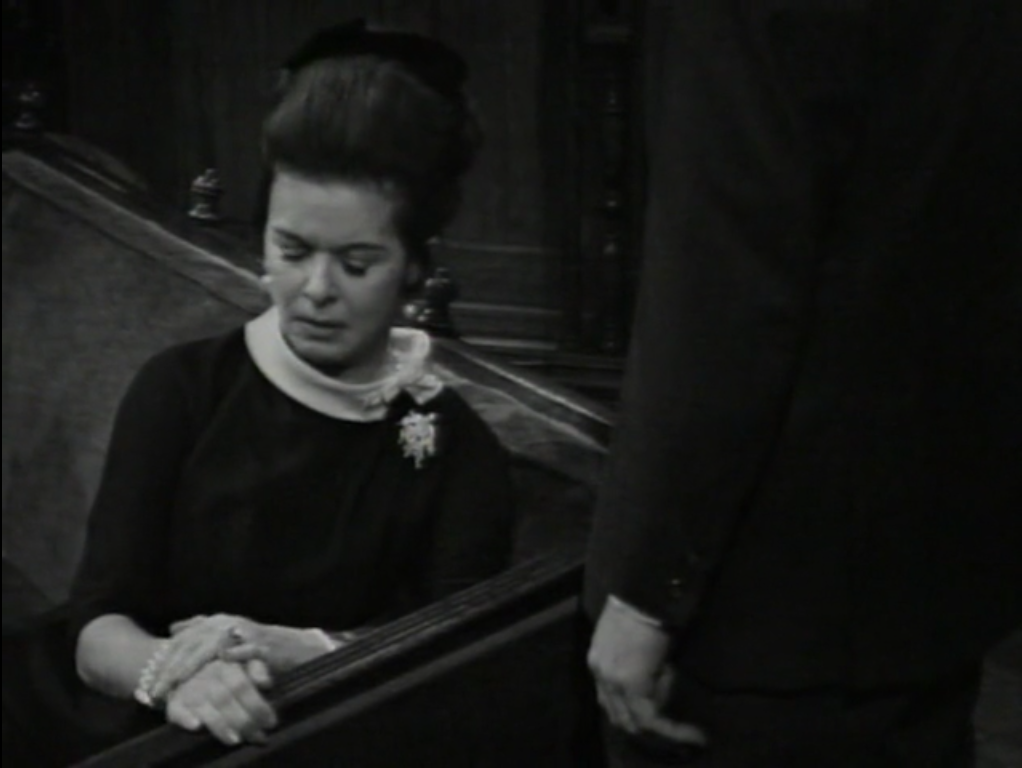
Reclusive matriarch Liz is despondent, and no wonder. For months and months, seagoing con man Jason McGuire has been blackmailing her. She hasn’t been able to resist any of his demands; today she tells him that “There is no point in not being agreeable.” She makes a great show of submissiveness towards him, asking his permission to leave the drawing room. They are scheduled to marry in a few days, much to the dismay of everyone except Jason.
In the pre-credit teaser, we see Liz’ dream that she is standing atop the high cliff on her property, looking at the rocks and the sea far below. The ghosts of the Widows who have jumped to their deaths from the cliff over the years are calling her name. The Widows were a big part of Dark Shadows‘ supernatural back-world in its first months, but this is the first we’ve seen or heard from them since #126. In her dream, they call her name and she tumbles headlong over the cliff.
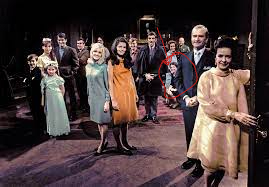
Liz mopes around the house during the day, then goes to the cliff. Housekeeper Mrs Johnson finds her there at nightfall. This is the first time in ten and a half weeks we have seen Mrs Johnson; I don’t usually give spoilers, but we won’t see her again for fourteen and a half more weeks. I suspect she was in this one just to be sure actress Clarice Blackburn would be in the studio when they were taking the cast photo I use as the header on this blog.
Was this photo taken the day this episode was shot?
Mrs Johnson mentions the Widows and tells Liz she doesn’t like hearing the legends about them. So Liz launches a detailed recounting of all of those legends. By the time Mrs Johnson is thoroughly uncomfortable, Liz starts to faint and pitch forward towards the edge of the cliff. Mrs Johnson rescues her, and walks her back to the house.
Liz goes back to bed and has the dream from the opening again. She gets up, opens the window, and tells the Widows she can hear them. As their voices travel in the wind, she repeats a catchphrase from one of the legends- “The sea is my grave. My grave is the sea.”
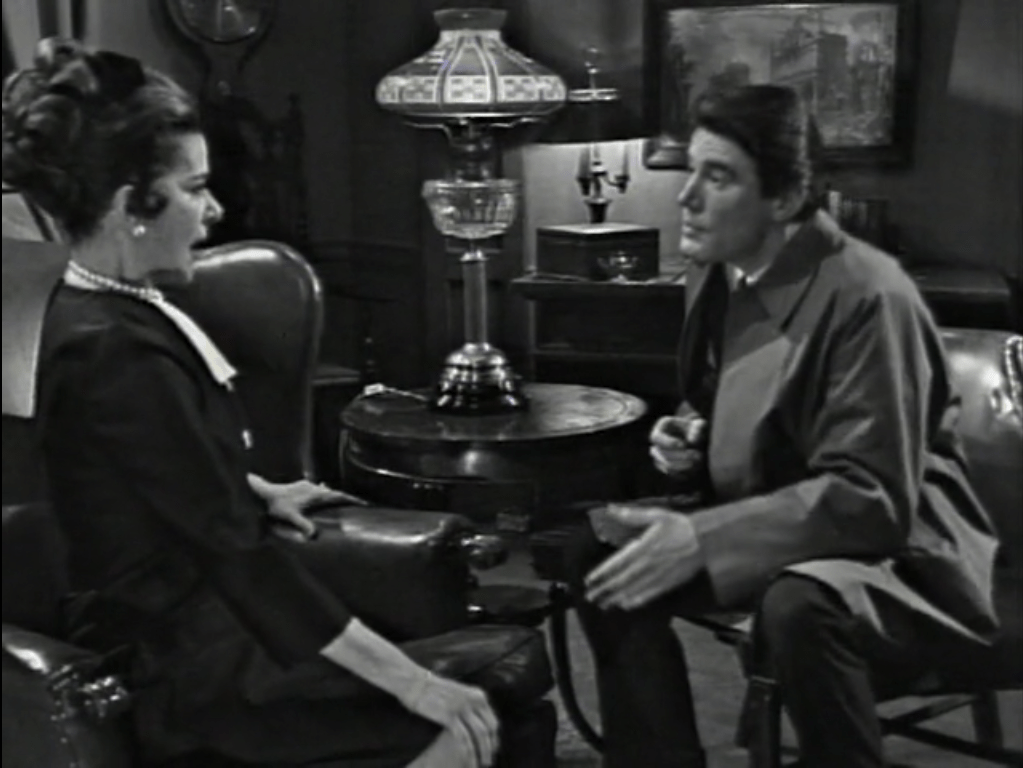
Reclusive matriarch Liz and well-meaning governess Vicki are in the drawing room of the great house of Collinwood. Liz is depressed because her daughter Carolyn is dating motorcycle enthusiast Buzz. She asks Vicki if she has any idea how to break Carolyn and Buzz up, then answers her own question. Liz knows that Carolyn is protesting her engagement to seagoing con man Jason McGuire, and that only by breaking it off with Jason can she change things with Carolyn.
When Liz claims that she is marrying Jason because she wants to, Vicki says it’s none of her business. Vicki has seen abundant evidence that Jason is blackmailing Liz, and won’t pretend she hasn’t. She manages to be quite respectful to her employer without backing down an inch. Despite herself, Liz is impressed with Vicki’s firmness and diplomacy.
Alexandra Moltke Isles was cast as Vicki because she and Joan Bennett looked so much alike, and this is one of the scenes that uses their resemblance to show Vicki as a reflection of Liz. As Vicki is finding tactful ways to express her suspicions, she says things that we have heard Liz say and that we know she is thinking. Each time she does so, Joan Bennett does a quarter turn one direction from the shoulders and a quarter turn the other direction from the neck, as if she were being twisted open. When Liz tells Vicki to stop, she calls her “Victoria,” a name we haven’t heard her use since 1966, and when Vicki asks permission to leave the room she responds, in a near-whisper, with the usual “Vicki.” This alternation also suggests twisting, and to regular viewers who remember that Liz has a secret connected with the fact that “Her name is Victoria” it is another twisting open.
Meanwhile, Jason is entering the Blue Whale tavern with his former henchman, Willie Loomis. Jason wants to confront Willie with the fact that he saw him in town earlier in the day selling a piece of jewelry. Willie says that he was selling it on behalf of his employer, wealthy eccentric Barnabas Collins. Jason knows of Willie’s obsessive fascination with jewels and his tendency to steal them, and does not believe that Barnabas would entrust him with such a task. What Jason does not know is that Barnabas is a vampire and Willie is his sorely bedraggled blood-thrall. As such, Barnabas has a power over Willie that makes it rational to entrust the most remarkable tasks to him.
Carolyn and Buzz enter. They almost leave when Carolyn sees Jason and Willie. Jason and Willie rise and meet them at the door. Jason assures Carolyn that they were just going. Before they do, he taunts Carolyn with his engagement to Liz.
On Tuesday, Carolyn and Buzz started dancing together in the drawing room. Buzz made a few very graceful moves, saw Carolyn going into the Collinsport Convulsion, and sat down to observe. Today, Buzz sees two background players twitching awkwardly while the jukebox plays and declines Carolyn’s invitation to join her on the dance floor. He wants to stop drinking, saying that he is looking for something that will make him feel like he’s never lived before, while “drinking only makes you feel drunk.” It sounds a little bit like he’s going to offer Carolyn a drug stronger than alcohol, but by the end of the scene he just wants to get back on his bike. Liz’ fears to the contrary, Buzz seems pretty darned wholesome.
While Carolyn and Buzz are on their way out of the tavern, hardworking young fisherman Joe comes in. Carolyn asks Buzz to wait outside while she talks with Joe. Buzz reluctantly agrees to spend a few minutes alone with his bike.
Carolyn and Joe were dating when the show started, and there was a whole storyline about how they were tired of each other and couldn’t get themselves sufficiently organized to break up. Their scenes together reminded us that the 1960s were the decade in which Michelangelo Antonioni used the cinema to explore the nature and significance of boredom.
But they are far from boring today. After he and Carolyn finally called it quits, Joe started seeing Maggie Evans, The Nicest Girl in Town. Maggie is now missing and feared dead. Carolyn sits next to Joe at the bar and expresses her sympathies. When I say that Nancy Barrett’s acting style was to throw herself unreservedly into whatever the script gave her character to do that day, it may sound like I’m saying she was undisciplined or that she lacked subtlety. That is not at all what I mean, and in this scene she does one of the most delicate drunk acts I’ve ever seen. Carolyn sits a fraction of an inch too close to Joe, tilts her head back a fraction of a degree too far, opens her eyes the tiniest bit too wide, and speaks ever so slightly too slowly. No one of those signs would even be noticeable by itself, but together they make it very clear why Buzz was anxious that he and Carolyn should leave their drinks unfinished.
Back in the drawing room, Jason is badgering Liz into setting the date for their wedding. Carolyn and Buzz come back, and Jason tells them he and Liz will be married two weeks from tonight. Carolyn says that she and Buzz ought to get married the same night. Buzz is delighted when she first says this, and is still smiling when she insists she is being serious.
My wife, Mrs Acilius, urged me to call this one “A piece of that action,” something Jason says to Willie. Trekkie that she is, that seemed irresistible to her. But Joe’s line that Buzz seems to be “about as much fun as a bag of spiders” is the funniest of the many witty lines in today’s script, and when you remember that Dark Shadows has, since December of 1966, been basically a horror story, you have to think that in its terms a bag of spiders might be a lot of fun. So that had to be the title.
The entire episode is taken up with the thirteenth iteration of something that wasn’t especially appealing the first time we saw it: seagoing con man Jason McGuire makes a demand of reclusive matriarch Elizabeth Collins Stoddard; Liz resists; Jason threatens to expose her terrible secret; Liz capitulates.
Today, Jason makes the ultimate demand, that Liz marry him. In response, she laughs merrily, the first time we have seen her do this. She takes her resistance to the very point of calling the sheriff’s office and admitting that, eighteen years ago, she killed her husband Paul Stoddard and Jason buried him in the basement.
Jason stops her, telling her that the first person who ought to hear her confession is her daughter Carolyn. Liz agrees to this. Jason goes to summon Carolyn from the study, warning her that her mother is “on edge.”
Carolyn comes in. When Liz tells her that she has something important to discuss, Carolyn tries to lighten the mood by joking that it’s a bit late to break the news to her about the birds & bees. When Liz goes into detail about how Paul was a terrible man who never loved her, Carolyn is so upset that she refuses to listen to any more. She hurries out. This is the first time in months that flighty heiress Carolyn has had an opportunity to behave in a flighty manner.
Carolyn returns to the study. Jason is waiting for her there. She asks Jason how her father felt about her. He spins tales about what a loving father Stoddard was, which Carolyn eats up.
Jason returns to Liz. He stands over her, while she tells him Carolyn wouldn’t listen to her. We can see that her resistance is at an end. She asks him to give her time. He answers that he will give her time, but not much.
Liz, brokenLiz, still examining Jason for vulnerabilities
Over the last several weeks, we’ve seen Jason doing things other than enacting his liturgy with Liz. He and Liz have even shared a few scenes where they don’t perform it. When Dennis Patrick gets to play a charming swindler who has to think on his feet, he is fun to watch. We’ve come to like Jason enough that seeing him twist Carolyn into a fetter binding Liz to his will is a genuinely horrifying moment.
Strange and troubled boy David Collins is in the Old House on the estate of Collinwood with his aunt, reclusive matriarch Liz. David laments to Liz that he can no longer feel the tutelary presence of the ghost of their ancestor Josette Collins. For more than 24 weeks, from #70 when the Old House was introduced to #191 with the conclusion of the storyline centered on David’s mother, blonde fire witch Laura Murdoch Collins, the Old House had been Josette’s sanctuary. Now it is “a new house, a new place,” and she’s gone. David is particularly sad that the house’s new occupant, the newly arrived Barnabas Collins, has removed Josette’s portrait from its place above the mantle in the front parlor and plans to hang a portrait of himself there.
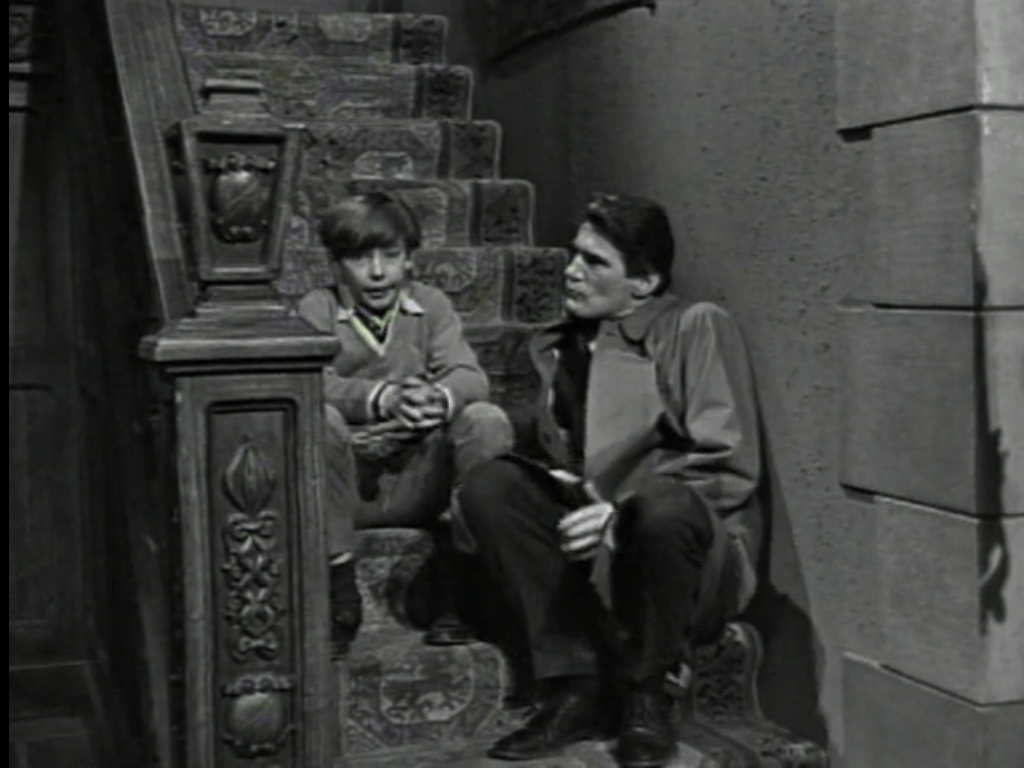
Back in the great house on the estate, David sees dashing action hero Burke Devlin. He sits on the stairs with Burke and talks about his feelings concerning Barnabas, Josette, the portrait, and the Old House. Burke suggests he ask Barnabas to give him the portrait. David is thrilled by this suggestion, and declares that he will go to the Old House at once to ask him. Burke points out that Barnabas probably isn’t home. That doesn’t make an impression on David, but he does stop before going out the door. Burke asks if he is afraid to go there alone, apparently preparing to volunteer to go with him. David says he isn’t afraid, but doesn’t explain what feeling he does have that is holding him back.
David and Burke talk it out
David goes to the Old House and calls to Barnabas. No one answers. The howling of dogs fills the air from every side, frightening David. He calls to Josette. He does not feel her presence. The doors slam shut on their own; when he runs to them, he cannot open them. We conclude with a closeup of his terrified face.
Those three scenes might have appeared in a good episode, but this is not that episode. In fact, it is a real stinker, very possibly the single worst we have seen so far. There is one funny line, when Liz remarks that Willie Loomis’ “illness appears to have caused him no end of convenience.” And the actors and director do what they can. But the script defeats them all.
As David Collins, David Henesy appears to be delivering the lines Ron Sproat actually wrote when he says things like “If I blame [Barnabas] for anything, it’s for changing things around [at the Old House]… I just hope he hasn’t changed [the Old House.]” Some of the words that come out of his mouth may be flubs, but most of it is of a piece with what the adult actors are saying in response to him, and nothing anyone says is close to intelligible. This is one of the rare episodes when Henesy winds up roaming about the sets declaiming like some kid actor in a 60s TV show.
As well-meaning governess Vicki, Alexandra Moltke Isles is trying so hard to remember her own pointless lines that she stands stiff as a board every time she is on camera. Vicki and David’s scenes were the heart of the first 39 weeks of the show, often in spite of writing nearly as bad as what the cast is stuck with today, but their conversation on the stairs today is terribly dull to watch.
Joan Bennett and Mitch Ryan each had star quality in abundance, and so they manage to hold their scenes together. The opening scene between Liz and Vicki has some snap to it, David’s conversation with Burke is appealing, and when Liz and Burke have a scene in the study arguing about a business deal she made with a man called Hackett* things start to crackle. But even in that scene Bennett and Ryan stumble over Sproat’s awful dialogue and wind up in the ditch more than once. Her frequent glances at the teleprompter and a couple of alarmingly long pauses from him turn the crackle to a fizzle well before it is over.
Burke and Liz argue about the Hackett deal
The scene between David and Liz in the Old House is another defeat for Joan Bennett. David Collins’ nonsensical lines and David Henesy’s flailing attempts to find some kind of through line in them leave her standing in mid-air, and the scene goes on so long they repeat every point they have to make at least twice. By the third time through the sparse material they have to work with, not even she could make it interesting.
Moreover, regular viewers will be puzzled when Liz tells David over and over that the Old House and its contents belong to Barnabas. On Monday, in #220, Barnabas and Vicki had a conversation in the foyer of the great house about the fact that he was not going to own the Old House. There hasn’t been any indication of a change in that plan, but Liz goes out of her way to say three times, not that Barnabas is staying in the house, but that it is his. We are left wondering what she is talking about.
Burke and Vicki spend some time together. They stand in front of the portrait of Barnabas Collins in the foyer of the great house talking about Barnabas’ decision to hire Willie as his servant. Burke remarks that “Cousin Barnabas doesn’t seem too bright.” That’s a fun moment, but then Vicki sticks up for Barnabas and they have nowhere to go with it. The scene doesn’t end until they’ve spent a few more moments standing there jabbering.
Burke and Vicki sit on the sofa together in the drawing room. The nonverbal communication between them raises the question the show has been teasing for some time, whether Burke and Vicki are dating. As with Burke’s paternal moment with David, it shows that the actors and directors can create little stories to keep us interested when they can keep the dialogue out of the way.
Burke says he’s going to talk with Liz about a business matter that he can’t tell Vicki about. He then tells Vicki why he is concerned about the matter. These mutually contradictory lines are no better than David being upset that Barnabas has changed the Old House, and just hoping that he hasn’t changed the Old House. For a moment, friend Burke doesn’t seem too bright.
*A name we have never heard before on Dark Shadows.
We open in an old, abandoned fishing shack loaded with junk, much of it made of dry, brittle wood. The floor of the shack is on fire. Flames leap from the floor several feet up to the ceiling. Over the next half hour, none of the junk will catch fire, nor will the walls. During that period, strange and troubled boy David Collins and his mother, blonde fire witch Laura, will stand around in the shack, carrying on a conversation. David slowly recites the legend of the Phoenix. There are also several cuts away from the burning shack. We see well-meaning governess Vicki in the drawing room at the great house of Collinwood; we see reclusive matriarch Liz in her hospital room in Boston. Evidently it’s one of those leisurely shack fires that don’t demand your undivided attention.
In the pre-credits teaser, Laura calls David to come to her, deeper into the flames. He takes a few steps in her direction. After the credits, David is back where he started. This sets the amazingly dilatory tone that persists throughout the whole episode.
David has got this far towards Laura at 1 minute 35 seconds into the episode.
In the drawing room, Vicki is shouting at the ghost of Josette Collins, asking where David is. My wife, Mrs Acilius, says that on this viewing of the series she is starting to identify with the ghost of Josette. Josette must be getting pretty frustrated that after everything she and the other ghosts have done to try to explain the situation to them, the living still don’t get it. Vicki really ought to have thought of the fishing shack several days ago, when a ghost told her that there would be a deadly fire in a very small house by the sea, but it doesn’t dawn on her until some minutes into today’s episode, by which time a wooden shack would have burned to ashes.
Laura asks David to tell her the legend of the Phoenix. He announces the title: “The Legend of the Phoenix!” Then he looks at the teleprompter, intones a few more words, and looks at the teleprompter again. It is very unusual for David Henesy’s memory to fail him, and even more unusual for him to bellow his lines like some kid actor on a 1960’s TV show. Usually he’s letter-perfect and remarkably natural. But Diana Millay is also a good study, and she’s looking at the teleprompter today as well.
Maybe writer Malcolm Marmorstein didn’t get today’s script to the actors at the usual time. It’s easy to imagine that the producers might have kept sending Marmorstein back to do rewrites- this is the grand finale of the most ambitious storyline they’ve had, and it stinks to high heaven. Maybe by the time they realized they weren’t going to get a decent piece of writing out of Marmorstein, it was too late for the actors to learn their parts properly.
In a hospital room in Boston, flighty heiress Carolyn is sitting with her mother Liz. Liz has been in a catatonic state and off the show since #160, immobilized by Laura’s evil spell and Joan Bennett’s annual five week vacation. It’s the first hospital room we’ve seen on Dark Shadows, and it comes equipped with Ivor Francis, who would be one of the busiest and most distinguished character actors on American television in the 1970s. Francis plays the doctor who very patiently and calmly tells Carolyn that there isn’t any point in sitting with Liz tonight. Francis is always interesting to watch- you can tell that the doctor has a thousand interesting things on his mind, and are engrossed in his every word, expecting him to say one of them out loud. But of course he never does.
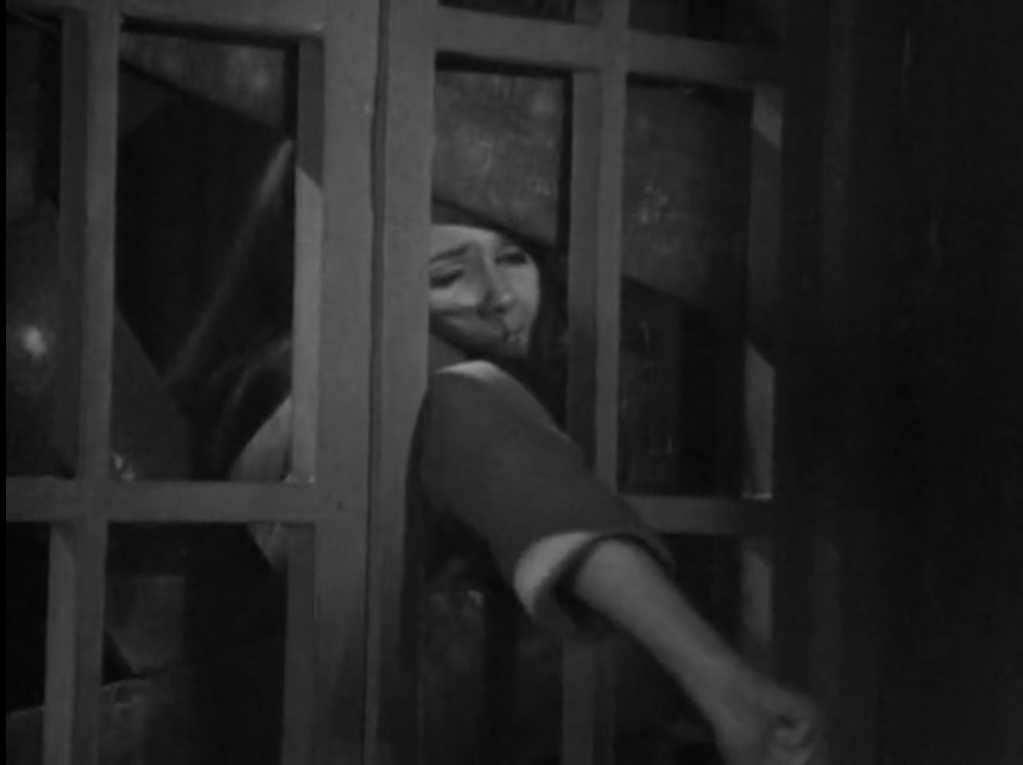
Vicki makes her way to the shack, where the fire hasn’t made the slightest progress. Maybe the real danger David is facing is asbestos exposure. Vicki tries the door and finds it locked. She stands at the window, which has no glass but is crossed with stout wooden beams, and shouts at David to come out. Laura urges him to finish telling the story of the Phoenix, Vicki urges him to stop telling the story and get out of the shack. Vicki can stick her hand into the shack, but can’t quite touch David.
Vicki realizes she can’t reach David
Laura looks up at Vicki and says that David can’t hear her. Vicki keeps talking, and Laura sounds as exasperated as we imagine Josette must be. After all the research she and her allies have done, hasn’t she figured out that this was what was going to happen?
Returning viewers share Laura’s exasperation, because we know that Vicki has indeed figured it out. She’s spent weeks warning all of her friends that exactly this scenario would play out. But suddenly today she has forgotten everything. It’s the ultimate Dumb Vicki moment, when the writers paint themselves into a corner and escape by making Vicki act like a moron. Marmorstein has to keep the shack burning and David in it from 4:00 to 4:30 PM Eastern time, and if that means Vicki has to develop some kind of amnesia, too bad for her.
Laura says that David, like her, will attain immortality if he burns in the fire. We know that is false.The ghost of David Radcliffe, a son whom she burned in a previous incarnation, spoke through David at a séance the other day and told us that he was separated from his mother in the fire and has been an unquiet spirit since. Laura may not know this, and may sincerely believe that David will share in her resurrection. But Vicki was at the séance. It’s a bit odd she doesn’t try to correct Laura on this point, since they have plenty of time for chit-chat while the flames burn in place.
In Boston, Liz wakes up. Evidently Laura’s impending immolation has broken the spell she cast on Liz. After some minutes of preliminaries, Liz starts shouting “David! Fire! David in fire!” Carolyn and the doctor try to calm her, but she keeps shouting. Almost 300 miles away at Collinwood, David can hear Liz’ voice.
After he hears Liz, David can hear Vicki as well. Evidently all of Laura’s spells are breaking. Laura keeps pleading with David to join her in the flames, Vicki keeps yelling at him to stay where he is. Two minutes before the end of the episode, a burning beam falls, and Laura looks terrified. She delivers her lines after this with the utmost intensity. In an Archives of Television interview, Diana Millay explained that the beam wasn’t supposed to fall, that she really was frightened, and that after all those weeks on the show she had developed a maternal feeling for David Henesy that nearly led her to break character and try to protect him at that moment. She uses those feelings to great advantage, selling the audience on the idea that this is Laura’s last chance to take David with her into the flames.
A fiery shot we were supposed to seeNot supposed to happen
Finally Laura tells David it is too late. David looks back and forth between Laura in the flames and Vicki at the window. The flames consume Laura as she cries out “From these ashes, the Phoenix is reborn!” David is horrified as he watches his mother disappear in the blaze.
David pulls at the window in an attempt to escape. Vicki calls him to come out the door. He does, and she embraces him as he weeps.
David tries to get out through the windowThe climactic moment of Dark Shadows 1.0
The last couple of minutes of the episode work well enough to show us what we are supposed to be feeling. Mostly that is down to the emotions Millay and Henesy are able to project when they aren’t burdened with a lot of lines they got at the last minute and that don’t make much sense anyway. It also rests on the foundation of the only relationship that has been interesting every time we’ve seen it, the growing friendship between David and Vicki.
Now that David has chosen the life Vicki is offering him over the death his mother represented, that relationship has nowhere to go. None of the unresolved stories has ever been interesting, and there is no reason to suppose that will change now. So today marks the end, not only of the Laura arc, but of Dark Shadows 1.0. ABC has renewed the show for thirteen more weeks, taking them to episode 260. At this point, there is no indication of what they could possibly do to keep the characters busy for that long.
Blonde fire witch Laura Murdoch Collins has returned to Collinsport, Maine, after a long absence. She wants to divorce her husband, high-born ne’er-do-well Roger Collins, and to go away with their son, strange and troubled boy David. Roger is delighted by this prospect, but he is dependent for his living on his sister, reclusive matriarch Liz, and Liz is adamant that David must stay with her in the great house of Collinwood.
Last week, things came to a head between Laura and Liz. Liz declared that she would never let Laura take David, and Laura responded by casting a spell on Liz. As a result of the spell, Liz is bedridden and given to bouts of confusion.
Well-meaning governess Vicki suspects that Laura is connected with the supernatural. Yesterday, Vicki and her boyfriend, instantly forgettable young lawyer Frank, came across some documents that she interpreted to support this suspicion. Frank is one of Liz’ attorneys and Vicki is for all intents and purposes a member of the Collins family. Further, the ghost of Josette Collins has intervened a number of times to guide Vicki to become the protagonist in the story about the dangers Laura poses. So it would seem that a potent alliance is taking shape against Laura.
Today, another member seems to be joining this force. Liz’ only acknowledged child, flighty heiress Carolyn, initially reacts to the doctor’s recommendation that her mother be moved to a hospital in Boston by agreeing to talk her into it. Then it dawns on her that it would be very convenient for Roger and Laura if Liz were away from the house. She makes some pointed remarks to each of them in turn. She does not say that she thinks Laura is responsible for what happened to Liz, but she is hostile enough that she is unlikely to discourage Vicki’s efforts.
As Liz, Joan Bennett has a lot of screen time today, all of it in bed. You can see why she was such a big movie star in her youth- all she really has to work with are her eyes, and with those alone she holds what could have quite a dreary episode together.
Liz looking at Roger with alarm
Liz considers the idea of going to the hospital, and tells first Carolyn, then Vicki, to stand up to Laura. When each points out in her turn that, as David’s parents, Laura and Roger have certain legal rights to which they must yield, she declares that they are too young to fill in for her in her absence, and resolves to stay in the house.
Vicki leaves the room and Laura appears, sitting on the foot of Liz’ bed. Liz is outraged and demands to know who let her in the house. Laura assures her that no one else knows she is there. The first time Laura insinuated herself into the house, lighting effects made her look like a ghost. She interacted only with David, in circumstances that suggested the whole thing might be a dream he was having, then vanished. Now she is very corporeal, and after her talk with Liz she heads downstairs to talk with Roger and Carolyn in the drawing room. She seems to be gaining strength, becoming able to sustain her form and assert her personality for longer periods. The alliance forming against her will have its work cut out.
Carolyn goes up to Liz’ room while Roger and Laura talk about what Liz’ absence might mean for their divorce. Roger says that as long as Liz can speak, she can keep them from getting what they want. Laura says that may not be as much of a problem as he thinks. At that, they hear Carolyn scream. Roger runs up to Liz’ room and finds that she is catatonic. In the drawing room, Laura smiles.
At the end of yesterday’s episode, Maggie Evans, The Nicest Girl in Town, and her boyfriend, hardworking young fisherman Joe Haskell, had gone out to look for Maggie’s father, drunken artist Sam Evans. Maggie and Joe wound up carrying Sam home from the tavern.
Joe left the Evans cottage, Maggie went to the kitchen to brew up some coffee, and Sam lit a cigarette and passed out. The cigarette fell on some newspapers and started a fire.
While the fire began, the face of blonde fire witch Laura Collins was superimposed on the image of Sam. Some mysterious force has compelled Sam to paint pictures of Laura naked and in flames. Laura objects to these portraits. She came to the Evans cottage the afternoon before the fire and told Sam she would find a way to stop him painting any more of them. Her face appearing over the fire, along with spooky music and everything else the show has told us about Laura, demonstrates that she is casting a spell on Sam with the intention of making good her threat.
Today, Sam regains consciousness and sees the fire. He tries to put it out with his hands, burning them badly. Maggie comes running and beats the flames out with a rug.
The current storyline hinges on the idea that Laura’s supernatural powers make her a deadly threat to her son, strange and troubled boy David Collins, and perhaps to others as well. The outcome of this spell creates suspense as the audience wonders if Laura is mighty enough to keep the narrative arc going. After all, causing Sam to pass out and mess himself does not take much. There’s no suggestion that any magical abilities reside in Bob the bartender, yet he manages to do that just about every night, and he collects a paycheck for it to boot. For all we know, Laura’s spell might have been a total failure- it might be a sheer coincidence that she was trying to make him pass out and drop a lit cigarette when that’s what he was going to do anyway.
Maggie scolds Sam for his drinking. To Maggie’s exasperation, he raves that Laura started the fire. As he goes on and on about an unnamed power that has been controlling his behavior, Maggie responds “I think they call it alcohol.” Yesterday, Maggie was talking to Joe about laying aside her role enabling her father’s alcoholism and leaving the town of Collinsport altogether. Regular viewers will remember that conversation today, when she tells Sam that she is approaching the limit of what she will take from him. Sam loves Maggie more than anything, and he desperately tries to convince her that he is telling the truth. She sees his desperation, and we see her struggle to make herself say that nothing can convince her of a story like the one he is telling her.
As the voice of correction, Maggie is perfectly reasonable, perfectly justified, and perfectly mistaken. Sam is indeed the plaything of uncanny powers. A couple of weeks ago, they gave us scene after scene full of sound and fury, repeating the point that some spiritual force was making Sam paint Laura’s picture. We see today how little of that was necessary- Laura’s likeness and the theremin music are plenty to show us that the fire is in line with a spell she is casting. But Maggie, while she has often said that she wants to avoid the estate of Collinwood because she believes the stories that ghosts and ghouls haunt it, refuses to entertain the idea that there is anything unearthly at the root of Sam’s troubles. She says that she has to have evidence she can look at out in the open, and that she isn’t going to listen to Sam’s talk about unseen and unknowable powers. Although we know that Sam is right and Maggie is wrong about the particulars of this incident, to the extent that Maggie is speaking to her father as an adult child of an alcoholic she is the voice of the audience.
Meanwhile, Laura is sitting by the hearth in the drawing room at the great house of Collinwood. She is casting her spell on Sam. Reclusive matriarch Liz enters and tries to get Laura’s attention. When Laura finally looks up, her face is contorted in an unattractive expression. Liz remarks on it, and Laura asks if she looked ugly. Liz says yes, then for a fraction of a second looks embarrassed when she realizes that she told another woman that she was ugly. She quickly makes some meaningless remarks in a courteous voice. It is a small moment, but Joan Bennett extracts the jewel of comedy from it quite deftly.
Laura has come to Collinwood to re-establish a relationship with David. After years away, she wants to take David and leave. David’s father, high-born ne’er-do-well Roger, is all for this plan, but Liz is determined to thwart it. As the only male of his generation in the family, David represents the sole hope that the name of Collins will continue. As the custodian of the family’s past and future, Liz wants to be the chief maternal presence in David’s life. Besides, she never leaves the estate, so she needs all the company she can get.
Liz tells Laura that, while she had agreed that Laura could take David if their relationship were to make the right sort of progress, she is not at all satisfied that such is happening. Her objections don’t make much sense, and if the audience hadn’t been informed that Laura is an uncanny being whose plans will likely lead to David’s death we would probably be appalled at how unfair she is.
Roger shows up and takes Laura’s side. While the two of them stand firm against Liz’ wispy arguments, a knock comes at the front door. It is Maggie. Laura is shocked to see her- apparently she had expected her spell to do enough damage to the Evans cottage that Maggie would be unable to go visiting tonight. Laura’s reaction is dramatic enough, and the music behind it is overstated enough, that we may think Laura expected to kill Maggie. Again, the indications of Laura’s failure lead us to wonder if she is enough of a witch to deliver the supernatural thriller we have been led to expect.
Maggie wants to tell Laura about Sam’s accident, and to lament that Sam’s obsession with Laura has led him to the idea that she somehow caused it. Roger is indignant that Sam would say such things about his estranged wife, and storms off to the Evans cottage to give Sam a piece of his mind. Liz, on the other hand, is intrigued by Sam’s ideas and wants Maggie to give as many details as possible about Laura’s visit to the cottage earlier that day.
When we were watching the episode, Mrs Acilius wondered if Liz’ interest in Maggie’s story was a sign that she had noticed something eerie about Laura during their previous acquaintance. My interpretation was that Liz is so desperate to find information she can use to present Laura as an unfit mother that she is ready to listen when the town drunk claims she cast a spell on him. As reasonable, justified, and wrong as Maggie was in her scolding of Sam, so unreasonable, unjustified, and right is Liz in her conversation with Laura.
When Maggie says that Laura had threatened to stop Sam painting pictures of her naked and in flames, Liz asks what threat she made. Laura answers that all she said was that she would find a way to stop him. With a look of suspicion on her face, Liz asks what she was planning to do when she said that. “Just what I did do,” Laura answers. After a pause, she specifies, “Turn the matter over to Roger.”
In the Evans cottage, Roger reads the Riot Act to Sam. Louis Edmonds was a master of sarcastic dialogue, and Roger’s lines in this scene give him many chances to shine. Indeed, he and David Ford have a blast playing Roger and Sam’s mutual hatred. When Roger ridicules his claim to be subject to mystic powers, Sam replies in a taunting voice that Roger is in as much trouble as he is. The two men jeer contemptuously at each other, and it is a wonder to behold.
Mrs Acilius was particularly impressed by the contrast between the opening scene with Maggie scolding Sam and the closing scene with Roger railing at him. Sam’s two interlocutors make the same basic point, but the differences between them as individuals and between their respective relationships to Sam tell us entirely different things. Sam hates Roger almost as much as he loves Maggie, and their hostility is as explosive as Sam’s scene with Maggie is poignant. Maggie’s lovable, down-to-earth persona makes her the polar opposite of Roger with his haughty manner, sharp tongue, and utterly debased moral stature. In her scene, Maggie was to an extent the voice of the audience; insofar as Roger is continuing the lesson Maggie began teaching Sam, he is taking over in that capacity. It is quite a different thing for us to relate to The Nicest Girl in Town as our voice than it is for us to see a virtueless snob like Roger in that capacity, and so Roger’s first moments berating Sam in the Evans cottage whip us around fast.
Sam confirms that he has been driven to paint another picture of Laura, and Roger announces that he will destroy it. Sam doesn’t object. When Roger goes over to the painting, he sees that most of it has already been burned away. Sam is shocked to see this- the fire was on the other side of the room, and nothing in the several feet between a burned spot on the carpet and the painting has been touched by the flames. With this, the suspense is resolved- we know that Laura’s fire magic did achieve a result that Sam’s drinking could not. So the show will have a story to tell after all.
The script is credited to Malcolm Marmorstein, who was by far the worst writer on Dark Shadows. It is difficult for me to believe that someone who delivered so many low points wrote a script this good all by himself. Joe Caldwell was making uncredited contributions to the writing by this time, and he was so much better than Marmorstein that I am inclined to suspect that he wrote this one.
I suppose Marmorstein might just have been having a good day. There don’t seem to be any surviving documents identifying those contributors to the writing whose names didn’t appear in the on-screen credits for any given episode, so we can only guess which ones Caldwell worked on in his first several months on the show. But the structure, dialogue, and pacing of this one feel a lot more like the ones with his name on them than they do like the general run of Marmorstein’s work.
Each of the 1225 episodes of Dark Shadows features one name under the credit “Written by.”* A total of nine names rotate in that spot. While we know that some episodes included writing from uncredited contributors, the only such contributors we can identify come from among that tiny group of eight men and one woman. For example, Malcolm Marmorstein, credited with today’s script, wasn’t officially named among the writers until #115, but he may well have written additional dialogue as far back as #46. Joe Caldwell’s name doesn’t appear on-screen until #245, but he will actually be writing some of the scripts attributed to Ron Sproat starting this month, maybe this week.
Opinions will of course vary as to which of the nine identifiable writers was better and which was worse. Few, however, will find a place for Marmorstein on a list of Dark Shadows’ eight best writers. Although he had extensive experience in the theater, Marmorstein had none of the sense of what actors can do that Art Wallace and Francis Swann brought to the first nineteen weeks of the show. Nor did he know how to structure a drama, write crisp dialogue, or invent fresh story points. Directors Lela Swift and John Sedwick collaborate with a uniformly strong cast to put Marmorstein’s scripts on such a strong footing that at moments they seem like they are about to be good. Those brief flashes of hope are invariably, cruelly, disappointed.
There are indeed some bright spots in today’s episode. Reclusive matriarch Liz is in the drawing room of the great house of Collinwood. Well-meaning governess Vicki and homicidal fugitive Matthew are both missing, and Liz is worried that Vicki may have fallen into Matthew’s hands. Wildly indiscreet housekeeper Mrs Johnson shares her conviction that Matthew has killed Vicki, and won’t stop talking about this belief even after Liz expressly orders her to do so. Clarice Blackburn plays Mrs Johnson as a woman with no self-awareness whatsoever, and no screen actor has ever had a more effective way of showing horror at displays of social maladroitness than did Joan Bennett. In their hands, this scene is laugh-out-loud funny.
A knock at the door rescues Liz from Mrs Johnson’s untrammeled morbidness. The sheriff has come to report to Liz on the state of the searches for Vicki and Matthew. Mrs Johnson answers the door and won’t let the sheriff see Liz until she’s given him a piece of her mind about the incompetence of his department. There aren’t any memorable lines in this exchange, but the contrast between Blackburn’s highly animated movements and Dana Elcar’s cheerful placidity is so obviously suitable for comedy that it feels funny.
Back in the drawing room, the episode starts to fall apart. Liz and the sheriff talk about the searches for Vicki and Matthew. The dialogue is full of repetition and wasted words. Liz asks if the sheriff has an idea where Matthew might be, to which he replies, “He could be anywhere, and everywhere.” Might he hurt Vicki? “He might, but on the other hand he might not.” After all, “he’s very unpredictable.” Then, “you know how unpredictable he is.” Yep, unpredictable, let’s repeat that word five or six more times, that’ll keep us busy until the commercial break.
They could have cut some of that smoke-blowing and replaced it with lines about what the sheriff has done. My wife, Mrs Acilius, wishes the sheriff had mentioned telephoning Vicki’s former residence, the Hammond Foundling Home, and asking people there about where Vicki might have gone and whom she might have tried to contact. That might not have led to any action, but at least it would invite us to imagine that something might be going on somewhere.
The scene between Liz and the sheriff does have an effective ending. She asks him if he holds out much hope for Vicki. He replies, “Frankly, no.” She turns to leave the room. We break for commercial on that downbeat, which lets the bleakness of the situation sink in.
Strange and troubled boy David Collins comes home. David is the one person who knows that Matthew is hiding in the long-abandoned Old House on the grounds of the estate. He has been delivering supplies to him. Even David does not know that Matthew is holding Vicki prisoner in a hidden chamber. David sees that the sheriff is in the house, and asks Mrs Johnson if the sheriff has any news about Vicki or Matthew. Mrs Johnson seizes this opportunity to resume denouncing the sheriff’s incompetence, saying that the only clue he can recognize one that tells him it is time to eat and make himself even fatter than he already is.
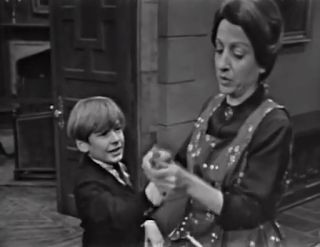
David is about to move on when Mrs Johnson questions him about the pack of cigarettes he stole from her earlier. She sets some punchlines up for David in this exchange. She mentions that she lit a cigarette while serving David his breakfast, to which David replies by asking if she is supposed to smoke while working. She says she knows that she set her pack of cigarettes on the table when she and David were alone in the kitchen, and that she hasn’t seen it since. He suggests it walked away by itself. She tells him he’s the only one who could have taken them; he says that if he wanted cigarettes, he wouldn’t steal them, he’d buy them. None of these lines is much on the page, but as delivered by Blackburn and David Henesy, they are genuinely funny.
David goes into the drawing room and talks with the sheriff. Picking up on Mrs Johnson’s remark about the sheriff’s vigilant observation of meal-times, David asks him what it means when the whistle blows at the cannery. “Lunch,” says the sheriff. Again, not a world-class piece of comic material, but Henesy and Elcar make it land.
David then asks the sheriff for the details of his search for Matthew. The sheriff happily answers all of David’s questions in detail, as if he were giving a briefing to the state police. He tells David that anyone who might be hiding Matthew will go to jail.
This scene shows the limits of what a good actor can do with bad material. David is going to return to the Old House at the end of the episode. He will be prompted to go back there because he has learned information from the sheriff that Matthew will want to know. While there, he will set up suspense by revealing to Matthew that the sheriff has triggered his intense phobia of jail. That locks the sheriff into playing his scene with David as a babbling oaf.
In Elcar’s first episodes as the sheriff, he had made indiscreet remarks to David, but as we saw him observing the reactions those remarks elicited from David and others he seemed to be using them as ploys to advance his investigations. For example, in #59, he had given David some information that excites him and unnerves his father, high-born ne’er-do-well Roger Collins.
We can see how he might use similar tactics in this situation. After all, Vicki is David’s governess, and David has spent more time with her than has anyone else. Matthew had been the caretaker in the house where David lives, and David knows him quite well also. In this conversation, when the sheriff refers to Matthew as unlikable, David becomes very excited and exclaims “I like him! Er, I did like him, I mean.” If the sheriff knows his business he might well pay very close attention to everything David says, and keep encouraging David to say more. He will certainly notice David’s terrified reaction to the idea that someone helping Matthew will go to jail, and test his reaction to further comments on related themes. But if he takes any note at all of David’s attitude, the current storyline will end within minutes. So in this scene, Marmorstein leaves Elcar no way to play the sheriff as an intelligent character.
After the sheriff leaves, David and Liz have a scene in the drawing room that builds up to a tremendously frustrating moment. David keeps asking his aunt one question after another about Matthew and Vicki, Vicki and Matthew, does Matthew have Vicki, is Vicki in danger from Matthew, then without taking a breath “Do you know any secrets about the Old House?” Liz responds “I wish that someday you’d ask an important question.”
Granted, we know that Matthew is holding Vicki prisoner in the Old House and Liz does not, but it is hard to imagine anyone failing to see the connection between these two thoughts. Joan Bennett and David Henesy had a fine rapport that made the scenes between Liz and David Collins a delight, and you can see them trying to save this exchange. David is in a panic at the beginning of the scene and gets steadily more worked up as it goes along. We see Liz observing his agitated emotional state, paying such close attention to his facial expressions, tone of voice, and frantic bodily movements that she misses key elements of his words. It’s a valiant attempt on their part to make the scene work.
David wants to go to the Old House to see Matthew. In the foyer, Mrs Johnson again confronts him about the cigarettes. He yells at her to “Get off my back!” and runs out. This might have been an attempt to show that David feels his world closing in on him, but it doesn’t succeed. We’ve already seen those two characters say everything they had to say about that topic on that set. Repeating it just feels like filler.
*There are reference works that draw on the original paperwork produced by the makers of the show; even these list one writer per episode. That’s how the Dark Shadows wiki manages to list a writer for every episode, including those that don’t show writing credits on-screen.
Dashing action hero Burke Devlin pays yet another visit to the great house of Collinwood. He announces to its residents, the ancient and esteemed Collins family, that he intends to take control of all their properties, including the house. He is buying up their debts and will use them to seize their businesses. He offers to pay them for the house, though. He even offers to pay for it at higher than the market value.
Ne’er-do-well Roger Collins urges his sister, reclusive matriarch Liz, to take Burke’s offer for the house. It’s a huge, gloomy, impractical place, and they would be better off without it. He doesn’t mention that the cash might come in handy when Burke starts calling in all the notes they have no way of meeting. Liz won’t hear of it, and vows to fight.
Flighty heiress Carolyn and well-meaning governess Vicki process their feelings about the matter. Carolyn is wounded by the evidence that Burke never really wanted to be her boyfriend- not that he ever said he did, but she kept hoping. Vicki wonders what Burke is thinking, and whether he understands his own motives. He admits that he may not- after all, if he’s trying to avenge the wrongs the Collinses have done him by bankrupting them and collecting their assets, why not just watch their house fall into his lap with the cannery, the fishing boats, and whatever else they may have, leaving them with nothing?
With this post we say goodbye to one of the bloggers who has kept us company. This was the last episode Marc Masse discussed on his blog Dark Shadows from the Beginning. His posts usually include stimulating insights, sometimes remarkable scholarship, and occasionally material that is in one way or another frustrating. Still, he is always well worth reading.
Among his most extraordinary contributions was about the story of the sabotaging of Roger’s car, a.k.a. The Saga of the Bleeder Valve. That story began when we, accompanying Vicki, saw Burke standing by Roger’s car in episode 13.
Burke tells Vicki that he was looking at Roger’s car because he was thinking of buying one like it, an explanation she finds unconvincing.
In his post about episode 46, Masse includes a long section about similarities between the Saga of the Bleeder Valve and a particular episode of The Alfred Hitchcock Hour. He convinces me that Art Wallace and Lela Swift had studied that episode. You’ll notice from his screenshots that that John Cassavetes even had the same haircut that Mitch Ryan wore as Burke:
Source material for the missing brake valve storyline on Dark Shadows can also be found in The Alfred Hitchcock Hour anthology series. In the episode Murder Case (season 2, episode 19; aired March 6, 1964), Gena Rowlands plays an actress (Diana Justin) in London married to a rich diamond merchant (Charles Justin) played by Murray Matheson. Diana isn’t really in love with her much older husband Charles, but since he is the main financial backer of a play she is starring in, her success is ensured… that is until the boyfriend she dropped so she could run off to England and start a production company with her rich husband, a struggling actor named Lee Griffin (played by John Cassavetes), manages to wangle his way through an audition and secure a part in the play by getting Diana to pass a good word along to the author and director of the production. Lee gets Diana to agree to resume their former relationship, and in no time the pair are in cahoots to relieve Diana of her marital obligations and in the process secure a huge windfall by plotting to have the old man bumped off. To accomplish this, they arrange for Charles to have an automobile accident; this is where the similarities to the missing brake valve story on Dark Shadows come into play.
One afternoon, on a visit up to the country home where Diana and Charles live, which is situated high up on a hilly area, Lee gets an idea when he comments on how the type of car that Charles drives is famous for its brakes.
To compromise the functioning of the car’s brake system, Lee first uses a wrench to loosen something, probably the bleeder valve…
…after which he pumps the brake pedal several times so there won’t be any hydraulic fluid left for when Charles next gets behind the wheel.
Just after completing the task, and with the wrench still in his back pocket, Charles walks in to find Lee there standing by his car, just like in Dark Shadows episode 13 when Victoria Winters walks into the Collinwood garage to find Burke near Roger’s car. To diffuse the situation, Lee explains to Charles: “I was, uh, just admiring your car. It’s, uh, fabulous!”
That night Lee and Diana have a performance in London; to set the plan in motion, Lee phones Charles from backstage while the play is still on and concocts a story about nearly having gotten into an accident on their drive into London due to a careless young motorist, which left Diana shaken up, and suggesting to Charles that he drive down to London to take his wife home…
…which he agrees to, just like in Dark Shadows episode 15 when Roger agrees to drive into town to meet with Burke at the Blue Whale.
Similar to how Roger in episode 17 is shown to have miraculously escaped with just a sprained arm and a few stitches to the forehead, Charles winds up crashing head on into a tractor that was just starting up the hill; despite that the car ended up a total loss, Charles was extremely lucky in having sustained only a couple of cracked ribs and a slight concussion.
The missing brake valve story on Dark Shadows never really did feel like something that would ordinarily be presented on a daytime serial drama. Instead, thus far Dark Shadows has taken its cue from 1940s film noir for atmosphere, Broadway theater style for acting performances, and nighttime mystery suspense anthology programs for subject matter. Is it any wonder that Dark Shadows would go on to evolve into the cultural phenomenon it would later become? A truly one of a kind blend of widely varying influences.
In his post for episode 76, Masse includes the audio of Joan Bennett singing “Sentimental Moments” in the 1955 film We’re No Angels. I’d never heard of the song, and had no idea she sang. Indeed she was not a Singer with a capital S, but her gentle, precise phrasing is perfect for this strange, sad little tune. I think of it as a farewell to Masse and his blog.
Well-meaning governess Vicki sits placidly in her bedroom at the great house of Collinwood, sewing and looking out the window. Flighty heiress Carolyn comes in and loudly berates Vicki for spending the day away from her charge, problem child David. Carolyn saw Vicki coming home as a passenger in a car driven by the family’s arch-nemesis, dashing action hero Burke Devlin, and jumped to the conclusion that Vicki was both on a date with Burke and on Burke’s side in his conflict with her family. Vicki is at first bewildered by Carolyn’s rage, and then confronts her with her own record of infatuation with Burke.
This scene shows how well cast Nancy Barrett and Alexandra Moltke Isles were as Carolyn and Vicki respectively. Miss Barrett throws herself completely into whatever her character is supposed to be doing at any given moment, a perfect style for the role of someone who is stormy and unpredictable. Mrs Isles takes a very deliberate approach to her part, working her way from the center of Vicki’s thoughts out to whatever lines she has to deliver. That suits the role of someone who is often baffled by the strange goings-on around her and who gradually gathers the strength to stand up for herself.
Carolyn is on her way to the front door when her mother, reclusive matriarch Liz, asks her where she’s going. Still upset after her confrontation with Vicki, Carolyn snaps at Liz and gives sarcastic answers. Eventually she tells her that Vicki didn’t give David his lessons for the day, that she spent the day with Burke, and that she brought Burke home with her. Alarmed by this report, Liz heads upstairs towards Vicki’s room. Carolyn remembers her latest project, persuading her mother to take Mrs Sarah Johnson onto the domestic staff as a housekeeper. Liz cuts her off, saying that she has no time to think of hiring a housekeeper- all she can think about is firing a governess.
After Liz leaves the foyer to fire Vicki because Carolyn has led her to suspect she might be a spy for Burke, Carolyn picks up the telephone. She tries to call Burke. Evidently the infatuation Vicki had brought up to her is still driving Carolyn to inexplicable actions.
Mrs Johnson is in the restaurant at the Collinsport Inn. In fact, we first see her on the pay-phone there, talking to Burke about her plan to join the staff at Collinwood so she can work as a spy for him. Patrick McCray makes a nice remark about this on his Dark Shadows Daybook:
[P]lanting a spy for Burke Devlin is just the touch of espionage intrigue that Collinwood needs. Finally, someone can actually be the spy that Vicki is suddenly accused of working as. (In the same episode no less, with the irony and subtlety of an anvil landing in your lap.) That kind of duality — especially among the backstairs staff — is a concession to the dramatic thinking that DARK SHADOWS kinda lost over the years. The show gained plot, but it lost those opportunities for characters to reflect one another. As it reached a supernatural frenzy, this earlier, authorial delicacy was a necessary casualty. However, it’s vital to know that a sculpted duality like Mrs. Johnson and Vicki is an instinct buried in the program’s DNA.
I think he paints with a bit of a broad brush when he says that “this earlier authorial delicacy was a necessary casualty.” The frenzied pace of the later years didn’t stop Joe Caldwell or Violet Welles from crafting dramatic miniatures Art Wallace and Francis Swann would have been proud of. While Sam Hall and Gordon Russell were no miniaturists and did often value slam-bang story development over every other consideration, they did take time to show characters in each other’s reflections. Indeed, the whole “1970 Parallel Time” arc is months and months of nothing but “opportunities for characters to reflect one another,” and the actors could often make those reflections interesting (at least the first two or three times you saw them.) Of course, there are also large numbers of episodes written by Ron Sproat and Malcolm Marmorstein, but you can’t blame their shortcomings on excessively rapid pacing.
Mrs Johnson is a difficult customer for Maggie Evans, who runs the restaurant. She sends a sandwich back because she disapproves of the mayonnaise, and the look on Maggie’s face shows us that the cost of that sandwich is coming out of her paycheck. Mrs Johnson insists her meal be served in courses, demands that Maggie sit at her table, and gives her a tip of 10 cents (I checked- 10 cents in October 1966 would have the same purchasing power as 90 cents in October 2022. You could take that to your local hardware store, buy several nails, and still have enough left to operate a gumball machine.) She declares that the death of her late employer, beloved local man Bill Malloy, was no accident, and that according to the Bible someone will have to pay for it. When Carolyn comes into the restaurant, Maggie leaps at the opportunity to leave Mrs Johnson and wait on her.
Clarice Blackburn must have had tremendous fun playing Mrs Johnson in these sequences. The character is exaggerated almost to the level of what would become Dark Shadows’ “Go back to your grave!” house style of acting, so that there is no need to worry about overacting. Besides, so many performers wait tables that one of the standard responses young people in Los Angeles get when they tell people they are actors is “Great! What restaurant?” So it must always be gratifying to play a character who will show the world what a bad restaurant customer looks like.
As Maggie, Kathryn Leigh Scott also has a juicy role today. We usually see her in one of two settings. Either she is in the restaurant, where she is required to be nice to everyone, or she is at home with her father, drunken artist Sam. As the adult child of an alcoholic, she has a thousand habits designed to keep the mood light. When she is dealing with Mrs Johnson, Miss Scott shows us what Maggie looks like when her Nicest Girl In Town persona is stretched to the max.
When she greets Carolyn, Maggie goes right into the chirpiest version of that persona. It’s a version that brings home the continuity between Maggie’s relationship to her father and her relationship to her customers. She speaks the first few syllables of each of her lines through a laugh. Many Dark Shadows fans complain about that as a habit of Kathryn Leigh Scott’s, but it’s a habit of Maggie’s. And if you start watching the series from episode 1, seeing all the scenes in the Evans cottage between Maggie and Sam, you’ll recognize it as something many adult children of alcoholics do. At the risk of giving away a spoiler, I’ll say that Sam will eventually cut back on his drinking, and some time after that will be written out of the show altogether. But Maggie’s character is formed in these weeks, when Sam is drunk all the time. Some of Miss Scott’s other characters on the show have similar habits, but those are the characters who are presented as Maggie Evans by other means, so they would have to be recognizable as her.
Carolyn tries to explain to Maggie, sotto voce, why Mrs Johnson is so upset, and Maggie drops her Nicest Girl In Town voice completely for a second- “I know who she is,” she rasps. Carolyn has been friendly to Maggie, and is equally friendly when she goes to sit with Mrs Johnson and tries to talk her into taking the job as housekeeper at Collinwood, assuming that her mother will offer it to her. After Mrs Johnson leaves, Maggie tells Carolyn that she has never been able to stand her- “She’s always given me the willies. I don’t know why,” she says, looking thoughtfully off into the middle distance.
Carolyn’s friendliness to the working class Maggie and Mrs Johnson is a welcome relief from her terribly snobbish sneer at Vicki as “Little Orphan Annie” who should “go back to your precious foundling home.” And it’s an opportunity for Nancy Barrett to take her performance from one emotional extreme to another within a single episode.
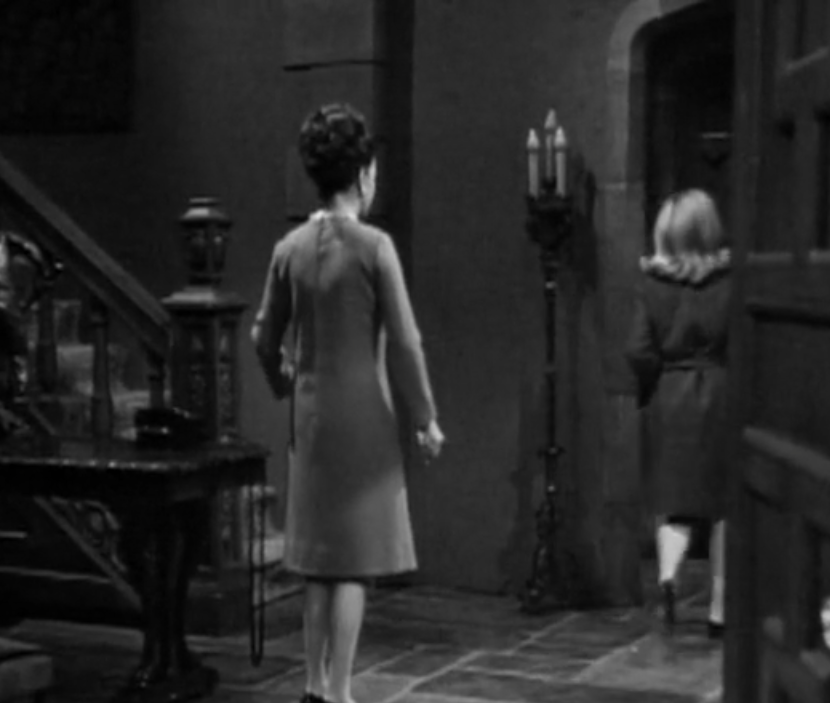
Back in the mansion, Liz confronts Vicki about not giving David his lessons. Vicki replies that Liz’ brother, high-born ne’er-do-well Roger, had said that he would tell Liz that he had taken Vicki on a tour of the cannery and had given David the day off. When Vicki hears Liz on the telephone confirming this with Roger, she blows up at Liz. She objects to being checked up on, she objects to being accused of lying, and, turning to look at the last spot where she had seen Carolyn, she objects to being accused of stealing people’s boyfriends. After she is done with her objections, she walks over to Liz. With their backs to the camera, the women quietly apologize to each other. Vicki explains that her protests mark the only way she can go on living in the house. Liz for the first time calls Vicki by her first name. Hearing this conversation when they are looking away from us is remarkably effective at creating a sense that they are sharing an intimate moment- more is happening between the two of them than even the audience can know.
Mrs Isles and Joan Bennett, as Liz, both play a wide array of emotions in their two scenes together, and do so brilliantly. It’s particularly interesting to compare Liz’ startled reaction to Carolyn’s snapping at her in the foyer when she asks her where she’s going to with her startled reaction to Vicki raising her voice at her in the drawing room when she’s been on the phone with Roger. They are two quite distinct startles. We see Liz from behind when Carolyn startles her. From that angle, we see the muscles in the back of her neck tense, signifying anger. That startle gives way to a parental sternness. The startle Vicki provokes is shown in profile. Liz pulls back a little, suggesting guilt. It leads to a rapid retreat.










 Dark Shadows Commentary