Episode 190: Always

Strange and troubled boy David Collins has run off to be with his mother, blonde fire witch Laura Murdoch Collins. Wildly indiscreet housekeeper Mrs Johnson had been keeping an eye on him yesterday, and only let him out of her sight long enough for him to escape because she had to answer a telephone call from well-meaning governess Vicki. Vicki had set Mrs Johnson to watch David, because she knows that if he gets loose Laura is going to burn him to death. So it was an act of inexplicable stupidity on Vicki’s part to make that call.

Today, the show lampshades this problem, having Vicki say that she assumed someone else would answer the phone. But the whole reason Vicki was giving orders to Mrs Johnson in the first place was that no one else was at home. They take a moment that made Vicki look dumb yesterday and turn it into one that makes her look twice as dumb today.

Vicki and her allies, dashing action hero Burke and hardworking young fisherman Joe, remember something that happened at a recent séance. David had channeled the ghost of David Radcliffe, the son of one of his mother’s previous incarnations, whom she had burned to death one hundred years ago. David Radcliffe had said that there would soon be a deadly fire in a “little house by the sea.” Laura has been staying in a cottage on the grounds of the estate of Collinwood, and it could meet that description. Burke and Joe head for the cottage while Vicki and Mrs Johnson stay in the great house.

We see David enter an old fishing shack on the estate. As he does so, he shines a flashlight directly into the camera, creating a halo of light that fills the screen. He does this three more times during this brief scene.

Flashlight halo

While David settles in at the fishing shack, Burke and Joe go to Laura’s cottage. When they arrive at the cottage, Burke shines a flashlight directly into the camera. He’s way behind David, he only creates a halo effect once.
Flashlight halo

He and Joe don’t find Laura or her luggage at the cottage, but when they see the wood-fire still blazing in the hearth they know that she must have been back since leaving on a bus early this morning. Burke wonders if David might have gone to meet Laura at the long-abandoned Old House on the estate. This leads to a spectacular dialogue flub:

Burke: Maybe she asked him to meet her up at the Old House. I think I’ll go and check.

Joe: Want me to go with you?

Burke: No, I think we should stick together… No, no… we can’t stick together. You go down to the greenhouse and look through the woods. I’ll go up to the Old House.

This may not look like much on the page, but as Mitch Ryan delivers it his mangled lines are good for a laugh out loud. Joel Crothers can’t hide his confusion while Ryan is stumbling:

What?

Back in the drawing room at the great house, Vicki has called the bus company. We see her on the telephone protesting “I don’t understand!” As Dumb Vicki becomes a bigger and bigger part of the character in the months ahead, we will hear those words many, many times.

The bus company tells Vicki that the driver reported a weird story about Laura. She was sitting next to an old lady. The old lady nodded off and when she woke up, Laura was gone. The bus had not stopped while she was asleep- Laura simply vanished into thin air. As a frequent user of mass transit, I enjoyed the idea of something uncanny happening on a bus. That was definitely the high point of the episode for me.

In the fishing shack, David hears Burke and Joe approach. He hides in a wooden crate. They don’t think to walk around it, or turn it over, or tap on it. Apparently whatever has knocked three or four standard deviations off Vicki’s IQ is contagious. Joe does give us one flashlight halo, but otherwise the scene is a bust.

The Three Stooges couldn’t have missed that kid

Laura materializes in the corner of the fishing shack, holding a lantern. David sees her and expresses only very mild surprise that he didn’t hear her coming in. Within seconds, he is acting as if it is perfectly natural for her to be there. Considering that there is only one door and he is standing directly in front of it, his rapid acceptance of the fact that she has somehow managed to insert herself into the shack ought to be a chilling sign of the power she already has over his mind. We’ve seen too much dumb behavior on the part of Vicki, Burke, and Joe today for that to land, so the impact of the scene is blunted.

Laura gives David her lantern and instructs him to look into the center of the flame. Several times we have seen her sit with him by a hearth and urge him to look deep into the flames, but this is the first time she or anyone else on Dark Shadows indicates an object held in the hand and directs someone to “look into the center” as a means of inducing a trance-like state.

Alone in the drawing room, Vicki senses the presence of her chief patroness, the ghost of Josette Collins. She catches the scent of Josette’s jasmine perfume while spooky music plays on the soundtrack and the picture goes out of focus. She keeps asking Josette what she is trying to tell her. It takes her quite a long while to figure out that Josette is reminding her of the fishing shack.

While we were watching this scene, my wife, Mrs Acilius, wondered how exasperated Josette must be getting with the dimwitted living beings she has to work with. She imagined Josette at each turn of the Phoenix story starting to get her hopes up- “OK, they’re getting it!”- only to be disappointed time and again. In #149, she literally paints a picture for them, and they still can’t figure it out.

Meanwhile, David is complaining of the cold and saying that he’s tired. Laura refuses to take the lantern from him, quietly urging him to peer into the center of the flame, then talking about sleep. When he drops the lantern and sees the floor catch fire, he says they should get out. She tells him everything will be all right so long as they stay inside. We end with animation effects suggesting that fire is starting to surround them, while David stands quite still.
Episode 178: Bake me a cake

We open in the drawing room of the great house of Collinwood. Visiting parapsychologist Dr Guthrie is trying to talk hardworking young fisherman Joe into helping him open a grave. Joe’s ex-girlfriend, flighty heiress Carolyn, is alarmed by the idea, but is on Guthrie’s side. Guthrie recaps the current storyline until he bores Joe into submission. Joe goes off to get his tools.

Guthrie, Carolyn, and Joe make their plans

As Joe, Joel Crothers does manage to hold the audience’s attention. While the other actors are starting to seem bored with the endless repetitions, his shocked interjections make him seem like someone learning these bizarre facts for the first time. With so much time spent selling old rope, it is genuinely surprising to find oneself taking an interest in anything about the dialogue.

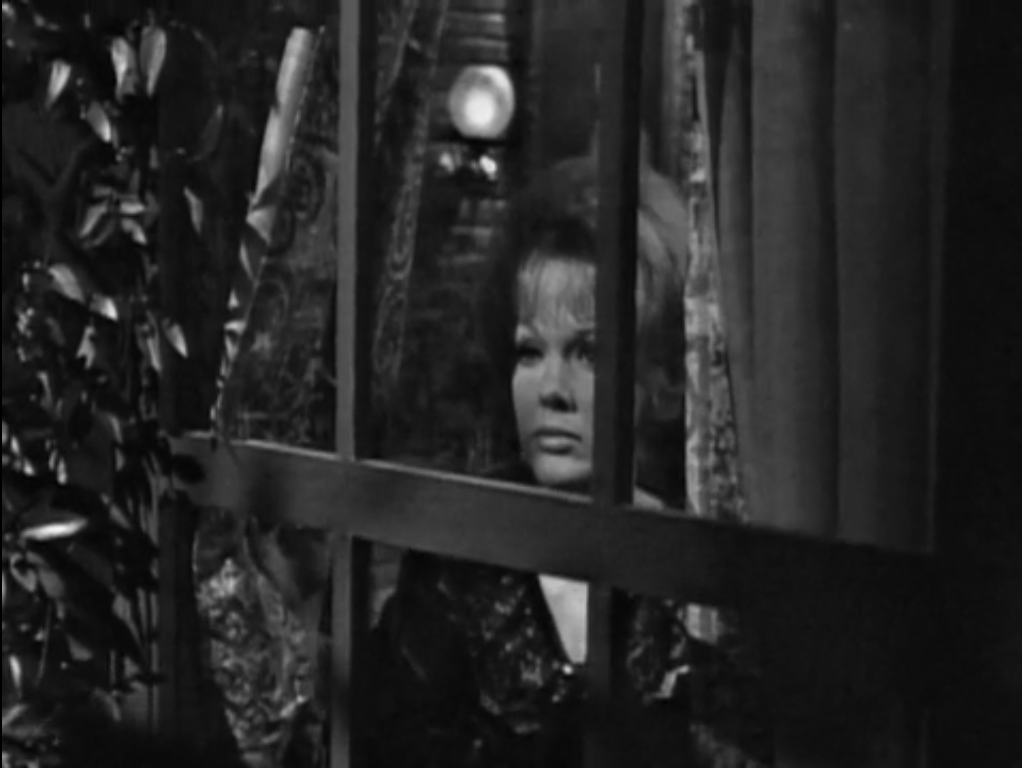
We cut to stock footage of the Moon behind clouds, then see blonde fire witch Laura staring out the window of the cottage on the estate. This is the first time we see that footage coupled with the sight of a supernatural villain staring out a window, but it won’t be the last.

The Moon
Laura

Laura’s estranged husband, high-born ne’er-do-well Roger drops in on her. They recap the same material Guthrie has been going over.

When we were watching the episode, Mrs Acilius became frustrated. Laura tells Roger that Guthrie is not simply a psychologist- he is a parapsychologist. Roger is appalled by this news. Mrs Acilius was appalled that Roger, who has always been presented as a reasonably intelligent person, is suddenly so dumb that he hadn’t figured it out yet. After all, Roger and Laura had both participated in a séance Guthrie had organized- wasn’t that enough of a clue for him?  

My interpretation is that Roger isn’t being dumb. He has said time and again that he regards Guthrie as a quack. I think that up to this point, he has assumed that Guthrie was just making stuff up as he went along. When Laura tells him that Guthrie is a researcher specializing in psychic phenomena, he is stunned to realize Guthrie isn’t improvising- he is a committed to a systematic plan of quackery. The missus seemed to find that interpretation intriguing.

Roger is stunned deeply enough, in fact, that his resistance to the idea that there might be something seriously weird about Laura starts to break down. Roger runs through all the unexplainable occurrences that have taken place since Laura has come back to town, and insists she tell him anything she might be holding back. Roger usually responds to information that inconveniences him by declaring that he will erase it from his memory as soon as possible, but it seems that he can no longer seal off the warning signs about Laura.

As Roger talks to Laura, she realizes that he might be about to become a lot less manageable. Her look changes from irritation to worry to a brief, beautiful moment when she is clearly thinking of casting a spell on him. I missed that bit when we were watching the episode, and Mrs Acilius had to point it out to me. I must have been looking away- as Diana Millay plays the scene, the flickering thought is easily legible on her face.

Laura thinks of hexing Roger

Roger goes to the great house and acts like he owns the place. Carolyn and Guthrie play along with him. He orders Guthrie out. Guthrie goes quietly; it’s time for him to meet up with Joe anyway. Carolyn pleads with him to give Guthrie a chance. After yet more recapping, he breaks down and admits that it is possible that something supernatural might be going on.

We see Guthrie and Joe at the door of the building in which the crypt they want to open is located. They try vainly to open the door. They knock and get no answer. They are about to give up when the doorknob starts to turn. The door opens, and they peer inside with startled looks. This is a reprise of the ending of #153, when well-meaning governess Vicki and her boyfriend, instantly forgettable young lawyer Frank, came to the same door with the same result. Vicki and Frank had been led to the building by the ghost of Josette Collins, and did not know what they were to do there. Guthrie and Joe have decided to go there because Guthrie’s analysis has led him to the conclusion that they have to open the tomb of L. Murdoch Stockbridge. That difference in context doesn’t make today’s conclusion any more exciting than that one was, but at least it marks a certain measure of progress in the development of the plot.

Episode 87: She came to us from nowhere, and now it seems she has disappeared into nowhere

Hardworking young fisherman Joe is spending the evening with Maggie, The Nicest Girl in Town. It’s their first date. Maggie impresses him with her knowledge of ships, and he sings a verse of “What Do You Do With a Drunken Sailor?” It may not sound like much, but the actors, Kathryn Leigh Scott and Joel Crothers, sell it so well that we’ll be rooting for Joe and Maggie for years to come. The final moment of the scene comes after Joe leaves. Maggie looks directly into the camera and says to the audience, “Goodnight, pal.”

Goodnight, pal

In the great house of Collinwood, high-born ne’er-do-well Roger Collins greets his niece, flighty heiress Carolyn, on her return home. Carolyn is upset because Joe has broken off their relationship and is having a date with Maggie. The story of Joe and Carolyn was a bore, largely because the two of them never had a scene with any fraction of the sweetness we see between Joe and Maggie today. There was nothing at stake in their quarrels, because they had nothing to lose if they simply gave up on each other.

Roger tells Carolyn that well-meaning governess Vicki hasn’t been seen for hours, and that he promised Carolyn’s mother, reclusive matriarch Liz, that he would sit up waiting for Vicki’s return. Carolyn is worried as well, and asks Roger why he isn’t actively searching for her. He says she’s probably fine. When Carolyn says that people don’t just disappear, he reminds her of family friend Bill Malloy, who disappeared not so long ago, but then turned up. Considering that Bill turned up in the form of a corpse washed ashore by the tide, it is perhaps unsurprising that Carolyn does not find Roger’s analogy particularly comforting.

After Roger persuades Carolyn to toddle off to bed, he makes sure he’s alone (well, alone except for the stagehand in the lower left-hand corner of the screen.)

Once assured that no one mentioned in the script can see him, Roger returns to the drawing room and opens a secret passage we’ve never seen before. After he disappears into it, Carolyn comes to the drawing room and is baffled at his absence.

The suggestion that Carolyn doesn’t know about the secret passage is characteristic of the show. From the beginning, Vicki has represented our point of view. She started off knowing nothing about the other characters, and everything had to be explained to her while she was on camera. If Vicki knows just what we know, Carolyn, who grew up in the house where most of the action is set, can be presumed to know a great deal we do not. When they reveal a secret to us, they can amplify its importance by showing that Carolyn isn’t in on it. They’ve done this several times, mostly in situations having to do with the murky origins of Roger’s feud with dashing action hero Burke Devlin. Carolyn’s ignorance of the secret passage is particularly effective- it’s right there in the most important room of the only house she’s ever lived in. If she doesn’t know about it, it must be a very well-kept secret indeed.

We go with Roger into the secret passage. He shines his flashlight directly into the camera, creating a halo of light around it. This would not seem to be a desirable visual effect, yet we will see it many, many times in the years to come. This is the second appearance of the effect. The first time came when Roger’s son, strange and troubled boy David, was leading Vicki into the abandoned Old House in episode 70. Now we see it when Roger himself is entering another abandoned space, one where he might meet Vicki.

Halo

It’s hard to believe that the repeated use of this effect was altogether unintentional.

All the more so because of what follows Roger’s entry into the passageway. His journey through it actually does seem to wind through a very large space. In the opening narration, Vicki had said that the house is made up of 80 rooms, retconning the total of 40 given in the second episode. Roger’s trek up one flight of stairs, down another, up a spiral staircase, around corners, past windows, etc etc, seems like it must take him past enough space for at least that many. Perhaps the sequence would be a bit more attractive with less time spent focused on Roger’s feet, but all in all it is as effective a creation of space as Dark Shadows would ever do. If there had been Daytime Emmy Awards in 1966, Lela Swift would have had every right to expect to win Best Director for conjuring up this illusion of vast, winding corridors without editing or going outside the tiny studio space available to her.

Roger does indeed discover Vicki’s whereabouts. He hears her calling for David from behind a locked door, promising David not to tell anyone he imprisoned her there if he will let her out now. Roger does not simply let Vicki out. Instead, he makes some loud noises, then puts on a ghostly, wavering voice and calls out to Vicki that she is in great danger as long as she stays in Collinwood. He seems to be having trouble keeping a straight face when he makes these spooky sounds. Vicki isn’t laughing, and returning viewers aren’t either- in Friday’s episode, she and we saw the ghost of Bill Malloy in the room, and heard that ghost warn her that she would be killed if she stayed in the house much longer.

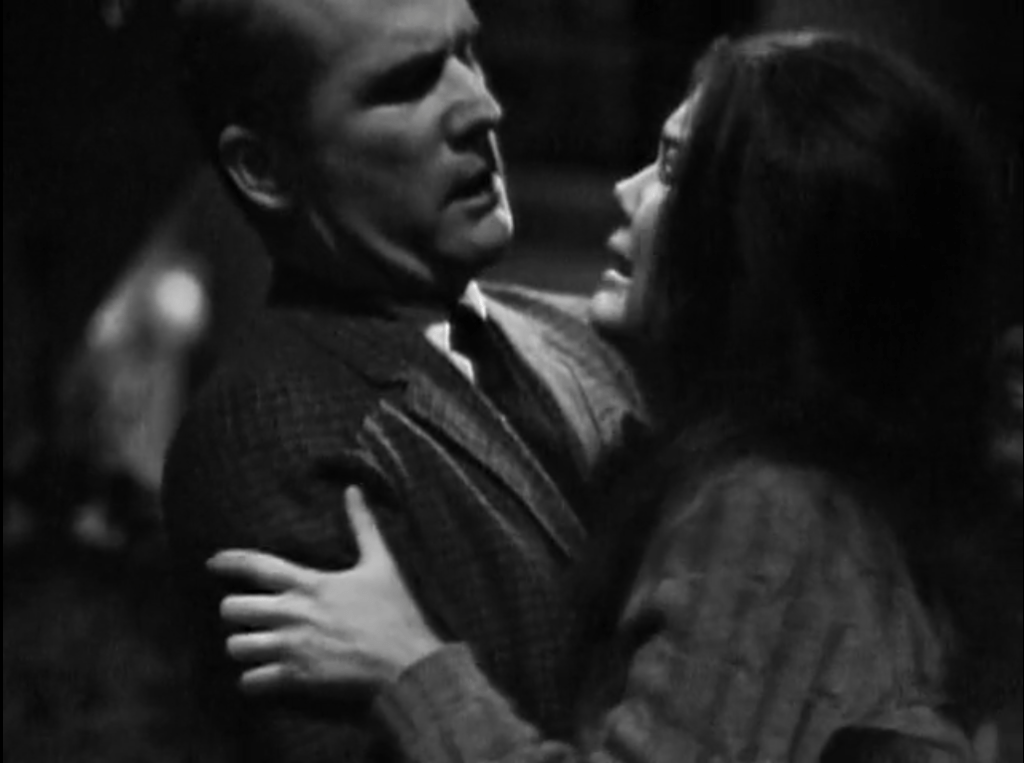
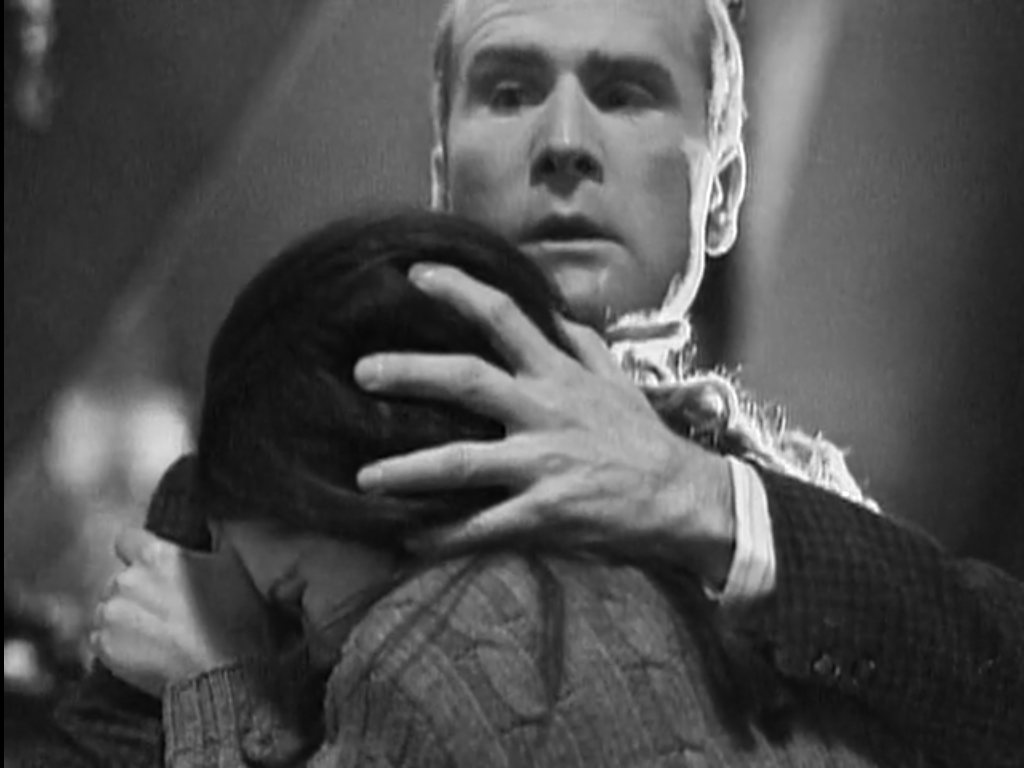
Once he’s had his fun, Roger opens the door. After another flashlight halo, Vicki recognizes him. Alexandra Moltke Isles gives us one of the finest moments of acting in the entire series, when Vicki throws her arms around Roger, her bodily movement as smooth as any ballet dancer’s but her voice jagged, and says that “David is a monster, you were right!” Up to this point, Roger has been brutally hostile to his son, Vicki heroically friendly to him. Her determination to befriend David has become so central to her character that hearing her make this declaration makes it seem that she is permanently broken.

Broken Vicki

Vicki struggles to hold back her sobbing long enough to tell Roger that she saw the ghost of Bill Malloy. That’s an episode-ending sting- Roger wants everyone to forget about Bill’s death, and if his ghost starts popping up he is unlikely to get that wish.

Stunned Roger

Mrs Isles was a “head actor,” one who found the character’s innermost psychological motivation and worked outward from that. That heavily interiorized style would be one of the things that left her in the dust, along with similar performers like Joel Crothers and Don Briscoe, in the period when Dark Shadows was a hyper-fast paced, wildly zany show about vampires and werewolves and time-travel and God knows what. But in the period when Art Wallace and Francis Swann were writing finely etched character studies, she consistently excelled. In this little turn, she shows that when it was logical for her character to go big, she could go as big as any of the stars of the show in those later days.

Episode 36: Politeness is a passing phase

The actors all go big in this one. Marc Masse calls it “The David Ford Effect” and concentrates on Louis Edmonds’ thunderous performance in Roger’s confrontation with Liz, but since the entire cast has turned up the volume, I think it is more likely a response to direction coming from the people who hired David Ford (and, to be seen in a couple of days, Thayer David) than to David Ford himself.

Masse isn’t the only commentator who tends to ignore the directors and producers as influences on the acting. Perhaps that tendency goes back to an interview John Karlen gave in which he says that he doesn’t recall ever getting any direction at all on Dark Shadows. His first day, Lela Swift said “Go!” and that was it, he just did whatever he wanted for the next four years. On the other hand, Joel Crothers said that he left the show because the directors were so busy with special effects they no longer had any time to work with actors, implying that they had worked with them at one point. Since Crothers was there from the beginning and Karlen joined the cast ten months in, I can only assume that it was during these first months that the directors told the actors what they wanted.

Why would Lela Swift and the other masterminds behind the scenes start hiring actors like David Ford and Thayer David and tell the existing cast members to start hamming it up at this point? Well, the saga of the bleeder valve has wrapped up, and there is no other story going on that wasn’t there in episode 1. Some of those stories are starting to look pretty pointless. There’s “The Revenge of Burke Devlin”- they haven’t told us what exactly he wants revenge for, but if he ever takes it we will see either the death of Roger, which would have the disastrous effect of requiring Louis Edmonds to leave the show, or Burke taking control of the Collins family assets, which will bring the equally disastrous requirements of a showing a bunch of episodes about various forms of debt and building a new set for Joan Bennett to play her scenes on. So we’re starting to suspect that Burke will just keep going in circles. Roger’s angry scene with Sam in this episode is fun to watch because Edmonds and Ford play well off each other, but as part of The Revenge of Burke Devlin story it doesn’t take us to any new ground.

There’s “Vicki Seeks Her Origin.” We might expect that one to lead somewhere, eventually, but if that happens it won’t be for a good while. In this one, Vicki tells Liz that she’s decided she can’t help David and replies to Liz’ plea with her to stay with “Why am I so important?” She doesn’t renew her inquiries into how Liz knew about her and why she hired her. Of course not- that was getting tedious. So Alexandra Moltke Isles and Joan Bennett just emote furiously while exchanging lines that don’t add up to much.

We don’t see Carolyn or Joe in this one, but their romance is another dead end. Joe is a nice guy who wants to get married, Carolyn is a rich girl who doesn’t. There aren’t that many ways to make a story out of that.

The one story that works in the first 42 weeks is the growing friendship between Vicki and David. Right now there isn’t much to do with that one, either. David has just been caught trying to murder his father- he isn’t going to be particularly reachable. Today, he openly threatens Vicki at the beginning of the episode, then comes out of hiding after Liz persuades her to stay and declares that he doesn’t want her to stay. We have to see them at rock bottom today for the gradual rise in the months ahead to grip us the way they will, but not a lot happens while you’re at rock bottom.

So, maybe the producers and directors decided to dial the acting up to 11 because they knew they didn’t have much of a story to tell. This is Art Wallace’s final week as the sole credited writer on the show; I don’t know how much help he had in those first eight weeks, how much involvement he really had in episodes attributed to him in the nine weeks after, and whether anyone is already around whose name will be printed on the screen in that period. But they don’t have a story to tell right now. So it falls to the cast to distract us while they wait for the next phase.

Episode 33: The one with Harvey Keitel

At Collinwood, Liz tells Carolyn that David won’t be going away just because he tried to murder his father. “Things will go on just as before.” On the other hand, Carolyn should marry Joe and leave the house, because “You’re the only one of us who can have a sane, happy life.” I suppose we’ve all seen that in real life, someone swinging wildly between deep denial and exaggerated despair. Two forms of learned helplessness, I guess.

At the Blue Whale, Joe is getting well and truly sloshed. Burke joins him at his table, interrupting a conversation between Joe and his whiskey glass. Joe tells Burke that he doesn’t like him, expresses his frustration with Carolyn’s refusal to get married, then goes to Collinwood, roaring drunk, and tells Carolyn, Liz, and Vicki what he thinks of them.

One thing Joe thinks is that Carolyn is doomed to be a spinster. Considering that she’s supposed to be about seventeen, that does call to mind Barnabas’ line to Carolyn in the 2012 Dark Shadows movie, “Fifteen? And no husband?

Marc Masse brings this point out well on his Dark Shadows from the Beginning, and argues that the depiction of Carolyn may be one of the things that sunk the show with young viewers between the end of the first month and the introduction of the vampire:

You have to wonder what kind of impression the character of Carolyn Stoddard would have made to young viewers in 1966. Here she is having grown up in a mansion with forty rooms and her only option in life is to be married off before her eighteenth birthday to a local fisherman, or else face a life of lonely spinsterhood. In that respect, Dark Shadows seems to belong to the sensibilities of previous decades.

This paragraph is part of an in-depth discussion of Dark Shadows’ place on ABC’s schedule, its ratings, the show that preceded it in its time-slot, and Art Wallace’s rather antiquated view of the world. It’s all very informative, highly recommended.

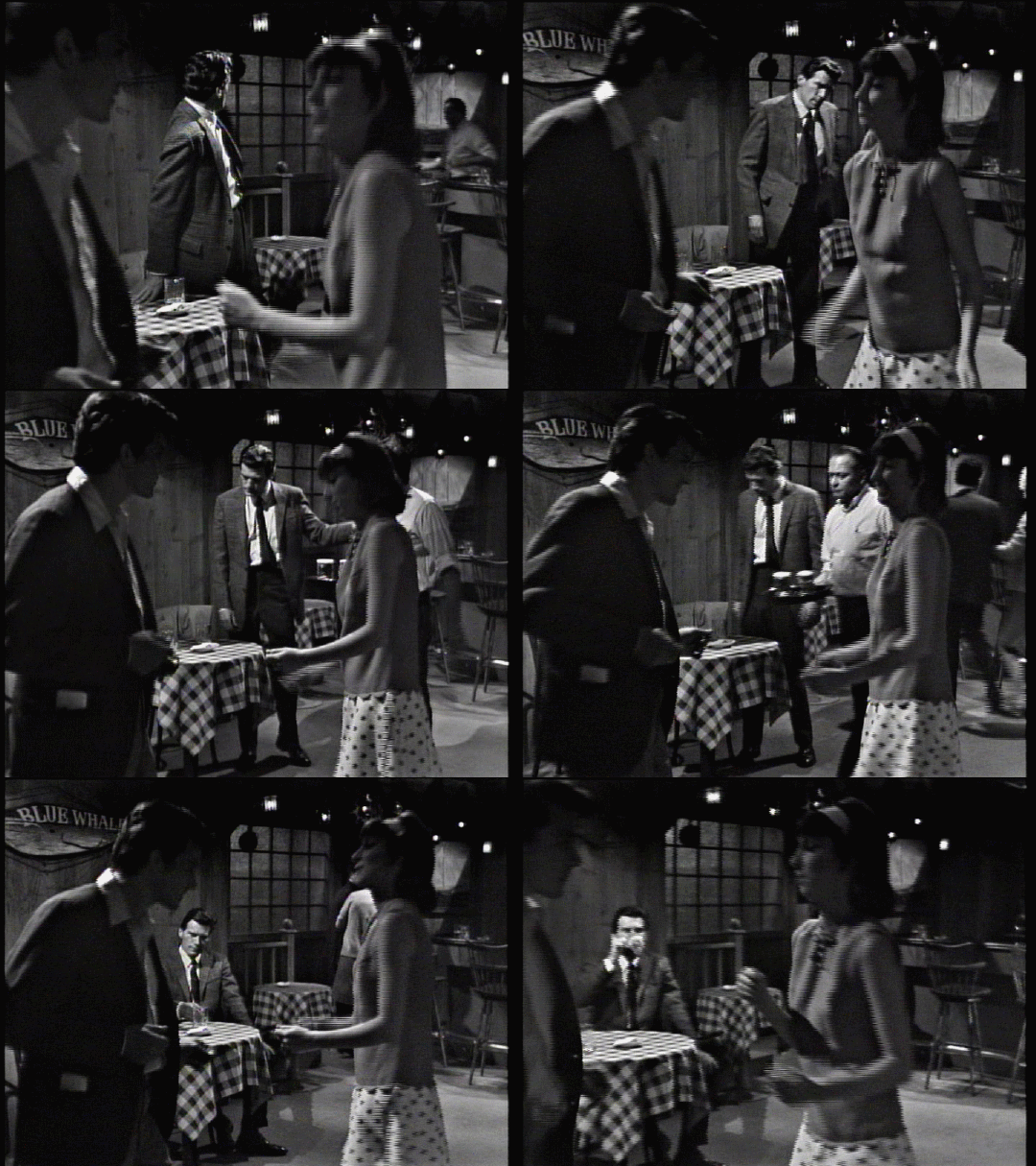
When Joe passes out on the couch, Vicki goes to town. She goes to the Blue Whale, where Burke asks if she’s looking for someone. “I just found him,” she replies. Obviously, she’s talking about Harvey Keitel, who is dancing a few feet away from her.

That Harvey Keitel was once an extra on Dark Shadows is pretty interesting. If he took that job, clearly he would have taken a speaking part. I gave some thought to parts I wish he had taken in comments on Danny Horn’s Dark Shadows Every Day four times: here (on episode 470,) here (on episode 769,) here (on episode 1057,) and here (on episode 1137.)