Episode 861: Complete control of my faculties

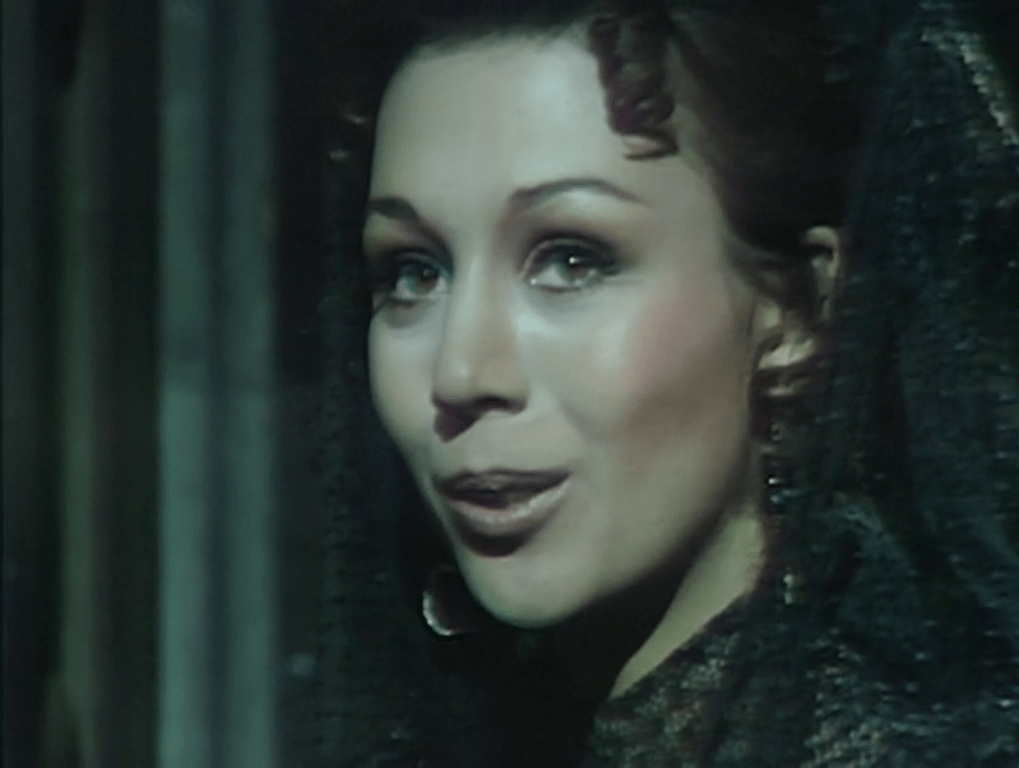
Judith Collins Trask, owner of the estate of Collinwood and all the Collins family businesses, has returned home after more than thirteen weeks confined to a sanitarium. Her return is supposed to be a big shock, but they spoil it by having Joan Bennett do the opening voiceover. They really should have paid more attention to that sort of thing.

Judith’s husband, the odious Gregory Trask, gaslighted her into the sanitarium, and has been exercising control over the Collins family’s wealth ever since. Today, Judith tells her stuffy but lovable brother Edward that Trask never visited her during her time as a mental patient. Edward is surprised, telling her that Trask left the house for an overnight stay every week during that period, and presented these absences as visits to her. In fact, he is on such a trip now. She does not want to hear any more, and says she will give Gregory a chance to explain himself when he comes back to Collinwood.

Judith claims to be entirely herself. That puts her in the minority today. When she left Collinwood in July, Judith had a stepdaughter named Charity Trask. When she enters today, she sees someone who is to all appearances Charity leading Edward and a lady named Kitty Soames in a séance. The body is indeed Charity’s, but sorcerer Count Petofi erased Charity’s personality in #819 and replaced it with that of the late Pansy Faye, a Cockney showgirl and “mentalist” whom Judith met in #771, when Judith’s late brother Carl brought her to Collinwood as his fiancée. Pansy noticed Judith’s disapproval of her when she was alive, and is quite indignant about it now. That Judith keeps live-naming her, calling her “Charity,” doesn’t help.

Judith does manage to do something Edward failed to do a while ago, and talks Pansy into moving back into the great house of Collinwood. She agrees to give up the apartment she rented in the village of Collinsport after she took a job doing her old act at the local tavern, the Blue Whale. We saw her at the Blue Whale in Friday’s episode; it was shortly before nine PM, and she was the only person in the place. So perhaps her income as a cabaret performer is not particularly lavish, and the mansion is a more appealing place to live than the apartment that job would pay for.

For her part, Kitty is still, most of the time, the dowager countess of Hampshire. But the ghost of Josette Collins has been possessing her off and on ever since she arrived at Collinwood in #844, and the trend is definitely towards “on.” In Friday’s scene at the Blue Whale, Kathryn Leigh Scott played Kitty quietly and let Nancy Barrett’s Pansy provide the scene with all its Crazy Lady Energy; today, it is Miss Barrett’s turn to stand back and let Miss Scott show that Kitty is Pansy’s match in that department.

Crazy Lady Energy, also known as “CLE,” the main driving force of Soap Opera Land. Screenshot by Dark Shadows Before I Die.

Judith and Edward’s brother Quentin is in an even stranger predicament than are Pansy and what’s left of Kitty. Between #854 and #856, Petofi forced Quentin to swap bodies with him, so that David Selby now plays Petofi and Thayer David plays Quentin. I call Mr Selby’s portrayal of Petofi “Q-Petofi,” and Thayer David’s portrayal of Quentin “P-Quentin.”

Kitty with P-Quentin. Screenshot by Dark Shadows Before I Die.

The initial shock of finding himself estranged from his own body and trapped in Petofi’s left P-Quentin bewildered. All he could do was go to one person after another and tell the true story of what had happened, which produced only a widespread belief that Count Petofi had gone mad. Now he is starting to figure out how to use his resources.

P-Quentin’s first attempt to take advantage of the fact that everyone thinks he is Petofi was not successful. In #859, he exploited Kitty’s fear of Petofi and threatened to make her vanish if she did not bring him a portrait of Quentin later that night. Kitty tried to comply, but failed, and now it is long past the deadline. Soon she will realize that his threat was an empty one, and so far from being useful to him as a cat’s paw, she will be in a position to expose him as powerless.

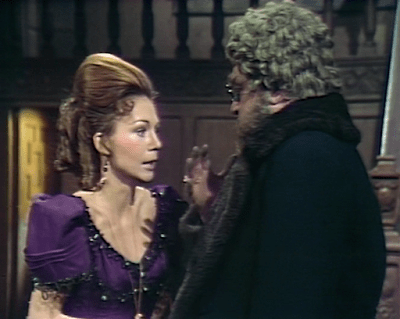
Today, P-Quentin runs a smarter game. He introduces himself to Judith as Petofi, and claims to have psychic abilities. He pretends to read her palm, and tells her a story from their childhood that very few people could know. She is delighted, and decides that Count Petofi is someone she wants to see more of.

P-Quentin and Judith. Screenshot by Dark Shadows Before I Die.

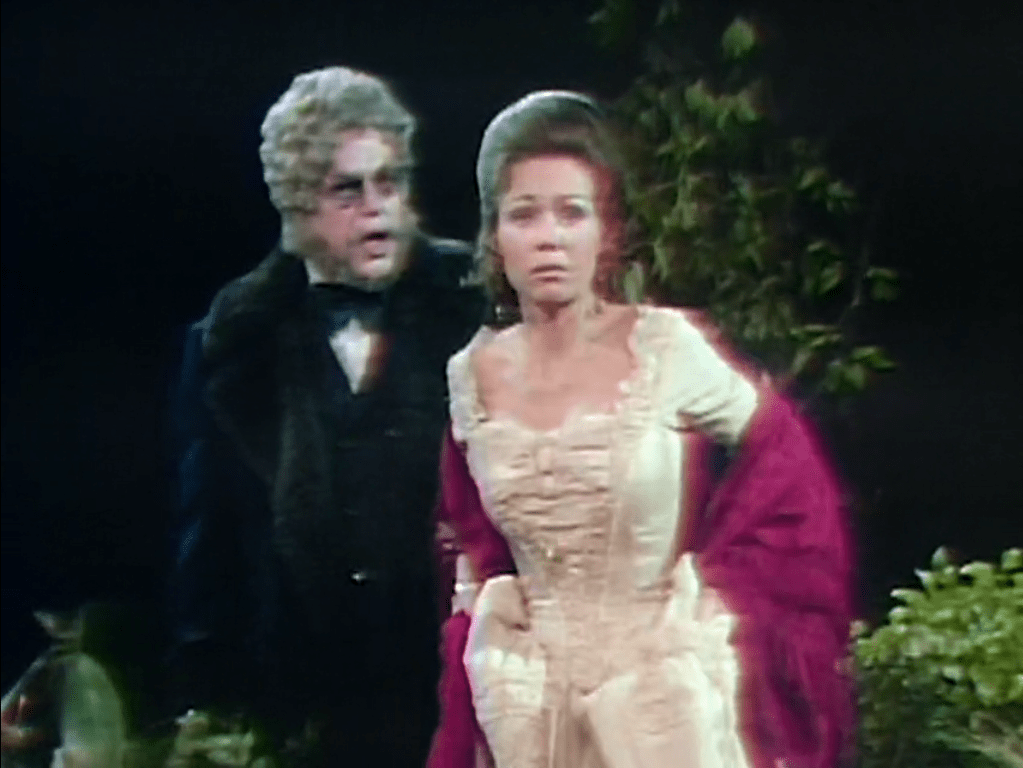
In her bedroom upstairs at Collinwood, Kitty has another fit of Josettification. She opens the trunk at the foot of her bed and finds Josette’s wedding dress. She puts it on and wraps a red cloak around it. She goes to the top of Widow’s Hill, the cliff from which Josette jumped to her death in the 1790s. The ghost of Josette’s husband Jeremiah appears to her.

The show is set in 1897 now. It was set in the 1790s from November 1967 to March 1968. Miss Scott played Josette then, and for most of the segment Anthony George played Jeremiah. After Jeremiah’s death, Timothy Gordon played his ghost in a memorable part of the 1790s story. Gordon made two appearances as the ghost after the show returned to contemporary dress, playing him in #462 and #512. This is Jeremiah’s first appearance in 1897, and the second time, after #462, that Gordon’s name appeared in an on-screen credit on Dark Shadows.

Episode 854: Substitute for will

Ever since she came to the estate of Collinwood in #844, Kitty Soames, the dowager Countess of Hampshire, has been having psychotic breaks. Regular viewers know that these are supernatural in origin. The late Josette DuPrés Collins is taking possession of Kitty.

As Kitty continues turning into Josette, so rakish libertine Quentin Collins has begun turning into sorcerer Count Petofi. Josette has been dead for 101 years, but Petofi is alive and squatting in an abandoned mill on the old North Road in the village of Collinsport. Petofi’s magical powers are immense, but he is vulnerable to the Rroma people, who have reason to hate him and have been hunting him for a century. He has cast a spell that will cause him and Quentin to switch bodies. We see the first effects of this spell today.

Petofi knew Kitty’s late husband quite well. We learned in #844 that he persecuted the Earl and drove him to suicide; we learned also that Kitty was left penniless. During a conversation with Kitty today in the drawing room at Collinwood, Quentin switches into Petofi mode and confronts her with these facts. She slaps him, and he reverts to himself. He is bewildered by the fact that she slapped him, and cannot remember saying anything. This is just how Kitty is after one of her Josette moments- she doesn’t even know that they happened. Kitty tells Quentin that “If you don’t remember, neither do I.”

Kitty realizes she isn’t the only one who isn’t always herself.

I clapped and cheered when she said this. The writers of Dark Shadows rarely trust their characters with such simple lines. Most of them would get flustered and say something compromising, and even the very smartest of them, such as Julia Hoffman, MD, would likely make up a cover story that would be at risk of disproof. That Kitty can make the perfect response leaves me sad that she is so clearly meant to be a short-timer. Perhaps we can hope that she will stick around for a while after she has fully become Josette, and that she will show us a new side of that character.

There’s also a laugh-out-loud funny moment in this one when Petofi is talking to his henchman Aristide. Once he is in the form of Quentin, he plans to travel forward in time from 1897 to 1969. Julia came from that year a while ago, and was dressed in the costume of the period. Petofi disapproves of her look, and says that he can’t believe that men’s fashions will be as degraded. If he’d known how American men would actually dress in the years following 1969, he might have surrendered to the Rroma!

Episode 853: Strange and horrifying spirits

Kitty Soames, a young American woman who is the dowager Countess of Hampshire, is gradually turning into Josette DuPrés, who has been dead for 101 years. Kitty is staying at the great house on the estate of Collinwood. Also among the houseguests is Angelique, the immortal, time-traveling wicked witch who was responsible for Josette’s death.

Kitty has been getting information about Angelique, apparently from Josette’s ghost. She interrogates Angelique’s fiancé, rakish libertine Quentin Collins. Quentin does not give her any useful information about Angelique. When Kitty asks if Angelique has ever lived in England, Angelique herself enters and says that she has not. Kitty asks Angelique if she was ever a servant. Angelique made it quite clear yesterday that she knows perfectly well what is happening to Kitty, but she regards the transformation as a nuisance and does not want to help it along. She chooses to pretend that Kitty is being a snob, and says that Quentin is not marrying beneath his station. With that, Kitty has nowhere to go but back to her room.

Angelique has made an alliance with Julia Hoffman, MD, a fellow time-traveler from the late 1960s. Julia followed her friend and the object of Angelique’s lunatic obsessions, vampire Barnabas Collins, to 1897. Barnabas is now believed to have been destroyed, but we’ve already seen that Julia is continuing work replicating the experimental procedure that put his vampirism into abeyance for a little while in the spring of 1968. Today, Angelique brings some medical supplies to Julia in her hiding place, and Julia asks if she can come a little earlier the next day.

The two women sit down and have a friendly chat. Longtime viewers will find this breathtaking. Angelique was at Collinwood in 1968, wearing a black wig, calling herself Cassandra, and functioning as Julia and Barnabas’ bitterest enemy. Now that Angelique has turned to Quentin and has let go of her drive to dominate Barnabas, she and Julia have made an alliance against sorcerer Count Petofi. Their animosity set aside, they can commiserate about the difficulty of a life yoked to Barnabas.

“Ugh, vampires, all the good ones are either obsessed with recreating their dead ex or gay.” Screenshot by Dark Shadows Before I Die.

Angelique wants to liberate Quentin, whom Petofi has enslaved. Julia is horrified today when Kitty, in Josette mode, bursts into her hiding place and demands to see Barnabas. Quentin follows her in and hears her ask why she is keeping Barnabas in the next room. Neither Kitty nor Quentin believe Julia when she keeps insisting that Barnabas is no more. If Quentin knows that Barnabas is still around, Petofi will soon know it as well, and that can only be bad news.

Petofi is not content keeping Quentin as a slave. He wants to abuse him even more totally. We saw the other day that Petofi wants to swap bodies with Quentin as his means of escaping from his deadly enemies, the Rroma people. Petofi visits Quentin in the drawing room at Collinwood this evening and gives him a scalp massage. Quentin notices Petofi’s ring, and agrees that he would like a new life. He falls asleep, then wakes up to find Petofi’s ring on his finger. To his alarm, he cannot take it off. My wife, Mrs Acilius, called out to the screen to suggest he spray some Windex on his finger, but that wasn’t invented until 1933 and the dramatic date is 1897. Presumably the transfer of the ring is the first step towards Quentin’s eviction from his own body and his replacement in it by Petofi.

Closing Miscellany

Danny Horn’s post about the episode at his great Dark Shadows Every Day is a study of Kathryn Leigh Scott’s facial expressions. His thesis is that Miss Scott is imitating Grayson Hall, who plays Julia. Later in the series there will be a moment when Miss Scott imitates Hall in a scene they play together; Hall’s reaction then will be hilarious.

Kitty sees the portrait of Barnabas Collins hanging in the foyer on the spot by the front door. She Josettifies and becomes fascinated by it. Stuffy but lovable Edward Collins had the portrait removed when Barnabas was exposed as a vampire some time ago, and is shocked to find that it has returned. Presumably whatever supernatural agency is Josettifying Kitty put it there. Longtime viewers, who remember how active Josette’s own ghost was at Collinwood before Barnabas first appeared on the show, will think she is the likeliest suspect.

When Kitty/ Josette is kneeling beside the grave of Josette’s husband Jeremiah Collins (spelled “Jerimiah” on the marker,) Edward shows up and tells her that she was married, not to Jeremiah, but to the late Gerald Soames Earl of Hampshire. That was the first time it dawned on me that both Josette and Kitty married guys named Jerry.

Angelique’s intrusion into the scene between Quentin and Kitty might have been more effective if the camera hadn’t swung wide and shown her standing outside the door waiting to make her entrance. We don’t see Angelique eavesdropping, but Lara Parker standing well upstage waiting to make her entrance.

Episode 852: All kinds of spells on people

From November 1967 to March 1968, Dark Shadows was set in the 1790s. The cast included Kathryn Leigh Scott as the gracious Josette, Louis Edmonds as haughty overlord Joshua Collins, and Lara Parker as wicked witch Angelique. Now, the dramatic date is 1897. Miss Scott plays Kitty Soames, an American who went to England to be a governess, married the Earl of Hampshire, and is now widowed, penniless, and scheming to land another rich husband. Edmonds takes the role of stuffy but lovable Edward Collins, who is the focus of Kitty’s ambition. Parker is still Angelique, who is both immortal and a time-traveler.

Ever since arriving at the great house of Collinwood in #844, Kitty has been having psychological breaks during which she acts like Josette. She therefore appears to be suffering from a severe mental illness, an impression which would tend to get in the way when trying to win a new spouse. Today these breaks take a new turn.

Kitty is walking in the woods on the grounds of Collinwood when she is overwhelmed by the sense that she is being watched, and furthermore that the person watching her knows her well and wishes her ill. She runs into the house and flings herself at Edward, describing this paranoid episode to him. Edward has only begun to talk her down when his brother, rakish libertine Quentin, enters with his own fiancée. The fiancée is Angelique.

Edward is about to introduce the two ladies, who have never met. Before he can do so, Kitty becomes Josette. In Josette’s voice, she denounces Angelique. She then grabs her by the throat and vows to kill her for what she has done.

Angelique was responsible for the deaths of Josette and many others at Collinwood in the 1790s, and has been obsessively hostile to her throughout the centuries. When she was first conjured up from Hell to be part of the 1897 segment in #711, she went to the Old House on the estate, looked at the portrait of Josette that hangs over the mantel in the front parlor there, and declared “I am Angelique and I hate you!” During her lifetime, Josette was oblivious to Angelique’s enmity. She knew Angelique as a lady’s maid in service to her aunt, and regarded her as a close friend. But on Dark Shadows, death is a learning opportunity, and we see today that when she is animated by Josette’s spirit Kitty knows everything Angelique hid from Josette when she was alive.

Edward and Quentin separate Kitty and Angelique. In a private conversation with Quentin, Angelique makes it clear to the audience that she knows exactly what is happening with Kitty, and that she regards it as a minor nuisance. Quentin has troubles of his own, and doesn’t ask for an explanation.

Meanwhile, Kitty and Edward have a private conversation of their own. Edward tells Kitty that she is just upset because of her late husband’s death, and assures her that he will help her recover. She flashes a cunning smile at the camera. Well she might- not many people are so good at attaching themselves to rich guys that they can turn a psychotic episode to their advantage.

Kitty takes satisfaction in a job well done. Screenshot by Dark Shadows Before I Die.

Kitty has a dream in which Angelique is her servant and is addressing her as “Mademoiselle.” In the dream, Angelique delivers an arrangement of flowers and a book of poetry that Josette’s fiancé wants her to have before their impending wedding. When she wakes up, Kitty finds the arrangement and the book by her bedside, and she realizes that what is happening to her is not simply a mental aberration.

The dream will puzzle new viewers, even those who know that Angelique was a servant in Josette’s household. When Angelique is busy being Evil, she often laughs a maniacal laugh that breaks in the middle with a sharp intake of breath. She keeps doing this throughout the dream, which doesn’t fit at all with the action of bringing a present from a lover. She also tells Josette that her happy life is of the sort that makes the gods jealous, and speaks the lines with an undisguised and exaggerated hostility that leads into another gale of maniacal laughter. People who have joined the show in the last year will wonder why Angelique is being so crudely obvious.

Lara Parker used to say that she didn’t really learn to act until Humbert Allen Astredo joined the cast of Dark Shadows in June 1968. She’d taken acting classes and appeared in plays and so on, but it wasn’t until Astredo explained acting techniques to her while they were rehearsing that it all clicked in her head. You really can see a sudden improvement in her performances at that time. The dream Josette transmits to Kitty’s mind takes her to a time, not only when Angelique was a servant, but when Lara Parker was not a particularly good actress. The contrast between the reliably capable professional we see in most of the episode and the often bombastic student who appears in the dream makes us appreciate just how far she came in a short time.

Episode 846: Advantage of an unfortunate creature

Tim Shaw was a poor put-upon fellow when first we met him in #731, an episode set in April 1897. He had spent his childhood among the pupils imprisoned at Worthington Hall, a dungeon masquerading as a school, and when he was of age the headmaster, the evil Gregory Trask, coerced him into staying on as a teacher. In company with another man, Trask contrived to use Tim as an unwitting instrument in his plot to murder his wife Minerva. Trask’s plan to frame Tim for the murder fell apart, and Tim managed to keep his freedom. Not only that- he stole the legendary Hand of Count Petofi and took it to New York City, where within weeks he used its magical powers to make himself very rich. In August, he returned to Collinsport determined to take revenge on Trask.

Shortly after coming back to his hometown, Tim lost the Hand. (Which, to be clear, was an actual human hand severed from a sorcerer named Count Petofi a century before.) The 150 year old Petofi himself reclaimed it, and reattached it to his wrist. The ill-fortune Tim suffered in his youth left him a weak and cowardly man, who betrayed his only friend when Trask was looking for her. But his good fortune when he was in possession of the Hand has corrupted him much more severely. He used to be kind to children and even risked his life to rescue nine year old Nora Collins when Worthington Hall burned down in #736, but in #816 he violently shook Nora when he found that she had let the box containing the Hand out of her sight. In his pursuit of another gimmick that will enable him to continue getting rich, he has developed a number of schemes, the worst of which do not stop at murder.

This morning, Tim is sitting at a table in the Blue Whale, Collinsport’s tavern. The place isn’t open yet, and Tim does not appear to have any connection with it, so it is simply a mystery how he got in and why he wants to be there. The only other person in the room is sitting at the bar. She is a woman who used to be Trask’s daughter Charity, but who has since been transformed into Cockney showgirl and sometime mentalist Pansy Faye, who died in June.

Pansy’s presence makes some kind of sense, as she works at the tavern doing her act. But returning viewers know that she isn’t still there from the night before. After closing, she went back to the great house of Collinwood, where Trask and she live, and talked with the rakish and profoundly drunk Quentin Collins. After dawn, Pansy followed Quentin from the house to a cave. In the cave, she found a mallet and stake Quentin left behind, and next to them the coffin occupied by vampire Barnabas Collins. She drove the stake into Barnabas’ heart. Now she wants a good stiff drink, and she doesn’t care if she has to pour it herself.

Tim stops Pansy’s attempt to pilfer her employer’s stock, and she tells him that she has destroyed Barnabas. Dollar signs flash in his eyes as he calculates what it is worth to the Collins family to know that their single most embarrassing relative is no longer going to be exsanguinating the locals. Pansy does not want to go back to the great house or even to tell the Collinses what happened, and she steadfastly declares she does not want any of their money. But Tim insists.

At the house, stuffy Edward Collins makes it clear he wants nothing to do with Tim and that he regards Pansy as a lunatic. When Tim makes him listen to the story, Edward dismisses it out of hand. But Edward finally agrees to go to the cave with Tim while Pansy stays in the drawing room.

Edward sees that Pansy was telling the truth, and returns to Collinwood in time to see the aftermath of a strange conversation. Pansy meets Edward’s guest, a young American woman named Kitty Soames who is the widow of the Earl of Hampshire. Pansy’s reaction when the dowager countess introduces herself as “Lady Hampshire” is a very characteristic “Well, la-dee-dah!”

Pansy’s delighted smile and relaxed manner suggest that in Kitty she has recognized a kindred spirit. Returning viewers know she’s onto something- we’ve heard Kitty’s interior monologue as she’s screwed up her courage to try to connect with the rich Collinses. We also know that she and her husband were mixed up with Petofi, who is not an individual who often attracts the innocent. And while she is so quick to deny to Edward that her husband’s suicide had anything to do with business reverses that he assumes she is still imposingly rich, later today we will hear the text of a letter in which she tells her mother that if she doesn’t get something going with Edward, she won’t be able to raise enough money to pay the train fare from Maine to Pennsylvania. So Kitty’s presentation of herself is misleading, and she is not so different from the living Pansy, who was what in the parlance of the 1890s might have been called an adventuress.

In her letter to her mother, Kitty mentions that she first came to the earl’s home as the governess. This circumstance reminds us of two other characters played by the same actress. In the parts of Dark Shadows set in 1969, Kathryn Leigh Scott’s Maggie Evans was the governess at Collinwood. And in the first part of the 1897 segment, she took the role of neurotic intellectual Rachel Drummond, who held the same job in that year.

Rachel was the friend whom Tim betrayed to Trask, and the contrast between her and Kitty reflects the change in Tim. Rachel and Tim were both well-meaning but helpless before Trask. They stood out in the 1897 segment as almost the only characters who weren’t playing an angle of their own. Rachel died in Tim’s arms, in the same room where he would later find the Hand. As his discovery of the Hand opened the way for Tim to become a schemer, so the death of Rachel allowed Miss Scott to return as a someone who could keep up with the quick-witted and merrily vicious characters who make 1897 such a delight. Moreover, we are in suspense as to what sort of person Kitty will turn out to be. She could end up being as innocent as Miss Scott’s previous roles, she could be as detestable as Tim has become, or she could land anywhere in between.

Pansy has a vision of a music box. She vocalizes its tune, and tells Kitty that if she ever receives one like it she must destroy it at once. If she does not, she will die. Kitty is upset by the whole conversation. Pansy tells Kitty that she ought to listen to her, because she has “powers.” “I guess… I didn’t use to have, but now I do.” Pansy often mentions this point, which harks back to her first appearance. In #771, the living Pansy came to Collinwood as the fiancée of the childlike Carl Collins. She was astounded to find that in the spirit-charged atmosphere of the estate her phony “mentalist” act really did conjure up a voice from the supernal realms. In turn, that echoed #400, when Charity’s ancestor, the fanatical Rev’d Mr Trask, was delighted that an exorcism he was performing seemed actually to work.

When Edward comes back, he assures Kitty that Pansy is mad and that he will “deal with her.” Kitty goes upstairs to her room, where she will later find that the music box Pansy described has materialized. This music box has a long history, and in 1967, when the show was set in contemporary times, Barnabas used it to try to convince girls that they were his lost love Josette. Even if Barnabas hadn’t been staked, we wouldn’t suspect him of planting the music box in Kitty’s room- it appears there during the daytime. Viewers who have been with the show from the beginning will remember that Josette’s ghost used to be quite active around Collinwood, and might wonder if she did it.

In the drawing room, Edward talks with Tim and Pansy. He refuses to call Pansy anything other than “Charity Trask”; she is indignant at being live-named, but he won’t relent. He asks her to stay in the house, and offers to provide her with the best possible mental health care. She angrily declares “I! Ain’t! Sick!”

Tim is sure his angle will open up any second now. Screenshot by Dark Shadows Before I Die.

Tim says that he will see to it that Pansy doesn’t tell anyone about Barnabas; Edward doesn’t bother to conceal his contempt for Tim, and makes it clear that he will not pay him for this or any other service he might offer to perform. Pansy tells Tim that it is time for them to leave. She invites Edward to catch her act at the Blue Whale; he says he doesn’t expect to find the time, but that he is sure Tim will come back to Collinwood when he wants something.

When Tim first came back to town, he had a girlfriend named Amanda whom he planned to use in the game he was going to run on Trask. Eventually we learned that this plan was to involve the murders of the former Judith Collins, who is now Trask’s wife, and of Trask himself. Amanda would marry Trask after she had incited him to kill Judith, they would then kill Trask, and Tim would marry Amanda, thereby becoming the master of Collinwood. Amanda was never fully sold on the homicides, and she and Tim now seem to have gone their separate ways. So Tim is left without friends and without a plan. Nor does he seem to understand how dangerous the people he is dealing with truly are. He thinks that he can bluff his way into partnership with the enormously powerful and thoroughly evil Petofi, and is only dimly aware of the other monsters lurking in the area. One might surmise that Tim’s happiest days are firmly behind him.

Episode 844: Some clean, fresh air

Adventurer Tim Shaw is in his hotel room with an apparently mute man, trying to get him to speak. The man is struggling to make a sound when artist Charles Delaware Tate enters and produces a revolver. Tate proclaims that the man will never speak. He fires, and the man falls dead to the floor.

The man’s body glows, then vanishes. Tim knows that Tate created the man earlier in the evening. Tate has a magical power that enables him to cause objects and people to pop into existence just by drawing them. Tim says that he ought to call the police, since Tate just murdered a man in cold blood in front of him. But there is no body, and the only other person who has seen the man is Tim’s traveling companion and occasional accomplice Amanda Harris, who turns out to be another of Tate’s creations. So instead Tim pours a drink, and Tate tells him all about how he gained his powers as the result of a bargain he struck with sorcerer Count Petofi.

Petofi is aware of several magical abilities he gave Tate, but does not know that he can bring his creations to life. Tim calls Petofi to his room and brings him up to date. He believes that this report will somehow establish a partnership between himself and Petofi. Since Tate made it clear that his powers are the result of Petofi’s own interventions, it is unclear why Tim would expect even a finder’s fee for this information. It certainly does not provide the basis for an ongoing relationship of any kind.

Meanwhile, a visitor is arriving at the great house of Collinwood. Her face is familiar to longtime viewers- she is played by Kathryn Leigh Scott, who has been in the cast from #1 as Maggie Evans, wisecracking waitress turned The Nicest Girl in Town. When from November 1967 to March 1968 the show was a costume drama set in the 1790s, Miss Scott played the gracious Josette; she had already played Josette’s ghost in some of the episodes in contemporary dress, and in the spring and summer of 1967 vampire Barnabas Collins had tried to brainwash Maggie into becoming Josette. We last saw Miss Scott from March to June in the first part of the still-ongoing segment set in 1897, when she was neurotic intellectual Rachel Drummond.

Before we know the name of this new character, we see that she is wearing widow’s weeds. There is also a first- we hear her thoughts in an interior monologue before she interacts with another character. Whoever she is, the widow is telling herself that she has come to her big moment and she shouldn’t chicken out now. “No one will know,” she assures herself.

Neither Maggie, Josette, or Rachel ever used that facial expression.

The unknown widow knocks, and rakish libertine Quentin Collins lets her in. He appreciates her beauty and asks who in the house is fortunate enough to know her. She says that she and her late husband were friends of the stuffy Edward Collins. Quentin says that Edward is away, and identifies himself as his brother. “Quentin or Carl?” asks the widow. Quentin says, with a sad note, that Carl is dead. This is the first time anyone other than his onetime fiancée Pansy Faye has mentioned Carl’s name in the three months since his death.

The widow finally identifies herself as Kitty Soames, Countess to the late Earl of Hampshire. She says that she is an American, and that after her husband’s death she felt that she was a stranger in England and ought to return home. Quentin invites her to stay in the house.

Kitty is alone in the foyer when Petofi enters. She is horrified to see him. It becomes clear that her husband’s death was a suicide, and that Petofi’s threats prompted it. She goes out to take a walk in the woods.

Along the way, she meets Barnabas, who has traveled back in time from 1969. They have a brief talk. When she exits, he says that she is Josette, returned to him at last.

Back in the great house, Quentin finds Kitty looking at the spot on the wall next to the front door where Barnabas’ portrait has long hung. Some weeks ago, Edward learned that Barnabas was a vampire and ordered the portrait removed. There is a mirror there now, the same mirror that hung in that spot in #195, when the ABC art department was painting Barnabas’ portrait and another portrait was reflected in it. Kitty asks Quentin why Barnabas’ portrait was removed. Since she has never been in the house before, this question perplexes him. He asks how she knows about the portrait and how she knows of Barnabas. At first she is amused by the idea that she would not know of him, but a second later she returns to herself. She insists she has never met anyone named Barnabas and has no idea what Quentin is talking about. Perhaps this time, Barnabas is right- maybe Kitty really is a revenant of Josette.

Miss Scott was one of the biggest stars on the show. She tells a story nowadays about a trip she and her then-husband took to Africa in the late 1960s, when they were on a photo safari deep in the bush. Some people happened by, took one look at her, and all started saying excitedly “Maggie Evans!” So it is inexplicable that today’s closing credits misspell her name as “Kathryn Lee Scott.”

Episode 817: The way back

In #425, set in the year 1796, vampire Barnabas Collins had bitten his lost love Josette and brought her under his power. He summoned her to join him as his eternal bride. At the last moment, wicked witch Angelique caused Josette to have a vision of what it would mean to join with Barnabas. Josette saw herself risen from the grave as a vampire herself. Horrified, she flung herself to her death from the top of the cliff at Widows’ Hill before Barnabas could get to her.

Josette’s death seemed like it might mark the end of the 1790s flashback. It explained the last of the major events we had heard about before well-meaning governess Vicki took us along on her uncertain and frightening journey into the past. As it happens, that first costume drama segment was a hit, and they had enough story to keep us there for a while. So it was seven more weeks before Vicki went home to the 1960s.

Shortly after Vicki’s return to her own time, Barnabas was freed of the effects of the vampire curse and had convinced himself that he was a good guy. So when in early 1969 two ghosts, the malevolent one of Quentin Collins and the ambiguous one of maidservant Beth Chavez, haunted the great house of Collinwood so aggressively that everyone was driven out of it and strange and troubled boy David Collins was left on the point of death, Barnabas appointed himself chief defender of the living against the evil dead. After a series of futile attempts, he stumbled so badly that he fell backwards in time and found himself in 1897, when Quentin and Beth were living beings. Barnabas, however, found that his curse reasserted itself in full force once he left the 1960s. He is now a vampire again.

Barnabas is in the middle of his twenty-fourth week in 1897, and things could hardly be going worse for him. He has failed to solve any of the problems that led to the disaster of 1969, has killed many people, has been exposed as a vampire, and is now a prisoner of the evil sorcerer Count Petofi. Petofi knows that Barnabas has traveled back in time, is under the mistaken impression that he knew what he was doing when he did so, and demands that Barnabas take him back to 1969 with him. Petofi refuses to believe Barnabas when he tells him he has no idea how to get back. To force Barnabas to use knowledge which he does not have, Petofi has called David’s spirit from the future and caused it to possess his grandfather, Jamison Collins, who will soon die if the possession continues. Petofi has placed a cross on Barnabas’ chest, immobilizing him in his coffin.

Barnabas does have allies in 1897. He has befriended Quentin and enslaved Beth. Quentin comes to Petofi’s hiding place today; Petofi allows him to talk privately with Barnabas, but Quentin finds he cannot touch the cross to free him. Barnabas uses his psychic power over Beth to summon her, but she does not help him either. Petofi takes a page from Angelique’s book, and shows Beth an image of herself as a vampire. She is as horrified by that prospect as was Josette. Not only will longtime viewers remember Josette’s suicide, but earlier in this episode Jamison/ David had talked to Beth about her upcoming suicide. Since the topic has been introduced, we might expect Beth to react to the vision as Josette did, by immediately taking her own life. But she does not. Instead, Petofi tells her that all she has to do is turn her back on Barnabas and he will free her of his power. She does, and he is as good as his word.

Beth sees the end of the road she has been traveling. Screenshot by Dark Shadows Before I Die.

With that, no one is left to help Barnabas. For some time it has seemed that the show might return to contemporary dress soon. Petofi has been doing a lot of interesting things, but he really doesn’t have any reason to stick around Collinwood, and everyone else has pretty well run out of road. The nod to Josette’s death scene seems like another hint that they are getting ready to go back to the 1960s. We’ve had a number of callbacks to earlier phases of the show recently. Vicki’s name has been mentioned twice lately, and schoolteacher-turned-adventurer Tim Shaw has become an homage to dashing action hero Burke Devlin. Those reminders of long-forgotten characters would suggest that they are looking over the show’s stockpile of narrative material and trying to figure out what to do next. The 1790s flashback ended only when Vicki was all alone and standing on the gallows with her neck in a noose; perhaps the 1897 flashback will end with Barnabas all alone and lying in his coffin with a wooden stake about to be driven into his heart.

Episode 478: Carried on the wind

Soap operas usually have multiple more or less independent storylines going simultaneously. Dark Shadows had trouble keeping that up, usually having an A story with all the action and a B story that never got off the ground and eventually dried up altogether. Now, in the spring of 1968, they have several equally dynamic arcs going at once. As a result, today’s episode is a bit of a jumble, as we catch glimpses of several loosely related events.

For the nineteen weeks stretching from #365 to #461, well-meaning governess Vicki came unstuck in time and found herself trapped in the 1790s. In that period, she met many people, among them gracious lady Josette and wicked witch Angelique. In the 1960s, one of Vicki’s closest friends is Maggie, The Nicest Girl in Town. Like Maggie, Josette is played by Kathryn Leigh Scott. When Vicki saw Josette, she realized that Maggie had some kind of metaphysical connection to her. This was a daring move on the part of the show, since it means that vampire Barnabas was onto something in the summer of 1967 when he abducted Maggie and tried to brainwash her so that her personality would vanish and Josette’s would appear in its place.

Angelique has followed Vicki to 1968. She calls herself Cassandra, wears a black wig, and has married sarcastic dandy Roger, thereby securing residence in the great house of Collinwood. Vicki and Barnabas recognize Angelique/ Cassandra, and each knows that she is a deadly threat to everyone in and around the estate. For her part, Vicki is trying to hide her knowledge from Angelique; Barnabas has taken a different tack, and the other day let Angelique into his house where he proceeded to give her all the information she could possibly need to realize her evil intentions towards him. This is not because Barnabas cannot keep a secret. Vicki has tried to enlist him in the battle against Angelique, but he, now in recovery from the vampire curse Angelique placed on him in the 1790s, does not want Vicki to know the truth about him, and so he will not cooperate with her in any way. It’s only his enemies with whom Barnabas compulsively shares damaging intelligence.

Maggie comes to the great house to have a tea party with Vicki today. Angelique/ Cassandra opens the door, and cannot hide her shock at Maggie’s resemblance to Josette. She so blatantly stares at her that she has to admit that she is unnerved because Maggie looks very much like someone she knew a long time ago.

Vicki comes in, and Angelique/ Cassandra asks her, not in her usual mid-Atlantic accent, but in Lara Parker’s sweetly musical Tennessee voice, if she and Maggie are planning to use the drawing room. Vicki at once offers to use a different space, not only as would be correct for a member of the household staff speaking to one of the family, but in a relaxed and friendly way that betrays nothing of her knowledge of Angelique/ Cassandra’s true identity. While returning viewers know that Angelique/ Cassandra remembers Vicki from the 1790s, the Southern accent is so much more natural than her usual way of speaking that it suggests Vicki has managed to get her to let her guard down to some degree.

While Vicki and Maggie settle into the drawing room, Angelique/ Cassandra goes to a portrait of Barnabas that hangs in the foyer of the great house and delivers a speech to it. She tells the portrait that Maggie is the very image of Josette, and will therefore be the first victim of her latest evil plan. She is going to spam people’s dreams with a series of nightmares, and when the last person has had the nightmare Barnabas will be a vampire again. Evidently the dreamers of Collinsport didn’t have anti-virus programs installed in their brains, because Angelique/ Cassandra expects them all to be helpless before this morphean malware.

In the drawing room, Maggie is too preoccupied with Angelique/ Cassandra’s strange reaction to her to hear when Vicki asks her how she takes her tea. When she tells Vicki that Angelique/ Cassandra was shocked by the sight of her, Vicki amazes her by saying that she is sure she did react that way, and giving her the details of the reaction before Maggie reports them. Maggie asks Vicki to explain how she knew and what it means. Vicki explains nothing.

This is something of a reversal. In #1, Vicki met Maggie. Vicki had just arrived in Collinsport, and went to the diner where Maggie was the waitress. While Maggie served Vicki, she told her that Collinwood was haunted and that it was unwise to go there. Vicki did not at that time believe in ghosts and told Maggie so. Now, Vicki is the one serving the tea, and she is the one who knows far more about the supernatural than does Maggie. At least, far more than is in Maggie’s conscious mind- she has amnesia about her experience as Barnabas’ victim.

Vicki and Maggie’s tea party

Maggie is far more upset by Angelique/ Cassandra’s reaction to her than circumstances would appear to warrant. Vicki’s reticence is understandable, given the extreme complexity and improbability of her story, but she has always been so forthcoming with her friends that when Maggie asks why she is being so mysterious it seems quite likely that Vicki will tell her everything. Together, these two facts suggest to regular viewers that Maggie will eventually hear herself compared to Josette, that the comparison will jar loose the memory of what Barnabas did to her, and that she will go to the authorities. As an audience, we hope Barnabas will get away with his crimes, because the show is most fun to watch when he does. Now that Angelique has come to 1968, we have a morally defensible in-universe reason for this hope. Angelique is even more evil than Barnabas is, and without his active participation there is no hope she can be stopped.

Vicki’s reticence brings up another question. In the months before her journey to the past, she saw a great deal of evidence that Barnabas was a vampire. While in the eighteenth century, she saw so much more that upon her return Barnabas was certain she must have figured out his secret, and bit her to keep her quiet. When his vampirism responded to medical treatment, the symptoms of his bite went away. We wonder what Vicki knew at each stage of the story, and what she remembers now.

One possibility is that she has known everything all along. That would put Vicki in an intriguing position if Maggie’s memory does come back. Vicki originally represented the audience’s point of view; if she turns out to have been aware of Barnabas’ crimes from the beginning, she will put us in the uncomfortable position of wondering what it tells us about ourselves that we are consistently on the vampire’s side.

Vicki changes the subject to her boyfriend, a man named Peter. Vicki met Peter in the 1790s, and like Angelique he has followed her into her own time. Also like Angelique, he keeps insisting that he has a different name. He wants to be called Jeff. Unlike Angelique, Peter/ Jeff is amnesiac, is under the control of mad scientist Dr Lang, and brings the show to a screeching halt every time he is on screen. Vicki asks if Peter/ Jeff can rent the spare room in the cottage Maggie shares with her father. Maggie has never met or heard of Peter/ Jeff, and wants more information before she commits to living with him. Vicki doesn’t have anything to tell her, inflaming Maggie’s curiosity to the point where she exclaims “I can’t stand it!”

Peter/ Jeff telephones from Lang’s laboratory, and Vicki gets Maggie to agree to meet him at her house in an hour. Unknown to Vicki, Lang is building a Frankenstein’s monster, and plans to download Barnabas’ personality into the body once it is completed. Peter/ Jeff has dug up graves and fetched body parts for Lang to use, but is tired of that sort of work and is eager to make a fresh start. Unfortunately for him, Barnabas requested that the body look like Peter/ Jeff. So Lang persuades Peter/ Jeff to call Vicki back to say he won’t be available to meet her and Maggie today after all. He then gives Peter/ Jeff a shot to knock him out, straps him to a table, and sets about cutting his head off. Peter/ Jeff comes to and complains about this; Lang, irritated, tells him he can’t very well have expected him to let him live, knowing what he knows.

Maggie has the dream Angelique has sent. It begins with Peter/ Jeff calling on her. Since they went out of their way to tell us Maggie has never seen Peter/ Jeff, this tells first time viewers that this sequence, as is typical of dream sequences on Dark Shadows, comes not from the character’s mind, but is the product of a supernatural agency. In the course of the dream, Maggie hears the sound of Josette’s music box; Barnabas made her listen to this when he was holding her prisoner. This again raises the prospect that Maggie’s memory will return. The rest of the dream is a concerto for fog machine. Technical director Lou Marchand is credited today; presumably he was the soloist. The fog immerses everything so completely that it is anyone’s guess what exactly Miss Scott is doing for most of the sequence.

Episode 430: Do not disturb

Barnabas Collins became a vampire just a few weeks ago, and he doesn’t yet know what powers his new condition has brought him. On the chance that he might be able to raise the dead, he goes to the fresh grave of his ex-fiancée Josette. He whines about how much he misses her until the sound of her sobbing can be heard. She begs him to let her rest. Later, she appears to him in her former bedroom in the Old House on the estate of Collinwood, and shows him that in her ghostly form her face bears the severe disfigurement inflicted when she fell to her death while fleeing from him.

Screenshot by Dark Shadows Before I Die.

The audience is supposed to be in suspense at whether Barnabas will reach Josette. Unfortunately, the show ruins the surprise right at the outset, when Kathryn Leigh Scott delivers the opening voiceover. These monologues are spoken by an actress who appears in the episode, so we know that we will be seeing Miss Scott, and therefore Josette. It’s true that Miss Scott uses a very different voice for the opening monologues than she does for Josette or any of her other characters, but fans will recognize her right off.

Viewers who have been with Dark Shadows from the outset will recognize some connections with earlier episodes. Josette’s sobbing sounds more than a little like the mysterious sobbing heard several times in the basement of the great house of Collinwood in the first months of the show. They strongly hinted that the ghost of Josette was the source of this sobbing, only to give another explanation for it later.

Josette tells Barnabas that “the dead must rest!” This was a catchphrase of one of the funniest characters on the show, the Caretaker of the old cemetery. When we heard it from Josette, my wife and I laughed out loud.

Josette also commands “Do not disturb my rest.” A “Do Not Disturb” sign hung on a tombstone would be an apt symbol of Dark Shadows‘ view of the afterlife, since death on the show is usually about as temporary and as subject to interruptions as a stay at a cheap motel.

When Josette convinces Barnabas that she must not rise from the dead, not because she would have to prey upon the living as he does, but because she is ugly now, Mrs Acilius and I remembered two things. It’s true that when we saw Josette’s ghost in the first 73 weeks of the show, when it was set in 1966 and 1967, her face was almost always at least partly obscured. There were some brief exceptions, but in her most important appearances, when Miss Scott played her in #70 and #126, her face was completely veiled. So perhaps she bears her wounds then as well.

Our other recollection was not of Dark Shadows at all, but of the original Star Trek. And I do mean the original one, the first pilot, shot in 1964. At the climax of that one, our heroes commit themselves to die rather than stay on the planet where they have been trapped, as conditions there are such that no human being could possibly live a worthwhile life. When one woman says she wants to stay behind, they see that she is, contrary to the illusory appearance they have seen so far, severely disfigured. At that, the captain instantly accepts that she is right to stay. No uggoes allowed in space! Usually I’m reluctant to bring up the labels that end in “-ism,” but that ending and this one seem to be examples of looks-ism so extreme that they would be frankly genocidal if taken as a guide to real-world action.

Episode 425: Widows’ Hill

In episode #2 of Dark Shadows, well-meaning governess Vicki first visited the precipice known as Widows’ Hill. She was standing near the edge when high-born ne’er-do-well Roger Collins crept up on her, breaking his silence with a loud voice in a deliberate attempt to startle her. He tells her that she wouldn’t be the first to jump to her death from Widows’ Hill. The precipice is thus established as a place of danger.

Roger surprises Vicki atop Widows’ Hill.

In #5, Vicki again stood atop Widows’ Hill, and again a man she had never met startled her there. He was drunken artist Sam Evans, and he told Vicki the story of Josette Collins, a grand lady of a previous century who leapt to her death from the cliff.

In the same episode, strange and troubled boy David Collins mentions the ghosts of “The Widows” to Vicki. Later, we will hear that these are the ghosts of women who jumped to their deaths from Widows’ Hill at various moments in the nineteenth century. In #12, we will learn of “The Widows’ Wail,” a peculiar sound that can be heard in the wind around Widows’ Hill on nights when the ghosts of these sad women are restless. We will hear the Widows’ Wail several times, most effectively in #344, when Vicki is trying to talk her depressing fiancé Burke out of going on an airplane journey from which he will never return, leaving her a widow before she can become a bride.

The association of Widows’ Hill with deadly danger is reinforced in #50, when Vicki and heiress Carolyn look down from it and see the corpse of beloved local man Bill Malloy on the rocks below.

Bill in the water, as seen from the precipice of Widows’ Hill. Screenshot by Dark Shadows Before I Die.

In #75, we hark back to Vicki’s first meeting with Roger. Vicki finds Roger standing on the spot where she had stood when he startled her in #2. She reenacts that scene with the roles reversed. He exclaims angrily that she might have caused him to fall; she reminds him that he had done the same to her. He laughs happily and apologizes. They have a sweet little moment together after that, but his protest shows that she really was in danger then, and that she is none too safe now.

The death of Bill set off a series of events that ended with crazed handyman Matthew Morgan abducting Vicki, holding her bound and gagged in the Old House on the estate of Collinwood, and bringing an ax with the express intention of chopping her head off. At the last moment, he is stopped from decapitating Vicki by the manifested ghosts of Josette, the Widows, and Bill. When Bill appears with Josette and the Widows, it ceases to matter that he died somewhere else and only washed up below Widows’ Hill. Thereafter he is joined with them, and like their deaths, his death belongs to that place.

The Dead of Widows Hill confront Matthew. Josette manifested earlier in the episode, and is represented here by her portrait above the mantel. Screenshot by Dark Shadows Before I Die.

In #266, the Widows briefly reemerged from the supernatural back-world implicit in the action into the story, this time associated with a malign intention towards the characters. Reclusive matriarch Liz heard their voices luring her to throw herself off Widows’ Hill. We haven’t heard about them since then.

Liz dreams of the Widows, calling her to join them. Screenshot by Dark Shadows Before I Die.

Josette’s ghost was central to the action from #126 to #191, when she and Vicki together protected David from his mother, undead fire witch Laura Murdoch Collins. That Laura posed a danger to David was not clear to the characters in #139 and #140, when Laura startled David while he was at the edge of the precipice on Widows’ Hill. Vicki rescued him, then urged him to go to his mother. 

Vicki rescues David. Screenshot by Dark Shadows Before I Die.

In #185, Sam and Vicki visited the Old House, the seat of Josette’s power. Sam saw the portrait of Josette that hangs over the mantel. He asked if she was “the lady who went over the cliff.” Again, we join the image of Widows’ Hill with the concept of danger and the role of David’s protectress. Sam and Vicki came to the Old House to hold a séance. Josette speaks through Vicki at séances, suggesting that in sharing her role with regard to David, Vicki’s personality is coming to merge with that of Josette.

In April 1967, vampire Barnabas Collins succeeded Laura as Dark Shadows‘ resident supernatural menace. Barnabas was too dynamic an adversary for wispy presences like Josette and the Widows to oppose. In #212, he went to the Old House and told Josette’s portrait that her power there was at an end. In #223 and #240, David lamented that the family had lost its tutelary spirit.

With that, Josette ceased to be an active presence. She lost the role of David’s protectress, and with it her link to Vicki. But Josette is still an important element of the show. Instead of a guardian who intervenes in the story, she becomes the object of Barnabas’ obsession. Instead of a companion who acts with Vicki, speaks through her, and inspires her devotion, she becomes Barnabas’ motivation to victimize women, Vicki perhaps to be among them. Vicki’s personality may yet be replaced, not by a merger with Josette’s spirit, but by Barnabas’ insane plan to find a woman he can brainwash into becoming a facsimile of his long-lost, long-dead love.

The transformation of Josette from an active presence to the object of Barnabas’ delusions revolves around Widows’ Hill. In #233, Barnabas tells Vicki and Carolyn a story about Josette’s fatal leap. He says that she threw herself off the cliff to escape a lover with whom she quarreled there. Vicki was a bright person in those days, and she figured out that the lover must have been Barnabas Collins. She believes the Barnabas in question to have been the ancestor of the one she knows, but of course it is the man himself, as he was in that previous century. When Barnabas realizes that Vicki has picked up more information than he intended to disclose, he reacts apprehensively, and seems as if he is thinking about killing her. Barnabas would revise the story of Josette’s death many times, most notably in #345, when told it while standing on Widows’ Hill with his associate, mad scientist Julia Hoffman.

At the end of #365, the visible foreground and the implicit back-world traded places when Vicki came unstuck in time and found herself in the late eighteenth century. When she first arrived in the year 1795, Barnabas and Josette were living beings, as was Barnabas’ little sister Sarah, whose ghost haunted Collinwood in 1967. Sarah is dead and gone now; Barnabas is dead, but as a vampire he is not at all gone. He’s been sucking Josette’s blood, and today he plans to kill her so that she can rise as his undead bride.

Barnabas became the star of Dark Shadows and turned it into a hit with his efforts to scam everyone into believing that he was a living man native to the twentieth century. When Vicki first found herself in 1795, we may have hoped to see her running an equally suspenseful con game. But the show hasn’t given her any such thing to do. Instead, she flailed around helplessly. Lately, she’s taken to telling everyone how and when they will die. That has led to her imprisonment on charges of witchcraft. She told Josette and her aunt, the Countess DuPrés, that Josette would throw herself to her death off Widows’ Hill. The countess has been trying desperately to keep Josette off the hill, and Barnabas doesn’t want her to go there either. But the ghost of wicked witch Angelique tricks her into going there tonight.

Barnabas realizes what has happened. He races to Widows’ Hill. He sees Josette there. Angelique causes Josette to see a gruesome image of a vampiric version of herself, and brings it home that it reflects Barnabas’ plans for her. Barnabas approaches; terrified, Josette flees, and goes over the cliff.

Bride to be. Screenshot by Dark Shadows Before I Die.

For a scene that we’ve been hearing about for all 85 weeks Dark Shadows has been on the air, Josette’s death is not very impressive visually. Since they are going to pan from Josette and Barnabas over to the ghoul version of Josette, they have to put the camera very close to the action. The whole sequence also has to be in a low contrast color scheme for the ghoul version to have its effect. The tight frame and the drab palette make it impossible to create an illusion of space, leaving Jonathan Frid and Kathryn Leigh Scott looking like a couple of people monkeying around in a tiny television studio. At times we see so little of the set that it is not clear what’s happening. We don’t even see the edge of the cliff, blunting the effect of the climactic fall.

The introduction of the living Josette to the ensemble during the 1795 segment reduced the character’s importance in the show’s mythology. That is not any reflection on Miss Scott’s performance, or even of the scripts she had to work with or the direction she had to follow. It is the consequence of the whole idea of supernaturalism. To accept the idea of the supernatural is to believe that what seems to be weak is in fact strong. The dead, to all outward appearances, would seem to be utterly powerless, and the living would seem to have a monopoly on the means of making things happen in the world. But phantoms and revenants and zombies and vampires and the rest are supposed to have overwhelming advantages that we can defeat only by precise application of knowledge that only the rarest sort of people have. Likewise, people who are disadvantaged by the social order of the visible world are supposed to have access to powers in the supernatural realm that leave even the most eminent people at their mercy. So servant girl Angelique brought lofty aristocrats Barnabas and Josette to the very lowest of positions.

As a living person, Josette is charming, kindly, and beautiful. But she is not at all forceful. She cannot be. If she were, her ghost could not have gained the potency it would have in the 1960s. Our acquaintance with the living Josette has been a long anticlimax to the tales of her sovereign haunting of Collinwood. Her death scene is an anticlimax to that anticlimax. Widows’ Hill itself will continue to be a place of danger and death, but Josette will no longer be its patroness in the way she was before this episode.