Maggie Evans, The Nicest Girl in Town, has escaped from vampire Barnabas Collins, but not before Barnabas put the zap on her brains. She is being treated at Windcliff Sanitarium, under the care of Dr Julia Hoffman.
Dr Hoffman’s old acquaintance Dr Dave Woodard shows up with Maggie’s father Sam and boyfriend Joe. Woodard and Hoffman are Dark Shadows ‘ current versions of Bram Stoker’s Dr John Seward and Professor Abraham Van Helsing. As Seward called Van Helsing in when he needed help solving the mystery he encountered treating the victims of Count Dracula, so Woodard has called the expert Dr Hoffman in to help him solve the mystery he has encountered treating Barnabas’ victims. As Van Helsing refuses to answer any of Seward’s questions when they first start working together, so today Dr Hoffman refuses to answer any of Woodard’s questions about the case. There is one departure, in that Dr Hoffman combines Seward’s occupation as chief physician at a sanitarium with Van Helsing’s role as mysterious expert from out of town.
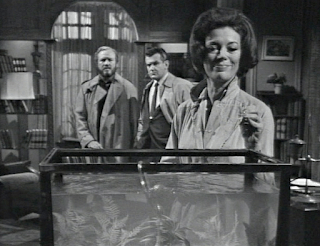
Dr Hoffman tells Dr Woodard that she believes it will be bad for Maggie to see Sam and Joe, but she consents to the visit as a way of discouraging them from trying to come back. When Sam and Joe join them in her office, she attends to her aquarium. In the post about this episode on Dark Shadows Before I Die, Christine Scoleri points out that this is a rather direct way of telling us that there is something fishy about Dr Hoffman.
When Sam and Joe go to Maggie’s room, she has a mad scene. She starts singing “London Bridge,” gets to an obscure verse running “Take the key and lock her up,” and starts screaming “Lock her up!” over and over. It’s magnificently terrifying.
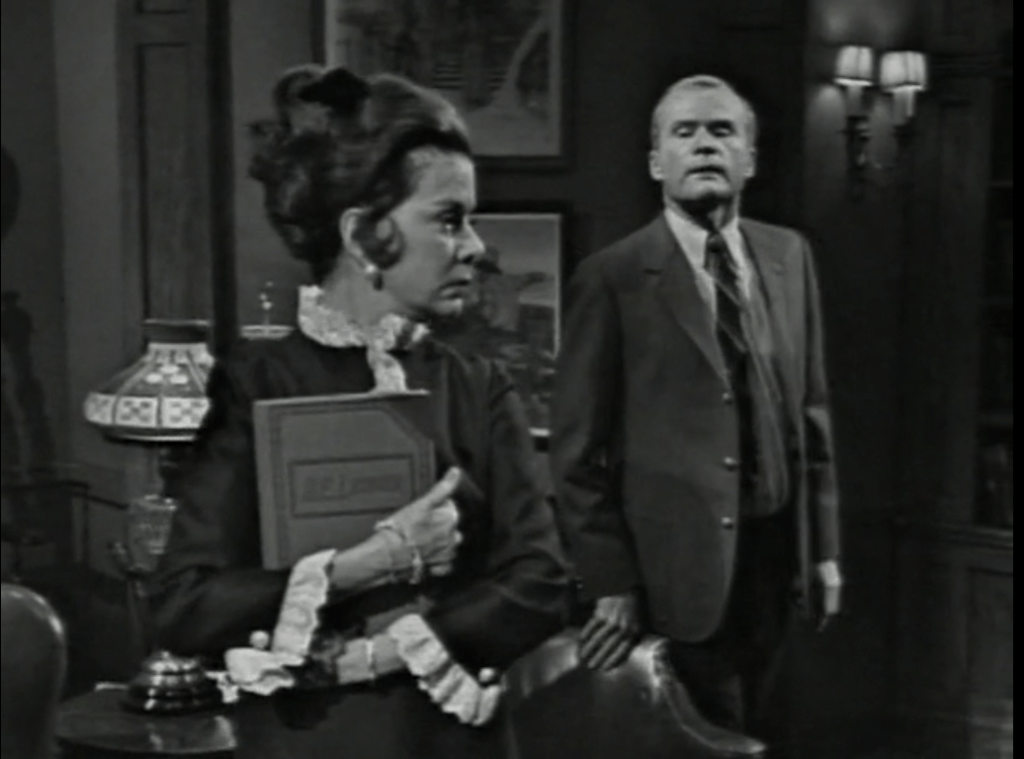
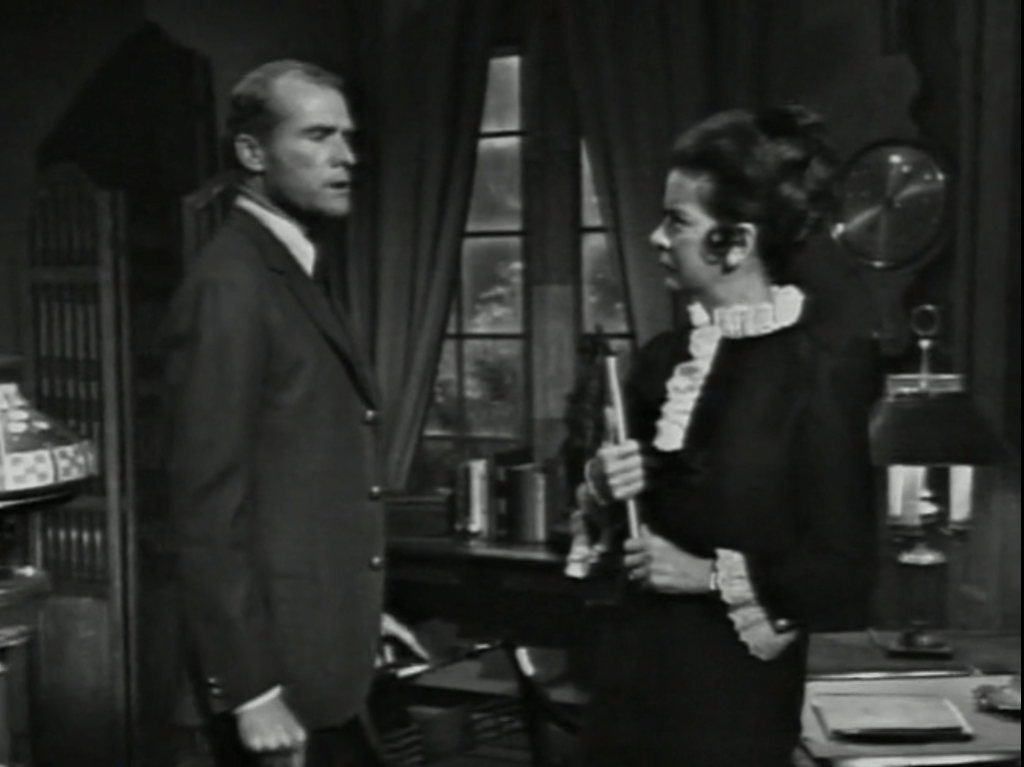
In his post on Dark Shadows Every Day, Danny Horn raves about Grayson Hall’s performance as Julia Hoffman. Rightly so, she will quickly make herself indispensable to the series. He includes a lot of screenshots of her face, showing the wide variety of expressions she uses. I have a more complicated response to this aspect of her style.
As many screenshots as Danny gives of Grayson Hall’s face in his post, I presented even more screenshots of Lovelady Powell’s face in my post about #193, where Powell plays art dealer Portia Fitzsimmons. What impressed me about Powell’s performance is that she takes one of the most basic rules of screen acting- choose one of your eyes and look at your scene partner only with it- and builds a whole character around it. Her left eyelid is all she needs to command the stage and leave an indelible impression.
Hall was at the opposite extreme. She ignores the one-eye rule, and virtually every other piece of guidance professionals give about how to create a character on camera. She uses every muscle at every moment. Her broad, stagy approach works well for Dark Shadows, and the three actors with whom she shares her shots today stay out of her way. Still, she does make me miss Powell’s dominating simplicity.
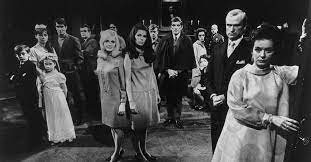
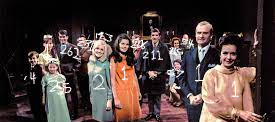
With Julia’s introduction, all of the actors in the photo I use as the header for this blog have joined the cast of Dark Shadows. There is also a version of the picture where the actors are frowning.
Gloom in the shadows
Here’s the smiley version. I’ve marked each player with the number of the first episode in which s/he appeared:
Maggie Evans, The Nicest Girl in Town, has solved a riddle posed by the ghost of nine year old Sarah Collins. The solution led Maggie to a secret panel through which she has escaped from the cell in which she has been imprisoned by Sarah’s big brother, vampire Barnabas Collins. Barnabas is chasing Maggie through the corridors on the other side of the panel.
Maggie has reached two doors, both of which appear to be locked. The other day, Sarah had visited Maggie in the cell and played “London Bridge” on her recorder. Maggie hears a few notes of that same tune, and one of the doors opens. She runs through the door, closing it behind her. She finds herself in another maze of corridors. She hears the music again, and follows it to a stairway. A moment later, we cut to Barnabas going through the other door and heading in Maggie’s direction.
Maggie finds herself on the beach. She staggers about and collapses. Apparently her escape took more strength than she had left after her long imprisonment. Barnabas makes his way to the beach and stands over Maggie, declaring that he has defeated her. She screams.
Maggie’s father, Sam Evans, is on the beach. Sarah had visited him at home and told him he might find Maggie if he went there that night. Sam hears Maggie’s scream and calls out. Barnabas retreats while Sam runs to Maggie.
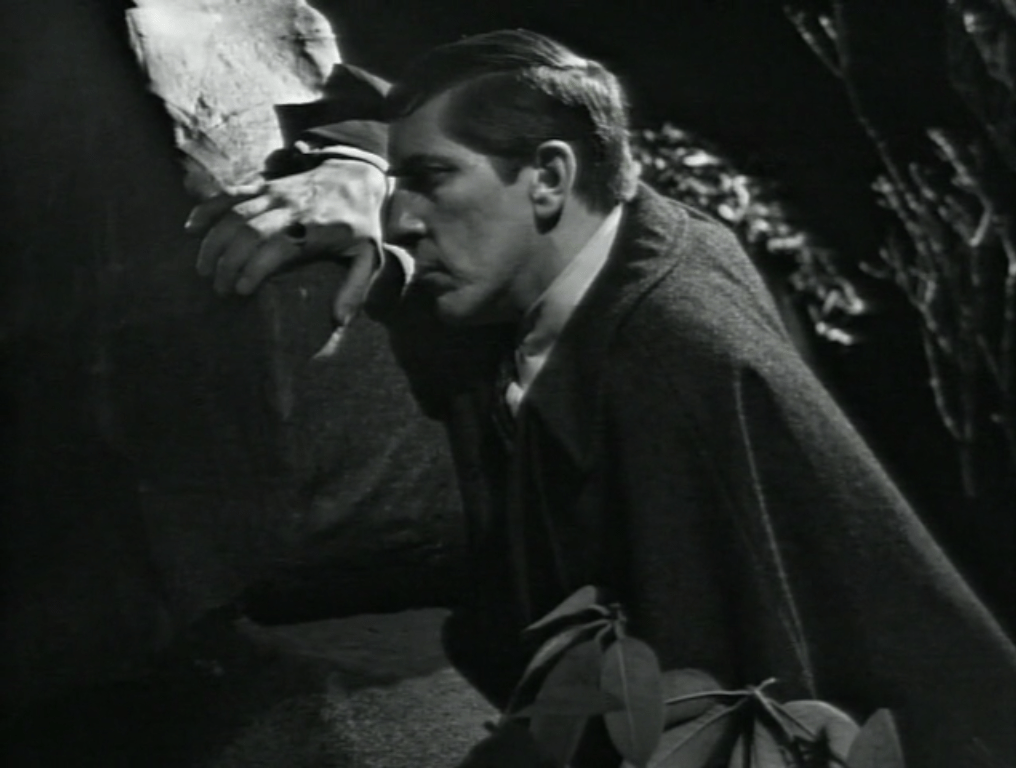
Barnabas hides behind a rock and stares hard at Maggie. When he first sucked Maggie’s blood, Barnabas gained great power over her mind. She has shaken free from that to the point where she can try to kill him and run away from him, but maybe he still thinks he can put some kind of zap on her.
Evil eye
In the hospital, Sam, addled quack Dr Woodard, and Maggie’s boyfriend Joe discover that Maggie has amnesia and thinks she’s ten years old. She greets Sam as “Papa,” a title Sam says she hasn’t used in “a long time.” She did call him that in #200, but that was an ultra-dramatic moment, so maybe he means it has been a long time since she used it when she was calm and cheerful. Sam tells Woodard about Sarah. Maggie reacts to Sarah’s name, which is surprising since Sarah never gave it to her. Maggie has Sarah’s doll, which the men find puzzling but don’t ask her about.
Woodard has an idea. The three of them will tell everyone that Maggie is dead, and she will go to Windcliff, a nursing home a hundred miles north of town, which would put it someplace near Mount Katahdin. There, she will be in the hands of Dr Woodard’s colleague Julia Hoffman.
After Sam and Joe have agreed to this, we see Barnabas enter the hospital. A clock prominently featured on the wall shows that it is 3:30 AM. Barnabas asks to see Maggie. Dr Woodard asks him how he knew she was in the hospital. He claims that he has heard a rumor to that effect from everyone in town. Woodard says he isn’t surprised. Collinsport must be rather an odd place if everyone is up and exchanging rumors at that hour.
Woodard tells Barnabas that Maggie is dead. She never recovered consciousness, so she wasn’t able to tell anyone what happened to her. Barnabas manages to keep from smiling until after he turns his face away from the doctor.
Barnabas’ obvious relief when Woodard tells him that Maggie is dead makes an interesting contrast with the shot of him behind the rock on the beach. Maggie’s amnesia is such a stark change from her mental state in the last couple of weeks that it seems Barnabas must have made a successful attempt to project psychic power against her. But those transmissions go in only one direction- he can’t sense that Maggie is still alive.
This is the first time we hear the name “Julia Hoffman.” Woodard first mentioned Dr Hoffman in #242, when she was a blood specialist and a man. Julia still has expert knowledge about blood, but is now primarily a psychiatrist.
There is a legend among fans of Dark Shadows that Julia transitioned from male to female as the result of a typographical error. Ron Sproat is supposed to have put the name “Julian Hoffman” in the script, but a typist left the “n” off the end of the first name. Executive Producer Dan Curtis liked the idea of a female Dr Hoffman, and they ran with it.
The Dark Shadows wiki explains that the evidence does not support this charming tale. Various members of cast and production staff told various stories over the years to explain the switch, and no surviving paperwork can settle the question for us. It certainly is true that the storylines sometimes took wild U-turns based on last-minute decisions by Curtis and others, and some of those decisions were so whimsical that they may as well have been based on typographical errors. But it is also true that we’ve never heard the name “Julian,” and the near-rhyme of “Julian Hoffman” would be the first awkward-sounding name on Dark Shadows. Further, Woodard stopped mentioning Hoffman weeks ago, likely before ABC had decided to renew the show beyond #260.
If they are going to make another 13 weeks of Dark Shadows, they are going to need new characters and new storylines. They must have responded to the renewal with some story conferences during which the producers, the writing staff, and others tried to flesh out some possibilities.
The writers appear to have decided there would be a secret passage from the Old House to the beach by #238, when well-meaning governess Vicki mentions that the Old House is very close to the sea. That was a retcon that would startle viewers who remembered previous episodes that suggested it was deep in the woods. But it wasn’t clear then that Maggie would be the one escaping by that passage. She was ranging freely through the house at that point, and wasn’t locked up in the cell until #251. Until that point, it was possible Maggie would become a vampire and be destroyed like Lucy in Dracula, leaving Vicki to be the Final Girl who escapes from Barnabas’ clutches and defeats him.
Months ago, they brought parapsychologist Dr Peter Guthrie on the show to help fight undead fire witch Laura Murdoch Collins. In #183 and #184, Guthrie offered to help Laura if she would renounce evil and participate in his research. That suggested the possibility that a complex relationship might arise between the male visiting expert and the undead female menace. Laura was a one-shot monster, on a mission to burn her son David to death and bound to vanish after the attempt, and so could not stay on the show indefinitely. She could respond to Guthrie’s offer only by killing him the night after he made it. But now an undead male menace is here for the duration, so a female visiting expert might be able to pick up the marker Guthrie laid down.
There are a lot of jokes in Dark Shadows fandom about Julia’s two specialties. Psychiatry and hematology don’t usually go hand in hand. I’ve dreamed up a little fanfic that satisfies me about this. I shared it in a comment on Danny Horn’s Dark Shadows Every Day:
The story I made up for myself is that Julia started out as a blood specialist but switched to psychiatry. She was interested in rare diseases, the rarer the better. She found that in hematology, there’s so much money to be made from developing treatments for the most widespread disorders that a researcher with an emphasis in the exotic is constantly fighting an uphill battle for funding and recognition.* Even those colleagues who had an abstract appreciation of the importance of studying rare disorders had to work within a system where all the institutions push them towards the biggest projects possible.
Psychiatry, on the other hand, always had room for the unusual.** In fact, Julia discovered that high-strung rich people would pay a great deal of money to be told that whatever happens to be bothering them at the moment is not the same kind of problem that one of their servants might have, but is a mental aberration hitherto unattested in the annals of psychiatry.*** So she switched to that field and quickly made enough money to open her own, hugely profitable, mental hospital. But she never stopped working in rare blood diseases, and the experiments she was able to finance by flattering the vanity of her wealthier patients earned her such a reputation in a male-dominated field that even her old acquaintance Dave Woodard would commit sexist slips of the tongue and say of “Hoffman” that “he” is “the top man in the field” of rare blood diseases.
Lucrative as Windcliff was, Julia’s true love was never money, or even science per se, but the exotic. When she found herself as the best friend/ frequent accomplice/ bossy big sister of an honest-to-wickedness vampire, surrounded by ghosts and witches and werewolves and Frankensteins and time travelers and interdimensional anomalies and who knows what else, there was never any question of her going back to the office.
*I have no reason to believe this was true in the real world in the middle decades of the twentieth century, or that it is true today. It’s simply part of the fictional world in which I see Julia. **(Same note) ***(Same note)
Maggie Evans, The Nicest Girl in Town, suffered from an ailment her doctor, Dave Woodard M. D., could not identify. She then vanished from her hospital room in a manner law enforcement, led by Sheriff George Patterson, could not explain. The opening voiceover says that Maggie’s troubles “mystify the finest minds.” This is the first and last time either Woodard or Patterson is classed with “the finest minds” even among the low-functioning characters who abound in the period when Dark Shadows is being written by Ron Sproat and Malcolm Marmorstein. Well-meaning governess Vicki is still the single smartest character on the show, and she turns into an absolute moron every two or three days.
In the opening teaser, dashing action hero Burke Devlin asks Dr Woodard if his studies of Maggie’s blood samples will help find her. He says that they won’t, but that if he can diagnose her he might be able to help her after she is found. Burke asks if he is about to make a diagnosis. He says that he might be making progress towards that goal. At that point, there is a dramatic musical sting, and we cut to the credits. That’s the hook, a statement that further study is needed.
Dr Woodard tells Burke that he has contacted “Hoffman, one of the best men in the field,” and that he hopes Hoffman will be able to get things moving. Under Burke’s questioning, he admits that he is pessimistic that Hoffman will see anything he has missed. This is the first mention of the name “Hoffman” on Dark Shadows. I believe it is only the second mention* of any surname that is not derived from Irish (as are such names as Collins, Devlin, Malloy, and McGuire,) English (as are names such as Woodard, Patterson, Loomis, Johnson, Stockbridge, and Garner,) Welsh (as are names such as Evans and Morgan,) Scottish (as are the names Adair and Murdoch,) or French (as are the names La Freniere, Bilodeau, and du Près.)** It is certainly the first name we have heard that suggests there might be Jewish people in the universe of Dark Shadows.
We then cut to the study in great house of Collinwood, where high-born ne’er-do-well Roger Collins has to confront his sister, reclusive matriarch Liz. The auditors have told Roger that the books are out of balance at the family business. Roger knows that the reason for this is that Liz is giving money to buy the silence of seagoing con man Jason McGuire. He reminds Liz that he himself was afraid of blackmail for the first 40 weeks of the show, so he knows from personal experience that it is no way to live. Liz refuses Roger’s plea that she tell him her secret. As he probes and she resists, they move around the room at times like fencers, at times like dancers performing a paso doble. Their movements are easily the most interesting element of the episode, a credit to director John Sedwick.
Roger’s first approach to the shielded LizLiz parries Roger’s thrustRoger’s second approach
Roger admits that he hasn’t been much help to Liz over the years, but begs her to let him help her now. Liz won’t tell him anything, but she is touched to see her bratty brother sincerely trying to step up.
Liz goes to the drawing room. The camera is behind her as she approaches the room. Jason is standing at the fireplace under the large portrait, the spot furthest from the camera. Not only does he look as small as possible, but at the moment we first see him he is turned away from us, his head tilted far back as he takes a drink. Jason’s smallness and obscurity, coming so soon after Roger’s speech about the dreariness of blackmail, feels like an acknowledgment that Jason doesn’t have much to offer the audience.***
Coming upon Jason
Liz tells Jason she can’t give him any more money without blowing the secret they share. He amazes her by accepting this information calmly, but she is sure he is not done tormenting her.
Liz returns to the study, where Roger is still sitting. She tells him that she has talked to the auditor and straightened out the books. That sounds like something that would take quite a while, even if you are sitting across from each other, and Liz and the auditor had to do it over the telephone. So how long has Roger been sitting there?
Then we rejoin Burke and Woodard in the doctor’s office, which someone has ransacked. The perpetrator wrenched the metal bars out of the window and stole Maggie’s blood samples. Dr Woodard says that the only way the bars could have been twisted was by someone with the “supernatural strength of madness.” I’m not an expert in mental health, but that does not sound like a conventional psychiatric opinion to me.
*After Lieutenant Costa of the Arizona State Police, whom we saw when Dark Shadows took us to Phoenix in #174.
**It is pretty weird that a show set in Maine has so few French-surnamed characters. We’ve only heard of one working-class Mainer with a French name, Amos Bilodeau. La Freniere was given in #45 as the maiden name of Josette, a grand lady who came from France to marry into the Collins family in a previous century; eventually, Josette’s birth name will be retconned to du Près.
***My wife, Mrs Acilius, was the one who really noticed the visual strategy both in Liz and Roger’s first scene in the study and in Liz’ entry into the drawing room.
In 281 of the posts that follow, I link to comments I made on Danny Horn’s blog, “Dark Shadows Every Day.”
Not all of these comments were absolutely unique. Several times it occurred to me that a Dark Shadows features a number of older sisters who clean up messes that their misbehaving younger brothers make, and that a variety of male-female relationships on the show take on the dynamic of a bossy big sister and her bratty little brother. Danny doesn’t cover the first 209 episodes of the show, when we learn that Roger Collins has managed to squander his entire inheritance, half of the family fortune, and that his older sister Elizabeth Collins Stoddard has gone deeply into debt to contain the damage that his irresponsibility has done to the family business. Elizabeth takes Roger into her house, and alternates between demanding that he reform his ways and enabling his ongoing bad conduct. She takes charge of the raising of Roger’s son David and puts Roger to work in the family business, setting bounds to Roger’s crapulence but also insulating him from its consequences.
Watching this episode, I just realized the main relationship in DARK SHADOWS- Bossy Big Sister/ Bratty Little Brother. Liz and Roger are literally that, and each one’s struggle to safeguard their relationship by keeping the other in the dark about their shameful secrets is the background of every storyline in the first 209 episodes. Carolyn and David become the functional equivalent of a Bossy Big Sister and a Bratty Little Brother, and that’s the development that makes Carolyn a relatable character.
In Julia and Barnabas, we have the supreme example of such a relationship. They fall into it naturally; Julia is used to giving orders, and Barnabas is used to disobeying them. From the moment Julia lit her cigarette on the candles in the old house, she’s been Barnabas’ Bossy Big Sister, pursuing one plan after another meant for his own good. He’s been alternately pouting at her, raging against her, and clinging to her, at once resenting her demands on him and craving her validation for his narcissism. The climax of the episode, when they both know that a he-vampire is roaming about in search of a victim but it occurs to neither Julia nor Barnabas that Julia might be in danger, shows how deeply they have embedded themselves in these roles. Barnabas won’t even let Vicki walk to her car alone, and Julia, hearing the dognoise, understands why. But when Julia tells Barnabas that she will close up the lab and leave shortly after he goes out to join Willie, implying that she’s going to walk all the way back to the Great House by herself, he just leaves. Of course nothing will happen to Big Sis, she’ll always be OK.
That’s also why I don’t see how slashfic positing a sexual relationship between Barnabas and Julia can work. They are so much Bossy Big Sister and Bratty Little Brother that no matter how much time they spent telling themselves that they aren’t actually related, it would still be impossibly weird to try to be something else to each other.
I returned to the theme in a remark about episode 572, where Jonathan Frid gives a line-reading so pouty that I wonder if he was consciously trying to depict Barnabas as a bratty little brother to Julia:
I love the way Jonathan Frid pouts the line “I was afraid your visit would be pointless.” He’s every inch the bratty little brother upset that his big sister went out when he didn’t want her to go.
Cavada Humphrey looks quite a bit like Jonathan Frid. I wonder what 1795 would have been like if Barnabas had had an older sister who bossed him around, stood around during his ridiculously childish fits of petulance, occasionally acted as his conscience, and time and again serve as his enabler and protector. It would have been funny to see Grayson Hall’s Countess express disapproval of such a relationship.
Heck, that older sister could have been Sarah. Just because she’s a child in her ghost form doesn’t mean she has to have died at that age. Maybe she comes back in the form in which her relationship to her brother took its permanent shape, when she was about nine and he was about seven. Of course, that possibility is foreclosed at Sarah’s first appearance, when she tells Maggie not to let her “big brother” know she saw her, but I suppose they could have retconned that away with a phony flashback where she says “little brother.”
I revisited these points a few times- Danny’s blog consists of over a thousand posts, one each for episodes 210-1245, plus a few dozen about properties related to Dark Shadows, and each post has its own discussion thread. So it isn’t bad netiquette to repeat yourself a bit from one thread to another- there is always a chance someone who didn’t see a comment previously posted elsewhere will take an interest when you post a similar one. But I did try to keep from making a bore of myself to those who read everything.
I could have mentioned some other bossy big sister/ bratty little brother combos. In a comment on the 1897 storyline, I alluded to the relationship between Judith Collins Trask and her feckless younger brothers. Judith’s arc doesn’t really allow her to be a bossy big sister to any of her three bratty little brothers. But each of them does find himself attached to at least one woman who is stronger than he is, and who might well treat him as Elizabeth does Roger and as Julia does Barnabas.
It’s a shame Terry Crawford wasn’t a more accomplished actress in the 1960s- in the scripts Beth fluctuates between indulging Quentin in his every vice and insisting that he clean up his act. That’s the bossy big sister/ bratty little brother dynamic we’ve seen so many times, but unlike any previous pair who have enacted it Beth and Quentin are lovers and are not social equals. It would be interesting to explore the dynamic in that context, but Ms Crawford’s performance is so wooden that you sometimes have to think about her scenes after it is over and call to memory the dialogue and the visual composition before it strikes you what the point was.
Pansy Faye isn’t on the show very long, unfortunately but she’s clearly in the driver’s seat in her relationship with her thoroughly clownish husband Carl Collins. And Edward Collins is much the weaker personality in his connections with both his estranged wife Laura and with Kitty Soames. So each of those men was looking for a woman who was forceful enough to take charge of him, but indulgent enough to allow him to continue in all his established habits.
I did not refer to the theme in my comments on posts about “The Haunting of Collinwood” by the ghost of Quentin, and I made only a single reference to it in my comments on posts about the “Re-Haunting of Collinwood” by the ghost of mini-Quentin Gerard. Indeed, that single reference is to Julia’s failure to focus her bossiness on Barnabas. I dropped the ball there, I think- the relationship between David and Amy in the original “Haunting of Collinwood” is at its most interesting when it mixes elements of the bossy big sister/ bratty little brother dynamic with other types of interaction, while the bland, lifeless relationships between David and Hallie on the one hand and between Tad and Carrie on the other in the “Re-Haunting of Collinwood” could benefit from some kind of structure.
I also left the theme unmentioned in my comments regarding the show’s dying days, the 1841 Parallel Time storyline of episodes 1199-1245. That’s understandable- the show did not develop any bossy big sister/ bratty little brother relationships in that period. But there was an implicit one- Miss Julia Collins was the sister of Justin Collins, and she had functioned as head of the household during his years of madness. Justin dies a few episodes into the story, without sharing a scene with Julia, and she is left as a bossy big sister with no bratty brother to whom she can attach herself. Meanwhile, Bramwell is a thoroughly bratty man with no big sister. It’s rather sad for the loyal audience, having enjoyed so many scenes in which Grayson Hall and Jonathan Frid had enormous fun with the bossy big sister/ bratty little brother pattern, seeing them drift separately through these dreary episodes.
The closest we get to a bossy big sister/ bratty little brother scene in the dying days of the show is also the one genuinely irresistible moment of that segment. In episode 1215, Flora Collins (Joan Bennett) and her son Morgan (Keith Prentice) are walking through the woods on their way to Biddleford’s Creek. He whines about the pointlessness of the trip, she scolds him, and we get a brilliant little glimpse of what their relationship must have been like since he first learned to talk. That authoritative mother/ whiny son moment left me, not only wanting more such scenes between them, but also wishing it had been presented in contrast with a bossy big sister/ bratty little brother relationship elsewhere in the show.
In 281 of the posts that follow, I link to comments I made on Danny Horn’s blog, “Dark Shadows Every Day.”
Not all of these comments were absolutely unique. A number of times I argued that the show was not so discontinuous as people were making it out to be. To be sure, the creative process is very close to the surface, so that viewers have to do a lot of re-writing in their heads to make sense of what they’re watching. Sometimes the writers just lost track of the story and contradicted themselves from one episode to the next, and other times they changed their minds abruptly. But there were other times when alleged contradictions can be reconciled without having to invent anything drastic.
For example, Danny and many of his regular commenters from time to time mock the depiction of Dr Julia Hoffman as sometimes a blood specialist, sometimes a psychiatrist. I think that’s a pretty easy one to resolve. In this comment, I added some fanfic of my own to sell the idea that she started as a hematologist and retained an interest in that field after switching to psychiatry:
The story I made up for myself is that Julia started out as a blood specialist but switched to psychiatry. She was interested in rare diseases, the rarer the better. She found that in hematology, there’s so much money to be made from developing treatments for the most widespread disorders that a researcher with an emphasis in the exotic is constantly fighting an uphill battle for funding and recognition.* Even those colleagues who had an abstract appreciation of the importance of studying rare disorders had to work within a system where all the institutions push them towards the biggest projects possible.
Psychiatry, on the other hand, always had room for the unusual.** In fact, Julia discovered that high-strung rich people would pay a great deal of money to be told that whatever happens to be bothering them at the moment is not the same kind of problem that one of their servants might have, but is a mental aberration hitherto unattested in the annals of psychiatry.*** So she switched to that field and quickly made enough money to open her own, hugely profitable, mental hospital. But she never stopped working in rare blood diseases, and the experiments she was able to finance by flattering the vanity of her wealthier patients earned her such a reputation in a male-dominated field that even her old acquaintance Dave Woodard would commit sexist slips of the tongue and say of “Hoffman” that “he” is “the top man in the field” of rare blood diseases.
Lucrative as Windcliff was, Julia’s true love was never money, or even science per se, but the exotic. When she found herself as the best friend/ frequent accomplice/ bossy big sister of an honest-to-wickedness vampire, surrounded by ghosts and witches and werewolves and Frankensteins and time travelers and interdimensional anomalies and who knows what else, there was never any question of her going back to the office.
*I have no reason to believe this was true in the real world in the middle decades of the twentieth century, or that it is true today. It’s simply part of the fictional world in which I see Julia. **(Same note) ***(Same note)
In this comment, I devised a much more modest bit of fanfic to answer a simpler question. Quentin has a girlfriend named Tessie, and at some point in the night he had, in his werewolf form, attacked her in the woods. Why was she in the woods? Danny and his commenters had proposed various awkward scenarios to answer this question, but I suggest she just followed Quentin after she saw him in town looking for booze.
In the “1995” segment, Mrs Johnson and Carolyn talk about how Mrs Johnson brushed Carolyn’s hair for her when she was a little girl. Some say this was a continuity error, because Mrs Johnson didn’t come to work at Collinwood until episode 81. Before that, she’d been housekeeper to Collins family retainer Bill Malloy. However, I say that she still could have brushed little Carolyn’s hair while working for Malloy:
I have a theory that could explain Mrs Johnson brushing Carolyn’s hair when she was little.
In the early episodes, Carolyn talks about having gone to school in town. How did she get there?
She can’t have walked; it was miles away, much of it along a winding road with several blind curves. Her mother never left the grounds during those years, she couldn’t have driven her. Roger was living in Augusta with Laura. The only servant was Matthew. Matthew and Carolyn don’t seem at all close; it doesn’t seem likely that he drove her to school every morning. If a school bus came up the hill to Collinwood day after day, the kids who rode it couldn’t have maintained the attitude Carolyn describes, whispering behind her back about her living with the witch in the haunted house. Sooner or later they’d have started talking to her face to face about it.
Carolyn also talks about Bill Malloy being more like a father to her than any other man, and the two of them do have a cozy relationship. Carolyn is also very quick to fall in with Mrs Johnson when Burke pitches the idea of her joining the household staff at Collinwood. So I think we have to conclude that Bill Malloy and his housekeeper were in charge of getting Carolyn to school in the mornings. Malloy was on the fishing boats, so that would require an early start to the day. There were probably many days when little Carolyn was still in her pajamas when she got to the Malloy house. On those days, Mrs Johnson brushed her hair while the water came to a boil for breakfast.
Several times I explained my theory about how the “Meet Gerard” segment (episodes 1061-1198, including “1995,” “The Re-Haunting of Collinwood,” and “1840”) fits together. This iteration also suggests ways to resolve a couple of puzzles about Angelique:
For me, a lot can be explained by the smile of satisfaction Gerard gives when he sees Julia and Barnabas take the staircase from 1995 to 1970. The dark power he represents called them to 1995 from Parallel 1970, and is now sending them back in time, first to 1970, then to 1840 to make it possible for the future they see in 1995 to exist.
This is analogous to what the Leviathans did at the end of 1897. First Quentin’s ghost, then Barnabas and Julia’s I Ching trips, had created a rift in the order of things that made it possible for the Leviathans to erupt from the underworld into the human world, and to send Barnabas to 1969 as their agent. So too have the journeys Barnabas and Julia took into Parallel Time torn open the fabric of time and space, and made it possible for Judah Zachery to bring a Frankenstein maker back to his time.
Attributing to Zachery the same power to exploit disruptions in time to shuttle people between past and future and thereby to rewrite his own history that the Leviathans had shown, we also have a way to resolve the Angelique/ Miranda paradox. Perhaps Angelique really was relatively new to witchcraft in 1795. Perhaps also, in her early naive attempts, she stumbled into the same kind of trouble Barnabas stumbled into with his time-travel. That’s what Zachery had in mind when he shouted at her during his trial that she ought to tell the truth, that she had come to him of her own accord- it was only because she had already worked in the black arts that he could call her to him, from the days after she first left Collinwood in 1796 to a nearby town 104 years before. And perhaps, with the first beheading of Zachery, his spell broke returning her to a time shortly after the “Burn Witch Burn!” moment in the tower room.
Come to think of it, that might also put sense into Angelique’s remark that she is “consigned to this century forever.” There were a few days after Zachery calls her to 1692 and before she returns from 1692, and until Barnabas and Ben torched her, she was sentenced to relive those few days over and over again, Bill Murray-style.
The logic that counts the most in the show isn’t so much the kind of sequential reasoning that I’ve done in these posts as it is the associational logic of a dream. An image or situation or word reminds a dreamer of something, and suddenly the dreamer is in the middle of that something. You dream about polishing your Ford with Turtle Wax, and the next thing you know Polish turtles are whacking away at a shallow spot in a river. You tell a story about rich, selfish people who obsessively keep secrets and set a dreary tone for their town, and the next thing you know your main character is a vampire. I left an unreasonably long comment where I natter on about the concept of dream logic.




 Dark Shadows Commentary