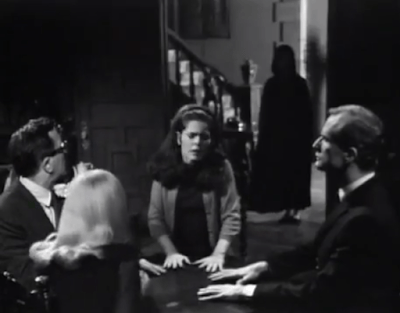
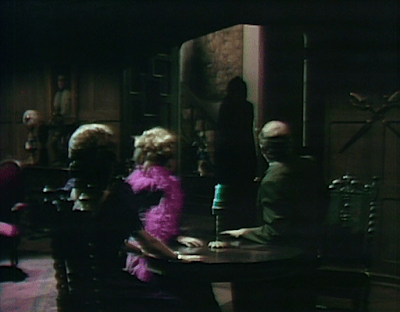
Episode 886: One of the most terrifying tales ever told

In #701, broadcast at the beginning of March 1969, recovering vampire-turned-bumbling protagonist Barnabas Collins was trying to solve some problems his distant cousins were having, and inadvertently came unstuck in time. He found himself in the year 1897, where his vampirism was once more in full force. Barnabas spent the next eight months in that year, precipitating one disaster after another around the estate of Collinwood and the village of Collinsport.

As summer gave way to fall of 1897, Barnabas’ friends managed to put his vampirism back into remission. In #844, he met Kitty Soames, the dowager countess of Hampshire. Despite what her title would suggest, Kitty was an American woman in her twenties. Barnabas recognized her as the reincarnation of his lost love Josette. In February of 1796, Josette found out that Barnabas had become a vampire and that he wanted to kill her and raise her from the dead as his vampire bride. She flung herself to her death from the cliff on Widows’ Hill rather than let him do that to her.

In the eight weeks following Kitty’s first appearance, Josette’s personality irrupted into her conscious mind more and more frequently. Josette wanted to live again and to be with Barnabas. By last week, Kitty could hear Josette’s voice talking to her through the portrait of her that hangs in the Old House on the grounds of Collinwood. Josette suggested that if Kitty stopped resisting her, the two of them could both live, resolving themselves into a composite being.

In Thursday’s episode, the boundary between Kitty and Josette had become very indistinct. As Kitty, she agreed to marry Barnabas that night, later to wonder why she had done so. She was holding Josette’s white dress in her hand and struggling with the idea of putting it on when she abruptly found herself wearing it. Barnabas entered the room just in time to see her bodily assumed into the portrait. He reached up to the moving image of Kitty overlaid on the painted likeness of Josette, and both he and Kitty vanished at the same instant.

In Friday’s episode, Barnabas found himself lying on the ground, wearing clothes he had last put on in 1796. He learned that it was the night of Josette’s death. He is a vampire in this period, but he is confident he can again be free of the effects of the curse. He does not want to kill Josette, but to take her back to 1897 with him. His efforts to that end were not at all successful, and Friday ended with her on the edge of the cliff. She hears footsteps, which she and the audience have every reason to think are Barnabas’. If she sees him, she is prepared to jump.

Neither Kitty’s assumption into the portrait nor his own translation to 1796 prompt Barnabas to ask a single question about what forces are at work around him. Regular viewers would not expect him to. He lives in a universe where time travel is easy. Not only did he travel from March 1969 to 1897 without even trying to do so, but in #661 he managed to get from January 1969 to 1796 by standing in a graveyard at night and shouting for one of the residents to give him a ride. And in #365, he was present at a séance where the ghost of his little sister Sarah, speaking through well-meaning governess Vicki Winters, said that she would “tell the story from the beginning.” Vicki then vanished from the circle and Sarah’s governess, Phyllis Wick, materialized in her place. For the next four months the show was a costume drama set in the 1790s, where Vicki flailed about helplessly while Barnabas became a vampire, Sarah died of exposure, and Josette jumped off Widows’ Hill.

Barnabas and we also know that portraits are powerful in the universe of Dark Shadows. When he is in full vampire-mode, he communicates with his victims and potential victims through a portrait of him that hangs in the foyer of the great house of Collinwood. Much of the action in the 1897 segment had to do with a magical portrait that keeps Barnabas’ distant cousin Quentin from turning into a werewolf. Quentin had a romance with Amanda Harris, a woman who came to life when another magical portrait was painted.

Barnabas knows, not only that portraits in general have power, but also that Josette’s portrait in particular is powerful. In his second episode, #212, he went to the Old House and talked with strange and troubled boy David Collins, who often communed with Josette through her portrait. After David left him alone there, Barnabas addressed the portrait and told Josette that she would no longer function as the tutelary spirit of the Collins family. At that point Josette was supposed to be Barnabas’ grandmother who sided against him in a fateful family battle, but even after she was retconned as his lost love he felt the portrait’s power. So in #287, Vicki had invited herself to spend the night at Barnabas’ house. While she slept, Barnabas entered the room, intending to bite her. But he looked at the portrait of Josette and found that something was stopping him from doing so.

Barnabas would not have any way of knowing it, but in #70 Dark Shadows‘ first major special effect came when we saw Josette’s ghost take shape in front of her portrait and take three steps down from it to the floor of the room where it was hanging then, the front parlor of the Old House. She then turned, looked at the portrait, and went outside, where she danced among the columns of the portico. Longtime viewers will see Kitty’s assumption into the portrait as a reversal of this momentous little journey.

Most people nowadays who have been watching the show for some time will therefore take the strange goings-on as much in stride as Barnabas does. But viewers at the time may have had a different reaction. Friday’s episode and today’s originally ended with announcements over the closing credits. These announcements were not on the original master videotapes from which Amazon Prime Video and Tubi and the other streaming apps take their copies of the episodes, and so most viewers these days don’t hear them. But evidently one of the DVD releases reproduces them as they were preserved on some kinescopes. One promises that in Tuesday’s episode “one of the most terrifying tales ever told” will begin; the other, that it will be “one of the most unusual tales ever told.”

A terrifying tale suggests a mighty villain. By the end of the 1897 segment, all the villains have either turned into protagonists, as Barnabas, Quentin, and wicked witch Angelique had done; been heavily defeated, as sorcerer Count Petofi had been; or were dead and forgotten. So “one of the most terrifying tales ever told” would seem to require a new villain, or perhaps a new group of villains. And if it is also “one of the most unusual tales ever told,” those villains will have to be strikingly different from anything we have seen before.

So, having heard those announcements, we will be less inclined to chalk Barnabas’ latest adventure in anachronism up to the usual way things are on Dark Shadows. We will be looking for signs that some previously unknown and hugely formidable malevolent force is luring him into a trap.

At first, no such signs seem to be forthcoming. The footsteps that alarm Josette turn out not to be Barnabas’, but those of her aunt, the Countess DuPrés. The countess talks Josette down and takes her back to the great house of Collinwood. Having saved Josette’s life, the countess takes her to a room occupied by fluttery heiress Millicent Collins. The countess asks Millicent to sit with Josette while she runs an errand.

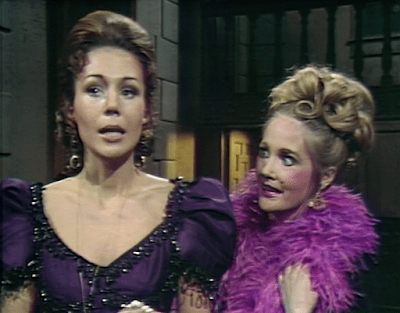
Millicent means well, but always makes everything hilariously worse. Seeing that Josette is shaking, she observes that she is suffering a shock. She asks very earnestly “Was your shock a romantic one?” Josette responds by wailing. Millicent keeps talking about the dangers of love, causing Josette to get more and more upset. Longtime viewers will remember that Millicent will turn from a comic figure to a tragic one soon after this, when she falls in love with an evil man. That tinges our reaction with sadness, but Millicent’s total insensitivity to the effect she is having on Josette makes for an effective comedy scene. No matter how much the oblivious Millicent is worsening Josette’s mood, this hardly seems likely to be part of a grand evil scheme.

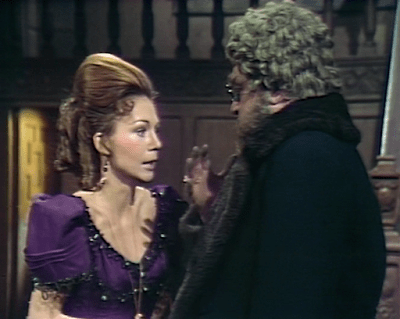
It turns out that the errand the countess had to run was a visit to Barnabas, who is waiting in Josette’s room. This time Barnabas has actually had a sensible idea. Rather than go to Josette on top of the cliff as he did the first time through these events, he asked the countess to go. The countess confronts him about his status as a walking dead man. Barnabas will not explain- how could he? He asks the countess if she thinks he is a ghost; she does not answer. He insists on seeing Josette; she says she will not allow it. He says he does not want to force her to help him; she declares that he cannot force her. Finally, he ends the exchange by biting her.

The countess goes to Millicent’s room and tells Josette to go back to her own room. Millicent is surprised the countess doesn’t go with her, protesting that Josette is in no condition to be left alone. The countess responds numbly.

The countess is one of three characters we have so far seen Grayson Hall play. The first, mad scientist Julia Hoffman, offered herself to Barnabas as a victim in #350; he declined the offer. Julia was motivated by a mixture of despair over the failure of her first attempt to cure Barnabas’ vampirism, an obligation to prevent him harming others, and her own unrequited love for him, so she was disappointed when he said no. The other, broad ethnic stereotype Magda Rákóczi, told Barnabas to “Bite me!” when they were at the grave of her husband, his onetime blood thrall. He refused to do that, too. Magda was angry and defiant, wanting to get something horrible over with, so her reaction was more ambiguous. The countess didn’t know Barnabas was a vampire until his fangs were in her neck, so she is just dazed.

That Hall’s other characters expected Barnabas to bite them, and in Julia’s case hoped he would do so, shows that no new force is needed to explain why he bites the countess. And bad as a vampire’s bite is, from what we have seen in previous segments of the show we can be sure that the countess will forget all about her experience as Barnabas’ victim once he leaves. Besides, when he came back in time in January Barnabas triggered a chain of events that led to the countess’ death- we can assume that whatever he has put in motion this time will have a different outcome for her. So while the bite still has its echoes of rape and is therefore a horror, it in no way shows the presence of any fresh villain that is about to set off “one of the most terrifying tales ever told.”

Josette is in her room. The secret panel opens, and Barnabas enters. She is shocked to see him. He assures her that he does not want to kill her and raise her as his vampire bride; after a bit of prodding, she gets him to admit that this was, at one point, his plan. He starts explaining to her that he has come to her after a sojourn in the 1890s. She reacts with disbelief and confusion. He keeps talking. He asks her if she remembers Kitty Soames. At first the name does not ring a bell, but as he goes on she recognizes what she had thought to be a dream in which she was talking with her portrait. He tells her that it was no dream, but that just a few hours before they were together in that other century.

Finally, Barnabas persuades Josette to meet him at the Old House. He says they must go separately, since he has to go to his friend Ben Stokes and ask him to stand guard for them while they disappear into the portrait. She wants to say goodbye to her aunt the countess, and Barnabas tells her to write a note. They kiss passionately. One wonders if Josette notices the taste of her aunt’s blood on Barnabas’ lips.

Barnabas’ decision to go to Ben and send Josette to the house on her own doesn’t make much sense. This is the first we have heard they need someone to stand guard, and there is no apparent reason why they should. Moreover, the countess is right there in the house with them, and she is under Barnabas’ power. The three of them can go to the house together, Josette can say goodbye to her there, and if they need someone to stand guard she can do it. Afterward she can tell Ben what she saw and tell lies to anyone else who has questions about where Josette went. Besides, regular viewers of Dark Shadows know that when two people are supposed to go to a place separately, they never actually meet there. A smart character who understood how things work in this universe would know that Barnabas’ decree that he and Josette must take their own paths to the house means that they are doomed. But contrary to the glimmers of brainpower Barnabas showed earlier, he has never been that smart. He is so much a creature of habit that his decision to send Josette to the Old House by herself bears no traces at all of any outside influence, least of all the influence of the new villain we are looking for.

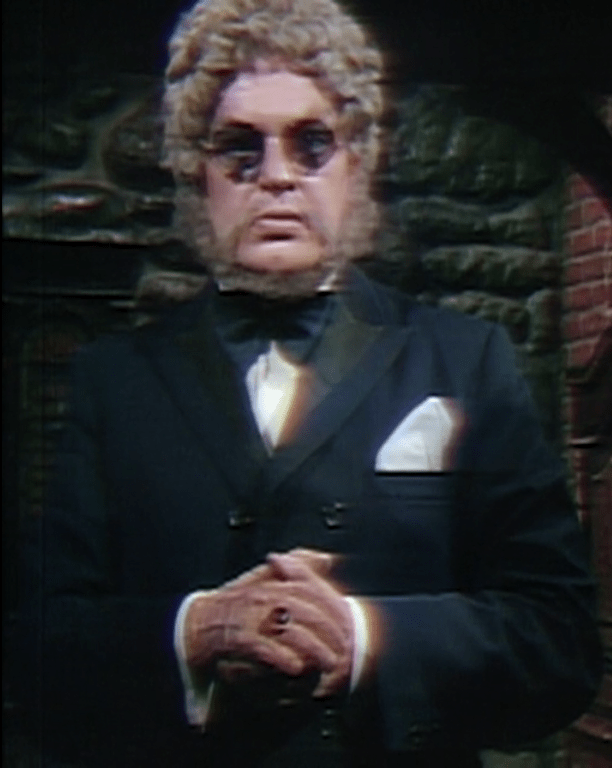
Barnabas is on his way across the grounds of Collinwood to meet Ben when it dawns on him that he is lost. This is the first thing he has done today that is out of character. He has been on the estate for centuries, and knows it surpassingly well. He looks around and sees a cairn, a large stone structure. The cairn has a flat surface in the middle and is flanked with torches and decorated with carvings resembling coiled serpents. Though he does not know where he is, he knows he has been following the same path he used shortly before, and that no such thing was there at that time or in the area ever before. Hooded figures approach, a man and a woman. They make gestures that he cannot understand. He cannot see or feel anything binding him, but neither can he move his feet or use his vampire powers to dematerialize. At last we have encountered the new presence that is supposed to deliver “one of the most terrifying tales ever told.”

Back in the great house, Millicent and the countess discover that Josette is gone. They read the note. When Millicent reads that Josette has gone to be with Barnabas, she is puzzled. All she knows is that Barnabas is dead. As a visitor from light comedy, she assumes that death is a full-time occupation. She tells the countess that to be with Barnabas, Josette will have to die. The countess replies that “Many have died for love.” Millicent is shocked by the countess’ resigned tone, and declares that she will not give up on Josette even if the countess does.

It would have been impossible for Barnabas to explain the situation to the countess while she was actively opposing him, but one might have thought that after he had bitten her and broken her will he might have tried to reassure her that his plans for Josette were now benevolent. The utter hopelessness in her voice when she says that no one can help Josette suggests he didn’t even try. Again, it wouldn’t have taken the influence of any outside force to cause Barnabas to skip this. As a vampire, he is a metaphor for extreme selfishness, and when he is pressed for time he is especially unlikely to take other people’s feelings into account in any way. Though it is a bit of a shame he didn’t try to smooth things over with the countess, there is nothing in his behavior that needs explaining, and too little at stake here for us to imagine that the mysterious forces launching “one of the most terrifying tales ever told” would care much about it.

In the Old House, Josette is looking at her portrait and wondering why Barnabas is late. She talks herself into believing that he was lying when he told her the story about 1897. She jumps to the conclusion that he really is going to turn her into a vampire, and declares she has nothing left to live for. She takes out a vial she had with her when she was with Millicent and drinks it. It is poison, and she dies.

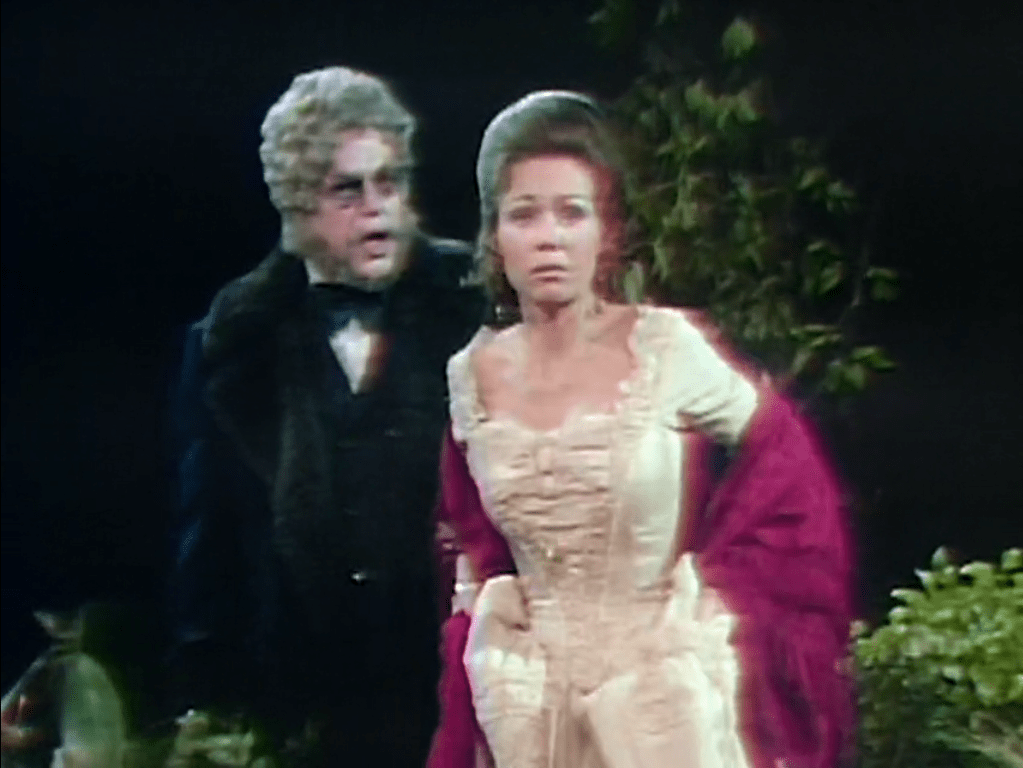
Back in the mysterious clearing in the woods, Barnabas loses consciousness. The hooded figures say some prayers to Mother Earth, then lay him on the cairn. They place some foliage on him. This action recalls the sprinkling of grain on the necks of animals led to altars in ancient Indo-European paganism, an act known in Latin as sacrificium- it was this ritual act, not the killing of the animal, that made the animal sacer, that is, set aside for the gods. The man declares that when Barnabas awakens he will recognize him and the woman, and that he will then lead them “to a new and everlasting life.” My wife, Mrs Acilius, and I reacted to the idea of Barnabas as a guide to enlightenment the same way every regular viewer of Dark Shadows would, viz. with gales of laughter.

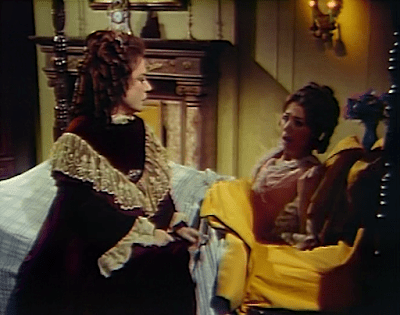
Oberon and Haza sacrifice Barnabas on the cairn. Screenshot by Dark Shadows Before I Die.

If the hooded figures represent the force that has directed the events of this episode and Friday’s, the force that we have been promised will bring us “one of the most terrifying tales ever told,” then something that happened in them must have been a necessary precondition for the sacrifice of Barnabas. After all, that force had him under its power when he disappeared from 1897 and found himself lying on the ground. He could just as easily have materialized on the cairn, accompanied by the hooded figures with their foliage.

The only development in these two installments that would seem to be significant enough to qualify as such a precondition is Josette’s poisoning of herself. That Josette jumped to her death from Widows’ Hill is one of the most firmly established parts of the show’s continuity. Artist Sam Evans told Vicki about it in #5. In #185, a very different version of Sam saw Josette’s portrait for the first time and identified her as “the lady who went over the cliff.” In #233, Barnabas gave a vivid and rather indiscreet account of Josette’s death to Vicki and heiress Carolyn. We saw Josette make her leap in #425, and in #876 the leap was reenacted with maidservant Beth Chavez in Josette’s role and Quentin in Barnabas’. So having Josette poison herself instead of taking the jump is an example of something Dark Shadows did several times in the later phases of the 1897 segment, making a retcon into a self-conscious plot point. That leaves us with a puzzle. Why does it matter so much just how Josette went about killing herself?

Josette’s original death was a desperate flight from vampirism. It barely qualified as a suicide at all. Josette was cornered at the edge of the cliff, seeing no way but a mortal leap to escape transformation into a bloodsucking fiend. She went over the cliff in a spontaneous act that prevented the killings and enslavements that she would have inflicted on others had Barnabas succeeded in making her into the same kind of monster he was. This time, she has been keeping a vial of poison with her, so that her suicide is a premeditated act. Moreover, she drinks it when she is still alone, motivated not by a clear and present danger but by her purely intellectual, and as it so happens faulty, analysis of the situation. She still has options, and she is helping no one. So it could be that “one of the most terrifying tales ever told” is supposed to begin with the audience disapproving of Josette’s suicide on moral grounds.

This doesn’t seem very promising, but we should mention that writer Sam Hall probably did not approve of suicide. He was a churchgoer, serious enough about his Lutheran faith that he insisted Shirley Grossman convert from Judaism before they married and she became Grayson Hall. Christians have traditionally regarded despair as a sinful state and suicide as a religious offense. And Hall does seem to have been in a religious mood at this period. Lately his episodes have shown evidence that he was reading the novels of George MacDonald, a nineteenth century Congregationalist minister whose works of fantastic fiction were enormously popular in their day, but which are suffused with such a heavily Christian atmosphere that by the late 1960s their readership was a subset of that of such self-consciously Christian fans of MacDonald’s as C. S. Lewis, J. R. R. Tolkien, and W. H. Auden. Indeed, the three priests who hosted the podcast God and Comics admitted in a 2022 installment of their show that MacDonald’s novels reminded them a little too strongly of their day jobs to count as fun reading for them.

If Hall was feeling pious enough to keep reading MacDonald, he may well have seen Josette’s intentional and unnecessary self-poisoning as a prelude to “one of the most terrifying tales ever told.” Still, nothing we have seen so far explains just how that would work. Maybe we will find out later that Josette’s soul is in need of some kind of intervention from the other characters to avoid damnation. Lutherans aren’t supposed to think in those terms, but not even MacDonald, churchy as he was, ever let any kind of orthodoxy get between him and a good story.

Today marks the final appearance of both Millicent and the countess. It is also the last time we will visit the 1790s.

The hooded figures Barnabas meets today are identified in the credits as Oberon and Haza. Oberon, King of the Fairies, was a figure in medieval and Renaissance folklore whom Shakespeare used as a character in A Midsummer Night’s Dream. Also, MacDonald mentioned Oberon occasionally in his novels. I don’t know where Hall came up with “Haza.” Bookish people pick up vocabulary items all the time, so any of the various words in the world that take that form might have popped into his head when he was writing this episode.

Oberon is played by Peter Kirk Lombard, Haza by Robin Lane. Miss Lane’s acting career seems to have peaked with her turn as Haza, but for the last six years she has been releasing videos on various platforms under the title Badass Women 50+. As of this writing, her bio on YouTube says that she is 89 years old. Until 2022, her videos ran on a cable TV service in NYC, where she was still living then and for all I can tell is still living now.

Peter Lombard died in 2015. He worked steadily on Broadway for a couple of decades. From the point of view of a Dark Shadows enthusiast, the most interesting work he did there was in the original production of 1776, a cast which also included Dark Shadows alums David Ford, Daniel F. Keyes, Emory Bass, and Virginia Vestoff. Those four were all principal members of the cast, while Lombard was a stage manager and Ken Howard’s understudy in the role of Thomas Jefferson. When the cast appeared on The Ed Sullivan Show, Howard was absent, but the part of Jefferson was played not by Lombard, but by Roy Poole. I think I can spot Lombard in the background in the costume worn by Poole’s main character, Stephen Hopkins of Rhode Island.*
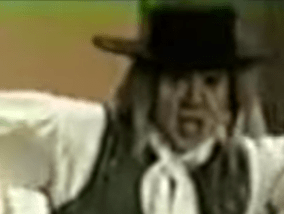
The old age makeup makes it impossible to be sure, but I suspect this is Lombard as Stephen Hopkins.

Lombard bore a resemblance to Carel Struycken, the actor who played the very tall man in Twin Peaks. So much so that when I first saw this episode I was certain he was the same person. But they aren’t related. I do wonder if David Lynch or Mark Frost or casting director Johanna Ray saw this episode and had Lombard in mind when they cast Mr Struycken as “The Fireman,” who like Oberon appears unexpectedly and represents a remote and mysterious world.

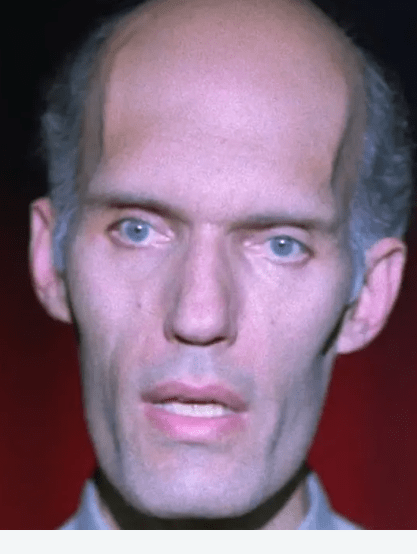
*Stephen Hopkins is not only a character in 1776, but also figures in H. P. Lovecraft’s “The Strange Case of Charles Dexter Ward.” Lovecraft says that (the fictional) Joseph Curwen had been a friend and supporter of his when (the historical) Hopkins was first governor of Rhode Island, but that when Curwen was exposed as a menace Hopkins personally took part in the raid on Curwen’s place. Since the story beginning today is based on another of Lovecraft’s tales, a connection between Lombard and Stephen Hopkins qualifies as a mildly amusing coincidence.
Episode 885: The girl in the portrait

We open with a reprise of yesterday’s closing scene. It is November 1897, and time traveler/ recovering vampire Barnabas Collins is about to be reunited with his lost love, Josette DuPrés, who threw herself to her death from the cliff on Widows’ Hill in February 1796. Josette is now reincarnated in the person of Kitty Soames, the dowager countess of Hampshire. Josette’s personality has been emerging from the substrata of Kitty’s unconscious mind in the eight weeks she has been staying at the great estate of Collinwood. Now Kitty and Josette are merging into a symbiont, and that combined being has agreed to marry Barnabas tonight. Kitty/ Josette is in the Old House on the estate, in the bedroom once meant for Josette, waiting for Barnabas to return from the great house where he has told his distant cousin Judith of their wedding plans.

Barnabas enters the bedroom just in time to see Kitty/ Josette assumed bodily into the portrait of Josette that hangs over the mantel. He reaches up to touch Kitty/ Josette, and the two of them both vanish.

Barnabas finds lying himself on the ground, wearing clothes he last put on in the 1790s. He stands up and calls out for Kitty. “Kitty! Kitty! Where are you, Kitty?” He calls her name several more times. Oddly, he stops short of calling out “Here, Kitty, Kitty, Kitty!” In a comment on Danny Horn’s post about the episode at his great Dark Shadows Every Day, user “kosmo13” wrote “It would’ve been cool if they’d had a cat wander into the scene at that moment and had Barnabas say ‘No. Not you!'”*

Barnabas comes face to face with Ben Stokes, who was his indentured servant and fanatically devoted friend in the 1790s. Ben has no idea why Barnabas is talking as if they haven’t seen each other for a long time- they saw each other last night, as far as he is concerned. Barnabas realizes that he has traveled back in time again. He was in 1897 after being dislocated from the 1960s. Now he has returned to February 1796, to the very night Josette killed herself.

Barnabas tries frantically to keep Josette from repeating her suicide. He sends Ben to the great house of Collinwood to see if Josette is in her room there, as she is supposed to be. He is concerned that, since the trip through the portrait left him on the ground near the woods, there is no telling where it may have dropped Kitty/ Josette.

He needn’t have worried about that. We see Josette in bed, as she was in #425, the first time the show took us through this night. Her aunt Natalie, the Countess DuPrés, is with her, and is intensely afraid of a prophecy foretelling Josette’s death this night. That much is identical to what we saw in the previous timeline, when the show was set in the 1790s in February 1968. Josette does tell the countess that she had an odd dream in which she was wearing an unfamiliar dress and having a conversation with a portrait; that dream, which Josette herself dismisses as not at all important, is evidently the only trace of Kitty left in Josette’s conscious mind.

Josette tells the countess about her dream. Screenshot by Dark Shadows Before I Die.

This scene plays on the iconography of these two actresses. From the moment Kathryn Leigh Scott showed up as Kitty in #844, her title has reminded us of Josette’s aunt. So it is with a nice sense of inevitability that we see the show’s first countess again. Moreover, Miss Scott first joined the cast as Maggie Evans, The Nicest Girl in Town; Grayson Hall as Maggie’s psychiatrist, Julia Hoffman, MD. So it seems right to us when the countess becomes a therapist and listens intently to Josette’s account of her dream, growing only more interested as Josette insists that the dream was unimportant.

The first time through, Barnabas was trying to kill Josette and turn her into his vampire bride. Wicked witch Angelique, who had made Barnabas a vampire in the first place, lured Josette to the top of Widows’ Hill and showed her a vision of herself as a vampire. When Barnabas showed up, Josette ran from him and jumped off the cliff, flinging herself to a death on the rocks below rather than let him make her what he was.

This time, Barnabas wants Josette to live. He knows what Angelique is planning. During his eight months in 1897, he and Angelique became allies, almost friends. So it is logical that he meets with her and asks her to leave Josette alone. But this is Angelique as she was in #425. She is enraged with Barnabas, and full of hate for Josette. She does listen to him, and for a moment she seems to be considering his request that she stay with him through the night. One wonders how she would have reacted had Barnabas leveled with her about what happened in 1897, explaining why he thinks they can be something other than enemies. But he holds back, telling her nothing. She makes a hostile remark, and vanishes.

Angelique does just what she did the first time- she tricks the countess into leaving Josette’s room, projects a voice that Josette mistakes for Barnabas’ voice calling her to go to Widow’s Hill, and causes Josette to see a vision of herself as a vampire once she is on top of the hill. At the end, we hear footsteps approaching. The last we saw Barnabas, he announced he was hastening to Widows’ Hill to keep Josette from jumping; if he arrives now, that is exactly what he will prompt her to do.

In the 1897 segment, Grayson Hall played broad ethnic stereotype Magda Rákóczi and also had a few weeks as Julia. Today she returns to the cast after an absence of more than five weeks. She spent that time in Excelsior Springs, Missouri, where she had a part in a movie called Adam at 6 AM. The cast included Michael Douglas, Joe Don Baker, Dana Elcar, Louise Latham, and Meg Foster. Actor Steve McQueen was one of the producers. Hall and Elcar were the only Dark Shadows alums in the company, though Foster later played an ultra-soapy story opposite David Selby in a miniseries called Washington: Behind Closed Doors.

We haven’t seen the countess since #666. In that one, Barnabas had traveled back to a night a few weeks after the one he arrives in today. He made a terrible mess of things, which is his function on the show, and Ben wound up inadvertently killing the countess. Seeing her today, regular viewers can hope that, whatever misfortunes Barnabas brings with him this time, at least that won’t happen. The countess is a likable character, and while there was a point to showing Ben becoming a murderer it is a point they have already made. They won’t lose anything if they imply that the events we are about to see prevent it from happening.

*Posted 25 December 2024 on Danny Horn, “Not in Canvas Anymore,” Dark Shadows Every Day, 21 June 2016.

Episode 884: Departure date

It is November 1897, and time traveler/ recovering vampire Barnabas Collins is searching through the burned remains of a cottage recently occupied by famed artist/ criminal lowlife Charles Delaware Tate. Barnabas finds a pair of glasses just outside the front door and a length of chain just inside. The glasses belonged to Tate’s master, evil sorcerer Count Petofi, the chain to a creature named Garth Blackwood whom Petofi and Tate summoned from the depths of Hell. When Barnabas was last in the house, Blackwood had taken Petofi prisoner there and announced his intention to kill him. Petofi couldn’t get far without his glasses, and the chain was Blackwood’s very favorite murder weapon. So Barnabas has reason to believe both of them died in the fire.

Tate shows up. Barnabas demands he paint another portrait of Quentin Collins to replace the one destroyed in the fire. Quentin is Barnabas’ friend and distant cousin, and, because of some magical powers Petofi long ago gave Tate, the portrait kept Quentin from turning into a werewolf. Tate is a jerk about Barnabas’ demands, as he is a jerk about everything, but finally says he will comply. He tells Barnabas to come back to the ruins of the cottage at 10 PM to pick up the portrait. Barnabas is surprised to hear that Tate can work so quickly, and Tate does not explain why he needs so little time. But after all, the important thing is simply that the magic spell is renewed- the portrait doesn’t have to have any particular aesthetic quality. Perhaps a simple sketch will serve that purpose as effectively as did the full oil painting Tate did previously.

Meanwhile, back at the great house of Collinwood, Quentin’s sister Judith is busy with a project of her own. She is torturing her husband to death. He is the odious Gregory Trask, so she has the audience’s sympathy, at least up to a point. She has had Trask bricked up in Quentin’s old room. There is a telephone there which can receive incoming calls, but not make outgoing calls. Judith has been using it to torment Trask. Today, she directs Trask’s attention to two objects which he has somehow overlooked in his time in the room. One is a portrait of Amanda Harris, a woman he tried to seduce while he had Judith imprisoned in a sanitarium. The other is a loaded gun. When she calls him for the last time, she does not receive an answer, evidently because he has shot himself to death.

Judith is the third role Joan Bennett played on Dark Shadows. In the parts of the show set in the 1960s, she plays matriarch Elizabeth Collins Stoddard. Liz is a depressive personality who keeps trying to kill herself. When from November 1967 to March 1968 the show was set in the 1790s, she played Naomi Collins, Barnabas’ mother, who actually did kill herself when she found out that her son was a vampire. Now she plays someone who, though she was introduced as a psychologically fragile individual, does not kill herself, but drives one of the major villains to commit suicide. Judith’s method of disposing of Trask is not morally defensible, but it is interesting to see Bennett playing a more assertive character.

Trask’s discovery of the portrait of Amanda leads to an interlude in New York City, a place the show hasn’t taken us since #8. Quentin is in a hotel lobby there, waiting for Amanda. She is surprised to see him. They had been lovers, and had planned to leave Collinsport together. He did not meet her at the train station. She had told him that if he did not, she would understand that he had given up on their relationship, so she had gone ahead without him. She says she is so overjoyed at the sight of him that she won’t ask for explanations, but he gives one anyway. He tells her about the portrait. Since she herself came to life as the result of another of Tate’s magical paintings, she can’t very well dismiss the story out of hand. He says that because he does not know where the portrait is, he cannot be sure he won’t become a mindless ravening beast at the next full moon, so he will have to leave her.

Oddly, Judith takes time out from her torture of Trask to perform the same function of motherly talk-to that Liz and Naomi often served. Kitty Soames, the dowager countess of Hampshire, has been staying at Collinwood for the last eight weeks, and is engaged to marry Judith’s stuffy but lovable brother Edward. Contrary to what her title would suggest, Kitty is an American woman in her twenties. Judith sees Kitty coming downstairs with two leather overnight bags. Kitty explains that she will be leaving at once and never returning. She has realized that she cannot marry Edward. She says that she has not told Edward this. Judith says that she is disappointed that they will not be sisters, but that she admires her for facing the truth and doing something about it.

Later, Barnabas comes to the great house. He finds Judith worried that Kitty’s bags are still in the foyer, though she has been gone for hours. He says that he knows where she is. She is waiting for him. They will be married later tonight. Judith is bewildered by this. Barnabas says that they will come back after their wedding and tell Edward what they have done, and that they will then leave Collinwood forever. She is sad to think that they will be going.

In fact, Kitty is two people at once. The young dowager shares her body with the soul of the late Josette DuPrés, whom Barnabas loved when he was a living being in the 1790s and whom he tried to recreate when he was a vampire in the 1960s. Ever since Kitty arrived at Collinwood in #844, Josette has been forcing her way into her conscious mind, triggering psychotic episodes and from time to time pushing Kitty aside and living through her body. Now Kitty is in the bedroom once meant for Josette in the Old House on the grounds of the estate. Josette’s voice keeps speaking to Kitty through the portrait of her that hangs there, urging her to let go and accept her place as part of a combined entity that will love Barnabas and live with him in the bonds of matrimony. Kitty struggles against the voice. For a time she hopes Barnabas will help her thwart Josette’s attempt to come back to life and take the leading part in their symbiotic existence, but when he enters he urges her to give up the fight and become Josette.

Kitty is alone in the room when she suddenly finds herself wearing Josette’s white dress. She floats off the floor and into the portrait. Barnabas enters just in time to see Kitty merge with the portrait. He reaches up to the Kitty/ Josette entity in the frame above the mantel, and he and Kitty both disappear from the screen at the same time.

Josette puts Kitty in the picture. Screenshot by Dark Shadows Before I Die.

Josette was first mentioned in #5 as the lady who went over the cliff at Widows’ Hill, and her ghost emerged as the tutelary spirit of Collinwood in the months that followed. In #70, our first view of the Old House involved the first truly ambitious special effect, when Josette’s ghost, who was Kathryn Leigh Scott in a veil and a white dress, emanated from the portrait and took three steps from it down to the floor. When Miss Scott’s Kitty rises up into the same portrait today, longtime viewers will see that momentous little journey in reverse.

Barnabas was not dreamed of until long after Josette’s ghost emerged. When we first saw him in the Old House in #212, he delivered a speech to her portrait telling her that her power on the estate was ended, and for several weeks afterward strange and troubled boy David Collins, who had been the ghost’s close friend, lamented that he could no longer feel her presence. In those days it sounded like Josette was Barnabas’ grandmother, and she had sided with his father in the fateful conflict that led to his becoming a vampire.

Later, Josette was retconned as Barnabas’ lost love. In a plot borrowed from the 1932 film The Mummy, Barnabas decided that Maggie Evans, The Nicest Girl in Town, was Josette’s reincarnation, and he tried to torture her into accepting this fact. Maggie resisted Barnabas. She ultimately escaped, only to have her memory of his abuse wiped clean by her psychiatrist, Barnabas’ accomplice and future best friend Julia Hoffman, MD.

Maggie was another Kathryn Leigh Scott character. When Miss Scott played Josette in the 1790s segment, the show was sticking to its source material, in which Zita Johanns played Imhotep’s victim Helen Grosvenor in the contemporary sequences and his lost love, Princess Ankh-Esen-Amun, in the flashback to ancient Egypt. It also left us with the uncomfortable feeling that perhaps Barnabas was onto something when he devised his horrifying program of cruelty towards Maggie. Sure, his methods were wrong, but if she “really” was Josette, he wasn’t just crazy.

With Kitty, they take us a step further. Barnabas’ attempt to Josettify Maggie made the show so bleak for so many weeks that longtime viewers will flinch at the thought that Kitty would be right to yield to Josette’s importunings, and even more at the idea that this will lead to a happy marriage between the Kitty/ Josette symbiont and Barnabas. Yet within the context of what we have seen in the 1897 segment, these would seem to be plausible conclusions. The body they share is as much Josette’s as it is Kitty’s, and Kitty has nothing to lose by merging fully into the being who lurks in the substrata of her mind.

For his part, Barnabas’ relationship to Kitty represents almost as drastic a departure from the personality he showed in his relationships to Miss Scott’s previous characters as the reinvention of Josette as his lost love rather than his estranged grandmother did in his early days on the show. He does not abduct her, torture her, or even give her Josette’s hypnotic music box. It is Josette’s ghost, always before shown as a benevolent force, that keeps pressing the transformation on Kitty. Barnabas is a gentle and considerate lover to the Josette part of the Kitty/ Josette complex, and is solicitous to the Kitty part. When Barnabas disappears with Kitty, we reverse not only the walk Josette’s ghost took in #70, but also the speech he gave in #212. So far from wanting to expel Josette from the world of the living as he did then, or turn her into his vampire bride as he tried both with Maggie in 1967 and with the living Josette in 1796, he wants to revive her as herself.

Barnabas’ function on the show, both when he is an outright villain and when he is trying to be the good guy, is to create problems that other characters will have to solve. So this moment of benevolence and rationality cannot last. It is the ultimate indication that the 1897 segment has indeed ended. But it is a beautiful little thing, for the few minutes it lasts.

This episode marks the final appearance of Trask and of Judith. We will see Kitty again tomorrow, but only in a reuse of today’s closing scene. After that she will only be implied as a feature of Josette’s unconscious mind.

Episode 874: Makes a girl feel creepy

Ever since its first time-travel storyline, when it spent November 1967 through March 1969 visiting the 1790s, Dark Shadows has been committed to treating its cast as a repertory theater company. Now, we are coming to the end of the 35th week of an arc set in 1897, and most of the actors are not only playing characters unique to that year but are playing two characters at once. So David Selby joined the cast as rakish libertine Quentin Collins, and Thayer David, who has played several parts on the show, had been playing sorcerer Count Petofi. But a few weeks ago Petofi cast a spell to trade bodies with Quentin. I refer to the villainous Petofi who looks like Quentin as Q-Petofi and to the forlorn Quentin who looks like Petofi as P-Quentin.

In #819, Petofi found uptight minister’s daughter Charity Trask to be an irritant, and so he erased her personality. He replaced it with that of late Cockney showgirl/ mentalist Pansy Faye, whom Charity had never met. Pansy has been residing in Charity’s body ever since. Charity had run out of story, and Pansy is a lot of fun, so it would be a pure loss if this transformation were reversed.

Pansy Faye, occupying the former body of Charity Trask.

In #844, a young American woman named Kitty Soames arrived at the great house of Collinwood. Kitty is the dowager countess of Hampshire. The late Earl was a friend of Quentin’s stuffy but lovable brother Edward, and because of his involvement with Petofi he died penniless. Kitty is hoping to marry Edward and rescue her financial position. Since Edward is also penniless and looking for a way out of his troubles, we might look forward to a comedy resolution where each finds out about the other’s poverty on their wedding day.

But that doesn’t seem to be in the cards. From the day of her arrival, Kitty has been having psychotic episodes. These are triggered by the irruption into her consciousness of the mind of the late Josette DuPrés. In the 1790s, Josette was engaged to marry Barnabas Collins. A wicked witch sabotaged their engagement, turned Barnabas into a vampire, and drove Josette to kill herself. Barnabas became obsessed with recreating Josette; in 1967, when the show was set in contemporary times, he tried to achieve this by abducting women and torturing them. Now Barnabas has traveled back in time to 1897, and he is apparently not being evil when he urges Kitty to allow Josette to take over as her primary consciousness.

Barnabas and Kitty, under Josette’s watchful eyes.

Petofi’s magical powers are concentrated in his right hand, and he took them with him when he moved into Quentin’s body. Today we see that he is losing these powers. Q-Petofi confronts Barnabas, who is for the time being free of the effects of the vampire curse. Q-Petofi announces he will restore those effects and touches Barnabas’ forehead with his right hand. When nothing happens, Barnabas taunts him. Later, Q-Petofi confronts Pansy, who has figured out about the body swap. He announces he will turn her back into Charity. He touches her with his right hand, and again nothing happens. She complains that he makes her feel creepy acting like that. The scene between Q-Petofi and Pansy really is hilarious.

For her part, Kitty/ Josette has gone to P-Quentin, whom she believes to be Petofi. She insists he touch her with his magic hand and clear up her identity crisis; unable to convince her he has no powers, he plays along. To his amazement and delight, it works. She realizes she is both Kitty and Josette, and he realizes that he now has Petofi’s powers.

Kitty/ Josette goes to her room in the Old House on the estate of Collinwood. Josette has communicated with the living through her portrait since its first appearance in #70; longtime viewers will remember a one-sided conversation strange and troubled boy David Collins had with it in #102. Kitty hears the portrait talking to her, urging her to become Josette, assuring her they will be happy once they meld into a symbiont. Barnabas shows up, and Kitty/ Josette has a candid and endearing conversation with him. She realizes the whole truth about him; she knows everything Josette knows. She cannot decide what she ought to do.

Episode 873: Charming and exquisitely dangerous

In October 1897, sorcerer Count Petofi has used his magical powers to swap bodies with Quentin Collins. I refer to the villainous Petofi who looks like Quentin as Q-Petofi, and to the forlorn Quentin who looks like Petofi as P-Quentin.

We open with Q-Petofi meditating on a lineup of I Ching wands. He goes into a trance which unlocks a cosmic force that transports him to the great house of Collinwood in 1969. He wanders into the drawing room, finds a newspaper dated 28 October of that year, and starts exulting. Maggie Evans, governess in the great house in the late 60s, hears him and comes downstairs.

As the segment of Dark Shadows set in 1897 winds down, we’ve been thinking of ways they might have moved forward. Some of the possibilities involve splitting the week between episodes set in 1897 and others set in 1969. Maggie has been on the show from episode #1, and has been central to several of the storylines that take place in contemporary dress. The last of these stories before the move to 1897 centered on Quentin’s malevolent ghost haunting Collinwood and making it impossible for anyone to live there. In the course of that, he appeared to Maggie several times. In #682, Maggie had a dream in which Quentin’s ghost strangled her to death. Though the events we have seen in 1897 have changed the future, we saw in #839 that the 1960s characters remember Quentin’s haunting. So when Maggie is on her way to meet someone who is to all outward appearances Quentin, we have a hint that a story might be brewing in which Q-Petofi finds himself carrying the can for all of the horrors Quentin’s ghost wrought between December 1968 and September 1969.

Alas, it is not to be. By the time Maggie reaches the drawing room, Q-Petofi has vanished. A few moments after he left 1897, maidservant Beth scattered the wands and brought him back. He is furious when he comes to, and she explains that she had to do it. The magical portrait that keeps Quentin, and presumably also Q-Petofi, from becoming a werewolf is not in the suitcase Q-Petofi gave her earlier in the evening to bury. Q-Petofi has been in possession of Quentin’s body and of his portrait for weeks, and he has vast powers of sorcery, so you’d think he would have hidden the portrait long before. His magic powers would seem to give him the ability to do anything at all to hide it. My favorite idea is that he would impose onto Quentin’s portrait an exact copy of the portrait that hangs above the mantel in the drawing room of the great house and hang it in its place, so that it would be hidden in plain sight for years to come.

Besides, if Q-Petofi was going to bury the portrait surely he would at least have put it in something airtight and made of metal, not a wooden suitcase that doesn’t close all the way and that will likely rot to dust in a year or two. Apparently he isn’t as big on long-term plans as he led us to believe when he claimed he was working on a design to become the ruler of the cosmos.

Q-Petofi orders Beth to bring Pansy Faye, a deceased Cockney showgirl/ mentalist who has for some time been inhabiting the body once occupied by the stunningly dreary Charity Trask, to Quentin’s room at Collinwood. He demands information which she refuses to give. She storms out.

Pansy has a dream in which she and Quentin dance in the drawing room of Collinwood while a specially recorded version of her song, I Wanna Dance for You, featuring the voices of Nancy Barrett and David Selby, plays in the background. Colors flare on the screen while we hear them sing. Miss Barrett was an excellent singer, Mr Selby an adequate one. He does speak a few of his lines, which damages the rhythm of the song, and the flaring colors often obscure the actors completely. Mr Selby and Miss Barrett are so lovable that we very much want to overlook these flaws in the number’s conception.

The dream ends with Quentin turning into Petofi and laughing evilly at Pansy. She awakes in horror. She has known for some days that Q-Petofi isn’t Quentin, and she knows enough about Petofi that it is strange she hasn’t already figured out that he is the one hiding inside his body. But when she sits up with a gasp, we know that she has finally put it all together.

Time-traveler Barnabas Collins, a recovering vampire, meets Q-Petofi in the drawing room at Collinwood. Q-Petofi is convinced that Barnabas stole the portrait of Quentin, and is very aggressive about pressing his suspicions. Barnabas has been playing dumb ever since his vampirism went into remission, but after a couple of minutes of Q-Petofi’s hectoring he addresses him as “Count Petofi.” When Barnabas cannot tell him what he wants to hear, Q-Petofi declares that he will restore the vampire curse to its full potency. He touches Barnabas’ forehead with the right hand in which his powers are concentrated. Barnabas squeezes his eyes shut for a moment, then opens them with a look of triumph. He asks Q-Petofi what has become of his powers.

The rest of the episode revolves around yet another possessed person. Kitty Soames, a young American woman who is the dowager countess of Hampshire, is also Josette DuPrés, who plunged to her death from the cliff at Widow’s Hill 101 years before. Barnabas was supposed to marry Josette at one point, and he has been obsessed with recreating her ever since.

In May and June of 1967, when the show was set in the present, Barnabas abducted Maggie and tried to brainwash her into becoming Josette. In those days, the show was ambiguous about why Barnabas picked Maggie. Strange and troubled boy David Collins was an intimate friend of Josette’s ghost, and when he saw Maggie in Josette’s dress in #240 and #241, he thought she was Josette, looking just as she always did. Indeed, Miss Scott had played the ghost a few times, always behind a veil. When Barnabas was about to give up on Maggie in #260 he very earnestly told her “But you are Josette!” Yet after Maggie escaped, he picked another girl and planned to repeat the experiment with her, explaining to his sorely-bedraggled blood thrall Willie in #274 that all you have to do is “Take the right individual, place her under the proper conditions and circumstances, apply the required pressure, and a new personality is created.”

But when the show made its first trip back in time, visiting the 1790s from November 1967 to March 1968, Kathryn Leigh Scott played Josette. That was a bold move. Longtime viewers were left with the uncomfortable feeling that Barnabas may have had a point when he devised the horrifying program of torture that made the show so terribly bleak for several weeks. When we see Miss Scott playing Kitty, who really is Josette and really does have to accept that fact, longtime viewers can only squirm as they remember Barnabas shoving Maggie into his old coffin and later walking down the long gray corridors of his basement on his way to the prison cell where he was going to murder her. We’ve since come to know Barnabas as an endearingly ineffectual comic villain, but it is a stretch to remind us of him as he was in those grim days and ask us to concede that he was in any sense right.

Kitty confronts Barnabas at Collinwood and accuses him of orchestrating her Josettifying psychosis. He denies that he is responsible, and claims to know that Josette’s spirit lives in her and that she ought to yield to it. When she asks how he knows, he makes up a story about being a boy in England, falling in love with a portrait of Josette, and reading her diaries. She is unconvinced.

Later, Josette goes to P-Quentin in Petofi’s old squat, the abandoned mill on the North Road. She believes he is Petofi, and asks him to use his power to resolve her identity crisis. He tries to explain that he only looks like Petofi, and has none of his power, but she refuses to believe him. Having nothing to lose, he decides to play along. He tells the right hand to tell Kitty the truth about herself, and touches her forehead. She suddenly realizes that she is both Josette and Kitty. P-Quentin just as suddenly realizes that Petofi’s power has returned to the body in which he is now an unwilling tenant.

Kitty/ Josette keeps telling P-Quentin that she remembers what he was able to do with his right hand when he was staying with her and her late husband in England a few years before. This is a pretty bad continuity error. For eight weeks from #778, the most dynamic story on the show centered on the fact that Petofi’s hand was cut off in 1797 and kept in a box by a Romani tribe for the hundred years since, until broad ethnic stereotype Magda Rákóczi stole it in an attempt to lift the werewolf curse from Quentin. It was only in #815, in August, that Petofi reattached his hand and with it regained the bulk of his power. Granted, #815 is eleven and a half weeks ago, but the show now takes so little time to onboard new viewers by recapping that the writers are clearly counting on the audience to have a great deal of information about the story so far in their heads. As such, it is very surprising that they would break from established continuity on such a major point of the recent months.

Episode 867: The name of your beloved

The dramatic date is October 1897. Sorcerer Count Petofi is using the body of Quentin Collins as a disguise. While he is doing this, I call him Q-Petofi.

Q-Petofi has stripped witch Angelique of her powers and confined her in the cave where the chained coffin of vampire Barnabas Collins is kept. In #845, we saw Cockney showgirl/ mentalist Pansy Faye open this coffin and drive a stake. Now, Angelique starts banging away at the lock on the chains with a rock. When Q-Petofi’s servant Aristide comes to investigate the noise, Angelique talks about pulling the stake out of Barnabas’ heart so that he will rise again. Aristide dismisses this idea.

Longtime viewers won’t be so sure that pulling the stake out will not bring Barnabas back. In #630, broadcast and set in November 1968, warlock Nicholas Blair pulled a stake from the heart of vampire Tom Jennings and put him back into operation. That came to mind in #846 when Quentin’s brother, stuffy but lovable Edward Collins, learned that Pansy had staked Barnabas and decreed, not that Barnabas’ body be taken out into the sunlight and allowed to disintegrate, but that the coffin be chained and the cave sealed up.

Presenting the stake in the vampire’s heart as an on/ off switch lets a lot of the suspense out of the show, and it feels like a cheat. But however bad the idea is, apparently it was not original to Dark Shadows. Two frequent commenters bring this out under Danny Horn’s post about the episode at his great Dark Shadows Every Day. “Courtley Manor” (also an FotB here) writes:

Well, in some vampire legends the stake through the heart (or often the stomach or solar plexus) served a two-fold purpose. Believing a corpse was bloated due to ingestion of blood (which we now know is rather caused by gases produced by microscopic organisms during decomposition), the vampire slayer would deprive the bloodsucker of its recent meal and also the ability to consume more blood by, in effect, bursting it like a balloon. Also, the stake pinned the nightwalker to the earth or coffin so it couldn’t roam about anymore. Dan Curtis and/or the writers may have been drawing on these older legends, and figured that removing the stake could conceivably allow the vampire to heal from its wound and rise again.

Comment left 9 March 2021 by “Courtley Manor” on Danny Horn, “Episode 867: Nothing Up My Sleeve,” 26 May 2016, at Dark Shadows Every Day.

“Goddess of Transitory” added this remark to “Courtley Manor’s”:

John Carradine played exactly this in the old film House of Dracula–he starts out as a skeleton in a coffin with a stake in its rib cage as part of a sideshow but when the stake is removed, he’s back–cape, hat, and bat transforming powers intact.

Comment left 12 April 2021 by “Goddess of Transitory” on Danny Horn, “Episode 867: Nothing Up My Sleeve,” 26 May 2016, at Dark Shadows Every Day.

Meanwhile, back at the great house of Collinwood, Q-Petofi is passing as Quentin. Edward is fretting that his girlfriend Kitty Soames is missing. Kitty, a young American woman who is the dowager countess of Hampshire, has been having psychotic episodes ever since she arrived at Collinwood in #844. Unknown to Edward, these are the result of the spirit of the late Josette Collins taking possession of her. Q-Petofi found Kitty in Josette’s room at the Old House on the estate earlier, and lost track of her when she ran out into the woods.

Kitty/ Josette comes wandering into the drawing room. She claims to have seen Barnabas in the woods. When she says where in the woods she saw him, Q-Petofi says “Near the cave!” Edward wants to go to the cave to see if Barnabas is still in his coffin. Q-Petofi, not wanting Edward to walk in on Angelique and Aristide, volunteers to go. When Edward says he thinks he ought to handle the matter himself, Q-Petofi causes Kitty/ Josette to feel a chill. She asks Edward to stay with her, and he agrees to let Quentin go.

Q-Petofi finds Aristide holding a gun on Angelique. Aristide tells him what has been going on, and they open the coffin. They find Barnabas still inside. We see him there, the stake still in his chest.

Hello, Barney, well, hello, Barney! It’s so nice to have you back where you belong.

This is the first time we have seen Jonathan Frid since #845. He’s been in Chicago doing a play. Clearly Dan Curtis isn’t going to pay his fee just to have him lie in the coffin and breathe rapidly while the others talk about how dead he is, so we know that Barnabas is back.

Q-Petofi says that he will come back later and that he and Aristide will destroy the coffin and the body. To keep Angelique from making any more trouble, he casts a spell and surrounds her with magical flames.

While Q-Petofi is back at Collinwood reassuring Edward and Kitty/ Josette that Barnabas is dead, Angelique offers to tell Aristide secrets that no mortal man knows if he will release her from the magic flames. Aristide has no supernatural powers or occult knowledge; he is just a lummox whom Q-Petofi employs because he likes his looks and finds his sadism useful when he wants someone tortured to death. But somehow Aristide is able to stop the flames. Before Angelique can start talking, he pulls a knife on her and tells her that he doesn’t want her secrets- he just wants to kill her. Aristide has a special knife that he makes a fetish of. He calls it “The Dancing Girl.” Except when he calls it “The Dancing Lady.” At any rate, this isn’t it.

Aristide is inefficient about taking the knife out of its hiding place. He gives Angelique time to run out of the cave. He runs after her, and she hits him in the head with a rock, knocking him out. When he comes to, Aristide sees a man standing over him, asking for help. It is Barnabas.

Episode 866: Some various phases of change

It is 20 October 1897. Angelique, immortal witch and time-traveler, has discovered that her sometime fiancé, Quentin Collins, is not himself. He is 150 year old sorcerer Count Petofi, and Petofi is him, having used his magic powers to force Quentin to trade bodies with him. I will refer to the villainous Petofi who looks like Quentin as Q-Petofi, and to the forlorn Quentin who looks like Petofi as P-Quentin.

Q-Petofi

Yesterday, Q-Petofi caught Angelique trying to help P-Quentin. He attacked her, and we open today in a cave where he has imprisoned her. He tells her he has stripped her of her powers. He demands she tell him what she and time-traveling mad scientist Julia Hoffman have been doing. Regular viewers know that Julia is gone, having vanished from 1897 and returned to the 1960s in #858. That Q-Petofi does not know this is one of the few signs we have had recently that he has limitations.

Q-Petofi leaves Angelique in the cave with a chained coffin. He tells her that it is the one in which her ex-husband, vampire Barnabas Collins, was staked (#845.) She looks at the coffin and gives a little soliloquy about how she needs Barnabas, but he cannot help her.

Q-Petofi is not the only resident of the great house of Collinwood who is not the person he seems to be. Kitty Soames, a young American woman who is the dowager countess of Hampshire, came to Collinwood intending to get Quentin’s stuffy but lovable brother Edward Collins to marry her by concealing some key facts about her financial status. But the very day she arrived, in #844, Kitty found that she was the one most gravely deprived of information about herself. As soon as she saw the portrait of Barnabas that hangs by the front door in the foyer, she became possessed by the spirit of Barnabas’ lost love Josette.

Kitty’s episodes of Josettification have continued. Today’s begins with another look at the portrait and a longing sigh. As sight of the chained coffin sets off Angelique’s yearning for Barnabas, so the portrait is the visual cue that triggers Josette to come to the surface of Kitty’s mind. By the end of the episode, she will be in Josette’s bedroom at the Old House on the estate, telling an unseen person that she is waiting for him.

Kitty is still herself most of the time. And we can assume that sooner or later, Petofi will be defeated and Quentin will return to his right body. But a third resident of the great house has made a permanent and irreversible change of spirit. Her body is that of Charity Trask, whose father, the odious Gregory Trask, is married to Quentin and Edward’s sister Judith. But in #819, Petofi annihilated Charity’s personality and replaced it with that of Pansy Faye, a Cockney showgirl/ mentalist who came to Collinwood in #771 and was killed that very night, without ever having met Charity.

Angelique and Kitty/ Josette yearn for Barnabas’ return. Increasingly, the audience does too- there doesn’t seem to be anywhere the story can go until he comes back. That sets them and us against Pansy. She doesn’t share our concern for narrative progression- she is such a daffy invention she can amuse us all by herself. And she knows that Barnabas was a vampire, who preyed on Charity and was ultimately, if indirectly, responsible for Pansy’s death. Indeed, it was she who drove the stake in #845. So Barnabas is absolutely the last person Pansy wants to see again. But now someone else has emerged in next to last place.

On Friday, Pansy looked at Q-Petofi and realized that he was not Quentin. She confronted him with questions that Quentin could answer but he couldn’t, exposing him to Angelique as an impostor. When Pansy shut herself in her room, Q-Petofi went upstairs and through her door threatened that if she didn’t keep quiet “her days [would be] numbered.” Now, she has passed a note to Edward reporting on the incident. Edward and Q-Petofi meet with Pansy in her room. She tells Edward about the visions and sensings that led her to conclude that the man with him is not really Quentin. Edward thinks Pansy is just a delusion Charity is having, and so cannot ascribe much evidentiary value to these experiences. Q-Petofi claims that when he said “her days are numbered” he meant that her days as a resident of the house were numbered if she went on saying bizarre things about him. Edward asks Pansy if she might be mistaken in her interpretation of her psychic data. She says she never has been before, but allows, in a very reasonable tone, that it is possible she could be this time.

Pansy is, at the moment, the only person who could possibly be an ally for P-Quentin in his attempt to return to his own body. She does not seem to be a match for Q-Petofi’s magical powers, and so others would have to be recruited to help in the fight. But if she is now as unsure as it seems, P-Quentin doesn’t even have a place to start.

When Kitty/ Josette is in the room at the Old House, she looks at the portrait of Josette and sees that it is signed and dated. We’ve seen the portrait many times since its first appearance in #70, and it has never before borne either a signature or a date. The signature is “Coswell,” which is as good as any.

The date on the portrait is 1797, which is rather less good. In #402, set early in January 1796, we saw the portrait delivered to the Old House. Moreover, it was in #425, set in February 1796, that Josette flung herself to her death from the top of Widows’ Hill. So if this portrait is a replacement for the original, it was painted at a time when the subject was unavailable for further sittings.

Moreover, Kitty misstates the current date as 1797 in a letter to her mother, which is supposed to be a sign of her Josettification. Viewers who remember the 1790s flashback will just be puzzled by this, while those who do not are unlikely to see much significance in the date at all. It is hard to see why they’ve decided to retcon this particular point.

Episode 862: Reexamine your loyalties

Know Yourself

In yesterday’s episode, Kitty Soames, the dowager countess of Hampshire, found a note on the dresser in the room where she has been staying in the great house of Collinwood. It read “Know yourself, be who you must be.” The dramatic date is 1897, 1504 years after the Delphic oracle went out of business, so it is unlikely that its management sent the message as a translation of and commentary on their motto γνῶθι σεαυτόν.* It was also 83 years before the US Army adopted the slogan “Be all you can be,” so we can rule out the idea that a recruiting sergeant was trying to get Kitty to enlist. The US Army didn’t even accept countesses in those days, not even if, like Kitty, they originally came from Pennsylvania and are now in Maine.

Ever since she arrived at Collinwood in #844, the ghost of the gracious Josette has been taking possession of Kitty from time to time. The note prompts another spell of Josettification. Kitty puts on Josette’s wedding dress and wraps a red cloak around it. She mutters that “He is waiting for me,” not specifying who “he” is. She goes to the top of Widows’ Hill, the precipice from which Josette flung herself to her death a century before.

Josette was married to Jeremiah Collins. Jeremiah’s ghost appears to Kitty/ Josette. He urges her to leave Collinwood at once, lest “he” kill her. By this time the possession has worn off, and Kitty has no more idea who Jeremiah means by “he” than anyone overhearing her earlier would have known who Kitty/ Josette meant when she said that “he” was waiting for her.

Jeremiah’s ghost reaches out to Kitty.

Be on Guard Against Your Enemies**

Jeremiah vanishes, and Kitty is joined by a man she believes to be Count Petofi, the sorcerer who drove her husband to suicide. She fears Petofi and hates him, and is unhappy to find herself standing next to him at the top of a cliff, especially when she is in a confused frame of mind.

In fact, the man is not Petofi. Two weeks ago, Petofi used magic to force the devastatingly handsome Quentin Collins to change bodies with him. Now Petofi occupies Quentin’s strong young form, while Quentin is trapped in Petofi’s aging and feeble one. While this predicament lasts, I refer to Quentin as played by Thayer David as P-Quentin, and Petofi as played by David Selby as Q-Petofi.

P-Quentin meets Kitty.

P-Quentin tells Kitty that he saw Jeremiah’s ghost and assures her he did not cause it to appear. He tells her he is going to Collinwood, and firmly recommends she accompany him. She waits a moment, but seeing no alternative, she goes his way.

Do Not Fight an Absent Foe***

When P-Quentin first found himself estranged from his own body and encased in Petofi’s, he was too stunned to show much tactical sense. He went around blurting out what had happened, earning nothing but a reputation as a lunatic. Now he has learned to let people believe he is Petofi and to conduct himself as befits that role. So yesterday, he found that his sister, Judith Collins Trask, had returned to the house after a long absence. She had not met Petofi, so he introduced himself to her by that name and used his memories of their childhood to befriend her.

Back at Collinwood, P-Quentin enters the drawing room and tells Judith that Kitty is resting comfortably upstairs. Judith is impressed with his thoughtfulness, and leaves him alone in the drawing room while she goes to Kitty’s room. He sees that she is preparing a note for her attorney, Evan Hanley. It occurs to him that Evan can be of use to him, and he sets out for his house.

Give the Advice the Time Calls For ****

P-Quentin knocks on Evan’s door. Evan never met Petofi, and does not recognize him. He and Quentin were for a long time close friends and fellow Satanists, and when he identifies himself as Quentin he does not gain credence. He pushes his way in, and eventually persuades Evan to take him seriously. Evan agrees to go to Collinwood and see if the man who appears to be Quentin knows him, and, if he does not do so, to trick him into participating in a ceremony to reverse the body-swap.

Judith comes. While P-Quentin hides on the terrace, she tells Evan that she wants to revoke the power of attorney she granted to her husband, the odious Gregory Trask, while she was away. Evan makes excuses, but she insists, and he agrees to follow her directions. She exits.

P-Quentin returns, and tells him that if he has involved himself with Trask’s evil schemes, it is time for him to disentangle himself from them.

Act Like a Stranger, If You Are One*****

Back at Collinwood, Q-Petofi opens the drawing room door and sees Judith. Petofi never met Judith, and Quentin has not seen her since she left more than thirteen weeks ago. Not knowing who she is, Q-Petofi simply apologizes, says he didn’t know anyone was in there, and leaves. Thinking he is her brother, Judith is of course indignant.

Q-Petofi walks in on Judith.

Judith goes to the foyer and says she expected a warmer greeting. Not having the faintest idea who she is, the best Q-Petofi can manage is “Welcome to Collinwood.” When she protests that even their rather distant brother-sister relationship entitles her to expect better than that, the light comes to him and he calls her by name. This does not appease her.

There is a knock at the front door. Judith is enraged to see Q-Petofi standing still, and orders him to answer it. He does, and lets Evan in. When he does not speak to his old friend, Judith demands to know if he doesn’t recognize Evan either. Q-Petofi pretends to know him, and is powerless to do anything but agree when Evan asks him if he remembers the meeting at his house tonight.

Q-Petofi had been cruising along unchallenged so far. How could he not, when the secret he is concealing is so bizarre? But his interaction with Judith, though it has not exposed his identity, has antagonized someone whose support would be useful to him, and now Evan knows that P-Quentin was telling him the truth.

Know Your Chance ******

Q-Petofi shows up at Evan’s. After some verbal jousting, Evan tells Q-Petofi to take a seat with his back to the room. He says that he has been chosen to preside over the festivities. P-Quentin sneaks up and chloroforms him. Evan says that he doesn’t know how long the chloroform will last, so they must proceed with the ceremony at once.

Honor Good Men *******

When Jeremiah’s ghost fades away, we see Timothy Gordon for the last time. Gordon was a frequent stand-in and background player starting in July 1966. His right hand, which he extends to Kitty in the screenshot above, was the hand that shot out of the coffin Willie Loomis was trying to plunder in #210. In mischievous moments, I think that makes him “Barnabas Collins #1,” in imdb terms. Then again, Jonathan Frid had posed for the face of the portrait of Barnabas some weeks before, and producer Robert Costello modeled for the portrait’s body before that. Many of his fellow extras went on to big careers, but Gordon’s turn as Jeremiah’s ghost made him the only performer to graduate from background player to credited member of the main cast of Dark Shadows. So I think of him as their representative.

*Greek for “Know yourself,” one of 150 maxims inscribed in the walls at the oracle. Γνῶθι σεαυτόν (gnōthi seauton) was one of two inscribed at the entrance, the other being Μηδεν ἄγαν (mēden agan,) “nothing in excess.” The maxims are preserved in a book by a fifth century CE author named Stobaeus; many of them appear on stones that archaeologists have found at Delphi. There’s a handy list of them on Wikipedia, pairing the Greek with some more or less OK translations. The eighth maxim on Stobaeus’ list is Σαυτον ἴσθι (sauton isthi,) “Be who you are,” which sounds a bit like the second half of the note on Kitty’s dresser.

**Stobaeus’ twenty-ninth maxim is Ἐχθρους ἀμύνου (ekhthrous amynou,) “Be on guard against your enemies.”

***Stobaeus’ 125th maxim is Ἀπόντι μὴ μάχου (aponti mē makhou,) “Do not wage a battle against one who is absent.”

****Stobaeus’ 103rd maxim is Βουλεύου χρόνῳ (bouleuou kronoi,) “Give the advice right for the time.”

*****Stobaeus’ twelfth maxim is Ξένος ὢν ἴσθι (xenos ōn isthi,) which we would translate word for word as “Stranger being, be.” The idiom plays on two senses of the verb εἰμί- the participle ὢν means “If you in fact are,” while the imperative ἴσθι is “assume the character of.” It is the same kind of play on words that you see in the word “like” in the English sentence “Time flies like an arrow, but fruit flies like a banana.”

******Stobaeus’ tenth maxim is Καιρον γνῶθι (kairon gnōthi,) “Know the proper time.”

*******Stobaeus’ sixty fifth maxim is Ἀγαθους τίμα (agathous tima,) “Give honors to the good.”

Episode 861: Complete control of my faculties

Judith Collins Trask, owner of the estate of Collinwood and all the Collins family businesses, has returned home after more than thirteen weeks confined to a sanitarium. Her return is supposed to be a big shock, but they spoil it by having Joan Bennett do the opening voiceover. They really should have paid more attention to that sort of thing.

Judith’s husband, the odious Gregory Trask, gaslighted her into the sanitarium, and has been exercising control over the Collins family’s wealth ever since. Today, Judith tells her stuffy but lovable brother Edward that Trask never visited her during her time as a mental patient. Edward is surprised, telling her that Trask left the house for an overnight stay every week during that period, and presented these absences as visits to her. In fact, he is on such a trip now. She does not want to hear any more, and says she will give Gregory a chance to explain himself when he comes back to Collinwood.

Judith claims to be entirely herself. That puts her in the minority today. When she left Collinwood in July, Judith had a stepdaughter named Charity Trask. When she enters today, she sees someone who is to all appearances Charity leading Edward and a lady named Kitty Soames in a séance. The body is indeed Charity’s, but sorcerer Count Petofi erased Charity’s personality in #819 and replaced it with that of the late Pansy Faye, a Cockney showgirl and “mentalist” whom Judith met in #771, when Judith’s late brother Carl brought her to Collinwood as his fiancée. Pansy noticed Judith’s disapproval of her when she was alive, and is quite indignant about it now. That Judith keeps live-naming her, calling her “Charity,” doesn’t help.

Judith does manage to do something Edward failed to do a while ago, and talks Pansy into moving back into the great house of Collinwood. She agrees to give up the apartment she rented in the village of Collinsport after she took a job doing her old act at the local tavern, the Blue Whale. We saw her at the Blue Whale in Friday’s episode; it was shortly before nine PM, and she was the only person in the place. So perhaps her income as a cabaret performer is not particularly lavish, and the mansion is a more appealing place to live than the apartment that job would pay for.

For her part, Kitty is still, most of the time, the dowager countess of Hampshire. But the ghost of Josette Collins has been possessing her off and on ever since she arrived at Collinwood in #844, and the trend is definitely towards “on.” In Friday’s scene at the Blue Whale, Kathryn Leigh Scott played Kitty quietly and let Nancy Barrett’s Pansy provide the scene with all its Crazy Lady Energy; today, it is Miss Barrett’s turn to stand back and let Miss Scott show that Kitty is Pansy’s match in that department.

Crazy Lady Energy, also known as “CLE,” the main driving force of Soap Opera Land. Screenshot by Dark Shadows Before I Die.

Judith and Edward’s brother Quentin is in an even stranger predicament than are Pansy and what’s left of Kitty. Between #854 and #856, Petofi forced Quentin to swap bodies with him, so that David Selby now plays Petofi and Thayer David plays Quentin. I call Mr Selby’s portrayal of Petofi “Q-Petofi,” and Thayer David’s portrayal of Quentin “P-Quentin.”

Kitty with P-Quentin. Screenshot by Dark Shadows Before I Die.

The initial shock of finding himself estranged from his own body and trapped in Petofi’s left P-Quentin bewildered. All he could do was go to one person after another and tell the true story of what had happened, which produced only a widespread belief that Count Petofi had gone mad. Now he is starting to figure out how to use his resources.

P-Quentin’s first attempt to take advantage of the fact that everyone thinks he is Petofi was not successful. In #859, he exploited Kitty’s fear of Petofi and threatened to make her vanish if she did not bring him a portrait of Quentin later that night. Kitty tried to comply, but failed, and now it is long past the deadline. Soon she will realize that his threat was an empty one, and so far from being useful to him as a cat’s paw, she will be in a position to expose him as powerless.

Today, P-Quentin runs a smarter game. He introduces himself to Judith as Petofi, and claims to have psychic abilities. He pretends to read her palm, and tells her a story from their childhood that very few people could know. She is delighted, and decides that Count Petofi is someone she wants to see more of.

P-Quentin and Judith. Screenshot by Dark Shadows Before I Die.

In her bedroom upstairs at Collinwood, Kitty has another fit of Josettification. She opens the trunk at the foot of her bed and finds Josette’s wedding dress. She puts it on and wraps a red cloak around it. She goes to the top of Widow’s Hill, the cliff from which Josette jumped to her death in the 1790s. The ghost of Josette’s husband Jeremiah appears to her.

The show is set in 1897 now. It was set in the 1790s from November 1967 to March 1968. Miss Scott played Josette then, and for most of the segment Anthony George played Jeremiah. After Jeremiah’s death, Timothy Gordon played his ghost in a memorable part of the 1790s story. Gordon made two appearances as the ghost after the show returned to contemporary dress, playing him in #462 and #512. This is Jeremiah’s first appearance in 1897, and the second time, after #462, that Gordon’s name appeared in an on-screen credit on Dark Shadows.

Episode 860: I just say things

Edward Collins isn’t what he seems. His stuffy manner is real enough, as are his kind impulses when he sees people in distress. But he allows those who meet him to believe that he is the heir to the vast Collins family fortune, which in fact belongs in its entirety to his sister Judith. Judith is currently an inmate in a mental hospital. During her absence, her husband, the odious Gregory Trask, exercises control of all the family’s assets. Edward hopes to get out from under Trask’s thumb by marrying the dowager countess of Hampshire, a young American woman named Kitty Soames. He befriended Kitty while a houseguest of the late Earl’s, and now that she is widowed and is his guest at the great house of Collinwood he sees an opportunity to take over the Hampshire interests.

Kitty isn’t what she seems. The Earl was bankrupt when he died. He had lost all his wealth and been driven to suicide by sorcerer Count Petofi. Kitty wrote a letter to her mother the other day saying that unless she marries Edward and becomes the mistress of Collinwood she didn’t think she could raise train fare from central Maine to her home in Pennsylvania. Nor is this all. If Kitty were simply without funds, she and Edward would be on an even footing. But she is not what she seems in a metaphysical sense as well as a financial one. She is intermittently possessed by the ghost of the late Josette Collins. Regular viewers have reason to believe that she is Josette’s reincarnation, and that the fits of possession are part of the process by which Josette is reuniting her spirit with her body. But the characters don’t know what we know. As far as they are concerned, Kitty seems to be a plain lunatic.

At rise, Edward catches Kitty in his brother Quentin’s room. She is rummaging through an armoire, apparently looking for something. He asks her what she is doing, and she feigns one of her fits. Kitty is not nearly as good an actress as Kathryn Leigh Scott; she doesn’t fool us for a minute. But Edward believes her. He gently escorts her out of the room. As they leave, we see a face peering at them from the shadows. It is Quentin’s face.

Downstairs, we hear Kitty’s thoughts as she takes satisfaction in having fooled Edward into thinking she was having a fit. Mental health professionals often talk about how people learn to use the resources they have, so that patients who carry diagnoses of major disturbances will sometimes find ways to exaggerate their symptoms for effect. It’s true that psychotic episodes are not usually an asset in the husband-hunting business, but everyone in the segment of Dark Shadows set in 1897 has some issue or other, and Edward really does have a soft spot for mentally ill women (unless they are married to Quentin, but that’s another thing altogether.) So Kitty may as well play up her particular case of dissociative identity disorder.

Kitty was in Quentin’s room trying to steal a portrait of him. She was doing this from her fear of Petofi, whom she believed to have ordered her to bring him the portrait before 9 PM lest he use his magical powers and make her vanish. It is almost that time now, and she has no idea how to find the portrait, let alone get it to him before the deadline. While she is worrying about this situation, a woman named Angelique enters.

Angelique isn’t what she seems. She is one of Quentin’s fiancées, and Edward takes her to be an innocent woman, about 30 years old, who has been hard done by in the course of the supernatural doings of the last several months. In fact, she is a wicked witch who wrought immense destruction the first time she was at Collinwood, in the 1790s, and again the second time, in 1968. She has traveled back in time to 1897, and has been one of the most powerful participants in all of the strange goings-on.

Kitty tells Angelique that she saw Petofi in the vacant rectory on Pine Road, and that he told her the woman who had been squatting there vanished into thin air before his eyes. At this, Angelique turns and rushes off to investigate. It dawns on Kitty that Angelique knows more than she is saying. We cut to the drawing room, where Edward is bracing for a conversation with Quentin.

Quentin isn’t what he seems. In fact, he isn’t Quentin at all. Petofi forcibly swapped bodies with him a few days ago. It is Petofi, using Quentin’s body as a disguise, who confronts Edward and demands to know what he and Kitty were doing in the room. I refer to this form of Petofi as Q-Petofi, and the Quentin who looks like Petofi as P-Quentin.

Q-Petofi confronts Edward. Screenshot by Dark Shadows Before I Die.

Edward tells Q-Petofi that Kitty had had a “seizure.” Q-Petofi expresses skepticism about this claim. He proceeds to tell Edward that Kitty’s late husband died in poverty, shortly after being released from prison for a jewel theft. Edward is thunderstruck. He calls the story a lie, and forbids Q-Petofi from repeating it to anyone.

Kitty goes to the village of Collinsport, and pays a visit to The Blue Whale, the local tavern. She wants to see the entertainer, Miss Pansy Faye.

Pansy isn’t what she seems. She has met the Collinses twice. Miss Charity Trask, daughter of Gregory and enforcer in his operation, came to the great house in #727 and took up residence when her father married Judith. Pansy Faye, mentalist and Cockney showgirl, came to the estate in #771 as the coldly cynical fiancée of the childlike Carl Collins. Pansy was killed the night she arrived. A few weeks later, Pansy started to take possession of Charity, and in #819 Petofi erased Charity’s personality altogether and gave her body over to Pansy.

When Kitty enters, Pansy is alone in the bar. She is picking out her theme song on the piano. When Petofi was in the process of switching bodies with Quentin, Quentin was with Pansy in this room. Petofi took control of him briefly and played the same song on this piano. He played it very impressively.

Kitty is desperate to find out what is happening to her, and she knows that Pansy has powers. Once Pansy assures her that she doesn’t work for Count Petofi, Kitty offers her a diamond-encrusted brooch in return for information. Pansy is offended. She says that she will take a gift in return for her services after she has rendered them, but that she does not accept payment in advance. She tells Kitty that there is one way to find out what is happening to her, which is to have a séance. Kitty gets up to leave, and Pansy presses the brooch on her.

The diamond brooch is a puzzle. Perhaps Kitty was lying to her mother when she said that she couldn’t buy a train ticket to Pennsylvania? Or perhaps the brooch is part of the late Earl’s ill-gotten gains, and Kitty doesn’t want to show it to anyone more reputable than Pansy.

Nancy Barrett’s approach to all her roles on Dark Shadows was to throw herself completely into whatever the character was doing at any given moment. That isn’t to say that her performances lacked nuance or that she didn’t support her scene partners, but that her method was to take her part from the outside in, letting the action supply the motivation. As Kitty, Miss Scott has opportunities to take this same approach. But in Kitty and Pansy’s scene in the Blue Whale, she deliberately lets Miss Barrett drive the action. Since Pansy has already completed a process of possession and transformation like that into which Kitty is now entering, Miss Scott can convey a great deal of information about Kitty’s state of mind by giving rather subtle reactions to Pansy’s behavior.

Back at Collinwood, Edward and Q-Petofi are drinking. Edward shakes his head at his brother’s ability alternately to enrage him and charm him. Q-Petofi asks him to be the best man at his wedding to Angelique; Edward agrees at once. Angelique enters, and Edward exits.

Angelique says that she doesn’t want to get married after all. Q-Petofi insists they go ahead. She points out that it was her idea, and he was extremely reluctant to agree to it. This is true- the engagement was part of Angelique’s price for invoking the power of Satan to break spells Petofi had cast on Edward and his son Jamison. While Q-Petofi has managed to copy Quentin’s behavior towards Edward almost exactly, his behavior towards Angelique has been radically different than was Quentin’s. We don’t know what Angelique has made of this.

Edward finds Kitty and Pansy preparing the séance. After an initial protest, he declares he will join them. It ends with a visual quote from Dark Shadows‘ first séance, back in #170. As in that episode, a hooded figure appears in the doorway.

The hooded figure in #170 turned out to be undead blonde fire witch Laura Murdoch Collins. Another iteration of Laura was on the show as Edward’s estranged wife in April and May. It seems unlikely she is coming back, so longtime viewers are in suspense as to the significance of the allusion.

The hooded figure today is Natalie Norwick, making the last of her seven appearances as an uncredited stand-in on Dark Shadows. Norwick was in many plays on Broadway, as the lead in more than one, appeared in three feature films, and worked steadily in television from 1945 until the mid 1960s. She retired from acting in 1982, returning to the Broadway stage as understudy to her friend Julie Harris in 145 performances of The Gin Game from 1997 and 1998 when she was in her mid-70s. When Harris had a fall in 1999, Norwick took over the part, playing it in Florida and Washington, DC. She was chiefly based in Los Angeles in the late 1960s; perhaps she took the stand-in work to pay some bills during visits back east.

Norwick is best remembered for a single supporting performance on television in 1966. She appeared in “The Conscience of the King,” an episode of the original Star Trek, as Martha Leighton, the wife of Captain Kirk’s troubled friend Tom. She didn’t get much screen time, but she made the most of it. After Tom is murdered, she plays Martha’s understated reaction with a quietness that startles you no matter how many times you’ve seen it. Norwick is another of the significant talents one wishes Dark Shadows had found more to do with.