Episode 278: If you become Josette

The first major villain on Dark Shadows was high-born ne’er-do-well Roger Collins, played by Louis Edmonds. Edmonds was a master of the sarcastic remark, so that Roger was often funny. But no matter how often he made the audience laugh, Roger was never a comic villain. That requires a character we can empathize with as we watch them scheme and plot, scramble and improvise, in pursuit of goals that could not be achieved without ruining all the fun. We laugh when we recognize our own foibles in an outlandish character, and laugh again when we realize that our ability to feel with others encompasses even those whose feelings have led them to do dastardly deeds.

Roger’s personality was too cold, his motives too contemptible for us to empathize with him. Where a comic villain thinks fast and puts himself in ridiculous situations, Roger stuck with his fixed ideas, using the same tactics time and again to bully his unwilling co-conspirator Sam to stick with their plan. Even when he bumbled about with a damning piece of evidence, a fountain pen left at a crime scene, he was never the coyote caught in his own over-elaborate trap, but a criminal in a police procedural. He was a melodramatic villain who was only incidentally funny.

The first supernatural menace on the show was Roger’s ex-wife, undead fire witch Laura Murdoch Collins, played by Diana Millay. Millay was hilarious, every bit as funny as Louis Edmonds. It was a shame the two of them didn’t play a married couple in a long-running comedy. They could have raised sarcasm to heights previously unknown to humankind. But while Millay gets laughs every time the script gives her the least chance, Laura was even less of a comic villain than Roger.

It is clear that Laura is a malign presence from beyond the grave and that, if she is not stopped, she will burn her young son David to death. But everything else about her is an impenetrable mystery. She is not part of a familiar mythology, and even the most basic questions about her remain unanswered. We cannot empathize with her motives, since we cannot begin to guess what her motives are or even be sure if she has motives.

The first comic villain on Dark Shadows was seagoing con man Jason McGuire, played by Dennis Patrick. Jason had his first comic turns only after he had been on the show for weeks, during which time we had been subjected to many iterations of a dreary ritual in which he made a demand of reclusive matriarch Liz, Liz resisted, he threatened to expose her terrible secret, and she capitulated. When his henchman Willie slips out of Jason’s control and he starts scrambling to contain the damage Willie is doing to his plan, Patrick finally gets a chance to play Jason as a comic villain, and the result is very engaging. But those scenes are scattered too thinly through Jason’s long-running, relentlessly monotonous storyline to make him a success as a comic villain.

Now, the show has struck gold. Vampire Barnabas Collins is becoming a pop culture phenomenon and bringing the show the first good ratings it has ever had. They have to keep Barnabas on the show indefinitely, and he has to be the most important character. That presents a practical difficulty. Vampires usually figure in folklore and fiction as unstoppable killing machines. Daytime soap operas explore the shifting relationships among large casts of characters. It’s going to be hard to maintain that cast if Barnabas sets about murdering everyone. To square the circle, they try to redefine Barnabas as a comic villain.

Barnabas is giving a costume party for his distant cousins, the living members of the Collins family. He has invited well-meaning governess Vicki to attend and to wear the dress of the legendary Josette Collins. In the first 39 weeks of Dark Shadows, Vicki had developed a close friendship with Josette’s ghost, so she is excited about this. For his part, Barnabas has borrowed an evil scheme from the 1932 film The Mummy. He will erase Vicki’s personality and replace it with Josette’s, then kill her so that she will rise as a vampiric Josette. So he is glad she likes the dress.

Barnabas asks Vicki to come to his house and help him pick out the antique clothes that the family will wear at the party. She enthusiastically agrees, saying that she loves to go through trunks full of old clothes. The clothes are in a trunk in Josette’s old room, which Barnabas has restored.

In the room, we see the ghost of Barnabas’ 9 year old sister Sarah sitting on the trunk. She vanishes a second before Barnabas and Vicki enter. Both of them have a strong feeling that someone just left the room. Barnabas tries to dismiss the sensation as nervousness, but Vicki has had too much experience with ghosts to be put off so easily.

Vicki has been our point of view character for most of the series. At first, that was because she was a newcomer to the great estate of Collinwood and the nearby town of Collinsport, and so we would learn everything we needed to know as we listened to people explain things to her. Later, it was because she was the key protagonist in the stories, so that the action got going once she knew what was going on. So when Barnabas equals Vicki’s sensitivity to Sarah’s presence, he is presented to us as another possible point of view character.

Barnabas keeps talking about the Collinses’ eighteenth century ancestors in terms that make it obvious that he knew them, so that he more than once has to clean up after himself with remarks like “I would imagine.” He does alarm Vicki when he blurts out something about what will happen to her should she “become Josette.” He hastens to say that he means that Vicki will become her for the duration of the party.

“Become Josette?”

Vicki goes back to the great house and talks with Liz about the party. Liz smiles happily, the first time we’ve seen this expression on her face in the whole run of the series.

Happy Liz

Vicki goes on about Barnabas’ connection to the past, saying that he gives the impression of someone who really is misplaced in time. She has the feeling that he needs to recreate a bygone era, and that he is doomed to be unhappy because of the impossibility of traveling backward in time. Vicki does not know what Barnabas’ plans for her are, but she understands his motives perfectly and empathizes with him deeply. That Vicki, Barnabas’ intended victim, can feel this way suggests that we can, too.

Back in Barnabas’ house, Sarah reappears in Josette’s room and sees her blue dress. She is excited to find it. She looks at her reflection in the mirror and smiles. Her good cheer is emphasized when her musical cue, an excerpt from “London Bridge,” is for the first time played in a major key.

Sarah’s reflection looks like it has never seen a ghost before

The minor key was appropriate during Sarah’s previous appearances. The first several times we saw her, Sarah was associated with Barnabas’ imprisonment of Maggie Evans, The Nicest Girl in Town. Maggie was the victim of Barnabas’ first mad attempt at Josettery, and Sarah intervened just in time to keep Barnabas from killing her. The other day, Barnabas killed Jason, and we saw Sarah when Barnabas was forcing Willie to help him hide his old friend’s corpse. Barnabas isn’t killing anyone today, so Sarah can be a bit more cheerful.

Sarah helps to establish Barnabas as a comic villain. As the ghostly sister who returned to the upper world when Barnabas was loosed to prey upon the living, Sarah and he are part of the same eruption from Dark Shadows‘ supernatural back-world into its main continuity. Perhaps she personifies his conscience, certainly she gives him an occasion to make schmaltzy speeches about his days as a human. More important than either of these, when we see that Barnabas’ 9 year old sister is his most powerful adversary, we begin to wonder just how seriously we should take him.

Closing Miscellany

Yesterday and today, Alexandra Moltke Isles delivered the recorded voiceover monologue at the beginning of the episode. The first 270 times she did this, it was in character as Vicki. Now, they’ve given up the idea that Vicki or any other one character will eventually find out about everything that we see on screen, so the openings are delivered by whatever actress is available as a nameless external narrator.

In those first 270 outings, Mrs Isles sounded like Vicki. She adopted Vicki’s distinctive way of speaking, carefully articulating one word at a time and often ending sentences with surprising little inflections- a curl of uncertainty here, a touch of breathy optimism there, a falling note of despair in another place. The voiceovers were usually remarks about the weather or the sea that were supposed to involve some vague metaphor for events in the story, so that it is open to question whether it was really worth Mrs Isles’ time to put so much effort into creating a character with them. But I guess a pro is a pro, and it was a matter of course that she would do her best no matter how little she had to work with.

In these last two, she has used a relatively flat voice, with none of Vicki’s particular vocal traits. The pacing has been structured, not around sentences, but around an attempt to convey an overall sense of urgency. They sound very much like The Narrator. I wonder what Mrs Isles would have made of The Narrator if the voiceover passages had extended beyond the opening moments and run through the episodes.

There is a famous production error under the closing credits, when a stagehand shows up in the window, realizes he’s on camera, and makes himself all the more conspicuous when he tries to escape from his predicament.

From PostImages

Episode 273: Why is there nothing there?

For sixteen weeks, starting with the introduction of seagoing con man Jason McGuire in #193 and ending today, Dark Shadows has subjected its viewers to a storyline about Jason blackmailing reclusive matriarch Elizabeth Collins Stoddard. Thirteen times in those sixteen weeks, we saw iterations of the same dreary scene- Jason makes a demand of Liz, Liz resists, he threatens to expose her terrible secret, she capitulates.

Now, Liz has exposed her own terrible secret. She has told everyone that eighteen years ago, she killed her husband Paul Stoddard and Jason buried Stoddard in the basement of the great house of Collinwood. Jason denied that Stoddard’s body could be found there, and as we open Sheriff Patterson and Fake Shemp Burke Devlin are digging up the basement to see who is right.

Liz and her brother Roger are in the drawing room. He asks why she didn’t confide her terrible secret in him. She says that perhaps she was too proud of her role as his older sister and the family’s moral compass. He admits that, if had told him the secret, he probably would have used it to blackmail her himself. This startling admission tells us just how completely isolated Liz is.

It tells regular viewers more than that. When Dark Shadows began, Roger was a deep-dyed villain. He hasn’t been directly connected to an ongoing storyline since his estranged wife, Laura Murdoch Collins, vanished in #191, and in the months since has figured as an immature, ineffectual person, a bratty little brother dependent on Liz’ money and unable to help her against Jason. With this admission he harks back to his first incarnation, and makes us wonder if we will see another side of him. If he has the strength to admit his villainy, perhaps he has the strength to change.

Meanwhile, Burke and the sheriff have turned up a trunk in the floor of the basement. It is empty and clean. There is no sign that there ever was a body in it.

Liz sees the empty trunk. Screenshot by Dark Shadows Before I Die

Viewers who have been with the show from the beginning will think of Laura. Laura had died in Phoenix, Arizona shortly before showing up in Collinsport. After the apparently alive Laura had been in Collinsport for some time, her corpse mysteriously vanished from the morgue back in Maricopa County. Upon inspection, the graves of several of her ancestors turned out to be empty and clean. The Laura arc swallowed up most of the non-paranormal story elements left over from Dark Shadows’ early days as a Gothic romance tinged with the suggestion of a noir crime drama, and the blackmail plot is meant to sweep the last of them away and get the show on track as a supernatural thriller/ horror story. So we might think that the empty trunk is a sign that there was something not of this world about Stoddard.

They retreat from that intriguing possibility, as yesterday they retreated from the evidence they had already given us that a ghost haunted the place of Stoddard’s supposed burial. Jason admits to Liz that he and Stoddard cooked up a scheme where Stoddard would pretend to be dead so that he and Jason could help themselves to a big chunk of her wealth, then go away to live the high life. Jason says that he saw Stoddard in Hong Kong a bit over ten years ago, and that so far as he knows he is still alive and well.

Liz doesn’t want to press charges against Jason- she simply wants him to go away. Roger demands that Jason be charged with blackmail. In front of the sheriff, Roger announces that he is outraged at the money Jason took from Liz, including “business money.” This might make us wonder about Liz’ own criminal exposure. In #242, Roger told Liz that the company’s accounts were out of balance. We knew it was because she was slipping money to Jason, and they made a big enough point of her meeting with the accountants and telling them lies so that they would fix the books that for a moment it seemed like they were getting ready for a story about her getting in trouble for falsifying business documents.

That was dropped right away, and it doesn’t seem likely that Liz will be charged for paying hush money to Jason. Not many people in the USA in 1967 had any understanding of the crime of obstruction of justice. It wasn’t until the Senate Committee investigating the Watergate affair broadcast its hearings live in 1973 that the average viewer of daytime television would learn that giving a person money to stay away from the police is a felony. Before then, even many trained lawyers, among them several of the Watergate defendants, did not grasp this. So we can be confident that such matters would not enter Soap Opera Law in the 1960s.

The blackmail arc was dredged up from Art Wallace’s original story bible for Dark Shadows, called Shadows on the Wall. The first time Wallace told the story was in a 1954 installment of an anthology TV series called The Web; that segment was titled “The House,” and he had to pad it a bit to fill out a 30 minute time slot. In 1957, Wallace stretched “The House” to even greater length, into an hour-long entry in another dramatic anthology, Goodyear Playhouse. Wallace left Dark Shadows in October 1966, but the series has been hanging from the old rope he sold Dan Curtis for four full months now. Jason will still be on the show for a couple more days, but we’ve finally seen the last of this drab tale.

Episode 255: My fair lady

Accustomed to Her Face

Imperious eccentric Barnabas Collins wants to reinvent working girl Maggie Evans as a member of his class- genteel in manner, florid in speech, thirsty for the blood of the living. Willie Loomis does not believe Barnabas’ plan will work, but because of the nature of their relationship he of course helps him with it. Living in their house, Maggie sometimes seems to be well on her way to developing the traits Barnabas is trying to inculcate in her, but at other times protests that she will never change.

Maggie’s father Sam is a drinking man. He comes to the house today to get some cash from Barnabas. Sam doesn’t know about Barnabas’ project; his visit has nothing to do with Maggie. He is an artist, and is delivering a portrait Barnabas commissioned him to paint.

The episode ends with a musical number. Maggie is in the basement prison cell where Barnabas keeps her between elocution lessons. Through the bars of her door, she sees and hears a little girl in eighteenth century garb singing “London Bridge is Falling Down.” The girl sings an obscure variant of the song with a verse that runs “Take the key and lock her up, lock her up, lock her up. Take the key and lock her up, my fair lady.”

Falling down.
Screenshot by Dark Shadows Before I Die

Up to this point, the Barnabas story has been a mashup of Dracula with the 1932 film The Mummy. There isn’t any particular reference to vampirism today. Maggie’s neck is uncovered throughout the episode, and we don’t even see the bite marks. It’s all about The Mummy and its possible sources.

Imhotep’s attempt in The Mummy to turn Helen Grosvenor into Princess Ankh-esen-amun may have been inspired in part by George Bernard Shaw’s Pygmalion. Imhotep only has Helen in his custody for a few minutes of screen time and those minutes are so heavy with images of Egyptian antiquities, suggestions of magic, and the threat of extreme violence that they never find time for an explicit comparison.

Dark Shadows, on the other hand, keeps Maggie in Barnabas’ house for weeks and weeks, so it’s inevitable that sooner or later they would explore the connection. Thanks to Lerner and Loewe, the story of Pygmalion was very familiar to American audiences in 1967. It’s only surprising that Sam isn’t getting married in the morning, Maggie’s boyfriend Joe doesn’t tell us that he’s often walked down Barnabas’ street before, and Maggie never shouts at a race horse to move its bloomin’ arse. Considering the alarmingly awkward movements people in Collinsport make when music is playing, there was never any prospect she could have danced all night.

Just You Wait

Maggie uses the word “undead” to describe Barnabas. The first time we heard that word on Dark Shadows was in #183, when parapsychologist Dr Guthrie told blonde fire witch Laura Murdoch Collins that he believed her to be “the undead.” Though Laura’s story owed many structural elements to Bram Stoker’s Dracula, not least Guthrie’s own depiction as a Van Helsing-like figure, she was not a vampire. So “undead” is not simply a euphemism for “vampire” on this show, though it is true they will avoid saying “vampire” until Barnabas’ 41st week.

Regular viewers who find a reminder of Laura in the word “undead” will be especially interested in today’s ending. When Laura was first on the show, she was a vague presence. There were indications that she wasn’t so much a person as she was a whole collection of phenomena, some of them physical, some of them purely spectral, each of them with its own purposes. As Laura became more dynamic, those phenomena resolved themselves into the deadly fire witch and her adversary, the benevolent ghost of Josette Collins.

Like Laura, Barnabas seems to have stirred up numerous uncanny forces with his arrival. The clearest indication of this so far has been the howling of dogs when he is forming an evil plan, a howling which is not related to his physical location and which, often as not, hampers his efforts. There have also been some shenanigans with the doors in his house which don’t seem to have a natural explanation and which he wouldn’t have had a motive to arrange. The appearance of the mysterious girl* suggests that this time, the antagonist will pull a whole new cast of characters out of the supernatural back-world behind the main setting of the show.

*The girl is a lot less mysterious than she ought to be, since the closing credits identify her as “Sarah Collins.” That’s enough to tell even first-time viewers that she is a member of the ancient and esteemed Collins family that is at the center of the show. It gives more away to regular viewers. The tomb from which Barnabas emerged has marked graves for his parents, Joshua and Naomi, and his sister, Sarah, who died in childhood.

And right before Sarah appears, Barnabas was looking at Josette’s portrait. From #70 to #191, that portrait would glow when the ghost of Josette was about to do something. So if we didn’t know her name, we might think that the girl was an ally Josette had recruited, or perhaps Josette herself in a different form than the adult ghost we have seen before. That in turn would send us into the weekend speculating about the ghostly adversaries who might be lining up to oppose Barnabas. Giving the name, even to viewers who’ve forgotten about Barnabas’ sister, limits our speculations to possible one-on-one confrontations.

Episode 238: This place is becoming a prison

Well-meaning governess Vicki goes to the front door of the great house of Collinwood and brings in an afternoon paper dated 16 April 1967. There is the headline on the front page: “Pfizer Dropping Its Patent Suits on Tetracycline.” Right next to it, “Factory Labor Costs Reached Five Year High Relative to Output in October, Agency Says.” The New York papers had these stories on 24 November 1966, and ran them in the business sections. Apparently Collinsport’s afternoon paper doesn’t believe in rushing into print. There’s also some stuff there about the disappearance of Maggie Evans, The Nicest Girl in Town.

The Collinsport Star, 16 April 1967

Vicki looks directly at the paper for less than four seconds, yet when reclusive matriarch Liz asks her if the articles about Maggie provide any new information, she says no. Speed reading courses were a big fad in the 1960s, evidently Vicki must have taken one. Liz forbids Vicki or flighty heiress Carolyn to go out after dark until Maggie is found.

As soon as Liz leaves the room, Vicki suggests to Carolyn that they go for a walk to the Old House on the grounds of the estate. She wants Carolyn to see the restoration work that has been done since the courtly Barnabas Collins and his irritable servant Willie Loomis have moved in. Carolyn reluctantly agrees. We see a video insert of the women walking through the woods towards the house, with audio of their voices dubbed over it. I believe this is the first new exterior footage we have seen since #174, and the first to include actors since #130.

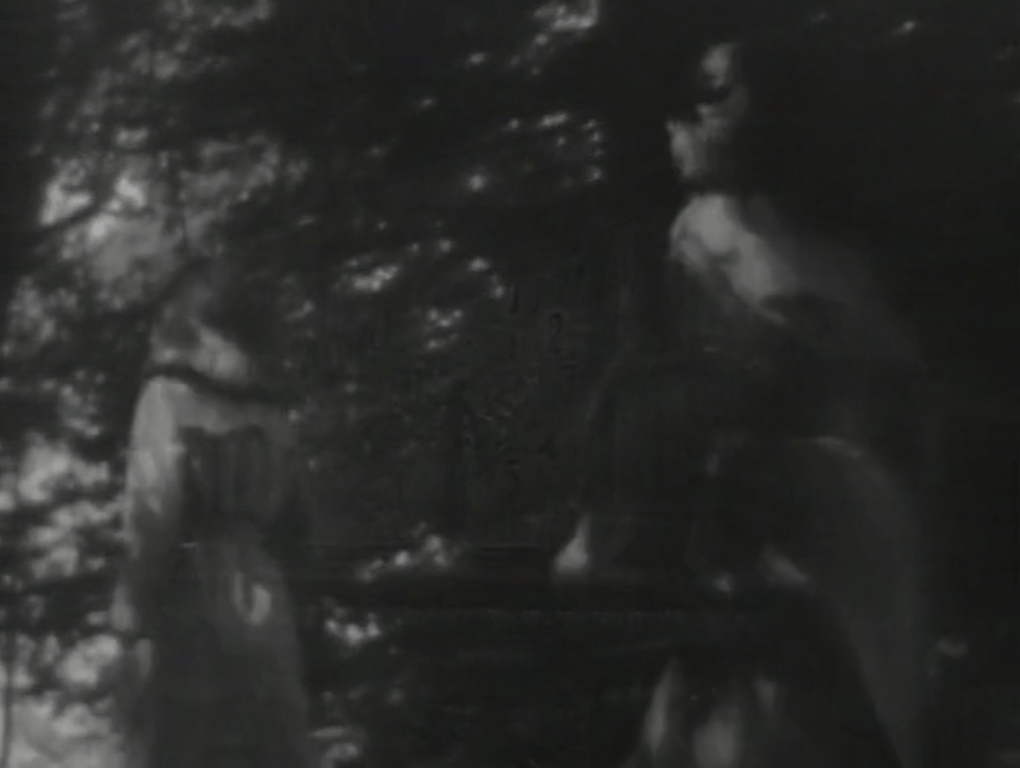
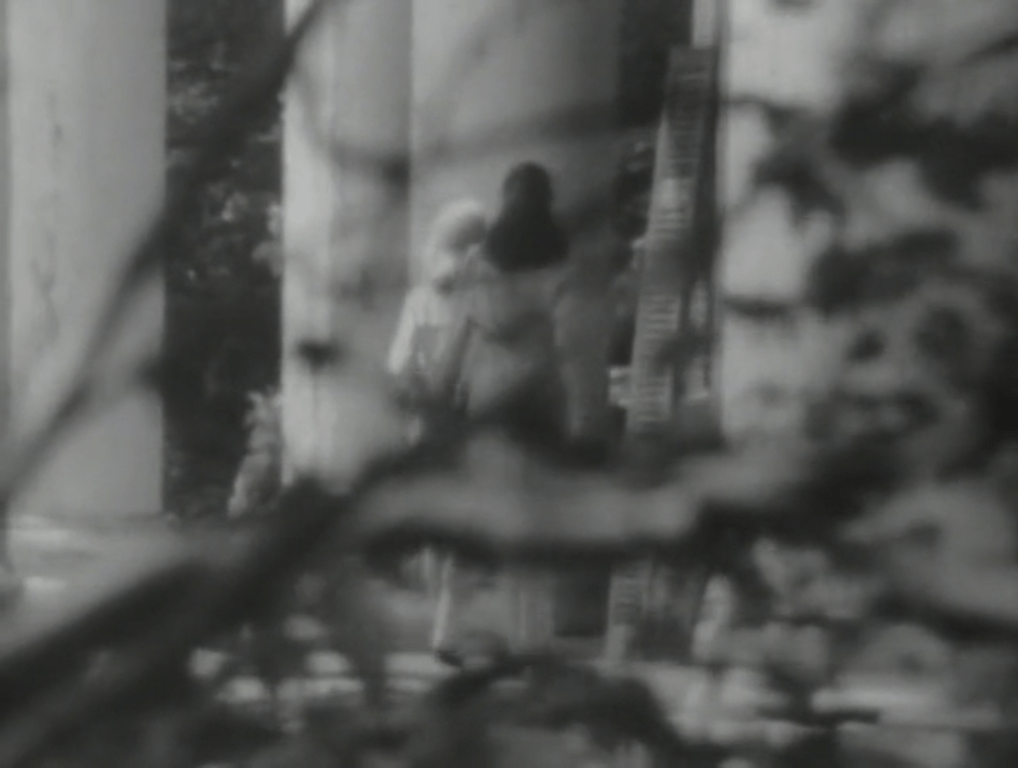
We see the women from an increasing distance, so that they appear to shrink; then through foliage, so that they appear to be in a trap; and finally from a high angle, as if they are small and weak. Since we know that Barnabas is a vampire and they are on their way to enter his lair, this is effective visual storytelling. In fact, it is the only good scene in the episode.

The beginning of the walk- Carolyn and Vicki at their largest
Approaching the house, they reach their smallest size
On the porch, behind the branches
At the bottom

Carolyn says that it is much colder around the Old House than it is at the great house, and Vicki mentions that they are closer to the ocean. This is something of a retcon. When strange and troubled boy David first took Vicki through the woods to the Old House in #70, not only was it news to her that the place existed, but the trek was a long one, suggesting it was far inland, deep into the grounds of the estate. That impression was reinforced a number of times, and Vicki’s remark is the first to contradict it. Apparently the writers are planning some story point that will require the Old House to be by the shore.

Vicki knocks on the door several times without an answer. As she and Carolyn turn to go, we see the doorknob turn and the door open. When the women see that no one is in the front part of the house, Vicki guesses that her knocking loosened the door. What we saw of the doorknob tells us that some agency opened it. It is still daylight, so Barnabas’ powers are unlikely to be at work, and it doesn’t seem that he would want people wandering into his house.

The Old House has also been the abode of the benevolent ghost of Josette Collins, and it is possible Josette might want Vicki and Carolyn to figure out what Barnabas is up to. But nothing they do today gives them a clue about him, and since it is almost nightfall it is extremely dangerous for them to be there. Josette would be unlikely to put them in that situation without good reason.

That leaves us wondering what other supernatural beings might be operating in and around the Old House. The first time Dark Shadows told a story that was modeled on Bram Stoker’s Dracula, it centered on blonde fire witch Laura Murdoch Collins. In the first weeks of that arc, it seemed that Laura was not simply a single physical body, but that she was a whole complex of material and immaterial presences, some of them working at cross-purposes to each other.

Now we are using another set of ideas from the same book. Barnabas is more dynamic than Laura was in those early days, but he too seems to have brought company with him, perhaps including companions he does not know about and whom he does not control. This is most obvious when he is planning some evil deed and the dogs start howling. Occasionally the dog-noise helps him by intimidating his victims or scaring away their would-be protectors, but more often it gets in his way by acting as a warning that trouble is brewing. If an unknown force that upsets the dogs emerged when Barnabas rose from his tomb, then perhaps still another force has appeared that is fiddling with the doors to the Old House.

Over Carolyn’s objections, Vicki insists on exploring the Old House. Carolyn protests that this is trespassing. They have been confusing about the legal status of the place. In #220, they said explicitly that Liz would continue to own it and would let Barnabas stay there. There hasn’t been any indication since that Barnabas has paid Liz anything or that she has done any paperwork. If the house belongs to Liz, Carolyn, as Liz’ daughter and heir, would be speaking figuratively when she uses the word “trespassing.” But in #223, Liz talked about the house as if it and its contents were Barnabas’ property. So who knows, maybe she signed the place over to him when the show was busy with a day of recapping.

Whether Barnabas is the proprietor of the house or a guest there, Vicki and Carolyn are certainly intruding on his privacy when they go upstairs and examine the bedrooms. Carolyn at least has the presence of mind to point this out, but Vicki just keeps repeating that Barnabas once told her she was welcome to come over any time and she interprets this to mean that she can go anywhere in the house whether he’s there or not. This is one of the most sustained, and most bizarre, of all the Dumb Vicki moments we’ve seen so far. Alexandra Moltke Isles usually tries to find something to put behind her eyes during these scenes to suggest Vicki has a thought we will find out about if we keep watching, but Vicki’s behavior today is so senseless Mrs Isles just grins and looks off into the middle distance like a crazy person. Who can blame her, really.

They find the bedroom of Josette all appointed as if Josette herself were living there, complete with jasmine-scented perfume. The door mysteriously closes, trapping them inside. Again, no one we have met, either living or ghostly, would have any motive to do this. After a moment, Willie comes to the door and demands to know why they are there. Vicki asks about the room and complains about Willie’s manners, as if she had a right to be there.

Downstairs, Vicki asks Willie to tell Barnabas how impressed she and Carolyn are with all the work that has been done. Barnabas shows up and is extremely gracious to the women. After they leave, he scolds Willie for his unfriendliness to them. Maybe he does want visitors letting themselves in and roaming freely about the house while he’s resting in his coffin and keeping a girl prisoner, who knows. That would seem foolish, but no more so than Vicki’s activities today. It was the 1960s and people’s blood had a lot of lead in it. Maybe that’s getting to Barnabas.

Vicki and Carolyn go back to the great house and tell Liz what they saw at Barnabas’. Liz is annoyed that they went to a place where they were likely to see Willie, whom she remembers from his pre-blood thrall days, when he was dangerously unstable ruffian Willie Loomis. She wonders why Barnabas has chosen to restore Josette’s room.

We return to the Old House, where the episode ends with its only scene not including Vicki. Barnabas stands before a small table in the parlor. It is set for a dinner for two. There are two plates, and two glasses. Barnabas has appeared to drink coffee at the restaurant in the Collinsport Inn, Amontillado in the study at the great house, and some kind of booze at The Blue Whale tavern. These glasses also seem to hold something other than human blood, indicating that Barnabas is not sticking strictly to the diet of his people. He tells Willie to bring their guest. Maggie enters, wearing Josette’s bridal gown and offering her hand when Barnabas addresses her as Josette.

It is by no means clear where Maggie has been up to this point. She wasn’t in Josette’s room, and doesn’t seem to be coming from the basement. The secret chamber behind the bookcase is no secret anymore, least of all from Vicki, who was held prisoner there by crazed handyman Matthew Morgan. Perhaps we are to think that her entrance, along with Barnabas’ insouciant attitude towards unexpected visitors, implies that there are spaces in the house only Barnabas can find.

Episode 225/226: Enough to give any woman nightmares

Dark Shadows is recycling a story element from December 1966 and January 1967. Back then, blonde fire witch Laura Murdoch Collins kept staring out the window into the night and establishing a psychic connection with her son, strange and troubled boy David Collins. Each time she did so, David would have a terrible nightmare in which she was beckoning him to his death in flames. Since burning him to death was in fact her plan, we were left wondering if the nightmares were Laura’s attempt to get him used to the idea; if they were signs of his own willpower as he resisted her influence; if they were messages from the benevolent ghost of Josette Collins trying to warn her descendant of the danger his mother presented to him; or were the result of some other force that travels with Laura, but that is not under her control or necessarily known to her.

The other day, vampire Barnabas Collins stared out his window into the night and established a psychic connection with Maggie Evans, The Nicest Girl in Town. Maggie reacted to that contact with confusion and dismay. In yesterday’s episode, she had a nightmare in which she saw a coffin open from the inside and herself laid out in it. It isn’t much of a stretch to assume that Barnabas’ plans for Maggie will require her to spend her days in a coffin. That leaves us with just the same options we had in accounting for David’s nightmares.

Maggie and Barnabas cross paths today in Collinsport’s night spot, The Blue Whale tavern. When Maggie leaves, Barnabas wishes her “Sweet Dreams.” She is shocked at this conventional night-time farewell. We see her at home getting ready for bed; Barnabas is still in The Blue Whale, chatting amiably with dashing action hero Burke Devlin. Barnabas gets a peculiar look on his face, excuses himself, and hurries out. Then we cut to the Evans cottage, where we see him entering her room to bite her. These are things we might have expected to see if the nightmare was something Barnabas sent to get Maggie used to the idea of becoming a vampire.

Barnabas sits at a table in the tavern with Maggie’s father Sam. They talk about how strong and independent she is. We have known her since the first episode, and know that she is indeed someone who can stand up for herself. Reminding us of that, this conversation leaves open the idea that the source of the nightmare is Maggie’s own struggle against Barnabas.

Sam himself figured prominently in the Laura story as a medium for Josette’s influence. He is an artist, and when David’s nightmares did not suffice to make Laura’s plans clear to the characters, Josette took possession of Sam and used him to literally paint a picture for them. That possession occurred in Sam and Maggie’s cottage. Moreover, Maggie had been delighted with Barnabas before the nightmare, but seeing him now she is extremely uncomfortable. That reaction, Sam’s presence in the episode, and the scene in the Evans cottage would all seem to support the idea that the nightmare was a warning from Josette.

When Barnabas and Burke are alone at the table, Burke is admiring the silver wolf’s head sculpted on the handle of Barnabas’ cane. He says that it looks ferocious and asks if the cane was made to be a weapon. Barnabas replies that he sees the wolf’s head as a peaceful symbol, an animal originally wild and hostile that has been tamed to be a companion, “almost a servant,” to humans. Canines are not so tame when Barnabas is busy, however. We hear a variety of dog noises, ranging from the howl of a sad hound to the violent snarling of a pack of large hunting dogs. This does not appear to serve his interests. Since it happens around people like Maggie who are mystically connected to him when he is far away, it is difficult to see it as a natural phenomenon. And since Josette’s previous interventions have not involved dogs, she is not an obvious suspect. So perhaps when Barnabas rose from his grave, he brought with him a ghostly companion who is not his servant, but is working at cross-purposes with him.

Barnabas realizes that he wants to have a bite before sunrise

Joe and Maggie are interesting today. Maggie wakes up from her nightmare and calls Joe. We see Joe, getting our first look at his apartment. We don’t see much of the place, just a single panel behind him decorated in true Collinsport fashion with a painting on one side and the shadow of some studio equipment on the other.

Joe at home

It isn’t just the decor that tells us Joe is a true Collinsporter. Maggie waits anxiously for him to answer when the phone rings several times. When we see him, we know what took him so long- he had to put his robe on over his pajamas. Sure, he lives alone, but he isn’t a savage.

When Joe and Maggie enter the tavern, she remarks that they could have saved money- she has liquor at home. Joe tells her she needed to get out of the house. Again, he is following the norms of Collinsport. A young woman alone at home telephones her boyfriend in the middle of the night and asks him to come over right away. A fellow from another town might not have realized that the best thing to do was to take her to a public place where they would be likely to meet her father.

Maggie and Joe have been talking about getting married for a while now. She kept saying she couldn’t marry, because she was worried about her father. During the “Revenge of Burke Devlin” arc, which ran from the first episode until Burke decided to peace out in #201, Sam was an alcoholic given to binge drinking. When they gave up on that storyline, they dropped the theme of Sam’s alcoholism as well. Today he goes to a bar with someone who is determined to buy him all the liquor he will accept. He stops after a couple of drinks and goes home, where he is crisp and sober. Apparently he just isn’t an alcoholic any more. I’m no expert, but I have a feeling it doesn’t really work that way. Be that as it may, it leaves Joe and Maggie with no reason not to get married.

Joe and Maggie not only run into Sam at The Blue Whale, but also Barnabas. If Art Wallace and Francis Swann were still writing the show, or if Violet Welles had come on board, I might wonder if this were a subtle hint that sexual repression creates monsters. Joe Caldwell has been making uncredited contributions to the writing for months, and he was perfectly capable of slipping in a point like that. But this one is credited to Ron Sproat, and Sproat is shameless about putting characters where they need to be to make the next plot point happen on whatever flimsy pretext he can find, regardless of any other consideration. So while it is always possible that the cast or the director or someone else associated with the production was trying to make a clever point, I don’t think Sproat was in on it.

Closing Miscellany:

The makers of Dark Shadows wanted episodes aired on Fridays to have numbers that ended in 5 or 0. A strike several weeks ago caused them to miss a day of broadcasting, and the numbers have been off ever since. They gave this one two numbers, 525 and 526, to get back on track.

Barnabas addresses Burke as “Devlin” and hardworking young fisherman Joe Haskell as “Haskell.” We’ve heard him call Sam “Mr Evans,” so evidently he’s following some rule of his own about who gets a courtesy title and who doesn’t. His exquisite manners are such a big part of what comes up when the other characters talk about him that the writers might well have thought they were making some kind of point with this, but heaven knows what it was. Making it even harder to decipher, he calls Maggie “Miss Evans” at the beginning of the episode, but “Maggie” at the end.

I can’t resist quoting one of the many lines that made me laugh when I read Danny Horn’s commentary about Barnabas in his post about this episode:

What a weird character. Even for a vampire, he’s a weird character.

Danny Horn, “Episode 225/226: Fangs for Nothing,” Dark Shadows Every Day, 23 September 2013

Episode 221: A new Collins in Collinsport

Maggie Evans, The Nicest Girl in Town, is closing up shop in the restaurant at the Collinsport Inn. A stranger startles her. He is the mysterious Barnabas Collins. Barnabas recently left his long-time residence in the cemetery five miles north of town and has been hanging around the great estate of Collinwood, but this is the first time we’ve seen him in Collinsport proper.

In the opening months of Dark Shadows, the restaurant, like the rest of the inn, was coded as the base from which dashing action hero Burke Devlin mounted his campaign to avenge himself on the ancient and esteemed Collins family. As the Revenge of Burke Devlin storyline ran out of steam, the restaurant emerged as a neutral space where new characters could be introduced without defining their relationships to the established cast all at once. In that period, Maggie was Collinsport’s one-woman welcoming committee.

Now, even Burke has given up on his storyline. The only narrative element of the show with an open-ended future is Barnabas, and once the audience has figured out that he is a vampire there’s no such thing as a neutral space where he is concerned. So it is not clear what, if any, role the restaurant will have from now on.

Barnabas asks if it is too late to get a cup of coffee. Maggie tells him it is, but relents after about a minute and reopens to serve him. She is charmed by his old-world manners and excited to learn that “there is a new Collins in Collinsport.” He tells her he is staying at the long-abandoned Old House on the grounds of Collinwood, prompting her to marvel at the idea of someone living in a dilapidated ruin that is probably haunted. When she admires his cane, he explains that it is not only quite valuable, but is also a family heirloom and on that account his most prized possession.

Barnabas appears to drink the coffee, as he appeared to drink the sherry his distant cousin Roger served him when he visited Collinwood in #214. Usually vampires are supposed to limit their diet strictly to human blood, but just a few weeks ago Dark Shadows wrapped up a long story about Laura Murdoch Collins, a humanoid Phoenix, who raised everyone’s suspicions by never being seen to eat or drink. So they may have thought that it would be repetitious to follow the Laura arc so closely with another undead menace who betrays himself with the same sign.

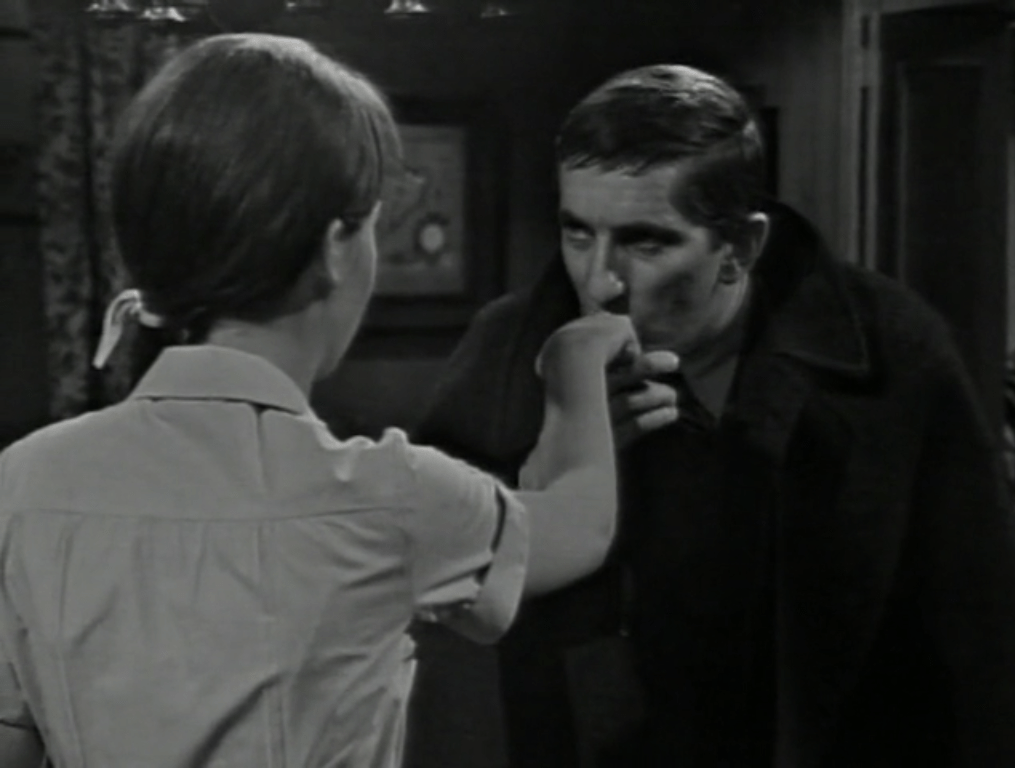
Barnabas kisses Maggie’s hand in farewell

Maggie’s boyfriend, hardworking young fisherman Joe, comes bustling into the restaurant seconds after Barnabas leaves. Maggie is surprised that Joe and Barnabas didn’t pass each other, and puzzled when Joe tells her there was no one in sight anywhere near the inn. Neither of them had heard of Barnabas before.

Joe tells Maggie that a woman named Jane Ackerman had an unpleasant run-in with a man she couldn’t see earlier in the night. The fellow retreated before doing her any serious harm, but Joe seems fairly sure that whoever it was is a real threat to the women of Collinsport. So he wants to keep Maggie company. Maggie doesn’t seem worried, either for her own sake or for Jane’s. She’s just happy to see Joe, and gladly agrees when Joe suggests they go to the local tavern, the Blue Whale.

As Dark Shadows’ principal representatives of Collinsport’s working class, Maggie and Joe illustrate the point the opening voiceover made when it said that people “far away from the great house” of Collinwood would soon be “aware of” Barnabas and of “the mystery that surrounds him.” As a name we have never heard before and are unlikely to hear again, “Jane Ackerman” reminds us that there is a whole community of people for Barnabas to snack on.

As Joe and Maggie are heading out of the restaurant, she notices that Barnabas left his precious cane behind. She wants to go straight to the Old House to return it to him. Joe would rather wait until morning, but Maggie explains that she doesn’t want to be responsible for it overnight. This is a bit odd- they are in a hotel, after all, a business that specializes in keeping valuable property safe while its owners sleep.

Perhaps Maggie wants to see the Old House. Joe has been there many times. When we saw him there with Burke, searching for well-meaning governess Vicki in #118, he mentioned that when he and flighty heiress Carolyn were children, they would occasionally play there. He returned there during the Laura storyline. Even Maggie’s father has visited the Old House, participating in a séance there in #186 and #187. Maggie has never been there at all. So perhaps she just feels left out.

Maggie and Joe knock on the doors of the Old House. No one comes. As they turn to go, there is a closeup of the door knobs turning. Maggie and Joe hear a door open, and go in. They don’t see anyone, but candles are burning and Joe remarks that the front parlor has been fixed up. Joe goes upstairs and leaves Maggie behind, explaining that he knows his way around the place and it isn’t safe up there for someone who doesn’t.

Once Maggie is alone, Barnabas appears next to her. She is startled and cannot see how he could have got there without her knowing. He apologizes for once more catching her unawares. He seems surprised that she is not alone. When Joe comes downstairs, he is exceedingly polite to both of them.

After Maggie and Joe excuse themselves, Barnabas’ blood-thrall, the sorely bedraggled Willie Loomis, appears. With obvious difficulty, Willie forces out one word after another, and manages to ask Barnabas what he plans to do to Maggie. Barnabas is displeased with Willie’s presence and with his presumption that he has the right to question him. He climbs the stairs and looks down at Willie, full of menace and demanding that he go out and do the work Barnabas has ordered him to do. Willie tries to refuse, but cannot stand the look Barnabas is giving him.

Barnabas gives Willie his orders

During this staring contest, Barnabas and Willie are standing on the spots where strange and troubled boy David Collins and Barnabas had stood when we first saw Barnabas in the Old House in #212. In that scene, David and Barnabas were more or less eye-to-eye, and for a moment it seemed that Barnabas was contemplating violence against David. In this scene, Barnabas shows how committed he is to violence. He has a power over Willie that he gained by the extreme violence of drinking Willie’s blood, and Willie’s inability to resist Barnabas’ stare shows that power in use. Willie’s horror at the task Barnabas has assigned suggests that it also is violent.

My wife, Mrs Acilius, believes that the confrontation between Willie and Barnabas solves one of the behind-the-scenes mysteries about Dark Shadows. Why was James Hall replaced by John Karlen in the role of Willie? She points out that Hall, while he is a fine actor, had a lot of trouble with Willie’s lines, particularly in the long he shared with Dennis Patrick’s Jason McGuire. By the time Willie was recast, Jonathan Frid had been attached to the role of Barnabas for some days, and Frid never made it a secret that he was a slow study. So if there were going to be a lot of long conversations between Willie and Barnabas, Willie had to be played by an actor who could get his dialogue letter perfect day after day. That was John Karlen.

After Willie scurries off to do whatever evil chore Barnabas has ordained for him, Barnabas wanders over to the window. On his way, we see that the portrait of Josette Collins is no longer hanging in the spot over the mantle where we have seen it since our first look at the Old House in #70. At the end of that episode, Josette’s ghost emanated from the portrait and danced around the outside of the house. From that point, the Old House was chiefly a setting for Josette. Crazed handyman Matthew Morgan learned that to his cost when he tried to hold Vicki prisoner there and Josette and other ghosts ganged up on him and scared him to death in #126. Laura knew that she was entering the territory of a powerful enemy when her son David took her to the Old House in #141, and when Vicki had formed a group to oppose Laura’s evil plans she and parapsychologist Dr Guthrie went there to contact Josette. In #212, Barnabas addressed the portrait and told Josette that her power was ended and he was now the master of the house. Removing the portrait tells us that Barnabas is confident that he is not only a new Collins in Collinsport, but that he is now the Collins at Collinwood.

Barnabas then does something Laura did several times- he stares intently out his window. When Laura stared out her window, David would be violently disturbed, no matter how far away he was or how many obstacles were between him and his mother. These incidents were a big enough part of Laura’s story that regular viewers, seeing Barnabas stare out the window, will expect someone at a distance from him to react intensely.

We cut from Barnabas to Joe and Maggie at her house. Joe asks what time he should pick Maggie up tomorrow, and Maggie suddenly becomes disoriented. Kathryn Leigh Scott has a sensational turn playing that moment of lightheadedness, creating the impression that she is having a scene with Barnabas. As she recovers, she explains to Joe that she has the feeling she is being stared at. Then we dissolve to Barnabas in his window. Barnabas may not be Maggie’s mother, but apparently there is some kind of link between them. Perhaps kissing Maggie’s hand in the restaurant was enough to give Barnabas the power to creep her out even when he is miles away from her.

Episode 188: There is no room for you in my future

Well-meaning governess Vicki has concluded that, because someone called Laura Murdoch Radcliffe and her son David Radcliffe died in a fire “exactly one hundred years ago tonight!,” blonde fire witch Laura Murdoch Collins must be planning to burn her son David Collins to death before sunrise. David’s father, high-born ne’er-do-well Roger Collins, agrees that Laura is probably a supernatural being, and that she probably represents a threat to David, but is not convinced that there is anything special about tonight. Vicki has also brought dashing action hero Burke Devlin, who is David’s idol and Laura’s ex, around to her point of view about Laura, but he too is unsure about the significance of the anniversary.

Yesterday, the three of them planned that Burke would take David away on a fishing trip early in the morning, and that once they are well away from the great estate of Collinwood Roger will evict Laura from her cottage on its grounds. Today, though, Roger decides not to wait until David is far from Laura and perhaps clear of the danger she embodies. Instead, he insists on going to her cottage immediately, in the middle of the night. When Vicki objects, Roger says he wants to call on her while he’s good and mad. For his part, Burke resists Vicki’s urging to take David away at once, cheerfully sure that morning will be soon enough.

Roger and Burke’s decisions set up the episode. Roger calls on Laura, then reports back to Vicki and Burke on their conversation. Burke calls on Laura, then reports back to Vicki and Roger on their conversation. Laura materializes in David’s bedroom and tells him they will be leaving together tomorrow night, and that he must keep this secret.

These scenes leave us with two reasons to object to what Roger and Burke have chosen to do. First, neither man’s decision makes much sense. Roger’s choice is particularly idiotic, a problem the script lampshades when Vicki tells Roger it makes no sense to let Laura know what’s going on while David is still in the house. But considering that Burke has already accepted Vicki’s analysis of the situation, his complacent refusal to take David at once is just as inexplicable.

The second problem is that today’s scenes are just so much filler. If Burke were to take David away immediately and Roger were to wait several hours before telling Laura that she must go, we’d have a situation in which Laura would either have to take action immediately in order to get David, to demonstrate that she has some power we didn’t know about previously, or to change her plans. Any of those would qualify as plot-advancing developments. Instead, we spend the whole half hour marching in place.

Making matters worse, the plan Laura outlines to David promises at least one more episode with no significant action. He will pretend to be sick, she will pretend to go away, Vicki will keep sounding the alarm, and the rest of them will wander around with their tongues hanging out. They may as well have staff announcer Bob Lloyd end the show by telling the audience not to bother tuning in until Friday.

The actors salvage some good moments. When Burke goes to Laura’s cottage, she is packing her bags. He tells her that people usually pack their bags shortly before going someplace. In response, she asks him if he has any more fascinating generalizations. Diana Millay is so good at delivering sarcastic dialogue that this line is worth a laugh out loud.

There are also some interesting connections with previous episodes. That Laura is packing shows that she at some point unpacked. When she first moved into the cottage in #135, we learned that she had never unpacked during the two or three weeks she had been staying at the Collinsport Inn. Indeed, her only luggage was a single bag that was so light it might be empty. That was a suggestion of her ghostly nature. As time has gone on, Laura has become more dynamic and more corporeal, to the point where she has some laundry.

As previously when Laura appeared in David’s room, today we see her standing in the corner for a moment before the spotlight finds her. I don’t know if that was intentional, or if they didn’t think the television audience would be able to make her out in 1967. Maybe they couldn’t- sets weren’t so great then, and most ABC stations didn’t come in well unless you had an extra-large aerial antenna. But I kind of like it. The pose Diana Millay holds while waiting for her light reminds me of live theater, and her gradual way of starting to move when the light does come plays into the idea that Laura isn’t a full-fledged human being. She turns on like a machine.

Waiting for her light

To motivate David to keep their plan secret from Roger, Laura tells him that Roger is going to send him to boarding school. At this, David flies into a panic.

In the first couple of months of Dark Shadows, David was preoccupied with a fear that his father would send him away. When David overheard Roger saying that he wanted David to go to boarding school in #10, David’s response was to sabotage the brakes on his father’s car in hopes that he would crash and die. When David saw Roger driving off in #15, he spoke into the night “He’s going to die, mother, he’s going to die!” We still don’t know if Laura could, by some uncanny means, hear David’s voice when he said this, but we do know who taught him that boarding school was so bad that patricide was a rational response the the prospect of it.

Episode 184: It’s been my life

Parapsychologist Dr Guthrie visits blonde fire witch Laura Murdoch Collins in her cottage on the grounds of the estate of Collinwood. He tells her that his researches have led him to the conclusion that she is “The Undead” and that she poses a danger to her son, strange and troubled boy David. She replies that he is being preposterous, but she doesn’t deny anything he says.

Guthrie says that she is probably wondering why he has told her these things. The audience certainly is- Laura has already tried to cast a paralyzing spell on Guthrie, and can hardly be expected to grow more benevolent towards him now that she knows that he has figured out her nature and has told her he is “closing in on” her.

Guthrie explains to Laura that their meeting marks a significant moment in the history of the world- a scientist has come face to face with a being who has died and returned to walk the earth. He wants to learn from her, and offers to help her if she will stop trying to claim David. He tells her that an effort to bring science to bear on cases like hers “has been my life.” “What an interesting way to put it,” Laura responds, in her unforgettable sardonic tone. She dismisses his offer, and tells him he is powerless.

In a way, it’s too bad Laura doesn’t take an interest in what Guthrie might be able to do for her. That’s quite an idea, a scientist trying to help an undead being and to explore the realm of the supernatural thereby. It suggests the 1945 Universal movie The House of Dracula, in which a blood specialist treats Dracula for vampirism, with apparent success. That doctor then encounters the Wolf Man and Frankenstein’s monster. He attempts to treat them also, but things eventually go awry. The House of Dracula runs for 67 minutes; it might be interesting to develop a story like that in a daytime serial, where you have as much time as the audience and the network are willing to give you.

Guthrie is trying to organize a séance to contact Laura’s chief adversary, the ghost of Josette Collins. He tells hardworking young fisherman Joe* that they will have to recruit drunken artist Sam Evans to join them at the séance. Joe laughs at the thought of how Sam will react to such an invitation. Sam’s daughter, Maggie, is Joe’s girlfriend; Joe stops laughing and is a little bit scared when he thinks of Maggie’s likely reaction. But Guthrie insists that Sam’s participation is essential. Josette took possession of Sam to paint pictures that gave them some of their first and clearest warnings of what Laura might do to David, so he has already been one of her most powerful mediums. Joe agrees to ask him.

At the Evans cottage, Joe pitches Sam and Maggie on the séance. Sam at first finds the notion hard to take seriously. The more he thinks about it, the more convinced he becomes that Guthrie’s theories are correct and that it is his duty to participate. Maggie is dead set against her father having anything to do with Collinwood or the supernatural. She has worked on getting him to forget the paintings he made under Josette’s influence and his belief that Laura was responsible for the fire that injured his hands shortly after he painted them. As an Adult Child of an Alcoholic, Maggie is in the habit of heading Sam off when he’s on his way to do something weird. Usually Joe is her most reliable ally and greatest help in looking after her father. Today, she reluctantly gives in when Sam and Joe both think the séance is a good idea.

In the drawing room of the great house at Collinwood, Dr Guthrie is studying some documents. We see Laura staring into the fire in her cottage. Her eyes are superimposed over the image of Guthrie as he becomes ill.

Joe comes in and sees that Guthrie is struggling for breath. He asks Guthrie if he is all right. Guthrie complains of the heat. Since Joe is still wearing his heavy coat and looks perfectly comfortable, he ought to know that isn’t much of an explanation. He mentions that he has completed some tasks Guthrie asked him to perform. Guthrie has no idea what he’s talking about. When Laura attacked Guthrie in episodes 175 and 176, it was through a spell that hit him while he was in this same room. Then also, he had difficulty breathing during the attack and a gap in his memory afterward.

That time, well-meaning governess Vicki came into the drawing room and saw Guthrie suffering the effects of the attack. The attack abruptly ended. While Guthrie was recovering, David came back to the house and told him and Vicki that he had interrupted Laura a few minutes before while she was staring into the fire at her cottage. After David gave Vicki and Guthrie a full account of the incident, they sent him off to have dinner followed by two desserts- cake and ice cream.

That day, Vicki recognized the symptoms of Guthrie’s attack as the same those reclusive matriarch Liz exhibited after a confrontation with Laura and before she lapsed into a catatonic state from which she has not yet recovered. From this, Vicki concluded that David must have stopped Laura while she was in the process of casting the same spell on Guthrie that she earlier cast on Liz. Guthrie agreed with Vicki’s analysis, but was confident he could defend himself against any further spells Laura might cast. He never explained what his defense would be.

Whatever protection Guthrie thought he could give himself against Laura’s powers obviously isn’t working, at least not while he is alone. After Joe goes away, Laura resumes casting her spell.

Featuring Laura, as Egg-Fu

While Guthrie struggles in the drawing room, David strolls into the foyer. The ghost of Josette manifests on the staircase above. She takes a few steps down towards him and points to the drawing room doors.

Josette sends David to rescue Dr Guthrie

David realizes Josette is telling him to go into that room at once. He obeys, and finds Dr Guthrie on the floor by the fireplace, apparently near death.

*Who is evidently fishing again. Months ago, Joe got a white-collar position in the offices of the cannery, a position he accepted only in order to make enough money to buy his own boat. Today David asks him when he will take him along on the boats, and Maggie mentions that he’d recently lost his watch in a mackerel net. They never told us that he’d gone back out, and indeed he was carrying papers back and forth from the office as recently as #174.

Episode 183: Listening to reason

Blonde fire witch Laura Murdoch Collins opens the front door of the great house of Collinwood. Housekeeper Mrs Johnson intercepts her. Laura wants to see her son, strange and troubled boy David Collins. Mrs Johnson tells her that David has gone to town with well-meaning governess Vicki to buy shoes. Laura objects that she was supposed to take David to get new shoes, and is quite upset that Vicki has taken this from her. She is even more upset when Mrs Johnson says she is under orders to keep David in the house unless he is with Vicki or flighty heiress Carolyn. Laura asked who gave those orders, and is shocked to hear that it was her estranged husband, high-born ne’er-do-well Roger.

Laura shouts for Roger, who comes downstairs to see her. In the drawing room, she demands to know why he is keeping David from her. At first he repeats Vicki’s old line that David is falling behind in his studies, but when Laura dismisses this he tells her that he is suspicious of her because of all the strange goings-on that started when she came back to town. They quarrel about this for some time, and Roger holds his ground.

Laura goes to the Collinsport Inn, where her ex-boyfriend, dashing action hero Burke Devlin, is in residence. Burke also refuses to help her. He tells her that she is not at all the same person he was in love with ten years before. She protests that everyone gets older, and he says it isn’t that. She has somehow become a stranger to him.

Yesterday, visiting parapsychologist Dr Guthrie had laid out the case against Laura to Roger, while Vicki presented the same facts to Burke. Roger resisted until the ghost of Josette Collins intervened to present him with some particularly hair-raising information. Today, we see that Josette and Guthrie have combined to carry their point, and have enlisted Roger in the fight against Laura.

After Vicki had told Burke why she regards Laura as a threat to David, Burke had said that he thought he ought to go along with her request that he stop urging David to leave with his mother. But he admitted that Laura has such a strong emotional effect on him that he couldn’t promise that he would be able to follow that resolution. In the scene between Burke and Laura, Burke alternately gives Laura hard stares and avoids eye contact altogether, turning his back on her and edging away whenever possible. Returning viewers will appreciate the effort he is making to keep his feelings from overwhelming him. By the time the scene ends, the two most important men in David’s life are both on the team opposing Laura.

Laura loses her last ally, Burke breaks his own heart

Back at Collinwood, Guthrie talks briefly with Roger. For the first time, Roger speaks respectfully to Guthrie, whom he has always before disdained as a quack. Roger leaves, and Guthrie has a few words with Mrs Johnson. Mrs Johnson mentions that when she was cleaning the cottage where Laura is staying, she made a move to extinguish the fire in the hearth. Laura responded with terror, frantically demanding that she leave the fire alone. At this news, Guthrie decides to pay a call on Laura.

In the cottage, Guthrie says that it is very warm and makes a move to put the fire out. He observes Laura’s panicked reaction. He asks her why fire is important to her; she says she merely dislikes cold rooms. He asks if she derives a power from fire; she says she doesn’t know what he’s talking about.

Laura asks Guthrie if he is the one who talked Roger into keeping her from seeing David. Guthrie says yes. She asks why, and he tells her he thinks she is a danger to her son. She asks what danger she could be to David, and he asks her who she really is. When he says that she is not the woman Roger married, she ridicules the idea that an impostor could fool all the people who have identified her as Laura. He says that he doesn’t mean that she is an impostor. When she asks what he does mean, he asks if she really wants him to say the words. She says yes. He tells her “You, Laura Murdoch Collins, are the undead.”*

*If I recall correctly, that marks the first time the phrase “the undead” is spoken on Dark Shadows.

Episode 182: That spook bit

Like many children of divorce, strange and troubled boy David Collins finds himself having to decide which parent he will live with. He and his father, high-born ne’er-do-well Roger, have been living in the great house of Collinwood as guests of Roger’s sister, reclusive matriarch Liz, ever since Roger ran out of money some months ago. Now David’s mother, blonde fire witch Laura Murdoch Collins, has reappeared after an absence of many years, and she wants to take David. This idea delighted Roger from the first, but David had initially reacted to Laura with fear. He still has mixed feelings about her.

Today, well-meaning governess Vicki is trying to get David to focus on his studies. He tells her that he is thinking about his living situation. He likes Collinwood, especially since Vicki came. But he has just about decided to go away with his mother.

Vicki asks why David wants to do this. He reminds her of a vision he had yesterday that terrified him. He saw himself in the fireplace, immersed in flames and showing no sign of wanting to escape them. He interprets this as a warning from the supernatural realm that he is in great danger, and that the danger is to be found at Collinwood. He believes he will find safety if he goes far from the estate with his mother.

Vicki knows that David is partly correct. She has considerable evidence that the ghost of Josette Collins has been trying to warn David and her and several other people that David is in danger of being burned alive. She is also sure that the source of this danger is at Collinwood- it is Laura herself. She is an inhuman creature who will burn David alive. Vicki can’t tell David about this, but she does remind him of some of Josette’s previous warnings. David realizes that his mother featured prominently in those warnings, but does not see that she is the one Josette is warning him about. To Vicki’s dismay, David concludes that Laura is also in danger, and that it is urgent that the two of them go off together at once.

When her warnings to David backfire, Josette is running true to form. The first time she tried to rescue someone from imminent peril was in episode 122, when crazed handyman Matthew Morgan had kidnapped Vicki. Matthew’s response upon hearing a ghostly voice was to put a knife to Vicki’s throat. Eventually Josette enlisted some of her buddies from that land of ghosts which forms the back-world behind what we see, and together they would stop Matthew and save Vicki. Here again, Josette needs help getting her point across.

Of all the characters, David is the one who has had the easiest rapport with Josette. In #102, we saw him standing in front of her portrait in the long-abandoned Old House on the grounds of Collinwood, chattering happily away to her. We couldn’t hear her, but he could. She had no need to manifest herself visibly or do anything else spectacular; she and David could just talk to each other.

Now, Laura is blocking Josette’s attempts to communicate. In #165, Josette manifested in a room with Laura and David; Laura ordered her to go away, and she did. In #170, Josette began speaking through Vicki at a séance; Laura silenced her, and in later episodes visiting parapsychologist Dr Guthrie said that Josette was battling against some power at least equal to her own. Strong as Josette’s connection to David has been, she cannot break through his mother’s interference.

Vicki confers with Guthrie. They decide to present their case to Roger, who alone has the legal right to oppose Laura’s wish to take David, and to dashing action hero Burke Devlin, who has a great influence over the boy. Guthrie meets with Roger in the drawing room, and Vicki goes to Burke’s suite at the Collinsport Inn.

Roger despised Guthrie as a quack starting almost as soon as he met him, but in his most recent appearance, in #178, he started to suspect that there might be something to Guthrie’s ideas. He is quite rude to Guthrie throughout their conversation today, but does hear him out.

Burke respects Vicki, but finds it impossible to sit still when she starts talking about Josette. So she sticks to the demonstrable facts. The camera sticks to Alexandra Moltke Isles’ eyes, on which the light plays arrestingly.

Vicki looks at Burke

At length, Burke admits that something strange might be going on. Vicki asks Burke if he will stop encouraging David to go away with his mother. He says he believes that he ought to stop doing that, but that he doesn’t know what he will actually do after he next sees Laura. Vicki says she knows how he feels about Laura. Burke tells her that he himself doesn’t know how he feels about Laura, or about anyone else.

Mitch Ryan projects Burke’s bewilderment about his own behavior when he is with Laura. We haven’t seen any sign that Laura has cast a spell on Burke. So far, it is entirely possible that Burke is just smitten with Laura. She was the ex-girlfriend who left him for Roger and is now suggesting she wants to get back together with him. As such, she is the symbol of both his lost youth and his upcoming triumph over his bitter enemy. Also, she is beautiful, and can be hilariously funny. That combination would be enough to cloud anyone’s mind. But when Burke is telling Vicki how confused he is about his emotions, we wonder if there might be some witchcraft involved as well.

Back at Collinwood, Roger and David are in the drawing room. David tells Roger that he wants to go away with Laura, and when Roger asks why he has made that decision David tells him what he saw in the fire. David asks him if he still wants him to go away. In previous episodes, David had asked Roger about his hostility towards him. Sometimes Roger parried these questions with witty remarks, other times he simply dismissed David and walked away. Now Roger just chokes up. “We’ll see,” he keeps saying. “We’ll see.” What we the audience see in Louis Edmonds’ performance is a man who is starting to realize what he has thrown away by refusing to love his son. It makes a powerful moment.

Roger tries to connect with David

After David leaves him alone in the drawing room, Roger assumes his usual position in front of the brandy bottle and pours himself a glass. He lifts it to his lips, then looks around, as if he detects an unusual scent in the air. He sets the drink down. He turns, and sees an old book open itself.

Roger sees the book open itself

A book first did this in the drawing room in #52. That time the Collins family history opened to a picture of Josette. More recently, Josette’s signature jasmine perfume was in the air in the crypt at the old cemetery when a book opened itself there in #157. Regular viewers will therefore assume that when a book opens without visible aid of a cast member, it is Josette, the spectral research librarian, leading the characters to the information they need.

Roger hasn’t seen these previous occurrences, and he has chosen to disregard the evidence he has seen for the existence of supernatural influences around him. So the sight of the book opening itself comes as a great shock to him. When he looks at the page to which it has opened, he finds out something about the death of a woman named Laura Murdoch Radcliffe, whom Guthrie and Vicki believe to be an earlier incarnation of his wife. That Laura had died by fire in 1867, along with her young son David. Guthrie had told Roger that. A fact he had not mentioned, and which strikes Roger with particular terror, is that David Radcliffe had not wanted to be rescued from the fire. He had wanted to burn.

The idea of Laura the Phoenix is an interesting one, and the storyline gives Josette and the other vague, indefinable spirits of the supernatural back-world Dark Shadows has been hinting at since it began a suitable adversary to bring them into the action of the main continuity. But most of the individual episodes are so slow, so heavy with recapping, and so confused in their development that few of them can be recommended on their own merits. Indeed, this is only the second episode from the Laura arc, after #146, to which I apply the “Genuinely Good Episode” tag.

After we watched the episode, my wife, Mrs Acilius, shared her theory that the show is getting better because they’ve learned that it will be renewed for another 13 weeks. That makes sense- if it was going to be canceled after #195, the writers might not want to come up with any fresh stories and the producers certainly wouldn’t want to pay to build any new sets or hire actors to play new characters. Better just to run out the clock so that the Laura arc ends in #195 and everyone else lives spookily ever after. But if they know they can keep going until #260, they will have time to work out new ideas.

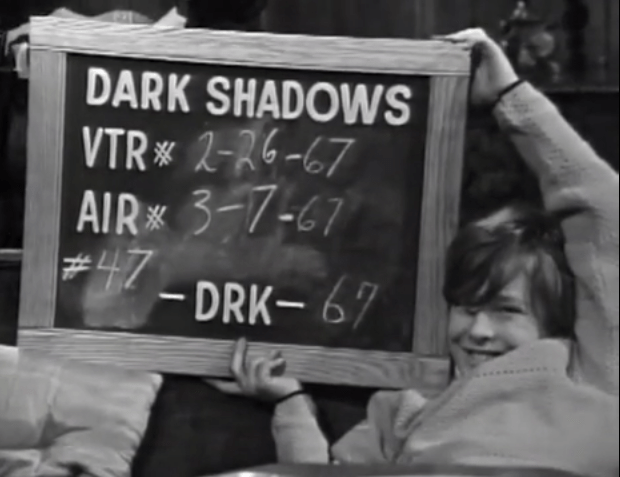
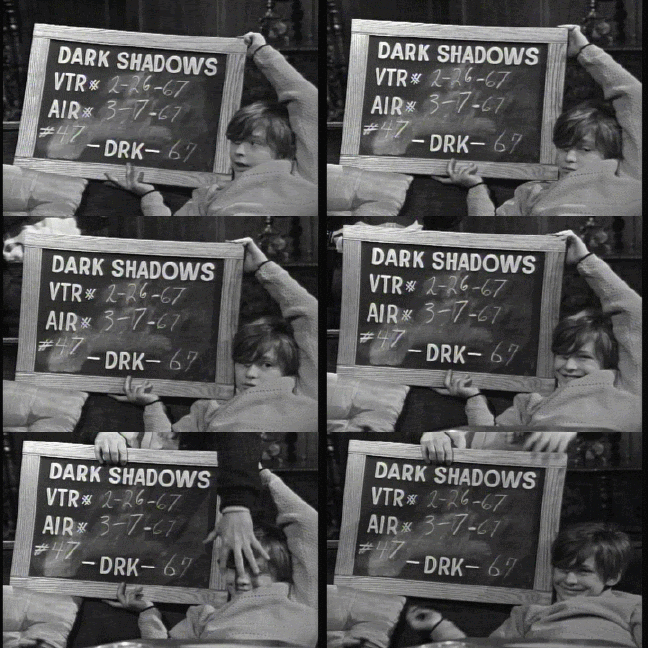
Whatever was going on among the writers, the actors seem to have been in a good mood today. David Henesy and Mrs Isles horse around a bit with the opening slate. He strikes a goofy pose to hold it, and she creeps up on him and puts her hand over his mouth.

Screenshot by Dark Shadows Before I Die