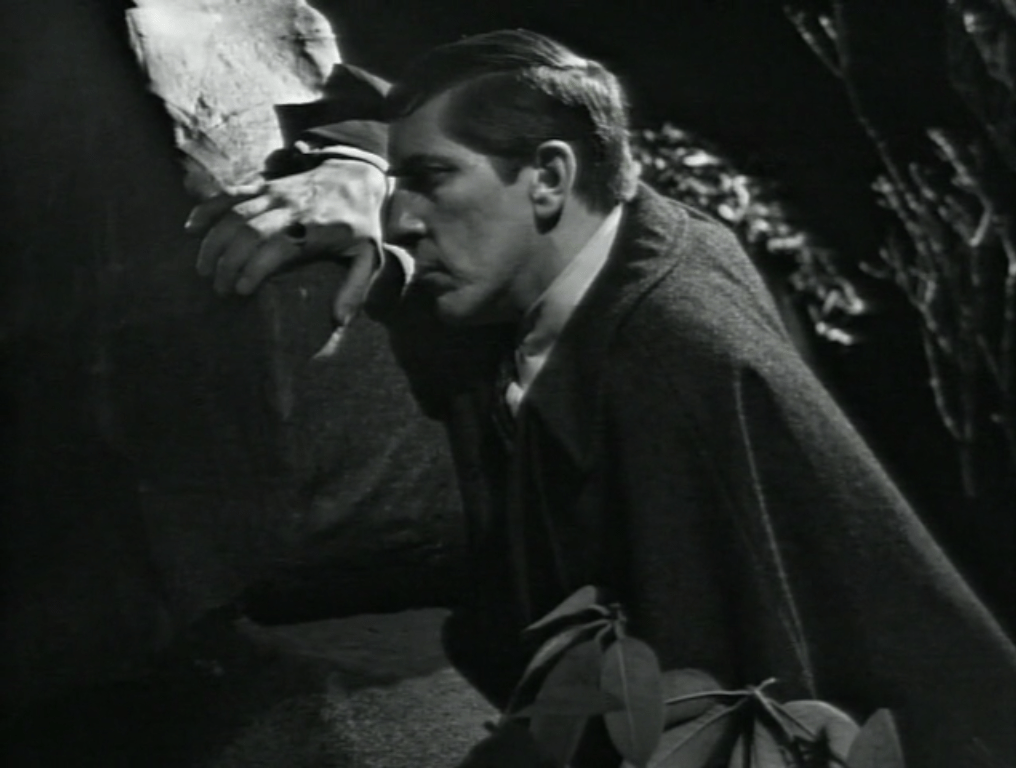
Episode 311: Attached to children

Both Danny Horn and Patrick McCray wrote fine blog posts about this episode. I have a few things to add to what they’ve said.

When vampire Barnabas Collins and his sorely bedraggled blood thrall Willie approach the Tomb of the Collinses, strange and troubled boy David hears them talking about mysterious little girl Sarah. Since Sarah had made him promise to keep her connection to the place secret, he opens the panel to the concealed chamber she had shown him and hides there. To his horror, he hears Barnabas order Willie to open the panel. Still trying to keep Sarah’s secret, he hides in the coffin in the center of the chamber while Willie and Barnabas walk around it. He hears them talk about Barnabas’ relationship with Sarah and Willie’s discomfort with the chamber.

They don’t mention that Barnabas is a vampire, or that he was the one who imprisoned Maggie Evans, The Nicest Girl In Town. But they say enough that David should be able to figure out all of Barnabas’ secrets. Once he has heard Barnabas say that he was left to comfort Sarah after their dog was put down, it isn’t much of a leap to conclude that Sarah is his little sister. And once he’s heard Barnabas ask Willie if he is frightened by the “contents” of the chamber, he should know that there is something in there more than can be seen at a first glance.

In episodes #301 and #306, we were reminded of Jason McGuire, whom Barnabas killed and forced Willie to bury in the floor of this chamber. We also saw the chamber itself in #306, so that regular viewers would be sure to think of Jason’s grave. If David should repeat Barnabas’ comment about the chamber’s “contents” at the right time, Jason might yet be exhumed. So Barnabas has created an extreme danger to himself with his big mouth. Since it does not seem that Dark Shadows could continue if either Barnabas or David were to destroy the other, we are in suspense as to how they will get out of this situation.

After Barnabas and Willie leave, David gets out of the coffin and finds he cannot open the panel from the inside. Willie had used a gadget hidden in the stairs to open it, the first time we have seen this device. As David starts to panic, he hears the strains of Sarah’s signature tune, “London Bridge.” He turns away from the panel, looks at the blank walls of the chamber, and starts calling on Sarah.

In his post, Danny Horn asks “Has David just figured out that Sarah’s a ghost?” I think it’s more complicated than that. In #288, David happily considered the possibility that Sarah might be a ghost, and throughout the series he has been on easy terms with several ghosts. So I think he has assumed she was a ghost all along, and was just too tactful to bring it up when he was talking with her.

Back in the great house of Collinwood, well-meaning governess Vicki is on the terrace, worried about David’s disappearance. Barnabas peeks at her through the gate, as he would do if he were not allowed to look at her. Then he just walks up and starts a conversation with her, leaving us to wonder what the whole peeping-Tom act was about.

Vicki is so concerned for David that she starts crying. Barnabas tells her to put her head on his shoulder, which she does. He seems to be trying to restrain himself, but she has such a long, pretty neck, and it’s right there, and he’s so very thirsty…
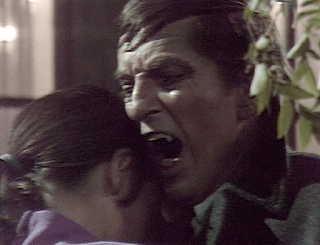
Snack time. Screenshot by Dark Shadows Before I Die.

Patrick McCray says of this moment:

As Barnabas lunges in to bite her, my concern and sympathy is challenged as I ponder her almost athletic lack of awareness. Of course, I’ll inevitably side with the person getting her throat ripped out… but it won’t stop me from wondering why she’s practically painting a landing strip on her neck. Vicki? You have a generation of young people idolizing you.

Today, the discussion isn’t even a metaphor. No, she’s not asking for it. No one is. So, what is the message that we’re supposed to take away from a dangerous conversation like this? For a person constantly asking questions about everything — and never understanding what she hears — Vicki is the picture of unawareness. Evil is evil. An attack is an attack. And awareness is power. Ironic that her would-be attacker, Barnabas, is frequently even more unaware than is she. However, if anyone on a soap paid attention at all, the stories would last ten minutes. But that’s the point. The more the characters lack focus, the more we learn its value. David is the most aware character on the show, and in this episode, he learns the most he ever will in one night. Pity it’s from inside a coffin.

That part of the discussion is too much metaphor to ignore.

Patrick McCray, “The Dark Shadows Daybook: August 22,” The Collinsport Historical Society, 22 August 2018.

Again, I think it’s a more complicated. I think we have to analyze Vicki’s behavior at three levels of intentionality. First, there’s the in-universe level, the sort of analysis of her motives another character in the same story might give if they had the same information we do. If that character saw Vicki’s depressing fiancé Burke angrily telling her she was crazy for saying that she had seen and heard things that we have also seen and heard, refusing to give her even the most basic information about himself and airily dismissing her questions as a morbid preoccupation with “the past,” and telling other people that her imagination will “run wild” unless he monitors and controls her, they might very well think that Vicki is tired of Burke’s abusive ways. To that character, there would be nothing “athletic” about Vicki’s failure to suspect Barnabas- it is perfectly natural for her to want to think the best of a man who has always been pleasant and respectful to her, unlike the blatant villain she is supposed to marry.

The second level of intentionality is of Vicki’s usual function in the narrative. Up to this point, every storyline has come to its climax when Vicki found out what was going on. She is still the audience’s main point of view character, and as such she naturally tends towards the center of the action. All of the action lately has been in the vampire story, so we expect her to involve herself deeply in it. In the first weeks, when it was possible that Barnabas, as the second in a parade of supernatural nemeses, would be destroyed and make way for a third as undead fire witch Laura Murdoch Collins had made way for him, we expected Vicki to be the one who drive the stake into his heart. Now that it is clear he is on the show for the long haul, we are expecting Vicki to become his victim, and presumably to become a vampire herself. As the protagonist, she is actively working to get more deeply involved with Barnabas. She hasn’t yet resorted to “painting a landing strip on her neck,” but she did invite herself to spend the night at Barnabas’ house in #285 and #286, and it wasn’t her fault she left in the morning still having all her blood.

Vicki the unappreciated fiancée wants only a friend who will respect her; Vicki the protagonist wants to be part of the main story. The tension between the incompatible goals of these two aspects of Vicki is expressed in the third level of intentionality, which Alexandra Moltke Isles expresses in the choices that make up her performance. Mrs Isles takes every opportunity to show that Vicki is more strongly drawn to Barnabas than to anyone else, most definitely including Burke. That attraction brings the character back to life. After a few days when she was trying to submit to Burke’s abuse and ignore “the past,” Barnabas asks her to intercede with Burke on his behalf and she comes roaring back, an assertive character who will not give an inch even when Burke makes some good points.

It is the sight of this strong Vicki that introduces a conflict into the audience’s feelings. On the one hand, we don’t want to lose her, and if she does not become a vampire, it’s hard to see a future for her on the show. On the other, it would be a terrible betrayal for Barnabas to repay her trust in him by doing such a thing to her. All the more so because we’ve spent so much time seeing Vicki become close to David, and if she follows the pattern set in Bram Stoker’s Dracula, vampire Vicki will be a threat to all children.

Our sadness at that betrayal would be a deep emotion of exactly the kind soap operas are supposed to create. That so shocking a crime would lead to a more meaningful and more suspenseful story and a richer part for our favorite character would guarantee that we would surprise ourselves by forgiving Barnabas for it and cheering when he and Vicki become a couple. So, I think a savvy audience watching Dark Shadows up to this point would have to expect to see just that story play out.

Episode 306: Private little investigations

Sarah Collins has taken her friend and distant cousin, strange and troubled boy David Collins, home with her. Since Sarah is a ghost, her home is in a mausoleum. She has decided to show David one of the most interesting features of the place.

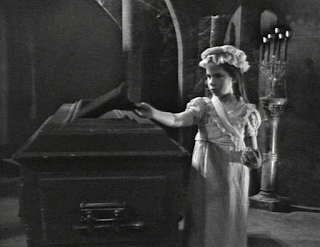
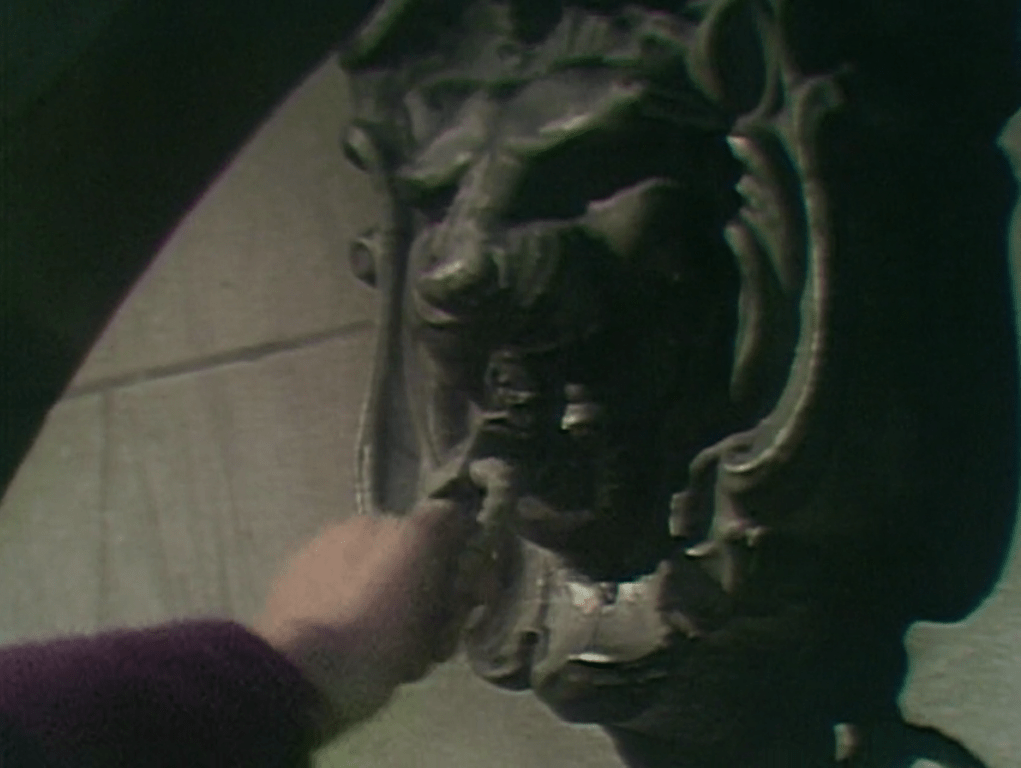
As we open, David is following Sarah’s instructions. He is standing on the sarcophagus of her mother and pulling a metal ring in the mouth of a stone lion’s head. The ring comes forward and a panel opens, revealing a room that was hidden for more than a century and a half.

The lion’s head.
Pulling the ring
The panel opens

The first time we saw the panel open was in #210, when dangerously unstable ruffian Willie Loomis happened upon the ring and ended up releasing vampire Barnabas Collins from his coffin in the hidden room. Now that we see this gimmick again and see it in color, it’s starting to seem odd that all you have to do to open the panel is pull the ring. The ring stands out as the only piece of metal in the tomb. Anyone entering the space would be tempted to tug on it, if only to polish it. If you’re wanting to make sure your vampire doesn’t get loose, I’d think you’d install a more secure system. Maybe you could add two or three additional decorative doodads to the wall, one of which you turn, say, three quarters of the way to the left, the other of which you turn some other way, and between them they release the ring.

Be that as it may, Barnabas’ old coffin is still in the hidden room. Sarah announces they will be opening it, and David resists the idea. He debates with Sarah for a while before curiosity gets the better of him.

Sarah the psychopomp.
David wants to let the dead rest.
David’s resistance crumbles.

He is shocked to see that it is empty. David asks Sarah why an empty coffin would be put in such a place, and she happily tells him that it wasn’t always empty. There was someone in it once, but he got up and left. David protests that the dead don’t walk away, to which Sarah replies that “Sometimes they do.”

David is shocked.
Nobody’s home.

When David first met Sarah in #256, she was outside Barnabas’ house, puzzled that she couldn’t find her parents or anyone else she knew. Now it is starting to seem that she knows that she is a ghost haunting a time long after her own, but Sarah’s lines here are the first clear indication that she knows what is going on with her brother Barnabas.

David’s bafflement that the coffin is empty echoes #273. In that episode, matriarch Liz was shocked to find that the chest seagoing con man Jason McGuire buried in her basement did not contain the murdered remains of her husband. Liz kept asking “Why is there nothing there?” David seems almost as appalled as his aunt had been at the sight of some clean fabric unadorned with a rotting corpse. A few days after Liz found out Jason hadn’t really buried her husband in her basement, Barnabas killed Jason. Regular viewers will already have this story in mind, because in #276 Barnabas and his sorely bedraggled blood thrall Willie buried Jason in the floor of the very room David and Sarah are visiting at this moment. Clearly Barnabas would not be happy were he to find out that David knows about the room.

That wasn’t the first vacant grave in Dark Shadows. From #126 to #191, the show was mainly about David’s mother, undead fire witch Laura Murdoch Collins. As the Laura arc progressed, graves of various women named Laura Murdoch were revealed to be empty. Now Laura’s son is coming face to face with an unoccupied coffin, suggesting to loyal fans that he may yet learn something about his own origins.

To Sarah’s consternation, David says he has to go home. He tells her that if he does not, his governess, the well-meaning Vicki, will be upset with him. He simply refers to Vicki by name, as if Sarah already knows who she is. Regular viewers have reason to believe she does know who Vicki is, but it is not clear why David assumes that he can just say “Vicki” without explaining to Sarah who he means. Sarah swears David to secrecy about the existence of the room.

By the time David gets back to the great house of Collinwood, it is 9:30 PM and Vicki is indeed worried about him. Apparently no one else is at home; certainly, no one else has missed David. Vicki sits David down on a seat that’s been in the foyer from the beginning of the series, but which has only been used once or twice before. They have an earnest little talk that recalls the scenes they shared in the first 39 weeks of Dark Shadows, when their complicated relationship was the one storyline that consistently worked.

Rarely used seat.

David describes Sarah to Vicki. It finally dawns on her that Sarah is the little girl she saw on top of the stairs at Barnabas’ house in #280. When the light flashed in Vicki’s eyes, my wife, Mrs Acilius, shouted at the screen “Tell him!” Vicki and David again look like the fast friends they had become by #140, so we would indeed expect her to tell David that she thinks she has seen Sarah, and to tell him where and when she saw him. If she and David join their lines of inquiry and work together to find out about Sarah, the plot will move more quickly and on a much bigger scale than it can so long as everyone pursues their own questions in isolation.

Vicki catches on.

But, Vicki is also very fond of Barnabas, and reluctant to believe anything bad about him. Sarah has been seen in several places connected to the abduction of Maggie Evans, The Nicest Girl in Town. Vicki doesn’t want anyone to add Barnabas’ house to that list, so perhaps it is not a “Dumb Vicki” moment when she decides to keep the information to herself.

Meanwhile, Barnabas is at home. He is irritated with mad scientist Julia Hoffman. Julia is attempting to cure Barnabas of vampirism, and he is dissatisfied with the progress of the treatment. He is also irked that Sarah broke Maggie out of the mental hospital where Julia was keeping her locked up, and blames Julia for failing to ghost-proof the place. He declares that Julia is “a meddlesome and domineering woman,” and that he, as a native of a different century, has no intention of tolerating such a person.

Barnabas and Julia discuss Vicki’s depressing boyfriend Burke. Burke has been investigating Barnabas, and his operatives have come upon some information that would raise questions Barnabas would have a hard time answering. Julia agrees that Burke must be stopped, and urges Barnabas to let her handle the matter. He says that he will take care of it, and that he will do so with “finesse” of a sort unfamiliar to the loutish inhabitants of the twentieth century.

Barnabas’ masterful finesse consists of telling Vicki what Burke is doing and asking her to make him stop. Those eighteenth century guys must have been amazing, to come up with something so complex and subtle in just a couple of days.

Julia comes into the great house as Barnabas is leaving. She asks Vicki if David is back yet. Vicki tells her that he had been out playing with Sarah in some location he refuses to disclose. Barnabas tries to conceal his alarm with a laughing remark about leaving Vicki and Julia to investigate the mystery of David’s playmate.

David comes out of his room to ask for food. While Vicki goes to fetch the housekeeper for him, Julia meets him at the top of the stairs and they talk about Sarah. David points out that she is repeating questions she has asked in previous episodes. He tells her that he doesn’t mind questions and neither does Sarah, but cautions her that the answers Sarah gives don’t make much sense.

The stained glass windows at the top of the stairs look great in color, and it is a relief when David shares the audience’s awareness that we’ve heard Julia’s lines before. Even so, the scene is a disappointment. David and Julia were fun to watch in their previous scenes because they were so relaxed together. Perhaps that was because David Henesy and Grayson Hall understood each other right away. Not only did they have similar ways of working as actors, but her son Matthew is about his age, so she might already have been familiar with a lot of things in his life that the other adults on set wouldn’t have known about.

Today, though, they are both having trouble with their lines. That keeps them from making enough eye contact with each other to sell the scene. David Henesy keeps looking at the teleprompter, which he could evidently read from the top of the stairs with only a little squint; Grayson Hall couldn’t read from that distance, but she does tilt her head back and look up when she’s searching her memory for her next line. Since the characters aren’t looking at each other, we don’t feel an emotional connection between them.

Hall has to thread a particularly small needle in this scene. Julia is trying to make her interest in Sarah seem casual in the same way Barnabas affected a lack of interest in her, by delivering lines about her with a jokey inflection. We know that she is urgently concerned with finding Sarah, and her efforts have to leave David unsure whether she really is the easygoing adult he has so far taken her to be or whether she is trying to pull a fast one.

In the course of a friendly chat between two people who obviously like each other, onetime Academy Award nominee and frequent Broadway luminary Hall could certainly have accomplished all of this. But in the course of this awkward encounter, it all falls flat. Especially so with Julia’s last line to David. After he has told her how difficult it is to get a straight answer from Sarah, she puts on a goofy voice and says that she’ll keep that in mind if she ever meets her. Since she isn’t looking at him when says this, it comes off not as an affectionate gesture acknowledging that they’ve run out of things to say, but as a high-handed dismissal. Even though she pats him on the shoulder and he smiles after that line, it still doesn’t seem that David would come away from the interaction with as complex an emotional response as he is supposed to have. Most likely he would just be irritated with Julia, as indeed the audience is likely to be.

“I’lll kee-e-ep that in mind.”
Departure.

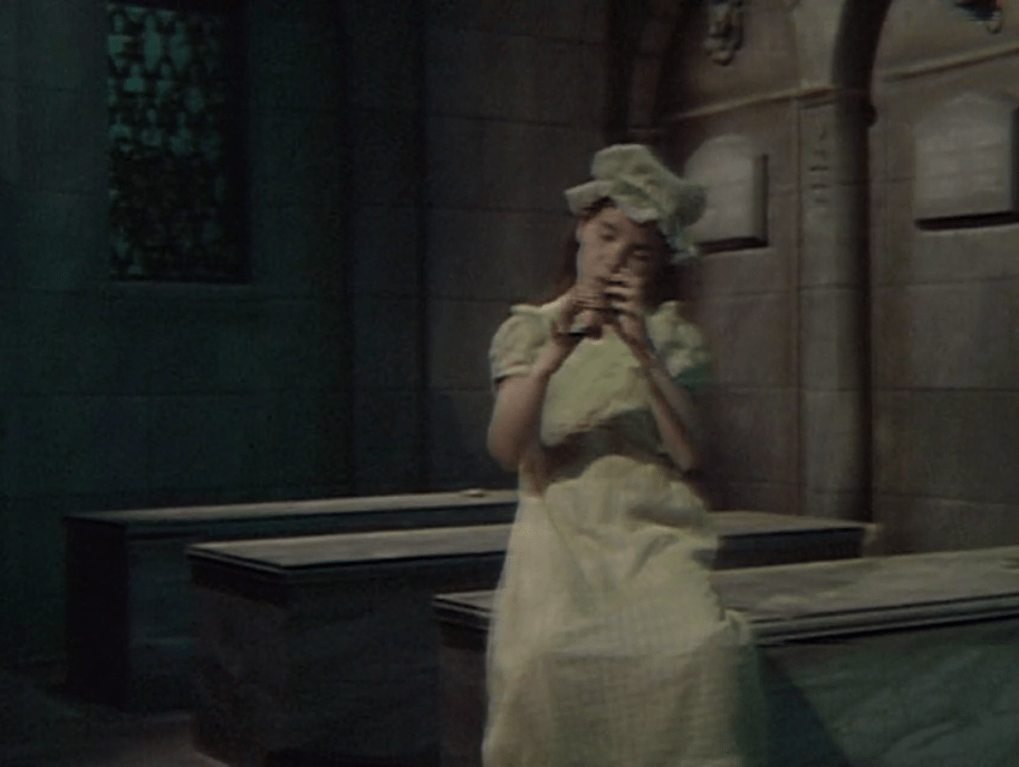
We end back at Sarah’s place. Barnabas is in the cemetery looking pathetic. He hears the strains of “London Bridge” coming from the mausoleum. We see Sarah sitting on her mother’s sarcophagus moving her fingers on her recorder far more rapidly than the music we hear would call for. She looks more like she’s playing a rock ‘n’ roll number.

Jammin’ with the Junior Funky Phantom of 1967.

Barnabas calls out to Sarah. He identifies himself as her brother and says that he has come to take her home. He goes into the mausoleum only to find that she has vanished. Wracked with sorrow, he pleads with her to come back, saying that he loves her and needs her. He touches the plate marking her grave. This underscores the futility of his desire to take her home. Leading him here, it is she who has brought him to what is in fact her home, and what ought also to be his.

Sad Barney.
The impassable barrier.

This shows us a Barnabas we can sympathize with, but it also sets him on a collision course with David. Barnabas has been so harmless lately that we might wonder if his part is going to be recast with a purple felt puppet counting “Vun peanut butter saand-veech!” If he sets out to kill a child, he’ll be back on track as a horrifying menace.

Besides, David is not just any child- as the last bearer of the Collins name, David’s survival has a great symbolic importance to the show. He was central to everything that happened on Dark Shadows in its first 39 weeks. So if Barnabas becomes a threat to David, it will be a case of conflict between the current main character and the previous main character. Since Vicki originally represented the audience’s point of view and is still a major character, the divided loyalties between Barnabas and David that we first see influencing her behavior today could create a high level of dramatic tension. Especially so if Barnabas turns her into a vampire, and she winds up like Lucy in Dracula, the “Bloofer Lady” who herself preys on children.

Episode 286: No little girl

The most interesting storyline in the first 39 weeks of Dark Shadows was the relationship between well-meaning governess Victoria Winters and her charge, strange and troubled boy David Collins. That story concluded when David chose life with Vicki over death with his mother, undead fire witch Laura Murdoch Collins. Vicki and David settled into a happy and uneventful friendship, and the show moved on. Now its core is vampire Barnabas Collins, and Vicki is trying to migrate into his orbit.

When we open, Vicki has made her way to Barnabas’ house as a storm was breaking. She had made a show of wanting to hurry home, only to find that it was raining so hard she had to stay with Barnabas overnight. The opening scenes take place in Barnabas’ front parlor, where Vicki is all wide-eyed innocence.

Vicki and Barnabas are both excited about the prospect of a sleepover. Screenshot by Dark Shadows Before I Die

Vicki asks Barnabas about the long-ago death of Josette Collins. Unknown to her, Josette killed herself because she feared Barnabas would turn her into a vampire, the fate he has in mind for Vicki now. As he tells the story, Barnabas shows more and more anguish. At the end, he suggests that the storm might be letting up and offers to take Vicki home. She says that the rain sounds worse than ever, and insists on staying. This is the first scene in which Barnabas plays the “reluctant vampire” we hear so much about in thumbnail sketches of Dark Shadows.

Vicki goes up to Josette’s restored bedroom. She lies on the bed and covers herself up, remaining fully clothed. She doesn’t even take her shoes off.

Downstairs, Barnabas’ sorely bedraggled blood thrall Willie brings a child’s ball he found in the basement by Barnabas’ coffin. For a moment they are afraid that David might have made his way to the basement during the daytime, but Barnabas concludes that they would have heard about it by now if that had happened. Willie brings up the little girl whom he and David both saw playing outside the house on separate occasions some weeks ago. He also reminds Barnabas that when he was keeping Maggie Evans, The Nicest Girl in Town, in the prison cell in the basement Maggie talked about a little girl who visited her there. Barnabas won’t listen to anything about Maggie, and is irritated when Willie keeps saying that he has the feeling that there is someone else in the house. But he does go to search the basement.

Meanwhile, Vicki is awakened by the sound of a child’s voice singing “London Bridge.” Returning viewers know that this is the little girl Willie spoke of, and that she is the ghost of Barnabas’ nine year old sister Sarah. Victoria lights a candle and searches the room, but finds nothing.

Willie is startled when Victoria comes down the stairs and calls him. Barnabas hadn’t bothered telling him she was around. We might be startled too. The diffident, girlish manner she had used with Barnabas earlier in the episode is gone; when she calls “Willie!” she is every inch the lady of the house summoning a servant. In their previous interactions, Willie has always called Vicki by her first name. Today she is “Miss Winters” to him, and that’s only to be expected- she retains an air of command even as Willie tries to warn her that she is in danger.

Barnabas enters and hears Willie urging Vicki to get out of the house at once. Willie takes a second to come up with a suitable lie, claiming that he was afraid spending the night in the house would get people talking about Vicki. She and Barnabas dismiss this concern. Vicki praises Willie’s generous offer to walk her home and shelter her from the rain, and Barnabas assures Willie that he will get what he deserves.

Vicki tells Barnabas that she heard a little girl singing “London Bridge.” Shaken by this report, he insists it is impossible for her to have heard any such thing. He says that he understands if she does not want to return to the room, implicitly repeating his offer to let her go, but she happily returns upstairs. In this conversation, she is not as loftily aristocratic as she had been with Willie, but neither does she revert to the diffident girlishness she had shown Barnabas in the first scene. She looks him in the eye, smiles, speaks briskly, and moves from her hips. She is a woman who knows what she wants and has made up her mind to get it.

Barnabas and Willie have an interesting talk after Vicki goes back upstairs. Willie asks about the little girl, and Barnabas hotly denies she exists. Barnabas is his usual menacing self at first, but then says he won’t punish him for trying to warn Vicki. He asks Willie to “talk to me.” Willie is startled by this, then Barnabas says he has a better idea- “don’t talk to me.” This generates a bad laugh. Some think this is Jonathan Frid trying to cover a misreading of a line, but I tend to think it is good acting exposing bad writing. After their talk, Barnabas sends Willie to his room, then goes upstairs and stares at Vicki while she sleeps, apparently contemplating the possibility of biting her.

Episode 284: The right name for something else

Vampire Barnabas Collins spends most of his time on screen doing a job of acting. He is playing the role of a present-day gentleman from the long-forgotten English branch of the ancient and esteemed Collins family of Collinsport, Maine. His performance has been convincing enough that the Collinses have entrusted him with the long-abandoned Old House on the great estate of Collinwood. He and his sorely bedraggled blood thrall Willie reside there and have restored it to the condition it was in when Barnabas was alive.

Today, another actor comes to Collinwood. She is mad scientist Julia Hoffman. By profession, Julia is a medical doctor with specialties in psychiatry and hematology. She is treating Maggie Evans, The Nicest Girl in Town, who is in a state of complete mental collapse after months as Barnabas’ victim. After Maggie escaped from Barnabas, her family doctor, addled quack Dave Woodard, decided to tell everyone in town that she was dead and send her to Julia’s mental hospital so long as her captor was unknown and at large. So when Julia figures out that the person responsible for Maggie’s woes is an undead monster who dwells at Collinwood, she has to conceal her identity from everyone there and in Collinsport.

In the drawing room of the great house at Collinwood, Julia tells well-meaning governess Vicki and Vicki’s charge, strange and troubled boy David Collins, that she is an historian writing a book about the Collinses. David immediately exposes a fatal flaw in Woodard’s cockamamie plan when he mentions a girl named Sarah whom he has seen near the Old House. Julia knows that Maggie saw Sarah when she was imprisoned and that Sarah visited Maggie’s father Sam and told him where to find her. If that information had been made public, Vicki and David would have been able to connect Sarah with the Old House, and the police would have suspected Barnabas weeks ago. Returning viewers know that Sarah is the ghost of Barnabas’ sister, a fact onto which Julia cottoned yesterday and of which she finds corroboration today.

Vicki tells Julia how elusive Sarah is

We also know that Barnabas wants Vicki to become his next victim, and that she is already under his influence to a substantial degree. When she and Julia are talking in the drawing room, Vicki waxes enthusiastic about how Barnabas has recreated a past world and committed himself to living in it, and says that this is a fine thing for him. “But not for you?” asks Julia. Vicki looks down, and with a troubled expression says that she supposes not.

When Julia asked “But not for you,” she drew a reaction from my wife, Mrs Acilius. Mrs Acilius said that while Julia may not seem like any kind of therapist in the sessions we’ve seen her have with Maggie, her delivery of that question sounds exactly like every therapist she’s ever had. With Maggie, the mad scientist is very much on the surface of Julia’s manner, but when she is playing the role of Miss Hoffman the historian she can draw on her profession to make herself appealing.

Vicki takes Julia to the Old House and shows her the restored bedroom of Josette Collins. Vicki says that she could stay in that room forever, which is as a matter of fact precisely what Barnabas has in mind for her. Julia feels a chill as the sun sets. Perhaps this is the result of Barnabas coming back to life and rising from his coffin in the basement of the house, or perhaps it is Sarah or another friendly ghost* trying to warn her to get out before the vampire finds her. Whatever its cause, Vicki doesn’t feel it. Again, we don’t know whether this is because Barnabas already has a strong enough hold on Vicki that she is insensitive to warnings about him, or if it is a message specifically for Julia.

Julia wants to leave the room, but Vicki insists on lighting a candle so that they can see it as Josette did. The candle burns long enough for Julia to make the appropriate comments, and then something we cannot see blows it out while Julia feels another chill. The cold still doesn’t reach Vicki.

Julia returns to Woodard’s home office,** where she has stashed Maggie. Maggie has the doll Sarah gave her when she visited her in Barnabas’ dungeon. Julia takes the doll from Maggie, much to Maggie’s displeasure. She holds the doll and says she wants her to listen for the doll’s name. Maggie furrows her brow and asks “Doll talk?” Maggie has been speaking in complete sentences lately, but apparently Julia’s latest antics have been too much for her and she has lost some ground.

Julia orders Maggie to listen and says the names of some of the people at Collinwood. Maggie doesn’t react until she gets to “Barnabas Collins,” at which point Maggie freaks out. Julia holds her and repeats “It is the wrong name” until Maggie stops crying and starts singing “London Bridge.” She then looks away and says “The wrong name for the doll… but the right name for… something else.
*Sarah’s little cousin, Caspar Collins?

**An exact replica of his office in the hospital as we saw it in #242. Man knows how he likes to have things set up.

Episode 278: If you become Josette

The first major villain on Dark Shadows was high-born ne’er-do-well Roger Collins, played by Louis Edmonds. Edmonds was a master of the sarcastic remark, so that Roger was often funny. But no matter how often he made the audience laugh, Roger was never a comic villain. That requires a character we can empathize with as we watch them scheme and plot, scramble and improvise, in pursuit of goals that could not be achieved without ruining all the fun. We laugh when we recognize our own foibles in an outlandish character, and laugh again when we realize that our ability to feel with others encompasses even those whose feelings have led them to do dastardly deeds.

Roger’s personality was too cold, his motives too contemptible for us to empathize with him. Where a comic villain thinks fast and puts himself in ridiculous situations, Roger stuck with his fixed ideas, using the same tactics time and again to bully his unwilling co-conspirator Sam to stick with their plan. Even when he bumbled about with a damning piece of evidence, a fountain pen left at a crime scene, he was never the coyote caught in his own over-elaborate trap, but a criminal in a police procedural. He was a melodramatic villain who was only incidentally funny.

The first supernatural menace on the show was Roger’s ex-wife, undead fire witch Laura Murdoch Collins, played by Diana Millay. Millay was hilarious, every bit as funny as Louis Edmonds. It was a shame the two of them didn’t play a married couple in a long-running comedy. They could have raised sarcasm to heights previously unknown to humankind. But while Millay gets laughs every time the script gives her the least chance, Laura was even less of a comic villain than Roger.

It is clear that Laura is a malign presence from beyond the grave and that, if she is not stopped, she will burn her young son David to death. But everything else about her is an impenetrable mystery. She is not part of a familiar mythology, and even the most basic questions about her remain unanswered. We cannot empathize with her motives, since we cannot begin to guess what her motives are or even be sure if she has motives.

The first comic villain on Dark Shadows was seagoing con man Jason McGuire, played by Dennis Patrick. Jason had his first comic turns only after he had been on the show for weeks, during which time we had been subjected to many iterations of a dreary ritual in which he made a demand of reclusive matriarch Liz, Liz resisted, he threatened to expose her terrible secret, and she capitulated. When his henchman Willie slips out of Jason’s control and he starts scrambling to contain the damage Willie is doing to his plan, Patrick finally gets a chance to play Jason as a comic villain, and the result is very engaging. But those scenes are scattered too thinly through Jason’s long-running, relentlessly monotonous storyline to make him a success as a comic villain.

Now, the show has struck gold. Vampire Barnabas Collins is becoming a pop culture phenomenon and bringing the show the first good ratings it has ever had. They have to keep Barnabas on the show indefinitely, and he has to be the most important character. That presents a practical difficulty. Vampires usually figure in folklore and fiction as unstoppable killing machines. Daytime soap operas explore the shifting relationships among large casts of characters. It’s going to be hard to maintain that cast if Barnabas sets about murdering everyone. To square the circle, they try to redefine Barnabas as a comic villain.

Barnabas is giving a costume party for his distant cousins, the living members of the Collins family. He has invited well-meaning governess Vicki to attend and to wear the dress of the legendary Josette Collins. In the first 39 weeks of Dark Shadows, Vicki had developed a close friendship with Josette’s ghost, so she is excited about this. For his part, Barnabas has borrowed an evil scheme from the 1932 film The Mummy. He will erase Vicki’s personality and replace it with Josette’s, then kill her so that she will rise as a vampiric Josette. So he is glad she likes the dress.

Barnabas asks Vicki to come to his house and help him pick out the antique clothes that the family will wear at the party. She enthusiastically agrees, saying that she loves to go through trunks full of old clothes. The clothes are in a trunk in Josette’s old room, which Barnabas has restored.

In the room, we see the ghost of Barnabas’ 9 year old sister Sarah sitting on the trunk. She vanishes a second before Barnabas and Vicki enter. Both of them have a strong feeling that someone just left the room. Barnabas tries to dismiss the sensation as nervousness, but Vicki has had too much experience with ghosts to be put off so easily.

Vicki has been our point of view character for most of the series. At first, that was because she was a newcomer to the great estate of Collinwood and the nearby town of Collinsport, and so we would learn everything we needed to know as we listened to people explain things to her. Later, it was because she was the key protagonist in the stories, so that the action got going once she knew what was going on. So when Barnabas equals Vicki’s sensitivity to Sarah’s presence, he is presented to us as another possible point of view character.

Barnabas keeps talking about the Collinses’ eighteenth century ancestors in terms that make it obvious that he knew them, so that he more than once has to clean up after himself with remarks like “I would imagine.” He does alarm Vicki when he blurts out something about what will happen to her should she “become Josette.” He hastens to say that he means that Vicki will become her for the duration of the party.

“Become Josette?”

Vicki goes back to the great house and talks with Liz about the party. Liz smiles happily, the first time we’ve seen this expression on her face in the whole run of the series.

Happy Liz

Vicki goes on about Barnabas’ connection to the past, saying that he gives the impression of someone who really is misplaced in time. She has the feeling that he needs to recreate a bygone era, and that he is doomed to be unhappy because of the impossibility of traveling backward in time. Vicki does not know what Barnabas’ plans for her are, but she understands his motives perfectly and empathizes with him deeply. That Vicki, Barnabas’ intended victim, can feel this way suggests that we can, too.

Back in Barnabas’ house, Sarah reappears in Josette’s room and sees her blue dress. She is excited to find it. She looks at her reflection in the mirror and smiles. Her good cheer is emphasized when her musical cue, an excerpt from “London Bridge,” is for the first time played in a major key.

Sarah’s reflection looks like it has never seen a ghost before

The minor key was appropriate during Sarah’s previous appearances. The first several times we saw her, Sarah was associated with Barnabas’ imprisonment of Maggie Evans, The Nicest Girl in Town. Maggie was the victim of Barnabas’ first mad attempt at Josettery, and Sarah intervened just in time to keep Barnabas from killing her. The other day, Barnabas killed Jason, and we saw Sarah when Barnabas was forcing Willie to help him hide his old friend’s corpse. Barnabas isn’t killing anyone today, so Sarah can be a bit more cheerful.

Sarah helps to establish Barnabas as a comic villain. As the ghostly sister who returned to the upper world when Barnabas was loosed to prey upon the living, Sarah and he are part of the same eruption from Dark Shadows‘ supernatural back-world into its main continuity. Perhaps she personifies his conscience, certainly she gives him an occasion to make schmaltzy speeches about his days as a human. More important than either of these, when we see that Barnabas’ 9 year old sister is his most powerful adversary, we begin to wonder just how seriously we should take him.

Closing Miscellany

Yesterday and today, Alexandra Moltke Isles delivered the recorded voiceover monologue at the beginning of the episode. The first 270 times she did this, it was in character as Vicki. Now, they’ve given up the idea that Vicki or any other one character will eventually find out about everything that we see on screen, so the openings are delivered by whatever actress is available as a nameless external narrator.

In those first 270 outings, Mrs Isles sounded like Vicki. She adopted Vicki’s distinctive way of speaking, carefully articulating one word at a time and often ending sentences with surprising little inflections- a curl of uncertainty here, a touch of breathy optimism there, a falling note of despair in another place. The voiceovers were usually remarks about the weather or the sea that were supposed to involve some vague metaphor for events in the story, so that it is open to question whether it was really worth Mrs Isles’ time to put so much effort into creating a character with them. But I guess a pro is a pro, and it was a matter of course that she would do her best no matter how little she had to work with.

In these last two, she has used a relatively flat voice, with none of Vicki’s particular vocal traits. The pacing has been structured, not around sentences, but around an attempt to convey an overall sense of urgency. They sound very much like The Narrator. I wonder what Mrs Isles would have made of The Narrator if the voiceover passages had extended beyond the opening moments and run through the episodes.

There is a famous production error under the closing credits, when a stagehand shows up in the window, realizes he’s on camera, and makes himself all the more conspicuous when he tries to escape from his predicament.

From PostImages

Episode 276: Into the room

For the first 54 weeks of Dark Shadows, reclusive matriarch Liz was paralyzed by the fear that someone would enter the locked room in the basement of the great house of Collinwood and find the murdered body of her husband Paul Stoddard buried there. For the last 16 of those weeks, seagoing con man Jason McGuire exploited that fear to blackmail Liz.

It turned out that Liz didn’t actually kill Stoddard and there never was a corpse hidden in the basement of the great house. There is, however, a corpse hidden in the basement of another house on the same estate. During the daytime, Liz’ distant cousin Barnabas Collins is a dead body resting in a coffin in the basement of the Old House. He gets up at night to feed on the blood of the living, lure the unwary to their damnation, and deliver rambling monologues about how sorry he feels for himself. Unlike Stoddard’s supposed grave in the great house, Barnabas’ coffin is not kept in a locked room, so the parallel has been incomplete.

Today, Barnabas decides to complete it. Trying to find and steal Barnabas’ jewels, Jason had broken into the Old House. He made his way to the basement, where he stumbled upon the coffin. He opened it, and Barnabas strangled him. Now, Barnabas orders his sorely bedraggled blood thrall Willie to help him carry Jason’s body to the secret room in the mausoleum where Barnabas himself was imprisoned and undiscovered for “nearly 200 years.”

Before they leave the basement, Barnabas tells Willie about his sister Sarah, who died when she was very young and innocent. After they leave, Sarah’s ghost appears and puts Jason’s sea cap on Barnabas’ coffin.

Sarah places Jason’s cap. Screenshot by Dark Shadows Before I Die

Episodes #1-#274 had all opened with voiceover narrations delivered by Alexandra Moltke Isles in character as well-meaning governess Vicki. Starting Friday, they gave the opening monologues to one of the actresses who happened to be in the episode to deliver as an unnamed external narrator. Today, this spoils a surprise. We haven’t seen Maggie Evans, The Nicest Girl in Town, for a while, and aren’t sure when we will see her again. When Kathryn Leigh Scott delivers today’s opening voiceover, we know we will see Maggie today.

Barnabas had held Maggie prisoner for several weeks. He had borrowed a plan from the 1932 Universal film The Mummy. He would erase Maggie’s personality and replace it with that of his long lost love Josette. Once he had done that, he would kill her and she would rise from the dead as a vampiric version of Josette. Maggie did not go along with the plan, and Sarah’s ghost helped her to escape. Barnabas managed to scramble Maggie’s memory before her father found her, and she is now in treatment at a sanitarium called Windcliff.

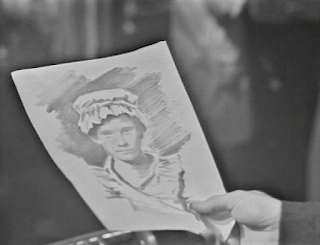
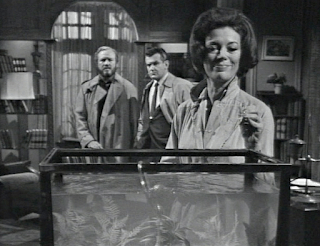
Maggie’s hometown doctor, addled quack Dave Woodard, is visiting the director of Windcliff, Dr Julia Hoffman. Woodard wants to show Maggie a sketch Maggie’s father, artist Sam Evans, made when the ghost of Sarah visited him to tell him where to look for Maggie. Julia resists, Woodard insists. While Julia delays, she feeds the fish in the aquarium in her office. We see enough of the aquarium to suggest that Julia is the keeper of a world within a world, a little enclosure with its own rules.

Aquarium. Screenshot by Danny Horn.

Woodard shows Maggie the sketch. After a moment, she says “Sarah.” She tells them that Sarah visited her in the room where she was confined, that she told her a riddle that showed her how to escape. She becomes too upset to talk. She starts miming her search for a loose brick in the wall of the cell, then sings a verse of Sarah’s signature tune, “London Bridge.” She is shouting words from “London Bridge” when the nurse drags her down the hall, back to her room. Julia declares that the whole thing was a waste of time, a judgment in which Woodard does not concur.

Sam’s sketch of Sarah. Apparently the drawing was done before Sharon Smyth was cast as Sarah, when they planned to give the part to Harvey Keitel in drag. Screenshot by Dark Shadows Before I Die

Meanwhile, Barnabas and Willie take the body of Jason to the tomb of the Collinses and bury it in the secret room. They talk about the people buried in the part of the structure known to the public- Barnabas’ parents and his sister Sarah. Barnabas confirms that Sarah is the one he was telling Willie about in the basement, the friend he knew long before he met Josette. He reminisces about repairing a doll of hers the night before she died. We see the plaque giving her dates as 1786-1796, implying that Barnabas met Josette after 1796. They leave, and Sarah appears.

Liz had last seen Jason the night she thought she killed Stoddard; his reappearance would lead to the opening of the locked room and the exposure of its secret. Barnabas last saw Sarah in 1796; her reappearance, today’s events suggest, might lead to the opening of all the rooms Barnabas wants to keep closed and to the exposure of all his secrets.

Episode 267: No one has clearly defined death

Reclusive matriarch Liz is standing on the edge of a cliff, staring out to sea. Her distant cousin, Barnabas the vampire, comes up stealthily behind her. He grabs her, and she screams.

The vampire approaches the lady. Screenshot by Dark Shadows Before I Die

For months, Liz has been stuck in a go-nowhere storyline about blackmail. So it is exciting to see the beginning of a new story where she is under Barnabas’ power. Or it would be, if that were what was happening. Instead, we come back from the opening credits to find that Barnabas approached Liz that way only because he was afraid she might go over the cliff if he made a noise and startled her.*

As a result of the blackmail arc, Liz is suicidal. Barnabas fears that she may be trying to jump, and tries to cheer her up by spending several minutes delivering a semi-coherent oration about how wonderful it is to be dead.

The scene started with a disappointment, and the dialogue doesn’t make much sense, but it is always fun to see Jonathan Frid and Joan Bennett work together. Frid’s acting style was a bit of a throwback to the nineteenth century, which made him an ideal scene partner for a daughter of Richard Bennett.

In #264, Barnabas had made some remarks to Liz’ brother Roger about the importance of family. Barnabas had then gone on to bluster uselessly at Liz’ blackmailer, seagoing con man Jason. He later told his sorely bedraggled blood-thrall Willie that he might kill Jason soon. As a vampire, Barnabas is a metaphor for extreme selfishness, and his hostility to Jason fits into that- Jason does represent a possible inconvenience for him. But today, we see a hint that Barnabas might actually have some measure of concern for Liz and the rest of the Collinses. After he walks Liz home, he confides in the perpetually well-meaning Vicki that he was afraid Liz would jump off the cliff. He tells Vicki that she seems to be the person most able to help Liz.

Yesterday, housekeeper Mrs Johnson had grabbed Liz as she was about to plunge off the same cliff, and had told Vicki of the incident. But Mrs Johnson just thought Liz was fainting. Vicki had noticed yesterday that Liz was deeply depressed, but she is shocked and disbelieving when Barnabas breaks the news that she seems to be suicidal.

On his way into the house with Liz, Barnabas had seen strange and troubled boy David Collins. David had seen Liz, but Liz neither saw nor heard him- she walked silently away from him, even though he twice called out “Aunt Elizabeth!”

In #256, David had met a little girl wearing eighteenth century dress hanging around outside Barnabas’ house. Unknown to anyone but the audience, the little girl is the ghost of Barnabas’ sister Sarah. David told Willie about Sarah, and Willie himself saw her in #264 and told Barnabas about her. Today, Barnabas tells David that if he sees Sarah again he should tell her to stay away from his property.

Barnabas’ message to Sarah and David

David denies that Sarah is his girlfriend, and says that her habit of singing “London Bridge” gets on his nerves. Barnabas is startled by the mention of “London Bridge.” David says that he isn’t likely to see Sarah near the Old House again, because “I’m not allowed to play at the Old House.” He delivers this line with a pungency that led us to laugh out loud. The whole scene is a lot of fun.

“I’m not allowed to play at the Old House.” Screenshot by Dark Shadows Before I Die

Barnabas had turned his creepy, anachronistic charm on at full force when talking to Vicki, and was obviously disappointed when she told him she had a date with fake Shemp Burke Devlin. He politely responded to this news by describing Burke as “a very interesting man.”

We then go to the Blue Whale tavern, where we see that “very interesting man” drinking and smoking by himself for a minute and a half. He wanders from his table to the bar to get another drink, passing some people whom first-time viewers will believe to be suffering from spastic disorders, but whom regular viewers will recognize as Collinsport residents who think they are dancing.

Notice her right hand- she has her guard up in case the convulsions spread to his arms

Burke goes to the pay phone to call Vicki. She enters, and he tries to get his dime back. He takes the receiver off the hook, replaces it, probes around in the coin return, bangs the side of the phone, explores the coin return again, and sadly tells Vicki that he has lost his dime. She tells him that if the purpose of calling was to get her to show up, he got his money’s worth. He agrees, but keeps looking back at the phone with longing.

Burke and Vicki dance. She tries to take his mind off the lost dime by recapping the last couple of episodes, but too little of interest has happened to refocus his attention. Vicki gives up and says she’s going home. We don’t see Burke resume his battle with the coin return slot, I guess they decided they had already given us our thrill for the day.

Back in the house, Liz is sitting in front of a table on which there is an open book. She is staring blankly into space. David enters the room. He greets her. She smiles vaguely, mumbles “Oh, David,” then gets up to leave. When Vicki comes in and says hello, Liz mutters “Hi, Vicki,” but doesn’t turn her head to look at her.

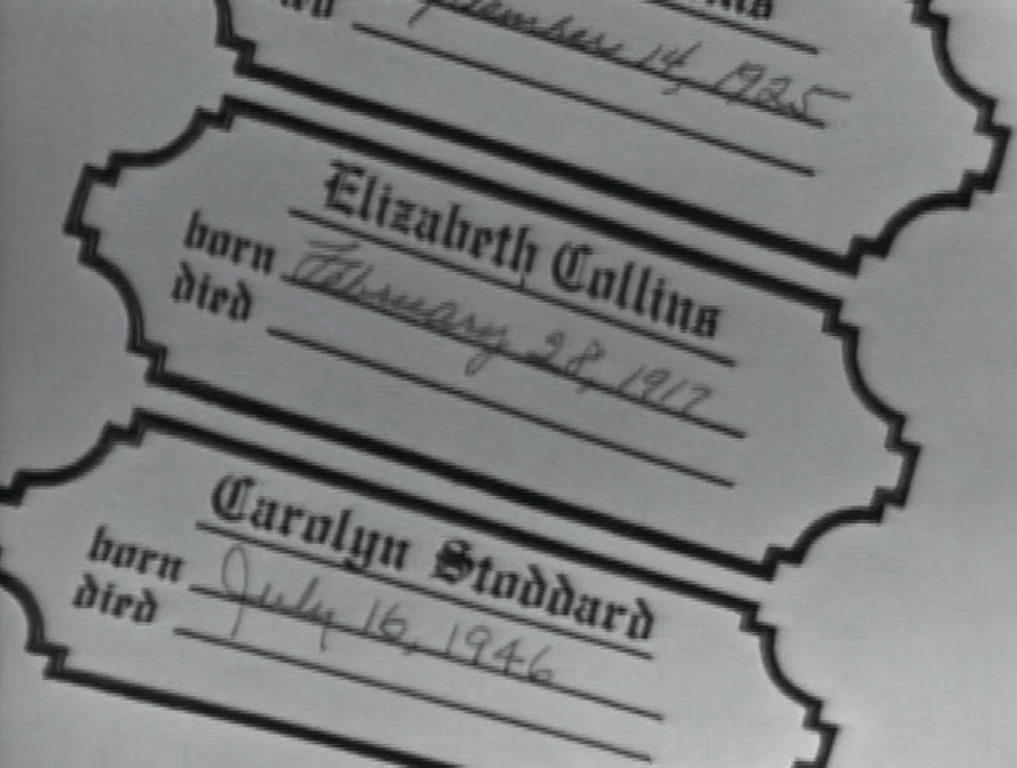
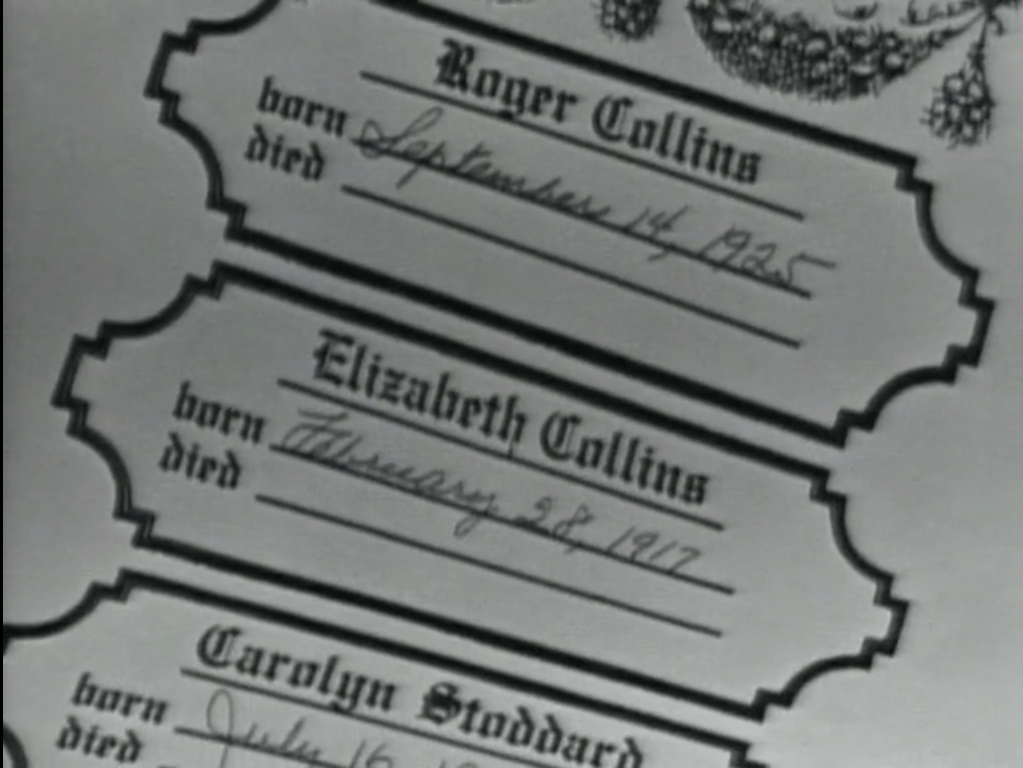
David calls Vicki’s attention to the book. It is the Collins family Bible, and was open to some plates that have been inserted bearing birth-dates for Liz and other members of the family. That’s the end of the episode. I must say, it’s quite an anti-climax after Burke’s attempt to retrieve his lost dime.

Closing Miscellany

Bob O’Connell is not on hand to play Bob the Bartender at the Blue Whale today. Instead, the bartender is Tom Gorman, who played the same role in #104 and will reprise it again in #607.

The birth-dates in the Collins family Bible are:

Roger Collins, 14 September 1925

Elizabeth Collins, 28 February 1917

Carolyn Stoddard, 16 July 1946

By comparison, the actual birth-dates of the actors were:

Louis Edmonds, 24 September 1923

Joan Bennett, 27 February 1910

Nancy Barrett, 5 October 1943

So it looks like they adjusted Edmonds’ and Bennett’s birth-dates by a few days plus a few years in setting their characters’ births, but ignored Miss Barrett’s actual birth-date in setting Carolyn’s. Maybe she refused to tell them what it was!

The show has been hinting heavily that Vicki is Liz’ biological daughter. A birth-date of 16 July 1946 for Carolyn would tend to pull against that- Vicki had apparently just turned 20 when the show started late in June 1966. Unless they were twins, one or the other of those characters is going to have to have her birth-date adjusted if they are going to resolve the question of Vicki’s origin that way.

*That’s a concern we’ve heard several times on this set- in #2, Roger introduced himself to Vicki by startling her as she stood at the edge of the cliff, and in #75 Vicki did the same thing to Roger. In #139, David was at the edge of the cliff when his mother, blonde fire witch Laura Murdoch Collins, surprised him; the episode ended with a literal cliffhanger after Laura made a move David wasn’t expecting. We’ve heard many times that the legendary Josette Collins was “the lady who went over the cliff,” as artist Sam Evans calls her in #185. It’s unclear why she did- maybe someone startled her.

Episode 265: Unusual as doctors go

Maggie Evans, The Nicest Girl in Town, has escaped from vampire Barnabas Collins, but not before Barnabas put the zap on her brains. She is being treated at Windcliff Sanitarium, under the care of Dr Julia Hoffman.

Windcliff Sanitarium. Screenshot by Dark Shadows Before I Die

Dr Hoffman’s old acquaintance Dr Dave Woodard shows up with Maggie’s father Sam and boyfriend Joe. Woodard and Hoffman are Dark Shadows ‘ current versions of Bram Stoker’s Dr John Seward and Professor Abraham Van Helsing. As Seward called Van Helsing in when he needed help solving the mystery he encountered treating the victims of Count Dracula, so Woodard has called the expert Dr Hoffman in to help him solve the mystery he has encountered treating Barnabas’ victims. As Van Helsing refuses to answer any of Seward’s questions when they first start working together, so today Dr Hoffman refuses to answer any of Woodard’s questions about the case. There is one departure, in that Dr Hoffman combines Seward’s occupation as chief physician at a sanitarium with Van Helsing’s role as mysterious expert from out of town.

Dr Hoffman tells Dr Woodard that she believes it will be bad for Maggie to see Sam and Joe, but she consents to the visit as a way of discouraging them from trying to come back. When Sam and Joe join them in her office, she attends to her aquarium. In the post about this episode on Dark Shadows Before I Die, Christine Scoleri points out that this is a rather direct way of telling us that there is something fishy about Dr Hoffman.

Fishy doctor. Screenshot by Dark Shadows Before I Die

When Sam and Joe go to Maggie’s room, she has a mad scene. She starts singing “London Bridge,” gets to an obscure verse running “Take the key and lock her up,” and starts screaming “Lock her up!” over and over. It’s magnificently terrifying.

In his post on Dark Shadows Every Day, Danny Horn raves about Grayson Hall’s performance as Julia Hoffman. Rightly so, she will quickly make herself indispensable to the series. He includes a lot of screenshots of her face, showing the wide variety of expressions she uses. I have a more complicated response to this aspect of her style.

As many screenshots as Danny gives of Grayson Hall’s face in his post, I presented even more screenshots of Lovelady Powell’s face in my post about #193, where Powell plays art dealer Portia Fitzsimmons. What impressed me about Powell’s performance is that she takes one of the most basic rules of screen acting- choose one of your eyes and look at your scene partner only with it- and builds a whole character around it. Her left eyelid is all she needs to command the stage and leave an indelible impression.

Hall was at the opposite extreme. She ignores the one-eye rule, and virtually every other piece of guidance professionals give about how to create a character on camera. She uses every muscle at every moment. Her broad, stagy approach works well for Dark Shadows, and the three actors with whom she shares her shots today stay out of her way. Still, she does make me miss Powell’s dominating simplicity.

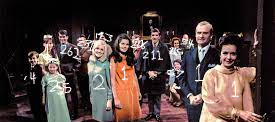
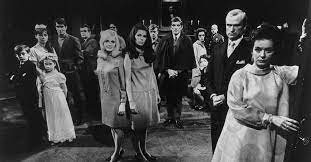
With Julia’s introduction, all of the actors in the photo I use as the header for this blog have joined the cast of Dark Shadows. There is also a version of the picture where the actors are frowning.

Gloom in the shadows

Here’s the smiley version. I’ve marked each player with the number of the first episode in which s/he appeared:

Episode 261: Nine, ten, home again

Maggie Evans, The Nicest Girl in Town, has solved a riddle posed by the ghost of nine year old Sarah Collins. The solution led Maggie to a secret panel through which she has escaped from the cell in which she has been imprisoned by Sarah’s big brother, vampire Barnabas Collins. Barnabas is chasing Maggie through the corridors on the other side of the panel.

Maggie has reached two doors, both of which appear to be locked. The other day, Sarah had visited Maggie in the cell and played “London Bridge” on her recorder. Maggie hears a few notes of that same tune, and one of the doors opens. She runs through the door, closing it behind her. She finds herself in another maze of corridors. She hears the music again, and follows it to a stairway. A moment later, we cut to Barnabas going through the other door and heading in Maggie’s direction.

Maggie finds herself on the beach. She staggers about and collapses. Apparently her escape took more strength than she had left after her long imprisonment. Barnabas makes his way to the beach and stands over Maggie, declaring that he has defeated her. She screams.

Maggie’s father, Sam Evans, is on the beach. Sarah had visited him at home and told him he might find Maggie if he went there that night. Sam hears Maggie’s scream and calls out. Barnabas retreats while Sam runs to Maggie.
Barnabas hides behind a rock and stares hard at Maggie. When he first sucked Maggie’s blood, Barnabas gained great power over her mind. She has shaken free from that to the point where she can try to kill him and run away from him, but maybe he still thinks he can put some kind of zap on her.

Evil eye

In the hospital, Sam, addled quack Dr Woodard, and Maggie’s boyfriend Joe discover that Maggie has amnesia and thinks she’s ten years old. She greets Sam as “Papa,” a title Sam says she hasn’t used in “a long time.” She did call him that in #200, but that was an ultra-dramatic moment, so maybe he means it has been a long time since she used it when she was calm and cheerful. Sam tells Woodard about Sarah. Maggie reacts to Sarah’s name, which is surprising since Sarah never gave it to her. Maggie has Sarah’s doll, which the men find puzzling but don’t ask her about.

Woodard has an idea. The three of them will tell everyone that Maggie is dead, and she will go to Windcliff, a nursing home a hundred miles north of town, which would put it someplace near Mount Katahdin. There, she will be in the hands of Dr Woodard’s colleague Julia Hoffman.

After Sam and Joe have agreed to this, we see Barnabas enter the hospital. A clock prominently featured on the wall shows that it is 3:30 AM. Barnabas asks to see Maggie. Dr Woodard asks him how he knew she was in the hospital. He claims that he has heard a rumor to that effect from everyone in town. Woodard says he isn’t surprised. Collinsport must be rather an odd place if everyone is up and exchanging rumors at that hour.

Woodard tells Barnabas that Maggie is dead. She never recovered consciousness, so she wasn’t able to tell anyone what happened to her. Barnabas manages to keep from smiling until after he turns his face away from the doctor.

Barnabas’ obvious relief when Woodard tells him that Maggie is dead makes an interesting contrast with the shot of him behind the rock on the beach. Maggie’s amnesia is such a stark change from her mental state in the last couple of weeks that it seems Barnabas must have made a successful attempt to project psychic power against her. But those transmissions go in only one direction- he can’t sense that Maggie is still alive.

This is the first time we hear the name “Julia Hoffman.” Woodard first mentioned Dr Hoffman in #242, when she was a blood specialist and a man. Julia still has expert knowledge about blood, but is now primarily a psychiatrist.
There is a legend among fans of Dark Shadows that Julia transitioned from male to female as the result of a typographical error. Ron Sproat is supposed to have put the name “Julian Hoffman” in the script, but a typist left the “n” off the end of the first name. Executive Producer Dan Curtis liked the idea of a female Dr Hoffman, and they ran with it.
The Dark Shadows wiki explains that the evidence does not support this charming tale. Various members of cast and production staff told various stories over the years to explain the switch, and no surviving paperwork can settle the question for us. It certainly is true that the storylines sometimes took wild U-turns based on last-minute decisions by Curtis and others, and some of those decisions were so whimsical that they may as well have been based on typographical errors. But it is also true that we’ve never heard the name “Julian,” and the near-rhyme of “Julian Hoffman” would be the first awkward-sounding name on Dark Shadows. Further, Woodard stopped mentioning Hoffman weeks ago, likely before ABC had decided to renew the show beyond #260.

If they are going to make another 13 weeks of Dark Shadows, they are going to need new characters and new storylines. They must have responded to the renewal with some story conferences during which the producers, the writing staff, and others tried to flesh out some possibilities.

The writers appear to have decided there would be a secret passage from the Old House to the beach by #238, when well-meaning governess Vicki mentions that the Old House is very close to the sea. That was a retcon that would startle viewers who remembered previous episodes that suggested it was deep in the woods. But it wasn’t clear then that Maggie would be the one escaping by that passage. She was ranging freely through the house at that point, and wasn’t locked up in the cell until #251. Until that point, it was possible Maggie would become a vampire and be destroyed like Lucy in Dracula, leaving Vicki to be the Final Girl who escapes from Barnabas’ clutches and defeats him.

Months ago, they brought parapsychologist Dr Peter Guthrie on the show to help fight undead fire witch Laura Murdoch Collins. In #183 and #184, Guthrie offered to help Laura if she would renounce evil and participate in his research. That suggested the possibility that a complex relationship might arise between the male visiting expert and the undead female menace. Laura was a one-shot monster, on a mission to burn her son David to death and bound to vanish after the attempt, and so could not stay on the show indefinitely. She could respond to Guthrie’s offer only by killing him the night after he made it. But now an undead male menace is here for the duration, so a female visiting expert might be able to pick up the marker Guthrie laid down.

There are a lot of jokes in Dark Shadows fandom about Julia’s two specialties. Psychiatry and hematology don’t usually go hand in hand. I’ve dreamed up a little fanfic that satisfies me about this. I shared it in a comment on Danny Horn’s Dark Shadows Every Day:

The story I made up for myself is that Julia started out as a blood specialist but switched to psychiatry. She was interested in rare diseases, the rarer the better. She found that in hematology, there’s so much money to be made from developing treatments for the most widespread disorders that a researcher with an emphasis in the exotic is constantly fighting an uphill battle for funding and recognition.* Even those colleagues who had an abstract appreciation of the importance of studying rare disorders had to work within a system where all the institutions push them towards the biggest projects possible.

Psychiatry, on the other hand, always had room for the unusual.** In fact, Julia discovered that high-strung rich people would pay a great deal of money to be told that whatever happens to be bothering them at the moment is not the same kind of problem that one of their servants might have, but is a mental aberration hitherto unattested in the annals of psychiatry.*** So she switched to that field and quickly made enough money to open her own, hugely profitable, mental hospital. But she never stopped working in rare blood diseases, and the experiments she was able to finance by flattering the vanity of her wealthier patients earned her such a reputation in a male-dominated field that even her old acquaintance Dave Woodard would commit sexist slips of the tongue and say of “Hoffman” that “he” is “the top man in the field” of rare blood diseases.

Lucrative as Windcliff was, Julia’s true love was never money, or even science per se, but the exotic. When she found herself as the best friend/ frequent accomplice/ bossy big sister of an honest-to-wickedness vampire, surrounded by ghosts and witches and werewolves and Frankensteins and time travelers and interdimensional anomalies and who knows what else, there was never any question of her going back to the office.

*I have no reason to believe this was true in the real world in the middle decades of the twentieth century, or that it is true today. It’s simply part of the fictional world in which I see Julia.
**(Same note)
***(Same note)

“Acilius,” comment left 23 January 2021 on “Episode 1042: Still Another Murderer,” Dark Shadows Every Day, Danny Horn, 2 July 2017

Episode 258: Secret friend

Maggie Evans, The Nicest Girl in Town, is giving up hope. Vampire Barnabas Collins locked her up in the jail cell in the basement of his house some time ago, and everyone she knows is coming to believe that she is dead.

The other day, a little girl in eighteenth century clothing appeared outside Maggie’s cell. The girl did not respond when Maggie tried to get her attention, nor did Barnabas’ sorely bedraggled blood thrall, Willie, see her when she walked past him. Only on her second or third visit to Maggie did the girl interact with her, and then only to warn her not to tell her big brother that she had seen her. Maggie suspects that the girl was a hallucination of hers.

We know that the girl is real, because we saw her interacting with someone else. Outside Barnabas’ house, the girl talked with strange and troubled boy David Collins and played catch with him. If we’ve been watching the show from the beginning, we also know that there are many ghosts in and around Barnabas’ house, and that they have a special rapport with David. Further, this girl gives her name as Sarah and says that everyone she knows went away a long time ago. We’ve been told that Barnabas had a sister named Sarah who died in childhood, so we know that Sarah is the ghost of that sister.

Today, the girl appears to Maggie again. This time she shows up in the cell itself. At first, she tosses her ball in the air, sings “London Bridge,” and ignores Maggie’s repeated questions. Eighteenth century kids didn’t have mobile phones, apparently they had to resort to a ball and “London Bridge” when they wanted to tune out the grownups. Sarah finally comes around when Maggie puts her hand on her shoulder.

Sarah explains that she came because Maggie was crying. She asks what Maggie is sad about, which Maggie doesn’t try to explain.

Sarah won’t answer many of Maggie’s questions. Sarah says that she has been looking for her parents, and she is puzzled as to where they and everyone else have gone. She says she does have one friend. If that is a reference to David, it would show that Sarah can learn information during one apparition and retain it during subsequent apparitions. It is unclear whether she knows that she is a ghost, and her understanding of Maggie’s situation is remarkably slight.

Maggie and Sarah play catch and sing “London Bridge” together. Sarah vanishes a moment before Barnabas arrives. Maggie reacts to him with terror, but when it becomes clear that he isn’t planning to kill her right away her excitement at Sarah’s visit comes bursting out. She tells him that she has a secret friend who visits her in her cell and plays with her. When he asks what she’s talking about, she tells him it’s a secret. She babbles in a gleeful, childlike way.

Barnabas reacts to this with discomfort. He keeps his eyes on Maggie and edges away from her, speaking to her in a pitying tone. Bleak as Maggie’s situation is, this is a laugh-out-loud moment- she’s become too weird for Barnabas.

Maggie weirds Barnabas out

Upstairs, Barnabas tells Willie that Maggie isn’t working out. In a moment of wild hope, Willie asks if that means he’ll let her go. Barnabas sourly replies that of course it does not mean that- they will have to kill her. His plan is to kill her in such a way that no trace of her will ever be found, “because there will be no trace.”

Willie takes a meal to Maggie and demands she stop pretending to be crazy. It isn’t helping her, he says. She denies that she is doing any such thing, and babbles cheerfully that “I do whatever anyone tells me to do.” Willie leans in, putting his face close to hers, and screams and shouts that she has to be her usual self if she is to have any chance of survival.

After Willie leaves, Maggie starts crying again and telling herself that there is no little girl. But then she looks at the floor and finds a doll Sarah left behind. Maggie smiles, knowing that her secret friend does exist.

Maggie’s mad scenes are fascinating. Even though she believes that Sarah is real and we know she is right, seeing Sarah has the same effect on Maggie a psychotic break might have. It takes her out of the reality that she shares with Barnabas and Willie, and gives her an affect that is neither continuous with her usual personality nor intelligible to them.

The three adult actors are all on the top of their form today, just superb. Nowadays, when Sharon Smyth Lentz describes her performance as Sarah, she says that “The first word that comes to mind is ‘clueless.’” But that works out surprisingly well. We know so little about what, if anything, is going on in Sarah’s mind that the keynotes of the performance would have to be “lost,” “confused,” and “vague,” and she had those three things down pat. Things sometimes get rocky when Sarah has a long stretch of dialogue or when multiple actors are moving at the same time, but neither of those is a problem today.

Joe Caldwell started making uncredited contributions to the writing of Dark Shadows early in 1967, and I am tempted to attribute every good thing in a script by Malcolm Marmorstein to him. But Caldwell’s name is showing up in the credits now, and this episode is excellent. So maybe Marmorstein could rise to an occasion every now and then.

My wife, Mrs Acilius, points out that this is the first episode set entirely in the Old House.