In August 1967, Maggie Evans, The Nicest Girl in Town, was about to expose old world gentleman Barnabas Collins as a vampire. In the nick of time, Maggie’s doctor, mad scientist Julia Hoffman, hypnotized her and blocked all memory of her time as Barnabas’ victim.
Today, suave warlock Nicholas puts a magical zap on the mind of heiress Carolyn Collins Stoddard to induce her to take part in an experiment meant to produce a mate for Frankenstein’s monster Adam. All this mind control makes for a low level of suspense. If traumatic memories can be erased and personal motives overriden by whatever mumbo-jumbo is convenient, there is no reason to suppose that the story’s events will have consequences or that there is any point in getting to know the characters.
This episode includes a tacit acknowledgement of the problem. The other day, Willie Loomis, Barnabas’ bedraggled servant, overheard Barnabas and Julia discussing another evil plan for Maggie. Willie has a crush on Maggie, so he resolved to foil that plan. He has abducted Maggie and is holding her in the hidden chamber inside the old Collins family mausoleum. This turns out to be the worst possible choice of location. Barnabas tortured Maggie there when she was his victim, and in a series of dream sequences those events come back to her. At the end of this episode, Maggie exclaims “I know what Barnabas Collins is!”
Now, Barnabas is not in fact a vampire at the moment. An experiment involving the creation of a Frankenstein’s monster freed him from the effects of that curse. But it would cause a lot of trouble for Barnabas, Julia, Willie, and the plot if Maggie were to go to the police and identify Barnabas as the man who held her prisoner. So Maggie’s closing exclamation might encourage us to hope that the show will swear off its habit of turning its characters into each other’s puppets.
In April 1968, mad scientist Eric Lang promised Barnabas Collins that he could cure him of vampirism. The cure was an experimental procedure modeled on the one in Hammer Studios’ 1967 film Frankenstein Created Woman. A body constructed of parts salvaged from several fresh corpses was to be associated with Barnabas, and when the procedure was complete Lang expected Barnabas’ body to be dead and his mind to awaken in the constructed body. After Lang’s death, Barnabas’ friend, Dr Julia Hoffman, completed the experiment. To their surprise, the procedure ends with both Barnabas and the new man alive. Barnabas named the new man Adam. They take Adam to the dungeon in Barnabas’ house, and keep him there in horrifyingly bad conditions until he escapes. Adam of course hates Barnabas and Julia.
Lately, Adam has been hiding out in a long-deserted part of the great house of Collinwood. Heiress Carolyn Collins Stoddard took pity on him and has been looking after him there. He has fallen in love with Carolyn, to her embarrassment and his frustration. Carolyn has delegated the day-to-day responsibility for looking after Adam to unsightly ex-convict Harry Johnson. Adam’s former protector, occult expert Timothy Eliot Stokes, visits from time to time. Adam’s most frequent and most influential visitor is suave warlock Nicholas Blair. Carolyn and Stokes are good, Nicholas is evil, and Harry is just distasteful.
When Nicholas found out about Adam, he forgot about whatever plans he may previously have had and focused on the goal of founding a new humanoid race. He has talked Adam into demanding Barnabas and Julia repeat the experiment to build a mate for him. Adam threatened to kill well-meaning governess Vicki Winters unless they complied. Now there is a patchwork female corpse and a lot of scientific equipment in Barnabas’ basement. All that is missing is a woman to donate her “life force.”
Barnabas and Julia were plotting to use Maggie Evans, The Nicest Girl in Town. When Barnabas was a vampire in May and June of 1967, he abducted Maggie and tortured her in an attempt to erase her personality and replace it with that of his lost love, the gracious Josette. When that evil scheme collapsed, Maggie escaped and Julia used her preternatural powers of hypnosis to block her memories. Ever since, Maggie has had no idea of what happened during those two months, and she has thought of Barnabas as a wonderful person. Barnabas wants Julia to use those same powers first to bring Maggie to the basement lab, and then to block her memory in case she survives.
Barnabas’ much-put-upon servant, Willie Loomis, overheard this plan. Willie has a crush on Maggie. He tried to talk Barnabas and Julia out of their fell intentions, and when they would not listen he tried to persuade Maggie to leave town. She wouldn’t listen either, so he took it upon himself to abduct Maggie. He stole some chloroform from the lab, broke into her room, and took her to the hidden chamber inside the old Collins family mausoleum.
We open today in the front parlor of the Old House, where Adam is coolly explaining to Barnabas that he does not want Maggie to donate the “life force” for his mate. Barnabas angrily explains that it must be Maggie, because Julia has proven that she can control her. Besides, Maggie lives alone, so she can go missing for several days before anyone knows she is gone. Barnabas is the chief protagonist of this show, by the way.
Adam says that the only woman whose “life force” he wants to animate his bride is Carolyn. Barnabas says that this is impossible. Adam has been gradually learning the details of the experiment that brought him to life; only now does Barnabas tell him that in the original plan, he would die and come back to life in his body. Adam is bewildered by this. “How could you hate yourself so much that you wanted to change your body?” Barnabas does not want to confess his his former vampirism, so Adam doesn’t get an answer.
Adam meets Nicholas at the gazebo on the grounds of the estate. Nicholas wants him to ignore everything Barnabas said, but Adam is giving deep thought to all of it. It was Nicholas’ idea that Carolyn should provide the “life force,” and Adam enthusiastically agreed, believing this meant that his mate would be like her. He says now that he and Barnabas do not recognize themselves in each other, and Nicholas tries to brush this very apt observation off by saying that Barnabas would hide his similarities. Adam demands Nicholas assure him that Carolyn will not be subjected to any violence. She must want to participate in the experiment. As my wife, Mrs Acilius, pointed out, that condition is indeed a similarity with his “life force” donor- Barnabas had been preoccupied with the idea that Maggie and his other female victims would eventually come to him of their own will. While Nicholas is trying to quell the big guy’s concern, Willie happens by.
Adam starts to figure everything out, and wants to reason with Nicholas.
Adam hides while Nicholas confronts Willie. He puts a magic zap on Willie to compel him to release Maggie. After Willie goes, Nicholas tells Adam he will use the same painless technique to cause Carolyn to cooperate. Adam is skeptical, but Nicholas assures him that his doubts will be settled when he sees that Maggie is free before daybreak.
That may not quite work out. Willie made the worst possible choice of hiding place when he stashed Maggie in the hidden chamber of the mausoleum. Barnabas took her to that chamber for torture when she was his prisoner, and shortly after she awoke there her memory started to come back. By the end of today’s episode, she remembers that Barnabas was her captor. When Willie returns, he will find that he has quite a problem on his hands.
Recovering vampire Barnabas and mad scientist Julia are under pressure to create a female Frankenstein’s monster. The process they are using requires draining the “life force” from a woman into a constructed corpse. The other day, Barnabas announced they would force the role of donor onto Maggie, The Nicest Girl in Town and one of his former victims. When Barnabas’ servant Willie heard of this plan, he was horrified. Willie has a crush on Maggie, and is determined to spare her this fate.
Now, Willie has abducted Maggie and is hiding her from Barnabas and Julia. Barnabas is worried about what will happen if they cannot find another woman to use in the experiment. Julia says “If worse came to worst, I could do it.” Barnabas points out that only she is prepared to operate the equipment, and that she could not do that if she were serving as donor. She makes a feeble suggestion that their onetime lab tech, an unpleasant man named Peter who prefers to be called Jeff, might run the equipment. Barnabas says that Peter/ Jeff does not have her training. In any case, Barnabas had to fire Peter/ Jeff because he had reason to believe he was trying to sabotage the experiment, so he can scarcely trust him now.
This is not the first time Julia has offered to solve a problem by destroying herself, only for Barnabas to turn her down. In #350, when Barnabas was still a vampire and was desperately thirsty for blood, Julia volunteered herself as his victim. Barnabas was sufficiently moved to address her for the first time as “Julia” rather than with a distinctly contemptuous pronunciation of the title “Doctor,” but he still said the reason he was refusing was that he had use for her medical expertise. Barnabas’ cruel plan for Maggie suggested that he isn’t really any nicer now than he was as a vampire; this echo of that moment would suggest that he hasn’t even stopped seeing Julia, who after all loves him, as a kind of higher servant.
Willie has taken Maggie to the hidden chamber inside the old Collins family mausoleum. It was in this chamber that Barnabas was trapped in his coffin from 1796 until Willie inadvertently freed him to prey upon the living in #210. When she was his prisoner in #248, Barnabas took Maggie to that chamber and shut her up in the coffin there. While Willie tries to assure Maggie that she will be safe as long as she is with him, the memories that Julia used her preternatural powers of hypnosis to erase start coming back.
We see a flashback, not to Maggie’s time at Barnabas’ mercy, but to #283, when she was Julia’s patient at Windcliff Sanitarium. Julia took her on a trip to the old cemetery north of Collinsport, and they went into the mausoleum. Julia did not know about the hidden chamber, and did not understand why Maggie became upset when they were in the publicly known part of the mausoleum. Maggie remembers visiting the mausoleum with Julia, and cannot remember why it frightened her to be there. But the fact that she recognizes the chamber as part of the mausoleum means that her memory of what Barnabas did to her is coming loose.
This creates a truly suspenseful situation. Maggie is an audience favorite with connections to several other characters, and so it seemed unlikely anything Barnabas and Julia did would result in her leaving the show. But if she remembers what they did to her and tells the police about it, they will go to prison. Since Barnabas and Julia are the source of all the action on Dark Shadows, that would mean the end of the series. So her memory coming back sets up a crisis that might be resolved with a significant change.
Perhaps Barnabas and Julia will force Maggie to donate her “life force” with the consequence that her body dies and she wakes up in the newly created woman, who just so happens to look exactly like her but to have a drastically different personality. That seems plausible, since the long-running storyline of her romance with hardworking young fisherman Joe seems to be over, the minor theme of her relationship with her hard-drinking father Sam had been resolved long before Sam died a few months ago, and we have reason to expect her to move out of her house, which has long served as our window into the working class of Collinsport. If Maggie is running out of story, they may very well decide to keep Kathryn Leigh Scott on as another character.
Closing Miscellany
The flashback is not made of tape cut from #283. It couldn’t be- the show was in black and white then, and is in color now. So they recreate it. It’s kind of adorable to see Julia in her old wig.
This was not the episode they intended to shoot. It was the dress rehearsal. Shooting the flashback scene put them so far behind schedule they didn’t have time to do the episode, and they had to send this footage to the network. I believe that is the only occasion they ever resorted to that desperate expedient. The camera is out of focus much of the time and occasionally does not seem to be pointed in the right direction, the microphones are misplaced so that it sounds at one point like Julia is referring to Maggie as “Greg,” booms and other equipment intrude into the shots, and the actors frequently blow their lines. In other words, it is in no way different from any other episodes.
Some time ago, mad scientist Eric Lang promised Barnabas Collins that he could cure him of vampirism. His cure involved building a Frankenstein’s monster and draining Barnabas’ “life force” into it. Lang expected that this experimental procedure would end with Barnabas’ body dead and his consciousness awakening inside the newly constructed creature.
Lang died before he could complete the experiment. Barnabas’ friend, Dr Julia Hoffman, picked up where Lang left off. To their surprise, both Barnabas and the new man lived. Barnabas was freed of his curse, but he and Julia turned out to be the worst parents conceivable. They took the new man, whom they named Adam, to the prison cell in the basement of Barnabas’ house and kept him chained to the wall, alone for all but a few minutes a day, with nothing to stimulate his mind. Adam eventually escaped, and quite understandably hates Barnabas.
Adam has fallen under the influence of suave warlock Nicholas Blair. Nicholas persuaded Adam to go to Barnabas and threaten to murder well-meaning governess Vicki and everyone else Barnabas cares about unless he provided him with a mate. Barnabas enlisted Julia to take charge of the process and his servant Willie to steal dead bodies to use for parts. Now there is a constructed female corpse on a table in Barnabas’ basement and an apparatus to use in its animation. All that is missing is a woman to donate her “life force.”
Yesterday, Barnabas’ servant Willie overheard Barnabas telling Julia that he wanted her to hypnotize Maggie Evans, The Nicest Girl in Town, so that she would submit to the procedure. When Barnabas was a vampire, he took Maggie as his victim, keeping her in the cell where Adam would later be chained. After Maggie escaped from Barnabas, Julia hypnotized her to forget her ordeal. She now believes that Barnabas is just peachy.
Today, Maggie is on the terrace at the great house of Collinwood. She is having coffee with Vicki. The two of them are lamenting the fact that their fiancés have both become strangely distant lately, leading to the end of their engagements. Some of the fan-sites mention that both Kathryn Leigh Scott and Alexandra Moltke Isles have moments during this sad scene when they seem to be stifling laughter. In the years since the show ended, several of the actresses have said that Louis Edmonds had a habit of making wickedly hilarious remarks to them immediately before a taping that would involve a deeply serious scene, and that it would take everything they had not to burst out laughing at the worst possible moments. Edmonds’ character Roger Collins isn’t in this episode, but maybe he was on set for some other reason.
Barnabas shows up and talks with each woman separately. While Vicki is away getting a cup for Barnabas, Maggie tells him she might be leaving town soon. He is distressed to learn she may not be available for the crimes he is planning against her. After Maggie leaves, Vicki mentions that her charge David just left on a camping trip, and “It was quite something getting him off.” On Danny Horn’s Dark Shadows Every Day, a commenter named “Chris” remarked on this:
During the outdoor coffee scene after Maggie leaves Vicky with Barnabas, is the funniest blooper ever…….
Vicky, paraphasing: “I was getting David ready for his trip to Boston.”
Actual finish: “It was quite something getting him off.”
And then, she buries her face in the coffee cup, knowing that everyone is holding back laughter, and the awkward pause goes on forEVER.
Comment left by “Chris” at 7:57 AM Pacific time, 21 March 2016, on “Episode 583: Every Woman We Know,” by Danny Horn, on Dark Shadows Every Day (12 February 2015.)
To which I replied, “Vicki, no, he’s only twelve!”
When Mrs Isles is trying not to laugh, she bites her upper lip. She visibly does that before lifting the coffee cup to cover as much of her face as she possibly can, and the pause does go on a long time. So it could be that “Chris” is correct. I can only imagine Edmonds saying that now we know why they stopped showing the audience what goes on when Vicki and David are alone together.
While Maggie was Barnabas’ prisoner, Willie came to be very fond of her. Barnabas eventually framed Willie for his own crimes against Maggie; Willie was sent off to the mental hospital Julia is in charge of. After a few months, he was released. Willie came back. Since his return, Willie has been firmly convinced that Barnabas is his friend. Willie is also in love with Maggie. These attitudes thrust Willie into a crisis when he learns of Barnabas’ cruel plan for Maggie.
At first Willie tries to persuade Julia to refuse to bring Maggie into the experiment; she will not. Then he tries to stab the constructed body. Barnabas caught him before he could plunge the knife in, and threatened to kill him if he tried again.
Later, Willie goes to Maggie’s house and tries to persuade her to leave town immediately because “people” will hurt her if she doesn’t. When she asks what people, he with great reluctance tells her that “Barnabas, he’s involved… Now look, it’s not his fault- but he’s in it whether he likes it or not.” When Maggie expresses disbelief that Barnabas could be a part of any plan to hurt her, Willie says “I’ve got my loyalties to Barnabas, because he’s been good to me. And I’m being as loyal to him as I can be.” Even first-time viewers who do not know that Barnabas was a vampire who fed on Willie, beat him unmercifully, killed his friend Jason and forced him to dispose of the body, etc, will remember the opening of today’s episode when Barnabas greets Willie with a death threat. When we see that Willie sincerely believes that Barnabas has been good to him, we know that we are seeing a man who is as utterly lost as he can be.
After he fails to talk Maggie into getting on the next bus out of town, Willie goes back to the lab and steals a bottle of chloroform. He knocks over a stool; the noise brings Barnabas. Barnabas glances around the room, concludes that he is alone, and leaves. We see Willie cowering behind a table. Barnabas’ brief visit to the lab makes Willie seem even more pitiable. Barnabas doesn’t know where Willie is, does know that he has access to the lab, and has seen him trying to sabotage the experiment. Even so, he has so little regard for Willie’s ability to take action that he doesn’t see any need to do a real search. We hear his thoughts in voiceover as he thinks “There’s no one here.” Seeing Willie making himself small, we might suspect that Barnabas would have the same thought even if he were looking directly at his onetime slave.
Willie hiding.
Meanwhile, Barnabas encounters Adam on the terrace at the great house. Adam says that he will murder Vicki tonight unless Barnabas returns to the lab and gets back to work.
Willie breaks into Maggie’s bedroom. She awakens to find him pressing a cloth to her mouth. She screams, he apologizes, and the chloroform takes effect. He hears Barnabas let himself into the house and call for Maggie; when Barnabas comes into the bedroom, he finds the room vacant and the French windows open. We first saw this room in May 1967, when Barnabas was a vampire taking Maggie into his power. In those days, her father Sam and fiancé Joe were horrified to find that she had disappeared from it, leaving the windows open. That was because she was answering Barnabas’ call. Now Sam is dead and Joe is estranged from Maggie, and it is Barnabas’ turn to find that Maggie is gone. When he does, Adam’s threat to kill Vicki replays in his thoughts.
When Dark Shadows began in June of 1966, hardworking young fisherman Joe Haskell was dating flighty heiress Carolyn Collins Stoddard. The two of them were bored beyond words with each other. They only kept going out because Carolyn’s mother, reclusive matriarch Elizabeth Collins Stoddard, was determined that they should get together, and neither of them wanted to disappoint her. For months, we were subjected to one scene after another of Joe and Carolyn having nothing to say to each other while we waited for Liz to give up on them.
Joe and Carolyn finally called it quits in #84, and shortly afterward Joe started seeing Maggie Evans, The Nicest Girl in Town. The audience has been rooting for Joe and Maggie ever since, but because there are too few obstacles to their romance for them to have a storyline of their own, we sometimes go months at a time without seeing them together.
Now, Joe has become the blood thrall of vampire Angelique, and Angelique’s master Nicholas has designs on Maggie. If Nicholas and Angelique were ordinary criminals and she were blackmailing Joe or had hooked him on drugs, this would be an archetypal soap opera situation. The supernatural twist makes it specific to Dark Shadows among the daytime serials of its period, but the story is still so deep in the genre’s wheelhouse that it is no wonder they’ve spent three days in a row luxuriating in it.
There’s a lot of emphasis on bachelor’s quarters this time out. Maggie lives alone, but we see so much of and hear so much about her late father’s paintings today that it feels as if the Evans cottage is still his house and Maggie is still his little buddy. That makes her relationship with Joe feel all the more urgent. She is waiting to make a home with him so that her adult life can begin.
We see Joe’s apartment as well. It is apartment 24, the default number for a Collinsport bachelor pad. Dashing action hero Burke Devlin lived in suite 24 at the Collinsport Inn in the first year of the show, and Humphrey Bogart-esque lawyer Tony Peterson lived in apartment 24, presumably in some other building, in the fall of 1967. Joe is sitting in his apartment 24 and staring at a glass of booze when Maggie knocks on the door. She tells him that his boss called her at home and told her that Joe hasn’t shown up at work lately. If Joe doesn’t call soon, he’ll have to fire him. Joe says he won’t call the boss, since he can no more explain the nature of his trouble to him than he can to Maggie.
We also see Nicholas’ house. Even though he is keeping Angelique on the premises, Nicholas is very much a bachelor. He peers into his magic mirror and sees Willie Loomis, servant to old world gentleman Barnabas Collins. Willie is asleep in his room in Barnabas’ house. The only other time we saw Willie’s room was in #328, when Barnabas framed Willie for terrible crimes he had himself committed against Maggie. Now, Nicholas uses his mirror for a magical video call with Willie. He interrogates Willie about an evil plan of his that is playing out in Barnabas’ house.
On Dark Shadows Before I Die, John and Christine Scoleri caught this screenshot of Nicholas making an unfortunate gesture while he is telling Maggie what he thinks of Willie:
Suave warlock Nicholas Blair is furious with his subordinate, vampire Angelique. He had ordered Angelique to summon her blood thrall, hardworking young fisherman Joe Haskell. While Joe was out of the way serving as Angelique’s breakfast, Nicholas would be making time with Joe’s fiancée, Maggie Evans, The Nicest Girl in Town. Much to Nicholas’ dismay, Joe turned up at Maggie’s house.
Angelique explains that she did summon Joe, but that old world gentleman Barnabas Collins was with him and persuaded him to leave before she could take a bite. Since Nicholas has, for reasons of his own, forbidden Angelique to harm Barnabas, he has no choice but to accept that explanation. Angelique teases him about his interest in Maggie. Nicholas used to be very harsh with Angelique about her lingering human attachment to Barnabas, and she is hugely amused to find him chasing Maggie. Her amusement fades when he tells her that if she doesn’t bring Joe back tonight, he will not allow her to return to her coffin at sunrise.
Back at the Evans cottage, Joe is pleading with Maggie to keep him from leaving. “You’ve got to watch me tonight. Be with me. Don’t take your eyes off me. Don’t let me get away like I did this afternoon. If I start to leave, just take something — hit me over the head. Do anything you have to, to keep me here with you!” He keeps telling her that he needs her, that he belongs with her, and that it is his last chance. He hears Angelique’s voice and yells back to it; Maggie is bewildered.
Joe asks Maggie for two sleeping pills. She says that the pills she has are very strong. He says that if he can be knocked out until morning, he might be all right. It is daytime television and it is 1968, so while Joe sleeps on the couch, she goes into her bedroom and closes the door. Angelique’s voice finally wakes him, and he goes.
Nicholas knocks on the door. He apologizes for disturbing Maggie at 4 AM. He explains that he had a strange feeling she was in danger. She tells him about Joe, and says she is glad Joe is sound asleep on the couch. He breaks the news to her that the couch is vacant. While she is looking away, he allows himself a self-satisfied smile.
Maggie Evans, The Nicest Girl in Town, was under the influence of vampire Barnabas Collins in May and June of 1967. At the beginning of that period, she spent her days sick in bed at home, and at night regained strength and insisted on going out. When her father Sam and her boyfriend Joe tried to keep Maggie in, her adorable personality vanished and she raged at them.
Maggie eventually escaped from Barnabas, and mad scientist Julia Hoffman erased her memory of the ordeal. Since then, Barnabas’ vampirism has gone into remission. Julia has taken up residence at the great house of Collinwood and has become Barnabas’ fast friend.
Julia drops in at Maggie’s house today. Maggie says she is worried about Joe. He has been standing her up for dates, hasn’t reported for work for three days, and won’t answer his phone.
After Julia leaves, Joe comes in through the back door. He is pale, sweaty, and wild-eyed, obviously ill. He faints for a second. Maggie goes to call a doctor. Joe protests against this idea, almost shrieking, and Maggie relents. He asks her to keep him in the house overnight no matter what he says or does; this is very much the sort of thing Maggie used to say when she was falling under Barnabas’ power. Also like Maggie in those days, minutes later Joe announces that he will be leaving the house and that Maggie has no right to keep him from going. Maggie tries to block the door; Joe grabs her, flings her aside violently, and rushes out.
Kathryn Leigh Scott and Joel Crothers do an excellent job with this last bit of business. Yesterday and the day before, there was a fight scene that was so poorly done I couldn’t get a screenshot that didn’t look like a joke. But the choreography is perfect here. The actors really make it look like Joe is throwing Maggie to the floor, and in her closeup at the end of the sequence Miss Scott convinces us Maggie is hurt.
The similarity between Maggie’s behavior in May 1967 and Joe’s now is no coincidence. He is the victim of Angelique, formerly a wicked witch, now a vampire under the control of suave warlock Nicholas Blair.
After he had asked Maggie to keep him in the house no matter what he said and before he told her he was going to leave no matter what she did, Joe talked to her about going away from Collinsport, far away, going anywhere at all, anywhere from which they would never come back. It’s a poignant moment. Once there were other places for Joe and Maggie, and once there were ways to go there. When art dealer Portia Fitzsimmons called on Sam in this room in #193, Dark Shadows had run out of story. For all we knew, Sam might have gone to New York and taken Maggie and Joe with him, and the show might have reinvented itself to follow them there. But Sam is dead now, Mrs Fitzsimmons is long forgotten, and outside Collinsport there is nothing but a mental hospital. Even Hell seems to be located in a corner of Barnabas’ basement, and Purgatory in the woods outside.
The House by the Sea
Nicholas lives in a house by the sea. Collinsport is a fishing village, so a lot of its people probably live in houses by the sea, but there are two that we have heard referred to as “The House by the Sea,” and this is the second of them.
Barnabas and Julia know that there is a vampire on the loose and are pretty sure that Nicholas is to blame for that fact. Maggie mentioned to Julia that Nicholas will be coming to her house at 5 PM to buy a painting, and so Julia suggests to Barnabas that they go to Nicholas’ at that time and search.
They find the door unlocked. The green screen behind them has an image that makes it look as if the house is floating in the sky. Maggie’s house has always been the place the show has taken us when it wanted to give us a feeling of realistic kitchen sink drama; the effect of this background outside Nicholas’ front door is to tell us that we are leaving that world behind and entering an exotic, paranormal space.
As they enter, Julia has second thoughts about trespassing. Now it is Barnabas’ turn to insist they probe forward.
They split up. Barnabas runs into Joe. The two men ask each other what they are doing there, and each tells a lie about having business with Nicholas. They then take turns ordering each other out of the house. We end with a view of Angelique’s coffin, its lid opening.
This episode features the first appearance on Dark Shadows by an actor of color, and the only speaking part any non-White performer ever had. (CORRECTION: Mr Nakamura, played by Sho Onodera in #903, has a couple of lines.) This fact is made even more depressing because that performer fits so perfectly into the show that a first time viewer would assume she had been a major player from episode #1.
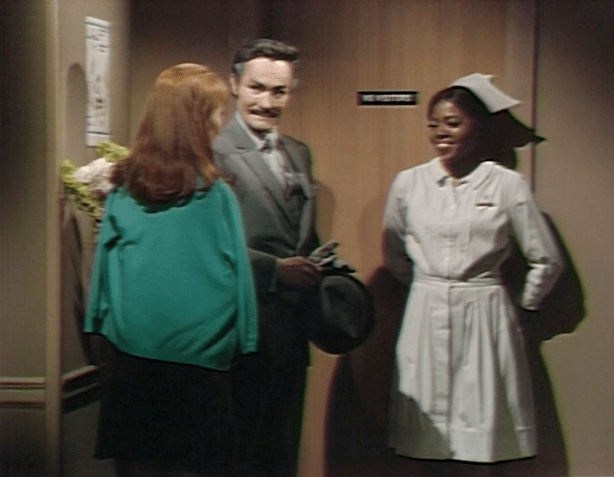
Beverly Hope Atkinson plays an unnamed nurse who meets suave warlock Nicholas Blair when he is trying to make his way into a hospital room occupied by Tom Jennings, a victim of one of Nicholas’ evil schemes. She firmly refuses him admittance. When Maggie Evans, The Nicest Girl in Town, enters and asks to see Tom, the unnamed nurse smiles brightly and says “Of course, Maggie!” in a tone that makes it sound like they’ve been friends all their lives. She then shuts the door before Nicholas can follow. He asks her why Maggie can go in and he cannot, and she tells him sternly that Maggie has permission from the doctor.
I have a fanfic idea about Atkinson’s nurse that I originally posted as a comment on Danny Horn’s Dark Shadows Every Day. I can’t find it there, but here is a copy of it:
In the first 42 weeks of the show, when the supernatural was in the background and the stories were slow, it would have been easy to have a couple of tea party scenes at the Evans cottage where Maggie and her lifelong friend, Unnamed Nurse, recap whatever is going on. Those scenes could have led to a whole exploration of the tension between the working-class people in the village and the jerks in the big house on the hill. That in turn could have led to the introduction of Unnamed Nurse’s family, headed by Unnamed’s parents, Mr and Mrs Nurse, including her brothers, Young Mr Nurse and Master Nurse, and her sister, Moody Miss Nurse. We could then have seen the ancestors of the Nurse family in each of the flashback segments and analogues of them in Parallel Time.
At some point in my musings about this idea, I decided the family should be named “Wilson” (if I had a reason for this, I’ve forgotten it, but I now think of Atkinson’s character as Nurse Wilson,) and that in a flashback segment we should learn that they are descended from free persons of color who settled in Collinsport before the Civil War and were the first proprietors of the Collinsport Inn. Some wicked deed by a member of the Collins family knocked them out of the entrepreneurial class long ago, and they’ve been working their way back up the socio-economic ladder ever since.
We met Maggie in #1 as the waitress at the diner in the Collinsport Inn. She, her late father Sam, and her fiancé, hardworking young fisherman Joe Haskell, have been Dark Shadows‘ main representatives of the people in the village. Her house, the modest counterpoint to the mansions on the Collins family’s great estate, has been familiar to us from the beginning, and is the place where we have seen most vividly what the Collinses’ doings have meant for the people who work for their businesses and live in their town. So, as a frequent visitor there, the nurse could have given a whole new dimension to the drama, showing that it isn’t just one family whose lives hang in the balance, but that a whole community is exposed to the consequences of what happens on the hill.
The Blue Whale
Joe is sitting alone at a table in the Blue Whale tavern, and he looks terrible. He’s pale and fidgety, looking around and periodically jumping up to peek out the window.
Maggie comes in and joins Joe. At first she is angry with him- he stood her up last night, without so much as a telephone call. She sees how upset he is and her anger is mixed with worry. He pounds on the table while the camera is tight on her. Her startled reaction reminds us of the early months of the show, when Sam was a self-pitying drunk and Maggie was a sophisticated portrait of an Adult Child of an Alcoholic.
After that moment, Maggie gets very quiet. When Joe says with alarm that it is getting dark, she responds that “It usually does, at this time of day.” It’s inherently funny to hear someone make that kind of matter-of-fact statement in response to an inexplicably intense remark, but also poignant to those of us who remember Maggie’s early interactions with Sam. From childhood on, simple rationality must have seemed to Maggie like a joke in the face of the overpowering irrationality at the center of her life.
As it happens, Joe is indeed exhibiting addicted behavior. But he isn’t hooked on alcohol. Instead, he is under the power of a vampire. Angelique, who was once the wicked witch who first made Barnabas Collins a vampire, found herself reduced to bloodsucker status when she displeased Nicholas. At Nicholas’ direction, she bit Joe the other day, and now Joe is desperate to hear her summons and report for another bite. She does call, and he does dash out, leaving a bewildered Maggie behind.
It was at the Blue Whale that we first met Joe, back in #3. Then, he was an upstanding young man who indignantly rejected the attempts of one of the Collins family’s sworn enemies to bribe him into spying against them. We’ve seen him in the tavern many times since then, always as the doughty representative of the wholesome and intelligible world against the sinister and supernatural. For example, in #215 it was a deeply troubled Joe who brought the news to Maggie and others at the Blue Whale that the cows on his uncle’s farm had been somehow drained of blood, news which turned out to be the first sign of vampirism in the area. This is the first time we’ve seen the Blue Whale since #358, back in November, and the first time a scene has closed with the formerly very familiar Blue Whale jukebox dance tunes in even longer than that. Longtime viewers see a loop closing. Joe leaves the place where he has most often shown himself as one who dwells in the daylight and goes down to the deepest dark.
Once Joe is gone, Nicholas enters. He engages Maggie in conversation, and talks his way into the seat Joe vacated. Soon he is doing magic tricks for her and she is agreeing to have dinner with him. He brings up the idea of staying out all night, and she seems amenable. Where is her old friend the nurse when you need her?
The Fix
Joe lets himself into Nicholas’ house, a place by the sea that he is renting from the Collinses. Angelique is there. Joe laments his dependency on her, and asks if she was the one who attacked Tom, whom he identifies as his cousin. Perhaps the son of the uncle whose cows fell victim to Barnabas long ago! She doesn’t bother to deny it. She tells him that they will both visit Tom tonight. She bites Joe.
Joe visits Tom, who has emerged from the coma in which Angelique’s first bite left him. He tells Joe all about Angelique’s attack on him. He says he knows how bizarre the story sounds, but that he hopes that if he has Joe to vouch for him he will be able to make the police take it seriously. Joe gives Tom a few perfunctory assurances, then opens the window. Joe explains that he is doing this because it is hot in the room. Tom does not agree that it is hot, but Joe insists, and Tom is too ill to argue long.
Joe leaves, and we jump forward to 2 AM. The window is still open- apparently no nurse was on duty. Perhaps the hospital thought Beverly Hope Atkinson’s character did such a good job on the day shift that the patients could just cruise along through the night. We hear a bat squeaking, and Angelique appears. She bites Tom.
In Barnabas’ first weeks on Dark Shadows, the show made heavy use of the idea that vampires can enter a lodging only when they have been invited. For example, he went to the diner after hours so that Maggie would have to invite him in, and later went to her house and stood just outside the front door for a noticeably long time before she explicitly asked him to enter. They haven’t done anything with that idea in a long time, but neither have they very clearly contradicted it. Perhaps Joe’s opening of the window is the invitation Angelique needs to make her way into the hospital.
Recovering vampire Barnabas Collins is dead, and this time it seems like he might stay that way. At least it seems so to his friend Julia Hoffman, MD, and his servant Willie Loomis; they’ve buried him, and are talking about what to do next. Julia decides they should tell people Barnabas went on a long trip, and that they themselves should leave the area before dawn. They will go to a sanitarium called Windcliff. Julia will resume her duties as its chief, while Willie will take a job there doing whatever he can handle.
Julia orders Willie to pack his things; he asks if he should pack Barnabas’ things also. Julia is impressed that Willie thinks of this. Perhaps he is remembering his onetime friend Jason McGuire, whom Barnabas killed in #275. Jason was hated by all and was under orders from the sheriff to leave town when he fell afoul of Barnabas, and so it was easy for everyone to assume he had simply gone away. Still, in #277, sarcastic dandy Roger wondered why Jason hadn’t taken his clothes or his shaving kit. No one ever tried to tie up that loose end, but perhaps Willie learned of the problem and made a note of it for the next time he had to conspire to conceal a death.
Willie goes directly from Barnabas’ freshly dug grave to Maggie Evans’ house. Willie has an unwholesome preoccupation with Maggie. Longtime viewers will remember Willie’s menacing approach to her in #202 and #207, before Barnabas got hold of him and turned him from a dangerously unstable ruffian into a sorely bedraggled blood thrall; those who are mindful of the period when Dark Shadows first became a hit will remember May and June of 1967, when Maggie was Barnabas’ prisoner and Willie tried desperately to lessen her suffering; and first time viewers will be startled by the beginning of the scene, when we see Willie peeking through the window at Maggie. When Barnabas’ vampirism went into remission, his former victims tended to return to the personalities they had before he bit them. Willie has not quite become the rapey goon he was in his first two weeks on the show, but neither is he the first man a woman would choose to be alone with.
Willie!
Since she is The Nicest Girl in Town, Maggie has long since forgiven Willie what he did when he first came to Collinsport. And Julia used a magical version of hypnosis on Maggie to induce amnesia covering the whole period of her involvement with Barnabas and to leave her with warm feelings of goodwill for him. But it’s late at night, so when Willie knocks, she is reluctant to let him in. He insists, and she relents.
Willie tells her he will be going away soon to take an exciting new job. Maggie says that she is sure everyone will miss him. At first he repeats the story that Barnabas is going away on a long trip, but then he starts crying. When Maggie asks why, he tells her Barnabas has died. He asks her to keep this secret, but the most she will agree to do is to wait until he leaves town to start talking about it.
Meanwhile, Julia has gone to the great house of Collinwood, where she has been a houseguest for about a year. Before she goes upstairs to pack, she stops and tells Roger’s wife Cassandra that Barnabas is dead.
Julia knows that Cassandra is actually Angelique, the wicked witch responsible for Barnabas’ woes. It would seem that the whole point of covering up Barnabas’ death would be to keep Angelique/ Cassandra from finding out about it. Yet Julia not only goes out of her way to tell her, she also declares to her that she will continue to fight against her.
Angelique/ Cassandra spits out that Julia is in love with Barnabas, to which Julia replies “Not nearly as much as you are.” For some time, the show has been developing the theme that Julia would like Barnabas to be her lover. In their post about the episode on Dark Shadows Before I Die, John Scoleri said “So Julia’s true feelings are finally on the table.” To which Christine Scoleri replied, “Where have you been? Julia’s feelings have been on the table, the wall, the floor…pretty much everywhere for a long time.”
Willie’s visit to Maggie and Julia’s to Angelique/ Cassandra mark a difference between the first year of Dark Shadows and its later phases. When the show started, the characters were too good at keeping secrets, with the result that very little happened. They took this to such an extreme that one of the two principal storylines with which the show began- well-meaning governess Vicki’s attempt to find out who her parents were- died out altogether because reclusive matriarch Liz and her lawyers, the only characters who knew anything about it, would never talk.
Now, the characters involved in the action don’t keep secrets from each other at all, with the result that events comes thick and fast, but it is hard to build complex alliances or to explore nuanced relationships. They still conceal information from Vicki, Liz, Roger, and other characters left over from the early days, rendering them background figures with little to contribute to the story. Video game enthusiasts might call them “NPCs”- non-player characters.
Professor Timothy Eliot Stokes, occult expert, enters. Stokes tells Julia that a man named Adam appears to be dead. Julia goes with him to an abandoned shack in the woods where she examines Adam’s body and pronounces him dead. When Stokes tells her that Adam exhibited sharp pains in his neck starting at about 11 PM, that he called out for Barnabas, that his strength appeared to ebb for no apparent reason, and that he then died, Julia’s eyes widen. Suddenly Adam comes back to life. He starts gasping for air and miming a struggle against an invisible barrier just above his face. Julia tells Stokes she will have to go. He protests that she must stay with her patient. What she says next doesn’t mean much to Stokes, and would mean less to a first-time viewer:
JULIA: He is suffocating- I may know why. No, it’s impossible! But it may be that they are the same. Experiment- perhaps Adam is why-
STOKES: What are you talking about?
JULIA: Barnabas- I buried him- alive!
Regular viewers know that Adam is a Frankenstein’s monster created in an experiment begun by mad scientist Eric Lang. Shortly before he died of wounds inflicted by Angelique/ Cassandra, Lang recorded an audiotape in which he explained that as long as Adam lives, Barnabas’ vampirism will remain in remission. Julia has not heard that tape, but the audience has, time without number. We also know that when Barnabas was sealed up in a wall from #512 to #516, Adam experienced the pains that Barnabas suffered. In these lines, we see Julia for the first time beginning to understand the true nature of the connection between Adam and Barnabas.
Stokes’ approach to Julia is as indiscreet in its own way as were Willie’s to Maggie and Julia’s to Angelique/ Cassandra. Adam hates Julia and Barnabas, because they abused him shockingly in his first weeks of life, and forbade Stokes to bring her. Julia’s closing outburst is also an extreme indiscretion, as Stokes is basically a law-abiding person who could not be expected to help Julia and Willie cover up their many crimes. Again, we have come a long way from the days when the show would drop a major story rather than have a recurring character breach attorney-client privilege.
Like the Scoleris, Danny Horn was in good form when blogging about this part of the show. His post on Dark Shadows Every Day about this episode makes a number of penetrating observations about the connections between Julia and Willie’s opening scene at the grave and absurdist plays like Waiting for Godot and Rosenkrantz and Guildenstern are Dead.
Well-meaning governess Vicki has had a nightmare. She knows that it is no ordinary dream, but the penultimate stage in “The Dream Curse,” a spell cast by the wicked witch known variously as Angelique and Cassandra. She will feel a compulsion to tell the dream to old world gentleman Barnabas. If she gives in to this compulsion, he will have the same dream, and it is supposed to bring disaster to him. She does not know, but he does, that this disaster is to be his reversion to vampirism, a condition with which he was afflicted for 172 years.
Barnabas calls on Angelique/ Cassandra at the great house of Collinwood, where she lives as the wife of his distant cousin Roger. Barnabas says he will surrender to Angelique/ Cassandra and become her faithful lover if she will relieve Vicki of the suffering that the dream brings. He tells her that Vicki is a person of great strength, that she has deep affection for him, and that she will hold out for a very long time rather than endanger him. Angelique/ Cassandra says nothing, but after he leaves she thinks his offer over with great excitement.
Vicki comes home to the great house with her friend Maggie. No one is downstairs when they arrive; Maggie leads Vicki through the front door, approaches the partly open doors to the drawing room, and opens them the rest of the way.
This will intrigue longtime viewers. First, because the camera is looking out of the drawing room into the foyer when Maggie comes toward the lens, takes hold of the doors, and opens them, a visual composition we have never seen before. Second, because opening and closing those doors has always been a sign that a person had authority in the house, and while Maggie is very much in charge of the rattled Vicki at this moment, she has never had any connection to Collinwood.
Maggie meets the suave Nicholas, who flatters her extravagantly and offers her a ride to the hospital where she will visit her injured fiancé Joe. Nicholas is a warlock, and he has been very severe with his subordinate Angelique/ Cassandra for her ability to feel love for Barnabas. He is fun to watch when he is casting spells or deceiving people or giving bizarre motivational speeches to Angelique/ Cassandra, but his single-minded devotion to evil for its own sake is a shallow foundation for a regular character. When we see his obvious attraction to Maggie putting the lie to his scornful denunciations of Angelique/ Cassandra’s mushy feelings for Barnabas, we might wonder if he will develop another side to his personality, one which will make it possible for him to stay on the show for the long term.
After Nicholas returns from taking Maggie to the hospital, he meets Angelique/ Cassandra in the foyer. He asks her if Vicki has told Barnabas the dream yet. She says that she has not, and that it may be quite some time before she does. But she also tells him that that may not matter. She looks at Barnabas’ portrait and, in a blissful tone, tells Nicholas that she has won and the Dream Curse need not continue. When she describes Barnabas’ offer, Nicholas is appalled. He says that he brought her back to the world of the living to take revenge, not to indulge in love. She acquiesces.
Vicki comes downstairs and confronts Angelique/ Cassandra. She tells her that she will never go to Barnabas, no matter how much the dream makes her suffer. While Vicki tells her off, Angelique/ Cassandra’s back is against the large clock that stands on the floor of the foyer.
Vicki has had it with Angelique/ Cassandra.
Vicki was the main character on Dark Shadows for its first year, when the only story on the show that really worked was her difficult relationship with her charge, strange and troubled boy David. That story was resolved when David’s mother, undead fire witch Laura, vanished in a cloud of smoke in #191, and the show hasn’t known what to do with Vicki since. The writers often seem to have given up on her, and occasionally Alexandra Moltke Isles shows signs of withdrawing from the character. But she gives her all in this scene.
I’ve noticed that Mrs Isles tends to be at her most vigorous when she is in the foyer near the clock. Maybe she was inspired by Vicki’s complex relationship with time- in #85 and #126, she was the first character to interact with ghosts, and from #365 to #461 she was displaced to the late 1790s. She was therefore the key figure in breaking down the barriers between past and present in the narrative universe of Dark Shadows. Moreover, her old role as the audience’s point of view long put her at the beginning of every episode with a voiceover beginning “My name is Victoria Winters,” and the cast credits for every episode she is in still end with “and Alexandra Moltke as Victoria Winters.” Her position as the last in the long, long line of victims of the Dream Curse is another example of her function as an indicator that a narrative arc is approaching its climax. So maybe she could sympathize with the clock.











 Dark Shadows Commentary