
Episode 640: Stay for another séance

Eleven year old Amy Jennings and her big brother Chris joined the show recently, and they are the stars today. Amy has discovered the ghost of Quentin Collins, who haunts a room in the long deserted west wing of the great house of Collinwood. Strange and troubled boy David Collins is rather miffed that Quentin prefers Amy’s company to his- after all, “Quentin Collins is my ancestor,” not Amy’s. They hold a séance in an attempt to bring Quentin to them. David has only participated in one séance, back in #186, when he went into a trance and gave voice to the late David Radcliffe, a boy who died (by fire!) in 1867. So he hasn’t had a chance to catch on that séances on Dark Shadows require a minimum of three people- the first to begin the ceremony and bark orders at everyone else, the second to go into the trance and act as medium, and the third to grow alarmed, try to wake the medium from the trance, and be sternly rebuked by the first. Since David and Amy have no third person, they have no chance of contacting Quentin.

Instead, a shadowy figure appears in the doorway. She is well-meaning governess Vicki, or a rough approximation thereof. David Collins’ scenes with Vicki had been the highlight of the first year of Dark Shadows, not because of the writing or the direction but entirely due to the rapport between actors David Henesy and Alexandra Moltke Isles. A few weeks ago Mrs Isles left the show, and Vicki was recast. Her brief appearance is Mr Henesy’s first scene with the new actress, Betsy Durkin. They can’t recreate his chemistry with Mrs Isles, and Vicki ran out of story long ago. As a result, the scene sounds a discordant note for longtime viewers, reminding us that Miss Durkin, whatever her talents, is here nothing more than a fake Shemp taking up screen time.

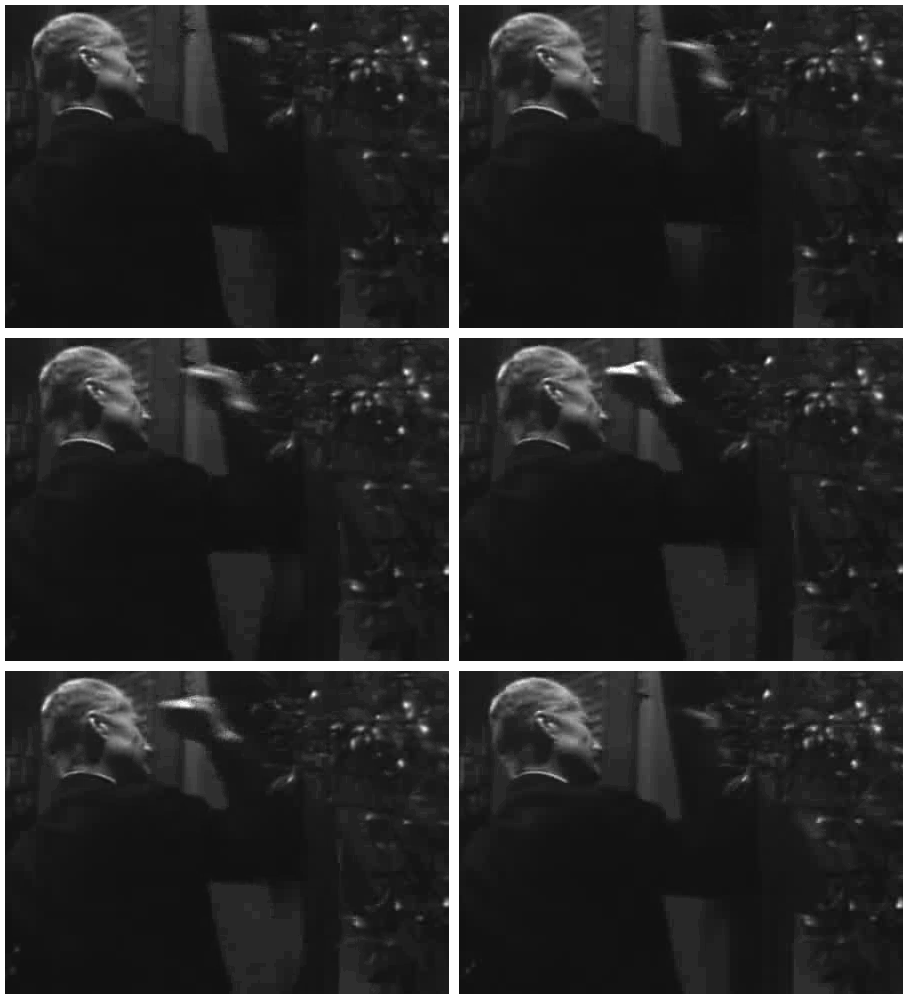
Unknown to the other characters, Chris is a werewolf. Chris accepts an offer from the Collins family to host Amy at Collinwood while he deals with his mysterious problems; in gratitude, he takes heiress Carolyn for a drink at the Blue Whale tavern. While there, he sees a pentagram on the barmaid’s face and hurriedly excuses himself. Later, he transforms into his lupine shape and returns to the barroom, not through the door this time but through the window. He kills the barmaid.

The werewolf drops in to the bar. Dark Shadows Before I Die.

The barmaid appears only in this episode; she doesn’t even get a name. But we see her face in closeup often enough that she feels like a person. Even more importantly, she is wearing the same wig that Maggie Evans, The Nicest Girl in Town, wore in her first four episodes (#1, #3, #7, and #12.) Since Maggie was also a server, working the counter at the diner in the Collinsport Inn, this wig tells longtime viewers that the werewolf’s victim could just as easily have been Maggie, one of everyone’s favorite characters.

Don Briscoe played Chris in his human phase, Alex Stevens as the werewolf. Stevens was credited not as an actor, but as “Stunt Coordinator.” Yet today, his credit card appears in between Briscoe’s and that of Carol Ann Lewis, who was cast as the luckless barmaid. Some of the original audience may have caught on that Stevens was the man in the character makeup, but others who noticed the odd billing order would have chalked it up as another of the show’s frequent imperfections.
Episode 20: A mockery to the future

In episode 18, Roger (Louis Edmonds) had demanded Vicki (Alexandra Moltke Isles) come with him to Burke’s hotel room, where they will tell Burke (Mitch Ryan) about all the evidence they have connecting him to Roger’s car wreck. Vicki repeatedly protests in that episode that it would be better to take this information to the police. In this one, they arrive at the hotel, and again Vicki objects that they really should be going to the police. Roger, however, is a man obsessed. He asks Vicki to wait in the restaurant while he goes to Burke’s room, telling her that it may not be necessary for her to join him.

Sam (Mark Allen) comes to the restaurant looking for his daughter Maggie. Finding that Maggie isn’t at work, he invites himself to Vicki’s table. Their previous encounter had been a strange and frightening one on the top of Widow’s Hill; Vicki is no more comfortable with Sam now than she had been then. He bellows at her, she reacts with quietly frosty disdain. These attitudes may have less to do with the script or the direction than with Mark Allen’s limitations as an actor; he bellows all of his lines in this episode, and quiet frostiness is as effective a technique as any other for holding onto the audience while sharing a scene with an incompetent loudmouth.

There’s no incompetence in the scenes in Burke’s room. Louis Edmonds and Mitch Ryan were first-rate stage actors, and their confrontation is a terrific fireworks display. When Roger brings Vicki up to tell Burke what she saw him do in the garage, she again plays the scene quietly, an effective counterpoint to the artillery blasts the men have been letting loose.

In the Evans cottage, Sam finds that Maggie (Kathryn Leigh Scott) has been home all this time. When Allen bellows at her, Scott bellows back at him, a far less effective tactic than the quiet intensity Mrs Isles had used earlier. The scene has some potential- the situation is that an alcoholic finds that his adult daughter has been checking up on him, he resents it, and they have a fight about all of the ways in which she has been forced to take on the parental role in their relationship. But as a shouting match, it might as well be about anything, or about nothing.

Returning home after their confrontation with Devlin, Roger and Vicki say goodnight in the foyer. Time and again in these early episodes, people have urged Vicki to leave Collinsport while she still can. Even in this episode, Burke had told her that. But as they part ways for the night, Vicki to her bedroom and Roger to the brandy bottle, Roger tells her that as a witness, “you can’t leave now.”

That line is effective enough, but if the scene between Sam and Maggie had worked it would have been very powerful. The Evanses, father and daughter, are a case of two people who are trapped, trapped in Collinsport, trapped with each other, trapped with his alcoholism and her sense of obligation to keep him alive. As written, the scene could have brought all that out, and induced a claustrophobic sense in the audience that would have made Roger’s line feel like a death sentence. As ruined by Mark Allen, it just leaves us with the sense that we’re watching a show that needs some recasting.

Episode 12: You can still hear the widows

Roger and Vicki encounter each other on the peak of Widow’s Hill. Roger remarks it is the highest point in the area. At the end of their conversation, Vicki will call to Carolyn, inviting her to join them “down here.” This may seem to be a blooper, but since we hear “down” used to mean “up” in a later episode, I speculate that it’s a peculiarity of Collinsport English.

Little happens to advance the plot in this episode, but between Roger’s announcement that he and Vicki are standing on the highest point in the area and Vicki’s invitation to come “down here,” we hear a lot about the ghostly legends of the place. After the scene in episode 11 where the ghosts are troubling Elizabeth while David is doing something mysterious involving motor grease and little pieces of metal, it seems that the show is using the ghosts as a sign that something big is happening. Certainly the “Widow’s Wail” is a striking sound effect, and Louis Edmonds does a good job of selling the idea that Roger really does believe in all the legends about the house that his social position might require him and Elizabeth to ridicule publicly.

It’s a bit jarring that Carolyn drifts into the scene asking what Vicki and Roger are doing- “planning a suicide pact?” She had just told Vicki about the legend that a third governess would die by jumping off the cliff, and the series story bible still calls for Roger to throw himself to his death from it. So you might think it would be in questionable taste to bring that particular topic up just now.

There’s also a scene in the Evans cottage where Maggie (Kathryn Leigh Scott) tries to get Sam (Mark Allen) to tell her what’s been bothering him. In episode 11, Conrad Bain had triumphed over a weak script and Mark Allen’s relentless whine to turn what might have been a lot of tedious recapping into a compulsively watchable scene. At the beginning of this scene, Kathryn Leigh Scott is mustering such powerful emotions that it looks like she might be about to accomplish the same feat, but Allen has switched from whining all his lines to bellowing them. So the scene is a dead loss.

Episode 7: Nowhere- Everywhere- Perhaps I was here.

Vicki and Burke run into each other at the Collinsport Inn where Maggie serves them coffee, Roger lets himself into the Evans cottage where he makes demands of Sam, Maggie tells Roger that Burke and Vicki are sharing a table and he runs away.

In these interactions, we see Burke using his considerable charm to try to get information out of Vicki, Roger using his social position to try to bully Evans the father while Evans the daughter exposes his cowardice, Sam wallowing in self-pity, Maggie letting information out indiscriminately, and Vicki taking it all in, cautiously.

Marc Masse’s post about this episode on his Dark Shadows from the Beginning has some interesting stuff. Both Mitch Ryan as Burke and Mark Allen as Sam are required to talk with their mouths full; both of them have mishaps, which he records with gifs showing matter falling out of their mouths. He also has these intriguing paragraphs about the character of Sam Evans:

One thing about the Evans cottage you notice in this episode is that when Sam walks in the door you can see houses across the street, a setting that would suggest a quiet, cozy cul-de-sac near the waterfront. Sam has neighbors, but none ever come calling. One gets the impression that Sam is troubled about something and just wants to be left alone, but time and again unwanted trespassers will just keep barging in, like this nervous, frightened man who lives in a mansion on the hill who busts in to order him around and warn him to keep certain information secret that might be damaging to the both of them. There will at one point be a cannery plant manager who just walks in without knocking while he and Roger are arguing about Burke Devlin, the plant manager telling Sam that if he wants privacy he should keep his door locked. But even that wouldn’t work, because as time goes on the trespassers will only become more aggressive: a fire goddess who, by staring into a blazing fireplace miles away, can make Sam fall asleep on the sofa with a lit cigarette to ignite a nearby newspaper so that he burns his hands badly enough that he can no longer paint; a newly risen vampire who sneaks in through the French windows to make a blood bank of his daughter; a Frankenstein monster who lets himself in for food and shelter and who knows where the cutlery is kept; a werewolf that doesn’t even bother with locked doors and just crashes in through the nearby window. The Evans cottage is a hub of activity for invasive beings with criminal intent.

But now, in the relatively sane and quiet summer of sixty-six, all Sam Evans has to do for a little peace of mind is assure his unwanted patrician visitor that he will not do or say nothing to jeopardize the agreement the two apparently made that ties them together like conspirators – because that’s what they represent to the viewer, two people who keep information away from others, information the viewer at this point is also not fully privy to.

But the one salvation for Sam Evans is that, unlike Roger Collins, he does seem to have some remnant of a conscience about whatever unsavory information ties these two unlikely co-conspirators together, and therefore a soul that may be worth saving.

Marc Masse has more use for Mark Allen’s acting than I do- I would say that he tends to be monotonous, his voice either a constant whine or a series of bellows. So I find it difficult to think of Sam Evans #1 as a soul worth saving. But this is a most insightful passage.

Episode 3: Open your door!

Episode 3 of Dark Shadows is remembered chiefly for two things. It’s the one where Carolyn and Vicki first meet, and Carolyn introduces herself by going on at alarming length about her crush on her Uncle Roger. Vicki’s quiet reaction is just what you’d expect from a new member of the household staff discovering that a member of the family is a raving loon.

It’s also the one that opens with Roger pounding on the door to the Evans cottage and shouting “Open yer doah, ya drunken bum!”:

There is more to it. At the Blue Whale, Burke tries to enlist Joe in his intelligence-gathering operation, an attempt Joe virtuously rebuffs. Bill Malloy confronts Burke, showing that he, like Joe, is devoted to protecting the Collinses.

Art Wallace, the author of the show’s story bible and sole credited writer for its first eight weeks, specializes in a diptych structure, building an episode by interweaving two parallel scenes. That structure leads us to compare and contrast characters with each other in a wider variety of ways than we might if the scenes followed each other in succession. In this one, we see Joe and Bill faithfully standing up to Collins family foe Burke, while newcomer Victoria tries to assume the persona of a loyal retainer in her response to Carolyn’s bizarre talk.

Episode 1: Who’s talking?

In 281 of the posts that follow, I link to comments I made on Danny Horn’s great blog Dark Shadows Every Day. Danny starts with episode 210 and makes only a handful of remarks, most of them highly disparaging, about the first 42 weeks of the show. As a particular fan of that period of the show, that distressed me when I first started reading him, but I found that it gave me an opportunity to make substantial contributions to the comment section. I could always find something in those early stories that gave extra depth to whatever was going on in the later installments.

Now, Mrs Acilius and I are watching the show through a second time, again starting with episode 1. I’d so much enjoyed commenting on Danny’s site when we were watching 210-1245 from March of 2020 to April of 2021 that I decided to start commenting on a blog that covered the first 42 weeks. So I’ve left many comments on John and Christine Scoleri’s Dark Shadows Before I Die.

The Scoleris haven’t assembled the kind of community that made Danny’s comment section a big party. I still get responses to comments I left on Danny’s site, almost a year and a half after his final post. I have yet to get a reaction to any of my comments on Dark Shadows Before I Die. So I’m thinking of just recording my thoughts here.

The Scoleris aren’t the only bloggers who discuss the first 42 weeks of the show. There’s also Marc Masse, a.k.a. Prisoner of the Night, whose (fiercely controversial) Dark Shadows from the Beginning is occasionally viewable, usually private. And of course Patrick McCray, whose Dark Shadows Daybook set the standard for online commentary on the show. Neither of those sites has an open comments section, which is why I’ve been contributing to the Scoleris. There are also podcasts, Facebook groups, Reddit threads, etc, but I’m not into any of those.

Asking who to talk to and how to get through to them brings episode 1 to mind. Vicki comes to an unfamiliar town, and the audience comes to an unfamiliar show. She’s a stranger looking for someone to talk with; we’re viewers of a daytime soap, a genre that consists almost entirely of conversation. Everyone Vicki meets is talkative enough, but most of their talk is about how they aren’t speaking. The lady sitting next to her on the train goes on about what a nasty place Collinsport is. The fellow who gives her a ride from the train station responds to the innkeeper’s warm greeting with an ostentatious refusal even to acknowledge that he knows him, let alone to engage in conversation. The server at the lunch counter announces to Vicki, before she’s had a chance to say two sentences, that she regards her as a “jerk.” The family she will be working for is represented by a lady who won’t answer her brother’s questions as to who Vicki is and why she hired her, a reticence that is made all the more ominous when a private investigator reports on their strange, unfriendly ways. Dark Shadows fandom is far less forbidding than the situation Vicki faced!