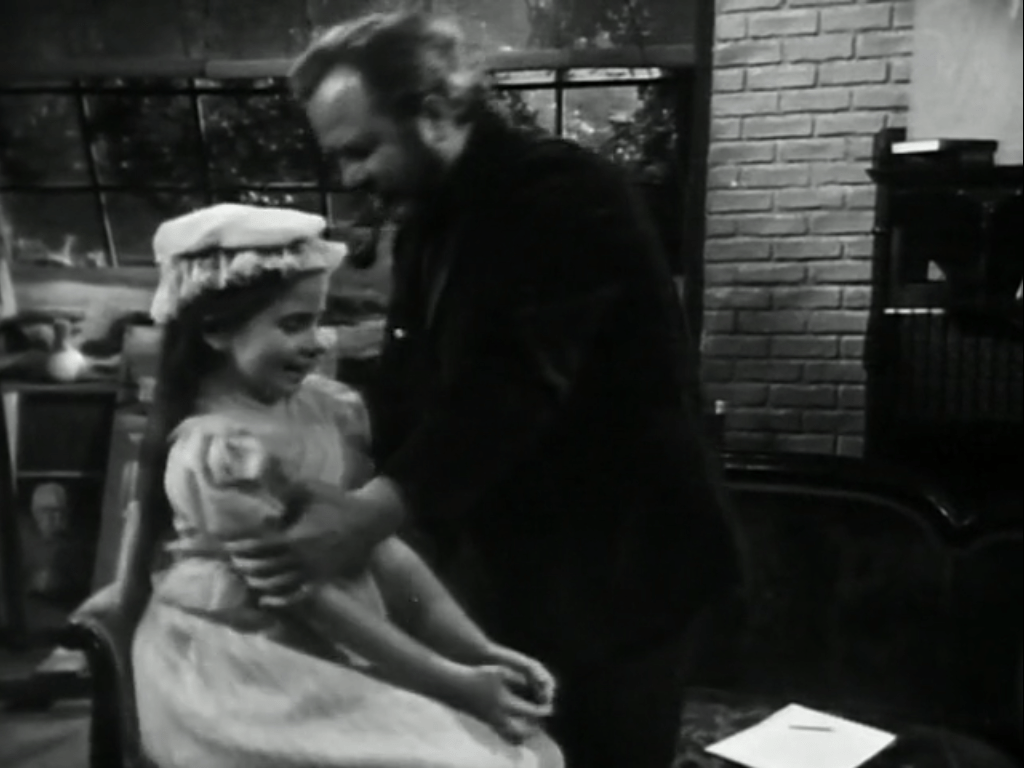
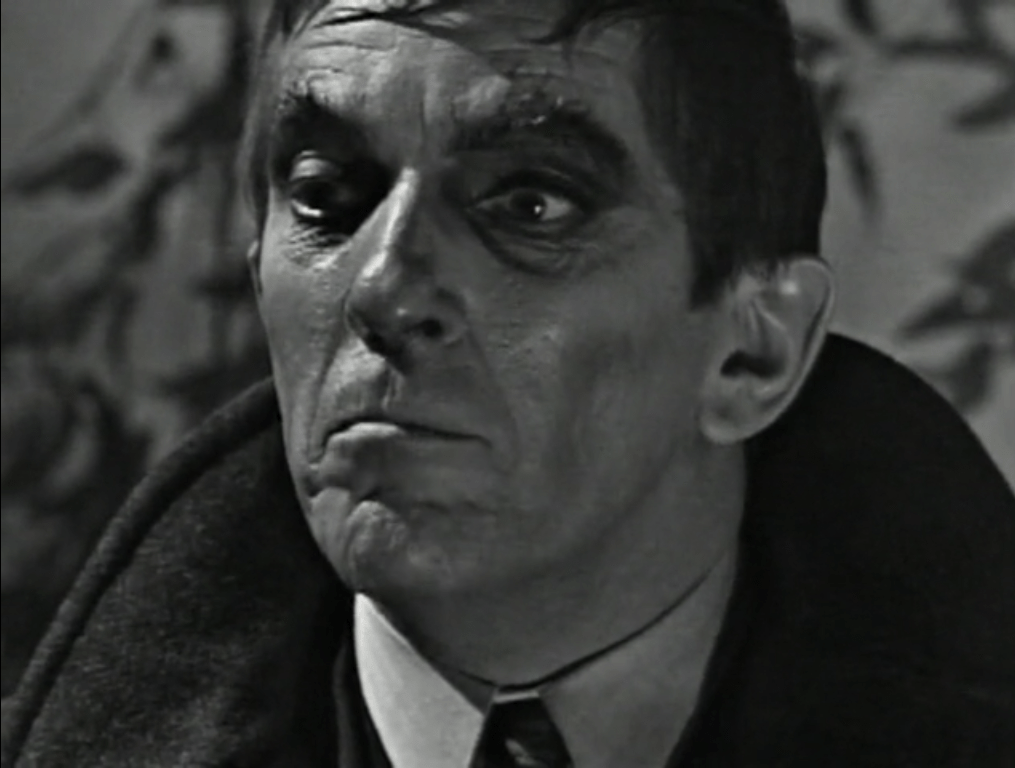
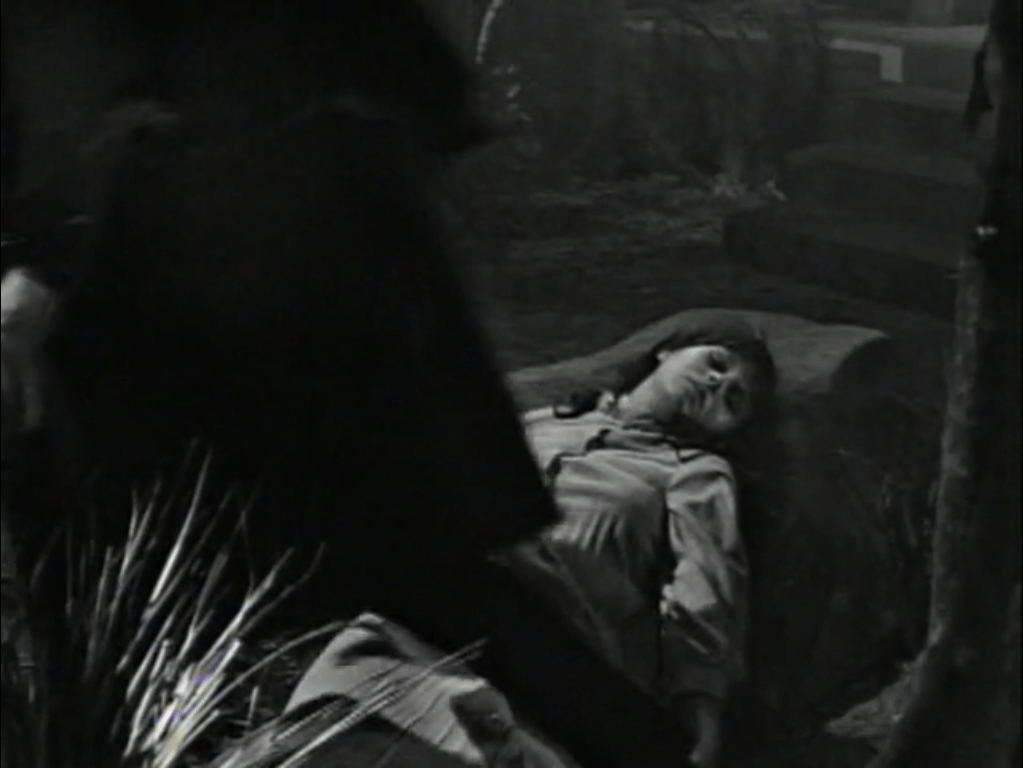
Episode 227: The nature of her illness

Vampire Barnabas Collins enters the bedroom of Maggie Evans, The Nicest Girl in Town. We see a closeup of him in profile, his mouth open to expose his fangs. This shot might have been effective if it had flashed on the screen for a fifth of a second or less and been followed by some kind of action, but we linger on it for a couple of seconds and cut to the opening credits. The result is laugh-out-loud funny. It makes him look like he’s pretending to be a dog in a cartoon. It’s bad enough when Barnabas reminds us of a Scooby-Doo villain without pushing him over the line into imitating Scooby-Doo.

Ruh-roh!
Screenshot by Dark Shadows Before I Die

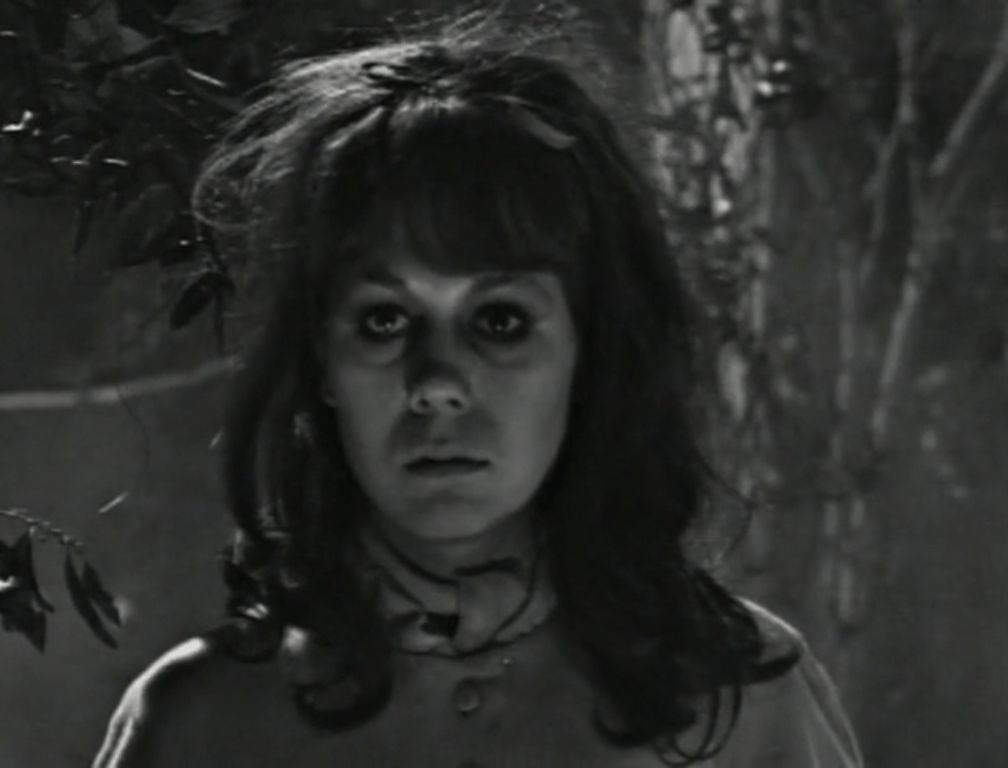
The rest of the episode is composed of scenes that go on too long, though none quite as disastrously as this. In the morning, Maggie’s father, artist and former alcoholic Sam, wakes her. She is ill and moody. Kathryn Leigh Scott maintains just the right level of intensity, and David Ford plays Sam quietly enough to stay out of her way. But they make all their points in the first minute or two, and it just keeps going.

Later, Maggie is sitting at the counter at her place of employment in the restaurant at the Collinsport Inn.* She’s wearing a scarf and feeling awful. Her boyfriend, hardworking young fisherman Joe, comes in. He teasingly asks her how a paying customer can get a cup of coffee. She tells him to pour it himself. He’s about to do it when she drags herself to her feet. She drops the cup. He makes a little joke about seeing her use a broom and she says she’ll sweep it up later. He is shocked, and she snaps at him.

She continues to have trouble with basic tasks, and Joe grows concerned. Sam comes in and reminds her that he told her she shouldn’t have gone to work. He says he’ll call the doctor, and she yells at him. Then, she faints.

That’s probably the best scene in the episode. Miss Scott holds on at the level she had established in the previous scene, while Joel Crothers matches Ford’s steady, understated support. With three actors, there’s enough action to keep us interested. My wife, Mrs Acilius, praised the choreography that allowed Miss Scott to make such a memorable turn unencumbered by Malcolm Marmorstein’s dialogue. Still, they could have done all that in about half the time and we wouldn’t have missed a thing.

Then Maggie’s back in her room, this time with Joe sitting on the side of the bed while she lies in it. The body language between them is affectionate, but after about a minute and a half you can’t help but notice them complying with the requirements of the Standards and Practices office. Sick as Maggie is, it is jarring to see Joe keep his distance from her quite so scrupulously.

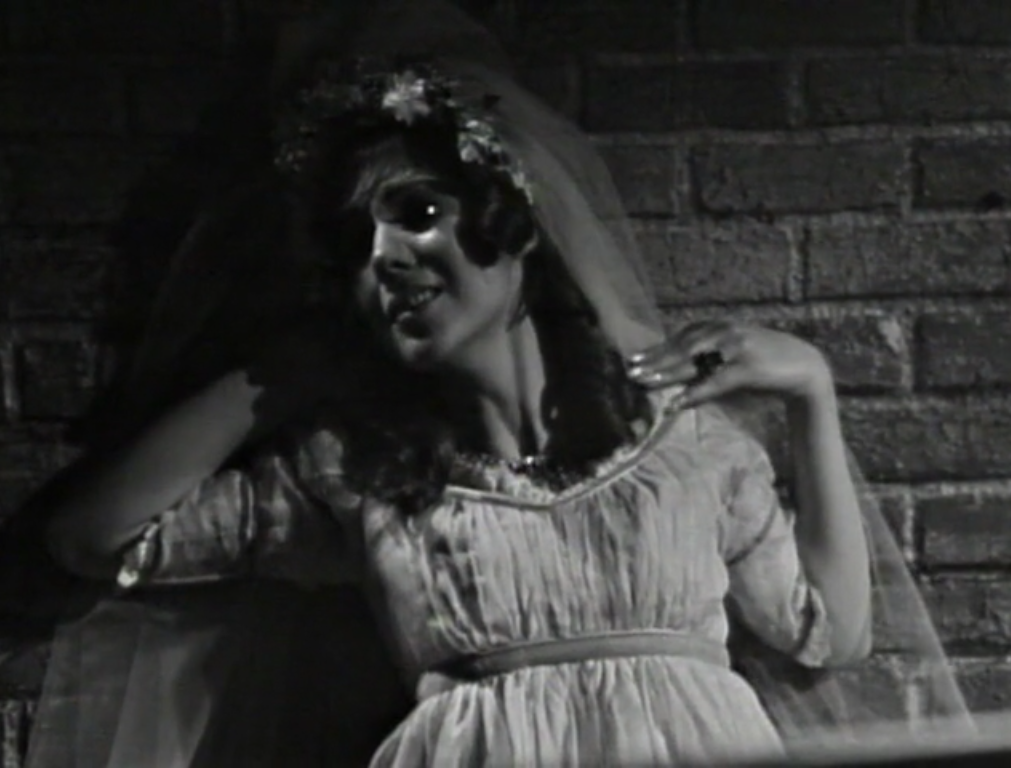
Night falls, and we see Barnabas in his house. He peers out his window, and we cut to Maggie. She’s still in her room, but now she is out of bed, brushing her hair, and grinning. Sam enters and is surprised at the change in her.

Maggie’s up.
Screenshot by Dark Shadows Before I Die

After a meandering conversation, Maggie volunteers to drive Sam to Barnabas’ house where Sam will be working on a portrait of Barnabas. Evidently Sam agrees, because the two of them enter there together.

Maggie and Barnabas exchange looks and conversation loaded with double meanings while Sam sets up. Jonathan Frid plays Barnabas’ part in this so heavily that it is laughable Sam doesn’t notice something is going on between him and Maggie.

Barnabas and Maggie murmuring to each other.
Screenshot by Dark Shadows Before I Die

I’m always reluctant to complain about Frid’s acting. It’s so hard to explain just what it was that made Barnabas such an enormous hit that you can never rule out the possibility that any given thing might have been indispensable to it. Still, seeing him ham it up so shamelessly today, especially after the other three members of the cast have shown such strict discipline, I did have to wonder what he was thinking. It’s hard to imagine anyone would have directed him to play the part that way.

I can see one advantage to Frid’s overacting. Maggie sticks around his house a couple of minutes after the point of the sequence has been made, and the time is filled with repetitious dialogue about her illness. When Barnabas says that the house is an unhealthy place for someone in her condition, Frid leans so hard on the line and makes himself look so silly that you don’t really notice that there is no reason for the scene still to be going on.

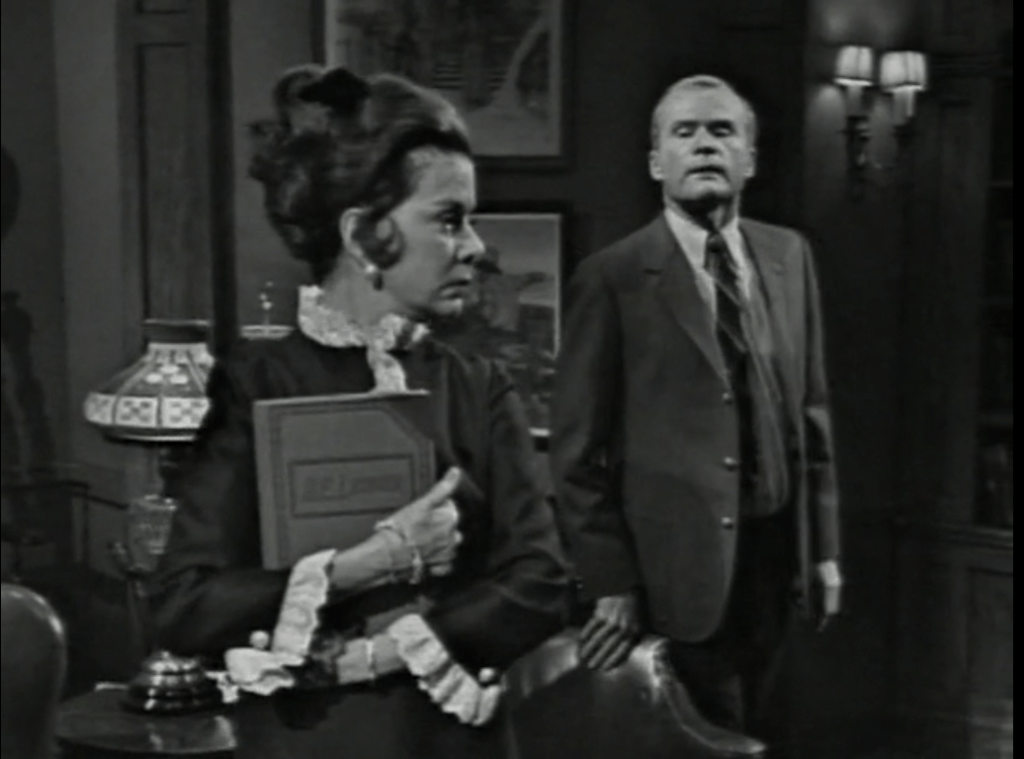
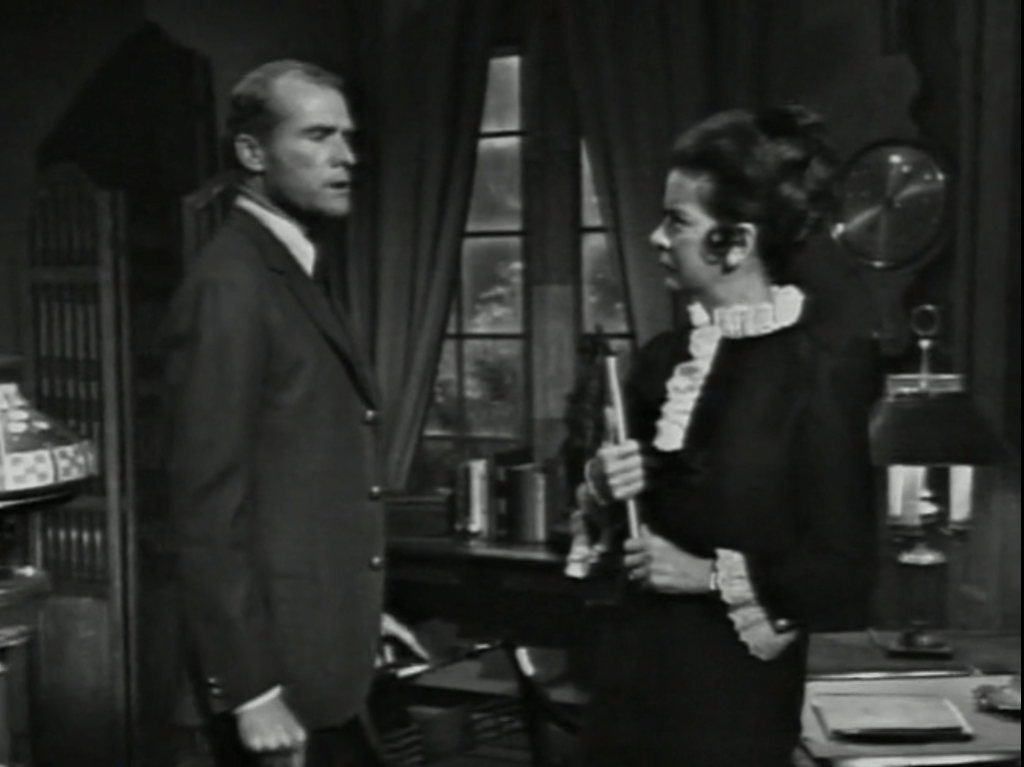
After Maggie has gone home and got back into bed, Sam tells Barnabas he’s tired and thinks it’s time to stop for the night.** Barnabas wants him to keep going for a while and to take the next night off. They discuss this fascinating topic at length. Sam decides to spend an hour working on the background. Their conversation has already taken so long that we fear they might show that hour of painting in real time, and it is a relief when Barnabas says he will go outside while Sam paints. We can assume he’s going to pop into Maggie’s room for a snack.

*The last appearance of this set, alas.

**Barnabas’ sorely bedraggled blood-thrall, Willie Loomis, will be driving Sam home. At this point they’ve settled on the idea that Willie has a car.

Episode 222: The local crime rate

We open in the front parlor of the long-abandoned Old House on the grounds of the estate of Collinwood. Willie Loomis, the sorely bedraggled blood-thrall of newly resident vampire Barnabas Collins, is lighting candles.

A knock comes at the door. No one knows that Barnabas has brought Willie to the house. Before Barnabas bit him, he was dangerously unstable ruffian Willie Loomis, a menace to all and sundry. Almost everyone in the great house on the estate and many people in the nearby village of Collinsport have been feeling a great sense of relief for the last few days because they believe that Willie has gone and will never return. So he responds to the knocking by trying to hide.

Willie hides from Vicki

Well-meaning governess Vicki comes in and calls for Barnabas. She finds Willie and demands to know what he is doing there. He tells her not to worry about that, but to get out of the house as quickly as she can.*

Willie tried to rape Vicki in #203, and crazed handyman Matthew Morgan held her prisoner in the Old House in episodes #116-126. So regular viewers will be absorbed in Alexandra Moltke Isles’ performance of Vicki’s refusal to be intimidated by this man in this space. At first she visibly steels herself to stand up to Willie. As he keeps his distance and evades her questions, she starts to suspect that he is more afraid of her than she is of him. She begins to relax, and takes stock of the improvements that have been made to the house. By the time she concludes that Willie is probably telling the truth about being Barnabas’ servant, she has an amused, almost triumphant look on her face and an easy sway to her movements. She talks easily and cheerfully about the improvements made since the last time she was in the house, and Willie squirms.

Vicki stands up to Willie
Vicki amused by Willie

As Vicki tries to communicate reclusive matriarch Liz’ invitation for Barnabas to join the Collins family for dinner in the great house, Willie denies that he knows where Barnabas is or when he will come back, and continues to demand that Vicki leave. She finally gives up and goes, but with irritation, not fear. She leaves with a sarcastic “Thank you!”

Vicki leaves, irritated

After Vicki leaves, Barnabas appears and scolds Willie. First, he taunts Willie’s roughness (“My, you are a polite one!”) Then, he orders him not to try to protect anyone from him. He is stern, Willie is terrified, the whole effect is suitably sinister.

We cut to the Evans cottage, home of artist Sam Evans and his daughter Maggie, The Nicest Girl in Town. Maggie rushes into the front door panting, as if she has been running. She shows intense fear when she hears a knock on the door. She calls out, “Who is it?” “Barnabas Collins,” comes the reply. “Mr Collins?” “That’s right.” She slowly opens the door, with the chain in place, and peeks out. She relaxes slightly when she sees that it really is the kindly eccentric she met the other night.

Barnabas asks permission to come in. Maggie opens the door and gestures towards the inside of the house. Barnabas asks again. Only after she explicitly invites him does he cross the threshold. There’s a tradition that vampires can enter only where they are invited, and the show has been following that strictly so far. Barnabas didn’t even go into Maggie’s restaurant until she asked him. Perhaps that was why he went there after it had closed, so that she would have to unlock the door and explicitly invite him to come in.

Maggie explains that she is unsettled because she felt someone followed her home. Considering that Barnabas knocked on her front door less than 30 seconds after she came in, I’d say her feeling has had some pretty solid corroboration, but she doesn’t seem to be making the connection. Maggie goes on to say that she is on edge anyway because some unseen man grabbed local woman Jane Ackerman by the throat the other day and vanished into the night when Jane was able to scream and attract a crowd.

Barnabas explains that he was intrigued when she mentioned that her father was an artist. Maggie brightens and ushers Barnabas towards Sam’s paintings. He looks at several and admires them.

Sam comes home. He is as disquieted as Maggie was when she entered. He tells her that he looked for her at the restaurant and was alarmed to see that she had already closed and was presumably walking home. There has been another attack.

The conversation shows how exotic Barnabas is in Collinsport. He speaks with a mid-Atlantic accent, uses old-fashioned grammatical constructions,** and his manners are a caricature of the Old World courtier. Sam is slangy and vulgar, telling Barnabas that the police “think it’s the same guy” behind both attacks. The contrast between the polished Barnabas and the coarse Sam will be developed further in this episode and later.

Barnabas asks Sam to paint his portrait. At the word “commission,” Sam stands up straight and becomes very still, while Maggie holds her breath. When Barnabas offers $1000 for the work, Maggie burst into grin, and Sam visibly struggles to keep from jumping with joy.***

“A commission?”
“A satisfactory fee.”

As Sam, David Ford has a lot of trouble with his lines today. So much that Danny Horn, in his post about this episode on Dark Shadows Every Day, writes that “It’s unbelievable that this man was employed, even on this show.” But Ford plays Sam’s response to Barnabas’ offer perfectly, showing us a man who is excited by a lucrative opportunity, but who also remembers a time when he was in a position to negotiate when such offers came in, and who wishes his daughter could remember it as well. In spite of all Ford’s communings with the teleprompter, that moment reminded me of Marc Masse’s rave review of Ford’s first appearances on Dark Shadows and of his theory that Ford’s style of acting had a salutary influence on his cast-mates.

Barnabas wants to sit for Sam before the night is out. He insists that the painting be done at the Old House, and exclusively at night. Sam has little choice but to agree.

We know that Barnabas is unavailable during the day, but it is not immediately clear why the work should be done at the Old House. Barnabas seems to have plans for Maggie, and hanging around her house every night would seem a more efficient way to advance those than having her father come to his.

Perhaps he wants the portrait to have some kind of special relationship to the house. Portraits have been an important part of the show from the beginning. The main set is the foyer and drawing room of the great house of Collinwood, and the oversized portraits of Collins ancestors are among its most prominent visual features. In the early weeks, dashing action hero Burke Devlin commissioned Sam to paint his portrait, which for reasons too tedious to repeat sent high-born ne’er-do-well Roger Collins into a tizzy.

As the show moved deeper and deeper into uncanny themes, portraits became a bridge between the world of the living and the world of the more or less dead. When blonde fire witch Laura Murdoch Collins was driving the action of the show, a supernatural force compelled Sam to paint portraits of her. And Willie freed Barnabas from his coffin because he became obsessed with the portrait of Barnabas in the foyer of the great house and Barnabas was able to call to him through it. So maybe a portrait painted in the much-haunted Old House will derive some kind of magical or demonic power from its place of origin.

Maggie, still radiant with joy at the promising new turn in her Pop’s career, drops him off at the Old House. He sets up an easel, puts a canvas on it, puts a chair where he wants Barnabas to sit, and starts to work right away. My wife, Mrs Acilius, is among other things a painter; when she saw this, she asked in puzzlement what happened to the sketch-making phase of the project. By the time the sun is about to rise and Barnabas disappears from the room, the figure is almost half completed. Comparing that with the weeks and weeks Sam spent dragging his feet in response to Roger’s demand he not paint Burke, and with his frustratingly repetitious role in the Laura storyline, this Bob Ross-like speed would seem to suggest that the show will be picking up its pace sometime soon. ****

One night’s work

Meanwhile, Maggie is visiting Vicki at the great house. In front of Barnabas’ portrait in the foyer, Vicki says that she likes Barnabas very much- after all the troubles the Collinses have had in the last several months, it’s a relief to have someone around who is friendly. This is almost exactly what flighty heiress Carolyn had said to Vicki when they were standing on the same spot in #214, and it accounts for Liz’ instantaneous delight upon meeting Barnabas in #211. It is his contrast with foes like Burke, Laura, Willie, and seagoing con man Jason McGuire that has smoothed Barnabas’ entry into the present-day Collins family, and he is sliding right into possession of the Old House, which is after all a huge mansion.

The episode ends with an inversion of its beginning. Instead of going into hiding, Willie emerges into view. Sam, who had a nasty run-in with Willie in #207, is as surprised and as unhappy to see him as Vicki had been. As Vicki had done, he accepts Willie’s claim to be Barnabas’ servant after he looks around the parlor and realizes that Barnabas must have had someone helping him put it to rights. As the action began with Vicki coming in through the doors of the Old House, so it ends with Sam going out through them. Vicki entered looking up and calling loudly “Mr Collins!” Sam exits looking down and muttering about the idea of resuming work at sundown. The contrast shows how the events of the episode, even those which seemed pleasant to the people experiencing them, have left everyone confused and helpless before Barnabas.*****

*When Willie delivers this line, actor John Karlen briefly assumes an accent reminiscent of his predecessor in the role, Mississippian James Hall. There’s a little bit of the South in some of his lines later in the episode as well, mostly when he says “Ah’m” instead of “I’m.” Karlen was from Brooklyn, and the day will come when Willie is from there as well. But today is not that day.

**He doesn’t use them correctly- twice he uses the objective case form “whom” when the context calls for the subjective “who.” Still, he uses them, that’s the point.

***For several months, ending 1 May 2023, PlutoTV had a channel that showed Dark Shadows 24/7. They had about 600 episodes, starting from #210 and ending somewhere in the 800s, which they run on a loop interspersed with some related material, such as Dan Curtis’ Dracula. Every week or two, I turned it on during odd moments of the day to see which one they were showing. Often as not, I found this episode. Twice in a row, I tuned in at the moment when Barnabas is telling Sam “You are definitely the man for me!” I turned it on in the middle of the afternoon on 18 April, the very day Mrs Acilius and I were going to watch this episode and I would start writing the post above, and there was Maggie telling Barnabas about the attack on Jane Ackerman. I turned away, since I knew we’d be watching it that evening.

Now, Pluto shows a block of episodes on their “Classic TV Dramas” channel in the afternoons. Late this morning I turned Pluto on to have sound in the background while doing some paperwork, found Rat Patrol on that channel, and at noon it gave way to… Dark Shadows, episode 222!

****Mrs Acilius points out that Sam painted Laura’s portraits just as quickly. That time, he was acting as the tool of the ghost of Josette Collins. Perhaps Barnabas can do what Josette did, and is acting through Sam.

She also remarks that what Sam has painted includes Barnabas’ face without his mouth. Considering that the subject is a vampire, it must be significant that the painter is delaying the depiction of that particular body part.

*****As Willie leads Sam out of the house, a bell tower chimes. A single rooster isn’t too hard to accept as a feature of the estate, but since when has Collinwood had a carillon?

Episode 221: A new Collins in Collinsport

Maggie Evans, The Nicest Girl in Town, is closing up shop in the restaurant at the Collinsport Inn. A stranger startles her. He is the mysterious Barnabas Collins. Barnabas recently left his long-time residence in the cemetery five miles north of town and has been hanging around the great estate of Collinwood, but this is the first time we’ve seen him in Collinsport proper.

In the opening months of Dark Shadows, the restaurant, like the rest of the inn, was coded as the base from which dashing action hero Burke Devlin mounted his campaign to avenge himself on the ancient and esteemed Collins family. As the Revenge of Burke Devlin storyline ran out of steam, the restaurant emerged as a neutral space where new characters could be introduced without defining their relationships to the established cast all at once. In that period, Maggie was Collinsport’s one-woman welcoming committee.

Now, even Burke has given up on his storyline. The only narrative element of the show with an open-ended future is Barnabas, and once the audience has figured out that he is a vampire there’s no such thing as a neutral space where he is concerned. So it is not clear what, if any, role the restaurant will have from now on.

Barnabas asks if it is too late to get a cup of coffee. Maggie tells him it is, but relents after about a minute and reopens to serve him. She is charmed by his old-world manners and excited to learn that “there is a new Collins in Collinsport.” He tells her he is staying at the long-abandoned Old House on the grounds of Collinwood, prompting her to marvel at the idea of someone living in a dilapidated ruin that is probably haunted. When she admires his cane, he explains that it is not only quite valuable, but is also a family heirloom and on that account his most prized possession.

Barnabas appears to drink the coffee, as he appeared to drink the sherry his distant cousin Roger served him when he visited Collinwood in #214. Usually vampires are supposed to limit their diet strictly to human blood, but just a few weeks ago Dark Shadows wrapped up a long story about Laura Murdoch Collins, a humanoid Phoenix, who raised everyone’s suspicions by never being seen to eat or drink. So they may have thought that it would be repetitious to follow the Laura arc so closely with another undead menace who betrays himself with the same sign.

Barnabas kisses Maggie’s hand in farewell

Maggie’s boyfriend, hardworking young fisherman Joe, comes bustling into the restaurant seconds after Barnabas leaves. Maggie is surprised that Joe and Barnabas didn’t pass each other, and puzzled when Joe tells her there was no one in sight anywhere near the inn. Neither of them had heard of Barnabas before.

Joe tells Maggie that a woman named Jane Ackerman had an unpleasant run-in with a man she couldn’t see earlier in the night. The fellow retreated before doing her any serious harm, but Joe seems fairly sure that whoever it was is a real threat to the women of Collinsport. So he wants to keep Maggie company. Maggie doesn’t seem worried, either for her own sake or for Jane’s. She’s just happy to see Joe, and gladly agrees when Joe suggests they go to the local tavern, the Blue Whale.

As Dark Shadows’ principal representatives of Collinsport’s working class, Maggie and Joe illustrate the point the opening voiceover made when it said that people “far away from the great house” of Collinwood would soon be “aware of” Barnabas and of “the mystery that surrounds him.” As a name we have never heard before and are unlikely to hear again, “Jane Ackerman” reminds us that there is a whole community of people for Barnabas to snack on.

As Joe and Maggie are heading out of the restaurant, she notices that Barnabas left his precious cane behind. She wants to go straight to the Old House to return it to him. Joe would rather wait until morning, but Maggie explains that she doesn’t want to be responsible for it overnight. This is a bit odd- they are in a hotel, after all, a business that specializes in keeping valuable property safe while its owners sleep.

Perhaps Maggie wants to see the Old House. Joe has been there many times. When we saw him there with Burke, searching for well-meaning governess Vicki in #118, he mentioned that when he and flighty heiress Carolyn were children, they would occasionally play there. He returned there during the Laura storyline. Even Maggie’s father has visited the Old House, participating in a séance there in #186 and #187. Maggie has never been there at all. So perhaps she just feels left out.

Maggie and Joe knock on the doors of the Old House. No one comes. As they turn to go, there is a closeup of the door knobs turning. Maggie and Joe hear a door open, and go in. They don’t see anyone, but candles are burning and Joe remarks that the front parlor has been fixed up. Joe goes upstairs and leaves Maggie behind, explaining that he knows his way around the place and it isn’t safe up there for someone who doesn’t.

Once Maggie is alone, Barnabas appears next to her. She is startled and cannot see how he could have got there without her knowing. He apologizes for once more catching her unawares. He seems surprised that she is not alone. When Joe comes downstairs, he is exceedingly polite to both of them.

After Maggie and Joe excuse themselves, Barnabas’ blood-thrall, the sorely bedraggled Willie Loomis, appears. With obvious difficulty, Willie forces out one word after another, and manages to ask Barnabas what he plans to do to Maggie. Barnabas is displeased with Willie’s presence and with his presumption that he has the right to question him. He climbs the stairs and looks down at Willie, full of menace and demanding that he go out and do the work Barnabas has ordered him to do. Willie tries to refuse, but cannot stand the look Barnabas is giving him.

Barnabas gives Willie his orders

During this staring contest, Barnabas and Willie are standing on the spots where strange and troubled boy David Collins and Barnabas had stood when we first saw Barnabas in the Old House in #212. In that scene, David and Barnabas were more or less eye-to-eye, and for a moment it seemed that Barnabas was contemplating violence against David. In this scene, Barnabas shows how committed he is to violence. He has a power over Willie that he gained by the extreme violence of drinking Willie’s blood, and Willie’s inability to resist Barnabas’ stare shows that power in use. Willie’s horror at the task Barnabas has assigned suggests that it also is violent.

My wife, Mrs Acilius, believes that the confrontation between Willie and Barnabas solves one of the behind-the-scenes mysteries about Dark Shadows. Why was James Hall replaced by John Karlen in the role of Willie? She points out that Hall, while he is a fine actor, had a lot of trouble with Willie’s lines, particularly in the long he shared with Dennis Patrick’s Jason McGuire. By the time Willie was recast, Jonathan Frid had been attached to the role of Barnabas for some days, and Frid never made it a secret that he was a slow study. So if there were going to be a lot of long conversations between Willie and Barnabas, Willie had to be played by an actor who could get his dialogue letter perfect day after day. That was John Karlen.

After Willie scurries off to do whatever evil chore Barnabas has ordained for him, Barnabas wanders over to the window. On his way, we see that the portrait of Josette Collins is no longer hanging in the spot over the mantle where we have seen it since our first look at the Old House in #70. At the end of that episode, Josette’s ghost emanated from the portrait and danced around the outside of the house. From that point, the Old House was chiefly a setting for Josette. Crazed handyman Matthew Morgan learned that to his cost when he tried to hold Vicki prisoner there and Josette and other ghosts ganged up on him and scared him to death in #126. Laura knew that she was entering the territory of a powerful enemy when her son David took her to the Old House in #141, and when Vicki had formed a group to oppose Laura’s evil plans she and parapsychologist Dr Guthrie went there to contact Josette. In #212, Barnabas addressed the portrait and told Josette that her power was ended and he was now the master of the house. Removing the portrait tells us that Barnabas is confident that he is not only a new Collins in Collinsport, but that he is now the Collins at Collinwood.

Barnabas then does something Laura did several times- he stares intently out his window. When Laura stared out her window, David would be violently disturbed, no matter how far away he was or how many obstacles were between him and his mother. These incidents were a big enough part of Laura’s story that regular viewers, seeing Barnabas stare out the window, will expect someone at a distance from him to react intensely.

We cut from Barnabas to Joe and Maggie at her house. Joe asks what time he should pick Maggie up tomorrow, and Maggie suddenly becomes disoriented. Kathryn Leigh Scott has a sensational turn playing that moment of lightheadedness, creating the impression that she is having a scene with Barnabas. As she recovers, she explains to Joe that she has the feeling she is being stared at. Then we dissolve to Barnabas in his window. Barnabas may not be Maggie’s mother, but apparently there is some kind of link between them. Perhaps kissing Maggie’s hand in the restaurant was enough to give Barnabas the power to creep her out even when he is miles away from her.

Episode 219: One look at the man

This teleplay badly needed another trip through the typewriter.

In the opening scenes, seagoing con man Jason McGuire demands his friend and former henchman, the sorely bedraggled Willie Loomis, leave the estate of Collinwood and the town of Collinsport. He mentions that he saw Willie’s car the night before at the cemetery. He then orders Willie to get on a bus and leave town. Then he starts talking about Willie’s car again. Does Willie have a car or not? They’ve gone back and forth on this from one episode to another, but today they can’t keep it straight from one line of dialogue to the next.

A doctor shows up to examine Willie. He tells Jason that Willie is not sick at all. The reason he is so weak is that he has lost “an enormous amount of blood.” What does the doctor think the word “sick” means if it doesn’t apply to a person who is doing badly because of an “enormous” loss of blood?

Whatever meaning the doctor attaches to “sick” apparently also applies to “ailment.” High-born ne’er-do-well Roger Collins asks what Willie’s ailment is, and the doctor says he has no ailment. He is simply immobilized due to an enormous loss of blood.

The doctor tells first Jason, then Roger, that Willie will be fine if he gets some rest and fluids and food. The idea of a blood transfusion doesn’t cross his mind, nor do Jason or Roger bring it up. It would be one thing if the doctor, Jason, and Roger were played by the Three Stooges, but there is no sign that we are supposed to think that they are a load of idiots.

An actor who has repeatedly triumphed over bad writing reappears after an absence of sixteen weeks. This is Dana Elcar as Sheriff George Patterson. The sheriff’s activities don’t always make a great deal of sense, but Elcar’s acting choices and his zest for performance make him a pleasure to watch no matter how dire the script he has to work with.

Today, the sheriff is telling Roger that a number of cows on the farms owned by the Collins family have been destroyed. A person or persons unknown somehow sucked every drop of blood out of these cows through small punctures in their hides. Roger is deeply unsettled by this strange news, and the sheriff sympathizes with him.

Roger repeatedly asks the sheriff why he is the one telling him about the cows. He says that he would have expected the veterinarian to call him. The sheriff says that the veterinarian called his office, because he determined that the cows were killed by someone’s deliberate act. That doesn’t explain why the veterinarian, whose bill the Collinses will presumably be paying, didn’t call him. We were so glad to see these fine actors working together that the senselessness of the scene didn’t bother us while we were watching it, but as soon as it was over we were left with a feeling of confusion.

Roger and the sheriff. Screenshot by Dark Shadows Before I Die

Regular viewers do wonder what farms the sheriff and Roger are talking about. The only previous reference to the word “farm” in connection with the Collinses was in #64, when Sheriff Patterson told their servant Matthew Morgan to “work their farm for them” and stay out of trouble. Today’s conversation repeatedly refers to “farms,” plural, more than one of which are big enough to have cows. That’s an operation much too complicated for Matthew, who had many other duties, to have handled by himself. Besides, Matthew left his job in #112 and was scared to death by ghosts in #126, and hasn’t been replaced. Whatever farm Matthew was working must have been so small that the Collinses can take care of it themselves in whatever time they can spare from their main occupation, keeping secrets and being sarcastic.

Writer Ron Sproat specialized in inventorying disused storylines and getting them out of the way. Back when Matthew was on the show, the Collinses were heavily in debt and running out of money. Dashing action hero Burke Devlin spent the first 40 weeks of the show trying to avenge himself on the Collinses by driving them into bankruptcy. All of that has gone by the boards, and we aren’t hearing any more about troubles concerning the business. So it’s time for Dark Shadows to reconceive the family as financially secure, indeed as imposingly rich. Talking about their many farms and the herds of livestock on them helps Sproat open up space in his narrative warehouse, but it doesn’t offer much to interest the audience.

My wife, Mrs Acilius, thought up a little fanfic that might have introduced the same points more intriguingly. The trouble with the cows first came up in #215. Hardworking young fisherman Joe Haskell told the story of a calf belonging to his uncle that was found drained of blood. That suggested that an evil has been loosed that is spreading throughout the town and beyond. Why not stick with Joe as the point of view character in connection with the mystery of the desiccated cows? Not only would that give a badly under-utilized character something to do, but would also give us the sense that the fate of a whole community is at stake in the action.

If they needed to connect the Collinses to the cow story, they could have come up with a way to oblige them to join with Joe to figure out what’s going on. That in turn would raise the prospect of a story structured like Bram Stoker’s Dracula, in which one character after another joins the team opposing the malign Count. The formation of the group that resisted blonde fire witch Laura Murdoch Collins in the months leading up to #191 very much followed the pattern set in Stoker’s novel. Of course, the ending could be modified. The Laura story ended, not with the triumphant team-work that defeats Dracula, but with well-meaning governess Vicki cut off from her allies and left to confront Laura alone. But the team-work leading up to that point was full of interest, as characters shared information with each other, reconfigured their relationships, and found themselves doing things neither they nor we would have expected. Simply reintroducing the topic of the cows and leaving Joe and the Collinses siloed off from each other is easy for the writers, but it doesn’t take the story anywhere.

Episode 217: A terrible beating

Dennis Patrick was a fine actor, but so far he has had very little to do as seagoing con man Jason McGuire. Jason’s endlessly repeated blackmail threats against reclusive matriarch Liz are tedious in the extreme, and his attempts to charm others limit Dennis Patrick to the acting choices we might expect Jason to make. Things get livelier when he has to rein in his sidekick, Willie Loomis. Willie was introduced as a dangerously unstable ruffian, and Jason had to scramble to keep up with Willie’s moods. When Jason has to think fast, Patrick has room to maneuver.

Now, Willie is strangely changed. He is ill, and is for a second time a house guest in the great mansion of Collinwood. Flighty heiress Carolyn and well-meaning governess Vicki talk about Willie’s new demeanor, and Carolyn says that it is as if Willie has become another person. Considering that Willie tried to rape each of them the last time he stayed at Collinwood, you might think just about anyone else would represent an improvement, but Carolyn is for some reason distressed.

The episode really belongs to Dennis Patrick. It has never been clear why Jason wanted Willie around, and today there is only one possible answer- he cares about him. Even when Jason has a scene alone with Carolyn and confirms a threat he made a few days ago to make “serious trouble” for her mother Liz if Carolyn didn’t stop asking questions, he never stops being a man concerned for his friend.* It is interesting to see him combine that admirable quality with Jason’s overall rottenness.

Willie is very sick all day, barely able to stay awake, stumbling as soon as he tries to get out of bed. But at nightfall, he seems to gain strength. He hears the sound of a heartbeat. He gets up, goes downstairs, and gets past Jason. We hear a car squeal away while Jason calls after him to come back.

It is unclear whose car this is. The other day Carolyn mentioned “Willie’s car,” but before and after the idea of Willie leaving town had always been mentioned in connection with bus fare. Perhaps we are back to the idea that Willie has a car- he started it so quickly he must have had the keys. Since whatever car it is is parked by the house on what is supposed to be a large estate, its owner may have left the keys on the dashboard, but since Willie seems to have expected to have them it is at least as likely that it is his car and they were in his pocket.

Jason follows Willie to the old cemetery north of town, where he shines a flashlight directly into the camera. Willie disappears into the Tomb of the Collinses, and Jason loses his trail there.

Flashlight halo

*My wife, Mrs Acilius, phrased it this way. She also developed the idea of the episode as a glimpse of a different side of Jason, and called my attention to the phrase “a terrible beating” as the best title for a post about it.

Episode 211: He pretended to be someone he wasn’t

The opening voiceover complains about “a frightening and violent man.” We then see a fellow with a crazed look on his face trying to break into a coffin. Assuming that he is the frightening and violent man, a first time viewer might not be especially upset when a hand darts from the coffin and chokes him, even though something like that can’t be altogether a good sign.

At a mansion identified as the great house of Collinwood, an aristocratic lady is demanding that a man in a captain’s hat account for the whereabouts of someone called Willie. The man answers to the name of Jason and calls the lady Liz. Liz has had all she can take of Willie, whoever he might be, and is not at all happy that Willie’s things are still in her house. Jason does a lot of fast talking, but cannot satisfy Liz either that Willie is really leaving or that he himself does not know where Willie is.

Jason talks with the housekeeper, a woman named Mrs Johnson. He asks her a series of questions about what she knows about Willie and she asks why he wants to know. Even though Mrs Johnson was in the room when Liz was insisting that Jason find Willie and get rid of him, for some unaccountable reason he will not tell her that he is looking for Willie.

Despite Jason’s inexplicable reticence, Mrs Johnson does tell him that Willie was preoccupied with the portrait of an eighteenth century figure named Barnabas Collins, that he was also interested in a legend that another eighteenth century personage, someone named Naomi Collins, was buried with a fortune in jewels, that Naomi Collins is buried in a tomb in a cemetery five miles north of town, and that the night before she saw Willie hanging around the toolshed. Returning viewers will recall that in yesterday’s episode, well-meaning governess Vicki had also told Jason that she had seen Willie in the vicinity of the toolshed, carrying a bag. There doesn’t seem to be a television set in the house, so everyone spends the evenings looking out the windows at the toolshed.

We see a cemetery. It soon becomes clear that it is the same cemetery we saw in the opening teaser. The gate of the tomb in which the frightening and violent man did his sinister work is swinging in the breeze. An old man in a three piece suit and celluloid collar comes upon it. He shows alarm and mutters that he can feel evil in the air.

Jason arrives at the cemetery and meets the old man. Jason says that he is looking for a friend of his, a young man. The old man identifies himself as the caretaker of the cemetery and laments the fact that a young man meeting the description Jason gives was there last night and broke the lock on the gate to the tomb. A first-time viewer’s suspicion that Willie and the frightening and violent man from the teaser are one and the same finds confirmation.

The caretaker can’t believe that Jason is unable to sense the palpable evil that emanates from the tomb. Jason overcomes the caretaker’s attempts to keep him out and makes his way into the tomb. The caretaker keeps warning Jason of the perceptible evil and Jason keeps failing to perceive it. Jason does find a cigarette on the edge of a casket in the tomb, and in closeup gives a look that can only be his recognition of a trace of Willie’s presence.

Jason finds Willie’s cigarette

Jason returns to the great house. Liz is exasperated that he still can’t tell her where Willie is, and Mrs Johnson is irritated he doesn’t put his hat and coat where they belong. After Jason and Liz have left her alone in the foyer, Mrs Johnson takes Jason’s things to the coat closet.

We see Mrs Johnson fussing with the hat and coat from inside the coat closet, an unusual perspective that has in the past been used during shots when characters have stumbled onto important evidence about whatever mystery they were puzzling over at the moment. The shot goes on long enough to lead us to wonder if Mrs Johnson is about to find something important. My wife, Mrs Acilius, mentions that each time she has seen this shot she expected Mrs Johnson to find Willie’s cigarette in Jason’s pocket and to recognize it.

Mrs Johnson fussing with Jason’s coat

That expectation is thwarted when there comes a knock at the door. Mrs Johnson answers and greets the visitor.

The next shot is from the perspective of the visitor. We see a look of astonishment on Mrs Johnson’s face as a man in a fedora and an overcoat asks to be announced to “the mistress of this house, Mrs Elizabeth Collins Stoddard.” He identifies himself as Mrs Stoddard’s cousin from England. Mrs Johnson invites the man in. He hastens across the threshold.

We cut back to the interior, and see the man and Mrs Johnson facing each other. As she bustles up the stairs, the camera tracks around to show him standing next to the portrait of Barnabas Collins, a portrait he resembles strongly. He says, “Oh, madam! If you would, you may tell her that it is Barnabas Collins.”

For regular viewers, it is refreshing to see Jason on the defensive. Ten times in the first eight episodes where they appeared together, he and Liz had a conversation in which he made a demand of her, she resisted, he threatened to expose her terrible secret, and she capitulated. Today is the second episode in which they have interacted without reenacting this drab ritual. Liz is driving the action, Jason is thinking fast, and they are each in their element. For a first time viewer wondering about the hand that came out of the coffin, it’s a lot of filler, but for those of us who have been suffering through the tedium of the blackmail plot it is a fun change of pace.

Regular viewers will also be glad to see the return of the caretaker. He appeared four times* in the storyline of Laura Murdoch Collins, the humanoid Phoenix, and managed to be simultaneously eerie and funny. His catchphrases “Died by fire!” and “The dead must rest!” are all it takes to make Mrs Acilius laugh out loud. His return in #209 moved Patrick McCray to label him a refugee from the EC comics universe, and in my post about that episode I pointed to a shot that looks so much like a panel from an EC comic book that I wonder if the similarity might have been intentional.

While first time viewers may be confused or impatient with the caretaker’s oft-repeated attempts to alert Jason to the nimbus of evil that hangs in the air around him, regular viewers know that the caretaker is the one who understands the show he is on. Jason thinks that he’s on a noir crime drama, and indeed there had been a period when Dark Shadows just about met that description.

But for months now, all the action has been pointing towards the supernatural back-world behind the visible setting. Jason’s own storyline was introduced the very day Laura’s ended, and it is a means for wrapping up all the non-supernatural narrative elements still lying around. Jason’s insensibility to the evil in the tomb is not only a sign that he is himself too corrupt to tell the difference between a wholesome space and a cursed one, but also that he doesn’t fit into the genre where Dark Shadows will be from now on. The audience in 1967 wouldn’t have known that actor Dennis Patrick always insisted on fixing a date for his departure when he joined the cast of a daytime soap, but this scene should give them a strong indication that Jason McGuire is not to be with us indefinitely.

Patrick McCray’s commentary on this episode includes an analysis of director John Sedwick’s visual strategy in the last two shots, those in which Jonathan Frid first appears as Barnabas Collins. McCray confines himself to the first thing photography students are usually taught, the “Rule of Thirds.” But that’s all it takes to get us to look closely at the imagery and to see how Sedwick tells his story with pictures:

Two clear and subtly clever images with a bridge. His introduction comes from his own perspective, rather than Mrs. Johnson’s. It’s an exterior shot of the entrance, looking in.

The grid helps us divide the image. People in the west read from left to right, and tend to circle in our gaze back to the left. Sedwick uses this model of composition in all three shots.  In image 1, we see someone — him? — through the eyes of Mrs. Johnson as the camera hangs over his shoulder, minimizing her (1.1). Why is she so transfixed? We follow her gaze up to the towering figure (1.2). Following the slope of his collar, we come back to Mrs. Johnson… specifically, her throat (1.3). After that, we circle back up to her gaze, even more worried. For what reason?

Then he enters with purpose, and we next see him again from the back, divesting himself of his cane and hat, getting a glimpse of his strangely antique cloak. His voice is rich with a uniquely tentative sense of authority. We still don’t see his face, just bits of his profile. These moments tease us, and yet they put us in the position of a confidant of the vampire’s. The composition mirrors what we saw outside. Within, Mrs. Johnson (2.1) is minimized, and the turn in the figure shows him looming, ready to pounce. Again, we begin with her, following her gaze from left to right. The mystery of what bedevils her, bedevils us, as well. The man towers (2.2) in the right, blocking the exit. Instead of following a sloping collar, we follow its larger, expanding offspring in the cape, which takes us circling to the left again where we stop on the poor, miniscule shield of his hat and then, like a wolf pulling her away, his feral looking cane (2.3).

Situated so close to the predator, with his gaze elsewhere, we have a strange safety. We don’t see him from the eyes of his prey. Instead, we are a quietly unacknowledged friend. Finally, as Mrs. Johnson goes to summon Elizabeth, the figure turns to face the portrait, rotating upstage to let us see him from profile to profile. As she exits, and we are alone with him, the chiseled face comes into focus from the side. It is alien. It is familiar. We think we know why, but then we see why. They are only face to face for a moment before the camera takes us away from him and uncomfortably close to the painting from 1795, cold and haughty and haggard and sad. He then steps even uncomfortably closer to it and spins to give his inevitable name. We see the two men in mutual relief.

The painting of Barnabas is a prisoner in a four-sided frame on the wall, disapproving and distant as the first thing our eyes rest on (3.1). Is the painting gazing at the man? No. The more we look, the more the painting is gazing at us, as if we’ve been caught looking. It’s natural to avert our eyes from this, and by comparison, section 3.2 is practically benevolent. His impossible doppelganger is standing before it in three dimensions on our 2D screen. Liberated, he smiles, and there is something optimistic about it. He’s gazing upward to the landing, yes, but it’s also to the future. Gazing left, he’s anticipating the next image rather than look for one that has passed. Subtly, our eyes wander down to 3.3, his medal, a subtle reminder that, despite his strange warmth, he’s a soldier as well, and a force to be reckoned with. 

Patrick McCray, “The Dark Shadows Daybook: April 14,” from The Collinsport Historical Society, 14 April 2017

*In episodes 154, 157, 179, and 180

Episode 202: You and I wouldn’t be friends

There is only one ongoing story on Dark Shadows right now, and it doesn’t seem to have much of a future. Seagoing con man Jason McGuire is blackmailing reclusive matriarch Liz, threatening to reveal that she killed her husband Paul Stoddard eighteen years ago and that he buried Stoddard’s body in the basement of the great house of Collinwood. Not only was all of that clear when Liz and Jason had their first conversation several days ago, but yesterday we heard Jason on the telephone making it clear that he is bluffing. If Liz calls the police, he will get out of town as fast as he can. So whatever Liz does in response to Jason’s so-frequently repeated threat, the story can go only so far before it reaches a dead end.

Looking at Jason, audiences at the time would have recognized actor Dennis Patrick as a frequent guest star on prime time television shows and might have suspected that he was too big a name to stay on a daytime soap opera for very long. They would not have known that Patrick always made it a point to have an end date in place anytime he agreed to guest on a soap or that when he played Jason he did not have a contract, and was free to walk away any time he wanted. Seeing him share so many scenes with Joan Bennett, who had been a major movie star for a number of years, they might have thought it was possible he could stick around, but the show so quickly burned through what little story the two of them had that it wouldn’t have seemed likely.

So, what comes next? Alexandra Moltke Isles’ opening voiceover, delivered as always in character as well-meaning governess Vicki, gives us a hint:

My name is Victoria Winters. The foundations of Collinwood house a frightful secret, a secret that has lain dormant for eighteen years, a secret awakened by a stranger. But there is another stranger, one who is to awaken and unleash a force that will affect the lives of everyone.

This other stranger is Jason’s henchman, dangerously unstable ruffian Willie Loomis. At the beginning of this episode, Willie is drinking at the bar in Collinsport’s only night spot, The Blue Whale. There are three other customers in the tavern, an old man at the bar and a young couple in the background* bowing to each other at irregular intervals. If we assume, as I suppose we must, that these movements represent an attempt at dancing, we might wonder if the force Willie is destined to awaken and unleash is choreography.

Maggie Evans, The Nicest Girl in Town, enters. She looks around for a long moment, then slowly makes her way to a table. Willie tells Bob the bartender he wants to buy Maggie a drink. Bob goes to her table, and we see them have a conversation in the course of which Bob gestures to Willie and Maggie shakes her head no. When Bob returns to the bar, Willie tells him that “A good bartender wouldn’t have asked any questions!” Not even what kind of drink the lady would like, apparently. So maybe he’s going to awaken and unleash the force of unconsumed beverages.

Willie goes to Maggie’s table and sits down. When she protests that she’s waiting for someone, he sneers that no one tells him where to sit.** As Willie, James Hall is doing a great job of establishing himself as a clear and present danger to everyone he meets. Maybe Willie was right about one thing- a good bartender would notice Maggie’s discomfort and order Willie out of the bar. It’s obvious that Willie wants to awaken and unleash the force of sexual assault.

Maggie’s boyfriend, hardworking young fisherman Joe, enters. Willie refuses to leave the table and tells Joe to go wait at the bar. Joe squares up for a fight. He and Willie are about to start throwing punches when Jason comes into the bar and commands Willie to back off. At that, Willie awakens and unleashes the force of doing as he is told.

Jason apologizes to Maggie and Joe for Willie’s behavior and tells Bob he wants to treat everyone to a round of drinks. Joe mentions that Maggie’s father, drunken artist Sam, will be sad he missed a free drink. Maggie says that Sam won’t be drinking tonight, because New York art dealer Portia Fitzsimmons is pressing him for more paintings. Evidently Sam will be working more and drinking less now that he is no longer connected to any ongoing storyline.

At the bar, Willie complains to Jason that he’s come to help him, but hasn’t got any money out of the operation yet. Jason gives him some cash and tells him to be patient. The time has not yet come for Willie’s brawn to complement Jason’s brains.

Hall’s Willie does not spend any time processing his emotions or any energy concealing them. When he is getting ready to fight, he displays unfiltered rage; the instant he has to forgo the idea of beating up Joe and raping Maggie, he lowers his eyes and a look of deepest despair comes over him. Much as we hate Willie when he is menacing our friends, the transparency and intensity of his feelings makes it easy to watch him when he is feeling sorry for himself. Why is this strange, horrible man the way he is, and what will he do next? So when he awakens and unleashes the force of whining, it proves to be a strong enough force to keep us watching for a few minutes.

Those are good minutes for Dennis Patrick as well. Monotonous as Patrick’s scenes with Joan Bennett were, his scenes with other members of the cast usually had some element of unpredictability. We don’t know what is going on between Jason and Willie, and Jason himself doesn’t really know what Willie is going to do from one moment to the next. So it’s fun to watch Jason scramble to keep his associate in line. Also, we have a chance to root for Jason, at least for the duration of his two shots with Willie, since his control over Willie is what prevents violence against characters we care about.

Jason’s remark about Willie’s brawn raises the question of what exactly he wants Willie for. Liz is giving Jason everything she has, bit by bit, in response to his blackmail. If that is the whole plan, there doesn’t seem to be any need for brawn at all. Of course, Hall is a short, slender man, so much so that only his well-realized portrait of a violent felon keeps Willie’s confrontation with the substantially taller and more muscular Joe from looking ridiculous. Only Jason’s intervention prevented Willie from awakening and unleashing the force of badly losing a bar fight. Still, we keep wondering what the next phase of Jason’s evil plan will be.

Back at Collinwood, Jason is in the study, smoking a fine cigar. Flighty heiress Carolyn enters, and remarks that the cigar is one of her Uncle Roger’s favorites. Jason says that he knows of even finer cigars, and says that his whole philosophy of life is finding the good things and squeezing whatever he can out of them. Carolyn agrees that he has described himself well, neither hiding her disgust nor disturbing his complacent attitude.

Jason has identified himself as a friend of Carolyn’s father, the long-missing Paul Stoddard. Carolyn explains that she knows very little about her father, and asks Jason to tell her about him. He doesn’t really tell her anything she doesn’t already know, but does remark that “Paul Stoddard and I were very much alike.” He delivers that line in a way that suggests it might become significant. Once Carolyn gets up to go, Jason assures her that he does have stories about Stoddard to tell her some other time. Once she is gone and we are wondering if he really knew Stoddard at all, he steals three more of Roger’s cigars.

When we were watching this episode, my wife, Mrs Acilius, surmised that Carolyn asked Jason about her father less because she wanted to learn about him than because she wanted to figure Jason out. It is strange that she follows her obvious disapproval of Jason’s “philosophy of life” with “I never knew my father…,” unless it is a ploy to get Jason to talk about himself. And indeed, he does tell her far more about himself than about Stoddard. So that may well have been on Nancy Barrett’s mind when she was playing the scene.

A knock comes at the front door. Carolyn opens it to find Willie, identifying himself as a friend of Jason’s and announcing that he has decided to accept Jason’s invitation to stay at Collinwood. Jason is crestfallen to see that he has lost his control over Willie, and we are appalled to see Maggie’s would-be assailant moving into Carolyn’s house.

*This is the man in that couple. He would be a very familiar face on TV for a long time after this. He isn’t listed on either the Dark Shadows wiki or the imdb entry for this episode, and I can’t quite place him.

Hey look, it’s that guy! The one who was on those cop shows, you remember.

UPDATED 7 February 2024: I just spotted him in an episode of Columbo! His name is Paul Jenkins.

Paul R. Jenkins as Sergeant Douglas and Peter Falk as Lieutenant Columbo in The Most Dangerous Match (1973)

Jenkins appeared in a number of feature films, among them Rosemary’s Baby, Chinatown, and Network, and did guest spots on dozens of TV shows, among them the Dark Shadows-adjacent Falcon Crest. Evidently he was friends with Sidney Poitier, the two of them worked together on multiple projects, including Poitier’s 1992 film Sneakers. Most of the images of Jenkins I can find online come from a 1972 episode of M*A*S*H where he played an American NCO who keeps a Korean woman as a slave. This still from The Secrets of Isis illustrates his Wikipedia entry, and the civilian clothing from the 1970s is more typical of his on-screen appearance than was the 1950s Army uniform he wore on M*A*S*H:

Paul R. Jenkins, 1975.

**For some reason, Willie addresses Maggie as “Speedball.” “Listen, Speedball!” he commands. I wonder if Vladimir Nabokov considered Listen, Speedball as the title for a sequel to his Speak, Memory.

Episode 199: About as welcome as poison ivy

Yesterday’s episode ended with a powerful scene in which Maggie Evans, The Nicest Girl in Town, learned the terrible secret her father, drunken artist Sam Evans, has been keeping for the last ten years. Today begins with a reprise of that scene.

Sam has admitted that one night he saw a car barreling down the highway, swerving wildly from lane to lane. It hit and killed a man, then sped off. Sam could see the driver, high-born ne’er-do-well Roger Collins. Dashing action hero Burke Devlin was passed out in the back seat, and Roger’s future wife, blonde fire witch Laura Murdoch, was also in the car. The night after the collision, Roger showed up at the Evans cottage and offered Sam $15,000 for some paintings.*

Sam tells Maggie that he knew this was a bribe to secure his silence. He explains that at that time, Maggie’s mother was very sick with the illness that would ultimately take her life, and that he had no way of earning enough money to meet even the family’s basic expenses. With the money from Roger, he was able to give Maggie’s mother everything he had always wanted her to have. The more Sam explains that he traded his conscience for money, the more Maggie looks down at herself and sees her waitress’ uniform. Apparently she can’t help thinking about where the household income has been coming from in the years since Sam’s big sale, and assessing Sam’s current contribution to their balance of expenses.

Maggie talks slowly, choosing her words with care and her themes with tact. She acknowledges that it would have been hard to refuse Roger’s money under the circumstances, and Sam exclaims that it would have been impossible. Maggie turns away with a look of distress, as if she suspects that another sort of person might have found it entirely possible to say no to Roger. She leaves that topic alone, and focuses on how shocked she is that Sam kept quiet when Burke was tried, convicted, and sentenced to five years in prison on the premise that he had been the driver.

Sam asks Maggie what he can do or say to regain her respect. She suggests he go to Burke and confess to him. Sam asks if she wants him to go to jail; she says no, of course she doesn’t want that. He swears he will quit drinking; wearily, she tells him she hopes he sticks with it this time. Eventually she stops responding to what he says, and just answers his pleas by announcing that she has a date to get ready for.

This exchange is divided into two scenes. The second begins with some repetition of points from the first, but that actually works to strengthen the drama- it shows us that Sam is desperate to find some way of making things right with Maggie that doesn’t involve volunteering for a prison sentence.** When Maggie has left for her date, we see Sam stew around for a moment. Finally, he picks up the telephone and calls Burke. By that time, we can see that he really has exhausted every possible alternative.

In between the two Sam/ Maggie scenes, we see Burke having dinner with well-meaning governess Vicki at Collinsport’s only night spot, The Blue Whale. Vicki is telling Burke everything she knows about the current doings at the great house of Collinwood. She is worried about reclusive matriarch Liz, who hasn’t been herself lately, and uncomfortable around Liz’ houseguest, seagoing con man Jason McGuire. Burke has never heard of Jason. As the Collins family’s sworn enemy, Burke of course listens attentively to all the intelligence Vicki has gathered. One does wonder what the Collinses think of their governess blabbing so much to Burke, who casually mentions in response to one of Vicki’s expressions of concern for Liz that he is trying to drive her out of business.

Jason shows up in the tavern and approaches Vicki. She introduces him to Burke. While they are exchanging pleasantries, a young man enters and smiles. He calls to Jason, who hastens away from Burke and Vicki to talk alone with him.

The young man leers at Vicki. Burke gets up and says he wants to confront the young man, but Vicki insists he sit back down. The young man continues leering at Vicki, and Jason pleads with him to stop. The man’s tone and bearing are threatening, and his habit of referring to himself in the third person while talking about the things to which “Willie” is entitled emphasizes the note of menace. When another customer brushes against him, Willie jumps up. Three men, Jason, Bob the bartender, and a background player*** restrain him from punching the guy. Burke and Vicki comment on Jason’s choice of friends.

Willie forlornly watches a man leave, taking with him his chance to beat him up

Actor James Hall does a fine job of showing Willie as a dangerously unstable man. His staring at Vicki unsettles everyone, a fact which seems to please him. As soon as he stops talking, the airy manner he adopts when he declares that his current lodgings are “not Willie’s style” or that “Willie is not a patient man,” disappears and his face settles into a look of depression. The brush that sets him off into his spasm of violence is so light and so brief as to be noticeable only in a prison laundry. When Jason, Bob, and the man from the background hold him and he realizes he has missed his chance to beat someone up, his rage at once gives way to a hollow look of yearning and sorrow, as if he is in mourning for the violence that might have been. He would be right at home on a cross-country killing spree, but it’s hard to see what use Jason would have for him. Jason is a con man and blackmailer, two forms of criminality that require the ability to gain some measure of trust from a victim, and no one would trust Hall’s Willie for even a fraction of a second.

If it turns out that Jason has more than one piece of compromising information on Liz, Willie might make sense. Let’s say that, when she and her long-absent husband lived together, they found themselves implicated in a number of Jason’s crimes, and some of those involved hyper-violent hoodlums. Then when Liz sees Willie, she might find herself falling back into an old trap and try to figure out a new way to free herself from it. But if all Jason knows about Liz is what he has threatened to reveal in his three conversations with her so far, Willie would seem to be an unsolvable puzzle.

Burke shows up at the Evans cottage and tells Sam that he received his message. Since Sam had told the clerk at Burke’s hotel that he was calling in connection with an emergency, Burke keeps pressing him to explain what he wanted to say. Sam keeps stalling. Despite his promise to Maggie a few minutes ago to quit drinking, his stalling involves a couple of shots of booze. Finally Sam screws up his courage and tells Burke everything. Burke declares “I knew it!”

*According to the Bureau of Labor Statistics online CPI calculator, $15,000 in the summer of 1956 would have the same purchasing power as $165,905.41 in March of 2023.

**I am curious as to what Sam’s legal position would actually have been. He tells Maggie that neither he nor Roger said anything about the accident when he gave him the money; Sam simply assumed he was taking a bribe. Since Roger did receive the paintings, and famed art dealer Portia Fitzsimmons has told Sam that the paintings would now be worth a great deal of money, only Sam’s confession of his corrupt motive would suggest that he did anything ten years ago that it might be possible to prosecute him for. Besides, he never committed perjury or lied to law enforcement- he never said anything at all. It would seem the most they could have got him on at the time would have been failure to report an accident, and surely the statute of limitations on that misdemeanor would have expired after ten years.

His more recent behavior would seem to present a more serious problem. Ever since Burke came back to town in episode 1, Sam and Roger have been talking to each other about the accident and its aftermath, meeting in public places and confirming over and over that the money was a bribe. Moreover, Sam has spent the last few days blackmailing Roger, threatening to go to Burke unless Roger produces the paintings in time for him to have Portia Fitzsimmons show them in her gallery. Roger has not been able to find the paintings. So going to Burke, or even to the police, could be interpreted as an act in furtherance of Sam’s blackmail scheme, and therefore as itself felonious. It is no wonder that when Sam went to the telephone, my wife, Mrs Acilius, was shouting at the screen “Call a lawyer!”

***Who according to the Dark Shadows wiki worked under the name “Frank Reich.” Since “Frankreich” is the German name for France, I assumed that “Frank Reich” was an obvious pseudonym. But it turns out there are a number of people in the world whose actual given name is “Frank Reich,” some of them well-known, so who can say.

Episode 193: Portia Fitzsimmons

Drunken artist Sam Evans receives an unexpected visitor to his cottage. She is famed art dealer Portia Fitzsimmons, and she is magnificent.

Mrs Fitzsimmons, as she insists on being addressed, was in a junk shop earlier this week, where she found two of Sam’s paintings available to buyers of the frames they were in. The paintings were done ten or twelve years ago, and she declares that they are in a style that will soon become fashionable. If Sam can come up with a dozen more canvases from that period, he will have a one-man show at her gallery, and he will become famous. With that fame, he may even be able to sell some of his newer paintings, countless of which have been collecting dust around the cottage for years on end.

This was the very first scene of Dark Shadows I ever saw. I’d heard of the show when I was a boy in the late 70s and my mother was watching whatever daytime soap she was into. I heard her say something like, “Ooh, they’re going to turn into Dark Shadows.” I asked her what Dark Shadows was, and she explained that it was a soap opera that had been on about ten years before which introduced a vampire as one of the regular characters. At that age, I thought of soaps as the dullest thing in the world. I wasn’t particularly into vampires, but they were obviously too interesting for the televised sleeping pills that beamed into our living room for an hour every afternoon, so I followed up with some more questions. She had never watched the show, so all she could tell me was that it started as a more or less conventional daytime serial, added a vampire, and became a hit.

When the 90s came along and I got cable TV in my apartment, that was still all I knew about it. So when I saw that the Sci-Fi Channel* was showing Dark Shadows, I decided to take a look. There is no suggestion of vampires in this one, but Portia Fitzsimmons is such a dynamic character that I could see that the show was capable of being pretty lively without them.

Actress Lovelady Powell has two physical abilities that enable her to give us something fresh to look at every second the camera is on her. First is her remarkably mobile face. Her left eyelid alone is capable of a wider variety of expressions than most performers can produce with their entire physiognomy. Since it is her left eye that is focused on Sam throughout the scene, that eyelid is going to be the crucial body part in her delineation of their relationship, but she uses it with remarkable facility. Focus on her left eyelid in these three images, and see how it does most of the work in taking her in a few seconds from delighted to dismayed to dismissive:

Delighted
Dismayed
Dismissive

Those three images show a major shift in mood. The same eyelid can also modulate finer shades of feeling. In this sequence a few moments later, the left eye is partially obscured, but still shows precisely what is going on when Mrs Fitzsimmons gives Sam his marching orders:

Laying down the law
Letting it sink in
Adding emphasis
Observing Sam’s reaction
Confirming Sam in his reaction
Making up her mind about Sam

Powell not only made excellent use of the fine muscles of her face, but of her limbs as well. So her second strength is her style of movement. She walks around the set continually, making many wide, sweeping gestures. If those seemed to be a number of distinct motions, she would be a hectic, distracting presence. But in fact, it all comes together as an uninterrupted flow, and defines the entire performance space in terms of her action and her presence. This is difficult to illustrate with still images, but if you look at how she uses her elbows in this sequence I think you’ll get the idea:

Maximum distance
Approaching
Arrival
Starting to unbend

I think an actor could watch this scene a dozen times and learn new things from every viewing.

All these techniques for establishing visual dominance pay off in the scene. Sam is an artist who has so utterly despaired of finding an audience for his art that it simply does not register with him that a famous art dealer has come calling. Returning viewers will remember that Sam has been moping around feeling sorry for himself since his first appearance in episode 5. Two weeks ago, in #184, he told his daughter Maggie that it was too late for him ever to have a one-man show and that all he could ever hope for was to sell a few paintings to tourists every summer. Within minutes, Mrs Fitzsimmons has changed all of that. She watches Sam’s reactions as she turns his life upside down, and visibly calculates the particular sort of flourish with which she will deliver each of her lines. When he tells her that he thinks he will be able to assemble enough paintings within a week, she stands in the doorway and replies that she is sure he will be able to do it then, “if you can do it at all.” She then pirouettes away and wafts off whence she came.

When I first saw the scene, I wondered how big a part Mrs Fitzsimmons would play in the storylines to come. I still remember seeing the name “Lovelady Powell” in the closing credits. With my work schedule at the time, I didn’t have a chance to see another episode for months, and when I did join it again there was no sign of Portia Fitzsimmons. I assumed she’d been written out, perhaps to return in some later narrative arc, perhaps because Lovelady Powell had gone on to bigger things. It came as quite a surprise to learn that this was her only appearance on Dark Shadows, and that her acting career never really took off.

Now that I’m on my second complete viewing of the series, it’s an even bigger surprise. The portraits of the ancestors of the ancient and esteemed Collins family are among the most prominent visual features of the chief sets, those representing the great house of Collinwood. Portraits there and elsewhere, including in the long-abandoned Old House at Collinwood and in the Evans cottage, have repeatedly been shown to have supernatural power, representing a bridge between the world of the living and that of the dead.

Further, every storyline that has been resolved so far has centered on strange and troubled boy David Collins. The show has gone out of its way to show that David has promise as an artist. David Collins is nine, and actor David Henesy turned ten in October of 1966, but the character is unusual enough and the actor is sophisticated enough that it would be interesting to see David interact with the grand dame of the New York art world.

An art connoisseur is therefore as well-positioned as anyone to act as a guide to the uncanny realms into which the show will be venturing from now on. Combining Portia Fitzsimmons’ claim to expertise with her imperious personality and Lovelady Powell’s sophisticated acting style, you’d have a character who could carry us right through the whole series. The producers will be hard-pressed to find another actress who can play as worldly and forceful a Vergil to the various Dantes who will be exploring Collinwood’s weird infernos.

Sam’s reaction to Portia Fitzsimmons’ command that he bring her a dozen canvases that he painted ten or twelve years ago puzzled me on my first viewing, and puzzles me in a different way now. The only group of works that fill that bill are in the possession of high-born ne’er-do-well Roger Collins. Sam sold them to Roger ten years ago for $15,000. Roger likes money, a point made clear in his scene with Sam today. If Sam simply telephoned Roger and told him that the famous Portia Fitzsimmons wants to show the paintings in her gallery and sell them at a great profit to Roger, no doubt he would be eager to find them and make the deal.

Sam does not do anything so straightforward. Instead, he visits Roger at Collinwood. Roger responds to his presence by railing at him, declaring that he never wants to see him in the house and wants him to leave immediately. Sam then insists that Roger give him the paintings. When Roger asks why, Sam denies that any part of the $15,000 was a payment for the paintings. He starts to explain that it was hush money Roger gave Sam to ensure he kept a secret Roger wants withheld from dashing action hero Burke Devlin.** Roger looks around in terror when Sam starts talking about the secret, then orders him never to speak of the matter again. Sam says he will tell Burke all about it unless Roger produces the paintings. Roger dismisses Sam’s threat, but does offer to sell him the paintings for $50,000, unless it turns out that he destroyed them or lost them somewhere along the way.

Now that I’ve seen episodes 1-192 a couple of times, I know that Sam hates Roger, hates himself for taking Roger’s money and betraying Burke, and wants to start a new life in which Roger will have no part. But his undisguised attempt to blackmail Roger into handing over the paintings isn’t really in character for Sam. His tortured conscience has hobbled Sam time and again in his attempts to stand up to Roger. Besides, Sam just had a harrowing encounter with the supernatural in the form of Roger’s estranged wife, blonde fire witch Laura Collins, and that experience seemed like it would make him a kinder and more thoughtful man. That his first act after emerging from it is to commit an out-and-out felony is a disappointment to me.

My wife, Mrs Acilius, wasn’t disappointed. She likes the scenes when Sam is sober enough to stand up to Roger, and she sees this as one of the strongest of those. While she acknowledges that Sam is not being rational, she cheers for his desire to press to the hilt his advantage over the rich so-and-so who has been a blight on his existence for so long.

In the local tavern, The Blue Whale, Maggie Evans is having a drink with her boyfriend, hardworking young fisherman Joe. The camera focuses on a man in a seaman’s coat and captain’s hat sitting at the bar, eavesdropping on their conversation. When they mention Collinwood and reclusive matriarch Liz, the sailor perks up and approaches them.

He apologizes for listening to their conversation, but goes on to ask a series of questions about its content. When Joe makes it clear he does not welcome the intrusion, he apologizes again, while in the act of sitting down with them. When they are finally getting rid of him, he says that it is terribly sad that Liz never leaves her home, and while speaking of that terrible sadness flashes a huge grin. He gives his name as Jason McGuire.

So we are introduced to a second new character in this episode. This one is apparently going to get some kind of storyline started. The actor is talented and the scene has some good things in it, but Jason McGuire is no Portia Fitzsimmons.

*As it then was known.

**A sketch of Burke is on display in Sam’s cottage today. The Dark Shadows wiki speaks with the voice of fans everywhere when it says that Sam tore up a sketch of Burke in #41 and therefore should not have this item now. But Sam made that sketch as part of his preparation for painting a full portrait of Burke. Artists make more than one sketch when they are getting ready for a major painting, so the fact that Sam tore up one sketch doesn’t mean that he doesn’t have any number of others lying around.

Episode 182: That spook bit

Like many children of divorce, strange and troubled boy David Collins finds himself having to decide which parent he will live with. He and his father, high-born ne’er-do-well Roger, have been living in the great house of Collinwood as guests of Roger’s sister, reclusive matriarch Liz, ever since Roger ran out of money some months ago. Now David’s mother, blonde fire witch Laura Murdoch Collins, has reappeared after an absence of many years, and she wants to take David. This idea delighted Roger from the first, but David had initially reacted to Laura with fear. He still has mixed feelings about her.

Today, well-meaning governess Vicki is trying to get David to focus on his studies. He tells her that he is thinking about his living situation. He likes Collinwood, especially since Vicki came. But he has just about decided to go away with his mother.

Vicki asks why David wants to do this. He reminds her of a vision he had yesterday that terrified him. He saw himself in the fireplace, immersed in flames and showing no sign of wanting to escape them. He interprets this as a warning from the supernatural realm that he is in great danger, and that the danger is to be found at Collinwood. He believes he will find safety if he goes far from the estate with his mother.

Vicki knows that David is partly correct. She has considerable evidence that the ghost of Josette Collins has been trying to warn David and her and several other people that David is in danger of being burned alive. She is also sure that the source of this danger is at Collinwood- it is Laura herself. She is an inhuman creature who will burn David alive. Vicki can’t tell David about this, but she does remind him of some of Josette’s previous warnings. David realizes that his mother featured prominently in those warnings, but does not see that she is the one Josette is warning him about. To Vicki’s dismay, David concludes that Laura is also in danger, and that it is urgent that the two of them go off together at once.

When her warnings to David backfire, Josette is running true to form. The first time she tried to rescue someone from imminent peril was in episode 122, when crazed handyman Matthew Morgan had kidnapped Vicki. Matthew’s response upon hearing a ghostly voice was to put a knife to Vicki’s throat. Eventually Josette enlisted some of her buddies from that land of ghosts which forms the back-world behind what we see, and together they would stop Matthew and save Vicki. Here again, Josette needs help getting her point across.

Of all the characters, David is the one who has had the easiest rapport with Josette. In #102, we saw him standing in front of her portrait in the long-abandoned Old House on the grounds of Collinwood, chattering happily away to her. We couldn’t hear her, but he could. She had no need to manifest herself visibly or do anything else spectacular; she and David could just talk to each other.

Now, Laura is blocking Josette’s attempts to communicate. In #165, Josette manifested in a room with Laura and David; Laura ordered her to go away, and she did. In #170, Josette began speaking through Vicki at a séance; Laura silenced her, and in later episodes visiting parapsychologist Dr Guthrie said that Josette was battling against some power at least equal to her own. Strong as Josette’s connection to David has been, she cannot break through his mother’s interference.

Vicki confers with Guthrie. They decide to present their case to Roger, who alone has the legal right to oppose Laura’s wish to take David, and to dashing action hero Burke Devlin, who has a great influence over the boy. Guthrie meets with Roger in the drawing room, and Vicki goes to Burke’s suite at the Collinsport Inn.

Roger despised Guthrie as a quack starting almost as soon as he met him, but in his most recent appearance, in #178, he started to suspect that there might be something to Guthrie’s ideas. He is quite rude to Guthrie throughout their conversation today, but does hear him out.

Burke respects Vicki, but finds it impossible to sit still when she starts talking about Josette. So she sticks to the demonstrable facts. The camera sticks to Alexandra Moltke Isles’ eyes, on which the light plays arrestingly.

Vicki looks at Burke

At length, Burke admits that something strange might be going on. Vicki asks Burke if he will stop encouraging David to go away with his mother. He says he believes that he ought to stop doing that, but that he doesn’t know what he will actually do after he next sees Laura. Vicki says she knows how he feels about Laura. Burke tells her that he himself doesn’t know how he feels about Laura, or about anyone else.

Mitch Ryan projects Burke’s bewilderment about his own behavior when he is with Laura. We haven’t seen any sign that Laura has cast a spell on Burke. So far, it is entirely possible that Burke is just smitten with Laura. She was the ex-girlfriend who left him for Roger and is now suggesting she wants to get back together with him. As such, she is the symbol of both his lost youth and his upcoming triumph over his bitter enemy. Also, she is beautiful, and can be hilariously funny. That combination would be enough to cloud anyone’s mind. But when Burke is telling Vicki how confused he is about his emotions, we wonder if there might be some witchcraft involved as well.

Back at Collinwood, Roger and David are in the drawing room. David tells Roger that he wants to go away with Laura, and when Roger asks why he has made that decision David tells him what he saw in the fire. David asks him if he still wants him to go away. In previous episodes, David had asked Roger about his hostility towards him. Sometimes Roger parried these questions with witty remarks, other times he simply dismissed David and walked away. Now Roger just chokes up. “We’ll see,” he keeps saying. “We’ll see.” What we the audience see in Louis Edmonds’ performance is a man who is starting to realize what he has thrown away by refusing to love his son. It makes a powerful moment.

Roger tries to connect with David

After David leaves him alone in the drawing room, Roger assumes his usual position in front of the brandy bottle and pours himself a glass. He lifts it to his lips, then looks around, as if he detects an unusual scent in the air. He sets the drink down. He turns, and sees an old book open itself.

Roger sees the book open itself

A book first did this in the drawing room in #52. That time the Collins family history opened to a picture of Josette. More recently, Josette’s signature jasmine perfume was in the air in the crypt at the old cemetery when a book opened itself there in #157. Regular viewers will therefore assume that when a book opens without visible aid of a cast member, it is Josette, the spectral research librarian, leading the characters to the information they need.

Roger hasn’t seen these previous occurrences, and he has chosen to disregard the evidence he has seen for the existence of supernatural influences around him. So the sight of the book opening itself comes as a great shock to him. When he looks at the page to which it has opened, he finds out something about the death of a woman named Laura Murdoch Radcliffe, whom Guthrie and Vicki believe to be an earlier incarnation of his wife. That Laura had died by fire in 1867, along with her young son David. Guthrie had told Roger that. A fact he had not mentioned, and which strikes Roger with particular terror, is that David Radcliffe had not wanted to be rescued from the fire. He had wanted to burn.

The idea of Laura the Phoenix is an interesting one, and the storyline gives Josette and the other vague, indefinable spirits of the supernatural back-world Dark Shadows has been hinting at since it began a suitable adversary to bring them into the action of the main continuity. But most of the individual episodes are so slow, so heavy with recapping, and so confused in their development that few of them can be recommended on their own merits. Indeed, this is only the second episode from the Laura arc, after #146, to which I apply the “Genuinely Good Episode” tag.

After we watched the episode, my wife, Mrs Acilius, shared her theory that the show is getting better because they’ve learned that it will be renewed for another 13 weeks. That makes sense- if it was going to be canceled after #195, the writers might not want to come up with any fresh stories and the producers certainly wouldn’t want to pay to build any new sets or hire actors to play new characters. Better just to run out the clock so that the Laura arc ends in #195 and everyone else lives spookily ever after. But if they know they can keep going until #260, they will have time to work out new ideas.

Whatever was going on among the writers, the actors seem to have been in a good mood today. David Henesy and Mrs Isles horse around a bit with the opening slate. He strikes a goofy pose to hold it, and she creeps up on him and puts her hand over his mouth.

Screenshot by Dark Shadows Before I Die