Episode 306: Private little investigations

Sarah Collins has taken her friend and distant cousin, strange and troubled boy David Collins, home with her. Since Sarah is a ghost, her home is in a mausoleum. She has decided to show David one of the most interesting features of the place.

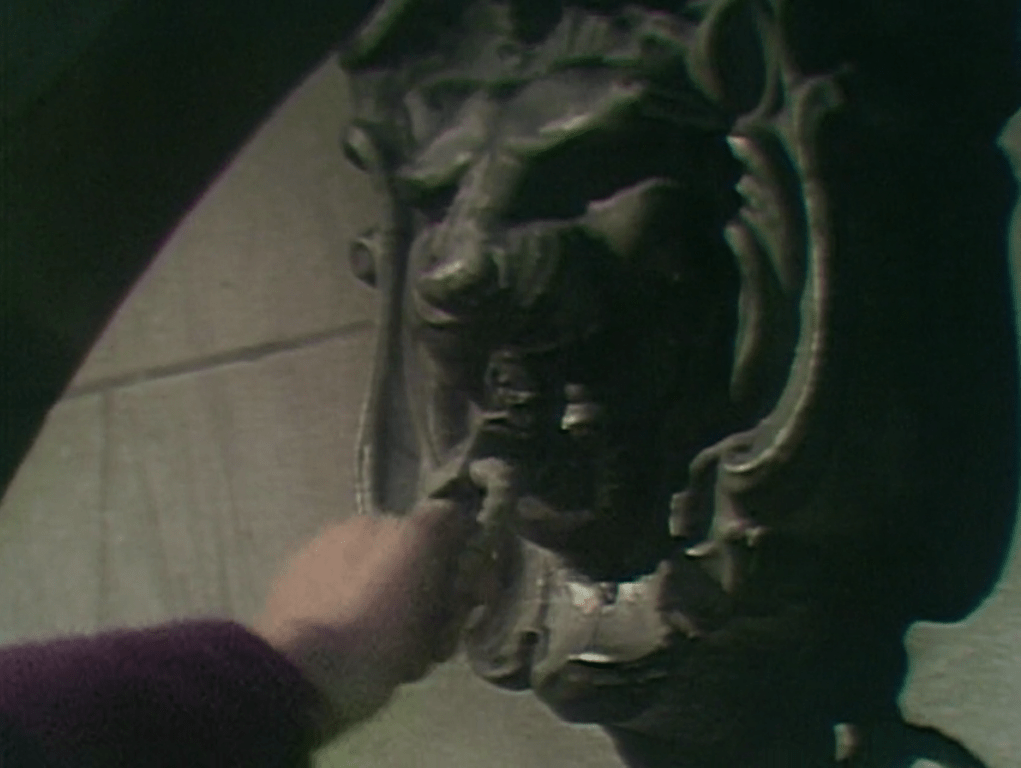
As we open, David is following Sarah’s instructions. He is standing on the sarcophagus of her mother and pulling a metal ring in the mouth of a stone lion’s head. The ring comes forward and a panel opens, revealing a room that was hidden for more than a century and a half.

The lion’s head.
Pulling the ring
The panel opens

The first time we saw the panel open was in #210, when dangerously unstable ruffian Willie Loomis happened upon the ring and ended up releasing vampire Barnabas Collins from his coffin in the hidden room. Now that we see this gimmick again and see it in color, it’s starting to seem odd that all you have to do to open the panel is pull the ring. The ring stands out as the only piece of metal in the tomb. Anyone entering the space would be tempted to tug on it, if only to polish it. If you’re wanting to make sure your vampire doesn’t get loose, I’d think you’d install a more secure system. Maybe you could add two or three additional decorative doodads to the wall, one of which you turn, say, three quarters of the way to the left, the other of which you turn some other way, and between them they release the ring.

Be that as it may, Barnabas’ old coffin is still in the hidden room. Sarah announces they will be opening it, and David resists the idea. He debates with Sarah for a while before curiosity gets the better of him.

Sarah the psychopomp.
David wants to let the dead rest.
David’s resistance crumbles.

He is shocked to see that it is empty. David asks Sarah why an empty coffin would be put in such a place, and she happily tells him that it wasn’t always empty. There was someone in it once, but he got up and left. David protests that the dead don’t walk away, to which Sarah replies that “Sometimes they do.”

David is shocked.
Nobody’s home.

When David first met Sarah in #256, she was outside Barnabas’ house, puzzled that she couldn’t find her parents or anyone else she knew. Now it is starting to seem that she knows that she is a ghost haunting a time long after her own, but Sarah’s lines here are the first clear indication that she knows what is going on with her brother Barnabas.

David’s bafflement that the coffin is empty echoes #273. In that episode, matriarch Liz was shocked to find that the chest seagoing con man Jason McGuire buried in her basement did not contain the murdered remains of her husband. Liz kept asking “Why is there nothing there?” David seems almost as appalled as his aunt had been at the sight of some clean fabric unadorned with a rotting corpse. A few days after Liz found out Jason hadn’t really buried her husband in her basement, Barnabas killed Jason. Regular viewers will already have this story in mind, because in #276 Barnabas and his sorely bedraggled blood thrall Willie buried Jason in the floor of the very room David and Sarah are visiting at this moment. Clearly Barnabas would not be happy were he to find out that David knows about the room.

That wasn’t the first vacant grave in Dark Shadows. From #126 to #191, the show was mainly about David’s mother, undead fire witch Laura Murdoch Collins. As the Laura arc progressed, graves of various women named Laura Murdoch were revealed to be empty. Now Laura’s son is coming face to face with an unoccupied coffin, suggesting to loyal fans that he may yet learn something about his own origins.

To Sarah’s consternation, David says he has to go home. He tells her that if he does not, his governess, the well-meaning Vicki, will be upset with him. He simply refers to Vicki by name, as if Sarah already knows who she is. Regular viewers have reason to believe she does know who Vicki is, but it is not clear why David assumes that he can just say “Vicki” without explaining to Sarah who he means. Sarah swears David to secrecy about the existence of the room.

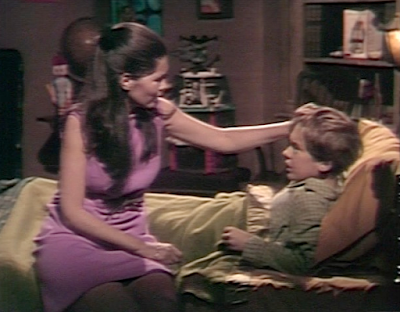
By the time David gets back to the great house of Collinwood, it is 9:30 PM and Vicki is indeed worried about him. Apparently no one else is at home; certainly, no one else has missed David. Vicki sits David down on a seat that’s been in the foyer from the beginning of the series, but which has only been used once or twice before. They have an earnest little talk that recalls the scenes they shared in the first 39 weeks of Dark Shadows, when their complicated relationship was the one storyline that consistently worked.

Rarely used seat.

David describes Sarah to Vicki. It finally dawns on her that Sarah is the little girl she saw on top of the stairs at Barnabas’ house in #280. When the light flashed in Vicki’s eyes, my wife, Mrs Acilius, shouted at the screen “Tell him!” Vicki and David again look like the fast friends they had become by #140, so we would indeed expect her to tell David that she thinks she has seen Sarah, and to tell him where and when she saw him. If she and David join their lines of inquiry and work together to find out about Sarah, the plot will move more quickly and on a much bigger scale than it can so long as everyone pursues their own questions in isolation.

Vicki catches on.

But, Vicki is also very fond of Barnabas, and reluctant to believe anything bad about him. Sarah has been seen in several places connected to the abduction of Maggie Evans, The Nicest Girl in Town. Vicki doesn’t want anyone to add Barnabas’ house to that list, so perhaps it is not a “Dumb Vicki” moment when she decides to keep the information to herself.

Meanwhile, Barnabas is at home. He is irritated with mad scientist Julia Hoffman. Julia is attempting to cure Barnabas of vampirism, and he is dissatisfied with the progress of the treatment. He is also irked that Sarah broke Maggie out of the mental hospital where Julia was keeping her locked up, and blames Julia for failing to ghost-proof the place. He declares that Julia is “a meddlesome and domineering woman,” and that he, as a native of a different century, has no intention of tolerating such a person.

Barnabas and Julia discuss Vicki’s depressing boyfriend Burke. Burke has been investigating Barnabas, and his operatives have come upon some information that would raise questions Barnabas would have a hard time answering. Julia agrees that Burke must be stopped, and urges Barnabas to let her handle the matter. He says that he will take care of it, and that he will do so with “finesse” of a sort unfamiliar to the loutish inhabitants of the twentieth century.

Barnabas’ masterful finesse consists of telling Vicki what Burke is doing and asking her to make him stop. Those eighteenth century guys must have been amazing, to come up with something so complex and subtle in just a couple of days.

Julia comes into the great house as Barnabas is leaving. She asks Vicki if David is back yet. Vicki tells her that he had been out playing with Sarah in some location he refuses to disclose. Barnabas tries to conceal his alarm with a laughing remark about leaving Vicki and Julia to investigate the mystery of David’s playmate.

David comes out of his room to ask for food. While Vicki goes to fetch the housekeeper for him, Julia meets him at the top of the stairs and they talk about Sarah. David points out that she is repeating questions she has asked in previous episodes. He tells her that he doesn’t mind questions and neither does Sarah, but cautions her that the answers Sarah gives don’t make much sense.

The stained glass windows at the top of the stairs look great in color, and it is a relief when David shares the audience’s awareness that we’ve heard Julia’s lines before. Even so, the scene is a disappointment. David and Julia were fun to watch in their previous scenes because they were so relaxed together. Perhaps that was because David Henesy and Grayson Hall understood each other right away. Not only did they have similar ways of working as actors, but her son Matthew is about his age, so she might already have been familiar with a lot of things in his life that the other adults on set wouldn’t have known about.

Today, though, they are both having trouble with their lines. That keeps them from making enough eye contact with each other to sell the scene. David Henesy keeps looking at the teleprompter, which he could evidently read from the top of the stairs with only a little squint; Grayson Hall couldn’t read from that distance, but she does tilt her head back and look up when she’s searching her memory for her next line. Since the characters aren’t looking at each other, we don’t feel an emotional connection between them.

Hall has to thread a particularly small needle in this scene. Julia is trying to make her interest in Sarah seem casual in the same way Barnabas affected a lack of interest in her, by delivering lines about her with a jokey inflection. We know that she is urgently concerned with finding Sarah, and her efforts have to leave David unsure whether she really is the easygoing adult he has so far taken her to be or whether she is trying to pull a fast one.

In the course of a friendly chat between two people who obviously like each other, onetime Academy Award nominee and frequent Broadway luminary Hall could certainly have accomplished all of this. But in the course of this awkward encounter, it all falls flat. Especially so with Julia’s last line to David. After he has told her how difficult it is to get a straight answer from Sarah, she puts on a goofy voice and says that she’ll keep that in mind if she ever meets her. Since she isn’t looking at him when says this, it comes off not as an affectionate gesture acknowledging that they’ve run out of things to say, but as a high-handed dismissal. Even though she pats him on the shoulder and he smiles after that line, it still doesn’t seem that David would come away from the interaction with as complex an emotional response as he is supposed to have. Most likely he would just be irritated with Julia, as indeed the audience is likely to be.

“I’lll kee-e-ep that in mind.”
Departure.

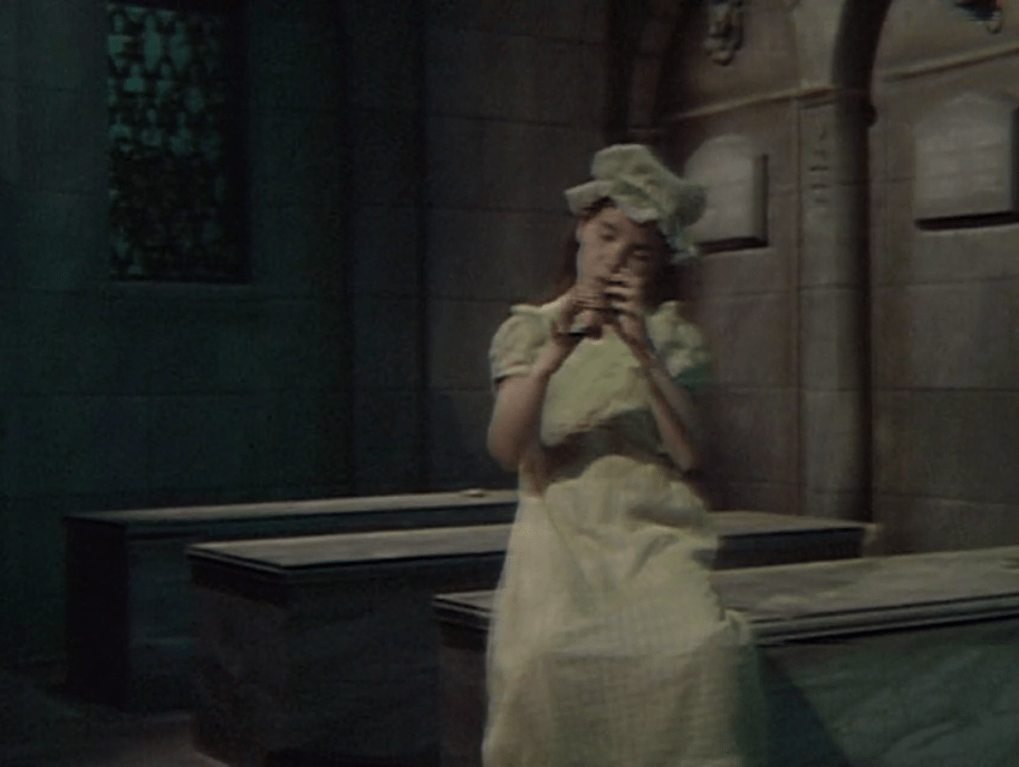
We end back at Sarah’s place. Barnabas is in the cemetery looking pathetic. He hears the strains of “London Bridge” coming from the mausoleum. We see Sarah sitting on her mother’s sarcophagus moving her fingers on her recorder far more rapidly than the music we hear would call for. She looks more like she’s playing a rock ‘n’ roll number.

Jammin’ with the Junior Funky Phantom of 1967.

Barnabas calls out to Sarah. He identifies himself as her brother and says that he has come to take her home. He goes into the mausoleum only to find that she has vanished. Wracked with sorrow, he pleads with her to come back, saying that he loves her and needs her. He touches the plate marking her grave. This underscores the futility of his desire to take her home. Leading him here, it is she who has brought him to what is in fact her home, and what ought also to be his.

Sad Barney.
The impassable barrier.

This shows us a Barnabas we can sympathize with, but it also sets him on a collision course with David. Barnabas has been so harmless lately that we might wonder if his part is going to be recast with a purple felt puppet counting “Vun peanut butter saand-veech!” If he sets out to kill a child, he’ll be back on track as a horrifying menace.

Besides, David is not just any child- as the last bearer of the Collins name, David’s survival has a great symbolic importance to the show. He was central to everything that happened on Dark Shadows in its first 39 weeks. So if Barnabas becomes a threat to David, it will be a case of conflict between the current main character and the previous main character. Since Vicki originally represented the audience’s point of view and is still a major character, the divided loyalties between Barnabas and David that we first see influencing her behavior today could create a high level of dramatic tension. Especially so if Barnabas turns her into a vampire, and she winds up like Lucy in Dracula, the “Bloofer Lady” who herself preys on children.

Episode 303: Separate worlds

Fake Shemp Burke Devlin is starting to suspect that there is something odd about old world gentleman Barnabas Collins. He suspects that Barnabas is not from England as he claims to be. More darkly, he is considering the possibility that Barnabas might be the one who abducted Maggie Evans, The Nicest Girl in Town, and held her prisoner. As it happens, the audience knows that he is correct in both of these suspicions. We also know more- that Barnabas is a vampire.

Burke has hired investigators to probe into Barnabas’ past. Barnabas told him he lived near London with a cousin named Niall Bradford. Burke’s investigators have found that the last time a man of that name lived in London was 130 years previously. Dark Shadows has been going back and forth for months on whether Barnabas lived in the 1830s or in the eighteenth century. Yesterday they seemed to commit themselves to the earlier date, but now we’re back with the 1830s.

Burke asks Maggie’s doctor, addled quack Dave Woodard, to show him all of her medical records. Woodard protests that medical records are confidential. He then tells Burke everything he knows about Maggie’s case.

Burke calls on Maggie. She is back home, apparently well, but suffering from amnesia covering the entire period of her captivity. Unknown to any of the characters we see today, Maggie’s psychiatrist Julia Hoffman is a mad scientist in league with Barnabas, and she has wiped Maggie’s memory clean of any information that might threaten to expose him. Burke talks with Maggie and her boyfriend, hardworking young fisherman Joe, repeating everything Woodard told him a few minutes before.

Maggie and Joe tell Burke that she has had a few visitors since she came home. Maggie blithely mentions that Barnabas was one of those visitors. Burke is startled to hear this, and Maggie repeats that Barnabas dropped in to pay his respects.

During the fourteen weeks when Dark Shadows was driven by undead fire witch Laura Murdoch Collins, Burke saw extensive evidence of supernatural doings. But he lately he has decided that he lives in the kind of world where the show took place in its first few months, where there might be hints of ghosts in the background, but all the action came from flesh and blood humans subject to the usual laws of nature. Since it doesn’t occur to him that a person might have powers like Julia’s, Maggie’s calmness when talking about a visit from Barnabas seems to prove that Barnabas is innocent.

Burke learns that Barnabas has been to see Maggie.

Maggie does say that there is just one memory she has that seems to be connected with her time in captivity. It is a bit of music- “a light, playful tune. A soft, tinkling sound.” She freely admits that it seems unlikely that this would have any connection with such an experience, and speculates that it may have been something she remembered from childhood.

In the great house of Collinwood, well-meaning governess Vicki is listening to the enchanted music box Barnabas gave her. Burke and Vicki are now engaged to be married. He comes to see her, and remarks on the music box. She accuses him of being jealous of Barnabas, and he keeps coming back to the music box. When she opens it for him, he remarks that it makes “a light, playful tune… a soft, tinkling sound.”

The episode ends with Burke listening to the music box and staring off into space. Barnabas gave the music box first to Maggie, then to Vicki, in each case hoping that she would listen to it until its magical quality caused her to believe that she was his lost love Josette. Seeing the look on Burke’s face as he listened, my wife, Mrs Acilius, said “Maybe Burke will start to think that he’s Josette.” Who knows, maybe he and Barnabas could be very happy together.

Episode 302: As dead as Jeremiah Collins

When new writers start working on Dark Shadows, they do some inventorying of ongoing and disused storylines. When Ron Sproat came aboard in November of 1966, he contrived a lot of scenes that served to mark storylines as “To be developed” or “To be discarded.” Now Gordon Russell has begun to be credited with scripts. He addresses continuity questions with brief lines of dialogue.

For example, for the last forty weeks the show has been equivocating about when it was that Barnabas Collins lived as a human being. Sometimes they say that he died and became a vampire in the 1830s. That fits with the original idea that Jeremiah Collins built the great house of Collinwood for his bride Josette in that decade, because Barnabas is supposed to have loved Josette and hated Jeremiah. At other times, they have pushed Barnabas, Josette, and Jeremiah back into the eighteenth century.

Now Barnabas has risen from the grave. Mad scientist Julia Hoffman has developed a series of injections to cure him of vampirism and turn him into a real boy. When Julia finds that Barnabas has heard the ghostly voice of his sister, nine year old Sarah, she declares that “The injection can wait!” and wants to talk all about Sarah. When Barnabas tries to avoid the subject, saying that Sarah has been dead for nearly 200 years, Julia replies “So have you.” That would seem to nail down that continuity question.

Julia speculates that Barnabas has subconsciously willed Sarah to return to the living, because she symbolizes the kindly side of his nature. There have been a bunch of possible explanations for why Sarah emerged shortly after Barnabas did; evidently this is the one we will be going with, at least for a while.

Barnabas has been looking through an album of family portraits, Sarah’s among them. He tells Julia that he is particularly intrigued by another portrait in the same volume, that of Jeremiah. He says that Burke Devlin, depressing boyfriend of well-meaning governess Vicki, bears a striking resemblance to Jeremiah. This point was first made in #280, when Burke came to a costume party at Barnabas’ in Jeremiah’s clothing and Barnabas was shocked by the resemblance. Barnabas says that he will be a happy man when Burke is as dead as Jeremiah. This tells us, not only that Barnabas is serious about his hostility to Burke, but also that we can expect some connection between Jeremiah and Burke to be developed.

Julia chases Barnabas around his living room until he hangs his head and mutters a promise not to hurt anyone, not even Burke, as long as there is a chance the injections will work. This helps both to explain why Barnabas has been so harmless lately and to reinforce the Bossy Big Sister/ Bratty Little Brother dynamic that is forming between him and Julia.

Julia goes to the great house. Matriarch Liz is under the impression that Julia is an historian writing a book about the old families of New England, and letting her stay in the mansion on the understanding that she is doing research into the Collinses. Liz asks about Julia’s previous books. Julia evades the question, saying that only scholars have ever heard of them. Liz mentions that she was a recluse for eighteen years, during which time she read so widely that she became aware of many scholarly books. Julia seizes on Liz’ reference to her time as a recluse, and asks a series of questions about it. Observing Julia’s facility at deflecting questions she doesn’t want to answer, Liz says that “If you are as nimble with the written word as you are with the spoken, you must be a very interesting writer.” This conversation not only marks Liz’ period of seclusion as an extinct topic, but also shows that Julia’s cover story is not going to be solid enough to cover her operations indefinitely. Moreover, it gives Joan Bennett a chance to show what Liz sounds like when she is smart.

Vicki meets Burke in the courtyard of the great house. She asks him why he’s late. He says he had a meeting with his lawyer, James Blair (a character we last saw in #95 and last heard mentioned in #133.) The reference to Blair tells regular viewers that Burke’s business interests may have something to do with an upcoming storyline.

Vicki asks what the meeting was about. Burke says it was to do with a message from London, then declares he didn’t come to talk about business. At the end of yesterday’s episode, Burke placed a call to London to initiate an investigation of Barnabas, so we know that he has already received some information about him. We also know that he is keeping the investigation secret from Vicki.

Burke brings up the marriage proposal he made to Vicki when last they saw each other. She says that she doesn’t know enough about him to be comfortable making a decision. In particular, she doesn’t know how he made his money or who his business associates are. In response to that, he launches into a speech dismissing those concerns as matters of “the past,” saying that he wants her to think only about “the future.” Considering that Burke won’t even tell Vicki what business he was conducting twenty minutes ago, “the past” that is off limits to her stretches right up to the present. This tells even first time viewers that Burke is a secretive and untrustworthy man likely to drag a wife into some shady enterprises.

It rings even louder warning bells for regular viewers. At this point in Dark Shadows, “the past” is how the characters refer to the vampire arc, which is the only ongoing storyline. Several times, Burke has angrily demanded Vicki renounce interest in “the past,” by which he means her attempts to stay relevant to the plot. As he has made those demands, he has accused her of being crazy when she told him that she saw and heard phenomena that we also saw and heard, in some cases phenomena that Burke himself is in a position to know are real. On Thursday, Burke enlisted Julia’s support in his effort to gaslight Vicki; in that conversation, Julia asked Burke if, when he said Vicki must “live in the present,” he meant that she must live with him, and he confirmed that he did. So Burke’s evasiveness in this scene shows that he is likely to be an abusive husband who will devote himself to controlling Vicki and stifling her contributions to the story.

The show is making something of an effort to launch a storyline in which Vicki and Burke will get married and move into a long-vacant “house by the sea” that has some kind of association with Barnabas and therefore with the supernatural. So the parade of red flags that Burke sends marching in front of his proposal may tell us to expect a story in which Vicki, the long-suffering wife confined to a haunted house, loses contact with the world of the living.

Perhaps that is where we will see Burke’s connection to Jeremiah. Maybe Burke will be possessed by the spirit of Jeremiah, and under that possession his abuse of Vicki will intensify. It is also possible that Burke will be revealed as a descendant of Jeremiah. On Friday, the story of Burke’s childhood was retconned, introducing the idea that his father left the family when Burke was nine. Perhaps it will turn out that he did this after he found out that Burke was the product of an extramarital dalliance with a Collins. That in turn might revive another paternity question concerning a nine year old boy. For months, the show hinted that Burke, not Liz’ brother Roger, was the father of strange and troubled boy David Collins. If Burke is a Collins bar sinister, then David can be his natural son and still retain his symbolic importance as the last in the male line of the family.

Whatever the nature of Burke’s connection to Jeremiah, Vicki’s eventual flight from him might lead her into the vampire story. Since Barnabas thinks he wants Vicki to be his next victim, he has been solicitous towards her, and she regards him warmly. My wife, Mrs Acilius, points out a sort of visual pun implicit in the prospect of Vicki choosing Barnabas over Burke. As played by Anthony George, Burke is an astonishingly poor kisser. As a vampire, Barnabas gives what might be called “the kiss of death.” A woman might prefer a single kiss of death to a lifetime of the impossibly awkward kisses of George.

Vicki caves in and agrees to marry Burke, even though he won’t answer any of her questions. They go into the drawing room and announce this ominous news to Liz, Barnabas, and Julia. Barnabas responds by looking off into space and exclaiming “Jeremiah!” Again, whatever relationship develops between Burke and Jeremiah, we know that Barnabas is committed to resisting its influence on Vicki.

“Jeremiah!” Screenshot by Dark Shadows Before I Die.

Barnabas cannot conceal his dismay. He and Julia leave, explaining that they had planned to spend the evening together in town. Liz remarks that Barnabas was happy when he came, and sad when he left. Still, the idea that he and Julia might be going on a date is enough to keep Burke smiling.

In the courtyard, Barnabas tells Julia that he will give her his full cooperation as she tries to cure him of vampirism. He explains he wants to become human again so that he can prevent Vicki from marrying Burke.

This is rather alarming for the viewers. Dark Shadows became a hit when a vampire joined the cast. If the Burke/ Vicki/ Barnabas story is going to be just another daytime soap love triangle among humans, you may as well watch The Guiding Light. The foreboding dun dun DUNN! that ends each episode has rarely seemed more apt than it does coming on the heels of this grim prospect.

Episode 298: You will remember nothing

The only story on Dark Shadows at this point is the one about vampire Barnabas Collins. They’re trying to get a second one off the ground, about an old vacant house that has caught the fancy of well-meaning governess Vicki. Vicki’s depressing boyfriend Burke has interpreted her interest in the place as a marriage proposal. He wants to buy the house and live in it with her.

Today, we find out that the house is the property of the ancient and esteemed Collins family. That isn’t a big surprise, since Barnabas clearly knew something about it from his time as a human. It does suggest a partial answer to a question Vicki had when she, Burke, and Barnabas visited the house on Thursday. Barnabas found a handkerchief there bearing the initials “F. McA. C.” and gave it to Vicki. She expressed a determination to find out what those initials stood for. Now she should be able to look at the family’s records and search for a Mrs Collins whose maiden name had the initials “F. McA.”

Burke asks matriarch Liz if she is willing to sell the house to him, and she is perfectly agreeable. Liz’ daughter Carolyn joins them for a tour of the house. There is some startlingly sloppy writing in this scene. Carolyn remarks that the house has a special warmth and speculates that it is the result of so much light reflected into its windows from the sea nearby. A couple of minutes later, Liz complains that the house is terribly cold, and Carolyn says that’s because it is so close to the sea.

Both Liz’ glad willingness to sell the house to Burke and her trip to it signal that storylines from the first year of the show are now behind us once and for all. Burke was introduced in episode 1 as a dashing action hero returning to his home town to wreak vengeance on his old persecutors, the Collins family. The “Revenge of Burke Devlin” arc consisted so largely of talk about people, places, and events we never saw that it didn’t amount to much, and by the time Burke formally renounced his revenge in #201 it had long since fizzled. That left some chance it would flare back up, so in #223 Liz vowed she would never sell Burke any property at any price, but now the door is firmly closed on that old theme.

When Dark Shadows started, Liz was a recluse who hadn’t left home in eighteen years. Since they never showed us anyplace Liz might want to go, that story was an even more total dud than was The Revenge of Burke Devlin. Even after the reason for Liz’ seclusion was exposed as fraudulent in #273, she still made a show of reluctance when her brother Roger suggested she go to town in #277. Now she doesn’t hesitate to hop in a car and go to the house by the sea. In fact, she is the one who urges Carolyn to get out of the house. So that sends another non-starter to the narrative junk yard.

In this episode, the characters refer to “the house by the sea” as “Seaview.” That was an inside joke. The Newport, Rhode Island mansion used in the exterior establishing shots of the great house of Collinwood was known as Seaview Terrace. In 1974, Martin and Millicent Carey bought the house, and it came to be known as the Carey Mansion.

Meanwhile, Vicki is visiting Maggie Evans, The Nicest Girl in Town. Maggie has amnesia, a condition induced by her doctor, mad scientist Julia Hoffman. Julia is in league with Barnabas, and has damaged Maggie’s memory to keep her from recalling that Barnabas abducted her and tried to replace her personality with that of his lost love Josette. Vicki is trying to help Maggie regain her memory.

There is another instance of distressingly sloppy writing in this scene. Vicki tells Maggie that she thought she saw her in Eagle Hill cemetery during the period she cannot recall. She tells Maggie that Burke tried to convince her that she can’t have seen her. In response, Maggie asks if Burke saw her, and Vicki again says Burke tried to convince her she hadn’t seen her.

Vicki tells Maggie that she and Burke had gone to the cemetery to lay flowers at Josette’s grave. Maggie reacts strongly to Josette’s name, and Vicki starts telling her about Josette. When she mentions that Barnabas has restored Josette’s room, a light comes on in Maggie’s eyes and she grows very animated. She is about to say something when a knock comes at the door. It is Julia.

There is a strange blooper in the conversation between Vicki and Julia at the door. Julia asks “Would it be all right if I came in and waited?” Vicki responds “Not at all.” My wife, Mrs Acilius, is usually very forgiving of bloopers, but she laughed out loud at this one.

It could be that Julia’s line was “Would you mind if I came in and waited?” Alexandra Moltke Isles was famously accurate with her line delivery, even when her scene partners bobbled, and it could be that she just went ahead and said what Vicki was supposed to say even though it didn’t make sense. In view of Carolyn’s self-contradictory lines about the temperature of the house and Vicki’s repetitious lines about Burke’s attempt to gaslight her, both of which were obviously scripted, it could also be that the actors are working from Ron Sproat’s unrevised first draft.

While Julia looks at some of Maggie’s father’s paintings, Vicki sits back on the couch with Maggie. Julia hears Maggie exclaim “Barnabas!” and get very agitated. It seems she is about to tell Vicki all about what happened when she was missing.

Maggie, remembering

Julia swoops in, asking if they like antiques. Vicki looks bewildered at the interruption, but answers with a polite yes.

Julia interrupts

Julia presses her jeweled medallion on her. Vicki passes it to Maggie, and Julia asks for a cup of tea. Maggie volunteers to make the tea, but Vicki insists on doing it. In #143, the living room and kitchen in the Evans cottage were two parts of an undivided space, but now we hear Vicki close a door when she goes to make tea. Not only is that confusing to viewers who remember the earlier episodes, but since Vicki goes in the direction of the front door it seems for a moment that she is leaving the cottage altogether.

While Vicki is out of the room, Julia hypnotizes Maggie. She commands her to forget everything that happened while she was missing. When Vicki returns, Maggie has indeed forgotten everything.

Maggie under hypnosis

Episode 292: I know who’s dead and who isn’t

Mad scientist Julia Hoffman is hanging around her new base of operations, the Old House on the great estate of Collinwood. She is getting ready to perform an experiment which, if successful, will convert vampire Barnabas Collins into a real boy. She learned of Barnabas’ existence when treating his former victim Maggie Evans, The Nicest Girl in Town. Julia answers a knock on the front door, and sees her old acquaintance, addled quack Dave Woodard.

Woodard has no idea what Julia is up to. So far as he knows, she is still on board with his own idiotic scheme, in which he, along with Maggie’s father Sam and her fiancé Joe, has told everyone in town that Maggie is dead in hopes that her captor would forget about imprisoning girls and draining their blood. In fact, Julia has told Barnabas that Maggie is alive and has lured him into cooperating with her project by promising to keep Maggie in a state of amnesia so that she will not represent a threat to him.

In yesterday’s episode, Sam and Joe called on Woodard and complained that Julia is staying at Collinwood while Maggie is a hundred miles away. They demanded that Woodard take her out of Julia’s care. Woodard tells Julia today that her conduct is growing “more and more unethical.”

Last week, Julia was able to forestall Woodard’s threat to take her off the case by playing dumb. This time, she has to take him partly into her confidence, telling him that Maggie encountered the supernatural and that her case represents an opportunity to find a crossing point on the boundary between life and death. She dangles the possibility of great fame before him, saying that the doctors who make the breakthrough she sees coming will go down in history. When he presses for details, she says that there is great danger in what she already knows, and that she must not tell him more.

Woodard has been on the show for months, and has been stuck in just two modes the whole time. When he’s with a patient, he makes a show of brisk dissatisfaction, as if trying to convince them that they oughtn’t to take their disease so seriously that they give up. This mode was as far as Richard Woods, the first actor to play Woodard, got in his two appearances (in #219 and #229.) When he is talking with someone else, Woodard struggles to find the words to express his bafflement at the terrible case he is treating. These two modes didn’t make Woodard a source of suspense. They were just filler between his announcements of what the script called for him to do next.

When Julia asks Woodard if, when he was in school, he dreamed of making a major contribution to the science of medicine, he gets a thoughtful look and says “Well, of course.” This is the first moment we have seen Woodard outside his two modes. When Julia tempts him with the idea that he will go down in history as the co-discoverer of the most fundamental truth imaginable, he displays an emotion that might lead to him to any of a number of exciting, story-productive actions. The first scene in the first episode credited to writer Gordon Russell manages the astounding feat of turning Dr Woodard into an interesting character.

We cut to the woods on the estate. We see the ghost of Barnabas’ nine year old sister Sarah sitting on a rock crying. All of Sarah’s previous scenes started with some other character on camera, then proceeded to Sarah making a mysterious entrance. That’s what we would expect of a ghost, after all. This time, Sarah is all by herself at rise. The first time we saw a ghost was in #70, when the ghost of Josette Collins emerged from her portrait and danced around the columns of the Old House. That was a solo appearance as well, but people had been in the Old House talking about Josette immediately before, so she was manifesting herself in response to attention from the living. Here, we see a ghost on her own, processing her emotions, hoping someone will come and hang out with her.

Strange and troubled boy David Collins shows up and asks Sarah why she is crying. She says she can’t find Maggie. David breaks the news to her that Maggie is dead. Sarah laughs, and assures David that she is still alive. When David insists that Maggie is dead, Sarah tells him that he may know “about leaves and everything,” but she knows “who’s dead, and who isn’t.”

Sarah laughs at the idea that Maggie is dead. Screenshot by Dark Shadows Before I Die.

Less than a week ago, in #288, David saw a portrait of Sarah and wondered aloud if the girl he has met is her ghost. In the first 39 weeks of the show, he was on intimate terms with Josette and some of the other ghosts. When he first met Barnabas in #212, he asked him if he were a ghost, and was disappointed to hear that he was not. So returning viewers expect David to ask Sarah the same question. Indeed, David has always interacted with ghosts as if they were people with whom he could pass the time of day, share thoughts and feelings, and get to know better from one encounter to the next. Seeing Sarah crying by herself should validate this attitude. But instead, David has developed Soap Opera Goldfish Syndrome, forgetting information which everything we have seen has led us to expect he will remember.

David insists Sarah come home with him to the great house of Collinwood and have dinner with the family. She tries to decline politely, but he will not take “I’ve been dead for centuries” for an answer. He gets Sarah into the foyer, then goes to the drawing room to announce her presence. He finds Julia there, with well-meaning governess Vicki and Vicki’s depressing boyfriend, fake Shemp Burke Devlin. By the time David gets the adults into the foyer, Sarah has disappeared.

Vicki is suffering from an even more frustrating version of Soap Opera Goldfish Syndrome. She had had extensive dealings with the ghosts of Collinwood on many occasions between #85 and #191, and that had been the basis of her bond with David. Vicki’s interactions with the supernatural reached a climax when she led the opposition to David’s mother, undead fire witch Laura Murdoch Collins, from #126 to #191. Since then, Josette has spoken through Vicki at a séance and she has seen Sarah.

But lately, Vicki has started to deny that there are ghosts. This is in response to Burke’s demands. Burke lost his connection to the story months ago, and he’s been trying to gaslight Vicki into dismissing all of her spectral encounters as signs of mental illness so that she will join him on the show’s discard pile of useless characters. In Friday’s episode, Vicki had apparently decided to give in to Burke and make herself believe that there were no supernatural beings at work around Collinwood. As a result, her scenes in that episode were unbearably dreary.

Before David brought Sarah home, Vicki had been dreary again. She’s excited about some old house she saw, and wants Burke to go look at it with her. As David’s governess, Vicki’s compensation consists largely of room and board, so as long as she has her job her interest in any particular piece of real estate isn’t going to lead to story development. If she quits the job and marries Burke, she will be giving up on ever being part of the action again. So her rambling about “the house by the sea” is suspenseful only to fans of Vicki who are afraid she will vanish into the background of the show.

When David starts telling the adults about Sarah, Vicki launches into the same garbage Burke has been giving her, talking down to him about imaginary friends and insinuating that anyone who believes in ghosts is soft in the head. Burke, who had previously been David’s great friend, joins in this abusive behavior. After David indignantly stalks away, Julia gets very uptight and lectures Vicki and Burke about the need to stifle David’s imagination and discourage him from telling them things they don’t already know. This scene is effective, but the effect is claustrophobic- by the end of Julia’s little speech, we feel like the mad scientist is holding us prisoner.

Vicki and Burke decide to leave to look at the house, and Vicki finds Sarah’s cap on the floor. That’s such a great moment that not only do we leave the episode no longer disappointed in David’s goldfish memory, we can even forgive Vicki’s.

The closing credits run over an image of the foyer with Sarah’s cap on the table. My wife, Mrs Acilius, thought it would have been hilarious if Sarah had marched in and taken the cap while the credits were rolling. I’d have liked to see that too, especially if, after putting it back on, Sarah had turned to the camera and put her finger to her lips, telling the audience to keep quiet about what we had seen.

Sarah’s cap on the foyer table. Screenshot by Dark Shadows Credits.

Episode 288: Feminine vanity

At the great house of Collinwood, well-meaning governess Vicki is in a stupor, staring out a window and dreaming of a time when she will again be central to the plot.

Ever since #191 when she rescued her charge, strange and troubled boy David Collins, from his mother, undead fire witch Laura, Vicki has been hanging on to narrative relevance by her fingernails. Now Dark Shadows is built around vampire Barnabas Collins, and Vicki longs to play a major role in his storyline. He plans to make her his next victim, but is moving so slowly towards that objective that we’ve started to wonder if he ever will strike.

David comes into the room and calls Vicki’s name several times. When she finally comes to, she admits that she has been zoning out a lot lately, and says that it is a habit she needs to break. David says that it frightens him when she gets that way. She doesn’t look like herself when those spells come over her. He gets the feeling that she’s turning into someone else. Vicki can’t deny that David is onto something, and only when he insists on sticking with the subject after she has clearly become uncomfortable does Vicki become defensive and retreat behind claims that David is letting his imagination run away with him.

Mad scientist Julia Hoffman has insinuated herself into the house, concealing her true identity and pretending to be an historian writing a book about the old families of New England. David shows her an album of family portraits. He identifies one portrait as his namesake, David Collins. In #153, it was established that he was the first member of the family to bear the name “David,” and that his mother Laura insisted on giving her son this name would ultimately become evidence that her evil plans for him were in place long before he was born. So David’s remark about a previous “David Collins” will strike longtime viewers as a significant retcon.*

Though David has looked through the book many times, he finds a portrait in it that he has never seen before. It depicts Sarah Collins, who lived from 1786 to 1796. Sarah’s ghost has been busy in the area in recent weeks, and the clear implication is that she inserted the page. That in turn would suggest that Sarah might have more powers than we have seen her use so far.

Julia and David find a photograph of Sarah Collins, d. 1796.
Screenshot by Dark Shadows Before I Die

David has seen Sarah and played with her on more than one occasion, and he recognizes the portrait. He wonders aloud if the girl he has met is Sarah’s ghost. Julia laughs off the suggestion. Vicki returns. She also recognizes the picture of Sarah. The police circulated a drawing of her when Maggie Evans, The Nicest Girl in Town, was missing. Since Julia is actually a doctor who found out that supernatural doings were afoot at Collinwood when she was treating Maggie, she has heard several facts about Sarah, and by the end of her talks with David and Vicki she knows enough to be sure David is right about her.

We cut to the Blue Whale tavern, where Vicki is on a date with her depressing boyfriend, fake Shemp Burke Devlin. Burke sullenly complains about Vicki’s wish to help Julia with her project, complaining about Vicki’s “interest in the past.” “Interest in the past” is at this point synonymous with “a function in the story,” and Burke lost the last trace of that months ago. It’s as if Burke and Vicki know that they are fictional characters, and he resents her for holding on to a place in the action while he has settled in once and for all on the discard pile.

Vicki mentions that the night before, she had been awakened by the sound of a small girl singing. She says that after she got up and lit a candle, she could still hear the singing, but could not see the girl. Burke is too busy grumbling and making nasty remarks about Vicki’s mental health to ask her why she lit a candle rather than flipping the light switch. Vicki has to press on with more details and then volunteer that she wasn’t sleeping in her own room. She was sleeping in the Old House at Collinwood, home to Barnabas Collins.

Burke is upset by this news. Unfortunately Vicki doesn’t let him believe she went to bed with Barnabas. She tells him she was in a guest room, and that Barnabas was “a perfect gentleman.” Burke demands Vicki never go to the Old House again, and she refuses to make any such promise.

Julia takes the book of portraits to the Old House and insists that Barnabas look through it. While he grudgingly complies, Julia opens her compact. She finds that Barnabas does not cast a reflection in its mirror. This confirms her suspicion that Barnabas is a vampire. In #241 and #278, we had seen his reflection, but perhaps those were slip-ups and they were planning all along to use the idea that vampires do not cast a reflection.

Barnabas catches Julia studying her mirror and angrily asks what she is doing. She smiles and chirps that even historians have their share of feminine vanity. He glowers at her. The camera holds on his menacing look for quite some time, leading us to think that Julia has signed her own death warrant. But she doesn’t seem to think she is in any great danger. She is still smiling when she leaves.

Back in the great house, Vicki wanders up to the portrait of Barnabas that hangs by the front door. Apparently she is planning to stare at it as she resumes her dream of having something to do on the show. It worked for dangerously unstable ruffian Willie Loomis- after a couple of long sessions staring at the portrait, Barnabas summoned him and next thing he knew he was securely established as his sorely bedraggled blood thrall, a core member of the cast. So Vicki is trying to take a proven path to success.

Before Vicki can get any high-quality staring done, Julia enters. Vicki asks her how it went with Barnabas, and Julia exults that she may have learned everything she needed to know.

*My wife, Mrs Acilius, noticed this and had a lot to say about it. I will refer to her insights in later entries, as they would contain spoilers at this point in the run of the show.

Episode 284: The right name for something else

Vampire Barnabas Collins spends most of his time on screen doing a job of acting. He is playing the role of a present-day gentleman from the long-forgotten English branch of the ancient and esteemed Collins family of Collinsport, Maine. His performance has been convincing enough that the Collinses have entrusted him with the long-abandoned Old House on the great estate of Collinwood. He and his sorely bedraggled blood thrall Willie reside there and have restored it to the condition it was in when Barnabas was alive.

Today, another actor comes to Collinwood. She is mad scientist Julia Hoffman. By profession, Julia is a medical doctor with specialties in psychiatry and hematology. She is treating Maggie Evans, The Nicest Girl in Town, who is in a state of complete mental collapse after months as Barnabas’ victim. After Maggie escaped from Barnabas, her family doctor, addled quack Dave Woodard, decided to tell everyone in town that she was dead and send her to Julia’s mental hospital so long as her captor was unknown and at large. So when Julia figures out that the person responsible for Maggie’s woes is an undead monster who dwells at Collinwood, she has to conceal her identity from everyone there and in Collinsport.

In the drawing room of the great house at Collinwood, Julia tells well-meaning governess Vicki and Vicki’s charge, strange and troubled boy David Collins, that she is an historian writing a book about the Collinses. David immediately exposes a fatal flaw in Woodard’s cockamamie plan when he mentions a girl named Sarah whom he has seen near the Old House. Julia knows that Maggie saw Sarah when she was imprisoned and that Sarah visited Maggie’s father Sam and told him where to find her. If that information had been made public, Vicki and David would have been able to connect Sarah with the Old House, and the police would have suspected Barnabas weeks ago. Returning viewers know that Sarah is the ghost of Barnabas’ sister, a fact onto which Julia cottoned yesterday and of which she finds corroboration today.

Vicki tells Julia how elusive Sarah is

We also know that Barnabas wants Vicki to become his next victim, and that she is already under his influence to a substantial degree. When she and Julia are talking in the drawing room, Vicki waxes enthusiastic about how Barnabas has recreated a past world and committed himself to living in it, and says that this is a fine thing for him. “But not for you?” asks Julia. Vicki looks down, and with a troubled expression says that she supposes not.

When Julia asked “But not for you,” she drew a reaction from my wife, Mrs Acilius. Mrs Acilius said that while Julia may not seem like any kind of therapist in the sessions we’ve seen her have with Maggie, her delivery of that question sounds exactly like every therapist she’s ever had. With Maggie, the mad scientist is very much on the surface of Julia’s manner, but when she is playing the role of Miss Hoffman the historian she can draw on her profession to make herself appealing.

Vicki takes Julia to the Old House and shows her the restored bedroom of Josette Collins. Vicki says that she could stay in that room forever, which is as a matter of fact precisely what Barnabas has in mind for her. Julia feels a chill as the sun sets. Perhaps this is the result of Barnabas coming back to life and rising from his coffin in the basement of the house, or perhaps it is Sarah or another friendly ghost* trying to warn her to get out before the vampire finds her. Whatever its cause, Vicki doesn’t feel it. Again, we don’t know whether this is because Barnabas already has a strong enough hold on Vicki that she is insensitive to warnings about him, or if it is a message specifically for Julia.

Julia wants to leave the room, but Vicki insists on lighting a candle so that they can see it as Josette did. The candle burns long enough for Julia to make the appropriate comments, and then something we cannot see blows it out while Julia feels another chill. The cold still doesn’t reach Vicki.

Julia returns to Woodard’s home office,** where she has stashed Maggie. Maggie has the doll Sarah gave her when she visited her in Barnabas’ dungeon. Julia takes the doll from Maggie, much to Maggie’s displeasure. She holds the doll and says she wants her to listen for the doll’s name. Maggie furrows her brow and asks “Doll talk?” Maggie has been speaking in complete sentences lately, but apparently Julia’s latest antics have been too much for her and she has lost some ground.

Julia orders Maggie to listen and says the names of some of the people at Collinwood. Maggie doesn’t react until she gets to “Barnabas Collins,” at which point Maggie freaks out. Julia holds her and repeats “It is the wrong name” until Maggie stops crying and starts singing “London Bridge.” She then looks away and says “The wrong name for the doll… but the right name for… something else.

*Sarah’s little cousin, Caspar Collins?

**An exact replica of his office in the hospital as we saw it in #242. Man knows how he likes to have things set up.

Episode 283: The shock of recognition

Four and a half weeks ago, Maggie Evans, The Nicest Girl in Town, escaped from vampire Barnabas Collins. Barnabas managed to scramble Maggie’s brains sufficiently that she has amnesia covering her time as his victim and much of the rest of her life as well. She is now a patient at a mental hospital called Windcliff, where her care is supervised by Dr Julia Hoffman.

Maggie’s family doctor, addled quack Dave Woodard, is an old friend of Julia’s. He had recommended Maggie be sent to Windcliff. He had also come up with a cockamamie scheme to protect her from her captor by hiding her there and telling everyone in and around the town of Collinsport that she was dead. If he had known that the captor was a vampire, this might have made some kind of sense- no character on Dark Shadows has ever heard of Dracula, so they don’t know how to fight against vampires. But he doesn’t know that, so his plan is just a way for the writers to stall while they try to come up with more plot points.

Today we open with Woodard in Julia’s office, complaining that she isn’t communicating with him about Maggie’s case. She tells him that there have been no developments worth reporting. Returning viewers know that this is a lie, because in a session we saw yesterday Maggie remembered a lot of sense impressions from her time of captivity and Julia told her that they represented tremendous progress. Woodard tells Julia that a lack of new information is no excuse for her failure to return any of his last six phone calls. He says that she seems to be intent on hoarding any information she may glean from Maggie as her own private possession, an impression he describes as frightening.

Julia responds to this characterization with a display of offense, and Woodard apologizes. She then brings up an idea that occurred to her at the end of yesterday’s episode. She says that Maggie’s memory might improve if she takes her to visit Eagle Hill Cemetery, where she was found wandering early in her illness. Woodard objects strongly that Maggie’s condition, as Julia has described it, is so delicate that such a visit might do her permanent harm. Julia retreats and promises she won’t actually take Maggie to the cemetery. This is such a flagrant lie that the camera momentarily goes haywire, focusing on Woodard’s chair rather than his face.

Woodard leaves, and Julia calls Maggie in. She’s already wearing her coat. She asks where Julia is going to take her, and she tells her not to worry about that.

On the great estate of Collinwood, well-meaning governess Vicki is staring vacantly into space while listening to an antique music box Barnabas gave her as part of his plan to subject her to the same treatment he inflicted on Maggie. A knock comes at the door. Vicki closes the music box and goes to answer it. It is her boyfriend, fake Shemp Burke Devlin.

Burke is waging a determined battle against the story, and he is fighting dirty. He doesn’t want Vicki to have anything to do with Barnabas, or with the ghost of Josette Collins. When Vicki says she wants to lay flowers on Josette’s grave in the cemetery, where we know she will cross paths with Maggie and Julia, he resists furiously. When she reminds him that she has had dealings with Josette’s ghost, he says “Or you think you have.” In previous episodes, including yesterday’s and Monday’s, he knew she had, and in an earlier period of the show he knew that several other characters, including some of the most level-headed ones, had also encountered Josette’s ghost. When he starts belittling Vicki for believing in “the spooks of Collinwood,” it therefore comes off as an especially crude instance of gaslighting. The Mrs and I aren’t much for profanity, but we both cussed at the screen when Burke was disgracing himself this way.

Julia and Maggie are in the cemetery. I believe it is the first time we’ve seen the set in a daylight scene. You can see the shadows of the foliage on the soundstage walls, and the corners where the walls meet. I can’t believe the director meant for us to see those things, but I kind of like it- the situation needs a touch of unreality, and the obvious falsity gives it the feeling of a black box theater.

Some of the shadows on the wall that Art Wallace spoke of
Corner of the soundstage

Maggie is agitated. Julia tells her to calm down and that everything is all right. I’m no expert, but I kind of doubt that talk therapy involves a lot of “Calm down!” and “Everything is all right!” It reminded me of this Saturday Night Live sketch from the 90s, in which Patrick Stewart plays “Phil McCracken, Scottish Therapist,” a psychologist who won’t stand for any emotionalism from his patients.

Vicki and Burke see Julia and Maggie in the distance. When Maggie turns to face them, Vicki recognizes her. Julia whisks her away before Burke can see her. When Vicki tells Burke she saw Maggie, he immediately unloads on her with the same garbage he handed her at Collinwood. He declares that Maggie is dead, that Vicki knows she’s dead, that she can’t possibly have seen her, that “there is a resemblance, THAT’S! ALL!” When he asks “What’s wrong with you?” I stopped the streaming and shouted at the screen “She’s wasting her time with you, you ******* ********, that’s what’s wrong with her!” To that, Mrs Acilius said that we should just restart the show and get through the scene.

Part of what makes Burke’s behavior so infuriating is the writer’s fault. A first-time viewer, unaware that what Burke is telling Vicki are delusions that suggest she is crazy are in fact things he knows to be true, might think that he is being reasonable in dismissing ideas about ghosts and the like. But even that viewer will realize that a person ought to be nicer about it. When Vicki says she saw Maggie, Burke could easily have suggested that they go up to the woman and introduce themselves, thinking that a closer look will disabuse her of the notion. But actor Anthony George must also bear part of the blame.

George C. Scott famously told Gene Siskel that there are three things to consider in evaluating an actor’s performance: first is to make the audience believe that the person they are looking at is the sort of person who might do the things the character does. This is in turn dependent on casting- put the wrong person in the part, and all is lost. Second are the choices the actor makes in the key emotional moments. Performers have any number of options as to how they will use their faces, voices, and limbs to show a character’s feelings, and those who make a lasting impression are those who make choices that are at once totally unexpected and perfectly logical. Third is the zest of performance, the actor’s joy in the opportunity to create a character. If that doesn’t come through, nothing else is worth much.

As Burke, Anthony George fails all three of these tests. Burke would have been a difficult part for anyone to take over, both because the originator of the role, Mitch Ryan, was so memorable, and because the character had lost all connection to any ongoing storylines by the time Ryan left. And by his own admission, George knew nothing about soap operas and had no idea how to play a romantic interest on one when he joined Dark Shadows. That’s where he fails the casting part of the believability test.

As for the skill part, George has something going for him. He is always mindful of his physicality, moving only those parts of his body he needs to show us who he is and keeping the rest of himself admirably still. He also keeps his voice remarkably consistent, both by holding a steady level of volume and maintaining a simple, precise pitch. In these and other ways, he shows impressive levels of technical proficiency as an actor, but the result is a mannered, unconvincing performance. His Burke doesn’t seem to be a real person. As a cardboard figure, he becomes an abstract symbol of whatever he’s doing, and when he’s doing something bad he’s hard not to hate.

Since he makes one choice for each resource available to him and sticks with it unvaryingly throughout the episode, he doesn’t give the audience any surprises. Nor does he yield anything to his scene-mates. They always know exactly what’s coming from him. George’s eyes are always watching another actor intently, as he watches Alexandra Moltke Isles intently today, but nothing in her performance can divert him from his plan, not in the smallest particular. When Burke isn’t listening to the other character, as he isn’t listening to Vicki, George’s disconnection from the other actors makes Burke seem like an irredeemable jackass.

Nor does George show any zest for the part. He covers his discomfort with soap acting by plastering on a smile whenever the script allows it, but he is stiff when Burke ought to be loose, cool when he ought to be warm, and loud when he ought to speak with a quiet, nuanced voice. The result is just sad and awkward. When Burke is being pleasant, we can feel sorry for George, but when he has to play the scenes like the ones Burke gets today we just want him to get off the screen and leave us alone.

Compare George’s Burke with Grayson Hall’s Julia, and you will see how an actor can determine an audience’s reaction to a character. Julia is a terrible therapist. She lies repeatedly to Woodard in the beginning, denying the severe breach of ethics and disturbing disregard of public safety involved in covering up what she knows and suspects about Maggie’s experiences and running an unconscionable risk with Maggie’s mental health by taking her to the cemetery. She lies again to Maggie at the end, promising that they will duck into the Tomb of the Collinses only for a moment and then refusing to let her leave there when she starts to show a violent emotional reaction. Her methods are so unorthodox and so harsh that we suspect she is not interested in helping Maggie at all. Because we have known Maggie since episode #1, and Kathryn Leigh Scott’s performance as Maggie renews our fondness for her every time she appears, we ought to feel deep hostility towards Julia.

But we don’t. In fact, Julia quickly becomes (almost) every Dark Shadows fan’s favorite character. The George C. Scott tests tell us why. Hall’s manner is so intense that we can believe her as a mad scientist; her uninhibited use of every facial muscle, of the full range of her vocal output, and of subtle tricks of movement she learned from choreographers when she appeared in musicals may have produced a style that no acting teacher could recommend as a model, but they do mean that every moment she is on screen she is doing something we wouldn’t have predicted; and she’s clearly having a blast. She can do things vastly worse than what makes us hate Burke today, and we will still want her to come back again and again.

Closing Miscellany

The opening voiceovers aren’t usually the best-written parts of the show, but there is a particularly bad bit in today’s: “Hidden deep in the cliffs of Collinwood, the majestic, ancient rocks that separate the Earth from the sea, there is a tiny cove carved by a long-ago sea. No one at Collinwood has seen it, and no one will ever see it.” If no one ever will see it, why bother telling us about it? The narrator tells us that it is because “the Earth knows how to hide its secrets well. Sometimes men, too, must hide secrets.” Does this mean that “no one ever will” discover the secrets the characters are hiding from each other? That isn’t a very promising thing to tell the audience of a soap opera, a genre which is all about unsuccessful attempts to keep secrets and their aftermath.

Maggie tells Julia that she doesn’t recognize the name Collins. She has lived her whole life in the town of Collinsport, where most people are employed by Collins Enterprises, which is owned by the Collins family who live at Collinwood. That’s some pretty widespread amnesia she has.

The show has been going back and forth on the dates when Barnabas and Josette Collins originally lived and died. Today we get a long look at Josette’s tombstone, giving her dates as 1800-1822, and another at the plaque on Barnabas’ little sister Sarah’s resting place in the mausoleum, with the dates 1786-1796. Those dates fit with a remark Barnabas made to his sorely bedraggled blood thrall Willie in #271, that Sarah lived long before he met Josette, but not with his remark in #281 that Josette had been dead for “almost 200 years,” much less with a book we saw in #52 that gave her dates as 1810-1834.

Josette’s tombstone
Sarah’s marker

Episode 282: Sense memories

We cut back and forth between an opulent estate called Collinwood and a mental hospital called Windcliff.

At Collinwood, we spend our time with well-meaning governess Vicki. From the beginning of Dark Shadows, Vicki has been the audience’s main point of view character. The audience is now made up chiefly of people who want to see how they are going to fit vampire Barnabas Collins into an ongoing series, and Barnabas’ principal concern is getting hold of a woman, erasing her personality, and replacing it with that of his lost love Josette. So of course Vicki is fascinated with Barnabas and fantasizes about being Josette.

Matriarch Liz has functioned as a blocking figure. Her goal has been to keep her secrets. Her actions in pursuit of that goal have slowed story development in a largely futile attempt to create suspense. She’s fresh out of secrets, but is still trying to put the brakes on. She keeps complaining that Vicki’s interest in Josette is unwholesome.

Liz has a point. Barnabas has settled on Vicki as the next subject of his experiment. To that end, he has given Vicki Josette’s music box. When he was trying his lunatic plan on Maggie Evans, The Nicest Girl in Town, he had given Maggie the music box. Evidently the music box has some kind of magical power over the women to whom Barnabas gives it. When she opens it, Vicki sits for hours staring vacantly into space listening to its simple tune.

The previous night, Vicki had worn Josette’s dress at a costume party Barnabas hosted in his house on the estate. The party ended in a séance in which Josette spoke through Vicki. Liz mentions this possession as a sign that Vicki is becoming too involved with Josette. Vicki doesn’t see anything out of the ordinary. She blandly exclaims “It’s happened before!” Indeed, the show’s first séance, in #170 and #171, climaxed with Vicki channeling a message from Josette. Liz points out that this doesn’t make it better.

Vicki goes to Barnabas’ house to return the dress. She and Barnabas’ sorely bedraggled blood thrall Willie take it to Josette’s restored bedroom upstairs. There, she blissfully tells Willie she wishes she could wear Josette’s clothes all the time. Remembering what Barnabas did to Maggie and knowing his plans for Vicki, Willie winces. He hates the things Barnabas does, but is too far under his power to actively oppose him. Vicki goes on about how close she is coming to feel to Josette, and Willie winces harder. She tells him that she has been listening to the music box for hours at a time, and he shouts “You shouldn’t do that!” When she asks why not, he takes a second to come up with something that he can say. He tells her she might damage the mechanism. Still blissful, she says, “Oh, I’ll be careful.”

Willie tells Vicki that tomorrow is Josette’s birthday. Vicki is delighted with this information. She resolves to go to the cemetery and lay flowers on Josette’s grave. When she tells Liz of this plan, Liz objects to it. Because of Liz’ function as a blocking figure, her opposition implies that it will advance the plot. To appease Liz, Vicki agrees not to go alone, but to take Liz’ fellow narrative speed-bump Burke Devlin.

At Windcliff, Maggie is in session with her therapist, Dr Julia Hoffman. As a result of her time as Barnabas’ prisoner, Maggie has amnesia and can speak only with difficulty. In his effort to Josettify Maggie, Barnabas combined his own supernatural powers with sensory stimuli like the music box that were supposed to elicit the responses he had in mind. Now Julia is trying to recreate those stimuli in her effort to recover Maggie’s memories and restore her personality.

At one point, Maggie tells Julia about a sweet scent that regular viewers know to be that of Josette’s jasmine perfume. As she does so, music starts playing on the soundtrack that we have heard when Josette’s ghost has appeared. When this happened, my wife, Mrs Acilius, said “Josette is there.” Later in the episode, when Vicki is in Josette’s room with Willie, Vicki takes a whiff of the perfume. The music strikes up then too. Josette’s ghost hasn’t manifested since March- maybe the ghost’s musical cue is now the perfume’s.

Their use of sensory stimuli is not the only way in which Julia is a reverse-image reflection of Barnabas. Barnabas is a vampire, so we expect to hate him and oppose his plans. But he is also the character who makes the show fun to watch, so we find ourselves wanting to see more of him. Further, he evolves into a comic villain, with whom we identify as we see him scramble to keep his madcap schemes from backfiring. And the longer we see him, the more of actor Jonathan Frid’s personality comes through, and Frid seems to have been adorable.

Julia is a doctor trying to help a patient we know and care about, so we expect to like her and cheer her on. Yet she always seems more than a little sinister. She takes a stern, occasionally impatient tone with Maggie today, which we might think is part of her therapeutic technique. But in her previous appearance, in #265, she took the same tone with Maggie’s father, boyfriend, and family doctor, none of whom is her patient. More than once in that episode, she made remarks suggesting that she suspected that Maggie’s condition was the result of an encounter with an undead monster, then refused to explain what she meant. We wonder why she would withhold such information. At the end of today’s installment, she insists that Maggie return to a place where something terrible happened to her. When Maggie begs her not to make her go back there, we see a closeup of Julia’s face with a look of satisfaction that led Mrs Acilius to say “Julia can do ‘evil face’ as well as Barnabas can.”*

Julia’s E-face

Julia’s grim satisfaction mirrors ours. Ever since Liz gave her great show of reluctance at Vicki’s plan to lay flowers at Josette’s grave, we’ve been wondering what kind of progress a stop at the cemetery could possibly represent for the story. Julia has unwittingly answered that question for us. The place she is going to take Maggie is, of course, that very cemetery.

*Mrs Acilius had a lot to say about Julia as Barnabas in reverse, this whole section is derived from her insights.

Episode 280: To the past

Vampire Barnabas Collins is giving a costume party using clothes that belonged to members of his family in the century when he was alive. It isn’t exactly a wild evening. Barnabas doesn’t appear to have planned any activities beyond mutual admiration of the costumes and a guided tour of his house. Moreover, four of the five guests live together and the fifth is fake Shemp Burke Devlin.

My wife, Mrs Acilius, said that the first time we watched the episode it was enough for her to see the actors dressed in antique clothes. But this time, she couldn’t help but notice their awkward pauses as they sit around with nothing to do.

There are some red herrings that particularly bothered her. For example, when the other guests left for the party while well-meaning governess Vicki waited for Burke, the show dwelt on Vicki for quite some time, leading us to expect that her separation from the group would cause something dramatic to happen. When Vicki and Burke arrive shortly after the other guests, Barnabas is startled by the sight of Burke in his costume. For a moment it seems that this might be the dramatic thing we were led to expect, but Barnabas recovers his composure right away and Burke doesn’t seem to be offended. Everyone forgets about it instantly. Vicki and Burke might as well have come with everyone else.

Amid the boredom, the guests start to notice cold spots in the room and other traditional indications of ghostly presences. Roger Collins gets a bright idea. There is no electricity and are therefore no light bulbs in Barnabas’ house, so the idea is represented by a candle above his head.

Roger has an idea

Roger suggests they hold a séance to contact any ghosts who might be in the room. Everyone is reluctant, especially Barnabas, but Roger gets his way. After a lot of grumbling from around the table, well-meaning governess Vicki goes into a trance. Roger announces that a visitor from the world of the dead is about to deliver a message. The closing credits roll.

Closing Miscellany

This episode was taped on the Fourth of July. I can’t help but suspect that the characters’ impatience with Barnabas’ snoozer of a party may reflect the cast’s frustration at having to work on a holiday.

As the party begins, a bell tower strikes eleven. We’ve heard this chiming in Barnabas’ house before. Barnabas identifies it as the bells of “the chapel in the valley,” and matriarch Liz remarks that she hadn’t realized you could hear it so clearly in his house.

So much emphasis is placed on Liz’ resemblance to Barnabas’ mother and Vicki’s to Josette Collins that we wonder if Joan Bennett and Alexandra Moltke Isles will play their ghosts in upcoming episodes. Barnabas mentions that Roger doesn’t look as much like his father as Liz looks like his mother, so any plans they did have along those lines evidently did not include Louis Edmonds.

This is the third séance we’ve seen on Dark Shadows. In #170 and #171, the ghost of Josette spoke through Vicki, and in #186 someone named David Radcliffe spoke through strange and troubled boy David Collins. Roger had been a staunch opponent of those earlier séances, a fact he acknowledges in passing as he begins his pitch today.