Episode 345: That place in Brazil

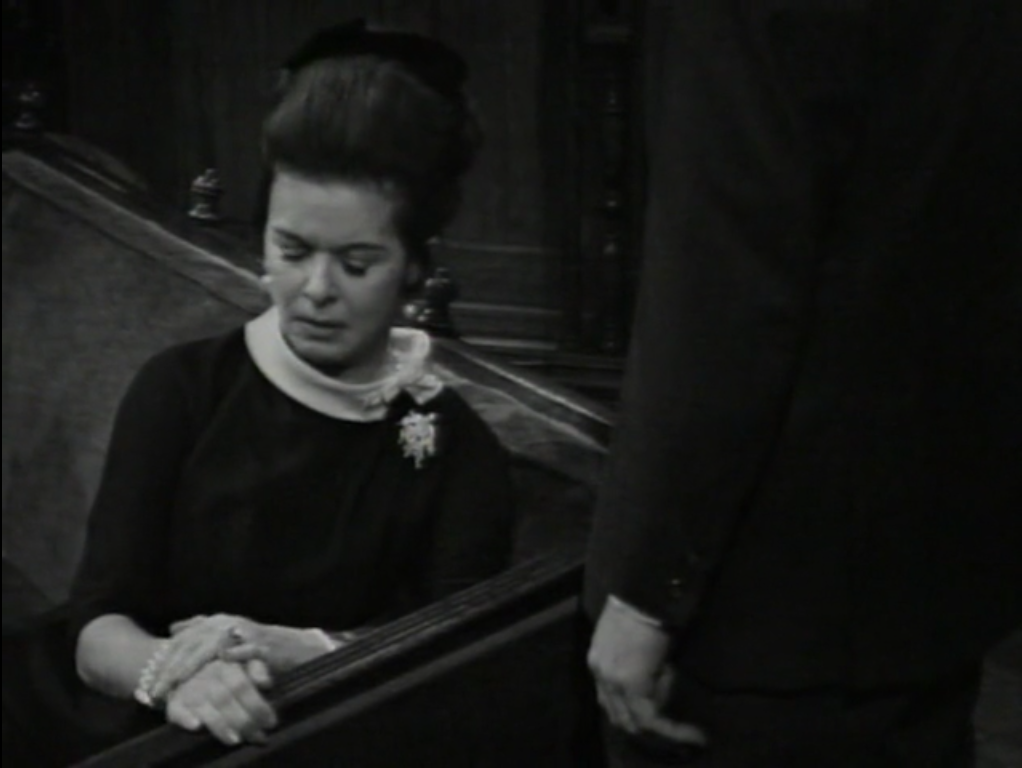
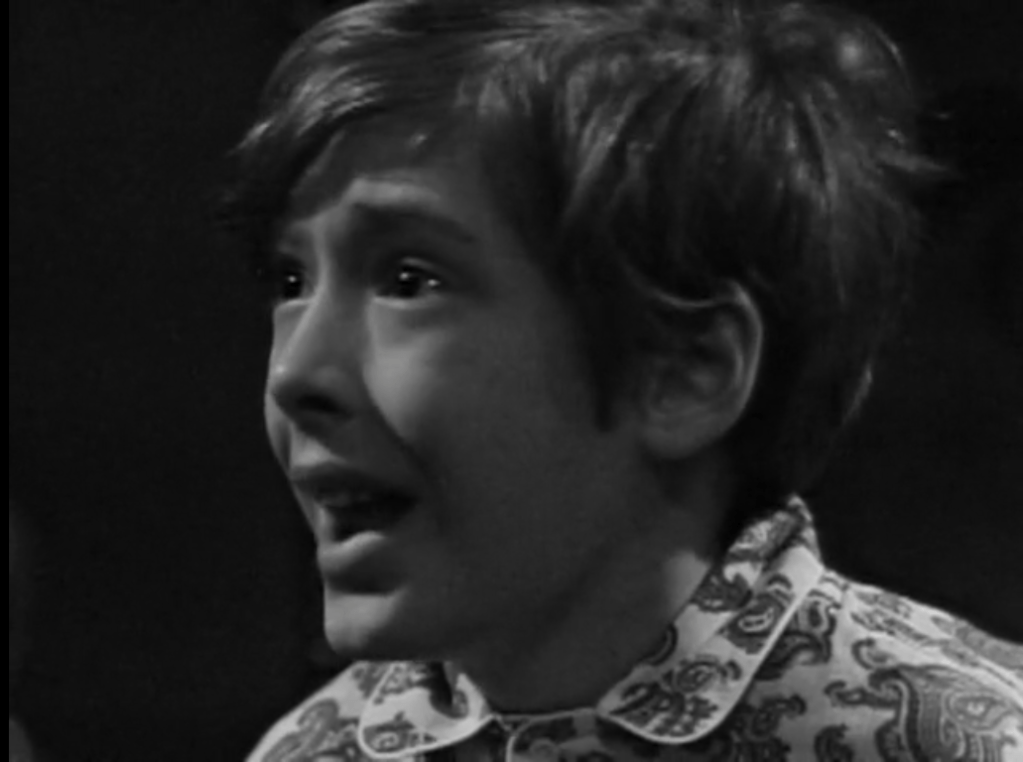
In Dark Shadows #3, man of mystery Burke Devlin mentioned that he started on the path to riches when he was in a bar in South America. Since then, he has mentioned his business interests on that continent several times, and the old standard “Brazil” has emerged as his informal theme song. Yesterday’s episode, one of the finest in the series, called back to the early days of the show several times, and today they close the loop on Burke’s connection to Brazil. His plane crashes in that country, and he dies there.

We learn of Burke’s fatal accident when housekeeper Mrs Johnson tells her employer, Elizabeth Collins Stoddard, that she has heard a radio report of an aviation disaster in Brazil. Mrs Johnson first came to work in Liz’ home, the great house of Collinwood, in #81. At that time Burke had sworn to wreak a terrible vengeance on the Collinses and Mrs Johnson was his secret agent. Burke renounced his quest for vengeance in #201, which was just as well, since it was never very interesting anyway. But they never told us that he had stopped paying Mrs Johnson or that she had stopped funneling information to him. So viewers who have been watching all along may wonder if she really did just happen to be listening when the radio announced that a Varig flight had gone down outside Belém. Maybe she was in touch with some associate of Burke’s who told her more than she could repeat to Liz. Or maybe not, but in any case it is satisfying to be reminded of the connection.

Burke was engaged to marry one of Collinwood’s residents, well-meaning governess Vicki. When she is told that Burke is missing and presumed dead, Vicki declares that she is certain he will come back. Vicki was originally the audience’s point of view character, an outsider to whom everything we did not know had to be explained. We now know many things she does not, but in this declaration she once more seems to be closer to us than to the other characters in her knowledge. She knows, as we do, that she lives in a soap opera and no major character is likely to stay dead permanently, especially not when his death is supposed to be the result of a plane crash in a faraway jungle.

On the other hand, Burke has been fading in importance for a long time. After his revenge story fizzled, he never really found a new reason to be on the show. His relationship with Vicki might have made things happen when he was still in conflict with the Collinses. She would then have found herself torn between her lover and the family that had all but adopted her. But once Burke and the Collinses patched things up, there was no obstacle between him and Vicki. In the last few days, it has seemed that she might even be able to stay in the house and keep her job after marrying him. There has been a theme where Burke tried to gaslight Vicki out of believing in supernatural phenomena that he himself had plenty of evidence to suppose were real, but that was less a storyline than a speed bump. Burke’s part was recast after the charismatic Mitch Ryan showed up for #252 too drunk to work; since then he has been played by the woefully miscast Anthony George, and it has been obvious that the character needed to be written out of the show before he did permanent damage to George’s career. So maybe Burke won’t come back after all.

Meanwhile, in the Old House on the same estate, vampire Barnabas Collins is moping around while mad scientist Julia Hoffman works on her notes about her attempt to turn him into a real boy. When she asks if there is anything she can do to lighten his mood, he sarcastically suggests that they play a game of cards or of cribbage. She’s up for either one, but he says that he won’t be happy until Vicki comes to him. He doesn’t know about Burke’s accident, but has somehow convinced himself that Vicki’s personality will eventually disappear and be replaced with that of his long-lost love Josette, and that as Josette she will be his bride. Barnabas goes on so long about how wonderful it will be when the Josettified Vicki is in the house that we start to wonder just how the two of them will pass the time. The day may come when Barnabas is glad of a cribbage board.

Julia only recently committed her first murder. She and Barnabas killed her old medical school classmate Dave Woodard a week ago, and she is still reeling from the shock of it. One thing she has settled on is the fact that she is going to be linked to Barnabas for the rest of her life. It doesn’t seem likely that she will ever be able to tell anyone else about Woodard, and being a murderer is, like it or not, an important part of her identity. So no one other than Barnabas can ever really know her. She’s making the best of this by trying to fall in love with him, but his sick obsession with reenacting the plot of the 1932 film The Mummy with himself in the Boris Karloff role and a woman in her early twenties in Zita Johanns’ double role as the dead princess and her reincarnation would seem to leave her at an impasse.

Julia presses Barnabas about his relationship with Josette. When he keeps insisting that the Josettified Vicki will come to him of her own free will, she asks if the original Josette ever did that. Barnabas’ silent grimace answers her question. She goes on to ask why Josette is so important to him if he was never very important to her. He says he will explain it all to her, but that they must have the proper setting. He leads her to the place of Josette’s death, the cliff at Widows’ Hill.

Barnabas has given us at least two versions of his relationship with Josette. In #212, he gave a speech to her portrait which implied that she was his grandmother, and that she sided with his father her son when he and Barnabas had a fateful clash. Soon after, Josette was retconned into Barnabas’ lost love. In #236, Barnabas was trying to brainwash Maggie Evans, The Nicest Girl in Town, into thinking that she was Josette. He told her then that he had sailed with Josette from her home in the French West Indies to Collinwood, where she was to marry his uncle Jeremiah Collins. It was his task to teach her English on the voyage. Aboard ship, they fell in love. This reenactment of the tale of Tristan and Isolde ended as sadly as did the original, though the particulars of the story were not the same.

Now, Barnabas tells Julia that he met Josette for the first time when she arrived at Collinwood. He had taken no interest in his uncle’s betrothed until he saw her, but was stunned by her beauty and quickly fell in love with her. He found himself compelled to be “her good and faithful friend Barnabas,” a position he found humiliating. As a vampire, Barnabas is a metaphor for selfishness and cruelty, and so it is hardly surprising that he confines Julia to the same position with regard to himself and that he openly delights in her humiliation. It is a bit dizzying that she expresses so much sympathy for him, telling him in this scene that he never seems more human than when he talks about Josette.

In telling this latest version of the story, Barnabas says that as Josette came to feel that her youth was wasted on the elderly Jeremiah, it dawned on him that there was a way he could offer her eternal youth. This harks back to #233, when Barnabas told Vicki and Liz’ daughter Carolyn the story of Josette’s death, that she leapt off the cliff because she was being pursued by her lover. So we are to assume that Josette killed herself rather than let Barnabas turn her into a vampire. But it might suggest more than that. Whenever Barnabas met Josette, and whether it was aboard ship or on her arrival, he was not yet a vampire. We have not heard how he turned into one. Perhaps he involved himself in some kind of black magic in an attempt to keep himself and Josette young forever, and as a result he became a vampire and she fled from him to her death.

Vicki shows up and tells Barnabas and Julia about Burke. They are stunned. Julia’s reflex is to lean in and touch Vicki’s arm, Barnabas’ is to stagger back.

Shocked.

Barnabas quickly senses opportunity, and he shoos Julia away. He says that she was complaining of the cold and that for the sake of her health she ought not to stay. She is so obviously humiliated that only Vicki’s absorption in her own distress keeps her from noticing.

Barnabas plays the “good and faithful friend,” and Vicki looks over the edge of the cliff. She talks about the widows who have thrown themselves to their deaths from it over the years. She says that she had at first assumed that they were just “make-believe creatures,” but that if she thought Burke were really gone she would throw herself after them. Barnabas grabs her and urges her to stop such talk.

As this goes on, we hear the “Widows’ Wail,” a sound effect prominent in the early months of the show that the uninitiated mistake for wind, but that indicates something terrible is about to happen. When Vicki and Burke had their final conversation yesterday, they heard it, and he refused to admit its meaning. Vicki and Barnabas hear it now. The Widows bewail upcoming disasters, and Burke is already dead. Barnabas tells Vicki that she will be a bride very soon, and she nods and repeats, “A bride… very soon.” As she does, the Wail sounds louder than before.

“A bride… very soon.”

Closing Miscellany

This episode includes one of the most famous bloopers in the entire series. When Liz is on the telephone getting the news about Burke’s plane crash, she refers to “That place in Brazil… (long pause)… (separate, equally long pause)… (fidget)… (different kind of pause)… Belém!” It is a wonder to behold.

This episode was taped on 16 October 1967. On the 28th of that month, Alexandra Moltke married Philip Isles. So, whether or not Vicki was going to become “a bride very soon,” her player was. The wedding announcement in The New York Times doesn’t mention Dark Shadows; it does mention that “Mrs David Ford” was part of the bridal party. That Mrs David Ford was Nancy Barrett, who played Carolyn, and her Mr Ford played Maggie’s father Sam.

From The New York Times, 29 October 1967

Neither Mrs Isles’ marriage to Philip nor Miss Barrett’s to David Ford lasted very long. Mrs Isles is still known as Mrs Isles, even though she was married to a doctor named Alfred Jaretzki for 33 years, ending with his death in 2014. By the time she met Jaretzki, she was a nationally known documentary filmmaker, and there is her son Adam Isles, the father of her three grandchildren and a former high official of the US government. So I suppose it made sense to stick with that name. In any case, I doubt very much that the widows were wailing for her.

My wife, Mrs Acilius, mentioned that even though we have seen the whole series before, she fully expected Barnabas to push Julia off the cliff. The episode pulled her in so completely that she didn’t stop to tell herself that she would have remembered if he’d done that.

Episode 344: Listen to the music, listen!

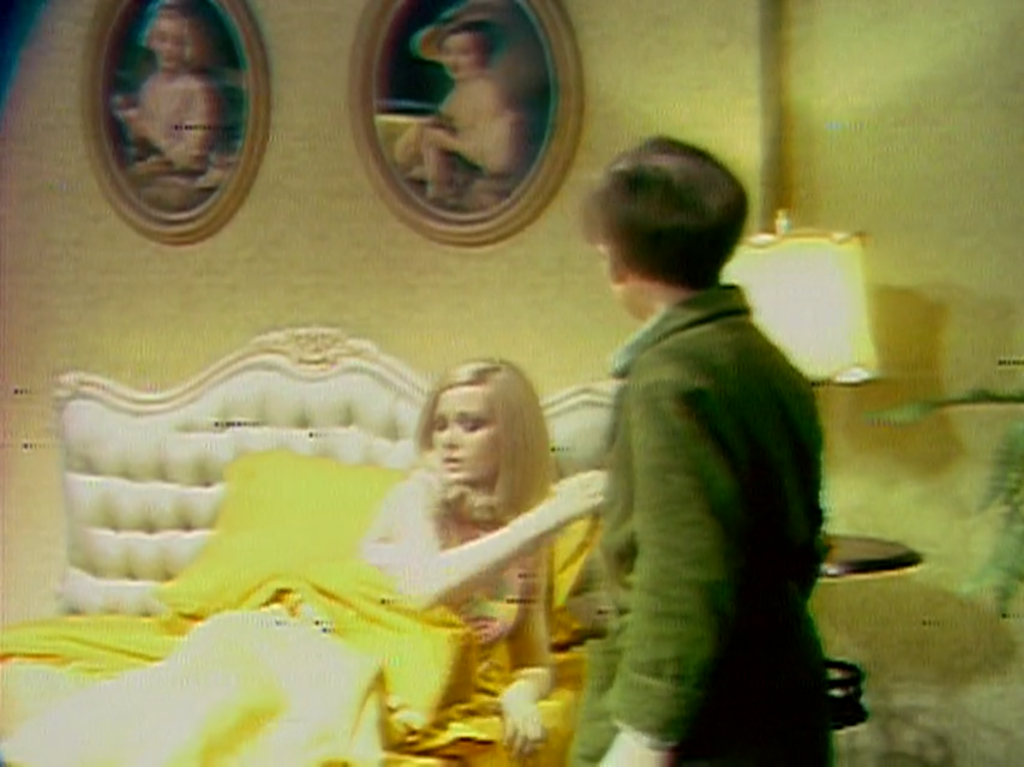
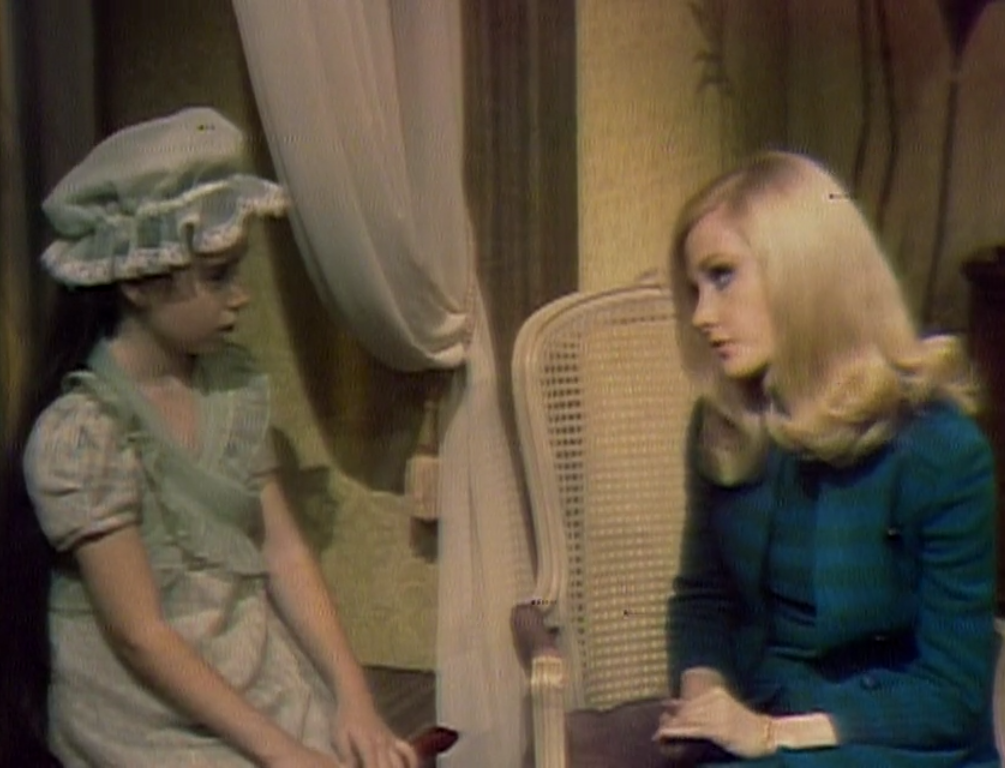
Strange and troubled boy David Collins is sitting on his bed. The ghost of his cousin Sarah is with him, playing “London Bridge” on her flute. She has told him that local physician Dave Woodard is dead, and he is depressed. She explains that she thought she had to tell him.

Sarah says she thinks that Woodard’s death was a terrible one and that it shouldn’t have happened. She denies knowing any more than that, and when David presses her for further information she becomes uncomfortable and vanishes.

David’s aunt, matriarch Liz, comes into his room to break the news to him about Woodard. She is startled to find that he already knows. She is distressed at his attitude of complete resignation. Woodard was the only adult who believed all of the facts about the supernatural menace looming over the great estate of Collinwood and the town of Collinsport that David and Sarah have shared with each other, and when David last saw him Woodard was trying to do something about that menace. David takes Woodard’s death as the end of all hope.

Downstairs, Liz meets her daughter Carolyn and well-meaning governess Vicki. She tells them how sad David is, and Carolyn goes up to see him. She starts talking about imaginary friends, and David asks if she means Sarah. Carolyn says that she doesn’t think Sarah is imaginary, and David replies “You don’t have to pretend. I don’t care.” He isn’t the least bit angry with her- he means exactly what he says when he tells her he doesn’t care how she feels about him.

Viewers who have been with the show from the beginning could see that reaction coming. For the first 24 weeks or so, Carolyn was a flighty heiress, a self-centered young woman who took no interest at all in her little cousin. Since then they have discarded that theme and Carolyn has become a mature and caring person. She and David have had some moments where she has seemed like a big sister. Still, she is still far less involved with him than is Vicki, and David doesn’t have any hopes that even Vicki will listen to him when he tells the truth about the strange goings-on. So when David says “I don’t care,” Carolyn is hit by a freight train that we’ve seen coming for a long time.

This new Carolyn won’t give up on David. She confides that when she was nine years old, she had a friend named Randy, a little boy who always wore a red sweater and who may or may not have existed. Carolyn admits that Randy may have been a ghost, and there is a moment when, as Danny Horn puts it on his Dark Shadows Every Day, “David stands up, and he looks at her, as if they’re really seeing each other for the first time in a long while.” The first time ever, I’d say- David and his father Roger only moved into the house a month or so before the show started, and by that time Carolyn was the character we first saw.

This isn’t the first time the audience has seen this side of Carolyn. In the opening weeks of Dark Shadows, she was one of several characters who had brief conversations with Vicki about the legendary ghosts of Collinwood, and she was the most persistent about laughing those legends off. But before the show had been on the air for five weeks, Carolyn admitted to Vicki that the legends were all true, and that she had tried to downplay them only because she liked Vicki and wanted her to stay.

That development is recapitulated in this scene. Where Vicki had reacted with confusion, telling herself that she ought to be concerned about Carolyn’s mental health but unable to quash a sickly feeling that she might be right, David reacts with wonderment. He is beyond trying to do anything about the horrors that he knows are in progress, let alone appealing to anyone to join him in fighting them, but we can see him absorbing the information that Carolyn is not at all the person she had led him to believe she was.

Once Carolyn stops pretending she does not believe in ghosts, we see why she and the other adults in the family are so insistent about keeping the door shut on the supernatural back-world behind the main action. “London Bridge” starts playing on the soundtrack; Carolyn and David can both hear it. As it goes on, David declares that something terrible is about to happen. It will be an accident- no one will cause it, no one wants it to happen. But it can’t be stopped. Carolyn asks how he knows, and he says he just does.

David communes with the spirits. Screenshot by Dark Shadows Before I Die.

The little girl we saw in the opening is Sarah, but in this moment we realize she is not the whole of Sarah. The girl is only one manifestation of an unfathomably vast complex of phenomena. The world in which the action appears to be taking place is a tiny, fragile thing by comparison with forces like Sarah. If the characters stray from their little paths of denial and evasion the whole thing may at any moment dissolve altogether, thrusting the back-world into the foreground and leaving them adrift. After a few minutes of David’s soothsaying, Carolyn protests that “None of this is real, it can’t be!” But it’s too late- she knows that it is all too real, and the world of love affairs and hotels and motorcycles and dress shops and restaurants in which she has spent the last 69 weeks trying to find a place is a dream from which she is already starting to awaken.

Meanwhile, Vicki and her depressing fiancé Burke have declined Liz’ offer to live in the west wing of Collinwood when they are married. Liz had hoped to keep Vicki around so that she could help with David. When Burke asks if he should talk to David, Liz tells him not to bother. Carolyn already talked to him, Liz explains, and so far from calming David down she got herself upset too.

That response would suggest that Liz wants to tranquilize David, not to communicate with him. On the heels of the scene between David and Carolyn, it tells us more. Liz has lived in Collinwood longer than anyone, and she has struggled harder than anyone to keep the non-supernatural fore-world in operation. After Carolyn’s experiment in facing facts comes so close to sweeping the “logical explanations” away once and for all, we can see what Liz is trying to protect by keeping David quiet.

Burke is leaving the house, about to go on a business trip to South America, when David emerges from his room and says goodbye. David’s tone makes it clear that it is a final farewell. Burke keeps telling David that he will come back, but David is certain that Burke will die. Burke is shocked by David’s attitude, and says that perhaps they should live in the west wing after all. Vicki is thrilled by the idea.

Burke and Vicki go to a terrace outside the house. There, they hear the wind whistling through the rocks along the shore. On Vicki’s first night in the house, she heard from Liz’ brother Roger the legend of “The Widows’ Wail,” according to which this sound is a warning from the spirits of the widows who haunt the area. In those days, Vicki had little patience for ghost stories, and the “Widows’ Wail” seemed to be the easiest of all the legends to dismiss. But the wind blows every night, and she’s only heard it make that sound on a handful of occasions, usually right before something terrible happens. She’s also seen multiple ghosts, done battle with a humanoid Phoenix, and encountered what anyone with access to old movies would recognize as evidence that a vampire is operating in the vicinity. So she hears the Widows’ Wail the same way regular viewers of the show do, as the sound of the supernatural back-world blasting through and knocking everything else down.

Vicki hears the Widows’ Wail. Screenshot by Dark Shadows Before I Die.

When Vicki pleads with Burke not to go to South America, he replies “Don’t tell me you’re starting to believe all that stuff!” For months now, Burke has been gaslighting Vicki, pretending that she is crazy for believing in supernatural phenomena, including phenomena he himself witnessed and previously acknowledged. But hearing the Widows’ Wail, which was a prominent topic in the early days, and seeing the black and white imagery of the kinescope, we can remember a more appealing version of Burke. Back then, Burke was one of several longtime residents of Collinsport who used the word “ghost” figuratively in conversation with Vicki, each time prompting her to exclaim “Surely you don’t believe in ghosts!?,” to which he would reply that it was entirely possible that there were literal ghosts at Collinwood. For a moment, we see that Burke, and forget the gaslighting abuser. That moment lasts just long enough that we can share David’s sorrow and Vicki’s terror at Burke’s imminent death.

Episode 308: Master of the evasive answer

Artist Sam Evans is at home with his daughter Maggie, The Nicest Girl in Town. Sam is wearing a coat and tie while painting. I suppose that could be called “professional attire,” and Sam is a professional painter.

Professional attire.

Maggie’s main occupation these days is an important one on a soap opera. She is the resident amnesia sufferer. She can’t remember anything about the weeks she was missing and in the custody of a person or persons unknown to the non-villain characters on Dark Shadows. The only clue Sam, Maggie, and Maggie’s fiancé Joe have as to who abducted Maggie is that a mysterious little girl named Sarah has turned up and shared important information at key moments in Maggie’s travails. So they are desperate to find Sarah.

As the three of them talk about how elusive Sarah is, Maggie says that she seems to be able to disappear at will. Joe dismisses this idea out of hand. Regular viewers might find that a bit odd. During the storyline centered on undead fire witch Laura Murdoch Collins, both Joe and Sam had definite encounters with supernatural beings, Joe with the ghost of Josette Collins in #179 and Sam with the same spirit on the several occasions she compelled him to paint pictures explaining the danger Laura represented. Sam has also seen Sarah appear in and disappear from a locked room. So we would expect at least one of the two men to hesitate for a moment before rejecting the idea that Sarah might be a ghost.

Sam and Joe decide that because strange and troubled boy David Collins has seen Sarah more often than anyone else, they should go visit him at the great house of Collinwood and ask him to lead them to Sarah. David is happy to talk about Sarah, but he tells them that he has no idea how to contact her. He also warns them that if they do get in touch with her, they will likely find that nothing she says makes much sense. David and his cousin Carolyn continue with their plans to take a bus trip to the nearby town of Bangor, Maine, while Sam and Joe search the grounds of the estate hoping to find Sarah in one of the spots David mentioned that he had run into her.

David doesn’t have the answers. Screenshot by Dark Shadows Before I Die.

They see a swing moving in the breeze and jump to the conclusion that Sarah had been in it moments before. If they could hear the background music, they would know they were right- Sarah’s “London Bridge” cue is playing. Lacking this ability, they conclude that they have found nothing. They decide to go ahead and visit the Old House on the estate, home to courtly gentleman Barnabas Collins and Barnabas’ servant Willie. They hope that one of them will be able to tell them something about Sarah.

They find that neither Barnabas nor Willie is at home, but someone they know is there. Dr Julia Hoffman answers the door. When Sam followed Sarah’s directions and found Maggie at the end of her ordeal, she was in a terrible state, drained of blood and in a state of total mental collapse. Maggie was treated at a hospital overseen by Julia, who is qualified as a specialist in both hematology and psychiatry. Now Julia is settled in at Collinwood, masquerading as an historian writing a book about the old families of New England.

Sam wants to know why Julia is keeping up this imposture. He delivers a speech full of courteous words thanking her for spending so much time on Maggie’s case without remuneration, but his tone and body language prepare us for his angry response when Julia refuses to give him any specifics. He tells Julia that he has decided he doesn’t believe her. He gives her a piece of his mind, then storms off.

Joe stays behind and apologizes for Sam. Julia assures Joe she isn’t upset, and asks him to tell Sam that she is doing everything she can. After the two men are both out of earshot, Julia smiles and repeats “I am doing everything I can!” Without that mustache-twirling line, first time viewers might not have caught on that Julia is a Villain.

Julia twirling her mustache. Screenshot by Dark Shadows Before I Die.

Sam and Joe go back to the Evans cottage. It is night time, Maggie isn’t in the parlor, and her bedroom door is closed. Sam goes up to the door and shouts her name repeatedly. When she answers in a groggy voice, he apologizes, saying he didn’t mean to wake her.

Maggie comes out of her bedroom holding a wooden doll in eighteenth century garb. The doll wasn’t there when she went to sleep, and is the sort of thing Sarah would have, so she concludes that Sarah must have been in her room while she slept. Returning viewers will recall that when Sarah visited Maggie in #297 and found that she couldn’t remember her, she became upset and took away the doll she had previously given Maggie. This is a different doll, but it does confirm that Sarah is still watching over Maggie.

Closing Miscellany

This is one of only two episodes in which Nancy Barrett and David Ford share a scene. In #85, Miss Barrett’s Carolyn and Ford’s Sam were in the Blue Whale tavern at the same time; today, Carolyn, Sam, Joe, and David stand in the foyer of the great house talking about Sarah. It’s interesting that the two actors worked together so seldom, because from 1967 to 1969, Miss Barrett was known socially as Mrs David Ford.

At the climax of his scene with Julia, Sam tells her that she “should have been a member of the diplomatic corps…because you’re a master of the evasive answer!” So far as I’m concerned, the Foreign Service is one of the most honorable professions there is, and this is a shameful swipe at one of the most selfless, patriotic, and often heroic groups of people our country is blessed to produce. Writer Malcolm Marmorstein often cranks out mediocre scripts, but this smear marks a new low even for him.

Episode 254: As much fun as a bag of spiders

Reclusive matriarch Liz and well-meaning governess Vicki are in the drawing room of the great house of Collinwood. Liz is depressed because her daughter Carolyn is dating motorcycle enthusiast Buzz. She asks Vicki if she has any idea how to break Carolyn and Buzz up, then answers her own question. Liz knows that Carolyn is protesting her engagement to seagoing con man Jason McGuire, and that only by breaking it off with Jason can she change things with Carolyn.

When Liz claims that she is marrying Jason because she wants to, Vicki says it’s none of her business. Vicki has seen abundant evidence that Jason is blackmailing Liz, and won’t pretend she hasn’t. She manages to be quite respectful to her employer without backing down an inch. Despite herself, Liz is impressed with Vicki’s firmness and diplomacy.

Alexandra Moltke Isles was cast as Vicki because she and Joan Bennett looked so much alike, and this is one of the scenes that uses their resemblance to show Vicki as a reflection of Liz. As Vicki is finding tactful ways to express her suspicions, she says things that we have heard Liz say and that we know she is thinking. Each time she does so, Joan Bennett does a quarter turn one direction from the shoulders and a quarter turn the other direction from the neck, as if she were being twisted open. When Liz tells Vicki to stop, she calls her “Victoria,” a name we haven’t heard her use since 1966, and when Vicki asks permission to leave the room she responds, in a near-whisper, with the usual “Vicki.” This alternation also suggests twisting, and to regular viewers who remember that Liz has a secret connected with the fact that “Her name is Victoria” it is another twisting open.

Meanwhile, Jason is entering the Blue Whale tavern with his former henchman, Willie Loomis. Jason wants to confront Willie with the fact that he saw him in town earlier in the day selling a piece of jewelry. Willie says that he was selling it on behalf of his employer, wealthy eccentric Barnabas Collins. Jason knows of Willie’s obsessive fascination with jewels and his tendency to steal them, and does not believe that Barnabas would entrust him with such a task. What Jason does not know is that Barnabas is a vampire and Willie is his sorely bedraggled blood-thrall. As such, Barnabas has a power over Willie that makes it rational to entrust the most remarkable tasks to him.

Carolyn and Buzz enter. They almost leave when Carolyn sees Jason and Willie. Jason and Willie rise and meet them at the door. Jason assures Carolyn that they were just going. Before they do, he taunts Carolyn with his engagement to Liz.

On Tuesday, Carolyn and Buzz started dancing together in the drawing room. Buzz made a few very graceful moves, saw Carolyn going into the Collinsport Convulsion, and sat down to observe. Today, Buzz sees two background players twitching awkwardly while the jukebox plays and declines Carolyn’s invitation to join her on the dance floor. He wants to stop drinking, saying that he is looking for something that will make him feel like he’s never lived before, while “drinking only makes you feel drunk.” It sounds a little bit like he’s going to offer Carolyn a drug stronger than alcohol, but by the end of the scene he just wants to get back on his bike. Liz’ fears to the contrary, Buzz seems pretty darned wholesome.

While Carolyn and Buzz are on their way out of the tavern, hardworking young fisherman Joe comes in. Carolyn asks Buzz to wait outside while she talks with Joe. Buzz reluctantly agrees to spend a few minutes alone with his bike.

Carolyn and Joe were dating when the show started, and there was a whole storyline about how they were tired of each other and couldn’t get themselves sufficiently organized to break up. Their scenes together reminded us that the 1960s were the decade in which Michelangelo Antonioni used the cinema to explore the nature and significance of boredom.

But they are far from boring today. After he and Carolyn finally called it quits, Joe started seeing Maggie Evans, The Nicest Girl in Town. Maggie is now missing and feared dead. Carolyn sits next to Joe at the bar and expresses her sympathies. When I say that Nancy Barrett’s acting style was to throw herself unreservedly into whatever the script gave her character to do that day, it may sound like I’m saying she was undisciplined or that she lacked subtlety. That is not at all what I mean, and in this scene she does one of the most delicate drunk acts I’ve ever seen. Carolyn sits a fraction of an inch too close to Joe, tilts her head back a fraction of a degree too far, opens her eyes the tiniest bit too wide, and speaks ever so slightly too slowly. No one of those signs would even be noticeable by itself, but together they make it very clear why Buzz was anxious that he and Carolyn should leave their drinks unfinished.

Back in the drawing room, Jason is badgering Liz into setting the date for their wedding. Carolyn and Buzz come back, and Jason tells them he and Liz will be married two weeks from tonight. Carolyn says that she and Buzz ought to get married the same night. Buzz is delighted when she first says this, and is still smiling when she insists she is being serious.

Buzz delighted with Carolyn’s proposal.
Screenshot by Dark Shadows Before I Die

My wife, Mrs Acilius, urged me to call this one “A piece of that action,” something Jason says to Willie. Trekkie that she is, that seemed irresistible to her. But Joe’s line that Buzz seems to be “about as much fun as a bag of spiders” is the funniest of the many witty lines in today’s script, and when you remember that Dark Shadows has, since December of 1966, been basically a horror story, you have to think that in its terms a bag of spiders might be a lot of fun. So that had to be the title.

Episode 252: I know we swing, and that’s all I have to know

Frustrated that her mother, reclusive matriarch Liz, has decided to marry seagoing con man Jason McGuire, flighty heiress Carolyn spends the day and night with motorcycle enthusiast Buzz Hackett.

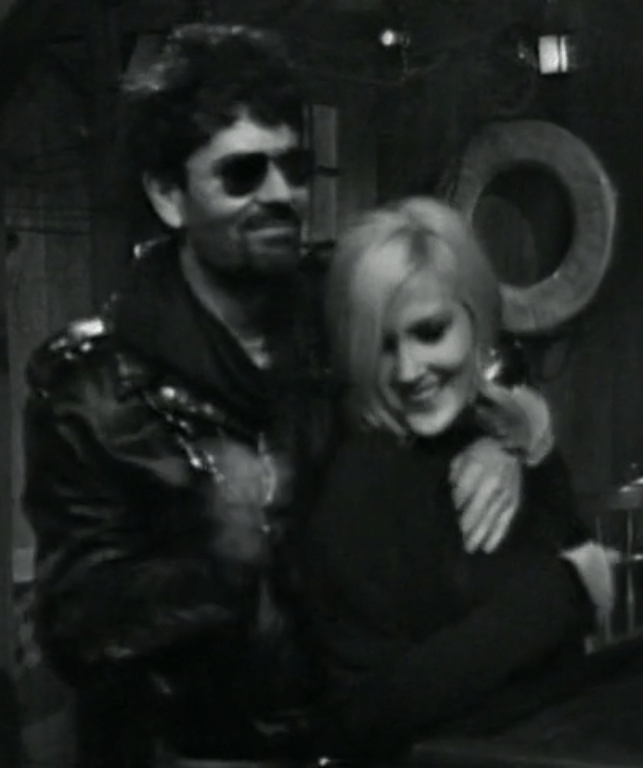
Buzz is modeled on the biker dude villains of Beach Blanket Bingo. Some of his mannerisms, such as speaking in a Beatnik slang that was a decade and a half out of date by 1967 and wearing sunglasses when he rides his motorcycle at night, would have been a little too broadly comic even for that movie, and are ludicrously out of place on the rather solemn Dark Shadows. The very sight of Buzz therefore raises a laugh.

I mean really

Nancy Barrett’s acting style was to throw herself unreservedly into whatever the script had her character doing that day, and seeing her present Carolyn as a newly minted biker mama is hilarious from beginning to end. When Carolyn and Buzz show up at the Blue Whale tavern, she’s already sloppily drunk. They see well-meaning governess Vicki and hardworking young fisherman Joe at a table, and Carolyn insists they go over and greet them. Vicki and Joe give Buzz and Carolyn frosty stares, which are of course the main ingredients of drawing room comedy.

If Vicki put on a police uniform, Carolyn wore a big feathered headdress, and Joe were a construction worker, they could make beautiful music together

As Danny Horn points out in his post about the episode on Dark Shadows Every Day, Buzz is actually pretty nice. That’s a good comic move- the obvious outsider is the one who knows enough to be uncomfortable, while the one who has been a central member of the cast from the first week is oblivious to the social awkwardness surrounding her. If it were the other way around, we might feel sorry for Buzz or be angry with him, but since we know that Carolyn’s place is essentially secure we can laugh at her uninhibited behavior, no matter how much it may make others squirm.

Buzz takes Carolyn home to the great house of Collinwood, parking his motorcycle a few feet from the front door. That isn’t a sign of inconsideration- there only are a few feet in front of the door, they’d be off the set if he parked any further away. It’s still pretty funny to see.

Buzz and Carolyn

Inside the house, Buzz jokes about riding his bike up the main staircase. Carolyn laughs, then urges him actually to do it. He refuses, clearly appalled that she would want such a thing.

Carolyn shocks Buzz

They go into the drawing room. Carolyn picks up a transistor radio and finds some dance music. Buzz is ready to dance, but takes a seat when Carolyn goes into the violent, rhythm-less jerks people in Collinsport do when music is playing. Buzz watches her, apparently ready to provide first aid.

As Carolyn’s performance of the Collinsport Convulsion ends with her falling face first, Liz comes downstairs. She protests against Carolyn and Buzz making so much noise at 3 AM. For the first time, Buzz is rude. He does not stand up when Liz comes into the room, and when Carolyn introduces her as “Mommy,” he greets her with “Hiya, Mommy!” Liz orders him to go.

Before Buzz has a chance to comply, Carolyn starts taunting her mother, yelling at her that her name will soon be “Mrs McGuire!” Liz retreats up the stairs as Carolyn taunts her with repetitions of this name. When Liz is on the landing, Carolyn and Buzz clench and kiss passionately. While they kiss, we see Liz above and behind them, trying to exit the scene. As it happens, the door she is supposed to go out is stuck, so she has to struggle with the knob until she’s out of the frame. Thus, the longest period of intentional comedy on the show ends, not with a break into angry melodrama, but with a huge unintended laugh. It is one of the few truly perfect things ever seen on television.

Door’s stuck

As Buzz, Michael Hadge really isn’t much of an actor- he shouts his lines and goes slack whenever he isn’t speaking. That doesn’t matter so much today. Nancy Barrett’s high-energy performance, the other cast members’ skill at comedy of manners, and the mere sight of Buzz combine to keep the audience in stitches throughout.

Still, I can’t help but wonder what might have been. Yesterday, vampire Barnabas Collins threatened to murder his blood thrall, the sorely bedraggled Willie Loomis. Viewers watching on first run might have wondered if Buzz was going to be his replacement. They might have, that is, if Buzz were played by an actor in the same league as John Karlen. With Mr Hadge in the role, that suspense never gets off the ground.

One of the little games I play in my head when the show gets boring is to ask who else might have taken a part and to imagine how it would have changed with that other actor in the cast. So, if Harvey Keitel was available to dance in the background at the Blue Whale in #33, then surely Mr Keitel’s friend Robert De Niro would have taken a speaking part in #252. Actors inspire screenwriters, and if Mr De Niro had played Buzz I would have wanted to write this line for him to speak to Liz: “Mrs Stoddard, you got me all wrong. You think I want to hurt you, or take something from you, but that’s not the way it is. Me and Carolyn, we’re just trying to have a good time.” Mr Hadge’s shouting wouldn’t have made much of a line like that, but delivered by Mr De Niro to Joan Bennett it could have started a scene between Buzz and Liz that would have expanded his role beyond comic relief and earned him a permanent place in the cast.

It may be for the best that it didn’t work out that way. A De Niro-Buzz might have been such a hit that Dark Shadows never would have got round to becoming the excursion into sheer lunacy that we know and love. And Martin Scorsese might never have been able to get soap opera star/ teen idol Robert De Niro to answer his phone calls.

Closing Miscellany

There are some other notable moments today. We might wonder why Vicki and Joe are sitting together in the Blue Whale, when Vicki has been dating dashing action hero Burke. In fact, the script originally called for Vicki to be out with Burke, but actor Mitch Ryan showed up too drunk to work the day they taped this one and was fired off the show. Burke gave up on his big storyline over ten weeks ago and there hasn’t been a reason for him to be on the show since. Besides, the same cast of characters cannot indefinitely include one whose type is “dashing action hero” and another whose type is “vampire.” The vampire is already pulling in bigger audiences than anything else they’ve done, so Burke has to go. Still, Ryan was such a charismatic screen presence that he was a high point in every episode he appeared in, so it’s sad we’ve seen him for the last time.

The bartender brings drinks to Vicki and Joe’s table and Joe calls him “Bob.” They have settled on this name by now. The same performer, Bob O’Connell, has been playing the bartender since the first week, but in the opening months of the show he had a long list of names. My favorite was “Punchy.”

There is some new music in the jukebox at the tavern and more new music while Carolyn and Buzz are outside the front doors of Collinwood. In the tavern we hear something with brass, and at the doors we hear a low-key saxophone solo.

The closing credits give Buzz’ last name as “Hackett.” We heard about a businessman named Hackett in #223, but Buzz doesn’t seem to be related to him. In the Blue Whale, Carolyn says that her mother has more money than Buzz will ever see, to which Buzz laughingly replies “That isn’t much!”

Patrick McCray’s post about this episode on his Dark Shadows Daybook is fun. I especially enjoyed his description of Michael Hadge’s performance as a merger of “Russ Tamblyn with Truman Capote.”

Episode 244: The nature of evil

The entire episode is taken up with the thirteenth iteration of something that wasn’t especially appealing the first time we saw it: seagoing con man Jason McGuire makes a demand of reclusive matriarch Elizabeth Collins Stoddard; Liz resists; Jason threatens to expose her terrible secret; Liz capitulates.

Today, Jason makes the ultimate demand, that Liz marry him. In response, she laughs merrily, the first time we have seen her do this. She takes her resistance to the very point of calling the sheriff’s office and admitting that, eighteen years ago, she killed her husband Paul Stoddard and Jason buried him in the basement.

Jason stops her, telling her that the first person who ought to hear her confession is her daughter Carolyn. Liz agrees to this. Jason goes to summon Carolyn from the study, warning her that her mother is “on edge.”

Carolyn comes in. When Liz tells her that she has something important to discuss, Carolyn tries to lighten the mood by joking that it’s a bit late to break the news to her about the birds & bees. When Liz goes into detail about how Paul was a terrible man who never loved her, Carolyn is so upset that she refuses to listen to any more. She hurries out. This is the first time in months that flighty heiress Carolyn has had an opportunity to behave in a flighty manner.

Carolyn returns to the study. Jason is waiting for her there. She asks Jason how her father felt about her. He spins tales about what a loving father Stoddard was, which Carolyn eats up.

Jason returns to Liz. He stands over her, while she tells him Carolyn wouldn’t listen to her. We can see that her resistance is at an end. She asks him to give her time. He answers that he will give her time, but not much.

Liz, broken
Liz, still examining Jason for vulnerabilities

Over the last several weeks, we’ve seen Jason doing things other than enacting his liturgy with Liz. He and Liz have even shared a few scenes where they don’t perform it. When Dennis Patrick gets to play a charming swindler who has to think on his feet, he is fun to watch. We’ve come to like Jason enough that seeing him twist Carolyn into a fetter binding Liz to his will is a genuinely horrifying moment.

Episode 181: People can change

Strange and troubled boy David Collins is sleeping peacefully in his bed. His cousin, flighty heiress Carolyn, comes into his room to check on him. She tucks him in, waking him. He asks what she is doing in his room. When she says that she was making sure he was asleep, he points out that she woke him up. When she keeps showing concern for him, he reminds her that she has called him “a spoiled monster” and a “menace to the civilized world” among other endearments, and that if he showed up in her room there would be no end of hollering.

Carolyn goes on talking to David in a gentle voice about how important he is to her, and says that maybe she’s the one who is a spoiled monster and a menace to the civilized world. After Carolyn maintains an affectionate attitude towards him for a few unbroken minutes, David asks her if she is OK. She assures him that she is. As David Collins, David Henesy’s bewildered response to Carolyn’s friendliness brings the house down.

While we are still laughing, David presses Carolyn to explain why she is being nice to him. A look of fear comes over him, and he asks if something terrible has happened. Carolyn assures him that nothing has, but he just looks more and more alarmed. By the time she leaves him, his expression is little short of heartbreaking.

David alarmed

The next morning, well-meaning governess Vicki is sitting with David in the drawing room, going over his homework. He has written an essay about what it might be like to have an older sister. He wonders if such a sister would love him. Vicki says that she might, and that it is a waste when you don’t love the people who love you. When Vicki asks David where he got the idea of writing about an imaginary older sister who loves him, he doesn’t give a direct answer. He does start talking about Carolyn, making it clear that he is thinking of her.

Vicki leaves David alone in the drawing room for a short while. He looks into the fireplace and sees his own face wearing a placid expression and immersed in the flames. He flees the room in terror, bumping into visiting parapsychologist Dr Guthrie. Vicki comes running, and David holds onto her for dear life.

Reflections
Safe with Vicki

David’s vision reminds me of a post of Wallace McBride’s on The Collinsport Historical Society from April of 2020. His point is summarized in his title, “In Dark Shadows, Your Reflection Always Tells the Truth.” David lives in 1967, so he doesn’t have access to that article. But he already knows the truth it tells- his terrified reaction shows that he knows it means there is an imminent danger that he will die by fire.

We see hardworking young fisherman Joe poring over old newspapers in the Collinsport Public Library. He finds something that alarms him, and rushes to a public telephone to call Vicki. He tells her he is coming to the house to show something important to her and Guthrie.

Joe on the phone

When Vicki tells Joe and Guthrie that David had a vision of himself in flames, she connects it with a recurring nightmare that had plagued him several weeks ago. David’s mother, blonde fire witch Laura Murdoch Collins, had come back into his life after an absence of several years, and he kept dreaming that she was beckoning him to join her in flames. While he was suffering from this nightmare, drunken artist Sam Evans, miles away in town, inexplicably painted a couple of canvases depicting exactly the image that kept appearing in David’s dreams.

Joe and Guthrie become very animated when Vicki tells them what David saw and how he reacted. Joe declares that what David has seen is a vision of the past. Joe has already shown Guthrie what he found in the library, a newspaper article from one hundred years before. The article is about someone named Laura Murdoch Radcliffe. That Laura Murdoch died in 1867 in a fire along with her young son. His name was David.

Episode 169: Living, but no longer alive

Visiting parapsychologist Dr Guthrie is organizing a séance. Well-meaning governess Vicki is strongly in favor of this. Flighty heiress Carolyn has mixed feelings about it. High-born ne’er-do-well Roger is contemptuous of the notion. Instantly forgettable young lawyer Frank shows up and says that he trusts Guthrie.

Nancy Barrett throws herself completely into whatever her character is supposed to be doing at any given moment. At one point, Carolyn throws a big fit because she is afraid her mother, reclusive matriarch Liz, might die before she can see her again. Mrs Acilius recently lost a close family member, and says that it was therapeutic to watch this scene.

Frank and Roger have a scene in Roger’s study. It’s the first time we’ve seen that set. That favorite prop of Dark Shadows’ hardcore fans, the “Ralston-Purina lamp,” is there.

In Roger’s study

Episode 161: Something in the atmosphere

This episode consists entirely of conversations in which the characters recap events we have already seen. To the extent that it has a point, it is that while flighty heiress Carolyn seems to be in charge of the house, well-meaning governess Vicki actually is. Vicki made her boyfriend, instantly forgettable young lawyer Frank, take the idea of the supernatural seriously enough to call in an expert on the subject, Dr Peter Guthrie of Dartmouth College. Vicki then made Dr Guthrie agree to conceal from everyone else information he would normally share freely. She has made Carolyn go along with Dr Guthrie’s activities. Today, Carolyn’s uncle, high-born ne’er-do-well, Roger, asks Carolyn about Dr Guthrie. Carolyn tells Roger that it was her idea to call Dr Guthrie in. She directs Roger to cooperate with Dr Guthrie, not mentioning Vicki, but invoking the authority her ailing mother, reclusive matriarch Liz, has entrusted to her.

To explain how the performances and the visual composition keep it from being excruciatingly dull, you’d have to go over the whole thing frame by frame and analyze each of hundreds of decisions the actors and director made that held the episode together. Impressive as their efforts were, the result is far from exciting. So even if I had the expertise to provide that kind of commentary, I would not for a moment consider doing it.

One thing I will mention is that we see a lot of the kitchen at Collinwood in this episode. Usually this set is one where the characters exchange story-productive information. No such information is exchanged today. The scenes play out in a way to soften that disappointment for us.

The kitchen is typically a small space where the characters share a meal, giving rise to a natural intimacy. There’s no meal today- Vicki and Carolyn are sitting in front of the coffee things, but it isn’t until Dr Guthrie enters that it becomes clear that there is any coffee. There certainly isn’t any food to be had. Nor does the space seem particularly small. The plants are as extravagant as we ever see them, creating a sense of luxuriant growth. In the course of her conversation with Vicki, Carolyn manages to move around the room so much that she gives us the feeling of a large space. Even for someone as short as Nancy Barrett, there are very few patterns of movement that can leave us with that impression. She and the director* worked out one such pattern, and she executes it flawlessly.

Carolyn among the plants
Vicki and Carolyn in the jungle
By the pantry
Long shot

*There seems to be some question as to who directed this episode. John Sedwick has the credit on screen, but the Dark Shadows wiki says it was Lela Swift. Sometimes the wiki is edited by people who have seen the original paperwork from the making of the show, so occasionally it is right and the credits are wrong.

Episode 148: A sane and adult level

Writer Ron Sproat stayed with Dark Shadows too long, and fans of Danny Horn’s great blog Dark Shadows Every Day will have fond memories of his frequent denunciations of Sproat. It is true Sproat had many glaring weaknesses. For example, he was pretty bad at inventing stories to tell, which you might think would get in the way of building a career as a fiction writer. But one strength Sproat undoubtedly had was a sense of structure. There might not be anything happening in one of his episodes, but you can count on him to make it clear why it isn’t happening, where it isn’t happening, to whom it isn’t happening, and who isn’t making it happen. Today there are some events, and between Sproat’s script and the work of the actors, it is plain to see what purpose each of those events serves in keeping the story on track.

As the episode opens, Lieutenant Dan Riley of the Maine State Police is visiting instantly forgettable young lawyer Frank Garner in an office. Regular viewers will be confused; we’ve seen this set several times, with exactly these decorations, as high-born ne’er-do-well Roger Collins’ office at the headquarters of Collins Enterprises. We haven’t seen the set since #69, and Roger wasn’t there at that time. So apparently Frank has moved in.

Frank hasn’t even moved the portrait of the Mustache Man from the spot where Roger had it when he was in the office. Screenshot by Dark Shadows Before I Die

Lieutenant Riley wants to pass along to Frank the information that the Phoenix, Arizona police have given him about a fire in Laura Collins’ apartment in that city. Laura is Roger’s estranged wife, and Frank is representing Roger in their upcoming divorce. It isn’t clear why Riley wants to tell Roger’s lawyer what he has heard about Laura. Later in the episode, Frank will tell well-meaning governess Vicki that Riley came to him because he is a “lawyer for the Collins family.” Perhaps that means he believed that Frank represented Laura. Throughout their conversation, Frank repeatedly protests that no one has any grounds for accusing Laura of anything, encouraging Riley in such a belief. I suppose it’s a lawyer’s job to collect damaging information about the opposition, but Frank does seem to be pushing an ethical boundary here.

The charred body of a woman was found in what was left of Laura’s apartment. Since the woman appeared to be the same age, height, and build as Laura, the room was locked from the inside, and everyone associated with the building other than Laura was accounted for, the body was initially identified as hers. Riley now tells us that the police have determined that the fire started in Laura’s apartment, and that a witness claims to have seen Laura in the building the day of the fire.

Laura checked into the Collinsport Inn the day of the fire and has been in and around town ever since, as many witnesses can testify. Riley says that there is no indication that Laura has been on an airplane recently, and it would seem impossible to travel from Phoenix, Arizona to central Maine in a few hours any other way.

The lieutenant goes on to say that because the room was locked from the inside and the woman who died in the fire made no attempt to escape, the police suspect murder. This is nonsense. An attempt to escape might have been evidence of murder, not the lack of such an attempt. And if the room was locked from the inside, how did the murderer get out?

Frank doesn’t raise these objections, but just blusters through a lot of verbiage as he protests against any suggestion that Laura should be suspected of murder. The lieutenant keeps pointing out that Arizona isn’t his jurisdiction, so he doesn’t have anything to do with it. He’s just a messenger.

Some scholar of acting really ought to make a frame-by-frame study of Conard Fowkes portrayal of Frank in this scene. He has plenty of dialogue, he’s challenging statements made by a policeman, he raises his voice, makes gestures, moves around the room, looks down moodily and up excitedly. Yet he is still so bland that it is difficult to remember a word he says. It is far beyond my understanding of the actor’s craft to explain how Fowkes manages to be so consistently dull no matter what the character is doing.

When Frank is a small part of an episode, I think of his blandness as a note of pure realism. He is just the sort of person you would expect to meet in a small-town law office in 1967, and indeed it is reassuring to think that someone who has obviously never thought of putting himself in the spotlight would handle your sensitive legal affairs. The last person anyone should want as a lawyer is some guy who habitually makes himself interesting to watch on television.

Today, Frank is the leading man of the first half of the episode, and comes back with a key part in the second half. Giving that much time to a performer with such a bland screen presence does serve a purpose. None of the characters has really committed to the notion that they have to worry about crimes and physical danger, much less that they are facing a challenge from the realm of the supernatural. As far as they know, the whole story today is about a couple of romances and a child custody matter. That’s the right speed for dull, amiable Frank Garner.

That the characters don’t yet know the true dimensions of what they are facing in the storyline is one of the points this scene has to make. The other is that we will be hearing more about the investigation in Phoenix, and that it will advance the plot.

I think an acting problem muddies this second point. Today Vince O’Brien takes over the part of Lieutenant Dan Riley from John Connell, who played him in #143 and #144. As Connell played him, Riley was an out-of-town cop, not the least bit awed by the Collinses of Collinsport. His matter-of-fact speaking and impatient listening made it clear that the family’s connection to the case in Phoenix was not going to result in the discreet, abbreviated treatment that the local authorities have given them. But O’Brien’s version of the character is noticeably quick to agree when Frank makes a statement. When Frank does a TV lawyer “may I remind you” about the elements of a murder charge (elements which he gets wrong, but hey, it’s TV, not law school,) O’Brien’s Riley is agitated. He shows defiance by declaring “You don’t have to remind me” in a harrumphing voice, but his wide eyes and trembling legs show that he is intimidated to be in a discussion with the representative of the mighty Collinses. There’s no point in bringing in an out-of-town character if that’s what you’re going for- the residents of Collinsport can show you what it’s like to live under the thumb of the people in the big house on the hill. And it introduces a doubt as to whether anything will come of the investigation, a doubt which leaves us wondering why we just spent so much time watching these two guys talk to each other.

Meanwhile, Vicki is visiting dashing action hero Burke Devlin in his hotel suite. Burke has asked her to come. Yesterday, she told him that she was suspicious there was something sinister about Laura, and he had listened attentively. Later, he met with Laura and the love he once felt for her had flared back into life. So today, he wants to tell Vicki that Laura is A-OK and she should do everything she can to help her.

Like the scene with Frank and Lieutenant Riley in Roger’s office, this scene has two points to make. First is to establish Vicki as a credible protagonist for the rest of the storyline about the danger Laura presents to her son, strange and troubled boy David. Second is to show that Burke is so smitten with Laura that he won’t be much help in protecting David.

Burke guides Vicki into his kitchen, a cozy space where people can confide in each other. Last time they were in this space, she made coffee for him; this time, he makes coffee for her. He’s remarkably dainty about it, sifting cream and sugar in separate cups. He makes a pitch about how remarkable Laura is, how he’s rethought everything they said yesterday, and how a fine woman like her deserves Vicki’s trust and support.

Burke making coffee for Vicki. Screenshot by Dark Shadows Before I Die

Vicki is unimpressed. She was in the room when Laura telephoned Burke yesterday, and heard him agree to meet her at one of their old places. She presses him to explain what has changed his mind, and he won’t give a clear answer. She asks how well he really knows Laura, and he looks dreamily off into space and says that he knows her better than anyone else. She asks if his feelings for Laura might be clouding his judgment, and he demands she change the subject. When Burke urges her to persuade David to grow closer to his mother Laura, Vicki replies “I’ll do what I can for David.” Burke says “You’re hedging.” Vicki replies coolly, “I can’t help it.” When he repeats his urging, he tells her she doesn’t look convinced. She replies, “I can’t help how I look, either.”

Vicki’s strength and intelligence and Burke’s dreamy infatuation should impress anyone watching this scene, but especially viewers who just saw yesterday’s episode. When Vicki is asking Burke what happened between yesterday and today to change his mind, she is waiting for him to talk about the meeting he arranged with Laura while she was right next to him. He never mentions it, and his repeated statements that all he has done is think more deeply implies that he does not remember that Vicki heard him talking to Laura. He is so captivated with Laura that the sound of her voice erases his awareness of everyone else, even of someone he is trying hard to persuade of an important idea.

Shortly after Vicki leaves, Burke receives another visitor from the great house of Collinwood. Flighty heiress Carolyn shows up. Carolyn is pouting because Burke hasn’t been paying attention to her since her Aunt Laura showed up.

This scene has one major point to make, which is that the budding Burke/ Carolyn romance is not going to be blooming this winter. Nancy Barrett’s Carolyn bursts off the screen as she bounces from one extreme to another, trying to attract Burke by pushing her breasts at him, trying to anger him by suggesting that her mother Liz and her Uncle Roger were right when they said he was just using her to get at them, trying to embarrass him by bringing up the obstacles between him and Laura, trying to break through his reserve by flinging her arms around his neck and pleading with him to love her.

Carolyn flings herself at Burke. Screenshot by Dark Shadows Before I Die

Burke tries to let Carolyn down easy, smiling at her, caressing her face, hugging her, kissing her on the forehead. But signs of boredom and irritation keep slipping out. He tells her that the time has come for them not to see each other any more, and there can be no doubt he means it.

Burke, bored with Carolyn

Vicki goes to visit Frank. Frank blabs everything to her that the lieutenant had told him.

Vicki and Frank in Roger’s office. Screenshot by Dark Shadows Before I Die.

Vicki is deeply concerned about the idea that Laura might be a murderer. Frank keeps telling her that there’s probably nothing to that idea, but Vicki resolves at the end of the episode to do whatever she can to keep Laura away from David. Having established Vicki as a character strong enough and smart enough to square off with Laura in her previous scene, this scene shows us her decision to do just that.