We’ve been watching each episode of Dark Shadows on the 56th anniversary of its original broadcast. Today was the 56th anniversary of the broadcast of episode 56, so a milestone of sorts.
Word is making its way around the town of Collinsport that the Coast Guard has found the body of Bill Malloy, manager of the fishing fleet and cannery that between them employ most of the men in town and sustain the Collins family in their big dark house on the hill. In the opening, reclusive matriarch Liz is stumbling over her words trying to break the news of Bill’s death to her daughter Carolyn. The phone rings. Carolyn answers it, and gets the Coast Guard’s report. Liz is shattered.
Carolyn tells well-meaning governess Vicki that Bill’s body has been found. In episode 52, Carolyn had told Vicki that Bill was like a father to her. Carolyn, as played by Nancy Barrett, does indeed seem as upset in this scene as would someone who had just heard that her father’s body had washed up on shore. Vicki, as played by Alexandra Moltke Isles, is very calm and deliberate as she listens to Carolyn, letting her say what she has to say and emote as she needs to emote. It’s quite a well-turned bit of drama.
In the Blue Whale, Collinsport’s tavern, Liz’ ne’er-d-well brother Roger finds drunken artist Sam Evans, his co-conspirator in a long-ago crime. Sam tells Roger that the Coast Guard has found Bill’s body. Roger first takes a very lofty tone and announces that he will do whatever he must to ensure that Bill’s killer is brought to justice. After Sam asks him what he means by this, Roger coaches him on the lies the two of them should tell to ensure that neither of them is convicted of killing Bill.
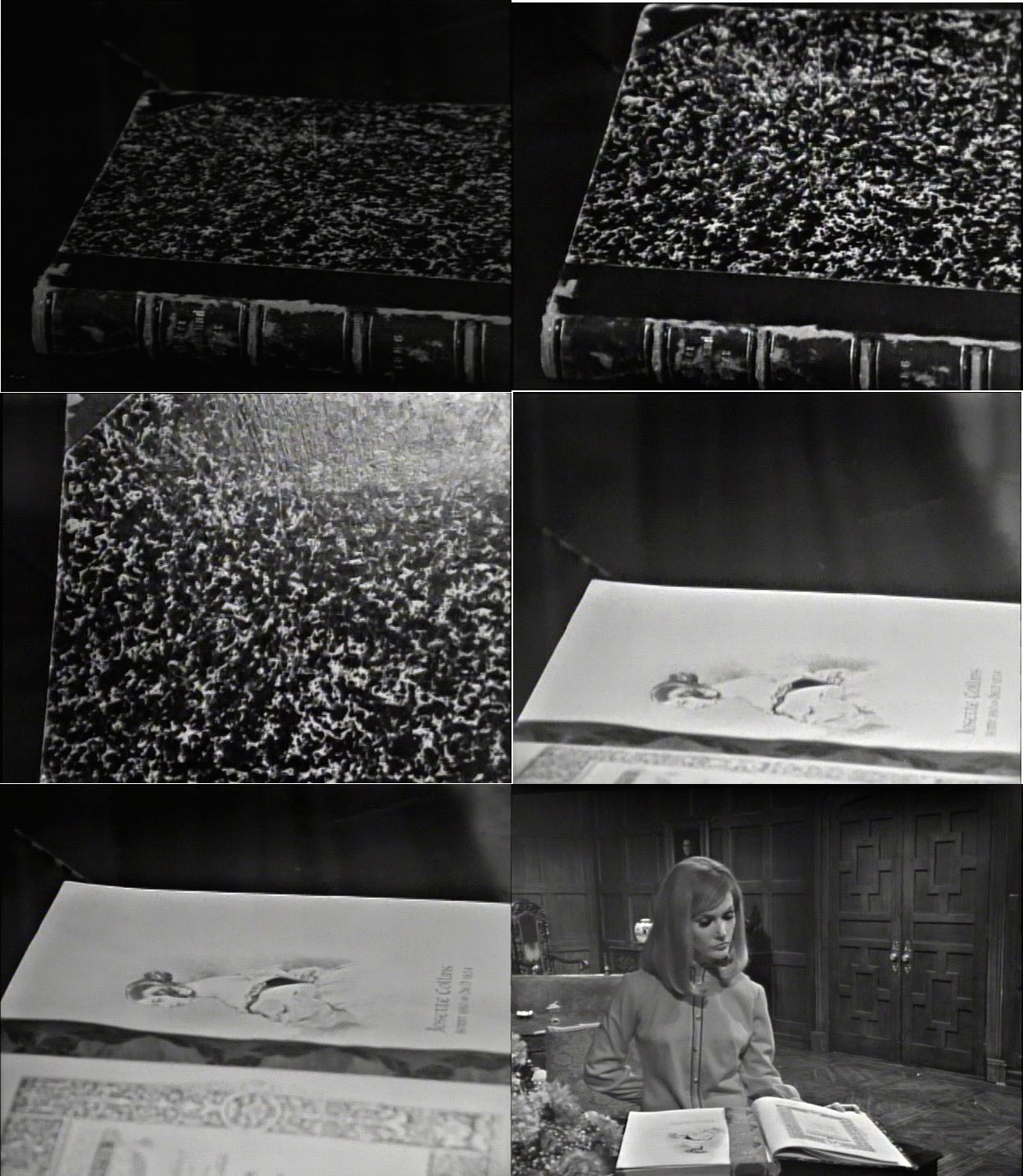
Back at the great house on the estate of Collinwood, we see the Collins family album open to the page with the picture and name of Josette Collins. The last time we saw this was in episode 52, when the book opened to that page without the aid of any visible hands. Now we see that Carolyn is opening the book. That is followed immediately by the drawing room doors opening. That too has been the prelude to a ghostly apparition, but this time turns out to be Vicki’s doing.
The first few weeks, several characters used the word “ghosts” in metaphorical senses when talking with Vicki. Each time, she behaved as if they were talking about literal ghosts and said something like “Surely you don’t believe in ghosts!” To which they said that they damn well did believe in them, and that if she goes on living in the house at Collinwood for any length of time she will, too. Reminding us of ghostly manifestations and then showing mortal agency behind them harks back to this kind of open question. Art Wallace, who was the only writer credited on the first 40 episodes, is the writer today as well. Evidently he wants to remind us of the supernatural themes and to keep us guessing where they will take us.
This one is so good that I can’t resist going over it scene by scene. It has a wide variety of mood and image, tautly structured in a clearly told story, subtly realized by highly accomplished acting, and memorably presented in superb photography and imaginative sound design.
Well-meaning governess Vicki, out for a night-time stroll, makes her way to the crest of Widow’s Hill, where flighty heiress Carolyn stands looking down at the ocean swirling a hundred feet below. “Advance and be recognized! Friend or foe?” Carolyn challenges. Seeing Vicki, she remarks “Even the tutors are out tonight.”
Despite her whimsical greeting, Carolyn is in a low mood. She’s wondering at her own inability to take hardworking young fisherman Joe Haskell’s desire to marry her seriously. She tries to interest Vicki in some of the ghost stories that surround the great estate of Collinwood, while the wind whips around the hill making the eerie sound known as “The Widows’ Wail.” Vicki stoutly insists on reducing all of Carolyn’s tales to psychology and asking her about her feelings. You can really see Nancy Barrett’s Carolyn trying to maintain a light tone despite her gloom, and in Alexandra Moltke Isles’ Vicki you can just as easily see a determination to cut through the nonsense and stick to what’s real, a determination fueled partly by her empathy for Carolyn and partly by her reflexive rejection of the weirdness of her new home in the old dark house.
In the house, troubled rich boy David Collins is complaining to his aunt Liz that the ghosts won’t let him sleep. Liz tells him to turn the lights on and chase them away. Unsatisfied by that response, David persists. Liz tells him that she has no time for him now and sends him to his room. Ten year old David Henesy trades these well-written lines with veteran movie star Joan Bennett as her professional equal. David Collins continually does nasty things to characters we like, refuses to take responsibility for any of his wrong-doing, and becomes violently surly when interrupted in his endless bouts of self-pity. He ought by rights to be a difficult character to take. But David Henesy finds something lovable in him, and brings that out clearly enough that he’s always a welcome presence on screen.
Vicki and Carolyn come to the house. Liz is disappointed they aren’t her ne’er-do-well brother Roger. Liz had ordered Roger to leave his desk at her company and come home early in the afternoon. She has questions about the disappearance of plant manager Bill Malloy, and about Roger’s lie that he hadn’t seen Malloy the night before. It’s well after 10 PM now, and no one has seen or heard from Roger since Liz called him.
Carolyn and Vicki have tea and try to take Liz’ mind off her worries, but without success. Liz scolds Carolyn for bringing up the ghost stories at a time when everyone is worried about Bill Malloy, but she can’t long keep herself from drifting off into the tale of the two women who died falling off the cliff, and the third who will someday follow them. That drifting, as Joan Bennett plays it, speaks volumes about Liz’ state of mind. She’s agitated about Bill Malloy, about Roger, about the possible connection between their two absences. That agitation gives way to hopelessness.
Roger comes home. Liz greets him with a demand for explanations. He responds with perfect insouciance, informing his sister, in whose house he lives as a guest and from whose business he draws a salary on her sufferance, that he is going to the kitchen to make a sandwich. Louis Edmonds’ delivery of Roger’s lines is brilliantly funny- we laughed out loud.
Liz most definitely does not see the humor. She has a brief scene by herself after he goes off to prepare his snack. All she does is watch him leave the foyer, turn, walk a few steps to the drawing room, and take a seat. With no dialogue and no mugging for the camera, she shows anger, disbelief, exasperation, and despair. It is a wonderfully economical performance, quite as extraordinary as is Edmonds’ comic turn preceding it.
In Vicki’s room, we see the word “death” scrawled on her mirror in all caps. Vicki enters, dragging David behind her. She demands to know who wrote it. He insists that the ghosts of the Widows did it. Vicki remarks that it is surprising that the Widows have the same handwriting as David. Carolyn enters, sees the word, and scolds David. Vicki silences Carolyn with a glance and asserts control of the situation. Only when Vicki threatens to tell Liz about the word does David erase it, though he still insists it was the Widows who wrote it, not him.
After David has left the room, Carolyn tells Vicki how horrid David is. Vicki perks up and makes a series of jokes about the Widows. She’s in such a chipper mood as soon as David is out of earshot that she must have been putting on an act presenting herself to him as angry. Much to Carolyn’s mystification, Vicki likes David and is confident that sooner or later she will make friends with him.
At another point in the series, this scene might have been padded out to fill a whole episode. Today, Art Wallace writes a quick and forceful interlude, showing us everything we need to know about what the three characters in it are like and where they stand in their relationships to each other, shedding some light on the idea of the ghosts of the Widows, then moving on to the next story point. The writing is as economical as the acting, and as absorbing.
Liz and Roger have a confrontation in the drawing room. Liz asks why Roger didn’t come home when she told him to. He tells her that he went to Bill Malloy’s cousins’ house to see if Bill had been there, and that he simply forgot to tell her he would be making the trip. This response is so unsatisfactory that it seems to double the anger with which Liz puts her next question- why did he lie to her when he denied having seen Bill Malloy last night? Roger tries to weasel out of answering that question, and does manage to get Liz to give him some information he can use to craft more plausible lies, but does not get himself off the hook.
The relationship between Liz and Roger is the first of Dark Shadows’ several relationships between a Bossy Big Sister and a Bratty Little Brother. In Liz and Roger’s case, they are literally older sister and younger brother; the most important such relationship will be a figurative one, between Julia and Barnabas. But it’s Liz and Roger who set the pattern. Roger’s impossible behavior in this scene is certainly among the finest examples of brattiness among all the little brothers, and Liz shows with crystal clarity the limitations of the power of the Bossy Big Sister when confronted with a truly horrid Bratty Little Brother.
Carolyn and Vicki come downstairs. They are going back to the crest of the hill to look for Carolyn’s wristwatch. Once they’ve left, Liz meets David at the top of the stairs. She tells David that they are looking for a wristwatch. “That’s not what they’ll find- they’ll find death” replies the boy. Last episode, David received the gift of a crystal ball; that marked the beginning of his career as a clairvoyant.
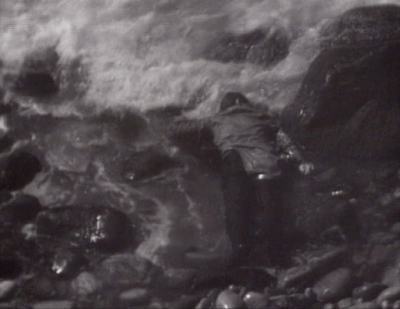
No sooner has the seer made his prediction than we hear Vicki screaming. Looking down from the cliff, she and Carolyn see a figure on the beach- a man face-down in the water. We hear the tide and the wind, sounds of nature on a large scale, and the immobile figure seems to represent something vast and inevitable.
Vicki tells Carolyn that David was the one who sabotaged Roger’s car, which Carolyn accepts as fact almost immediately. The story does build a foundation for Carolyn’s reaction- she repeatedly calls David a monster, and has been guilt-stricken at the thought that she let Burke into the house to commit the crime. But it is also the first example of what will become the hallmark of all of Nancy Barrett’s performances on the show. Her characters are the first to throw themselves into whatever is going on. She comes to serve as a one-woman chorus backing whoever happens to be the protagonist at the moment.
Liz still refuses to face the facts about David. When Vicki finds David’s Mechano magazine in her underwear drawer with the page about hydraulic braking systems marked, she and Carolyn see it as evidence that David had access both to the drawer and to the technical information he needed to commit the crime. Liz sees it differently, saying in a distant, ghostly voice “It was in your room, Miss Winters.”
Liz’ ghostliness is highlighted strikingly earlier in the episode. In the upstairs hallway, Carolyn is chattering away about ghosts, both the metaphorical ghosts of current problems resulting from past conflicts and the literal ghosts that, she would have you know, most definitely exist. Vicki looks at the door to the rest of the house which inexplicably opened and closed itself a few episodes back, and gasps as it opens again. This time it’s Liz coming out, having looked for David in the closed-off wing. Liz is impatient with the girls’ talk of ghosts, but her manner and appearance as she enters through that door are spectral.
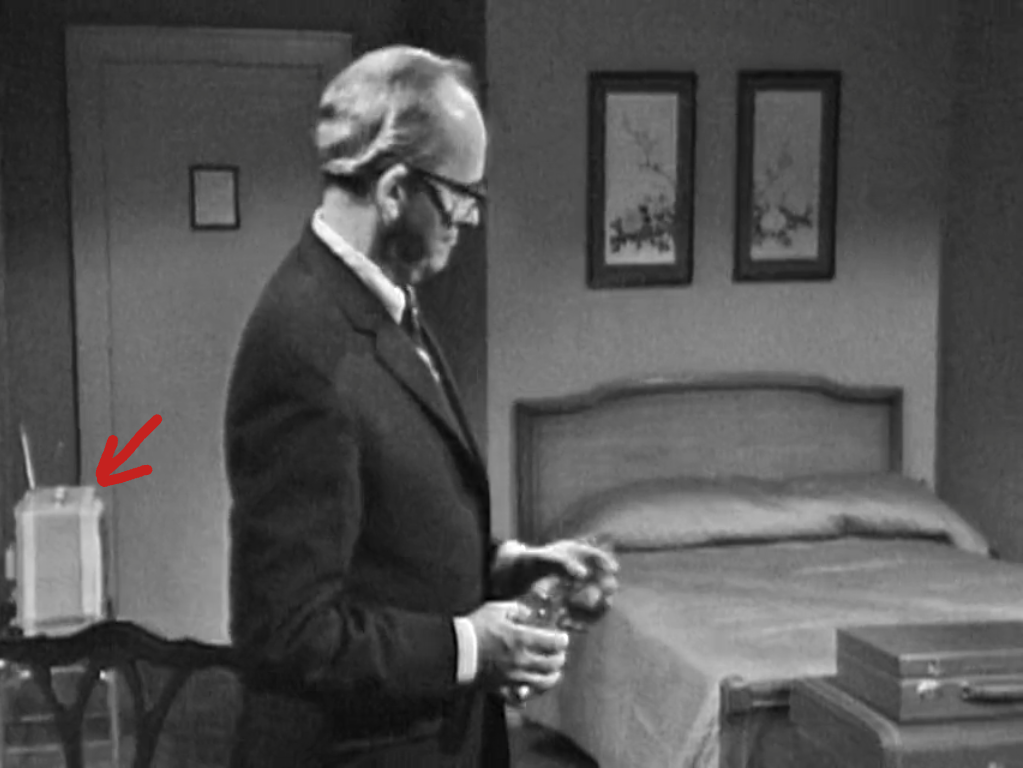
The other setting in today’s diptych is a hotel room in Bangor.* Burke is meeting a private investigator there. He’s giving him a tough assignment. He wants more information about the Collinses in less time than the investigator had originally expected. He also wants the job done in absolute secrecy, and if the Collinses catch wind of the project the investigator will suffer dire consequences. The investigator is played by Barnard Hughes, a highly accomplished actor, and his skills are needed. Burke is being harsh and unreasonable, and the investigator is being deferential. Hughes is able to give his character enough texture that he seems to be keeping his dignity. Without that, Burke would have come off as a bully. The audience has to like Burke, so Hughes makes an important contribution to the show in this, his only appearance.
There’s an irony to Burke’s hard-driving intensity. He’s looking for information to hurt the Collinses, while the women at Collinwood have information far more damaging to the family than anything he’s sending his man to look for. So we’re in suspense as to what he’ll do when he catches up to them.
*In a comment on Danny Horn’s Dark Shadows Every Day, “TD” points out that the hotel room in Bangor has a television set, the first such device we see on Dark Shadows. We will not see another until 1970. That one will be in a parallel universe. We never do see a TV set in the Collinsport of the main continuity.
Evidently Mr Bronson had the hotel send a TV up to his room.
In the teaser, Carolyn asks Vicki what’s on her mind. “The meaning of life?” “No, just the opposite- death.” Exchanges like that go a long way towards explaining the appeal the show has to depressives. Casting makes a difference, too- actresses Nancy Barrett and Alexandra Moltke Isles seem to be far from death-obsessed, so they can deliver the most preposterously gloomy lines without boring the audience.
After the first break, Vicki and Carolyn are having breakfast in the kitchen. As it always does, that set creates an intimate atmosphere which makes it seem natural that the characters should share confidences. Carolyn confesses her feelings of guilt at having brought Burke to the house; Vicki confesses that she doesn’t believe Burke tampered with Roger’s brakes. For some reason, Vicki tells Carolyn that when she was six years old, an attendant at the foundling home played a prank and told her that her birth parents would be coming for her. All of Vicki’s stories about her childhood are like that, it’s no wonder she feels at home in Collinwood.
There’s a scene between Bill Malloy and Burke in Burke’s room. It’s always interesting to see actors as talented as Mitch Ryan and Frank Schofield playing off each other. It is puzzling that a Collins family retainer as loyal and intelligent as Bill would go to Burke before the police have a chance to question him or search his room and tell him everything he knows and suspects about the crime. But Roger has already tipped his hand to Burke, so another indiscretion isn’t going to damage the prospects of the prosecution by much. This scene, in which Burke is eating breakfast while Bill is confronting him with his suspicions, is intercut with the scene in which Vicki and Carolyn are eating breakfast and consoling each other. So, opposite extremes- former friends in a hostile setting, new friends in a nurturing setting.
Carolyn tells Liz that Vicki doesn’t think Burke is guilty. Liz responds that she doesn’t “care what Miss Winters thinks.” Liz then collapses into pity for Carolyn and guilt about herself as a mother. She remembers that when Carolyn was a child, she would come home from school crying because the other children taunted her, saying that “Carolyn’s mother is a witch.”
That’s an interesting story, because it implies that Carolyn went to the school in town. How did she get there? It’s much too far to walk. Did a school bus come up the hill to Collinwood to pick her up and drop her off? That’s a bit hard to imagine. Liz doesn’t want anyone around the place. Sooner or later, some adventurous child would slip off the bus with Carolyn and go exploring the grounds, no doubt finding a way into the house itself. Roger didn’t live there until recently, and Liz has never set foot outside the grounds since Carolyn’s birth. The only servant on the estate is Matthew, and he and Carolyn are not at all close, not as they would be if he’d taken her to and from school every day in her childhood.
That leaves Bill Malloy. He comes to the house more or less daily to go over business with Liz- perhaps he used to combine those visits with picking Carolyn up for school and dropping her off afterward. He is very close to her, calling her “Princess.” He’d have to pick her up very early in the morning, since his responsibilities involve supervision of the fishing boats. She might still have been in her pajamas. She’d have needed to get dressed and have breakfast at Bill’s house. We learn later that he has a housekeeper who has been with him many years; much, much later, that housekeeper will reminisce with Carolyn about brushing her hair for her when she was a little girl. So maybe that was it…
Vicki talks with Liz and Carolyn about the private investigator Burke has hired to look into her background. Liz doesn’t want to talk about anything that touches on how she heard about Vicki and what she knows about her, but by a skillful line of Socratic questioning, Vicki leads Liz to the conclusion that something about her origins might be embarrassing to someone associated with Collinwood. Liz walks out of the room, as Euthyphro walks out when Plato’s Socrates springs a similar trap for him, and we can see how smart and determined Vicki is.
Scenes that focus on the question of Vicki’s origins tend not to get much attention from fandom, perhaps because the whole story-line ultimately fizzled out with no resolution. But watching it forward, not thinking about what comes later, we can see some strong scenes devoted to it.
Interesting how the early episodes tiptoe towards the supernatural. Burke, Roger, and Carolyn all use the word “ghost” metaphorically, to refer to unresolved conflicts from the past that are still causing problems in the present. Liz and Vicki, each in her turn, responds by saying there are no such things as literal ghosts, only to hear the first person assert that there absolutely are. Giving this same little conversation to both Liz and Vicki is one of the ways the show tries to establish Liz and Vicki as mirrors of each other, of presenting Liz’s current life as a possible future for Vicki and of Vicki as a revenant of Liz’s past.
The sobbing sounds Vicki hears in this one are the first occurrences that would have to be explained as the act either of a ghost or of someone trying to make Vicki believe there are ghosts. The next such moment will come in episode 14, and there will be several more in the weeks and months ahead. This tiptoeing is what the Dark Shadows wiki on fandom tracks as “Ghostwatch.”
In view of the near-sexlessness of the later years of the show, it’s striking how frank this one is. Roger’s aggressiveness towards Victoria is plainly sexual. Liz catches him trying to sneak into Victoria’s bedroom, he derides her attempt to regulate his “morals.” He offers Victoria a drink, they talk about pleasure and pain in words that so clearly about sex that they barely qualify as sens double. Indeed, that is the only moment in the whole series when Victoria seems like what she’s supposed to be, a street kid from NYC. And the flirtation between Uncle Roger and his niece Carolyn is so blatant that it’s a wonder how Louis Edmonds and Nancy Barrett keep the scene from making the audience either laugh or feel ill.