Wicked witch Angelique made her first appearance in #368/369, set in the year 1795. We first saw Angelique when she entered the doors of the Old House on the estate of Collinwood, working as a lady’s maid and hiding her powers.
Today, it is 1970 and Angelique is back in the Old House. Her ex-husband, vampire Barnabas Collins, has summoned her and asked her to lift a curse she placed on Jabe, the husband of his distant cousin Carolyn. Barnabas tells Angelique that her quarrel was never with Jabe, but with suave warlock Nicholas Blair. Earlier in the episode we had seen Angelique and Nicholas having a discussion about how much they hate each other. He taunted her by claiming she has not changed in the last 200 years. When Barnabas invites Angelique to redirect her wrath towards Nicholas, she perks up. She orders Barnabas to fetch Carolyn’s husband and leave him alone in the Old House with her.
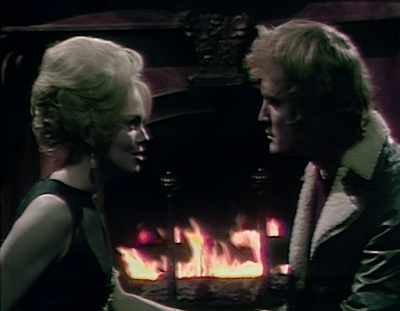
Angelique sits by the fire with Jabe and explains that she cannot simply liquidate the curse. It must end with someone’s death. But the good news is that it does not have to be his death. He can transfer it to someone else. He says he doesn’t want to kill anyone. She tells him that the person she has in mind is Nicholas. Suddenly he’s all ears as she explains the process for handing the curse over.
Angelique finds the limit of Jabe’s newfound reverence for life. Screenshot by Dark Shadows Before I Die.
Longtime viewers know that Nicholas was quite wrong to say Angelique has never changed. She was monomaniacal and utterly narcissistic in 1795. She wasn’t so very different when we next saw her in 1968, though the show’s pace was a bit slower at that point and so Lara Parker was free to play her with more nuance. That made a difference that the show underlined early in 1969, when Barnabas took a brief trip back in time to the 1790s and ran into Angelique as she was when first we knew her. Even though they were still enemies in 1968, they occasionally had to tell each other the truth, and occasionally had to leave each other alone to fight other adversaries. The unbending hostility the eighteenth century version of Angelique showed Barnabas startled him and us after we had seen the relatively circumspect approach she took to conducting a cold war against him.
Throughout most of 1969, Dark Shadows was set in 1897. Angelique showed up then, and she remembered the events of 1968. Barnabas and his friend, mad scientist Julia Hoffman, were there as time travelers. Julia actually befriended Angelique, and Angelique became Barnabas’ ally in the battles he attempted to wage in that period. Angelique even let go of her erotic obsession with Barnabas, transferring her affections to his distant cousin Quentin Collins.
After the show came back to contemporary dress, Julia stumbled upon Angelique. She found that Angelique had sworn not to use her powers, had married a man who made her happy, and had lost all interest in Barnabas or anyone else at Collinwood. She was as relaxed and attentive to others as in 1795 she had been frantic and self-absorbed. Only after it turned out the same supernatural enemies Barnabas and Julia were fighting had corrupted her husband did Angelique start casting spells again, and then in pursuit of more rational, identifiable goals than she had ever sought in the eighteenth century.
That arc of character development ends with this episode. We will see Lara Parker as several more characters up to and beyond the end of the series, some of them named Angelique, but none of whom went through the transformations we have seen.
Today also marks the final appearances of werewolf Chris Jennings and his girlfriend Sabrina Stuart. Evidently the makers of the show planned to bring them back in a few months, after an upcoming story plays out, but by that time actor Don Briscoe was unable to work. He had bipolar personality disorder and tried to self-medicate with street drugs.
Quentin was such a big hit in 1897 that they had a magic spell put on him that immunized him against aging and brought him intact to the contemporary setting. Today, Barnabas takes Quentin to a room in the long disused east wing of Collinwood where you can occasionally catch glimpses of an alternate universe. The effect manifests while they are looking in, then winks out, leaving the dark, bare room that is in that space in their universe. Once that happens, Barnabas announces “You have just seen Parallel Time.” Those of us who have been watching from the beginning know that he got the line wrong. You’re supposed to say “Parallel Time is a Dan Curtis Production.”
Dark Shadows spent a few months trying to put a story together from some themes drawn from the works of H. P. Lovecraft. A race of Elder Gods known as the Leviathan People wanted to escape from their long captivity in the underworld, retake the Earth, and destroy humankind. To that end, they controlled the minds of several people in and around the village of Collinsport, formed them into a cult, and entrusted them with the care of a fast-growing, shape-shifting monster. When the monster was able to assume the form of a grown man, he was supposed to be joined to heiress Carolyn Collins Stoddard in an unholy ceremony that would transform Carolyn into the same sort of being he was, and mark the beginning of the Time of the Leviathan People.
In #965, the unholy ceremony was underway. But the monster, who when he first appeared as an adult invited people to “Call me Jabe,” had decided he would rather become a human than turn Carolyn into a Leviathan. So he called to Carolyn’s distant cousin, old world gentleman Barnabas Collins, to whisk her away from the scene while he used the Leviathan sceptre to smash the Leviathan box, causing the Leviathan altar to explode and the Leviathan high priest to declare that the time of the Leviathans was over. He told Jabe that he had not only ruined the Leviathans’ grand design, but had doomed himself. His squamous, rugose, and paleogean form was his only true form; the tall young man is just a projection that cannot survive on its own.
Evidently, the original plan was that Jabe’s rebellion would begin a second half of the Leviathan arc. In that half, the chief villain would be a Leviathan who had been roaming the Earth for centuries and who wielded powers as great as Jabe’s even though he could not fulfill Jabe’s intended role as harbinger of Leviathan world dominion. The battle that Barnabas, Jabe, and their allies waged against that villain would involve a trip back in time to the 1790s, during a brief visit to which period Barnabas had first encountered the Leviathans. That return to the 1790s would tie the Leviathans into the tales that have become basic to the show’s backstory, including the stories of the gracious Josette, well-meaning governess Vicki, and Barnabas’ first vampire curse.
They abandoned that plan in some haste. The Leviathan arc never came together as a coherent story, and it was a flop in the ratings. So they never introduced the second Leviathan villain. In his place, they brought back suave warlock Nicholas Blair, who had been one of the villains in 1968, and made him the high priest of the cult and Jabe’s supervisor. When we hear about past deeds that Nicholas could not have done, they nonsensically attribute them either to Mr Strak, a character whose whole point was that he was only on the show once and could never be seen or heard of again, or to Jabe himself, who is four months old. The ghost who was supposed to usher in the return to the eighteenth century turns up in two episodes, does some shouting, then meets wicked witch Angelique, who tells him that he is irrelevant to the story and causes him to disappear forever.
Now, the show is gearing up to tell a story about a parallel universe that Barnabas has found in the east wing of the great house of Collinwood. But all the actors we need to kick that story off are in the cast of the film House of Dark Shadows, which had started principal photography by the time this episode was taped. So we have to find a way to take the characters left over from the Leviathan arc and make a story out of whatever it is they are doing.
Even though Nicholas has said in so many words that the Leviathan segment is over, he and his henchman Bruno are still hanging around Collinsport. They are joined by a third stooge, Angelique’s estranged husband Sky Rumson. Sky had been a fabulously successful publisher because of the deal he made when he met Nicholas and sold his soul to him, but now that the Leviathans have been defeated his enterprises are going under. Sky has apparently been crashing at Bruno’s place.
Bruno and Sky are holding a young woman named Sabrina Stuart prisoner. Sabrina had shown up and offered Bruno a packet of cash to leave Collinsport and forget about her fiancé, Chris Jennings, whom he knows to be a werewolf. Bruno refused to leave, saying that he hopes to exploit Chris’ curse for his own evil purposes. Sabrina then drew a gun on him. Before she could shoot, Sky bumbled in and distracted her. Bruno ordered Sky to guard Sabrina while he contacted Nicholas. Sky resented Bruno’s commands, but obeyed them anyway.
When Sky gets Sabrina into Bruno’s back room, she asks him what they are going to do to Chris. Sky lampshades the fact that there is no reason for him to be on the show when he says that he has never heard of Chris and has no idea what is going on. After Bruno and Nicholas have conferred, Sabrina tells Sky that they seem to have forgotten about him. Sky protests that this is impossible, since Nicholas had promised to talk with him about his future. He goes out to the front room, and sees that Sabrina was right. Bruno and Nicholas have in fact left without him.
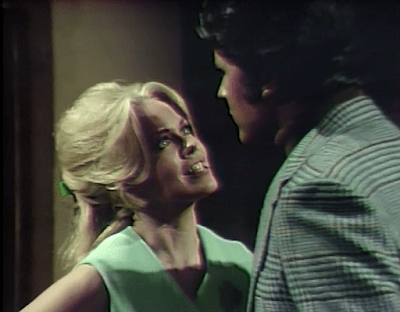
Sky finds Angelique sitting in the corner, waiting for him. She left him when she learned that he was a pawn of the Leviathans and he tried to set fire to her. She taunts him for his reduced circumstances:
ANGELIQUE: From tycoon to lackey. My, how the mighty are fallen.
SKY: Angelique, what are you doing here?
ANGELIQUE: Oh, I came to see you, Sky.
SKY: How did you know where to find me?
ANGELIQUE: Oh, I’ve been keeping a very close watch on your activities. Tell me-how does it feel to be a has-been?
SKY: What are you talking about?
ANGELIQUE: That’s what you are, you know.
SKY: I said, what are you talking about?
ANGELIQUE: Every one of your business ventures is a disaster. There’s nothing you can do about it, because all you are now is Nicholas Blair’s slave.
SKY: That’s not true! I’m very important to him!
ANGELIQUE: Oh, don’t be absurd. Consider right now, what you’re doing- what he has you doing. Keeping guard over a helpless young girl. You’re not important to Nicholas. He doesn’t care anything about you.
SKY: That’s not true.
ANGELIQUE: What does Nicholas plan to do with that girl anyway? Or hasn’t he consulted you?
SKY: Angelique, shut up!
ANGELIQUE: What’s the matter, Sky? Am I making you unhappy?
SKY: Get off my back!
ANGELIQUE: [Chuckling] Oh, you’ve grown quite thin-skinned in your declining days, haven’t you?
Shall I tell you how it’s all going to end? Nicholas is going to find some ingenious way of doing himself in, he always does. And then you’re going to be alone. All alone. With no one to turn to. And then… Someone’s going to put you out of your misery. Who knows? It may even be me. Well, I better not keep you any longer. I know you have an important job to do in the next room.
Angelique’s sarcastic characterization of guarding Sabrina as “an important job” not only reflects the lowly status of the work compared to the executive responsibilities Sky recently had as the head of a big business. The story has passed Sabrina and Chris by as completely as it has passed by Sky, Nicholas, and Bruno. Chris knows that on nights of the full moon, he will become an animal who, if not restrained, will kill at least one random person. Both magical and scientific means to relieve him of his curse have failed, but he has friends who will keep him cooped up on those nights so that he doesn’t hurt anyone. Yet he persistently refuses to let them do so. He is deliberately choosing to be a serial murderer. Not only is there no moral ambiguity about him, he has no plans or goals to draw our curiosity and win our sympathies in spite of ourselves. He is a simply and tediously bad person, and to the extent that livelier characters go along with him we like them less. Since Sabrina has no interest in anything other than her relationship with Chris, the two of them are both useless.
Nicholas is puzzled that Jabe continues to exist. He thinks that Jabe’s love for Carolyn, whom he has married, is giving him such a strong will to live that he has managed to hold onto his humanoid form for so long. As Angelique indicated when she told Sky that “Nicholas is going to find some ingenious way of doing himself in, he always does,” Nicholas’ run on the show in 1968 ended with the total failure of all his efforts and his abrupt recall to Hell. But he hopes that he can turn things around for himself. He was only seconded to the Leviathans by his real boss, Satan. He thinks he might be able to get his career back on track in Satan’s organization if he can be the one to destroy Jabe. To that end, he wants to use the werewolf to kill Carolyn, thereby depriving Jabe of his zest for life and making him fade away.
Siccing the werewolf on Carolyn is a typical Nicholas scheme. Even in his monstrous form, Jabe was defenseless against werewolves. So all Nicholas has to do is set the werewolf on him. Bringing Carolyn into it only increases the chances of failure. Moreover, Jabe is likely to be killed off soon, so we might have been willing to believe Nicholas would be the one to do it. But Carolyn has been a core member of the cast since the first week, so once Nicholas promulgates a scheme that involves her death, regular viewers know nothing will come of it.
Moreover, Nicholas has only a short time to make good his designs on Jabe. Angelique blames Jabe for Sky’s involvement with the Leviathans, and has taken a page from George MacDonald’s 1858 novel Phantastes by plaguing him with an autonomous shadow that occasionally appears to him. The shadow that attached itself to Anodos, MacDonald’s protagonist, was an allegory for anxiety as a consequence of unredeemed sin, but the shadow Angelique imposes on Jabe is a direct threat to his physical survival. It grows in size and intensity at each appearance, and when it engulfs Jabe entirely it will kill him.
In the drawing room of the great house of Collinwood, Jabe calls on Angelique to relieve him of the shadow. Nicholas comes instead. Jabe asks him for help against the shadow. He refuses. He does say that he very much hopes that he, not Angelique, is the one who finishes Jabe off, but he will not try to remove the shadow even to improve his own odds of success. Again, we are left wondering why the camera keeps settling on Nicholas if he won’t take action to change the direction of the plot.
Angelique appears to Jabe after Nicholas has gone. Jabe pleads with her to lift the shadow, and she says no. He tells her he had nothing to do with Sky’s recruitment to the Leviathan cult, and that he barely knows Sky. Angelique knows these things to be true, so she pauses before she answers him. She tells him he was the center of the Leviathan conspiracy, so she blames him for everything done in the course of it.
We end up at Bruno’s place. Sky has told Chris that Sabrina is being held prisoner there, and has given him the key. Chris lets himself in and opens a closet. He finds Sky in it, strung up by his wrists and bleeding. Sky begs for help, and Bruno appears. He holds a gun on Chris and greets him with “Good evening, Mr Jennings! Sabrina and I have been waiting for you.”
Writer Gordon Russell deserves a lot of credit for taking this unpromising material and coming up with a well-constructed script with a fast pace and intelligent dialogue. The actors also do a good job, all of them except the woefully inept Geoffrey Scott as Sky.
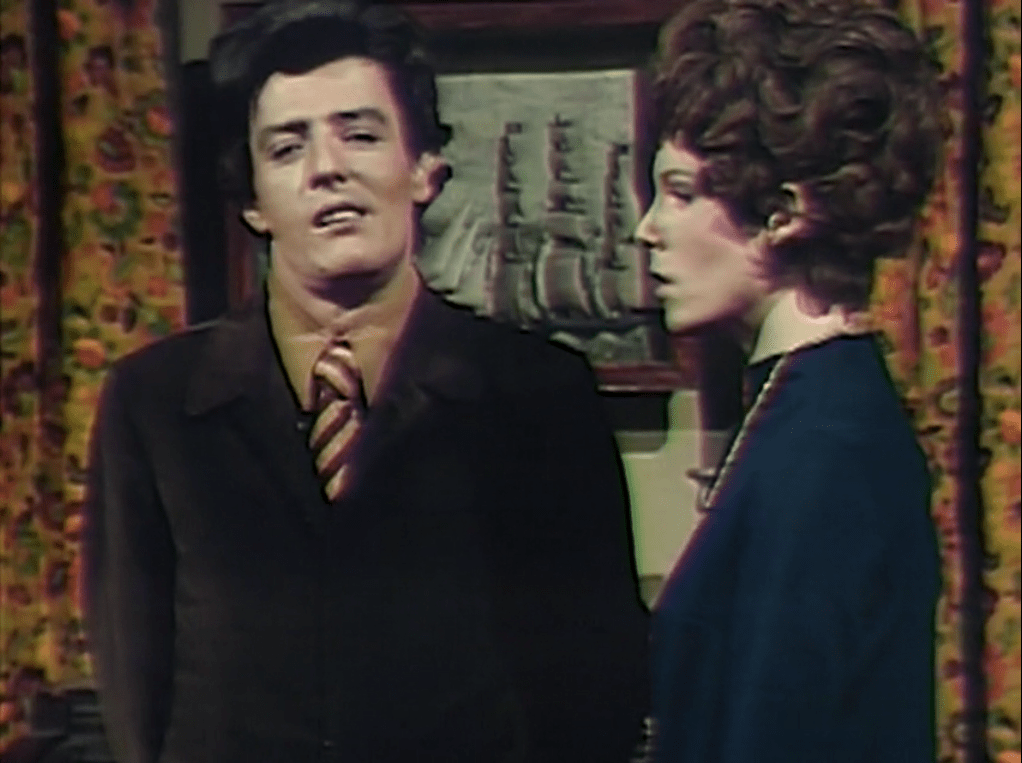
But director Henry Kaplan really does let everyone down. The episode starts with a fantastically bad job of blocking. Bruno and Sabrina are standing at right angles to each other, enabling us to see both of their faces.
Right angle pose.
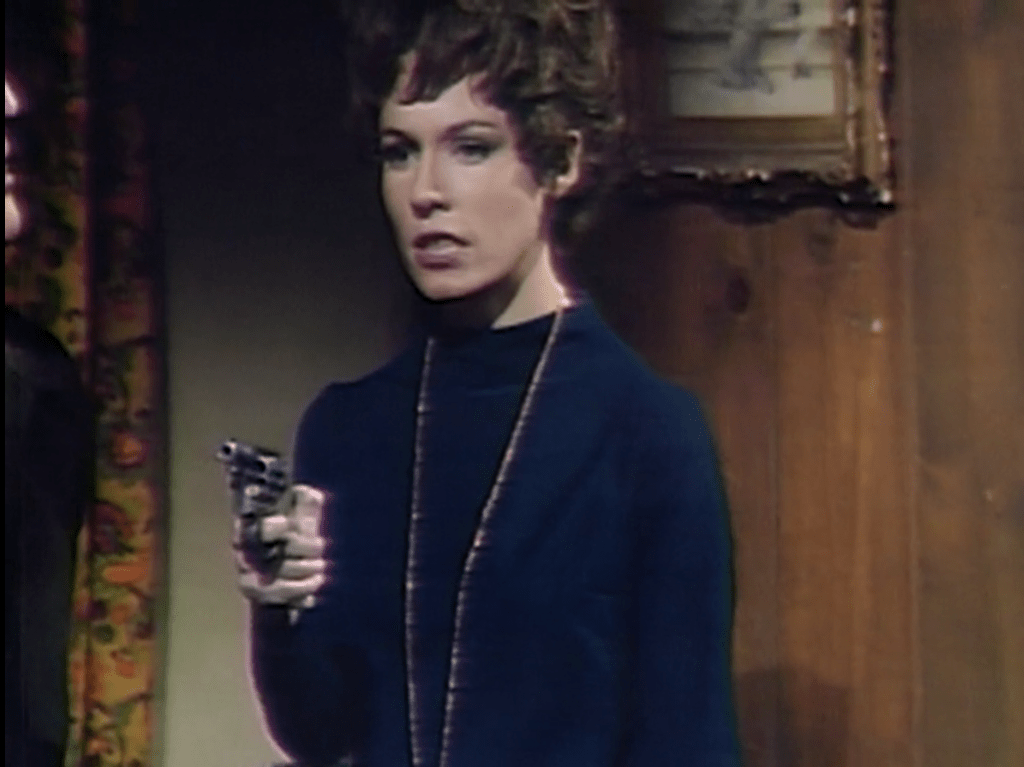
Unfortunately, this pose means that when Sabrina draws her gun, she is not pointing it at Bruno, but holding it in front of him and threatening to fire it into the wall. Kaplan’s habit of relying heavily on closeups in lieu of a visual strategy does nothing to obscure this, and viewers who missed yesterday may be genuinely puzzled as to who or what Bruno is afraid Sabrina will shoot.
For most of 1969, Dark Shadows was a costume drama set in the year 1897. Among the characters we got to know were Quentin Collins, Charles Delaware Tate, Count Petofi, and Amanda Harris. Quentin was a rakish libertine and occasional murderer who was cursed to be a werewolf. Tate was an artist. Petofi was a sorcerer who had, for reasons of his own, given Tate the power to paint portraits with magical effects. Tate painted a portrait of Quentin that cured him of the effects both of lycanthropy and of aging. He painted a portrait of an imaginary woman, and she popped into being and became Amanda.
The story of Quentin’s portrait is borrowed from Oscar Wilde’s 1895 novel The Picture of Dorian Gray. The story of Amanda is borrowed from the story of Pygmalion and Galatea that Ovid told in Book 10 of his Metamorphoses. While Pygmalion’s statue of the ideal woman loved him when it came to life, Amanda can’t stand Tate. That’s understandable; like all characters played by Roger Davis, Tate had an intolerable personality. Amanda fell in love with Quentin, who is cruel and evil, but very charming.
Now it is 1970. Quentin has come back to the village of Collinsport, still young and handsome, but suffering from amnesia and unwilling to believe that he is a hundred years old. Amanda is back too. She is also young, not because of the painting, but because a god of death named Mr Best gave her several decades to reconnect with Quentin, get him to say he loves her, and then live with him ever after, perhaps happily.
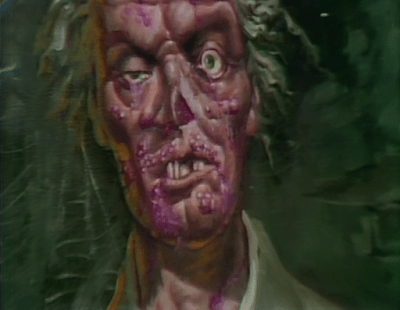
Mad scientist Julia Hoffman has been working with Amanda to restore Quentin’s memory. Julia, Amanda, and Quentin go to see Quentin’s portrait, which Julia has just had restored. It is suitably gruesome, and Amanda runs out screaming when she sees it. But Quentin examines it, and his memory comes back to him. Julia tells him about Amanda’s deal, and says that Mr Best is on his way. He could catch up with Amanda at any time. Quentin runs out to tell Amanda that he loves her, but gets to the scene a moment too late.
Quentin’s portrait, a face only a fan of EC Comics could love. Screenshot by Dark Shadows Before I Die.
Mr Best takes Amanda to a hotel lobby. She described this lobby to Julia in #922 when she explained her arrangement with Mr Best, but he has to explain it to her today. In #922 he called it “The Stopping-Off Place”; today he calls it “A Passing-Through Place.” He excuses himself, since he has other souls to harvest.
Amanda is alone for a moment with a bellhop in a white costume with an accent that is supposed to be sort of Cockney, or perhaps Australian. The bellhop makes it clear that he used to be alive, and that his current job makes him nostalgic for his days as a human. When he mentions things he can’t do anymore, he looks Amanda up and down for a half second. The wistfulness of his tone, the frankness of his look, and the sadness with which he turns away from her leaves no doubt what he misses. It’s a surprisingly lovely moment, and a much more adult one than we expect from the show at this point.
Back in the land of the living, Quentin and Julia have a scene in Amanda’s suite at the Collinsport Inn. Julia leaves, and Quentin tries to kill himself. Mr Best stops him. He tells him that he knows he is alive “by courtesy of Count Petofi”; this is the first time we have heard Petofi’s name since the show came back from 1897, and the first vague hint that Petofi might have survived the fire that appeared to have killed him in #884. He says that it is not Quentin’s time to die.
Quentin says he doesn’t want to live without Amanda, and Mr Best gets a bright idea. He says he likes experiments, and he has one he will run with the two of them. He takes Quentin to The Stopping Off/ A Passing-Through Place. He explains his idea. As befits Amanda, it is derived from the tale of Orpheus and Eurydice which Ovid tells earlier in Book 10 of the Metamorphoses. As Orpheus was allowed to bring his wife Eurydice back from the realm of the dead so long as they could make the long, arduous journey without looking at each other, so Quentin will be allowed to bring Amanda back so long as they do not touch each other until they return to the sunlight. The episode ends with Quentin deep in thought about this proposition while Amanda walks up behind him, stretching her hand towards him.
Mr Best tells Quentin that if he and Amanda can make their way through the countless traps and perils of the journey back to the upper world, they will be together “for eternity- whatever that means.” It’s intriguing he doesn’t know- he explicitly identifies himself as an immortal being today, and he has such a wide range of discretion that he can only be called a god. Apparently writer Sam Hall is imagining a cosmos where even the gods are left guessing about the answers to the big questions.
The story of Orpheus and Eurydice has long been a popular favorite. In the 1960s, Jean Cocteau’s 1950 Orphée and the 1959 Brazilian hit Black Orpheus were both staples of art cinema and would have been familiar to NYC theater people like the makers of Dark Shadows, so it is hardly surprising that when they start looking to classical antiquity as a source of material that was one of the first stories to come to mind.
This is Emory Bass’ final appearance as Mr Best, and Brian Sturdivant’s only appearance as the bellboy from Hell. Each will return in another small part later this year.
The closing credits roll over an image of Quentin’s portrait. Most of them do, anyway. Sturdivant’s was cut into the middle of the roll over a black background. Apparently they forgot about him until the last minute.
In June 1966, Dark Shadows opened with a train carrying well-meaning governess Victoria Winters and dashing action hero Burke Devlin from New York City to Collinsport, Maine. Vicki and Burke first met at the train station in Collinsport. When she found that no one was waiting to take her to the great house of Collinwood, Burke volunteered to drive her there. We haven’t seen the train station since, and all subsequent references to mass transit to and from Collinsport in the 1960s have been about buses. That is to some extent an adjustment to real-world history. In our universe, passenger train service to central Maine had already stopped by 1966.
Now, the show is set in 1897. Devastatingly handsome reprobate Quentin Collins has talked the lovely and mysterious Amanda Harris into joining him on the 6 PM train from Collinsport to NYC. Amanda and Quentin will remind viewers who have been with the show from the beginning of Vicki and Burke. Quentin is no hero, but he serves the plot function Burke did in those early days, antagonizing all the authority figures and fascinating all the women and children. Amanda takes part in some sleazy schemes, while Vicki was eventually forced to be an impossibly stainless model of virtue. But as Vicki was on a quest to learn the truth about her biological parents and felt she could know nothing about herself until she found out who they were, Amanda is tormented that she has no memories and no information about herself dating beyond two years into the past. And as in the first week Vicki was a savvy New York street kid who could keep smiling while she fended off the indecent advances of the lecherous Roger Collins, so Amanda sees right through the equally lecherous but toweringly hypocritical Rev’d Mr Gregory Trask.
Quentin and Amanda agree to meet at the train station. Amanda has to hide from Trask and from a repulsive little man named Charles Delaware Tate, and so she will spend the afternoon in a vacant house on Pine Road where a friend of Quentin’s is squatting. Quentin will settle his affairs at Collinwood. When they made this plan, my wife, Mrs Acilius, said that Dark Shadows has so consistently shown that when its characters leave separately they do not meet each other at their intended destination that it would be a surprise if they get on the train together. Indeed, from the time Amanda leaves Collinwood the suspense is not about whether their reunion will be thwarted, but how.
Tate steals a portrait of Quentin. He knows that the portrait has magical powers and is of the utmost importance to Quentin. Quentin discovers that the portrait is missing. He writes a note saying that he may not be able to get to the train station by 6 PM and asks his nine year old niece, Nora Collins, to take it to Amanda at the house on Pine Road. Nora agrees to do so.
Quentin goes to Tate’s and demands he give the portrait back. They get into a fistfight. Quentin knocks Tate out and searches the house.
Trask catches Nora on her way to the house on Pine Road. He forces her to give him the note. He reads it, and goes to the house himself. He and Amanda have a confrontation. She tells Trask that she first approached him as part of a con game she was ashamed to take part in, but when she saw him leering at her she decided that he deserved to be cheated. He furiously denies being a lecher and she calls him a liar. Trask can intimidate most people into silence, so much so that his scenes are often suffocating to watch, and it is glorious to see Amanda dump the whole truth on him and not back down.
Trask does get in one more lie. He claims that he just saw Quentin getting ready to go out on a date with his other fiancée, Angelique. Amanda doesn’t believe him but she does know about Angelique. She also told Quentin that she wasn’t convinced she was right for him, and that if he didn’t show up she would understand that he had decided they didn’t have a future together after all. So when at the conclusion the conductor sees Amanda standing on the platform by herself and tells her that it’s time to get on the train, we are to assume that she thinks it is over between her and Quentin.
The year is 1897, and the mythological world described by the ancient Greeks seems very far away. The story of Pygmalion, the sculptor who loved a statue he had made depicting an imaginary woman so intensely that it came to life, answered to the name “Galatea,” and returned his affections, is no exception to that feeling of distance. But here is the lovely Amanda Harris, who used to wonder why she had total amnesia, but now knows that the reason she cannot remember anything prior to two years ago is that she didn’t exist before then. She popped into being when a painter named Charles Delaware Tate made a portrait of his ideal woman.
Tate told her about this and told her that he loved her, but Amanda, unlike Galatea, has no desire for her creator. Perhaps this is because his personality is absolutely intolerable, a common attribute of characters played by Roger Davis. Nor is she interested in Tim Shaw, who brought her to Collinsport to take part in a scam he wanted to run on his old enemies and abandoned her in Tate’s house once he learned of Tate’s powers and thought he saw a way to make more money than his original plan was likely to yield. Instead, she is in love with rakish libertine Quentin Collins. Quentin has asked Amanda to run away with him and get married, and she agrees.
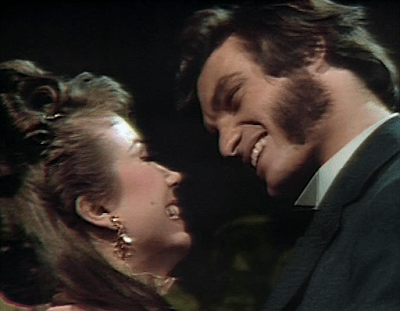
Quentin is trying to control Amanda too, but at least he isn’t a total jerk about it like those other two guys. Screenshot by Dark Shadows Before I Die.
Tim and Tate take turns intruding into Amanda’s room and telling her ugly things. Tate snarls at her that she belongs to him because he created her. This claim of ownership would be nasty however it was made, but Mr Davis’ gratingly unpleasant voice makes it truly nauseating to hear. Tim tells her that she isn’t really human, because if she is like another person Tate created she might die if someone shoots her. By that standard humans are extremely rare, but Tim goes on to explain that the man Tate created and then gunned down in cold blood while Tim watched vanished into thin air as soon as he died. So what he means is that Amanda will never be a corpse. In the context of Dark Shadows, a show that is so largely about the reanimation of the dead, this actually makes sense.
Quentin was cursed to be a werewolf, but was freed of the effects of that curse when Tate painted his portrait. When the Moon is full nowadays, the portrait changes, while Quentin himself stays the same. To extort Quentin into leaving Amanda to him, Tate steals the portrait. He tells himself that, if need be, he will destroy the portrait. If Quentin and Amanda stick with their plan of running as far away as possible very soon, they will know nothing about what Tate has done until the night of the next full Moon, when Quentin will turn into the werewolf, kill Amanda, and wake up covered in her blood. I suppose that would meet Tate’s objective of punishing Quentin, but it doesn’t fit very well with his professed belief that he loves Amanda.
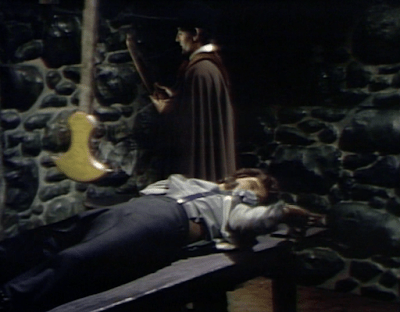
Quentin Collins is strapped to a table under a descending pendulum which supposedly has a razor sharp blade. His captor, a strange man named Aristede, tells wicked witch Angelique that Quentin will die in minutes unless she gives him the severed hand of Count Petofi, which has magical properties. Aristede is under the impression that Quentin and Angelique are engaged, and he has set the blade to strike Quentin’s body at a point causing the maximum wedding night-related inconvenience.
A little off the top I can understand, but this is ridiculous! Screenshot by Dark Shadows Before I Die.
Meanwhile, Quentin’s distant cousin Barnabas Collins has the hand and is hoping it will cure Quentin of a curse under which he is laboring. Rroma maiden Julianka claims that she knows how to use the hand to relieve lycanthropy. Her great-grandmother cured Count Petofi himself of that condition, and took the hand from him as payment for doing so. She is the only living person who knows the procedure, and no one else will know it until her daughter is born.
Barnabas and Angelique have a scene which ends with a decision to go to Aristede together. Barnabas tries to use his vampire powers to hypnotize Aristede; if he had been thinking logically, he could just have taken his bat form and flown around the meeting place, since Quentin can’t be very far from it if Aristede is going to be able to take the hand and stop the pendulum in the few minutes remaining. Instead, he lets Aristede lead him far in the wrong direction. When it seems to be too late, Aristede taunts Barnabas by telling him where to find Quentin’s body. To his consternation, Barnabas then vanishes and the squeaking of a bat rings out. Barnabas rescues Quentin at the last possible second, of course.
In #767, Quentin’s nephew Jamison dreamed that Quentin told him three things would happen that would spell his doom. The first was the discovery of a silver bullet on the great estate of Collinwood. That happened in that very episode. The last would be when the one person Quentin truly loved turned against him. We know that Jamison is the only person Quentin loves, so we know what to look for there. But the second has been a mystery up until now. Quentin said that the only person who could help him would be murdered. It has not been clear until now that there is one and only one person who can relieve Quentin of his curse. Now that Julianka has been identified as that person, viewers who remember back that far will not be surprised that at the end of the episode she is lying in the woods, a mysterious mark on her forehead, unable to move.
Diana Davila plays Julianka with her eyes always wide open. She does not blink, and when she looks from side to side she turns her whole head. The rest of her body is rigid, too, and she maintains a heightened tone throughout. This is quite effective for Julianka as written; she is supposed to seem distant and unapproachable. Miss Davila bobbles over a few too many of her lines for the performance to reach its full potential, but you can see what she was going for, and it was terrific.
Quentin Collins has devoted himself to the pursuit of evil, and as a result he has two intractable problems. When Quentin murdered his wife Jenny, her sister, broad ethnic stereotype Magda Rákóczi, turned him into a werewolf. Magda later found out that Jenny had borne twins to Quentin, and since the curse is hereditary she tried to lift it. She placed the magical “Hand of Count Petofi” on Quentin before his transformation. That didn’t stop him becoming a wolfman, but it did cause his face to be severely disfigured when he returned to human form.
Now Quentin has made his way to the house of Evan Hanley, his onetime friend and partner in Satanism. Evan had recently been disfigured in the same way Quentin is disfigured, also as a result of contact with the hand, and Quentin knows that Evan stole the hand from Magda to use in an attempt to de-uglify himself. When Quentin sees that Evan is handsome again, Evan denies that he used the hand to restore his looks. He claims not to know what happened. That is as frustrating for the audience as it is for Quentin. We were sure Evan would start looking like himself again, and they went to enough trouble to show that he was not able to correct his appearance by himself that we were expecting the cure to involve a significant plot point. When Evan presents us with “It just happened” as his explanation of how he got his old face back, we are quite sympathetic to Quentin’s decision to grab a blunt instrument and knock him out.
Quentin finds the hand in a box in Evan’s desk, and a strange man immediately enters. He demands Quentin give him the hand at once. Quentin is willing to surrender the hand once he has used it to become his desperately handsome self again, but the man will not wait. He pulls a knife to underline his point. The knife is a flat piece of wood cut in a shape with some pronounced curves and no sharp edges, and the man holds it loosely at the end of an arm that is directly over the box Quentin could easily raise to disarm him. So the audience has to help a bit to make the confrontation credible. Still, the acting is very good, and the dialogue, in which the man combines lethal threats with apparently sincere expressions of sympathy for Quentin’s plight and jokes at his expense, is complex and lively enough that we are glad to make the effort. Besides, the man goes to the trouble of telling Quentin that the knife is named “The Dancing Girl” and that it was made long ago by a Persian swordsmith, so he’s giving our imaginations something to work with. I, for one, didn’t have any trouble keeping a straight face when Quentin lost the fight and the man left with the box containing the hand.
Kids, if you are going to rob someone at knife-point, do not imitate what Aristide is doing here. Screenshot by Dark Shadows Before I Die.
Quentin goes to Magda at the Old House on the estate of Collinwood and reports what happened. She is frightened, since she herself stole the hand from a Romani chieftain/ organized crime boss named King Johnny Romana. When he says that a strange man came to take the hand, she assumes that he is an emissary of King Johnny’s, and that his next stop will be to kill her. When Quentin says that the man was young, Magda is puzzled- the recognized norms dictate that King Johnny send “an elder of the tribe” to complete such a task. She sets aside her plan to flee, and agrees to help Quentin in his attempt to summon wicked witch Angelique.
Quentin and Evan conjured Angelique up in #711. In previous segments of the show, when it was set in the 1790s and in the 1960s, Angelique established herself as one of its principal sources of action. But she hasn’t had much to do in 1897. She had a showdown with fellow undead blonde fire witch Laura Murdoch Collins back in May, and has barely been seen since. Quentin and Magda speak for the audience when they wonder where she is and what she has been doing. They speculate that she might have gone home to the depths of Hell, and light some black candles to accompany an incantation meant to call her thence.
Angelique does appear, but not at the Old House. Evan finds her in his parlor when he comes to. One of the possible explanations for the restoration of Evan’s good looks was that he made some kind of bargain with Angelique; this is excluded, not only when he is surprised to see her, but when she asks questions that make it clear she knows nothing about the hand or anything that has happened since Magda brought it back with her. Angelique orders Evan to give her a complete briefing, and we cut back to the Old House.
Quentin is still in front of the black candles, fervently reciting his mumbo-jumbo, and Magda is telling him they have failed. After a moment, Angelique enters. Quentin jubilantly declares that he has succeeded in summoning her, and Angelique says that she is not aware of that. She tells him she was with Evan, and asks about the hand. Quentin tells her it was taken from him, and asks for her assistance. She says she is willing to help him, for a price, and that as a token of her good faith she will retrieve the hand. But first she insists he tells her everything he knows. We cut to the waterfront.
There, the man who took the hand from Quentin is standing alone in the fog. Angelique enters and flirts with him. He gives his name as Aristide. She says she is a puppeteer, and that if he lends her his handkerchief she will perform a trick. She wraps his handkerchief around the neck of a doll depicting a Continental soldier, a familiar prop from 1967 that became prominent during the 1790s segment, and squeezes it. Aristide begins choking, and Angelique orders him to give her the hand before he dies.
The closing credits bill Michael Stroka as playing “Aristede,” an unusual spelling. The following item, posted in the comments under Danny Horn’s post about this episode at Dark Shadows Every Day, confirms my resolution to stick to the conventional spelling:
Factoid… I have the original script for episode 808, and Aristede is spelled throughout as Aristide.
Comment left 3 September 2017 by “Isaac from Studio 16 on W 53rd” on Danny Horn, “Episode 792: Dances with Wolves,” Posted at Dark Shadows Every Day, 19 December 2015.
In the same comment thread, Carol Zerucha goes on at length about Stroka’s ethnicity. He was Slovak, as she is, and she had a big crush on him when she was a kid watching the show. The characters in today’s episode assume that Aristide is Roma, but Ms Zerucha points out that we have no reason to assume they are right, and that he, too, might be Slovak.
Also in that thread, FotB “Straker” says that Aristide looks like William F. Buckley, Jr. I agree. I wish they had at some point cast him as a character who leaned way back in his chair and used polysyllabic words.
Schoolteacher Tim Shaw was introduced in #731. The name “Shaw” is common enough that few viewers are likely to have found any significance in it at the time. It is true that Dark Shadows is at this point a costume drama set in 1897 and that George Bernard Shaw was coming into his own as a playwright in that year. The show was written, acted, and directed largely by theater people, and is so self-consciously stagy that it is possible there might be a reference of some kind to Bernard Shaw in a character’s name. But there doesn’t seem to be anything especially Shavian about Tim.
Today we learn the reason Tim was called Shaw. Satanist Evan Hanley gives Tim a potion that robs him of his will. He holds up a deck of playing cards and tells him that when he sees the Queen of Spades he will know it is time for him to murder someone. In Richard Condon’s 1959 novel The Manchurian Candidate, soldier Raymond Shaw was brainwashed into becoming an assassin when he saw the Queen of Hearts; in the John Frankenheimer’s 1962 film based on the novel, Raymond’s trigger was the Queen of Diamonds.
Frankenheimer’s film is one of the supreme examples of a movie that shouldn’t have worked, but did. No part of the plot stands up to rational analysis for one second, but when the tale is told through stark black and white imagery that puts us deep in the world of a nightmare it is spellbinding. Unfortunately, the irrationality of the plan the villains carry out and of the other characters’ responses to their evil deeds in The Manchurian Candidate are on full display in this homage, without the paranoid verve that makes the movie compelling. All by itself the potion puts Tim so deep in Evan’s power that he gladly goes to witch Magda Rákóczi to buy poison and insists she sell it to him even after she has pointed out that it is useful for nothing but murder. It doesn’t seem there is anything left for the card to add to the control Evan has over him.
It gets worse. Evan is acting as the agent of the evil Rev’d Gregory Trask. Trask is unhappily married to a woman named Minerva, and is blackmailing Evan into sending an assassin to kill her. When Evan shows Tim the card today, he confirms that the intended victim is a woman. But why not have him kill Trask? As my wife, Mrs Acilius, points out, if Trask dies, Evan will be free of the threat of blackmail. So if he is prepared to be a party to murder, you’d think he would forget Minerva and commit the crime he has a motive to commit.
The highlight of today’s episode doesn’t have anything to do with Evan, Tim, Minerva, or Trask. It is a scene between Magda and sometime maidservant Beth.
Beth has come to the Old House on the great estate of Collinwood to plead with Magda to lift a curse she has placed on Beth’s boyfriend, rakish Quentin Collins. Quentin murdered his estranged wife, Magda’s sister Jenny, and as revenge Magda turned him into a werewolf. Magda is unimpressed with anything Beth says until she tells her that in spite of everything, she will marry Quentin and go away with him. Magda marvels at this and asks Beth if she will really go through with it knowing that any son Quentin might have will suffer from the same curse. Shocked, Beth asks Magda if she means what she has said, and she repeats that Quentin’s son will also be a werewolf. Beth replies that in that case, Magda has laid a curse upon her own kin.
Magda dismisses this, saying that Jenny had no children by Quentin. Beth says she is wrong, that Jenny bore twins, a boy and a girl. Beth lays the story out systematically, and it dawns on Magda that she is telling the truth. Magda calls out to Jenny’s spirit and begs forgiveness, saying she did not know. Beth says that it is time to lift the curse, and Magda tells her to get a pentagram and make sure the boy wears it all the days of his life. Beth has her own moment of horrified realization. “And… you can’t end it? Can you?”
Beth realizes Magda does not know how to undo the curse.
Terrayne Crawford had some weaknesses as an actress that severely undercut her in her first weeks as Beth. But this scene is right in her wheelhouse. She is flawless as she portrays Beth’s progression from weepy begging to methodical explanation to utter shock. And Grayson Hall of course brings great power and vivid color to Magda.
We’ve been waiting for this scene since #642, months before Magda first appeared in #701, let alone before she placed the curse on Quentin in #750. In that episode, back in December 1968, the show took place in a contemporary setting. The characters had noticed some strange goings-on, and held a séance as part of their inquiry. The spirit they reached was Magda, who spoke regretfully of “my currrrse!” It’s taken more than 24 weeks, but Magda has finally learned what she already knew when we first heard from her.
Well-meaning time-traveler/ bloodsucking fiend Barnabas Collins enters a cottage on the grounds of the estate of Collinwood to find thuggish groundskeeper Dirk Wilkins standing over the freshly stabbed corpse of the rakish Quentin Collins. Since Quentin’s cause of death is a long-bladed thrusting dagger, a weapon also known as a “dirk,” it would seem clear that Wilkins is the culprit. But as it happens, Barnabas saw Wilkins enter the cottage a moment before, so he can be fairly sure he did not kill Quentin.
Nonetheless, Barnabas threatens to go to the police and accuse Wilkins unless he answers “a lot of questions.” Barnabas doesn’t have any witnesses to back up his version of events, and though he claims to be a relative of the ancient and esteemed Collins family he only arrived in town a few weeks before. But Wilkins isn’t hard to intimidate, so he answers some of Barnabas’ questions about madwoman Jenny Collins. Most importantly, he tells Barnabas that Jenny is the estranged wife of Quentin, not of Quentin’s brother Edward as the audience had been led to believe in the four weeks leading up to Friday’s episode.
As Wilkins, actor Roger Davis has been getting very careless with his lines. Jonathan Frid always had a lot of trouble with his own dialogue, but he is clearly sticking with the script in an exchange like this:
Wilkins: Mr. Collins, you gotta understand that she’s crazy in the head! She could hurt herself — or somebody!
Barnabas: Who do you mean by “we”?
This comes to a head with one of Dark Shadows‘ most famous bloopers:
Barnabas: Tell them that you saw no one here. Wilkins: Oh, that’s fine. What am I gonna tell ’em? Barnabas: That you saw no one here!
Jenny is being kept in a cell in the basement of the great house on the estate. Wilkins and maidservant Beth were assigned to watch her. On Friday Jenny bashed Wilkins on the head with her dinner tray, unfortunately not hard enough to kill him and get the odious Mr Davis off the show. She did knock him out, though, and ran off to the cottage to stab Quentin. We cut to the cell, where Jenny is babbling to Beth. It gradually dawns on Beth that Jenny is telling her she stabbed Quentin and killed him. Beth locks Jenny in the cell and rushes off to the cottage.
In the cottage, Barnabas has summoned wicked witch Angelique and asked her to bring Quentin back to life. Angelique points out some of the flaws in Barnabas’ plan, and tells him that even if she does grant his wish the price for her services will be very high. They seem to be approaching a tentative agreement when Beth arrives at the door and Angelique vanishes.
Beth finds Barnabas in the cottage. He tries to keep her out. It has long since been established that, as a vampire, Barnabas is far stronger than any mortal man, yet Beth pushes past him without apparent difficulty. For that matter, we also know that he is as capable as Angelique of vanishing into thin air, yet he hangs around while Beth sees Quentin’s body. Barnabas insists she tell no one what she saw in the cottage, and he is staring at her with the same intensity that has sometimes exerted an hypnotic effect on people. This doesn’t work on Beth. She says that she will tell Judith Collins, the mistress of the estate, that Quentin is dead and that Barnabas was with him. Barnabas just watches Beth go. Evidently he has given up on using his vampiric powers. Terry Crawford’s literal acting style doesn’t win her much enthusiasm from the fans of Dark Shadows, but it does add a touch of humor to a scene like this. Vampire? What’s that? Sounds like bullshit, I’m gonna report this to the boss.
We cut to the drawing room of the great house, where Quentin’s body is laid out in a coffin with candles burning on high stands by its head and foot. Barnabas and Beth are there. Beth tells Barnabas she has not yet spoken to Judith. Apparently she just took Quentin’s body to the great house on her own? And found a coffin? And carried it into the drawing room where she put Quentin in it? And that’s how the family is going to find out Quentin is dead, by seeing him lying in state in the middle of the house?
Barnabas and Beth exit, and Angelique enters. She tells the corpse that she will raise him from the dead, and that once she does Barnabas will really be sorry.
From #701, the episode in which Dark Shadows first became a costume drama set in the year 1897, they have been strongly hinting that Jenny Collins, the madwoman locked in the room on top of the tower in the great house of Collinwood, is the estranged wife of stuffy Edward Collins. Today, Jenny gets loose, and confronts Edward’s brother, rakish Quentin. It is only then that we learn that she is in fact Quentin’s wife. All of the clues that had led us to the other conclusion take on new meanings in that moment, making it one of the most effective twists on the show.
Edward is the father of two children whom we have seen, twelve year old Jamison and nine year old Nora. Jenny has been preoccupied with some dolls she has with her in her prisons, which she calls “my babies.” She is afraid someone will take her “babies” from her.
We came to 1897 along with well-meaning adventurer/ bloodsucking ghoul Barnabas Collins, who in 1969 encountered the ghosts of Quentin and of maidservant Beth. Quentin’s ghost had made the great house uninhabitable and was in the process of killing strange and troubled boy David when Barnabas decided to resort to the mumbo-jumbo that has brought him back to this period. In 1969, Barnabas was not only trying to contain the damage Quentin’s ghost was doing; he was also trying to help drifter Chris Jennings, who was a werewolf. Beth’s ghost appeared to Chris and led him to an unmarked grave containing the remains of an infant wearing an amulet meant to ward off werewolves. This proved that there was a werewolf at Collinwood when Beth and Quentin were alive, and suggested that Chris’ curse was inherited from that person.
When Barnabas first met the living Beth in # 703, he asked if there were any children in the house other than Jamison and Nora. She said that there were not. He wondered if the newborn to whose grave Beth’s ghost led Chris had already died and been buried. But now that we know that Jenny is Quentin’s wife, we remember that in that same episode Quentin caught Beth with $300 and that in #707 we heard that she had taken the money to a “Mrs Fillmore” in town. Perhaps Jenny really did have babies who were taken from her, and perhaps Mrs Fillmore is taking care of them. Perhaps, too, the “Jennings” in Chris’ name indicates that he is a descendant of Jenny, and therefore of Quentin. We have already seen Quentin dabbling in black magic- perhaps he brings the curse of the werewolf on his descendants by means of it.
Jenny’s meeting with Quentin today does not come to a happy ending as far as he is concerned. She leaves him on the floor, with a dagger stuck in his chest.
While the search is on for Jenny, Beth tells another servant that Edward and Quentin’s sister Judith has searched the west wing and is now searching the east wing. This is only the second time the dialogue has made it unequivocally clear that there are two wings extending from the main house, and the first time it is established that the east wing exists prior to the twentieth century. There was a time when the writers had not settled on which side of the house the long-deserted wing lay; the first couple of appearances of the phrase “east wing” dated from then. Subsequently, there were slips of the tongue by actors who were supposed to say “west wing.” We may wonder when, if ever, the writers will find a use for this other part of the house.





 Dark Shadows Commentary