Episode 446: You have given me nothing I can understand

Haughty tyrant Joshua Collins goes to the basement of the Old House on his estate and finds his son Barnabas rising from a coffin. Barnabas explains to his father that he has become a vampire.

Joshua and Barnabas in the coffin room. Screenshot by Dark Shadows Before I Die.

This scene prompts considerable discussion in fandom about gay subtext. In his post about the episode on Dark Shadows Every Day, Danny Horn points out that actors Jonathan Frid and Louis Edmonds were both gay, and speculates that this fact might have had some influence on the way they play Barnabas’ coming out to his father. “I’m not suggesting that this situation is intended to be a metaphor for a gay child talking to his father about his terrible, shameful secret life… But the ‘keep the secret, don’t tell my mother’ part — there’s some resonance, isn’t there? At least, it’s a hook into the story that helps us to get closer, and really feel some of the horror of this moment. A father hands a gun to his son, and says, Kill yourself, so that your mother never finds out.”

Even this tentative raising of the question, with its “I’m not suggesting” and “some resonance” and “at least,” is too much for Patrick McCray. In his Dark Shadows Daybook post about #446, he concedes that “homosexuality is the obvious choice” for an interpretive lens through which to read the scene, but goes on to flatly assert that “this isn’t a veiled metaphor for something like homosexuality.” For him, as for Danny, Barnabas figures in the scene as a murderer first and last, and Joshua as a man finding himself irrevocably severed from the world of rationally explainable phenomena.

For my part, I think that we have to remember that intentionality is always a more complicated thing in a work of art than it is when lawyers are interpreting a contract or cryptographers are cracking a cipher. Certainly the scene is not simply a coming-out scene played in code. Barnabas’ murders do not map onto any metaphor for sexual encounters. While the vampire’s bite is often a metaphor for the sexual act, Barnabas presents his acknowledgement in this scene that he has murdered three women in terms of the secrets he calculated he could keep by killing them and maintains a cold, matter-of-fact tone while doing so. When in the course of the scene Barnabas exasperates Joshua by attempting to murder him, there is nothing erotic between the men. No doubt the scene is at one level meant to be what Danny Horn and Patrick McCray say it is, the point when Joshua realizes he is part of a supernatural horror story and the audience realizes that Barnabas is a cold-blooded killer. As such, it is one of the key moments that defines the 1795 flashback as The Tragedy of Joshua Collins.

But there are other levels of intentionality here as well. One has to do with the word “vampire.” When Barnabas is trying to tell his story to Joshua, his first approach is to give him the facts and leave it to him to apply the correct label. But the facts are so alien to Joshua that they only deepen his confusion. Seeing his father’s bewildered reaction, Barnabas’ frustration mounts until he finally shouts “I am a vampire!”

We have heard this word only once before on Dark Shadows, when wicked witch Angelique mentioned it in #410, but it figured in the show as a metaphor for outness long before it was spoken. In #315, Barnabas’ associate, mad scientist Julia Hoffman, urges him not to murder strange and troubled boy David Collins. She catches herself, breaking off after saying that David deserves better than “to die at the hands of a-” Barnabas grins and teases her, asking “At the hands of a what, doctor?” He dares her to say the word and taunts her for her faux pas in coming so close to using it. Julia and Barnabas have a tacit understanding that they will discuss his vampirism only in euphemisms and circumlocutions. To say the word would be to push beyond the limits of Barnabas’ outness to Julia.

When he tries to avoid calling himself a vampire, Barnabas is trying to establish a relationship in which his father will know enough that he is no longer inclined to ask questions, but not enough to achieve any real understanding of his feelings. When he realizes that he cannot keep from using the embarrassing, ridiculous, utterly necessary word, Barnabas is forced to come out to Joshua in a way he had desperately wanted to avoid.

Moreover, Jonathan Frid’s performance as Barnabas departs starkly from anything else he does on Dark Shadows. After he calls himself a vampire, Frid’s whole body relaxes. His neck, shoulders, and hips are looser than we have ever seen them; even his knees bend a little. His voice shifts a bit away from the old-fashioned mid-Atlantic accent he typically uses as Barnabas, a bit toward twentieth century Hamilton, Ontario. At that point, he is not playing a murderer or a creature from the supernatural or an eighteenth century aristocrat- he is playing himself, enacting a scene from his own life.

Barnabas’ coming out to his father is not today’s only story about information management. Joshua rules his corner of the world by parceling out just that information he thinks people ought to have. We have seen this habit lead to disaster after disaster. In his scene with Barnabas, we see another such instance. Joshua has come to the basement because naval officer/ sleazy operator Nathan Forbes told him that he had seen Barnabas at the Old House, and that Barnabas had attacked Joshua’s second cousin Millicent. After Barnabas admits to his various murders, Joshua brings up the attack on Millicent. Barnabas denies that he had any involvement in that attack, sparking an angry response from Joshua. When Barnabas later asks Joshua why he came to the basement, he swears that Barnabas will never know why.

Had Joshua told Barnabas that Nathan sent him to the basement, the two of them might have figured out that Nathan faked the attack on Millicent as part of his scheme to trick her into agreeing to marry him and to blackmail Joshua into consenting to the marriage. That in turn might have helped Joshua find a way to prevent Nathan from carrying out his evil schemes. But his parsimony with information leaves Joshua believing Nathan’s story about the attack, and therefore puts him and the rest of the Collinses entirely at Nathan’s mercy. When we see the effect that the radical honesty of coming out as a vampire had on Barnabas, we can’t help but wonder how many misfortunes the Collinses might have avoided if they had not lived according to Joshua’s code of truthlessness.

A voice comes from the upstairs. Naomi Collins, wife to Joshua and mother to Barnabas, has entered the house. Joshua leaves his gun with Barnabas and tells him to do the honorable thing, then hastens up to meet her.

Naomi tells Joshua that she he came to the Old House because Nathan told her he had gone there. She insists that Joshua explain what is going on; he pleads with her not to ask. She tells him to think of her; a quiver in his voice, he says “I am thinking of you now.” Naomi is as mystified and as frustrated by Joshua’s refusal to explain himself as Joshua had been with Barnabas’ story, but even as she plays these reactions Joan Bennett also shows us Naomi softening towards her husband. She catches a glimpse of the lover hidden beneath the lord of the manor, peeking out from below the massive superstructure of his pride.

Back in the great house, Nathan is sprawled on the sofa, his boots resting on a polished table, guzzling the Collinses’ fine liqueurs. When Joshua and Naomi return, Nathan offers Joshua a snifter of brandy and invites him to drink it with him in the drawing room. Joshua reacts indignantly, protesting that he is not accustomed to a guest offering him the hospitality of his own house.

This exchange is familiar to longtime viewers. From March to June of 1967, when Dark Shadows was set in contemporary times, the great house was dominated by seagoing con man Jason McGuire, who was blackmailing reclusive matriarch Liz. Several times, most notably in #200 and #264, Jason poured himself a drink and invited Liz’ brother, high-born ne’er-do-well Roger Collins, to join him. Roger would protest that he was not accustomed to being offered a drink of his own brandy in his own house, often drawing the rejoinder that it was Liz’ brandy and Liz’ house, and that he was as much her guest as Jason was.

Roger and Joshua are both played by Louis Edmonds. Roger represents the final stage of decay from the height Joshua represents. He has squandered his entire inheritance, committed acts of cowardice that cost the lives of two men, and let a more or less innocent man go to prison in his place. In #4 he tried to sneak into well-meaning governess Vicki’s room while she slept, and when Liz caught him he told her he didn’t want to be lectured on his “morals,” leaving no doubt that he was looking for some kind of cheap sexual thrill at Vicki’s expense. He openly scorns his responsibilities as a father, cares nothing for the family’s traditions, and the one time we see him working in his office at the headquarters of the family’s business all he does is answer the telephone and tell the caller to contact someone else instead. He drinks constantly, is always the first to give up on a difficult task, makes sarcastic remarks to everyone, and backs down whenever he faces the prospect of a fair fight. In #273, he even admitted to Liz that, had he known what Jason knew about her, he probably would have blackmailed her too.

Joshua’s relentlessly dishonest approach to life may be rooted in fear, and it is never difficult to see that its end result would be to produce a man as craven as Roger. But Joshua himself is as strong as Roger is weak. It is impossible to imagine Roger shaking off an attempt on his life as Joshua shakes off Barnabas’ attempt to strangle him today. While Roger is prepared to sacrifice any member of his family for his own convenience, Joshua will go to any lengths to protect Naomi from the truth of Barnabas’ horrible secret. Nor does Joshua take the easy way out even when he is knuckling under to Nathan. In their scene today, Nathan makes it clear that he is willing to accompany Joshua back to the Old House. Had Roger known what Joshua knows about that basement, he would never have missed an opportunity to send Jason there and let Barnabas do his dirty work for him. But Joshua cuts Nathan off the moment he raises the subject.

Joshua does go back to the coffin room, and he finds Barnabas standing around. He is disappointed that his son has not killed himself. Barnabas tries to explain that he cannot die by a gunshot, but Joshua dismisses his words. He takes the gun himself and, with a display of anguish, shoots Barnabas in the heart. Only thus, he believes, can he keep the unbearable truth from coming to light.
Episode 348: A matter of fact

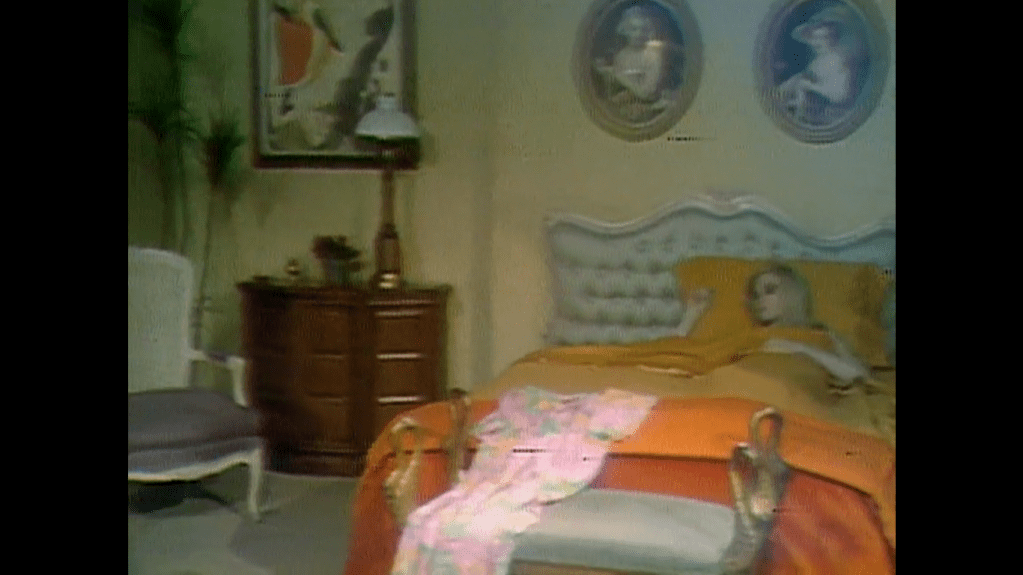
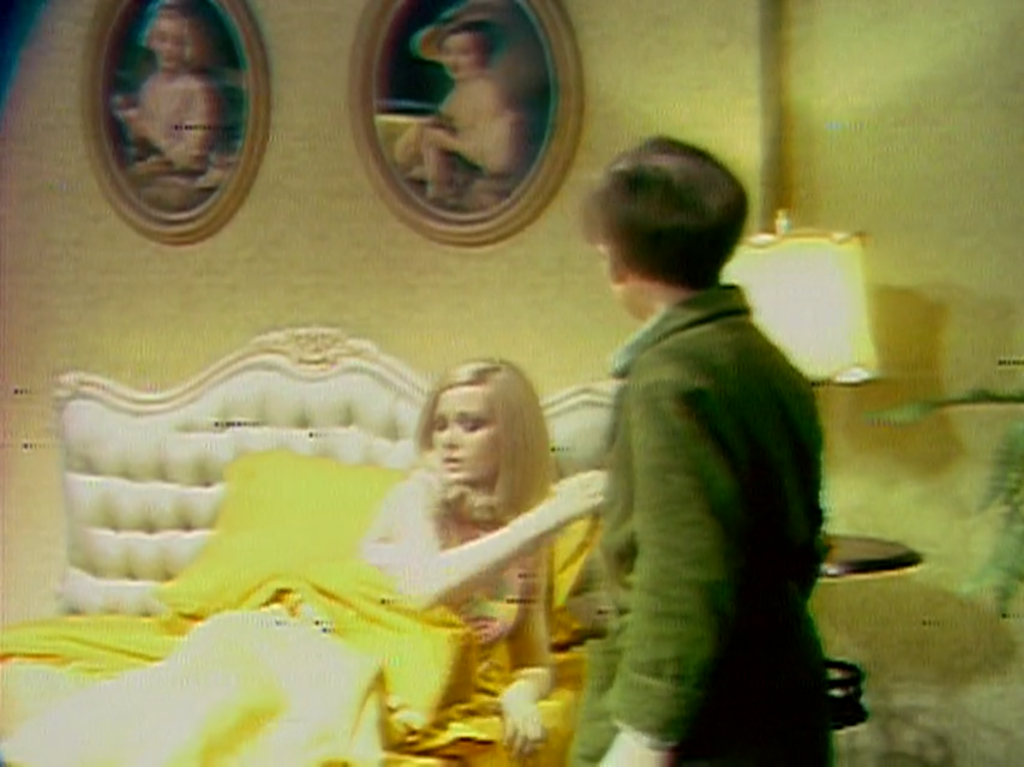
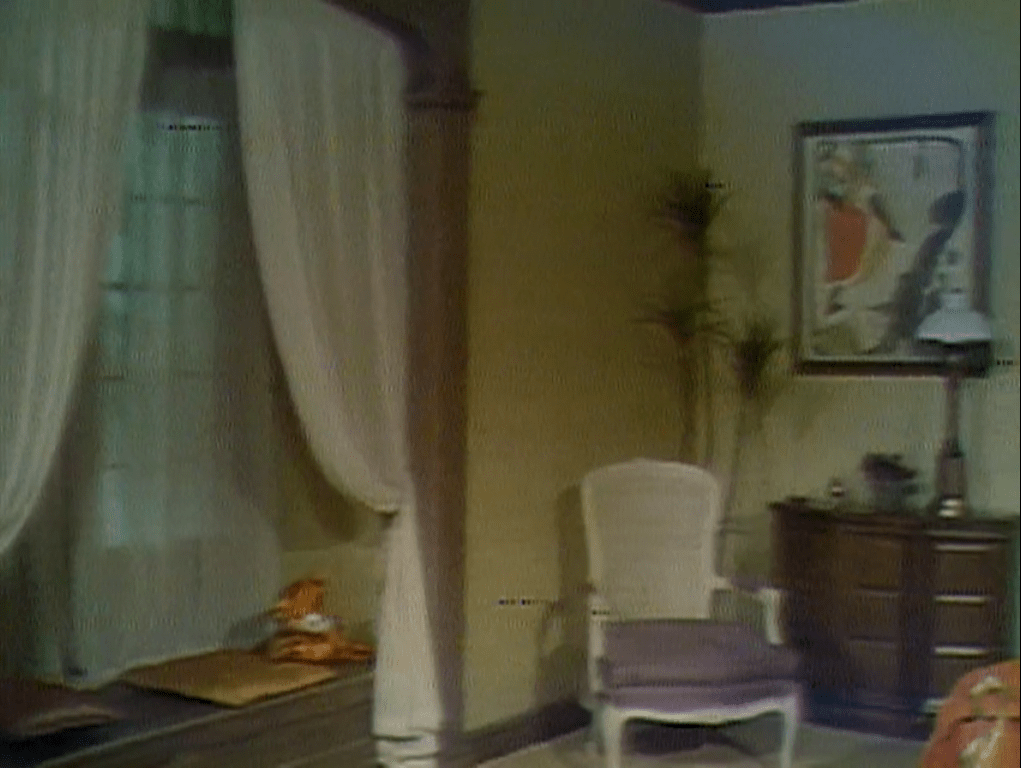
We open on a new set, the bedroom of heiress Carolyn Collins Stoddard in the great house of Collinwood. Dark Shadows has been in color since #295 in August. Though directors Lela Swift and John Sedwick were both ambitious visual artists, they haven’t been able to do much with color so far. With Carolyn’s bedroom, Swift and the staging team have accomplished one of their first real essays in color. It is composed mostly of shades of yellow, pink, and orange.

The color schemes of the other interiors we’ve seen up to this point run the gamut from sedate to subdued to drab to dank, so we already know we are in a unique space. The only other room in Collinwood that might have matched this one for brightness was the kitchen, but we haven’t seen that since #208.

Carolyn’s young cousin, strange and troubled boy David, lets himself into her room. He touches her, and she awakes with a scream. He explains that he just dropped in to make sure she wasn’t dead. When she turns on the light, the screen is so bright that I reflexively squinted, a reaction I’d never before had to an image on Dark Shadows.

Bright room.

David can’t quite explain why he was afraid Carolyn might be dead, but he does insist that she take an antique toy soldier, saying that she will be safe if she keeps it with her. Carolyn’s mother, matriarch Liz, comes into the room to investigate Carolyn’s scream. Liz wonders what David is doing there. Carolyn hastens to say that he was just making sure she was all right.

David goes, and Carolyn tells Liz she doesn’t think anything can be done for him at home. Liz is reluctant to send him away. Regular viewers will not be surprised by this. We know that Liz took David and his father, her ne’er-do-well brother Roger, into Collinwood at the beginning of the summer of 1966 and summoned her unacknowledged daughter, well-meaning governess Vicki, to come look after David starting with #1 on 27 June 1966, so that her conviction that the family ought to look after him got the whole show started. Nonetheless, Liz is so disturbed by David’s unusual statements and depressive affect that she agrees that he needs residential care.

We cut to the Old House on the estate. Vampire Barnabas Collins is sitting in a basement room where mad scientist Julia Hoffman maintains a laboratory. The room is full of electrical equipment, a bit odd since the Old House has no electricity; the laboratory itself is lit by flaming torches. But if we’ve ever seen a Universal Studios production from the 1930s, we know that where you find a mad scientist, you will find electrical currents, so naturally things start buzzing when Julia flips a switch.

Barnabas confined

Julia is trying to implement a medical cure for Barnabas’ vampirism. In the first shot of this scene, we see a visual metaphor for that project. Barnabas, an uncanny being, is confined to a small space in the middle of an elaborate collection of technology. If Julia succeeds, the supernatural will be vanquished altogether and scientific rationality will fill the whole world. The color scheme emphasizes the contrast between Julia’s optimistic goal and the terrain on which she operates. The walls and floor are dominated by the grays and browns of the basement, but the frames and tubing of her equipment are a bright metallic hue, light plays on the glass components, and the intense greens, reds, and blues of the potions are distributed in a slightly unbalanced, lively pattern. The irregular shapes of the frames and tubing emphasize this pattern, and contrast with the solid gray of the floor and the even grid of the brickwork on the walls.

This image not only represents Julia’s plans, but also one of the major themes the show is exploring at this period. Too many characters have encountered too much evidence of supernatural forces and beings for anyone to simply deny that such things exist. But even those who have been most heavily exposed to them keep reverting to a naturalistic frame of reference. Sure, Julia spends all her time hanging around with a vampire and has encountered a couple of ghosts, but she’s determined to ring all of those phenomena around with scientific explanations and technological interventions until they yield to rational control.

Julia’s project has hit its first major setback, as the latest treatment led Barnabas’ hands to age dramatically. He expresses the fear that time will catch up with him, and his apparent age will soon catch up with his actual age, something like 200 years. Julia’s hope that her experiment will not only free Barnabas of his curse, but found a new kind of medicine that will free everyone else of aging and death, will thus be defeated.

Barnabas gives a remarkable little speech about the situation he finds himself in:

I’ve been granted privileges given to few other men… For most men, time moves slowly, so very slowly. They don’t even realize it. But time has revealed itself to me in a very special way. Time is a rushing, howling wind raging past me, withering me in one relentless blast and then continues on. I have been sitting here passively, submissive to its rage, watching its work. Listen. Time, howling, withering.

Writer Joe Caldwell has a fine sense of what actors can do, and this odd little bit of purple prose is right in Jonathan Frid’s wheelhouse. It doesn’t make a whole lot of sense, but the sound of his voice delivering it is so gorgeous it may as well be Shakespeare. Well, maybe not Shakespeare, but Ben Jonson at least.

It is possible to read this speech as a programmatic statement. Daytime soap operas of the 1960s were famously slow-paced; the old joke was that a viewer saw an episode that ended with a character hearing a telephone ring, missed four months of the show, and tuned back in to see the episode that started with the same character saying “Hello.” Even by the standards of the period, the first months of Dark Shadows were notoriously leisurely, with action often as not playing out in real time. When we are watching the 21 episodes centering on Roger’s attempts to find a fountain pen he misplaced, it is indeed the case that “time moves slowly, so very slowly.” But those days are behind us. The show is whipping through plot points at a pace that many prime time series contemporary with it would have had a hard time matching.

If the speech is programmatic, it is also autobiographical on the part of the screenwriter. A fast pace promises excitement for the viewers, but makes life hard for a writing staff that never numbered more than three. Indeed, this is the last episode Joe Caldwell will write for two and a half years. Perhaps he felt the demands of the new pace as “a relentless blast” withering his talents, and had to bow out.

We return to Carolyn’s room. She is in front of her mirror, contemplating the toy soldier. She hears the strains of “London Bridge” playing on a wooden flute, which she has learned is a sign that the ghost of ten year old Sarah Collins is present. Carolyn grew up in this haunted house, so it may not be entirely surprising that her response is to lean back and enjoy the music. But she sits up when Sarah manifests herself in visible form.

Ghost in the mirror

Sarah speaks, and Carolyn sees her reflected in her mirror. The following scene is so extraordinary I’m going to transcribe all of the dialogue:

Sarah: David must have given you that.

Carolyn: Sarah!

Sarah: He told you my name.

Carolyn: Sarah, how did you get in here?

Sarah: Didn’t David tell you?

Carolyn: Tell me what?

Sarah: All about me.

Carolyn: I’m not sure I understand.

Sarah: I think I’m a ghost. Matter of fact, I’m sure I am.

Giving the facts

This is the first time Sarah has described herself in any terms, certainly the first time she has called herself a ghost. Her coyness about herself had left David confused about what she was; it was not until #325 that he finally concluded that she was a ghost. After that, she became more forthright with him. When he wasn’t sure what she was, she would wait until she was out of his line of sight to appear and disappear. But in #327, she fades away while he’s looking right at her.

Coming out to David not only allowed Sarah to relax around him, but has led her to discard her coyness altogether. She is startlingly blunt with Carolyn as this conversation goes on:

Carolyn: B-but- I don’t believe in-

Sarah: Yes you do. Or I wouldn’t have been able to come here. You’re not afraid of me, are you?

Carolyn: No…

Sarah: If you are, I understand.

This is the first confirmation that Sarah can appear only to those who are prepared to believe in her. It’s true that most of the people who have seen and heard her- David; Maggie Evans, The Nicest Girl in Town; Maggie’s father Sam; Vicki; Barnabas; Julia; Barnabas’ sometime blood thrall Willie; and local physician Dave Woodard- have either had extensive contact with the supernatural or had reasoned their way to the conclusion that she existed. But she also showed herself to Maggie’s nurse at the mental hospital Julia runs, and we don’t know anything about her background or beliefs. And local man Burke Devlin heard Sarah when she and David were talking in #327. While Burke has had plenty of contact with supernatural beings and in the early days of Dark Shadows, when he was fun, was willing to believe in them, he was at that point tearing around bellowing that there were no such things as ghosts. So this is new and unexpected information.

Carolyn’s denial that Sarah frightens her is given in a trembling voice that shows it to be a lie. Still, she isn’t as frightened as she might be. The other day, in #344, Carolyn was in David’s room when Sarah manifested there, not in the visible form of a little girl, but as the sound of “London Bridge” and as information appearing in David’s mind about Burke’s imminent death. Carolyn was terrified of Sarah when she came that way.

Carolyn: Well, what do you want?

Sarah: Don’t send David away.

Carolyn: How do you know about that?

Sarah: I don’t know, I just do.

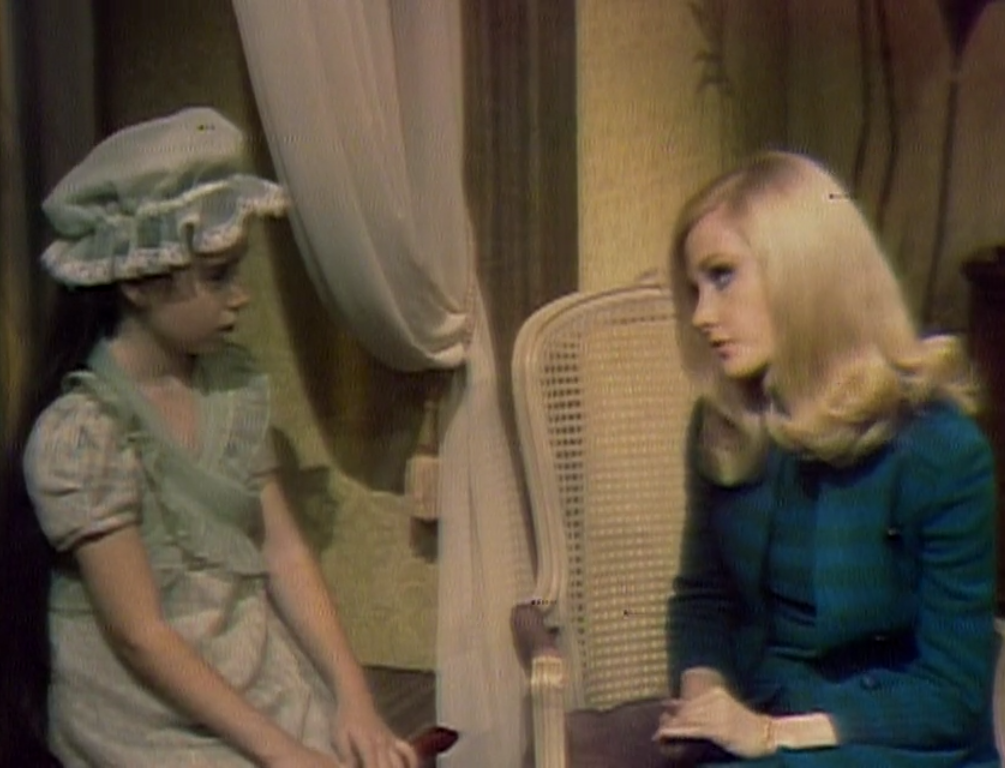
At this point, we see Carolyn’s fear fading. She is starting to react to Sarah as if she really were a ten year old girl.

Carolyn urging Sarah to be reasonable.

Carolyn: But Sarah, we have to send David away. It’s the only way we can help him.

Sarah: But if you send David away, I won’t have anyone to play with.

Carolyn: Well, maybe it isn’t good for David to play with you.

Sarah: Why do you say that?

Carolyn: Because it leads him into believing all sorts of things that aren’t true.

Sarah: How do you know they’re not true?

Carolyn: Well, they’re just not, they couldn’t be.

Sarah: He wasn’t lying about me, was he?

Carolyn: No.

Sarah: Well.. then maybe David is acting the way he is because no one will believe him.

Carolyn: But… it isn’t possible.

Sarah: People say I’m not possible, but I am. Why doesn’t that make the rest possible?

Carolyn: Sarah, maybe you don’t know the stories David’s been telling!

Sarah: Why do you think that?

Carolyn: Because they’re too fantastic! And besides, they’ve all been proved false.

Sarah: How do you know they’ve been proved false?

Carolyn: Sarah, are you trying to tell me that Barnabas actually slee-

This exchange is the ultimate example of a character accepting the existence of a particular supernatural being and then snapping back into a frame of reference that does not allow for supernatural beings. Carolyn knows that Sarah is a ghost, and starts arguing with her about how fantastic the world is permitted to be.

There comes a knock at the door. Carolyn turns away from Sarah to look at the door, and when she looks back, Sarah has vanished. Regular viewers know that Sarah was Barnabas’ little sister, that she wants to keep him from doing horrible things to people she likes, but that she will not say anything against him. So when Carolyn says Barnabas’ name, we know that Sarah is about to vanish.

Sarah’s part is an outstanding example of writing to an actor’s abilities, even more so than was Barnabas’ speech. Caldwell knew that Jonathan Frid had a flair for making flowery gibberish appealing, because that is what he has been doing the whole time he’s been on Dark Shadows. What Sharon Smyth has been doing well as Sarah is being a cutie pie and creating a vague and mysterious impression. When she has more than a few lines to deliver, things tend to get very wobbly. Today, she has to maintain a commanding tone and an adult demeanor throughout an extended patch of rapid-fire dialogue. Absolutely nothing we have seen on screen would suggest that she could handle that. But she pulls it off, more than competently. There are a few glances at the teleprompter, but at no point does she break out of the patient and authoritative manner she has to adopt. It is an impressive job of acting by any standard.

The person at Carolyn’s door is Liz. Liz is Dark Shadows‘ queen of denial. Viewers who have been with the show from the beginning have seen a few cracks in her facade of disbelief in the supernatural. In #10, she dozed off in the drawing room and started talking in her sleep about ghosts. When Vicki insisted to her in #127 that she had seen a ghost, Liz said she believed her. And in #280 and #281, Liz reluctantly agreed to participate in a séance, and afterward agreed that Vicki had been possessed by a spirit. But even in those moments Liz was fighting to keep the topic of ghosts at bay, and the rest of the time she has presented a blank wall to any attempt to face facts about the strange goings-on. So it is not surprising that Carolyn tells her mother she was talking to herself while tidying up her room.

Having talked Liz into sending David away, she now has to talk her back out of it. She manages to get her to agree to wait a few days. “London Bridge” plays. Carolyn reacts to it, Liz does not.

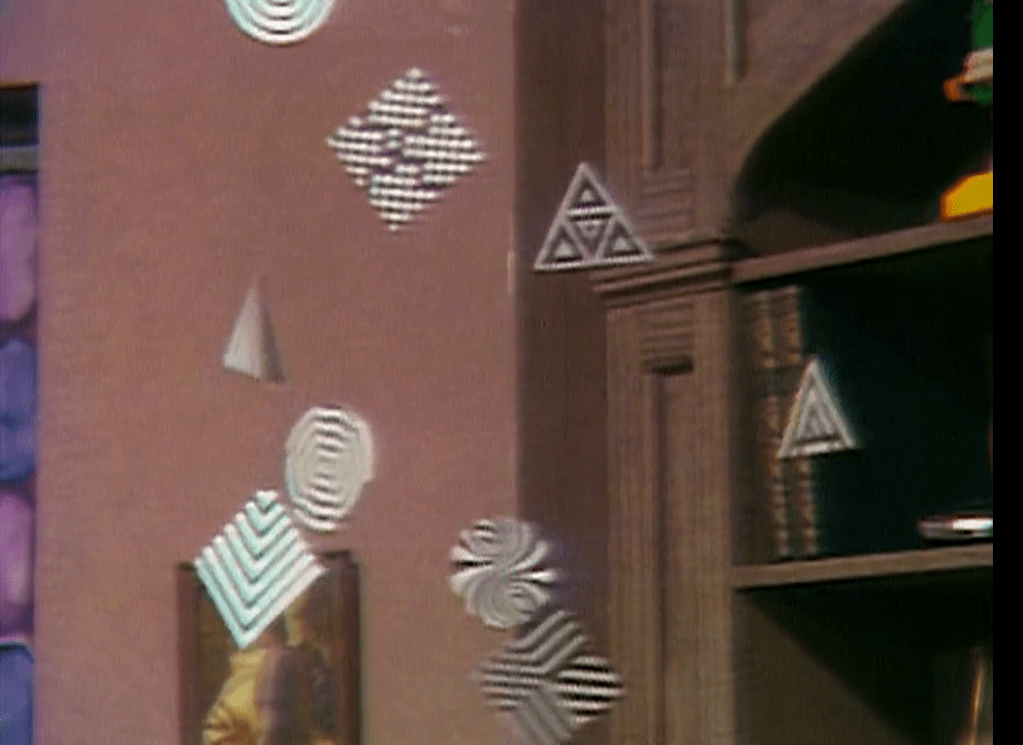
In his room, a distraught David is looking at a mobile. Its whimsical black and white markings suggest a puzzle and make a stark contrast with the vivid colors around them.*

Puzzling shapes.
Back to the wall.

Carolyn comes in. She brings the toy soldier and tells David she doesn’t think she will need it. He insists that she will, but she explains that Sarah visited her and now she believes him and knows how to help him. David is horrified by this. He says that Sarah visited Dr Woodard, that Woodard believed him, and that led to his death. He begs Carolyn not to believe him and claims to have been lying. He sobs and clutches her.

Anguished embrace.

Back in the Old House, Julia prepares to give Barnabas another treatment. He snaps at her. She tells him that whatever happens, she wants him to know that she always wished him well. That prompts him to unload a further stream of sour remarks about her competence and intentions. Julia carries out the treatments, only to find that the aged appearance of Barnabas’ hands has spread to his head.

In his post about this episode on Dark Shadows Every Day, Danny Horn puts it well when he says that “This is just good soap opera construction. People that we care about, facing terrible danger, and desperate to help each other.” He’s referring specifically to the scenes between David and Carolyn and Liz, but it applies to everyone. We care not only about the good people in the great house (well, they’ve been relatively good, lately,) but also about Barnabas and Julia, evil people who are the terrible danger David and Carolyn and Liz are facing, but who make the show fun to watch. We care about Sarah too, and she’s desperately trying to accomplish exactly the result we most want to see, an outcome in which David, Barnabas, and everyone else we enjoy watching stays on the show.

*Evidently this mobile was a commercially produced item. One of the commenters on Danny Horn’s Dark Shadows Every Day reports having had one like it as a child.

Episode 327: Snap! Like that.

For the last eight weeks, Dark Shadows has been presenting a riddle about strange and troubled boy David Collins. In #288, he wondered if mysterious little girl Sarah might be a ghost. Since then, he has seen her several times, and every time she has given fresh evidence to corroborate that hypothesis. When he isn’t with Sarah, David is either looking for her or fielding questions from adults who are anxious to make contact with her, and in the course of every search and every question he finds still more reason to suppose that she is a ghost. David had always been the first character to believe in ghosts, yet he kept resisting the obvious conclusion that Sarah was one.

Friday, David had a dream in which Sarah told him that she died when she was ten years old. In that same dream, David saw his cousin Barnabas rise from a coffin, greet Sarah warmly, and threaten him with his cane. Yesterday, David woke up and told his well-meaning governess Vicki that he now understood everything about Sarah, because he knew that she was a ghost. Vicki listened carefully to his dream. Much to his frustration, she tried to talk him out of taking it literally. But today, when David is out of earshot, Vicki twice shows the other adults that she regards David’s dream with the utmost seriousness.

In the drawing room of the great house of Collinwood, mad scientist Julia Hoffman tries to hypnotize David so that he will stop making trouble for her co-conspirator Barnabas. Before she can induce the trance, David recognizes her medallion as the one a faceless woman held before his face in the dream. He flees from Julia and calls out for Vicki.

Vicki and matriarch Liz ask Julia what happened. Julia tries to play dumb, but Vicki recognizes her medallion both as the one David described when he was telling her about his dream and as the one Julia showed her and Maggie Evans, The Nicest Girl in Town, when she dropped in on them at Maggie’s house in #298. During that visit, Vicki briefly left Julia and Maggie alone together. Before she left the room, Maggie was about to remember who abducted her and held her prisoner; after she came back, Maggie’s amnesia had returned in full force. During the interval, Julia had used the medallion to do a little emergency hypnosis, restoring the memory block that keeps Maggie from identifying Barnabas as her captor and as a vampire. Julia has reason to squirm when she realizes that Vicki has connected the medallion both with that incident and with David’s dream.

Vicki goes to David’s room to again try to talk him out of a supernatural reading of his dream. She finds him gazing into his crystal ball, looking for Sarah. He pleads with her to allow him to go look for Sarah. She resists, but he tells her that he saw Sarah in the crystal ball and that it won’t take him long to find her. He promises to tell Vicki what he and Sarah talk about. She lets him go, on condition that he be back within an hour.

The riddle of David’s long refusal to acknowledge that Sarah is a ghost is matched by the riddle of Vicki’s attitude. She has seen and interacted with ghosts on many occasions, a fact that is no secret from David. Both her recognition of Julia’s medallion and her acceptance of David’s claim to have seen Sarah in the crystal ball show that she knows she is operating in a world where supernatural forces are at work. Yet she keeps urging David back into “logical explanation”-land. Perhaps she has read Henry James’ “The Turn of the Screw,” and doesn’t want there to be any ambiguity about whether the boy saw the ghosts himself or his crazy governess put the idea into his head.

David goes to the woods, hears the familiar strains of “London Bridge,” and sees Sarah. She tells him that she knows he saw her in his crystal ball. When he asks how she knows he was looking into his crystal ball, she answers only “I know lots of things.” He asks her about his dream; apparently that is not among the things she knows about, because it all comes as news to her. David tells her that in his dream, she told him that she was very sick when she was ten years old. She excitedly replies “That’s true!” He then says that she told him she died of that sickness. Even now, after the dream, after telling Vicki that Sarah is a ghost and shouting with frustration when she won’t agree, he follows up the idea that Sarah has died with “That isn’t true, is it, Sarah?”

Before Sarah can answer, Vicki’s depressing boyfriend Burke lumbers onto the scene. He hears David and Sarah’s voices and shouts “David!” Sarah then becomes alarmed and declares she has to go away. David asks her to stay, and goes to tell Burke to wait. By the time they turn around, Sarah has vanished.

Burke used to be an interesting character, back when he was a dashing action hero played by the charismatic Mitch Ryan. In fact, he was the one who gave David the crystal ball in the first place, back in #48. But he hasn’t had much to do on the show since his major storyline evaporated in #201, and now he is played by Anthony George, an actor whose cool, understated approach was the exact opposite of Ryan’s tendency to red-hot, larger than life reactions. In the scripts written by Ron Sproat, the part of Burke still depends on Ryan’s strengths, and George is entirely at sea with it. Today, Gordon Russell’s script takes advantage both of George’s actual abilities and of the dimwitted impression he has made previously.

David tells Burke that he doesn’t think Sarah will talk to anyone other than him from now on, not because she is shy, but because she doesn’t want anyone else to know that she is a ghost. Burke gives David a smug little speech about how foolish it is to believe in ghosts. David asks how Sarah got away so fast. Burke admits he doesn’t know. David gives Burke some details about Sarah’s way of vanishing into thin air, and he is left speechless.

“You don’t know much about Sarah, do you?” Screenshot by Dark Shadows Before I Die.

Back in the drawing room, Burke tells Vicki and Liz that David thinks Sarah is a ghost. Liz reflexively asks if he ought to be taken to a doctor. Burke suavely says that he doesn’t believe it is as serious as all that, that David is just letting his imagination run away with him.

Vicki speaks up. She says that she disagrees with Burke on two points. First, she thinks the matter is very serious. Second, she doesn’t believe it has anything to do with David’s imagination. Sarah really is a ghost.

Burke starts giving another sanctimonious speech about how one oughtn’t to believe in ghosts. Some weeks ago, Sproat and recently-departed, never-lamented writer Malcolm Marmorstein had given Burke some angry speeches in which he demanded Vicki stop taking the supernatural seriously. Those speeches would have marked Burke as bad news had Mitch Ryan delivered them, but at least they might have suggested that he was going to become an interesting villain- coming from an actor as cold as Anthony George, they were just pointless nastiness. Vicki’s attempts to comply with Burke’s gaslighting campaign also did a lot of damage to her character in the audience’s eyes, presenting her as weak-willed and empty-headed.

But today, Gordon Russell doesn’t write Burke as a loudmouth or Vicki as an aspiring doormat. Instead, he lets George make a reasonable-sounding case in the quiet, detached manner in which he excelled, and he has Vicki surprise him with an equally quiet but unyielding disagreement. She tells Burke to hire all the private investigators he likes to use and tell them to search for Sarah. If they can produce the girl in the flesh, she will admit that she is mistaken. But she tells Burke that won’t happen, because “David is right- that little girl is a ghost.”

If we remember Vicki’s earlier attempts to submit to Burke’s gaslighting, this scene answers the riddle about her. She knows that there are a lot of Burkes and a lot of Lizzes in this world, and that if you want to get along with them you have to be able to present yourself as someone who doesn’t believe in ghosts. She is trying to teach David how to play the role of the practical-minded fellow who takes it for granted that what we can see in the plain light of day is all we have to concern ourselves with. If she and the other adults can shelter him from enough of the uncanny doings that she knows full well are afoot all around them, perhaps he might get through his childhood actually being something like that fellow. It worked out that way when David’s mother, undead fire witch Laura Murdoch Collins, came to Collinwood to claim him- the storyline around her drew him deeper and deeper into the world of the occult, but once Vicki had rescued him and it was all over he didn’t remember anything about that side of it.

Upstairs, David is trying to sleep. Sarah appears in the corner of his room, lit from below. Laura stood on the same spot, in the same lighting, when she visited David while he slept in #150. His mother had called his name in a whispering voice and had a subtle message for him, but Sarah yells “David!” and says she’s ready to answer more questions.

“You said you had more questions to ask me.” Screenshot by Dark Shadows Before I Die.

David doesn’t ask her if she died. Perhaps when he told Burke that she doesn’t want anyone to know that she is a ghost, he meant that he has realized it is a sensitive subject for her. He does ask about the coffin he saw in his dream. She says she doesn’t know what he’s talking about. He says it was in a room that he felt he’d been in before, and she says maybe it was. He says he doesn’t know where it is, and she tells him that’s good- she doesn’t want him going anywhere near it.

David keeps talking about the coffin, and it dawns on him that it is in the basement of Barnabas’ house. She insists that he stay away from Barnabas’ house, that it isn’t safe for him there. She won’t answer any of his questions about that, but she keeps insisting that he stay away from Barnabas’ house.

David asks Sarah if Barnabas’ servant Willie really was the man who abducted Maggie, as the police think. Sarah answers, “Oh no, poor Willie only went to Maggie’s house to warn her.” David asks what he was trying to warn Maggie of, and Sarah says that she has to go away. She repeats that he must stay away from Barnabas’ house. He pleads with her to stay, but she dematerializes in front of him. This is the first time we’ve seen a ghost vanish in this way since #85, when the ghost of Bill Malloy appeared to Vicki, sang a sea shanty, and then disappeared. It’s also the first time Sarah has let David see her dematerialize. Evidently, she’s more relaxed about these things now that she’s out to him.

Closing Miscellany

There is a particularly funny blooper 14 minutes and 20 seconds into the episode, when Burke comes out of the door that leads to the bedrooms at Collinwood, an off-camera voice calls out “Go in!,” he turns around, goes back in the door, then comes out again with exactly the same expression on his face.

Burke and Vicki have a little conversation about why Julia spends so much time at Barnabas’ house. Burke guesses Julia might have “a mad crush on Barnabas.” Vicki reacts as if this is absurd. The same idea had occurred to Julia’s old acquaintance Dave Woodard, MD, in #324, and Julia had been delighted to find that she had inadvertently acquired a cover story. That Burke came up with the notion independently leads us to wonder if we will be hearing more about it, and that Vicki regards it as so self-evidently preposterous reminds us of the times she has seemed more interested in Barnabas than in Burke. Perhaps the Vicki/ Burke/ Barnabas love triangle has a future after all.