Episode 900: Precious possession

We open with the sight of a man (Dennis Patrick) sitting nervously on a chair placed in the middle of a pentagram marked on a rug. At each point of the pentagram there is a candle. The man is Paul Stoddard.
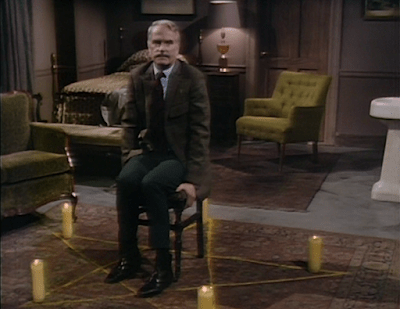
Paul’s precarious pentagram perch. Screenshot by Dark Shadows Before I Die.

Regular viewers will remember #752, in which Quentin Collins was told to sit on a chair in the middle of a similar pentagram. Quentin’s friend, amateur warlock Evan Hanley, told him that by doing this he could keep from turning into a werewolf. Paul isn’t afraid of turning into a werewolf, and he doesn’t have a friend like Evan. His worry is vague, but urgent- he knows that someone is after him, that if that someone catches up to him they will do something horrible, and that whoever it is keeps sending him messages that it is time for him to pay his debt. But he has no idea who that is, what they will do, or what the debt they are talking about. Sitting in the pentagram was a suggestion that came from a sailor who cruised him in a gay bar met him in a local tavern.

Paul’s pursuers are a cult associated with mysterious beings known as “the Leviathan people.” It has been made clear to us that both Paul and his daughter, heiress Carolyn Collins Stoddard, are, unknown to themselves, part of its orbit. In #888, Paul and Carolyn ran into each other at a cairn that is the cult’s ceremonial center and looked at it. Carolyn had been on its site many times, and could not understand why she had not seen it before. In #894/895, the cult’s acting leader, Carolyn’s distant cousin Barnabas Collins, took antique shop owner Philip Todd to the cairn. Philip told Barnabas he had walked past the site a few days before and that the cairn was not there then; Barnabas explained that only those connected with the Leviathan cult can see it. Barnabas has also been highly solicitous of Carolyn’s well-being since he became part of the cult, and he keeps telling her that he knows she has an extraordinary future ahead of her. So we know that the cult has plans for her, and Paul’s distress suggests that they have less attractive plans for him.

Paul sees the doorknob turning. He is terrified. Instead of the enemy Paul expects, Carolyn enters. He yells at her to leave. She stays. When he is unable to explain what he is afraid of, but that the pentagram on the floor will protect him, she notices that it is the same as the symbol she has been wearing on a chain around her neck. Barnabas gave it to her some days ago and urged her to wear it always. The audience knows, but she does not, that he intends it to protect her from the local werewolf. When she sees the similarity, the show invites us to wonder what the Leviathans have to do with werewolves. Carolyn tells Paul that if the symbol will protect him from his enemies in the form of chalk or gaffer tape on the floor, it will also protect him when it is composed of a silver pendant. He puts the pendant on and declares that he feels much better. He can no longer hear the voices that have been telling him his payment is due immediately. He embraces Carolyn and tells her he trusts only her.

When Carolyn mentioned Barnabas to Paul, he responded “Who is Barnabas?” Carolyn seems surprised he does not know, since she saw him near Barnabas’ house. Indeed, we saw him enter Barnabas’ house and wander through it the night he first returned to Collinwood, after an absence of twenty years. But he doesn’t remember anything about that.

Not that Carolyn’s own long acquaintance with Barnabas is all that enlightening to her just now. Ever since the Leviathans adopted him as one of their own, he has not been himself at all. We see him in his front parlor with mad scientist Julia Hoffman, who has for a year and a half been his inseparable best friend. She is trying to interest him in some information she has gathered about another storyline, and he makes it clear he could not be less interested in it or in her. She demands to know what he is interested in, and he refuses to answer. Carolyn enters, and suddenly Barnabas is all ears. Julia, frustrated, snaps that now she can see what he does care about.

In the autumn of 1967, Barnabas was a vampire and Julia had failed in an attempt to make him human again. He bit Carolyn and made her his blood thrall. He also decided that he would kill Julia to prevent her exposing him. Julia soon learned that Carolyn was both a wily operator and a most devoted servant. Julia had already realized that she was in so deep with Barnabas that she would be unlikely ever to make a life with anyone else, and so she conceived an unrequited love for him. In her dealings with Carolyn in those days, terror mingled with jealousy. Her bitter remark when she sees that Barnabas, who has been so dismissive of her, is now so concerned with Carolyn, reminds longtime viewers of that jealousy. Combined with the story of a daughter reunited with her long-absent and none too respectable father, this faint suggestion of a love triangle is enough to remind us that we are watching a daytime soap.

For her part, Carolyn was freed of her subservience to Barnabas as soon as he was freed of the effects of the vampire curse in March 1968. For some time, Nancy Barrett went out of her way to play Carolyn in a way that left us wondering if Carolyn remembered her time in his power. The scripts didn’t give her a lot of support in that endeavor, but the closeness she feels towards him combines with Julia’s jealousy to bring it back to our minds.

Carolyn has come to ask Julia to help Paul. Julia is back in the great house of Collinwood getting her medical bag to take to Paul’s hotel room when Paul himself bursts in. He demands to see Carolyn. Julia tells him that she left a little while ago to go to his hotel, and is probably there now. The telephone rings. Julia answers it, and tells Paul it is for him. This doesn’t strike her as odd, even though he hasn’t set foot there in twenty years, not since the night he left his wife Liz thinking she had killed him. Julia hands the phone to Paul. He expects to hear Carolyn, but instead hears the same voice that has been taunting him, saying that his bill is due now. He hangs up, and it starts ringing again. He forbids Julia to answer it, and runs out. We cut to his hotel room, and see that this time it is Carolyn trying to reach her father. Later, Carolyn will come home and Julia will tell her that Paul doesn’t seem to want help, however much he may need it.

Paul goes back to his room, and hears the phone there ringing. Terrified, he runs out, returning to the bar where he’d picked up trade met a new friend the night before. He sees another stranger sitting at a table, looking him over and beckoning him by rolling back one finger. The stranger is Barnabas.
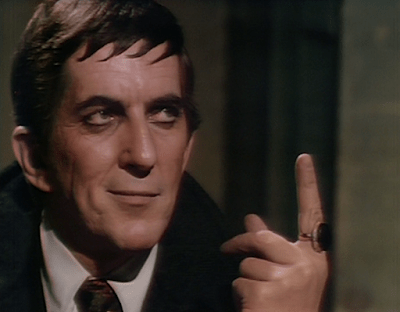
Barnabas beckons Paul. Screenshot by Dark Shadows Before I Die.

Paul reluctantly goes to the table, and Barnabas introduces himself. Paul says he doesn’t know Barnabas, but Barnabas makes it clear he knows all about Paul. He asks him to think back to the night he left Collinwood in 1949. We dissolve to a flashback.

Paul is at the bar, and another strange man strikes up a conversation with him. The man encourages him to assume that he has the power to grant any wish Paul might make in return for a price they would agree on. Paul says that in that case, he will ask for twenty years of boundless prosperity. At the end of those twenty years, Paul will give up anything he has, even his “most precious possession.” They shake hands on this deal. Paul laughs, and says he has won the game. He said that he would surrender anything he has, present tense- not anything he might gain in the course of his successful future, but anything he has as of 4 December 1949. On that date, Paul assures the man, he has nothing anyone could possibly want. The man laughs, and wants to drink to congratulate Paul on his cleverness.

Back in the present, Barnabas is laughing as heartily as the other man did twenty years before. He finds it preposterous that Paul could have forgotten such an important encounter. Paul can’t see anything important in it- it was just a silly little game, and its only consequence was that a strange man bought him a drink. Barnabas says that on the contrary, the bargain he struck was quite real. The Leviathans kept their side of it by giving him the success he has had over the last twenty years. Now that the twenty years are up, the time has come for them to claim the most precious possession he had the night he fled Collinwood.

Paul says that he supposes Barnabas is talking about his soul. He laughs heartily at that, and tells Barnabas that he is welcome to it. He is telling Paul that that is not what he meant as Carolyn enters. Paul is still laughing, and is delighted to see his daughter. She says she is relieved that the two of them found each other, and he tells her everything will be all right now. Barnabas says that Carolyn is her father’s most precious possession.

The scenes of Paul rushing around in a steadily mounting panic he is unable to explain are highly reminiscent of The Twilight Zone. The last line is a twist worthy of that classic series, especially as delivered by Jonathan Frid. His icy performance as Barnabas in these early episodes of the Leviathan arc not only recalls the malign representatives of alien powers on that show, but is superb in itself. He stumbles a little over his words in Barnabas’ scene with Julia, but is perfectly composed otherwise, and the effect is quite frightening.

I remarked on the gay subtext of the barroom scenes in the comment thread on Danny Horn’s post about the episode at his great Dark Shadows Every Day:

So far, this has been the gayest storyline the show has taken on yet.

In 899, the sailor offers to buy Paul a drink, and Paul shouts “I buy my own drinks!” This isn’t subtext- any man getting that reaction in a bar will know that the other fellow has interpreted his offer as including more than the drink. Paul apologizes and becomes friendly, indicating that he is willing to abandon that interpretation and set aside the hostility that accompanied it.

In this episode, we’re back in the same bar. Barnabas beckons Paul to his table with his index finger. I invite any man who doesn’t think we are intended to read this as a reference to a sexual come-on to try that move on a homophobic tough guy in a bar.

Paul’s face shows his inner struggle as he tries to resist Barnabas’ advances, but he can’t. Barnabas coaxes him into reminiscing about yet another night in the same bar, when a casual encounter with yet another guy led to something that seemed at the time like a little harmless tomfoolery, but that has now grown into a threat to his relationship with his family, his standing in the community, his physical well-being, and everything else.

Comment by “Acilius,” left 12 December 2020 on Danny Horn, “Episode 900: The Long Con,” posted on Dark Shadows Every Day, 18 July 2016.

In response to someone who said some kind words about that comment, I made a remark that I no longer think is very good:

Thanks! It’s a bit of a puzzle- so far as I know, none of the writers on the show at this time was gay, so I’m not sure why they decided to go so deep into these themes just then.

Comment by “Acilius,” left 11 April 2021 on Danny Horn, “Episode 900: The Long Con,” posted on Dark Shadows Every Day, 18 July 2016.

What I think now, and probably would have thought then if I had stopped and considered it for a minute before I hit “Post Comment,” is that the writing staff’s sexuality has nothing to do with it. They were worldly, sophisticated people with long experience in the theatrical profession in New York City. They all probably had many gay friends, and when they are called upon to write a story about people being drawn into a secret underworld and learning uncomfortable truths about themselves in the process their minds will naturally turn to themes having to do with closeted homosexuality. Granted, that doesn’t fully account for Christopher Bernau’s decision to play Philip as a much queenier version of Paul Lynde, but it is hardly a “puzzle” that the writers would draw on motifs suggestive of the closet when that’s the story they have to work with.

The man who met Paul in the bar in 1949 is unnamed in today’s dialogue, but will later be referred to as Mr Strak. Strak is played by John Harkins, who appeared in #174 as Lieutenant Costa of the Arizona State Police and in #878, 879, 880, 881, and 883 as Garth Blackwood, formerly the keeper of England’s Dartmoor Prison, and by that time a creature raised from Hell to wreak vengeance on an escaped prisoner and anyone else who caught his attention.

Strak’s name may remind longtime viewers of another minor character whom we saw in episodes #1 and #2, Wilbur Strake, private eye. We saw Strake in this same bar, where he gave reports about Carolyn and other members of the Collins family to his employer, Burke Devlin. Like Strak, Strake was a rather smug, sardonic sort. Add to this the rarity of the names “Strak” and “Strake” and the fact that they sound so much alike, and it seems obvious that there is an intentional reference of some kind. Paul’s presence in this storyline is the result of the writers reaching back to the show’s early days to find a loose end they could attach to this storyline to incorporate it into the Collins family saga, so they probably were looking through the scripts from the first week. Still, I can’t imagine they thought many people would remember Wilbur Strake by this point. Likely the reference is an inside joke, but who was on the inside and what the point of the joke was, I can’t begin to guess.

I wasn’t writing detailed posts with background information when I covered the first weeks of the show, so I will mention here Strake was played by Joseph Julian, who later became a regular on Somerset, a soap that aired on NBC opposite Dark Shadows for the last year of its run. The cast of Somerset included several Dark Shadows alums, including Dennis Patrick, Joel Crothers, and Christopher Pennock in major roles, and, as day players, Dolph Sweet and Humbert Allen Astredo.

Episode 890: They will be strangers, but you will know them

Like many episodes of Dark Shadows, this one ran long and ended with credits only for the cast and for Dan Curtis Productions. The entry on the Dark Shadows wiki says that the director was Lela Swift. I am sure that it was in fact directed by Henry Kaplan. This shot of Nancy Barrett as heiress Carolyn Collins Stoddard is proof positive:

There is another flagrant Kaplanism in today’s first scene between antique shop owners Philip and Megan Todd (Christopher Bernau and Marie Wallace.) Philip enters from upstairs. He stops with his waist at the top of the frame. That’s where he stays for the first part of the scene, ending with Megan raising a paper that covers part of her face. Evidently what’s happening between the characters is none of the audience’s business.

Swift was a talented and ambitious visual artist, Kaplan a sloppy and unimaginative one. He relied heavily on closeups. When it dawned on him that it was dull to hold the frame just beyond the edges of an actor’s face, his response was to zoom in and give us an extreme closeup of some part of the actor’s face. It’s above average for him that the first shot above includes Miss Barrett’s eyes- he specialized in shots displaying the face from the nostrils down, and often held them even after the actors had to move, leaving us with the sight of an ear drifting out of our view.

Even when Kaplan’s tight little frames do not keep us from figuring out what is happening in a scene, they deprive us of the energy that comes from seeing the players interact with each other. We don’t get statements and reactions simultaneously, and we don’t see the actors using the space between them to tell us how the characters feel about each other. Kaplan was also a pretty bad director of actors, regularly poking them with a stick as his way of telling them he wanted them to play a scene differently and on one occasion fastening a handle to a child actor so that he could physically place him on his mark during rehearsal. So perhaps his mania for closeups reflected a lack of awareness of what actors do and how the choices they make contribute to the audience’s experience. As a result of his insensitivity to these and other visual aspects of the medium, Kaplan’s episodes would often be better suited to radio than to television.

Fortunately, the dialogue today is peppered with snappy lines. So Danny Horn devotes his post about the episode on his great Dark Shadows Every Day to a selection of memorable pieces of dialogue. That also makes me suspect the wiki is not entirely correct. It attributes the script to Gordon Russell, an able writer overall but one who is not at all given to bons mots. I use bits of dialogue whenever possible as the titles of these posts, and I often have to search very hard through Russell’s to find suitable ones. It was Violet Welles who excelled at producing those. Russell and Welles often collaborated, so it could be that he wrote a draft to which she added the quotable quotes.

The current story centers on a mysterious cult that has sent time traveler Barnabas Collins back to 1969 from a long sojourn in 1897, by way of a couple of days in 1796. Under the influence of the cult, Barnabas is being a real jerk to his friend, mad scientist Julia Hoffman. Barnabas was a vampire for a long time, and even when he is free of the effects of that curse he habitually resorts to murder to solve his problems. But the victims of those murders are imaginary, played by actors who will go on to find other work, so we don’t usually stay mad at him for any length of time when he commits them. His friendship with Julia, on the other hand, is the emotional core of the show. Barnabas’ coldness to her in yesterday’s episode and today’s leads us to see what the cult is doing to him as the greatest crime anyone has ever committed on Dark Shadows.

Barnabas was a pop culture phenomenon familiar to many millions of people who never saw a single minute of Dark Shadows. The show’s fanbase largely consisted of his devoted followers. So a story about a cult which co-opts him as its leader and changes his personality so that he is impossible to get along with directly addresses a fear that must have blacked out the mind of Dan Curtis every time the postal service truck loaded with Jonathan Frid’s fan mail backed up at ABC Studio 16.

Barnabas brought a box with him from his visit to the eighteenth century, and it is of the utmost importance to the vast eternal plan the cult is working on that the box not be opened until the right time. So Barnabas put it on the mantel in his living room, and when Julia was standing a few inches from him he lifted it from the mantel and placed it on a table in the middle of the room. When she asked what it was, he became flustered and refused to answer any questions about it.

When Julia left the house, Barnabas left the room, with the front door unlocked and the box still on the table. Today, we open with Julia coming back in, hearing the sound of breathing coming from the box, finding its key on the table next to it, and placing the key in its lock. Barnabas comes in just in time to stop her opening it, but we can see that the cult probably could have chosen an agent with a better sense of operational security. Barnabas’ function in the story is to make messes that other people will have to clean up, so as soon as we heard that the box must not under any circumstances be opened we expected him to leave it where it would inevitably fall into the hands of someone bent on opening it, though it is a bit disappointing he has done so this quickly.

After he has taken the box from her, Barnabas berates Julia, orders her from his house, and tells her he owes her nothing. He abruptly sweetens up and tells her that he is only carrying on that way because of some kind of temporal jet lag. He reminds her that when she traveled back in time in September, she was very ill for a while; he suggests that his surly mood might be the result of the same shock that caused that reaction. About a minute after he starts on this new tack, just as Julia has started smiling again, a knock comes at the door. It is Carolyn.

We don’t know what effect the cult’s co-optation of him has had on Barnabas, but regular viewers know that characters on Dark Shadows are always acquiring one magical power and losing another. For the last few months of the 1897 segment, the show’s main villain was sorcerer Count Petofi. One of Petofi’s signature moves was to become aware of visitors shortly before they arrived. It could be that the writers have decided to give the cultified Barnabas that power, and that it was because Carolyn was on her way that he wanted to put Julia in a good mood.

That interpretation is supported by what follows. Carolyn is delighted to see Barnabas; she hadn’t known he was back from his trip to 1897. She hugs him and he smiles, a stark contrast to his icy reaction when Julia hugged him yesterday. She wants to talk about Chris Jennings, a young man she dated a few times and whom she has been told is dangerous. Julia and Barnabas have befriended Chris and know that he is a werewolf. Julia thinks she can somehow control Chris’ transformations, and she urges Carolyn to think well of him. Barnabas tells her to trust her instincts and to avoid Chris. He keeps telling her that she is too important to be allowed to come to harm. Later, he visits Carolyn in her home, the great house on the estate of Collinwood, and he keeps going on and on about how important she is and how confident he is about her future. He also gives her a silver pentagram, an amulet to ward off werewolves, and urges her to wear it at all times. He subsequently has another scene with Julia in his own house, and he is just as cold and dismissive as he was in the first scene, exploding at her for being “irrational.” Evidently the cult has plans for Carolyn, but not for Julia.

Julia bought a painting from the Todds the other day, and now they have received a telegram offering to buy it regardless of price. Julia goes to their shop and discusses the telegram with them. She believes that the telegram, which is signed “Corey,” may actually be from Quentin Collins, a distant cousin of Barnabas’ whom he befriended during his time in 1897 and who may have been immortalized by a magical portrait painted by the same artist responsible for the picture Julia bought. She tells the Todds that she is not certain she wants to part with the painting, but that she would very much like to meet “Mr Corey,” and that she believes others in town would also like to do so. She urges them to reply to the telegram with an invitation.

Barnabas stands over the box. We hear his thoughts as he mulls over his questions about it. He suddenly declares “It is time!” Then he goes to his chair and sits down. Evidently, it is time to take a load off.

Barnabas has a vision of one of the hooded figures who inducted him into the cult. The figure, a man named Oberon, addresses him as “Master” and tells him that he is to give the box to people who wake him by knocking at his door. There is a knocking, he does awaken, and he goes to the door.

Episode 764: A primitive tribe

Odds and ends today:

The Kindest, Warmest, Bravest, Most Wonderful Human Being I’ve Ever Known in My Life

The show is doing an homage to The Manchurian Candidate this week, with schoolteacher Tim Shaw brainwashed into becoming an assassin when he sees the Queen of Spades. We open with the plan going awry. Lawyer/ warlock Evan Hanley did the brainwashing with the intention that Tim would kill someone else, but when he shows Tim the card, Tim tries to kill him. As Evan, Humbert Allen Astredo shows us a man suddenly becoming frightened and just as suddenly making up his mind to be brave. In other episodes, Astredo has already shown us Evan responding to fear in other ways. He really was a remarkably good actor, and it is a pleasure to see how much variety he can find in his parts.

Later, we see Judith Collins, the mistress of Collinwood, playing solitaire. Tim comes to the house. We know that each episode ends with a cliffhanger, and so this leads us to expect that we will end today with Tim’s hands around Judith’s throat. But that is a misdirection. In fact, Judith turns the Queen of Spades away from Tim at the last second, and he leaves the room without attacking her.

Slight Enough to Vanish, But Too Dense to Live

Tim’s brainwashing is a B-story on the show right now, and it would throw off the rhythm of the week to end two consecutive episodes with cliffhangers from it. The A-story is about the rakish Quentin Collins, who has been cursed to become a werewolf. There is a full moon tonight, and the sheriff’s department is roaming the grounds of the great estate of Collinwood with guns looking for the wolf who walks like a man. Joining in the search is Quentin’s distant cousin, Barnabas Collins, who is, unknown to all but a very few people, a vampire. Barnabas has traveled back in time to the year 1897, and among the things he is hoping to do is to learn how the werewolf curse that has afflicted his friend Chris Jennings in the 1960s first began.

Barnabas learned in 1969 that in 1897 Quentin and a woman named Beth Chavez paid a man named Ezra Braithwaite to make a silver pendant in the form of a pentagram and that a baby boy was buried in that year wearing that pendant. Tonight, Ezra telephones Barnabas at the great house of Collinwood and tells him that Beth just came in, ordered such a pendant, and told him to send the bill to Quentin.

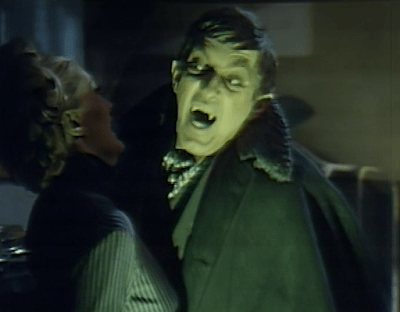
Barnabas knows that the pentagram was an amulet meant to ward off werewolves. Beth is Quentin’s girlfriend, a fact that is no secret to anyone, not even Barnabas. So you might assume Barnabas would have figured out that Quentin is the werewolf. But apparently he has not. He materializes inside Beth’s room and demands she tells him who the werewolf is. When she refuses, he bites her. That bite is the cliffhanger.

Dear cousin Barnabas. Screenshot by Dark Shadows Before I Die.

Barnabas occasionally makes remarks about how he wants to keep the original timeline intact so that the people he knew in the 1960s will still be there when he gets back. But he’s been feasting on the people he meets in 1897 with abandon. Beth is the fourth resident of Collinwood he has bitten, and he has killed at least two young women in the village. Moreover, his approach to every problem he encounters or imagines is to confront the most powerful person associated with it and antagonize them immediately. It’s hard to see how he expects anything to remain unchanged after he inserts this rampage into the history of the late Victorian age.

But You Wouldn’t Know Anything About That

Judith tells Barnabas today that Beth came to Collinwood as a lady’s maid two years ago. Beth claims to have a cousin in town to Judith today while lying to cover up her trip to Braithwaite’s, and when Barnabas asks Judith if Beth is from Collinsport she mentions this cousin as her reason for believing that she is. Judith clearly knows very little about Beth, and cares less.

The lady who brought Beth as her maid was Quentin’s then-wife, Jenny, who was secretly a member of the Romani people. In #701 it was hinted that Beth was concealing a Romani origin of her own. Casting the tall, blonde, blue-eyed, pale Terrayne Crawford as Beth would seem to indicate that they were not committed to following up this hint, but in today’s scenes with Judith they do go out of their way to emphasize that Beth’s background is a mystery.

The Woman Who Never Left

Beth has been helping the family hide the fact that Jenny went mad and bore twins after Quentin left her. Quentin murdered Jenny in #748, eliminating the need for a servant to cover up her existence, and the twins, about whom Quentin does not know, are firmly ensconced in the care of a woman in the village named Mrs Fillmore. In #750, Judith fired Beth, but it didn’t take. Beth never left the house, and after a while the family started giving her orders again. Today Beth tells Judith that Mrs Fillmore reports that the boy twin is feverish, and asks to be kept on staff until he gets well. Judith agrees.

Judith tells Beth that she has decided to tell Quentin about the twins. She hopes that is what will prompt her brother to cast aside his selfish ways and become a mature adult. Beth is horrified and begs her not to do so. Judith, puzzled, says that Beth has always urged her to tell Quentin. She asks why she has changed her mind, and she makes up something obviously false about Quentin being unable to cope with the news that his son has a fever.

Yesterday, Beth learned that Quentin’s curse is hereditary. Returning viewers might wonder if she is afraid that Quentin will also learn that, and that if he does he might kill his children to prevent them passing it on. He does keep saying that he would rather be dead than have the curse, so he might talk himself into regarding such a murder as an act of mercy.

Featuring Edward Marshall as Ezra Braithwaite

Edward Marshall plays Ezra, a part played in #684 and #685 as an 87 year old man living in the year 1969 by Abe Vigoda (who was 48 at the time, but he and the makeup department both knew their business well enough that he was entirely convincing.) Mr Marshall appeared in #669 as unsightly ex-convict Harry Johnson, a part originally created by the not-always-stellar Craig Slocum. Mr Marshall gave Harry the same attitude and many of the same mannerisms Slocum had given him, but was so much more fun to watch that I wanted to see a lot more of him.

Parts of Harry’s costume and most of his surly demeanor are recycled in the 1897 segment in the character of dimwitted groundskeeper Dirk Wilkins, played by the repulsive Roger Davis. Whenever Dirk is on screen, I imagine Mr Marshall in Mr Davis’ place. I recommend that bit of mental recasting, it goes a long way towards making Dirk bearable. Unfortunately this is Mr Marshall’s final appearance on Dark Shadows.

Episode 763: An afternoon of cards, a night of murder

Schoolteacher Tim Shaw was introduced in #731. The name “Shaw” is common enough that few viewers are likely to have found any significance in it at the time. It is true that Dark Shadows is at this point a costume drama set in 1897 and that George Bernard Shaw was coming into his own as a playwright in that year. The show was written, acted, and directed largely by theater people, and is so self-consciously stagy that it is possible there might be a reference of some kind to Bernard Shaw in a character’s name. But there doesn’t seem to be anything especially Shavian about Tim.

Today we learn the reason Tim was called Shaw. Satanist Evan Hanley gives Tim a potion that robs him of his will. He holds up a deck of playing cards and tells him that when he sees the Queen of Spades he will know it is time for him to murder someone. In Richard Condon’s 1959 novel The Manchurian Candidate, soldier Raymond Shaw was brainwashed into becoming an assassin when he saw the Queen of Hearts; in the John Frankenheimer’s 1962 film based on the novel, Raymond’s trigger was the Queen of Diamonds.

Frankenheimer’s film is one of the supreme examples of a movie that shouldn’t have worked, but did. No part of the plot stands up to rational analysis for one second, but when the tale is told through stark black and white imagery that puts us deep in the world of a nightmare it is spellbinding. Unfortunately, the irrationality of the plan the villains carry out and of the other characters’ responses to their evil deeds in The Manchurian Candidate are on full display in this homage, without the paranoid verve that makes the movie compelling. All by itself the potion puts Tim so deep in Evan’s power that he gladly goes to witch Magda Rákóczi to buy poison and insists she sell it to him even after she has pointed out that it is useful for nothing but murder. It doesn’t seem there is anything left for the card to add to the control Evan has over him.

It gets worse. Evan is acting as the agent of the evil Rev’d Gregory Trask. Trask is unhappily married to a woman named Minerva, and is blackmailing Evan into sending an assassin to kill her. When Evan shows Tim the card today, he confirms that the intended victim is a woman. But why not have him kill Trask? As my wife, Mrs Acilius, points out, if Trask dies, Evan will be free of the threat of blackmail. So if he is prepared to be a party to murder, you’d think he would forget Minerva and commit the crime he has a motive to commit.

The highlight of today’s episode doesn’t have anything to do with Evan, Tim, Minerva, or Trask. It is a scene between Magda and sometime maidservant Beth.

Beth has come to the Old House on the great estate of Collinwood to plead with Magda to lift a curse she has placed on Beth’s boyfriend, rakish Quentin Collins. Quentin murdered his estranged wife, Magda’s sister Jenny, and as revenge Magda turned him into a werewolf. Magda is unimpressed with anything Beth says until she tells her that in spite of everything, she will marry Quentin and go away with him. Magda marvels at this and asks Beth if she will really go through with it knowing that any son Quentin might have will suffer from the same curse. Shocked, Beth asks Magda if she means what she has said, and she repeats that Quentin’s son will also be a werewolf. Beth replies that in that case, Magda has laid a curse upon her own kin.

Magda dismisses this, saying that Jenny had no children by Quentin. Beth says she is wrong, that Jenny bore twins, a boy and a girl. Beth lays the story out systematically, and it dawns on Magda that she is telling the truth. Magda calls out to Jenny’s spirit and begs forgiveness, saying she did not know. Beth says that it is time to lift the curse, and Magda tells her to get a pentagram and make sure the boy wears it all the days of his life. Beth has her own moment of horrified realization. “And… you can’t end it? Can you?”

Beth realizes Magda does not know how to undo the curse.

Terrayne Crawford had some weaknesses as an actress that severely undercut her in her first weeks as Beth. But this scene is right in her wheelhouse. She is flawless as she portrays Beth’s progression from weepy begging to methodical explanation to utter shock. And Grayson Hall of course brings great power and vivid color to Magda.

We’ve been waiting for this scene since #642, months before Magda first appeared in #701, let alone before she placed the curse on Quentin in #750. In that episode, back in December 1968, the show took place in a contemporary setting. The characters had noticed some strange goings-on, and held a séance as part of their inquiry. The spirit they reached was Magda, who spoke regretfully of “my currrrse!” It’s taken more than 24 weeks, but Magda has finally learned what she already knew when we first heard from her.

Episode 753: Each and every one of us is doomed

Before Dark Shadows became a costume drama set in 1897, we learned about a number of things erstwhile lady’s maid Beth Chavez had done in that year, none of which she has yet had a chance to do. So when yesterday’s cliffhanger left Beth alone in a small room with her boyfriend Quentin Collins after he had turned into a werewolf, we could be fairly sure she would somehow escape. In today’s opening teaser, we see that she stumbles into the middle of a pentagram that was chalked onto a rug as part of an abortive effort to contain Quentin’s lycanthropy. The werewolf paws at the space above the pentagram, but cannot enter it. As a stunt performer, Alex Stevens must have had considerable occasion to practice miming, but I guess there’s only so much you can do with the old “I’m trapped in an invisible box!” routine. He gives up, goes to the door, turns the knob, and leaves.

After this comic start, the episode turns to the grimmest story they have going. Twelve year old Jamison Collins has been sent to a boarding school that the overwhelmingly evil Rev’d Gregory Trask operates as a dungeon for the torment of children and teachers alike. Jamison has been confined to a closet and kept on a diet of bread and water until he confesses to offenses Trask knows full well he did not commit. The closet adjoins the classroom where teacher Tim Shaw works. Trask’s daughter Charity, temporarily in charge of the school in her father’s absence, sees Tim in the room with some papers; she offers to help him grade them, but he says he needs to go through them himself to judge the students’ progress. When she leaves him there, he smuggles food to Jamison.

Charity catches on, and gives Jamison her father’s “favorite book of meditations” to read while in confinement. She tells him he will have “ample time to browse through it” before her father returns and decrees his additional punishment in the morning. Since the book is about 8 inches thick, it must be in very large print. It is a bit difficult to imagine speed-reading a book of meditations. (“Meditate faster!”)

Charity gives Jamison something to read during the night.

In fact, the book is so thick Jamison can use it as a step to reach a window through which he escapes. Charity is distraught when she realizes that he is gone, and Tim is gleeful to see that he used Trask’s Big Book o’ Meditations to get away.

Charity assumes that Jamison has run back home to the great house of Collinwood. She orders Tim to accompany her there. Beth lets them in and tells them she hasn’t seen Jamison. In her imperious manner, Charity demands that Beth let them search the house, and dismisses out of hand her reply that she does not have the authority to permit such a thing.

In fact, Jamison did come to the house, and Beth is covering for him. He knows the place well enough that even if Charity did have free rein to search for him she probably wouldn’t find him. Jamison went into the drawing room when Charity and Tim came. Charity insists Beth let them into the drawing room. She is disappointed that Jamison isn’t there, and says he must have gone out the window. Regular viewers know that there is a secret passage leading from the drawing room to the west wing, and that the west wing has a myriad of hiding places.

Evidently Beth is unaware of that passage, because she seems to believe Charity is right. She is afraid that Jamison is in the woods, where she knows the werewolf is roaming, and once Charity and Tim have left she goes out there with a gun. Again, those who have been watching the show know something Beth does not, that the gun is formidable to the werewolf only if it is loaded with silver bullets. When she finds the werewolf and points the gun at him, we again come to a cliffhanger ending that leaves Beth’s life in jeopardy.

Episode 752: Matters other than the law

Libertine Quentin Collins murdered his wife Jenny the other day, shortly after he learned that she was the sister of broad ethnic stereotype Magda Rákóczi. Since Quentin is convinced that Magda has magical powers, this would seem to suggest a low degree of impulse control on his part.

Magda did place a curse on Quentin, and she refuses to tell him what it is. Last night he doubled over in pain, lost consciousness, and disappeared from the great house on the estate of Collinwood. This morning he has shown up in the foyer, flat on his back, his clothing in shreds and blood all over him. His girlfriend, Jenny’s former maid Beth, found him and helped him to his room. Neither of them can figure out what happened to him overnight.

Meanwhile, Collins family attorney Evan Hanley has come to meet with Quentin’s sister Judith, who owns the estate and the Collins family’s businesses. Judith is enraged that Quentin took $10,000 from her in return for signing an agreement to leave the house and never come back, but has refused either to leave or to return the money. Evan assures Judith he will take care of the matter at once. While he is still in the drawing room, Judith answers the telephone. She learns that a young woman named Dorcas Trilling was brutally killed on the estate the night before, her body ripped apart as if by a wild animal of some kind.

Unknown to Judith, Evan and Quentin are members of a Satanist coven. Evan does call on Quentin and Beth in Quentin’s room, and he does deliver Judith’s message. He and Quentin both ask Beth to leave so they can discuss another matter. At first she resists, but finally she does go. Quentin tells him what happened the night before and that he believes Magda has cursed him. Evan sees the bloody clothing in a pile on the floor, and his face shows a grim surmise. Nonetheless, he does not tell Quentin about Dorcas.

Quentin asks Evan to help him with Magda. Evan says that he will do so, but cautions Quentin that his help will come at a very high price. Quentin asks what happened to their friendship. Evan tells him that “There is no such thing as a friend” and laughs. That must come as quite a nasty shock to Quentin. You spend time with a fellow conjuring up demons, forging wills, and working together to impoverish half your family and kill the other half, and you think you mean something to each other. But no, it just isn’t that way with Evan.

Evan calls on Magda at the Old House on the estate. Magda is coy and does not tell him anything he does not already know, but he does notice that she is wearing a pendant in the form of a pentagram. She says it is just a bit of Romani jewelry, worth only a few cents. He offers her a hundred dollars for it. She refuses, saying that it was a gift from her late mother, and offers to show him other pieces of the same type. Evan tells her that he knows the pentagram can protect against many supernatural menaces, and asks which one she is guarding against at the moment. She keeps mum.

Back in Quentin’s room, Evan chalks a pentagram all over his rug. He tells Quentin and Beth that at nightfall, they must set two black candles burning, one in each of two points of the pentagram, and Quentin must take up a position in the center of the pentagram. He must not move from this spot until daybreak.

The year is 1897, and the first vacuum cleaner wasn’t invented until 1901. It’s going to be quite a job to clean that rug. Screenshot by Dark Shadows Before I Die.

Quentin is having an anxiety attack, and refuses to cooperate with Evan’s plan. This is consistent with his character as we have seen it so far. In #710, he and Evan summoned a creature to rise from Hell and smite one of their enemies, and when a form actually started to take shape, he panicked and tried to run away. Quentin is obsessed with black magic and the occult, but when it turns out there is something to all of his spells and incantations, he cannot bring himself to face the reality of it.

Quentin declares that he wants a plan that “makes sense.” He then says they have to kill Magda. Evan replies that that is the worst thing they could possibly do. If they kill Magda, there will never be any way to lift the curse.

Later that night, Beth and Quentin are still in the room. The pains come on Quentin again. She hurriedly picks up the chalk and redraws the parts pentagram that Quentin had smudged, then sets a chair in the middle. She tries to get Quentin into that chair, but he is unable to get himself onto the seat. She turns to look for the black candles, then hears snarling and growling. She turns to the spot off camera where Quentin is, and reacts with horror. We know that Quentin is a werewolf; now she knows it, too. As the closing credits roll, it does not seem likely that she will have much chance to make use of that knowledge.

Episode 685: Barnabas, Quentin, and the Thing Glasses

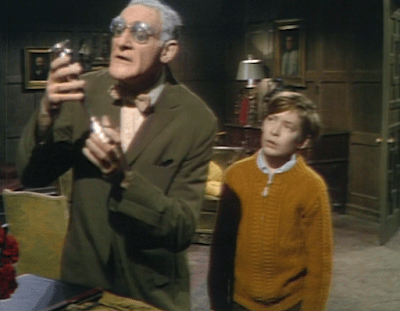
Silversmith Ezra Braithwaite comes to the great house of Collinwood, bearing a ledger with information that old world gentleman Barnabas Collins wants. Barnabas is in the study, so twelve year old boy David Collins lets Mr Braithwaite into the house and escorts him to the drawing room. The two of them play a scene that may not have looked like much on the page, but as delivered by talented comic actors Abe Vigoda and David Henesy the lines are hilarious.

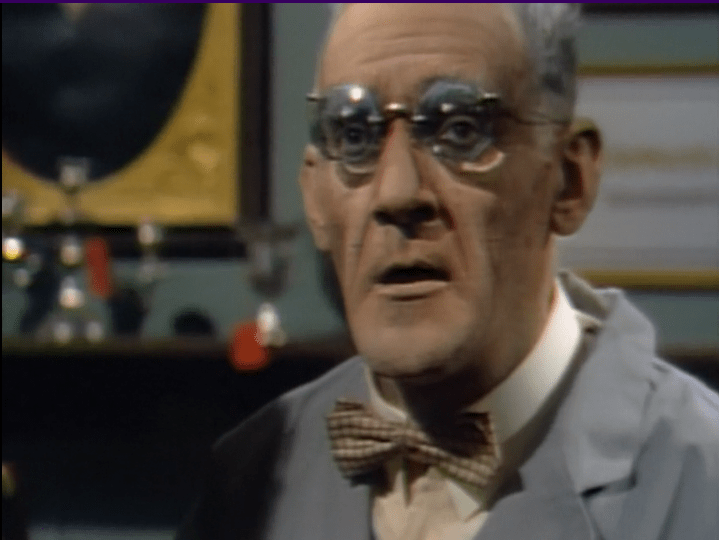
For example, Mr Braithwaite has two pairs of glasses, which he describes to David as his glasses for looking at things and his glasses for looking at people. David asks if the ones he is wearing are his “thing glasses.” We laughed out loud at that whole exchange. Mr Braithwaite asks David to go get “Uncle Barnabas”; David replies “He’s my cousin,” to which Mr Braithwaite answers “Ah, yes.” Again, that wouldn’t be a hit in a joke book, but Vigoda and Mr Henesy sell it. The purest example comes when Mr Braithwaite starts to change his glasses as he turns to the pages of the ledger and says out loud to himself “Oh, Ezra, Ezra, you already got on your reading glasses.” That is a laugh line entirely because of the way Vigoda stresses the words “got” and “on.”

There is a little exchange between Ezra and David that will stand out to longtime viewers:

Ezra: David is it? Well, I don’t remember a Collins being named David before. Now, my name is Ezra, as my father was and his father before him. You find a name like Ezra and you don’t give it up.

David: I guess not.

Ezra: Yes, now, David’s kind of a new-fangled name.

David: No, there’s King David in the Bible.

Ezra: Oh, of course, yes, yes. A good man, too.

In #153, it was established that no Collins ever bore the name “David” until undead blonde fire witch Laura Murdoch Collins insisted that her husband Roger go along with her plan to name their son “David Theodore Collins.” That turned out to be hugely important as evidence of Laura’s evil intentions. In #288, it sounded like they had decided to retcon that away when David looked in a family album, saw a portrait of a “David Collins” from a previous century, and wondered aloud if he had found his namesake. Nothing has come of that potential namesake in the 79 weeks since, and Ezra’s line that he didn’t “remember a Collins being named David before” would suggest that they’ve gone back to the original idea.

Mr Braithwaite, in his thing glasses, examines a piece of silver. David examines him. Screenshot by Dark Shadows Before I Die.

Each time Mr Braithwaite looks at someone through his “thing glasses,” we get a point of view shot showing that his eyesight is blurry. They then cut back to the other actor in regular focus. These shots are brief enough that the repetition isn’t a big problem, but it results in a series of exchanges the actors deliver to the camera rather than to each other. Those don’t work at all. Mr Henesy and Abe Vigoda had such a fine comic rhythm going that it’s a shame to break it up with this clunky stuff.

Reading the ledger, Mr Braithwaite says that the silver pentagram Barnabas wants to know about was bought in April 1897 by Miss Beth Chavez and paid for by Quentin Collins. We have seen Beth’s ghost. She is very tall and so thin you could clasp your fingers around her waist. Her complexion is pale as can be, her hair blonde, her eyes blue. I’ve met a fair number of Chavezes in my time, including a couple of Elizabeth Chavezes, and none has met this description. I have nothing to say against slender blondes, and actress Terrayne Crawford is movie-star beautiful. Still, if a fellow were excited about a blind date with a girl known to him only by the name “Beth Chavez,” he’d probably be a bit disappointed if the person who showed up met her description.

We have also seen Quentin’s ghost. Quentin is manipulating David into helping him with a number of murders he intends to commit. Beth has thwarted one of these murders so far, and is trying to prevent Quentin from achieving other evil plans of his. But Quentin is apparently more powerful than she is.

While Mr Braithwaite is alone in the drawing room, Quentin enters through a secret panel. Earlier in this episode, they made it clear Quentin can choose whether he is visible to the living people in the spaces he occupies; there is no need for him to hide. Why does he use the panel?

Longtime viewers may be able to make a surmise. We saw this panel for the first time in #87, when David’s father Roger used it for a sneaky errand. We didn’t see it or hear of it again until #643, when David told nine-year old Amy Jennings that there was a passage “very few people” knew about, and used it to lead her to the room in which Quentin was at that point confined. Quentin’s use of it will therefore suggest that he knows all the secrets of the house. It also suggests that when he dwelt there as a living being he was a naughty fellow who was in the habit of using its secret passages for the sort of underhanded mischief Roger got up to in #87 and #88.

Quentin strolls up to Mr Braithwaite and smiles at him. Mr Braithwaite is wearing his “thing glasses” and cannot see Quentin clearly. He asks Quentin if he is the friend Barnabas spoke of when he asked him about the pentagram. Quentin nods. Mr Braithwaite says that he himself made the pentagram in April 1897, when he was “fifteen and a half.” It is now February 1969, so we know that Mr Braithwaite is 87. He recognizes Quentin. Shocked to see a man who has been dead for decades apparently alive, well, and in his twenties,* Mr Braithwaite dies of a heart attack.

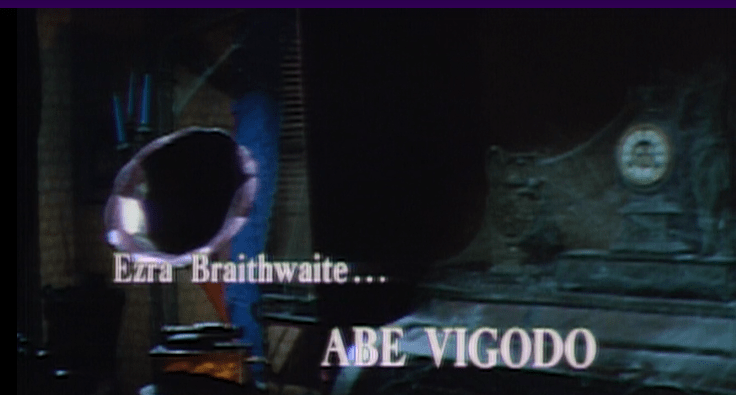
It’s a shame we won’t be seeing more of Abe Vigoda as Mr Braithwaite. At least they spelled his name correctly in the credits this time; yesterday he was “Abe Vigodo.”

*Two days past his 28th birthday, to be exact. Happy belated 84th to David Selby!

Episode 684: This is a funny house we live in

Dark Shadows has two ongoing storylines at this point. Mysterious drifter Chris Jennings came to town a couple of months ago and turned out to be a werewolf. Heiress Carolyn Collins Stoddard does not know of Chris’ curse. She has taken a fancy to him and set him up in the caretaker’s cottage on the estate of Collinwood. Old world gentleman Barnabas Collins and mad scientist Julia Hoffman do know that Chris is a werewolf, and they are working to help him. Barnabas has found a place to keep him confined on the nights of the full Moon, and Julia is trying to develop a medical intervention that will keep him in his human form.

Meanwhile, Chris’ nine year old sister Amy has taken up residence in the great house on the estate. She and her twelve year old friend, strange and troubled boy David Collins, are falling under the power of the evil spirit of the late Quentin Collins. At first Amy could communicate with Quentin more clearly than David could. This made David envious. In #640, David complained that Amy could hear his voice and he could not, even though “Quentin Collins is my ancestor.” That suggested to the audience that Quentin would turn out also to be Amy and Chris’ ancestor, joining the werewolf story with the Haunting of Collinwood.

Today, Barnabas and Chris have dug up a spot on the ground to which the ghost of a mysterious woman had led Chris. They find a tiny coffin holding the remains of an infant. They discover that the infant was wearing a medallion in the shape of a silver pentagram. The sight of the dead baby shocks Barnabas right away; Chris keeps his composure at first, but seems close to tears a moment later. Quentin stands in the shrubbery and watches Barnabas and Chris.

Barnabas has not seen Quentin and does not know who he is. Others have seen him and described him to Barnabas and Julia. They and those others suspect that he is a malevolent ghost with designs on David and Amy. No one has yet made a connection between Quentin and the werewolf story, however.

Julia and Barnabas have also seen the mysterious woman who led Chris to the baby’s grave. They know that she is a ghost and that she has helped Chris, and they also know that her clothing is of the same vintage as is the clothing which Quentin wears. But they do not know what, if anything, the two ghosts have to do with each other. The audience knows that the female ghost’s name is Beth and that she was with Quentin in the little room in the long deserted west wing of the great house when the children first met him.

Barnabas tells Chris that the pentagram can only be a device to ward off a werewolf, so that there must have been a werewolf in the area when the baby was buried. He also tells Chris that the mysterious woman would not have led him to dig up the grave unless what they found in the coffin would be of help to him.

While Barnabas inspects the pentagram in the drawing room of the great house, David throws darts at a board propped up on a chair nearby. The audience knows that David is under Quentin’s control, so it is obvious to us that the dart playing is an attempt to distract Barnabas and keep him from figuring out the meaning of the pentagram. Lacking our knowledge, Barnabas is merely annoyed with David. Jonathan Frid and David Henesy expertly develop the comedy in Barnabas’ fast-burn reaction to David’s behavior.

Heiress Carolyn Collins Stoddard interrupts the scene. She notices what Barnabas is doing. He shows her the pentagram, and she recognizes the jeweler’s mark as that of Braithwaite’s silver shop in the village of Collinsport. While Barnabas telephones Braithewaite’s and arranges to take the pentagram there to see if the proprietor can give him any information about it, Carolyn tells David she wants to have a conversation with him about some cryptic remarks he made earlier. David refuses, saying that he has homework to do. Carolyn argues with him briefly, but finally gives up and leaves. Barnabas is still involved in his conversation with Mr Braithwaite when David hides the pentagram behind his dartboard.

Barnabas gets off the phone, and David resumes throwing darts. Barnabas asks him why he isn’t doing the homework he was just telling Carolyn presented such an urgent obligation that he could not talk with her. He launches into a shaggy dog story, the upshot of which is that he has to wait for Amy.

More exasperated than ever, Barnabas turns to the desk and sees that the pentagram is gone. He demands David return it. David denies having it. He says that it may have vanished on its own. After all, unaccountable things happen at Collinwood all the time, as Barnabas is in a position to know. The way he says “You should know that” reminds longtime viewers that David has more than once shown signs of figuring out more about Barnabas’ own connections to the supernatural than have any of his adult relatives. In #316, he pointed out that none of the Collinses really knows anything about Barnabas- “He just showed up one night.” And in #660, he told Amy that “Barnabas knows a lot of things he doesn’t tell anybody.” At moments like these, we wonder just how much information David really has at his disposal. Perhaps he secretly knows everything, and has just decided there’s no point in notifying the authorities.

David invites Barnabas to search him. He lists the contents of his pockets, and turns the right front pocket inside out. He tells him that he has a pack of chewing gum, which he got from Amy. He specifies that he traded her a box of raisins for it. As David Henesy delivers the line and Jonathan Frid shows us Barnabas’ reaction, this detail is laugh-out-loud funny. Barnabas surrenders and apologizes to David, fretting about the pentagram’s absence.

Barnabas takes a sketch of the pentagram to Braithwaite’s. In the first months it was on the air, Dark Shadows took us to New York City twice, to Bangor, Maine several times, and to Phoenix, Arizona once. But now that both stories center on characters all of whom dwell in one or another of the houses at Collinwood, it is as rare to leave the estate and go into the neighboring village as it was then to go on those remote excursions.

Old Mr Braithwaite tells Barnabas that the shop has been in operation since 1781 and has been providing fine silver to the Collins family the whole time. Regular viewers know that Barnabas was alive then, and lived in Collinsport. A curse made him a vampire in the 1790s, and he was under its power until he was freed early in 1968. So he must have been quite familiar with Braithwaite’s in its early years. What is more, in #459 we saw that in the first months of Barnabas’ career as a vampire his father Joshua learned of his curse and commissioned a local craftsman to make silver bullets with which he could put Barnabas out of his misery. That craftsman must have been one of the first Mr Braithwaites.

The incumbent Mr Braithwaite tells Barnabas he will consult his records as soon as the shop closes and telephone him if he finds anything. When the call comes, David answers. Mr Braithwaite tells David that he can’t imagine why he forgot about the pentagram since it was one of the very first he made himself, back in 1897. Quentin appears, takes the phone from David, and hears Mr Braithwaite say he will stop by Collinwood with the ledger shortly.

Mr Braithwaite almost remembers.

David protests that Quentin had no right to take the phone from him. Quentin turns to him, gives him a menacing look, and walks toward him. David backs away and and takes a place on the stairs, still objecting loudly to what Quentin did.

Closing Miscellany

The closing credits list the actor who plays Ezra Braithwaite as “Abe Vigodo.” Perhaps in some parallel time-band there was a man of that name who played Tossio in The Good Father and Detective Fosh in Barney Moeller, but this is in fact Abe Vigoda.

“Abe Vigodo”

In his 1977-1978 ABC TV series Fish, Vigoda’s character was married to a woman played by Florence Stanley. Stanley was also a Dark Shadows alum, as a voice actress. She provided sobbing sounds heard in #4, #98, #515, #516, and #666. Vigoda once appeared on the panel at a Dark Shadows convention; his main statement was “I don’t remember much about it.” I can’t find evidence that Stanley ever appeared in such a setting. I would love to imagine that Vigoda and Stanley compared notes about their experiences on Dark Shadows between setups on Fish, but I would be astonished to learn that ever happened.

Vigoda always played old men. The second screen credit on his IMDb page is a 1949 episode of Studio One in which he took the role of “Old Train Passenger.” At that time, he was 28. Vigoda was a marathon runner, a form of exercise that tends to burn out all the fat under the skin of the face. And of course he was a very strong actor, easily able to convince us that he is of a great age. So even though Vigoda was only three years older than Jonathan Frid, and about 175 years younger than Barnabas, it isn’t quite as funny as it might be to hear him call Barnabas one of “you young people.”

Danny Horn devotes his post about this episode on his great Dark Shadows Every Day to three points. The first is his exultation that his least favorite writer, Ron Sproat, was credited with his final script yesterday, so that today is the first day of the Sproatless Dark Shadows. The second is that the show is finally joining the werewolf story with the Haunting of Collinwood. The third is a point I have some reservations about. He says that this is the first episode where Quentin “has a feeling,” and therefore declares it to be Quentin’s debut as a real character. “It’s nice to meet you Quentin. Welcome to the show,” he concludes.

It’s true that Quentin shows a wider range of feelings today than he had previously, but I think it is an exaggeration to say that we are only now seeing his feelings. For example, when in #680 Quentin agrees to Amy’s demand that he stop trying to kill Chris, he looks very much like a man humiliated to find that he has to capitulate to a nine year old girl. In the same episode he showed amusement and anger at appropriate points. Those three responses may not sound like much, but David Selby’s face is a magnificent instrument, one he plays it expertly. For him, they are more than enough to make Quentin into a real person.

Chris and Carolyn have a brief scene in the drawing room as they are getting ready to go on a date. Chris defuses a potentially awkward conversation about his previous failures to respond to Carolyn’s hints that she was interested in him by saying “Oh, I didn’t notice that” in the W. C. Fields imitation he had used with Amy in #677. She chuckles delightedly. This is not implausible. Not only can we imagine her being relieved that the topic didn’t ruin their evening, but W. C. Fields was very much in vogue in the late 1960s, so much so that a fashionable young woman might have chuckled when a man briefly imitated him.

David and Carolyn have an exchange that longtime viewers will find less plausible. He asks her if she has ever seen a ghost; she responds by asking if he has. But each of them knows perfectly well that the other has seen ghosts. David spent the first year of the show on intimate terms with the ghost of the gracious Josette, and he and Carolyn both saw and had substantive conversations with the ghost of Barnabas’ little sister Sarah. In #344, Carolyn told David that when she was a little girl her best friend was the ghost of a boy named Randy. It’s just trashing character development to retcon all that away.

Barnabas says something that will catch the ears of properly obsessed fans. When he is in the shop, he tells Mr Braithwaite that he will gladly drive back from Collinwood whenever he has any information for him. There have been some suggestions lately that Barnabas has learned to drive and has come into possession of a car, but this is the first definite confirmation of that point.