We are in the fourteenth week of a story about the Leviathan People, a race of Elder Gods who are planning to retake the Earth from humankind. At first, old world gentleman Barnabas Collins was a zealous acolyte of the Leviathans and the faithful leader of a cult devoted to their service. The first chapter of the story came to an end when a shape-shifting monster from beyond space and time, the harbinger of the Leviathans’ return, ordered Barnabas to kill his best friend, mad scientist Julia Hoffman. Barnabas refused that order and became disaffected from the cult, held in line only by the Leviathans’ threats.
The shape-shifting monster has grown, and now spends most of his time as a young man whom everyone calls Jeb, despite his initial request to be called Jabe. Barnabas learned the other day that some of the threats the Leviathans had been making were empty, and so tried to smash a small wooden box that is important to them. Jabe stopped him, and punished the attempt by turning Barnabas back into what he was from the 1790s until 1968, a vampire.
Jabe’s home is a room above an antique shop owned by cultists Megan and Philip Todd. There is a lot of talk about this room as the only place where Jabe can change form. This is confusing to regular viewers. We saw him change from boy to girl while visiting the great house of Collinwood in #909, and in #946 and #947 he changed from his true, non-human, form into Jabe while at a house on an island many miles from the village of Collinsport. Today, Barnabas burns the antique shop down in order to destroy the room; Jabe says that he left the room through the window when the fire started, and changed from his true form into his human shape while outside. I keep trying to give them the benefit of the doubt about this, but at this point the whole theme of the “Chosen Room” falls apart completely.
Nonetheless, the antique shop sets and the troubled relationship between Philip and Megan have been signatures of the Leviathan story so far. Now the shop is gone, and Megan is gleeful that Philip is in jail, having confessed to three murders Jabe committed and unlikely ever to live with her again. So we can say that chapter two of the Leviathan story is over.
Barnabas’ re-vamping marks a transition in more than this storyline. He is the central character of the show and its main attraction; whether or not he is a vampire determines a great deal about what kind of show it is. You could periodize the show into segments depending on whether he is a vampire or not. I’ll risk a spoiler and tell you we have now begun a long segment of Barnabas-as-vampire.
Barnabas goes to the jail and has a conference with Philip. Jabe overtaxed Philip’s allegiance to the Leviathans, as he overtaxed Barnabas’. Philip has confessed to Jabe’s murders only because he loves Megan, believes she still loves him, and fears that if he does not do what Jabe commands he will kill Megan. Barnabas tells him that in fact Megan no longer cares about him at all, but is entirely devoted to Jabe.
In the real world, the state of Maine did away with capital punishment in 1887, a fact which applied to the universe of Dark Shadows in 1966. In #101, high-born ne’er-do-well Roger Collins disappointed his son, strange and troubled boy David, by mentioning it. But the prospect of a gallows is more melodramatic than is that of any prison sentence, however long, and so Philip announces that he is going to be hanged for Jabe’s murders.
Matriarch Elizabeth Collins Stoddard, owner of the great estate of Collinwood and of the businesses that employ most of the people in and around the village of Collinsport, is a devoted member of the Leviathan cult. Liz gives Jabe the carriage house on the estate to live in, telling him its back room will be suited to take the place of the now-destroyed Chosen Room. He tells her that Barnabas has betrayed the cult, but that she need not act against him yet. The carriage house was mentioned a few times in 1969, when Dark Shadows was a costume drama set in 1897 and the Collinses were still traveling by carriage. I believe this is our first confirmation that the carriage house still exists in the twentieth century.
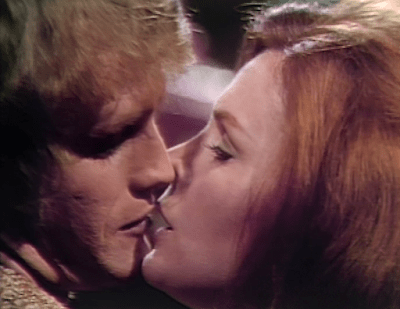
Megan comes to visit Jabe at the carriage house. She is exultant that Philip is in jail. Jabe tells her he has no intention of resuming his true form; she is appalled. The plan has been that he will take Liz’ daughter Carolyn as his bride, and that she will then turn into the same kind of being he is. If he is going to be humanoid all the time, then he will just be taking Carolyn out on dates. Megan says that this was not the point. Jabe dismisses her objections, and tells her that their own relationship is different now than it was when he was first taking shape and she and Philip were his foster parents. He pulls her close to him and gives her a passionate kiss.
Jabe spent several weeks in the form of a succession of children. The children showed violent hostility towards Philip and remarkably little sense of boundaries in their relationship with Megan; the reference to the Freudian Oedipus complex was not subtle then, and the kiss he gives to Megan while he is setting Philip up for a judicial murder makes the connection explicit.
No episode of Dark Shadows premiered 56 years ago this afternoon; the show was preempted by ABC-TV’s coverage of the Apollo 11 mission. That mission included the first steps taken by humans on the surface of the Moon, at a site 25 kilometers south of a crater then known as Sabine D. The following year, Sabine D was renamed Collins. That was not an attempt to console Dark Shadows fans for the trauma of a Monday spent away from Barnabas and his relatives, but was an honor given to United States Air Force officer Michael Collins, Command Module pilot on Apollo 11. Moreover, the nearby crater named Moltke was not named for Alexandra Moltke Isles, who played well-meaning governess Vicki in 333 episodes of Dark Shadows, but for her distant cousin Count Helmuth von Moltke the Elder, who died in 1891 and never appeared on the show (as far as we can tell.)
These changes to the map of the Moon remind me that, on this 56th anniversary watch-through, I’ve been revising my mental map of the show’s development. I used to divide it into chunks with labels like “Meet Vicki,” “Meet Matthew,” “Meet Laura,” “Meet Barnabas,” “Meet Julia,” “Meet Angelique,” and so on. In that scheme, this 161st week is an early part of the chunk I would have called “Meet Petofi.” I still see that the show defaults to having a main character, but now I think in terms of larger units. I also tend to focus more on the writing staff than on the central characters. So the first 38 weeks drew their vitality from the story of Vicki’s attempt to befriend strange and troubled boy David, a story which reached its conclusion at the end of the Phoenix tale, when David chose Vicki and life over his mother and death. That was Dark Shadows version 1.0, and I subdivide it less into the parts driven by Vicki, Matthew, and Laura than into the parts written by Art Wallace alone, by Wallace in alternation with Francis Swann, and by Ron Sproat and Malcolm Marmorstein with uncredited contributions by Joe Caldwell.
Dark Shadows 2.0 ran from March to November 1967, and its most interesting theme was vampire Barnabas Collins’ attempt to pass himself off as a living man native to the twentieth century. The first part of this, written by Sproat and Marmorstein, was even more slow-paced than were the first 38 weeks. Caldwell was credited with a number of scripts from May through October, Gordon Russell joined the staff in July, Marmorstein was fired in August, and Sam Hall replaced Caldwell in November. With each of those changes, the pace picked up and the overall quality of the scripts improved noticeably. There was also a shift in story in the middle of this period, as mad scientist Julia Hoffman teamed up with Barnabas in an attempt to physically transform him into a human, shifting his masquerade from an acting job to a medical problem.
Dark Shadows 3.0 ran from November 1967 to March 1968. This was a costume drama set in the 1790s, an era to which Vicki had traveled when she came unstuck in time while participating in a séance. It seemed at first that it would invert the 1967 story, with Vicki trying to pass herself off as a native in the time to which Barnabas actually belonged, but for some reason they chose to write Vicki as a screaming ninny during this segment. Mrs Isles made a valiant effort to overcome the painfully dumb lines she was given, but by the end of it, the character was no longer sustainable.
Barnabas was a human through the first half of Dark Shadows 3.0, and a vampire for the second half. That alternation answered three questions, each of which opened a door for further development.
First, the audience wanted to see how Barnabas became a bloodsucking ghoul. When they showed this happening in the course of his relationship with wicked witch Angelique, they laid the groundwork for more stories involving her.
Second, the audience wanted to see what Barnabas was like in his lifetime. When they showed this, they proved that he didn’t have to be a vampire to be interesting, and made it possible for Julia’s experiment or some other effort to free him of the effects of the curse to succeed.
Third, the audience wanted to see what Barnabas would be like if he were as deadly as one might expect a vampire to be. In the whole of 1967, Barnabas killed only two characters, each of them a middle aged man who had run out of story and seemed likely to disappear anyway. But he kills seven people in 1795-1796, not counting people who died of fright or confusion or despair as a result of seeing him.
When it was set in contemporary times, Dark Shadows was careful to keep its characters alive. They need to fill 22 minutes a day with conversations, and if they end up with Barnabas alone on the estate of Collinwood those will get to be rather one-sided. But since they were not committed to staying in the 1790s, they could let him slaughter people with abandon. That created a fast pace that the show tried to maintain for the rest of its time on the air. In consequence of that pace, by the end of the 1790s segment the show had left behind its origins as a Gothic romance appealing to an older demographic who were impressed that Joan Bennett was in the cast and had become a kids’ show.
Vicki returned to 1968 in #461, but Dark Shadows 3.0 did not end at that moment. Vicki came back to exactly the same collection of narrative dead-ends the show had gone to the eighteenth century to escape. It wasn’t until #466 that Barnabas found that he had been cured of vampirism- not by Julia, but by another mad scientist. That set the tone for Dark Shadows 4.0. Version 2.0 may have been content with one mad scientist, but 4.0 needed at least two, in addition to multiple witches, Frankensteins, vampires, ghosts, an invisible man, and, if not the Devil himself, at least one of the assistant managers of his upper New England operations. The fast pace of the 1790s segment turned into a frantic dash through this Monster Mash era.
In the course of Dark Shadows 4.0, there were four personnel changes that had especially profound effects. Two were in the cast. At the end of the segment, Mrs Isles left the role of Vicki, never to return to the show. Though Vicki had been pushed to the margins long before, she was so strongly associated with the first phase of Dark Shadows that every time she appeared on screen she made a connection with those early days. With her departure, that link is broken.
Thayer David, who had played crazed handyman Matthew Morgan in 1966 and much-put-upon indentured servant Ben Stokes in the 1790s segment, returned in 1968 as Ben’s descendant, occult expert Timothy Eliot Stokes. Ben was a commentary on Matthew, an example of what he might have been had he not grown up in a community under the somber mark of the Collinses and the many curses they bear. As such, David was like the rest of the cast for the 1790s, playing a character who shed light on the part he took in contemporary dress. But as Stokes, he is playing a man who has no direct connection to Matthew, and little connection to Ben. With that doubling, we see that any performer might return to the cast in a new role at any point in the story.
The other personnel changes during Dark Shadows 4.0 took place behind the camera. Ron Sproat ended his duties as a regular member of the writing staff late in that period, and left the show altogether shortly after. Sproat was the most devoted to conventional soapcraft of all the writers, and was the only one who consistently took care to keep the show comprehensible to first-time viewers. But he didn’t have an especially fertile imagination for story points or for clever dialogue. As Hall and Russell hit their stride and really started cooking, Sproat’s relative weakness became impossible to ignore. The show entered its most exciting phase when Sproat left, but his absence would later be felt at times when the staff tried to keep the story moving at a breakneck pace even when they were too fatigued to make sure it all made some kind of sense.
The least remarked of all the personnel changes was the departure of director John Sedwick. Sedwick was an outstanding visual artist, the equal of his colleague Lela Swift. Swift stayed with the show to the end, eventually combining the role of producer with responsibility for directing half the episodes. But after several men helmed a few episodes each, they settled on the lamentable Henry Kaplan as her alternate in the director’s chair. Kaplan was a famously poor director of actors, and the visual compositions he knew how to orchestrate ran the gamut from closeup to extreme closeup to even more extreme closeup. Dark Shadows was never all that easy for first-time viewers to take seriously, and when you tune in to one of Kaplan’s efforts you’re likely to dismiss it before you hear a word of dialogue.
As Dark Shadows 3.0 didn’t end until the show had already been back in 1968 for a week, so version 4.0 ended well before it began its next time travel story. In #627, we meet werewolf Chris Jennings and hear about Chris’ little sister, who will eventually be named Amy. Amy befriends David, and together they become the central figures in the Haunting of Collinwood by the ghost of Quentin Collins. This leads Barnabas to travel back in time to 1897 in #701. Barnabas and the show will stay in that year until #884. This whole arc, from #627 airing in November 1968 to #884 airing in November 1969, makes up Dark Shadows 5.0.
The major subdivisions of version 5.0 are the “Meet Amy” section that runs from #627 to #700, the “Meet Quentin” section from #701 to #778, and the “Meet Petofi” section from #778 to #884. The transitions among these segments showed that the shift from one time frame to another is not essential for making a chapter break in the show. The reset from the focus on Quentin to the focus on Petofi rolls across a few weeks, and does not have the single spectacular moment when we first find ourselves in 1897, but it is just as definite a break. It even involves doubling Thayer David, who played broad ethnic stereotype Sandor Rákóczi in 5.0.1 (the “Meet Quentin” section,) and who plays sorcerer Count Petofi in 5.0.2 (the “Meet Petofi” section.) As Ben was an alternative version of Matthew, so Petofi is an answer to the question “What would Stokes be like if he were evil?” As such, he brings version 5.0.2 in line with version 3.0, in which characters in one time frame mirror those in another.
That we can make a major transition without returning to the 1960s raises the question of whether we need to go back there at all. Barnabas is on a mission to save David and Amy and Chris, but he could always find a fresh threat to them in the 1890s. And the characters we have met in that period are at least as compelling as are those we left behind in the contemporary time frame. Despite the deficiencies of Henry Kaplan, the writing staff of Hall, Russell, and the brilliantly witty Violet Welles combine with an almost unanimously strong cast to make the dialogue glitter. It is the strongest period of the show by far, and it is difficult to imagine wanting it to end.
We will go back to a contemporary setting, eventually. The H. P. Lovecraft-inspired monster cult known as the “Leviathans” will be the center of version 6.0; in that segment, the show will start on the most adult tone it ever adopts, and end pitched squarely at a very young demographic. The change may well have come because the three-person writing staff burned out, and became a grave matter when Welles left the show.
Version 7.0 is another time travel story, but a story of traveling sideways in time, to an alternative universe where the characters wear clothing appropriate to 1970 but have different personalities and different relationships than do the people with the same names and faces whom we have met previously.
Version 8.0 is the most ambitious of all the segments, starting with a trip in time to the far-off future year 1995, returning to 1970 for a reprise of the Haunting of Collinwood, this time by a ghost who resembles Quentin in hairstyle and wardrobe but not in height, and proceeding to a long stay in the year 1840. That version had enough characters and enough story to last indefinitely, but Hall and Russell were the only full-time writers, and they simply could not keep it up. It finally collapsed, and the last nine weeks were set in another alternate universe, with no characters in common with the stories we had seen up to that point.
Version 9.0 had a drab feeling; some say it isn’t Dark Shadows at all, but another series shot on the same sets with some of the same actors. The name Dim Reflections has been proposed for it. There is one week in the middle of Dim Reflections when Violet Welles comes back to make some uncredited contributions to the scripts; you can tell it’s her, because all of a sudden the characters have senses of humor. But after that Gordon Russell is all alone at his typewriter until Sam Hall returns for the very last day, and by that time everyone knows it is time to go.
At the end of Friday’s episode, the well-meaning Vicki Winters was driving her car and bickering irritably with her passenger, Barnabas Collins the vampire. Barnabas wants to elope with her, which she doesn’t object to doing. But first she insists on running an errand in his old neighborhood, the deserted cemetery north of town, and he hates that idea.
A pedestrian wandered into the middle of the road. To keep from hitting him, Vicki had to slam the brakes so hard she lost control of the car and crashed. At least she learned the lesson of the cowardly Roger, who ran over a pedestrian years before the show even started and as punishment was condemned to spend months looking for some guy’s fountain pen.
Today, Vicki and Barnabas are in the hospital. We see Barnabas in bed, moaning alternately for Vicki and his long-lost love, the late Josette. It doesn’t bode well for the planned elopement that in his delirium Barnabas gives Vicki only equal time to Josette. We then see Vicki in her bed, moaning for Peter, an unpleasant young man she got to know recently while visiting the late eighteenth century. She doesn’t mention Barnabas’ name at all.
Vicki comes to and finds Peter at her bedside. He denies that he is Peter, claiming merely to be a strange man who let himself into her room to watch her sleep. She recognizes him not only as her boyfriend from the 1790s, but also as the wayward pedestrian involved in the crash. He admits to this, but will not answer any of her questions.
A nurse enters and finally gets Peter to leave Vicki’s room. Perhaps he will let himself into other girls’ rooms and stare at them while they sleep. The doctor, a man named Lang, comes in.
Dr Lang asks Vicki if she knows Barnabas well. This is an interesting question. Before he bit her on Tuesday, Vicki definitely did not know that Barnabas was a vampire. Her behavior towards him since has been so blasé, not only by contrast with the behavior of his other victims but also by contrast with the eager friendliness and habitual deference she had always shown him in the many months they have known each other, that we can’t tell if she has learned that he is one even now. Indeed, we have no idea what Vicki thinks is going on between her and Barnabas, and as a result their scenes together have been pure comedy.
Vicki nibbles on her index finger and thinks for a moment about Lang’s question. Since they were going off to spend the rest of eternity together, it would be pretty embarrassing for her to admit that she doesn’t really have much understanding of Barnabas, so she says that she does know him well. As she does so, she glances away for a moment, and the light flashes off her eye, emphasizing her unease.
Vicki talking through her hand
Lang asks about Barnabas’ health before the crash. Vicki puts her hands down and stutters slightly as she says “He was in excellent health.” A note of uncertainty gives her voice a childlike quality. When Lang replies with “Really?,” her voice sounds even more childlike when she answers “Y-yes, have you discovered something Mr Collins didn’t know about?” Lang says that he thinks Barnabas knew about it.
Lang looks at Vicki’s neck and finds the marks of Barnabas’ bite. They are just two dark dots, not conspicuously different from the last stages of an ordinary hickey.
The bite marks.
When Lang asks about the marks, Vicki’s grogginess suddenly vanishes and she becomes hyper-alert. Since Vicki has been so bland about her experience with Barnabas, returning viewers might well expect her to answer Lang’s questions about the bite marks by saying that Barnabas gave them to her when they were making out. Instead, she gets defensive, at first denying that she remembers how she got the marks and then asking “What’s wrong with them? Why are they so bad, please tell me?” Alexandra Moltke Isles reads that line brilliantly. There is a touch of defiance in her voice, but also a sincere question- she genuinely does not see any reason she should have to hide the marks or explain them to anyone.
Early in the episode, the telephone rang at the great house of Collinwood, and long-term houseguest Julia Hoffman answered. It was the nurse, reporting that Vicki and Barnabas had been brought in after a traffic accident and that “Mr Collins is on the critical list.” Now Julia is in Barnabas’ room trying to arrange transport to his house. Lang comes in and is astounded at the thought of taking an unconscious patient, who is in critical condition, out of the hospital.
Lang and Julia have a showdown. Lang makes it clear that he knows that Barnabas is a vampire, and has deduced that Julia, who is a doctor doubly qualified to practice as a psychiatrist and a blood specialist, has been trying to cure him. Lang marvels that Julia has been treating “a legendary condition.” He asks to examine her neck; she never removes her scarf, surprising returning viewers who know that Barnabas has not bitten her. He continues to pose direct, well-informed questions, which she continues to parry with lies and evasions. She grits her teeth when he refers to Barnabas as “our patient.” At the last, she agrees to go, and he agrees to keep the room dark.
Barnabas awakens and sees Lang. He becomes agitated and demands to be released. Lang refuses. Lang tells him the time is nearly four o’clock. Dawn broke in central Maine at 4:33 on the morning of 8 April 1968, so Barnabas has little more than a half hour to get back home to his coffin. It is no wonder that Barnabas puts on his murdering face when Lang will not let him go. Lang backs away and says he must explain something Barnabas does not understand. Lang reaches the window. As he opens the heavy curtains, he intones, “Yes, it is four o’clock! But it is FOUR O’CLOCK- IN THE AFTERNOON!!” The sunlight floods the room. Barnabas screams and covers his eyes with his hands. But he does not turn to dust- he is no longer a vampire.
This marks the end of the epilogue to the 1795 segment, and with that the end of Dark Shadows 3.0. Unlike version 1.0, which ended with no unresolved story threads of any interest, and version 2.0, which ended at a moment when the only way forward was the annihilation of all the characters, they have cued up at least three major storylines. Eventually Peter will stop pretending to be someone else and something will happen between him and Vicki; Roger will bring wicked witch Angelique home with him; Lang and Julia will work together to manage Barnabas’ aftercare. There are several other characters available for story-building. We have met kindly eccentric Professor Stokes and expect him to contribute to some or all of these storylines. We do not know how Barnabas’ cure will affect his blood thralls Vicki and Carolyn. Carolyn’s relationship with Humphrey Bogart-esque lawyer Tony is in an awkward spot, and Tony is in a position to trigger a major storyline if he starts telling people what he thinks he knows about Carolyn and Barnabas.
On his blog Dark Shadows Every Day, Danny Horn often identified Addison Powell, who plays Lang, as “THE WORST ACTOR EVER TO APPEAR ON DARK SHADOWS.” I don’t think he deserves that title. In fact, he isn’t even the worst actor in this episode. I’m sure the Nurse was written to be pretentious and silly, but Katharine Balfour’s stiffness and relentlessly exaggerated vocal mannerisms are simply excruciating. Powell isn’t great, and will get much, much worse, but he is basically competent today. Mrs Isles, Jonathan Frid, and Grayson Hall all do excellent work in their scenes with him, and he never once gets in their way. But when Balfour is on stage, the others can do nothing but stop and wait for her to leave. She had an extensive stage career, so I suppose she must have played many parts well, but she is stupefyingly bad today.
After Lang’s big “FOUR O’CLOCK- IN THE AFTERNOON!!,” we cut to the closing credits. Under them is a set where a clock’s hands indicate four. From April 1967 to July 1968, ABC suggested its affiliates run Dark Shadows from 3:30 to 4:00 PM. There were a great many stations which insisted on showing it at 10:30 AM. While it was a hit by this point in the 3:30 slot, its ratings were always rock bottom where it was shown in the mornings, so the great majority of viewers would have seen the correct time as they read the names of the people who worked on the show.
In #365, well-meaning governess Vicki came unstuck in time and found herself in the year 1795. Now, Vicki is about to be hanged for witchcraft, and the last of the story threads that have been playing out around her are about to be tied up.
Yesterday’s episode ended in the study at the great house of Collinwood, where naval officer/ sleazy operator Nathan Forbes shot a wooden bolt from a crossbow into the chest of vampire Barnabas Collins. At the top of today’s episode, Barnabas pulls the bolt out, telling Nathan that the bolt didn’t hit him. Barnabas’ voice is dubbed in over this, clarifying that Nathan missed his heart. We then switch to Nathan’s point of view and see Barnabas approaching for the kill.
After the opening title, we see that Barnabas is still in the study. Time has apparently passed. Barnabas’ father Joshua enters. Barnabas asks him if Nathan has been buried. Joshua says that he has, and lists the stories that he will tell to cover up all the deaths that Barnabas has been involved with over the last few months. Barnabas wants Joshua to shoot him through the heart with a silver bullet right now and destroy him forever. Joshua cannot do that, but he promises that he will put Barnabas out of his misery come daylight, when he is in his coffin. Barnabas asks two more favors of his father, that he free much put-upon servant Ben and that he prevent the execution of the wrongly convicted Vicki. Joshua promises to do these things as well.
Throughout this scene, actors Louis Edmonds and Jonathan Frid hold back tears. Patrick McCray remarks: “Crying is not the most powerful thing an actor can do on stage. Rather, it is the attempt not to cry that seizes audiences. In these moments, Frid and Edmonds seize. In a medium of love scenes, there is none more poignant.”
The performers have a powerful theme to work with, one that Danny Horn explicates when he considers the question of why Joshua is still alive at the end of this storyline. When she made Barnabas a vampire, wicked witch Angelique decreed that everyone who loved him would die. Yesterday, Joshua confessed that he feared he was incapable of love, and Barnabas told him that such a disability might save his life. But when we see Edmonds and Frid struggling against the urge to weep, we know that Joshua loves Barnabas very deeply indeed, as we have in recent weeks seen that he loved others he has lost. Danny explains:
The reason why Joshua is spared from the curse is that the love he feels for Barnabas isn’t the kind of love that Angelique recognizes, and so he slips under her radar.
Angelique’s love is selfish, and spiteful. She uses it as a convenient excuse for running over anyone who gets in her way. She doesn’t understand love that arises from respect, and strength of character. And she will never feel the kind of deep, honest love that Joshua now realizes for the first time that he is in fact capable of.
Danny goes on to explain that, while others had love for Barnabas that included a selfless element, there was also something in their feelings that Angelique could recognize, while Joshua’s love for him comes entirely from this higher plane. The portion of Dark Shadows set in the years 1795-1796 turns out to be The Tragedy of Joshua Collins, not only because Joshua has the highest social status among the characters, makes the most important decisions, and is played by one of the best actors, but because he grows into the sort of person who is governed by this kind of love. When the world around him is being ground down into dishonesty and cheapness, largely due to the consequences of his own misguided actions, Joshua discovers a new kind of strength within himself. Even amid the ruins of a world he himself did as much as anyone to wreck, Joshua represents the hope that something better might yet come into being.
After daybreak, Joshua stands beside Barnabas’ coffin in the secret chamber hidden inside the Collins family mausoleum, the pistol in his hand. Joshua cannot bring himself to fire the silver bullets into his son’s heart. Ben enters. Joshua orders him to affix a silver crucifix to the inside of the coffin to immobilize Barnabas there, and then to chain the coffin shut. Joshua and Ben assure each other that Barnabas will never be released. Later, we see Ben in the chamber, alone with the chained coffin. He looks at it and says “Goodbye, Mr Barnabas, goodbye.” Thayer David delivers that line with an unforgettable simplicity.
Returning viewers know that Joshua’s plan to keep Barnabas confined will work only until April of 1967, when Barnabas will be freed to prey upon the living once more. That July, in #276, Barnabas will stand in the hidden chamber and say that, while in chaining the coffin rather than destroying him his father “thought he was being merciful, what he did was no act of mercy.” This remark, combined with a story he told Vicki in #214 about his conflict with Joshua, just may have been the germ from which the whole story of Joshua grew. At any rate, the promise ABC-TV made to its viewers when it aired this promotional spot in November 1967 has been fulfilled:
Back in the study, Joshua frees Ben and gives him a severance packet of $100, worth about $2500 in 2024 dollars. When Ben thanks him for his generosity, Joshua denies that he is being generous. I have to agree with Joshua there- that amount might get a fellow out of town, but he’d have to find a new job pretty fast if he wanted to stay in the habit of sleeping indoors.
Another servant brings a note while Joshua and Ben are in the study. The governor has refused Joshua’s plea that Vicki’s execution be stayed. She will be hanged tonight.
At the gaol, Vicki’s boyfriend, an unpleasant man named Peter, is brought to her cell. The gaoler tells them they have five minutes before Vicki will be taken to her death. It is little wonder Vicki’s last request was to have time with Peter. Spending five minutes with him is like living to a ripe old age. Peter vows to overcome death and reunite with her. The last time we heard that was when Barnabas died the first time. In #409, he used his dying breaths to ask gracious lady Josette to wait for him to return to her. Fool that she was, Josette did, leading to disaster for her. Returning viewers may well wince, not only at the ominous parallel with Josette’s grim fate, but also at the memory of the many tedious scenes in which Josette at first insisted that Barnabas was coming back and was then at a loss when asked to explain herself. Besides, we don’t want to see any more of Peter.
The scene of Vicki’s hanging is quite elaborate by Dark Shadows standards. They’ve built a fairly realistic gibbet, hired several extras, put hats on them, and given them burning torches to hold. They test the equipment with a heavy sack, slowly lead Vicki to the place of honor, ask her if she wants a mask, and command the Lord to have mercy on her unrepentant soul. The camera drifts up to the top of the rigging, leaving Vicki out of the shot. When the time comes, we hear the drop and see the rope tighten.
This marks the end of the 1795 flashback, but not necessarily of Dark Shadows 3.0. In #437, Vicki told Peter that she often had nightmares in her childhood, so often that she became a connoisseur of nightmares. She would stay asleep throughout the whole process, waking up only at the very moment she was about to be killed. That was a rather heavy-handed way of telling the audience that Vicki would ascend the gallows, put her head in the noose, and find herself back in the 1960s. Once she is back in her own time, what she has learned in the 1790s will have consequences for what she does next. So we can expect an epilogue of some kind before Dark Shadows 4.0 begins.
As I’ve gone along making these notes, I’ve occasionally been moved to tag episodes as “Genuinely Good” or “Stinkers.” Since no episode of Dark Shadows aired 56 years ago today- 23 November 1967 was Thanksgiving Day in the United States, so ABC showed football games instead of its regular programming- I’m taking the opportunity to list the installments to which I gave these labels.
Genuinely Good Episodes
#25. Written by Art Wallace. Vicki finds an incriminating piece of evidence in David’s room.
#32. Written by Art Wallace. Roger and Liz face the fact that it was David who tried to kill Roger.
#50. Written by Art Wallace. Vicki and Carolyn see Bill Malloy’s body below the cliff.
#59. Written by Art Wallace. The sheriff comes to Collinwood and questions Roger.
#68. Written by Francis Swann. Roger encourages David to murder Vicki.
#69. Written by Francis Swann. Mrs Johnson visits Burke in his hotel room.
#87. Written by Francis Swann. Roger finds Vicki in the sealed room and releases her.
#102. Written by Francis Swann. David has a conversation with the portrait of Josette.
#103. Written by Francis Swann. Vicki and Burke investigate Roger.
#112. Written by Ron Sproat. Liz rescues Vicki from Matthew.
#126. Written by Ron Sproat. The ghosts of Josette and the Widows, accompanied by that of Bill Malloy, rescue Vicki from Matthew.
#146. Written by Malcolm Marmorstein. Sam burns his hands.
#182. Written by Ron Sproat. Roger begins to suspect that Laura might really be a supernatural being and a threat to David.
#253. Written by Joe Caldwell. Maggie gives Willie her ring. The first really good episode of Dark Shadows 2.0.
#254. Written by Joe Caldwell. Carolyn and Buzz announce their engagement.
#258. Written by Malcolm Marmorstein. Maggie talks with Sarah.
#260. Written by Ron Sproat. Maggie escapes from Barnabas.
#265. Written by Malcolm Marmorstein. First appearance of Dr Julia Hoffman.
#318. Written by Gordon Russell. Barnabas and Julia hide in the secret room of the mausoleum while Sam and Woodard search the outer part.
#325. Written by Gordon Russell. Sarah comes to David in a dream.
#327. Written by Gordon Russell. David communicates with two aspects of Sarah that don’t communicate with each other.
#333. Written by Ron Sproat. Burke and Woodard search Barnabas’ basement.
#344. Written by Joe Caldwell. David knows what’s going on and has given up hope of changing it.
#345. Written by Gordon Russell. Burke is missing and feared dead.
#348. Written by Joe Caldwell. Julia tries to save the experiment. The first episode of Dark Shadows to fully integrate color into a coherent visual strategy, and probably the best episode of the series up to this point.
#351. Written by Gordon Russell. Barnabas adds Carolyn to his diet.
#363. Written by Gordon Russell. Tony catches Carolyn going through his safe, then Sarah appears to Barnabas.
#364. Written by Gordon Russell. Sarah confronts Barnabas.
#365. Written by Sam Hall. A séance at Collinwood has an unexpected result. This is the final episode of Dark Shadows 2.0.
I credit the writers, because there were only two directors in this period of Dark Shadows, Lela Swift and John Sedwick, and they didn’t differ sharply in approach. The rest of the production staff was the same in every episode, so the writers were the only ones whose names seemed like they might give a clue as to what set the best episodes apart from the worst ones.
I’m very surprised to see Marmorstein’s name in this list three times. Joe Caldwell was making uncredited contributions to the writing from #123 on; #146 is very much in his style, and I suspect he was its true author. But Caldwell was getting on-screen credit by the time of #258 and #265, so I think those must actually have been Marmorstein’s handiwork. Granted, neither of them is all that close to the top of the all-time great list, and the actors and directors do a lot to elevate them. Even so, they do prove that Marmorstein was not the total incompetent he so often seemed to be.
One thing I notice is that many of these episodes feature long-delayed confrontations in which the character learns information they hadn’t expected and can’t use right away. So in #25, David talks with Vicki and for the first time makes an explicit statement about his father’s accident, while Liz talks with Roger and for the first time makes an explicit statement about Vicki’s origins. In each case, the explicit statement is an obvious lie and the person telling it demands that the other go along with it. Hearing the characters talk about issues they’ve been evading for a long time relieves some worn-out suspense, while the actual content of the conversation builds fresh suspense as we wonder what use Vicki and Roger will make of the knowledge that David and Liz are lying. And of course the similarity between David’s behavior and his aunt’s shows that the boy is carrying on a family tradition.
In #32, Roger and Liz finally admit to themselves and each other the fact that David caused the accident. While they set to work covering this up, Roger tells Liz that he isn’t sure David really is his son. Liz refuses to entertain the question, but it sets us up for the storyline centering on David’s mother Laura.
Jumping ahead to #258, the conversation between Maggie and Sarah shows that Sarah is able to interact with the living and suggests that she wishes Maggie well, but is just as inconclusive as were the conversations in #25 and #32. Sarah’s conversation with Barnabas in #364 shows that she is angry with him and trying to rein him in, but also shows that she has little direct influence over him.
Stinkers
#223. Written by Ron Sproat. David runs around and screams.
#249. Written by Ron Sproat. The family looks in the locked room and doesn’t find anything.
#266. Written by Ron Sproat. Liz is depressed.
#268. Written by Ron Sproat. Liz is still depressed.
#272. Written by Joe Caldwell. Liz has revealed her secret, and no one knows what to do about it.
#298. Written by Ron Sproat. It seems as if Maggie is going to remember what Barnabas did to her, but then she doesn’t.
#299. Written by Ron Sproat. It seems as if Barnabas is going to bite Vicki, but then he doesn’t.
#356. Written by Gordon Russell. Julia sticks her notebook in the clock, giving the clock the star turn it has been waiting for.
I suppose the first thing you’ll notice is that I didn’t come up with the “Stinkers” label until after Barnabas joined the show. If I’d thought of it sooner, Malcolm Marmorstein’s name would have graced the list many times. Also, there probably would have been some episodes there that aired on Fridays, as they didn’t really start to make an effort to do anything special at the end of the week until about halfway through Laura’s arc.
But I’m not going to go back and add the label to episodes from the first 42 weeks. I didn’t have any particular thought of making “Best” and “Worst” lists when I put them on; I was just marking some of my posts as raves or pans. So I’d be imposing a false organization on them if I went back through and did that.
The makers of Dark Shadows set out to give every episode airing on a Friday a number divisible by 5. Since no episode aired on Thanksgiving Day or the day after, that meant that episode 108, originally broadcast Wednesday, 23 November 1966, was followed by episode 111, originally broadcast Monday, 28 November 1966. There never was an episode 109 or 110. I’ve decided to take advantage of such breaks in the flow of the series to post general notes.
When we finished our first watch-through of Dark Shadows on 2 April 2021,* I looked back over the show and divided it into these 14 periods:
Episodes 1-45 “Meet Vicki”
Episodes 46-126 “Meet Matthew”
Episodes 127-192 “Meet Laura”
Episodes 193-209 “Meet Jason”
Episodes 210-260 “Meet Barnabas”
Episodes 261-365 “Meet Julia”
Episodes 366-466 “Meet Angelique”
Episodes 467-626 “Monster Mash”
Episodes 627-700 “Meet Amy” (subdivided into “Chris the Werewolf,” 627-638, and “The Haunting of Collinwood,” 639-700)
Episodes 701-885 “1897″ (subdivided into “Meet Quentin,” 701-748, and “Meet Petofi,” 749-885)
Episodes 886-969 “Leviathans”
Episodes 970-1060, “Meet Another Angelique”
Episodes 1061-1198, “Meet Gerard” (subdivided into “1995,″ 1061-1070, “The Re-Haunting of Collinwood,” 1071-1109, and “1840,″ 1110-1198)
Episodes 1199-1245, “Dying Days”
I’ve decided that it makes more sense to divide the first 42 weeks into two periods defined by writing staff rather than four periods defined by characters. So I now think of the first 21 weeks as the Art Wallace/ Francis Swann era, and of the second 21 weeks as the Ron Sproat/ Malcolm Marmorstein era. Wallace and Swann wrote finely etched character studies that gave their fine cast a chance to show their stuff. Sproat and Marmorstein didn’t really understand what actors could do, and needed much busier and more outlandish plots to keep the show going.
As for the stories, I’ve noticed a 14 week cycle. For the first 14 weeks of the series, characters occasionally use the word “ghost” as a metaphor for unresolved conflicts that have ongoing consequences. Often as not, they go on to say that around the great estate of Collinwood, ghosts are more than a metaphor- literal ghosts haunt that place. We see a few events for which no non-ghostly explanation is immediately forthcoming. Some of them would have to be either legitimately supernatural occurrences or deliberate hoaxes in the tradition of Scooby-Doo. In episode 70, at the end of week 14, we get our first sighting of an unmistakable, non-metaphorical ghost.
The second 14 week cycle ends with episode 140. That comes early in the saga of the “Phoenix.” The one storyline in the first 42 weeks that works every time we see it is well-meaning governess Vicki’s attempt to befriend her charge, strange and troubled boy David. In episode 140, David is terrified of his mother and goes to her only after Vicki has persuaded him to do so. It is a powerful scene, showing that David has come to trust Vicki totally. That marks the end of the Vicki-befriends-David story, and sets up the rest of the Phoenix saga as an exploration of what that trust means and what will become of it.
The third 14 week bloc ends with #210. That one is mostly about petty thief Willie Loomis trying to find some jewels that he believes are buried somewhere around the estate. It ends with Willie opening a coffin, from which a hand shoots out and grabs him by the throat. That moment turns out to be quite an important break from one phase to another.
So, my revised periodization of the first 42 weeks is:
Episodes 1-106, the Wallace/ Swann era. Subdivided into 1-35, Prologue; 36-106, The Mystery of Bill Malloy. In its turn, The Mystery of Bill Malloy is further divided into Bill Investigates, Bill Disappears, and Who Killed Bill?
Episodes 107-210, the Sproat/ Marmorstein era. Subdivided into 107-126, Matthew Imprisons Vicki; 127-192, the Phoenix; 193-210, Jason.
*The fiftieth anniversary of the first broadcast of the final episode.
Roger’s mounting anxiety about what Burke may learn from Sam leads him to alternate in each scene between yelling and begging. Depicting this, Louis Edmonds’ chews the scenery so hard that he momentarily loses track of Roger’s mid-Atlantic accent and slips into his native Louisiana drawl, yelling at Vicki “Jes supposin’ you a-tell me how long you wah standin’ in that doah-way?” Perhaps this is Marc Masse’s “David Ford Effect”– Ford came to the show from a long engagement as Big Daddy in Cat on a Hot Tin Roof, maybe they’ve decided to transport Collinsport from Maine to the Mississippi Delta.
At the Evans cottage, Sam gives Maggie a sealed envelope to be opened in event of his death. Maggie is bewildered and upset. Surmising that her father’s trouble is to do with Collinwood, she wishes that the mansion would burn to the ground. Sam waxes philosophical, opining that “Ghosts of the past don’t live inside a home. They live inside each man. They fight for his soul.. twist it into something unrecognizable.”
Moments later we find out that Sam is wrong, ghosts totally live inside a home. In the middle of the night, Vicki is awakened by the same strange sobbing she had heard in episode 4. She follows it to the basement. Last time she was in the basement, in episode 6, Matthew found her there and spoke sharply to her. Now Roger finds her there and yells at her. As she had stood up to Roger in the drawing room earlier, so she stands up to him now. After their showdown, he even admits that he has heard the sobbing woman many times, and says that she may be “one of our ghosts.”
I divide the series into several periods, the first of which I call “Meet Vicki.” The major story-lines of the Meet Vicki period are all in a down-cycle during this episode. Roger’s panic and Sam’s melancholy are part of the Revenge of Burke Devlin story, but Roger’s activities today do nothing to advance that story, and Sam’s letter will become one of the most tedious MacGuffins in a series that is notorious for forcing the audience to sit through overlong contemplation of its MacGuffins. Roger’s angry reaction to finding Vicki in the basement touches on the Mystery of the Locked Room, which is connected with the question of why Liz became a recluse. Those stories haven’t advanced for weeks. The sobbing woman revives the question of whether the house is haunted. While Roger’s admission that he has heard the sobbing marks the first time one character knows what another is talking about concerning the ghostly happenings, it does not prompt any further action. The question of Vicki’s origins is at a stalemate, the romance between Carolyn and Joe is dead in the water, and David is so alienated right now that they can’t do much with Vicki’s attempts to befriend him.
So the Meet Vicki period has reached a dead end. Tomorrow we’re going to meet someone else, and a new period is going to begin.
In the posts that follow, I link to comments I made on Danny Horn’s blog Dark Shadows Every Day. Unlike most daytime serials, Dark Shadows tended to restart itself from time to time, dividing the show into major periods. I’ve tagged most of these posts with the periods of the show to which they refer.
There are several ways of periodizing the show. The scheme I use is this:
Episodes 1-45 “Meet Vicki”
Episodes 46-126 “Meet Matthew”
Episodes 127-192 “Meet Laura”
Episodes 193-209 “Meet Jason”
Episodes 210-260 “Meet Barnabas”
Episodes 261-365 “Meet Julia”
Episodes 366-466 “Meet Angelique”
Episodes 467-626 “Monster Mash”
Episodes 627-700 “Meet Amy” (subdivided into “Chris the Werewolf,” 627-638, and “The Haunting of Collinwood,” 639-700)
Episodes 701-885 “1897″ (subdivided into “Meet Quentin,” 701-748, and “Meet Petofi,” 749-885)
Episodes 886-969 “Leviathans”
Episodes 970-1060, “Meet Another Angelique”
Episodes 1061-1198, “Meet Gerard” (subdivided into “1995,″ 1061-1070, “The Re-Haunting of Collinwood,” 1071-1109, and “1840,″ 1110-1198)



 Dark Shadows Commentary
