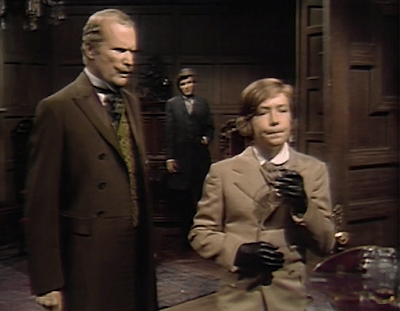
The evil Count Petofi, a 150 year old sorcerer, has taken possession of twelve year old Jamison Collins and is wreaking havoc in the great house of Collinwood. Due to Petofi’s spells, Jamison’s father Edward thinks he is a valet recently separated from the service of the Earl of Hampshire. Edward’s brother Quentin tries to explain to him what is actually going on, but Edward merely concludes that he is Quentin’s valet now. When Quentin follows the Collinses’ long-established protocol for dealing with mentally ill family members and locks Edward in the tower room, Edward bangs on the door and protests that he won’t be able to do his job if he is locked up. “And I will do it!” he vows.
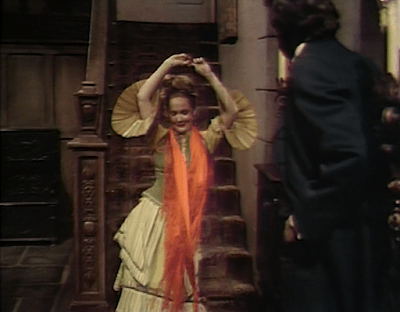
Charity Trask, disastrously uptight step-daughter of Quentin and Edward’s sister Judith, falls under Petofi’s influence and is possessed by the spirit of Cockney showgirl Pansy Faye. Pansy was on the show briefly in June. The childlike Carl Collins, brother to Judith, Edward, and Quentin, was engaged to marry Pansy before she was killed by vampire Dirk Wilkins. Pansy and Charity never met; when Carl asked Charity if she had seen Pansy, the scene was staged to make it seem absurd that the two women could exist in the same universe. Now, they exist in the same body.
If Petofi has caused startling changes in Jamison, Edward, and Charity, the change in Quentin is perhaps the most jarring of all. He has been a ghost, a homicidal maniac, a Satanist, a zombie, and a werewolf, but always and everywhere a source of total chaos, who destroys all recognized order and is perfectly at home in the midst of sheer madness. Today, Quentin keeps making earnest attempts to restore everyone to their right minds and reestablish the proper and respectable relations within the household.
First time viewers will immediately catch on that the preteen David Henesy is not the actor who would usually play a 150 year old Hungarian nobleman, and when Nancy Barrett suddenly takes on an East London accent and enters wearing a garish costume and doing a dance with lot of hip shaking and pelvic thrusts, they will know that Charity is turning into someone else. The dialogue in the scenes involving Edward explains what is happening to him. They may not know that Quentin is not supposed to be the defender of the status quo. That information is supplied in two scenes. Charity/ Pansy receives a psychic message from the world beyond telling her that Quentin was involved in the murder of Carl, and she announces this information. Also, Quentin calls for help, and the helper who materializes is his distant cousin, Barnabas Collins the vampire.
At the end of the episode, Barnabas lays hold of Jamison/ Petofi and drags him into the secret passage leading from the drawing room to the west wing. It is usually bad news when a vampire abducts a child and shoves him into a dark space, but David Henesy brings such joy to the role of Jamison/ Petofi that we can hardly doubt that what comes next will be equally fun to watch.
Meanwhile, a painter named Charles Delaware Tate has presented himself. Tate’s first appearance will cause a sinking sensation in longtime viewers; he is played by Roger Davis, a terrible actor who delivers much of his dialogue by shouting while clenching the sphincter muscles in his buttocks, and who routinely assaults the women and children in the cast while on camera. We may have hoped we had seen the last of Mr Davis when his most recent character, Dirk, was destroyed shortly after murdering Pansy. But evidently Pansy’s return in the form of another actress has come at the price of Mr Davis’ return in the guise of another character.
For much of 1968, Mr Davis played a man known variously as Peter Bradford and Jeff Clark. His approach to characterization consisted of shouting “My name is Jeff Clark!” When this technique was played out, he took to shouting “My name is Peter Bradford!” He doesn’t shout today, mercifully. But he does say the name “Charles Delaware Tate” quite a few times.
Today’s story about Tate is potentially interesting. Jamison/ Petofi finds him when he answers the front door. Tate asks to see Jamison Collins; Jamison/ Petofi confirms that despite his appearance, he is indeed the person Tate has come to see. Tate accepts this with a blandness that suggests that he knows he is dealing with a magical personage.
Jamison/ Petofi gives Tate a photograph of Quentin and says that he wants a portrait of him. When Quentin comes to the drawing room and finds Tate sketching, he asks who he is. Again, Quentin adopts a stern tone which suits someone defending the sanctity of private property against an unknown intruder. Tate introduces himself and shows him a handwritten letter which Quentin instantly accepts as the product of his grandmother Edith. He tells Tate that Edith has been dead for some time and that he is not interested in a portrait of himself. Tate says that he has already accepted the commission and the money that Edith sent with it, and so he will rent lodgings in the village of Collinsport and finish the job regardless. Quentin does what viewers have hoped everyone who shared a scene with one of Mr Davis’ characters would do, and throws him out.
The forged letter is a fascinating touch for returning viewers. Petofi made himself welcome as a guest at Collinwood by showing Edward forged papers creating the impression that he shared Edward’s friendship with the Earl of Hampshire. That he has also created papers that Quentin immediately accepts as coming from Edith, who died long before Petofi had any reason to come to Collinwood, suggests that his powers of forgery are very extensive indeed.
Tate not only seems to know that Petofi has magical powers; he also shows an acquaintance with Petofi’s henchman Aristide.* When Tate mentions Aristide, he calls him “Aristeedy,” a sort of pet name with a diminutive suffix. This is probably just a blooper on the part of Mr Davis, but since Petofi is continually telling Aristide how lovely he is and how he is more attractive when he doesn’t speak, it does remind us of the gay subtext that runs through their scenes together. We might suspect that Petofi and Aristide’s sexuality is in one way or another one of the reasons they are connected to Tate.
The script opens all of these questions about Tate. Had he been played by an actor who was capable of depicting depth and highlighting ambiguity, it could have been a lot of fun to speculate about just what their answers might be. In #137, future movie star Frederic Forrest was a featured extra on the dance floor at The Blue Whale tavern; it’s easy to suppose he would have taken a speaking part. So when the show puts Mr Davis in front of us, I like to make the time a little more tolerable by imagining what Forrest might have brought to the role of Tate.
*His name is spelled “Aristede” in the closing credits, but it was “Aristide” in the original scripts.
The spirit of evil sorcerer Count Petofi has taken possession of twelve year old Jamison Collins, much to everyone’s consternation. David Henesy spends most of the episode mimicking Thayer David’s Petofi, with hilarious results.
Jamison/ Petofi sipping a glass of “mineral water… for the digestion.” Screenshot by Dark Shadows Before I Die.
We see Jamison’s favorite uncle, Quentin the Satanist, trying to cast a spell to break Petofi’s possession of Jamison. As he always does when he is calling on the dark powers of the unseen realms, Quentin gets very fervent. We pan to Jamison/ Petofi, standing next to Quentin in a state of utter boredom, asking if Quentin will bring him a glass of mineral water once he’s “finished with all the mumbo-jumbo.”
Twice, Jamison/ Petofi pretends he is not possessed, but is his usual preteen self. He does this in order to trick people into letting him kiss them, which is how Petofi’s power spreads to them. This gives Mr Henesy the challenge of showing how Thayer David would play Petofi playing Jamison. That’s the sort of thing an actor needs a director’s help to pull off. Unfortunately, the woeful Henry Kaplan was at the helm today, so we discover that Petofi’s imitation of Jamison sounds exactly like the original, who is in turn uncannily like Jamison’s grandson David Collins and his great-great-grandfather Daniel Collins, who are also played by Mr Henesy.
Those whom Jamison/ Petofi kisses reveal their “true selves.” So maidservant Beth reveals that she was under the power of Jamison’s distant cousin, vampire Barnabas Collins. When Jamison’s father Edward passes this word along to Quentin, Quentin tells him is going to confront Barnabas. Edward has been hunting Barnabas, and by saying this Quentin implies that he knows where Barnabas is and that he has been helping to hide him. For some reason, Edward only smiles in response to this revelation.
Petofi wears a prosthesis in place of his right hand; Edward finds that Jamison’s right hand has also been replaced with a prosthesis. After this horrifying discovery, Jamison/ Petofi kisses Edward. Quentin returns shortly after, and finds that Edward does not recognize him or know the name of the house. Edward identifies himself as a newcomer to the area, and says that he would be glad of any work the family might hire him to do. Evidently his “true self” is a guy who needs a job. Since he has not inherited any assets or accumulated enough to live on, I don’t suppose we can disagree with whatever force it was that declared this to be Edward’s reality.
In the Old House on the estate of Collinwood, broad ethnic stereotype Magda Rákóczi accuses a man who calls himself Victor Fenn Gibbon of being Count Petofi, a sorcerer who, a hundred years before, was cured of lycanthropy at the price of his right hand and most of his magical powers. Fenn Gibbon denies the charge, and fills the awkward silence with a story that Petofi’s saddest morning came when he awoke to find that his pet unicorn was dead, killed by the wolf. Also in the room is the desperately handsome Quentin Collins, who is himself a werewolf. Quentin says that after they return to human form, werewolves do not remember what they did the night before. Since Fenn Gibbon’s story reveals his knowledge of that fact, Quentin takes it as confirmation that he is indeed Petofi.
Petofi’s severed hand is still in existence, and still carries with it great power. Magda stole the hand from Romani tribal leader/ New England crime boss King Johnny Romana several weeks ago in hopes that she could use it to lift the werewolf curse from Quentin. Since then it has been stolen by one person after another, none of whom has much benefited from it. Now schoolteacher-turned-adventurer Tim Shaw has taken the hand and skipped town. Petofi threatens to use his remaining powers to harm Quentin and Magda unless they find the hand and return it to him by morning; they have to admit they have no idea where it is.
At the end of the episode, we are in the great house on the estate. Petofi makes a series of ominous remarks to Magda and Quentin as he takes his suitcase and goes out the front door. Quentin’s twelve year old nephew Jamison appears at the top of the staircase. He is speaking in a raspy voice, continually suppressing a chuckle at his own witty remarks, and squinting by tightening his eyelids in the middle. He addresses Quentin as “Mr Collins,” says he is not in the habit of being interrupted, and walks downstairs with a slow gait, raising himself slightly from the hips as he comes to each step. We recognize an imitation of Petofi, and Magda declares that the boy is possessed.
Regular viewers will be intrigued to see Jamison as a medium for Petofi. Jamison is played by David Henesy, who in the parts of Dark Shadows set in the 1960s plays strange and troubled boy David Collins. In #186, David Collins participated in a séance during which he channeled the spirit of David Radcliffe, a boy who was burned alive by his mother in March 1867, exactly one hundred years before. In December 1968, David Collins was intermittently possessed by the ghosts of Quentin and Jamison, and when Quentin was temporarily dead and his body was a zombie in April 1969 Quentin possessed Jamison. So by this time Mr Henesy has substantial experience playing a boy who is being used as the vehicle for another spirit.
Mr Henesy is also deeply familiar with the style and manner of Thayer David, who plays Petofi. Thayer David’s first role on the show was crazed handyman Matthew Morgan, who had many scenes with David Collins, and his second was much-put-upon indentured servant Ben Stokes, who when the show was set in the 1790s shared screen time with Mr Henesy’s character Daniel Collins. Thayer David’s third role, Ben’s descendant and occult expert Timothy Eliot Stokes, crosses paths with David Collins only occasionally, but he was on so much that all Mr Henesy would have to do to keep up his status as an expert on Thayer David would be to watch the show on his days off. So it is exciting to see what Mr Henesy’s interpretation of Thayer David’s Petofi will be.
David Collins is always on the minds of longtime fans when Mr Henesy appears, and is especially so today. Magda has a crystal ball into which she occasionally peers; she gets melodramatically frustrated with it shortly before we cut to Jamison and Petofi today. This ball originally belonged to David Collins. He received it as a gift from dashing action hero Burke Devlin in #48, and thereafter used it several times to get information to advance the plot and to establish himself as a link between the visible action of the show and the supernatural forces which at that point lurked in an unseen back-world. Magda’s failed attempt at scrying today may seem like a throwaway to relatively recent fans, but when those who have been with the show from the beginning see the ball and then see Jamison so shortly afterward, they will know that something spooky is coming.
Thayer David might never have been cast on Dark Shadows if he had acted under the name he was given at birth. He was originally called David Thayer Hersey. It’s hard to imagine a producer adding David Thayer Hersey to the cast of a show that had already for eight weeks featured David Thomas Henesy.
A day of transformations. At dawn, the werewolf in the cell at the Collinsport jail turned into Quentin Collins. Edward Collins, Quentin’s stuffy brother, witnessed the transformation, and when we first see him he is staring at Quentin in bewilderment. Quentin is wearing the same blue suit he always wears, with the same distinctive hairstyle. But he has a glob of makeup on his face, and that’s enough to stymie Edward’s ability to recognize him.
This may reflect a hereditary disability of some kind. In #784, Quentin’s old friend and fellow Satanist, Evan Hanley, tried to steal the magical Hand of Count Petofi. The hand raised itself to Evan’s face and disfigured him, leaving his gray suit and highly identifiable hair and beard unchanged. But when Quentin saw Evan in #785, he was completely stumped as to who he might be.
Broad ethnic stereotype Magda Rákóczi enters. Edward accuses her of knowing who the man in the cell before them is. Magda does not share the Collinses’ peculiar inability to recognize people wearing facial appliances, so of course she does know. But she denies it. Edward does not believe her denials, and leaves in a huff.
Magda talks to Quentin, and he begins to speak. But he is not replying to her. Instead, he delivers lines that Count Petofi himself might have spoken when he was dwelling on the loss of his hand. He murmurs about “the forest of Ojden” and “the nine Gypsies” and suchlike. Magda realizes that Quentin has no idea who he is or what is going on.
Magda had placed the hand on Quentin’s heart the night before, as the moon was rising, hoping it would prevent the transformation. It didn’t do that, but by inflicting the same kind of facial disfigurement on Quentin that it had previously brought to Evan it does keep the werewolf story going beyond what might seem like a natural conclusion. When Magda leaves Quentin, she says that come nightfall she will consult with Quentin’s distant cousin, time-traveling vampire Barnabas Collins. “He will know what to do!” she declares. Barnabas has been the central character of the show for more than two years, and he has yet to have a non-disastrous idea. Ya gotta have hope, I guess.
At home in the great house of Collinwood, Edward tries to interest his sister Judith in the fact that he just saw a wolf turn into a human. She impatiently declares that she is not going to spend all day thinking about such a thing. Edward starts to remind Judith that she saw the wolf herself. He might have mentioned that she has seen it more than once, including in the very room where they are standing, but she says that it is “morbid” to go on paying attention to the topic once the creature has been caught and they can believe that they are safe.
Judith tells Edward that she had a bad dream. She won’t talk with him about that either. He needles her about her recent marriage to the Rev’d Mr Gregory Trask, which he calls “ridiculous.” She says that she does not regret her marriage, and that even if she did it would not be any more ridiculous than his own marriage. Since Edward’s wife was an undead fire witch who tried to incinerate their children to prolong her existence, all he can say to that is “Touché.”
Edward exits, and Judith dwells on her dream. It concerned Trask’s late wife Minerva. Minerva died in #773; Judith married Trask in #784. Judith knows that a young man named Tim Shaw poisoned Minerva, and that Trask gave Tim an alibi. She believes that Trask has forsworn justice for Minerva’s death for her sake. Tim knew that Judith, while under a magic spell, had shot his girlfriend Rachel Drummond to death, and he threatened to expose her if Trask handed him over to the police. What Judith did not know, and what is not mentioned today, is that Tim himself had acted under a spell. Trask and Evan connived to brainwash Tim so that when the Queen of Spades turned up in a card game he would poison Minerva. In her dream, Minerva told Judith that there was danger, then repeated the phrase “Queen of Spades” several times.
Judith turns around and looks at a table. It had been bare when last she saw it, and there was no one else in the room. But now a solitaire game is laid out there. She screams, and Edward comes. Judith turns up the Queen of Spades, and walks out the front door. Edward follows her to Minerva’s grave.
Judith tells Edward her dream, and he transforms into a psychoanalyst. “Your dream is nothing more than a manifestation of your own guilt.” Judith asks Edward what he imagines her to feel guilty about, and he says that she married Trask so shortly after Minerva’s death. She dismisses this, and soon goes into a trance. She wavers back and forth from the waist for a moment, then straightens up with a jolt. When Edward calls to her by her first name, she replies “I will thank you to call me Mrs Trask!” Edward doesn’t know what to make of this demand, but the audience knows that Minerva has taken possession of Judith.
Back at Collinwood, Edward meets Magda. She tells him that she is there to see maidservant Beth. Edward says that he hasn’t seen her all day. That puts him up on the audience; we haven’t seen her since #771. When they were setting up for the trip to this period, Beth was presented as a major character, and her ghost haunted the Collinwood of 1969 along with Quentin’s. When Barnabas and we first arrived in the year 1897 in #701, Beth figured very largely in the story for several weeks. But Terrayne Crawford’s limitations as an actress required Beth to be written as someone who says just what she means, no more and no less. Since the rest of the cast is able to rise to the task of portraying complex motivations and multilayered communication, and since Dark Shadows finally has a writing staff that can provide those things consistently, Miss Crawford has faded further and further into the background.
Edward goes to the drawing room and telephones Evan. Magda eavesdrops. She knows of Evan’s disfigurement, Edward does not. Edward tells Evan he must come over at once, that there is an emergency he must address in his capacity as Collins family attorney. Evan does not want anyone to see his face, and so he tries to beg off. Edward threatens to fire him if he does not show up. Evan has been making vain efforts to restore his appearance for days; he looks at himself in the mirror, and returning viewers might draw the conclusion that his goose is cooked.
That Evan’s face is still disfigured after we have seen Quentin’s disfigurement raises the possibility that the show is heading towards an all-disfigured cast. Evan is played by the conspicuously handsome Humbert Allen Astredo, and as Quentin David Selby’s good looks have become one of the show’s very biggest draws. If they are both going to be uglified for the duration, then there is nothing to stop anyone from having some plastic glued onto their face.
Judith enters. She does not recognize Magda and announces that she is Minerva. She closes herself in the drawing room.
Evan arrives, looking like his old self. Magda is astonished. When they have a moment alone together, he responds to her questions by saying that he will never tell her what happened to undo the hand’s work. That will hook returning viewers more effectively than any cliffhanger is likely to do- Evan’s case had seemed absolutely hopeless.
When Edward tells Evan what Judith has been doing, Evan starts playing psychiatrist, picking up where Edward had left off. “Well now, tell me exactly how she has been behaving. In what way is this delusion manifesting itself?” Edward sends Evan in to see for himself. Minerva/ Judith reacts to the sight of him with horror. She says that he was the one who made Tim Shaw poison her. Minerva did not know this in life, but it has long since been established on Dark Shadows that the dead pick up a lot of information in the afterlife. The murders have been coming thick and fast in 1897, and if all the victims talk to each other they would have a pretty easy time piecing together what has been happening behind closed doors. We end with Minerva/ Judith holding a letter opener over her head, walking towards Evan with evident intent of stabbing him.
A few times in the early months of Dark Shadows, writers Art Wallace and Francis Swann found themselves in a corner. The story could move forward only if a character took a particular action, but they couldn’t come up with a reason to explain why any character would take that action. So they had the character do whatever it was simply because it was in the script, and hoped the actors or director or somebody would come up with sleight of hand to conceal their desperation.
Since well-meaning governess Vicki was on screen more than anyone else, she was the one most often required to behave without motivation. Sometimes, Alexandra Moltke Isles finds a way to make Vicki’s behavior intelligible in spite of the writers. The scenes in which Vicki tries to befriend her charge, strange and troubled boy David Collins, are Dark Shadows‘ premier example of good acting trumping bad writing, and there are smaller examples as well. But there are three times in the Wallace/ Swann era- in episodes 26, 38, and 83– when Vicki simply looks like an idiot. This “Dumb Vicki” will appear more and more often as the series goes on, and will eventually ruin the character and do grave damage to the show.
Some weeks ago, Wallace and Swann were succeeded as the principal writers of the show by Ron Sproat and Malcolm Marmorstein. Sproat was a cut below Wallace and Swann, and Marmorstein was far less talented even than Sproat. Today, we get a succession of Dumb Vicki moments resulting from basic incompetence on Marmorstein’s part.
Vicki is visiting her friend Maggie Evans, The Nicest Girl in Town. Maggie has shown her a canvas that her father, drunken artist Sam, was possessed by an unexplained force to paint. Sam hates the painting and is surprised as he watches it take shape under his brush, but is powerless to stop working on it. It depicts Laura Collins, mother of David. Laura is shown as a winged figure, nude and engulfed in flames.
Sam has had several scenes in which he was shown in closeup delivering speeches about his hatred for the painting and going through convulsions while spooky music plays on the soundtrack. He has also had scenes with Maggie and with Laura’s husband, high-born ne’er-do-well Roger Collins, in which he tries to explain what is going on with him and the painting. Yesterday, Maggie recapped much of this to Vicki, sharing the suspicion that Laura is somehow responsible for Sam’s compulsion to paint the picture. Since the show has also given us loads of hints that Laura is connected to the supernatural, this all adds up to a very heavy-handed way of telling the audience that Sam is possessed.
Once you can say that your characters are possessed by unseen spirits, you get a lot of extra latitude as to what constitutes motivation. Once they have shown us that he is possessed, all we need to know about Sam for his actions to make sense is that he has some kind of connection to Laura and that Laura has some connection to the supernatural. The results of the possession hold our interest as we compare them with other events in the story and look for a pattern we can fit them into.
As far as the supernatural beings responsible for the possession go, we don’t need much information at all about their motivation. Far less than for human characters. Most audiences have more or less definite ideas as to what human beings are and what makes them do the things they do. We’re more flexible as to what supernatural beings are, and are willing to spend a long time searching for coherence hidden in story elements that don’t seem to have a logical connection once we have seen that there are uncanny forces in operation.
To get the benefit of that audience participation, a writer does have to show that supernatural forces are at work. Today, Vicki seems to be possessed, but there is no scene showing us that this has happened. Vicki looks at the painting and says she wants it. Asked why, she says she doesn’t know. Nothing she says makes much sense, or much impression.
Three seconds of Vicki staring at the painting while we hear a theremin cue on the soundtrack would have sufficed to tell us that she was falling under a spell. Not only don’t we get that, Mrs Isles never gets a chance to show us what is happening to Vicki. When Vicki first looked at the painting, she was partially obscured, standing behind Maggie; examining it later, she has her back to the camera. During her dialogue with the loudly agitated Sam, only a few brief shots focus on her. Sam gives Vicki the painting. When Maggie says she wonders how Laura will react when Vicki brings the painting into the house, Vicki mumbles that she doesn’t know.
Had we seen Vicki falling under the spell, the result could have been a powerful moment. As a supernatural storyline goes on, the mysterious forces behind it spread their influence from one character to another. The first moment in this one when we could see that sort of contagion at work is when the powers that have been controlling Sam take hold of Vicki. To hide that moment from us is to hide the whole development of the narrative arc.
Moreover, that this particular development takes place on this set among these characters is quite significant. When Vicki and Maggie first met, Maggie told her that she was a jerk for taking a job at the great house of Collinwood. She told Vicki that Collinwood was a source of trouble for the town of Collinsport. As the weeks went on, Maggie and other Collinsport natives made it clear that a big part of that trouble comes from the ghosts and ghoulies that are housed in Collinwood and that threaten to break out and take over the town. This will indeed become the major theme of the show in the years ahead.
Now Vicki has lived in Collinwood for over six months, and the only ghosts she has seen are the friendly, protective spirits of Josette Collins and beloved local man Bill Malloy. The first time a supernatural being does something frightening to Vicki is in the town of Collinsport, in Maggie’s own house.
Indeed, the Phoenix storyline is the only one in the whole series to invert the usual pattern of Collinwood as hell-mouth and Collinsport as a beleaguered outpost of normality. There are other storylines where evil powers came from far away, from across the sea or from another dimension, and settled in Collinwood before spreading out to threaten Collinsport, but in this story the source of the disturbance is Laura. While she may tell David in episode 140 that she comes from one of the realms described in the legends of the Holy Grail, that origin applies only to her uncanny side. When Laura first came to town, she had told Maggie that she was originally from Collinsport, and in episode 130, Laura’s estranged husband Roger, and Roger’s sister, reclusive matriarch Liz, had mentioned that Laura’s family had moved away from town.
The episode also leaves us on our own trying to figure out what Vicki is thinking. Regular viewers might take some time during the commercial break to puzzle it out, put it in the context of what we’ve seen previously, and wonder if Vicki is in a stupor because she too is possessed. That might help us to get through the rest of the episode, but if we are to feel a live connection to the character we have to understand what she is feeling while we are watching her. A theory we come up with after the fact is no substitute for empathy we experience during the scene. And of course people tuning in to Dark Shadows for the first time will simply think that Vicki is some kind of idiot.
Many fans of Dark Shadows, especially those who haven’t seen the first 42 weeks of the show or who didn’t see them until later episodes had given them fixed impressions, blame Alexandra Moltke Isles’ acting for Dumb Vicki. But today’s scene in the Evans cottage shows how deeply unfair that is. If an actor doesn’t have lines to deliver, she can’t use her voice to create a character. If the camera isn’t pointed at her, her body language is no use. And if the director is telling her to play the scene quietly while the others are going over the top, she’s likely to fade into the background. Without even a musical sting on the soundtrack to support her, there is nothing Mrs Isles could have done to communicate to the audience what Vicki is going through in this scene.
It is easy for me to denounce Malcolm Marmorstein, since his scripts are so often so bad. I am reluctant to place a share of the blame on director John Sedwick, since I am always impressed with Sedwick’s visual style and usually with his deployment of actors. But I can’t believe anyone would have stopped him pointing a camera at Mrs Isles at the appropriate moment, giving her a chance to play her part.
Back at the great house of Collinwood, David and Laura are sitting by the fire. David asks his mother about her old boyfriends. He wants to know if she ever dated dashing action hero Burke Devlin. She admits that she did. When David lets on that he wishes Burke, rather than Roger, were his father, Laura squirms. We’ve had a number of indications that Burke might in fact be David’s biological father, and Laura is alarmed that David is raising the topic.
The front door opens, and David and Laura are glad to see their friend Vicki. They are intrigued by the package Vicki is carrying. David begs to see what’s inside. Laura, in a light and cheerful voice, tells him that if Vicki wanted him to see it, she would have shown it to them. He continues to beg. Vicki says “All right!,” and unveils it. When we were watching the episode, Mrs Acilius exclaimed “All right!?,” appalled at Vicki’s nonsensical decision to yield to David’s pleas despite the cover Laura was giving her. Again, the idea that Vicki’s weird decisions and vague, distracted manner might be symptoms of possession was somewhere in our minds, but since nothing had been shown to give direct support to that idea our emotional reaction suited a Dumb Vicki moment.
As Maggie had suggested she might be, Laura is horrified to see herself depicted in this fiery image. David is thrilled- he had been plagued by a recurring nightmare, one he had described in detail to the deeply concerned Vicki, in which his mother stood in a sea of flames and beckoned him to join her. He asks how Sam knew about his dream- did he have the same dream? Vicki mumbles that he didn’t, that he didn’t know anything about the dream or even why he was painting the picture. The audience may have wondered why Vicki didn’t remember the dream until now- the explanation that fits best with the story is that she has been possessed by the same spirit that possessed Sam, but with so little attention given to Vicki as she was reacting to the painting some very insightful critics have taken it as another Dumb Vicki moment.
David points to a white space in the painting, one the shape of his own head, and asks what goes there. Vicki mumbles that she doesn’t know, and that Sam himself didn’t know. David is delighted with the painting and wants to hang it in his room. He asks Vicki to give it to him. Vicki tells him that his mother will have to rule on that question. Laura hates the painting and tries to talk David out of hanging it, but he is nothing deterred. She finally caves in.
While David goes upstairs with the painting, Laura asks Vicki what she was thinking bringing such a terrible thing into the house. Vicki says she doesn’t know- something just came over her. That goes to show that the writer wanted us to think that Vicki was possessed, which in turn makes it all the more exasperating that he didn’t let us in on it at the appropriate time. The fact that we know the writer wants us to have a reaction doesn’t mean that we actually have it. Confusion pushes people away from a story, and merely intellectual explanations offered after the fact don’t draw us back in.
Vicki, seeming to regain some of her brainpower, goes to David’s room and tries to talk him out of keeping the painting. He dismisses her concerns immediately, without even changing his delighted manner, and hangs it on his wall. Looking at it, Vicki admits that it looks like it belongs there.
Laura enters, and tells David she has changed her mind. She thinks it would be bad for him to have such an image on display, and asks him to get rid of the painting. David responds by threatening never to speak to her again. Laura has just been reunited with David after years of separation, and his initial reaction to her return was confused and traumatic. So it is understandable that she capitulates to this extortion.
It is more surprising that Vicki responds by turning away and wringing her hands after Laura leaves. Usually Vicki scolds David after he is nasty to people, and she has been on a particular mission to break down the barriers between him and his mother. If it were clear that Vicki was under the influence of a spirit and was not herself, this uncharacteristically diffident response might have carried a dramatic punch, at least for regular viewers. As it is, it slides past as yet another Dumb Vicki moment.
Back in the Evans cottage, Sam comes back from his usual night of drinking at the local tavern. Maggie is infinitely weary of her father’s alcoholism, but does smile to hear him reciting poetry and talking about a seascape he is planning to paint. At least he’s happy. Sam goes to his easel to start that seascape, only to recoil as he realizes that he is in fact painting another version of the picture of Laura in flames.
David is asleep in his room. The painting starts to glow. Then Laura’s painted likeness is replaced with a video insert of her face. The insert grows and grows, and David screams for it to stay away.
Maggie’s suspicion that Laura is behind the portrait fits with the many signs the show has given us of Laura’s uncanny nature. Laura’s reaction when Vicki brings the painting home, though, shows us that what has been happening to Sam does not serve Laura’s interests, any more than David’s nightmare did.
I think there are three possible explanations for the origin of the compulsion Sam had to paint the picture, the compulsion Vicki had to claim it, and David’s nocturnal disturbances. It could be that by exposing David time and again to the image of him following her into flames, Laura is gradually wearing down David’s resistance to a horrible idea that will lead to his destruction. In support of this interpretation, we remember the first night Laura was at Collinwood. She was calling David’s name in a quiet voice at the window of her cottage, far from the great house. Yet the sound of her voice penetrated David’s mind as he slept. He writhed on his bed, and went into the nightmare. Laura’s objection to the painting militates against this explanation.
When we were watching the episode, Mrs Acilius suggested a second reading. There might be a lot to Laura. Maybe in addition to the physical presence in the house that wants David to come away with her, there is also a ghostly presence that wants to warn him and everyone else of the danger that implies. That interpretation would fit with David’s sighting, the night Laura first came to the house, of a flickering image on the lawn that looked like Laura. David longed for that Laura to come to him, but reacted with terror when he saw the fleshly Laura in the drawing room. Perhaps there are two of her, and one is trying to protect David from the other. It is also possible that the two Lauras are not aware of each other, or even fully aware of themselves. So this interpretation is easier to reconcile with apparently contradictory evidence.
Vicki’s involvement suggests a third possibility. The ghost of Josette Collins appeared to her and comforted her in episode 126, and an eerie glow had emanated from the portrait of Josette when David left Laura alone in the Old House yesterday. Laura was alarmed to hear that David was interested in the ghosts of Collinwood, had not wanted to go to the Old House, and lies to David when he asks if he saw any sign of Josette’s presence. Perhaps Josette is intervening to thwart Laura’s plans, and it is her power that is benumbing Vicki today. Josette’s previous interventions have been intermittent and subtle, suggesting that it is difficult for her to reach the world of the living. So if she is preparing for a showdown with Laura, we might it expect it to take her some time to recruit her strength.
Again, this is the kind of search for patterns that an audience will gladly go into once you’ve let them know that there are supernatural forces at work in your story. Since Josette has been in the background of the show from week one, has appeared repeatedly, has a set devoted to her in the Old House, and has established connections with both Vicki and David, we might expect her to be the first of the uncanny presences we think of when we enter a supernatural storyline. That she is a tutelary spirit presiding over Collinwood brings it into sharp focus that the estate is under assault from a supernatural force emanating from the town of Collinsport. Today’s failure with Vicki kicks Josette’s ghost out of the spotlight, and that is one of the major faults with the episode.



 Dark Shadows Commentary