Episode 432: Cousin Abigail’s religion

In the deserted Old House on the great estate of Collinwood, repressed spinster Abigail Collins has stumbled upon the coffin in which her nephew Barnabas spends his days. She arrives just as he is rising for the evening. Abigail knows that Barnabas is dead, but she has never heard of vampires, so she has no idea what to make of what she sees.

Barnabas taunts Abigail. When she cries that the Devil is trying to touch her, he cynically asks why she thinks that the Devil always wants to touch her. The broadcast date is 1968, when Freudianism was riding high in the circles frequented by the sort of people who wrote and produced Dark Shadows. The dramatic date is 1796, when that school of thought was undreamed of. Still, there were various strands of folk wisdom about the adverse psychological effects of celibacy, so Barnabas’ smirking comment undoubtedly means exactly what the original audience would have taken it to mean.

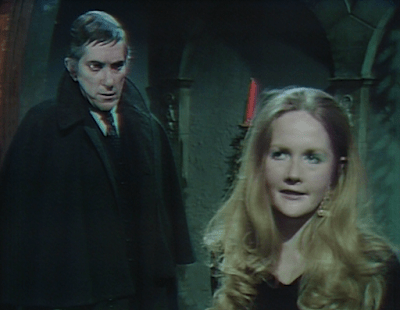
From the moment Barnabas saw Abigail at the end of yesterday’s episode, we’ve wondered how he would go about killing her. She is his aunt, after all; the vampire’s bite is so widely recognized a metaphor for the sexual act that we could hardly expect the ABC censors to have allowed him to make a meal of her. In the end, he simply bares his fangs and she dies of fright.

Barnabas scares Abigail to death. Screenshot by Dark Shadows Before I Die.

Abigail has been a villain; even the opening voiceover refers to her as “a woman who has been responsible for much grief.” During their confrontation, Barnabas tells Abigail many truths that, had she known them earlier, would have kept her from causing that grief. If she accepts them now, she will be remorseful. To the extent that we want Abigail to know what she has done, we identify with Barnabas during this scene. That might lead us to think that her death by fright is a way of letting us see Barnabas as the good guy, since he does not kill her by physical contact. But throughout the confrontation he has been telling her that she is about to die. Before he bares his teeth, he makes a dramatic announcement that clearly tells us that he is bringing matters to their climax, and when he sees her die he does not look the least bit unhappy. He seems to have known that the sight of his teeth had the power to kill his aunt, and to have deliberately used that power.

Abigail is the sister of Barnabas’ father, haughty overlord Joshua Collins. Before he even became a vampire, Barnabas killed Joshua’s brother Jeremiah in a duel. By his clumsiness, Barnabas inadvertently caused the death of his own sister, little Sarah Collins. Things are getting rather lonesome for Joshua.

In the great house on the same estate, young Daniel Collins is trying to slip out into the night. Yesterday, he arranged to meet secretly with much put-upon servant Ben so Ben could give him pointers on how to run away from this depressing house. The lady of the house, Joshua’s wife Naomi, intercepts Daniel. She asks if he plays whist, and he complains that he isn’t allowed to play cards because that is “against cousin Abigail’s religion.” Naomi says that so long as it isn’t against his religion, it’s no problem for her.

This isn’t the first indication that Abigail’s religion is different from that of the rest of the family. As rich New England landowners in the eighteenth century, we can assume they are all Congregationalists, but the loose polity of Congregationalism left room for a lot of variation from one congregation to another. She may well have attended a stricter meeting than did the other members of the family, though she seems to have taken her greatest satisfaction in imposing her austere ways on the other members of the household.

Naomi suggests that Daniel and his older sister Millicent might stay at Collinwood with her and Joshua indefinitely. Daniel is clearly not a fan of this idea, and struggles to find a polite way to say that he is desperate to go back home to New York City. He is still struggling when a knock comes at the door. It is the Rev’d Mr Trask, whom Abigail called in from out of town to find witches. Trask is currently prosecuting Victoria Winters, former governess to Daniel and the late Sarah. Abigail asked Trask to meet her because she thought she would find evidence against Vicki in the Old House. Since she found Barnabas instead, she will not be keeping the appointment.

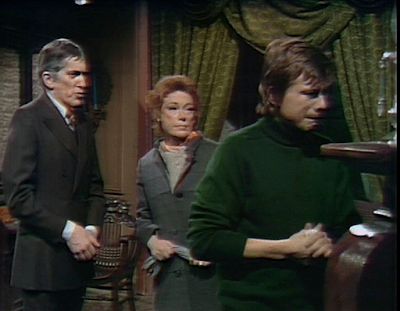
While Naomi goes to look for Abigail, Trask takes the opportunity to work on Daniel. At first Trask seems to be far more agreeable than we have ever seen him before. So when Daniel apologizes for telling him that he looks like the Devil and that he sees no reason they should exchange any words, Trask smiles and calmly says that he appreciates his honesty. Trask holds Abigail up as an exemplar of Christian virtue; Daniel says that he cannot bring himself to want to emulate Abigail, since she “is always so, so unhappy, as if whatever she has eaten doesn’t agree with her.” Trask takes this remark in good turn.

Daniel keeps insisting that Vicki is not a witch, but is very nice. Trask takes everything he says as evidence against Vicki. For example, when he tells Trask that Vicki extolled the virtues of curiosity, Trask exclaims that “Curiosity is the Devil’s money! What you buy with it is disbelief in everything it is right to believe in!” Even in this portion of their encounter, Trask seems far smoother than the screaming fanatic we’ve seen up to now. Daniel complains that Trask keeps talking about the Devil when “I want nothing to do with him.” At that, Trask leans in and says that if Daniel feels that way, he can still be saved. When Daniel asks how he can be saved, we can see how Trask might have managed to win a new follower, if he hadn’t gone straight to a demand that Daniel testify against his friend Vicki.

Trask and Daniel have a man-to-man talk. Screenshot by Dark Shadows Before I Die.

Trask finally loses his temper. Naomi returns and is appalled when she hears Trask telling Daniel that he bears the mark of the Devil. Daniel runs out into the night, and Naomi tells Trask he is to blame for that.

Daniel wanders about in the woods, looking for Ben. He quickly concludes that he must have missed Ben, and he thinks of going back to the house. Remembering that Trask is there, he chooses to stay outside.

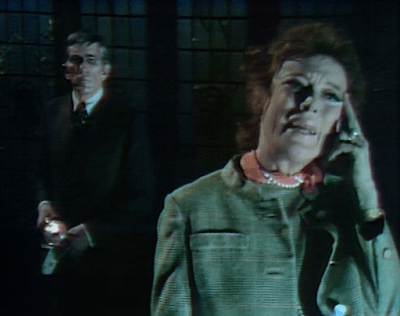
Naomi is in the woods looking for Daniel; Trask joins her, much to her displeasure. Daniel sees Abigail’s corpse propped against a tree. He shouts for Naomi. She and Trask come, and he points the corpse out to them.

Daniel shares his gruesome discovery. Screenshot by Dark Shadows Before I Die.

Abigail is the second character Clarice Blackburn has played on Dark Shadows. She joined the cast in #67 as housekeeper Mrs Johnson. In her first months on the show, Mrs Johnson was out to get revenge on the Collins family for their treatment of her former employer and the object of her unrequited love, the late Bill Malloy. Blackburn was told to think of the character as if she were Mrs Danvers, the terrifying housekeeper in Daphne DuMaurier’s Rebecca. After the Death of Bill Malloy storyline ended, Mrs Johnson transformed into a warm-hearted old biddy whose wildly indiscreet chatter gave the other characters just the information they could use to advance the plot.

Mrs Johnson was always fun to watch, and one of the reasons to look forward to the show’s return to a contemporary setting is that she is waiting for us in 1968. But after her first few weeks, her appearances were rare and usually brief. Abigail gave Blackburn her first chance to show viewers of Dark Shadows what she could do when she had the chance to work on a big canvas. In later storylines, she will have more such opportunities, but we will always miss Abigail.

Episode 67: I was fresh out of arsenic

This one belongs to Maggie Evans, the nicest girl in town. We open with her doing some work in the restaurant she runs. She isn’t feeling so nice today- dashing action hero Burke Devlin has accused her father, drunken artist Sam Evans, of various crimes, including the murder of beloved local man Bill Malloy. When flighty heiress Carolyn comes into the restaurant, Maggie tells her that it might be a good idea to flavor Burke’s coffee with rat poison.

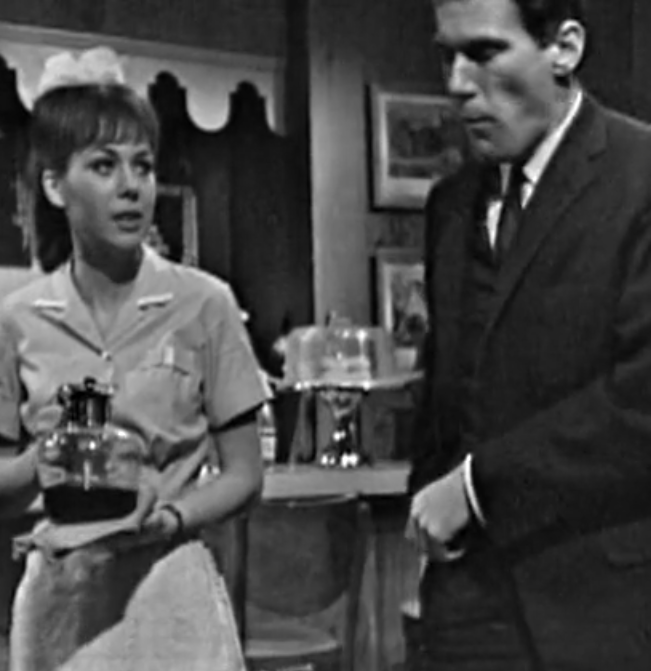
Burke does show up. When he complains about the coffee, Maggie picks up on the idea she had floated to Carolyn and apologizes for not adding arsenic.

Maggie apologizing to Burke for failing to give him arsenic
No arsenic today, sorry

Not that she’s going to let her father off without a piece of her mind. When he comes in and tells her some lies, she discards her usual adult-child-of-an-alcoholic manner of exaggerated patience and calmly asks him if he minds that she doesn’t believe him. He mumbles that there’s no reason why she should.

The sheriff comes into the restaurant to ask Maggie if she can confirm her father’s whereabouts at the time of Bill’s death. She gives him a sarcastic answer. When he asks what she is prepared to swear to on the witness stand, she makes it clear that she will swear to whatever she damn well pleases. Sam then tells the sheriff that Maggie doesn’t actually know where he was that night. At that, she declares that Sam has no idea what she does or doesn’t know. If she wants to perjure herself, it will take more than Sam and the sheriff to stop her.

In the sheriff’s office, we meet Mrs Sarah Johnson, housekeeper to the late Bill Malloy. Mrs Johnson is furious with the Collinses, the family in the big dark house on the hill who own half the town. She more or less blames them for Bill’s death. She very much blames them for his life, which he spent doing nothing but working for their interests. Mrs Johnson is even more indignant than Maggie, but the only person she interacts with is the sheriff. So we have a contrast between a character who gives us several distinct shades of outrage, one for each person she puts in their place, and another who spends her time bringing one specific shade of anger into perfect focus.

In between there’s a scene with Sam and the sheriff, and at the end one between Carolyn and Burke. These offset the studies in indignation from Maggie and Mrs Johnson, both giving the audience a bit of a breather and giving their fiery turns time to sink in.

Miscellaneous:

There’s a moment when the sheriff goes to the water cooler and finds the paper cup dispenser empty. He apologizes that he can’t offer Mrs Johnson a drink. All the websites list this as a production fault, but I’m not sure- it goes on for a while, longer than I imagine it would if he were actually drawing two drinks of water and giving her one, and the timing doesn’t seem off afterward. I don’t know if it was in the script- I suppose they might have noticed they were out of cups and improvised the scene before or during dress rehearsal. At any rate, I don’t think actor Dana Elcar was actually surprised by the absence of cups during the taping.

This episode was recorded on the Sunday before it aired. The Dark Shadows wiki quotes Kathryn Leigh Scott (Maggie) explaining that this was because one of her fellow cast members had shown up drunk on the day they were originally supposed to record it. Mitchell Ryan and David Ford both have important parts in it, and they were both alcoholics. After he stopped drinking, Ryan admitted that he showed up on the set of Dark Shadows drunk on more than one occasion. Ford never stopped drinking, and booze was apparently part of the reason he died in 1983 at the age of 57. Also, while Ryan and Ford are the two actors in this period of the show who usually have the most trouble with their lines, they are both nearly letter-perfect today, as if they had been in trouble and knew they had to be good boys or else. So it could have been either of them.

Clarice Blackburn joins the cast as Mrs Johnson today. As Mrs Johnson, Blackburn will be crucial at certain moments in the years ahead, and she will also be cast as other important characters in the later run of the show. When Mrs Johnson was cast, Blackburn was told to model her on Judith Anderson’s performance as Mrs Danvers, the frightening housekeeper in Hitchcock’s Rebecca. That instruction didn’t last very long, and when four years later they actually got round to including an homage to Rebecca, Blackburn didn’t play the Mrs Danvers part.

On his blog Dark Shadows from the Beginning, Marc Masse develops a theory that set designer Sy Tomashoff was influential in casting Dark Shadows. He focuses on a guest spot Clarice Blackburn had on an earlier series where Tomasheff did the sets, a primetime show called East Side, West Side:

The version of Mrs. Johnson we see today in episode 67 is based on an even earlier role as Gert Keller in the critically acclaimed but greatly overlooked groundbreaking series East Side, West Side, in a 1964 episode called The Givers. Perhaps the biggest surprise to those not familiar with the series would be its leading actor, featuring George C. Scott as a… social worker.

It should be noted that both of these earlier productions had Dark Shadows scenic designer Sy Tomashoff as the “art director”; in the East Side, West Side episode The Givers, the cast list even featured Bert Convy, the original early choice for casting as Barnabas Collins on Dark Shadows. Tomashoff held the same production role in For the People. Both of these series are notable for a good many cast member crossovers with Dark Shadows, often several in a single given episode; and because Sy Tomashoff worked so closely with executive producer Dan Curtis on Dark Shadows, it is likely that he played a significant part in a number of the key casting decisions in the early days of Dark Shadows.

Especially curious as noted in the introduction to today’s post is how Mrs. Johnson comes across as the grieving widow, indicating that she may have been more than just a housekeeper to Bill Malloy even if Malloy himself was never aware of this. If you see her as Gert Keller in the East Side, West Side episode, she seems to be reprising this earlier role…

An even more striking parallel between the portrayals of Gert Keller and Sarah Johnson are the similarities in character dialogue between the speech patterns and emotional tone… [I]n each instance, vocal delivery of dialogue as provided by the actress shows a similar shift between the emotional extremes of tearful despair and bitter resentment at the injustice of each character’s passing, first over Arthur Keller in East Side, West Side with an almost identical pattern and tone evident today on Dark Shadows over Bill Malloy.

In East Side, West Side, Art Keller is a business man struggling with elusive opportunities due to a past bankruptcy situation. Despite the best efforts of Neil Brock [George C. Scott] and his resources and contacts, Keller winds up ending his life soon after Brock drops by with the news that despite the availability of a possible deal for work in connection with a local congressional office, he had to intervene on Keller’s behalf because of the shady nature of the congressman’s methods of operation.

Two years later on Dark Shadows, Gert Keller is transplanted from East Side, West Side to make her debut as Bill Malloy’s bereaved housekeeper, Sarah Johnson.

It’s plausible, but not conclusive- after all, both East Side, West Side and Dark Shadows were cast with New York actors at a time when there was already more national television production, and therefore more proven acting talent, in Los Angeles. Many of the relatively well-established actors who were in New York in the 1960s were there because they were busy with specific projects and weren’t in a position to commit the time for a recurring role on a five-day-a-week TV show. So if you’re casting Dark Shadows and you’re looking for someone you can trust to give you a performance with a particular quality, of course you’re going to look at a lot of people who were on East Side, West Side, whether Sy Tomashoff recommended them or not.