Episode 93: A little wrong about David

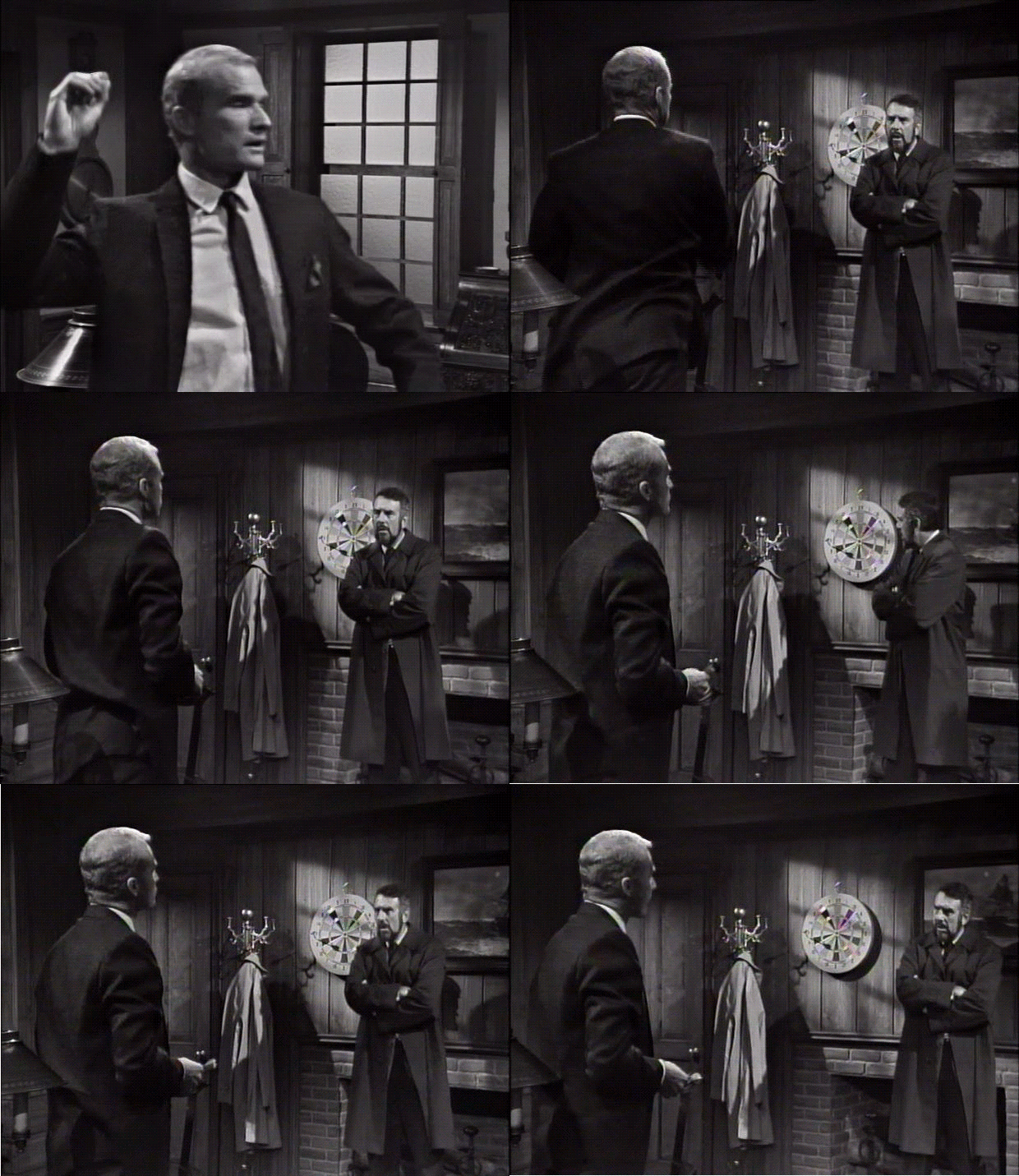
Strange and troubled boy David Collins talks with his father, high-born ne’er-do-well Roger, about David’s governess, the well-meaning Vicki. David wants Vicki to stay on. Puzzled by this, Roger lists some of the cruelties David has meted out to Vicki. David explains that he has changed his mind about her since he did those things. Roger asks why. David explains that Vicki has seen the ghost of beloved local man Bill Malloy, and that if she sees the ghost again, it might reveal that Roger murdered Bill. Roger responds to this remark by slapping David across the face. David is shocked, and runs to his aunt, reclusive matriarch Liz, to complain.

Roger is well-established as an abusive parent. He has time and again spoken openly of his hatred for his son, and more than once we have seen him manipulate the rage with which he has filled David so that the boy will do his dirty work for him. This is the first time we’ve seen him engage in physical violence. David’s disbelieving reaction and his assumption that he has the right to complain support the idea that Roger has previously limited himself to psychological abuse.

The actors are such pros that I find it hard to imagine Louis Edmonds really made contact with David Henesy when he swung his hand. But Henesy visibly flinches a second before the slap, as if he expected to be hit. Maybe Edmonds came close enough in dress rehearsal that Henesy couldn’t help being scared.

Roger hits David. Screenshot by Dark Shadows Before I Die

When David runs to Liz, he finds that she is busy trying to reason with her own strange and troubled child, flighty heiress Carolyn. Carolyn is annoyed by David’s interruption, and dismisses his claims about Roger out of hand. Even after Roger proclaims that he did hit David and will do it again if he doesn’t stop babbling about ghosts, Carolyn says that she believes David made the whole thing up. Liz sends Roger, but not Carolyn, out of the room, and talks to David about the incident. Liz walks him back to his room, not saying much as he seethes and says that he wishes his father were dead.

Liz returns to her conversation with Carolyn, trying to talk her out of her obsession with the family’s arch-nemesis, dashing action hero Burke Devlin. Liz understands the fascination- how could she not? Carolyn is a vigorous young woman, and she’s already broken up with the only other attractive man on the show, hardworking young fisherman Joe. So Liz shares some information about how miserable her marriage to Carolyn’s father was, tells her that Joe reminds her of the man she wishes she had married instead, and urges her to try to patch things up with him.

Roger reappears and pouts to his sister Liz. He claims that Vicki is a bad influence on David and demands that Liz fire her. Liz refuses to do so, or to take anything Roger says at all seriously. When he refers to the idea that he might take David and leave her house, she tells him she is sure that her money means more to him than does his son. His response to that is to slam his hand on the piano and to concede her point.

The Liz/ Roger moments today focus on Dark Shadows‘ most characteristic relationship, that between a Bossy Big Sister and her Bratty Little Brother. Liz fails to address Roger’s hitting David for the same reason she fails to address his psychological abuse of the boy- facing either problem would require acknowledging that Roger is a father and that he has the responsibilities of a grown man. Liz is deeply invested in treating him like a naughty little boy whose behavior she will try to correct when the two of them are alone together, but for whom she will always cover when the grownups are around.

Her cutting remark about Roger’s attachment to her money shows the same pattern. When it’s just the two of them, Liz scolds him for living off her. But when there was a prospect he would face consequences for his spendthrift ways, she borrowed against everything she has to pay his way out of trouble.

In a world of Bossy Big Sisters and Bratty Little Brothers, David is adrift. He’s bratty enough, but has no sister. The obvious candidate for a substitute big sister, his cousin Carolyn, makes it clear today she couldn’t be less interested in David. Regular viewers know that Roger and David moved into the house not long before episode 1, that Carolyn didn’t grow up with David, and that she was not happy when he ended her long reign as an only child. Aunt Liz likes David very much, but she has spent too much time protecting Roger from accountability to protect anyone from Roger. Vicki is determined to befriend David, and now that she has seen a ghost there is a chance she will succeed. But she is far too mentally healthy to reenact with him the pattern the Collinses of Collinwood are bred to expect. To accept Vicki’s friendship, David will have to learn an altogether new way of relating to another person. 

Episode 80: Not one to talk

The few minutes of action preceding the opening credits of a TV show are sometimes called the “hook,” the thrilling segment that will so intrigue the audience that they can’t turn away. Today’s hook takes place in the drawing room at the great house of Collinwood. High-born ne’er-do-well Roger Collins is muttering to himself as he tries to remember where he left a pen. We can hardly expect them to maintain that level of excitement for the entire half-hour.

Roger asks well-meaning governess Vicki to help him dissuade his sister, reclusive matriarch Liz, from hiring a new housekeeper. Liz walks in and humiliates Roger in front of Vicki, reminding him that he lives in her house as a guest and has no right to tell her how to run it.

Roger goes to the beach and looks for something, presumably the pen. He doesn’t find it. In frustration, he throws a rock into the ocean.

Throwing the rock

Later, Roger sits in on a conversation between Liz and hardworking young fisherman Joe. When Liz talks about giving Joe a promotion in the company she owns, Roger speaks up and says he thought that it was his place to make those decisions. Liz grimaces at Roger’s presumption, and says that she is sure he will agree with what she decides. Roger is again humiliated in front of someone he has more than once dismissed as a social inferior.

Roger goes to the foyer outside the drawing room. He sits uneasily on the table while Liz and Joe continue their meeting. His adoring niece, flighty heiress Carolyn, sees him there.

Sitting uneasily

Roger tells Carolyn that he and Vicki had seen Joe on a date with Maggie Evans, The Nicest Girl in Town, the night before. This is a misrepresentation of the facts- they had indeed seen Joe and Maggie together, but he knows they hadn’t planned to meet, and Maggie’s father was with them.

It is also a vicious thing for him to say to Carolyn. Joe and Carolyn are a couple. It’s true that Carolyn is lukewarm about Joe. The reason Joe ran into Maggie and her father was that he was looking for her after she broke a date with him to go for a drive by herself. But she is also quick-tempered and jealous. When Joe emerges from the meeting with Liz, Carolyn rages at him, as Roger must have expected her to do. His only motivation for telling her that he had seen Joe and Maggie talking to each other and representing what he saw between them as a date appears to be idle cruelty- he can’t accomplish anything else, so he’ll torture Carolyn and Joe for amusement.

At the end of the episode, Roger sees that Vicki found the pen he was looking for. Since the pen may be a piece of evidence that will connect him to a homicide, we may wonder what he will do to Vicki should she learn its significance. After all, he actually likes Carolyn, and he doesn’t hesitate to use her as a victim in his sadistic pastimes. Vicki, on the other hand, is someone he has never wanted to have around. If he sees her as a threat to his freedom there’s no telling what he might do.

Episode 45: Where Burke Devlin’s pen is

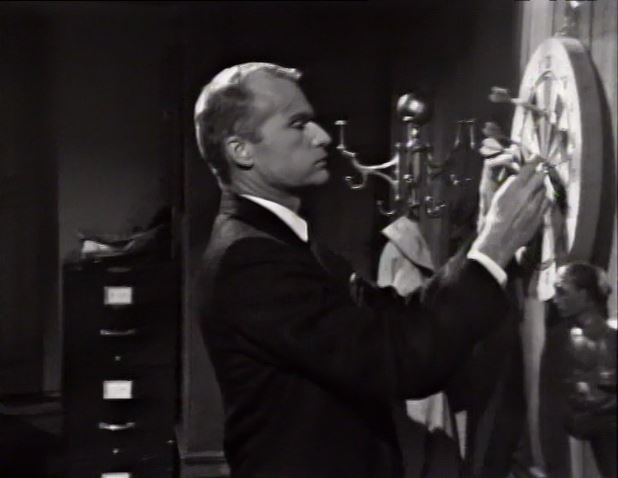
Roger is trying to keep his hands busy today. Our first look at his office focuses on his dart board, and he spends a great deal of time handling the darts.

Roger pulling the darts out of the dartboard on the wall in his office
Screenshot by Dark Shadows from the Beginning

Carolyn stops in the office. Roger hugs her, calls her “Kitten,” and doodles with his pen while he and his niece flirt pretty daringly.

Roger and Carolyn flirting with each other while Roger plays with his pen
Screenshot by Dark Shadows from the Beginning

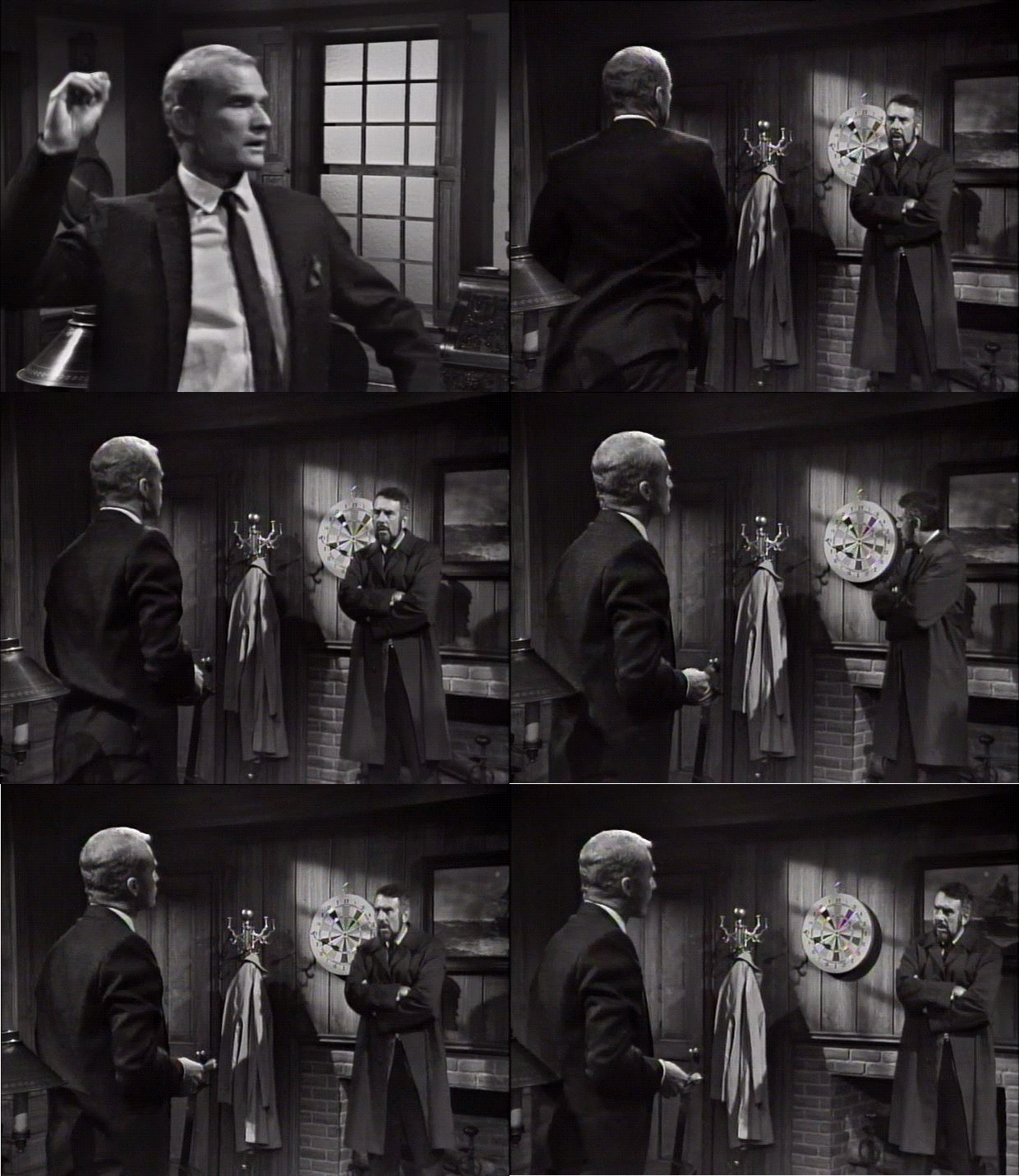
Bill, whom we just saw in the Blue Whale giving Burke a stern talking-to, comes to Roger’s office to continue his stern talking-to concert tour. He drives Carolyn away. Roger stops handling the pen playfully and handles the darts menacingly.

Roger throws a dart in Bill's direction
Screen capture by Dark Shadows from the Beginning

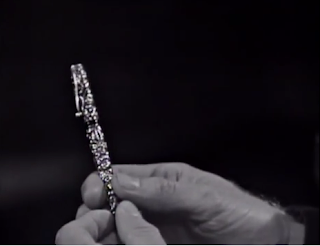
Later, Roger sees Carolyn at home. He finds out she had lunch with Burke and that Burke gave her his pen. He explodes at this and demands that she give up the pen. After a phone call from Bill (stern talking-to #3) and a commercial break, Roger simmers down. He apologizes and calls Carolyn “Kitten” again. She admits that she’s probably just hanging around Burke out of curiosity. She also tells Roger about the evidence that Burke is trying to put the family out of business. Roger takes this news calmly- after all, the Collinses’ cannery, fishing fleet, and other financial interests can hardly compare to the significance of who gets to touch Burke’s pen.

Roger's hands fondling Burke's pen
Screenshot by Dark Shadows Before I Die

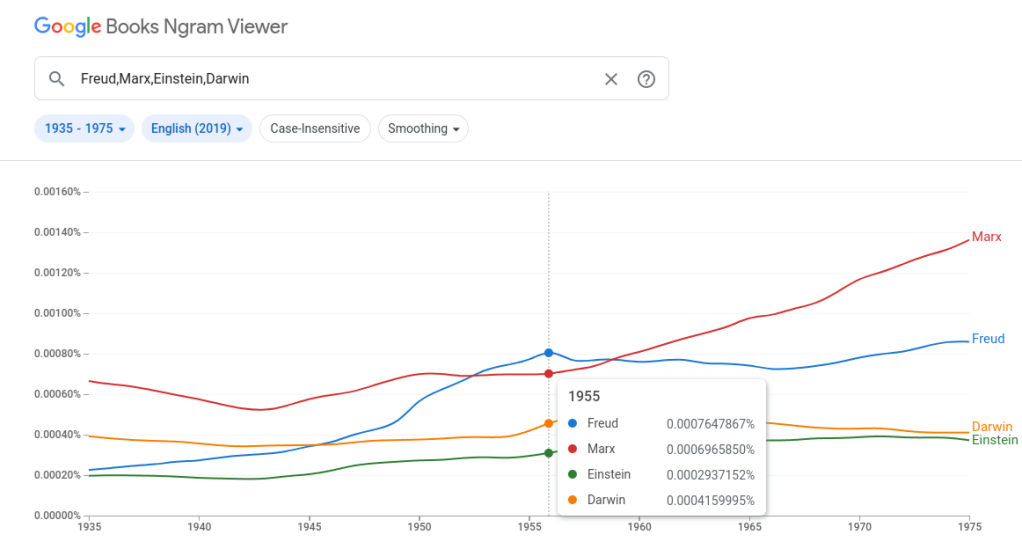
Roger’s obsession with where Burke Devlin’s pen is will become the show’s obsession for a couple of months. Anyone unsure whether there is some symbolic significance to this might have a look at the books, plays, and movies the makers of Dark Shadows and other intellectually ambitious New Yorkers were likely to be paying attention to in the summer of 1966. Maybe we can learn something about the ideas that were in the air if we look up the some famous thinkers on Google NGrams:

Google Ngram tracing the relative prominence of the names Marx, Freud, Darwin, and Einstein in English language books from 1935 to 1975

Looks like Marx was a biggie in those days- maybe Roger’s obsession with where Burke’s pen is illustrates the Marxist concept of commodity fetishism. That might also explain Roger’s relative disregard for the family’s capital holdings- he’s so caught up in the fantasy of value as something inherent in a physical object that he has lost sight of the actual source of his wealth.

Darwin was on people’s minds as well. Perhaps Roger’s fixation on Burke’s pen is the result of his genealogy- maybe the Collinses have been bred to their little niche for so many generations that they have emerged as a new species, one which does not have the same survival strategies as other humans and so does not share values and concepts which we would understand.

And there’s Einstein, also a popular preoccupation among people who aspired to advanced learning back then. One of Einstein’s most famous ideas was that time passes at different rates for different observers depending on how fast those observers are moving through space. There will be twenty or more episodes of Dark Shadows that focus largely or entirely on the question of where Burke’s pen is, and as we move through that narrative space there will be many occasions when it seems that time itself is about to grind to a halt. Could be that, I guess!

That leaves Freud. Hmm, looks like Dark Shadows was written and acted chiefly by people from Broadway, and that Freudianism was a major inspiration on Broadway in the 1950s, 60s, and 70s. I suppose we’ll have to figure out what Freud would have made of a fascination with where Burke’s pen is. Then maybe we’ll have some idea what’s really going on with Roger.

Episode 37: Fatigue lines

Roger’s mounting anxiety about what Burke may learn from Sam leads him to alternate in each scene between yelling and begging. Depicting this, Louis Edmonds’ chews the scenery so hard that he momentarily loses track of Roger’s mid-Atlantic accent and slips into his native Louisiana drawl, yelling at Vicki “Jes supposin’ you a-tell me how long you wah standin’ in that doah-way?” Perhaps this is Marc Masse’s “David Ford Effect”– Ford came to the show from a long engagement as Big Daddy in Cat on a Hot Tin Roof, maybe they’ve decided to transport Collinsport from Maine to the Mississippi Delta.

At the Evans cottage, Sam gives Maggie a sealed envelope to be opened in event of his death. Maggie is bewildered and upset. Surmising that her father’s trouble is to do with Collinwood, she wishes that the mansion would burn to the ground. Sam waxes philosophical, opining that “Ghosts of the past don’t live inside a home. They live inside each man. They fight for his soul.. twist it into something unrecognizable.”

Moments later we find out that Sam is wrong, ghosts totally live inside a home. In the middle of the night, Vicki is awakened by the same strange sobbing she had heard in episode 4. She follows it to the basement. Last time she was in the basement, in episode 6, Matthew found her there and spoke sharply to her. Now Roger finds her there and yells at her. As she had stood up to Roger in the drawing room earlier, so she stands up to him now. After their showdown, he even admits that he has heard the sobbing woman many times, and says that she may be “one of our ghosts.”

I divide the series into several periods, the first of which I call “Meet Vicki.” The major story-lines of the Meet Vicki period are all in a down-cycle during this episode. Roger’s panic and Sam’s melancholy are part of the Revenge of Burke Devlin story, but Roger’s activities today do nothing to advance that story, and Sam’s letter will become one of the most tedious MacGuffins in a series that is notorious for forcing the audience to sit through overlong contemplation of its MacGuffins. Roger’s angry reaction to finding Vicki in the basement touches on the Mystery of the Locked Room, which is connected with the question of why Liz became a recluse. Those stories haven’t advanced for weeks. The sobbing woman revives the question of whether the house is haunted. While Roger’s admission that he has heard the sobbing marks the first time one character knows what another is talking about concerning the ghostly happenings, it does not prompt any further action. The question of Vicki’s origins is at a stalemate, the romance between Carolyn and Joe is dead in the water, and David is so alienated right now that they can’t do much with Vicki’s attempts to befriend him.

So the Meet Vicki period has reached a dead end. Tomorrow we’re going to meet someone else, and a new period is going to begin.

Episode 32: Where all criminals belong

In today’s compare-and-contrast, we see the sheriff and Bill Malloy demonstrating how mentally healthy people might react to the idea that a nine year old boy has devised and executed a plan to murder his father. Then we go to Collinwood, where we see how Liz and Roger react to the idea.

The sheriff can’t bring himself to say out loud what the evidence is leading him to suspect David has done. Bill can say it only in part, and then only to express shock and bewilderment.

The scenes between Liz and Roger in this episode are among the strongest in the entire series. Roger is quite drunk, almost giddy, almost laughing at the fact that his son tried to kill him. Liz cycles through a half dozen intense emotions before finally accepting the fact that David is the culprit. She orders Roger to lie to the sheriff and say that what happened to his car was a simple accident, that no one was at fault.

In response to her explanation that this is the sort of thing the Collinses have always done, Roger brings up his suspicion that David may not be a Collins at all. David was born less than nine months after Roger and Laura* were married; she’d been Burke’s girl… Liz won’t hear such things, and insists that David is a Collins, that he belongs to all of the ancestors. She blames Roger for raising David in a home where he knew nothing but hate from the moment he was born, hate he couldn’t understand or cope with.

Roger insists that David be sent away to a mental hospital; Liz says no, that he will stay in the house, that “Miss Winters and I” will give him the home life he needs. Her mention of “Miss Winters” in this connection makes it clear that Vicki is central to Liz’ plans for the future, whatever those might be.

The sheriff shows up. He’s taking his time to get to the point. Roger cuts him off: “Is it about David?” At that, even the background music falls silent. The sheriff starts talking. Liz jumps in and says that the sheriff should drop the investigation, that it was all just an accident. The sheriff looks uneasily from Liz to Roger and back again, and finally agrees to do so.

In the coda, Roger tells Liz that she will regret covering up for David. He gives her a look of contempt that is among the most powerful things I’ve ever seen on a screen. Liz is totally alone now; Roger will obey her, but he’ll never respect her again. Joan Bennett was pushed to the margins of the show in later years, but she really did fill her “Starring” credit in these first months. It isn’t every show that would present us the leading lady devastated like this.

*Aside from the prologue delivered by Alexandra Moltke Isles, there are no surviving cast members in this episode. As of 9 August 2022, it is the earliest episode of which that can be said.

**Laura’s name is first mentioned here.

Episode 31: The judgment of the gods

Burke makes up a story about finding the bleeder valve on the side of the road leading to Collinwood, another lie to go along with the lie he told about finding David on a sidewalk in town. In the minutes before both of these lies collapse, he and David sit on the staircase in the foyer. He tells David that they’re still friends- after all, if he were really mad at David for trying to frame him for attempted murder, he’d have told Roger the truth.

That placates David, who likes Burke and is desperate for a friend. It doesn’t do much for us, though- the lies collapse so quickly that a crafty operator like Burke can’t have thought he was giving David much cover, and he’s observed the Collinses closely enough to know that they will go to any lengths to keep a family scandal from becoming public. So we are still undecided as to what Burke wants to do and whether he is right to do it.

David’s confidence in Burke allows him to talk openly, admitting that his murder plot was “stupid” and declaring that he’s going to get back at Vicki. Burke doesn’t like that idea, but David is still on the rampage when Vicki tries to talk to him. He says that he hopes “a thousand ghosts come and strangle you and make you dead!” Burke warns her that if she’s going to keep living in the same house as David, she ought to stay away from open windows.

It may be hard for the other characters to understand why Vicki wants to stay on as David’s governess, but the audience should understand it. It only took a few minutes with the warm, upbeat Burke Devlin before David was jumping up, making jokes and laughing. Vicki has spent her whole life at the Hammond Foundling Home, at first as a resident, then as staff. Her great achievement is connecting with troubled children. If she can get David past the idea that he is working with her father to lock him up, she should be able to get at least as good a reaction from him as Burke did.

Episode 30: What monsters we create

Thunder rumbles. The lights go out at Collinwood. Alone in the drawing room, Vicki lights a candle. The doors swing open, and a darkened figure stands in shadow. Vicki calls to the figure. It does not respond. The lights come back on. The figure has vanished. Roger happens by; he is the only other person in the house, but he is too tall to have been the figure.

This is the second occurrence in the series that is either a supernatural manifestation or an elaborate Scooby Doo-esque prank on Vicki. The first time, in episode 14, happened when David had taken the bleeder valve from the braking system on his father’s car, an event that would have dire consequences. We can assume that this second occurrence is telling us that we are about to see events that will stir up the supernatural back-world of Josette, the Widows, and heaven knows who else.

David had planted the bleeder valve in Burke’s room, trying to frame the family’s enemy for his own crime. When he spends a few minutes with Burke and takes a liking to him, he tries to retrieve the valve, not knowing that Burke has already found it and that he is carrying it in his pocket. In Burke’s car on the way to Collinwood, he pleads with Burke to go back to the hotel. He can’t give an explanation for his plea, and Burke refuses to turn back without one.

Vicki tells Roger that she had found the bleeder valve in David’s room, and Roger quickly accepts that his son had tried to murder him. When Burke brings David home, Roger takes David into the drawing room and demands he confess to his crime. Burke refuses to leave the house. Roger calls Vicki into the room; Burke insists on joining them. David calls Vicki a liar, Roger continues to browbeat him. We see a reaction shot of Burke in profile, standing in the doorway, watching the scene intently. Roger mentions the bleeder valve; Burke steps forward, and with a flourish produces the valve from his pocket. David’s face crumbles into absolute dejection.

Has Burke really betrayed David? Or is he playing some other game? We have to tune in next time to find out.

So, we begin with an indication that what follows will stir up the back-worlds, and then see an episode about the relationship between Burke and David. Roger describes Burke and David as “the two people I dislike the most.” Something Burke and David have in common, something that Roger cannot forgive, is going to bring the ghosts out of the woodwork and into the foreground.

Episode 25: A neat way of managing people

The episode revolves around a letter to Victoria from the Hammond Foundling Home. The letter reports that no one connected with the Home had ever heard of the Elizabeth Collins Stoddard or any of the other Collinses before the letter came offering Vicki the job as David’s governess. This letter has set Elizabeth into a panic, since it exposes as a lie her story that Roger was friends with someone connected to the Home and that that person had recommended her. It sets David into an even more extreme panic, since he is terrified that his father will send him away to some kind of institution where children are kept and the Hammond Foundling Home is such an institution.

In her panic, Elizabeth demands that Roger sit down with Vicki and corroborate her lie. Roger is worried that Burke, who has hired private investigators to look into Vicki’s background, will discover some piece of information that will damage the family, and wants Elizabeth to confide in him. He is insistent enough about this to raise the audience’s hopes that in some future episode, we will get answers about Vicki through dialogue between the two of them. For now, she shuts him down by threatening to throw him out of the house unless he obeys her.

When Roger does talk with Vicki, she reminds him that she had asked him if she knew anything about her or about the reason she was hired when they first met. He had said no, and in every way showed bafflement about how Elizabeth heard of her. He tries to explain that away by saying that he was distracted by worry about Burke, and tries to deflect further questions by saying that his contact is a donor who wishes to remain anonymous.

Vicki is obviously unconvinced. Alexandra Moltke Isles has strabismus, and in her closeups during the scene with Roger she turns this to her advantage. Her eyes seem to be moving independently of each other, a more polite expression than eye-rolling, but just as effective at communicating disbelief. Marc Masse captured the effect quite well in this still image, on his Dark Shadows from the Beginning:

Roger’s remark to Elizabeth in this line, that she has “a neat way of managing people,” applies equally well to Vicki in her scene with him. At the end of the conversation, she knows that he was lying, and he knows that she knows. She also knows that he is under his sister’s thumb, not a threat to her position no matter how uncomfortable he may find her presence on the staff, and he knows that she knows that.

David’s panic leads him to take a less devious path than does his aunt, but ultimately an even more disastrous one. He steals the letter from Vicki. His father catches him with it and returns it to her.

Vicki herself is less concerned with the letter than with a thought we saw take shape in the back of her mind at the end of episode 23. She asks David about the magazines on auto mechanics he likes to read, about how he learns to put things together and take them apart. David responds with a denial that he sabotaged his father’s car; Vicki calmly replies that she hadn’t accused him of that.

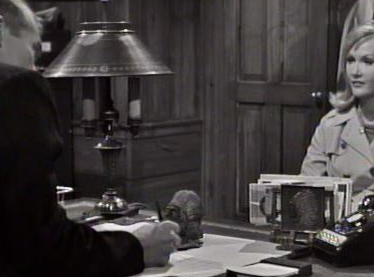
Vicki comes into the drawing room and tells Elizabeth that David has been acting strangely ever since his father’s car went off the road, that when the sheriff came he was overwhelmed with the thought that he would be arrested, etc. Elizabeth dismisses the topic brusquely, seeing no significance in it. Vicki persists in the topic, reminding her that the sheriff said they should try to think of someone other than Burke who might want to kill Roger. Elizabeth declares “There is no one else”; at that, Roger sashays into the room and declares “Except my loving son, of course.”

Elizabeth has even less patience with this remark from Roger than with whatever it is Vicki is saying, and moves along so that Roger can tell Vicki the lie she has ordained. In the course of that conversation, she again says that they don’t actually know that Burke was the saboteur, a point that is no more meaningful to Roger than it had been to his sister.

Afterward, she goes back to her room and finds that David has stolen the letter again. She goes to his room to look for it. She doesn’t find it. Instead, she finds the bleeder valve, evidence that her suspicions are correct.

Episode 20: A mockery to the future

In episode 18, Roger (Louis Edmonds) had demanded Vicki (Alexandra Moltke Isles) come with him to Burke’s hotel room, where they will tell Burke (Mitch Ryan) about all the evidence they have connecting him to Roger’s car wreck. Vicki repeatedly protests in that episode that it would be better to take this information to the police. In this one, they arrive at the hotel, and again Vicki objects that they really should be going to the police. Roger, however, is a man obsessed. He asks Vicki to wait in the restaurant while he goes to Burke’s room, telling her that it may not be necessary for her to join him.

Sam (Mark Allen) comes to the restaurant looking for his daughter Maggie. Finding that Maggie isn’t at work, he invites himself to Vicki’s table. Their previous encounter had been a strange and frightening one on the top of Widow’s Hill; Vicki is no more comfortable with Sam now than she had been then. He bellows at her, she reacts with quietly frosty disdain. These attitudes may have less to do with the script or the direction than with Mark Allen’s limitations as an actor; he bellows all of his lines in this episode, and quiet frostiness is as effective a technique as any other for holding onto the audience while sharing a scene with an incompetent loudmouth.

There’s no incompetence in the scenes in Burke’s room. Louis Edmonds and Mitch Ryan were first-rate stage actors, and their confrontation is a terrific fireworks display. When Roger brings Vicki up to tell Burke what she saw him do in the garage, she again plays the scene quietly, an effective counterpoint to the artillery blasts the men have been letting loose.

In the Evans cottage, Sam finds that Maggie (Kathryn Leigh Scott) has been home all this time. When Allen bellows at her, Scott bellows back at him, a far less effective tactic than the quiet intensity Mrs Isles had used earlier. The scene has some potential- the situation is that an alcoholic finds that his adult daughter has been checking up on him, he resents it, and they have a fight about all of the ways in which she has been forced to take on the parental role in their relationship. But as a shouting match, it might as well be about anything, or about nothing.

Returning home after their confrontation with Devlin, Roger and Vicki say goodnight in the foyer. Time and again in these early episodes, people have urged Vicki to leave Collinsport while she still can. Even in this episode, Burke had told her that. But as they part ways for the night, Vicki to her bedroom and Roger to the brandy bottle, Roger tells her that as a witness, “you can’t leave now.”

That line is effective enough, but if the scene between Sam and Maggie had worked it would have been very powerful. The Evanses, father and daughter, are a case of two people who are trapped, trapped in Collinsport, trapped with each other, trapped with his alcoholism and her sense of obligation to keep him alive. As written, the scene could have brought all that out, and induced a claustrophobic sense in the audience that would have made Roger’s line feel like a death sentence. As ruined by Mark Allen, it just leaves us with the sense that we’re watching a show that needs some recasting.

Episode 18: Strange sounds and lonely echoes

Only three characters in this one- Roger, Vicki, and David. In the previous episode, Roger learned that his crash was no accident, that someone tampered with his brakes. Now he wants Vicki to tell him what she can that will help him prove that Burke Devlin was the one responsible. Which is a great deal- she saw him in the garage, with a wrench, next to Roger’s car. She had gone into the garage after hearing what she thought was a car door slam. She admits that the slam could have been the hood over the engine compartment, and since the car door next to Devlin was open, this seems likely. Since the reason Roger was on the road was that Devlin had invited him to town to discuss “business,” and the two of them do not seem to have any business together at all, the case against Devlin seems quite strong.

David will place rather a substantial difficulty in the way of Roger’s hope of sending Devlin back to prison. As the audience knows, it was he, not Devlin, who removed the valve from the braking system on his father’s car. We even see him handling the valve in this episode. In episode 17, he nearly confessed to his Aunt Elizabeth, and this time he makes an incriminating statement to Vicki. Both women had assumed he was merely expressing guilt for his hostility to his father, and tried to reassure him that his feelings and thoughts didn’t mean that he was to blame for what happened on the road. David even tries to talk to his father in this one, and Roger icily dismisses him. But we’ve seen enough mystery stories, including inverted mysteries where the audience knows who done it before the detective does, to be sure that Roger will learn the truth when he least expects it.

Roger not only has reason to suspect that Burke is responsible for his crash; he also has deep, complex, ungovernable feelings where Burke is concerned. Some of those feelings have to do with the testimony he gave at the trial ten years before which sent Burke to prison. Some go back before that, and have to do with the friendship that existed between them before that trial. All of them are deeply secret.

This show was being made in 1966, when Freudianism reigned supreme in much of American intellectual life, and the most respected of respectable novels was Proust’s À la recherche du temps perdu. All of the cast and much of the production staff comes from Broadway, where at that time Tennessee Williams was the undisputed king of serious playwrights. And the part of Roger was played by Louis Edmonds, who came out of the closet as a gay man as soon as it was possible to do so, and who was never in the closet as far as his friends and colleagues were concerned. So it seems likely that the secrets Roger is so desperate to conceal include some kind of homoerotic connection with Burke. This episode lampshades some standard soap opera craziness in order to call our attention to the irrational nature of Roger’s attitude towards Burke, and I think a mid-1960s audience would be likely to suspect that a repressed sexuality is driving that irrationality.

Here’s how I put it in a comment on John and Christine Scoleri’s Dark Shadows Before I Die:

When Vicki tells Roger what she saw Devlin doing in the garage, Roger asks her to come with him to confront Devlin at the hotel. That’s a typical soap opera character idea. What isn’t so typical is Vicki’s response, that it would be better to go to the police. She sticks with that rational idea until Roger tells her of his urgent need to see Devlin’s face. That picks up on Roger’s frantic behavior in Week One and sets him up for the whole saga of Where Burke Devlin’s Pen Is, in which we see that Roger’s attitude towards Burke is rooted in some deep and complicated emotions.