The Leviathan People, a race of Elder Gods, are planning to retake the Earth from humanity. Like all stories of Elder Gods, this one raises the question of why they lost the Earth in the first place. The answer seems to be clear. The first Leviathan to manifest himself is a shape-shifting monster who spends most of his time in the form of a tall young man who, when we were introduced to him, asked to be called “Jabe.” No one would call him that, so he settled for “Jeb.” The Leviathans have assembled a cult of people to serve them; Jabe’s personality has alienated many of them already, and seems likely to alienate more.
Among the ex-followers who were glad to join a plot to exterminate homo sapiens but who found Jabe too obnoxious to stomach are vampire Barnabas Collins and a crazed sadist known only as Bruno. Jabe’s onetime foster mother, Megan Todd, lost her allegiance to the Leviathans after Barnabas bit and enslaved her. Since Barnabas’ current bout of vampirism is the result of a curse Jabe placed on him during a tantrum, the cult’s loss of Megan is another strike against Jabe.
The Leviathans have two principal vulnerabilities. They can be destroyed by ghosts or by werewolves. Since they have chosen to start their campaign on the great estate of Collinwood, which is the world capital of both ghosts and werewolves, this would suggest that they are as bad at strategic planning as Jabe is at team-building.
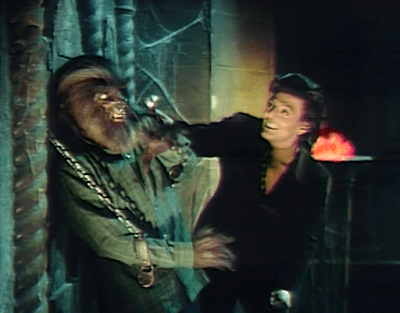
Bruno has captured the current werewolf and lures Jabe to him. He also discovers that Megan is Barnabas’ blood thrall. Everything else today is filler, but it does give the actors a chance to show off. Bruno beats the werewolf with a whip to ensure that he will be angry enough “to rip a man to shreds!” He’s a werewolf, the whole idea is that he’s already disposed to rip anyone he meets to shreds, but as Bruno Michael Stroka puts so much zest into the whipping scene that we forget how ridiculous the furry rig Alex Stevens is wearing looks and feels sorry for the poor widdle doggie.
Barnabas summons Megan to his house and gives her some instructions that don’t make sense and that she won’t have the chance to follow. While she is there, she says she just wants him to suck her blood. He does. Marie Wallace plays Megan in this scene as if she is having a sexy dream.
Bruno left the late Sheriff Davenport, whom Jabe killed and then brought back as a zombie slave, to guard the werewolf. To keep the zombie from getting in the way of his plan to use the werewolf against Jabe, he tricks him into letting the werewolf destroy him. Davenport is the most garrulous zombie of all time; in his first postmortem appearance, when Jabe set him to hold prisoner Maggie Evans, The Nicest Girl in Town, Davenport rambled on and on about everything he saw and heard, at one point launching into an explanation of some things his wife used to do that annoyed him. Today he has to argue with Bruno, demanding to know whether he has authorization from Jabe to leave the werewolf alive and giving his opinion that it isn’t a good idea to take too much initiative. Ed Riley does as much as anyone could to overcome the ludicrous overwriting of his part. No one could make a chatterbox like Zombie Davenport seem like a partially reanimated corpse, but when he isn’t saddled with excessive dialogue Riley manages to create the impression that he is at least somewhat weird. It’s too bad he won’t be back.
When Dark Shadows began in June 1966, its most dangerous villain was high-born ne’er-do-well Roger Collins. Roger had squandered his half of the Collins family’s wealth and put his sister, the reclusive Elizabeth Collins Stoddard, in a difficult position by selling his half of the family business to support his extravagant lifestyle. He now worked in the business as Liz’ employee and, with his son, strange and troubled boy David, lived in Liz’ house as her guest. Roger schemed to cover up his past crimes, and was quite willing to add murder to them if that was the only way to preserve his cushy circumstances.
As played by Louis Edmonds, Roger was too much fun to be killed off as the original story bible foresaw. The show had not in those early days committed itself to the all-villain cast that has come to define it, so they decided that they could keep Roger around only by nerfing him. He became a sardonic gay uncle, amusing, lovable, and harmless. He has been on the margins for years now, often absent for long periods. When Dark Shadows turned to time travel and began to feature extended costume drama inserts, they could make use of Edmonds’ talents by casting him as other characters. His turn as haughty patriarch Joshua Collins made him the star of the 1790s segment that ran from November 1967 to March 1968, and as the stuffy Edward Collins he was among the highlights of the 1897 segment that took up most of 1969. Now that the show has returned to contemporary dress, Edmonds is Roger again, and he is the same afterthought he has been for so long.
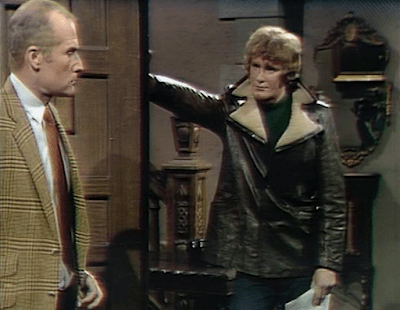
Today, a villain who introduced himself as Jabe but whom everyone calls Jeb walks into the house. Roger hears him, and protests that it is customary to knock. Jabe says that Liz gave him the run of the place, and tells Roger he has come to visit David. Roger forbids him to see David; Jabe says there is nothing he can do to stop him, and he goes upstairs to David’s room.
Roger picks up the phone and calls his distant cousin Quentin Collins. He tells Quentin he isn’t going to put up with any more of Jabe’s insolence, and that he doesn’t care how dangerous he is. He hangs up, and finds Jabe standing in front of him. Jabe asks if he is wondering how much he heard. Roger says that he doesn’t care if he heard all of it, that he wants him to leave the house at once. Jabe says that if it was Quentin he was talking to, he knows more about him than he had assumed. He also tells Roger that nothing Quentin may have told him about him and his associates was an exaggeration. If Roger defies them, he and everyone he loves will pay a terrible price.
When Roger was a villain, they sometimes made him sympathetic by having dashing action hero Burke Devlin threaten to take over the house and start ordering him around. Later, Liz was being blackmailed by seagoing con man Jason McGuire, who when he reached the zenith of his power acted like he owned the house and tried to order Roger around. Burke eventually peaced out, and Jason’s scheme led to his own death not long after he got openly aggressive towards Roger in the drawing room. So longtime viewers will look at this scene and find a reason to believe that Jabe’s menace is approaching its peak.
Jabe’s henchman Bruno has captured Chris Jennings, who is a werewolf. He has locked Chris up in the tomb of the Stockbridges, an old Collinsport family who are in a way related to Roger’s ex-wife. The full Moon will be rising tonight, and Bruno has chained Chris to a wall in the tomb. He has set the world’s most talkative zombie to guard Chris. The zombie was in life a law enforcement officer known as “Sheriff Davenport.” When Jabe raised him from the dead, we saw that his gravestone read “Sheriff Davenport,” so apparently “Sheriff” was his given name. Bruno gave Sheriff a revolver loaded with silver bullets and ordered him to shoot Chris if he started transforming.
Bruno went to Jabe to report that he had captured the werewolf. Before he could get a word out about that, Jabe was berating him about other matters. Jabe wound up hitting Bruno, then twisted his arm until he said that Jabe was born to lead and he was born to follow. After that, Bruno decided that he wouldn’t have Sheriff kill the werewolf after all. Rather, he would sic the werewolf on Jabe.
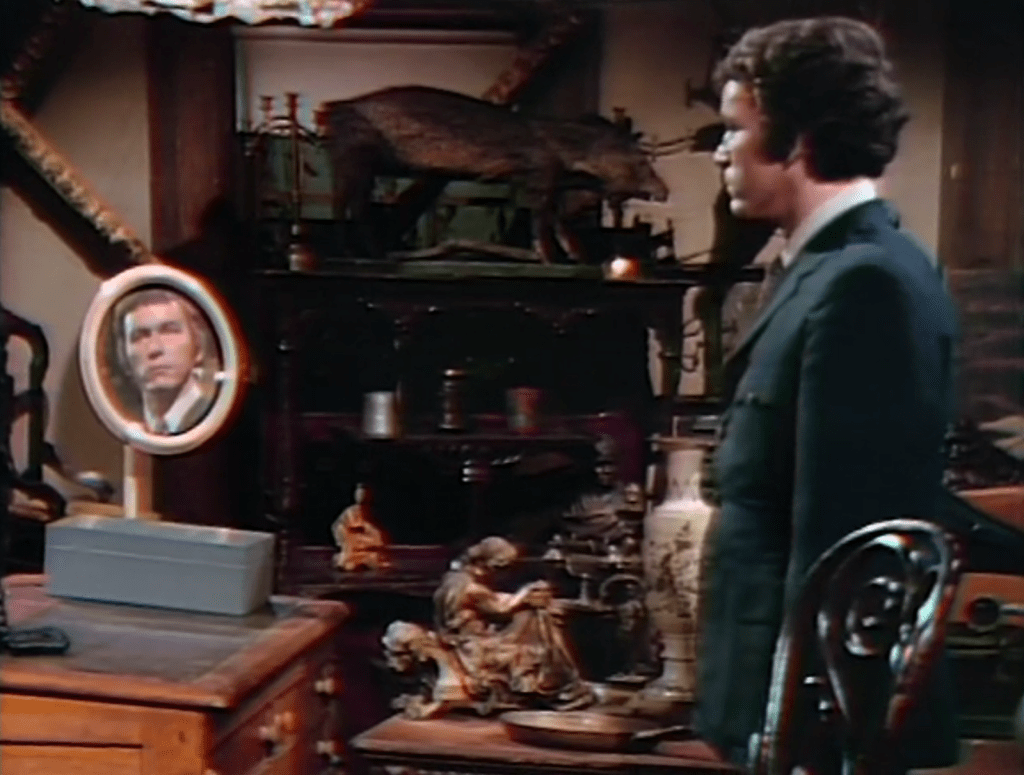
Jabe’s intolerable personality keeps alienating followers, and he has assembled an array of adversaries including not only people like Bruno who know all of his secrets, but also a vampire, a wicked witch, a mad scientist, and a man with a Dorian Gray-like magical portrait that gives him an immunity to physical harm. On top of all that, we saw yesterday and today that a ghost is after Jabe, and that Jabe is especially vulnerable to ghosts. Add the werewolf to that force, and it seems Roger will be sipping his brandy in peace any day now.
The current A story revolves around a race of Elder Gods called the Leviathan People. The Leviathans have taken over the minds of several characters and formed them into a cult devoted to advancing their plan to return to Earth and supplant humankind. As part of this plan, a monster has taken up residence in the room above the antique shop in the village of Collinsport. The monster’s true form is bizarre, terrifying, and unseen. It can assume other forms, and as it was growing it went through the shapes of a series of children. Now its human guise is that of a man in his twenties who, when first we saw him, invited people to “Call me Jabe.”
Jabe is a blowhard, impatient, petulant, and unreflective. He is keen to take heiress Carolyn Collins Stoddard as his bride and make her into the same kind of monster he is. Carolyn’s distant cousin, old world gentleman Barnabas Collins, was the Leviathans’ first choice as leader of the cult, and has now become disaffected from it. Working with another distant cousin, the perennially youthful Quentin Collins, Barnabas has for the moment put a stop to Jabe’s plans for Carolyn. Jabe has killed a couple of people, including Carolyn’s father Paul Stoddard and Sheriff Davenport, and plans to kill many more. He is fairly sure that Barnabas is working against him, but is afraid that if he strikes out at Barnabas his own superiors among the Leviathans will punish him. Carolyn’s mother, matriarch Elizabeth Collins Stoddard, and her cousin, strange and troubled boy David Collins, are devoted members of the cult, as is Quentin’s great-granddaughter Amy Jennings, but none of them knows about Jabe’s plans for Carolyn.
When Jabe appeared to be a thirteen year old boy named Michael, he spent a substantial amount of time bullying David. He has continued this in his adult form, breaking David’s leg for no reason to which the audience was made privy. David’s governess, Maggie Evans, saw Michael’s mistreatment of David and tried to stop it, and in response he locked her up and tried to kill her. No one has told Maggie that Michael and Jabe are the same person, but she does know that that Jabe is at fault for David’s injury. She has also, in the last several days, seemed to be getting very cozy with Barnabas. Jabe has abducted Maggie and has her locked up in a big mausoleum someplace.
Meet Bruno
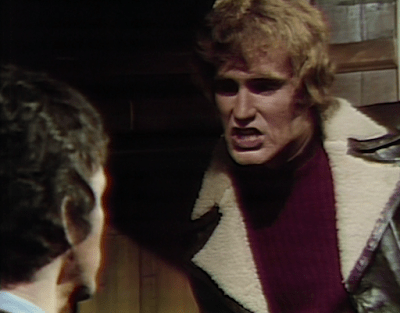
Jabe is in the antique shop when a man wearing a fur coat enters. Regular viewers recognize the actor as Michael Stroka. For most of 1969, Dark Shadows was a costume drama set in the year 1897, and Stroka played the sadistic Aristide, henchman to sorcerer Count Petofi. Petofi was a witty and whimsical villain, and Aristide spent a great deal of time as his straight man. Aristide also gave Stroka opportunities to show off his own formidable gift for deadpan comedy.
The fur coat is so specific to 1970 that the sight of Stroka wearing it means that the show has very literally returned to “contemporary dress.” His character introduces himself to Jabe as Bruno, and says that he will help him in any way. Bruno shows considerable knowledge of the story so far; the other cultists didn’t come with that knowledge, leading us to wonder whether he is one of them or is some kind of supernatural being. As the episode goes on, we see that Bruno shares Aristide’s fascination with knives and his glee in threatening to kill and disfigure pretty girls, and is also about as ineffective when he sets about doing Jeb’s dirty work as Aristide was when he tried to do Petofi’s. So however he came to know what he knows, it seems safe to dismiss the idea that he is anything other than what Aristide was.
David and Barnabas
At the great house of Collinwood, David enters by means of wheelchair. He and Barnabas talk about Maggie’s unexplained absence. They consider the possibility that Jabe might be responsible for it.
Just the other day, adult characters not in on the secret of the Leviathan cult mentioned that David did not seem like “the same little boy” he had been. He isn’t a little boy at all- he’s thirteen. Barnabas talks to him in this scene as one adult to another. After all these years, it’s refreshing to see a sign that David might eventually be allowed to grow up.
Maggie’s First Tormenter
Maggie awakens to find herself in a mausoleum. Before she can make her way to the door, the late Sheriff Davenport enters. Jabe has raised him from the dead and made him his slave. Your typical zombie is an inarticulate sort, who, if moved to speech at all, might emit a faint groan of “Brai-i-i-ins.” Davenport is an exception to this norm. He is positively chatty. He talks about how uncomfortable his grave was, about his sympathy for Maggie, and even starts in with a story about his wife. The guy just won’t shut up.
David and Jabe
David goes to the antique shop. How he got himself from Collinwood to the village in a manual wheelchair designed for use in a hospital is not explained. He tells Jabe about his conversation with Barnabas, including the part where Barnabas told him to study the holy book of the Leviathans and look for information about Jabe’s weaknesses. He says that he found a passage saying that Jabe is vulnerable to werewolves. He didn’t tell Barnabas about this, but came straight to the shop. Jabe is terrified by the mention of werewolves, and relieved David didn’t talk to Barnabas. He tells him not to trust Barnabas.
There is a werewolf on the show, Amy’s brother Chris Jennings, who inherited the curse from their great-grandfather Quentin. Quentin’s own lycanthropy was put into abeyance by the same magic spell that immunized him against aging. We haven’t seen Chris for about a month, when there was a full moon and he killed a character left over from an exhausted storyline. There were some hints early in the current story that Chris represented a threat to the Leviathans, and this is now confirmed.
Maggie’s Second Tormenter
Bruno shows up in the crypt where the late Sheriff Davenport is haranguing Maggie. He sends Davenport to guard the door. Maggie asks Bruno if he is dead, too. He assures her he isn’t, and is very unpleasant to her. Aristide was a lot of fun when he had someone to play off of, but where Petofi was sprightly, Jeb is monotonous. While Aristide would set his sights on victims who gave him more resistance than he bargained for, Maggie’s situation makes her tense and unwilling to volunteer anything. Maggie holds her ground and refuses to answer any of Bruno’s questions, so that he cannot afford to murder her as he had intended to do. That’s logical behavior on her part and a happy ending for the audience, but it does keep Bruno from doing anything to make us want to see him again.
Bruno meets David
Bruno goes to the antique shop. Jeb introduces him to David. He pushes David out of the shop with a brisk movement that is Stroka’s first opportunity to get a laugh as Bruno. He reports his failure to Jabe, who is too afraid of werewolves to rage at him as he has raged at everyone else who has told him things he didn’t want to hear.
Maggie’s Third Tormenter
Jabe goes to the crypt and sends Sheriff Davenport back out. He confronts Maggie, who tells him she recognizes him as “Michael grown up,” using the exact phrase David had used with Barnabas earlier. He tells her she will be all right if she opens a wooden box he has brought with him and looks in it. Returning viewers know that this is “the Leviathan Box,” and that it was by opening it and looking inside that Amy came under the power of the cult.
Heiress Carolyn Collins Stoddard is mourning her father, who was recently murdered. She tells Maggie Evans, governess to the children in the great house of Collinwood, that she will not rest until she finds the killer. Maggie urges her to leave that up to the Maine State Police. Returning viewers know that the culprit is a monster from beyond space and time. We also know that the monster takes the form of a very tall young man who, when he first materialized, asked people to “Call me Jabe.” They called him “Jeb” instead.
Jabe has no impulse control, no awareness of other people’s feelings, and no long-range plans. He wants to marry Carolyn tomorrow, which, considering that a disagreeable encounter yesterday was the first time he met her while in his current form, she would be unlikely to agree to do even if her father had not just been killed.
Carolyn is taking the night air on Collinwood’s terrace when she hears some strange noises. Most of them are being produced by the late Sheriff Davenport, whom Jabe recently murdered then raised from the dead to serve him as a zombie. He’s hanging around in the bushes, idly watching.
Jabe shows up and says he’s sorry if he startled Carolyn. He tells her that they will be married tomorrow, exasperating her beyond endurance. She gives him a piece of her mind. She uses the word “crazy” to describe his behavior, prompting him to get very stiff and snarl “Don’t ever call me that!” She turns to go, and he grabs her arm. She tells him to let go. He refuses, and she threatens to scream. He still does not let go, but she breaks away and goes back inside.
Maggie sees a flustered Carolyn come rushing into the house. She asks her what’s wrong. Carolyn won’t answer. She hurries upstairs to her bedroom.
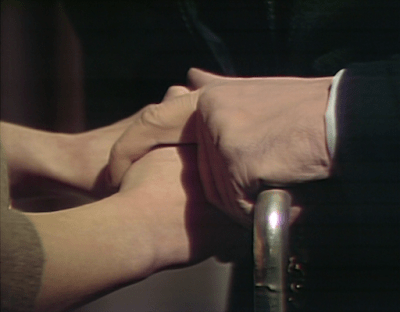
Carolyn’s distant cousin, old world gentleman Barnabas Collins, comes in. He and Maggie talk about Carolyn. Maggie says that she is deeply impressed by Barnabas’ concern for Carolyn. She takes his hand. They put their heads together and talk quietly about how important their friendship is to each of them while the camera zooms in on their hands. Barnabas used to be a vampire, and spent the spring and summer of 1967 torturing Maggie so viciously she suffered a complete mental collapse. Her psychiatrist, Julia Hoffman, saw in Barnabas her chance to pursue her dream career as a mad scientist, and so she sold Maggie out. She used her magical powers of hypnosis to rewrite Maggie’s memories so that she forgot all about what Barnabas had done to her. Her feelings of terror were replaced by warm friendliness towards him. Still, longtime viewers will find it a bit jolting to linger over this handclasp, with its suggestion that romance may be about to bloom between Maggie and Barnabas.
The next day, Carolyn finds a note of apology and some red roses in the drawing room. They are from Jabe. She is putting them in a vase when Barnabas turns up. He is concerned when she tells him the flowers are from Jabe. She says she is not sure what to make of Jabe.
We hear Barnabas thinking that if Carolyn starts seeing Jabe, there will be no hope for her. He’s thinking of Jabe’s monstrous nature and his association with the Elder Gods who are on their way to destroy the human race, but even first-time viewers who know nothing of those things have seen enough of Jabe to agree with him. Regular viewers know that, while there is, in an ontological sense, more to Jabe than Carolyn has seen, she has already taken the complete measure of his personality and temperament. If she winds up deciding he is an acceptable partner, it can only be because the writing staff has decided to sacrifice her character once and for all to the business of moving the plot forward.
Longtime viewers will find this prospect especially disturbing. The terrace was the scene of many grisly encounters between Maggie’s predecessor, well-meaning governess Vicki Winters, and Vicki’s boyfriend, a repellent little man named Peter who preferred to be called Jeff. Peter/ Jeff was not a monster from beyond space and time, he was something much worse- a character played by Roger Davis. At least when Jabe grabs Carolyn’s arm, it is only the characters who are in an abusive situation. When Peter/ Jeff clutched at Vicki, Mr Davis squeezed Alexandra Moltke Isles out of shape and blocked the camera’s view of her. Vicki, Dark Shadows‘ original protagonist, had been pushed to the margins of the story for a number of reasons, but it was her inexplicable insistence on sticking with the loathsome Peter/ Jeff that finally made it impossible for her to continue on the show.
For some unaccountable reason, the producers and directors seem to have liked Mr Davis. They kept him on the show for a couple of years, in a variety of roles, and allowed him to assault his scene partners with abandon. The writers seem to have caught on that he was not so good; his most recent character, Harrison Monroe, was a robot who just kept yelling at everyone until his head fell off. But the directors were still fans; when Christopher Pennock joined the cast as Jabe last week, they told him to imitate Roger Davis. To his credit, he instead conducted himself in a professional manner. However much of a dead-end Jabe is, you will never see Pennock hurting another member of the cast or obstructing her performance.
For the last eleven weeks, the A story on Dark Shadows has been about the Leviathan People, a mysterious race of Elder Gods who are trying to retake the Earth from humanity by enlisting a few people in central Maine into a secret cult and saddling them with responsibility for an ungovernable monster. The cultists have agreed to go along with the monster’s murders and other acts of physical violence, but drew the line when he asked them to call him “Jabe.” He answers to “Jeb” now.
The Leviathans chose old world gentleman Barnabas Collins as the first leader of the cult. This put him at odds with his longtime best friend, mad scientist Julia Hoffman. Now Barnabas has become disaffected from the cult, and he and Julia bring each other up to date on recent developments.
Julia and Barnabas’ conversation frames a series of clips, two of them selected from episode #884 and fulfilling Dan Curtis Productions contractual obligations to feature Roger Davis and Kathryn Leigh Scott in a certain number of episodes. There is also a newly produced clip of Barnabas’ induction into the Leviathan cult, in which a hooded figure named Oberon explains the terms and conditions of membership. When we first saw Oberon, the part of his scalp we could see was completely bald, but he has a tuft of hair growing there now. His part today is so dull that you can’t very well blame actor Peter Lombard for refusing to shave his head for it.
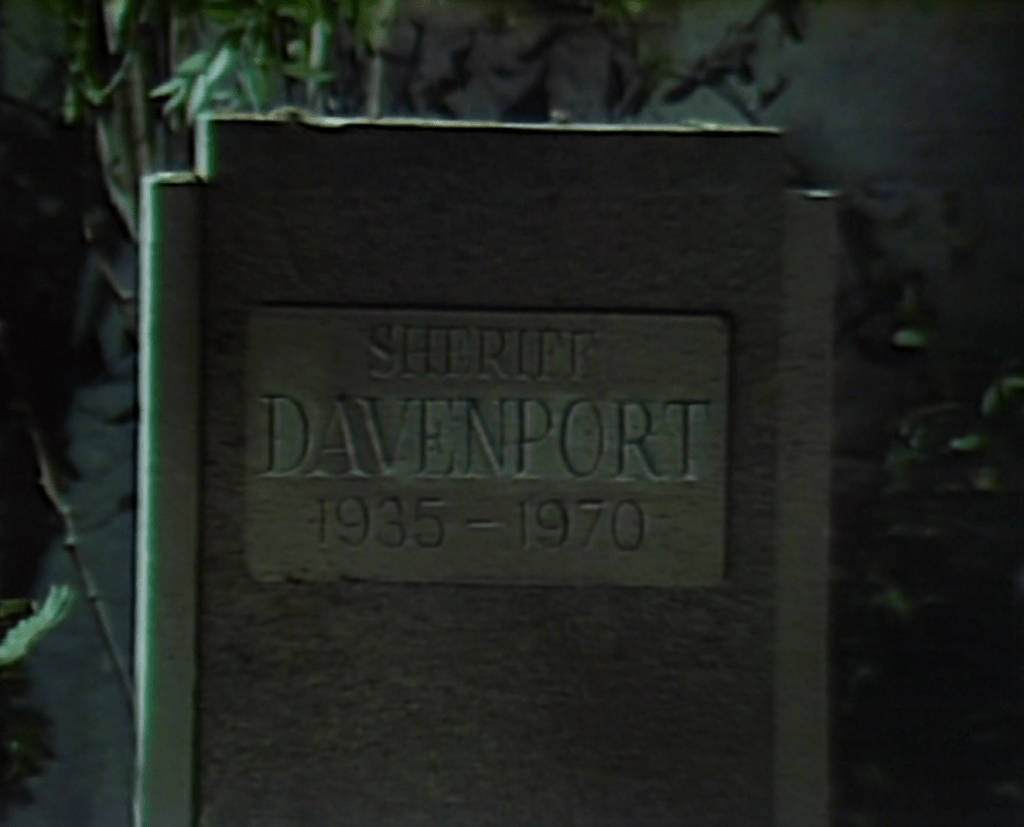
There is also some new information at the end of the episode. Barnabas says that Jabe can raise the corpses of those he has killed and use them as “an Army of the Dead.” We cut to a new grave with a marker reading “Sheriff Davenport.” The other day Jabe killed a law enforcement officer named Davenport; Davenport appeared to be the sheriff of Collinsport, but it turns out “Sheriff” was simply his first name. Sheriff’s hand bursts out of the soil.
I watched the closing credits, wondering if today would be the day they finally acknowledged the videotape editors. It’s due- there have been several obvious cuts over the last few weeks. But they are still toiling in anonymity.
Sheriff Davenport and his new sidekick, mad scientist Julia Hoffman, have come to the top of the stairs above Philip and Megan Todd’s antique shop in the village of Collinsport. The sheriff has a search warrant that specifies the room by the landing as a place of interest in connection with the violent death of one Paul Stoddard. Philip begs the sheriff not to enter the room, saying that a boy who lived there recently died and that any disturbance would “defile” it. He swears the room is entirely empty. The sheriff expresses his sympathy, but opens the door anyway.
Inside is a young man. Philip seems as surprised at the sight of him as are the sheriff and Julia. He gives his name as “Hawkes, Jeb Hawkes. Short for Jabez… Call me Jabe.” No one calls him Jabe, which seems a bit rude. Jabe claims that he came by earlier when Megan was in and Philip was out, and that she offered to let him live in the room.
The room does not contain any furniture, any luggage, or any other movable property whatsoever. Moreover, while it is possible Megan might have rented the room without mentioning it to Philip, it is difficult to see what Jabe has been doing up there since she left, and since Philip has been moving around the rest of the building it is even more difficult to suppose Jabe could have left his belongings elsewhere without attracting Philip’s notice. Jabe claims to be a photographer, but does not appear to have any camera equipment. Moreover, the sheriff will later tell Julia that he noticed a distinctive odor on Jabe that was prominent on Paul’s corpse, and that he found one of Paul’s cufflinks, damaged as by fire, on the floor of the antique shop. In the finest traditions of Collinsport law enforcement, the sheriff does not take Jabe or Philip into custody, question either of them more than cursorily, or close off the antique shop for a further search. He does come back later to tell Jabe that he should think about finding another apartment.
Jabe is the latest embodiment of a mysterious creature that has previously taken the form of a newborn boy, an eight year old boy, an eight year old girl, and a thirteen year old boy. The boys were vicious little tyrants who did not seem to think at all, only to follow impulses to dominate and humiliate whomever they met. The girl was a Doppelgänger of Paul’s daughter Carolyn as she was when she was eight, and she existed specifically to make Paul feel worthless because he was a deadbeat dad. None of these children engaged with another character in a way that meant there was anything at stake for them in any scene. They as much as tell us that the same will be true of Jabe. When Philip complains today that he has put him and Megan in a difficult position by failing to tell them of his plans, Jabe answers “Maybe I just didn’t want to let you know. Maybe I just wanted to see you sweat it out.”
The only time one of the children did anything surprising in an effort to take on an adversary was when the eight year old boy shape-shifted and became the young Carolyn. Had the sheriff not shown the clownish ineptitude typical of his office, but instead done what a real cop would do and arrested Jabe and Philip, they might have created a situation in which Jabe would have to surprise us again. It might be interesting to see him turn into the grown-up Carolyn, for example. As it is, Jabe just insults Philip, goes to the police station, and murders the sheriff.
This puts a new spin on Roger Ebert’s category of “Idiot Plot.” Ebert said that a movie had an Idiot Plot when its story would end immediately if any of the characters had the brains of an average member of the audience. In this case, the story stays stuck in an angry and utterly predictable rut because of the sheriff’s inexplicable nonfeasance.
The first time Mrs Acilius and I watched Dark Shadows through, we hated Jabe and didn’t want to see Christopher Pennock again. Later, Pennock will return in several quite different roles, each of them more appealing than the one before. By the end of the series he had become one of our favorites, and it occurred to us that even as Jabe he managed to do a lot of things right. But there is only so much an actor can do to work around a script problem, and as written Jabe is barely a character at all. His actions cause problems for several other people, but nothing we see him do or hear him say makes us care about why he takes those actions as opposed to any others. It certainly doesn’t help that half of his episodes, including this one, are directed by Henry Kaplan, whose idea of visual composition was to shove a camera so close to an actor’s face that you can see about one half of one cheekbone.
It didn’t have to be that way. Not only was Pennock a fine actor when he had something to work with, but in this episode we have a scene between Julia and rakish libertine Quentin Collins that shows how a character with a bizarre backstory and a record of evil deeds can become an audience favorite. Quentin is down in the dumps because he just failed to rescue his one true love, Amanda Harris, from the realm of the dead. Julia urges him to reconnect with the Collinses of Collinwood. He asks how he can possibly explain that he is 72 years older than he looks and is now alive, even though his ghost carried out a protracted and deadly haunting of the estate. This dialogue shows that Quentin’s origins require us to believe any number of impossible things, and longtime viewers remember that he is a murderer who killed his wife in cold blood, among other unspeakable acts. But all we see in this scene are his charm and the affection that he and Julia have for each other, and we want to see more of that, as much as they can give us. With similar material, Pennock could have achieved similar results. But it is already clear that he won’t get it as Jabe.
Postscript
In his scene with Julia, Quentin says that no one at the hotel where he and Amanda have been staying remembers her, and that all traces of the alias she had been using seem to have disappeared. Julia speculates that when he lost her in the underworld, the last 72 years of Amanda’s life were negated, that the past was reset so that she did in fact die on a night in the 1890s when she might have died had one of the gods of the dead not intervened.
This raises two questions. First, Amanda has been keeping Quentin. If they are now in a timeline where she never came to town, who’s paying his hotel bill and buying his liquor? It’s a standard feature of soap operas that unless they are telling a story about conflicts over ownership of a business or a house or some other valuable property, everyone just has an inexhaustible supply of money, but they put enough time into Amanda and Julia’s squabble as to which one of them would be Quentin’s sugar mama that you might have expected a line or two about this question.
Second, if everyone else has forgotten Amanda, how does Julia remember her? Quentin journeyed through the infernal regions with her, and so I suppose it makes a kind of sense that from that supernatural location he would have a perspective that would transcend our perception of time and space. But Julia was in and around Collinsport the whole time Quentin and Amanda were harrowing the abode of the permanently unavailable. I suppose the real answer is that she is the audience’s point of view character, and as such knows everything we know. But it does leave us wondering if, in the course of her adventures, some kind of uncanny power may have rubbed off on her.
We open with a reprise of the end of yesterday’s episode. Quentin Collins and Amanda Harris are reenacting the myth of Orpheus and Eurydice. As in the ancient Greek story, they will live together if they can escape all the perils on the road from the realm of the dead to that of the living. Unlike that story, they are allowed to look at each other along the way, but they are not allowed to touch.
The teaser ends where Wednesday’s episode ended, with Amanda falling through a gap in a footbridge and Quentin crying out in anguish. After the opening title, we are surprised to find ourselves at the same scene. Amanda is not yet lost. Quentin pulls her up from the ravine she fell into. But that involves touch, so the ceiling of the cavern collapses and buries her. Suddenly, Quentin finds himself lying on the ground, in the upper world, with no sign of any way back to the place from which he just came.
Amanda’s demise marks Donna McKechnie’s final appearance on Dark Shadows. Miss McKechnie left to be in the original cast of Stephen Sondheim’s Company, paving the way for her enormous success on Broadway in the 1970s. Much later, Miss McKechnie would reprise the role of Amanda in a couple of Big Finish Productions’ Dark Shadows audio dramas, and nowadays she appears at the Dark Shadows conventions.
Any account of Donna McKechnie’s last day at 433 West 53rd Street would be incomplete without this story from Hamrick and Jamison’s book Barnabas and Company:
In rehearsal, we went through the scene with a few Styrofoam boulders and a little peat moss, no big deal. Nobody told me there was going to be ten times as much dropped during the taping. So, when it was time to tape the scene, I was looking up, and I just got buried. I got peat moss in my eyes and in my mouth and ears and nose… and I was covered in rocks. The way things worked at the studio, at the end of that scene, the lights went out, and the camera and crew and actors all moved on to the next scene, in another part of the studio. So there I was, laying under all those Styrofoam rocks and peat moss, and nobody helped me get out. I had to dig myself out, and that was my last experience on Dark Shadows.
Craig Hamrick and R. J. Jamison, BARNABAS AND COMPANY: THE CAST OF THE TV CLASSIC DARK SHADOWS (2nd edition, 2012) page 245.
They’ve been doing a bit of videotape editing recently, as several awkward cuts have made clear. One might think that the whole Underworld sequence, pre- and post-title, was edited in from tape left over from yesterday’s shoot. But Miss McKechnie’s story proves that is not so. The episodes were done in sequence, so if the last bit of tape they shot yesterday had been the crushing of Amanda there wouldn’t have been any next scene to run off to and Miss McKechnie would have had plenty of help digging herself out from under.
Some Sort of Monster was After Him
Meanwhile, the sheriff is at the home of occult expert Timothy Eliot Stokes. Stokes and his friend, mad scientist Julia Hoffman, have called him in because a monster wrecked Stokes’ bedroom, in the process killing a man named Paul Stoddard.
No law enforcement officer on Dark Shadows has yet solved a case, and Sheriff Davenport seems likely to prove the most useless member of the fraternity yet. At no point does he interrogate Stokes and Julia, or even show much interest in what they were doing while Paul was being killed. He refuses to believe Julia when she says that he should be looking for a monster, even though Collinsport has been overrun with monsters for years now and he has acknowledged that the wreckage at Stokes’ is like nothing he has ever seen. Julia tells him that the monster lives in the room at the top of the stairs in the antique shop operated by Megan and Philip Todd. In response, he flatly states that “They wouldn’t have anything to do with his death.” He finally agrees to get a search warrant for the Todds’ place, but when he presents it to Philip he says that he will execute it “unless of course, you don’t want me to?”
The meatiest part of the episode is a long scene between Megan and Philip. She is exultant that the monster has killed Paul and certain that it will go on to do other, even more wonderful things. He’s scared to death of what the monster will do to them if it is not defeated and of the retribution that will come to them if it is. She sneers at him as a coward. He admits that he is a coward, but insists that they run away and count themselves fortunate if they can escape with their lives.
In her first role on Dark Shadows, as Eve, The Fiancée of Frankenstein, Marie Wallace was called upon to show an unbending, unvarying contempt for Adam, the patchwork man she was supposed to marry. Since that was the only feeling Eve had ever shown for Adam, it wasn’t very interesting. But Megan loved Philip when we first met them. The other day, when she told the monster that she had loved Philip for a long time, we could believe her. So her scorn today does carry some force, and no one knows better how to play scorn and play it to the hilt than does Miss Wallace.
The part of Philip has not been a particularly congenial one for Christopher Bernau up to this point, but he too excels in the scene. He has lots of lines you would expect a man to find it hard to say, calling himself a coward and so on, but he speaks them smoothly and fluently. He shows his hesitancy and anguish not in his delivery of the lines, but in his facial expressions and movements while Megan is speaking. You can see him deciding to put aside all male ego and say something that might get through to Megan, no matter how humiliating it is for him to say it. With lines proclaiming his cowardice, Bernau creates the image of a remarkably brave Philip.
That in turn makes it possible for the episode to end on a suspenseful note. The closing cliffhanger has Sheriff Davenport turning the doorknob to the monster’s room, while Philip is frenziedly trying to come up with a way to talk him out of entering it. When we watched that, my wife, Mrs Acilius, said to the screen “If you don’t tell him what’s in there, it’s murder,” in a tone that suggested she thought Philip actually might tell the sheriff the truth. That such an idea could even form is a testament to Bernau’s outstanding performance in this episode.
Professor Timothy Eliot Stokes has parked his car and is walking up to the great house of Collinwood, home to matriarch Elizabeth Collins Stoddard and her daughter Carolyn Collins Stoddard, among others. He sees a man lying on the ground and asks him what is wrong. The man pleads with Stokes to help him get away. Stokes asks him what he wants to get away from; the man responds “I can’t tell you.” Stokes asks who he is; he says his name is Stoddard. Stokes replies “You’re Paul Stoddard, Carolyn’s father.” Paul brightens momentarily at Carolyn’s name, but then draws up tight and asks “They sent you after me, didn’t they?” Stokes assures him that no one sent him, and tells him he will catch his death of cold if he continues lying on the ground.
Paul asks Stokes to take him to the police. Stokes nods to the house and says they can call the police from there. Paul cries out, “No! No, not to Collinwood. Please, Professor Stokes, you’ve got to take me to the police, it’s the only thing you can do for me. If you don’t, I’ll be dead. No, no, no, I am not being hysterical or melodramatic…” At this, Stokes turns to face his car. He gives Paul his arm, and says he will drive him to the police station.
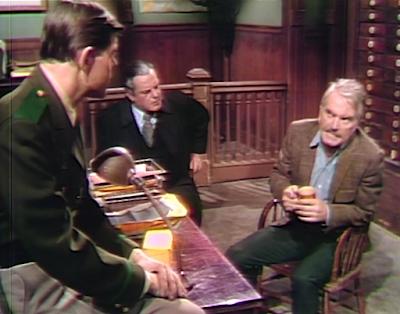
The police station was a frequent set for about a year after its first appearance in August 1966. It hasn’t changed a bit when we see it today. The officer on duty is someone we haven’t seen before, but that doesn’t mean he is a new character. Four actors took turns playing Sheriff George Patterson between September 1966 and January 1969; this man is not named in the dialogue and there are no acting credits on screen today, so for all we can tell he might be a fifth. He is younger and slimmer than were any of the other incarnations of Sheriff Patterson, but maybe he’s been working out.
Stokes introduces Paul to the policeman, and explains that Paul will speak only to the authorities. The policeman sits Paul down, gives him some coffee, and assures him that everything will be all right.
Paul tells the policeman that “It will never be alright until they stop chasing me” and “They have been after me ever since I got here.” The policeman asks “What are these people doing to you?” and Paul replies that “At first, there were just little hints, phone calls, things like that- veiled threats. It was their way of making me know that I was under their control. And I was, too, because when I tried to get away they took me back to Collinwood.”
The policeman responds “I see,” and Paul bursts out with “No, you don’t see! You think I’m mad!” The policeman tries to reassure him that he will listen, and asks him if he can name any of his persecutors. “Yes, I’ll name one, all right! My [ex-]wife, Elizabeth Stoddard.” The policeman says “That’s a little hard to believe,” and Paul responds “It’s impossible to believe, and yet! You tell me why she took me back into Collinwood, after years of open hatred, unless they wanted me there! And you know this town, you know how they gossip. And you know my wife. Why, why would she risk all that gossip, unless they wanted her to do so?” He answers that even so, “It’s still a little hard to believe.”
Paul angrily says “Yes, and because it’s Elizabeth Stoddard who’s involved, you will do nothing!” The policeman responds “I didn’t say that. I intend to talk to Mrs Stoddard and the doctor and whoever else is involved. If you still feel you’re being held captive, well, we’ll have to do something about it.” Paul visibly relaxes.
Earlier in the episode, we saw Liz forcing medicine on Paul. Returning viewers know that Liz has been absorbed into an evil cult that is trying to do something terrible to Paul, and indeed to the whole human race. We saw today that Liz has assigned her housekeeper, Mrs Johnson, to trick Paul into taking the medicine. It quickly becomes clear that Mrs Johnson has no idea that Liz is involved in anything sinister- she simply trusts her employer to do the right thing, and she follows her orders. Liz owns most of the village of Collinsport, and most of its people would react as Mrs Johnson does.
When we saw the last Sheriff Patterson for the last time in #675, he told a prisoner that he was releasing him because Liz’ cousin Barnabas said he was with him when the crime was committed, and Barnabas is “just about the best alibi you can have in this town.” He shook hands with the prisoner and sent him on his way. Since we know that Barnabas is, off and on, a vampire, and that even when he is free from the effects of that curse he spends most of his time covering up murders, that left us with an impression of Collinsport law enforcement as hopelessly in the thrall of the Collinses. That reinforces the image left by Sheriff Patterson’s predecessor, Constable/ Sheriff Jonas Carter, who was last seen in #32, toddling off after taking Liz’ orders to accept an obvious lie as a way of closing a case against a family member. Paul has every reason to suppose that this new policeman will be as submissive to Liz and her family as were his predecessors.
Now that Paul can hope that the policeman will be different from the others, he asks him to lock him away, to put him under guard someplace where no one can get to him until his daughter Carolyn Collins Stoddard can come for him. Stokes agrees to telephone Collinwood and talk to Carolyn, and the policeman escorts Paul to a back room. Paul awakes from a nap, and smiles at the policeman. He tells him he can’t tell him how much better he feels. The policeman tells him someone has come to see him. Paul’s delight at the thought that Carolyn has arrived gives way to cries of terror when he sees Liz at Stokes’ side. She comes at him with a spoonful of the hated medicine while Paul tells Stokes and the policeman that they are traitors and killers.
This one is primarily a showcase for Dennis Patrick as Paul, but all of the acting is excellent. My wife, Mrs Acilius, found it very difficult to watch the episode to the end, saying that they did too good a job- she felt as trapped as Paul. It really is one of those episodes you could show to a person who had never before seen Dark Shadows with a reasonable confidence that they would understand why we like the series so much.




 Dark Shadows Commentary