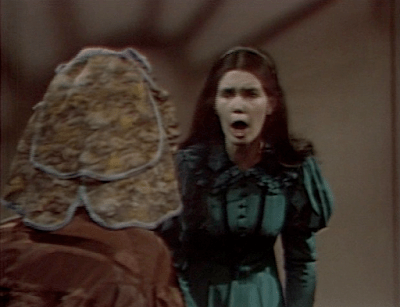
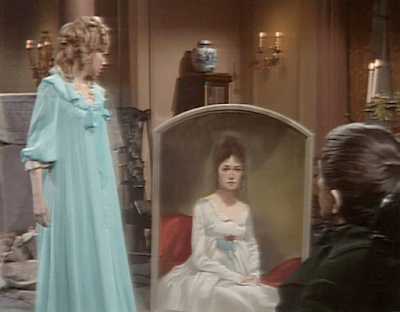
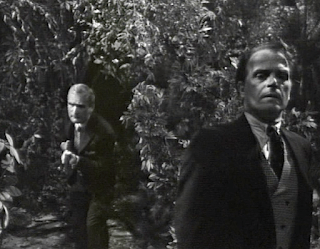
Episode 577: I imagined we would discuss Freud

Heiress Carolyn came running when her mother, matriarch Liz, woke her with her screams. Liz was having a nightmare about being buried alive. She tries Carolyn’s patience and ours with her obsession that this will in fact happen to her.

Liz tries to call her lawyer, Richard Garner. Whoever answers the phone tells Liz that Garner is not available, hardly surprising since it is the middle of the night. She responds that if he doesn’t call back within the hour, he need never call again. Since we last saw Garner in #246, and his name hasn’t been mentioned since #271, it seems like he may as well get some sleep.

Liz then calls Tony, a young lawyer in town who used to date Carolyn. Tony comes over and Liz hires him to help with some changes to her will. She dictates excerpts from Edgar Allan Poe’s “The Premature Burial” by way of a codicil protecting her from being buried alive, and he tells her he thinks she’s being weird.

The most prominent reference to Poe on Dark Shadows up to this point was in #442, when vampire Barnabas reenacted the plot of “The Cask of Amontillado” by bricking the fanatical Rev’d Mr Trask up in an alcove in his basement. Like Tony, Trask was played by Jerry Lacy, so it is possible that the writers hope the audience will recognize the connection.

Poe wrote punchy little short stories each of which leaves the reader with a single horrifying image. “The Cask of Amontillado” worked well as the basis for an episode, and the bricking up of Trask is one of the most enduring images in all of Dark Shadows. “The Premature Burial” could have made for the same kind of success, had Liz’ obsession begun and ended within one episode. But it has already gone on longer than that, and there is no end in sight. Each time we come back to it, the situation becomes more familiar and less urgent.

Meanwhile, Carolyn takes a glass of milk and a sandwich to Adam, a Frankenstein’s monster she is hiding in the long-deserted west wing of the house. Adam has little to do but read, and he has become quite intellectual. He is playing both sides of a game of chess when Carolyn arrives, pretending that she is his opponent. When she comes, he attempts a joke, pretending she has left him alone so long he does not remember her name. She is distressed about Liz’ obsessive fear of being buried alive, and so does not recognize that he is joking.

Carolyn looks at the chessboard and asks Adam who he is playing. He says that he is pretending to play her. He is smiling and relaxed when he admits this, and he starts joking again as he tells her about their imaginary games. Adam’s pretending that he did not remember Carolyn’s name was a weak joke, but he is actually pretty funny when he tells her that when he pretends they are playing, she doesn’t do as well as he does. She still does not realize that he is kidding, and reacts with horror. She says she doesn’t play chess; in #357, her uncle Roger mentioned that she does, but that she usually loses to him. Perhaps in the 44 weeks since then, she has given up the game altogether.
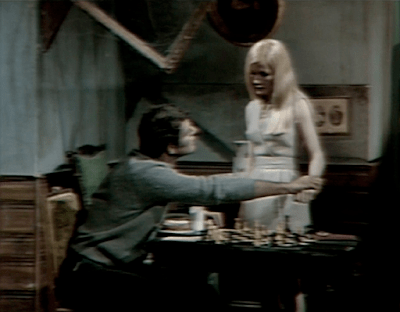
Adam wants Carolyn to play with him for real. Screenshot by Dark Shadows Before I Die.

Adam shows Carolyn the book he has been reading, a volume of Sigmund Freud’s works, and is disappointed she has not already read it. When she tells him she is worried because of Liz’ condition, he invites her to sit down and says “Tell me about your mother,” suggesting that he is ready to set up shop as a psychoanalyst. Adam is being serious now, but this part of the exchange is hilarious.

Carolyn goes out to the terrace and looks at the night sky, wondering if Freud could help her understand what is happening with her mother. I live in the year 2024, and so I have difficulty imagining how people could ever have taken Freud seriously. But he was very very big in the 1960s, and in its first year Dark Shadows gave us a lot of heavy-handed Freudian symbolism and a number of storylines with obvious psychoanalytic themes. Longtime viewers will find it a reassuring sign of continuity that Freud is still around as the thinker “every twentieth century man should read.”

Tony joins Carolyn on the terrace. He greets her and sees that she has a book about Freud. “I don’t have to ask why you’re reading him,” he remarks. Carolyn asks if he is referring to her mother, and Tony’s response is so indiscreet he may as well spinning his finger around his temple and saying “Cuckoo, cuckoo!” It is clear enough that the concept of “confidential communication” is alien to the lawyers in Soap Opera Land, and now we see that “basic respect” is also very much on the optional list. Carolyn tells Tony to do whatever Liz asks, and starts crying.

I was startled by Carolyn’s crying turn, because it is the first time in the two hundred or so episodes she has appeared in thus far Nancy Barrett has given a subpar performance. The actors all had to work under virtually impossible conditions, so I rarely mention it when one of those who usually does well has a bad day at the office, but the 20 seconds or so she spends very obviously not crying in this scene mark the end of an extraordinary streak.

Tony embraces Carolyn and kisses her. Adam’s room in the west wing overlooks the terrace, and he spies on them while they kiss. After Carolyn excuses herself and goes back into the house, Adam comes up behind Tony, grabs him, forbids him to touch Carolyn, and throws him to the ground.

Episode 427: I object

The opening voiceover melds into a sequence in which we cut back and forth between repressed spinster Abigail Collins and the fanatical Rev’d Mr Trask standing in front of black backgrounds, looking directly into the camera, and declaring that the trial of bewildered time-traveler Vicki for witchcraft must begin at once.

Soap Opera Land famously does not observe the legal codes that prevail elsewhere. If that is going to bother you, you probably aren’t in the right frame of mind to enjoy the show at all. But there is an art to depicting a fictional trial. You can deviate as much as you like from the rules that prevail in the real world, but there have to be some kind of rules the audience can understand. We can either see those rules applied with the result that a disorderly world is reduced to order, or see them flouted so that our heroes’ hopes of justice are cruelly dashed. If we aren’t aware of any rules, there is no point in setting the play in a courtroom.

That’s the first problem with Vicki’s trial. Now and then her lawyer/ gaoler/ boyfriend/ etc Peter will object to some question or move that a statement be stricken, and once or twice the judges will agree with him. But they are just as likely to respond to identical protests by ordering him to stop interrupting. The witnesses respond to questions with extended free association sessions. Vicki herself interrupts testimony repeatedly, usually to make self-incriminating remarks, and no one tries to stop her. Trask is for some reason simultaneously the prosecutor and one of the witnesses. Opposing counsel periodically engage in shouting matches with each other while the judges watch. The whole thing is so chaotic that it may as well be taking place in a bar-room or at the county fair or on the waterfront after dark.

The second problem with the trial is that it requires Peter to raise his voice repeatedly. Actor Roger Davis can deliver dialogue more or less competently when he is speaking in a normal conversational tone, but his loud voice always tends toward an ugly snarl. This is a major limitation for any performer on a show as shouty as Dark Shadows, but the opposition of Peter to Trask puts Davis head to head with Jerry Lacy, who is a virtuoso of shouting. Next to Lacy’s, Davis’ shouting is not recognizable as a performance.

When I’m watching a scene on Dark Shadows that suffers because of an actor’s shortcomings, I sometimes try to make it bearable by imagining what it would have been like had someone else who may have been available for the part been cast instead. Harvey Keitel was an extra on the show in #33; no doubt he would have accepted a speaking part if offered. Roger Davis plays Peter as a deeply angry man, and Mr Keitel is one of the very best at making audiences empathize with such characters. So it’s interesting to try to picture him as Peter.

On the other hand, there’s nothing in the scripts that requires Peter to constantly seethe with barely contained rage. That was Mr Davis’ contribution. Had the show gone with a more amiable Peter, they might have been able to cast Frederic Forrest in the part. In #137, Forrest was a background player. While Forrest played his share of angry men over the years, he also excelled as goofily cheerful characters, most famously as Chef in Apocalypse Now. I would have liked to see Peter played that way. I think he would have had some real chemistry with Alexandra Moltke Isles’ Vicki, and that we would have had protective feelings for him as he went up against the formidable Trask.

There is a third problem with the trial that neither Harvey Keitel nor the late Frederic Forrest could have done any more with than could Mrs Isles. That is that Vicki and Peter are written as phenomenally stupid. Vicki hasn’t done a single intelligent thing since arriving in the late eighteenth century in November,* but she has become, if anything, even dumber since 1795 gave way to 1796. Peter’s behavior has also been deeply foolish, and today he hits rock bottom when he blurts out to the court that he abused his position as gaoler to help Vicki sneak out, to commit a burglary at the great house of Collinwood, and to steal evidence against her so that it could not be presented to the court. Even under Soap Opera Law, that’s three felonies.

Some claim that the phrase “Dumb Vicki” is ableist. I disagree. “Dumb” really does not mean “mute” anymore, so that using it isn’t ableist against people who do not have the power of speech. And the intelligence characters like Peter and this version of Vicki lack is not the intelligence that IQ tests are supposed to measure. One of the most interesting characters in the part of Dark Shadows set in the eighteenth century is fluttery heiress Millicent Collins, who would probably fall far short of a triple digit score on a Stanford-Binet scale, but whose behavior makes sense to us because we tell what she wants out of life and how she thinks her actions will help her get it. That’s really all we mean when we talk about a “smart character.” A well-crafted story about someone with profound developmental disabilities can depict that person as a smart character, in that sense, as easily as can one about a great sage or a brilliant scientist. Vicki and Peter are not smart characters, no matter how what kind of school we might suppose would best suit them as students, because there is nothing for us to learn by observing their behavior and no suspense as to what their several actions will add up to. They just do one damn thing after another.

Clarice Blackburn and Jerry Lacy do some fine acting today, as does Grayson Hall in a brief turn as the Countess DuPrés. The pre-title bit with Blackburn and Lacy in front of the black backgrounds is so specific to theater in the 1960s that I can’t help but smile at it, but I’m glad it’s there. It isn’t as though you could ever really forget that the show is 56 years old, and I like to see that they preserved something that would have been so typical of the off-Broadway productions that would have been such a big part of the working lives of the cast and other creatives in those days.

*In her testimony today, Abigail gives the dramatic date of Vicki’s arrival in the past as 12 October 1795. The episodes in which the events she describes happened were broadcast on 17 November and 20 November 1967. In the last few weeks, the show has explicitly told us that the day and month of the dramatic setting in 1796 is the same as the broadcast date in 1968, so it’s confusing.

Episode 402: Name the witch

Well-meaning governess Vicki is in jail, about to be tried on a capital charge of witchcraft. That couldn’t happen in the New England that existed in 1795 in our timeband, but many things were possible in the world of Dark Shadows that we don’t see in ours.

Gallant gentleman Barnabas Collins has figured out that Vicki is innocent and that the real witch is his new wife, Angelique. Rather than go to the authorities with his evidence, he decides to take a more direct approach and murder Angelique. That won’t be much use to Vicki, but Barnabas can’t be bothered with details.

The longest sequence of the episode is a farce in which Barnabas pours two glasses of sherry, puts poison in the one he then gives Angelique, and tries to get her to drink. They don’t do “the old switcheroo” and mix up the glasses, but instead go with an equally hoary device of having Barnabas’ mother show up and take Angelique’s glass. Barnabas has to claim the glass is cracked and knock it from her hand.

After the failure of his attempt to poison Angelique, Barnabas opens a hidden compartment of his desk and takes out a dagger. If it weren’t for Robert Cobert’s solemn musical score, the effect would be that of seeing Wile E. Coyote open yet another crate from the Acme Corporation. He goes up to Angelique’s bedroom and lifts the dagger. Since there has been no indication that she has got into her bed, and all we see on it are a lump of covers, the audience has no reason to suppose she is in there. We end with the distinct impression that Barnabas, having barely avoided matricide, is stabbing a mattress.

We first knew Barnabas in the year 1967, when he will be a vampire and will develop from a profoundly bleak presence and an urgent threat to our favorite characters into a comic villain for whom we can’t help but feel a kind of affection as we watch him fail again and again in his elaborate schemes. In that way, his maladroit attempts on Angelique’s life today are entirely typical of the Barnabas we had met before Vicki traveled back in time in November.

In another way, this episode represents one of the biggest retcons in the whole series. Throughout his first eight months on the show, Barnabas nursed a bitter hatred for his uncle Jeremiah Collins. In the first weeks of the 1795 segment, we saw that Jeremiah eloped with Barnabas’ beloved fiancée, the gracious Josette, and that Barnabas responded to this betrayal by killing Jeremiah in a duel. When Barnabas is talking today about Angelique’s black magic, he realizes that Jeremiah and Josette ran off together only because they were under a spell, and that neither was responsible for betraying him. He has no hostility left for Jeremiah.

In the various accounts the vampire Barnabas gave in 1967 of his last years as a living being, he never mentioned Angelique. Nor did he ever say that he, Josette, or Jeremiah had been the victim of witchcraft. Instead, he had indicated that he himself had gotten involved in black magic. In #345, he told his sometime friend, mad scientist Julia Hoffman, that he became a vampire after trying to gain eternal youth, and that Josette killed herself when he offered her that eternal youth. In #358, he uses “the secret magic number of the universe,” which he had learned while studying witchcraft under a warlock on Barbados, to torment Julia. The Barnabas we met when we came to 1795 hadn’t done any of that. Until he learned the truth about Angelique, Barnabas was a man of the Enlightenment and didn’t believe that witches even existed.

Perhaps this is a change Vicki’s arrival and her bizarre behavior have wrought. The stories Barnabas tells in #345 and #358 both took place years after Josette and Jeremiah were married. So perhaps in the original timeline, with no one around yammering about what the first 73 weeks of the show were like, events moved much more slowly. The change of loves took place gradually enough that Barnabas did not feel he had to challenge Jeremiah to a duel, but he was still full of hatred and resentment. Angelique was able to cover her tracks so that no one suspected witchcraft was underway. She gradually lured Barnabas into the occult arts, perhaps giving up the idea of marrying him at some point, certainly losing his attention. By the time he brought the vampire curse on himself, the version of Barnabas in that timeline would have forgotten Angelique and would have come to be consumed by his grievance against Jeremiah. That fits far better with the April-November 1967 Barnabas than does the character we have seen so far in 1795.

Barnabas asks a key question in this episode. When Angelique says that she will always love him, he asks her what she thinks love is. She answers “Why of course I do!,” which probably means that the script called for him to ask if she knew what love was, but “What do you think love is, Angelique?” is a better question. She’s been destroying every relationship that makes him the man he is in order to have him all to herself, suggesting that if Barnabas pressed Angelique to explain what love is, she would wind up saying that it means having total control over someone. As a vampire, that’s going to be Barnabas’ working definition too, suggesting that he will be more like Angelique then than he already is now.

In this episode, the portrait of Josette is delivered to Barnabas’ home, the Old House on the estate of Collinwood. This portrait, haunted by Josette’s ghost, was the dominant presence in the Old House from its first appearance in #70 until Barnabas moved back in there in #221, and was important as a symbol of Barnabas’ obsession with Josette thereafter. The makers of the show left it on the wall of Josette’s bedroom at the beginning of the 1795 segment; we see it there in #374, but they replace it with a different portrait in #377. It’s hard to understand why it would already have been there before Josette formally became a member of the family- perhaps it was just a slip-up that it was there in #374, and they’d always planned to show its arrival at Collinwood.

The portrait of Josette arrives at the Old House. Screenshot by Dark Shadows Before I Die.

Episode 395: Stay on as master of the Old House

It is 1795. In the foyer of the great house of Collinwood, young gentleman Barnabas Collins stands on the staircase, his father Joshua stands on the floor. Joshua forbids Barnabas to marry lady’s maid Angelique on pain of disinheritance; when Barnabas declares he will marry her anyway, Joshua announces that they are no longer father and son.

Barnabas on the stairs, Joshua standing on the floor. Screenshot by Dark Shadows Before I Die.

In 1967, Barnabas will return to Collinwood as a vampire. In that year, in episode #214, he will take well-meaning governess Vicki on a guided tour of the foyer of the old manor house, indicate the staircase there, and say that “On these stairs, a father and son hurled words at each other, words that would lead to the death of the son.” He will then begin laughing maniacally and repeat the words “The death!,” seeing the desperate irony of referring to his own death in the past tense.

By today’s episode, the Collinses have moved out of the old manor house without any shocking scenes between Barnabas and Joshua playing out on the stairs there. That isn’t so surprising- that one remark eight months ago was the only reference to the stairs as the site of a fateful quarrel between Barnabas and Joshua, and the writer responsible for that day’s script, Malcolm Marmorstein, has been gone and forgotten since August. Neither today’s screenwriter, Gordon Russell, nor his colleague, Sam Hall, was with the show when Barnabas gave that speech to Vicki, and the third member of the writing staff, Ron Sproat, has been in the background for most of the 1795 segment so far.

But they do go out of their way to put Barnabas on the stairs of the new house for his showdown with Joshua today. It seems likely that they are hoping that at least some viewers will remember Barnabas’ remark in #214 and look for a significance in the connection. They did that sort of thing all the time in the early months of the show. For example, when they were developing a murder mystery about the death of beloved local man Bill Malloy in the last four months of 1966, they would show us a clock face in one episode, then weeks later have a character lie about the time established by that clock. Sproat more or less put a stop to those kinds of wild over-estimations of the audience’s attention span when he joined the writing staff near the end of 1966, but ever since the vampire story began in April of 1967 they had acquired obsessive fans who sent letters and gathered outside the studio. So they do have a reason to try to close the loop on a very long and very slender thread. What might the significance be of this particular nod to Barnabas’ first days on the show?

The 1795 segment began when the ghost of Barnabas’ little sister Sarah took possession of Vicki at a séance in #365, announced she wanted to “tell the story from the beginning,” and hurled Vicki back to her own time as a living being. But it is not simply a flashback explaining what made Barnabas a vampire. Vicki has completely failed to adapt to her new environment, and as a result has made significant changes to the timeline. She is now in hiding, suspected of witchcraft because of her endless stream of bizarre words and actions.

In fact, there is a witch at Collinwood. It is Angelique. Presumably, the first time these events took place Angelique pinned responsibility for her crimes on Sarah’s proper governess, Phyllis Wick. We caught a glimpse of Phyllis in #365; we could tell, not only that she was indigenous to the eighteenth century, but that she was quite cautious about anything that might suggest the paranormal. It would have taken Angelique some time and effort to set Phyllis up as a patsy, while Vicki volunteered for the role without any action at all on Angelique’s part. So maybe Vicki has speeded everything up. Maybe the family was still in the Old House when Joshua disowned Barnabas in the original sequence of events, but Vicki’s blunderings have accelerated matters so that they moved out before the conflict between them came to a head.

There is another puzzle about the writers’ intentions in this episode. It is established that without his inheritance or his position in the family business, Barnabas will be in a most parlous state. In separate scenes, both Barnabas and Joshua talk about the impossibility of Barnabas finding a job in Collinsport. Barnabas tells Angelique they will have to go at least as far as Boston before they can find anyone who will risk Joshua’s displeasure by hiring him. Later, Joshua tells Naomi that Barnabas won’t even be able to reach Boston- he doesn’t have enough money and won’t be able to get enough credit to stay in an inn, and he has no friends who will so much as put him up for a night if they know he doesn’t have an inheritance coming.

Barnabas’ mother, Naomi, has a solution to his financial problems. She gives him the Old House. The Old House is supposed to be a huge mansion, which it takes a very substantial income to maintain. How a man who can’t even afford a room for the night is going to meet those expenses is not made clear.

The frustrating thing about this is that they dwell at such length about the hard realities of dollars and cents immediately before, and then again after, Naomi makes her gift. By the laws of Soap Opera Land, a character who possesses a symbol of wealth such as a mansion does not need an income. We can accept that convention, and do in the 1967 segment, when a moneyless Barnabas occupies the Old House and can pay for all sorts of expensive things. But today they keep rubbing our faces in the implausibility of it.

My wife, Mrs Acilius, suggested they could have presented both themes if they’d dealt with the realistic financial problems in one episode and in a subsequent episode had gone back to the fantasy world. Maybe Joshua disinherits Barnabas on a Friday, he worries about getting a job on Monday, Tuesday we watch someone try to introduce Vicki to the concept of “lying,” Wednesday we see caddish naval officer Nathan woo feather-headed heiress Millicent, Thursday much-put-upon servant Ben Stokes tries to escape from the spell with which Angelique controls him, and then comes another Friday, when Naomi waves her magic wand and gives Barnabas the house. But as it stands, Barnabas talks to Angelique about how they have to go hundreds of miles to eke out a bare subsistence, Joshua talks to Naomi about Barnabas’ impending poverty, and then all of a sudden they remember that none of that matters, sorry sorry we shouldn’t have bothered you with it.

There were times in 1966 and 1967 when Dark Shadows only had one viable storyline, and no readily apparent means of starting others. But now they have several stories in progress, and an abundance of lively characters with whom they can make as many more as they like. There is no need for events in any one plot-line to move so quickly that incompatible themes crash into each other with such an unfortunate result.

Naomi’s gift to Barnabas was legally impossible in 1795. Until 1821, Maine was part of Massachusetts, and married women could not own property in Massachusetts until 1822. Maine did not pass its own Married Women’s Property Act until 1844. The show never brings this up, so it isn’t the same kind of problem as Barnabas’ lack of income.

Still, it does represent a missed opportunity. If Naomi’s family of origin had owned the house, they might have placed it in a trust over which she would have enough influence to deliver it to her son against her husband’s wishes. In fact, the show never makes the slightest allusion to where Naomi came from. If they’d given her relatives of her own, she would have had potential allies in a clash with Joshua and potential goals to pursue independently of him. As it stands, they have put her firmly in his shadow, so that the category of possible stories about Naomi is a subset of stories about Joshua. That’s a sad situation for a character who is capable of the dynamism she shows today, and a criminal waste of the talents of an actress as accomplished as Joan Bennett.

Episode 386: Innocent until proved innocent

For the first nine months it was on the air, Dark Shadows was the story of well-meaning governess Vicki Winters and her efforts to befriend her charge, strange and troubled boy David Collins. That phase of the show reached a climax with the story of David’s mother, blonde fire witch Laura Murdoch Collins, who was on from December 1966 until March 1967. Vicki rallied the regular characters in opposition to Laura’s evil plans for David, and when Laura went up in smoke David found refuge in Vicki’s arms. He had exchanged his destructive, death-oriented mother for the loving, life-affirming Vicki. At that moment, Dark Shadows version 1.0 ended.

Now, Vicki has been thrust back in time to the year 1795. Vicki has managed to get another job as governess on the great estate of Collinwood, supervising the education of ten year old Sarah Collins and her second cousin once removed, the visiting (but so far unseen) Daniel Collins. There is a blonde fire witch here as well, the mysterious Angelique. Viewers who have been with the show from the beginning will remember Vicki’s leadership of the campaign against Laura, and are waiting to see how she will take charge of the effort to defeat Angelique.

It’s already been a long wait. Vicki has not adapted her thinking at all to her new surroundings. Angelique’s spells have wrought considerable havoc, and members of the Collins household have begun to wonder whether a witch might be at work among them. Angelique hasn’t lifted a finger to deflect suspicion to Vicki, but Vicki’s own behavior has been so bizarre that she is the obvious suspect. As we open today, she has been tied to a tree by the Rev’d Mr Trask, a visiting witch-hunter from Salem, Massachusetts.

Vicki’s ineptitude is particularly frustrating to watch because the major theme of Dark Shadows 2.0, which ran from Laura’s immolation in March to Vicki’s temporal displacement in November, had been a brilliantly successful deception by a different sort of time-traveler. Vampire Barnabas Collins presented himself to the Collinses and their neighbors, not as a blood-sucking ghoul native to another century, but as a distant cousin from contemporary England. Barnabas made plenty of slips and raised miscellaneous suspicions in the minds of various people, but he played his part well enough that the Collinses let him take possession of a house on their estate, the people of Collinsport accepted him as a member of the local aristocracy, and in one way or another he made himself indispensable to everyone around him. We began this version 3.0 expecting to see Vicki do in 1795 something like what Barnabas had done in 1967, and instead we see her as a tedious dingbat.

Barnabas is alive and benevolent in 1795. He and his friend, caddish naval officer Nathan Forbes, are men of the Enlightenment who are appalled that there are still people who believe in witchcraft. They hold Trask in contempt and are committed to saving Vicki from him. Barnabas and Nathan ask the Collins family’s house-guest, the Countess DuPrés, what Trask has done with Vicki. The countess had originally believed Vicki to be a witch, but after seeing Trask’s lunatic behavior while interrogating her came to regret her involvement in bringing him to Collinwood. She tells them that Trask tied Vicki up and took her out of the house, whither he would not say.

Outraged, the men head out of the house. They meet Trask coming in. He refuses to tell them where he has left Vicki. Barnabas thunders that “[I]t perhaps has escaped your memory that we have just fought a war recently-a war to establish certain rights. And I am defending the right of this girl to be judged innocent until she is proved innocent. I am sure that this idea is a little complicated for your mind to absorb.” He’s probably right about that, I certainly find it difficult to absorb.

“Innocent until she is proved innocent!” Screenshot by Dark Shadows Before I Die.

Once Barnabas and Nathan are on their way to look for Vicki, Trask tells the countess he has tied her to a tree somewhere in the woods and that if she is a witch, the tree will be dead by morning. Angelique’s regular job is as the countess’ maid. She is in the room with a tea tray when Trask says this, and she smiles delightedly when she hears it. Later, she will sneak out of the house to go searching for Vicki herself.

Barnabas and Nathan find Vicki and untie her. They decide to hide her in the great house of Collinwood. The great house is Vicki’s home in the 1960s, and is under construction in 1795. They set off, and Angelique comes to the tree.

Once she is alone, Angelique takes a cutting from the tree and sets fire to it. This causes the tree itself to burn. It is not entirely clear why she doesn’t just set fire to the tree, since the cutting she has taken is the greenest and least flammable part of it, but witches gonna witch, I guess.

Building a fire the witchy way. Screenshot by Dark Shadows Before I Die.

The next morning, Trask goes to the tree. The countess insists on accompanying him. They find that Vicki is gone and the tree is a hunk of scorched timber. Trask triumphantly silences the countess’ doubts.

In our time-band, the last witchcraft trial in the English-speaking world was held in Scotland in 1727. The Westminster Parliament finally abolished all laws against witchcraft in 1736, including those still on the books in Massachusetts* and some other British colonies in North America. Had they lived in our 1795, Barnabas and Nathan could have gone to the constable and reported that Trask had abducted Vicki, bound her, and left her outside. The constable would help them find her, arrest Trask, and that would be it. But of course Dark Shadows takes place in a world that differs from ours in many respects, not least in regard to the legal history of Massachusetts.

As the countess, Grayson Hall has been doing an excellent job establishing a character who is distinct from mad scientist Julia Hoffman, the role she plays in the segments of Dark Shadows set in the twentieth century. But as my wife, Mrs Acilius, points out, Hall does lapse into Julia a few times today. When she gasps in horror, she makes a little clicking noise in the back of her throat that is one of Julia’s most recognizable mannerisms. Julia is deeply entangled with Barnabas’ activities, and has developed an emotional attachment to go along with her inability to get away from him; shortly before Vicki took us with her to 1795, we heard Julia address him with a deeply felt “Barnabas, Barnabas.” The countess barely knows Barnabas, but in an anguished moment today, she says “Barnabas, Barnabas” to him. Hall does return to being the countess before the episode is over, but there is a weird little visit from Julia in the middle of it all.

Vicki went back to the past after Sarah’s ghost took possession of her at a séance and said she was going to “tell the story from the beginning.” Vicki has traded places with Sarah’s original governess, a woman named Phyllis Wick. Presumably Angelique chose Phyllis as a patsy, and she wound up as Trask’s target. Maybe Angelique did this simply because Phyllis was new to the house and had no old friends to object that she couldn’t possibly be a witch, but maybe it was because she had caught on to Angelique.

It would make it all the more exciting to see Vicki catch on to Angelique and do battle with her. We’ve already seen Smart Vicki defeat one blonde fire witch, so if we see her try to fight another, we will hope that she might win again. Only when we saw the attempt end in disaster would we realize that everything we’ve seen Vicki doing is what Phyllis Wick did the first time around, and that her intervention won’t have changed a thing. That would be a powerful twist ending to the whole 1795 flashback. Instead, we are subjected to Dumb Vicki doing things neither Phyllis nor anyone else who belonged in 1795 could possibly have done, and we end up wondering what she is doing in this story.

*Collinsport is in Maine, which until 1821 was part of Massachusetts.

Episode 273: Why is there nothing there?

For sixteen weeks, starting with the introduction of seagoing con man Jason McGuire in #193 and ending today, Dark Shadows has subjected its viewers to a storyline about Jason blackmailing reclusive matriarch Elizabeth Collins Stoddard. Thirteen times in those sixteen weeks, we saw iterations of the same dreary scene- Jason makes a demand of Liz, Liz resists, he threatens to expose her terrible secret, she capitulates.

Now, Liz has exposed her own terrible secret. She has told everyone that eighteen years ago, she killed her husband Paul Stoddard and Jason buried Stoddard in the basement of the great house of Collinwood. Jason denied that Stoddard’s body could be found there, and as we open Sheriff Patterson and Fake Shemp Burke Devlin are digging up the basement to see who is right.

Liz and her brother Roger are in the drawing room. He asks why she didn’t confide her terrible secret in him. She says that perhaps she was too proud of her role as his older sister and the family’s moral compass. He admits that, if had told him the secret, he probably would have used it to blackmail her himself. This startling admission tells us just how completely isolated Liz is.

It tells regular viewers more than that. When Dark Shadows began, Roger was a deep-dyed villain. He hasn’t been directly connected to an ongoing storyline since his estranged wife, Laura Murdoch Collins, vanished in #191, and in the months since has figured as an immature, ineffectual person, a bratty little brother dependent on Liz’ money and unable to help her against Jason. With this admission he harks back to his first incarnation, and makes us wonder if we will see another side of him. If he has the strength to admit his villainy, perhaps he has the strength to change.

Meanwhile, Burke and the sheriff have turned up a trunk in the floor of the basement. It is empty and clean. There is no sign that there ever was a body in it.

Liz sees the empty trunk. Screenshot by Dark Shadows Before I Die

Viewers who have been with the show from the beginning will think of Laura. Laura had died in Phoenix, Arizona shortly before showing up in Collinsport. After the apparently alive Laura had been in Collinsport for some time, her corpse mysteriously vanished from the morgue back in Maricopa County. Upon inspection, the graves of several of her ancestors turned out to be empty and clean. The Laura arc swallowed up most of the non-paranormal story elements left over from Dark Shadows’ early days as a Gothic romance tinged with the suggestion of a noir crime drama, and the blackmail plot is meant to sweep the last of them away and get the show on track as a supernatural thriller/ horror story. So we might think that the empty trunk is a sign that there was something not of this world about Stoddard.

They retreat from that intriguing possibility, as yesterday they retreated from the evidence they had already given us that a ghost haunted the place of Stoddard’s supposed burial. Jason admits to Liz that he and Stoddard cooked up a scheme where Stoddard would pretend to be dead so that he and Jason could help themselves to a big chunk of her wealth, then go away to live the high life. Jason says that he saw Stoddard in Hong Kong a bit over ten years ago, and that so far as he knows he is still alive and well.

Liz doesn’t want to press charges against Jason- she simply wants him to go away. Roger demands that Jason be charged with blackmail. In front of the sheriff, Roger announces that he is outraged at the money Jason took from Liz, including “business money.” This might make us wonder about Liz’ own criminal exposure. In #242, Roger told Liz that the company’s accounts were out of balance. We knew it was because she was slipping money to Jason, and they made a big enough point of her meeting with the accountants and telling them lies so that they would fix the books that for a moment it seemed like they were getting ready for a story about her getting in trouble for falsifying business documents.

That was dropped right away, and it doesn’t seem likely that Liz will be charged for paying hush money to Jason. Not many people in the USA in 1967 had any understanding of the crime of obstruction of justice. It wasn’t until the Senate Committee investigating the Watergate affair broadcast its hearings live in 1973 that the average viewer of daytime television would learn that giving a person money to stay away from the police is a felony. Before then, even many trained lawyers, among them several of the Watergate defendants, did not grasp this. So we can be confident that such matters would not enter Soap Opera Law in the 1960s.

The blackmail arc was dredged up from Art Wallace’s original story bible for Dark Shadows, called Shadows on the Wall. The first time Wallace told the story was in a 1954 installment of an anthology TV series called The Web; that segment was titled “The House,” and he had to pad it a bit to fill out a 30 minute time slot. In 1957, Wallace stretched “The House” to even greater length, into an hour-long entry in another dramatic anthology, Goodyear Playhouse. Wallace left Dark Shadows in October 1966, but the series has been hanging from the old rope he sold Dan Curtis for four full months now. Jason will still be on the show for a couple more days, but we’ve finally seen the last of this drab tale.

Episode 272: Nothing downstairs

Reclusive matriarch Liz has spoiled her wedding to seagoing con man Jason by telling everyone that she was only marrying him to keep him from telling that she’d murdered her first husband and he’d buried the body in the basement. Fake Shemp Burke has found a gun and points it at every other character.

Jason denies Liz’ story, knocks the gun out of Burke’s hand, and runs out of the house. Burke runs after him and fires a couple of shots at a figure he assumes to be Jason, though it could be the sheriff or a small child or some other target of convenience for all he knows. The original Shemp Howard might have thought that last display of stupidity was a bit over-the-top for the Three Stooges. On Dark Shadows Every Day, Danny Horn has a bit of fun with Burke’s carelessness. His whole post about this episode is funny.

Out in the woods, Liz’ brother Roger looks directly at Jason, fails to see him, and moves on.

He’s right there, for crying out loud. Screenshot by Dark Shadows Before I Die

The sheriff comes and tells Liz that he is very sorry for bothering her with all of this, and assures her that his men will do everything they can to catch Jason and make things as easy for her as they can. Meanwhile, he needs some help digging up the body buried in her basement.

Liz has loudly refused to talk to her lawyers, a wildly bad move in our world, but under Soap Opera Law she has every reason to believe that, as a good person who has already suffered for her deeds, all she has to do is to tell the authorities about a bad person who has profited from his iniquity. The sheriff’s attitude confirms this assessment.

Liz tells well-meaning governess Vicki that she often went into the room where Paul is buried and cried. Vicki had heard sobbing coming from that room several times in the early days of the show, as had housekeeper Mrs Johnson on her first night in the house. At first, the show was equivocal as to whether it was Liz crying or a ghost. That equivocation fit with the show’s initial attitude towards the supernatural, which was to hint that there might be literal ghosts in the background, but to use the word “ghost” primarily as a metaphor for unresolved conflicts based on past events. Eventually, they showed us the door to the room locked from the outside while sobbing came from the inside, confirming that it couldn’t have been Liz. This week the show is committing totally to stories of the paranormal, yet they retreat to the idea that The Sobbing Woman was Liz all along.

Episode 271: A secret you had no right to keep

A wedding is being held in the drawing room of the great house at Collinwood. Matriarch Liz is marrying seagoing con man Jason. Carolyn, Liz’s daughter by her first husband, Paul Stoddard, has a pistol in her purse, which she is planning to use to shoot Jason before the ceremony can be completed. Well-meaning governess Vicki is distressed, because Liz confided in her in #259 that she is marrying Jason only because he is blackmailing her. Liz killed Stoddard long ago and Jason buried the body in the basement, facts he will reveal if she does not comply with his demands. The other guests hate Jason, but they share neither Vicki’s understanding of the situation nor Carolyn’s sense of initiative, so they just stand around and scowl.

When the judge asks Liz if she takes Jason to be her lawful wedded husband, she exclaims that she cannot. She points to him and declares “I killed Paul Stoddard and that man was my accomplice.” Carolyn drops the gun, Vicki flashes a defiant look at Jason, and everyone else is stunned.

Vicki triumphant

The judge excuses himself. He claims that he might be required to act as a judicial officer in a case that could arise from what Liz is about to say. That may not make sense in terms of the laws or canons of judicial conduct actually in effect in the State of Maine in 1967, where what he has already heard would be far too much to avoid being called as a witness. But it fits nicely with the logic of Soap Opera Law, in which neither the police nor the courts may be notified of any criminal matter until the prime suspect has completed his or her own investigation.

Carolyn says “You killed my father.” Before Liz can say much in response, Carolyn announces that she was about to kill Jason. Vicki’s boyfriend, Fake Shemp Burke Devlin, finds Carolyn’s gun. For some reason, Burke holds the gun up. He points it at whomever he is facing. When Jason announces he will be leaving the room, Burke is pointing the gun at him and forbids him to go. Again, giving orders to a person on whom you have a deadly weapon trained may be a felony in our world, but it is all well and good under Soap Opera Law.

Liz mentions that Vicki already knows that she killed Stoddard and that Jason has been blackmailing her. This prompts Liz’ brother Roger to tell Vicki “That was a secret you had no right to keep.” Liz responds that, had Vicki told anyone, she would have denied it and sent her away. Liz then describes the events of the night eighteen years before when she and Stoddard had their final showdown. We see them in flashback, on this same set.

Stoddard told Liz he was leaving her, never to return. She replied that she did not object to his going, but that the suitcase full of bonds, jewels, and other valuable assets he was planning to take was Carolyn’s property and would have to stay.

When the show started, just over a year ago, Stoddard’s disappearance had been 18 years in the past. So it still is, moving its date from 1948 to 1949. At that time, Stoddard was last seen six months before Carolyn was born. Later, they would say she was a newborn when her father vanished. In the flashback today, he answers Liz’ assertion of Carolyn’s right to the contents of the suitcase by saying that he has been putting up with the child for two years. We saw her birth-date as 1946 the other day, so apparently they are planning to stick with the idea that she was a toddler when Stoddard was last seen.

Stoddard and Liz quarrel over the suitcase. He confirms that he and his friend Jason have a plan to convert its contents into a big bundle of cash. He is walking away from her when she takes a poker from the fireplace and hits him on the back of the head. This may be another deed entirely unjustifiable by real-world law, but under Soap Opera Law any act committed against a man who openly despises his two-year old daughter and tries to steal from her is outside the jurisdiction of the courts.

Stoddard fell to the floor, bled, and remained very still after Liz hit him. Shocked by what she had done, she reeled out of the drawing room and closed the doors behind her. As she stood in the foyer wishing she were dead, Jason entered the house. Liz sent him into the drawing room to look at Stoddard. He came out, told her Stoddard was dead, and offered to bury him for her. After all, everyone in town knew he was leaving- there need be no scandal to cloud Carolyn’s future.

Liz asks why Jason wants to help her- he was Stoddard’s friend, planning to help Stoddard steal from her. Jason explains that Stoddard is beyond help now. Liz goes along with his plan.

In this flashback, Jason’s Irish accent is convincingly realistic. It sounds like he’s from Antrim, or someplace else in Norn Iron. That’s a contrast with what we’ve heard so far, when he’s been more than a little reminiscent of this guy:

Hearts, moons, clo-o-overs

My in-universe, fanfic theory is that Jason hadn’t been home or spent much time with other Irishmen in the years between 1949 and 1967, and so his accent drifted into a music hall Oyrish. My out-of-universe theory is that Dennis Patrick spent some time with a dialect coach after joining the show, but by the time he had learned to sound plausible Jason’s silly accent was already such an established part of the character that he couldn’t change it.

When Jason was done with his work downstairs, he showed Liz the storage room where he buried Stoddard in the floor. We got a long, long look at that floor in #249, when it was clean and tidy and there were many boxes and crates on it. When Jason left it to Liz “18 years ago,” there was dirt piled up all over the floor, a shovel in the corner, and few boxes or crates. Evidently Liz cleaned it up herself and organized its contents at some point. That doesn’t fit with the idea she had before #249, that a person entering the room would immediately discover her secret. Since Liz had often gone into the room in the early months of the show, it never had made sense she would believe such a thing, but it is annoying to be reminded of it.

In voiceover, Liz tells us that when Jason left her with the key to the room she knew she would be a prisoner of the house forever. The episode then ends, after less than 18 minutes of scripted content. That’s the shortest installment so far. The closing credits roll slowly, so slowly that they run out of music. The names scroll by in silence for 25 seconds before ABC staff announcer Bob Lloyd says “Dark Shadows is a Dan Curtis production.”

That cannot have been Plan A. This episode has eight speaking parts, two segments of events set in different decades, voiceover narration, a costume change, etc. So there was plenty of stuff that might have proven impossible in dress rehearsal, requiring a quick rewrite that might have left them running a little short. But they’ve been ambitious before, and have never ended up like this. So I suspect that the late script change that got them into trouble was more complicated than that.

Art Wallace’s original story bible for Dark Shadows, titled Shadows on the Wall, called for the mystery of Vicki’s parentage to be resolved at the same time as the blackmail plot. Wallace’s first idea was that Vicki would be shown to be the illegitimate daughter of Paul Stoddard, and that Liz’ interest in her well-being began with guilt after she responded to the news of Vicki’s existence by attacking Stoddard. Wallace also said that if it were more story-productive, they could say that Vicki was Liz’ illegitimate daughter.

Casting Alexandra Moltke Isles as Vicki committed them to that second course of action. Famously, when Joan Bennett first saw Mrs Isles on set she mistook her for her daughter, and the show has often capitalized on their resemblance to present Vicki as a reflection of Liz. For example, notice how the two women stand in this shot from today’s episode:

Pay particular attention to their legs- it’s the same posture

Moreover, the ghost of Josette Collins took a lively interest in Vicki in the first 39 weeks of the show, and Josette is specifically a protector of members of the Collins family. If Vicki is Paul’s illegitimate daughter, she is not a Collins and not linked to Josette.

The only advantage we’ve ever seen of establishing Vicki as a non-Collins would be the possibility of a romance between her and Roger. Since Vicki the foundling-turned-governess is Jane Eyre and Roger the father of her charge is Mr Rochester, this is an obvious direction to go. The show took a few feints towards such a relationship in the early days, but those clearly led nowhere. Vicki came to town in #1 on the same train as Burke, so they are fated to get together. Roger and Burke openly hate each other and often seem to secretly love each other, making for a potentially explosive love triangle if Vicki comes between them, but neither Roger and Burke’s much-advertised enmity nor their barely concealed homoerotic connection ever developed into a very interesting story. The whole thing fizzled out completely months ago. So there doesn’t seem to be a point in resolving the question of Vicki’s parentage any other way than with Liz admitting maternity.

So the first question is, when did they decide that this episode would not include that admission? The short running time would seem to suggest that it was only a few days before taping.

The second question is, why did they make that decision? Liz’ line today that she would fire Vicki if she had betrayed her secret, coupled with all the remarks she has been making to Vicki in the last few weeks about how Carolyn is the one and only person she really cares about, would suggest that the producers and writers are thinking of moving away from the idea of Vicki as Liz’ natural daughter. But the directors are still committed to it, as are the actresses.

We begin to suspect that the producers and writers are hoping that the viewers who have joined the show since the vampire came on in April won’t care about Vicki’s origin, so that they can just drop the whole thing. Since the only storylines they have going are the blackmail arc, which Liz is bringing to its end with her confession today, and the vampire arc, in which nothing at all is happening at the moment, you might think they would be glad to fill some screen time with Vicki and the rest of them reorienting themselves around a newly revealed family relationship. But, maybe not!