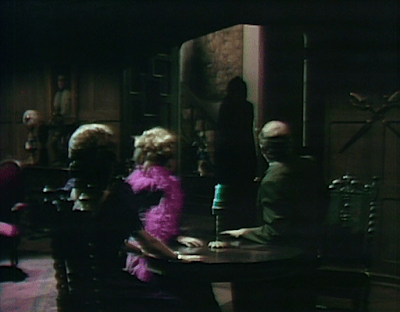
Episode 875: Barnabas, Quentin, and the difficulty of being oneself

This is the first episode credited to Peter Miner as line producer. Dark Shadows was being taped way out of sequence at this period, so Robert Costello’s name will appear in the credits several more times in the next few weeks. The role of the line producers is one of the most under-discussed aspects of the show’s history; writer Ron Sproat, for example, was in a 1985 festival appearance unable to remember ever receiving any input from Costello. So far as he could recall, the writers interacted exclusively with executive producer Dan Curtis.
Even if Sproat’s memory were accurate, I suspect that much of Curtis’ own time working on the show was spent in meetings with Costello. He was there from the beginning, and was around throughout the long periods when Curtis was away in London and other places working on other projects. When the show makes deep cuts into its early stages of development, referring to story points that played out long before any of the current staff of writers came aboard, I always suspect it was Costello who suggested the idea. Now that he is leaving, we will see if those references become rarer. If they don’t, maybe it is Curtis’ own memory that has been at work. On the other hand, even if they do dry up it may just be that they had run out of things to say about those old themes. Whatever happens, Costello had a hard job and clearly did it better than almost anyone else could have, it’s sad to see him go.

Today’s story is about the results of a spell that 150 year old sorcerer Count Petofi cast a few weeks ago. Petofi forcibly swapped bodies with handsome young Quentin Collins. I refer to the villainous Petofi who looks like Quentin as Q-Petofi, and to the forlorn Quentin who looks like Petofi as P-Quentin.

Yesterday, maidservant Beth Chavez found out about the body swap. In love with Quentin and terrified of Petofi, she was horrified by it. Today, she searches desperately for someone she can trust, and makes the singularly unfortunate choice of weak-willed schoolteacher turned unscrupulous adventurer Tim Shaw. She goes to Tim’s hotel room, tells him the story, and asks for help. Uncharacteristically, he does not look for a way to sell the information Beth gives him. He simply goes to Q-Petofi, whom he believes to be Quentin, in what can only be a sincere effort to do the right thing. He brings Q-Petofi back to his room, where Beth is waiting. She soon manages to escape, and Q-Petofi chases her.

For his part, P-Quentin made a happy discovery yesterday and the day before. When Petofi executed the body swap, he took his powers with him into Quentin’s form. But now P-Quentin finds that the powers have returned to Petofi’s own rightful body, which is to say to him. After consulting with his friend and distant cousin, recovering vampire Barnabas Collins, P-Quentin decides to will himself back into his own body.

This works. Quentin awakes as himself, in the woods on Widows’ Hill. He finds Beth at the summit of the hill, near the cliff from which so many people have leapt or fallen to their deaths. She thinks he is Petofi, and flees to the edge while he tries to reassure her of his true identity. The closing cliffhanger leaves her inches from death.

A few years ago, I posted a fanfic idea in the comments on Danny Horn’s post about this episode at his great Dark Shadows Every Day. I still like it:

This is one of the episodes that could have been novelized by “Marilyn” Ross under the title “Barnabas, Quentin, and the Dumbest Possible Plan.” Rather than will himself into his own body right away, thus returning Petofi to his body and for all they know to his full powers, a character with brains might have tried swapping places with someone relatively harmless. Beth would seem to be the obvious person. If she comes to in Petofi’s body, Beth would seem to be the person most likely to accept the situation and least likely to use the powers of Petofi to destroy Our Heroes. Playing Quentin may have been just the challenge Terry Crawford really needed to show off her acting talents, and I’m sure Thayer David would have done wonders as Beth.

Quentin/ Beth/ Petofi could have been the first in a whole series of body swaps. Some of those swaps could have led to villains getting their comeuppance, helping to clear the decks for the end of the 1897 segment. So, while inhabiting the body of a villain, Quentin tries to do something heroic, winds up in mortal peril, and at the last second snaps back to his previous host, just in time for the villain to be the one who dies.

Comment posted 6 December 2020 on Danny Horn, “Episode 875: Switchback,” Dark Shadows Every Day, 8 June 2016.

Fans if the original Star Trek will recognize the source of my inspiration. The episode titled “Return to Tomorrow” features a malevolent alien squatting in Mr Spock’s body. Spock hides his consciousness in the brain of Nurse Christine Chapel, whom the alien once controlled, as Petofi once controlled Beth, and who has a crush on Spock as Beth does on Quentin. And Spock and Nurse Chapel, as a composite being, deliver the fatal blow that kills the alien.

Episode 860: I just say things

Edward Collins isn’t what he seems. His stuffy manner is real enough, as are his kind impulses when he sees people in distress. But he allows those who meet him to believe that he is the heir to the vast Collins family fortune, which in fact belongs in its entirety to his sister Judith. Judith is currently an inmate in a mental hospital. During her absence, her husband, the odious Gregory Trask, exercises control of all the family’s assets. Edward hopes to get out from under Trask’s thumb by marrying the dowager countess of Hampshire, a young American woman named Kitty Soames. He befriended Kitty while a houseguest of the late Earl’s, and now that she is widowed and is his guest at the great house of Collinwood he sees an opportunity to take over the Hampshire interests.

Kitty isn’t what she seems. The Earl was bankrupt when he died. He had lost all his wealth and been driven to suicide by sorcerer Count Petofi. Kitty wrote a letter to her mother the other day saying that unless she marries Edward and becomes the mistress of Collinwood she didn’t think she could raise train fare from central Maine to her home in Pennsylvania. Nor is this all. If Kitty were simply without funds, she and Edward would be on an even footing. But she is not what she seems in a metaphysical sense as well as a financial one. She is intermittently possessed by the ghost of the late Josette Collins. Regular viewers have reason to believe that she is Josette’s reincarnation, and that the fits of possession are part of the process by which Josette is reuniting her spirit with her body. But the characters don’t know what we know. As far as they are concerned, Kitty seems to be a plain lunatic.

At rise, Edward catches Kitty in his brother Quentin’s room. She is rummaging through an armoire, apparently looking for something. He asks her what she is doing, and she feigns one of her fits. Kitty is not nearly as good an actress as Kathryn Leigh Scott; she doesn’t fool us for a minute. But Edward believes her. He gently escorts her out of the room. As they leave, we see a face peering at them from the shadows. It is Quentin’s face.

Downstairs, we hear Kitty’s thoughts as she takes satisfaction in having fooled Edward into thinking she was having a fit. Mental health professionals often talk about how people learn to use the resources they have, so that patients who carry diagnoses of major disturbances will sometimes find ways to exaggerate their symptoms for effect. It’s true that psychotic episodes are not usually an asset in the husband-hunting business, but everyone in the segment of Dark Shadows set in 1897 has some issue or other, and Edward really does have a soft spot for mentally ill women (unless they are married to Quentin, but that’s another thing altogether.) So Kitty may as well play up her particular case of dissociative identity disorder.

Kitty was in Quentin’s room trying to steal a portrait of him. She was doing this from her fear of Petofi, whom she believed to have ordered her to bring him the portrait before 9 PM lest he use his magical powers and make her vanish. It is almost that time now, and she has no idea how to find the portrait, let alone get it to him before the deadline. While she is worrying about this situation, a woman named Angelique enters.

Angelique isn’t what she seems. She is one of Quentin’s fiancées, and Edward takes her to be an innocent woman, about 30 years old, who has been hard done by in the course of the supernatural doings of the last several months. In fact, she is a wicked witch who wrought immense destruction the first time she was at Collinwood, in the 1790s, and again the second time, in 1968. She has traveled back in time to 1897, and has been one of the most powerful participants in all of the strange goings-on.

Kitty tells Angelique that she saw Petofi in the vacant rectory on Pine Road, and that he told her the woman who had been squatting there vanished into thin air before his eyes. At this, Angelique turns and rushes off to investigate. It dawns on Kitty that Angelique knows more than she is saying. We cut to the drawing room, where Edward is bracing for a conversation with Quentin.

Quentin isn’t what he seems. In fact, he isn’t Quentin at all. Petofi forcibly swapped bodies with him a few days ago. It is Petofi, using Quentin’s body as a disguise, who confronts Edward and demands to know what he and Kitty were doing in the room. I refer to this form of Petofi as Q-Petofi, and the Quentin who looks like Petofi as P-Quentin.

Q-Petofi confronts Edward. Screenshot by Dark Shadows Before I Die.

Edward tells Q-Petofi that Kitty had had a “seizure.” Q-Petofi expresses skepticism about this claim. He proceeds to tell Edward that Kitty’s late husband died in poverty, shortly after being released from prison for a jewel theft. Edward is thunderstruck. He calls the story a lie, and forbids Q-Petofi from repeating it to anyone.

Kitty goes to the village of Collinsport, and pays a visit to The Blue Whale, the local tavern. She wants to see the entertainer, Miss Pansy Faye.

Pansy isn’t what she seems. She has met the Collinses twice. Miss Charity Trask, daughter of Gregory and enforcer in his operation, came to the great house in #727 and took up residence when her father married Judith. Pansy Faye, mentalist and Cockney showgirl, came to the estate in #771 as the coldly cynical fiancée of the childlike Carl Collins. Pansy was killed the night she arrived. A few weeks later, Pansy started to take possession of Charity, and in #819 Petofi erased Charity’s personality altogether and gave her body over to Pansy.

When Kitty enters, Pansy is alone in the bar. She is picking out her theme song on the piano. When Petofi was in the process of switching bodies with Quentin, Quentin was with Pansy in this room. Petofi took control of him briefly and played the same song on this piano. He played it very impressively.

Kitty is desperate to find out what is happening to her, and she knows that Pansy has powers. Once Pansy assures her that she doesn’t work for Count Petofi, Kitty offers her a diamond-encrusted brooch in return for information. Pansy is offended. She says that she will take a gift in return for her services after she has rendered them, but that she does not accept payment in advance. She tells Kitty that there is one way to find out what is happening to her, which is to have a séance. Kitty gets up to leave, and Pansy presses the brooch on her.

The diamond brooch is a puzzle. Perhaps Kitty was lying to her mother when she said that she couldn’t buy a train ticket to Pennsylvania? Or perhaps the brooch is part of the late Earl’s ill-gotten gains, and Kitty doesn’t want to show it to anyone more reputable than Pansy.

Nancy Barrett’s approach to all her roles on Dark Shadows was to throw herself completely into whatever the character was doing at any given moment. That isn’t to say that her performances lacked nuance or that she didn’t support her scene partners, but that her method was to take her part from the outside in, letting the action supply the motivation. As Kitty, Miss Scott has opportunities to take this same approach. But in Kitty and Pansy’s scene in the Blue Whale, she deliberately lets Miss Barrett drive the action. Since Pansy has already completed a process of possession and transformation like that into which Kitty is now entering, Miss Scott can convey a great deal of information about Kitty’s state of mind by giving rather subtle reactions to Pansy’s behavior.

Back at Collinwood, Edward and Q-Petofi are drinking. Edward shakes his head at his brother’s ability alternately to enrage him and charm him. Q-Petofi asks him to be the best man at his wedding to Angelique; Edward agrees at once. Angelique enters, and Edward exits.

Angelique says that she doesn’t want to get married after all. Q-Petofi insists they go ahead. She points out that it was her idea, and he was extremely reluctant to agree to it. This is true- the engagement was part of Angelique’s price for invoking the power of Satan to break spells Petofi had cast on Edward and his son Jamison. While Q-Petofi has managed to copy Quentin’s behavior towards Edward almost exactly, his behavior towards Angelique has been radically different than was Quentin’s. We don’t know what Angelique has made of this.

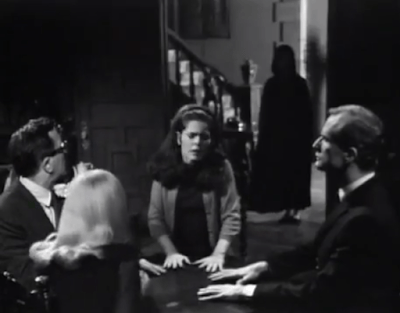
Edward finds Kitty and Pansy preparing the séance. After an initial protest, he declares he will join them. It ends with a visual quote from Dark Shadows‘ first séance, back in #170. As in that episode, a hooded figure appears in the doorway.

The hooded figure in #170 turned out to be undead blonde fire witch Laura Murdoch Collins. Another iteration of Laura was on the show as Edward’s estranged wife in April and May. It seems unlikely she is coming back, so longtime viewers are in suspense as to the significance of the allusion.

The hooded figure today is Natalie Norwick, making the last of her seven appearances as an uncredited stand-in on Dark Shadows. Norwick was in many plays on Broadway, as the lead in more than one, appeared in three feature films, and worked steadily in television from 1945 until the mid 1960s. She retired from acting in 1982, returning to the Broadway stage as understudy to her friend Julie Harris in 145 performances of The Gin Game from 1997 and 1998 when she was in her mid-70s. When Harris had a fall in 1999, Norwick took over the part, playing it in Florida and Washington, DC. She was chiefly based in Los Angeles in the late 1960s; perhaps she took the stand-in work to pay some bills during visits back east.

Norwick is best remembered for a single supporting performance on television in 1966. She appeared in “The Conscience of the King,” an episode of the original Star Trek, as Martha Leighton, the wife of Captain Kirk’s troubled friend Tom. She didn’t get much screen time, but she made the most of it. After Tom is murdered, she plays Martha’s understated reaction with a quietness that startles you no matter how many times you’ve seen it. Norwick is another of the significant talents one wishes Dark Shadows had found more to do with.

Episode 636: The old Adam

Unique among the narrative arcs in Dark Shadows, the story of Frankenstein’s monster Adam has a clear structure. It consists of a prologue and five acts, with an interlude between the second and third acts.

The prologue is about the process of building a patchwork man and animating him. It begins when mad scientist Eric Lang meets vampire Barnabas Collins in #466 and ends in #490, when Barnabas and another mad scientist, Julia Hoffman, bring Adam to life.

The next two weeks make up Act One of Adam’s story. Vampires and mad scientists are both metaphors for extreme selfishness, and so it is unsurprising that Barnabas and Julia turn out to be the worst possible parents. Though he has the body of a grown man, Adam has just begun to live. Barnabas and Julia lock their newborn in the prison cell in the basement of Barnabas’ house and leave him alone there for hours on end, chaining him to the wall. Robert Rodan’s facial expressions convey the heartbreak of this horrific act of child abuse unforgettably. We can’t help but take his suffering seriously. This is the first major difficulty for the storyline. Barnabas and Julia are the core of Dark Shadows, so that if we feel bad about them, we feel bad about the show.

Act Two begins at the end of #500, when Adam escapes from his cell and fights Barnabas. Adam can speak only a few words, has no idea how people interact with each other, and does not know his own strength. As a result, he hurts everyone he meets. He makes one friend during this period, blind artist Sam Evans. In a moment of confusion, Adam hits Sam in #515, causing an injury that leads to Sam’s death. Again, we pity Adam throughout this period, but can see no way he will be able to contribute anything to the story but more death and sorrow.

In #518, occult expert Timothy Eliot Stokes persuaded Adam to come home with him. Adam stays in Stokes’ apartment for some time, learning to talk, to read, and to do various other things. Aside from a few glimpses of these lessons, Adam is off-screen and not involved in the action during this period. That is why I say his time as a guest at Stokes’ place is an interlude, not an Act.

Act Three begins in #539, when Adam has to leave Stokes’ place to avoid the police and heiress Carolyn Collins Stoddard lets him live in the long-deserted west wing of the great house of Collinwood. In this period, Adam falls in love with Carolyn. She is attracted to him, but struggles against her feelings. This situation may sound more likely than either severe child abuse or lethal awkwardness to lead to an engaging story, but it suffers from its setting. Week after week, we see Adam cooped up in his dusty little room, alone with books and a chess set. The Creature in Mary Shelley’s Frankenstein reads The Sorrows of Werther, Plutarch’s Lives, and Paradise Lost; Adam reads the poems of Elizabeth Barrett Browning and the works of Sigmund Freud. He is marginally better off than he was in Barnabas’ basement cell, but he is still a prisoner, and it is still depressing to be confined along with him.

In Act Four, Adam is under the influence of suave warlock Nicholas Blair. In #549 Nicholas talks Adam into trying to rape Carolyn; that attack draws a line under their budding romance. By #551, Nicholas has talked Adam into confronting Barnabas and demanding that he build a woman to be his mate. Adam tells Barnabas that if he does not comply, he will murder everyone who lives in the great house of Collinwood, starting with well-meaning governess Vicki. Longtime viewers remember that Vicki spent the first 38 weeks of the show befriending strange and troubled boy David Collins, healing the psychological wounds David had suffered in his early years with his own unsuitable parents. If anyone could help Adam recover from the abuse he himself suffered from Barnabas and Julia in his first two weeks of life, it would be Vicki. His threat to kill her therefore shows just how little hope there is for Adam.

The project to build Adam’s mate reached its climax in #596, when she came to life and was given the name Eve. This began Act Five, which was all about Eve’s unconcealed hatred for Adam. Nicholas persuaded her to pretend to like him in #624; there is a jump cut in that episode which suggests that they may have had sex. Adam found out that she had been faking her interest in him, and murdered her in #626. Nicholas then persuaded him that if Barnabas and Julia could bring Eve’s body back to life, she would have a sweeter temperament. Adam renewed his demands upon them, and they ran the experiment again in #633/634, but it was a total failure, destroying Eve’s body so that it no further attempt would be possible.

Deranged with fury, Adam went to Vicki’s bedroom in the great house to abduct her. Carolyn found him there; she saw him hit Vicki in the face and flatten her. This not only alienated whatever sympathy Carolyn might have retained for Adam, it also shows how far he has come since the days when he was a danger because he didn’t know his own strength. The blow he delivers to Vicki is the same as the one he dealt to Sam, but while Sam wound up in the hospital and eventually died in part because of it, Vicki is only knocked out. He is still a deadly menace, but now he kills intentionally. This is emphasized when he chokes Carolyn in the same way as he had Eve, but she makes a full recovery a bit later.

Adam took Vicki to the laboratory in Barnabas’ basement where the equipment is still set up and Eve’s charred remains are still on a bed. He hooked Vicki up to the equipment and was trying to use it to torture her to death when Barnabas and Julia made their way to him. He laughs at Barnabas. Since the laboratory is only a few steps from the cell where Adam was kept in his early days, it was clear that this was closing the loop on the child abuse theme of Act One. Barnabas shot Adam in the shoulder, ending the threat to Vicki, and Adam escaped.

Stokes is the last friend Adam has left, and he sneaks into his apartment today. The telephone rings; Adam picks it up but does not say anything. Adam had done the same thing in #521, during the interlude when he was staying with Stokes. In those days, he didn’t know what a telephone was. But now, he is consciously trying to be stealthy. He recognizes the voice on the telephone as that of an intensely unpleasant man known variously as Peter and Jeff, and a moment later he picks up a knife. This is a perfectly understandable reaction to any reminder of Peter/ Jeff.

Stokes comes in, and Adam puts the weapon down. Stokes sees his gunshot wounds, and goes to call a doctor. “Not Julia!,” Adam objects, to which Stokes replies with the assurance that “Dr Hoffman is not my resident physician.” Before Adam can explain how he came to be shot, Stokes announces that “I won’t even ask you what has happened. Curiosity is the most boring obsession.” He telephones a doctor whom he calls “Carl,” and says that he knows he can count on his discretion. That Stokes knows a doctor who will come to his apartment, treat a fugitive from justice for a gunshot wound, and as a matter of course keep the matter between them is a sign that he is someone who will be able to look after Adam quite well.

Stokes gives Adam a new shirt. Adam tells him that he despairs of ever being loved because of the prominent scars on his face. Stokes introduces him to the concept of plastic surgery and tells him that the scars should be easy enough to correct. He is talking to Adam about the prospect of a new life when a knock comes at the door. Adam exits, never to be seen again.

Plaid Adam. Screenshot by Dark Shadows Before I Die.

One of the big surprises for me on this rewatch of Dark Shadows has been how good an actor Robert Rodan really was. The Adam story was such a downer that Mrs Acilius and I hadn’t liked anything about it before, and Rodan was caught up in our overall rejection of it. But he was excellent every step of the way. Whatever is going to happen to Adam after his exchange with Stokes will happen far from Collinsport, which is to say, not on Dark Shadows, so when we wish for more Rodan on the show we are wishing he could have been cast later as another character. I think his height- 6’6″- probably kept that from happening. Two other actors who are almost as tall as Rodan would become major cast members later. One of those, David Selby, will join the cast in just two weeks, much too soon for Rodan to reappear as someone else. The other, Christopher Pennock, won’t show up until #936, by which time Rodan had moved to Los Angeles.

Rodan did some commercials for Cheer detergent when he was in California. Here he is in a Star Trek themed bit where he wears pointed ears. Evidently he was the laundry officer aboard a Vulcan ship.

Episode 430: Do not disturb

Barnabas Collins became a vampire just a few weeks ago, and he doesn’t yet know what powers his new condition has brought him. On the chance that he might be able to raise the dead, he goes to the fresh grave of his ex-fiancée Josette. He whines about how much he misses her until the sound of her sobbing can be heard. She begs him to let her rest. Later, she appears to him in her former bedroom in the Old House on the estate of Collinwood, and shows him that in her ghostly form her face bears the severe disfigurement inflicted when she fell to her death while fleeing from him.

Screenshot by Dark Shadows Before I Die.

The audience is supposed to be in suspense at whether Barnabas will reach Josette. Unfortunately, the show ruins the surprise right at the outset, when Kathryn Leigh Scott delivers the opening voiceover. These monologues are spoken by an actress who appears in the episode, so we know that we will be seeing Miss Scott, and therefore Josette. It’s true that Miss Scott uses a very different voice for the opening monologues than she does for Josette or any of her other characters, but fans will recognize her right off.

Viewers who have been with Dark Shadows from the outset will recognize some connections with earlier episodes. Josette’s sobbing sounds more than a little like the mysterious sobbing heard several times in the basement of the great house of Collinwood in the first months of the show. They strongly hinted that the ghost of Josette was the source of this sobbing, only to give another explanation for it later.

Josette tells Barnabas that “the dead must rest!” This was a catchphrase of one of the funniest characters on the show, the Caretaker of the old cemetery. When we heard it from Josette, my wife and I laughed out loud.

Josette also commands “Do not disturb my rest.” A “Do Not Disturb” sign hung on a tombstone would be an apt symbol of Dark Shadows‘ view of the afterlife, since death on the show is usually about as temporary and as subject to interruptions as a stay at a cheap motel.

When Josette convinces Barnabas that she must not rise from the dead, not because she would have to prey upon the living as he does, but because she is ugly now, Mrs Acilius and I remembered two things. It’s true that when we saw Josette’s ghost in the first 73 weeks of the show, when it was set in 1966 and 1967, her face was almost always at least partly obscured. There were some brief exceptions, but in her most important appearances, when Miss Scott played her in #70 and #126, her face was completely veiled. So perhaps she bears her wounds then as well.

Our other recollection was not of Dark Shadows at all, but of the original Star Trek. And I do mean the original one, the first pilot, shot in 1964. At the climax of that one, our heroes commit themselves to die rather than stay on the planet where they have been trapped, as conditions there are such that no human being could possibly live a worthwhile life. When one woman says she wants to stay behind, they see that she is, contrary to the illusory appearance they have seen so far, severely disfigured. At that, the captain instantly accepts that she is right to stay. No uggoes allowed in space! Usually I’m reluctant to bring up the labels that end in “-ism,” but that ending and this one seem to be examples of looks-ism so extreme that they would be frankly genocidal if taken as a guide to real-world action.

Episode 254: As much fun as a bag of spiders

Reclusive matriarch Liz and well-meaning governess Vicki are in the drawing room of the great house of Collinwood. Liz is depressed because her daughter Carolyn is dating motorcycle enthusiast Buzz. She asks Vicki if she has any idea how to break Carolyn and Buzz up, then answers her own question. Liz knows that Carolyn is protesting her engagement to seagoing con man Jason McGuire, and that only by breaking it off with Jason can she change things with Carolyn.

When Liz claims that she is marrying Jason because she wants to, Vicki says it’s none of her business. Vicki has seen abundant evidence that Jason is blackmailing Liz, and won’t pretend she hasn’t. She manages to be quite respectful to her employer without backing down an inch. Despite herself, Liz is impressed with Vicki’s firmness and diplomacy.

Alexandra Moltke Isles was cast as Vicki because she and Joan Bennett looked so much alike, and this is one of the scenes that uses their resemblance to show Vicki as a reflection of Liz. As Vicki is finding tactful ways to express her suspicions, she says things that we have heard Liz say and that we know she is thinking. Each time she does so, Joan Bennett does a quarter turn one direction from the shoulders and a quarter turn the other direction from the neck, as if she were being twisted open. When Liz tells Vicki to stop, she calls her “Victoria,” a name we haven’t heard her use since 1966, and when Vicki asks permission to leave the room she responds, in a near-whisper, with the usual “Vicki.” This alternation also suggests twisting, and to regular viewers who remember that Liz has a secret connected with the fact that “Her name is Victoria” it is another twisting open.

Meanwhile, Jason is entering the Blue Whale tavern with his former henchman, Willie Loomis. Jason wants to confront Willie with the fact that he saw him in town earlier in the day selling a piece of jewelry. Willie says that he was selling it on behalf of his employer, wealthy eccentric Barnabas Collins. Jason knows of Willie’s obsessive fascination with jewels and his tendency to steal them, and does not believe that Barnabas would entrust him with such a task. What Jason does not know is that Barnabas is a vampire and Willie is his sorely bedraggled blood-thrall. As such, Barnabas has a power over Willie that makes it rational to entrust the most remarkable tasks to him.

Carolyn and Buzz enter. They almost leave when Carolyn sees Jason and Willie. Jason and Willie rise and meet them at the door. Jason assures Carolyn that they were just going. Before they do, he taunts Carolyn with his engagement to Liz.

On Tuesday, Carolyn and Buzz started dancing together in the drawing room. Buzz made a few very graceful moves, saw Carolyn going into the Collinsport Convulsion, and sat down to observe. Today, Buzz sees two background players twitching awkwardly while the jukebox plays and declines Carolyn’s invitation to join her on the dance floor. He wants to stop drinking, saying that he is looking for something that will make him feel like he’s never lived before, while “drinking only makes you feel drunk.” It sounds a little bit like he’s going to offer Carolyn a drug stronger than alcohol, but by the end of the scene he just wants to get back on his bike. Liz’ fears to the contrary, Buzz seems pretty darned wholesome.

While Carolyn and Buzz are on their way out of the tavern, hardworking young fisherman Joe comes in. Carolyn asks Buzz to wait outside while she talks with Joe. Buzz reluctantly agrees to spend a few minutes alone with his bike.

Carolyn and Joe were dating when the show started, and there was a whole storyline about how they were tired of each other and couldn’t get themselves sufficiently organized to break up. Their scenes together reminded us that the 1960s were the decade in which Michelangelo Antonioni used the cinema to explore the nature and significance of boredom.

But they are far from boring today. After he and Carolyn finally called it quits, Joe started seeing Maggie Evans, The Nicest Girl in Town. Maggie is now missing and feared dead. Carolyn sits next to Joe at the bar and expresses her sympathies. When I say that Nancy Barrett’s acting style was to throw herself unreservedly into whatever the script gave her character to do that day, it may sound like I’m saying she was undisciplined or that she lacked subtlety. That is not at all what I mean, and in this scene she does one of the most delicate drunk acts I’ve ever seen. Carolyn sits a fraction of an inch too close to Joe, tilts her head back a fraction of a degree too far, opens her eyes the tiniest bit too wide, and speaks ever so slightly too slowly. No one of those signs would even be noticeable by itself, but together they make it very clear why Buzz was anxious that he and Carolyn should leave their drinks unfinished.

Back in the drawing room, Jason is badgering Liz into setting the date for their wedding. Carolyn and Buzz come back, and Jason tells them he and Liz will be married two weeks from tonight. Carolyn says that she and Buzz ought to get married the same night. Buzz is delighted when she first says this, and is still smiling when she insists she is being serious.

Buzz delighted with Carolyn’s proposal.
Screenshot by Dark Shadows Before I Die

My wife, Mrs Acilius, urged me to call this one “A piece of that action,” something Jason says to Willie. Trekkie that she is, that seemed irresistible to her. But Joe’s line that Buzz seems to be “about as much fun as a bag of spiders” is the funniest of the many witty lines in today’s script, and when you remember that Dark Shadows has, since December of 1966, been basically a horror story, you have to think that in its terms a bag of spiders might be a lot of fun. So that had to be the title.