The ghost of the evil Quentin has driven the living members of the Collins family from the great house on the estate of Collinwood. They have taken refuge in the Old House on the estate, home to their distant cousin, old world gentleman Barnabas. Quentin wants to take possession of children Amy and David. Knowing of his plans for them, David and Amy sneak into the great house to recover and destroy the antique telephone Quentin first used to communicate with them. The children do not find the telephone there, and governess Maggie comes to the house and takes them away. Later, Maggie goes to their rooms in Barnabas’ house. She discovers that the children are missing, and Quentin’s telephone has appeared in David’s room.
Dark Shadows first became a hit in the late spring and early summer of 1967, when Barnabas was a vampire and Maggie was his victim. That story was chiefly modeled on the 1932 film The Mummy. As Boris Karloff’s Imhotep saw Zita Johanns’ Helen as the reincarnation of his lost love Ankh-Esen-Amun, so Jonathan Frid’s Barnabas saw Kathryn Leigh Scott’s Maggie as the reincarnation of his lost love Josette. As Imhotep took Helen prisoner and tried to replace her personality with Ankh-Esen-Amun’s, so Barnabas took Maggie prisoner and tried to replace her personality with Josette’s. As the movie showed us flashbacks to Imhotep’s time as a living being with Zita Johanns playing Ankh-Esen-Amun, so from November 1967 to March 1968 Dark Shadows became a costume drama set in the 1790s and featuring Miss Scott as Josette. Even Frid’s acting style and mannerisms were strongly reminiscent of Boris Karloff’s.
Since those days, Maggie’s memory has been repeatedly erased and Barnabas has been cured of vampirism. More than once, there were stories suggesting Maggie’s memory might come back and blow the whole show up, but those always ended with yet another mind-wipe. Several times lately, the show has gone out of its way to emphasize that they will not be revisiting that theme. There are two such moments today. David complains that the Old House is “like a prison”; Maggie, who was for long weeks kept in the barred cell in the basement, doesn’t miss a beat before replying “For a very good reason!”
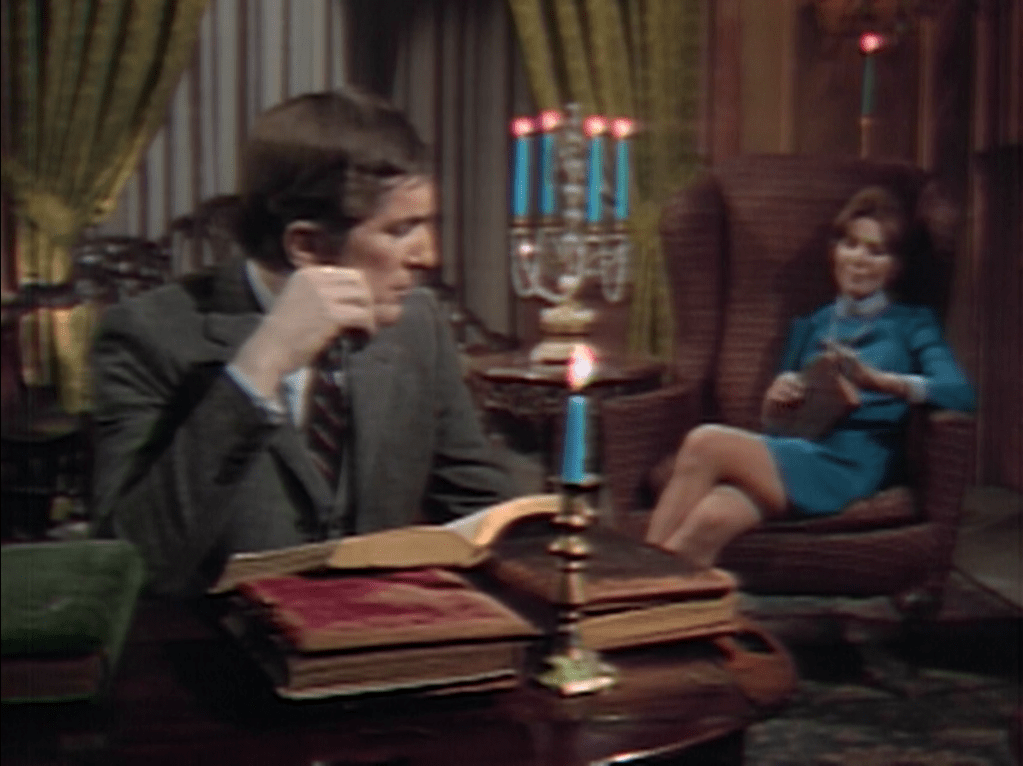
In 1967, Barnabas’ only interest was recreating the history of the Collins family. His attempted Josettification of Maggie was part of that antiquarian project. Today, we catch a glimpse of what he might have been hoping for in that period. He and Maggie are sitting in the parlor reading family histories, and she glances at him with a fond smile. Granted, if his original project had been successful Maggie would have forgotten her own name, they would both have been vampires, and no living human would be safe from their creeping terror, but between feedings the two of them would probably have sat around like this.
Werewolf Chris Jennings finds that his curse is no longer effective only on the nights of the full Moon, but that he can transform on other nights as well. Also, the evil ghost of Quentin Collins takes steps to foil the efforts of old world gentleman Barnabas Collins and permanent houseguest Julia Hoffman to prevent him from destroying the living members of his family.
So far, so much fun to watch. But there is also bad news. Actor Roger Davis rejoins the cast. Mr Davis ruined dozens of episodes in 1968, many of them by whining angrily when people called his character “Peter,” saying he preferred the name “Jeff.” Now he is greeted as “Jeff,” only to respond with a demand that he be called “Ned.” The character has some different story around him than did Peter/ Jeff, but he has the same irritating voice, the same uptight walk, the same handsiness with his female cast-mates, and the same incessantly violent temper Mr Davis showed in his previous role.
Ned shows up at the great house of Collinwood at 1:10 in the morning. He walks past heiress Carolyn Collins Stoddard when she opens the front door and takes up a position in the foyer, peppering her with his questions and refusing to answer hers. When she objects to his aggression, he sneers about the unfriendliness of New Englanders. He tells her he wants to see Chris. She reaches for the telephone to call Chris at his cottage. Ned rushes over and puts his hand on hers, keeping the receiver on the hook. She gives him a startled look, but does not raise an explicit objection to this violation of her autonomy.
Carolyn is befuddled by Ned’s jerkiness.
In #684, Quentin took the same telephone from the hand of twelve year old David Collins, who vigorously protested that he had no right to do so. Indeed, restraining a person from calling for help can be an element of kidnapping, and Ned has every reason to believe that Carolyn wants to enlist help dealing with his intrusion. Both Quentin’s relationship to David and Ned’s presence in the house at this moment have strong kidnap vibes.
The last time someone tried to confine Carolyn within the main part of the house was in #204, when dangerously unstable ruffian Willie Loomis blocked the door and kept her from leaving the drawing room. Carolyn responded to that move by pulling a loaded gun on Willie, with salutary results. We might hope she will use the same weapon to bring Mr Davis’ return to the show to an abrupt conclusion, but alas, it is not to be.
In #2, high-born ne’er-do-well Roger Collins saw governess Victoria Winters standing at the edge of a high cliff overlooking the ocean. She didn’t know he was there until he startled her by asking her if she was planning to jump. As the weeks go on, Vicki will learn of other women who have leapt to their deaths from that spot, including a story that over the years two governesses were among them and that legend says a third will someday follow suit. The cliff is the face of Widows’ Hill, named after women whose husbands never returned home from the sea; several times during storms an eerie note sounds in the wind, a note known as “The Widows’ Wail,” which the locals believe to be the ghosts of the Widows announcing that a tragic death will soon take place.
Vicki stands at the edge of the cliff again at the end of this installment while the Widows’ Wail sounds. She is distraught that she has herself become a widow and is dwelling on the idea that she can be reunited with her husband in death.
Though occult expert Timothy Eliot Stokes told her earlier in the episode that “Your time is now!,” Vicki’s time as a lively part of the show in fact ran out in March 1967, with the resolution of the story about her effort to befriend her charge, Roger’s strange and troubled young son David. Actress Alexandra Moltke Isles finally gave up on the character and left Dark Shadows after #627. Her successor in the role, Betsy Durkin, has essentially nothing to work with. We do not share her grief for the husband she is mourning; he was one of Dark Shadows‘ most repellent characters, and it is such a relief that he is away that we sympathize only too much with everyone who tells her to stop bringing him up. Nor do we have any other reason to care about her, since she is relevant to no ongoing plotlines. Even longtime viewers who remember the foreshadowing of Vicki’s possible death by a jump off the cliff will not react strongly to the sight of her there, since Miss Durkin is not Mrs Isles and does not bring her screen iconography to the reprise of the theme.
This phase of the show actually belongs to a character introduced in #632, eleven year old Amy Jennings. When Amy meets Stokes today she announces that she likes him because he is funny; he replies that he is pleased to find that “My appeal extends to all ages now.” Indeed it does; in its first year, Dark Shadows was very much aimed at adults, some of whom remembered Joan Bennett as one of the great movie stars of the 1930s and 1940s and were impressed by her presence in the cast as matriarch Liz, some of whom appreciated it as a specimen of slow-paced, highly atmospheric Gothic romance, and some of whom were fascinated by the story of Vicki and David and its theme of a grownup trying to make a difference in the life of a troubled child. But by the time Stokes arrived in #464, Dark Shadows had become a kids’ show. As Thayer David plays him, Stokes is amusing enough that anyone can like him, but the absolute seriousness with which he regularly expounds the most preposterous mumbo-jumbo is designed to make him a favorite of the very young.
Amy’s friendship with David develops in scenes that kids will find engaging, as they go exploring the big haunted house of Collinwood and find their way into spooky adventures. She also takes the lead in her relationships with adults more consistently than David ever did. While in the first year and a half of the show David often knew things the adults didn’t know, that was usually because he accepted the facts they refused to see. No matter what he said or did, he couldn’t move them from their habits of denial and evasion. But Amy has sources of information that the grownups around her don’t have. So today she has a vision of her brother Chris in some kind of terrible trouble. When she tells Vicki and Liz about her vision, Liz tries to telephone Chris and is deeply disturbed when he doesn’t answer. As my wife, Mrs Acilius, pointed out, it is after one o’clock in the morning, so you wouldn’t expect her to attach great importance to his failure to pick up the phone. That she does suggests that she is taking Amy seriously.
Returning viewers know that Amy’s vision is correct. Chris is a werewolf, and he just killed a barmaid. That Amy not only has a paranormal means of knowing how Chris is doing, but that she is also able to get through to the adults and influence their actions, suggests that she will have a major impact on the werewolf story as long as it continues. Indeed, she already has- the werewolf was about to eat Liz the other day, but backed off when he saw Amy nearby.
Amy is central to the other storyline that is beginning at this point. That is “The Haunting of Collinwood,” in which the ghost of Liz and Roger’s’ great-uncle Quentin Collins is going to be creating difficulties for everyone. Amy and David went into the long-deserted west wing of the house and retrieved an antique telephone from a room there. Though its cord is cut, Amy can sometimes hear Quentin’s voice through its receiver. When she is alone and worried about Chris, she picks the telephone up and asks for Quentin. She is disappointed he does not answer. None of the adults knows about Quentin’s ghost or the telephone. Not even David has heard more than Quentin’s breathing through the receiver. Again, Amy is uniquely positioned to understand and affect the action.
According to the closing credits, this week’s five episodes were directed by “Penberry Jones.” The name “Penberry Jones” is unknown to Google aside from these credits, and it sounds like a joke of some sort. Though the fansites all mention the improbability of Jones’ name and the likelihood that it is a pseudonym, none that I could find offers any clue as to who might have been behind that pseudonym. From the early 1970s until the quarantines of Covid-19 in 2020, Dark Shadows fans would organize festivals a couple of times every year at which panels of people who had been involved in making the show took questions from the audience. If any of those audiences asked who Penberry Jones was, either they did not get an answer or that answer was not recorded.
The name “Penberry” may remind longtime viewers of Dark Shadows of episode #83, which is about Roger burying a pen. Roger was a major villain then, and his part gave actor Louis Edmonds an opportunity to show what he could do. Roger has long since been demoted to occasional comic relief; one might imagine that Edmonds wanted to take a turn in the director’s chair, and that he chose his whimsical pseudonym as a nod to his character’s origins. Appealing as that idea may be, it does not seem at all likely. So many of the panel discussions among cast members abounded in fond stories about Edmonds that surely someone would have mentioned it if he had directed five episodes.
Indeed, most of the longer-lived members of the cast participated in so many of those panels that they all had moments when they had to grope more or less desperately for something fresh to say. If anyone whose name fans would recognize and who worked closely with the cast were “Penberry Jones,” it’s hard to imagine that one or another of them wouldn’t have brought it up in one of those moments.
Whoever it was must have been known to executive producer Dan Curtis and line producer Bob Costello, and probably quite well known to them. The Directors Guild of America does allow its members to change the names under which they are credited, as for example John Walter Sullivan was allowed to direct several episodes of Dark Shadows as “Jack Sullivan” and several more as “Sean Dhu Sullivan.” But it does not allow them simply to use pseudonyms at will. It wasn’t until 1969 that directors working in features could be billed as “Alan Smithee,” and then they had to prove that they did not really have control of the final product before they were allowed to substitute that name for their own. The first television production credited to “Alan Smithee” didn’t appear until 1970. So it is unlikely that “Penberry Jones” directed any screen productions under any other name. Curtis and Costello probably wouldn’t have chosen a first-time director with no imminent prospects of other screen work unless it were someone they already knew and trusted.
If “Penberry Jones” didn’t cover anyone the cast knew well or a director who worked under another name, but was someone who was close to Dan Curtis or Bob Costello, it should be possible to compile a short list of suspects. I’m not so deeply immersed in the behind-the-scenes lore that I can compile that list myself, but maybe you are. If so, I’d like to hear from you in the comments!
The director’s name isn’t the only puzzle in the closing credits. Every previous episode of Dark Shadows ended with the credits playing in front of a stationary shot of one or another set. It was always one shot per closing credits sequence. This time they start with a stationary shot of Vicki’s room, then cut to a stationary shot of the foyer. It’s hard to see what the point of that transition is. Perhaps we could ask “Penberry Jones,” if we had any idea who that was.
The only story that consistently worked in the first year of Dark Shadows was well-meaning governess Victoria Winters’ quest to befriend her charge, strange and troubled boy David Collins. In #191, David’s mother, blonde fire witch Laura Murdoch Collins, was trying to immolate him and herself. At the climactic moment, David ran from the flames into Vicki’s arms. When David chose Vicki and life over Laura and death, their story was concluded, and Dark Shadows 1.0 came to an end.
Vampire Barnabas Collins would first appear on Dark Shadows in #211 and quickly become its main source of interest. The show never made up its mind how Vicki would relate to Barnabas’ story. The obvious move would have been to follow Bram Stoker’s Dracula and make Vicki the vampire’s first victim, rising from the dead like Lucy Westenra as “The Bloofer Lady,” a friend to children in life who in her undead afterlife feeds on the blood of children. In that case, Vicki would be destroyed as she was about to kill David. But Vicki had been an effective protagonist throughout the Laura story, which was itself in large part an adaptation of Dracula, and if as seemed likely the show was going to be cancelled with #265 they would have wanted Vicki to stake Barnabas at the end of that episode. So she was spared his bite, and instead he turned his fell gaze upon Maggie Evans, The Nicest Girl in Town.
With Vicki walled off from the vampire story, David’s contact with it was initially limited to the inconvenience he could make for Barnabas by sneaking into his house during the day. When Barnabas was keeping Maggie in his basement, a new character was introduced who would meet David and relate to him in a way that would bring him to the center of Barnabas’ concerns. This was the ghost of Barnabas’ little sister Sarah, a girl about David’s age.
David Henesy had been the only child actor on Dark Shadows until Sharon Smyth joined the cast as Sarah in #255. Miss Smyth had very little of the training and experience Mr Henesy brought to the show, but playing a ghost she didn’t really need them. Our main reaction to Sarah is puzzlement, puzzlement as to what she wants, what she can do, and whether she knows anything at all about herself and the world she finds herself in. Miss Smyth was just as puzzled as the audience about all of these questions, and that works to her advantage. In Sarah’s scenes with David Collins, Sharon Smyth’s feelings about David Henesy- a precocious crush mixed with fear of his propensity for playing rather nasty practical jokes on her- added a touch of urgency without erasing any of the character’s mystery. At the same time, Mr Henesy’s acting skills made it possible for us to believe that David Collins had gone a tremendously long time without catching on that Sarah was a ghost. Once David Collins finally did figure it out, David Henesy made the most both of scenes where he coolly presented skeptical adults with irrefutable evidence of Sarah’s true nature and of scenes where he became overwrought at his inability to convince them of the truth.
Sarah’s ghost hasn’t appeared since #364. A couple of weeks ago Alexandra Moltke Isles left the show and the part of Vicki was recast; Mr Henesy hasn’t shared a scene with the new actress, but he had barely shared a scene with Mrs Isles for a year. Throughout 1968, his appearances on the show have been few and far between. Today, for example, he makes his first appearance since #609, which was in turn only his second appearance since #541. That changes when he meets a new co-star who will change the trajectory of his character and of the show.
Amy Jennings is played by Denise Nickerson, whose preparation was fully equal to Mr Henesy’s. Her style was quite different from his- while he, like Mrs Isles, tended to play his characters from the inside out, figuring out what is in their minds and then using the dialogue and action to project that understanding, she tended to start with the action and find the character in the middle of it. Today she shows up on the grounds of the estate of Collinwood just as David’s aunt, matriarch Elizabeth Collins Stoddard, comes face to face with a werewolf. The werewolf was about to attack Liz, but he runs off at the sight of Amy. Liz takes her unlikely rescuer home with her to the great house on the estate.
There, Amy meets permanent houseguest Julia Hoffman, MD. Julia is the nominal head of Windcliff, a sanitarium from which Amy recently escaped. Liz describes the encounter with the werewolf, and Amy explains that she is looking for her brother Chris. Returning viewers know that Chris is the werewolf, but none of the characters knows this yet. The adults are mystified by Chris’ wandering ways and his refusal to take responsibility for his little sister, while Amy is convinced that he is ready to give that up and settle with her in the village of Collinsport.
Julia wants to ship Amy back to Windcliff at once, but Liz talks her into letting Amy stay the night. David strolls in; he meets Amy, and Liz sends the two of them to get housekeeper Mrs Johnson.
We see David and Amy looking out the window of a guest room during a storm. David is disappointed to hear that Amy won’t be staying through the next day, and talks about what they will do the next time she visits. He asks if the thunder and lightning frightens her, she says no, “It can’t hurt you.” To this he replies, “Sure can! Lightning can strike you dead.” After a brief pause, he adds “Well, if you’re not afraid, I guess you don’t need me.” That sequence of lines is so funny the humor must have been intentional.
Amy asks David to stay. They sit on the floor in front of the fireplace in her room, and at her suggestion they decide to explore the long-deserted west wing of the house. They go straight to a room in which they find an antique telephone. They decide to play a game in which they pretend to talk to the ghosts of the people who used to live in the house using the telephone. Amy actually gets through to one of them. David thinks she’s kidding him, and takes the phone. To his amazement, he hears breathing on the other end, even though the telephone’s line is cut.
David only heard the breathing, no words. Amy tells him that the voice identified itself as that of Quentin Collins. David, whose avid interest in Collins family history made it logical that he, in #205, would be the first character to mention the name “Barnabas Collins,” says he has never heard of Quentin.
Later, they return to Amy’s room and find Quentin’s picture in a family album. Liz comes in, and when David asks her about Quentin she tells him that he was her great-uncle, that he left for Europe when he was young, and that he died in Paris. Regular viewers will remember that when Barnabas became a vampire, the Collinses put about the story that he had gone to London, and when he came back in 1967 he introduced himself to Liz as a cousin from England. Thus the show suggests that Quentin may be its next attempt to match Barnabas’ breakout success.
Amy has taken the telephone to her room, and at the end of the episode she talks to Quentin again. He beckons her to return to the room in the west wing, and she goes. If Quentin is indeed going to succeed Barnabas as Dark Shadows‘ great supernatural menace, evidently it is Amy who is in danger of becoming his first victim.
In #636, occult expert Timothy Eliot Stokes remarked that he had never heard of a ghost communicating by telephone. During this period, the show was going through a lot of last minute rewrites; the Dark Shadows wiki reports on several flimsies and drafts that were cast aside and replaced with new scripts. So I can imagine that Stokes’ line may have inspired the idea of using the telephone to introduce Quentin, though perhaps it is likelier that they already had the prop and Stokes’ line was a private joke among the writers.
Unique among the narrative arcs in Dark Shadows, the story of Frankenstein’s monster Adam has a clear structure. It consists of a prologue and five acts, with an interlude between the second and third acts.
The prologue is about the process of building a patchwork man and animating him. It begins when mad scientist Eric Lang meets vampire Barnabas Collins in #466 and ends in #490, when Barnabas and another mad scientist, Julia Hoffman, bring Adam to life.
The next two weeks make up Act One of Adam’s story. Vampires and mad scientists are both metaphors for extreme selfishness, and so it is unsurprising that Barnabas and Julia turn out to be the worst possible parents. Though he has the body of a grown man, Adam has just begun to live. Barnabas and Julia lock their newborn in the prison cell in the basement of Barnabas’ house and leave him alone there for hours on end, chaining him to the wall. Robert Rodan’s facial expressions convey the heartbreak of this horrific act of child abuse unforgettably. We can’t help but take his suffering seriously. This is the first major difficulty for the storyline. Barnabas and Julia are the core of Dark Shadows, so that if we feel bad about them, we feel bad about the show.
Act Two begins at the end of #500, when Adam escapes from his cell and fights Barnabas. Adam can speak only a few words, has no idea how people interact with each other, and does not know his own strength. As a result, he hurts everyone he meets. He makes one friend during this period, blind artist Sam Evans. In a moment of confusion, Adam hits Sam in #515, causing an injury that leads to Sam’s death. Again, we pity Adam throughout this period, but can see no way he will be able to contribute anything to the story but more death and sorrow.
In #518, occult expert Timothy Eliot Stokes persuaded Adam to come home with him. Adam stays in Stokes’ apartment for some time, learning to talk, to read, and to do various other things. Aside from a few glimpses of these lessons, Adam is off-screen and not involved in the action during this period. That is why I say his time as a guest at Stokes’ place is an interlude, not an Act.
Act Three begins in #539, when Adam has to leave Stokes’ place to avoid the police and heiress Carolyn Collins Stoddard lets him live in the long-deserted west wing of the great house of Collinwood. In this period, Adam falls in love with Carolyn. She is attracted to him, but struggles against her feelings. This situation may sound more likely than either severe child abuse or lethal awkwardness to lead to an engaging story, but it suffers from its setting. Week after week, we see Adam cooped up in his dusty little room, alone with books and a chess set. The Creature in Mary Shelley’s Frankenstein reads The Sorrows of Werther, Plutarch’s Lives, and Paradise Lost; Adam reads the poems of Elizabeth Barrett Browning and the works of Sigmund Freud. He is marginally better off than he was in Barnabas’ basement cell, but he is still a prisoner, and it is still depressing to be confined along with him.
In Act Four, Adam is under the influence of suave warlock Nicholas Blair. In #549 Nicholas talks Adam into trying to rape Carolyn; that attack draws a line under their budding romance. By #551, Nicholas has talked Adam into confronting Barnabas and demanding that he build a woman to be his mate. Adam tells Barnabas that if he does not comply, he will murder everyone who lives in the great house of Collinwood, starting with well-meaning governess Vicki. Longtime viewers remember that Vicki spent the first 38 weeks of the show befriending strange and troubled boy David Collins, healing the psychological wounds David had suffered in his early years with his own unsuitable parents. If anyone could help Adam recover from the abuse he himself suffered from Barnabas and Julia in his first two weeks of life, it would be Vicki. His threat to kill her therefore shows just how little hope there is for Adam.
The project to build Adam’s mate reached its climax in #596, when she came to life and was given the name Eve. This began Act Five, which was all about Eve’s unconcealed hatred for Adam. Nicholas persuaded her to pretend to like him in #624; there is a jump cut in that episode which suggests that they may have had sex. Adam found out that she had been faking her interest in him, and murdered her in #626. Nicholas then persuaded him that if Barnabas and Julia could bring Eve’s body back to life, she would have a sweeter temperament. Adam renewed his demands upon them, and they ran the experiment again in #633/634, but it was a total failure, destroying Eve’s body so that it no further attempt would be possible.
Deranged with fury, Adam went to Vicki’s bedroom in the great house to abduct her. Carolyn found him there; she saw him hit Vicki in the face and flatten her. This not only alienated whatever sympathy Carolyn might have retained for Adam, it also shows how far he has come since the days when he was a danger because he didn’t know his own strength. The blow he delivers to Vicki is the same as the one he dealt to Sam, but while Sam wound up in the hospital and eventually died in part because of it, Vicki is only knocked out. He is still a deadly menace, but now he kills intentionally. This is emphasized when he chokes Carolyn in the same way as he had Eve, but she makes a full recovery a bit later.
Adam took Vicki to the laboratory in Barnabas’ basement where the equipment is still set up and Eve’s charred remains are still on a bed. He hooked Vicki up to the equipment and was trying to use it to torture her to death when Barnabas and Julia made their way to him. He laughs at Barnabas. Since the laboratory is only a few steps from the cell where Adam was kept in his early days, it was clear that this was closing the loop on the child abuse theme of Act One. Barnabas shot Adam in the shoulder, ending the threat to Vicki, and Adam escaped.
Stokes is the last friend Adam has left, and he sneaks into his apartment today. The telephone rings; Adam picks it up but does not say anything. Adam had done the same thing in #521, during the interlude when he was staying with Stokes. In those days, he didn’t know what a telephone was. But now, he is consciously trying to be stealthy. He recognizes the voice on the telephone as that of an intensely unpleasant man known variously as Peter and Jeff, and a moment later he picks up a knife. This is a perfectly understandable reaction to any reminder of Peter/ Jeff.
Stokes comes in, and Adam puts the weapon down. Stokes sees his gunshot wounds, and goes to call a doctor. “Not Julia!,” Adam objects, to which Stokes replies with the assurance that “Dr Hoffman is not my resident physician.” Before Adam can explain how he came to be shot, Stokes announces that “I won’t even ask you what has happened. Curiosity is the most boring obsession.” He telephones a doctor whom he calls “Carl,” and says that he knows he can count on his discretion. That Stokes knows a doctor who will come to his apartment, treat a fugitive from justice for a gunshot wound, and as a matter of course keep the matter between them is a sign that he is someone who will be able to look after Adam quite well.
Stokes gives Adam a new shirt. Adam tells him that he despairs of ever being loved because of the prominent scars on his face. Stokes introduces him to the concept of plastic surgery and tells him that the scars should be easy enough to correct. He is talking to Adam about the prospect of a new life when a knock comes at the door. Adam exits, never to be seen again.
One of the big surprises for me on this rewatch of Dark Shadows has been how good an actor Robert Rodan really was. The Adam story was such a downer that Mrs Acilius and I hadn’t liked anything about it before, and Rodan was caught up in our overall rejection of it. But he was excellent every step of the way. Whatever is going to happen to Adam after his exchange with Stokes will happen far from Collinsport, which is to say, not on Dark Shadows, so when we wish for more Rodan on the show we are wishing he could have been cast later as another character. I think his height- 6’6″- probably kept that from happening. Two other actors who are almost as tall as Rodan would become major cast members later. One of those, David Selby, will join the cast in just two weeks, much too soon for Rodan to reappear as someone else. The other, Christopher Pennock, won’t show up until #936, by which time Rodan had moved to Los Angeles.
Rodan did some commercials for Cheer detergent when he was in California. Here he is in a Star Trek themed bit where he wears pointed ears. Evidently he was the laundry officer aboard a Vulcan ship.
Robert Rodan joined the cast of Dark Shadows in #485 as Frankenstein’s monster Adam. For his first few months, Adam could barely speak, limiting Rodan’s performance to facial expressions expressing his very intense emotions. He did well with that, and, as Adam came to master English, Rodan’s considerable range as an actor quickly became apparent. He gets a showcase today.
An experiment meant to bring Adam’s mate back to life has failed, and he decides that old world gentleman Barnabas Collins is at fault. Adam originally extorted Barnabas’ cooperation with the experiment in #557 by threatening to kill well-meaning governess Vicki and everyone else in the great house of Collinwood unless he were given a mate. Now Adam is in that house ready to carry out his threat.
He stands outside Vicki’s bedroom door. Through it, he hears heiress Carolyn Collins Stoddard talking with Vicki. Adam fell in love with Carolyn some time ago, while she was protecting him from the police. Since Vicki is Carolyn’s best friend, and since Carolyn, her mother, her favorite uncle Roger, and Roger’s son David all live in the great house, Adam’s threat to kill everyone there always lacked a certain credibility. He eavesdrops as Carolyn tells Vicki she was recently very much attracted to a man, she can’t say who, and that ever since that man had to go away she has been depressed. Regular viewers know that Carolyn is talking about Adam, and he may know as well. Once Carolyn has left the room, Adam slips in. He tries to abduct Vicki. She screams, and Carolyn comes.
Adam slaps Vicki in the face and she collapses on the floor. In #515, Adam struck his friend Sam Evans across the face, inflicting an injury that contributed to Sam’s death shortly after. Adam didn’t know his own strength then; now, he only knocks Vicki unconscious. Carolyn tries to call the police; Adam takes the telephone from her hand and rips it from the wall. She is shocked that he is prepared to hurt even her. He puts his hands on her throat and squeezes it between his thumbs. The reason his mate needed to be brought to life a second time is that he strangled her in #626, and what he is doing to Carolyn looks unnervingly like what we saw him do then.
Rodan is self-possessed and deliberate when Adam is alone with Vicki, apparently smug in his certitude that whatever plan he has for her will work. When Carolyn enters, he abruptly shifts to a mixture of sorrow and rage. While he is strangling her, the sorrow overwhelms him completely. He knows exactly what he is doing, and is utterly miserable to be doing it.
Mad scientist Julia Hoffman is in Barnabas’ house. Barnabas had figured out that Adam was likely to go to Collinwood to carry out his threats, and she is waiting for him to come home and tell her whether he succeeded in thwarting Adam. She hears a noise, and calls out for Barnabas. He does not come, but the equipment in her basement mad science laboratory starts making its noises. Adam enters.
Julia and Adam exchange some mutually evasive dialogue. Rodan had played Adam’s scene with Carolyn and Vicki very hot, his emotions right on the surface. Now he shows that he can just as effectively play cold. Julia keeps asking him questions, which he parries without losing his smile, becoming excited, or in any way giving a clue as to what is in his mind. He deploys each syllable like a chess player selecting the right square for a piece. He shows a bit of feeling at first when he refers to the charred skeleton in the basement as “the only bride I ever had,” but then settles into an imperturbable calm. He responds to Julia’s repeated questions about his plans for vengeance against Barnabas with perfectly logical questions of his own about what he would have to gain by hurting Barnabas- “or you, for that matter?” He is indifferent to the news that suave warlock Nicholas Blair, whom he once considered a friend, has vanished, never to return. When Julia tries to escape, he asks her where she is going, and she tries to deflect the question. He is still altogether composed until the very second Julia turns to go to the basement, when the placid surface suddenly breaks and he knocks her out.
Barnabas donated the “life force” that brought Adam to life, and there are moments when longtime viewers will recognize deep similarities between the two characters. For example, when Julia first met Barnabas he was a vampire, and he was deeply suspicious of her interest in him. In that period, they often faced each other in this room in conversations that could easily have ended with Barnabas murdering her. Barnabas would not condescend to using Julia’s first name, addressing her only as “doctor.” Adam has no way of knowing about that history, but he does know that each time he calls Julia “doctor” she seems a little bit more uncomfortable. So he does it as often as possible.
Julia regains consciousness sometime after Adam attacked her and finds that Barnabas is with her. She tells him that Adam is in the basement doing something with the equipment; he tells her what he found when he talked with the slightly injured Carolyn earlier, that Adam has abducted Vicki. They put two and two together, and go to the cellar door. It is locked, so they have to find another way to the basement.
We cut there to see Vicki strapped on a table, energy flowing from the equipment into her while she writhes and cries out in pain. Adam is at the controls. Images of Julia and of Carolyn, speaking and pleading with Adam to show mercy to Vicki, wipe across the screen. These effects may seem a little corny nowadays, but must have been quite startling on daytime television in 1968, and are typical examples of director Lela Swift’s visual artistry and technical ambition.
Barnabas and Julia enter. Barnabas points a gun at Adam and says he will kill him unless he lets Vicki go. Adam laughs at him. He and Barnabas have a connection like that between Alexandre Dumas’ Corsican brothers, so that any harm one suffers will endanger the other. Adam knows this, and he also remembers an audiotape in which the designer of the Frankenstein experiment that created him says that if he dies, “Barnabas Collins will be as he was before.” Barnabas knows about the Corsican brothers thing, but he never heard that tape, so he is puzzled when the laughing Adam says “If I die, you will revert back to what you were. That’s what it said on Dr. Lang’s tape and I heard it. I memorized it. I don’t know what you were but I know you don’t want me to die.” While Adam reaches for the switch to give Vicki a lethal jolt of electricity, Barnabas shoots him in the shoulder and he falls.
Adam’s laughter in this scene is of a piece with his sorrowful expression while he chokes Carolyn. Nothing matters, no one matters, life and death are just the same, he will kill and torture and maim and it will all be a big joke. Viewers who remember the first weeks of Adam’s life, when Julia the mad scientist and Barnabas the recovering vampire, symbols of extreme selfishness both, kept him locked in a cell a few paces from the spot where he is standing now, will see in this total nihilism the logical outcome of that horrifying act of child abuse. As Rodan sold Adam’s heartbreak so effectively that his scenes in the cell were hard to watch, so he sells his total alienation from humanity so effectively that we can believe that he is ready to commit any crime against any person and to laugh all the way through it. This utterly bleak moment brings the character’s development to a fitting climax.
There are a couple of notable goofs in this one. The right sleeve of Adam’s sweater can be seen at the edge of the shot when the closing credits start; the camera zooms in to get clear of him. Robert Rodan had played his part with so few slips that he hadn’t quite seemed at home on Dark Shadows; it’s good to see him making up for lost time now. Much more embarrassingly, while Barnabas and Julia are looking through the barred window of the cellar door Jonathan Frid touches his face, and it looks very much like he is picking his nose.
Three people expressed surprise in episode 40 that Roger Collins wasn’t at his office. He still isn’t there today, and three more people are surprised. He finally decides to go in when Liz presents him with the alternative of looking for Carolyn.
Bill Malloy isn’t at work either, hasn’t been all day. He and Roger have been taking turns inviting themselves into Sam Evans’ house. Sam is also not working, and in fact takes time out of his busy schedule of downing one glass of whiskey after another to destroy the only thing we’ve seen him make as part of a paying job, a sketch of Burke. Maggie pieces the sketch back together- she’s also at home when she’s supposed to be working.
Telephones are unusually dynamic in this episode. Typically we see only one end of a phone call on Dark Shadows. This time, we cut back and forth between both ends of three telephone conversations this time. In the teaser Roger is browbeating Sam; Sam sets the phone down and walks off. While he gets another drink, the receiver is in the foreground and we hear Roger’s voice at the same volume as we did when Sam was listening. Sam comes back, returns the receiver to its cradle, and goes to sit down while it rings.
The bit when we see the phone and hear Roger’s voice, though Sam isn’t looking at the phone and can’t hear it, establishes the telephone as a character with its own relationship to the audience, independent of anyone who may or may not be paying attention to it. It’s a neat moment:
Liz calls the office and talks to Joe. Joe tells her Bill hasn’t been in all day. The stress in his voice, the papers piled on his desk, and the tight grip he has on the telephone receiver all make it credible that he’s the only person in town who showed up for work today:
Liz mainly wants to talk to Joe about Carolyn. Joe tells her he hasn’t talked to Carolyn in some time, and that he has no idea what if anything she is thinking about their relationship. While he breaks this news to Liz, we see him continue working, then cut back to the look of distress on Liz’ face.
Maggie calls Collinwood. Vicki answers and is excited to talk to Maggie. I guess the show is telling us they’re friends now. Maggie asks to talk to Roger. Vicki says Roger is probably in the office at this time of day, Maggie somehow knows he isn’t, Vicki remarks that he isn’t in the habit of confiding in her. Roger overhears this and asks “Is there any reason why I should confide in you?” When Vicki holds the receiver out to him and says Maggie Evans is on the line, he takes it and hangs up without so much as putting the receiver to his ear. Vicki and Roger then have one of their little quarrels.
That’s the only thing Vicki does in the episode. Her character is heading into a danger zone. Through the first eight weeks, she was on all the time. She was our representative, the outsider who knew nothing about the other characters or the town they live in, and to whom everything had to be explained. Now she knows as much about the rest of the characters as they know about each other, and we know as much as we want to learn by hearing explanations.
The major characters all have their secrets, but the only two who know each other’s secret are Roger and Sam. Vicki isn’t any likelier than anyone else to uncover that one. She has no secrets of her own, and her original story-line- her quest to discover her origins- is dead in the water. What’s more, Vicki is no good at lying. Soap operas are mostly conversation, and the big events on them are lies and the exposure of lies. The only time Vicki has tried to lie to anyone- in episode 13, when she told Matthew that Liz knew she was in his cottage- she was immediately found out, with disastrous consequences. If she’s going to stay relevant to the show, something is going to have to change, and fast. It’s fun to watch Alexandra Moltke Isles bicker with Louis Edmonds, but the characters they play need something meatier to bicker about.
This is the first episode credited to writer Francis Swann, indeed the first episode credited to anyone other than Art Wallace. Swann’s teleplay finds humor in the idea that so many people have taken the day off. Each time another character remarks on a case of absenteeism it gets that much closer to raising a chuckle. And Roger’s line that looking for Carolyn would require him to “neglect my vital tasks at the office… Dear me, no” is genuinely funny, especially as Louis Edmonds delivers it. The telephone scenes are also an innovation, and promise a new source of visual activity. Those favorable omens are offset by Vicki’s scene and its suggestion that her character is about to be allowed to wither on the vine.
A couple of the blogs I read when I prepare my comments made remarks about this episode with which I disagree. John Scoleri of Dark Shadows Before I Die says this of the quarrel between Sam and Maggie:
I know Sam gets frustrated with Maggie, but I’m beginning to wonder about their relationship. If he’s that close to hitting Maggie when he gets drunk, there’s no way I’m believing he hasn’t done that before.
It doesn’t look to me like Sam has hit Maggie. She’s inches from his face when he is at his angriest, yet she doesn’t flinch, doesn’t slump down, doesn’t show any sign of withdrawal or fear or anger or panic or sullenness or bewilderment or any other possible response to physical abuse.
There hasn’t been much happening on DARK SHADOWS in the last few weeks, but that doesn’t mean the show hasn’t been moving forward. There’s been a growing sense of doom throughout the show, and it’s obvious that someone is going to die. In this episode Sam rips up his portrait sketch of Burke Devlin, he and Roger lob threats at each other, Liz begins to draw Joe’s attention to his girlfriend’s romantic intentions on the family rival, and Victoria has been pushed around by just about everyone in the cast. In theory, any one of them is eligible for a ride in the bone wagon, but the show has been implying that Devlin is headed for a fall. It’s interesting that the show decides to go in another direction: I don’t know when Bill Malloy checks in at Eagle Hill Cemetery, but it’s probably sooner rather than later.
While it is true that “in theory, any one of them is eligible for a ride in the bone wagon,” I do think there’s a clear front-runner to be the first Dark Shadows character to be killed. It’s Sam who is obsessed with the fear of death, Sam whom Roger has threatened, Sam who left a mysterious sealed envelope to be opened in the event “something happens.” And, from an out-of-universe perspective, it’s Sam who has a daughter played by an appealing actress who needs a story-line. Maggie seeking revenge for the killing of her father would be just the plot to elevate Kathryn Leigh Scott from the bottom of the second string to the starting lineup where she so obviously belongs.
No other character has anyone so well-positioned to play avenger if they’re killed. The only keen attachment Bill Malloy has shown is his devotion to Liz, and in her scene with Matthew in episode 38 Liz demonstrated that she sees devotion from people outside the family as a tool to use when time comes to protect the good name of those inside it. So if she suspects Roger killed Bill, she won’t become Bill’s avenger- if she could order Matthew to throw away his own good name to cover up the truth about David, we can hardly expect her to expose Roger to redress Bill’s grievance against him. Indeed, when Bill is murdered, they will introduce an entirely new character to seek revenge for him.
Vicki is an orphan, who tells us in today’s opening narration that before she arrived at Collinwood she had never known a home. No one is likely to avenge her, and besides, she still does the opening narration for every episode- she’s supposed to be important, even if the writers can’t quite figure out what to do with her. Burke is supposed to be rich and powerful. Presumably he has friends, but we haven’t seen any of them. Joe is Mr Nice Guy and he’s mentioned a friend or two, but again, we haven’t seen them. The series story bible calls for Roger to die when Burke finally gets his revenge, but every time Louis Edmonds’ performance is the most interesting thing in an episode it becomes so much the less likely that they will ever get around to playing that scene. So the smart money, at this point, would be on Sam to be the victim in the first Dark Shadows murder. So much so, indeed, that it might not be surprising enough if it does happen- they may think they have to kill someone else to keep the audience engaged.



 Dark Shadows Commentary